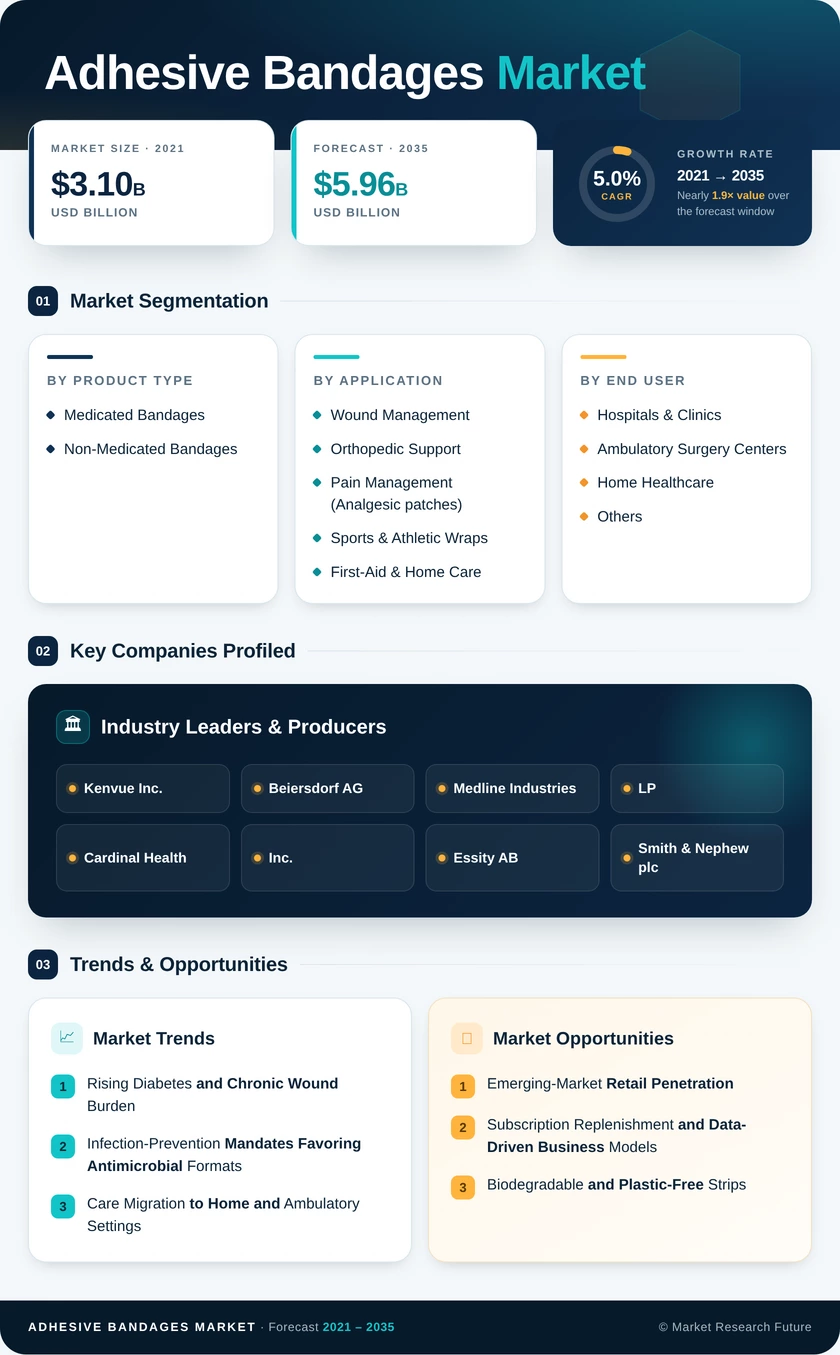
Segmentation Quick Reference
| Dimension | Sub-Segments | Dominant Segment | Fastest Growing Segment |
|---|
| By Product Type | Medicated Bandages; Non-Medicated Bandages | Medicated Bandages (57.0% share) | Non-Medicated Bandages (5.8% CAGR) |
| By Application | Wound Management; Orthopedic Support; Pain Management (Analgesic patches); Sports & Athletic Wraps; First-Aid & Home Care; Veterinary Use | Wound Management (49.5% share) | First-Aid & Home Care (6.0% CAGR) |
| By End User | Hospitals & Clinics; Ambulatory Surgery Centers; Home Healthcare; Others | Hospitals & Clinics (59.0% share) | Home Healthcare (7.4% CAGR) |
| By Region | North America; Europe; Asia-Pacific; South America; Middle East & Africa | North America (38.5% share) | Asia-Pacific (6.4% CAGR) |
Market Segmentation Overview
| Sub-Segment | Key Trend |
|---|
| Medicated Bandages | Antimicrobial (Silver/PHMB), hydrocolloid and silicone low-trauma formats gain hospital formulary listings |
| Non-Medicated Bandages | Biodegradable PLA, waterproof PE/PVC and elastic cloth strips expand through retail and online value packs |
Medicated Bandages lead the product mix because Antimicrobial (Silver/PHMB) Bandages and Hydrocolloid Adhesive Bandages give hospitals documented infection-control benefits that justify higher unit prices. Non-Medicated Bandages grow faster, as Biodegradable PLA Strips and Waterproof PE/PVC Strips meet retail demand for low-cost, everyday protection. Sustainability targets at major retailers are steering shelf space toward plastic-free variants within this sub-segment.
| Sub-Segment | Key Trend |
|---|
| Wound Management | Chronic ulcer and surgical incision care drive specialty dressing use |
| Orthopedic Support | Cohesive tapes stabilize joints after sprains and procedures |
| Pain Management (Analgesic patches) | Bandage-format delivery of topical analgesics broadens use |
| Sports & Athletic Wraps | Sweat-resistant wraps and blister pads serve active consumers |
| First-Aid & Home Care | Online reordering and larger household kits lift volumes |
| Veterinary Use | Lick-resistant cohesive wraps serve companion-animal care |
Wound Management leads application demand because Acute (Surgical & Traumatic) and Chronic (Diabetic, Pressure, Venous Ulcers) wounds require frequent, clinically specified dressing changes. First-Aid & Home Care grows fastest, driven by households treating minor cuts themselves and reordering through e-commerce. Sports & Athletic Wraps and Orthopedic Support benefit from active consumers, while Veterinary Use builds a small but distinct niche.
| Sub-Segment | Key Trend |
|---|
| Hospitals & Clinics | Evidence-based formularies and GPO contracts concentrate volume |
| Ambulatory Surgery Centers | Outpatient procedure migration adds post-operative demand |
| Home Healthcare | Caregiver training reimbursement and telehealth enable home dressing changes |
| Others | Workplaces, schools and sports clubs maintain first-aid stock |
Hospitals & Clinics remain the dominant end user because bulk contracts and formulary approvals channel most clinical purchasing through a small number of decision-makers. Home Healthcare grows fastest as Medicare caregiver training codes and remote monitoring shift dressing changes into patients' homes. Ambulatory Surgery Centers sit between the two, absorbing post-operative volume that hospitals once handled.


 Noah Malgeri
Co-Founder

 Peter Groot koerkamp
Account and Business Manager

 Younghwan Choi
Senior Retail Manager

 Mark Irwin
Management Consultant

 Akif Moroglu
Strategy & Business Development Director

 Guilherme Gomes Martins
Product Management Director

 Joseph Aguayo
Sales Operations & Pricing Manager

 La Terria Dodd
Program Support Specialist

 Rob Kooiker
Group Product Manager HVAC & Fire Protection GMA