×
Request Free Sample ×

Kindly complete the form below to receive a free sample of this Report

* Please use a valid business email

Leading companies partner with us for data-driven Insights

clients tt-cursor
Hero Background

Nanobots Market

ID: MRFR/MED/0793-CR
151 Pages
Kinjoll Dey
February 2021

Nanobots/Nanorobots Market Research Report Information by Product Type (Nanomanipulator, Bio-Nanorobotics, Magnetically Guided Nanobots/Nanorobots), Application (NanoMedicine, Biomedical), Region (Americas, Europe, Asia-Pacific and the Rest of the World) - Forecast till 2035

Share:
Download PDF ×

We do not share your information with anyone. However, we may send you emails based on your report interest from time to time. You may contact us at any time to opt-out.

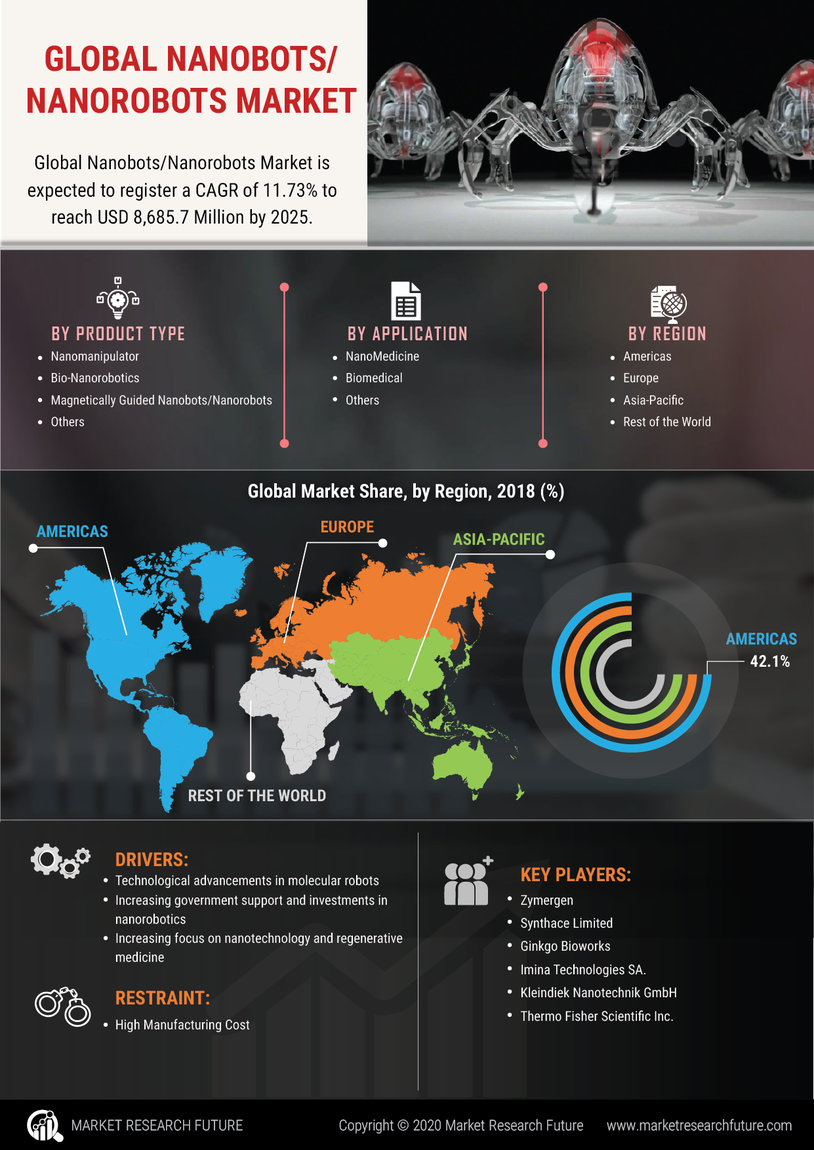
Nanobots Market Infographic
×
Nanobots Market Infographic Full View
Purchase Options

Nanobots Market Summary

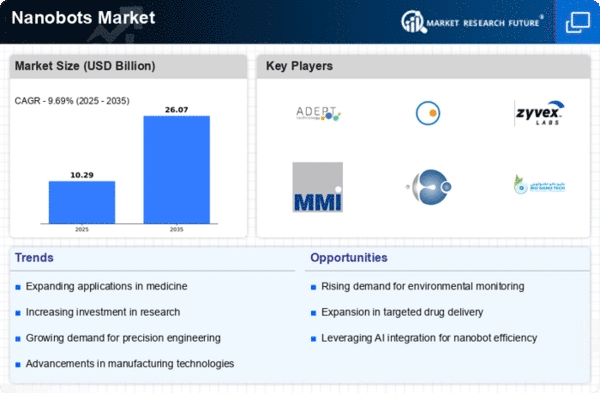
As per MRFR analysis, the Nanobots Market Size was estimated at 9.38 USD Billion in 2024. The Nanobots industry is projected to grow from 10.4 USD Billion in 2025 to 26.07 USD Billion by 2035, exhibiting a compound annual growth rate (CAGR) of 9.69 during the forecast period 2025 - 2035.

Key Market Trends & Highlights

The Nanobots Market is poised for substantial growth driven by technological advancements and increasing applications across various sectors.

  • North America remains the largest market for nanobots, primarily due to its advanced healthcare infrastructure and significant R&D investments.
  • The Asia-Pacific region is emerging as the fastest-growing market, fueled by rapid industrialization and increasing environmental concerns.
  • The medical segment dominates the market, while the environmental segment is witnessing the fastest growth as demand for remediation solutions rises.
  • Key drivers include the rising demand for targeted drug delivery and the growing focus on personalized medicine, which are shaping market dynamics.

Market Size & Forecast

2024 Market Size 9.38 (USD Billion)
2035 Market Size 26.07 (USD Billion)
CAGR (2025 - 2035) 9.69%

Major Players

Adept Technology (US), Nanosys (US), Zyvex Labs (US), Molecular Machines (DE), NanoComposix (US), Bionanotechnology (US), Nanoscale (US), Nanobot Medical (US)

Nanobots Market Trends

The Nanobots Market is currently experiencing a transformative phase, characterized by rapid advancements in technology and increasing applications across various sectors. These miniature robots, often measured in nanometers, are being integrated into fields such as medicine, environmental monitoring, and manufacturing. The potential for nanobots to revolutionize drug delivery systems, enhance precision in surgical procedures, and improve diagnostic capabilities is becoming increasingly apparent. As research and development efforts intensify, the market is likely to witness a surge in innovative solutions that address complex challenges faced by industries today. Moreover, the growing emphasis on automation and efficiency is propelling the demand for nanobots. Industries are recognizing the advantages of utilizing these tiny machines to perform tasks that are either too dangerous or impractical for humans. This trend is particularly evident in sectors like healthcare, where nanobots can target specific cells for treatment, thereby minimizing side effects and improving patient outcomes. As the Nanobots Market continues to evolve, it appears poised for substantial growth, driven by technological advancements and an increasing understanding of their potential applications.

Advancements in Medical Applications

The integration of nanobots in healthcare is gaining momentum, with a focus on targeted drug delivery and precision medicine. These innovations may lead to more effective treatments and reduced side effects, enhancing patient care.

Environmental Monitoring and Remediation

Nanobots are being explored for their potential in environmental applications, such as pollution detection and remediation. Their ability to operate at a microscopic level could revolutionize how environmental challenges are addressed.

Manufacturing and Automation

The Nanobots Market is witnessing a shift towards automation in manufacturing processes. These tiny robots can perform intricate tasks with high precision, potentially increasing efficiency and reducing production costs.

Market Segment Insights

By Application: Medical (Largest) vs. Environmental (Fastest-Growing)

In the Nanobots Market, the application segments are diversified, with the medical sector being the largest contributor. It significantly leads due to the increasing adoption of nanobots in drug delivery systems, surgical procedures, and diagnostics. Following this, the environmental application is growing at a rapid pace as industries leverage nanobots for pollution monitoring and remediation, showcasing a rising interest in sustainable solutions. The industrial and military segments are also prominent, albeit with slower growth rates compared to medical and environmental applications. Growth trends in the nanobot application segment are driven by technological advancements and increasing investments in research and development. Medical applications are fueled by the demand for minimally invasive procedures and personalized medicine, while environmental aspects gain momentum due to stricter regulations on pollution control. Furthermore, industrial applications are focusing on efficiency enhancements and automation, and military applications are influenced by the need for advanced surveillance and reconnaissance capabilities. Overall, the market dynamics indicate a promising future for nanobots across various applications.

Environmental (Dominant) vs. Consumer Electronics (Emerging)

Within the Nanobots Market, the Environmental application has emerged as a dominant force, pioneered by innovative technologies that enable efficient pollutant detection and waste management. Governments and organizations are increasingly investing in nanotechnology to promote sustainability and enhance ecological monitoring. In contrast, the Consumer Electronics segment is recognized as an emerging field, with potential applications in personal gadgets and electronic devices. The integration of nanobots in this sector could lead to revolutionary advancements, such as smart sensors and personalized user experiences. While the environmental market focuses on compliance and ecological balance, the consumer electronics arena emphasizes convenience, efficiency, and cutting-edge technology. Both segments are evolving, driven by distinct demands yet sharing a common goal of integrating nanobot technology to enhance overall functionality and performance.

By End Use: Healthcare (Largest) vs. Manufacturing (Fastest-Growing)

Within the Nanobots Market, the Healthcare sector leads significantly, taking up the largest share due to the increasing integration of nanotechnology in medical applications, including drug delivery and diagnostics. This dominance is primarily driven by technological advancements, enhanced patient outcomes, and a growing aging population seeking innovative treatment options. Furthermore, sectors like Manufacturing are rapidly gaining traction, showcasing a robust growth prospect as industries increasingly adopt precision engineering techniques utilizing nanobots for tasks such as materials handling and automation.

Healthcare: Drug Delivery (Dominant) vs. Manufacturing: Automation (Emerging)

In the healthcare domain, drug delivery systems leveraging nanobots are a dominant force, revolutionizing the way medications are administered and localized within the body. These nanobots optimize therapeutic efficiency, targeting specific tissues and reducing side effects, which greatly enhances patient care. Conversely, in manufacturing, the emergence of nanobots for automation highlights a significant trend. These innovative tools enhance efficiency and precision in production processes, driving aftermarket service adoption, and fostering a safer work environment by taking over dangerous tasks. This shift towards automation represents a transformative phase that is set to redefine industry standards.

By Type: Biological Nanobots (Largest) vs. Chemical Nanobots (Fastest-Growing)

The Nanobots Market is primarily dominated by Biological Nanobots, which hold the largest market share due to their wide applications in medical fields, such as drug delivery and disease treatment. In contrast, Chemical Nanobots are emerging rapidly, capturing attention for their ability to perform complex chemical reactions and environmental remediation. As industries increasingly recognize the unique benefits of these nanobot types, market share is anticipated to redistribute over the coming years, highlighting the growing presence of Chemical Nanobots as significant competitors in the space.

Biological Nanobots (Dominant) vs. Chemical Nanobots (Emerging)

Biological Nanobots are at the forefront of the Nanobots Market, offering unparalleled precision in healthcare and diagnostics. Their ability to navigate biological environments makes them invaluable for targeted therapies and personalized medicine. On the other hand, Chemical Nanobots, though still developing, are recognized for their innovative potential in catalyzing chemical reactions and addressing environmental concerns. As technological advancements fuel their growth, Chemical Nanobots position themselves to emerge as key players, appealing to industries focused on sustainability and efficiency.

By Material: Gold (Largest) vs. Carbon Nanotubes (Fastest-Growing)

The Nanobots Market is largely characterized by a diverse array of materials. Gold stands out as the largest segment in terms of market share, owing to its unique properties such as biocompatibility and excellent electrical conductivity. Following gold, carbon nanotubes are emerging quickly, driven by their exceptional strength-to-weight ratio and electrical properties that suit various applications in nanotechnology. Silicon and polymers, while important, represent smaller shares of this market as they are primarily utilized in specific applications rather than general nanobot construction. Growth trends in the Nanobots Market indicate a robust expansion, particularly among carbon nanotubes, which are recognized for their significant potential in medical and technological applications. The increasing investment in nanotechnology research and development significantly propels this segment. Innovations in manufacturing processes and a rising demand for precision medicine are contributing to a shift towards materials like gold and carbon nanotubes, marking them as vital to the progression of nanobot technology.

Gold (Dominant) vs. Silicon (Emerging)

Gold remains a dominant material in the Nanobots Market due to its unparalleled biocompatibility and conductivity, making it ideal for medical applications such as drug delivery and imaging. Its stability and ease of functionalization enhance its appeal for various nanobot designs. On the other hand, silicon, while traditionally a material for electronics, is emerging within the nanobots sphere due to advances in microfabrication technology. Its incorporation offers a blend of semiconductor properties, aiding in the development of smarter nanobots. The competition between gold and silicon material types underlines the industry's dynamic nature, with ongoing research driving innovation towards optimizing functionality and application efficiency in nanobot technology.

By Functionality: Drug Delivery (Largest) vs. Surgery (Fastest-Growing)

The Nanobots Market showcases significant diversity in its functionality segment, notably led by drug delivery mechanisms, which hold the largest share. This segment benefits from advancements in targeted therapies, allowing for precise and controlled release of medications at the cellular level. Meanwhile, surgery-related nanobots, while currently less prevalent, are swiftly gaining traction as innovations enhance their usability in minimally invasive procedures. Environmental monitoring and diagnostics, though critical, occupy a smaller portion of the market share due to their emerging status and ongoing development efforts.

Drug Delivery (Dominant) vs. Surgery (Emerging)

The Drug Delivery segment in the Nanobots Market remains dominant due to its pivotal role in revolutionizing treatment methods. These nanobots are engineered to deliver drugs directly to targeted cells, minimizing side effects and enhancing therapeutic efficacy. On the other hand, the Surgery segment is emerging rapidly, driven by increasing demand for minimally invasive techniques. Innovations in surgical nanobots promise to improve precision and safety in operations, making them a focal point for future growth. Together, these segments highlight the versatility and potential of nanobot technology in healthcare applications.

Get more detailed insights about Nanobots Market

Regional Insights

North America : Innovation and Leadership Hub

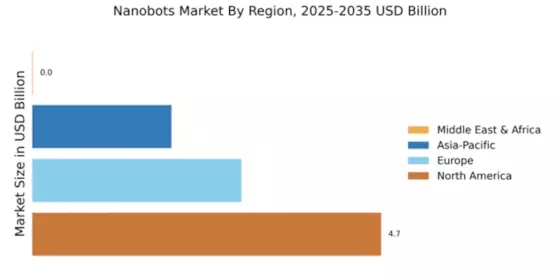
North America continues to lead the nanobots market, holding a significant share of 4.69 in 2024. The region's growth is driven by robust investments in R&D, a strong presence of key players, and increasing applications in healthcare and manufacturing. Regulatory support from government agencies further catalyzes innovation, ensuring a favorable environment for market expansion. The demand for advanced medical solutions and precision engineering is propelling the market forward. The United States stands out as the primary contributor, with companies like Adept Technology, Nanosys, and Zyvex Labs at the forefront. The competitive landscape is characterized by continuous innovation and strategic partnerships among leading firms. As the market evolves, the focus on integrating nanotechnology into various sectors, including pharmaceuticals and electronics, is expected to enhance growth prospects further.

Europe : Emerging Market with Potential

Europe's nanobots market is poised for growth, with a market size of 2.81 in 2024. The region benefits from strong governmental support for nanotechnology initiatives and a growing emphasis on sustainable solutions. Regulatory frameworks are evolving to accommodate advancements in nanotechnology, fostering innovation and collaboration among stakeholders. The increasing demand for nanobots in medical applications, particularly in drug delivery and diagnostics, is a key driver of market expansion. Leading countries such as Germany, France, and the UK are at the forefront of this growth, with significant investments in research and development. The competitive landscape features prominent players like Molecular Machines and NanoComposix, who are actively engaged in developing cutting-edge nanobot technologies. As the market matures, the focus on regulatory compliance and safety standards will be crucial for sustaining growth and fostering consumer trust.

Asia-Pacific : Rapidly Growing Market

The Asia-Pacific region is witnessing a burgeoning interest in nanobots, with a market size of 1.87 in 2024. The growth is fueled by increasing investments in healthcare and technology sectors, alongside rising consumer awareness about advanced medical solutions. Governments are actively promoting nanotechnology through funding and supportive policies, which are essential for market development. The demand for innovative healthcare solutions is driving the adoption of nanobots across various applications. Countries like China, Japan, and India are leading the charge in this emerging market, with a growing number of startups and established companies entering the nanobots space. The competitive landscape is becoming increasingly dynamic, with local players and international firms vying for market share. As the region continues to develop its technological capabilities, the integration of nanobots into healthcare and industrial applications is expected to accelerate significantly.

Middle East and Africa : Nascent Market with Opportunities

The Middle East and Africa region represents a nascent market for nanobots, with a market size of 0.01 in 2024. Despite its small size, there are significant opportunities for growth driven by increasing investments in healthcare and technology. Governments are beginning to recognize the potential of nanotechnology, leading to initiatives aimed at fostering innovation and research. The demand for advanced medical solutions is gradually rising, creating a conducive environment for market development. Countries such as South Africa and the UAE are starting to explore the applications of nanobots in healthcare and industrial sectors. The competitive landscape is still developing, with a few local players and international firms beginning to establish a presence. As awareness of nanotechnology's benefits grows, the region is expected to see gradual advancements in the adoption of nanobots, paving the way for future growth.

Nanobots Market Regional Image

Key Players and Competitive Insights

The Nanobots Market is currently characterized by a dynamic competitive landscape, driven by rapid technological advancements and increasing applications across various sectors, including healthcare, electronics, and environmental monitoring. Key players such as Adept Technology (US), Nanosys (US), and Zyvex Labs (US) are strategically positioning themselves through innovation and partnerships. Adept Technology (US) focuses on enhancing its robotic systems to integrate nanotechnology, thereby improving precision in manufacturing processes. Meanwhile, Nanosys (US) emphasizes the development of nanomaterials that enhance the performance of electronic devices, indicating a strong commitment to innovation. Zyvex Labs (US) appears to be concentrating on expanding its research capabilities, which may bolster its competitive edge in the market.The business tactics employed by these companies reflect a trend towards localizing manufacturing and optimizing supply chains to enhance efficiency. The market structure is moderately fragmented, with several players vying for market share. This fragmentation allows for a diverse range of innovations and applications, although it also intensifies competition among key players. The collective influence of these companies shapes the market dynamics, as they strive to differentiate themselves through technological advancements and strategic collaborations.

In November Adept Technology (US) announced a partnership with a leading semiconductor manufacturer to develop nanobots capable of performing intricate assembly tasks at the micro-level. This collaboration is strategically significant as it not only enhances Adept's technological capabilities but also positions the company to capitalize on the growing demand for precision manufacturing in the electronics sector. Such partnerships are likely to foster innovation and drive market growth.

In October Nanosys (US) launched a new line of nanomaterials designed for energy-efficient applications in consumer electronics. This strategic move is indicative of Nanosys's commitment to sustainability and innovation, aligning with current market trends that favor environmentally friendly technologies. By focusing on energy efficiency, Nanosys may attract a broader customer base, thereby enhancing its competitive position.

In September Zyvex Labs (US) secured a significant funding round aimed at expanding its research and development efforts in nanomedicine. This investment is crucial as it underscores the growing interest in the application of nanotechnology in healthcare, potentially leading to breakthroughs in drug delivery systems and targeted therapies. Zyvex's focus on healthcare applications may provide it with a unique advantage in a rapidly evolving market.

As of December the competitive trends in the Nanobots Market are increasingly defined by digitalization, sustainability, and the integration of artificial intelligence. Strategic alliances among key players are shaping the landscape, fostering innovation and enhancing operational efficiencies. The shift from price-based competition to a focus on technological differentiation and supply chain reliability is evident. Companies that prioritize innovation and sustainability are likely to emerge as leaders in this evolving market.

Key Companies in the Nanobots Market include

Industry Developments

    • In May 2019, Ginkgo Bioworks announced the acquisition of Warp Drive Bio, well known for genome mining, for an undisclosed amount. This acquisition will enhance R&D in the development of platforms for use in next-generation antibiotics
    • In January 2018, Zymergen acquired Radiant Genomics for an undisclosed amount. With this acquisition, Zymergen will be able to use sequencing, bioinformatics, synthetic biology, and other technologies of Radiant for natural product discovery, diversification, and production purposes
    • In April 2016, Synthace Limited announced a partnership with Microsoft to use Antha for Azure cloud analytics, cognitive services, and machine learning. This partnership will help the company in the development of the Antha platform

Future Outlook

Nanobots Market Future Outlook

The Nanobots Market is projected to grow at a 9.69% CAGR from 2025 to 2035, driven by advancements in healthcare, manufacturing, and environmental applications.

New opportunities lie in:

  • Development of targeted drug delivery systems for personalized medicine.
  • Integration of nanobots in precision agriculture for enhanced crop management.
  • Creation of nanobot-enabled environmental monitoring solutions for pollution control.

By 2035, the Nanobots Market is expected to be a pivotal sector, showcasing robust growth and innovation.

Market Segmentation

Nanobots Market Type Outlook

  • Biological Nanobots
  • Chemical Nanobots
  • Mechanical Nanobots
  • Hybrid Nanobots

Nanobots Market End Use Outlook

  • Healthcare
  • Manufacturing
  • Research
  • Defense
  • Agriculture

Nanobots Market Material Outlook

  • Gold
  • Silicon
  • Polymers
  • Carbon Nanotubes

Nanobots Market Application Outlook

  • Medical
  • Environmental
  • Industrial
  • Military
  • Consumer Electronics

Nanobots Market Functionality Outlook

  • Drug Delivery
  • Diagnostics
  • Surgery
  • Environmental Monitoring

Report Scope

MARKET SIZE 20249.38(USD Billion)
MARKET SIZE 202510.4(USD Billion)
MARKET SIZE 203526.07(USD Billion)
COMPOUND ANNUAL GROWTH RATE (CAGR)9.69% (2025 - 2035)
REPORT COVERAGERevenue Forecast, Competitive Landscape, Growth Factors, and Trends
BASE YEAR2024
Market Forecast Period2025 - 2035
Historical Data2019 - 2024
Market Forecast UnitsUSD Billion
Key Companies ProfiledAdept Technology (US), Nanosys (US), Zyvex Labs (US), Molecular Machines (DE), NanoComposix (US), Bionanotechnology (US), Nanoscale (US), Nanobot Medical (US)
Segments CoveredApplication, End Use, Type, Material, Functionality
Key Market OpportunitiesAdvancements in targeted drug delivery systems enhance growth potential in the Nanobots Market.
Key Market DynamicsTechnological advancements drive competitive forces, enhancing nanobot applications in healthcare and industrial sectors.
Countries CoveredNorth America, Europe, APAC, South America, MEA

Market Highlights

Author
Kinjoll Dey
Research Analyst Level I

He is an extremely curious individual currently working in Healthcare and Medical Devices Domain. Kinjoll is comfortably versed in data centric research backed by healthcare educational background. He leverages extensive data mining and analytics tools such as Primary and Secondary Research, Statistical Analysis, Machine Learning, Data Modelling. His key role also involves Technical Sales Support, Client Interaction and Project management within the Healthcare team. Lastly, he showcases extensive affinity towards learning new skills and remain fascinated in implementing them.

Leave a Comment

FAQs

How much is the nanobots/nanorobots market worth in the future?

The nanobots/nanorobots market is estimated to reach USD 22.48 Million by 2032.

At what CAGR is the nanobots/nanorobots market projected to grow during the forecast period (2024-2032)?

The nanobots/nanorobots market is estimated to grow at 10.78% CAGR during the forecast period (2024-2032).

Which region holds the largest share in the nanobots/nanorobots market?

North America holds the largest share in the nanobots/nanorobots market followed by Europe and Asia Pacific, respectively.

Who are the top players in the nanobots/nanorobots market?

Synthace Limited, Zymergen, Ginkgo Bioworks, Kleindiek Nanotechnik GmbH, Imina Technologies SA., and Thermo Fisher Scientific Inc., are some of the major players operating in the nanobots/nanorobots market.

Download Free Sample

Kindly complete the form below to receive a free sample of this Report

Compare Licence

×
Features License Type
Single User Multiuser License Enterprise User
Price $4,950 $5,950 $7,250
Maximum User Access Limit 1 User Upto 10 Users Unrestricted Access Throughout the Organization
Free Customization
Direct Access to Analyst
Deliverable Format
Platform Access
Discount on Next Purchase 10% 15% 15%
Printable Versions