Request Free Sample ×

Kindly complete the form below to receive a free sample of this Report

* Please use a valid business email

Leading companies partner with us for data-driven Insights

clients tt-cursor
Hero Background
English
Chinese
French
Japanese
Korean
German
Spanish

Nanobots Market Share

ID: MRFR/MED/0793-CR
151 Pages
Satyendra Maurya
February 2021

Nanobots/Nanorobots Market Research Report Information by Product Type (Nanomanipulator, Bio-Nanorobotics, Magnetically Guided Nanobots/Nanorobots), Application (NanoMedicine, Biomedical), Region (Americas, Europe, Asia-Pacific and the Rest of the World) - Forecast till 2035

Share:
Download PDF ×

We do not share your information with anyone. However, we may send you emails based on your report interest from time to time. You may contact us at any time to opt-out.

Nanobots Market Infographic
Purchase Options

Market Share

Nanobots Market Share Analysis

The NANOBOTS market is a burgeoning sector characterized by the integration of nanotechnology into various industries, from healthcare to manufacturing. As companies vie for prominence, market share positioning strategies become pivotal.

NANOBOTS manufacturers tend to focus on selected sectors, designing products that are tailored for specific needs. For example, others focus on what they call the Healthcare applications as an aim to take over medical nanorobotics market while other direct it towards environmental or industrial uses. Companies, which are very much aware of their market share invests a lot amount in the research and development process. Through promoting innovation, they remain competitive in design of superior NANOBOTs-leading to market domination. Market leaders know the need for providing universal NANOBOTS that are easily adjustable to multiple uses. Capacity to be flexible and adjusting according the various industry needs contributes in widening customer base. Such strategic alliances can be a game-changer. Such collaborations not only allow for better shared use of resources but also pave ways to new markets, increasing the reach and market share prospects for NANOBOTS producers. The regulatory standards are sacrosanct to comply with in the NANOBOTS market. Companies that concentrate on such strict regulations and also do well in it not only enjoy the trust of their customers but become leaders whose reliability increases market share. A competitive market requires the establishment of brand presence. Companies spend a lot of money on effective marketing strategies to ensure that their NANOBOTS are known, focusing the uniqueness and benefits they offer. Branding, and effective branding at that contributes to a powerful market position. However, customers education is one of the most important aspects due to NANOBOTS innovation. Corporations allocate funds to research and educate their intended consumer base on the advantages, uses of NANOBOTS; demystify myths associated with them in order to have a friendlier audience for sales. Providing excellent after-sales support is a key differentiator. Companies that offer comprehensive customer support, including troubleshooting, maintenance, and upgrades, enhance customer satisfaction. Satisfied customers are more likely to become repeat buyers and advocates, contributing to increased market share. As technology knows no boundaries, NANOBOTS manufacturers seek global expansion. By tapping into international markets, companies can diversify their customer base, reduce dependency on specific regions, and position themselves as global leaders in the NANOBOTS industry. Staying attuned to market trends and swiftly adapting product offerings is essential. Companies that demonstrate agility in responding to emerging trends can capture early market share, positioning themselves as trendsetters in the rapidly evolving NANOBOTS landscape.


Author
Author Profile
Satyendra Maurya
Research Analyst

An accomplished research analyst with high proficiency in market forecasting, data visualization, competitive benchmarking, and others. He holds a pronounced track record in research and consulting projects for sectors such as life sciences, medical devices, and healthcare IT. His capabilities in qualitative and quantitative analysis have resulted in positive client outcomes. Working on niche market trends, opportunities, sales, and forecasted value is part of his skill set.

Leave a Comment

FAQs

What is the current valuation of the Nanobots Market as of 2024?

<p>The Nanobots Market was valued at 9.38 USD Billion in 2024.</p>

What is the projected market size for the Nanobots Market in 2035?

<p>The market is projected to reach 26.07 USD Billion by 2035.</p>

What is the expected CAGR for the Nanobots Market during the forecast period 2025 - 2035?

<p>The expected CAGR for the Nanobots Market during 2025 - 2035 is 9.69%.</p>

Which application segments are driving growth in the Nanobots Market?

<p>Key application segments include Medical, Environmental, Industrial, Military, and Consumer Electronics, with Medical projected to grow from 2.81 to 7.56 USD Billion.</p>

What are the primary end-use sectors for nanobots?

The primary end-use sectors include Healthcare, Manufacturing, Defense, Research, and Agriculture, with Healthcare expected to grow from 3.0 to 8.0 USD Billion.

What types of nanobots are currently available in the market?

Available types include Swarm Nanobots, Targeted Nanobots, Biohybrid Nanobots, Magnetic Nanobots, and Chemical Nanobots, with Targeted Nanobots projected to grow from 2.81 to 7.5 USD Billion.

What materials are predominantly used in the production of nanobots?

The predominant materials include Metallic, Polymeric, Ceramic, Biodegradable, and Composite, with Metallic expected to grow from 2.81 to 7.56 USD Billion.

What functionalities do nanobots serve in various applications?

Nanobots serve functionalities such as Drug Delivery, Diagnostics, Sensing, Repair, and Monitoring, with Drug Delivery projected to grow from 2.81 to 7.56 USD Billion.

Who are the key players in the Nanobots Market?

Key players include Adept Technology, Nanosys, Zyvex Labs, Molecular Machines, NanoComposix, Bionanotechnology, Nanoscale, and Nanobot Systems.

How does the Nanobots Market compare across different applications and end uses?

The market shows varied growth across applications and end uses, with Medical and Healthcare segments leading in projected valuations.

Market Summary

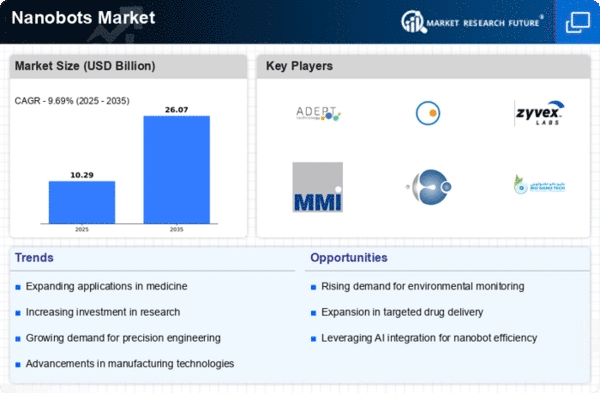
As per MRFR analysis, the Nanobots Market Size was estimated at 9.38 USD Billion in 2024. The Nanobots industry is projected to grow from 10.4 USD Billion in 2025 to 26.07 USD Billion by 2035, exhibiting a compound annual growth rate (CAGR) of 9.69% during the forecast period 2025 - 2035.

Key Market Trends & Highlights

The Nanobots Market is poised for substantial growth driven by technological advancements and increasing applications across various sectors.

  • North America remains the largest market for nanobots, primarily due to its advanced healthcare infrastructure and significant R&D investments.
  • The Asia-Pacific region is emerging as the fastest-growing market, fueled by rapid industrialization and increasing environmental concerns.
  • The medical segment dominates the market, while the environmental segment is witnessing the fastest growth as demand for remediation solutions rises.
  • Key drivers include the rising demand for targeted drug delivery and the growing focus on personalized medicine, which are shaping market dynamics.

Market Size & Forecast

2024 Market Size 9.38 (USD Billion)
2035 Market Size 26.07 (USD Billion)
CAGR (2025 - 2035) 9.69%
Largest Regional Market Share in 2024 North America

Major Players

Adept Technology (US), Nanosys (US), Zyvex Labs (US), Molecular Machines (DE), NanoComposix (US), Bionanotechnology (US), Nanoscale (US), Nanobot Medical (US)

Market Trends

The Nanobots Market is currently experiencing a transformative phase, characterized by rapid advancements in technology and increasing applications across various sectors. These miniature robots, often measured in nanometers, are being integrated into fields such as medicine, environmental monitoring, and manufacturing. The potential for nanobots to revolutionize drug delivery systems, enhance precision in surgical procedures, and improve diagnostic capabilities is becoming increasingly apparent. As research and development efforts intensify, the market is likely to witness a surge in innovative solutions that address complex challenges faced by industries today. Moreover, the growing emphasis on automation and efficiency is propelling the demand for nanobots. Industries are recognizing the advantages of utilizing these tiny machines to perform tasks that are either too dangerous or impractical for humans. This trend is particularly evident in sectors like healthcare, where nanobots can target specific cells for treatment, thereby minimizing side effects and improving patient outcomes. As the Nanobots Market continues to evolve, it appears poised for substantial growth, driven by technological advancements and an increasing understanding of their potential applications.

Advancements in Medical Applications

The integration of nanobots in healthcare is gaining momentum, with a focus on targeted drug delivery and precision medicine. These innovations may lead to more effective treatments and reduced side effects, enhancing patient care.

Environmental Monitoring and Remediation

Nanobots are being explored for their potential in environmental applications, such as pollution detection and remediation. Their ability to operate at a microscopic level could revolutionize how environmental challenges are addressed.

Manufacturing and Automation

The Nanobots Market is witnessing a shift towards automation in manufacturing processes. These tiny robots can perform intricate tasks with high precision, potentially increasing efficiency and reducing production costs.

Nanobots Market Market Drivers

Expansion of Industrial Applications

The expansion of industrial applications is a significant driver for the Nanobots Market. Industries such as manufacturing, electronics, and materials science are increasingly adopting nanobots for various processes, including quality control, assembly, and maintenance. The integration of nanobots in industrial settings enhances efficiency and precision, leading to improved product quality and reduced operational costs. The market for industrial automation is expected to grow substantially, with estimates suggesting a value of USD 200 billion by 2025. This growth indicates a strong demand for innovative solutions, positioning nanobots as essential components in the future of industrial operations. As industries continue to evolve, the Nanobots Market is likely to experience significant growth driven by these applications.

Rising Demand for Targeted Drug Delivery

The increasing prevalence of chronic diseases and the need for effective treatment options drive the demand for targeted drug delivery systems. Nanobots, with their ability to navigate through the human body and deliver drugs precisely to affected areas, are becoming a focal point in the Nanobots Market. According to recent estimates, the market for targeted drug delivery is projected to reach USD 200 billion by 2026, indicating a robust growth trajectory. This trend suggests that the integration of nanobots in drug delivery systems could revolutionize treatment methodologies, enhancing patient outcomes and reducing side effects. As healthcare providers seek innovative solutions, the Nanobots Market is likely to witness substantial investments and advancements in technology.

Technological Advancements in Nanotechnology

The rapid evolution of nanotechnology plays a pivotal role in shaping the Nanobots Market. Innovations in materials science, engineering, and computational modeling have led to the development of more efficient and versatile nanobots. These advancements enable the creation of nanobots that can perform complex tasks, such as targeted therapy and real-time monitoring of biological processes. The market for nanotechnology is expected to grow significantly, with projections indicating a value of USD 125 billion by 2024. This growth reflects the increasing interest in nanobots for various applications, including healthcare, environmental monitoring, and industrial processes. As technology continues to advance, the Nanobots Market is poised for transformative changes.

Growing Investment in Research and Development

Investment in research and development (R&D) is a critical driver for the Nanobots Market. Governments and private entities are increasingly allocating funds to explore the potential applications of nanobots across various sectors. This trend is evident in the healthcare sector, where R&D spending on nanotechnology is projected to exceed USD 30 billion by 2025. Such investments facilitate the exploration of novel applications, including cancer treatment, drug delivery, and diagnostics. Furthermore, collaborations between academic institutions and industry players are fostering innovation, leading to the development of cutting-edge nanobot technologies. As R&D efforts intensify, the Nanobots Market is likely to expand, offering new solutions to complex challenges.

Increasing Focus on Environmental Sustainability

The growing emphasis on environmental sustainability is influencing the Nanobots Market. Nanobots are being explored for their potential in environmental monitoring and remediation, offering innovative solutions to address pollution and resource management. For instance, nanobots can be designed to detect contaminants in water and soil, providing real-time data for environmental assessments. The market for environmental nanotechnology is projected to reach USD 50 billion by 2027, highlighting the increasing recognition of nanobots as valuable tools for sustainable practices. This trend suggests that as environmental concerns escalate, the Nanobots Market will likely expand its focus on eco-friendly applications, contributing to a more sustainable future.

Market Segment Insights

By Application: Medical (Largest) vs. Environmental (Fastest-Growing)

In the Nanobots Market, the application segments are diversified, with the medical sector being the largest contributor. It significantly leads due to the increasing adoption of nanobots in drug delivery systems, surgical procedures, and diagnostics. Following this, the environmental application is growing at a rapid pace as industries leverage nanobots for pollution monitoring and remediation, showcasing a rising interest in sustainable solutions. The industrial and military segments are also prominent, albeit with slower growth rates compared to medical and environmental applications. Growth trends in the nanobot application segment are driven by technological advancements and increasing investments in research and development. Medical applications are fueled by the demand for minimally invasive procedures and personalized medicine, while environmental aspects gain momentum due to stricter regulations on pollution control. Furthermore, industrial applications are focusing on efficiency enhancements and automation, and military applications are influenced by the need for advanced surveillance and reconnaissance capabilities. Overall, the market dynamics indicate a promising future for nanobots across various applications.

Environmental (Dominant) vs. Consumer Electronics (Emerging)

Within the Nanobots Market, the Environmental application has emerged as a dominant force, pioneered by innovative technologies that enable efficient pollutant detection and waste management. Governments and organizations are increasingly investing in nanotechnology to promote sustainability and enhance ecological monitoring. In contrast, the Consumer Electronics segment is recognized as an emerging field, with potential applications in personal gadgets and electronic devices. The integration of nanobots in this sector could lead to revolutionary advancements, such as smart sensors and personalized user experiences. While the environmental market focuses on compliance and ecological balance, the consumer electronics arena emphasizes convenience, efficiency, and cutting-edge technology. Both segments are evolving, driven by distinct demands yet sharing a common goal of integrating nanobot technology to enhance overall functionality and performance.

By End Use: Healthcare (Largest) vs. Manufacturing (Fastest-Growing)

Within the Nanobots Market, the Healthcare sector leads significantly, taking up the largest share due to the increasing integration of nanotechnology in medical applications, including drug delivery and diagnostics. This dominance is primarily driven by technological advancements, enhanced patient outcomes, and a growing aging population seeking innovative treatment options. Furthermore, sectors like Manufacturing are rapidly gaining traction, showcasing a robust growth prospect as industries increasingly adopt precision engineering techniques utilizing nanobots for tasks such as materials handling and automation.

Healthcare: Drug Delivery (Dominant) vs. Manufacturing: Automation (Emerging)

In the healthcare domain, drug delivery systems leveraging nanobots are a dominant force, revolutionizing the way medications are administered and localized within the body. These nanobots optimize therapeutic efficiency, targeting specific tissues and reducing side effects, which greatly enhances patient care. Conversely, in manufacturing, the emergence of nanobots for automation highlights a significant trend. These innovative tools enhance efficiency and precision in production processes, driving aftermarket service adoption, and fostering a safer work environment by taking over dangerous tasks. This shift towards automation represents a transformative phase that is set to redefine industry standards.

By Type: Swarm Nanobots (Largest) vs. Targeted Nanobots (Fastest-Growing)

<p>The nanobots market is diversifying rapidly, with notable segments comprising Swarm Nanobots, Targeted Nanobots, Biohybrid Nanobots, Magnetic Nanobots, and Chemical Nanobots. Swarm Nanobots currently command the largest share, leveraging their ability to work collectively to perform complex tasks efficiently. In contrast, Targeted Nanobots, designed for precision delivery in medical applications, are gaining momentum, appealing to a growing demand for targeted therapies. As healthcare advancements continue to rise, the growth trajectory for these segments is backed by innovations in nanotechnology and increased investments in research and development. Targeted Nanobots, in particular, are emerging rapidly due to their potential to transform drug delivery systems, making them more effective and less invasive. The market is witnessing an increased focus on enhancing the functionalities of these nanobots to improve their applications across various industries, including healthcare and environmental management.</p>

<p>Targeted Nanobots (Dominant) vs. Biohybrid Nanobots (Emerging)</p>

<p>Targeted Nanobots represent a dominant force in the nanobots market, primarily due to their effectiveness in delivering drugs directly to affected areas within the body, thereby maximizing treatment efficiency and minimizing side effects. These nanobots are at the forefront of medical technology, offering transformative solutions that are precisely tailored to patient needs. On the other hand, Biohybrid Nanobots are an emerging segment that combines biological components with synthetic materials, enabling them to perform complex biological functions. While still in the early stages of commercialization, Biohybrid Nanobots are gaining attention for their potential applications in <a href="https://www.marketresearchfuture.com/reports/regenerative-medicine-market-2220" target="_blank" title="regenerative medicine">regenerative medicine</a> and environmental remediation, where natural interactions can be leveraged. The distinct functional characteristics of both segments showcase the versatility and innovation driving the nanobots market.</p>

By Material: Metallic (Largest) vs. Polymeric (Fastest-Growing)

<p>In the Nanobots Market, the material segment is crucial as it dictates the capabilities and applications of these tiny robots. Among the various materials, metallic nanobots hold the largest share, benefiting from their electrical conductivity and mechanical strength, making them suitable for a wide range of applications in medicine and electronics. Polymeric nanobots, on the other hand, are emerging rapidly, offering advantages in biocompatibility and flexibility, thus gaining traction in the healthcare sector.</p>

<p>Metallic (Dominant) vs. Polymeric (Emerging)</p>

<p>Metallic nanobots are the dominant players in the market due to their superior electrical and thermal conductivity, which makes them ideal for applications in targeted drug delivery and medical imaging. They exhibit robust mechanical properties that provide resilience in various environments. Meanwhile, polymeric nanobots are emerging as a viable alternative, thanks to their customizable properties, which allow for functionalities like drug release systems and biocompatibility with human tissues. This adaptability is attracting significant attention from researchers and developers aiming to create innovative healthcare applications.</p>

By Functionality: Drug Delivery (Largest) vs. Diagnostics (Fastest-Growing)

<p>The Nanobots Market exhibits a diverse functionality landscape where Drug Delivery stands as the largest segment, leveraging its ability to administer medications at precise locations within the body. Diagnostics constitutes a rapidly evolving segment, driven by the need for highly efficient and accurate disease detection methods. Together, these segments showcase the significance of targeted and precise interventions in modern healthcare. Market dynamics indicate a shift towards increased investment and innovation in diagnostics as stakeholders recognize its potential to address unmet medical needs. Meanwhile, Drug Delivery remains foundational due to its applications in chronic disease management and personalized medicine. These trends underscore the importance of functionality in shaping the direction of the Nanobots Market, with advancements expected to further propel growth in both areas.</p>

<p>Drug Delivery (Dominant) vs. Diagnostics (Emerging)</p>

<p>The Drug Delivery segment of the Nanobots Market has established itself as a dominant player, known for its sophisticated systems that transport therapeutic agents directly to cells in need, minimizing side effects and improving treatment efficacy. This functionality not only enhances the standard of care for many patients but also opens avenues for innovations like smart pills. On the other hand, the Diagnostics segment is emerging rapidly, benefiting from advancements in nanotechnology that allow for quicker and more accurate health assessments. The integration of nanobots in diagnostics promises real-time monitoring and early detection of diseases, positioning it as a vital area for future growth. Both segments highlight the interplay of technological capabilities and patient-centric solutions in the evolving landscape of nanobot applications.</p>

Get more detailed insights about Nanobots/Nanorobots Market Research Report - Forecast till 2035

Regional Insights

North America : Innovation and Leadership Hub

North America continues to lead the nanobots market, holding a significant share of 4.69 in 2024. The region's growth is driven by robust investments in R&D, a strong presence of key players, and increasing applications in healthcare and manufacturing. Regulatory support from government agencies further catalyzes innovation, ensuring a favorable environment for market expansion. The demand for advanced medical solutions and precision engineering is propelling the market forward. The United States stands out as the primary contributor, with companies like Adept Technology, Nanosys, and Zyvex Labs at the forefront. The competitive landscape is characterized by continuous innovation and strategic partnerships among leading firms. As the market evolves, the focus on integrating nanotechnology into various sectors, including pharmaceuticals and electronics, is expected to enhance growth prospects further.

Europe : Emerging Market with Potential

Europe's nanobots market is poised for growth, with a market size of 2.81 in 2024. The region benefits from strong governmental support for nanotechnology initiatives and a growing emphasis on sustainable solutions. Regulatory frameworks are evolving to accommodate advancements in nanotechnology, fostering innovation and collaboration among stakeholders. The increasing demand for nanobots in medical applications, particularly in drug delivery and diagnostics, is a key driver of market expansion. Leading countries such as Germany, France, and the UK are at the forefront of this growth, with significant investments in research and development. The competitive landscape features prominent players like Molecular Machines and NanoComposix, who are actively engaged in developing cutting-edge nanobot technologies. As the market matures, the focus on regulatory compliance and safety standards will be crucial for sustaining growth and fostering consumer trust.

Asia-Pacific : Rapidly Growing Market

The Asia-Pacific region is witnessing a burgeoning interest in nanobots, with a market size of 1.87 in 2024. The growth is fueled by increasing investments in healthcare and technology sectors, alongside rising consumer awareness about advanced medical solutions. Governments are actively promoting nanotechnology through funding and supportive policies, which are essential for market development. The demand for innovative healthcare solutions is driving the adoption of nanobots across various applications. Countries like China, Japan, and India are leading the charge in this emerging market, with a growing number of startups and established companies entering the nanobots space. The competitive landscape is becoming increasingly dynamic, with local players and international firms vying for market share. As the region continues to develop its technological capabilities, the integration of nanobots into healthcare and industrial applications is expected to accelerate significantly.

Middle East and Africa : Nascent Market with Opportunities

The Middle East and Africa region represents a nascent market for nanobots, with a market size of 0.01 in 2024. Despite its small size, there are significant opportunities for growth driven by increasing investments in healthcare and technology. Governments are beginning to recognize the potential of nanotechnology, leading to initiatives aimed at fostering innovation and research. The demand for advanced medical solutions is gradually rising, creating a conducive environment for market development. Countries such as South Africa and the UAE are starting to explore the applications of nanobots in healthcare and industrial sectors. The competitive landscape is still developing, with a few local players and international firms beginning to establish a presence. As awareness of nanotechnology's benefits grows, the region is expected to see gradual advancements in the adoption of nanobots, paving the way for future growth.

Key Players and Competitive Insights

The Nanobots Market is currently characterized by a dynamic competitive landscape, driven by rapid technological advancements and increasing applications across various sectors, including healthcare, electronics, and environmental monitoring. Key players such as Adept Technology (US), Nanosys (US), and Zyvex Labs (US) are strategically positioning themselves through innovation and partnerships. Adept Technology (US) focuses on enhancing its robotic systems to integrate nanotechnology, thereby improving precision in manufacturing processes. Meanwhile, Nanosys (US) emphasizes the development of nanomaterials that enhance the performance of electronic devices, indicating a strong commitment to innovation. Zyvex Labs (US) appears to be concentrating on expanding its research capabilities, which may bolster its competitive edge in the market.The business tactics employed by these companies reflect a trend towards localizing manufacturing and optimizing supply chains to enhance efficiency. The market structure is moderately fragmented, with several players vying for market share. This fragmentation allows for a diverse range of innovations and applications, although it also intensifies competition among key players. The collective influence of these companies shapes the market dynamics, as they strive to differentiate themselves through technological advancements and strategic collaborations.

In November Adept Technology (US) announced a partnership with a leading semiconductor manufacturer to develop nanobots capable of performing intricate assembly tasks at the micro-level. This collaboration is strategically significant as it not only enhances Adept's technological capabilities but also positions the company to capitalize on the growing demand for precision manufacturing in the electronics sector. Such partnerships are likely to foster innovation and drive market growth.

In October Nanosys (US) launched a new line of nanomaterials designed for energy-efficient applications in consumer electronics. This strategic move is indicative of Nanosys's commitment to sustainability and innovation, aligning with current market trends that favor environmentally friendly technologies. By focusing on energy efficiency, Nanosys may attract a broader customer base, thereby enhancing its competitive position.

In September Zyvex Labs (US) secured a significant funding round aimed at expanding its research and development efforts in nanomedicine. This investment is crucial as it underscores the growing interest in the application of nanotechnology in healthcare, potentially leading to breakthroughs in drug delivery systems and targeted therapies. Zyvex's focus on healthcare applications may provide it with a unique advantage in a rapidly evolving market.

As of December the competitive trends in the Nanobots Market are increasingly defined by digitalization, sustainability, and the integration of artificial intelligence. Strategic alliances among key players are shaping the landscape, fostering innovation and enhancing operational efficiencies. The shift from price-based competition to a focus on technological differentiation and supply chain reliability is evident. Companies that prioritize innovation and sustainability are likely to emerge as leaders in this evolving market.

Key Companies in the Nanobots Market include

Industry Developments

    • In May 2019, Ginkgo Bioworks announced the acquisition of Warp Drive Bio, well known for genome mining, for an undisclosed amount. This acquisition will enhance R&D in the development of platforms for use in next-generation antibiotics
    • In January 2018, Zymergen acquired Radiant Genomics for an undisclosed amount. With this acquisition, Zymergen will be able to use sequencing, bioinformatics, synthetic biology, and other technologies of Radiant for natural product discovery, diversification, and production purposes
    • In April 2016, Synthace Limited announced a partnership with Microsoft to use Antha for Azure cloud analytics, cognitive services, and machine learning. This partnership will help the company in the development of the Antha platform

Future Outlook

Nanobots Market Future Outlook

The Nanobots Market is projected to grow at a 9.69% CAGR from 2025 to 2035, driven by advancements in healthcare, manufacturing, and environmental applications.

New opportunities lie in:

  • Development of targeted drug delivery systems for <a href="https://www.marketresearchfuture.com/reports/personalized-medicine-market-2937" target="_blank" title="personalized medicine">personalized medicine</a>.
  • Integration of nanobots in precision agriculture for enhanced crop management.
  • Creation of nanobot-enabled environmental monitoring solutions for pollution control.

By 2035, the Nanobots Market is expected to be a pivotal sector, showcasing robust growth and innovation.

Market Segmentation

Nanobots Market Type Outlook

  • Biological Nanobots
  • Chemical Nanobots
  • Mechanical Nanobots
  • Hybrid Nanobots

Nanobots Market End Use Outlook

  • Healthcare
  • Manufacturing
  • Research
  • Defense
  • Agriculture

Nanobots Market Material Outlook

  • Gold
  • Silicon
  • Polymers
  • Carbon Nanotubes

Nanobots Market Application Outlook

  • Medical
  • Environmental
  • Industrial
  • Military
  • Consumer Electronics

Nanobots Market Functionality Outlook

  • Drug Delivery
  • Diagnostics
  • Surgery
  • Environmental Monitoring

Report Scope

MARKET SIZE 2024 9.38(USD Billion)
MARKET SIZE 2025 10.4(USD Billion)
MARKET SIZE 2035 26.07(USD Billion)
COMPOUND ANNUAL GROWTH RATE (CAGR) 9.69% (2025 - 2035)
REPORT COVERAGE Revenue Forecast, Competitive Landscape, Growth Factors, and Trends
BASE YEAR 2024
Market Forecast Period 2025 - 2035
Historical Data 2019 - 2024
Market Forecast Units USD Billion
Key Companies Profiled Adept Technology (US), Nanosys (US), Zyvex Labs (US), Molecular Machines (DE), NanoComposix (US), Bionanotechnology (US), Nanoscale (US), Nanobot Medical (US)
Segments Covered Application, End Use, Type, Material, Functionality
Key Market Opportunities Advancements in targeted drug delivery systems enhance growth potential in the Nanobots Market.
Key Market Dynamics Technological advancements drive competitive forces, enhancing nanobot applications in healthcare and industrial sectors.
Countries Covered North America, Europe, APAC, South America, MEA

FAQs

What is the current valuation of the Nanobots Market as of 2024?

<p>The Nanobots Market was valued at 9.38 USD Billion in 2024.</p>

What is the projected market size for the Nanobots Market in 2035?

<p>The market is projected to reach 26.07 USD Billion by 2035.</p>

What is the expected CAGR for the Nanobots Market during the forecast period 2025 - 2035?

<p>The expected CAGR for the Nanobots Market during 2025 - 2035 is 9.69%.</p>

Which application segments are driving growth in the Nanobots Market?

<p>Key application segments include Medical, Environmental, Industrial, Military, and Consumer Electronics, with Medical projected to grow from 2.81 to 7.56 USD Billion.</p>

What are the primary end-use sectors for nanobots?

The primary end-use sectors include Healthcare, Manufacturing, Defense, Research, and Agriculture, with Healthcare expected to grow from 3.0 to 8.0 USD Billion.

What types of nanobots are currently available in the market?

Available types include Swarm Nanobots, Targeted Nanobots, Biohybrid Nanobots, Magnetic Nanobots, and Chemical Nanobots, with Targeted Nanobots projected to grow from 2.81 to 7.5 USD Billion.

What materials are predominantly used in the production of nanobots?

The predominant materials include Metallic, Polymeric, Ceramic, Biodegradable, and Composite, with Metallic expected to grow from 2.81 to 7.56 USD Billion.

What functionalities do nanobots serve in various applications?

Nanobots serve functionalities such as Drug Delivery, Diagnostics, Sensing, Repair, and Monitoring, with Drug Delivery projected to grow from 2.81 to 7.56 USD Billion.

Who are the key players in the Nanobots Market?

Key players include Adept Technology, Nanosys, Zyvex Labs, Molecular Machines, NanoComposix, Bionanotechnology, Nanoscale, and Nanobot Systems.

How does the Nanobots Market compare across different applications and end uses?

The market shows varied growth across applications and end uses, with Medical and Healthcare segments leading in projected valuations.

  1. SECTION I: EXECUTIVE SUMMARY AND KEY HIGHLIGHTS
    1. | 1.1 EXECUTIVE SUMMARY
    2. | | 1.1.1 Market Overview
    3. | | 1.1.2 Key Findings
    4. | | 1.1.3 Market Segmentation
    5. | | 1.1.4 Competitive Landscape
    6. | | 1.1.5 Challenges and Opportunities
    7. | | 1.1.6 Future Outlook
  2. SECTION II: SCOPING, METHODOLOGY AND MARKET STRUCTURE
    1. | 2.1 MARKET INTRODUCTION
    2. | | 2.1.1 Definition
    3. | | 2.1.2 Scope of the study
    4. | | | 2.1.2.1 Research Objective
    5. | | | 2.1.2.2 Assumption
    6. | | | 2.1.2.3 Limitations
    7. | 2.2 RESEARCH METHODOLOGY
    8. | | 2.2.1 Overview
    9. | | 2.2.2 Data Mining
    10. | | 2.2.3 Secondary Research
    11. | | 2.2.4 Primary Research
    12. | | | 2.2.4.1 Primary Interviews and Information Gathering Process
    13. | | | 2.2.4.2 Breakdown of Primary Respondents
    14. | | 2.2.5 Forecasting Model
    15. | | 2.2.6 Market Size Estimation
    16. | | | 2.2.6.1 Bottom-Up Approach
    17. | | | 2.2.6.2 Top-Down Approach
    18. | | 2.2.7 Data Triangulation
    19. | | 2.2.8 Validation
  3. SECTION III: QUALITATIVE ANALYSIS
    1. | 3.1 MARKET DYNAMICS
    2. | | 3.1.1 Overview
    3. | | 3.1.2 Drivers
    4. | | 3.1.3 Restraints
    5. | | 3.1.4 Opportunities
    6. | 3.2 MARKET FACTOR ANALYSIS
    7. | | 3.2.1 Value chain Analysis
    8. | | 3.2.2 Porter's Five Forces Analysis
    9. | | | 3.2.2.1 Bargaining Power of Suppliers
    10. | | | 3.2.2.2 Bargaining Power of Buyers
    11. | | | 3.2.2.3 Threat of New Entrants
    12. | | | 3.2.2.4 Threat of Substitutes
    13. | | | 3.2.2.5 Intensity of Rivalry
    14. | | 3.2.3 COVID-19 Impact Analysis
    15. | | | 3.2.3.1 Market Impact Analysis
    16. | | | 3.2.3.2 Regional Impact
    17. | | | 3.2.3.3 Opportunity and Threat Analysis
  4. SECTION IV: QUANTITATIVE ANALYSIS
    1. | 4.1 Healthcare, BY Application (USD Billion)
    2. | | 4.1.1 Medical
    3. | | 4.1.2 Environmental
    4. | | 4.1.3 Industrial
    5. | | 4.1.4 Military
    6. | | 4.1.5 Consumer Electronics
    7. | 4.2 Healthcare, BY End Use (USD Billion)
    8. | | 4.2.1 Healthcare
    9. | | 4.2.2 Manufacturing
    10. | | 4.2.3 Defense
    11. | | 4.2.4 Research
    12. | | 4.2.5 Agriculture
    13. | 4.3 Healthcare, BY Type (USD Billion)
    14. | | 4.3.1 Swarm Nanobots
    15. | | 4.3.2 Targeted Nanobots
    16. | | 4.3.3 Biohybrid Nanobots
    17. | | 4.3.4 Magnetic Nanobots
    18. | | 4.3.5 Chemical Nanobots
    19. | 4.4 Healthcare, BY Material (USD Billion)
    20. | | 4.4.1 Metallic
    21. | | 4.4.2 Polymeric
    22. | | 4.4.3 Ceramic
    23. | | 4.4.4 Biodegradable
    24. | | 4.4.5 Composite
    25. | 4.5 Healthcare, BY Functionality (USD Billion)
    26. | | 4.5.1 Drug Delivery
    27. | | 4.5.2 Diagnostics
    28. | | 4.5.3 Sensing
    29. | | 4.5.4 Repair
    30. | | 4.5.5 Monitoring
    31. | 4.6 Healthcare, BY Region (USD Billion)
    32. | | 4.6.1 North America
    33. | | | 4.6.1.1 US
    34. | | | 4.6.1.2 Canada
    35. | | 4.6.2 Europe
    36. | | | 4.6.2.1 Germany
    37. | | | 4.6.2.2 UK
    38. | | | 4.6.2.3 France
    39. | | | 4.6.2.4 Russia
    40. | | | 4.6.2.5 Italy
    41. | | | 4.6.2.6 Spain
    42. | | | 4.6.2.7 Rest of Europe
    43. | | 4.6.3 APAC
    44. | | | 4.6.3.1 China
    45. | | | 4.6.3.2 India
    46. | | | 4.6.3.3 Japan
    47. | | | 4.6.3.4 South Korea
    48. | | | 4.6.3.5 Malaysia
    49. | | | 4.6.3.6 Thailand
    50. | | | 4.6.3.7 Indonesia
    51. | | | 4.6.3.8 Rest of APAC
    52. | | 4.6.4 South America
    53. | | | 4.6.4.1 Brazil
    54. | | | 4.6.4.2 Mexico
    55. | | | 4.6.4.3 Argentina
    56. | | | 4.6.4.4 Rest of South America
    57. | | 4.6.5 MEA
    58. | | | 4.6.5.1 GCC Countries
    59. | | | 4.6.5.2 South Africa
    60. | | | 4.6.5.3 Rest of MEA
  5. SECTION V: COMPETITIVE ANALYSIS
    1. | 5.1 Competitive Landscape
    2. | | 5.1.1 Overview
    3. | | 5.1.2 Competitive Analysis
    4. | | 5.1.3 Market share Analysis
    5. | | 5.1.4 Major Growth Strategy in the Healthcare
    6. | | 5.1.5 Competitive Benchmarking
    7. | | 5.1.6 Leading Players in Terms of Number of Developments in the Healthcare
    8. | | 5.1.7 Key developments and growth strategies
    9. | | | 5.1.7.1 New Product Launch/Service Deployment
    10. | | | 5.1.7.2 Merger & Acquisitions
    11. | | | 5.1.7.3 Joint Ventures
    12. | | 5.1.8 Major Players Financial Matrix
    13. | | | 5.1.8.1 Sales and Operating Income
    14. | | | 5.1.8.2 Major Players R&D Expenditure. 2023
    15. | 5.2 Company Profiles
    16. | | 5.2.1 Adept Technology (US)
    17. | | | 5.2.1.1 Financial Overview
    18. | | | 5.2.1.2 Products Offered
    19. | | | 5.2.1.3 Key Developments
    20. | | | 5.2.1.4 SWOT Analysis
    21. | | | 5.2.1.5 Key Strategies
    22. | | 5.2.2 Nanosys (US)
    23. | | | 5.2.2.1 Financial Overview
    24. | | | 5.2.2.2 Products Offered
    25. | | | 5.2.2.3 Key Developments
    26. | | | 5.2.2.4 SWOT Analysis
    27. | | | 5.2.2.5 Key Strategies
    28. | | 5.2.3 Zyvex Labs (US)
    29. | | | 5.2.3.1 Financial Overview
    30. | | | 5.2.3.2 Products Offered
    31. | | | 5.2.3.3 Key Developments
    32. | | | 5.2.3.4 SWOT Analysis
    33. | | | 5.2.3.5 Key Strategies
    34. | | 5.2.4 Molecular Machines (DE)
    35. | | | 5.2.4.1 Financial Overview
    36. | | | 5.2.4.2 Products Offered
    37. | | | 5.2.4.3 Key Developments
    38. | | | 5.2.4.4 SWOT Analysis
    39. | | | 5.2.4.5 Key Strategies
    40. | | 5.2.5 NanoComposix (US)
    41. | | | 5.2.5.1 Financial Overview
    42. | | | 5.2.5.2 Products Offered
    43. | | | 5.2.5.3 Key Developments
    44. | | | 5.2.5.4 SWOT Analysis
    45. | | | 5.2.5.5 Key Strategies
    46. | | 5.2.6 Bionanotechnology (US)
    47. | | | 5.2.6.1 Financial Overview
    48. | | | 5.2.6.2 Products Offered
    49. | | | 5.2.6.3 Key Developments
    50. | | | 5.2.6.4 SWOT Analysis
    51. | | | 5.2.6.5 Key Strategies
    52. | | 5.2.7 Nanoscale (US)
    53. | | | 5.2.7.1 Financial Overview
    54. | | | 5.2.7.2 Products Offered
    55. | | | 5.2.7.3 Key Developments
    56. | | | 5.2.7.4 SWOT Analysis
    57. | | | 5.2.7.5 Key Strategies
    58. | | 5.2.8 Nanobot Systems (US)
    59. | | | 5.2.8.1 Financial Overview
    60. | | | 5.2.8.2 Products Offered
    61. | | | 5.2.8.3 Key Developments
    62. | | | 5.2.8.4 SWOT Analysis
    63. | | | 5.2.8.5 Key Strategies
    64. | 5.3 Appendix
    65. | | 5.3.1 References
    66. | | 5.3.2 Related Reports
  6. LIST OF FIGURES
    1. | 6.1 MARKET SYNOPSIS
    2. | 6.2 NORTH AMERICA MARKET ANALYSIS
    3. | 6.3 US MARKET ANALYSIS BY APPLICATION
    4. | 6.4 US MARKET ANALYSIS BY END USE
    5. | 6.5 US MARKET ANALYSIS BY TYPE
    6. | 6.6 US MARKET ANALYSIS BY MATERIAL
    7. | 6.7 US MARKET ANALYSIS BY FUNCTIONALITY
    8. | 6.8 CANADA MARKET ANALYSIS BY APPLICATION
    9. | 6.9 CANADA MARKET ANALYSIS BY END USE
    10. | 6.10 CANADA MARKET ANALYSIS BY TYPE
    11. | 6.11 CANADA MARKET ANALYSIS BY MATERIAL
    12. | 6.12 CANADA MARKET ANALYSIS BY FUNCTIONALITY
    13. | 6.13 EUROPE MARKET ANALYSIS
    14. | 6.14 GERMANY MARKET ANALYSIS BY APPLICATION
    15. | 6.15 GERMANY MARKET ANALYSIS BY END USE
    16. | 6.16 GERMANY MARKET ANALYSIS BY TYPE
    17. | 6.17 GERMANY MARKET ANALYSIS BY MATERIAL
    18. | 6.18 GERMANY MARKET ANALYSIS BY FUNCTIONALITY
    19. | 6.19 UK MARKET ANALYSIS BY APPLICATION
    20. | 6.20 UK MARKET ANALYSIS BY END USE
    21. | 6.21 UK MARKET ANALYSIS BY TYPE
    22. | 6.22 UK MARKET ANALYSIS BY MATERIAL
    23. | 6.23 UK MARKET ANALYSIS BY FUNCTIONALITY
    24. | 6.24 FRANCE MARKET ANALYSIS BY APPLICATION
    25. | 6.25 FRANCE MARKET ANALYSIS BY END USE
    26. | 6.26 FRANCE MARKET ANALYSIS BY TYPE
    27. | 6.27 FRANCE MARKET ANALYSIS BY MATERIAL
    28. | 6.28 FRANCE MARKET ANALYSIS BY FUNCTIONALITY
    29. | 6.29 RUSSIA MARKET ANALYSIS BY APPLICATION
    30. | 6.30 RUSSIA MARKET ANALYSIS BY END USE
    31. | 6.31 RUSSIA MARKET ANALYSIS BY TYPE
    32. | 6.32 RUSSIA MARKET ANALYSIS BY MATERIAL
    33. | 6.33 RUSSIA MARKET ANALYSIS BY FUNCTIONALITY
    34. | 6.34 ITALY MARKET ANALYSIS BY APPLICATION
    35. | 6.35 ITALY MARKET ANALYSIS BY END USE
    36. | 6.36 ITALY MARKET ANALYSIS BY TYPE
    37. | 6.37 ITALY MARKET ANALYSIS BY MATERIAL
    38. | 6.38 ITALY MARKET ANALYSIS BY FUNCTIONALITY
    39. | 6.39 SPAIN MARKET ANALYSIS BY APPLICATION
    40. | 6.40 SPAIN MARKET ANALYSIS BY END USE
    41. | 6.41 SPAIN MARKET ANALYSIS BY TYPE
    42. | 6.42 SPAIN MARKET ANALYSIS BY MATERIAL
    43. | 6.43 SPAIN MARKET ANALYSIS BY FUNCTIONALITY
    44. | 6.44 REST OF EUROPE MARKET ANALYSIS BY APPLICATION
    45. | 6.45 REST OF EUROPE MARKET ANALYSIS BY END USE
    46. | 6.46 REST OF EUROPE MARKET ANALYSIS BY TYPE
    47. | 6.47 REST OF EUROPE MARKET ANALYSIS BY MATERIAL
    48. | 6.48 REST OF EUROPE MARKET ANALYSIS BY FUNCTIONALITY
    49. | 6.49 APAC MARKET ANALYSIS
    50. | 6.50 CHINA MARKET ANALYSIS BY APPLICATION
    51. | 6.51 CHINA MARKET ANALYSIS BY END USE
    52. | 6.52 CHINA MARKET ANALYSIS BY TYPE
    53. | 6.53 CHINA MARKET ANALYSIS BY MATERIAL
    54. | 6.54 CHINA MARKET ANALYSIS BY FUNCTIONALITY
    55. | 6.55 INDIA MARKET ANALYSIS BY APPLICATION
    56. | 6.56 INDIA MARKET ANALYSIS BY END USE
    57. | 6.57 INDIA MARKET ANALYSIS BY TYPE
    58. | 6.58 INDIA MARKET ANALYSIS BY MATERIAL
    59. | 6.59 INDIA MARKET ANALYSIS BY FUNCTIONALITY
    60. | 6.60 JAPAN MARKET ANALYSIS BY APPLICATION
    61. | 6.61 JAPAN MARKET ANALYSIS BY END USE
    62. | 6.62 JAPAN MARKET ANALYSIS BY TYPE
    63. | 6.63 JAPAN MARKET ANALYSIS BY MATERIAL
    64. | 6.64 JAPAN MARKET ANALYSIS BY FUNCTIONALITY
    65. | 6.65 SOUTH KOREA MARKET ANALYSIS BY APPLICATION
    66. | 6.66 SOUTH KOREA MARKET ANALYSIS BY END USE
    67. | 6.67 SOUTH KOREA MARKET ANALYSIS BY TYPE
    68. | 6.68 SOUTH KOREA MARKET ANALYSIS BY MATERIAL
    69. | 6.69 SOUTH KOREA MARKET ANALYSIS BY FUNCTIONALITY
    70. | 6.70 MALAYSIA MARKET ANALYSIS BY APPLICATION
    71. | 6.71 MALAYSIA MARKET ANALYSIS BY END USE
    72. | 6.72 MALAYSIA MARKET ANALYSIS BY TYPE
    73. | 6.73 MALAYSIA MARKET ANALYSIS BY MATERIAL
    74. | 6.74 MALAYSIA MARKET ANALYSIS BY FUNCTIONALITY
    75. | 6.75 THAILAND MARKET ANALYSIS BY APPLICATION
    76. | 6.76 THAILAND MARKET ANALYSIS BY END USE
    77. | 6.77 THAILAND MARKET ANALYSIS BY TYPE
    78. | 6.78 THAILAND MARKET ANALYSIS BY MATERIAL
    79. | 6.79 THAILAND MARKET ANALYSIS BY FUNCTIONALITY
    80. | 6.80 INDONESIA MARKET ANALYSIS BY APPLICATION
    81. | 6.81 INDONESIA MARKET ANALYSIS BY END USE
    82. | 6.82 INDONESIA MARKET ANALYSIS BY TYPE
    83. | 6.83 INDONESIA MARKET ANALYSIS BY MATERIAL
    84. | 6.84 INDONESIA MARKET ANALYSIS BY FUNCTIONALITY
    85. | 6.85 REST OF APAC MARKET ANALYSIS BY APPLICATION
    86. | 6.86 REST OF APAC MARKET ANALYSIS BY END USE
    87. | 6.87 REST OF APAC MARKET ANALYSIS BY TYPE
    88. | 6.88 REST OF APAC MARKET ANALYSIS BY MATERIAL
    89. | 6.89 REST OF APAC MARKET ANALYSIS BY FUNCTIONALITY
    90. | 6.90 SOUTH AMERICA MARKET ANALYSIS
    91. | 6.91 BRAZIL MARKET ANALYSIS BY APPLICATION
    92. | 6.92 BRAZIL MARKET ANALYSIS BY END USE
    93. | 6.93 BRAZIL MARKET ANALYSIS BY TYPE
    94. | 6.94 BRAZIL MARKET ANALYSIS BY MATERIAL
    95. | 6.95 BRAZIL MARKET ANALYSIS BY FUNCTIONALITY
    96. | 6.96 MEXICO MARKET ANALYSIS BY APPLICATION
    97. | 6.97 MEXICO MARKET ANALYSIS BY END USE
    98. | 6.98 MEXICO MARKET ANALYSIS BY TYPE
    99. | 6.99 MEXICO MARKET ANALYSIS BY MATERIAL
    100. | 6.100 MEXICO MARKET ANALYSIS BY FUNCTIONALITY
    101. | 6.101 ARGENTINA MARKET ANALYSIS BY APPLICATION
    102. | 6.102 ARGENTINA MARKET ANALYSIS BY END USE
    103. | 6.103 ARGENTINA MARKET ANALYSIS BY TYPE
    104. | 6.104 ARGENTINA MARKET ANALYSIS BY MATERIAL
    105. | 6.105 ARGENTINA MARKET ANALYSIS BY FUNCTIONALITY
    106. | 6.106 REST OF SOUTH AMERICA MARKET ANALYSIS BY APPLICATION
    107. | 6.107 REST OF SOUTH AMERICA MARKET ANALYSIS BY END USE
    108. | 6.108 REST OF SOUTH AMERICA MARKET ANALYSIS BY TYPE
    109. | 6.109 REST OF SOUTH AMERICA MARKET ANALYSIS BY MATERIAL
    110. | 6.110 REST OF SOUTH AMERICA MARKET ANALYSIS BY FUNCTIONALITY
    111. | 6.111 MEA MARKET ANALYSIS
    112. | 6.112 GCC COUNTRIES MARKET ANALYSIS BY APPLICATION
    113. | 6.113 GCC COUNTRIES MARKET ANALYSIS BY END USE
    114. | 6.114 GCC COUNTRIES MARKET ANALYSIS BY TYPE
    115. | 6.115 GCC COUNTRIES MARKET ANALYSIS BY MATERIAL
    116. | 6.116 GCC COUNTRIES MARKET ANALYSIS BY FUNCTIONALITY
    117. | 6.117 SOUTH AFRICA MARKET ANALYSIS BY APPLICATION
    118. | 6.118 SOUTH AFRICA MARKET ANALYSIS BY END USE
    119. | 6.119 SOUTH AFRICA MARKET ANALYSIS BY TYPE
    120. | 6.120 SOUTH AFRICA MARKET ANALYSIS BY MATERIAL
    121. | 6.121 SOUTH AFRICA MARKET ANALYSIS BY FUNCTIONALITY
    122. | 6.122 REST OF MEA MARKET ANALYSIS BY APPLICATION
    123. | 6.123 REST OF MEA MARKET ANALYSIS BY END USE
    124. | 6.124 REST OF MEA MARKET ANALYSIS BY TYPE
    125. | 6.125 REST OF MEA MARKET ANALYSIS BY MATERIAL
    126. | 6.126 REST OF MEA MARKET ANALYSIS BY FUNCTIONALITY
    127. | 6.127 KEY BUYING CRITERIA OF HEALTHCARE
    128. | 6.128 RESEARCH PROCESS OF MRFR
    129. | 6.129 DRO ANALYSIS OF HEALTHCARE
    130. | 6.130 DRIVERS IMPACT ANALYSIS: HEALTHCARE
    131. | 6.131 RESTRAINTS IMPACT ANALYSIS: HEALTHCARE
    132. | 6.132 SUPPLY / VALUE CHAIN: HEALTHCARE
    133. | 6.133 HEALTHCARE, BY APPLICATION, 2024 (% SHARE)
    134. | 6.134 HEALTHCARE, BY APPLICATION, 2024 TO 2035 (USD Billion)
    135. | 6.135 HEALTHCARE, BY END USE, 2024 (% SHARE)
    136. | 6.136 HEALTHCARE, BY END USE, 2024 TO 2035 (USD Billion)
    137. | 6.137 HEALTHCARE, BY TYPE, 2024 (% SHARE)
    138. | 6.138 HEALTHCARE, BY TYPE, 2024 TO 2035 (USD Billion)
    139. | 6.139 HEALTHCARE, BY MATERIAL, 2024 (% SHARE)
    140. | 6.140 HEALTHCARE, BY MATERIAL, 2024 TO 2035 (USD Billion)
    141. | 6.141 HEALTHCARE, BY FUNCTIONALITY, 2024 (% SHARE)
    142. | 6.142 HEALTHCARE, BY FUNCTIONALITY, 2024 TO 2035 (USD Billion)
    143. | 6.143 BENCHMARKING OF MAJOR COMPETITORS
  7. LIST OF TABLES
    1. | 7.1 LIST OF ASSUMPTIONS
    2. | | 7.1.1
    3. | 7.2 North America MARKET SIZE ESTIMATES; FORECAST
    4. | | 7.2.1 BY APPLICATION, 2025-2035 (USD Billion)
    5. | | 7.2.2 BY END USE, 2025-2035 (USD Billion)
    6. | | 7.2.3 BY TYPE, 2025-2035 (USD Billion)
    7. | | 7.2.4 BY MATERIAL, 2025-2035 (USD Billion)
    8. | | 7.2.5 BY FUNCTIONALITY, 2025-2035 (USD Billion)
    9. | 7.3 US MARKET SIZE ESTIMATES; FORECAST
    10. | | 7.3.1 BY APPLICATION, 2025-2035 (USD Billion)
    11. | | 7.3.2 BY END USE, 2025-2035 (USD Billion)
    12. | | 7.3.3 BY TYPE, 2025-2035 (USD Billion)
    13. | | 7.3.4 BY MATERIAL, 2025-2035 (USD Billion)
    14. | | 7.3.5 BY FUNCTIONALITY, 2025-2035 (USD Billion)
    15. | 7.4 Canada MARKET SIZE ESTIMATES; FORECAST
    16. | | 7.4.1 BY APPLICATION, 2025-2035 (USD Billion)
    17. | | 7.4.2 BY END USE, 2025-2035 (USD Billion)
    18. | | 7.4.3 BY TYPE, 2025-2035 (USD Billion)
    19. | | 7.4.4 BY MATERIAL, 2025-2035 (USD Billion)
    20. | | 7.4.5 BY FUNCTIONALITY, 2025-2035 (USD Billion)
    21. | 7.5 Europe MARKET SIZE ESTIMATES; FORECAST
    22. | | 7.5.1 BY APPLICATION, 2025-2035 (USD Billion)
    23. | | 7.5.2 BY END USE, 2025-2035 (USD Billion)
    24. | | 7.5.3 BY TYPE, 2025-2035 (USD Billion)
    25. | | 7.5.4 BY MATERIAL, 2025-2035 (USD Billion)
    26. | | 7.5.5 BY FUNCTIONALITY, 2025-2035 (USD Billion)
    27. | 7.6 Germany MARKET SIZE ESTIMATES; FORECAST
    28. | | 7.6.1 BY APPLICATION, 2025-2035 (USD Billion)
    29. | | 7.6.2 BY END USE, 2025-2035 (USD Billion)
    30. | | 7.6.3 BY TYPE, 2025-2035 (USD Billion)
    31. | | 7.6.4 BY MATERIAL, 2025-2035 (USD Billion)
    32. | | 7.6.5 BY FUNCTIONALITY, 2025-2035 (USD Billion)
    33. | 7.7 UK MARKET SIZE ESTIMATES; FORECAST
    34. | | 7.7.1 BY APPLICATION, 2025-2035 (USD Billion)
    35. | | 7.7.2 BY END USE, 2025-2035 (USD Billion)
    36. | | 7.7.3 BY TYPE, 2025-2035 (USD Billion)
    37. | | 7.7.4 BY MATERIAL, 2025-2035 (USD Billion)
    38. | | 7.7.5 BY FUNCTIONALITY, 2025-2035 (USD Billion)
    39. | 7.8 France MARKET SIZE ESTIMATES; FORECAST
    40. | | 7.8.1 BY APPLICATION, 2025-2035 (USD Billion)
    41. | | 7.8.2 BY END USE, 2025-2035 (USD Billion)
    42. | | 7.8.3 BY TYPE, 2025-2035 (USD Billion)
    43. | | 7.8.4 BY MATERIAL, 2025-2035 (USD Billion)
    44. | | 7.8.5 BY FUNCTIONALITY, 2025-2035 (USD Billion)
    45. | 7.9 Russia MARKET SIZE ESTIMATES; FORECAST
    46. | | 7.9.1 BY APPLICATION, 2025-2035 (USD Billion)
    47. | | 7.9.2 BY END USE, 2025-2035 (USD Billion)
    48. | | 7.9.3 BY TYPE, 2025-2035 (USD Billion)
    49. | | 7.9.4 BY MATERIAL, 2025-2035 (USD Billion)
    50. | | 7.9.5 BY FUNCTIONALITY, 2025-2035 (USD Billion)
    51. | 7.10 Italy MARKET SIZE ESTIMATES; FORECAST
    52. | | 7.10.1 BY APPLICATION, 2025-2035 (USD Billion)
    53. | | 7.10.2 BY END USE, 2025-2035 (USD Billion)
    54. | | 7.10.3 BY TYPE, 2025-2035 (USD Billion)
    55. | | 7.10.4 BY MATERIAL, 2025-2035 (USD Billion)
    56. | | 7.10.5 BY FUNCTIONALITY, 2025-2035 (USD Billion)
    57. | 7.11 Spain MARKET SIZE ESTIMATES; FORECAST
    58. | | 7.11.1 BY APPLICATION, 2025-2035 (USD Billion)
    59. | | 7.11.2 BY END USE, 2025-2035 (USD Billion)
    60. | | 7.11.3 BY TYPE, 2025-2035 (USD Billion)
    61. | | 7.11.4 BY MATERIAL, 2025-2035 (USD Billion)
    62. | | 7.11.5 BY FUNCTIONALITY, 2025-2035 (USD Billion)
    63. | 7.12 Rest of Europe MARKET SIZE ESTIMATES; FORECAST
    64. | | 7.12.1 BY APPLICATION, 2025-2035 (USD Billion)
    65. | | 7.12.2 BY END USE, 2025-2035 (USD Billion)
    66. | | 7.12.3 BY TYPE, 2025-2035 (USD Billion)
    67. | | 7.12.4 BY MATERIAL, 2025-2035 (USD Billion)
    68. | | 7.12.5 BY FUNCTIONALITY, 2025-2035 (USD Billion)
    69. | 7.13 APAC MARKET SIZE ESTIMATES; FORECAST
    70. | | 7.13.1 BY APPLICATION, 2025-2035 (USD Billion)
    71. | | 7.13.2 BY END USE, 2025-2035 (USD Billion)
    72. | | 7.13.3 BY TYPE, 2025-2035 (USD Billion)
    73. | | 7.13.4 BY MATERIAL, 2025-2035 (USD Billion)
    74. | | 7.13.5 BY FUNCTIONALITY, 2025-2035 (USD Billion)
    75. | 7.14 China MARKET SIZE ESTIMATES; FORECAST
    76. | | 7.14.1 BY APPLICATION, 2025-2035 (USD Billion)
    77. | | 7.14.2 BY END USE, 2025-2035 (USD Billion)
    78. | | 7.14.3 BY TYPE, 2025-2035 (USD Billion)
    79. | | 7.14.4 BY MATERIAL, 2025-2035 (USD Billion)
    80. | | 7.14.5 BY FUNCTIONALITY, 2025-2035 (USD Billion)
    81. | 7.15 India MARKET SIZE ESTIMATES; FORECAST
    82. | | 7.15.1 BY APPLICATION, 2025-2035 (USD Billion)
    83. | | 7.15.2 BY END USE, 2025-2035 (USD Billion)
    84. | | 7.15.3 BY TYPE, 2025-2035 (USD Billion)
    85. | | 7.15.4 BY MATERIAL, 2025-2035 (USD Billion)
    86. | | 7.15.5 BY FUNCTIONALITY, 2025-2035 (USD Billion)
    87. | 7.16 Japan MARKET SIZE ESTIMATES; FORECAST
    88. | | 7.16.1 BY APPLICATION, 2025-2035 (USD Billion)
    89. | | 7.16.2 BY END USE, 2025-2035 (USD Billion)
    90. | | 7.16.3 BY TYPE, 2025-2035 (USD Billion)
    91. | | 7.16.4 BY MATERIAL, 2025-2035 (USD Billion)
    92. | | 7.16.5 BY FUNCTIONALITY, 2025-2035 (USD Billion)
    93. | 7.17 South Korea MARKET SIZE ESTIMATES; FORECAST
    94. | | 7.17.1 BY APPLICATION, 2025-2035 (USD Billion)
    95. | | 7.17.2 BY END USE, 2025-2035 (USD Billion)
    96. | | 7.17.3 BY TYPE, 2025-2035 (USD Billion)
    97. | | 7.17.4 BY MATERIAL, 2025-2035 (USD Billion)
    98. | | 7.17.5 BY FUNCTIONALITY, 2025-2035 (USD Billion)
    99. | 7.18 Malaysia MARKET SIZE ESTIMATES; FORECAST
    100. | | 7.18.1 BY APPLICATION, 2025-2035 (USD Billion)
    101. | | 7.18.2 BY END USE, 2025-2035 (USD Billion)
    102. | | 7.18.3 BY TYPE, 2025-2035 (USD Billion)
    103. | | 7.18.4 BY MATERIAL, 2025-2035 (USD Billion)
    104. | | 7.18.5 BY FUNCTIONALITY, 2025-2035 (USD Billion)
    105. | 7.19 Thailand MARKET SIZE ESTIMATES; FORECAST
    106. | | 7.19.1 BY APPLICATION, 2025-2035 (USD Billion)
    107. | | 7.19.2 BY END USE, 2025-2035 (USD Billion)
    108. | | 7.19.3 BY TYPE, 2025-2035 (USD Billion)
    109. | | 7.19.4 BY MATERIAL, 2025-2035 (USD Billion)
    110. | | 7.19.5 BY FUNCTIONALITY, 2025-2035 (USD Billion)
    111. | 7.20 Indonesia MARKET SIZE ESTIMATES; FORECAST
    112. | | 7.20.1 BY APPLICATION, 2025-2035 (USD Billion)
    113. | | 7.20.2 BY END USE, 2025-2035 (USD Billion)
    114. | | 7.20.3 BY TYPE, 2025-2035 (USD Billion)
    115. | | 7.20.4 BY MATERIAL, 2025-2035 (USD Billion)
    116. | | 7.20.5 BY FUNCTIONALITY, 2025-2035 (USD Billion)
    117. | 7.21 Rest of APAC MARKET SIZE ESTIMATES; FORECAST
    118. | | 7.21.1 BY APPLICATION, 2025-2035 (USD Billion)
    119. | | 7.21.2 BY END USE, 2025-2035 (USD Billion)
    120. | | 7.21.3 BY TYPE, 2025-2035 (USD Billion)
    121. | | 7.21.4 BY MATERIAL, 2025-2035 (USD Billion)
    122. | | 7.21.5 BY FUNCTIONALITY, 2025-2035 (USD Billion)
    123. | 7.22 South America MARKET SIZE ESTIMATES; FORECAST
    124. | | 7.22.1 BY APPLICATION, 2025-2035 (USD Billion)
    125. | | 7.22.2 BY END USE, 2025-2035 (USD Billion)
    126. | | 7.22.3 BY TYPE, 2025-2035 (USD Billion)
    127. | | 7.22.4 BY MATERIAL, 2025-2035 (USD Billion)
    128. | | 7.22.5 BY FUNCTIONALITY, 2025-2035 (USD Billion)
    129. | 7.23 Brazil MARKET SIZE ESTIMATES; FORECAST
    130. | | 7.23.1 BY APPLICATION, 2025-2035 (USD Billion)
    131. | | 7.23.2 BY END USE, 2025-2035 (USD Billion)
    132. | | 7.23.3 BY TYPE, 2025-2035 (USD Billion)
    133. | | 7.23.4 BY MATERIAL, 2025-2035 (USD Billion)
    134. | | 7.23.5 BY FUNCTIONALITY, 2025-2035 (USD Billion)
    135. | 7.24 Mexico MARKET SIZE ESTIMATES; FORECAST
    136. | | 7.24.1 BY APPLICATION, 2025-2035 (USD Billion)
    137. | | 7.24.2 BY END USE, 2025-2035 (USD Billion)
    138. | | 7.24.3 BY TYPE, 2025-2035 (USD Billion)
    139. | | 7.24.4 BY MATERIAL, 2025-2035 (USD Billion)
    140. | | 7.24.5 BY FUNCTIONALITY, 2025-2035 (USD Billion)
    141. | 7.25 Argentina MARKET SIZE ESTIMATES; FORECAST
    142. | | 7.25.1 BY APPLICATION, 2025-2035 (USD Billion)
    143. | | 7.25.2 BY END USE, 2025-2035 (USD Billion)
    144. | | 7.25.3 BY TYPE, 2025-2035 (USD Billion)
    145. | | 7.25.4 BY MATERIAL, 2025-2035 (USD Billion)
    146. | | 7.25.5 BY FUNCTIONALITY, 2025-2035 (USD Billion)
    147. | 7.26 Rest of South America MARKET SIZE ESTIMATES; FORECAST
    148. | | 7.26.1 BY APPLICATION, 2025-2035 (USD Billion)
    149. | | 7.26.2 BY END USE, 2025-2035 (USD Billion)
    150. | | 7.26.3 BY TYPE, 2025-2035 (USD Billion)
    151. | | 7.26.4 BY MATERIAL, 2025-2035 (USD Billion)
    152. | | 7.26.5 BY FUNCTIONALITY, 2025-2035 (USD Billion)
    153. | 7.27 MEA MARKET SIZE ESTIMATES; FORECAST
    154. | | 7.27.1 BY APPLICATION, 2025-2035 (USD Billion)
    155. | | 7.27.2 BY END USE, 2025-2035 (USD Billion)
    156. | | 7.27.3 BY TYPE, 2025-2035 (USD Billion)
    157. | | 7.27.4 BY MATERIAL, 2025-2035 (USD Billion)
    158. | | 7.27.5 BY FUNCTIONALITY, 2025-2035 (USD Billion)
    159. | 7.28 GCC Countries MARKET SIZE ESTIMATES; FORECAST
    160. | | 7.28.1 BY APPLICATION, 2025-2035 (USD Billion)
    161. | | 7.28.2 BY END USE, 2025-2035 (USD Billion)
    162. | | 7.28.3 BY TYPE, 2025-2035 (USD Billion)
    163. | | 7.28.4 BY MATERIAL, 2025-2035 (USD Billion)
    164. | | 7.28.5 BY FUNCTIONALITY, 2025-2035 (USD Billion)
    165. | 7.29 South Africa MARKET SIZE ESTIMATES; FORECAST
    166. | | 7.29.1 BY APPLICATION, 2025-2035 (USD Billion)
    167. | | 7.29.2 BY END USE, 2025-2035 (USD Billion)
    168. | | 7.29.3 BY TYPE, 2025-2035 (USD Billion)
    169. | | 7.29.4 BY MATERIAL, 2025-2035 (USD Billion)
    170. | | 7.29.5 BY FUNCTIONALITY, 2025-2035 (USD Billion)
    171. | 7.30 Rest of MEA MARKET SIZE ESTIMATES; FORECAST
    172. | | 7.30.1 BY APPLICATION, 2025-2035 (USD Billion)
    173. | | 7.30.2 BY END USE, 2025-2035 (USD Billion)
    174. | | 7.30.3 BY TYPE, 2025-2035 (USD Billion)
    175. | | 7.30.4 BY MATERIAL, 2025-2035 (USD Billion)
    176. | | 7.30.5 BY FUNCTIONALITY, 2025-2035 (USD Billion)
    177. | 7.31 PRODUCT LAUNCH/PRODUCT DEVELOPMENT/APPROVAL
    178. | | 7.31.1
    179. | 7.32 ACQUISITION/PARTNERSHIP
    180. | | 7.32.1

Healthcare Market Segmentation

Healthcare By Application (USD Billion, 2025-2035)

  • Medical
  • Environmental
  • Industrial
  • Military
  • Consumer Electronics

Healthcare By End Use (USD Billion, 2025-2035)

  • Healthcare
  • Manufacturing
  • Defense
  • Research
  • Agriculture

Healthcare By Type (USD Billion, 2025-2035)

  • Swarm Nanobots
  • Targeted Nanobots
  • Biohybrid Nanobots
  • Magnetic Nanobots
  • Chemical Nanobots

Healthcare By Material (USD Billion, 2025-2035)

  • Metallic
  • Polymeric
  • Ceramic
  • Biodegradable
  • Composite

Healthcare By Functionality (USD Billion, 2025-2035)

  • Drug Delivery
  • Diagnostics
  • Sensing
  • Repair
  • Monitoring
Infographic

Free Sample Request

Kindly complete the form below to receive a free sample of this Report

Get Free Sample

Customer Strories

Compare Licence

×
Features License Type
Single User Multiuser License Enterprise User
Price $4,950 $5,950 $7,250
Maximum User Access Limit 1 User Upto 10 Users Unrestricted Access Throughout the Organization
Free Customization
Direct Access to Analyst
Deliverable Format
Platform Access
Discount on Next Purchase 10% 15% 15%
Printable Versions
%>