Request Free Sample ×

Kindly complete the form below to receive a free sample of this Report

* Please use a valid business email

Leading companies partner with us for data-driven Insights

clients tt-cursor
Hero Background
English
Chinese
French
Japanese
Korean
German
Spanish

Activated Alumina Market Share

ID: MRFR/CnM/4144-HCR
140 Pages
Anshula Mandaokar
March 2026

Activated Alumina Market Research Report Information by Application (Catalyst, Desiccant, Adsorbent and others), End-Use Industry (Water Treatment, Pharmaceutical, Textile, Oil & Gas, Chemical and others) and Region (Asia-Pacific, North America, Europe, Latin America and Middle East & Africa) - Forecast till 2035

Share:
Download PDF ×

We do not share your information with anyone. However, we may send you emails based on your report interest from time to time. You may contact us at any time to opt-out.

Activated Alumina Market Infographic
Purchase Options

Market Share

Activated Alumina Market Share Analysis

Companies use different tactics for their market share positioning to gain competitive edge while strengthening their position in the ever-changing Activated Alumina Market. These strategies matter most especially where demand affects products like drugs medicine, oil & gas processing or water treatment systems. Differentiating themselves from competitors with unique features or particular application fields is a common approach of many firms. It might mean creating exclusive technologies, ensuring high cleanliness standards, or developing specialized solutions for select clients. By standing apart from others, businesses create a niche and build brand loyalty thereby enhancing their market shares.

Collaborative relationships and effective alliances are also of great importance in the market for activated alumina. Companies may enter into joint ventures, partnerships, or licensing agreements to reach new markets, technologies or delivery systems. By means of partnerships, these companies can merge their resources, share risks and repose on each others strengths. This combined approach enhances overall market performance and allows for a wider growth scope; ultimately resulting in an expanded market share.

In addition Marketing division is another technique often used with collaboration in the Activated Aluminum Market. Corporations may divide their goods and marketing plans to suit specific groupings of buyers according to factors such as business types, applications or geographical locations. The focused approach helps ensure that products have more relevance and attractiveness thereby promoting increased market growth within every category. By meeting the needs of wide-ranging customers cautiously corporations are able to get a bigger chunk of the market.

Diversification and increasing your market are key components towards having a complete framework for achieving further shares. Companies may opt to expand into new territories so as to capture open markets or align with shifting consumer tastes. In addition, having diverse products that are different from one another or complement each other increases the number of potential purchasers you can reach out too. This ability to change over time keeps businesses strong when markets fluctuate leading to steady growth and a greater portion of the market.

Author
Author Profile
Anshula Mandaokar
Team Lead - Research

Anshula Mandaokar holds an academic degree in Chemical Engineering and has been contributing to the field for more than 5 years. She has expertise in Market Research and Business Consulting and serves as a Team Lead for a reputed Market Research firm under the Chemicals and Materials domain spectrum. She has worked on multiple projects, generating explicit results in a quick turnaround time. Her understanding of data interpretation justifies her role as a leader.

Leave a Comment

FAQs

What is the projected market valuation of the Activated Alumina Market by 2035?

<p>The Activated Alumina Market is projected to reach a valuation of 7190.41 USD Million by 2035.</p>

What was the overall market valuation of the Activated Alumina Market in 2024?

<p>In 2024, the overall market valuation of the Activated Alumina Market was 4897.41 USD Million.</p>

What is the expected CAGR for the Activated Alumina Market during the forecast period 2025 - 2035?

<p>The expected CAGR for the Activated Alumina Market during the forecast period 2025 - 2035 is 3.55%.</p>

Which application segment had the highest valuation in 2024?

<p>The Water Treatment application segment had the highest valuation in 2024, amounting to 1500.0 to 2200.0 USD Million.</p>

What are the key players in the Activated Alumina Market?

<p>Key players in the Activated Alumina Market include Almatis, Axens, BASF, Honeywell, SABIC, Sorbead, Strem Chemicals, UOP, and Huntsman.</p>

How does the Chemical Industry segment perform in terms of market valuation?

The Chemical Industry segment had a market valuation ranging from 1200.0 to 1800.0 USD Million in 2024.

What is the market valuation range for Activated Alumina in the form of Granular?

The market valuation range for Activated Alumina in the form of Granular was between 1500.0 and 2200.0 USD Million in 2024.

Which functionality segment is expected to show the highest growth potential?

The Catalysis functionality segment is expected to show the highest growth potential, with a valuation range of 2897.41 to 4190.41 USD Million.

What is the projected valuation for the Water Treatment Facilities end-use segment by 2035?

The projected valuation for the Water Treatment Facilities end-use segment is expected to reach between 2297.41 and 3290.41 USD Million by 2035.

How does the Activated Alumina for Catalyst Support segment perform in 2024?

The Activated Alumina for Catalyst Support segment had a valuation range of 2397.41 to 2990.41 USD Million in 2024.

Market Summary

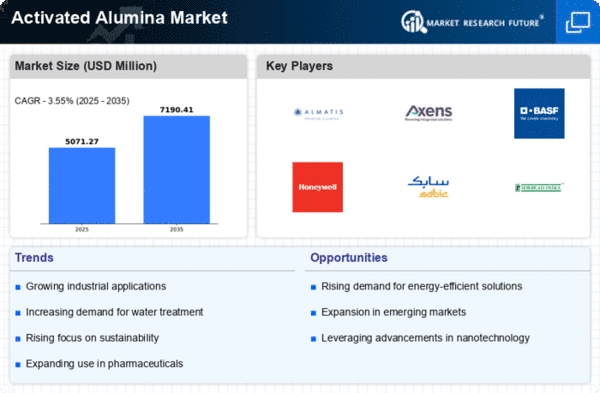
As per MRFR analysis, the Activated Alumina Market Size was estimated at 4897.41 USD Million in 2024. The Activated Alumina industry is projected to grow from 5071.41 USD Million in 2025 to 7190.41 USD Million by 2035, exhibiting a compound annual growth rate (CAGR) of 3.55% during the forecast period 2025 - 2035.

Key Market Trends & Highlights

The Activated Alumina Market is experiencing robust growth driven by sustainability and technological advancements.

  • North America remains the largest market for activated alumina, driven by stringent regulatory compliance and environmental standards. The Asia-Pacific region is emerging as the fastest-growing market, fueled by increasing industrial applications and demand for water treatment solutions. The desiccant segment holds the largest share, while the catalyst support segment is witnessing rapid growth due to technological innovations. Key market drivers include the rising demand for water treatment solutions and the growth in pharmaceutical and healthcare sectors.

Market Size & Forecast

2024 Market Size 4897.41 (USD Million)
2035 Market Size 7190.41 (USD Million)
CAGR (2025 - 2035) 3.55%
Largest Regional Market Share in 2024 Asia-Pacific

Major Players

Almatis (DE), Axens (FR), BASF (DE), Honeywell (US), SABIC (SA), Sorbead (US), Strem Chemicals (US), Süd-Chemie (DE), Tosoh Corporation (JP)

Market Trends

The Activated Alumina Market is currently experiencing a notable transformation, driven by increasing demand across various sectors such as water treatment, pharmaceuticals, and air purification. This material, known for its high adsorption capacity, is becoming essential in applications that require moisture control and contaminant removal. As industries strive for sustainability, the utilization of activated alumina is likely to expand, reflecting a shift towards eco-friendly solutions. Furthermore, advancements in production technologies may enhance the efficiency and effectiveness of activated alumina, potentially leading to broader adoption in emerging markets.

In addition to its growing applications, the activated alumina market is witnessing a rise in research and development activities aimed at improving product performance. Companies are investing in innovative methods to enhance the properties of activated alumina, which could result in superior products that meet the evolving needs of consumers. The competitive landscape is also changing, with new entrants emerging alongside established players, fostering a dynamic environment that encourages collaboration and technological advancements. These developments are shaping major activated alumina market trends, particularly in industrial drying, catalyst support, and water purification applications. Overall, the activated alumina market appears poised for growth, supported by both rising demand and continuous innovation in the activated alumina ball market.

Sustainability Initiatives

The Activated Alumina Market is increasingly influenced by sustainability initiatives. Companies are prioritizing eco-friendly production methods and materials, aligning with global efforts to reduce environmental impact. This trend suggests a growing preference for activated alumina products that not only meet performance standards but also adhere to sustainable practices.

Technological Advancements

Technological advancements are reshaping the Activated Alumina Market. Innovations in manufacturing processes and product formulations are enhancing the efficiency and effectiveness of activated alumina. This trend indicates a potential for improved performance in applications such as air and water purification, thereby expanding market opportunities.

Regulatory Compliance

Regulatory compliance is becoming a driving force in the Activated Alumina Market. Stricter environmental regulations are prompting industries to adopt activated alumina for its superior adsorption properties. This trend highlights the material's role in helping companies meet compliance standards while ensuring product quality.

Activated Alumina Market Market Drivers

Rising Applications in Oil and Gas Sector

The Global Activated Alumina Market Industry is witnessing a notable rise in applications within the oil and gas sector. Activated alumina is employed as a desiccant and adsorbent in the refining process, where it aids in the removal of impurities and moisture from hydrocarbons. This application is particularly critical as the industry seeks to enhance efficiency and reduce operational costs. The anticipated growth of the oil and gas sector, coupled with the increasing emphasis on sustainability, suggests a promising future for activated alumina. As the market evolves, it is expected to contribute significantly to the projected market value of 2.56 USD Billion by 2035.

Expanding Use in Pharmaceutical Applications

The Global Activated Alumina Market Industry is experiencing an expansion in the use of activated alumina within pharmaceutical applications. Its properties as an adsorbent make it suitable for various processes, including drug formulation and purification. The pharmaceutical sector's continuous growth, driven by increasing healthcare needs and innovation, is likely to enhance the demand for activated alumina. As regulatory bodies enforce stricter quality control measures, the reliance on high-purity activated alumina is expected to rise. This trend may further solidify the market's position, contributing to the overall growth and development of the industry.

Increasing Demand for Water Treatment Solutions

The Global Activated Alumina Market Industry is experiencing a surge in demand for water treatment solutions, driven by the growing need for clean and safe drinking water. Activated alumina is widely utilized in the removal of fluoride, arsenic, and other contaminants from water. As urbanization progresses and industrial activities expand, the pressure on water resources intensifies. This trend is reflected in the projected market value of 1.29 USD Billion in 2024, indicating a robust growth trajectory. Furthermore, the increasing regulatory focus on water quality standards is likely to propel the adoption of activated alumina in various regions, enhancing its market presence.

Technological Advancements in Production Methods

Technological advancements in the production methods of activated alumina are playing a pivotal role in shaping the Global Activated Alumina Market Industry. Innovations in manufacturing processes are enhancing the quality and efficiency of activated alumina, making it more accessible for various applications. For instance, the development of more efficient calcination techniques is likely to reduce energy consumption and production costs. This improvement not only benefits manufacturers but also encourages wider adoption across industries. As these advancements continue to unfold, they may contribute to the expected compound annual growth rate of 6.44% from 2025 to 2035, reflecting a dynamic market landscape.

Growing Awareness of Environmental Sustainability

The Global Activated Alumina Market Industry is increasingly influenced by the growing awareness of environmental sustainability. As industries and consumers alike prioritize eco-friendly solutions, activated alumina emerges as a viable option due to its recyclable nature and minimal environmental impact. This trend is particularly evident in sectors such as pharmaceuticals and food processing, where stringent regulations on waste management are in place. The shift towards sustainable practices is likely to drive demand for activated alumina, as companies seek to align with environmental standards. Consequently, this heightened awareness may bolster the market's growth trajectory in the coming years.

Market Segment Insights

By Application: Desiccant (Largest) vs. Catalyst Support (Fastest-Growing)

In the Activated Alumina Market, the application segment reveals a diverse distribution among desiccants, catalyst supports, fluoride adsorbents, <a href="https://www.marketresearchfuture.com/reports/water-treatment-systems-market-1568">water treatment</a>, and air treatment. Among these, desiccants hold the largest market share due to their widespread use in moisture control applications across various industries. Catalyst support follows, showcasing robust demand owing to rising catalytic processes in refining and petrochemical sectors, which contribute significantly to overall market dynamics.

Desiccant (Dominant) vs. Catalyst Support (Emerging)

Desiccants are the dominant application in the Activated Alumina Market, primarily utilized for their exceptional moisture-absorbing properties, which are crucial for preserving product quality in industrial and commercial settings. In contrast, catalyst support is emerging rapidly, driven by increased demand for efficient catalytic processes in industries like <a href="https://www.marketresearchfuture.com/reports/petrochemical-market-3164">petrochemicals</a> and automotive. This segment is gaining traction due to technological advancements in catalyst formulations that enhance performance and selectivity. The demand for enhanced environmental regulations and cleaner technologies further boosts the growth of catalyst support applications.

By End Use: Chemical Industry (Largest) vs. Pharmaceutical Industry (Fastest-Growing)

The Activated Alumina Market exhibits a varied distribution of market share across its end-use segments. The Chemical Industry stands as the largest segment, leveraging activated alumina for applications such as catalysts and adsorbents. Following closely, the Pharmaceutical Industry is gaining traction, propelled by increasing demand for high-purity activated alumina in drug manufacturing processes. Other notable segments include Food and Beverage, Oil and Gas, and Water Treatment Facilities, each contributing significantly to the market dynamics.

Chemical Industry: Dominant vs. Pharmaceutical Industry: Emerging

The Chemical Industry remains the dominant force in the Activated Alumina Market due to its extensive applications including catalysis and moisture adsorption, which are crucial for various chemical processes. This segment benefits from established usage patterns and ongoing demand across multiple chemical applications. In contrast, the Pharmaceutical Industry is emerging rapidly, driven by the rising need for specialized materials that ensure sterility and reliability in drug formulations. This shift is supported by innovations and regulatory guidelines favoring high-quality materials. Collectively, these segments illustrate a complex interplay of stability and growth within the market.

By Form: Powder (Largest) vs. Pellets (Fastest-Growing)

In the Activated Alumina Market, the form segment is characterized by various product types, including Powder, Granular, Pellets, and Beads. The Powder form holds the largest market share due to its widespread application in adsorbent materials and catalyst supports. In contrast, while the Granular and Beads forms contribute significantly, they are overshadowed by the growth of Pellets, which is quickly gaining traction in the market due to its unique properties and versatility.

Granular (Dominant) vs. Beads (Emerging)

In the Activated Alumina Market, Granular form is regarded as the dominant player due to its effectiveness in various industrial applications, including water treatment and gas drying. Its ability to maintain structural integrity and high adsorption capacity makes it a preferred choice for many manufacturers. Meanwhile, Beads represent an emerging segment characterized by their enhanced surface area and spherical shape, which facilitate improved flow and adsorption efficiency. As industries seek more efficient solutions for moisture control and pollutant removal, Beads are expected to witness rapid growth, attracting interest from both producers and end-users.

By Type: Activated Alumina for Water Treatment (Largest) vs. Activated Alumina for Fluoride Removal (Fastest-Growing)

The Activated Alumina Market is segmented into various types, of which Activated Alumina for Water Treatment holds the largest market share, attributed to its extensive application in municipal water purification and industrial processes. Activated Alumina for Fluoride Removal is gaining traction, reflecting a growing emphasis on health and environmental protection. Meanwhile, Activated Alumina for Air Drying and Catalyst Support represent niche markets that contribute significantly to the segment dynamics. Growth trends indicate a robust demand for Activated Alumina for Water Treatment, driven by increasing awareness of water quality and treatment regulations across various regions. In contrast, Activated Alumina for Fluoride Removal is emerging as a response to rising fluoride contamination concerns in drinking water, primarily in specific geographic locations. The increased focus on environmental sustainability is also propelling the adoption of Activated Alumina for Air Drying and Catalyst Support, indicating a diversified growth trajectory within this market segment.

Activated Alumina for Water Treatment (Dominant) vs. Activated Alumina for Fluoride Removal (Emerging)

Activated Alumina for Water Treatment is recognized as a dominant force in the Activated Alumina Market, widely utilized for its efficacy in removing contaminants from water sources, thereby enhancing water purity for both residential and industrial applications. Its versatility and capacity to handle various impurities make it integral to environmental health initiatives. On its journey towards full market integration, Activated Alumina for Fluoride Removal is emerging, addressing specific contamination issues that have escalated in priority due to health safeguards and regulatory measures. This segment caters to a targeted demand, particularly in regions facing fluoride pollution challenges, positioning it for rapid growth as consumer awareness on water safety increases. Industry innovations further support the development of these products.

By Functionality: Adsorption (Largest) vs. Filtration (Fastest-Growing)

The Activated Alumina Market is segmented into various functionalities, with Adsorption capturing the largest market share due to its established role in water purification and air treatment applications. This segment has a versatile nature, serving industries ranging from pharmaceuticals to food processing, which significantly bolsters its demand. Filtration, although a smaller segment, is rapidly gaining traction as industries seek efficient solutions for air and liquid purification, increasing its share considerably in recent years.

Filtration: Leading vs. Desiccation: Emerging

Filtration is emerging as a leading functionality in the Activated Alumina Market, driven by the increasing need for high-performance filtration solutions in sectors such as pharmaceuticals, water treatment, and environmental applications. This segment benefits from growing regulatory frameworks pushing for cleaner air and water, prompting manufacturers to innovate and enhance their filtration products. On the other hand, Desiccation, while currently less dominant, is gaining importance in industries like packaging and electronics, where moisture control is critical. The added focus on energy-efficient and effective moisture adsorbents continues to shape advancements in both functionalities, with filtration staying at the forefront of market developments.

Get more detailed insights about Activated Alumina Market Research Report - Global Forecast till 2035

Regional Insights

North America : Established Market with Growth Potential

The North American activated alumina market is projected to reach $1,200.0 million by 2025, driven by increasing demand in water treatment and air purification applications. Regulatory support for environmental sustainability and stricter emission standards are key growth catalysts. The region's focus on innovation and technology adoption further enhances market dynamics, positioning it as a leader in activated alumina production and usage. The United States dominates the North American market, with significant contributions from Canada. Key players such as Honeywell and Sorbead are actively involved in expanding their product offerings and enhancing production capabilities. The competitive landscape is characterized by strategic partnerships and investments aimed at meeting the growing demand for high-quality activated alumina products. The presence of established companies ensures a robust supply chain and innovation in the region.

Europe : Sustainable Solutions Driving Growth

The European activated alumina market is expected to reach $1,000.0 million by 2025, fueled by a strong emphasis on sustainability and environmental regulations. The region is witnessing a shift towards eco-friendly materials, with activated alumina being favored for its efficiency in various applications. Regulatory frameworks promoting green technologies are pivotal in driving market growth, as industries seek to comply with stringent environmental standards. Germany, France, and the UK are leading contributors to the European market, with major players like BASF and Almatis enhancing their production capabilities. The competitive landscape is marked by innovation and collaboration among companies to develop advanced activated alumina solutions. The presence of regulatory bodies ensures that the market remains aligned with sustainability goals, fostering a conducive environment for growth.

Asia-Pacific : Emerging Powerhouse in Market Share

The Asia-Pacific activated alumina market is projected to reach $3,000.0 million by 2025, making it the largest regional market. Rapid industrialization, urbanization, and increasing environmental concerns are driving demand for activated alumina in water treatment and air purification. Government initiatives aimed at improving environmental standards and promoting clean technologies are significant growth drivers in this region. China, Japan, and India are the leading countries in the Asia-Pacific market, with a strong presence of key players like Tosoh Corporation and Strem Chemicals. The competitive landscape is characterized by a mix of local and international companies striving to capture market share. Investments in research and development are crucial for innovation, ensuring that the region remains at the forefront of activated alumina production and application.

Middle East and Africa : Resource-Rich Frontier for Growth

The Middle East and Africa activated alumina market is expected to reach $697.41 million by 2025, driven by increasing industrial activities and a growing focus on environmental sustainability. The region is witnessing a rise in demand for activated alumina in various applications, including oil and gas, water treatment, and pharmaceuticals. Government initiatives aimed at enhancing industrial capabilities are pivotal in fostering market growth. Countries like South Africa and Saudi Arabia are key players in the Middle East and Africa market, with local companies and international firms competing for market share. The presence of major players such as SABIC indicates a robust competitive landscape. As industries in the region continue to evolve, the demand for activated alumina is expected to grow, supported by investments in technology and infrastructure.

Key Players and Competitive Insights

The Activated Alumina Market is currently characterized by a dynamic competitive landscape, driven by increasing demand for water treatment and air purification applications. Key players such as BASF (DE), Honeywell (US), and Almatis (DE) are strategically positioning themselves through innovation and regional expansion. BASF (DE) focuses on enhancing its product portfolio with advanced materials, while Honeywell (US) emphasizes digital transformation to optimize its operational efficiency. Almatis (DE) is actively pursuing partnerships to strengthen its supply chain, which collectively shapes a competitive environment that is increasingly reliant on technological advancements and sustainability initiatives.In terms of business tactics, companies are localizing manufacturing to reduce lead times and optimize supply chains. The market appears moderately fragmented, with several players vying for market share. The collective influence of these key players is significant, as they leverage their operational strengths to enhance market penetration and customer engagement.
In November BASF (DE) announced the launch of a new line of activated alumina products specifically designed for the pharmaceutical industry. This strategic move is likely to enhance BASF's market presence in a niche segment, catering to the growing demand for high-purity materials in drug manufacturing. The introduction of these products may also reflect a broader trend towards specialization within the market, as companies seek to differentiate themselves through tailored solutions.
In October Honeywell (US) unveiled a new digital platform aimed at improving the efficiency of activated alumina production processes. This initiative underscores Honeywell's commitment to integrating AI and IoT technologies into its operations, potentially leading to significant cost reductions and enhanced product quality. Such advancements may position Honeywell as a leader in the digital transformation of the activated alumina sector, aligning with current market trends towards automation and smart manufacturing.
In September Almatis (DE) entered into a strategic partnership with a leading water treatment company to co-develop innovative solutions utilizing activated alumina for enhanced water purification. This collaboration not only expands Almatis's product offerings but also aligns with the increasing regulatory focus on water quality and sustainability. The partnership may serve as a model for future collaborations within the industry, emphasizing the importance of joint ventures in addressing complex environmental challenges.
As of December the Activated Alumina Market is witnessing trends that emphasize digitalization, sustainability, and AI integration. Strategic alliances are increasingly shaping the competitive landscape, as companies recognize the value of collaboration in driving innovation. The shift from price-based competition to a focus on technology and supply chain reliability is evident, suggesting that future competitive differentiation will hinge on the ability to innovate and adapt to evolving market demands.

Key Companies in the Activated Alumina Market include

Industry Developments

    • In October 2021, Shell plc and SE collaborated to determine risk and roll out the basic sorbed adsorption technology. Unlike activated alumina or molecular sieves, Sorbead, which is an aluminosilicate gel, is able to regenerate at relatively low temperatures and is resistant to water and acids. Furthermore, the Szorb adsorption technology guarantees the high quality of the treated gas, which meets the requirements for its transport through pipelines and underground storage and, therefore, is free from glycol.
    • February 2023, Evonik made a statement on the expansion of its fumed aluminum oxide production plant in Yokohama, Japan. The company plans to build its first alumina site in Asia. It is planned to specialize in the development of solutions for lithium-ion batteries, which are found in electric vehicle batteries. It is due to be completed in 2025.
    • In October 2022, Axens signed an Asset Sale Agreement ASA with Rio Tinto Alcan Canada concerning the acquisition of the Rio Tinto Alcan activated alumina business located in Brockville, Ontario, Canada. There will be potential for growth in this business for new global markets.
    • SiAT, a Taiwanese company that specializes in advanced nanomaterials used in batteries, has announced a partnership with Taiwan C.S. Aluminum Corporation. This Foil was unveiled in March 2024 and is intended to enhance the capabilities of Lithium Ion batteries, Sodium batteries, and supercapacitors, which require faster charge and longer life span.
    • In an effort to tackle single-use plastic waste, Grove Collaborative Holdings, Inc. unveiled updates to their preexisting products and launched an entirely new line of products under the brand name “Grove Co.” in March 2024. The company revealed that in order to maintain their competitive edge, they are formulating strong partnerships and intensely focusing on reaching their sustainability goals, these changes come as the company has repositioned itself as a certified B corporation and Public Benefit Corporation.

Intended Audience

    • Potential investors

    • Activated alumina manufacturers

    • Distributors

    • Industry associations

Future Outlook

Activated Alumina Market Future Outlook

The Activated Alumina Market is projected to grow at a 3.55% CAGR from 2025 to 2035, driven by increasing demand in water treatment and air purification applications.

New opportunities lie in:

  • <p>Expansion into emerging markets with tailored activated alumina solutions. Development of high-performance activated alumina for specialized industrial applications. Investment in sustainable production methods to enhance market competitiveness.</p>

By 2035, the Activated Alumina Market is expected to achieve robust growth, reflecting evolving industry needs.

Market Segmentation

Activated Alumina Market Form Outlook

  • Spherical
  • Powder
  • Granular
  • Pelletized

Activated Alumina Market End Use Outlook

  • Chemical Industry
  • Pharmaceuticals
  • Food and Beverage
  • Oil and Gas
  • Water Treatment

Activated Alumina Market Application Outlook

  • Desiccant
  • Catalyst Support
  • Fluoride Adsorbent
  • Water Treatment
  • Air Treatment

Activated Alumina Market Purity Level Outlook

  • Low Purity
  • Medium Purity
  • High Purity

Report Scope

MARKET SIZE 2024 4897.41(USD Million)
MARKET SIZE 2025 5071.41(USD Million)
MARKET SIZE 2035 7190.41(USD Million)
COMPOUND ANNUAL GROWTH RATE (CAGR) 3.55% (2025 - 2035)
REPORT COVERAGE Revenue Forecast, Competitive Landscape, Growth Factors, and Trends
BASE YEAR 2024
Market Forecast Period 2025 - 2035
Historical Data 2019 - 2024
Market Forecast Units USD Million
Key Companies Profiled Almatis (DE), Axens (FR), BASF (DE), Honeywell (US), SABIC (SA), Sorbead (US), Strem Chemicals (US), Süd-Chemie (DE), Tosoh Corporation (JP)
Segments Covered Application, End Use, Form, Purity Level
Key Market Opportunities Growing demand for water treatment solutions drives innovation in the Activated Alumina Market.
Key Market Dynamics Rising demand for activated alumina in water treatment applications drives market growth and innovation in purification technologies.
Countries Covered North America, Europe, APAC, South America, MEA

FAQs

What is the projected market valuation of the Activated Alumina Market by 2035?

<p>The Activated Alumina Market is projected to reach a valuation of 7190.41 USD Million by 2035.</p>

What was the overall market valuation of the Activated Alumina Market in 2024?

<p>In 2024, the overall market valuation of the Activated Alumina Market was 4897.41 USD Million.</p>

What is the expected CAGR for the Activated Alumina Market during the forecast period 2025 - 2035?

<p>The expected CAGR for the Activated Alumina Market during the forecast period 2025 - 2035 is 3.55%.</p>

Which application segment had the highest valuation in 2024?

<p>The Water Treatment application segment had the highest valuation in 2024, amounting to 1500.0 to 2200.0 USD Million.</p>

What are the key players in the Activated Alumina Market?

<p>Key players in the Activated Alumina Market include Almatis, Axens, BASF, Honeywell, SABIC, Sorbead, Strem Chemicals, UOP, and Huntsman.</p>

How does the Chemical Industry segment perform in terms of market valuation?

The Chemical Industry segment had a market valuation ranging from 1200.0 to 1800.0 USD Million in 2024.

What is the market valuation range for Activated Alumina in the form of Granular?

The market valuation range for Activated Alumina in the form of Granular was between 1500.0 and 2200.0 USD Million in 2024.

Which functionality segment is expected to show the highest growth potential?

The Catalysis functionality segment is expected to show the highest growth potential, with a valuation range of 2897.41 to 4190.41 USD Million.

What is the projected valuation for the Water Treatment Facilities end-use segment by 2035?

The projected valuation for the Water Treatment Facilities end-use segment is expected to reach between 2297.41 and 3290.41 USD Million by 2035.

How does the Activated Alumina for Catalyst Support segment perform in 2024?

The Activated Alumina for Catalyst Support segment had a valuation range of 2397.41 to 2990.41 USD Million in 2024.

  1. SECTION I: EXECUTIVE SUMMARY AND KEY HIGHLIGHTS |
    1. EXECUTIVE SUMMARY | |
      1. Market Overview | |
      2. Key Findings | |
      3. Market Segmentation | |
      4. Competitive Landscape | |
      5. Challenges and Opportunities | |
      6. Future Outlook 2
  2. SECTION II: SCOPING, METHODOLOGY AND MARKET STRUCTURE |
    1. MARKET INTRODUCTION | |
      1. Definition | |
      2. Scope of the study | | |
    2. RESEARCH METHODOLOGY | |
      1. Overview | |
      2. Data Mining | |
      3. Secondary Research | |
      4. Primary Research | | |
      5. Forecasting Model | |
      6. Market Size Estimation | | |
      7. Data Triangulation | |
      8. Validation 3
  3. SECTION III: QUALITATIVE ANALYSIS |
    1. MARKET DYNAMICS | |
      1. Overview | |
      2. Drivers | |
      3. Restraints | |
      4. Opportunities |
    2. MARKET FACTOR ANALYSIS | |
      1. Value chain Analysis | |
      2. Porter's Five Forces Analysis | | |
      3. COVID-19 Impact Analysis | | |
  4. SECTION IV: QUANTITATIVE ANALYSIS |
    1. Chemicals and Materials, BY Application (USD Million) | |
      1. Desiccant | |
      2. Catalyst Support | |
      3. Fluoride Adsorbent | |
      4. Water Treatment | |
      5. Air Treatment |
    2. Chemicals and Materials, BY End Use (USD Million) | |
      1. Chemical Industry | |
      2. Pharmaceutical Industry | |
      3. Food and Beverage Industry | |
      4. Oil and Gas Industry | |
      5. Water Treatment Facilities |
    3. Chemicals and Materials, BY Form (USD Million) | |
      1. Powder | |
      2. Granular | |
      3. Pellets | |
      4. Beads |
    4. Chemicals and Materials, BY Type (USD Million) | |
      1. Activated Alumina for Fluoride Removal | |
      2. Activated Alumina for Water Treatment | |
      3. Activated Alumina for Air Drying | |
      4. Activated Alumina for Catalyst Support |
    5. Chemicals and Materials, BY Functionality (USD Million) | |
      1. Adsorption | |
      2. Desiccation | |
      3. Filtration | |
      4. Catalysis |
    6. Chemicals and Materials, BY Region (USD Million) | |
      1. North America | | |
      2. Europe | | |
      3. APAC | | |
      4. South America | | |
      5. MEA | | |
  5. SECTION V: COMPETITIVE ANALYSIS |
    1. Competitive Landscape | |
      1. Overview | |
      2. Competitive Analysis | |
      3. Market share Analysis | |
      4. Major Growth Strategy in the Chemicals and Materials | |
      5. Competitive Benchmarking | |
      6. Leading Players in Terms of Number of Developments in the Chemicals and Materials | |
      7. Key developments and growth strategies | | |
      8. Major Players Financial Matrix | | |
    2. Company Profiles | |
      1. Almatis (DE) | | |
      2. Axens (FR) | | |
      3. BASF (DE) | | |
      4. Honeywell (US) | | |
      5. SABIC (SA) | | |
      6. Sorbead (IN) | | |
      7. Strem Chemicals (US) | | |
      8. UOP (US) | | |
      9. Huntsman (US) | | |
    3. Appendix | |
      1. References | |
      2. Related Reports 6 LIST OF FIGURES |
    4. MARKET SYNOPSIS |
    5. NORTH AMERICA MARKET ANALYSIS |
    6. US MARKET ANALYSIS BY APPLICATION |
    7. US MARKET ANALYSIS BY END USE |
    8. US MARKET ANALYSIS BY FORM |
    9. US MARKET ANALYSIS BY TYPE |
    10. US MARKET ANALYSIS BY FUNCTIONALITY |
    11. CANADA MARKET ANALYSIS BY APPLICATION |
    12. CANADA MARKET ANALYSIS BY END USE |
    13. CANADA MARKET ANALYSIS BY FORM |
    14. CANADA MARKET ANALYSIS BY TYPE |
    15. CANADA MARKET ANALYSIS BY FUNCTIONALITY |
    16. EUROPE MARKET ANALYSIS |
    17. GERMANY MARKET ANALYSIS BY APPLICATION |
    18. GERMANY MARKET ANALYSIS BY END USE |
    19. GERMANY MARKET ANALYSIS BY FORM |
    20. GERMANY MARKET ANALYSIS BY TYPE |
    21. GERMANY MARKET ANALYSIS BY FUNCTIONALITY |
    22. UK MARKET ANALYSIS BY APPLICATION |
    23. UK MARKET ANALYSIS BY END USE |
    24. UK MARKET ANALYSIS BY FORM |
    25. UK MARKET ANALYSIS BY TYPE |
    26. UK MARKET ANALYSIS BY FUNCTIONALITY |
    27. FRANCE MARKET ANALYSIS BY APPLICATION |
    28. FRANCE MARKET ANALYSIS BY END USE |
    29. FRANCE MARKET ANALYSIS BY FORM |
    30. FRANCE MARKET ANALYSIS BY TYPE |
    31. FRANCE MARKET ANALYSIS BY FUNCTIONALITY |
    32. RUSSIA MARKET ANALYSIS BY APPLICATION |
    33. RUSSIA MARKET ANALYSIS BY END USE |
    34. RUSSIA MARKET ANALYSIS BY FORM |
    35. RUSSIA MARKET ANALYSIS BY TYPE |
    36. RUSSIA MARKET ANALYSIS BY FUNCTIONALITY |
    37. ITALY MARKET ANALYSIS BY APPLICATION |
    38. ITALY MARKET ANALYSIS BY END USE |
    39. ITALY MARKET ANALYSIS BY FORM |
    40. ITALY MARKET ANALYSIS BY TYPE |
    41. ITALY MARKET ANALYSIS BY FUNCTIONALITY |
    42. SPAIN MARKET ANALYSIS BY APPLICATION |
    43. SPAIN MARKET ANALYSIS BY END USE |
    44. SPAIN MARKET ANALYSIS BY FORM |
    45. SPAIN MARKET ANALYSIS BY TYPE |
    46. SPAIN MARKET ANALYSIS BY FUNCTIONALITY |
    47. REST OF EUROPE MARKET ANALYSIS BY APPLICATION |
    48. REST OF EUROPE MARKET ANALYSIS BY END USE |
    49. REST OF EUROPE MARKET ANALYSIS BY FORM |
    50. REST OF EUROPE MARKET ANALYSIS BY TYPE |
    51. REST OF EUROPE MARKET ANALYSIS BY FUNCTIONALITY |
    52. APAC MARKET ANALYSIS |
    53. CHINA MARKET ANALYSIS BY APPLICATION |
    54. CHINA MARKET ANALYSIS BY END USE |
    55. CHINA MARKET ANALYSIS BY FORM |
    56. CHINA MARKET ANALYSIS BY TYPE |
    57. CHINA MARKET ANALYSIS BY FUNCTIONALITY |
    58. INDIA MARKET ANALYSIS BY APPLICATION |
    59. INDIA MARKET ANALYSIS BY END USE |
    60. INDIA MARKET ANALYSIS BY FORM |
    61. INDIA MARKET ANALYSIS BY TYPE |
    62. INDIA MARKET ANALYSIS BY FUNCTIONALITY |
    63. JAPAN MARKET ANALYSIS BY APPLICATION |
    64. JAPAN MARKET ANALYSIS BY END USE |
    65. JAPAN MARKET ANALYSIS BY FORM |
    66. JAPAN MARKET ANALYSIS BY TYPE |
    67. JAPAN MARKET ANALYSIS BY FUNCTIONALITY |
    68. SOUTH KOREA MARKET ANALYSIS BY APPLICATION |
    69. SOUTH KOREA MARKET ANALYSIS BY END USE |
    70. SOUTH KOREA MARKET ANALYSIS BY FORM |
    71. SOUTH KOREA MARKET ANALYSIS BY TYPE |
    72. SOUTH KOREA MARKET ANALYSIS BY FUNCTIONALITY |
    73. MALAYSIA MARKET ANALYSIS BY APPLICATION |
    74. MALAYSIA MARKET ANALYSIS BY END USE |
    75. MALAYSIA MARKET ANALYSIS BY FORM |
    76. MALAYSIA MARKET ANALYSIS BY TYPE |
    77. MALAYSIA MARKET ANALYSIS BY FUNCTIONALITY |
    78. THAILAND MARKET ANALYSIS BY APPLICATION |
    79. THAILAND MARKET ANALYSIS BY END USE |
    80. THAILAND MARKET ANALYSIS BY FORM |
    81. THAILAND MARKET ANALYSIS BY TYPE |
    82. THAILAND MARKET ANALYSIS BY FUNCTIONALITY |
    83. INDONESIA MARKET ANALYSIS BY APPLICATION |
    84. INDONESIA MARKET ANALYSIS BY END USE |
    85. INDONESIA MARKET ANALYSIS BY FORM |
    86. INDONESIA MARKET ANALYSIS BY TYPE |
    87. INDONESIA MARKET ANALYSIS BY FUNCTIONALITY |
    88. REST OF APAC MARKET ANALYSIS BY APPLICATION |
    89. REST OF APAC MARKET ANALYSIS BY END USE |
    90. REST OF APAC MARKET ANALYSIS BY FORM |
    91. REST OF APAC MARKET ANALYSIS BY TYPE |
    92. REST OF APAC MARKET ANALYSIS BY FUNCTIONALITY |
    93. SOUTH AMERICA MARKET ANALYSIS |
    94. BRAZIL MARKET ANALYSIS BY APPLICATION |
    95. BRAZIL MARKET ANALYSIS BY END USE |
    96. BRAZIL MARKET ANALYSIS BY FORM |
    97. BRAZIL MARKET ANALYSIS BY TYPE |
    98. BRAZIL MARKET ANALYSIS BY FUNCTIONALITY |
    99. MEXICO MARKET ANALYSIS BY APPLICATION |
    100. MEXICO MARKET ANALYSIS BY END USE |
    101. MEXICO MARKET ANALYSIS BY FORM |
    102. MEXICO MARKET ANALYSIS BY TYPE |
    103. MEXICO MARKET ANALYSIS BY FUNCTIONALITY |
    104. ARGENTINA MARKET ANALYSIS BY APPLICATION |
    105. ARGENTINA MARKET ANALYSIS BY END USE |
    106. ARGENTINA MARKET ANALYSIS BY FORM |
    107. ARGENTINA MARKET ANALYSIS BY TYPE |
    108. ARGENTINA MARKET ANALYSIS BY FUNCTIONALITY |
    109. REST OF SOUTH AMERICA MARKET ANALYSIS BY APPLICATION |
    110. REST OF SOUTH AMERICA MARKET ANALYSIS BY END USE |
    111. REST OF SOUTH AMERICA MARKET ANALYSIS BY FORM |
    112. REST OF SOUTH AMERICA MARKET ANALYSIS BY TYPE |
    113. REST OF SOUTH AMERICA MARKET ANALYSIS BY FUNCTIONALITY |
    114. MEA MARKET ANALYSIS |
    115. GCC COUNTRIES MARKET ANALYSIS BY APPLICATION |
    116. GCC COUNTRIES MARKET ANALYSIS BY END USE |
    117. GCC COUNTRIES MARKET ANALYSIS BY FORM |
    118. GCC COUNTRIES MARKET ANALYSIS BY TYPE |
    119. GCC COUNTRIES MARKET ANALYSIS BY FUNCTIONALITY |
    120. SOUTH AFRICA MARKET ANALYSIS BY APPLICATION |
    121. SOUTH AFRICA MARKET ANALYSIS BY END USE |
    122. SOUTH AFRICA MARKET ANALYSIS BY FORM |
    123. SOUTH AFRICA MARKET ANALYSIS BY TYPE |
    124. SOUTH AFRICA MARKET ANALYSIS BY FUNCTIONALITY |
    125. REST OF MEA MARKET ANALYSIS BY APPLICATION |
    126. REST OF MEA MARKET ANALYSIS BY END USE |
    127. REST OF MEA MARKET ANALYSIS BY FORM |
    128. REST OF MEA MARKET ANALYSIS BY TYPE |
    129. REST OF MEA MARKET ANALYSIS BY FUNCTIONALITY |
    130. KEY BUYING CRITERIA OF CHEMICALS AND MATERIALS |
    131. RESEARCH PROCESS OF MRFR |
    132. DRO ANALYSIS OF CHEMICALS AND MATERIALS |
    133. DRIVERS IMPACT ANALYSIS: CHEMICALS AND MATERIALS |
    134. RESTRAINTS IMPACT ANALYSIS: CHEMICALS AND MATERIALS |
    135. SUPPLY / VALUE CHAIN: CHEMICALS AND MATERIALS |
    136. CHEMICALS AND MATERIALS, BY APPLICATION, 2024 (% SHARE) |
    137. CHEMICALS AND MATERIALS, BY APPLICATION, 2024 TO 2035 (USD Million) |
    138. CHEMICALS AND MATERIALS, BY END USE, 2024 (% SHARE) |
    139. CHEMICALS AND MATERIALS, BY END USE, 2024 TO 2035 (USD Million) |
    140. CHEMICALS AND MATERIALS, BY FORM, 2024 (% SHARE) |
    141. CHEMICALS AND MATERIALS, BY FORM, 2024 TO 2035 (USD Million) |
    142. CHEMICALS AND MATERIALS, BY TYPE, 2024 (% SHARE) |
    143. CHEMICALS AND MATERIALS, BY TYPE, 2024 TO 2035 (USD Million) |
    144. CHEMICALS AND MATERIALS, BY FUNCTIONALITY, 2024 (% SHARE) |
    145. CHEMICALS AND MATERIALS, BY FUNCTIONALITY, 2024 TO 2035 (USD Million) |
    146. BENCHMARKING OF MAJOR COMPETITORS 7 LIST OF TABLES |
    147. LIST OF ASSUMPTIONS | |
      1. |
    148. North America MARKET SIZE ESTIMATES; FORECAST | |
      1. BY APPLICATION, 2025-2035 (USD Million) | |
      2. BY END USE, 2025-2035 (USD Million) | |
      3. BY FORM, 2025-2035 (USD Million) | |
      4. BY TYPE, 2025-2035 (USD Million) | |
      5. BY FUNCTIONALITY, 2025-2035 (USD Million) |
    149. US MARKET SIZE ESTIMATES; FORECAST | |
      1. BY APPLICATION, 2025-2035 (USD Million) | |
      2. BY END USE, 2025-2035 (USD Million) | |
      3. BY FORM, 2025-2035 (USD Million) | |
      4. BY TYPE, 2025-2035 (USD Million) | |
      5. BY FUNCTIONALITY, 2025-2035 (USD Million) |
    150. Canada MARKET SIZE ESTIMATES; FORECAST | |
      1. BY APPLICATION, 2025-2035 (USD Million) | |
      2. BY END USE, 2025-2035 (USD Million) | |
      3. BY FORM, 2025-2035 (USD Million) | |
      4. BY TYPE, 2025-2035 (USD Million) | |
      5. BY FUNCTIONALITY, 2025-2035 (USD Million) |
    151. Europe MARKET SIZE ESTIMATES; FORECAST | |
      1. BY APPLICATION, 2025-2035 (USD Million) | |
      2. BY END USE, 2025-2035 (USD Million) | |
      3. BY FORM, 2025-2035 (USD Million) | |
      4. BY TYPE, 2025-2035 (USD Million) | |
      5. BY FUNCTIONALITY, 2025-2035 (USD Million) |
    152. Germany MARKET SIZE ESTIMATES; FORECAST | |
      1. BY APPLICATION, 2025-2035 (USD Million) | |
      2. BY END USE, 2025-2035 (USD Million) | |
      3. BY FORM, 2025-2035 (USD Million) | |
      4. BY TYPE, 2025-2035 (USD Million) | |
      5. BY FUNCTIONALITY, 2025-2035 (USD Million) |
    153. UK MARKET SIZE ESTIMATES; FORECAST | |
      1. BY APPLICATION, 2025-2035 (USD Million) | |
      2. BY END USE, 2025-2035 (USD Million) | |
      3. BY FORM, 2025-2035 (USD Million) | |
      4. BY TYPE, 2025-2035 (USD Million) | |
      5. BY FUNCTIONALITY, 2025-2035 (USD Million) |
    154. France MARKET SIZE ESTIMATES; FORECAST | |
      1. BY APPLICATION, 2025-2035 (USD Million) | |
      2. BY END USE, 2025-2035 (USD Million) | |
      3. BY FORM, 2025-2035 (USD Million) | |
      4. BY TYPE, 2025-2035 (USD Million) | |
      5. BY FUNCTIONALITY, 2025-2035 (USD Million) |
    155. Russia MARKET SIZE ESTIMATES; FORECAST | |
      1. BY APPLICATION, 2025-2035 (USD Million) | |
      2. BY END USE, 2025-2035 (USD Million) | |
      3. BY FORM, 2025-2035 (USD Million) | |
      4. BY TYPE, 2025-2035 (USD Million) | |
      5. BY FUNCTIONALITY, 2025-2035 (USD Million) |
    156. Italy MARKET SIZE ESTIMATES; FORECAST | |
      1. BY APPLICATION, 2025-2035 (USD Million) | |
      2. BY END USE, 2025-2035 (USD Million) | |
      3. BY FORM, 2025-2035 (USD Million) | |
      4. BY TYPE, 2025-2035 (USD Million) | |
      5. BY FUNCTIONALITY, 2025-2035 (USD Million) |
    157. Spain MARKET SIZE ESTIMATES; FORECAST | |
      1. BY APPLICATION, 2025-2035 (USD Million) | |
      2. BY END USE, 2025-2035 (USD Million) | |
      3. BY FORM, 2025-2035 (USD Million) | |
      4. BY TYPE, 2025-2035 (USD Million) | |
      5. BY FUNCTIONALITY, 2025-2035 (USD Million) |
    158. Rest of Europe MARKET SIZE ESTIMATES; FORECAST | |
      1. BY APPLICATION, 2025-2035 (USD Million) | |
      2. BY END USE, 2025-2035 (USD Million) | |
      3. BY FORM, 2025-2035 (USD Million) | |
      4. BY TYPE, 2025-2035 (USD Million) | |
      5. BY FUNCTIONALITY, 2025-2035 (USD Million) |
    159. APAC MARKET SIZE ESTIMATES; FORECAST | |
      1. BY APPLICATION, 2025-2035 (USD Million) | |
      2. BY END USE, 2025-2035 (USD Million) | |
      3. BY FORM, 2025-2035 (USD Million) | |
      4. BY TYPE, 2025-2035 (USD Million) | |
      5. BY FUNCTIONALITY, 2025-2035 (USD Million) |
    160. China MARKET SIZE ESTIMATES; FORECAST | |
      1. BY APPLICATION, 2025-2035 (USD Million) | |
      2. BY END USE, 2025-2035 (USD Million) | |
      3. BY FORM, 2025-2035 (USD Million) | |
      4. BY TYPE, 2025-2035 (USD Million) | |
      5. BY FUNCTIONALITY, 2025-2035 (USD Million) |
    161. India MARKET SIZE ESTIMATES; FORECAST | |
      1. BY APPLICATION, 2025-2035 (USD Million) | |
      2. BY END USE, 2025-2035 (USD Million) | |
      3. BY FORM, 2025-2035 (USD Million) | |
      4. BY TYPE, 2025-2035 (USD Million) | |
      5. BY FUNCTIONALITY, 2025-2035 (USD Million) |
    162. Japan MARKET SIZE ESTIMATES; FORECAST | |
      1. BY APPLICATION, 2025-2035 (USD Million) | |
      2. BY END USE, 2025-2035 (USD Million) | |
      3. BY FORM, 2025-2035 (USD Million) | |
      4. BY TYPE, 2025-2035 (USD Million) | |
      5. BY FUNCTIONALITY, 2025-2035 (USD Million) |
    163. South Korea MARKET SIZE ESTIMATES; FORECAST | |
      1. BY APPLICATION, 2025-2035 (USD Million) | |
      2. BY END USE, 2025-2035 (USD Million) | |
      3. BY FORM, 2025-2035 (USD Million) | |
      4. BY TYPE, 2025-2035 (USD Million) | |
      5. BY FUNCTIONALITY, 2025-2035 (USD Million) |
    164. Malaysia MARKET SIZE ESTIMATES; FORECAST | |
      1. BY APPLICATION, 2025-2035 (USD Million) | |
      2. BY END USE, 2025-2035 (USD Million) | |
      3. BY FORM, 2025-2035 (USD Million) | |
      4. BY TYPE, 2025-2035 (USD Million) | |
      5. BY FUNCTIONALITY, 2025-2035 (USD Million) |
    165. Thailand MARKET SIZE ESTIMATES; FORECAST | |
      1. BY APPLICATION, 2025-2035 (USD Million) | |
      2. BY END USE, 2025-2035 (USD Million) | |
      3. BY FORM, 2025-2035 (USD Million) | |
      4. BY TYPE, 2025-2035 (USD Million) | |
      5. BY FUNCTIONALITY, 2025-2035 (USD Million) |
    166. Indonesia MARKET SIZE ESTIMATES; FORECAST | |
      1. BY APPLICATION, 2025-2035 (USD Million) | |
      2. BY END USE, 2025-2035 (USD Million) | |
      3. BY FORM, 2025-2035 (USD Million) | |
      4. BY TYPE, 2025-2035 (USD Million) | |
      5. BY FUNCTIONALITY, 2025-2035 (USD Million) |
    167. Rest of APAC MARKET SIZE ESTIMATES; FORECAST | |
      1. BY APPLICATION, 2025-2035 (USD Million) | |
      2. BY END USE, 2025-2035 (USD Million) | |
      3. BY FORM, 2025-2035 (USD Million) | |
      4. BY TYPE, 2025-2035 (USD Million) | |
      5. BY FUNCTIONALITY, 2025-2035 (USD Million) |
    168. South America MARKET SIZE ESTIMATES; FORECAST | |
      1. BY APPLICATION, 2025-2035 (USD Million) | |
      2. BY END USE, 2025-2035 (USD Million) | |
      3. BY FORM, 2025-2035 (USD Million) | |
      4. BY TYPE, 2025-2035 (USD Million) | |
      5. BY FUNCTIONALITY, 2025-2035 (USD Million) |
    169. Brazil MARKET SIZE ESTIMATES; FORECAST | |
      1. BY APPLICATION, 2025-2035 (USD Million) | |
      2. BY END USE, 2025-2035 (USD Million) | |
      3. BY FORM, 2025-2035 (USD Million) | |
      4. BY TYPE, 2025-2035 (USD Million) | |
      5. BY FUNCTIONALITY, 2025-2035 (USD Million) |
    170. Mexico MARKET SIZE ESTIMATES; FORECAST | |
      1. BY APPLICATION, 2025-2035 (USD Million) | |
      2. BY END USE, 2025-2035 (USD Million) | |
      3. BY FORM, 2025-2035 (USD Million) | |
      4. BY TYPE, 2025-2035 (USD Million) | |
      5. BY FUNCTIONALITY, 2025-2035 (USD Million) |
    171. Argentina MARKET SIZE ESTIMATES; FORECAST | |
      1. BY APPLICATION, 2025-2035 (USD Million) | |
      2. BY END USE, 2025-2035 (USD Million) | |
      3. BY FORM, 2025-2035 (USD Million) | |
      4. BY TYPE, 2025-2035 (USD Million) | |
      5. BY FUNCTIONALITY, 2025-2035 (USD Million) |
    172. Rest of South America MARKET SIZE ESTIMATES; FORECAST | |
      1. BY APPLICATION, 2025-2035 (USD Million) | |
      2. BY END USE, 2025-2035 (USD Million) | |
      3. BY FORM, 2025-2035 (USD Million) | |
      4. BY TYPE, 2025-2035 (USD Million) | |
      5. BY FUNCTIONALITY, 2025-2035 (USD Million) |
    173. MEA MARKET SIZE ESTIMATES; FORECAST | |
      1. BY APPLICATION, 2025-2035 (USD Million) | |
      2. BY END USE, 2025-2035 (USD Million) | |
      3. BY FORM, 2025-2035 (USD Million) | |
      4. BY TYPE, 2025-2035 (USD Million) | |
      5. BY FUNCTIONALITY, 2025-2035 (USD Million) |
    174. GCC Countries MARKET SIZE ESTIMATES; FORECAST | |
      1. BY APPLICATION, 2025-2035 (USD Million) | |
      2. BY END USE, 2025-2035 (USD Million) | |
      3. BY FORM, 2025-2035 (USD Million) | |
      4. BY TYPE, 2025-2035 (USD Million) | |
      5. BY FUNCTIONALITY, 2025-2035 (USD Million) |
    175. South Africa MARKET SIZE ESTIMATES; FORECAST | |
      1. BY APPLICATION, 2025-2035 (USD Million) | |
      2. BY END USE, 2025-2035 (USD Million) | |
      3. BY FORM, 2025-2035 (USD Million) | |
      4. BY TYPE, 2025-2035 (USD Million) | |
      5. BY FUNCTIONALITY, 2025-2035 (USD Million) |
    176. Rest of MEA MARKET SIZE ESTIMATES; FORECAST | |
      1. BY APPLICATION, 2025-2035 (USD Million) | |
      2. BY END USE, 2025-2035 (USD Million) | |
      3. BY FORM, 2025-2035 (USD Million) | |
      4. BY TYPE, 2025-2035 (USD Million) | |
      5. BY FUNCTIONALITY, 2025-2035 (USD Million) |
    177. PRODUCT LAUNCH/PRODUCT DEVELOPMENT/APPROVAL | |
      1. |
    178. ACQUISITION/PARTNERSHIP | |

Chemicals and Materials Market Segmentation

Chemicals and Materials By Application (USD Million, 2025-2035)

  • Desiccant
  • Catalyst Support
  • Fluoride Adsorbent
  • Water Treatment
  • Air Treatment

Chemicals and Materials By End Use (USD Million, 2025-2035)

  • Chemical Industry
  • Pharmaceutical Industry
  • Food and Beverage Industry
  • Oil and Gas Industry
  • Water Treatment Facilities

Chemicals and Materials By Form (USD Million, 2025-2035)

  • Powder
  • Granular
  • Pellets
  • Beads

Chemicals and Materials By Type (USD Million, 2025-2035)

  • Activated Alumina for Fluoride Removal
  • Activated Alumina for Water Treatment
  • Activated Alumina for Air Drying
  • Activated Alumina for Catalyst Support

Chemicals and Materials By Functionality (USD Million, 2025-2035)

  • Adsorption
  • Desiccation
  • Filtration
  • Catalysis
Infographic

Free Sample Request

Kindly complete the form below to receive a free sample of this Report

Get Free Sample

Customer Strories

Compare Licence

×
Features License Type
Single User Multiuser License Enterprise User
Price $4,950 $5,950 $7,250
Maximum User Access Limit 1 User Upto 10 Users Unrestricted Access Throughout the Organization
Free Customization
Direct Access to Analyst
Deliverable Format
Platform Access
Discount on Next Purchase 10% 15% 15%
Printable Versions