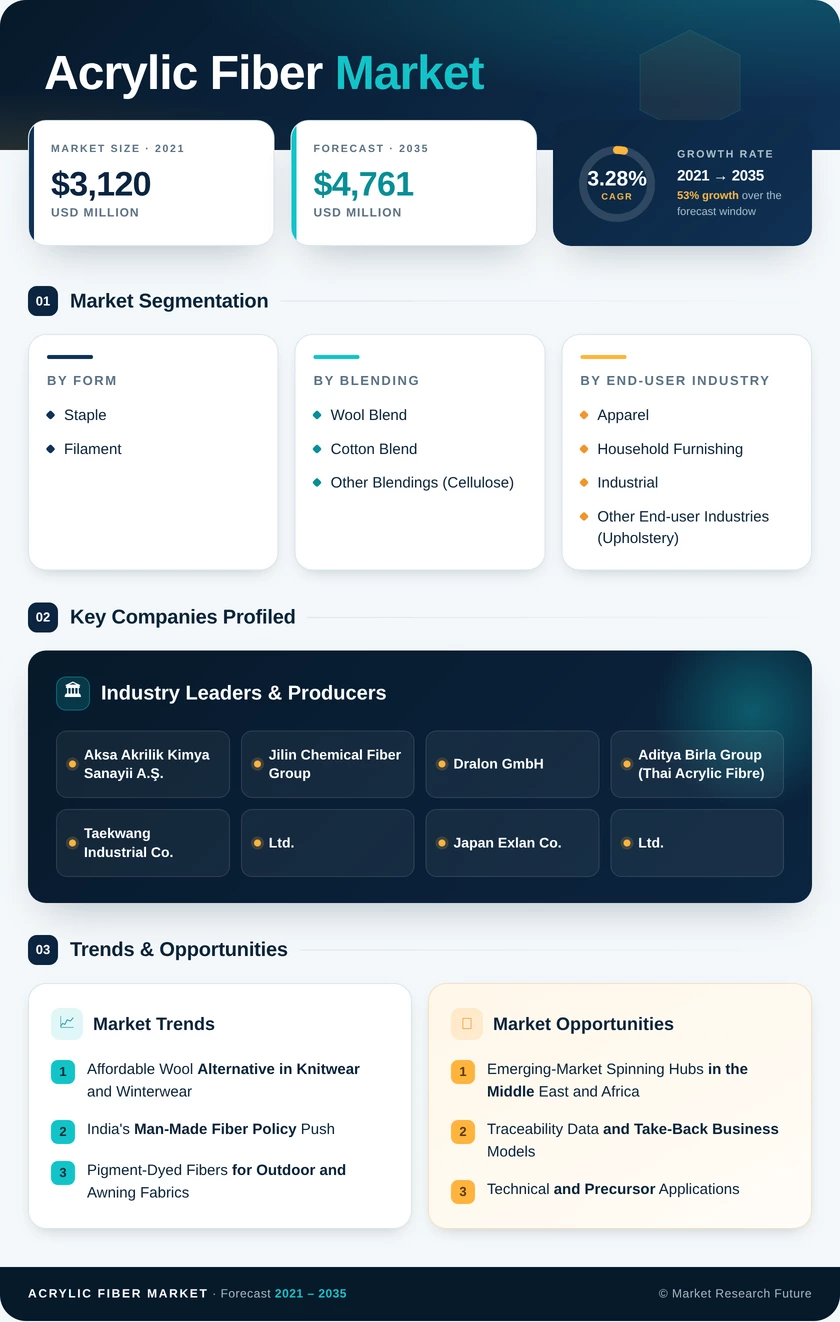
Acrylic Fiber Market (2026 - 2035)

ID: MRFR/CnM/1589-CR 94 Pages Anshula Mandaokar Last Updated: November 06, 2026
Acrylic Fiber Market Research Report Information By Form (Staple and Filament), By Blending (Wool Blend, Cotton Blend, and Other Blends (Cellulose)), By End-User Industry (Apparel, Household Furnishing, Industrial, and Other End-User Industries (Upholstery)), And By Region (North America, Europe, Asia-Pacific, and Rest of the World) – Market Forecast Till 2035.
Acrylic Fiber Market
Market Size
Forecast Period2026-2035
CAGR (2026-2035)3.28%
2025 Market SizeUSD 3,448 Million
2035 Market SizeUSD 4,761 Million
Key Players
Aksa Akrilik Kimya Sanayii A.Ş.
Jilin Chemical Fiber Group
Dralon GmbH
Aditya Birla Group
Taekwang Industrial Co., Ltd.
Japan Exlan Co., Ltd.
Opportunities
  • Emerging-Market Spinning Hubs in the Middle East and Africa
  • Traceability Data and Take-Back Business Models
  • Technical and Precursor Applications
  1. 1 Market Summary | |
  2. 2 Key Report Takeaways | |
    1. 2.1 By Form | |
    2. 2.2 By Blending | |
    3. 2.3 By End-user Industry | |
    4. 2.4 By Region | |
  3. 3 Market Size and Forecast (2021–2035) | |
  4. 4 Driver Impact Analysis | |
    1. 4.1 Affordable Wool Alternative in Knitwear and Winterwear | |
    2. 4.2 India's Man-Made Fiber Policy Push | |
    3. 4.3 Pigment-Dyed Fibers for Outdoor and Awning Fabrics | |
    4. 4.4 Hot-Gas Filtration Under Tighter Emission Rules | |
    5. 4.5 Trade Remedies Lifting Domestic Utilization | |
    6. 4.6 Recycled and Traceable Acrylic Grades | |
  5. 5 Restraints Impact Analysis | |
    1. 5.1 Acrylonitrile Feedstock Price Volatility | |
    2. 5.2 Substitution by Polyester and Recycled PET | |
    3. 5.3 Producer Exits and Capacity Rationalization | |
    4. 5.4 Acrylonitrile Exposure and Emission Compliance | |
    5. 5.5 Microfiber and Recyclability Scrutiny Under EPR | |
  6. 6 Opportunities | |
    1. 6.1 Emerging-Market Spinning Hubs in the Middle East and Africa | |
    2. 6.2 Traceability Data and Take-Back Business Models | |
    3. 6.3 Technical and Precursor Applications | |
    4. 6.4 Flue-Gas Filtration in Asian Power and Steel | |
    5. 6.5 Flame-Retardant Contract Furnishings | |
  7. 7 Regional Market Share and Country-Level Analysis | |
    1. 7.1 North America | | |
      1. 7.1.1 United States | | |
      2. 7.1.2 Canada | | |
      3. 7.1.3 Mexico | |
    2. 7.2 Europe | | |
      1. 7.2.1 Germany | | |
      2. 7.2.2 United Kingdom | | |
      3. 7.2.3 France | | |
      4. 7.2.4 Italy | | |
      5. 7.2.5 Russia | | |
      6. 7.2.6 NORDIC Countries | | |
      7. 7.2.7 Rest of Europe | |
    3. 7.3 Asia-Pacific | | |
      1. 7.3.1 China | | |
      2. 7.3.2 India | | |
      3. 7.3.3 Japan | | |
      4. 7.3.4 South Korea | | |
      5. 7.3.5 ASEAN Countries | | |
      6. 7.3.6 Rest of Asia-Pacific | |
    4. 7.4 South America | | |
      1. 7.4.1 Brazil | | |
      2. 7.4.2 Argentina | | |
      3. 7.4.3 Rest of South America | |
    5. 7.5 Middle East and Africa | | |
      1. 7.5.1 Saudi Arabia | | |
      2. 7.5.2 South Africa | | |
      3. 7.5.3 Rest of Middle East and Africa | |
  8. 8 Future Outlook (2026–2035) | |
    1. 8.1 Circularity Mandates Reshape Product Design | |
    2. 8.2 Feedstock Decarbonization | |
    3. 8.3 Trade Realignment and Regional Supply | |
    4. 8.4 Digital Spinning and Traceability | |
  9. 9 Segmentation Analysis | |
    1. 9.1 By Form | | |
      1. 9.1.1 Staple | | |
      2. 9.1.2 Filament | |
    2. 9.2 By Blending | | |
      1. 9.2.1 Wool Blend | | |
      2. 9.2.2 Cotton Blend | | |
      3. 9.2.3 Other Blends (Cellulose) | |
    3. 9.3 By End-user Industry | | |
      1. 9.3.1 Apparel | | |
      2. 9.3.2 Household Furnishing | | |
      3. 9.3.3 Industrial | | |
      4. 9.3.4 Other End-user Industries (Upholstery) | |
  10. 10 Competitive Landscape | |
    1. 10.1 Market Concentration Analysis | |
    2. 10.2 Competitive Benchmarking Table | |
  11. 11 Recent News & Developments | |
  12. 12 Report Scope and Methodology | |
  13. 13 Detailed Sources and Citations | |
  14. 14 Frequently Asked Questions (FAQs) | | LIST OF TABLES | |
  15. TABLE 1 Global Acrylic Fiber Size Summary, 2025–2035 (USD Million) | |
  16. TABLE 2 Global Acrylic Fiber Size & Forecast, by Revenue, 2021–2035 (USD Million) | |
  17. TABLE 3 Driver Impact Analysis, 2026–2035 | |
  18. TABLE 4 Restraints Impact Analysis, 2026–2035 | |
  19. TABLE 5 Regional Summary, by Region, 2025 | |
  20. TABLE 6 North America, by Country, 2025 | |
  21. TABLE 7 Europe, by Country, 2025 | |
  22. TABLE 8 Asia-Pacific, by Country, 2025 | |
  23. TABLE 9 South America, by Country, 2025 | |
  24. TABLE 10 Middle East and Africa, by Country, 2025 | |
  25. TABLE 11 Global Acrylic Fiber Size, by Form, 2021–2035 (USD Million) | |
  26. TABLE 12 Global Acrylic Fiber Size, by Blending, 2021–2035 (USD Million) | |
  27. TABLE 13 Global Acrylic Fiber Size, by End-user Industry, 2021–2035 (USD Million) | |
  28. TABLE 14 Competitive Benchmarking Table, 2025 | |
  29. TABLE 15 Report Scope and Methodology | |
  30. TABLE 16 Detailed Sources and Citations | | LIST OF FIGURES | |
  31. FIGURE 1 Market Dynamics Overview — Drivers, Restraints, and Opportunities | |
  32. FIGURE 2 Acrylic Fiber Value Chain Analysis | |
  33. FIGURE 3 Porter's Five Forces Analysis | |
  34. FIGURE 4 Global Acrylic Fiber Size Trend, 2021–2035 (USD Million) | |
  35. FIGURE 5 Share by Form, 2025 (%) | |
  36. FIGURE 6 Share by Blending, 2025 (%) | |
  37. FIGURE 7 Share by End-user Industry, 2025 (%) | |
  38. FIGURE 8 Regional Share, 2025 (%) | |
  39. FIGURE 9 Country-Level Share within Asia-Pacific, 2025 (%) | |
  40. FIGURE 10 Competitive Landscape — Estimated Revenue Share Ranges of Key Players, 2025

Segmentation Quick Reference

DimensionSub-SegmentsDominant SegmentFastest Growing Segment
By FormStaple, FilamentStaple (65.2% share)Staple (faster-growing form)
By BlendingWool Blend, Cotton Blend, Other Blends (Cellulose)Wool Blend (48.3% share)Other Blendings (Cellulose) (3.66% CAGR)
By End-user IndustryApparel, Household Furnishing, Industrial, Other End-user Industries (Upholstery)Apparel (62.4% share)Other End-user Industries (Upholstery) (4.15% CAGR)
By RegionNorth America, Europe, Asia-Pacific, South America, Middle East and AfricaAsia-Pacific (68.4% share)Middle East and Africa (4.32% CAGR)

Market Segmentation Overview

By Form

Sub-SegmentKey Trend
StapleFiner-denier grades entering cashmere-touch knitwear
FilamentNiche use in flame-retardant uniforms and technical fabrics

Staple leads with a 65.2% share because standard ring- and open-end spinning mills can process it into high-volume knitwear and blanket yarns. It is also the faster-growing form, as finer-denier staple moves into premium knitwear. Filament grows at 2.95% CAGR, held back by its narrow base in uniforms and technical fabrics where continuous strength matters.

By Blending

Sub-SegmentKey Trend
Wool BlendCost reduction and anti-pilling in mid-range sweaters
Cotton BlendSoftness and moisture management in leisurewear
Other Blends (Cellulose)Viscose and lyocell hybrids for brand circularity targets

Wool Blend leads at 48.3% share because acrylic lowers yarn cost while reducing pilling compared with pure wool. Other Blendings (Cellulose) grow fastest at 3.66% CAGR, as brands pair acrylic with viscose or lyocell to improve biodegradability. Cotton Blend remains the volume middle ground for T-shirts and lightweight leisurewear.

By End-user Industry

Sub-SegmentKey Trend
ApparelKnitwear and outer layers valued for color and warmth
Household FurnishingBlankets and draperies tied to hospitality renovation.
IndustrialNeedle felts for acidic flue-gas filtration.
Other End-user Industries (Upholstery)Flame-retardant contract upholstery

Apparel dominates with a 62.4% share, relying on acrylic's vivid color, warmth, and low shrinkage in knitwear. Other End-user Industries (Upholstery) grow fastest at 4.15% CAGR, as contract furnishing specifications demand flame-retardant fabrics that keep acrylic's color range. Industrial use is rising due to stricter emission rules that favor acrylic filter felts over polyester in acidic gas streams.


Download PDF ×

We do not share your information with anyone. However, we may send you emails based on your report interest from time to time. You may contact us at any time to opt-out.