×
Hero Background
English
Chinese
French
Japanese
Korean
German
Spanish

Acetaldehyde Market Size

ID: MRFR/CnM/4268-HCR
140 Pages
Chitranshi Jaiswal
October 2025

Acetaldehyde Market Research Report Information By Product Type (Pyridine & Pyridine Bases, Pentaerythritol, Acetic Acid, Peracetic Acid, Ethyl Acetate, And Others), by Application (Chemical Synthesis, Food & Beverage, Pharmaceuticals & Cosmetics, Paper & Pulp, Plastics & Synthetic Rubber) and Region - Forecast to 2035

Share:
Download PDF ×

We do not share your information with anyone. However, we may send you emails based on your report interest from time to time. You may contact us at any time to opt-out.

Acetaldehyde Market Infographic
Purchase Options

Acetaldehyde Size

Acetaldehyde Market Growth Projections and Opportunities

The Acetaldehyde market is influenced by various market factors that play a crucial role in shaping its dynamics. One of the primary drivers is the growing demand from the chemical industry. Acetaldehyde serves as a key intermediate in the production of various chemicals, including acetic acid, pyridine, and pentaerythritol. As the chemical industry expands globally, especially in regions like Asia-Pacific, the demand for acetaldehyde is expected to witness a substantial increase.

Additionally, the rise in the automotive sector contributes significantly to the acetaldehyde market. Acetaldehyde is utilized in the production of pyridine bases, which find applications in rubber and tire manufacturing. With the automotive industry experiencing steady growth, particularly in emerging economies, the demand for acetaldehyde in this sector is anticipated to rise.

Market factors are also influenced by the changing consumer preferences and the rise in disposable income. The increasing urbanization and changing lifestyles have led to a surge in the consumption of packaged food and beverages. Acetaldehyde is used in the production of flavor and fragrance agents for food and beverages. As the demand for packaged and processed food continues to grow, the acetaldehyde market is likely to benefit from this trend.

Moreover, government regulations and environmental concerns are pivotal market factors for acetaldehyde. Stringent regulations regarding emissions and environmental impact drive industries to adopt greener practices. Acetaldehyde is used in the production of biodegradable plastics, and as the focus on sustainable materials increases, the demand for acetaldehyde in this application is expected to rise.

Global economic conditions also play a crucial role in shaping the acetaldehyde market. Economic growth, inflation rates, and currency exchange rates impact the overall production and consumption patterns. Fluctuations in these factors can influence the cost of raw materials and transportation, thereby affecting the pricing and profitability of acetaldehyde.

Competitive factors are another key element influencing the acetaldehyde market. The presence of established players, their market share, and strategic alliances impact the overall competitiveness of the market. Innovation and research and development activities by key market players contribute to the growth and evolution of the acetaldehyde market.

Furthermore, the availability of raw materials is a significant market factor. Acetaldehyde is primarily produced from petrochemical feedstocks, and any fluctuations in the supply and prices of these feedstocks can directly impact the acetaldehyde market. Additionally, technological advancements in production processes, such as bio-based production methods, can influence the market dynamics by providing alternative and more sustainable sources for acetaldehyde.

The acetaldehyde market is shaped by a combination of factors, including demand from the chemical and automotive industries, changing consumer preferences, government regulations, economic conditions, competitive landscape, and the availability of raw materials. Understanding and monitoring these market factors are essential for stakeholders in the acetaldehyde industry to make informed decisions and adapt to the evolving market dynamics.
Acetaldehyde Market Size Graph
Author
Chitranshi Jaiswal
Research Analyst Level I

In her 3 years of experience in the market research field, she has handled critical cross-domain projects. She has an in-depth knowledge of market estimation & analysis, problem-solving, primary as well as secondary research, and team management.She holds an engineering degree and is an MBA professional from a well-known university, capable of evaluating the market and competitive conditions. An exceptional strategist with excellent communication skills and a passion for delivering cutting-edge & practical insights for the market. Proficient in multi-tasking, and can successfully deal with competing demands, while maintaining complete confidentiality. Generated business through active client and project development, networking, and high-quality responses. Her knowledge and skills have helped in making solid business decisions, securing funding from investors, and avoiding business failures.

Leave a Comment

FAQs

What is acetaldehyde?

Acetaldehyde is an organic colorless liquid with the chemical formula CH3CHO. It is widely used as a precursor to a number of chemicals.

What is the major product type in the acetaldehyde market?

Major product types in the acetaldehyde market include pyridine and pyridine bases, pentaerythritol, acetic acid, peracetic acid, and ethyl acetate.

What is the major driver for the market?

The increasing demand for a number of industrial chemicals derived from acetaldehyde is the major driver for the global acetaldehyde market.

Which is the leading regional market?

Asia Pacific is the leading regional market for acetaldehyde.

What are the key players in the market?

Leading players in the market include Merck, Sumitomo, and Eastman, among others.

Market Summary

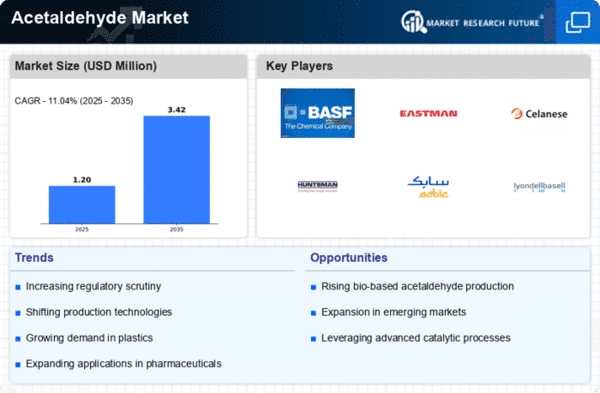
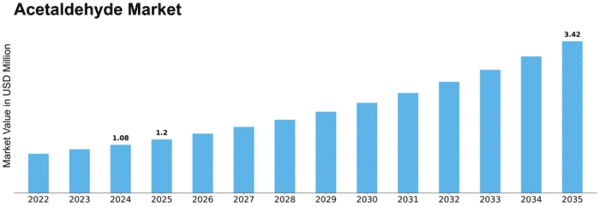
As per MRFR analysis, the Acetaldehyde Market Size was estimated at 1.08 USD Million in 2024. The Acetaldehyde industry is projected to grow from 1.2 in 2025 to 3.42 by 2035, exhibiting a compound annual growth rate (CAGR) of 11.04 during the forecast period 2025 - 2035.

Key Market Trends & Highlights

The Acetaldehyde Market is poised for growth driven by diverse applications and sustainability initiatives.

  • North America remains the largest market for acetaldehyde, primarily due to its extensive use in chemical synthesis.
  • The Asia-Pacific region is currently the fastest-growing market, reflecting increasing industrialization and demand for acetaldehyde.
  • The chemical synthesis segment dominates the market, while the pharmaceuticals segment is experiencing rapid growth.
  • Rising demand in chemical synthesis and the expansion of the food and beverage sector are key drivers propelling market growth.

Market Size & Forecast

2024 Market Size 1.08 (USD Million)
2035 Market Size 3.42 (USD Million)
CAGR (2025 - 2035) 11.04%
Largest Regional Market Share in 2024 Asia-Pacific

Major Players

<p>BASF SE (DE), Eastman Chemical Company (US), Celanese Corporation (US), Huntsman Corporation (US), SABIC (SA), LyondellBasell Industries N.V. (NL), Mitsubishi Gas Chemical Company, Inc. (JP), Oxea GmbH (DE), Formosa Plastics Corporation (TW)</p>

Market Trends

The Acetaldehyde Market is currently experiencing a dynamic phase characterized by evolving applications and regulatory frameworks. This compound, primarily utilized in the production of various chemicals, is witnessing increased demand across multiple sectors, including plastics, textiles, and food processing. The versatility of acetaldehyde as a building block in synthesizing other compounds contributes to its growing significance in industrial applications. Furthermore, the market is influenced by environmental regulations that aim to reduce emissions and promote sustainable practices, thereby shaping production methodologies and consumption patterns. In addition, the Acetaldehyde Market is likely to benefit from advancements in technology that enhance production efficiency and reduce waste. Innovations in catalytic processes and alternative feedstock utilization may provide opportunities for manufacturers to optimize their operations. As industries continue to seek eco-friendly solutions, the demand for acetaldehyde derived from renewable sources could potentially rise. Overall, the market appears poised for growth, driven by both traditional applications and emerging trends that emphasize sustainability and efficiency.

Sustainability Initiatives

The Acetaldehyde Market is increasingly influenced by sustainability initiatives aimed at reducing environmental impact. Manufacturers are exploring greener production methods and alternative feedstocks, which may lead to a shift in sourcing practices. This trend reflects a broader commitment to eco-friendly solutions across various industries.

Technological Advancements

Technological advancements in production processes are reshaping the Acetaldehyde Market. Innovations in catalytic methods and process optimization are likely to enhance efficiency and reduce costs. These developments may enable producers to meet rising demand while adhering to stricter environmental regulations.

Diverse Applications

The versatility of acetaldehyde is driving its adoption in diverse applications. From plastics to food processing, the compound serves as a crucial intermediate in various chemical syntheses. This broad range of uses suggests a robust market potential as industries continue to discover new applications.

Acetaldehyde Market Market Drivers

Growing Demand in Chemical Manufacturing

The Global Acetaldehyde Market Industry is experiencing a surge in demand driven by its extensive use in chemical manufacturing. Acetaldehyde Market serves as a key intermediate in the production of various chemicals, including acetic acid and ethanol. As industries expand, particularly in Asia-Pacific and North America, the need for acetaldehyde is projected to rise. In 2024, the market is valued at approximately 900 USD Million, reflecting the increasing reliance on acetaldehyde in various applications. This trend indicates a robust growth trajectory, with projections suggesting a market value of 1500 USD Million by 2035, highlighting the compound annual growth rate of 4.75% from 2025 to 2035.

Market Segment Insights

By Application: Chemical Synthesis (Largest) vs. Fuel Additive (Fastest-Growing)

<p>In the Acetaldehyde Market, the application segment is diverse, encompassing Chemical Synthesis, Solvent, Fuel Additive, Intermediate, and Preservative. Among these, Chemical Synthesis holds the largest share due to its extensive use in producing various chemicals and pharmaceuticals. Solvent and Intermediate are also significant contributors, but they do not match the dominance of Chemical Synthesis. Fuel Additive, while smaller in current market share, is experiencing rapid growth driven by the increasing demand for more efficient fuels and cleaner emissions.</p>

<p>Chemical Synthesis (Dominant) vs. Fuel Additive (Emerging)</p>

<p>Chemical Synthesis is the dominant application in the Acetaldehyde Market, utilized widely in the production of various chemicals, plastics, and pharmaceuticals. Its established presence is supported by a broad range of applications in industrial processes. In contrast, Fuel Additive is an emerging segment that has gained momentum recently, owing to the rising focus on environmental sustainability and the development of advanced fuel formulations. As regulatory pressures mount for cleaner fuels, the demand for acetaldehyde as a fuel additive is expected to surge, positioning it as a key player in the market's future.</p>

By End Use: Food and Beverage (Largest) vs. Pharmaceuticals (Fastest-Growing)

<p>In the Acetaldehyde Market, the end-use segment distribution illustrates that Food and Beverage applications hold a significant share, driven by the high demand for flavoring agents and preservatives. Other important sectors include Automotive, Agriculture, Cosmetics, and Pharmaceuticals, each contributing uniquely to the overall market landscape. The varying needs of these industries shape acetaldehyde usage and influence market dynamics accordingly. Growth trends reveal that Pharmaceuticals is rapidly emerging, driven by innovations in drug formulation and increased demand for acetaldehyde in the synthesis of essential compounds. Meanwhile, Food and Beverage maintains dominance, but shifts towards more organic and natural products are influencing purchasing habits and production processes. This evolving landscape signifies changing consumer preferences and regulatory environments in the market.</p>

<p>Pharmaceuticals (Dominant) vs. Agriculture (Emerging)</p>

<p>Within the Acetaldehyde Market, Pharmaceuticals represent a dominant end-use sector due to their extensive applications in drug synthesis and formulation, positioning them as a key player influencing demand and pricing. Acetaldehyde's role in producing various pharmaceuticals, including anti-infectives and analgesics, underscores its significance. Conversely, Agriculture is emerging as an important segment, fueled by the need for agrochemicals and plant growth regulators. The increasing focus on sustainable agricultural practices is driving innovations within this segment, although it still lags behind Pharmaceuticals in overall market share and influence. Together, these sectors illustrate a dynamic interplay between traditional and emerging applications, reshaping the market landscape.</p>

By Production Method: Oxidation of Ethylene (Largest) vs. Dehydrogenation of Ethanol (Fastest-Growing)

<p>The production method segment in the acetaldehyde market showcases a diverse range of processes, with significant contributions from oxidation of ethylene, dehydrogenation of ethanol, hydrolysis of acetaldehyde, oxidation of ethanol, and thermal cracking. Among these, oxidation of ethylene currently holds the largest market share due to its efficiency and established technology. Dehydrogenation of ethanol, while smaller, is on a rapid growth trajectory, fueled by increasing demand for eco-friendly production methods and the use of renewable feedstocks.</p>

<p>Oxidation of Ethylene (Dominant) vs. Dehydrogenation of Ethanol (Emerging)</p>

<p>Oxidation of ethylene stands as the dominant production method in the acetaldehyde market, leveraging advanced technologies that ensure higher yields and lower operational costs. This process is well-established, making it the preferred choice for large-scale production. On the other hand, dehydrogenation of ethanol is emerging as a noteworthy alternative, driven by market shifts towards sustainable practices. This method is gaining traction due to its potential for utilizing bioethanol as a feedstock, which aligns with the global push for greener chemistry. As regulations tighten and consumers lean towards sustainable options, dehydrogenation of ethanol is expected to play a pivotal role in the market's future dynamics.</p>

By Purity Level: Industrial Grade (Largest) vs. Laboratory Grade (Fastest-Growing)

<p>In the Acetaldehyde Market, the purity level segment is divided into four main categories: Industrial Grade, Laboratory Grade, Reagent Grade, and Technical Grade. Industrial Grade acetaldehyde commands the largest share due to its widespread use in various industries, including plastics and textiles, making it a staple in manufacturing processes. Following it, Laboratory Grade and Reagent Grade acetaldehyde are also significant, though they hold a smaller share, with Laboratory Grade emerging rapidly as it finds increased applications in research and development laboratories.</p>

<p>Industrial Grade (Dominant) vs. Laboratory Grade (Emerging)</p>

<p>Industrial Grade acetaldehyde stands as the dominant player in the purity level segment, primarily used in the production of acetic acid, perfumes, and as an intermediate in various chemical reactions. Its extensive application in manufacturing quality products ensures its strong market position. On the other hand, Laboratory Grade acetaldehyde is emerging quickly due to its critical role in research and educational environments. It is largely utilized in synthesis and analytical applications, suggesting a growing demand driven by academic research and industrial labs. The push for higher purity levels and stringent regulations also contribute to the advancement of Laboratory Grade acetaldehyde as crucial for precise scientific applications.</p>

By Form: Liquid (Largest) vs. Gas (Fastest-Growing)

<p>In the Acetaldehyde Market, the distribution of market share among the form segments reveals significant insights. Liquid acetaldehyde dominates the market due to its versatility and widespread application in various industries, particularly in the production of acetic acid and other chemicals. This segment's established industrial use positions it as a critical player in the market. In contrast, the gas segment, while smaller in overall share, has been showing rapid growth driven by its increasing utility in specialized applications such as fuel and chemical synthesis, making it a noteworthy contender in the market landscape.</p>

<p>Liquid (Dominant) vs. Gas (Emerging)</p>

<p>Liquid acetaldehyde is characterized by its high stability and ease of storage, making it the preferred choice in chemical manufacturing, particularly in producing acetic acid and other derivatives. Its established presence and significant market share highlight its role as a dominant player. On the other hand, gas phase acetaldehyde is emerging as a preferred option due to its advantages in efficiency and lower energy costs in certain applications. The increasing demand for clean energy solutions and the development of new technologies that can effectively utilize gas acetaldehyde are fueling its growth. This transition reflects a broader market shift toward more sustainable practices.</p>

Get more detailed insights about Acetaldehyde Market Research Report - Forecast to 2035

Regional Insights

North America : Innovation and Demand Growth

The North American acetaldehyde market is projected to grow steadily, driven by increasing demand from the chemical and automotive sectors. With a market share of 30%, the region benefits from robust industrial activities and favorable regulations that promote chemical manufacturing. The push for sustainable practices is also influencing demand, as companies seek eco-friendly alternatives in production processes. Leading countries like the US and Canada are home to major players such as Eastman Chemical Company and Celanese Corporation. These companies are investing in R&D to enhance production efficiency and reduce environmental impact. The competitive landscape is characterized by strategic partnerships and technological advancements, ensuring a strong foothold in the market.

Europe : Regulatory Framework and Innovation

Europe's acetaldehyde market, holding a 25% share, is significantly influenced by stringent environmental regulations and a strong focus on sustainability. The European Union's commitment to reducing carbon emissions is driving innovation in chemical processes, leading to increased demand for acetaldehyde in various applications, including pharmaceuticals and agrochemicals. The region's regulatory framework encourages investment in cleaner technologies, fostering market growth. Germany, France, and the Netherlands are key players in this market, with companies like BASF SE and LyondellBasell Industries leading the charge. The competitive landscape is marked by collaborations between industry and academia, aimed at developing sustainable production methods. This synergy is crucial for maintaining Europe's position as a leader in chemical manufacturing.

Asia-Pacific : Emerging Market Dynamics

Asia-Pacific is the largest market for acetaldehyde, commanding a 50% share due to rapid industrialization and urbanization. The region's growth is fueled by increasing demand from the plastics, textiles, and automotive industries. Countries like China and India are leading this surge, supported by government initiatives aimed at boosting manufacturing capabilities. The favorable economic environment and investment in infrastructure are key drivers of market expansion. China stands out as a major producer, with companies like Mitsubishi Gas Chemical Company and Formosa Plastics Corporation playing pivotal roles. The competitive landscape is characterized by a mix of local and international players, all vying for market share. This dynamic environment fosters innovation and efficiency, ensuring the region's continued dominance in acetaldehyde production.

Middle East and Africa : Emerging Opportunities

The Middle East and Africa (MEA) region, while currently holding a modest 3% market share in acetaldehyde, presents significant growth potential. The market is driven by increasing industrial activities and a growing demand for chemicals in various sectors, including construction and agriculture. Government initiatives aimed at diversifying economies and reducing reliance on oil are also contributing to market growth. Countries like South Africa and Saudi Arabia are emerging as key players in the acetaldehyde market. The presence of major chemical manufacturers is fostering a competitive landscape, with opportunities for new entrants to capitalize on the growing demand. As the region continues to develop its industrial base, the acetaldehyde market is expected to expand significantly in the coming years.

Key Players and Competitive Insights

The Acetaldehyde Market exhibits a dynamic competitive landscape characterized by a blend of established players and emerging contenders. Key growth drivers include the increasing demand for acetaldehyde in the production of various chemicals, including acetic acid and ethanol, alongside its applications in the food and beverage industry as a flavoring agent. Major companies such as BASF SE (Germany), Eastman Chemical Company (US), and Celanese Corporation (US) are strategically positioned to leverage their extensive production capabilities and innovation-driven approaches. These firms focus on enhancing operational efficiencies, expanding their product portfolios, and pursuing strategic partnerships to solidify their market presence, thereby shaping a competitive environment that is both collaborative and competitive.

In terms of business tactics, companies are increasingly localizing manufacturing to reduce transportation costs and enhance supply chain resilience. The market structure appears moderately fragmented, with several key players exerting considerable influence. This fragmentation allows for a diverse range of products and innovations, while also fostering competition among the leading firms. The collective influence of these players is significant, as they engage in continuous improvement of their operational frameworks to meet the evolving demands of the market.

In November 2025, BASF SE (Germany) announced the expansion of its acetaldehyde production facility in Ludwigshafen, aimed at increasing output by 20%. This strategic move is likely to enhance BASF's competitive edge by ensuring a more robust supply chain and meeting the rising demand for acetaldehyde in various applications. The expansion not only signifies a commitment to growth but also reflects the company's focus on sustainability through improved production processes.

In October 2025, Eastman Chemical Company (US) launched a new line of bio-based acetaldehyde, derived from renewable resources. This initiative aligns with the growing trend towards sustainability and positions Eastman as a leader in eco-friendly chemical solutions. The introduction of bio-based products may attract environmentally conscious consumers and industries, potentially increasing market share and enhancing brand reputation.

In September 2025, Celanese Corporation (US) entered into a strategic partnership with a leading technology firm to develop advanced digital solutions for acetaldehyde production. This collaboration aims to integrate AI and machine learning into manufacturing processes, thereby optimizing efficiency and reducing waste. Such technological advancements could redefine operational standards within the industry, setting a new benchmark for productivity and sustainability.

As of December 2025, the competitive trends in the Acetaldehyde Market are increasingly influenced by digitalization, sustainability initiatives, and the integration of AI technologies. Strategic alliances are becoming more prevalent, as companies recognize the value of collaboration in driving innovation and enhancing operational capabilities. Looking ahead, competitive differentiation is expected to evolve, shifting from traditional price-based competition to a focus on innovation, technological advancements, and supply chain reliability. This transition underscores the importance of adaptability and forward-thinking strategies in maintaining a competitive edge in the market.

Key Companies in the Acetaldehyde Market market include

Industry Developments

Future Outlook

Acetaldehyde Market Future Outlook

<p>The Acetaldehyde Market is projected to grow at 11.04% CAGR from 2024 to 2035, driven by increasing demand in the chemical and automotive sectors.</p>

New opportunities lie in:

  • <p>Expansion into bio-based acetaldehyde production methods.</p>
  • <p>Development of advanced storage solutions for acetaldehyde transport.</p>
  • <p>Strategic partnerships with automotive manufacturers for integrated applications.</p>

<p>By 2035, the Acetaldehyde Market is expected to achieve robust growth and enhanced market positioning.</p>

Market Segmentation

Acetaldehyde Market Form Outlook

  • Liquid
  • Gas
  • Solid

Acetaldehyde Market End Use Outlook

  • Automotive
  • Pharmaceuticals
  • Food and Beverage
  • Agriculture
  • Cosmetics

Acetaldehyde Market Application Outlook

  • Chemical Synthesis
  • Solvent
  • Fuel Additive
  • Intermediate
  • Preservative

Acetaldehyde Market Purity Level Outlook

  • Industrial Grade
  • Laboratory Grade
  • Reagent Grade
  • Technical Grade

Acetaldehyde Market Production Method Outlook

  • Oxidation of Ethylene
  • Dehydrogenation of Ethanol
  • Hydrolysis of Acetaldehyde
  • Oxidation of Ethanol
  • Thermal Cracking

Report Scope

MARKET SIZE 20241.08(USD Million)
MARKET SIZE 20251.2(USD Million)
MARKET SIZE 20353.42(USD Million)
COMPOUND ANNUAL GROWTH RATE (CAGR)11.04% (2024 - 2035)
REPORT COVERAGERevenue Forecast, Competitive Landscape, Growth Factors, and Trends
BASE YEAR2024
Market Forecast Period2025 - 2035
Historical Data2019 - 2024
Market Forecast UnitsUSD Million
Key Companies ProfiledBASF SE (DE), Eastman Chemical Company (US), Celanese Corporation (US), Huntsman Corporation (US), SABIC (SA), LyondellBasell Industries N.V. (NL), Mitsubishi Gas Chemical Company, Inc. (JP), Oxea GmbH (DE), Formosa Plastics Corporation (TW)
Segments CoveredApplication, End Use, Production Method, Purity Level, Form
Key Market OpportunitiesGrowing demand for bio-based acetaldehyde in sustainable chemical production presents a key opportunity.
Key Market DynamicsRising demand for acetaldehyde in various industries drives competitive dynamics and regulatory scrutiny in production processes.
Countries CoveredNorth America, Europe, APAC, South America, MEA

FAQs

What is acetaldehyde?

Acetaldehyde is an organic colorless liquid with the chemical formula CH3CHO. It is widely used as a precursor to a number of chemicals.

What is the major product type in the acetaldehyde market?

Major product types in the acetaldehyde market include pyridine and pyridine bases, pentaerythritol, acetic acid, peracetic acid, and ethyl acetate.

What is the major driver for the market?

The increasing demand for a number of industrial chemicals derived from acetaldehyde is the major driver for the global acetaldehyde market.

Which is the leading regional market?

Asia Pacific is the leading regional market for acetaldehyde.

What are the key players in the market?

Leading players in the market include Merck, Sumitomo, and Eastman, among others.

  1. Executive Summary
  2. The scope of the Report
    1. Market Definition
    2. Scope of the
      1. Research Objectives
      2. Assumptions & Limitations
    3. Study
    4. Markets Structure
    5. Market Research Methodology
    6. Research
    7. Process
    8. Secondary Research
    9. Primary Research
    10. Forecast Model
  3. Market Landscape
    1. Porter’s Five Forces Analysis
      1. Threat of New Entrants
      2. Bargaining power of buyers
      3. Segment
    2. Threat of substitutes
    3. rivalry
    4. Value Chain/Supply Chain of
    5. Global Acetaldehyde Market
  4. Industry Overview of Global
    1. Acetaldehyde Market
    2. Introduction
    3. Growth Drivers
    4. Impact analysis
    5. Market Challenges
  5. Market Trends
    1. Introduction
    2. Growth Trends
    3. Impact analysis
    4. Global Acetaldehyde Market by Product Type
    5. Introduction
    6. Pyridine & Pyridine bases
      1. Market Estimates
      2. Market Estimates & Forecast by Region,
    7. & Forecast, 2020-2027
    8. Pentaerythritol
      1. Market Estimates
      2. Market Estimates & Forecast by Region,
    9. & Forecast, 2020-2027
    10. Acetic Acid
      1. Market Estimates &
      2. Market Estimates & Forecast by Region, 2020-2027
    11. Forecast, 2020-2027
    12. Peracetic acid
      1. Market Estimates & Forecast,
      2. Market Estimates & Forecast by Region, 2020-2027
      3. Market Estimates & Forecast, 2020-2027
      4. Market Estimates & Forecast by Region, 2020-2027
      5. Market Estimates & Forecast, 2020-2027
    13. Ethyl acetate
    14. Others
    15. Market Estimates & Forecast by Region, 2020-2027
  6. Global
    1. Acetaldehyde Market by Application
    2. Introduction
      1. Market Estimates & Forecast, 2020-2027
      2. Market Estimates & Forecast by Region, 2020-2027
      3. Market Estimates & Forecast, 2020-2027
      4. Market Estimates & Forecast by Region, 2020-2027
      5. Market Estimates & Forecast,
      6. Market Estimates & Forecast by Region, 2020-2027
      7. Market Estimates & Forecast, 2020-2027
      8. Market Estimates & Forecast by Region, 2020-2027
      9. Market Estimates & Forecast, 2020-2027
      10. Market Estimates & Forecast by Region, 2020-2027
      11. Market Estimates & Forecast,
      12. Market Estimates & Forecast by Region, 2020-2027
      13. Market Estimates & Forecast, 2020-2027
      14. Market
    3. Chemical synthesis
    4. Food & beverage
    5. Pharmaceuticals & Cosmetics
    6. Paints & Coatings
    7. Paper & Pulp
    8. Plastics & Synthetic Rubber
    9. Others
    10. Estimates & Forecast by Region, 2020-2027
  7. Global
    1. Acetaldehyde Market by Region
    2. Introduction
      1. Market Estimates & Forecast, 2020-2027
      2. Market Estimates
      3. US
      4. Canada
    3. North America
    4. Market Estimates & Forecast by Product Type, 2020-2027
    5. & Forecast by Application, 2020-2027
    6. Market Estimates & Forecast, 2020-2027
    7. by Product Type, 2020-2027
    8. Forecast, 2020-2027
    9. Europe
      1. Market Estimates & Forecast, 2020-2027
      2. Market Estimates & Forecast by Product Type, 2020-2027
      3. Market
      4. Germany
      5. France
      6. Italy
      7. Spain
      8. Russia
      9. Poland
    10. Estimates & Forecast by Application, 2020-2027
    11. & Forecast by Product Type, 2020-2027
    12. by Application, 2020-2027
    13. Estimates & Forecast, 2020-2027
    14. by Product Type, 2020-2027
    15. Forecast, 2020-2027
    16. Market Estimates & Forecast by Application, 2020-2027
    17. UK
    18. Estimates & Forecast by Product Type, 2020-2027
    19. & Forecast by Application, 2020-2027
    20. & Forecast by Product Type, 2020-2027
    21. by Application, 2020-2027
    22. Estimates & Forecast, 2020-2027
    23. by Product Type, 2020-2027
    24. Asia Pacific
      1. Market Estimates &
      2. Market Estimates & Forecast by Product Type,
      3. Market Estimates & Forecast by Application, 2020-2027
      4. China
      5. Japan
      6. Australia
      7. New Zealand
    25. Forecast, 2020-2027
    26. Market Estimates & Forecast by Application, 2020-2027
    27. India
    28. Market Estimates & Forecast by Product Type, 2020-2027
    29. & Forecast by Application, 2020-2027
    30. Market Estimates & Forecast, 2020-2027
    31. by Product Type, 2020-2027
    32. Forecast, 2020-2027
    33. Rest of Asia Pacific
    34. Market Estimates & Forecast by Application, 2020-2027
    35. Middle East &
      1. Market Estimates & Forecast, 2020-2027
      2. Market
      3. Market Estimates
      4. Turkey
      5. Israel
      6. North Africa
      7. GCC
      8. Rest
      9. Market Estimates & Forecast, 2020-2027
      10. Market Estimates
      11. Brazil
      12. Argentina
      13. Mexico
      14. Rest of Latin America
    36. Africa
    37. Estimates & Forecast by Product Type, 2020-2027
    38. & Forecast by Application, 2020-2027
    39. & Forecast, 2020-2027
    40. Type, 2020-2027
    41. Market Estimates & Forecast by Application, 2020-2027
    42. & Forecast by Product Type, 2020-2027
    43. by Application, 2020-2027
    44. of Middle East & Africa
    45. Latin America
    46. Market Estimates & Forecast by Product Type, 2020-2027
    47. & Forecast by Application, 2020-2027
    48. Estimates & Forecast, 2020-2027
    49. by Product Type, 2020-2027
    50. & Forecast by Product Type, 2020-2027
    51. by Application, 2020-2027
    52. Estimates & Forecast, 2020-2027
    53. by Product Type, 2020-2027
  8. Company Landscape
  9. Company
    1. Profiles
    2. Celanese Corporation
      1. Company Overview
      2. Product
      3. Financial Updates
      4. Key Developments
    3. Type/Business Segment Overview
    4. Eastman Chemical
      1. Company Overview
      2. Product
      3. Financial Updates
      4. Key Developments
    5. Type/Business Segment Overview
    6. Merck KGaA
      1. Company Overview
      2. Product
      3. Financial Updates
      4. Key Developments
    7. Type/Business Segment Overview
    8. Sumitomo
      1. Company Overview
      2. Financial
      3. Key Developments
    9. Corporation
    10. Product Type/Business Segment Overview
    11. Updates
    12. SEKAB
      1. Company Overview
      2. Product
      3. Financial Updates
      4. Key Developments
    13. Type/Business Segment Overview
    14. SHOWA DENKO
      1. Company Overview
      2. Financial
      3. Key Developments
    15. K.K.
    16. Product Type/Business Segment Overview
    17. Updates
    18. Jubilant
      1. Company Overview
      2. Financial
      3. Key Developments
    19. Life Sciences Ltd.
    20. Product Type/Business Segment Overview
    21. Updates
    22. Ashok
      1. Company Overview
      2. Financial
      3. Key Developments
      4. Company Overview
      5. Product Type/Business Segment Overview
      6. Key Developments
      7. Company Overview
      8. Product Type/Business Segment Overview
      9. Key Developments
      10. Company Overview
      11. Financial
      12. Key Developments
    23. Alco- chem Limited
    24. Product Type/Business Segment Overview
    25. Updates
    26. LCY Group
    27. Financial Updates
    28. Laxmi Organic Industries Ltd.
    29. Financial Updates
    30. Lonza
    31. Product Type/Business Segment Overview
    32. Updates
    33. Naran
      1. Company Overview
      2. Financial
      3. Key Developments
    34. Lala Pvt. Ltd.
    35. Product Type/Business Segment Overview
    36. Updates
    37. Eurochem
      1. Company Overview
      2. Financial
      3. Key Developments
    38. Group AG
    39. Product Type/Business Segment Overview
    40. Updates
    41. Wacker
      1. Company Overview
      2. Financial
      3. Key Developments
    42. Chemie AG
    43. Product Type/Business Segment Overview
    44. Updates
    45. China
      1. Company Overview
      2. Product Type/Business Segment Overview
      3. Key Developments
    46. National Petroleum Corporation
    47. Financial Updates
  10. Conclusion
  11. LIST OF TABLES
    1. Table 1
    2. World Population by Major Regions (2020 To 2027)
    3. Table 2
    4. Global Acetaldehyde Market: By Region, 2020-2027
    5. Table 3
    6. North America Acetaldehyde Market: By Country, 2020-2027
    7. Table
  12. Europe Acetaldehyde Market: By Country, 2020-2027
  13. Asia-Pacific Acetaldehyde Market: By Country, 2020-2027
  14. Middle East & Africa Acetaldehyde Market:
    1. By Country, 2020-2027
  15. Latin America Acetaldehyde
    1. Market: By Country, 2020-2027
  16. Global Acetaldehyde
    1. by Product Types Market: By Regions, 2020-2027
    2. Table 9
    3. North America Acetaldehyde by Product Types Market: By Country, 2020-2027
  17. Europe Acetaldehyde by Product Types Market:
    1. By Country, 2020-2027
    2. Table11 Asia-Pacific Acetaldehyde
    3. by Product Types Market: By Country, 2020-2027
    4. Table13
    5. Middle East & Africa Acetaldehyde by Product Types Market: By Country,
    6. Table12 Latin America Acetaldehyde by Product
    7. Types Market: By Country, 2020-2027
    8. Table14 North
    9. America Acetaldehyde for Application Market: By Country, 2020-2027
    10. Table13
    11. Europe Acetaldehyde for Application Market: By Country, 2020-2027
    12. Table14 Asia-Pacific Acetaldehyde for Application Market: By
    13. Country, 2020-2027
    14. Table16 Middle East & Africa
    15. Acetaldehyde for Application Market: By Country, 2020-2027
    16. Table15
    17. Latin America Acetaldehyde for Application Market: By Country, 2020-2027
    18. Table23 Global Product Types Market: By Region, 2020-2027
    19. Table24 Global Application Market: By Region, 2020-2027
  18. Table25 North America Acetaldehyde Market, By Country
  19. Table26 North America Acetaldehyde Market, By Product Types
  20. Table27 North America Acetaldehyde Market, By Application
  21. Table28 Europe: Acetaldehyde Market, By Country
    1. Table29
  22. Europe: Acetaldehyde Market, By Product Types
    1. Table30
  23. Europe: Acetaldehyde Market, By Application
    1. Table31
  24. Asia-Pacific: Acetaldehyde Market, By Country
    1. Table32
  25. Asia-Pacific: Acetaldehyde Market, By Product Types
    1. Table33
  26. Asia-Pacific: Acetaldehyde Market, By Application
    1. Table36
  27. Middle East & Africa: Acetaldehyde Market, By Country
    1. Table37
  28. Middle East & Africa Acetaldehyde Market, By Product Types
  29. Table33 Middle East & Africa: Acetaldehyde Market, By Application
  30. Table34 Latin America: Acetaldehyde Market, By Country
  31. Table35 Latin America Acetaldehyde Market, By Product
    1. Types
    2. Table33 Latin America: Acetaldehyde Market,
    3. By Application
  32. LIST OF FIGURES
  33. Global
    1. Acetaldehyde Market segmentation
  34. Forecast Methodology
    1. FIGURE
  35. Five Forces Analysis of Global Acetaldehyde Market
  36. Value
    1. Chain of Global Acetaldehyde Market
  37. Share of Global Acetaldehyde
  38. Market in 2020, by country (in %)
  39. Global Acetaldehyde Market,
  40. Sub segments of Product Type
    1. FIGURE 8
    2. Global Acetaldehyde Market size by Product Type, 2020
  41. Share
    1. of Global Acetaldehyde Market by Product Type, 2020-2027
  42. Sub
    1. segments of Application
  43. Global Acetaldehyde Market size by
    1. Application, 2020
  44. Share of Global Acetaldehyde Market by Application,

Acetaldehyde Market Segmentation

Market Segmentation Overview

  • Detailed segmentation data will be available in the full report
  • Comprehensive analysis by multiple parameters
  • Regional and country-level breakdowns
  • Market size forecasts by segment
Infographic

Free Sample Request

Kindly complete the form below to receive a free sample of this Report

Get Free Sample

Customer Strories

Compare Licence

×
Features License Type
Single User Multiuser License Enterprise User
Price $4,950 $5,950 $7,250
Maximum User Access Limit 1 User Upto 10 Users Unrestricted Access Throughout the Organization
Free Customization
Direct Access to Analyst
Deliverable Format
Platform Access
Discount on Next Purchase 10% 15% 15%
Printable Versions