
×
Request Free Sample ×

Kindly complete the form below to receive a free sample of this Report

* Please use a valid business email

Leading companies partner with us for data-driven Insights

clients tt-cursor
Hero Background
English
Chinese
French
Japanese
Korean
German
Spanish

Accounting Software Market Trends

ID: MRFR/ICT/6280-CR
118 Pages
Aarti Dhapte
April 2019

Accounting Software Market Size, Share and Trends Analysis Report By Software Type (Accounting Software (Billing And Invoice Software, Payroll Management Software, Enterprise Resource Planning System), and Tax Software), Deployment Mode (On-premise, and Cloud), Organization Size (Small & Medium Enterprise, and Large Enterprise), Vertical (BFSI, IT and Telecommunication, Manufacturing, Retail and E-commerce, Healthcare), Region (North America, Europe, Asia-Pacific, Middle East & Africa, and South America) - Forecast till 2035

Share:
Download PDF ×

We do not share your information with anyone. However, we may send you emails based on your report interest from time to time. You may contact us at any time to opt-out.

Accounting Software Market Infographic
Purchase Options

Market Trends

Key Emerging Trends in the Accounting Software Market

The global tax and accounting software market is projected to witness a robust Compound Annual Growth Rate (CAGR) of 7.9% from 2019 to 2025, attributing its growth to the escalating demand for automated solutions spanning diverse industry sectors worldwide. This surge is fueled by the software's capacity to efficiently manage financial data, aiding in cost-effective planning within sectors such as manufacturing, retail & consumer goods, and the BFSI domain. Tax and accounting software encompass distinct solutions that enterprises and independent financial consultants employ to navigate financial transactions seamlessly. Tax software primarily facilitates filing various taxes—ranging from income tax to corporate tax and regional levies—while accounting software manages a spectrum of accounting transactions, including accounts payable, accounts receivable, bank reconciliation statements, journals, ledgers, and payroll.

These software solutions have emerged as pivotal tools for small, medium, and large enterprises, with market players offering integrated solutions like ERP systems and standalone solutions such as invoice and billing software and payroll management software.

The escalating enterprise count in developing regions like Asia-Pacific, South America, and the Middle East and Africa fuels the surge in demand for such solutions. Moreover, amendments in taxation policies, such as India's Goods and Services Tax (GST) and the European Union's (EU) Value-Added Tax (VAT), have increased the necessity for accessible tax software. Cloud-based accounting and tax software are also gaining traction among individual professionals for managing their financial affairs. For instance, FreshBooks' annual report estimated that approximately 24 million individuals would be self-employed in the US by 2019. This burgeoning population of self-employed individuals seeks cost-effective and user-friendly accounting and tax software, thereby elevating the demand for cloud-based solutions, a trend also witnessed in regions like Asia-Pacific and the Middle East and Africa.

Market players are strategically investing in research and development endeavors to deliver easy-to-use and cost-effective software solutions. Key industry players such as Xero Limited, Sage, and MYOB have shifted their focus to Amazon Web Services (AWS) and are actively automating bookkeeping services to simplify accounting processes. Xero Limited, for instance, has acquired Hubdoc Inc., utilizing Optical Character Recognition (OCR) technology to extract and analyze essential data, streamlining bank reconciliation processes.

Although the global tax and accounting software market boasts numerous small- and mid-size players offering an array of solutions, a handful of key players such as Intuit Inc., Sage Group plc., Xero Limited, and SAP SE dominate the market landscape, engaging in intense competition based on pricing, software features, and market presence. Additionally, emerging players like Xero Limited and FreshBooks Reviso Cloud Accounting Limited have established themselves as market innovators, wielding strong regional footholds and striving to expand into lucrative markets like Asia-Pacific and the Middle East.

The market's projection paints a vibrant picture, with an anticipated CAGR of 7.9% from 2019 to 2025. In 2018, the accounting software segment commanded a significant market share of 67.5%, while tax software is expected to exhibit the highest CAGR of 8.4%. In terms of organization size, small- and medium-sized enterprises accounted for a substantial share of 58.91% in 2018, projected to grow at an even higher CAGR of 8.1% in the forecast period. Manufacturing stood as the dominant vertical, capturing 33.11% of the market in 2018. Geographically, North America led the tax and accounting software market with a 39.73% market share in 2018, closely followed by Europe with a share of 28.23%. Asia-Pacific exhibits the highest forecasted CAGR of 11.2% from 2019 to 2025, indicative of its burgeoning growth potential in the market.


Author
Aarti Dhapte
AVP - Research

A consulting professional focused on helping businesses navigate complex markets through structured research and strategic insights. I partner with clients to solve high-impact business problems across market entry strategy, competitive intelligence, and opportunity assessment. Over the course of my experience, I have led and contributed to 100+ market research and consulting engagements, delivering insights across multiple industries and geographies, and supporting strategic decisions linked to $500M+ market opportunities. My core expertise lies in building robust market sizing, forecasting, and commercial models (top-down and bottom-up), alongside deep-dive competitive and industry analysis. I have played a key role in shaping go-to-market strategies, investment cases, and growth roadmaps, enabling clients to make confident, data-backed decisions in dynamic markets.

Leave a Comment

FAQs

What is the current valuation of the Accounting Software Market as of 2024?

<p>The Accounting Software Market was valued at 16.06 USD Billion in 2024.</p>

What is the projected market size for the Accounting Software Market by 2035?

<p>The market is projected to reach 42.29 USD Billion by 2035.</p>

What is the expected CAGR for the Accounting Software Market during the forecast period 2025 - 2035?

<p>The expected CAGR for the Accounting Software Market during 2025 - 2035 is 9.2%.</p>

Which companies are considered key players in the Accounting Software Market?

<p>Key players include Intuit, Sage, Oracle, SAP, Xero, FreshBooks, Zoho, Wave, and Microsoft.</p>

How does the market valuation for Accounting Software compare to Tax Software in 2024?

<p>In 2024, the market valuation for Accounting Software was 4.5 USD Billion, compared to 2.5 USD Billion for Tax Software.</p>

What is the projected valuation for Payroll Management Software by 2035?

<p>Payroll Management Software is projected to reach 7.5 USD Billion by 2035.</p>

What are the market segments for Accounting Software based on deployment mode?

<p>The market segments include On-premise, valued at 6.42 USD Billion, and Cloud, valued at 9.64 USD Billion in 2024.</p>

What is the market size for Accounting Software in small and medium enterprises as of 2024?

<p>The market size for Accounting Software in small and medium enterprises was 8.03 USD Billion in 2024.</p>

Which verticals are driving growth in the Accounting Software Market?

<p>Key verticals include BFSI, IT & Telecommunication, Manufacturing, Retail & E-commerce, and Healthcare.</p>

What is the projected growth for the Billing and Invoice Software segment by 2035?

<p>The Billing and Invoice Software segment is projected to grow to 5.0 USD Billion by 2035.</p>

Market Summary

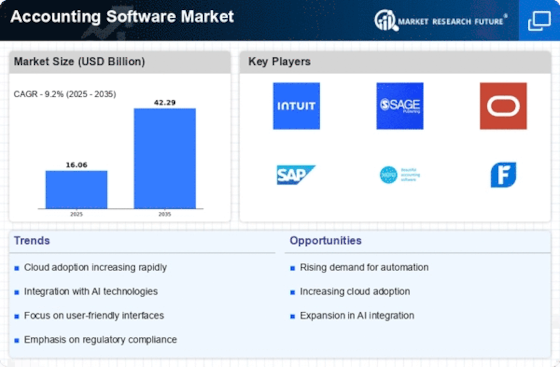
As per Market Research Future analysis, the Accounting Software Market was estimated at 16.06 USD Billion in 2024. The Accounting Software industry is projected to grow from 17.54 USD Billion in 2025 to 42.29 USD Billion by 2035, exhibiting a compound annual growth rate (CAGR) of 9.2% during the forecast period 2025 - 2035

Key Market Trends & Highlights

The Accounting Software Market is experiencing robust growth driven by technological advancements and evolving business needs.

  • North America remains the largest market for accounting software, characterized by high cloud adoption rates. The Asia-Pacific region is emerging as the fastest-growing market, fueled by increasing digital transformation initiatives. Accounting software continues to dominate the market, while tax software is witnessing rapid growth due to regulatory changes. Key market drivers include the rising demand for automation and the need for real-time financial insights, particularly among SMEs.

Market Size & Forecast

2024 Market Size 16.06 (USD Billion)
2035 Market Size 42.29 (USD Billion)
CAGR (2025 - 2035) 9.2%
Largest Regional Market Share in 2024 North America

Major Players

Intuit (US), Sage (GB), <a title="Oracle" href="https://www.oracle.com/in/erp/what-is-accounting-software/" target="_blank" rel="noopener">Oracle</a> (US), SAP (DE), Xero (NZ), FreshBooks (CA), <a title="Zoho" href="https://www.zoho.com/accounting-software/" target="_blank" rel="noopener">Zoho</a> (IN), Wave (CA), Microsoft (US)

Market Trends

The Accounting Software Market is currently experiencing a transformative phase, driven by advancements in technology and evolving business needs. Organizations are increasingly recognizing the necessity of efficient financial management tools that not only streamline operations but also enhance decision-making processes. As digital transformation continues to permeate various sectors, the demand for cloud-based solutions is on the rise, offering flexibility and accessibility that traditional software cannot match. Furthermore, the integration of artificial intelligence and machine learning into accounting software is reshaping functionalities, enabling predictive analytics and automation of routine tasks. Demand for growth stage SaaS accounting software is increasing as startups and mid-sized firms seek flexible and subscription-based financial solutions. In addition to technological advancements, regulatory changes and compliance requirements are influencing the Accounting Software Market. The accounting industry growth is being accelerated by digital transformation, regulatory compliance requirements, and increased adoption of automated financial management solutions. Companies are compelled to adopt solutions that ensure adherence to evolving standards, thereby mitigating risks associated with financial reporting. The emphasis on data security and privacy is also paramount, as organizations seek to protect sensitive information from potential breaches. As the market evolves, it seems likely that providers will continue to innovate, offering tailored solutions that cater to diverse industry needs, ultimately enhancing the overall user experience and operational efficiency. The accounting software industry continues to evolve as businesses prioritize efficiency, accuracy, and real-time financial insights.  Growth in the financial software industry is positively influencing demand for advanced accounting platforms across multiple verticals. Accounting software for growing businesses is gaining traction as SMEs prioritize scalability and operational efficiency. Businesses are increasingly investing in business growth accounting software to support expansion, forecasting, and performance tracking. Accounting software for public companies focuses on compliance, audit readiness, and transparent financial reporting.

Cloud Adoption

The shift towards cloud-based accounting solutions is becoming increasingly prevalent. Businesses are gravitating towards these platforms due to their scalability, cost-effectiveness, and ease of access. This trend indicates a move away from traditional on-premises software, as organizations seek greater flexibility in managing their financial operations. The cloud accounting software market is witnessing rapid expansion due to its scalability, lower deployment costs, and remote accessibility.

AI Integration

The incorporation of artificial intelligence into accounting software is gaining traction. This trend suggests that businesses are looking to leverage AI for automating repetitive tasks, enhancing accuracy, and providing insights through data analysis. Such capabilities may lead to more informed decision-making and improved financial strategies. This accounting market analysis highlights strong demand for cloud-based platforms, AI-driven automation, and compliance-focused financial solutions. 

Regulatory Compliance

As regulations evolve, the demand for accounting software that ensures compliance is intensifying. Companies are increasingly prioritizing solutions that can adapt to changing legal requirements, thereby reducing the risk of non-compliance. This trend highlights the importance of staying current with financial regulations in a dynamic business environment. The accounting software analysis indicates that organizations are increasingly replacing legacy systems with scalable and integrated digital platforms. The accounting software industry analysis reveals sustained growth driven by SMEs, enterprise  modernization, and rising regulatory complexity.

Accounting Software Market Market Drivers

Increased Demand for Automation

The Accounting Software Market experiences a notable surge in demand for automation solutions. Businesses are increasingly seeking to streamline their financial processes, reduce manual errors, and enhance efficiency. Automation tools within accounting software facilitate tasks such as invoicing, payroll processing, and financial reporting. According to recent data, the automation segment is projected to grow at a compound annual growth rate of approximately 10% over the next five years. This trend indicates a shift towards more sophisticated software solutions that can handle complex accounting tasks with minimal human intervention. As organizations recognize the value of automation in improving accuracy and saving time, the Accounting Software Market is likely to witness a robust expansion driven by this demand.

Growing Focus on Cybersecurity Measures

As the Accounting Software Market evolves, the emphasis on cybersecurity measures is becoming increasingly pronounced. With the rise in cyber threats, businesses are prioritizing the protection of sensitive financial data. Accounting software providers are responding by implementing robust security features, including encryption, multi-factor authentication, and regular security updates. Recent surveys indicate that over 70% of organizations consider cybersecurity a top priority when selecting accounting software. This heightened focus on security is likely to influence purchasing decisions, as companies seek solutions that not only meet their accounting needs but also safeguard their financial information. Consequently, the Accounting Software Market is expected to grow as firms invest in secure software solutions.

Rising Need for Real-Time Financial Insights

In the current business landscape, the need for real-time financial insights is becoming increasingly critical. The Accounting Software Market is responding to this demand by offering solutions that provide instant access to financial data and analytics. Companies are now prioritizing software that enables them to monitor their financial health in real-time, allowing for quicker decision-making and strategic planning. Recent statistics suggest that organizations utilizing real-time accounting software report a 20% improvement in financial performance. This trend underscores the importance of timely information in driving business success, thereby propelling the growth of the Accounting Software Market as firms seek to leverage data for competitive advantage.

Integration of Advanced Analytics and Reporting

The integration of advanced analytics and reporting capabilities into accounting software is transforming the Accounting Software Market. Businesses are increasingly recognizing the value of data-driven decision-making, prompting software providers to enhance their offerings with sophisticated analytical tools. These tools enable users to generate detailed financial reports, forecasts, and performance metrics, facilitating informed strategic planning. The market for analytics in accounting software is expected to grow significantly, with estimates suggesting a growth rate of around 12% annually. This trend indicates a shift towards more comprehensive software solutions that not only manage financial transactions but also provide actionable insights, thereby driving the evolution of the Accounting Software Market.

Expansion of Small and Medium Enterprises (SMEs)

The proliferation of small and medium enterprises (SMEs) is a significant driver for the Accounting Software Market. As SMEs continue to emerge and expand, their need for efficient financial management solutions becomes paramount. Accounting software tailored for SMEs offers affordability, scalability, and user-friendly interfaces, making it accessible for businesses with limited resources. Recent reports indicate that SMEs account for over 90% of all businesses, highlighting a vast market potential. This demographic shift is prompting software developers to create specialized solutions that cater to the unique needs of SMEs, thereby fostering growth within the Accounting Software Market. The increasing number of SMEs is likely to sustain demand for innovative accounting solutions.

Market Segment Insights

By Type: Accounting Software (Largest) vs. Tax Software (Fastest-Growing)

<p>The Accounting Software market exhibits a diverse range of segment values, with the Accounting Software segment capturing the largest share. This segment is primarily driven by the increasing need for businesses to streamline their financial operations and ensure compliance with regulations. Meanwhile, Tax Software is emerging rapidly due to growing complexities in tax regulations and the need for enhanced efficiency in tax preparation and filing processes, making it the fastest-growing segment within the market.</p>

<p>Accounting Software (Dominant) vs. Tax Software (Emerging)</p>

<p>Accounting Software remains a dominant force in the market, characterized by its extensive functionality and widespread adoption across various industries. This segment caters to small and medium-sized enterprises, providing essential features like bookkeeping, financial reporting, and performance analysis. On the other hand, Tax Software is an emerging segment that specifically addresses the intricacies of tax calculation and compliance. As tax laws evolve and businesses seek to avoid penalties, this segment is gaining traction, appealing to both individual tax preparers and corporate tax departments for its efficiency and user-friendly solutions.</p>

By Deployment Mode: Cloud (Largest) vs. On-premise (Fastest-Growing)

In the Accounting Software Market, the deployment mode segment is primarily dominated by Cloud solutions, which are leading in adoption due to their flexibility and lower upfront costs. On-premise options, while still significant, are increasingly declining in market share as businesses look for more agile and scalable solutions. As companies seek to modernize their financial operations, the shift towards Cloud accounting software is becoming more evident, reshaping the competitive landscape in favor of online deployment models.

Cloud (Dominant) vs. On-premise (Emerging)

The Cloud deployment mode has emerged as the dominant force in the Accounting Software Market, offering businesses a range of advantages such as easy accessibility, automatic updates, and enhanced collaboration tools. On the other hand, the On-premise segment continues to hold its ground as an emerging alternative, particularly among established enterprises seeking to maintain tight control over their data and compliance measures. While Cloud solutions benefit from lower operational costs and scalability, On-premise solutions appeal to organizations with specific security needs or regulatory requirements. The convergence of these two deployment modes illustrates the diverse needs of customers in the accounting space and highlights the ongoing evolution driven by technology.

By Organization Size: Small & Medium Enterprise (Largest) vs. Large Enterprise (Fastest-Growing)

In the Accounting Software Market, the distribution of market share is heavily skewed towards the Small &amp; Medium Enterprise (SME) segment, which dominates due to its wide adoption of user-friendly and cost-effective software solutions. SMEs often seek accounting tools that are easy to implement and maintain, allowing them to focus on growth and operations while ensuring compliance and efficiency in financial processes. The small business accounting software market dominates overall adoption due to the need for affordable, easy-to-use, and compliant solutions. On the other hand, the Large Enterprise segment, while smaller in share, is gaining traction as these organizations increasingly require advanced functionalities in accounting software that can handle complex financial structures and reporting demands. Adoption of large enterprise accounting software is rising as organizations require advanced analytics, ERP integration, and multi-entity reporting.

Small &amp; Medium Enterprise: Dominant vs. Large Enterprise: Emerging

The Small &amp; Medium Enterprise (SME) segment stands as the dominant player in the Accounting Software Market due to its significant adoption rates, largely driven by the need for affordability and scalability in financial solutions. This segment benefits from a diverse range of products that cater to varied industry needs, fostering a competitive landscape where innovations thrive. Conversely, the Large Enterprise segment is emerging rapidly, driven by the demand for comprehensive and customizable accounting solutions that can integrate seamlessly with enterprise resource planning (ERP) systems. Large Enterprises are looking for robust software that can handle vast amounts of transaction data, regulatory compliance, and advanced analytics, leading to a growing preference for specialized providers that can meet their unique requirements.

By Vertical: BFSI (Largest) vs. Retail & E-commerce (Fastest-Growing)

In the Accounting Software Market, the BFSI sector commands the largest share, driven by stringent regulatory requirements and the need for robust financial management. The <a href="https://www.marketresearchfuture.com/reports/e-commerce-market-18845">Retail &amp; E-commerce</a> segment, however, is rapidly increasing its presence, capturing market attention with the rise in online transactions and the need for efficient financial tracking. This dynamic distribution reflects the diverse applications of accounting software across different industries, with BFSI firmly established and Retail &amp; E-commerce rising swiftly.

BFSI: Dominant vs. Retail &amp; E-commerce: Emerging

The BFSI sector represents a dominant force in the Accounting Software Market, characterized by complex regulatory environments and the demand for high-level financial analytics. <a href="https://www.marketresearchfuture.com/reports/financial-analytics-market-7680">Financial institutions</a>, including banks and investment firms, leverage sophisticated software solutions to ensure compliance and streamline operations. Conversely, the Retail &amp; E-commerce segment is emerging as a critical player, propelled by the digital transformation and an increasing number of online businesses. These companies require agile accounting solutions to manage transactions and integrate with e-commerce platforms, highlighting the evolving needs of modern businesses in a fast-paced digital economy.

Get more detailed insights about Accounting Software Market Research Report – Forecast till 2035

Regional Insights

By Region, the study segments the market into North America, Europe, Asia-Pacific, Middle East & Africa, and South America. Currently, Accounting Software Market solutions are being extensively used in North America. There are a greater number of industrial sectors, educational institutions, and business segments in the region that require proper accounting management. North American end-user applications have invested in Accounting Software Market solutions due to developed infrastructure and time constraints. Accounting Software Market solutions are being used by an increasing number of healthcare, information technology, manufacturing, E-Commerce, and retail businesses to increase revenue.

In North America, the economic climate provides additional support for investing in the costs associated with installation, maintenance, and other related fees. The North American market benefits from strong adoption of American accounting software, supported by advanced IT infrastructure and regulatory standards.

It is expected that the Asia Pacific region will exhibit the fastest CAGR during the forecast period. One of the major drivers for the growth of the accounting software market in the Asia-Pacific region is the increasing adoption of digital technologies by small and medium-sized enterprises (SMEs). The increasing awareness of the benefits of automation and the need to comply with various financial regulations are driving the adoption of accounting software in this region. Demand for Asia accounting software is rising due to SME digitization and regulatory modernization across emerging economies.

Further, the countries considered in the scope of the accounting software market are the US, Canada, Mexico, UK, Germany, France, Italy, Spain, Switzerland, Austria, Belgium, Denmark, Finland, Greece, Hungary, Italy, Luxembourg, Netherlands, Norway, Poland, Portugal, Slovakia, Sweden, Romania, Ireland, China, Japan, Singapore, Malaysia, Indonesia, Philippines, South Korea, Hong Kong, Macau, Singapore, Brunei, India, Australia & New Zealand, South Africa, Egypt, Nigeria, Saudi Arabia, Qatar, United Arab Emirates, Bahrain, Kuwait, and Oman, Brazil, Argentina, Chile, and others. Adoption of international accounting software is increasing as multinational enterprises seek standardized global financial reporting.

Key Players and Competitive Insights

Major market players are spending a lot of money on R&D to increase their product lines, which will help the accounting software market grow even more. Accounting software used by large companies typically includes ERP-integrated platforms that support complex financial operations and global compliance. Market participants are also taking a range of strategic initiatives to grow their worldwide footprint, including new product launches, contractual agreements, mergers and acquisitions, increased investments, and collaboration with other organizations. Competitors in the accounting software industry must offer cost-effective items to expand and survive in an increasingly competitive and rising market environment. This accounting software report provides detailed insights into market size, segmentation, competitive dynamics, and growth opportunities. Enterprises continue to modernize traditional software accounting programs by migrating to cloud-based platforms. The software of accounting has evolved significantly, offering automation, AI integration, and advanced reporting capabilities.
 
Oracle offers a range of accounting solutions for large enterprises, including Oracle E-Business Suite Financials, which is a comprehensive financial management solution. SAP offers a wide range of accounting solutions for large enterprises, including the SAP S/4HANA Finance, which is a comprehensive financial management solution. Overall, the accounting software market is highly competitive, with a large number of vendors offering a wide range of solutions to meet the needs of different types of businesses. The market is expected to continue to grow as more businesses adopt digital technologies and automate their financial operations.

Key Companies in the Accounting Software Market include

Industry Developments

  • Q2 2024: Intuit names Sasan Goodarzi as CEO, replacing Brad Smith Intuit, the maker of QuickBooks accounting software, announced the appointment of Sasan Goodarzi as its new CEO, succeeding Brad Smith. The leadership change is aimed at driving the next phase of growth for the company.
  • Q2 2024: Accounting software startup Pennylane raises $40M Series B to expand in Europe French accounting software company Pennylane secured $40 million in Series B funding to accelerate its expansion across European markets and further develop its integrated financial management platform.
  • Q2 2024: Xero launches new AI-powered features for small business accounting Xero announced the launch of new artificial intelligence-driven features in its accounting software, designed to automate data entry and provide predictive financial insights for small businesses.
  • Q3 2024: Oracle NetSuite unveils NetSuite Bill Capture to automate accounts payable Oracle NetSuite introduced NetSuite Bill Capture, a new product that automates the accounts payable process by leveraging machine learning to extract and process invoice data.
  • Q3 2024: Sage acquires GoProposal to strengthen accounting practice management offering Sage Group announced the acquisition of GoProposal, a UK-based provider of proposal management software for accountants, to enhance its suite of solutions for accounting firms.
  • Q3 2024: FreshBooks secures $80M in growth financing to fuel product innovation FreshBooks, a cloud accounting software provider, raised $80 million in growth financing to invest in product development and expand its presence in new international markets.
  • Q4 2024: SAP launches new cloud-based accounting suite for mid-sized enterprises SAP announced the launch of a new cloud-based accounting software suite tailored for mid-sized businesses, aiming to simplify compliance and automate financial operations.
  • Q4 2024: Wave partners with Shopify to offer integrated accounting for e-commerce merchants Wave, a provider of free accounting software, announced a partnership with Shopify to deliver integrated accounting solutions for Shopify's e-commerce merchants.
  • Q1 2025: Carbon accounting software startup Persefoni raises $50M Series C Persefoni, a provider of carbon accounting software, closed a $50 million Series C funding round to scale its platform and meet growing demand for ESG reporting tools.
  • Q1 2025: QuickBooks launches new payroll and HR features for small businesses Intuit's QuickBooks introduced new payroll and human resources features to its accounting software, aiming to streamline compliance and employee management for small businesses.
  • Q2 2025: Xero acquires Australian fintech Waddle to expand invoice financing capabilities Xero completed the acquisition of Waddle, an Australian fintech specializing in invoice financing, to enhance its accounting software's cash flow management features.
  • Q2 2025: Zoho Books receives regulatory approval for GST e-invoicing in India Zoho Books, the cloud accounting software from Zoho Corporation, received regulatory approval to offer GST-compliant e-invoicing features for businesses in India.

Future Outlook

Accounting Software Market Future Outlook

The Accounting Software Market is projected to grow at a 9.2% CAGR from 2025 to 2035, driven by digital transformation, regulatory compliance, and demand for real-time analytics.

New opportunities lie in:

  • <p>Integration of AI-driven analytics for predictive financial insights. Development of mobile accounting solutions for remote workforce management. Expansion into emerging markets with localized software offerings.</p>

By 2035, the market is expected to be robust, driven by innovation and increased adoption across various sectors.

Market Segmentation

Accounting Software Market Type Outlook

  • Accounting Software
  • Tax Software
  • Payroll Management Software
  • Billing And Invoice Software
  • Enterprise Resource Planning System
  • Others

Accounting Software Market Vertical Outlook

  • BFSI
  • IT & Telecommunication
  • Manufacturing
  • Retail & E-commerce
  • Healthcare
  • Others

Accounting Software Market Deployment Mode Outlook

  • On-premise
  • Cloud

Accounting Software Market Organization Size Outlook

  • Small & Medium Enterprise
  • Large Enterprise

Report Scope

MARKET SIZE 2024 16.06(USD Billion)
MARKET SIZE 2025 17.54(USD Billion)
MARKET SIZE 2035 42.29(USD Billion)
COMPOUND ANNUAL GROWTH RATE (CAGR) 9.2% (2025 - 2035)
REPORT COVERAGE Revenue Forecast, Competitive Landscape, Growth Factors, and Trends
BASE YEAR 2024
Market Forecast Period 2025 - 2035
Historical Data 2019 - 2024
Market Forecast Units USD Billion
Key Companies Profiled Intuit (US), Sage (GB), Oracle (US), SAP (DE), Xero (NZ), FreshBooks (CA), Zoho (IN), Wave (CA), Microsoft (US)
Segments Covered Software Type
Key Market Opportunities Integration of artificial intelligence and automation enhances efficiency in the Accounting Software Market.
Key Market Dynamics Rising demand for cloud-based solutions drives innovation and competition in the Accounting Software Market.
Countries Covered North America, Europe, APAC, South America, MEA

FAQs

What is the current valuation of the Accounting Software Market as of 2024?

<p>The Accounting Software Market was valued at 16.06 USD Billion in 2024.</p>

What is the projected market size for the Accounting Software Market by 2035?

<p>The market is projected to reach 42.29 USD Billion by 2035.</p>

What is the expected CAGR for the Accounting Software Market during the forecast period 2025 - 2035?

<p>The expected CAGR for the Accounting Software Market during 2025 - 2035 is 9.2%.</p>

Which companies are considered key players in the Accounting Software Market?

<p>Key players include Intuit, Sage, Oracle, SAP, Xero, FreshBooks, Zoho, Wave, and Microsoft.</p>

How does the market valuation for Accounting Software compare to Tax Software in 2024?

<p>In 2024, the market valuation for Accounting Software was 4.5 USD Billion, compared to 2.5 USD Billion for Tax Software.</p>

What is the projected valuation for Payroll Management Software by 2035?

<p>Payroll Management Software is projected to reach 7.5 USD Billion by 2035.</p>

What are the market segments for Accounting Software based on deployment mode?

<p>The market segments include On-premise, valued at 6.42 USD Billion, and Cloud, valued at 9.64 USD Billion in 2024.</p>

What is the market size for Accounting Software in small and medium enterprises as of 2024?

<p>The market size for Accounting Software in small and medium enterprises was 8.03 USD Billion in 2024.</p>

Which verticals are driving growth in the Accounting Software Market?

<p>Key verticals include BFSI, IT & Telecommunication, Manufacturing, Retail & E-commerce, and Healthcare.</p>

What is the projected growth for the Billing and Invoice Software segment by 2035?

<p>The Billing and Invoice Software segment is projected to grow to 5.0 USD Billion by 2035.</p>

  1. SECTION I: EXECUTIVE SUMMARY AND KEY HIGHLIGHTS
    1. | 1.1 EXECUTIVE SUMMARY
    2. | | 1.1.1 Market Overview
    3. | | 1.1.2 Key Findings
    4. | | 1.1.3 Market Segmentation
    5. | | 1.1.4 Competitive Landscape
    6. | | 1.1.5 Challenges and Opportunities
    7. | | 1.1.6 Future Outlook
  2. SECTION II: SCOPING, METHODOLOGY AND MARKET STRUCTURE
    1. | 2.1 MARKET INTRODUCTION
    2. | | 2.1.1 Definition
    3. | | 2.1.2 Scope of the study
    4. | | | 2.1.2.1 Research Objective
    5. | | | 2.1.2.2 Assumption
    6. | | | 2.1.2.3 Limitations
    7. | 2.2 RESEARCH METHODOLOGY
    8. | | 2.2.1 Overview
    9. | | 2.2.2 Data Mining
    10. | | 2.2.3 Secondary Research
    11. | | 2.2.4 Primary Research
    12. | | | 2.2.4.1 Primary Interviews and Information Gathering Process
    13. | | | 2.2.4.2 Breakdown of Primary Respondents
    14. | | 2.2.5 Forecasting Model
    15. | | 2.2.6 Market Size Estimation
    16. | | | 2.2.6.1 Bottom-Up Approach
    17. | | | 2.2.6.2 Top-Down Approach
    18. | | 2.2.7 Data Triangulation
    19. | | 2.2.8 Validation
  3. SECTION III: QUALITATIVE ANALYSIS
    1. | 3.1 MARKET DYNAMICS
    2. | | 3.1.1 Overview
    3. | | 3.1.2 Drivers
    4. | | 3.1.3 Restraints
    5. | | 3.1.4 Opportunities
    6. | 3.2 MARKET FACTOR ANALYSIS
    7. | | 3.2.1 Value chain Analysis
    8. | | 3.2.2 Porter's Five Forces Analysis
    9. | | | 3.2.2.1 Bargaining Power of Suppliers
    10. | | | 3.2.2.2 Bargaining Power of Buyers
    11. | | | 3.2.2.3 Threat of New Entrants
    12. | | | 3.2.2.4 Threat of Substitutes
    13. | | | 3.2.2.5 Intensity of Rivalry
    14. | | 3.2.3 COVID-19 Impact Analysis
    15. | | | 3.2.3.1 Market Impact Analysis
    16. | | | 3.2.3.2 Regional Impact
    17. | | | 3.2.3.3 Opportunity and Threat Analysis
  4. SECTION IV: QUANTITATIVE ANALYSIS
    1. | 4.1 Information and Communications Technology, BY Type (USD Billion)
    2. | | 4.1.1 Accounting Software
    3. | | 4.1.2 Tax Software
    4. | | 4.1.3 Payroll Management Software
    5. | | 4.1.4 Billing And Invoice Software
    6. | | 4.1.5 Enterprise Resource Planning System
    7. | | 4.1.6 Others
    8. | 4.2 Information and Communications Technology, BY Deployment Mode (USD Billion)
    9. | | 4.2.1 On-premise
    10. | | 4.2.2 Cloud
    11. | 4.3 Information and Communications Technology, BY Organization Size (USD Billion)
    12. | | 4.3.1 Small & Medium Enterprise
    13. | | 4.3.2 Large Enterprise
    14. | 4.4 Information and Communications Technology, BY Vertical (USD Billion)
    15. | | 4.4.1 BFSI
    16. | | 4.4.2 IT & Telecommunication
    17. | | 4.4.3 Manufacturing
    18. | | 4.4.4 Retail & E-commerce
    19. | | 4.4.5 Healthcare
    20. | | 4.4.6 Others
    21. | 4.5 Information and Communications Technology, BY Region (USD Billion)
    22. | | 4.5.1 North America
    23. | | | 4.5.1.1 US
    24. | | | 4.5.1.2 Canada
    25. | | 4.5.2 Europe
    26. | | | 4.5.2.1 Germany
    27. | | | 4.5.2.2 UK
    28. | | | 4.5.2.3 France
    29. | | | 4.5.2.4 Russia
    30. | | | 4.5.2.5 Italy
    31. | | | 4.5.2.6 Spain
    32. | | | 4.5.2.7 Rest of Europe
    33. | | 4.5.3 APAC
    34. | | | 4.5.3.1 China
    35. | | | 4.5.3.2 India
    36. | | | 4.5.3.3 Japan
    37. | | | 4.5.3.4 South Korea
    38. | | | 4.5.3.5 Malaysia
    39. | | | 4.5.3.6 Thailand
    40. | | | 4.5.3.7 Indonesia
    41. | | | 4.5.3.8 Rest of APAC
    42. | | 4.5.4 South America
    43. | | | 4.5.4.1 Brazil
    44. | | | 4.5.4.2 Mexico
    45. | | | 4.5.4.3 Argentina
    46. | | | 4.5.4.4 Rest of South America
    47. | | 4.5.5 MEA
    48. | | | 4.5.5.1 GCC Countries
    49. | | | 4.5.5.2 South Africa
    50. | | | 4.5.5.3 Rest of MEA
  5. SECTION V: COMPETITIVE ANALYSIS
    1. | 5.1 Competitive Landscape
    2. | | 5.1.1 Overview
    3. | | 5.1.2 Competitive Analysis
    4. | | 5.1.3 Market share Analysis
    5. | | 5.1.4 Major Growth Strategy in the Information and Communications Technology
    6. | | 5.1.5 Competitive Benchmarking
    7. | | 5.1.6 Leading Players in Terms of Number of Developments in the Information and Communications Technology
    8. | | 5.1.7 Key developments and growth strategies
    9. | | | 5.1.7.1 New Product Launch/Service Deployment
    10. | | | 5.1.7.2 Merger & Acquisitions
    11. | | | 5.1.7.3 Joint Ventures
    12. | | 5.1.8 Major Players Financial Matrix
    13. | | | 5.1.8.1 Sales and Operating Income
    14. | | | 5.1.8.2 Major Players R&D Expenditure. 2023
    15. | 5.2 Company Profiles
    16. | | 5.2.1 Intuit (US)
    17. | | | 5.2.1.1 Financial Overview
    18. | | | 5.2.1.2 Products Offered
    19. | | | 5.2.1.3 Key Developments
    20. | | | 5.2.1.4 SWOT Analysis
    21. | | | 5.2.1.5 Key Strategies
    22. | | 5.2.2 Sage (GB)
    23. | | | 5.2.2.1 Financial Overview
    24. | | | 5.2.2.2 Products Offered
    25. | | | 5.2.2.3 Key Developments
    26. | | | 5.2.2.4 SWOT Analysis
    27. | | | 5.2.2.5 Key Strategies
    28. | | 5.2.3 Oracle (US)
    29. | | | 5.2.3.1 Financial Overview
    30. | | | 5.2.3.2 Products Offered
    31. | | | 5.2.3.3 Key Developments
    32. | | | 5.2.3.4 SWOT Analysis
    33. | | | 5.2.3.5 Key Strategies
    34. | | 5.2.4 SAP (DE)
    35. | | | 5.2.4.1 Financial Overview
    36. | | | 5.2.4.2 Products Offered
    37. | | | 5.2.4.3 Key Developments
    38. | | | 5.2.4.4 SWOT Analysis
    39. | | | 5.2.4.5 Key Strategies
    40. | | 5.2.5 Xero (NZ)
    41. | | | 5.2.5.1 Financial Overview
    42. | | | 5.2.5.2 Products Offered
    43. | | | 5.2.5.3 Key Developments
    44. | | | 5.2.5.4 SWOT Analysis
    45. | | | 5.2.5.5 Key Strategies
    46. | | 5.2.6 FreshBooks (CA)
    47. | | | 5.2.6.1 Financial Overview
    48. | | | 5.2.6.2 Products Offered
    49. | | | 5.2.6.3 Key Developments
    50. | | | 5.2.6.4 SWOT Analysis
    51. | | | 5.2.6.5 Key Strategies
    52. | | 5.2.7 Zoho (IN)
    53. | | | 5.2.7.1 Financial Overview
    54. | | | 5.2.7.2 Products Offered
    55. | | | 5.2.7.3 Key Developments
    56. | | | 5.2.7.4 SWOT Analysis
    57. | | | 5.2.7.5 Key Strategies
    58. | | 5.2.8 Wave (CA)
    59. | | | 5.2.8.1 Financial Overview
    60. | | | 5.2.8.2 Products Offered
    61. | | | 5.2.8.3 Key Developments
    62. | | | 5.2.8.4 SWOT Analysis
    63. | | | 5.2.8.5 Key Strategies
    64. | | 5.2.9 Microsoft (US)
    65. | | | 5.2.9.1 Financial Overview
    66. | | | 5.2.9.2 Products Offered
    67. | | | 5.2.9.3 Key Developments
    68. | | | 5.2.9.4 SWOT Analysis
    69. | | | 5.2.9.5 Key Strategies
    70. | 5.3 Appendix
    71. | | 5.3.1 References
    72. | | 5.3.2 Related Reports
  6. LIST OF FIGURES
    1. | 6.1 MARKET SYNOPSIS
    2. | 6.2 NORTH AMERICA MARKET ANALYSIS
    3. | 6.3 US MARKET ANALYSIS BY TYPE
    4. | 6.4 US MARKET ANALYSIS BY DEPLOYMENT MODE
    5. | 6.5 US MARKET ANALYSIS BY ORGANIZATION SIZE
    6. | 6.6 US MARKET ANALYSIS BY VERTICAL
    7. | 6.7 CANADA MARKET ANALYSIS BY TYPE
    8. | 6.8 CANADA MARKET ANALYSIS BY DEPLOYMENT MODE
    9. | 6.9 CANADA MARKET ANALYSIS BY ORGANIZATION SIZE
    10. | 6.10 CANADA MARKET ANALYSIS BY VERTICAL
    11. | 6.11 EUROPE MARKET ANALYSIS
    12. | 6.12 GERMANY MARKET ANALYSIS BY TYPE
    13. | 6.13 GERMANY MARKET ANALYSIS BY DEPLOYMENT MODE
    14. | 6.14 GERMANY MARKET ANALYSIS BY ORGANIZATION SIZE
    15. | 6.15 GERMANY MARKET ANALYSIS BY VERTICAL
    16. | 6.16 UK MARKET ANALYSIS BY TYPE
    17. | 6.17 UK MARKET ANALYSIS BY DEPLOYMENT MODE
    18. | 6.18 UK MARKET ANALYSIS BY ORGANIZATION SIZE
    19. | 6.19 UK MARKET ANALYSIS BY VERTICAL
    20. | 6.20 FRANCE MARKET ANALYSIS BY TYPE
    21. | 6.21 FRANCE MARKET ANALYSIS BY DEPLOYMENT MODE
    22. | 6.22 FRANCE MARKET ANALYSIS BY ORGANIZATION SIZE
    23. | 6.23 FRANCE MARKET ANALYSIS BY VERTICAL
    24. | 6.24 RUSSIA MARKET ANALYSIS BY TYPE
    25. | 6.25 RUSSIA MARKET ANALYSIS BY DEPLOYMENT MODE
    26. | 6.26 RUSSIA MARKET ANALYSIS BY ORGANIZATION SIZE
    27. | 6.27 RUSSIA MARKET ANALYSIS BY VERTICAL
    28. | 6.28 ITALY MARKET ANALYSIS BY TYPE
    29. | 6.29 ITALY MARKET ANALYSIS BY DEPLOYMENT MODE
    30. | 6.30 ITALY MARKET ANALYSIS BY ORGANIZATION SIZE
    31. | 6.31 ITALY MARKET ANALYSIS BY VERTICAL
    32. | 6.32 SPAIN MARKET ANALYSIS BY TYPE
    33. | 6.33 SPAIN MARKET ANALYSIS BY DEPLOYMENT MODE
    34. | 6.34 SPAIN MARKET ANALYSIS BY ORGANIZATION SIZE
    35. | 6.35 SPAIN MARKET ANALYSIS BY VERTICAL
    36. | 6.36 REST OF EUROPE MARKET ANALYSIS BY TYPE
    37. | 6.37 REST OF EUROPE MARKET ANALYSIS BY DEPLOYMENT MODE
    38. | 6.38 REST OF EUROPE MARKET ANALYSIS BY ORGANIZATION SIZE
    39. | 6.39 REST OF EUROPE MARKET ANALYSIS BY VERTICAL
    40. | 6.40 APAC MARKET ANALYSIS
    41. | 6.41 CHINA MARKET ANALYSIS BY TYPE
    42. | 6.42 CHINA MARKET ANALYSIS BY DEPLOYMENT MODE
    43. | 6.43 CHINA MARKET ANALYSIS BY ORGANIZATION SIZE
    44. | 6.44 CHINA MARKET ANALYSIS BY VERTICAL
    45. | 6.45 INDIA MARKET ANALYSIS BY TYPE
    46. | 6.46 INDIA MARKET ANALYSIS BY DEPLOYMENT MODE
    47. | 6.47 INDIA MARKET ANALYSIS BY ORGANIZATION SIZE
    48. | 6.48 INDIA MARKET ANALYSIS BY VERTICAL
    49. | 6.49 JAPAN MARKET ANALYSIS BY TYPE
    50. | 6.50 JAPAN MARKET ANALYSIS BY DEPLOYMENT MODE
    51. | 6.51 JAPAN MARKET ANALYSIS BY ORGANIZATION SIZE
    52. | 6.52 JAPAN MARKET ANALYSIS BY VERTICAL
    53. | 6.53 SOUTH KOREA MARKET ANALYSIS BY TYPE
    54. | 6.54 SOUTH KOREA MARKET ANALYSIS BY DEPLOYMENT MODE
    55. | 6.55 SOUTH KOREA MARKET ANALYSIS BY ORGANIZATION SIZE
    56. | 6.56 SOUTH KOREA MARKET ANALYSIS BY VERTICAL
    57. | 6.57 MALAYSIA MARKET ANALYSIS BY TYPE
    58. | 6.58 MALAYSIA MARKET ANALYSIS BY DEPLOYMENT MODE
    59. | 6.59 MALAYSIA MARKET ANALYSIS BY ORGANIZATION SIZE
    60. | 6.60 MALAYSIA MARKET ANALYSIS BY VERTICAL
    61. | 6.61 THAILAND MARKET ANALYSIS BY TYPE
    62. | 6.62 THAILAND MARKET ANALYSIS BY DEPLOYMENT MODE
    63. | 6.63 THAILAND MARKET ANALYSIS BY ORGANIZATION SIZE
    64. | 6.64 THAILAND MARKET ANALYSIS BY VERTICAL
    65. | 6.65 INDONESIA MARKET ANALYSIS BY TYPE
    66. | 6.66 INDONESIA MARKET ANALYSIS BY DEPLOYMENT MODE
    67. | 6.67 INDONESIA MARKET ANALYSIS BY ORGANIZATION SIZE
    68. | 6.68 INDONESIA MARKET ANALYSIS BY VERTICAL
    69. | 6.69 REST OF APAC MARKET ANALYSIS BY TYPE
    70. | 6.70 REST OF APAC MARKET ANALYSIS BY DEPLOYMENT MODE
    71. | 6.71 REST OF APAC MARKET ANALYSIS BY ORGANIZATION SIZE
    72. | 6.72 REST OF APAC MARKET ANALYSIS BY VERTICAL
    73. | 6.73 SOUTH AMERICA MARKET ANALYSIS
    74. | 6.74 BRAZIL MARKET ANALYSIS BY TYPE
    75. | 6.75 BRAZIL MARKET ANALYSIS BY DEPLOYMENT MODE
    76. | 6.76 BRAZIL MARKET ANALYSIS BY ORGANIZATION SIZE
    77. | 6.77 BRAZIL MARKET ANALYSIS BY VERTICAL
    78. | 6.78 MEXICO MARKET ANALYSIS BY TYPE
    79. | 6.79 MEXICO MARKET ANALYSIS BY DEPLOYMENT MODE
    80. | 6.80 MEXICO MARKET ANALYSIS BY ORGANIZATION SIZE
    81. | 6.81 MEXICO MARKET ANALYSIS BY VERTICAL
    82. | 6.82 ARGENTINA MARKET ANALYSIS BY TYPE
    83. | 6.83 ARGENTINA MARKET ANALYSIS BY DEPLOYMENT MODE
    84. | 6.84 ARGENTINA MARKET ANALYSIS BY ORGANIZATION SIZE
    85. | 6.85 ARGENTINA MARKET ANALYSIS BY VERTICAL
    86. | 6.86 REST OF SOUTH AMERICA MARKET ANALYSIS BY TYPE
    87. | 6.87 REST OF SOUTH AMERICA MARKET ANALYSIS BY DEPLOYMENT MODE
    88. | 6.88 REST OF SOUTH AMERICA MARKET ANALYSIS BY ORGANIZATION SIZE
    89. | 6.89 REST OF SOUTH AMERICA MARKET ANALYSIS BY VERTICAL
    90. | 6.90 MEA MARKET ANALYSIS
    91. | 6.91 GCC COUNTRIES MARKET ANALYSIS BY TYPE
    92. | 6.92 GCC COUNTRIES MARKET ANALYSIS BY DEPLOYMENT MODE
    93. | 6.93 GCC COUNTRIES MARKET ANALYSIS BY ORGANIZATION SIZE
    94. | 6.94 GCC COUNTRIES MARKET ANALYSIS BY VERTICAL
    95. | 6.95 SOUTH AFRICA MARKET ANALYSIS BY TYPE
    96. | 6.96 SOUTH AFRICA MARKET ANALYSIS BY DEPLOYMENT MODE
    97. | 6.97 SOUTH AFRICA MARKET ANALYSIS BY ORGANIZATION SIZE
    98. | 6.98 SOUTH AFRICA MARKET ANALYSIS BY VERTICAL
    99. | 6.99 REST OF MEA MARKET ANALYSIS BY TYPE
    100. | 6.100 REST OF MEA MARKET ANALYSIS BY DEPLOYMENT MODE
    101. | 6.101 REST OF MEA MARKET ANALYSIS BY ORGANIZATION SIZE
    102. | 6.102 REST OF MEA MARKET ANALYSIS BY VERTICAL
    103. | 6.103 KEY BUYING CRITERIA OF INFORMATION AND COMMUNICATIONS TECHNOLOGY
    104. | 6.104 RESEARCH PROCESS OF MRFR
    105. | 6.105 DRO ANALYSIS OF INFORMATION AND COMMUNICATIONS TECHNOLOGY
    106. | 6.106 DRIVERS IMPACT ANALYSIS: INFORMATION AND COMMUNICATIONS TECHNOLOGY
    107. | 6.107 RESTRAINTS IMPACT ANALYSIS: INFORMATION AND COMMUNICATIONS TECHNOLOGY
    108. | 6.108 SUPPLY / VALUE CHAIN: INFORMATION AND COMMUNICATIONS TECHNOLOGY
    109. | 6.109 INFORMATION AND COMMUNICATIONS TECHNOLOGY, BY TYPE, 2024 (% SHARE)
    110. | 6.110 INFORMATION AND COMMUNICATIONS TECHNOLOGY, BY TYPE, 2024 TO 2035 (USD Billion)
    111. | 6.111 INFORMATION AND COMMUNICATIONS TECHNOLOGY, BY DEPLOYMENT MODE, 2024 (% SHARE)
    112. | 6.112 INFORMATION AND COMMUNICATIONS TECHNOLOGY, BY DEPLOYMENT MODE, 2024 TO 2035 (USD Billion)
    113. | 6.113 INFORMATION AND COMMUNICATIONS TECHNOLOGY, BY ORGANIZATION SIZE, 2024 (% SHARE)
    114. | 6.114 INFORMATION AND COMMUNICATIONS TECHNOLOGY, BY ORGANIZATION SIZE, 2024 TO 2035 (USD Billion)
    115. | 6.115 INFORMATION AND COMMUNICATIONS TECHNOLOGY, BY VERTICAL, 2024 (% SHARE)
    116. | 6.116 INFORMATION AND COMMUNICATIONS TECHNOLOGY, BY VERTICAL, 2024 TO 2035 (USD Billion)
    117. | 6.117 BENCHMARKING OF MAJOR COMPETITORS
  7. LIST OF TABLES
    1. | 7.1 LIST OF ASSUMPTIONS
    2. | | 7.1.1
    3. | 7.2 North America MARKET SIZE ESTIMATES; FORECAST
    4. | | 7.2.1 BY TYPE, 2025-2035 (USD Billion)
    5. | | 7.2.2 BY DEPLOYMENT MODE, 2025-2035 (USD Billion)
    6. | | 7.2.3 BY ORGANIZATION SIZE, 2025-2035 (USD Billion)
    7. | | 7.2.4 BY VERTICAL, 2025-2035 (USD Billion)
    8. | 7.3 US MARKET SIZE ESTIMATES; FORECAST
    9. | | 7.3.1 BY TYPE, 2025-2035 (USD Billion)
    10. | | 7.3.2 BY DEPLOYMENT MODE, 2025-2035 (USD Billion)
    11. | | 7.3.3 BY ORGANIZATION SIZE, 2025-2035 (USD Billion)
    12. | | 7.3.4 BY VERTICAL, 2025-2035 (USD Billion)
    13. | 7.4 Canada MARKET SIZE ESTIMATES; FORECAST
    14. | | 7.4.1 BY TYPE, 2025-2035 (USD Billion)
    15. | | 7.4.2 BY DEPLOYMENT MODE, 2025-2035 (USD Billion)
    16. | | 7.4.3 BY ORGANIZATION SIZE, 2025-2035 (USD Billion)
    17. | | 7.4.4 BY VERTICAL, 2025-2035 (USD Billion)
    18. | 7.5 Europe MARKET SIZE ESTIMATES; FORECAST
    19. | | 7.5.1 BY TYPE, 2025-2035 (USD Billion)
    20. | | 7.5.2 BY DEPLOYMENT MODE, 2025-2035 (USD Billion)
    21. | | 7.5.3 BY ORGANIZATION SIZE, 2025-2035 (USD Billion)
    22. | | 7.5.4 BY VERTICAL, 2025-2035 (USD Billion)
    23. | 7.6 Germany MARKET SIZE ESTIMATES; FORECAST
    24. | | 7.6.1 BY TYPE, 2025-2035 (USD Billion)
    25. | | 7.6.2 BY DEPLOYMENT MODE, 2025-2035 (USD Billion)
    26. | | 7.6.3 BY ORGANIZATION SIZE, 2025-2035 (USD Billion)
    27. | | 7.6.4 BY VERTICAL, 2025-2035 (USD Billion)
    28. | 7.7 UK MARKET SIZE ESTIMATES; FORECAST
    29. | | 7.7.1 BY TYPE, 2025-2035 (USD Billion)
    30. | | 7.7.2 BY DEPLOYMENT MODE, 2025-2035 (USD Billion)
    31. | | 7.7.3 BY ORGANIZATION SIZE, 2025-2035 (USD Billion)
    32. | | 7.7.4 BY VERTICAL, 2025-2035 (USD Billion)
    33. | 7.8 France MARKET SIZE ESTIMATES; FORECAST
    34. | | 7.8.1 BY TYPE, 2025-2035 (USD Billion)
    35. | | 7.8.2 BY DEPLOYMENT MODE, 2025-2035 (USD Billion)
    36. | | 7.8.3 BY ORGANIZATION SIZE, 2025-2035 (USD Billion)
    37. | | 7.8.4 BY VERTICAL, 2025-2035 (USD Billion)
    38. | 7.9 Russia MARKET SIZE ESTIMATES; FORECAST
    39. | | 7.9.1 BY TYPE, 2025-2035 (USD Billion)
    40. | | 7.9.2 BY DEPLOYMENT MODE, 2025-2035 (USD Billion)
    41. | | 7.9.3 BY ORGANIZATION SIZE, 2025-2035 (USD Billion)
    42. | | 7.9.4 BY VERTICAL, 2025-2035 (USD Billion)
    43. | 7.10 Italy MARKET SIZE ESTIMATES; FORECAST
    44. | | 7.10.1 BY TYPE, 2025-2035 (USD Billion)
    45. | | 7.10.2 BY DEPLOYMENT MODE, 2025-2035 (USD Billion)
    46. | | 7.10.3 BY ORGANIZATION SIZE, 2025-2035 (USD Billion)
    47. | | 7.10.4 BY VERTICAL, 2025-2035 (USD Billion)
    48. | 7.11 Spain MARKET SIZE ESTIMATES; FORECAST
    49. | | 7.11.1 BY TYPE, 2025-2035 (USD Billion)
    50. | | 7.11.2 BY DEPLOYMENT MODE, 2025-2035 (USD Billion)
    51. | | 7.11.3 BY ORGANIZATION SIZE, 2025-2035 (USD Billion)
    52. | | 7.11.4 BY VERTICAL, 2025-2035 (USD Billion)
    53. | 7.12 Rest of Europe MARKET SIZE ESTIMATES; FORECAST
    54. | | 7.12.1 BY TYPE, 2025-2035 (USD Billion)
    55. | | 7.12.2 BY DEPLOYMENT MODE, 2025-2035 (USD Billion)
    56. | | 7.12.3 BY ORGANIZATION SIZE, 2025-2035 (USD Billion)
    57. | | 7.12.4 BY VERTICAL, 2025-2035 (USD Billion)
    58. | 7.13 APAC MARKET SIZE ESTIMATES; FORECAST
    59. | | 7.13.1 BY TYPE, 2025-2035 (USD Billion)
    60. | | 7.13.2 BY DEPLOYMENT MODE, 2025-2035 (USD Billion)
    61. | | 7.13.3 BY ORGANIZATION SIZE, 2025-2035 (USD Billion)
    62. | | 7.13.4 BY VERTICAL, 2025-2035 (USD Billion)
    63. | 7.14 China MARKET SIZE ESTIMATES; FORECAST
    64. | | 7.14.1 BY TYPE, 2025-2035 (USD Billion)
    65. | | 7.14.2 BY DEPLOYMENT MODE, 2025-2035 (USD Billion)
    66. | | 7.14.3 BY ORGANIZATION SIZE, 2025-2035 (USD Billion)
    67. | | 7.14.4 BY VERTICAL, 2025-2035 (USD Billion)
    68. | 7.15 India MARKET SIZE ESTIMATES; FORECAST
    69. | | 7.15.1 BY TYPE, 2025-2035 (USD Billion)
    70. | | 7.15.2 BY DEPLOYMENT MODE, 2025-2035 (USD Billion)
    71. | | 7.15.3 BY ORGANIZATION SIZE, 2025-2035 (USD Billion)
    72. | | 7.15.4 BY VERTICAL, 2025-2035 (USD Billion)
    73. | 7.16 Japan MARKET SIZE ESTIMATES; FORECAST
    74. | | 7.16.1 BY TYPE, 2025-2035 (USD Billion)
    75. | | 7.16.2 BY DEPLOYMENT MODE, 2025-2035 (USD Billion)
    76. | | 7.16.3 BY ORGANIZATION SIZE, 2025-2035 (USD Billion)
    77. | | 7.16.4 BY VERTICAL, 2025-2035 (USD Billion)
    78. | 7.17 South Korea MARKET SIZE ESTIMATES; FORECAST
    79. | | 7.17.1 BY TYPE, 2025-2035 (USD Billion)
    80. | | 7.17.2 BY DEPLOYMENT MODE, 2025-2035 (USD Billion)
    81. | | 7.17.3 BY ORGANIZATION SIZE, 2025-2035 (USD Billion)
    82. | | 7.17.4 BY VERTICAL, 2025-2035 (USD Billion)
    83. | 7.18 Malaysia MARKET SIZE ESTIMATES; FORECAST
    84. | | 7.18.1 BY TYPE, 2025-2035 (USD Billion)
    85. | | 7.18.2 BY DEPLOYMENT MODE, 2025-2035 (USD Billion)
    86. | | 7.18.3 BY ORGANIZATION SIZE, 2025-2035 (USD Billion)
    87. | | 7.18.4 BY VERTICAL, 2025-2035 (USD Billion)
    88. | 7.19 Thailand MARKET SIZE ESTIMATES; FORECAST
    89. | | 7.19.1 BY TYPE, 2025-2035 (USD Billion)
    90. | | 7.19.2 BY DEPLOYMENT MODE, 2025-2035 (USD Billion)
    91. | | 7.19.3 BY ORGANIZATION SIZE, 2025-2035 (USD Billion)
    92. | | 7.19.4 BY VERTICAL, 2025-2035 (USD Billion)
    93. | 7.20 Indonesia MARKET SIZE ESTIMATES; FORECAST
    94. | | 7.20.1 BY TYPE, 2025-2035 (USD Billion)
    95. | | 7.20.2 BY DEPLOYMENT MODE, 2025-2035 (USD Billion)
    96. | | 7.20.3 BY ORGANIZATION SIZE, 2025-2035 (USD Billion)
    97. | | 7.20.4 BY VERTICAL, 2025-2035 (USD Billion)
    98. | 7.21 Rest of APAC MARKET SIZE ESTIMATES; FORECAST
    99. | | 7.21.1 BY TYPE, 2025-2035 (USD Billion)
    100. | | 7.21.2 BY DEPLOYMENT MODE, 2025-2035 (USD Billion)
    101. | | 7.21.3 BY ORGANIZATION SIZE, 2025-2035 (USD Billion)
    102. | | 7.21.4 BY VERTICAL, 2025-2035 (USD Billion)
    103. | 7.22 South America MARKET SIZE ESTIMATES; FORECAST
    104. | | 7.22.1 BY TYPE, 2025-2035 (USD Billion)
    105. | | 7.22.2 BY DEPLOYMENT MODE, 2025-2035 (USD Billion)
    106. | | 7.22.3 BY ORGANIZATION SIZE, 2025-2035 (USD Billion)
    107. | | 7.22.4 BY VERTICAL, 2025-2035 (USD Billion)
    108. | 7.23 Brazil MARKET SIZE ESTIMATES; FORECAST
    109. | | 7.23.1 BY TYPE, 2025-2035 (USD Billion)
    110. | | 7.23.2 BY DEPLOYMENT MODE, 2025-2035 (USD Billion)
    111. | | 7.23.3 BY ORGANIZATION SIZE, 2025-2035 (USD Billion)
    112. | | 7.23.4 BY VERTICAL, 2025-2035 (USD Billion)
    113. | 7.24 Mexico MARKET SIZE ESTIMATES; FORECAST
    114. | | 7.24.1 BY TYPE, 2025-2035 (USD Billion)
    115. | | 7.24.2 BY DEPLOYMENT MODE, 2025-2035 (USD Billion)
    116. | | 7.24.3 BY ORGANIZATION SIZE, 2025-2035 (USD Billion)
    117. | | 7.24.4 BY VERTICAL, 2025-2035 (USD Billion)
    118. | 7.25 Argentina MARKET SIZE ESTIMATES; FORECAST
    119. | | 7.25.1 BY TYPE, 2025-2035 (USD Billion)
    120. | | 7.25.2 BY DEPLOYMENT MODE, 2025-2035 (USD Billion)
    121. | | 7.25.3 BY ORGANIZATION SIZE, 2025-2035 (USD Billion)
    122. | | 7.25.4 BY VERTICAL, 2025-2035 (USD Billion)
    123. | 7.26 Rest of South America MARKET SIZE ESTIMATES; FORECAST
    124. | | 7.26.1 BY TYPE, 2025-2035 (USD Billion)
    125. | | 7.26.2 BY DEPLOYMENT MODE, 2025-2035 (USD Billion)
    126. | | 7.26.3 BY ORGANIZATION SIZE, 2025-2035 (USD Billion)
    127. | | 7.26.4 BY VERTICAL, 2025-2035 (USD Billion)
    128. | 7.27 MEA MARKET SIZE ESTIMATES; FORECAST
    129. | | 7.27.1 BY TYPE, 2025-2035 (USD Billion)
    130. | | 7.27.2 BY DEPLOYMENT MODE, 2025-2035 (USD Billion)
    131. | | 7.27.3 BY ORGANIZATION SIZE, 2025-2035 (USD Billion)
    132. | | 7.27.4 BY VERTICAL, 2025-2035 (USD Billion)
    133. | 7.28 GCC Countries MARKET SIZE ESTIMATES; FORECAST
    134. | | 7.28.1 BY TYPE, 2025-2035 (USD Billion)
    135. | | 7.28.2 BY DEPLOYMENT MODE, 2025-2035 (USD Billion)
    136. | | 7.28.3 BY ORGANIZATION SIZE, 2025-2035 (USD Billion)
    137. | | 7.28.4 BY VERTICAL, 2025-2035 (USD Billion)
    138. | 7.29 South Africa MARKET SIZE ESTIMATES; FORECAST
    139. | | 7.29.1 BY TYPE, 2025-2035 (USD Billion)
    140. | | 7.29.2 BY DEPLOYMENT MODE, 2025-2035 (USD Billion)
    141. | | 7.29.3 BY ORGANIZATION SIZE, 2025-2035 (USD Billion)
    142. | | 7.29.4 BY VERTICAL, 2025-2035 (USD Billion)
    143. | 7.30 Rest of MEA MARKET SIZE ESTIMATES; FORECAST
    144. | | 7.30.1 BY TYPE, 2025-2035 (USD Billion)
    145. | | 7.30.2 BY DEPLOYMENT MODE, 2025-2035 (USD Billion)
    146. | | 7.30.3 BY ORGANIZATION SIZE, 2025-2035 (USD Billion)
    147. | | 7.30.4 BY VERTICAL, 2025-2035 (USD Billion)
    148. | 7.31 PRODUCT LAUNCH/PRODUCT DEVELOPMENT/APPROVAL
    149. | | 7.31.1
    150. | 7.32 ACQUISITION/PARTNERSHIP
    151. | | 7.32.1

Information and Communications Technology Market Segmentation

Information and Communications Technology By Type (USD Billion, 2025-2035)

  • Accounting Software
  • Tax Software
  • Payroll Management Software
  • Billing And Invoice Software
  • Enterprise Resource Planning System
  • Others

Information and Communications Technology By Deployment Mode (USD Billion, 2025-2035)

  • On-premise
  • Cloud

Information and Communications Technology By Organization Size (USD Billion, 2025-2035)

  • Small & Medium Enterprise
  • Large Enterprise

Information and Communications Technology By Vertical (USD Billion, 2025-2035)

  • BFSI
  • IT & Telecommunication
  • Manufacturing
  • Retail & E-commerce
  • Healthcare
  • Others
Infographic

Free Sample Request

Kindly complete the form below to receive a free sample of this Report

Get Free Sample

Customer Strories

Compare Licence

×
Features License Type
Single User Multiuser License Enterprise User
Price $4,950 $5,950 $7,250
Maximum User Access Limit 1 User Upto 10 Users Unrestricted Access Throughout the Organization
Free Customization
Direct Access to Analyst
Deliverable Format
Platform Access
Discount on Next Purchase 10% 15% 15%
Printable Versions