Request Free Sample ×

Kindly complete the form below to receive a free sample of this Report

* Please use a valid business email

Leading companies partner with us for data-driven Insights

clients tt-cursor
Hero Background

6G Market

ID: MRFR/ICT/9467-CR
212 Pages
Ankit Gupta
February 2023

6G Market Research Report By Technology (Terahertz Communication, Massive Mimo, Advanced Antenna Systems, Optical Wireless Communication), By Application (Autonomous Vehicles, Smart Cities, Augmented Reality, Healthcare, Industrial Automation), By End Use (Telecommunications, Transportation, Healthcare, Manufacturing), By Network Type (Private Networks, Public Networks, Hybrid Networks) andBy Regional (North America, Europe, South America, Asia Pacific, Middle East and Africa)- Forecast to 2035.

Share:
Download PDF ×

We do not share your information with anyone. However, we may send you emails based on your report interest from time to time. You may contact us at any time to opt-out.

6G Market Infographic
Purchase Options

6G Market Summary

As per Market Research Future analysis, the 6G Market Size was estimated at 8.08 USD Billion in 2024. The 6G industry is projected to grow from 12.27 USD Billion in 2025 to 800.37 USD Billion by 2035, exhibiting a compound annual growth rate (CAGR) of 51.86% during the forecast period 2025 - 2035

Key Market Trends & Highlights

The 6G Market is poised for transformative growth driven by technological advancements and evolving consumer demands.

  • The integration of AI and machine learning is reshaping the 6G Market landscape, enhancing network efficiency and user experience.
  • North America remains the largest market for 6G Market, while the Asia-Pacific region is emerging as the fastest-growing area, reflecting diverse technological adoption.
  • Massive MIMO technology continues to dominate the market, whereas terahertz communication is rapidly gaining traction as a key innovation.
  • Enhanced data speeds and capacity, alongside the emergence of smart cities, are pivotal drivers propelling the 6G Market forward.

Market Size & Forecast

2024 Market Size 8.08 (USD Billion)
2035 Market Size 800.37 (USD Billion)
CAGR (2025 - 2035) 51.86%

Major Players

Nokia (FI), Ericsson (SE), Huawei (CN), Samsung (KR), Qualcomm (US), Intel (US), ZTE (CN), AT&T (US), Verizon (US), T-Mobile (DE)

Our Impact
Enabled $4.3B Revenue Impact for Fortune 500 and Leading Multinationals
Partnering with 2000+ Global Organizations Each Year
30K+ Citations by Top-Tier Firms in the Industry

6G Market Trends

The 6G Market is currently undergoing a transformative phase, characterized by rapid advancements in technology and increasing demand for high-speed connectivity. As industries evolve, the need for enhanced communication capabilities becomes more pronounced. This market appears to be driven by the integration of artificial intelligence, the Internet of Things, and advanced data analytics, which collectively enhance user experiences and operational efficiencies. Furthermore, the anticipated rollout of this Market technology is likely to facilitate unprecedented levels of connectivity, enabling smart cities, autonomous vehicles, and immersive virtual environments. The evolution of the 6G cellular network is expected to redefine wireless communication by enabling ultra-low latency, massive connectivity, and unprecedented data speeds. In addition, the global landscape for the 6G Market is shaped by collaborative efforts among governments, private enterprises, and research institutions. These stakeholders are investing in research and development to explore innovative applications and address potential challenges associated with this next-generation technology. As the market matures, it seems poised to redefine communication paradigms, offering new opportunities for economic growth and societal advancement. The convergence of various technologies within the 6G Market ecosystem may lead to enhanced security measures, improved energy efficiency, and a more sustainable approach to connectivity. As per the 6G market forecast 2030, early commercialization and pilot deployments are expected to accelerate adoption, setting the foundation for rapid growth through 2035.

Integration of AI and Machine Learning

The 6G Market is increasingly witnessing the incorporation of artificial intelligence and machine learning technologies. This integration is expected to optimize network management, enhance predictive analytics, and improve user experiences. By leveraging these advanced technologies, service providers may offer more personalized and efficient services, thereby meeting the evolving demands of consumers.

Expansion of IoT Applications

The proliferation of Internet of Things devices is likely to play a crucial role in the growth of the 6G Market. As more devices become interconnected, the demand for seamless communication and data exchange will intensify. This trend suggests that industries such as healthcare, manufacturing, and transportation may benefit significantly from enhanced connectivity and real-time data processing.

Focus on Sustainable Connectivity

Sustainability is emerging as a key consideration within the 6G Market. Stakeholders are increasingly prioritizing eco-friendly practices and energy-efficient technologies. This focus on sustainability may lead to the development of greener infrastructure and solutions that minimize environmental impact, aligning with global efforts to combat climate change.

6G Market Drivers

Emergence of Smart Cities

The 6G Market is likely to benefit from the rapid development of smart cities, which rely heavily on advanced communication technologies. These urban environments will utilize 6G Market networks to integrate various systems, including transportation, energy management, and public safety. The implementation of smart sensors and IoT devices will create a seamless flow of information, enhancing the quality of life for residents. As cities increasingly adopt these technologies, the demand for 6G Market connectivity is expected to surge, driving innovation and investment within the 6G Market.

Enhanced Data Speeds and Capacity

The 6G Market is poised to revolutionize data transmission with anticipated speeds exceeding 100 Gbps, significantly surpassing current 5G capabilities. This enhancement in data speeds is expected to facilitate advanced applications such as augmented reality, virtual reality, and ultra-high-definition video streaming. The increased capacity will also support a higher density of connected devices, which is projected to reach 1 million devices per square kilometer. As a result, the 6G Market is likely to experience substantial growth driven by the demand for faster and more reliable connectivity solutions.

Advancements in Network Infrastructure

The evolution of the 6G Market is closely tied to the development of next-generation network infrastructure. This includes the deployment of advanced antennas, such as massive MIMO and beamforming technologies, which are essential for achieving the high data rates and low latency required by future applications. Investments in fiber-optic networks and satellite communication systems are also expected to play a crucial role in enhancing connectivity. According to industry forecasts, the global investment in telecommunications infrastructure is projected to exceed 1 trillion dollars by 2026, indicating a robust commitment to advancing the 6G Market.

Focus on Security and Privacy Enhancements

As the 6G Market evolves, there is an increasing emphasis on security and privacy measures to protect user data. The anticipated integration of advanced encryption techniques and AI-driven security protocols is expected to address the growing concerns surrounding data breaches and cyber threats. With the proliferation of connected devices, ensuring robust security frameworks will be paramount. The 6G Market is likely to see innovations aimed at enhancing user trust and safeguarding sensitive information, which could further drive adoption and investment in next-generation communication technologies.

Increased Demand for Remote Work Solutions

The shift towards remote work has created a heightened demand for reliable and high-speed internet connectivity, which the 6G Market is well-positioned to address. With the anticipated capabilities of 6G Market, businesses can expect improved collaboration tools, enhanced video conferencing, and seamless access to cloud-based applications. This trend is likely to persist as organizations recognize the benefits of flexible work arrangements. Consequently, the 6G Market may see a significant uptick in adoption rates as companies seek to leverage advanced connectivity solutions to support their remote workforce.

Market Segment Insights

By Application: Telecommunications (Largest) vs. Internet of Things (Fastest-Growing)

In the 6G market, the application segment is primarily driven by Telecommunications, which holds the largest share due to its foundational role in mobile connectivity and infrastructure. Close behind, the Internet of Things (IoT) is rapidly gaining momentum, as advancements in 6G technology enable more efficient and widespread IoT deployments across various industries. Emerging applications such as Autonomous Vehicles, Smart Cities, and Healthcare are also becoming increasingly relevant, but their market shares remain smaller compared to Telecommunications and IoT. Growth trends in the 6G application segment reveal a dynamic landscape. Telecommunications continues to evolve with the shift towards smarter networks, while IoT is experiencing exponential growth as a result of the proliferation of connected devices and smart technologies. Autonomous Vehicles and Smart Cities are expected to witness increased adoption powered by 6G capabilities, enhancing capabilities in real-time data processing and communication, while Healthcare applications are driven by advancements in telemedicine and remote monitoring solutions.

Telecommunications (Dominant) vs. Internet of Things (Emerging)

Telecommunications remains the dominant application in the 6G market, propelled by its critical infrastructure that supports global communication networks. As 6G evolves, it enhances bandwidth, reduces latency, and incorporates advanced technologies like artificial intelligence, making it indispensable for future communication requirements. In contrast, the IoT sector represents an emerging application that is rapidly changing the technology landscape. Growth in the IoT ecosystem will be fueled by smart devices, sensors, and interconnectivity driven by 6G's capabilities, allowing for better automation and widespread smart applications across industries. Both sectors are vital, but they align differently regarding market maturity, with Telecommunications leading the way and IoT on the cusp of significant expansion.

By End Use: Consumer Electronics (Largest) vs. Healthcare Services (Fastest-Growing)

The 6G market reveals a diverse distribution of end-use segments, with Consumer Electronics dominating the landscape due to its ubiquitous application in everyday devices. This segment holds the largest share, driven by the demand for high-speed connectivity and advanced mobile applications. In contrast, Healthcare Services is emerging as a key player fueled by increasing telemedicine adoption and the need for reliable, high-speed communication in medical environments.

Consumer Electronics: Dominant vs. Healthcare Services: Emerging

Consumer Electronics stands as a dominant segment within the 6G market, characterized by a vast array of devices reliant on the latest communication technologies to enhance consumer experience. The demand for high-definition streaming, augmented reality, and seamless connectivity propels this sector. On the other hand, Healthcare Services is emerging rapidly, driven by the shift towards virtual care and remote patient monitoring. The need for robust, low-latency networks to support real-time data exchange in diagnostics and treatment applications positions Healthcare Services as a vital growth area. As both segments evolve, their interplay will significantly shape the future landscape of the 6G market.

By Technology: Massive MIMO (Largest) vs. Terahertz Communication (Fastest-Growing)

In the 6G market, the technology segment is primarily dominated by Massive MIMO, which has established a significant share due to its ability to enhance capacity and coverage. This technology effectively utilizes multiple antennas at the transmitter and receiver ends, thereby enabling a high level of spectrum efficiency. On the other hand, Terahertz Communication is catching up rapidly as it leverages higher frequency bands for data transmission, presenting the potential for faster speeds and greater bandwidth.

Technology: Massive MIMO (Dominant) vs. Terahertz Communication (Emerging)

Massive MIMO technology plays a crucial role in shaping the 6G landscape, offering enhanced connectivity and capacity, which meet the increasing demands of users. The ability to deploy numerous antennas allows for increased data throughput and improved signal quality even in high-density environments. Conversely, Terahertz Communication represents an exciting emerging frontier in the 6G market, enabling data rates that could far exceed current capabilities. Its rapid growth is fueled by advancements in material science and photonic technologies, making it a key driver for innovations in mobile communications.

By Network Type: Private Networks (Largest) vs. Hybrid Networks (Fastest-Growing)

In the 6G Market, the segmentation of network types reveals that Private Networks hold the largest share, gaining traction among enterprises seeking enhanced security and control over their communication infrastructure. Public Networks, representing a significant portion of the market, serve general consumers and businesses, providing widespread connectivity. Hybrid Networks are emerging as a robust solution, combining the benefits of both private and public networks, thus expanding their presence in the market. Growth trends in the 6G Market are significantly influenced by increasing demand for high-speed and reliable connectivity. The shift towards automation and the Internet of Things (IoT) fuels the need for Private Networks, as organizations prioritize data security. Hybrid Networks are gaining momentum due to their flexibility and scalability, catering to diverse business requirements and paving the way for innovative applications in multiple sectors.

Private Networks (Dominant) vs. Hybrid Networks (Emerging)

Private Networks are becoming the dominant force in the 6G Market due to their proficiency in delivering secure and dedicated communication channels for enterprises. These networks enable organizations to implement tailored solutions that meet specific operational needs while maintaining data integrity. Meanwhile, Hybrid Networks are emerging as a versatile option, appealing to businesses that seek to leverage both private security and public accessibility. These networks allow organizations to optimize resources by balancing the need for privacy with the advantages of widespread connectivity. As such, the hybrid approach is fostering innovation, especially in industries like manufacturing and smart cities, where the combination of both network types is crucial for success.

Get more detailed insights about 6G Market

Regional Insights

North America : Innovation and Investment Hub

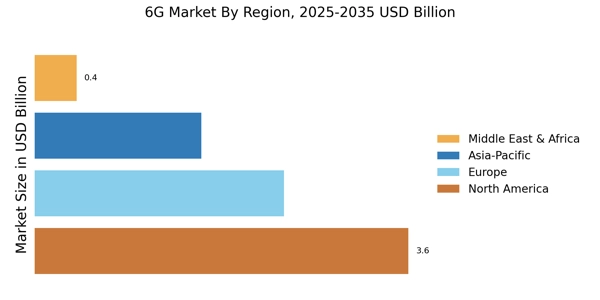
North America is poised to dominate the 6G Market, driven by significant investments in research and development, alongside a robust regulatory framework. The region is expected to hold approximately 45% of the global market share, with the United States being the largest contributor, followed by Canada. The demand for enhanced connectivity and advanced applications in sectors like healthcare and smart cities is propelling growth. Key players such as Qualcomm, Intel, and Verizon are at the forefront of 6G Market development, leveraging their technological expertise and extensive infrastructure. The competitive landscape is characterized by collaborations between telecom operators and technology firms, fostering innovation. The U.S. government is actively supporting initiatives to accelerate 6G Market deployment, ensuring the region remains a leader in telecommunications.

Europe : Regulatory Framework and Innovation

Europe is emerging as a significant player in the 6G Market, with a projected market share of around 30%. The European Union's regulatory frameworks and funding initiatives are driving innovation and collaboration among member states. Countries like Germany and France are leading the charge, focusing on sustainable technologies and digital transformation. The demand for high-speed connectivity and IoT applications is a key growth driver in the region. The Germany 6G market is driven by strong industrial digitization initiatives, automotive innovation, and government-backed research programs supporting next-generation wireless technologies.

The Spain 6G market is gradually emerging, supported by EU-funded research initiatives and increasing interest in advanced mobile communication technologies. The competitive landscape features major players such as Ericsson and Nokia, who are investing heavily in R&D to develop next-generation technologies. Collaborative projects funded by the EU, such as the Hexa-X initiative, aim to create a unified vision for 6G Market. This strategic approach positions Europe as a hub for technological advancements and regulatory leadership in the global 6G Market landscape.

Asia-Pacific : Emerging Powerhouse in 6G Market

Asia-Pacific is rapidly emerging as a powerhouse in the 6G Market, expected to capture approximately 20% of the global share. Countries like China and South Korea are leading the way, driven by government initiatives and substantial investments in telecommunications infrastructure. The China 6G market is witnessing significant momentum, driven by strong government support, large-scale R&D investments, and active participation from leading telecom equipment manufacturers. The South Korea 6G market is advancing rapidly due to early technology trials, strong semiconductor capabilities, and strategic collaborations between telecom operators and research institutions.

The Japan 6G market is gaining traction as the country focuses on next-generation connectivity for smart infrastructure, robotics, and advanced industrial applications. The region's focus on smart cities and advanced mobile applications is fueling demand for 6G Market technologies. Key players such as Huawei and Samsung are heavily involved in 6G Market research and development, collaborating with local governments to enhance connectivity. The competitive landscape is marked by aggressive strategies to roll out next-generation networks, with a strong emphasis on innovation and technological advancements. The region's dynamic market environment is set to accelerate the adoption of 6G Market solutions across various sectors.

Middle East and Africa : Resource-Rich Frontier for 6G Market

The Middle East and Africa region is gradually recognizing the potential of the 6G Market, with an estimated market share of around 5%. Countries like the UAE and South Africa are investing in telecommunications infrastructure to support future connectivity needs. The demand for enhanced mobile broadband and digital services is driving interest in this Market technologies, supported by government initiatives aimed at digital transformation. The competitive landscape is characterized by partnerships between local telecom operators and global technology firms. Companies like ZTE are exploring opportunities in the region, focusing on building robust networks. The region's unique challenges and opportunities present a fertile ground for innovation, as stakeholders work towards integrating advanced technologies into their economies. The GCC 6G market is at an early stage of development, with countries such as the UAE and Saudi Arabia investing in future-ready telecommunications infrastructure and digital transformation strategies.

6G Market Regional Image

Key Players and Competitive Insights

The Global 6G Market is currently in a state of rapid evolution, leveraging advanced technologies and innovations aimed at transforming connectivity and communication standards across the globe. As industries and consumers increasingly demand faster, more efficient, and reliable networks, the competitive landscape becomes even more crucial to understanding market dynamics. Key players are closely monitoring advancements in wireless communication, edge computing, and artificial intelligence as they strategize to enhance their offerings. The Nokia Group remains a key player in the global 6G Market, leveraging its strong R&D capabilities, advanced antenna systems, and strategic partnerships to drive next-generation network innovation.
The race to capture a share of the emerging  Market is intensified by the necessity to address challenges such as spectrum allocation, security issues, and the integration of new use cases, which are pivotal to gain a competitive edge in this burgeoning field. Collaboration between companies, research institutions, and governments also plays a significant role, amplifying the need for players to innovate while also establishing partnerships that could position them favorably in the marketplace.
IBM has positioned itself as a formidable contestant in this Market by leveraging its expertise in cutting-edge technologies such as AI, quantum computing, and cloud infrastructures. The company has been focusing on creating robust solutions that facilitate seamless integration of the next generation of connectivity, contributing to enhanced network efficiency and reliability. Its strengths lie in its extensive research capabilities, global reach, and existing relationships with various telecommunications entities, which enable IBM to influence the standards and architecture pertaining to this Market network design.
Additionally, by promoting a hybrid cloud strategy, IBM enhances its ability to innovate in an adaptable manner, demonstrating its commitment to floating ahead in the competitive space of Market while targeting diverse industrial applications.ZTE Corporation stands out in the Global Market through its emphasis on research and development, with substantial investments made to explore and roll out innovative wireless communication technologies. The company offers a range of products and services, including network infrastructure solutions, platforms to support smart cities, and services enhancing mobile broadband performance designed specifically for 6G Market.
ZTE's market presence is reinforced by its global partnerships and collaborations, enabling it to adapt swiftly to the evolving demands in the telecommunications sector. One of the notable strengths of ZTE Corporation is its commitment to sustainability and energy-efficient technologies, which aligns with the increasing regulatory focus on environmentally conscious solutions. Furthermore, ZTE has engaged in strategic mergers and acquisitions to augment its technological capabilities, thereby bolstering its position as a preferred partner in the 6G Market.
This strategic approach, combined with its portfolio of next-gen solutions, establishes ZTE as a key player ready to capitalize on the emerging opportunities in the region.

Key Companies in the 6G Market include

Industry Developments

Recent developments in the 6G Market indicate a surge in investments and collaborative efforts among leading technology companies. For instance, in September 2023, Samsung Electronics announced the successful testing of its next-generation 6G Market technology, paving the way for more advanced mobile communication. Meanwhile, Qualcomm has been actively engaged in Research and Development initiatives focused on enhancing connectivity for various applications. In August 2023, ZTE Corporation unveiled its new 6G Market pipeline which aims to integrate artificial intelligence into network operations, pointing toward a trend where AI plays a pivotal role in future communication technologies.

Additionally, there were notable market movements, with Broadcom in October 2023 acquiring an AI chipset startup to bolster its capabilities in the Market space. In October 2022, Nokia and Telefonaktiebolaget LM Ericsson formed a strategic alliance to jointly explore 6G Market technologies, reflecting a growing trend toward collaborative innovation. Growth in the valuation of companies involved in theMarket has been significant, with investments propelling advancements in various sectors, illustrating the high demand for faster and more efficient communication services worldwide.

Future Outlook

6G Market Future Outlook

The 6G Market is projected to grow at 51.86% CAGR from 2025 to 2035, driven by advancements in AI, IoT, and enhanced connectivity solutions.

New opportunities lie in:

  • Development of ultra-reliable low-latency communication systems for autonomous vehicles. Creation of smart city infrastructure leveraging 6G Market connectivity. Expansion of telemedicine platforms utilizing high-speed data transfer capabilities.

By 2035, the 6G Market is expected to be a cornerstone of global digital transformation.

Market Segmentation

6G Market End Use Outlook

  • Telecommunications
  • Transportation
  • Healthcare
  • Manufacturing

6G Market Technology Outlook

  • Terahertz Communication
  • Massive Mimo
  • Advanced Antenna Systems
  • Optical Wireless Communication

6G Market Application Outlook

  • Autonomous Vehicles
  • Smart Cities
  • Augmented Reality
  • Healthcare
  • Industrial Automation

6G Market Network Type Outlook

  • Private Networks
  • Public Networks
  • Hybrid Networks

Report Scope

MARKET SIZE 2024 8.08(USD Billion)
MARKET SIZE 2025 12.27(USD Billion)
MARKET SIZE 2035 800.37(USD Billion)
COMPOUND ANNUAL GROWTH RATE (CAGR) 51.86% (2025 - 2035)
REPORT COVERAGE Revenue Forecast, Competitive Landscape, Growth Factors, and Trends
BASE YEAR 2024
Market Forecast Period 2025 - 2035
Historical Data 2019 - 2024
Market Forecast Units USD Billion
Key Companies Profiled Nokia (FI), Ericsson (SE), Huawei (CN), Samsung (KR), Qualcomm (US), Intel (US), ZTE (CN), AT&T (US), Verizon (US), T-Mobile (DE)
Segments Covered Technology, Application, End Use, Network Type, Regional
Key Market Opportunities Integration of advanced artificial intelligence in the 6G Market enhances connectivity and user experience.
Key Market Dynamics Intensifying competition among telecom providers drives rapid advancements in 6G technology and infrastructure development.
Countries Covered North America, Europe, APAC, South America, MEA

Market Highlights

Author
Author
Author Profile
Ankit Gupta LinkedIn
Team Lead - Research
Ankit Gupta is a seasoned market intelligence and strategic research professional with over six plus years of experience in the ICT and Semiconductor industries. With academic roots in Telecom, Marketing, and Electronics, he blends technical insight with business strategy. Ankit has led 200+ projects, including work for Fortune 500 clients like Microsoft and Rio Tinto, covering market sizing, tech forecasting, and go-to-market strategies. Known for bridging engineering and enterprise decision-making, his insights support growth, innovation, and investment planning across diverse technology markets.
Co-Author
Co-Author Profile
Shubham Munde LinkedIn
Team Lead - Research
Shubham brings over 7 years of expertise in Market Intelligence and Strategic Consulting, with a strong focus on the Automotive, Aerospace, and Defense sectors. Backed by a solid foundation in semiconductors, electronics, and software, he has successfully delivered high-impact syndicated and custom research on a global scale. His core strengths include market sizing, forecasting, competitive intelligence, consumer insights, and supply chain mapping. Widely recognized for developing scalable growth strategies, Shubham empowers clients to navigate complex markets and achieve a lasting competitive edge. Trusted by start-ups and Fortune 500 companies alike, he consistently converts challenges into strategic opportunities that drive sustainable growth.
Leave a Comment

FAQs

What is the projected market valuation of the 6G market by 2035?

<p>The projected market valuation of the 6G market by 2035 is expected to reach 56.0 USD Billion.</p>

What was the market valuation of the 6G market in 2024?

<p>The overall market valuation of the 6G market was 11.0 USD Billion in 2024.</p>

What is the expected CAGR for the 6G market during the forecast period 2025 - 2035?

<p>The expected CAGR for the 6G market during the forecast period 2025 - 2035 is 15.95%.</p>

Which companies are considered key players in the 6G market?

<p>Key players in the 6G market include Nokia, Ericsson, Huawei, Samsung, Qualcomm, ZTE, Intel, Cisco, and NEC.</p>

What are the main application segments of the 6G market?

<p>The main application segments of the 6G market include Telecommunications, Internet of Things, Autonomous Vehicles, Smart Cities, and Healthcare.</p>

How much is the Telecommunications segment projected to grow by 2035?

<p>The Telecommunications segment is projected to grow from 3.5 USD Billion to 17.5 USD Billion by 2035.</p>

What is the projected valuation for the Smart Infrastructure segment by 2035?

<p>The Smart Infrastructure segment is projected to reach 18.0 USD Billion by 2035.</p>

What technologies are driving the 6G market growth?

<p>Technologies driving the 6G market growth include Terahertz Communication, Artificial Intelligence Integration, Network Slicing, Massive MIMO, and Edge Computing.</p>

What is the expected growth of the Edge Computing segment by 2035?

<p>The Edge Computing segment is expected to grow from 3.5 USD Billion to 18.5 USD Billion by 2035.</p>

How does the 6G market's growth compare to other technology sectors?

<p>The 6G market's growth appears robust, with a projected CAGR of 15.95%, indicating strong potential compared to other technology sectors.</p>

Research Approach

Secondary Research

The secondary research process involved comprehensive analysis of regulatory filings, spectrum allocation databases, 3GPP standardization documents, peer-reviewed engineering journals, and authoritative telecommunications organizations. Key sources included the International Telecommunication Union (ITU-R/ITU-T), 3rd Generation Partnership Project (3GPP), European Telecommunications Standards Institute (ETSI), Institute of Electrical and Electronics Engineers (IEEE), US Federal Communications Commission (FCC), European Commission Radio Spectrum Committee, UK Ofcom, China's Ministry of Industry and Information Technology (MIIT), South Korea's Ministry of Science and ICT (MSIT), Japan's Ministry of Internal Affairs and Communications (MIC), National Institute of Standards and Technology (NIST), National Science Foundation (NSF) Wireless Research Initiatives, EU Hexa-X and SNS (Smart Networks and Services) Joint Undertaking, GSMA Intelligence, Ookla Speedtest Intelligence, and national spectrum regulatory authorities from key markets. These sources were used to collect spectrum allocation roadmaps, standardization timelines, infrastructure deployment projections, R&D investment flows, and patent landscape analysis for terahertz communication, massive MIMO systems, optical wireless communication, and advanced antenna technologies.

Primary Research

To gather both qualitative and quantitative information, the primary research process involved interviewing players from both the supply and demand sides. Members of the supply side who contributed to the discussion included CTOs, VPs of network architecture, heads of standards and industry relations, and product line directors from companies that make telecommunications equipment, semiconductors and chipsets, network infrastructure, and spectrum. On the demand side, we had CIOs, CDOs, heads of connectivity strategy at automotive OEMs (autonomous vehicle divisions), directors of smart city programs, chief technology officers of healthcare systems, leaders in industrial automation, and procurement directors from telecommunications network operators, factories, and government agencies responsible for digital infrastructure. Infrastructure CapEx cycles, spectrum auction methods, and patterns of vertical sector integration were among the topics covered by primary research, which also corroborated filing deadlines for patents and validated technology adoption roadmaps.

Primary Respondent Breakdown:

By Designation: C-level Primaries (30%), Director Level (35%), Others (35%)

By Region: North America (38%), Europe (25%), Asia-Pacific (28%), Rest of World (9%)

Market Size Estimation

Global market valuation was derived through infrastructure spend mapping and spectrum deployment volume analysis. The methodology included:

Identification of 60+ key stakeholders across telecommunications equipment, semiconductor components, and network infrastructure verticals spanning North America, Europe, Asia-Pacific, and Middle East & Africa

Technology mapping across terahertz communication, massive MIMO, advanced antenna systems, and optical wireless communication architectures

Analysis of reported and modeled R&D investments and infrastructure revenues specific to pre-commercial 6G development programs and pilot deployments

Coverage of manufacturers and network operators representing 75-80% of global telecommunications infrastructure market share in 2024

Extrapolation using bottom-up (cell site deployment volumes × equipment ASP by country/region, spectrum auction values, and patent licensing projections) and top-down (vendor revenue validation and operator CapEx analysis) approaches to derive segment-specific valuations for private networks, public networks, and hybrid network deployments across autonomous vehicles, smart cities, healthcare, and industrial automation applications

This methodology framework aligns with the 6G market's technological complexity, regulatory dependencies, and cross-industry applications while maintaining the same structural rigor as your dermal fillers reference methodology.

Download Free Sample

Kindly complete the form below to receive a free sample of this Report

Compare Licence

×
Features License Type
Single User Multiuser License Enterprise User
Price $4,950 $5,950 $7,250
Maximum User Access Limit 1 User Upto 10 Users Unrestricted Access Throughout the Organization
Free Customization
Direct Access to Analyst
Deliverable Format
Platform Access
Discount on Next Purchase 10% 15% 15%
Printable Versions
%>