Request Free Sample ×

Kindly complete the form below to receive a free sample of this Report

* Please use a valid business email

Leading companies partner with us for data-driven Insights

clients tt-cursor
Hero Background
English
Chinese
French
Japanese
Korean
German
Spanish

5G Radio Access Network Market Trends

ID: MRFR/ICT/10037-HCR
128 Pages
Aarti Dhapte
Last Updated: April 06, 2026

5G Radio Access Network Market Research Report Information By Component (Hardware, Software, And Services), By Architecture Type (CRAN, ORAN, and VRAN), By Deployment (Indoor And Outdoor), By End User (Telecom Operators And Enterprises), And By Region (North America, Europe, Asia-Pacific, And Rest Of The World) –Market Forecast Till 2035

Share:
Download PDF ×

We do not share your information with anyone. However, we may send you emails based on your report interest from time to time. You may contact us at any time to opt-out.

5G Radio Access Network Market Infographic
Purchase Options

Market Trends

Key Emerging Trends in the 5G Radio Access Network Market

The widespread adoption of 5G technology around the world is driving significant changes in the 5G Radio Access Network (RAN) market at the moment. Starting around 2023, market patterns demonstrate a powerful development direction for 5G RAN, pushed by the rising interest for high velocity, low-dormancy correspondence organizations.

One unmistakable pattern is the flood in ventures by media communications administrators and organization foundation suppliers to extend and update their 5G RAN framework. This increased speculation is energized by the developing requirement for improved portable broadband administrations, gigantic machine-type interchanges, and super solid low-inactivity correspondences.

Besides, the sending of 5G independent organizations is picking up speed, denoting a shift from the underlying non-independent executions. This change empowers administrators to completely use the abilities of 5G, opening new open doors for businesses like medical care, assembling, and transportation. The move towards independent organizations upgrades network cutting capacities, permitting administrators to tailor administrations in view of explicit necessities, in this way taking care of a different arrangement of utilizations with fluctuating execution needs. Notwithstanding the innovation progressions, market patterns in the 5G RAN space likewise feature the development of Open RAN engineering. This creative methodology advances interoperability and seller variety by decoupling equipment and programming parts, cultivating a more cutthroat scene. The reception of Open RAN is viewed as a vital procedure to address merchant secure in worries and improve adaptability in network organizations. Numerous industry players are effectively investigating and putting resources into Open RAN answers for make more lithe and proficient organizations. Moreover, the joining of computerized reasoning (man-made intelligence) and AI (ML) in 5G RAN is acquiring noticeable quality. Administrators are utilizing these advances to streamline network execution, robotize tasks, and proactively address issues. Simulated intelligence driven prescient upkeep and organization streamlining assume a pivotal part in guaranteeing the dependability and productivity of 5G organizations, adding to further developed client encounters and functional expense reserve funds.

Regional dynamics also play a crucial role in the 5G RAN market's development. Various districts are seeing shifting levels of 5G organization, impacted by variables like administrative conditions, range accessibility, and foundation speculations. While a few created economies are at the cutting edge of 5G reception, developing business sectors are steadily making up for lost time, introducing new learning experiences for industry partners. Notwithstanding the promising standpoint, challenges endure in the 5G RAN market. Range accessibility, framework costs, and administrative intricacies stay key obstacles for far reaching reception. Also, tending to security concerns and guaranteeing consistent interoperability between various ages of versatile organizations are basic contemplations for the business.


Author
Author Profile
Aarti Dhapte
AVP - Research

A consulting professional focused on helping businesses navigate complex markets through structured research and strategic insights. I partner with clients to solve high-impact business problems across market entry strategy, competitive intelligence, and opportunity assessment. Over the course of my experience, I have led and contributed to 100+ market research and consulting engagements, delivering insights across multiple industries and geographies, and supporting strategic decisions linked to $500M+ market opportunities. My core expertise lies in building robust market sizing, forecasting, and commercial models (top-down and bottom-up), alongside deep-dive competitive and industry analysis. I have played a key role in shaping go-to-market strategies, investment cases, and growth roadmaps, enabling clients to make confident, data-backed decisions in dynamic markets.

Leave a Comment

FAQs

What is the projected market valuation of the 5G Radio Access Network Market by 2035?

<p>The projected market valuation for the 5G Radio Access Network Market by 2035 is 134.02 USD Billion.</p>

What was the market valuation of the 5G Radio Access Network Market in 2024?

<p>The overall market valuation of the 5G Radio Access Network Market was 18.88 USD Billion in 2024.</p>

What is the expected CAGR for the 5G Radio Access Network Market during the forecast period 2025 - 2035?

<p>The expected CAGR for the 5G Radio Access Network Market during the forecast period 2025 - 2035 is 19.5%.</p>

Which companies are considered key players in the 5G Radio Access Network Market?

<p>Key players in the 5G Radio Access Network Market include Ericsson, Nokia, Huawei, Samsung, ZTE, Cisco, Qualcomm, Intel, and NEC.</p>

What are the segment valuations for hardware in the 5G Radio Access Network Market?

<p>The segment valuation for hardware in the 5G Radio Access Network Market ranges from 7.0 to 50.0 USD Billion.</p>

How does the valuation of software compare to hardware in the 5G Radio Access Network Market?

<p>The valuation of software in the 5G Radio Access Network Market ranges from 5.0 to 35.0 USD Billion, indicating a lower range compared to hardware.</p>

What is the projected valuation for outdoor deployment in the 5G Radio Access Network Market?

The projected valuation for outdoor deployment in the 5G Radio Access Network Market is between 11.33 and 80.01 USD Billion.

What are the expected segment valuations for telecom operators in the 5G Radio Access Network Market?

The expected segment valuation for telecom operators in the 5G Radio Access Network Market ranges from 10.0 to 70.0 USD Billion.

What is the valuation range for CRAN architecture type in the 5G Radio Access Network Market?

The valuation range for CRAN architecture type in the 5G Radio Access Network Market is between 5.66 and 40.0 USD Billion.

What is the projected valuation for enterprises as an end user in the 5G Radio Access Network Market?

The projected valuation for enterprises as an end user in the 5G Radio Access Network Market is between 8.88 and 64.02 USD Billion.

Market Summary

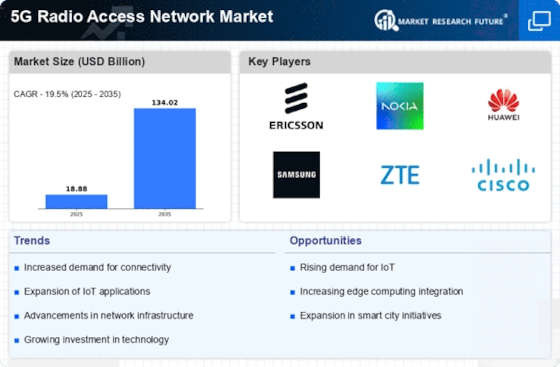
As per Market Research Future analysis, the 5G Radio Access Network Market Size was estimated at 18.88 USD Billion in 2024. The 5G Radio Access Network industry is projected to grow from 22.56 USD Billion in 2025 to 134.02 USD Billion by 2035, exhibiting a compound annual growth rate (CAGR) of 19.5% during the forecast period 2025 - 2035

Key Market Trends & Highlights

The 5G Radio Access Network Market is poised for substantial growth driven by technological advancements and increasing demand for connectivity.

  • North America remains the largest market for 5G Radio Access Networks, reflecting robust infrastructure investments. Asia-Pacific is emerging as the fastest-growing region, propelled by rapid urbanization and digital transformation initiatives. The hardware segment continues to dominate the market, while services are experiencing the fastest growth due to evolving customer needs. Rising demand for high-speed connectivity and government initiatives are key drivers fueling the expansion of the 5G Radio Access Network Market.

Market Size & Forecast

2024 Market Size 18.88 (USD Billion)
2035 Market Size 134.02 (USD Billion)
CAGR (2025 - 2035) 19.5%
Largest Regional Market Share in 2024 Asia Pacific

Major Players

<a href="https://www.ericsson.com/en/blog/2025/6/6g-are-we-ambitious-enough">Ericsson</a> (SE), Nokia (FI), Huawei (CN), Samsung (KR), ZTE (CN), Cisco (US), Qualcomm (US), Intel (US), <a href="https://www.nec.com/en/global/solutions/5g/blog/nec-open-optical-journey-with-tip-oopt.html">NEC</a> (JP)

Market Trends

The 5G Radio Access Network Market is currently experiencing a transformative phase, characterized by rapid advancements in technology and increasing demand for high-speed connectivity. As industries and consumers alike seek enhanced mobile broadband experiences, the deployment of 5G networks is becoming more prevalent. This shift is driven by the need for improved data transmission rates, reduced latency, and the ability to support a growing number of connected devices. Consequently, telecommunications companies are investing heavily in infrastructure upgrades and innovative solutions to meet these evolving requirements. Moreover, the competitive landscape of the 5G Radio Access Network Market is intensifying, with various players striving to establish their presence. Partnerships and collaborations among technology providers, network operators, and equipment manufacturers are emerging as a strategic approach to accelerate deployment and enhance service offerings. The focus on developing robust and scalable network architectures is paramount, as it enables operators to efficiently manage resources and deliver superior user experiences. As the market continues to evolve, it appears poised for substantial growth, driven by ongoing technological advancements and the increasing reliance on mobile connectivity across diverse sectors.

Increased Investment in Infrastructure

Telecommunications companies are channeling resources into upgrading existing networks and building new infrastructure to support 5G capabilities. This trend reflects a commitment to enhancing service quality and expanding coverage.

Emergence of Private Networks

Organizations are increasingly exploring private 5G networks to meet specific operational needs. This trend indicates a shift towards tailored solutions that provide enhanced security and control over network resources.

Integration of IoT with 5G

The convergence of Internet of Things (IoT) technologies with 5G networks is gaining traction. This integration is expected to facilitate smarter applications and services, driving innovation across various industries.

5G Radio Access Network Market Market Drivers

Emergence of New Business Models

The emergence of new business models is reshaping the landscape of the 5G Radio Access Network Market. Companies are exploring innovative approaches to leverage 5G technology, such as offering subscription-based services or creating partnerships with content providers. These models enable businesses to capitalize on the enhanced capabilities of 5G, such as ultra-reliable low-latency communication and massive connectivity. As organizations seek to differentiate themselves in a competitive market, the adoption of these new business models is likely to drive further investment in 5G infrastructure, thereby contributing to the growth of the 5G Radio Access Network Market.

Advancements in Network Technology

Technological advancements play a crucial role in shaping the 5G Radio Access Network Market. Innovations such as Massive MIMO, beamforming, and network slicing are enhancing the efficiency and capacity of 5G networks. These technologies enable operators to optimize their resources and provide tailored services to different user segments. For instance, network slicing allows for the creation of virtual networks that can cater to specific applications, such as autonomous vehicles or smart cities. As these technologies continue to evolve, they are expected to drive further investments in 5G infrastructure, thereby fostering growth in the 5G Radio Access Network Market.

Government Initiatives and Support

Government initiatives and support are pivotal in accelerating the growth of the 5G Radio Access Network Market. Many governments are implementing policies to promote the deployment of 5G networks, recognizing their potential to drive economic growth and innovation. For example, funding programs and regulatory frameworks are being established to facilitate the rollout of 5G infrastructure. In some regions, governments are collaborating with private sector players to create testbeds for 5G applications, which can lead to faster adoption. This supportive environment is likely to enhance the investment landscape for the 5G Radio Access Network Market.

Increased Adoption of Smart Devices

The proliferation of smart devices is significantly influencing the 5G Radio Access Network Market. As more consumers adopt smartphones, wearables, and IoT devices, the demand for high-speed, low-latency connectivity is intensifying. It is estimated that by 2025, there will be over 75 billion connected devices worldwide, creating a substantial need for robust 5G networks. This trend is prompting telecommunications companies to expand their 5G offerings and enhance their network capabilities. The increased adoption of smart devices is thus a critical driver for the growth of the 5G Radio Access Network Market.

Rising Demand for High-Speed Connectivity

The demand for high-speed connectivity is a primary driver of the 5G Radio Access Network Market. As consumers and businesses increasingly rely on data-intensive applications, the need for faster and more reliable internet connections has surged. According to recent estimates, the number of 5G subscriptions is projected to reach over 1.5 billion by 2025, indicating a robust growth trajectory. This demand is not limited to urban areas; rural regions are also seeking enhanced connectivity to support remote work and digital services. Consequently, telecommunications companies are investing heavily in 5G infrastructure to meet this demand, thereby propelling the growth of the 5G Radio Access Network Market.

Market Segment Insights

By Component: Hardware (Largest) vs. Services (Fastest-Growing)

In the 5G Radio Access Network Market, the 'Component' segment is primarily divided into Hardware, Software, and Services. Among these, Hardware holds the largest market share due to the essential infrastructure it provides for enabling 5G networks. The landscape is rapidly evolving, with Software also contributing significantly, particularly in terms of network management and optimization. However, Services are emerging as a key player, emphasizing the growing importance of customer support, deployment, and maintenance in ensuring the successful rollout of 5G technology.

Services: Deployment (Dominant) vs. Support (Emerging)

Within the Services segment of the 5G Radio Access Network Market, Deployment Services are currently dominant due to their critical role in facilitating the installation of advanced <a href="https://www.marketresearchfuture.com/reports/5g-infrastructure-market-10527" target="_blank" title="5g infrastructure">5G infrastructure</a>. These services encompass site acquisition, equipment installation, and network optimization, ensuring that telecommunications companies can efficiently roll out 5G networks. On the other hand, Support Services are an emerging focus, gaining traction as operators seek long-term partnerships for maintenance and troubleshooting. This shift underscores the increasing complexity of 5G networks and the necessity for continuous operational efficiency and customer satisfaction.

By Architecture Type: CRAN (Largest) vs. ORAN (Fastest-Growing)

The 5G Radio Access Network Market is primarily segmented into Centralized Radio Access Networks (CRAN), Open Radio Access Networks (ORAN), and Virtualized Radio Access Networks (VRAN). Among these, CRAN holds the largest market share, attributed to its established infrastructure and widespread acceptance among carriers. ORAN, on the other hand, is rapidly gaining traction as an emerging player due to its innovative, open-source approach, which allows for greater interoperability and flexibility for network operators.

Architecture: CRAN (Dominant) vs. ORAN (Emerging)

CRAN is characterized by its centralized processing, where network functions are consolidated to improve efficiency and reduce operational costs. It is solidly positioned as the dominant architecture within the 5G landscape due to its robustness and reliance on existing technologies. Conversely, ORAN is perceived as an emerging architecture, revolutionizing the market by promoting open interfaces and vendor diversity, which help operators to customize their networks. This shift also enhances the competitive landscape, fostering innovation and driving down costs, making it particularly appealing to new entrants and existing operators looking for future-proof solutions.

By Deployment: Indoor (Largest) vs. Outdoor (Fastest-Growing)

In the 5G Radio Access Network Market, the deployment segment is significantly characterized by indoor and outdoor solutions. Indoor deployments capture the largest share, driven by the increasing demand for enhanced connectivity in commercial buildings, urban areas, and residential complexes. As organizations prioritize seamless user experiences, the emphasis on robust indoor connectivity continues to grow. In contrast, outdoor deployments are rapidly gaining traction, fueled by the need to provide extensive coverage across city landscapes and rural areas alike, ensuring that 5G connectivity reaches as many users as possible.

Deployment: Indoor (Dominant) vs. Outdoor (Emerging)

Indoor deployments have established themselves as the dominant segment in the 5G Radio Access Network Market, characterized by a need for reliable and high-speed connectivity within buildings. These deployments utilize a mix of small cells and distributed antenna systems to enhance coverage and capacity indoors, addressing the challenges posed by physical barriers. On the other hand, outdoor deployments are emerging strongly, characterized by their ability to extend 5G coverage beyond traditional networks, utilizing advanced technologies such as beamforming and massive MIMO. These outdoor solutions are essential as urbanization increases and demand for outdoor connectivity grows, reinforcing their importance in the overall market landscape.

By End User: Telecom Operators (Largest) vs. Enterprises (Fastest-Growing)

In the 5G Radio Access Network Market, telecom operators currently hold the largest share among end users. This predominance is attributed to their significant investment in infrastructure and a robust customer base. As the backbone of telecommunication services, these operators are enhancing their service offerings, thus solidifying their market position. Conversely, enterprises are emerging as a rapidly growing segment, seeking 5G solutions to boost operational efficiency and enable digital transformation, driven by increasing demand for high-speed connectivity and business innovation.

End User: Telecom Operators (Dominant) vs. Enterprises (Emerging)

Telecom operators dominate the 5G Radio Access Network Market, leveraging extensive investments and established networks to deliver enhanced connectivity and services. Their ability to provide widespread coverage and handle vast amounts of data makes them indispensable in this evolving landscape. On the other hand, enterprises are viewed as an emerging force within the market. They are becoming increasingly aware of the benefits of 5G technology, particularly in sectors such as manufacturing, healthcare, and logistics, where low latency and high reliability are crucial. Enterprises are keen to adopt these advanced networks to innovate their processes and improve customer experiences.

Get more detailed insights about 5G Radio Access Network Market Research Report - Global Forecast till 2035

Regional Insights

North America : Leading Innovation Hub

North America is poised to lead the 5G Radio Access Network Market, driven by robust investments in infrastructure and technology. The U.S. holds approximately 60% of the market share, with Canada following at around 15%. Regulatory support from the Federal Communications Commission (FCC) has accelerated deployment, fostering a competitive environment. Demand for high-speed connectivity in urban areas is a significant growth driver, alongside the push for smart city initiatives. The competitive landscape is dominated by key players such as Ericsson, Cisco, and Qualcomm, who are actively collaborating with telecom operators to enhance network capabilities. The U.S. is home to major telecom providers like Verizon and AT&T, which are rapidly expanding their 5G networks. This region's focus on innovation and technology adoption positions it as a global leader in the 5G market.

Europe : Emerging 5G Powerhouse

Europe is emerging as a significant player in the 5G Radio Access Network Market, with a market share of approximately 25%. The European Union's regulatory framework encourages investment in 5G infrastructure, aiming for widespread coverage by 2025. Countries like Germany and the UK are leading the charge, driven by government initiatives and public-private partnerships that enhance network deployment and innovation. The competitive landscape features major players such as Nokia and Ericsson, who are collaborating with local telecom operators to expand their 5G offerings. Germany's Deutsche Telekom and the UK's BT Group are at the forefront, investing heavily in 5G technology. The region's commitment to digital transformation and sustainability is further propelling the growth of the 5G market.

Asia-Pacific : Rapidly Growing Market

Asia-Pacific is witnessing rapid growth in the 5G Radio Access Network Market, holding a market share of around 15%. Countries like China and South Korea are leading the way, driven by government initiatives and significant investments in telecommunications infrastructure. The demand for high-speed internet and the proliferation of IoT devices are key factors fueling this growth, with regulatory support enhancing deployment timelines. China's Huawei and ZTE are major players in this region, partnering with local telecom operators to expand 5G networks. South Korea's SK Telecom and KT Corporation are also at the forefront, pushing for innovative applications of 5G technology. The competitive landscape is characterized by intense rivalry among key players, driving advancements in network capabilities and service offerings.

Middle East and Africa : Emerging Frontier for 5G

The Middle East and Africa region is an emerging frontier for the 5G Radio Access Network Market, with a market share of approximately 5%. Countries like the UAE and South Africa are leading the charge, driven by government initiatives aimed at enhancing digital infrastructure. The region's young population and increasing smartphone penetration are significant demand drivers, alongside investments in smart city projects. Key players such as Ericsson and Huawei are actively involved in deploying 5G networks in this region. The competitive landscape is evolving, with local telecom operators partnering with global firms to enhance their service offerings. The potential for growth in this region is substantial, as governments prioritize digital transformation and connectivity initiatives.

Key Players and Competitive Insights

Leading market players are investing heavily in research and development in order to expand their Product lines, which will help the 5G Radio Access Network Market, grow even more. Market participants are also undertaking a variety of strategic activities to expand their global footprint, with important market developments including new product launches, contractual agreements, mergers and acquisitions, higher investments, and collaboration with other organizations. To expand and survive in a more competitive and rising market climate, 5G Radio Access Network industry must offer cost-effective items.
Manufacturing locally to minimize operational costs is one of the key business tactics used by manufacturers in the global 5G Radio Access Network industry to benefit clients and increase the market sector. In recent years, the 5G Radio Access Network industry has offered some of the most significant advantages to medicine. Major players in the 5G Radio Access Network Market, including Telefonaktiebolaget LM Ericsson, Qualcomm Technologies, Inc., Nokia, Intel Corporation, Samsung, Verizon, Cisco Systems, Inc., Huawei Technologies Co., Ltd., VMware, Inc., and Rakuten Symphony Singapore Pte. Ltd, are attempting to increase market demand by investing in research and development operations.
Elenion Technologies is a vertically integrated semiconductor business that promotes innovation in the design and development of silicon photonics-based chips.  Elenion's System-on-Chip solutions are suited for a wide range of telecom, hyperscale communication, and networking applications thanks to their SiPh technology platform and design for services pedigree. Elenion Technologies was purchased by Nokia Corporation in March 2020. With this acquisition, Elenion Technologies hopes to increase its knowledge and create a platform that will improve the optical connection of cloud, 5G, and enterprise networking.
A provider of software and IT infrastructure services is HCL Technologies Ltd (HCL). The business provides a variety of services in the areas of IT infrastructure management, digital process operations, cloud native services, cybersecurity, digital and analytics services, DRYiCE, IoT works, HCL software services, SIAM/XaaS products & advanced services, industry software services, and engineering and R&D services.
HCL provides its services to the following industries: banking, finance, manufacturing, telecommunications, retail and consumer packaged goods, media and entertainment, life sciences, insurance, capital markets, oil and gas, mining and natural resources, automotive, chemical and process industries, high-tech, industrial manufacturing, energy and utility, healthcare, travel, transportation, hospitality, and logistics. HCL Technologies (HCL) announced the 5G Open Radio Access Network (O-RAN) lab in India in September 2021. This launch aims to enable stakeholders in the global telecom industry to transition to a 5G network.

Key Companies in the 5G Radio Access Network Market include

Industry Developments

In October 2021 A partnership to develop Symware has been announced by Intel Corporation, Juniper Networks, and Rakuten Symphony. It is a carrier-grade Open RAN (Radio Access Network) solution created especially for mobile network operators to update radio cell sites by utilizing the most recent cloud-native architecture.

In August 2020 A partnership between Intel Corporation and VMware Inc. has been announced. In order to accelerate the rollout of both 5G and LTE networks, this cooperation aims to integrate a software platform designed for virtualized Radio Access Networks (RAN).

Future Outlook

5G Radio Access Network Market Future Outlook

The 5G Radio Access Network Market is poised for growth at 19.5% CAGR from 2025 to 2035, driven by increased demand for high-speed connectivity and IoT applications.

New opportunities lie in:

  • Development of private 5G networks for enterprises
  • Integration of AI-driven <a href="https://www.marketresearchfuture.com/reports/network-management-market-5242" target="_blank" title="network management">network management</a> solutions
  • Expansion of edge computing capabilities in RAN architecture

By 2035, the market is expected to achieve substantial growth, solidifying its role in global telecommunications.

Market Segmentation

5G Radio Access Network Market End User Outlook

  • Telecom Operators
  • Enterprises

5G Radio Access Network Market Component Outlook

  • Hardware
  • Software
  • Services

5G Radio Access Network Market Deployment Outlook

  • Indoor
  • Outdoor

5G Radio Access Network Market Architecture Type Outlook

  • CRAN
  • ORAN
  • VRAN

Report Scope

MARKET SIZE 2024 18.88(USD Billion)
MARKET SIZE 2025 22.56(USD Billion)
MARKET SIZE 2035 134.02(USD Billion)
COMPOUND ANNUAL GROWTH RATE (CAGR) 19.5% (2025 - 2035)
REPORT COVERAGE Revenue Forecast, Competitive Landscape, Growth Factors, and Trends
BASE YEAR 2024
Market Forecast Period 2025 - 2035
Historical Data 2019 - 2024
Market Forecast Units USD Billion
Key Companies Profiled Ericsson (SE), Nokia (FI), Huawei (CN), Samsung (KR), ZTE (CN), Cisco (US), Qualcomm (US), Intel (US), NEC (JP)
Segments Covered Component, Architecture Type, Deployment, End User, Region
Key Market Opportunities Expansion of edge computing capabilities enhances the 5G Radio Access Network Market potential.
Key Market Dynamics Intensifying competition among telecom providers drives innovation and investment in 5G Radio Access Network infrastructure and services.
Countries Covered North America, Europe, APAC, South America, MEA

FAQs

What is the projected market valuation of the 5G Radio Access Network Market by 2035?

<p>The projected market valuation for the 5G Radio Access Network Market by 2035 is 134.02 USD Billion.</p>

What was the market valuation of the 5G Radio Access Network Market in 2024?

<p>The overall market valuation of the 5G Radio Access Network Market was 18.88 USD Billion in 2024.</p>

What is the expected CAGR for the 5G Radio Access Network Market during the forecast period 2025 - 2035?

<p>The expected CAGR for the 5G Radio Access Network Market during the forecast period 2025 - 2035 is 19.5%.</p>

Which companies are considered key players in the 5G Radio Access Network Market?

<p>Key players in the 5G Radio Access Network Market include Ericsson, Nokia, Huawei, Samsung, ZTE, Cisco, Qualcomm, Intel, and NEC.</p>

What are the segment valuations for hardware in the 5G Radio Access Network Market?

<p>The segment valuation for hardware in the 5G Radio Access Network Market ranges from 7.0 to 50.0 USD Billion.</p>

How does the valuation of software compare to hardware in the 5G Radio Access Network Market?

<p>The valuation of software in the 5G Radio Access Network Market ranges from 5.0 to 35.0 USD Billion, indicating a lower range compared to hardware.</p>

What is the projected valuation for outdoor deployment in the 5G Radio Access Network Market?

The projected valuation for outdoor deployment in the 5G Radio Access Network Market is between 11.33 and 80.01 USD Billion.

What are the expected segment valuations for telecom operators in the 5G Radio Access Network Market?

The expected segment valuation for telecom operators in the 5G Radio Access Network Market ranges from 10.0 to 70.0 USD Billion.

What is the valuation range for CRAN architecture type in the 5G Radio Access Network Market?

The valuation range for CRAN architecture type in the 5G Radio Access Network Market is between 5.66 and 40.0 USD Billion.

What is the projected valuation for enterprises as an end user in the 5G Radio Access Network Market?

The projected valuation for enterprises as an end user in the 5G Radio Access Network Market is between 8.88 and 64.02 USD Billion.

  1. SECTION I: EXECUTIVE SUMMARY AND KEY HIGHLIGHTS
    1. | 1.1 EXECUTIVE SUMMARY
    2. | | 1.1.1 Market Overview
    3. | | 1.1.2 Key Findings
    4. | | 1.1.3 Market Segmentation
    5. | | 1.1.4 Competitive Landscape
    6. | | 1.1.5 Challenges and Opportunities
    7. | | 1.1.6 Future Outlook
  2. SECTION II: SCOPING, METHODOLOGY AND MARKET STRUCTURE
    1. | 2.1 MARKET INTRODUCTION
    2. | | 2.1.1 Definition
    3. | | 2.1.2 Scope of the study
    4. | | | 2.1.2.1 Research Objective
    5. | | | 2.1.2.2 Assumption
    6. | | | 2.1.2.3 Limitations
    7. | 2.2 RESEARCH METHODOLOGY
    8. | | 2.2.1 Overview
    9. | | 2.2.2 Data Mining
    10. | | 2.2.3 Secondary Research
    11. | | 2.2.4 Primary Research
    12. | | | 2.2.4.1 Primary Interviews and Information Gathering Process
    13. | | | 2.2.4.2 Breakdown of Primary Respondents
    14. | | 2.2.5 Forecasting Model
    15. | | 2.2.6 Market Size Estimation
    16. | | | 2.2.6.1 Bottom-Up Approach
    17. | | | 2.2.6.2 Top-Down Approach
    18. | | 2.2.7 Data Triangulation
    19. | | 2.2.8 Validation
  3. SECTION III: QUALITATIVE ANALYSIS
    1. | 3.1 MARKET DYNAMICS
    2. | | 3.1.1 Overview
    3. | | 3.1.2 Drivers
    4. | | 3.1.3 Restraints
    5. | | 3.1.4 Opportunities
    6. | 3.2 MARKET FACTOR ANALYSIS
    7. | | 3.2.1 Value chain Analysis
    8. | | 3.2.2 Porter's Five Forces Analysis
    9. | | | 3.2.2.1 Bargaining Power of Suppliers
    10. | | | 3.2.2.2 Bargaining Power of Buyers
    11. | | | 3.2.2.3 Threat of New Entrants
    12. | | | 3.2.2.4 Threat of Substitutes
    13. | | | 3.2.2.5 Intensity of Rivalry
    14. | | 3.2.3 COVID-19 Impact Analysis
    15. | | | 3.2.3.1 Market Impact Analysis
    16. | | | 3.2.3.2 Regional Impact
    17. | | | 3.2.3.3 Opportunity and Threat Analysis
  4. SECTION IV: QUANTITATIVE ANALYSIS
    1. | 4.1 Information and Communications Technology, BY Component (USD Billion)
    2. | | 4.1.1 Hardware
    3. | | 4.1.2 Software
    4. | | 4.1.3 Services
    5. | 4.2 Information and Communications Technology, BY Architecture Type (USD Billion)
    6. | | 4.2.1 CRAN
    7. | | 4.2.2 ORAN
    8. | | 4.2.3 VRAN
    9. | 4.3 Information and Communications Technology, BY Deployment (USD Billion)
    10. | | 4.3.1 Indoor
    11. | | 4.3.2 Outdoor
    12. | 4.4 Information and Communications Technology, BY End User (USD Billion)
    13. | | 4.4.1 Telecom Operators
    14. | | 4.4.2 Enterprises
    15. | 4.5 Information and Communications Technology, BY Region (USD Billion)
    16. | | 4.5.1 North America
    17. | | | 4.5.1.1 US
    18. | | | 4.5.1.2 Canada
    19. | | 4.5.2 Europe
    20. | | | 4.5.2.1 Germany
    21. | | | 4.5.2.2 UK
    22. | | | 4.5.2.3 France
    23. | | | 4.5.2.4 Russia
    24. | | | 4.5.2.5 Italy
    25. | | | 4.5.2.6 Spain
    26. | | | 4.5.2.7 Rest of Europe
    27. | | 4.5.3 APAC
    28. | | | 4.5.3.1 China
    29. | | | 4.5.3.2 India
    30. | | | 4.5.3.3 Japan
    31. | | | 4.5.3.4 South Korea
    32. | | | 4.5.3.5 Malaysia
    33. | | | 4.5.3.6 Thailand
    34. | | | 4.5.3.7 Indonesia
    35. | | | 4.5.3.8 Rest of APAC
    36. | | 4.5.4 South America
    37. | | | 4.5.4.1 Brazil
    38. | | | 4.5.4.2 Mexico
    39. | | | 4.5.4.3 Argentina
    40. | | | 4.5.4.4 Rest of South America
    41. | | 4.5.5 MEA
    42. | | | 4.5.5.1 GCC Countries
    43. | | | 4.5.5.2 South Africa
    44. | | | 4.5.5.3 Rest of MEA
  5. SECTION V: COMPETITIVE ANALYSIS
    1. | 5.1 Competitive Landscape
    2. | | 5.1.1 Overview
    3. | | 5.1.2 Competitive Analysis
    4. | | 5.1.3 Market share Analysis
    5. | | 5.1.4 Major Growth Strategy in the Information and Communications Technology
    6. | | 5.1.5 Competitive Benchmarking
    7. | | 5.1.6 Leading Players in Terms of Number of Developments in the Information and Communications Technology
    8. | | 5.1.7 Key developments and growth strategies
    9. | | | 5.1.7.1 New Product Launch/Service Deployment
    10. | | | 5.1.7.2 Merger & Acquisitions
    11. | | | 5.1.7.3 Joint Ventures
    12. | | 5.1.8 Major Players Financial Matrix
    13. | | | 5.1.8.1 Sales and Operating Income
    14. | | | 5.1.8.2 Major Players R&D Expenditure. 2023
    15. | 5.2 Company Profiles
    16. | | 5.2.1 Ericsson (SE)
    17. | | | 5.2.1.1 Financial Overview
    18. | | | 5.2.1.2 Products Offered
    19. | | | 5.2.1.3 Key Developments
    20. | | | 5.2.1.4 SWOT Analysis
    21. | | | 5.2.1.5 Key Strategies
    22. | | 5.2.2 Nokia (FI)
    23. | | | 5.2.2.1 Financial Overview
    24. | | | 5.2.2.2 Products Offered
    25. | | | 5.2.2.3 Key Developments
    26. | | | 5.2.2.4 SWOT Analysis
    27. | | | 5.2.2.5 Key Strategies
    28. | | 5.2.3 Huawei (CN)
    29. | | | 5.2.3.1 Financial Overview
    30. | | | 5.2.3.2 Products Offered
    31. | | | 5.2.3.3 Key Developments
    32. | | | 5.2.3.4 SWOT Analysis
    33. | | | 5.2.3.5 Key Strategies
    34. | | 5.2.4 Samsung (KR)
    35. | | | 5.2.4.1 Financial Overview
    36. | | | 5.2.4.2 Products Offered
    37. | | | 5.2.4.3 Key Developments
    38. | | | 5.2.4.4 SWOT Analysis
    39. | | | 5.2.4.5 Key Strategies
    40. | | 5.2.5 ZTE (CN)
    41. | | | 5.2.5.1 Financial Overview
    42. | | | 5.2.5.2 Products Offered
    43. | | | 5.2.5.3 Key Developments
    44. | | | 5.2.5.4 SWOT Analysis
    45. | | | 5.2.5.5 Key Strategies
    46. | | 5.2.6 Cisco (US)
    47. | | | 5.2.6.1 Financial Overview
    48. | | | 5.2.6.2 Products Offered
    49. | | | 5.2.6.3 Key Developments
    50. | | | 5.2.6.4 SWOT Analysis
    51. | | | 5.2.6.5 Key Strategies
    52. | | 5.2.7 Qualcomm (US)
    53. | | | 5.2.7.1 Financial Overview
    54. | | | 5.2.7.2 Products Offered
    55. | | | 5.2.7.3 Key Developments
    56. | | | 5.2.7.4 SWOT Analysis
    57. | | | 5.2.7.5 Key Strategies
    58. | | 5.2.8 Intel (US)
    59. | | | 5.2.8.1 Financial Overview
    60. | | | 5.2.8.2 Products Offered
    61. | | | 5.2.8.3 Key Developments
    62. | | | 5.2.8.4 SWOT Analysis
    63. | | | 5.2.8.5 Key Strategies
    64. | | 5.2.9 NEC (JP)
    65. | | | 5.2.9.1 Financial Overview
    66. | | | 5.2.9.2 Products Offered
    67. | | | 5.2.9.3 Key Developments
    68. | | | 5.2.9.4 SWOT Analysis
    69. | | | 5.2.9.5 Key Strategies
    70. | 5.3 Appendix
    71. | | 5.3.1 References
    72. | | 5.3.2 Related Reports
  6. LIST OF FIGURES
    1. | 6.1 MARKET SYNOPSIS
    2. | 6.2 NORTH AMERICA MARKET ANALYSIS
    3. | 6.3 US MARKET ANALYSIS BY COMPONENT
    4. | 6.4 US MARKET ANALYSIS BY ARCHITECTURE TYPE
    5. | 6.5 US MARKET ANALYSIS BY DEPLOYMENT
    6. | 6.6 US MARKET ANALYSIS BY END USER
    7. | 6.7 CANADA MARKET ANALYSIS BY COMPONENT
    8. | 6.8 CANADA MARKET ANALYSIS BY ARCHITECTURE TYPE
    9. | 6.9 CANADA MARKET ANALYSIS BY DEPLOYMENT
    10. | 6.10 CANADA MARKET ANALYSIS BY END USER
    11. | 6.11 EUROPE MARKET ANALYSIS
    12. | 6.12 GERMANY MARKET ANALYSIS BY COMPONENT
    13. | 6.13 GERMANY MARKET ANALYSIS BY ARCHITECTURE TYPE
    14. | 6.14 GERMANY MARKET ANALYSIS BY DEPLOYMENT
    15. | 6.15 GERMANY MARKET ANALYSIS BY END USER
    16. | 6.16 UK MARKET ANALYSIS BY COMPONENT
    17. | 6.17 UK MARKET ANALYSIS BY ARCHITECTURE TYPE
    18. | 6.18 UK MARKET ANALYSIS BY DEPLOYMENT
    19. | 6.19 UK MARKET ANALYSIS BY END USER
    20. | 6.20 FRANCE MARKET ANALYSIS BY COMPONENT
    21. | 6.21 FRANCE MARKET ANALYSIS BY ARCHITECTURE TYPE
    22. | 6.22 FRANCE MARKET ANALYSIS BY DEPLOYMENT
    23. | 6.23 FRANCE MARKET ANALYSIS BY END USER
    24. | 6.24 RUSSIA MARKET ANALYSIS BY COMPONENT
    25. | 6.25 RUSSIA MARKET ANALYSIS BY ARCHITECTURE TYPE
    26. | 6.26 RUSSIA MARKET ANALYSIS BY DEPLOYMENT
    27. | 6.27 RUSSIA MARKET ANALYSIS BY END USER
    28. | 6.28 ITALY MARKET ANALYSIS BY COMPONENT
    29. | 6.29 ITALY MARKET ANALYSIS BY ARCHITECTURE TYPE
    30. | 6.30 ITALY MARKET ANALYSIS BY DEPLOYMENT
    31. | 6.31 ITALY MARKET ANALYSIS BY END USER
    32. | 6.32 SPAIN MARKET ANALYSIS BY COMPONENT
    33. | 6.33 SPAIN MARKET ANALYSIS BY ARCHITECTURE TYPE
    34. | 6.34 SPAIN MARKET ANALYSIS BY DEPLOYMENT
    35. | 6.35 SPAIN MARKET ANALYSIS BY END USER
    36. | 6.36 REST OF EUROPE MARKET ANALYSIS BY COMPONENT
    37. | 6.37 REST OF EUROPE MARKET ANALYSIS BY ARCHITECTURE TYPE
    38. | 6.38 REST OF EUROPE MARKET ANALYSIS BY DEPLOYMENT
    39. | 6.39 REST OF EUROPE MARKET ANALYSIS BY END USER
    40. | 6.40 APAC MARKET ANALYSIS
    41. | 6.41 CHINA MARKET ANALYSIS BY COMPONENT
    42. | 6.42 CHINA MARKET ANALYSIS BY ARCHITECTURE TYPE
    43. | 6.43 CHINA MARKET ANALYSIS BY DEPLOYMENT
    44. | 6.44 CHINA MARKET ANALYSIS BY END USER
    45. | 6.45 INDIA MARKET ANALYSIS BY COMPONENT
    46. | 6.46 INDIA MARKET ANALYSIS BY ARCHITECTURE TYPE
    47. | 6.47 INDIA MARKET ANALYSIS BY DEPLOYMENT
    48. | 6.48 INDIA MARKET ANALYSIS BY END USER
    49. | 6.49 JAPAN MARKET ANALYSIS BY COMPONENT
    50. | 6.50 JAPAN MARKET ANALYSIS BY ARCHITECTURE TYPE
    51. | 6.51 JAPAN MARKET ANALYSIS BY DEPLOYMENT
    52. | 6.52 JAPAN MARKET ANALYSIS BY END USER
    53. | 6.53 SOUTH KOREA MARKET ANALYSIS BY COMPONENT
    54. | 6.54 SOUTH KOREA MARKET ANALYSIS BY ARCHITECTURE TYPE
    55. | 6.55 SOUTH KOREA MARKET ANALYSIS BY DEPLOYMENT
    56. | 6.56 SOUTH KOREA MARKET ANALYSIS BY END USER
    57. | 6.57 MALAYSIA MARKET ANALYSIS BY COMPONENT
    58. | 6.58 MALAYSIA MARKET ANALYSIS BY ARCHITECTURE TYPE
    59. | 6.59 MALAYSIA MARKET ANALYSIS BY DEPLOYMENT
    60. | 6.60 MALAYSIA MARKET ANALYSIS BY END USER
    61. | 6.61 THAILAND MARKET ANALYSIS BY COMPONENT
    62. | 6.62 THAILAND MARKET ANALYSIS BY ARCHITECTURE TYPE
    63. | 6.63 THAILAND MARKET ANALYSIS BY DEPLOYMENT
    64. | 6.64 THAILAND MARKET ANALYSIS BY END USER
    65. | 6.65 INDONESIA MARKET ANALYSIS BY COMPONENT
    66. | 6.66 INDONESIA MARKET ANALYSIS BY ARCHITECTURE TYPE
    67. | 6.67 INDONESIA MARKET ANALYSIS BY DEPLOYMENT
    68. | 6.68 INDONESIA MARKET ANALYSIS BY END USER
    69. | 6.69 REST OF APAC MARKET ANALYSIS BY COMPONENT
    70. | 6.70 REST OF APAC MARKET ANALYSIS BY ARCHITECTURE TYPE
    71. | 6.71 REST OF APAC MARKET ANALYSIS BY DEPLOYMENT
    72. | 6.72 REST OF APAC MARKET ANALYSIS BY END USER
    73. | 6.73 SOUTH AMERICA MARKET ANALYSIS
    74. | 6.74 BRAZIL MARKET ANALYSIS BY COMPONENT
    75. | 6.75 BRAZIL MARKET ANALYSIS BY ARCHITECTURE TYPE
    76. | 6.76 BRAZIL MARKET ANALYSIS BY DEPLOYMENT
    77. | 6.77 BRAZIL MARKET ANALYSIS BY END USER
    78. | 6.78 MEXICO MARKET ANALYSIS BY COMPONENT
    79. | 6.79 MEXICO MARKET ANALYSIS BY ARCHITECTURE TYPE
    80. | 6.80 MEXICO MARKET ANALYSIS BY DEPLOYMENT
    81. | 6.81 MEXICO MARKET ANALYSIS BY END USER
    82. | 6.82 ARGENTINA MARKET ANALYSIS BY COMPONENT
    83. | 6.83 ARGENTINA MARKET ANALYSIS BY ARCHITECTURE TYPE
    84. | 6.84 ARGENTINA MARKET ANALYSIS BY DEPLOYMENT
    85. | 6.85 ARGENTINA MARKET ANALYSIS BY END USER
    86. | 6.86 REST OF SOUTH AMERICA MARKET ANALYSIS BY COMPONENT
    87. | 6.87 REST OF SOUTH AMERICA MARKET ANALYSIS BY ARCHITECTURE TYPE
    88. | 6.88 REST OF SOUTH AMERICA MARKET ANALYSIS BY DEPLOYMENT
    89. | 6.89 REST OF SOUTH AMERICA MARKET ANALYSIS BY END USER
    90. | 6.90 MEA MARKET ANALYSIS
    91. | 6.91 GCC COUNTRIES MARKET ANALYSIS BY COMPONENT
    92. | 6.92 GCC COUNTRIES MARKET ANALYSIS BY ARCHITECTURE TYPE
    93. | 6.93 GCC COUNTRIES MARKET ANALYSIS BY DEPLOYMENT
    94. | 6.94 GCC COUNTRIES MARKET ANALYSIS BY END USER
    95. | 6.95 SOUTH AFRICA MARKET ANALYSIS BY COMPONENT
    96. | 6.96 SOUTH AFRICA MARKET ANALYSIS BY ARCHITECTURE TYPE
    97. | 6.97 SOUTH AFRICA MARKET ANALYSIS BY DEPLOYMENT
    98. | 6.98 SOUTH AFRICA MARKET ANALYSIS BY END USER
    99. | 6.99 REST OF MEA MARKET ANALYSIS BY COMPONENT
    100. | 6.100 REST OF MEA MARKET ANALYSIS BY ARCHITECTURE TYPE
    101. | 6.101 REST OF MEA MARKET ANALYSIS BY DEPLOYMENT
    102. | 6.102 REST OF MEA MARKET ANALYSIS BY END USER
    103. | 6.103 KEY BUYING CRITERIA OF INFORMATION AND COMMUNICATIONS TECHNOLOGY
    104. | 6.104 RESEARCH PROCESS OF MRFR
    105. | 6.105 DRO ANALYSIS OF INFORMATION AND COMMUNICATIONS TECHNOLOGY
    106. | 6.106 DRIVERS IMPACT ANALYSIS: INFORMATION AND COMMUNICATIONS TECHNOLOGY
    107. | 6.107 RESTRAINTS IMPACT ANALYSIS: INFORMATION AND COMMUNICATIONS TECHNOLOGY
    108. | 6.108 SUPPLY / VALUE CHAIN: INFORMATION AND COMMUNICATIONS TECHNOLOGY
    109. | 6.109 INFORMATION AND COMMUNICATIONS TECHNOLOGY, BY COMPONENT, 2024 (% SHARE)
    110. | 6.110 INFORMATION AND COMMUNICATIONS TECHNOLOGY, BY COMPONENT, 2024 TO 2035 (USD Billion)
    111. | 6.111 INFORMATION AND COMMUNICATIONS TECHNOLOGY, BY ARCHITECTURE TYPE, 2024 (% SHARE)
    112. | 6.112 INFORMATION AND COMMUNICATIONS TECHNOLOGY, BY ARCHITECTURE TYPE, 2024 TO 2035 (USD Billion)
    113. | 6.113 INFORMATION AND COMMUNICATIONS TECHNOLOGY, BY DEPLOYMENT, 2024 (% SHARE)
    114. | 6.114 INFORMATION AND COMMUNICATIONS TECHNOLOGY, BY DEPLOYMENT, 2024 TO 2035 (USD Billion)
    115. | 6.115 INFORMATION AND COMMUNICATIONS TECHNOLOGY, BY END USER, 2024 (% SHARE)
    116. | 6.116 INFORMATION AND COMMUNICATIONS TECHNOLOGY, BY END USER, 2024 TO 2035 (USD Billion)
    117. | 6.117 BENCHMARKING OF MAJOR COMPETITORS
  7. LIST OF TABLES
    1. | 7.1 LIST OF ASSUMPTIONS
    2. | | 7.1.1
    3. | 7.2 North America MARKET SIZE ESTIMATES; FORECAST
    4. | | 7.2.1 BY COMPONENT, 2025-2035 (USD Billion)
    5. | | 7.2.2 BY ARCHITECTURE TYPE, 2025-2035 (USD Billion)
    6. | | 7.2.3 BY DEPLOYMENT, 2025-2035 (USD Billion)
    7. | | 7.2.4 BY END USER, 2025-2035 (USD Billion)
    8. | 7.3 US MARKET SIZE ESTIMATES; FORECAST
    9. | | 7.3.1 BY COMPONENT, 2025-2035 (USD Billion)
    10. | | 7.3.2 BY ARCHITECTURE TYPE, 2025-2035 (USD Billion)
    11. | | 7.3.3 BY DEPLOYMENT, 2025-2035 (USD Billion)
    12. | | 7.3.4 BY END USER, 2025-2035 (USD Billion)
    13. | 7.4 Canada MARKET SIZE ESTIMATES; FORECAST
    14. | | 7.4.1 BY COMPONENT, 2025-2035 (USD Billion)
    15. | | 7.4.2 BY ARCHITECTURE TYPE, 2025-2035 (USD Billion)
    16. | | 7.4.3 BY DEPLOYMENT, 2025-2035 (USD Billion)
    17. | | 7.4.4 BY END USER, 2025-2035 (USD Billion)
    18. | 7.5 Europe MARKET SIZE ESTIMATES; FORECAST
    19. | | 7.5.1 BY COMPONENT, 2025-2035 (USD Billion)
    20. | | 7.5.2 BY ARCHITECTURE TYPE, 2025-2035 (USD Billion)
    21. | | 7.5.3 BY DEPLOYMENT, 2025-2035 (USD Billion)
    22. | | 7.5.4 BY END USER, 2025-2035 (USD Billion)
    23. | 7.6 Germany MARKET SIZE ESTIMATES; FORECAST
    24. | | 7.6.1 BY COMPONENT, 2025-2035 (USD Billion)
    25. | | 7.6.2 BY ARCHITECTURE TYPE, 2025-2035 (USD Billion)
    26. | | 7.6.3 BY DEPLOYMENT, 2025-2035 (USD Billion)
    27. | | 7.6.4 BY END USER, 2025-2035 (USD Billion)
    28. | 7.7 UK MARKET SIZE ESTIMATES; FORECAST
    29. | | 7.7.1 BY COMPONENT, 2025-2035 (USD Billion)
    30. | | 7.7.2 BY ARCHITECTURE TYPE, 2025-2035 (USD Billion)
    31. | | 7.7.3 BY DEPLOYMENT, 2025-2035 (USD Billion)
    32. | | 7.7.4 BY END USER, 2025-2035 (USD Billion)
    33. | 7.8 France MARKET SIZE ESTIMATES; FORECAST
    34. | | 7.8.1 BY COMPONENT, 2025-2035 (USD Billion)
    35. | | 7.8.2 BY ARCHITECTURE TYPE, 2025-2035 (USD Billion)
    36. | | 7.8.3 BY DEPLOYMENT, 2025-2035 (USD Billion)
    37. | | 7.8.4 BY END USER, 2025-2035 (USD Billion)
    38. | 7.9 Russia MARKET SIZE ESTIMATES; FORECAST
    39. | | 7.9.1 BY COMPONENT, 2025-2035 (USD Billion)
    40. | | 7.9.2 BY ARCHITECTURE TYPE, 2025-2035 (USD Billion)
    41. | | 7.9.3 BY DEPLOYMENT, 2025-2035 (USD Billion)
    42. | | 7.9.4 BY END USER, 2025-2035 (USD Billion)
    43. | 7.10 Italy MARKET SIZE ESTIMATES; FORECAST
    44. | | 7.10.1 BY COMPONENT, 2025-2035 (USD Billion)
    45. | | 7.10.2 BY ARCHITECTURE TYPE, 2025-2035 (USD Billion)
    46. | | 7.10.3 BY DEPLOYMENT, 2025-2035 (USD Billion)
    47. | | 7.10.4 BY END USER, 2025-2035 (USD Billion)
    48. | 7.11 Spain MARKET SIZE ESTIMATES; FORECAST
    49. | | 7.11.1 BY COMPONENT, 2025-2035 (USD Billion)
    50. | | 7.11.2 BY ARCHITECTURE TYPE, 2025-2035 (USD Billion)
    51. | | 7.11.3 BY DEPLOYMENT, 2025-2035 (USD Billion)
    52. | | 7.11.4 BY END USER, 2025-2035 (USD Billion)
    53. | 7.12 Rest of Europe MARKET SIZE ESTIMATES; FORECAST
    54. | | 7.12.1 BY COMPONENT, 2025-2035 (USD Billion)
    55. | | 7.12.2 BY ARCHITECTURE TYPE, 2025-2035 (USD Billion)
    56. | | 7.12.3 BY DEPLOYMENT, 2025-2035 (USD Billion)
    57. | | 7.12.4 BY END USER, 2025-2035 (USD Billion)
    58. | 7.13 APAC MARKET SIZE ESTIMATES; FORECAST
    59. | | 7.13.1 BY COMPONENT, 2025-2035 (USD Billion)
    60. | | 7.13.2 BY ARCHITECTURE TYPE, 2025-2035 (USD Billion)
    61. | | 7.13.3 BY DEPLOYMENT, 2025-2035 (USD Billion)
    62. | | 7.13.4 BY END USER, 2025-2035 (USD Billion)
    63. | 7.14 China MARKET SIZE ESTIMATES; FORECAST
    64. | | 7.14.1 BY COMPONENT, 2025-2035 (USD Billion)
    65. | | 7.14.2 BY ARCHITECTURE TYPE, 2025-2035 (USD Billion)
    66. | | 7.14.3 BY DEPLOYMENT, 2025-2035 (USD Billion)
    67. | | 7.14.4 BY END USER, 2025-2035 (USD Billion)
    68. | 7.15 India MARKET SIZE ESTIMATES; FORECAST
    69. | | 7.15.1 BY COMPONENT, 2025-2035 (USD Billion)
    70. | | 7.15.2 BY ARCHITECTURE TYPE, 2025-2035 (USD Billion)
    71. | | 7.15.3 BY DEPLOYMENT, 2025-2035 (USD Billion)
    72. | | 7.15.4 BY END USER, 2025-2035 (USD Billion)
    73. | 7.16 Japan MARKET SIZE ESTIMATES; FORECAST
    74. | | 7.16.1 BY COMPONENT, 2025-2035 (USD Billion)
    75. | | 7.16.2 BY ARCHITECTURE TYPE, 2025-2035 (USD Billion)
    76. | | 7.16.3 BY DEPLOYMENT, 2025-2035 (USD Billion)
    77. | | 7.16.4 BY END USER, 2025-2035 (USD Billion)
    78. | 7.17 South Korea MARKET SIZE ESTIMATES; FORECAST
    79. | | 7.17.1 BY COMPONENT, 2025-2035 (USD Billion)
    80. | | 7.17.2 BY ARCHITECTURE TYPE, 2025-2035 (USD Billion)
    81. | | 7.17.3 BY DEPLOYMENT, 2025-2035 (USD Billion)
    82. | | 7.17.4 BY END USER, 2025-2035 (USD Billion)
    83. | 7.18 Malaysia MARKET SIZE ESTIMATES; FORECAST
    84. | | 7.18.1 BY COMPONENT, 2025-2035 (USD Billion)
    85. | | 7.18.2 BY ARCHITECTURE TYPE, 2025-2035 (USD Billion)
    86. | | 7.18.3 BY DEPLOYMENT, 2025-2035 (USD Billion)
    87. | | 7.18.4 BY END USER, 2025-2035 (USD Billion)
    88. | 7.19 Thailand MARKET SIZE ESTIMATES; FORECAST
    89. | | 7.19.1 BY COMPONENT, 2025-2035 (USD Billion)
    90. | | 7.19.2 BY ARCHITECTURE TYPE, 2025-2035 (USD Billion)
    91. | | 7.19.3 BY DEPLOYMENT, 2025-2035 (USD Billion)
    92. | | 7.19.4 BY END USER, 2025-2035 (USD Billion)
    93. | 7.20 Indonesia MARKET SIZE ESTIMATES; FORECAST
    94. | | 7.20.1 BY COMPONENT, 2025-2035 (USD Billion)
    95. | | 7.20.2 BY ARCHITECTURE TYPE, 2025-2035 (USD Billion)
    96. | | 7.20.3 BY DEPLOYMENT, 2025-2035 (USD Billion)
    97. | | 7.20.4 BY END USER, 2025-2035 (USD Billion)
    98. | 7.21 Rest of APAC MARKET SIZE ESTIMATES; FORECAST
    99. | | 7.21.1 BY COMPONENT, 2025-2035 (USD Billion)
    100. | | 7.21.2 BY ARCHITECTURE TYPE, 2025-2035 (USD Billion)
    101. | | 7.21.3 BY DEPLOYMENT, 2025-2035 (USD Billion)
    102. | | 7.21.4 BY END USER, 2025-2035 (USD Billion)
    103. | 7.22 South America MARKET SIZE ESTIMATES; FORECAST
    104. | | 7.22.1 BY COMPONENT, 2025-2035 (USD Billion)
    105. | | 7.22.2 BY ARCHITECTURE TYPE, 2025-2035 (USD Billion)
    106. | | 7.22.3 BY DEPLOYMENT, 2025-2035 (USD Billion)
    107. | | 7.22.4 BY END USER, 2025-2035 (USD Billion)
    108. | 7.23 Brazil MARKET SIZE ESTIMATES; FORECAST
    109. | | 7.23.1 BY COMPONENT, 2025-2035 (USD Billion)
    110. | | 7.23.2 BY ARCHITECTURE TYPE, 2025-2035 (USD Billion)
    111. | | 7.23.3 BY DEPLOYMENT, 2025-2035 (USD Billion)
    112. | | 7.23.4 BY END USER, 2025-2035 (USD Billion)
    113. | 7.24 Mexico MARKET SIZE ESTIMATES; FORECAST
    114. | | 7.24.1 BY COMPONENT, 2025-2035 (USD Billion)
    115. | | 7.24.2 BY ARCHITECTURE TYPE, 2025-2035 (USD Billion)
    116. | | 7.24.3 BY DEPLOYMENT, 2025-2035 (USD Billion)
    117. | | 7.24.4 BY END USER, 2025-2035 (USD Billion)
    118. | 7.25 Argentina MARKET SIZE ESTIMATES; FORECAST
    119. | | 7.25.1 BY COMPONENT, 2025-2035 (USD Billion)
    120. | | 7.25.2 BY ARCHITECTURE TYPE, 2025-2035 (USD Billion)
    121. | | 7.25.3 BY DEPLOYMENT, 2025-2035 (USD Billion)
    122. | | 7.25.4 BY END USER, 2025-2035 (USD Billion)
    123. | 7.26 Rest of South America MARKET SIZE ESTIMATES; FORECAST
    124. | | 7.26.1 BY COMPONENT, 2025-2035 (USD Billion)
    125. | | 7.26.2 BY ARCHITECTURE TYPE, 2025-2035 (USD Billion)
    126. | | 7.26.3 BY DEPLOYMENT, 2025-2035 (USD Billion)
    127. | | 7.26.4 BY END USER, 2025-2035 (USD Billion)
    128. | 7.27 MEA MARKET SIZE ESTIMATES; FORECAST
    129. | | 7.27.1 BY COMPONENT, 2025-2035 (USD Billion)
    130. | | 7.27.2 BY ARCHITECTURE TYPE, 2025-2035 (USD Billion)
    131. | | 7.27.3 BY DEPLOYMENT, 2025-2035 (USD Billion)
    132. | | 7.27.4 BY END USER, 2025-2035 (USD Billion)
    133. | 7.28 GCC Countries MARKET SIZE ESTIMATES; FORECAST
    134. | | 7.28.1 BY COMPONENT, 2025-2035 (USD Billion)
    135. | | 7.28.2 BY ARCHITECTURE TYPE, 2025-2035 (USD Billion)
    136. | | 7.28.3 BY DEPLOYMENT, 2025-2035 (USD Billion)
    137. | | 7.28.4 BY END USER, 2025-2035 (USD Billion)
    138. | 7.29 South Africa MARKET SIZE ESTIMATES; FORECAST
    139. | | 7.29.1 BY COMPONENT, 2025-2035 (USD Billion)
    140. | | 7.29.2 BY ARCHITECTURE TYPE, 2025-2035 (USD Billion)
    141. | | 7.29.3 BY DEPLOYMENT, 2025-2035 (USD Billion)
    142. | | 7.29.4 BY END USER, 2025-2035 (USD Billion)
    143. | 7.30 Rest of MEA MARKET SIZE ESTIMATES; FORECAST
    144. | | 7.30.1 BY COMPONENT, 2025-2035 (USD Billion)
    145. | | 7.30.2 BY ARCHITECTURE TYPE, 2025-2035 (USD Billion)
    146. | | 7.30.3 BY DEPLOYMENT, 2025-2035 (USD Billion)
    147. | | 7.30.4 BY END USER, 2025-2035 (USD Billion)
    148. | 7.31 PRODUCT LAUNCH/PRODUCT DEVELOPMENT/APPROVAL
    149. | | 7.31.1
    150. | 7.32 ACQUISITION/PARTNERSHIP
    151. | | 7.32.1

Information and Communications Technology Market Segmentation

Information and Communications Technology By Component (USD Billion, 2025-2035)

  • Hardware
  • Software
  • Services

Information and Communications Technology By Architecture Type (USD Billion, 2025-2035)

  • CRAN
  • ORAN
  • VRAN

Information and Communications Technology By Deployment (USD Billion, 2025-2035)

  • Indoor
  • Outdoor

Information and Communications Technology By End User (USD Billion, 2025-2035)

  • Telecom Operators
  • Enterprises
Infographic

Free Sample Request

Kindly complete the form below to receive a free sample of this Report

Get Free Sample

Customer Strories

Compare Licence

×
Features License Type
Single User Multiuser License Enterprise User
Price $4,950 $5,950 $7,250
Maximum User Access Limit 1 User Upto 10 Users Unrestricted Access Throughout the Organization
Free Customization
Direct Access to Analyst
Deliverable Format
Platform Access
Discount on Next Purchase 10% 15% 15%
Printable Versions