×
Hero Background
English
Chinese
French
Japanese
Korean
German
Spanish

3D Printed Battery Market Trends

ID: MRFR/EnP/9752-HCR
128 Pages
Anshula Mandaokar
October 2025

3D Printed Battery Market Research Report Information By Architectural Process (Graphene-based PLA filaments, Graphene-based Li-ion Anodes, Platinum-based Electrodes and Others), By Application (Wearables, Smartphones, Electric Vehicles and Others), By End-User (Electronics, Automotive, Aerospace & Drones and Other) and By Region - Global Forecast to 2035

Share:
Download PDF ×

We do not share your information with anyone. However, we may send you emails based on your report interest from time to time. You may contact us at any time to opt-out.

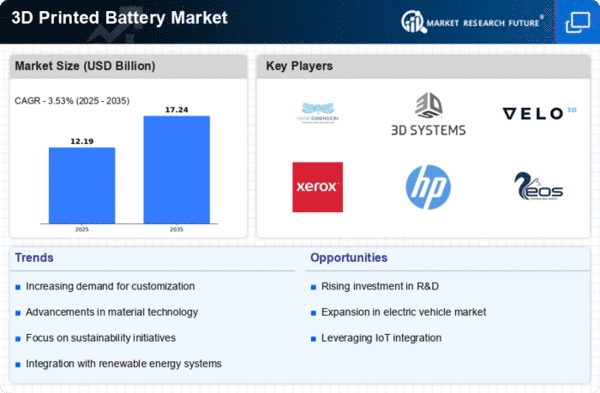
3D Printed Battery Market Infographic
Purchase Options

Market Trends

Key Emerging Trends in the 3D Printed Battery Market

The 3D Printed Battery Market is exhibiting a compound annual growth rate (CAGR) of 19.54% during the forecast period (2023 - 2030). The 3D Printed Battery Market is witnessing a surge in innovative strategies as companies vie for a larger market share. One prominent positioning strategy involves differentiation through technology. Businesses are heavily endowed with money for research and development in order to design batteries which have improved performance and unique features. Through the integration of state-of-the-art 3D printing, these batteries can be designed to have complex structures that enhance energy storing and discharging functionality. Luckily, they not only attract the tech-savvy customers but also they represent the best examples for the advanced energy solutions.

Another noticed market share positioning strategy is cost leadership. Other companies are paying attention to and focusing on improving production processes and economies of scale so that they can offer batteries at a low cost before their competitors. This goal is to attract a weighty customer group with the price-conscious mindset who prefer buying quality products without sacrificing it at a lower cost. Through effective optimization of the production and supply chain processes, companies will achieve the status of the ultimate brands for the people who are heading the cost and strive to buy absolutely reliable 3D batteries.

Besides, sustainability is gaining importance as one of the major segmentation factors in terms of market share within the 3D Printed Battery Market. Influenced by the growing importance of environmental issues, consumers today are not only interested in buying eco-friendly and sustainable goods but also want the products to be environmentally friendly. Integration of eco-friendly manufacturing technology and green materials in the production of 3D printing batteries could help companies promote the image of their economic activity as efficient and socially responsible. This practice not only captures the new rising segment of the consumers who are aware of the environment but it is also the direction of the globalization strategies for the green future.

Customer-centric approach is also a principal factor of market positioning. Some companies are focusing on understanding and catering to the specific needs of their target audience. This involves offering customization options, such as personalized designs, sizes, and energy capacities, to meet diverse consumer preferences. By positioning themselves as customer-focused, companies can build brand loyalty and gain a competitive advantage in a market where consumer demands are continually evolving.

Author
Anshula Mandaokar
Team Lead - Research

Anshula Mandaokar holds an academic degree in Chemical Engineering and has been contributing to the field for more than 5 years. She has expertise in Market Research and Business Consulting and serves as a Team Lead for a reputed Market Research firm under the Chemicals and Materials domain spectrum. She has worked on multiple projects, generating explicit results in a quick turnaround time. Her understanding of data interpretation justifies her role as a leader.

Leave a Comment

FAQs

How much is the 3D Printed Battery Market?

3D Printed Battery Market size US$ 22.01 Bn in 2022.

What is the growth rate of the 3D Printed Battery Market?

The growth rate of the 3D Printed Battery Market 19.54% by 2035.

Which region held the largest market share in the 3D Printed Battery Market?

North America held the largest market share in the 3D Printed Battery Market.

Who are the key players in the 3D Printed Battery Market?

Sakuu Corporation. (US), Photocentric (UK), Neware Technology Limited (China), American Elements (US), Element14 Electronics (Singapore), Stratasys Ltd. (Israel), Blackstone Resources (Switzerland) , GE Additive (US), 6K (US) and EOS GmbHn (Germany)

Which Architectural Process led the 3D Printed Battery Market?

Graphene-based PLA filaments Architectural Process led the 3D Printed Battery Market.

Which Application had the largest market share in the 3D Printed Battery Market?

Wearables Application had the largest market share in the 3D Printed Battery Market.

Which End-User had the largest market share in the 3D Printed Battery Market?

Energy Storage devices End-User had the largest market share in the 3D Printed Battery Market.

Market Summary

As per Market Research Future Analysis, the Global 3D Printed Battery Market was valued at USD 22.01 billion in 2022 and is projected to reach USD 90.08 billion by 2035, growing at a CAGR of 19.54% from 2023 to 2035. The growth is driven by rising demand from end-use industries such as automotive, healthcare, and aerospace & defense, particularly due to the increasing adoption of electric vehicles (EVs) and the need for battery miniaturization. The automotive sector is a significant contributor, with investments in 3D printing technologies aimed at reducing manufacturing costs and enhancing product performance. Additionally, the consumer electronics industry is rapidly adopting 3D printed batteries for wearable devices, further propelling market expansion.

Key Market Trends & Highlights

Key trends driving the 3D Printed Battery Market include technological advancements and increasing applications across various sectors.

  • 3D Printed Battery Market Size in 2022: USD 22.01 billion. Projected Market Size by 2035: USD 90.08 billion. CAGR from 2023 to 2035: 19.54%. Automotive sector is the fastest-growing end-use market for 3D printed batteries.

Market Size & Forecast

2022 Market Size USD 22.01 billion
2023 Projected Market Size USD 26.31 billion
2035 Projected Market Size USD 90.08 billion
CAGR (2023-2035) 19.54%

Major Players

<p>Sakuu Corporation (US), Neware Technology Limited (China), American Elements (US), Element14 Electronics (Singapore), Stratasys Ltd. (Israel), Blackstone Resources (Switzerland), <a href="https://photocentricgroup.com/3d-batteries/">Photocentric </a>(UK), GE Additive (US), 6K (US), EOS GmbH (Germany)</p>

Market Trends

Rising demand for 3D printed batteries from major end-use industries to fuel the 3D Printed Battery Market

The rising demand for 3d printed batteries from major end-use industries is one of the major factors driving the growth of the 3d printed battery market. The expansion of the 3D printing market is anticipated to be fueled by the rise in demand for 3D printed items in the automotive, healthcare, and aerospace & defence sectors. The need for 3d printed batteries is rising as 3d printing technology is being adopted more widely in the automotive and aerospace sectors. Electric and hybrid electric vehicles both use these batteries.

Another element fueling the expansion of the market for 3D printed batteries is the growing demand for electric vehicles. The market for 3D printed batteries is expanding as a result of the rising demand for consumer devices.

The end-use market for 3D printed batteries with one of the quickest growth is the automotive sector. Due to its numerous advantages, including decreased manufacturing costs, time, and product weight, the automotive industry is turning away from conventional manufacturing techniques and towards 3D printing.   This is a result of the growing demand for electric cars (EVs) and the requirement for battery miniaturisation. In order to lighten and extend the range of electric vehicles, 3D printed batteries are used. Both plug-in hybrid electric cars (PHEVs) and hybrid electric vehicles (HEVs) use these batteries.

Additionally, the automotive sector is spending a lot of money on 3D printing research and development. For instance, the BMW Group declared in January 2019 that it would spend EUR 10 million on its 3D printing campus in Munich, Germany. This facility would be utilised to create innovative 3D printing technologies for small-batch production and rapid prototyping.

The consumer electronics industry is also one of the fastest growing end-use industry for 3D printed batteries.  Due to the necessity for battery miniaturisation, the consumer electronics industry is seeing an increase in demand for 3D printed batteries. These batteries are utilised in wearable electronics, computers, and portable electronic gadgets. Compared to conventional batteries, 3D printed batteries have a better energy density and can be made to fit a specific device's needs.

Leading electronic companies are implementing 3D printing technologies to produce printed cells (microbattery) suitable with smart devices that have a low volumetric expansion, high-rate capability, stability, and security, which is anticipated to boost the market in the upcoming years. A 3D battery printing business called Sakuu Corporation has made progress in the development of its lithium-ion battery by obtaining an energy density of 800 Wh/L. The outcome, according to the business, is a significant advancement on its roadmap towards a fully functional 3D printed solid-state battery (SSB) capable of more than 1,200 Wh/L by 2023.

This would be far better than the lithium-ion battery that currently dominates the market and works in the 500–700 Wh/L range. In order to stay competitive in the market, major players in the global 3D printed battery business are quickly creating batteries using 3D printers and 3D printing technologies. Leading makers of 3D printed batteries are working with companies that make cars and aeroplanes to advance the market for these batteries. These batteries can reduce production costs, supplementary material costs, and current collector energy use by roughly 30%.

Manufacturing 3D-printed batteries has the potential to reduce capital costs by 40% when compared to the conventional battery manufacturing process.

The healthcare industry is also expected to boost the progress of the 3D printing market. The usage of 3D printing in the healthcare sector is anticipated to rise as a result of its capacity to produce personalised implants and prosthetics that conform to the anatomy of the patient. Additionally, a demand for 3D-printable organs is anticipated due to the rise in organ transplantation procedures. For instance, in the United States, a patient received the first kidney transplant made via 3D printing in 2016.

Additionally, the aerospace and defence sector is another important market for 3D printing. 3D printing is being used by the aerospace and defence sector to create prototypes and produce small batches of parts. The usage of 3D printing in the aerospace and defence sector helps with a major difficulty encountered by the sector: lowering the weight of the final goods. For instance, the Airbus Group declared in 2016 that by 2025, it will employ 3D printing to make up to 1,000 metal parts for each aircraft.

Additionally, conventional batteries don't match characteristics like flexibility, dependability, thinness, or lightweightness; as a result, wearable technology has grown to be a significant business for the market for 3D printed batteries. A recent study estimates that the worldwide wearables market will generate about $15,376 million in sales in 2020, with 356.8 million active users. Therefore, it is anticipated that all of these key industries, which are themselves growing exponentially, would eventually help to expand the global market for 3D printed batteries.

3D Printed Battery Market Market Drivers

Market Growth Projections

The Global 3D Printed Battery Market Industry is projected to experience substantial growth over the next decade. With a market value of 32.0 USD Billion in 2024, it is anticipated to expand significantly, reaching 219.9 USD Billion by 2035. This growth trajectory indicates a compound annual growth rate (CAGR) of 19.15% from 2025 to 2035. Such projections reflect the increasing adoption of 3D printed batteries across various sectors, driven by advancements in technology, rising demand for sustainable solutions, and the growing electric vehicle market. The future of the industry appears promising, with numerous opportunities for innovation and expansion.

Growing Electric Vehicle Market

The expansion of the electric vehicle market is a significant driver for the Global 3D Printed Battery Market Industry. As more consumers and manufacturers shift towards electric vehicles, the demand for advanced battery technologies increases. 3D printed batteries offer unique advantages, such as lightweight designs and customizable shapes, which are particularly beneficial for electric vehicle applications. Major automotive manufacturers are investing in 3D printing technologies to enhance battery performance and reduce production costs. This trend is likely to propel the market forward, as the electric vehicle sector continues to grow, further stimulating demand for innovative battery solutions.

Advancements in 3D Printing Technology

Technological advancements in 3D printing are significantly influencing the Global 3D Printed Battery Market Industry. Innovations in materials and printing techniques are enhancing the performance and efficiency of 3D printed batteries. For example, the development of new conductive materials allows for faster charging and higher energy densities. This progress not only improves battery performance but also reduces production costs, making 3D printed batteries more competitive against traditional battery technologies. As these advancements continue, the market is poised for substantial growth, with a projected CAGR of 19.15% from 2025 to 2035, indicating a robust future for the industry.

Rising Demand for Sustainable Energy Solutions

The Global 3D Printed Battery Market Industry is experiencing a surge in demand for sustainable energy solutions. As governments and organizations worldwide prioritize renewable energy sources, the need for efficient energy storage systems becomes paramount. 3D printed batteries, with their potential for reduced waste and lower carbon footprints, align well with these sustainability goals. For instance, the European Union has set ambitious targets for reducing greenhouse gas emissions, which could drive investments in innovative battery technologies. This trend is expected to contribute to the market's growth, with projections indicating a market value of 32.0 USD Billion in 2024.

Customization and Flexibility in Battery Design

Customization and flexibility in battery design are pivotal factors driving the Global 3D Printed Battery Market Industry. The ability to tailor battery shapes and sizes to specific applications allows for greater efficiency and performance. Industries such as consumer electronics, aerospace, and healthcare are increasingly seeking customized battery solutions to meet their unique requirements. 3D printing technology facilitates rapid prototyping and production of bespoke batteries, which can lead to improved product performance and reduced time-to-market. This adaptability is expected to attract more industries to adopt 3D printed batteries, thereby contributing to the overall growth of the market.

Increased Investment in Research and Development

Investment in research and development is a critical driver for the Global 3D Printed Battery Market Industry. Governments and private sectors are allocating substantial funds to explore innovative battery technologies, which is essential for enhancing battery performance and sustainability. For instance, initiatives in the United States aim to foster collaboration between academia and industry to accelerate the development of advanced battery technologies. This influx of funding not only supports the creation of more efficient 3D printed batteries but also encourages the commercialization of these technologies. As a result, the market is expected to grow significantly, potentially reaching 219.9 USD Billion by 2035.

Market Segment Insights

3D Printed Battery Market by Architectural Process Insights

<p>The 3D Printed Battery Market segmentation, based on Architectural Process has been segmented as Graphene-based PLA filaments, Graphene-based Li-ion Anodes, Platinum-based Electrodes and Others. Among these, the Graphene-based PLA filaments type is projected to dominate the 3D Printed Battery Market revenue through the projected period. A form of 3D printing material called graphene-based PLA filaments is manufactured by mixing graphene with Polylactic Acid (PLA) to produce a composite material with better qualities than regular PLA, such as greater strength, electrical conductivity, and thermal resistance.</p>

<p>With the ease of usage and minimal warping characteristics of PLA, this blend of graphene and PLA can create 3D printed parts with a high level of stiffness, toughness, and longevity. Although the use of graphene in 3D printing filaments is a relatively recent breakthrough, it has great potential for use in a variety of industries, including electronics, aircraft, and biomedicine.</p>

<p>August 2019:Sakuu Corporation&nbsp; produced 3D printed solid-state batteries for Musashi's motorcycles. Musashi Selmitsu Industry and KeraCel signed a partnership to develop safe, 3D printed, solid-state batteries for motorcycles. KeraCel produces a lithium-ion solid-state battery that might enable the production of cells with ceramic-based electrolytes and lithium metal anodes.</p>

3D Printed Battery Market by Application Insights

<p>The 3D Printed Battery Market segmentation, based on Application, the market is segmented as Wearables, Smartphones, Electric Vehicles and Others. Out of which the Wearables segment dominated base year market and is also projected to be holding a dominating share in the forecasted period as well. The 'Wearables' segment, which is extensively employed in smartwatches and wearable power banks, accounted for the largest market share in 2020.According to a study, the number of wearable gadgets has doubled in the past three years, going from just under 325.88 million in 2016 to just over 722.47 million in 2019.</p>

<p>And by 2023, it's expected to exceed 1 billion.Over 38.8 million consumers expressed interest in buying at least one wearable device in the preceding year, according to some study. Consumers who own at least one wearable product increased by 1.1% from the previous year. The increase in demand for one wearable device was a factor in the global market's overall wearable device demand rising by 9.7%.</p>

<p>May 2022:6K, a creator of speciality 3D printing materials, raised $102 million in Series D funding. The investment is the 1st of the two tranches that total up to $150 million, led by Koch and supported by Energy Impact Partners, Albemarle, HG Ventures, and 6 K's previous sponsors. The company will use the cash from its Series D round to increase its metal powder and cathode production facilities, allowing it to better meet the promising growth in demand for lithium-ion batteries.</p>

3D Printed Battery Market by End-User Insights

<p>The 3D Printed Battery Market segmentation based on the End-User, has been segmented as Energy Storage devices, Electronics, Automotive, Aerospace &amp; Drones and Other. The market's largest share belonged to the Energy Storage devices segment. Since the energy is stored in capacitors and batteries, a wide range of applications, including electric vehicles, laptops, and mobile devices, can use energy storage devices, which is fueling the overall expansion of this market. Additionally, there are environmental advantages to energy storage in gadgets like batteries, such as a reduction in greenhouse gas emissions.</p>

<p>Additionally, the demand for EVs is rising, which is driving the development of electrochemical energy storage technologies. In 2021, 6.75 million EVs&mdash;that is, light trucks, cars, and trucks used for light commercial purposes&mdash;were sold globally. Around 9.6 million units were sold in 2022, a startling 104% rise over the numbers from 2020. With plans to use over 532,000 electric buses in public transit by 2022, China is also predicted to be the market leader in the electric vehicle sector. As a result, there will be a big market for 3D printed EV batteries in the next years.</p>

<p>August 2021:Blackstone Technology received a $42.94 million financial boost from Swiss battery metals parent company Blackstone Resources for its 3D-printed batteries project in Germany. The investment, according to Blackstone, provides funding for plans to increase output at the German subsidiary's existing site in D&ouml;beln, Saxony, to 500 MWh per year by 2022.</p>

Get more detailed insights about 3D Printed Battery Market Research Report—Global Forecast till 2035

Regional Insights

By Region, the study segments the 3D Printed Battery Market into North America, Europe, Asia-Pacific, Middle East & Africa and South America. The North America 3D Printed Battery Market holds the largest market share and is also anticipated to account for the largest revenue share during the forecast period. This region's market is expanding due to the rapid technical improvements in the electronics industry and the existence of major market leaders in 3D printing technologies.

The University of Illinois and Harvard University have successfully printed lithium (Li)-ion microbatteries that are practically the size of a sand grain using 3D printing technology. As more electric vehicles employ 3D printed batteries, the North American market will expand. In North America, 3D printed batteries are used in smart packaging, smart cards for payment purposes in the telecommunications, banking, and transportation industries, and wearable technology like smartwatches, fitness bands, and wearable power banks for smartphones.

The income in the US IT sector will reach a new record of USD 487 billion in 2021, up 7.5% from the previous year, predicts the Consumer Technology Association. On any given day, almost 57 million Americans use a wearable device, and sales of smartwatches are expected to rise by 8%, driven by tech-savvy and fashion-conscious consumers. Major makers of 3D-printed batteries have made significant investments in the US market, particularly in the consumer electronics sector.

As a result of growing industrialization, consumer electronics manufacturers in the Asia Pacific area are refining their product designs, which calls for thin power sources to support the flexible design of their products. For the miniaturisation of electrical devices, 3D printed batteries are preferred. The market for 3D printed batteries is expanding as a result of China's expanding defence budget and the country's increased demand for cutting-edge consumer gadgets.

September 2022:Sakuu entered into a memorandum of understanding (MOU) with Japan's NGK Spark Plugs CO., LTD. to co-develop and provide ceramic materials for Sakuu's solid-state battery production. The partnership with NGK was a strategic step by Sakuu for expansion of its future solid-state battery commercialization plans.

Key Players and Competitive Insights

Major market players are spending a lot of money on R&D to increase their product lines, which will help the 3D Printed Battery Market grow even more. Market participants are also taking a range of strategic initiatives to grow their worldwide footprint, including new product launches, contractual agreements, mergers and acquisitions, increased investments, and collaboration with other organizations. Competitors in the 3D Printed Battery Market industry must offer cost-effective products to expand and survive in an increasingly competitive and rising market environment.

One of the primary business strategies adopted by manufacturers in the global 3D Printed Battery industry to benefit clients and expand the 3D Printed Battery Market sector is to manufacture locally to reduce operating costs. The market for 3D Printed Battery Market is recognized as being extremely competitive and fragmented. The market for 3D Printed Battery Market offers considerable potential opportunities for domestic and unorganised companies.

Some of the key players operating in the 3D Printed Battery Market are Sakuu Corporation. (US), Photocentric (UK), Neware Technology Limited (China), American Elements (US), Element14 Electronics (Singapore), Stratasys Ltd. (Israel), Blackstone Resources (Switzerland), GE Additive (US), 6K (US) and EOS GmbHn (Germany). To increase their global reach and client base, key firms are concentrating on acquisitions and product innovation.

Stratasys LtdOffers services for additive manufacturing and 3D printing solutions. The business sells 3D printers, consumables, and operating system packages. Along with this, it offers other services including strategic advice, quick prototyping, contract engineering, on-site installation, customer support and warranty, direct manufacturing paid-parts services, maintenance, and training. Government agencies as well as companies in the railway, aerospace, healthcare, automotive, educational, and consumer product sectors can benefit from Stratasys' technologies. These goods are offered by direct sales teams, distributors, and independent sales representatives. Across North America, Latin America, Europe, the Middle East, Africa, and Asia-Pacific, the company has operations.

Eden Prairie, Minnesota, in the US, serves as both of Stratasys's headquarters.

American Elements:Is an international producer and distributor of advanced materials with a catalogue of more than 35,000 products and a database of knowledge on chemical elements, sophisticated materials, and high-tech applications. Los Angeles, California serves as the location of the company's corporate offices and educational initiatives. Its facilities for research and production are situated in Manchester, the United Kingdom, Salt Lake City, Utah, Monterrey, Mexico, and Baotou, China. For more than 25 years, the company's materials science research and development programmes have been a valuable resource for new product development in business, government, and academia.

Key Companies in the 3D Printed Battery Market market include

Industry Developments

March 2022:Sakuu Corporation successfully achieved a new milestone in the development of its Li-ion metal battery by achieving an energy-density level of 800 Wh/L. This achievement was regarded as one of the most significant steps towards its roadmap in achieving fully 3D printed SSBs (solid-state batteries) that will be capable of generating a power of 1,200 Wh/L by 2023.

January 2022:6K, one of the leading manufacturers of speciality 3D printing materials, successfully collaborated with Albemarle Corporation, a worldwide chemicals company, to explore the new lithium-ion battery materials in-depth. 6K's patented UniMelt technology is regarded as one of the most efficient production platforms for composing industrial-grade powders. 

August 2021:Blackstone Technology successfully received a huge financial support worth USD 42.94 million from Blackstone Resources, a Swiss battery metals parent company, for launching its 3D-printed batteries project in Deutschland. The investment provided a sufficient amount of funding for plans to increase the overall power generation output at the German subsidiary in Döbeln, Saxony, to nearly 500 MWh per year.

Future Outlook

3D Printed Battery Market Future Outlook

<p>The Global 3D Printed Battery Market is poised for substantial growth, driven by innovations in materials and manufacturing processes, achieving a 19.15% CAGR from 2024 to 2035.</p>

New opportunities lie in:

  • <p>Develop customized battery solutions for electric vehicles to enhance performance and sustainability. Invest in R&amp;D for advanced materials to improve battery efficiency and reduce costs. Establish partnerships with renewable energy firms to integrate 3D printed batteries in energy storage systems.</p>

<p>By 2035, the market is expected to reach a robust position, reflecting significant advancements and widespread adoption.</p>

Market Segmentation

3D Printed Battery End-User Outlook

  • Energy Storage devices
  • Electronics
  • Automotive
  • Aerospace & Drones
  • Other

3D Printed Battery Application Outlook

  • Wearables
  • Smartphones
  • Electric Vehicles
  • Others

3D Printed Battery Architectural Process Outlook

  • Graphene-based PLA filaments
  • Graphene-based Li-ion Anodes
  • Platinum-based Electrodes
  • Others

Report Scope

Report Attribute/Metric Details
Market Size 2022 USD 22.01 billion
Market Size 2023 USD 26.31 billion
Market Size 2030 USD 90.08 billion
Compound Annual Growth Rate (CAGR) 19.54 % (2023-2030)
Base Year 2022
Forecast Period 2023-2030
Historical Data 2019 & 2021
Forecast Units Value (USD Billion)
Report Coverage Revenue Forecast, Competitive Landscape, Growth Factors, and Trends
Segments Covered Type, Source, Application and Region
Geographies Covered North America, Europe, Asia Pacific, Middle East & Africa and South America
Countries Covered The U.S, Canada, Germany, France, UK, Italy, Spain, China, Japan, India, Australia, South Korea,  Brazil, Saudi Arabia, UAE, Argentina,
Key Companies Profiled Sakuu Corporation. (US), Photocentric (UK), Neware Technology Limited (China), American Elements (US), Element14 Electronics (Singapore), Stratasys Ltd. (Israel), Blackstone Resources (Switzerland), GE Additive (US), 6K (US) and EOS GmbHn (Germany)
Key Market Opportunities Increasing need for portable & flexible energy sources and growing demand for wearable technologies.
Key Market Dynamics Rising demand for 3D printed batteries from major end-use industries.

FAQs

How much is the 3D Printed Battery Market?

3D Printed Battery Market size US$ 22.01 Bn in 2022.

What is the growth rate of the 3D Printed Battery Market?

The growth rate of the 3D Printed Battery Market 19.54% by 2035.

Which region held the largest market share in the 3D Printed Battery Market?

North America held the largest market share in the 3D Printed Battery Market.

Who are the key players in the 3D Printed Battery Market?

Sakuu Corporation. (US), Photocentric (UK), Neware Technology Limited (China), American Elements (US), Element14 Electronics (Singapore), Stratasys Ltd. (Israel), Blackstone Resources (Switzerland) , GE Additive (US), 6K (US) and EOS GmbHn (Germany)

Which Architectural Process led the 3D Printed Battery Market?

Graphene-based PLA filaments Architectural Process led the 3D Printed Battery Market.

Which Application had the largest market share in the 3D Printed Battery Market?

Wearables Application had the largest market share in the 3D Printed Battery Market.

Which End-User had the largest market share in the 3D Printed Battery Market?

Energy Storage devices End-User had the largest market share in the 3D Printed Battery Market.

  1. EXECUTIVE SUMMARY
  2. SCOPE OF THE REPORT
    1. MARKET DEFINITION
    2. SCOPE OF THE STUDY
    3. LIST OF ASSUMPTIONS
    4. MARKETS STRUCTURE
  3. MARKET RESEARCH METHODOLOGY
    1. RESEARCH PROCESS
    2. PRIMARY RESEARCH
    3. SECONDARY RESEARCH
    4. MARKET SIZE ESTIMATION
    5. FORECAST MODEL
  4. MARKET FACTOR ANALYSIS
    1. SUPPLY CHAIN ANALYSIS
      1. RAW MATERIALSUPPLIERS
      2. MANUFACTURERS OF 3D PRINTED BATTERY
      3. DISTRIBUTORS/RETAILERS/WHOLESALERS/END USERS
      4. END-USE INDUSTRIES
    2. PORTER’S FIVE FORCES MODEL
      1. THREAT OF NEW ENTRANTS
      2. INTENSITY OF COMPETITIVE RIVALRY
      3. THREAT OF SUBSTITUTES
      4. BARGAINING POWER OF SUPPLIERS
      5. BARGAINING POWER OF BUYERS
    3. PRICING ANALYSIS
  5. MARKET DYNAMICS OF GLOBAL 3D PRINTED BATTERY MARKET
    1. INTRODUCTION
    2. DRIVERS
      1. RISING DEMAND FOR 3D PRINTED BATTERIES FROM MAJOR END-USE INDUSTRIES
    3. RESTRAINTS
      1. HIGH COST OF 3D PRINTED BATTERIES
    4. OPPORTUNITIES
      1. INCREASING NEED FOR PORTABLE & FLEXIBLE ENERGY ARCHITECTURAL PROCESSS AND GROWING DEMAND FOR WEARABLE TECHNOLOGIES
  6. GLOBAL 3D PRINTED BATTERY MARKET, BY ARCHITECTURAL PROCESS
    1. INTRODUCTION
    2. GRAPHENE-BASED PLA FILAMENTS
      1. MARKET ESTIMATES & FORECAST, 2019–2030
      2. MARKET ESTIMATES & FORECAST, BY REGION, 2019–2030
    3. GRAPHENE-BASED LI-ION ANODES
      1. MARKET ESTIMATES & FORECAST, 2019–2030
      2. MARKET ESTIMATES & FORECAST, BY REGION, 2019–2030
    4. PLATINUM-BASED ELECTRODES
      1. MARKET ESTIMATES & FORECAST, 2019–2030
      2. MARKET ESTIMATES & FORECAST, BY REGION, 2019–2030
    5. OTHERS
      1. MARKET ESTIMATES & FORECAST, 2019–2030
      2. MARKET ESTIMATES & FORECAST, BY REGION, 2019–2030
  7. GLOBAL 3D PRINTED BATTERY MARKET, BY APPLICATION
    1. INTRODUCTION
    2. WEARABLES
      1. MARKET ESTIMATES & FORECAST, 2019–2030
      2. MARKET ESTIMATES & FORECAST, BY REGION, 2019–2030
    3. SMARTPHONES
      1. MARKET ESTIMATES & FORECAST, 2019–2030
      2. MARKET ESTIMATES & FORECAST, BY REGION, 2019–2030
    4. ELECTRIC VEHICLES
      1. MARKET ESTIMATES & FORECAST, 2019–2030
      2. MARKET ESTIMATES & FORECAST, BY REGION, 2019–2030
    5. OTHERS
      1. MARKET ESTIMATES & FORECAST, 2019–2030
      2. MARKET ESTIMATES & FORECAST, BY REGION, 2019–2030
  8. GLOBAL 3D PRINTED BATTERY MARKET, BY END-USER
    1. INTRODUCTION
    2. ENERGY STORAGE DEVICES
      1. MARKET ESTIMATES & FORECAST, 2019–2030
      2. MARKET ESTIMATES & FORECAST, BY REGION, 2019–2030
    3. ELECTRONICS
      1. MARKET ESTIMATES & FORECAST, 2019–2030
      2. MARKET ESTIMATES & FORECAST, BY REGION, 2019–2030
    4. AUTOMOTIVE
      1. MARKET ESTIMATES & FORECAST, 2019–2030
      2. MARKET ESTIMATES & FORECAST, BY REGION, 2019–2030
    5. AEROSPACE & DRONES
      1. MARKET ESTIMATES & FORECAST, 2019–2030
      2. MARKET ESTIMATES & FORECAST, BY REGION, 2019–2030
    6. OTHERS
      1. MARKET ESTIMATES & FORECAST, 2019–2030
      2. MARKET ESTIMATES & FORECAST, BY REGION, 2019–2030
  9. GLOBAL 3D PRINTED BATTERY MARKET, BY REGION
    1. INTRODUCTION
    2. NORTH AMERICA
      1. MARKET ESTIMATES & FORECAST, 2019–2030
      2. MARKET ESTIMATES & FORECAST, BY ARCHITECTURAL PROCESS, 2019–2030
      3. MARKET ESTIMATES & FORECAST, BY APPLICATION, 2019–2030
      4. MARKET ESTIMATES & FORECAST, BY END-USER, 2019–2030
      5. US
  10. MARKET ESTIMATES & FORECAST, 2019–2030
  11. MARKET ESTIMATES & FORECAST, BY ARCHITECTURAL PROCESS, 2019–2030
  12. MARKET ESTIMATES & FORECAST, BY APPLICATION, 2019–2030
  13. MARKET ESTIMATES & FORECAST, BY END-USER, 2019–2030
  14. CANADA
  15. MARKET ESTIMATES & FORECAST, 2019–2030
  16. MARKET ESTIMATES & FORECAST, BY ARCHITECTURAL PROCESS, 2019–2030
  17. MARKET ESTIMATES & FORECAST, BY APPLICATION, 2019–2030
  18. MARKET ESTIMATES & FORECAST, BY END-USER, 2019–2030
    1. EUROPE
      1. MARKET ESTIMATES & FORECAST, 2019–2030
      2. MARKET ESTIMATES & FORECAST, BY ARCHITECTURAL PROCESS, 2019–2030
      3. MARKET ESTIMATES & FORECAST, BY APPLICATION, 2019–2030
      4. MARKET ESTIMATES & FORECAST, BY END-USER, 2019–2030
      5. GERMANY
  19. MARKET ESTIMATES & FORECAST, 2019–2030
  20. MARKET ESTIMATES & FORECAST, BY ARCHITECTURAL PROCESS, 2019–2030
  21. MARKET ESTIMATES & FORECAST, BY APPLICATION, 2019–2030
  22. MARKET ESTIMATES & FORECAST, BY END-USER, 2019–2030
  23. FRANCE
  24. MARKET ESTIMATES & FORECAST, 2019–2030
  25. MARKET ESTIMATES & FORECAST, BY ARCHITECTURAL PROCESS, 2019–2030
  26. MARKET ESTIMATES & FORECAST, BY APPLICATION, 2019–2030
  27. MARKET ESTIMATES & FORECAST, BY END-USER, 2019–2030
  28. ITALY
  29. MARKET ESTIMATES & FORECAST, 2019–2030
  30. MARKET ESTIMATES & FORECAST, BY ARCHITECTURAL PROCESS, 2019–2030
  31. MARKET ESTIMATES & FORECAST, BY APPLICATION, 2019–2030
  32. MARKET ESTIMATES & FORECAST, BY END-USER, 2019–2030
  33. SPAIN
  34. MARKET ESTIMATES & FORECAST, 2019–2030
  35. MARKET ESTIMATES & FORECAST, BY ARCHITECTURAL PROCESS, 2019–2030
  36. MARKET ESTIMATES & FORECAST, BY APPLICATION, 2019–2030
  37. MARKET ESTIMATES & FORECAST, BY END-USER, 2019–2030
  38. UK
  39. MARKET ESTIMATES & FORECAST, 2019–2030
  40. MARKET ESTIMATES & FORECAST, BY ARCHITECTURAL PROCESS, 2019–2030
  41. MARKET ESTIMATES & FORECAST, BY APPLICATION, 2019–2030
  42. MARKET ESTIMATES & FORECAST, BY END-USER, 2019–2030
  43. RUSSIA
  44. MARKET ESTIMATES & FORECAST, 2019–2030
  45. MARKET ESTIMATES & FORECAST, BY ARCHITECTURAL PROCESS, 2019–2030
  46. MARKET ESTIMATES & FORECAST, BY APPLICATION, 2019–2030
  47. MARKET ESTIMATES & FORECAST, BY END-USER, 2019–2030
  48. REST OF EUROPE
  49. MARKET ESTIMATES & FORECAST, 2019–2030
  50. MARKET ESTIMATES & FORECAST, BY ARCHITECTURAL PROCESS, 2019–2030
  51. MARKET ESTIMATES & FORECAST, BY APPLICATION, 2019–2030
  52. MARKET ESTIMATES & FORECAST, BY END-USER, 2019–2030
    1. ASIA-PACIFIC
      1. MARKET ESTIMATES & FORECAST, 2019–2030
      2. MARKET ESTIMATES & FORECAST, BY ARCHITECTURAL PROCESS, 2019–2030
      3. MARKET ESTIMATES & FORECAST, BY APPLICATION, 2019–2030
      4. MARKET ESTIMATES & FORECAST, BY END-USER, 2019–2030
      5. CHINA
  53. MARKET ESTIMATES & FORECAST, 2019–2030
  54. MARKET ESTIMATES & FORECAST, BY ARCHITECTURAL PROCESS, 2019–2030
  55. MARKET ESTIMATES & FORECAST, BY APPLICATION, 2019–2030
  56. MARKET ESTIMATES & FORECAST, BY END-USER, 2019–2030
  57. INDIA
  58. MARKET ESTIMATES & FORECAST, 2019–2030
  59. MARKET ESTIMATES & FORECAST, BY ARCHITECTURAL PROCESS, 2019–2030
  60. MARKET ESTIMATES & FORECAST, BY APPLICATION, 2019–2030
  61. MARKET ESTIMATES & FORECAST, BY END-USER, 2019–2030
  62. JAPAN
  63. MARKET ESTIMATES & FORECAST, 2019–2030
  64. MARKET ESTIMATES & FORECAST, BY ARCHITECTURAL PROCESS, 2019–2030
  65. MARKET ESTIMATES & FORECAST, BY APPLICATION, 2019–2030
  66. MARKET ESTIMATES & FORECAST, BY END-USER, 2019–2030
  67. AUSTRALIA
  68. MARKET ESTIMATES & FORECAST, 2019–2030
  69. MARKET ESTIMATES & FORECAST, BY ARCHITECTURAL PROCESS, 2019–2030
  70. MARKET ESTIMATES & FORECAST, BY APPLICATION, 2019–2030
  71. MARKET ESTIMATES & FORECAST, BY END-USER, 2019–2030
  72. SOUTH KOREA
  73. MARKET ESTIMATES & FORECAST, 2019–2030
  74. MARKET ESTIMATES & FORECAST, BY ARCHITECTURAL PROCESS, 2019–2030
  75. MARKET ESTIMATES & FORECAST, BY APPLICATION, 2019–2030
  76. MARKET ESTIMATES & FORECAST, BY END-USER, 2019–2030
  77. REST OF ASIA-PACIFIC
  78. MARKET ESTIMATES & FORECAST, 2019–2030
  79. MARKET ESTIMATES & FORECAST, BY ARCHITECTURAL PROCESS, 2019–2030
  80. MARKET ESTIMATES & FORECAST, BY APPLICATION, 2019–2030
  81. MARKET ESTIMATES & FORECAST, BY END-USER, 2019–2030
    1. MIDDLE EAST & AFRICA
  82. MARKET ESTIMATES & FORECAST, 2019–2030
  83. MARKET ESTIMATES & FORECAST, BY ARCHITECTURAL PROCESS, 2019–2030
  84. MARKET ESTIMATES & FORECAST, BY APPLICATION, 2019–2030
  85. MARKET ESTIMATES & FORECAST, BY END-USER, 2019–2030
  86. TURKEY
  87. MARKET ESTIMATES & FORECAST, 2019–2030
  88. MARKET ESTIMATES & FORECAST, BY ARCHITECTURAL PROCESS, 2019–2030
  89. MARKET ESTIMATES & FORECAST, BY APPLICATION, 2019–2030
  90. MARKET ESTIMATES & FORECAST, BY END-USER, 2019–2030
  91. ISRAEL
  92. MARKET ESTIMATES & FORECAST, 2019–2030
  93. MARKET ESTIMATES & FORECAST, BY ARCHITECTURAL PROCESS, 2019–2030
  94. MARKET ESTIMATES & FORECAST, BY APPLICATION, 2019–2030
  95. MARKET ESTIMATES & FORECAST, BY END-USER, 2019–2030
  96. NORTH AFRICA
  97. MARKET ESTIMATES & FORECAST, 2019–2030
  98. MARKET ESTIMATES & FORECAST, BY ARCHITECTURAL PROCESS, 2019–2030
  99. MARKET ESTIMATES & FORECAST, BY APPLICATION, 2019–2030
  100. MARKET ESTIMATES & FORECAST, BY END-USER, 2019–2030
  101. GCC
  102. MARKET ESTIMATES & FORECAST, 2019–2030
  103. MARKET ESTIMATES & FORECAST, BY ARCHITECTURAL PROCESS, 2019–2030
  104. MARKET ESTIMATES & FORECAST, BY APPLICATION, 2019–2030
  105. MARKET ESTIMATES & FORECAST, BY END-USER, 2019–2030
  106. REST OF THE MIDDLE EAST & AFRICA
  107. MARKET ESTIMATES & FORECAST, 2019–2030
  108. MARKET ESTIMATES & FORECAST, BY ARCHITECTURAL PROCESS, 2019–2030
  109. MARKET ESTIMATES & FORECAST, BY APPLICATION, 2019–2030
  110. MARKET ESTIMATES & FORECAST, BY END-USER, 2019–2030
    1. SOUTH AMERICA
  111. MARKET ESTIMATES & FORECAST, 2019–2030
  112. MARKET ESTIMATES & FORECAST, BY ARCHITECTURAL PROCESS, 2019–2030
  113. MARKET ESTIMATES & FORECAST, BY APPLICATION, 2019–2030
  114. MARKET ESTIMATES & FORECAST, BY END-USER, 2019–2030
  115. BRAZIL
  116. MARKET ESTIMATES & FORECAST, 2019–2030
  117. MARKET ESTIMATES & FORECAST, BY ARCHITECTURAL PROCESS, 2019–2030
  118. MARKET ESTIMATES & FORECAST, BY APPLICATION, 2019–2030
  119. MARKET ESTIMATES & FORECAST, BY END-USER, 2019–2030
  120. ARGENTINA
  121. MARKET ESTIMATES & FORECAST, 2019–2030
  122. MARKET ESTIMATES & FORECAST, BY ARCHITECTURAL PROCESS, 2019–2030
  123. MARKET ESTIMATES & FORECAST, BY APPLICATION, 2019–2030
  124. MARKET ESTIMATES & FORECAST, BY END-USER, 2019–2030
  125. MEXICO
  126. MARKET ESTIMATES & FORECAST, 2019–2030
  127. MARKET ESTIMATES & FORECAST, BY ARCHITECTURAL PROCESS, 2019–2030
  128. MARKET ESTIMATES & FORECAST, BY APPLICATION, 2019–2030
  129. MARKET ESTIMATES & FORECAST, BY END-USER, 2019–2030
  130. REST OF SOUTH AMERICA
  131. MARKET ESTIMATES & FORECAST, 2019–2030
  132. MARKET ESTIMATES & FORECAST, BY ARCHITECTURAL PROCESS, 2019–2030
  133. MARKET ESTIMATES & FORECAST, BY APPLICATION, 2019–2030
  134. MARKET ESTIMATES & FORECAST, BY END-USER, 2019–2030
  135. COMPETITIVE LANDSCAPE
    1. INTRODUCTION
    2. MARKET KEY STRATEGIES
    3. KEY DEVELOPMENT ANALYSIS (EXPANSIONS/MERGERS & ACQUISITIONS/JOINT VENTURES/NEW 3D PRINTED BATTERYDEVELOPMENTS/AGREEMENTS/INVESTMENTS)
  136. COMPANY PROFILES
    1. SAKUU CORPORATION.
      1. COMPANY OVERVIEW
      2. FINANCIAL OVERVIEW
      3. PRODUCTS OFFERED
      4. KEY DEVELOPMENTS
      5. SWOT ANALYSIS
      6. KEY STRATEGIES
    2. PHOTOCENTRIC
      1. COMPANY OVERVIEW
      2. FINANCIAL OVERVIEW
      3. PRODUCTS OFFERED
      4. KEY DEVELOPMENTS
      5. SWOT ANALYSIS
      6. KEY STRATEGIES
    3. NEWARE TECHNOLOGY LIMITED
      1. COMPANY OVERVIEW
      2. FINANCIAL OVERVIEW
      3. PRODUCTS OFFERED
      4. KEY DEVELOPMENTS
      5. SWOT ANALYSIS
      6. KEY STRATEGIES
    4. AMERICAN ELEMENTS
      1. COMPANY OVERVIEW
      2. FINANCIAL OVERVIEW
      3. PRODUCTS OFFERED
      4. KEY DEVELOPMENTS
      5. SWOT ANALYSIS
      6. KEY STRATEGIES
    5. ELEMENT14 ELECTRONICS
      1. COMPANY OVERVIEW
      2. FINANCIAL OVERVIEW
      3. PRODUCTS OFFERED
      4. KEY DEVELOPMENTS
      5. SWOT ANALYSIS
      6. KEY STRATEGIES
    6. STRATASYS LTD.
      1. COMPANY OVERVIEW
      2. FINANCIAL OVERVIEW
      3. PRODUCTS OFFERED
      4. KEY DEVELOPMENTS
      5. SWOT ANALYSIS
      6. KEY STRATEGIES
    7. BLACKSTONE RESOURCES
      1. COMPANY OVERVIEW
      2. FINANCIAL OVERVIEW
      3. PRODUCTS OFFERED
      4. KEY DEVELOPMENTS
      5. SWOT ANALYSIS
      6. KEY STRATEGIES
    8. GE ADDITIVE
      1. COMPANY OVERVIEW
      2. FINANCIAL OVERVIEW
      3. PRODUCTS OFFERED
      4. KEY DEVELOPMENTS
      5. SWOT ANALYSIS
      6. KEY STRATEGIES
    9. 6K
      1. COMPANY OVERVIEW
      2. FINANCIAL OVERVIEW
      3. PRODUCTS OFFERED
      4. KEY DEVELOPMENTS
      5. SWOT ANALYSIS
      6. KEY STRATEGIES
    10. EOS GMBHN
      1. COMPANY OVERVIEW
      2. FINANCIAL OVERVIEW
      3. PRODUCTS OFFERED
      4. KEY DEVELOPMENTS
      5. SWOT ANALYSIS
      6. KEY STRATEGIES
    11. APPENDIX
  137. LIST OF TABLES
  138. TABLE 1: GLOBAL 3D PRINTED BATTERY MARKET, BY REGION, 2019–2030
  139. TABLE 2: NORTH AMERICA: 3D PRINTED BATTERY MARKET, BY COUNTRY, 2019–2030
  140. TABLE 3: NORTH AMERICA: 3D PRINTED BATTERY MARKET, BY ARCHITECTURAL PROCESS, 2019–2030
  141. TABLE 4: NORTH AMERICA: 3D PRINTED BATTERY MARKET, BY APPLICATION, 2019–2030
  142. TABLE 5: NORTH AMERICA: 3D PRINTED BATTERY MARKET, BY END-USER, 2019–2030
  143. TABLE 6: EUROPE: 3D PRINTED BATTERY MARKET, BY COUNTRY, 2019–2030
  144. TABLE 7: EUROPE: 3D PRINTED BATTERY MARKET, BY ARCHITECTURAL PROCESS, 2019–2030
  145. TABLE 8: EUROPE: 3D PRINTED BATTERY MARKET, BY APPLICATION, 2019–2030
  146. TABLE 9: EUROPE: 3D PRINTED BATTERY MARKET, BY END-USER, 2019–2030
  147. TABLE 10: ASIA-PACIFIC: 3D PRINTED BATTERY MARKET, BY COUNTRY, 2019–2030
  148. TABLE 11: ASIA-PACIFIC: 3D PRINTED BATTERY MARKET, BY ARCHITECTURAL PROCESS, 2019–2030
  149. TABLE 12: ASIA-PACIFIC: 3D PRINTED BATTERY MARKET, BY APPLICATION, 2019–2030
  150. TABLE 13: ASIA-PACIFIC: 3D PRINTED BATTERY MARKET, BY END-USER, 2019–2030
  151. TABLE 14: MIDDLE EAST & AFRICA: 3D PRINTED BATTERY MARKET, BY COUNTRY, 2019–2030
  152. TABLE 15: MIDDLE EAST & AFRICA: 3D PRINTED BATTERY MARKET, BY ARCHITECTURAL PROCESS, 2019–2030
  153. TABLE 16: MIDDLE EAST & AFRICA: 3D PRINTED BATTERY MARKET, BY APPLICATION, 2019–2030
  154. TABLE 17: MIDDLE EAST & AFRICA: 3D PRINTED BATTERY MARKET, BY END-USER, 2019–2030
  155. TABLE 18: SOUTH AMERICA: 3D PRINTED BATTERY MARKET, BY COUNTRY, 2019–2030
  156. TABLE 19: SOUTH AMERICA: 3D PRINTED BATTERY MARKET, BY ARCHITECTURAL PROCESS, 2019–2030
  157. TABLE 20: SOUTH AMERICA: 3D PRINTED BATTERY MARKET, BY APPLICATION, 2019–203
  158. TABLE 21: SOUTH AMERICA: 3D PRINTED BATTERY MARKET, BY END-USER, 2019–2030
  159. LIST OF FIGURES
  160. GLOBAL 3D PRINTED BATTERY MARKET SEGMENTATION
  161. FORECAST RESEARCH METHODOLOGY
  162. PORTER’S FIVE FORCES ANALYSIS OF GLOBAL 3D PRINTED BATTERY MARKET
  163. VALUE CHAIN/SUPPLY CHAIN OF GLOBAL 3D PRINTED BATTERY MARKET
  164. SHARE OF GLOBAL 3D PRINTED BATTERY MARKET, BY COUNTRY, 2022 (%)
  165. GLOBAL 3D PRINTED BATTERY MARKET, 2019–2030
  166. GLOBAL 3D PRINTED BATTERY MARKET SIZE, BY ARCHITECTURAL PROCESS, 2019–2030
  167. SHARE OF GLOBAL 3D PRINTED BATTERY MARKET, BY ARCHITECTURAL PROCESS, 2022 (%)
  168. GLOBAL 3D PRINTED BATTERY MARKET SIZE, BY APPLICATION, 2019–2030
  169. SHARE OF GLOBAL 3D PRINTED BATTERY MARKET, BY APPLICATION, 2022 (%)
  170. GLOBAL 3D PRINTED BATTERY MARKET SIZE, BY END-USER, 2019–2030
  171. SHARE OF GLOBAL 3D PRINTED BATTERY MARKET, BY END-USER, 2022 (%)

3D Printed Battery Market Segmentation

3D Printed Battery Architectural Process Outlook (USD Million, 2019-2030)

  • Graphene-based PLA filaments
  • Graphene-based Li-ion Anodes
  • Platinum-based Electrodes
  • Other

3D Printed Battery Application Outlook (USD Million, 2019-2030)

  • Wearables
  • Smartphones
  • Electric Vehicles
  • Others

3D Printed Battery End-User Outlook (USD Million, 2019-2030)

  • Energy Storage devices
  • Electronics
  • Automotive
  • Aerospace & Drones
  • Other

3D Printed Battery Regional Outlook (USD Million, 2019-2030)

  • North America Outlook (USD Million, 2019-2030)

    • North America 3D Printed Battery by Architectural Process
      • Graphene-based PLA filaments
      • Graphene-based Li-ion Anodes
      • Platinum-based Electrodes
      • Other
    • North America 3D Printed Battery by Application
      • Wearables
      • Smartphones
      • Electric Vehicles
      • Others
    • North America 3D Printed Battery by End-User
      • Energy Storage devices
      • Electronics
      • Automotive
      • Aerospace & Drones
      • Other
    • US Outlook (USD Million, 2019-2030)

    • US 3D Printed Battery by Architectural Process
      • Graphene-based PLA filaments
      • Graphene-based Li-ion Anodes
      • Platinum-based Electrodes
      • Other
    • US 3D Printed Battery by Application
      • Wearables
      • Smartphones
      • Electric Vehicles
      • Others
    • US 3D Printed Battery by End-User
      • Energy Storage devices
      • Electronics
      • Automotive
      • Aerospace & Drones
      • Other
    • Canada Outlook (USD Million, 2019-2030)

    • Canada 3D Printed Battery by Architectural Process
      • Graphene-based PLA filaments
      • Graphene-based Li-ion Anodes
      • Platinum-based Electrodes
      • Other
    • Canada 3D Printed Battery by Application
      • Wearables
      • Smartphones
      • Electric Vehicles
      • Others
    • Canada 3D Printed Battery by End-User
      • Energy Storage devices
      • Electronics
      • Automotive
      • Aerospace & Drones
      • Other
  • Europe Outlook (USD Million, 2019-2030)

    • Europe 3D Printed Battery by Architectural Process
      • Graphene-based PLA filaments
      • Graphene-based Li-ion Anodes
      • Platinum-based Electrodes
      • Other
    • Europe 3D Printed Battery by Application
      • Wearables
      • Smartphones
      • Electric Vehicles
      • Others
    • Europe 3D Printed Battery by End-User
      • Energy Storage devices
      • Electronics
      • Automotive
      • Aerospace & Drones
      • Other
    • Germany Outlook (USD Million, 2019-2030)

    • Germany 3D Printed Battery by Architectural Process
      • Graphene-based PLA filaments
      • Graphene-based Li-ion Anodes
      • Platinum-based Electrodes
      • Other
    • Germany 3D Printed Battery by Application
      • Wearables
      • Smartphones
      • Electric Vehicles
      • Others
    • Germany 3D Printed Battery by End-User
      • Energy Storage devices
      • Electronics
      • Automotive
      • Aerospace & Drones
      • Other
    • France Outlook (USD Million, 2019-2030)

    • France 3D Printed Battery by Architectural Process
      • Graphene-based PLA filaments
      • Graphene-based Li-ion Anodes
      • Platinum-based Electrodes
      • Other
    • France 3D Printed Battery by Application
      • Wearables
      • Smartphones
      • Electric Vehicles
      • Others
    • France 3D Printed Battery by End-User
      • Energy Storage devices
      • Electronics
      • Automotive
      • Aerospace & Drones
      • Other
    • UK Outlook (USD Million, 2019-2030)

    • UK 3D Printed Battery by Architectural Process
      • Graphene-based PLA filaments
      • Graphene-based Li-ion Anodes
      • Platinum-based Electrodes
      • Other
    • UK 3D Printed Battery by Application
      • Wearables
      • Smartphones
      • Electric Vehicles
      • Others
    • UK 3D Printed Battery by End-User
      • Energy Storage devices
      • Electronics
      • Automotive
      • Aerospace & Drones
      • Other
    • ITALY Outlook (USD Million, 2019-2030)

    • Italy 3D Printed Battery by Architectural Process
      • Graphene-based PLA filaments
      • Graphene-based Li-ion Anodes
      • Platinum-based Electrodes
      • Other
    • Italy 3D Printed Battery by Application
      • Wearables
      • Smartphones
      • Electric Vehicles
      • Others
    • Italy 3D Printed Battery by End-User
      • Energy Storage devices
      • Electronics
      • Automotive
      • Aerospace & Drones
      • Other
      •  
    • Spain Outlook (USD Million, 2019-2030)

    • Spain 3D Printed Battery by Architectural Process
      • Graphene-based PLA filaments
      • Graphene-based Li-ion Anodes
      • Platinum-based Electrodes
      • Other
    • Spain 3D Printed Battery by Application
      • Wearables
      • Smartphones
      • Electric Vehicles
      • Others
    • Spain 3D Printed Battery by End-User
      • Energy Storage devices
      • Electronics
      • Automotive
      • Aerospace & Drones
      • Other
    • Rest Of Europe Outlook (USD Million, 2019-2030)

    • Rest of Europe 3D Printed Battery by Architectural Process
      • Graphene-based PLA filaments
      • Graphene-based Li-ion Anodes
      • Platinum-based Electrodes
      • Other
    • Rest of Europe 3D Printed Battery by Application
      • Wearables
      • Smartphones
      • Electric Vehicles
      • Others
    • Rest of Europe 3D Printed Battery by End-User
      • Energy Storage devices
      • Electronics
      • Automotive
      • Aerospace & Drones
      • Other
  • Asia-Pacific Outlook (USD Million, 2019-2030)

    • Asia-Pacific 3D Printed Battery by Architectural Process
      • Graphene-based PLA filaments
      • Graphene-based Li-ion Anodes
      • Platinum-based Electrodes
      • Other
    • Asia-Pacific 3D Printed Battery by Application
      • Wearables
      • Smartphones
      • Electric Vehicles
      • Others
    • Asia-Pacific 3D Printed Battery by End-User
      • Energy Storage devices
      • Electronics
      • Automotive
      • Aerospace & Drones
      • Other
    • China Outlook (USD Million, 2019-2030)

    • China 3D Printed Battery by Architectural Process
      • Graphene-based PLA filaments
      • Graphene-based Li-ion Anodes
      • Platinum-based Electrodes
      • Other
    • China 3D Printed Battery by Application
      • Wearables
      • Smartphones
      • Electric Vehicles
      • Others
    • China 3D Printed Battery by End-User
      • Energy Storage devices
      • Electronics
      • Automotive
      • Aerospace & Drones
      • Other
    • Japan Outlook (USD Million, 2019-2030)

    • Japan 3D Printed Battery by Architectural Process
      • Graphene-based PLA filaments
      • Graphene-based Li-ion Anodes
      • Platinum-based Electrodes
      • Other
    • Japan 3D Printed Battery by Application
      • Wearables
      • Smartphones
      • Electric Vehicles
      • Others
    • Japan 3D Printed Battery by End-User
      • Energy Storage devices
      • Electronics
      • Automotive
      • Aerospace & Drones
      • Other


    • India Outlook (USD Million, 2019-2030)

    • India 3D Printed Battery by Architectural Process
      • Graphene-based PLA filaments
      • Graphene-based Li-ion Anodes
      • Platinum-based Electrodes
      • Other
    • India 3D Printed Battery by Application
      • Wearables
      • Smartphones
      • Electric Vehicles
      • Others
    • India 3D Printed Battery by End-User
      • Energy Storage devices
      • Electronics
      • Automotive
      • Aerospace & Drones
      • Other
    • Australia Outlook (USD Million, 2019-2030)

    • Australia 3D Printed Battery by Architectural Process
      • Graphene-based PLA filaments
      • Graphene-based Li-ion Anodes
      • Platinum-based Electrodes
      • Other
    • Australia 3D Printed Battery by Application
      • Wearables
      • Smartphones
      • Electric Vehicles
      • Others
    • Australia 3D Printed Battery by End-User
      • Energy Storage devices
      • Electronics
      • Automotive
      • Aerospace & Drones
      • Other
    • Rest of Asia-Pacific Outlook (USD Million, 2019-2030)

    • Rest of Asia-Pacific 3D Printed Battery by Architectural Process
      • Graphene-based PLA filaments
      • Graphene-based Li-ion Anodes
      • Platinum-based Electrodes
      • Other
    • Rest of Asia-Pacific 3D Printed Battery by Application
      • Wearables
      • Smartphones
      • Electric Vehicles
      • Others
    • Rest of Asia-Pacific 3D Printed Battery by End-User
      • Energy Storage devices
      • Electronics
      • Automotive
      • Aerospace & Drones
      • Other
  • Middle East & Africa Outlook (USD Million, 2019-2030)

    • Middle East & Africa 3D Printed Battery by Architectural Process
      • Graphene-based PLA filaments
      • Graphene-based Li-ion Anodes
      • Platinum-based Electrodes
      • Other
    • Middle East & Africa 3D Printed Battery by Application
      • Wearables
      • Smartphones
      • Electric Vehicles
      • Others
    • Middle East & Africa 3D Printed Battery by End-User
      • Energy Storage devices
      • Electronics
      • Automotive
      • Aerospace & Drones
      • Other


    • Saudi Arabia Outlook (USD Million, 2019-2030)

    • Saudi Arabia 3D Printed Battery by Architectural Process
      • Graphene-based PLA filaments
      • Graphene-based Li-ion Anodes
      • Platinum-based Electrodes
      • Other
    • Saudi Arabia 3D Printed Battery by Application
      • Wearables
      • Others
    • Saudi Arabia 3D Printed Battery by End-User
      • Energy Storage devices
      • Electronics
      • Automotive
      • Aerospace & Drones
      • Other
    • UAE Outlook (USD Million, 2019-2030)

    • UAE 3D Printed Battery by Architectural Process
      • Graphene-based PLA filaments
      • Graphene-based Li-ion Anodes
      • Platinum-based Electrodes
      • Other
    • UAE 3D Printed Battery by Application
      • Wearables
      • Others
    • UAE 3D Printed Battery by End-User
      • Energy Storage devices
      • Electronics
      • Automotive
      • Aerospace & Drones
      • Other
    • South Africa Outlook (USD Million, 2019-2030)

    • South Africa 3D Printed Battery by Architectural Process
      • Graphene-based PLA filaments
      • Graphene-based Li-ion Anodes
      • Platinum-based Electrodes
      • Other
    • South Africa 3D Printed Battery by Application
      • Wearables
      • Others
    • South Africa 3D Printed Battery by End-User
      • Energy Storage devices
      • Electronics
      • Automotive
      • Aerospace & Drones
      • Other
    • Rest of Middle East & Africa Outlook (USD Million, 2019-2030)

    • Rest of Middle East & Africa 3D Printed Battery by Architectural Process
      • Graphene-based PLA filaments
      • Graphene-based Li-ion Anodes
      • Platinum-based Electrodes
      • Other
    • Rest of Middle East & Africa 3D Printed Battery by Application
      • Wearables
      • Others
    • Rest of Middle East & Africa 3D Printed Battery by End-User
      • Energy Storage devices
      • Electronics
      • Automotive
      • Aerospace & Drones
      • Other


  • South America Outlook (USD Million, 2019-2030)

    • South America 3D Printed Battery by Architectural Process
      • Graphene-based PLA filaments
      • Graphene-based Li-ion Anodes
      • Platinum-based Electrodes
      • Aromatic
      • Aliphatic
      • Other
    • South America 3D Printed Battery by Application
      • Wearables
      • Others
    • South America 3D Printed Battery by End-User
      • Energy Storage devices
      • Electronics
      • Automotive
      • Aerospace & Drones
      • Other
    • Brazil Outlook (USD Million, 2019-2030)

    • Brazil 3D Printed Battery by Architectural Process
      • Graphene-based PLA filaments
      • Graphene-based Li-ion Anodes
      • Platinum-based Electrodes
      • Aromatic
      • Aliphatic
      • Other
    • Brazil 3D Printed Battery by Application
      • Wearables
      • Others
    • Brazil 3D Printed Battery by End-User
      • Energy Storage devices
      • Electronics
      • Automotive
      • Aerospace & Drones
      • Other
    • Argentina Outlook (USD Million, 2019-2030)

    • Argentina 3D Printed Battery by Architectural Process
      • Graphene-based PLA filaments
      • Graphene-based Li-ion Anodes
      • Platinum-based Electrodes
      • Aromatic
      • Aliphatic
      • Other
    • Argentina 3D Printed Battery by Application
      • Wearables
      • Others
    • Argentina 3D Printed Battery by End-User
      • Energy Storage devices
      • Electronics
      • Automotive
      • Aerospace & Drones
      • Other
    • Rest of South America Outlook (USD Million, 2019-2030)

    • Rest of South America 3D Printed Battery by Architectural Process
      • Graphene-based PLA filaments
      • Graphene-based Li-ion Anodes
      • Platinum-based Electrodes
      • Aromatic
      • Aliphatic
      • Other
    • Rest of South America 3D Printed Battery by Application
      • Wearables
      • Others
    • Rest of South America 3D Printed Battery by End-User
      • Energy Storage devices
      • Electronics
      • Automotive
      • Aerospace & Drones
      • Other


Infographic

Free Sample Request

Kindly complete the form below to receive a free sample of this Report

Get Free Sample

Customer Strories

Compare Licence

×
Features License Type
Single User Multiuser License Enterprise User
Price $4,950 $5,950 $7,250
Maximum User Access Limit 1 User Upto 10 Users Unrestricted Access Throughout the Organization
Free Customization
Direct Access to Analyst
Deliverable Format
Platform Access
Discount on Next Purchase 10% 15% 15%
Printable Versions