×
Request Free Sample ×

Kindly complete the form below to receive a free sample of this Report

* Please use a valid business email

Leading companies partner with us for data-driven Insights

clients tt-cursor
Hero Background
English
Chinese
French
Japanese
Korean
German
Spanish

3D Printed Battery Market Share

ID: MRFR/EnP/9752-HCR
128 Pages
Anshula Mandaokar
October 2025

3D Printed Battery Market Research Report Information By Architectural Process (Graphene-based PLA filaments, Graphene-based Li-ion Anodes, Platinum-based Electrodes and Others), By Application (Wearables, Smartphones, Electric Vehicles and Others), By End-User (Electronics, Automotive, Aerospace & Drones and Other) and By Region - Global Forecast to 2035

Share:
Download PDF ×

We do not share your information with anyone. However, we may send you emails based on your report interest from time to time. You may contact us at any time to opt-out.

3D Printed Battery Market Infographic
Purchase Options

Market Share

3D Printed Battery Market Share Analysis

The global 3D Printed Battery market is expected to reach USD 90.08 billion by 2030, at a CAGR of 19.54% during the forecast period. The North America region accounted for the fastest-growing global market. The 3D printed battery market is experiencing significant growth, driven by a confluence of technological advancements and increasing demand for energy storage solutions across various industries. Among major market tends is the ongoing development of new materials for 3D printing batteries. Manufacturers evaluate new types of materials with the improved conductivity, wearability, and safety features to create batteries 3D printed at the highest performance.

Another noticeable factor in 3D printed battery industry is the use of advanced manufacturing processes like, multi-material and multi-process 3D printing. This is achieved through these techniques that solely allow for the creation of very small, intricate battery designs with complex geometries which were quite difficult to achieve before. Consequently, a lot of laptops can now be personalized to fit particular devices or be fitted into odd spaces, streamlining the process of design and application.

Markets have been experiencing a rise in R&D activity that concentrates on increasing the energy density of 3D printed batteries. Battery energy density is the key determinant of their overall performance and researchers are extensively engaged to advance the existing electrode structures as well as enhance the operational efficiency of functional components in order to increase it. On the other hand, this will create an opportunity for the battery industry to innovate more, producing solutions with higher energy storage capacities, which can power more powerful and longer lasting energy sources, which will be used in many applications.

Moreover the 3D printed battery sector is enjoying accelerating demand in the electronics and consumer goods industry. Permitting for the battery design to be customized to define an application, extensible for the rapid prototyping and production elevates 3D printed battery printing an attractive attitude to the manufacturers of the above-said industries. This trend is expected to continue as more companies recognize the advantages of 3D printing in achieving product differentiation and meeting the evolving demands of consumers for compact, lightweight, and high-performance electronic devices.

Author
Anshula Mandaokar
Team Lead - Research

Anshula Mandaokar holds an academic degree in Chemical Engineering and has been contributing to the field for more than 5 years. She has expertise in Market Research and Business Consulting and serves as a Team Lead for a reputed Market Research firm under the Chemicals and Materials domain spectrum. She has worked on multiple projects, generating explicit results in a quick turnaround time. Her understanding of data interpretation justifies her role as a leader.

Leave a Comment

FAQs

How much is the 3D Printed Battery Market?

3D Printed Battery Market size US$ 22.01 Bn in 2022.

What is the growth rate of the 3D Printed Battery Market?

The growth rate of the 3D Printed Battery Market 19.54% by 2035.

Which region held the largest market share in the 3D Printed Battery Market?

North America held the largest market share in the 3D Printed Battery Market.

Who are the key players in the 3D Printed Battery Market?

Sakuu Corporation. (US), Photocentric (UK), Neware Technology Limited (China), American Elements (US), Element14 Electronics (Singapore), Stratasys Ltd. (Israel), Blackstone Resources (Switzerland) , GE Additive (US), 6K (US) and EOS GmbHn (Germany)

Which Architectural Process led the 3D Printed Battery Market?

Graphene-based PLA filaments Architectural Process led the 3D Printed Battery Market.

Which Application had the largest market share in the 3D Printed Battery Market?

Wearables Application had the largest market share in the 3D Printed Battery Market.

Which End-User had the largest market share in the 3D Printed Battery Market?

Energy Storage devices End-User had the largest market share in the 3D Printed Battery Market.

Market Summary

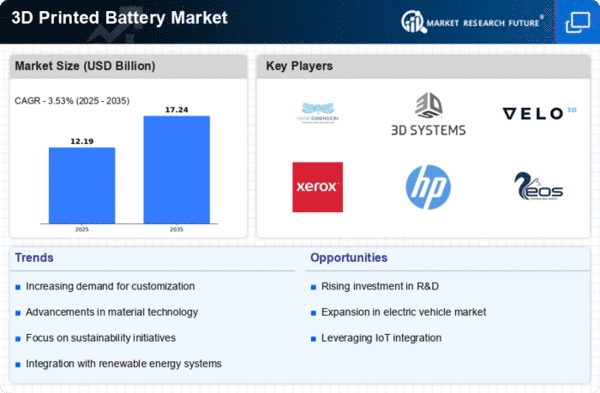
As per MRFR analysis, the 3D Printed Battery Market Size was estimated at 11.77 USD Billion in 2024. The 3D Printed Battery industry is projected to grow from 12.19 USD Billion in 2025 to 17.24 USD Billion by 2035, exhibiting a compound annual growth rate (CAGR) of 3.53 during the forecast period 2025 - 2035.

Key Market Trends & Highlights

The 3D Printed Battery Market is poised for substantial growth driven by technological advancements and increasing demand for sustainable energy solutions.

  • Customization and flexibility in battery design are becoming paramount, particularly in North America, where the market is largest.
  • Sustainability initiatives are gaining traction, especially in the Asia-Pacific region, which is recognized as the fastest-growing market.
  • Integration with smart technologies is enhancing the functionality of 3D printed batteries, particularly in the electric vehicle segment.
  • Advancements in 3D printing technology and rising consumer awareness of sustainable products are key drivers propelling market expansion.

Market Size & Forecast

2024 Market Size 11.77 (USD Billion)
2035 Market Size 17.24 (USD Billion)
CAGR (2025 - 2035) 3.53%
Largest Regional Market Share in 2024 North America

Major Players

Nano Dimension (IL), 3D Systems (US), Velo3D (US), Xerox (US), HP Inc. (US), EOS GmbH (DE), Stratasys (US), Materialise (BE), Sculpteo (FR)

Market Trends

The 3D Printed Battery Market is currently experiencing a transformative phase, characterized by rapid advancements in additive manufacturing technologies. This evolution appears to be driven by the increasing demand for lightweight, compact, and efficient energy storage solutions across various sectors, including consumer electronics, electric vehicles, and renewable energy systems. The integration of 3D printing techniques into battery production processes seems to offer significant advantages, such as reduced material waste, enhanced design flexibility, and the potential for customized battery configurations. As industries seek to optimize performance and sustainability, the adoption of 3D printed batteries is likely to gain momentum, reflecting a broader trend towards innovative manufacturing practices. Moreover, the ongoing research and development efforts in materials science are paving the way for the creation of novel battery chemistries that could further enhance the capabilities of 3D printed batteries. This includes the exploration of advanced materials that may improve energy density, charging speed, and overall lifespan. The convergence of these technological advancements suggests a promising future for the 3D Printed Battery Market, where the synergy between design and functionality could redefine energy storage solutions. Stakeholders in this market are expected to focus on collaboration and investment in R&D to harness the full potential of this emerging technology, thereby positioning themselves competitively in a rapidly evolving landscape.

Customization and Flexibility

The ability to customize battery designs through 3D printing is becoming increasingly relevant. This trend allows manufacturers to tailor energy storage solutions to specific applications, enhancing performance and efficiency. As industries demand more specialized products, the flexibility offered by additive manufacturing is likely to drive growth in the 3D Printed Battery Market.

Sustainability Initiatives

Sustainability is a key focus in the 3D Printed Battery Market, with manufacturers exploring eco-friendly materials and processes. The reduction of waste associated with traditional battery production methods aligns with global efforts to minimize environmental impact. This trend indicates a shift towards greener technologies, appealing to environmentally conscious consumers and businesses.

Integration with Smart Technologies

The integration of 3D printed batteries with smart technologies is emerging as a notable trend. As the Internet of Things (IoT) and smart devices proliferate, the demand for efficient and compact energy sources is increasing. This convergence suggests that 3D printed batteries could play a crucial role in powering the next generation of connected devices.

3D Printed Battery Market Market Drivers

Market Growth Projections

The Global 3D Printed Battery Market Industry is projected to experience substantial growth over the next decade. With a market value of 32.0 USD Billion in 2024, it is anticipated to expand significantly, reaching 219.9 USD Billion by 2035. This growth trajectory indicates a compound annual growth rate (CAGR) of 19.15% from 2025 to 2035. Such projections reflect the increasing adoption of 3D printed batteries across various sectors, driven by advancements in technology, rising demand for sustainable solutions, and the growing electric vehicle market. The future of the industry appears promising, with numerous opportunities for innovation and expansion.

Growing Electric Vehicle Market

The expansion of the electric vehicle market is a significant driver for the Global 3D Printed Battery Market Industry. As more consumers and manufacturers shift towards electric vehicles, the demand for advanced battery technologies increases. 3D printed batteries offer unique advantages, such as lightweight designs and customizable shapes, which are particularly beneficial for electric vehicle applications. Major automotive manufacturers are investing in 3D printing technologies to enhance battery performance and reduce production costs. This trend is likely to propel the market forward, as the electric vehicle sector continues to grow, further stimulating demand for innovative battery solutions.

Advancements in 3D Printing Technology

Technological advancements in 3D printing are significantly influencing the Global 3D Printed Battery Market Industry. Innovations in materials and printing techniques are enhancing the performance and efficiency of 3D printed batteries. For example, the development of new conductive materials allows for faster charging and higher energy densities. This progress not only improves battery performance but also reduces production costs, making 3D printed batteries more competitive against traditional battery technologies. As these advancements continue, the market is poised for substantial growth, with a projected CAGR of 19.15% from 2025 to 2035, indicating a robust future for the industry.

Rising Demand for Sustainable Energy Solutions

The Global 3D Printed Battery Market Industry is experiencing a surge in demand for sustainable energy solutions. As governments and organizations worldwide prioritize renewable energy sources, the need for efficient energy storage systems becomes paramount. 3D printed batteries, with their potential for reduced waste and lower carbon footprints, align well with these sustainability goals. For instance, the European Union has set ambitious targets for reducing greenhouse gas emissions, which could drive investments in innovative battery technologies. This trend is expected to contribute to the market's growth, with projections indicating a market value of 32.0 USD Billion in 2024.

Customization and Flexibility in Battery Design

Customization and flexibility in battery design are pivotal factors driving the Global 3D Printed Battery Market Industry. The ability to tailor battery shapes and sizes to specific applications allows for greater efficiency and performance. Industries such as consumer electronics, aerospace, and healthcare are increasingly seeking customized battery solutions to meet their unique requirements. 3D printing technology facilitates rapid prototyping and production of bespoke batteries, which can lead to improved product performance and reduced time-to-market. This adaptability is expected to attract more industries to adopt 3D printed batteries, thereby contributing to the overall growth of the market.

Increased Investment in Research and Development

Investment in research and development is a critical driver for the Global 3D Printed Battery Market Industry. Governments and private sectors are allocating substantial funds to explore innovative battery technologies, which is essential for enhancing battery performance and sustainability. For instance, initiatives in the United States aim to foster collaboration between academia and industry to accelerate the development of advanced battery technologies. This influx of funding not only supports the creation of more efficient 3D printed batteries but also encourages the commercialization of these technologies. As a result, the market is expected to grow significantly, potentially reaching 219.9 USD Billion by 2035.

Market Segment Insights

By Application: Electric Vehicles (Largest) vs. Consumer Electronics (Fastest-Growing)

In the 3D Printed Battery Market, the application segments showcase a diverse distribution of market share. Electric Vehicles (EVs) dominate this sector due to their substantial demand for efficient and lightweight battery solutions. Meanwhile, Consumer Electronics hold a significant position as well, increasingly embracing 3D printed batteries for their compact design and customization options. Other segments like Energy Storage Systems, Medical Devices, and Aerospace are also growing, albeit at a slower pace, contributing to the gradual evolution of the market. Examining the growth trends, the Electric Vehicle segment is fueled by shifts towards sustainable transportation, while innovations in additive manufacturing are driving the rapid adoption of 3D printed batteries in Consumer Electronics. Energy Storage Systems are seeing a steady rise as renewables integration demands effective storage solutions. Meanwhile, advancements in material science bolster Medical Devices and Aerospace applications, leading to enhanced performance and regulatory compliance that requires innovative power solutions.

Electric Vehicles: Dominant vs. Consumer Electronics: Emerging

Electric Vehicles (EVs) are the dominant application in the 3D Printed Battery Market, leveraging advancements in battery technology to meet the challenges of performance, weight, and efficiency. The substantial interest in reducing carbon emissions has led to a surge in demand for electric mobility solutions, enhancing the role of 3D printed batteries that offer customization and lightweight alternatives. On the other hand, Consumer Electronics represents an emerging segment within this market, characterized by rapid growth due to the demand for more versatile and compact battery designs. The continuous drive for thinner, lighter devices coupled with the need for longer battery life makes 3D printed batteries an attractive option in this space, appealing to manufacturers keen on innovation and differentiation.

By End Use: Automotive (Largest) vs. Healthcare (Fastest-Growing)

The 3D Printed Battery Market has witnessed diverse applications across various end-use segments, with the automotive sector leading by capturing the largest market share. This dominance can be attributed to the increasing demand for electric vehicles (EVs) and the necessity for lightweight, high-capacity batteries that can enhance performance and extend ranges. Furthermore, other segments such as industrial and commercial are also contributing substantially to the market, as industries continue to adopt innovative battery designs for efficiency and sustainability. On the other hand, the healthcare segment is emerging as the fastest-growing aspect of the market. As the medical field increasingly integrates technology, the need for customized and efficient power solutions for medical devices and healthcare equipment is on the rise. Additionally, advances in biotechnology and personalized medicine are driving the demand for 3D printed batteries, tailoring energy solutions to specific medical applications and increasing patient care quality.

Automotive: Largest vs. Healthcare: Fastest-Growing

In the 3D Printed Battery Market, the automotive segment stands out as the dominant force, primarily due to the surge in electric vehicle adoption and the industry's transition towards sustainable solutions. These batteries offer unique advantages such as weight reduction, increased energy density, and design flexibility, making them crucial for enhancing vehicle performance. Conversely, healthcare, categorized as the fastest-growing segment, is rapidly evolving as manufacturers create batteries tailored to the specific needs of medical devices. The customization levels offered by 3D printing technology are vital for developing portable, efficient, and reliable energy sources that support continuous patient monitoring and advanced medical technologies. Both segments highlight the transformative potential of 3D printing in revolutionizing energy storage solutions.

By Technology: Fused Deposition Modeling (Largest) vs. Stereolithography (Fastest-Growing)

In the 3D Printed Battery Market, the technology segment showcases diverse methodologies, with Fused Deposition Modeling (FDM) commanding a significant portion of market share due to its widespread adoption and compatibility with various materials. Following closely is Stereolithography (SLA), recognized for its precision and quality, but still trailing FDM in terms of overall market presence. Other techniques such as Selective Laser Sintering (SLS), Digital Light Processing (DLP), and Binder Jetting contribute to the pool but hold smaller shares, each serving specific niche applications in battery production.

Technology: Fused Deposition Modeling (Dominant) vs. Stereolithography (Emerging)

Fused Deposition Modeling (FDM) remains the dominant technology in the 3D Printed Battery Market due to its robust capabilities, ease of use, and affordability, allowing manufacturers to efficiently produce durable battery components. In contrast, Stereolithography (SLA) emerges as a promising technology with its superior accuracy and fine detail, making it suitable for high-performance battery applications. As the demand for lightweight and compact energy storage solutions grows, SLA's advancements in materials and processes position it as an attractive option for rapid prototyping and custom battery designs. This juxtaposition highlights how FDM's established presence is now challenged by SLA's innovative approach and potential for future growth.

By Material Type: Lithium-ion (Largest) vs. Solid State (Fastest-Growing)

In the 3D Printed Battery Market, Lithium-ion batteries hold the largest market share due to their widespread use in consumer electronics, electric vehicles, and renewable energy storage. This segment has proven to be highly efficient, offering optimal energy density and extensive lifecycle performance. Meanwhile, Solid State batteries are emerging rapidly, capturing attention for their enhanced safety features and potential for higher performance metrics, thus positioning themselves as the fastest-growing category within this market.

Lithium-ion (Dominant) vs. Solid State (Emerging)

Lithium-ion batteries continue to be dominant in the 3D Printed Battery Market, primarily due to their established infrastructure and technology. Their ability to combine lightweight design with high capacity and longer life cycles makes them suitable for various applications such as smartphones, power tools, and electric vehicles. On the other hand, Solid State batteries are viewed as an emerging technology, promising advancements in energy storage through their unique solid electrolyte that enhances safety and energy density compared to traditional batteries. As research and development continue, Solid State batteries are expected to penetrate the market significantly, driven by demand for safer and more efficient energy solutions.

By Form Factor: Cylindrical (Largest) vs. Prismatic (Fastest-Growing)

In the 3D Printed Battery Market, the form factor segment showcases distinctive preferences among consumers. The cylindrical form factor holds the largest share, owing to its established manufacturing processes and compatibility with existing battery applications. On the other hand, the prismatic form factor is rapidly gaining traction, representing the fastest-growing segment as it offers versatility in design and integration, appealing to automotive and electronics sectors which favor compact solutions.

Cylindrical (Dominant) vs. Prismatic (Emerging)

Cylindrical batteries are considered the dominant form factor in the 3D Printed Battery Market, known for their robust construction and thermal efficiency, making them a popular choice for high-performance applications. These batteries are widely utilized in consumer electronics and electric vehicles due to their cylindrical structure, which maximizes space efficiency. Conversely, prismatic batteries are an emerging trend, offering greater design flexibility and higher energy density, which are crucial characteristics for modern applications. As manufacturers seek to innovate, the prismatic design allows for customized solutions tailored to unique market needs, positioning it as a key player in the evolving landscape of 3D printed energy storage solutions.

Get more detailed insights about 3D Printed Battery Market Research Report—Global Forecast till 2035

Regional Insights

North America : Innovation and Market Leadership

North America is poised to maintain its leadership in the 3D printed battery market, holding a significant market share of 5.5 in 2025. The region's growth is driven by advancements in technology, increasing demand for lightweight and efficient energy storage solutions, and supportive regulatory frameworks. Government initiatives promoting sustainable manufacturing practices further catalyze market expansion, making it a hub for innovation in battery technology. The competitive landscape in North America is robust, featuring key players such as 3D Systems, HP Inc., and Stratasys. The U.S. leads the charge, supported by a strong ecosystem of research institutions and startups focused on 3D printing technologies. This region's emphasis on R&D and collaboration among industry leaders positions it favorably for future growth, ensuring a steady supply of innovative solutions to meet rising energy demands.

Europe : Emerging Market with Strong Potential

Europe is rapidly emerging as a significant player in the 3D printed battery market, with a market size of 3.0 in 2025. The region benefits from stringent environmental regulations and a strong push towards sustainable energy solutions, driving demand for innovative battery technologies. European governments are investing heavily in research and development, fostering an environment conducive to technological advancements and market growth. Leading countries such as Germany, France, and the UK are at the forefront of this transformation, hosting key players like EOS GmbH and Materialise. The competitive landscape is characterized by a mix of established companies and innovative startups, all vying for a share of the growing market. The European Union's commitment to reducing carbon emissions further enhances the region's attractiveness for investment in 3D printed battery technologies. "The European Commission aims to support the development of advanced battery technologies to ensure a sustainable energy future."

Asia-Pacific : Rapid Growth and Adoption

Asia-Pacific is witnessing a rapid surge in the 3D printed battery market, with a projected market size of 2.5 in 2025. The region's growth is fueled by increasing investments in renewable energy and a growing demand for efficient energy storage solutions. Countries like China and Japan are leading the charge, supported by favorable government policies and initiatives aimed at promoting advanced manufacturing technologies. The competitive landscape is vibrant, with numerous local and international players entering the market. Companies such as Velo3D and Sculpteo are making significant strides in the region, leveraging local manufacturing capabilities to meet the rising demand. The focus on innovation and collaboration among industry stakeholders is expected to drive further advancements in 3D printed battery technologies, positioning Asia-Pacific as a key player in the global market.

Middle East and Africa : Emerging Opportunities in Energy

The Middle East and Africa region is gradually emerging in the 3D printed battery market, with a market size of 0.77 in 2025. The growth is primarily driven by increasing energy demands and a shift towards sustainable energy solutions. Governments in the region are beginning to recognize the potential of advanced manufacturing technologies, leading to investments in research and development initiatives aimed at fostering innovation in battery technologies. Countries like South Africa and the UAE are taking the lead in exploring 3D printing applications in energy storage. The competitive landscape is still developing, with a mix of local startups and international companies looking to establish a foothold. As the region continues to invest in infrastructure and technology, the potential for growth in the 3D printed battery market is significant, paving the way for future advancements. The region is poised for growth as it seeks to diversify its energy sources and enhance sustainability efforts.

Key Players and Competitive Insights

The 3D Printed Battery Market is currently characterized by a dynamic competitive landscape, driven by rapid technological advancements and increasing demand for sustainable energy solutions. Key players such as Nano Dimension (IL), 3D Systems (US), and Stratasys (US) are at the forefront, each adopting distinct strategies to enhance their market positioning. For instance, Nano Dimension (IL) focuses on innovation in additive manufacturing technologies, aiming to revolutionize battery production through enhanced efficiency and customization. Meanwhile, 3D Systems (US) emphasizes partnerships with automotive and aerospace sectors to integrate 3D printed batteries into their supply chains, thereby expanding its operational reach. Stratasys (US) is also notable for its commitment to sustainability, developing eco-friendly materials for battery production, which aligns with global trends towards greener technologies.The business tactics employed by these companies reflect a concerted effort to optimize supply chains and localize manufacturing processes. The market structure appears moderately fragmented, with several players vying for dominance while also collaborating on various projects. This collective influence of key players fosters a competitive environment where innovation and operational efficiency are paramount, allowing companies to differentiate themselves in a crowded marketplace.

In November 3D Systems (US) announced a strategic partnership with a leading automotive manufacturer to co-develop advanced 3D printed battery solutions tailored for electric vehicles. This collaboration is expected to leverage 3D Systems' expertise in additive manufacturing, potentially leading to significant advancements in battery performance and production scalability. Such partnerships not only enhance product offerings but also position 3D Systems as a pivotal player in the transition to electric mobility.

In October Stratasys (US) unveiled a new line of biodegradable materials specifically designed for 3D printed batteries. This initiative underscores the company's commitment to sustainability and innovation, as it seeks to address environmental concerns associated with traditional battery production. By pioneering eco-friendly materials, Stratasys may attract environmentally conscious consumers and businesses, thereby enhancing its competitive edge in the market.

In September Nano Dimension (IL) expanded its operations into the Asian market by establishing a new manufacturing facility in Singapore. This strategic move is indicative of the company's intent to tap into the growing demand for 3D printed batteries in the region, particularly in the electronics and automotive sectors. The facility is expected to enhance production capabilities and reduce lead times, positioning Nano Dimension favorably against its competitors.

As of December the competitive trends within the 3D Printed Battery Market are increasingly defined by digitalization, sustainability, and the integration of AI technologies. Strategic alliances are becoming more prevalent, as companies recognize the value of collaboration in driving innovation and enhancing supply chain reliability. Looking ahead, it is likely that competitive differentiation will evolve from traditional price-based strategies to a focus on technological innovation and sustainable practices, reflecting the changing priorities of consumers and industries alike.

Key Companies in the 3D Printed Battery Market include

Industry Developments

March 2022:Sakuu Corporation successfully achieved a new milestone in the development of its Li-ion metal battery by achieving an energy-density level of 800 Wh/L. This achievement was regarded as one of the most significant steps towards its roadmap in achieving fully 3D printed SSBs (solid-state batteries) that will be capable of generating a power of 1,200 Wh/L by 2023.

January 2022:6K, one of the leading manufacturers of speciality 3D printing materials, successfully collaborated with Albemarle Corporation, a worldwide chemicals company, to explore the new lithium-ion battery materials in-depth. 6K's patented UniMelt technology is regarded as one of the most efficient production platforms for composing industrial-grade powders. 

August 2021:Blackstone Technology successfully received a huge financial support worth USD 42.94 million from Blackstone Resources, a Swiss battery metals parent company, for launching its 3D-printed batteries project in Deutschland. The investment provided a sufficient amount of funding for plans to increase the overall power generation output at the German subsidiary in Döbeln, Saxony, to nearly 500 MWh per year.

Future Outlook

3D Printed Battery Market Future Outlook

The 3D Printed Battery Market is projected to grow at a 3.53% CAGR from 2025 to 2035, driven by advancements in manufacturing technologies and increasing demand for customized energy solutions.

New opportunities lie in:

  • Development of scalable 3D printing technologies for mass production
  • Partnerships with electric vehicle manufacturers for tailored battery solutions
  • Integration of smart technology in battery design for enhanced performance

By 2035, the market is expected to achieve substantial growth, positioning itself as a leader in energy innovation.

Market Segmentation

3D Printed Battery Market End Use Outlook

  • Automotive
  • Industrial
  • Residential
  • Commercial
  • Healthcare

3D Printed Battery Market Technology Outlook

  • Fused Deposition Modeling
  • Stereolithography
  • Selective Laser Sintering
  • Digital Light Processing
  • Binder Jetting

3D Printed Battery Market Application Outlook

  • Consumer Electronics
  • Electric Vehicles
  • Energy Storage Systems
  • Medical Devices
  • Aerospace

3D Printed Battery Market Form Factor Outlook

  • Prismatic
  • Cylindrical
  • Pouch
  • Stacked
  • Flexible

3D Printed Battery Market Material Type Outlook

  • Lithium-ion
  • Solid State
  • Nickel Metal Hydride
  • Lead Acid
  • Graphene

Report Scope

MARKET SIZE 202411.77(USD Billion)
MARKET SIZE 202512.19(USD Billion)
MARKET SIZE 203517.24(USD Billion)
COMPOUND ANNUAL GROWTH RATE (CAGR)3.53% (2025 - 2035)
REPORT COVERAGERevenue Forecast, Competitive Landscape, Growth Factors, and Trends
BASE YEAR2024
Market Forecast Period2025 - 2035
Historical Data2019 - 2024
Market Forecast UnitsUSD Billion
Key Companies ProfiledNano Dimension (IL), 3D Systems (US), Velo3D (US), Xerox (US), HP Inc. (US), EOS GmbH (DE), Stratasys (US), Materialise (BE), Sculpteo (FR)
Segments CoveredApplication, End Use, Technology, Material Type, Form Factor
Key Market OpportunitiesAdvancements in material science enhance customization and efficiency in the 3D Printed Battery Market.
Key Market DynamicsTechnological advancements in 3D printing are driving innovation and competition in the battery manufacturing sector.
Countries CoveredNorth America, Europe, APAC, South America, MEA

FAQs

How much is the 3D Printed Battery Market?

3D Printed Battery Market size US$ 22.01 Bn in 2022.

What is the growth rate of the 3D Printed Battery Market?

The growth rate of the 3D Printed Battery Market 19.54% by 2035.

Which region held the largest market share in the 3D Printed Battery Market?

North America held the largest market share in the 3D Printed Battery Market.

Who are the key players in the 3D Printed Battery Market?

Sakuu Corporation. (US), Photocentric (UK), Neware Technology Limited (China), American Elements (US), Element14 Electronics (Singapore), Stratasys Ltd. (Israel), Blackstone Resources (Switzerland) , GE Additive (US), 6K (US) and EOS GmbHn (Germany)

Which Architectural Process led the 3D Printed Battery Market?

Graphene-based PLA filaments Architectural Process led the 3D Printed Battery Market.

Which Application had the largest market share in the 3D Printed Battery Market?

Wearables Application had the largest market share in the 3D Printed Battery Market.

Which End-User had the largest market share in the 3D Printed Battery Market?

Energy Storage devices End-User had the largest market share in the 3D Printed Battery Market.

  1. SECTION I: EXECUTIVE SUMMARY AND KEY HIGHLIGHTS
    1. | 1.1 EXECUTIVE SUMMARY
    2. | 1.1.1 Market Overview
    3. | 1.1.2 Key Findings
    4. | 1.1.3 Market Segmentation
    5. | 1.1.4 Competitive Landscape
    6. | 1.1.5 Challenges and Opportunities
    7. | 1.1.6 Future Outlook
  2. SECTION II: SCOPING, METHODOLOGY AND MARKET STRUCTURE
    1. | 2.1 MARKET INTRODUCTION
    2. | 2.1.1 Definition
    3. | 2.1.2 Scope of the study
    4. |-- 2.1.2.1 Research Objective
    5. |-- 2.1.2.2 Assumption
    6. |-- 2.1.2.3 Limitations
    7. | 2.2 RESEARCH METHODOLOGY
    8. | 2.2.1 Overview
    9. | 2.2.2 Data Mining
    10. | 2.2.3 Secondary Research
    11. | 2.2.4 Primary Research
    12. |-- 2.2.4.1 Primary Interviews and Information Gathering Process
    13. |-- 2.2.4.2 Breakdown of Primary Respondents
    14. | 2.2.5 Forecasting Model
    15. | 2.2.6 Market Size Estimation
    16. |-- 2.2.6.1 Bottom-Up Approach
    17. |-- 2.2.6.2 Top-Down Approach
    18. | 2.2.7 Data Triangulation
    19. | 2.2.8 Validation
  3. SECTION III: QUALITATIVE ANALYSIS
    1. | 3.1 MARKET DYNAMICS
    2. | 3.1.1 Overview
    3. | 3.1.2 Drivers
    4. | 3.1.3 Restraints
    5. | 3.1.4 Opportunities
    6. | 3.2 MARKET FACTOR ANALYSIS
    7. | 3.2.1 Value chain Analysis
    8. | 3.2.2 Porter's Five Forces Analysis
    9. |-- 3.2.2.1 Bargaining Power of Suppliers
    10. |-- 3.2.2.2 Bargaining Power of Buyers
    11. |-- 3.2.2.3 Threat of New Entrants
    12. |-- 3.2.2.4 Threat of Substitutes
    13. |-- 3.2.2.5 Intensity of Rivalry
    14. | 3.2.3 COVID-19 Impact Analysis
    15. |-- 3.2.3.1 Market Impact Analysis
    16. |-- 3.2.3.2 Regional Impact
    17. |-- 3.2.3.3 Opportunity and Threat Analysis
  4. SECTION IV: QUANTITATIVE ANALYSIS
    1. | 4.1 Energy & Power, BY Application (USD Billion)
    2. | 4.1.1 Consumer Electronics
    3. | 4.1.2 Electric Vehicles
    4. | 4.1.3 Energy Storage Systems
    5. | 4.1.4 Medical Devices
    6. | 4.1.5 Aerospace
    7. | 4.2 Energy & Power, BY End Use (USD Billion)
    8. | 4.2.1 Automotive
    9. | 4.2.2 Industrial
    10. | 4.2.3 Residential
    11. | 4.2.4 Commercial
    12. | 4.2.5 Healthcare
    13. | 4.3 Energy & Power, BY Technology (USD Billion)
    14. | 4.3.1 Fused Deposition Modeling
    15. | 4.3.2 Stereolithography
    16. | 4.3.3 Selective Laser Sintering
    17. | 4.3.4 Digital Light Processing
    18. | 4.3.5 Binder Jetting
    19. | 4.4 Energy & Power, BY Material Type (USD Billion)
    20. | 4.4.1 Lithium-ion
    21. | 4.4.2 Solid State
    22. | 4.4.3 Nickel Metal Hydride
    23. | 4.4.4 Lead Acid
    24. | 4.4.5 Graphene
    25. | 4.5 Energy & Power, BY Form Factor (USD Billion)
    26. | 4.5.1 Prismatic
    27. | 4.5.2 Cylindrical
    28. | 4.5.3 Pouch
    29. | 4.5.4 Stacked
    30. | 4.5.5 Flexible
    31. | 4.6 Energy & Power, BY Region (USD Billion)
    32. | 4.6.1 North America
    33. |-- 4.6.1.1 US
    34. |-- 4.6.1.2 Canada
    35. | 4.6.2 Europe
    36. |-- 4.6.2.1 Germany
    37. |-- 4.6.2.2 UK
    38. |-- 4.6.2.3 France
    39. |-- 4.6.2.4 Russia
    40. |-- 4.6.2.5 Italy
    41. |-- 4.6.2.6 Spain
    42. |-- 4.6.2.7 Rest of Europe
    43. | 4.6.3 APAC
    44. |-- 4.6.3.1 China
    45. |-- 4.6.3.2 India
    46. |-- 4.6.3.3 Japan
    47. |-- 4.6.3.4 South Korea
    48. |-- 4.6.3.5 Malaysia
    49. |-- 4.6.3.6 Thailand
    50. |-- 4.6.3.7 Indonesia
    51. |-- 4.6.3.8 Rest of APAC
    52. | 4.6.4 South America
    53. |-- 4.6.4.1 Brazil
    54. |-- 4.6.4.2 Mexico
    55. |-- 4.6.4.3 Argentina
    56. |-- 4.6.4.4 Rest of South America
    57. | 4.6.5 MEA
    58. |-- 4.6.5.1 GCC Countries
    59. |-- 4.6.5.2 South Africa
    60. |-- 4.6.5.3 Rest of MEA
  5. SECTION V: COMPETITIVE ANALYSIS
    1. | 5.1 Competitive Landscape
    2. | 5.1.1 Overview
    3. | 5.1.2 Competitive Analysis
    4. | 5.1.3 Market share Analysis
    5. | 5.1.4 Major Growth Strategy in the Energy & Power
    6. | 5.1.5 Competitive Benchmarking
    7. | 5.1.6 Leading Players in Terms of Number of Developments in the Energy & Power
    8. | 5.1.7 Key developments and growth strategies
    9. |-- 5.1.7.1 New Product Launch/Service Deployment
    10. |-- 5.1.7.2 Merger & Acquisitions
    11. |-- 5.1.7.3 Joint Ventures
    12. | 5.1.8 Major Players Financial Matrix
    13. |-- 5.1.8.1 Sales and Operating Income
    14. |-- 5.1.8.2 Major Players R&D Expenditure. 2023
    15. | 5.2 Company Profiles
    16. | 5.2.1 Nano Dimension (IL)
    17. |-- 5.2.1.1 Financial Overview
    18. |-- 5.2.1.2 Products Offered
    19. |-- 5.2.1.3 Key Developments
    20. |-- 5.2.1.4 SWOT Analysis
    21. |-- 5.2.1.5 Key Strategies
    22. | 5.2.2 3D Systems (US)
    23. |-- 5.2.2.1 Financial Overview
    24. |-- 5.2.2.2 Products Offered
    25. |-- 5.2.2.3 Key Developments
    26. |-- 5.2.2.4 SWOT Analysis
    27. |-- 5.2.2.5 Key Strategies
    28. | 5.2.3 Velo3D (US)
    29. |-- 5.2.3.1 Financial Overview
    30. |-- 5.2.3.2 Products Offered
    31. |-- 5.2.3.3 Key Developments
    32. |-- 5.2.3.4 SWOT Analysis
    33. |-- 5.2.3.5 Key Strategies
    34. | 5.2.4 Xerox (US)
    35. |-- 5.2.4.1 Financial Overview
    36. |-- 5.2.4.2 Products Offered
    37. |-- 5.2.4.3 Key Developments
    38. |-- 5.2.4.4 SWOT Analysis
    39. |-- 5.2.4.5 Key Strategies
    40. | 5.2.5 HP Inc. (US)
    41. |-- 5.2.5.1 Financial Overview
    42. |-- 5.2.5.2 Products Offered
    43. |-- 5.2.5.3 Key Developments
    44. |-- 5.2.5.4 SWOT Analysis
    45. |-- 5.2.5.5 Key Strategies
    46. | 5.2.6 EOS GmbH (DE)
    47. |-- 5.2.6.1 Financial Overview
    48. |-- 5.2.6.2 Products Offered
    49. |-- 5.2.6.3 Key Developments
    50. |-- 5.2.6.4 SWOT Analysis
    51. |-- 5.2.6.5 Key Strategies
    52. | 5.2.7 Stratasys (US)
    53. |-- 5.2.7.1 Financial Overview
    54. |-- 5.2.7.2 Products Offered
    55. |-- 5.2.7.3 Key Developments
    56. |-- 5.2.7.4 SWOT Analysis
    57. |-- 5.2.7.5 Key Strategies
    58. | 5.2.8 Materialise (BE)
    59. |-- 5.2.8.1 Financial Overview
    60. |-- 5.2.8.2 Products Offered
    61. |-- 5.2.8.3 Key Developments
    62. |-- 5.2.8.4 SWOT Analysis
    63. |-- 5.2.8.5 Key Strategies
    64. | 5.2.9 Sculpteo (FR)
    65. |-- 5.2.9.1 Financial Overview
    66. |-- 5.2.9.2 Products Offered
    67. |-- 5.2.9.3 Key Developments
    68. |-- 5.2.9.4 SWOT Analysis
    69. |-- 5.2.9.5 Key Strategies
    70. | 5.3 Appendix
    71. | 5.3.1 References
    72. | 5.3.2 Related Reports

Energy & Power Market Segmentation

Energy & Power By Application (USD Billion, 2025-2035)

  • Consumer Electronics
  • Electric Vehicles
  • Energy Storage Systems
  • Medical Devices
  • Aerospace

Energy & Power By End Use (USD Billion, 2025-2035)

  • Automotive
  • Industrial
  • Residential
  • Commercial
  • Healthcare

Energy & Power By Technology (USD Billion, 2025-2035)

  • Fused Deposition Modeling
  • Stereolithography
  • Selective Laser Sintering
  • Digital Light Processing
  • Binder Jetting

Energy & Power By Material Type (USD Billion, 2025-2035)

  • Lithium-ion
  • Solid State
  • Nickel Metal Hydride
  • Lead Acid
  • Graphene

Energy & Power By Form Factor (USD Billion, 2025-2035)

  • Prismatic
  • Cylindrical
  • Pouch
  • Stacked
  • Flexible
Infographic

Free Sample Request

Kindly complete the form below to receive a free sample of this Report

Get Free Sample

Customer Strories

Compare Licence

×
Features License Type
Single User Multiuser License Enterprise User
Price $4,950 $5,950 $7,250
Maximum User Access Limit 1 User Upto 10 Users Unrestricted Access Throughout the Organization
Free Customization
Direct Access to Analyst
Deliverable Format
Platform Access
Discount on Next Purchase 10% 15% 15%
Printable Versions