個別急速冷凍市場 (2026 - 2035)

Individual Quick Freezing Market Size, Share, Industry Trend & Analysis Research Report By Technology (Mechanical IQF, Cryogenic IQF), By Product (Fruits, Vegetables, Seafood, Meat, Poultry, Dairy Products), By Region (North America, Europe, Asia-Pacific, South America, Middle East and Africa) - Forecast to 2035
ID: MRFR/FnB/31112-HCR 128 Pages Varsha More Last Updated: November 08, 2026
Individual Quick Freezing Market
Market Size
Forecast Period2026-2035
CAGR (2026-2035)7.1%
2025 Market SizeUSD 25.90 Billion
2035 Market SizeUSD 51.43 Billion
Key Players
JBT Marel Corporation
GEA Group AG
Linde plc
Air Products and Chemicals, Inc.
Air Liquide
Messer Group
Opportunities
  • Tropical Fruit Processing in Emerging Markets
  • Freezing-as-a-Service and Performance Data Monetization
  • Natural Refrigerant Retrofits

個別急速冷凍市場 市場概要

The global Individual Quick Freezing Market was valued at USD 25.90 Billion in 2025 and is expected to reach USD 27.74 Billion in 2026, advancing to USD 51.43 Billion by 2035 at a CAGR of 7.1% over 2026–2035. Demand rests on a simple commercial logic: retailers and foodservice operators want free-flowing, portion-ready fruit, vegetables, seafood and proteins that keep their texture after thawing. Public capital is reinforcing that pull. India's Pradhan Mantri Kisan SAMPADA Yojana carries an outlay of roughly INR 4,600 crore through 2025–26 for integrated cold storage and processing [1], while China's national cold-chain development plan targets around 100 backbone cold storage bases [2].

Processors are retiring static blast rooms, batch plate freezers and older spiral units that produce clumped or dehydrated product. In their place, plants are installing fluidized-bed tunnels, multi-level impingement freezers and liquid nitrogen tunnels that crust each piece within minutes. Refrigerant regulation is accelerating the swap: the U.S. AIM Act requires an 85% phasedown of HFC production and consumption by 2036 [3], and the EU F-gas Regulation (EU) 2024/573 tightens limits on high-GWP refrigerants in new stationary equipment [4].

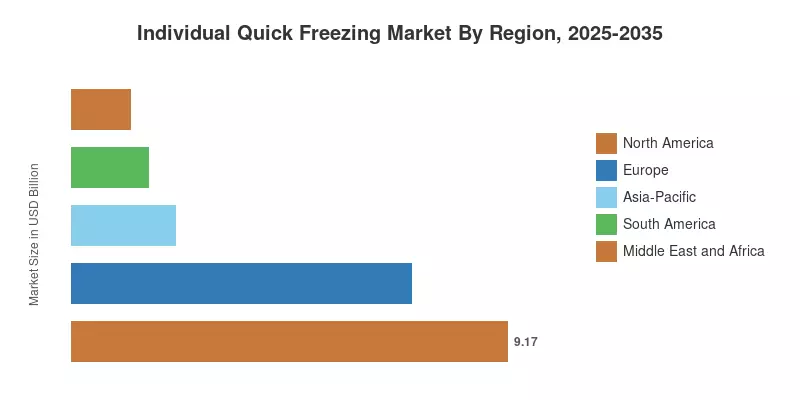
North America remains the dominant region with a 35.4% share in 2025, supported by mature frozen vegetable and potato processing. Asia-Pacific is the fastest-growing region at an 8.4% CAGR, led by Chinese, Indian and Vietnamese export processing. Europe ranks second, anchored by Belgian, Polish and Dutch vegetable clusters. Over the next decade, equipment buyers will weigh energy cost per kilogram as heavily as throughput.

Key Report Takeaways

• By Technology

  • Mechanical IQF accounts for a 62.0% share of the Individual Quick Freezing Market in 2025, reflecting its lower operating cost per tonne on high-volume vegetable lines.
  • Cryogenic IQF is the fastest-growing technology at a 7.9% CAGR, favored for shrimp, berries and other delicate products.

• By Product

  • Vegetables hold the largest product share at 34.8%, driven by year-round retail and institutional demand for peas, corn and broccoli.
  • Fruits are the fastest-growing product category in the Individual Quick Freezing Market at a 7.5% CAGR.
  • Seafood generated USD 4.40 Billion in 2025 as exporters upgraded shrimp and fillet freezing capacity.

• By Region

  • North America leads the Individual Quick Freezing Market with a 35.4% share, supported by large-scale frozen vegetable and potato processing.
  • Asia-Pacific grows fastest at an 8.4% CAGR on export-oriented seafood and tropical fruit processing.
  • Europe was valued at USD 7.15 Billion in 2025, with refrigerant compliance driving equipment replacement.

Market Size and Forecast (2021–2035)

Historical values for 2021–2024 draw on equipment shipment data, filings from leading freezer and industrial gas suppliers, trade statistics for frozen produce and seafood, and primary interviews with processors and plant engineers. The forecast for the Individual Quick Freezing Market applies bottom-up capacity modeling by product line and region, validated top-down against frozen food consumption and refrigerated warehouse capacity data [5][6].
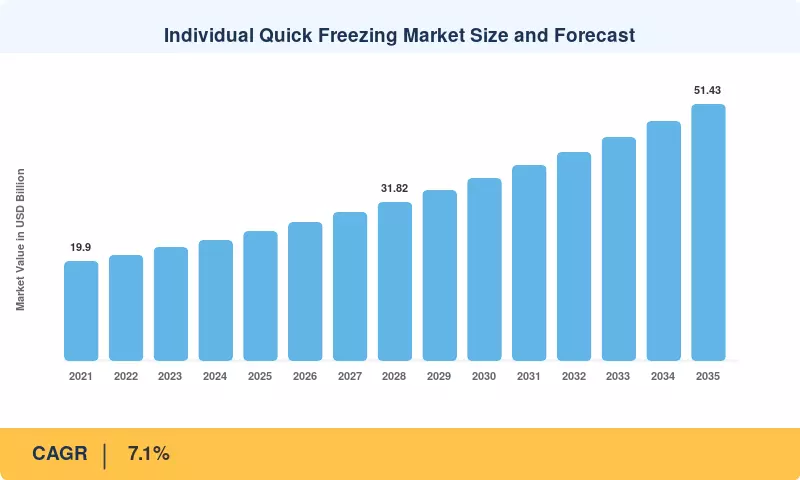
Individual Quick Freezing Market Size and Forecast
Our Impact

Enabled $4.3B Revenue Impact for Fortune 500 and Leading Multinationals

Partnering with 2000+ Global Organizations Each Year

30K+ Citations by Top-Tier Firms in the Industry

Driver Impact Analysis

Driver ~% Impact on CAGR Geographic Relevance Impact Timeline
Convenience-led demand for frozen produce +1.4% Global; strongest in North America and Europe Short term (≤2 yr)
Cold storage investment in emerging economies +1.1% Asia-Pacific, South America Medium term (2–4 yr)
Food loss reduction targets +0.9% Global Long term (≥4 yr)
Energy-efficient freezer design +0.8% Global Medium term (2–4 yr)
Seafood and protein export growth +0.7% Asia-Pacific, South America Medium term (2–4 yr)
Refrigerant transition replacement cycle +0.6% North America, Europe Short term (≤2 yr)

Convenience-Led Demand for Frozen Produce

From being a back-of-store mainstay, frozen food is now a growing segment. Retail sales of frozen foods in the United States reached over USD 74 billion in 2023, with frozen fruits and vegetables becoming more common in homes [7]. Because individually frozen pieces allow customers to use a portion of a bag and reseal it, reducing home waste, retail purchasers choose IQF products. Pre-cut, portion-controlled frozen inputs that speed up preparation and lower loss are valued by foodservice operators dealing with a personnel scarcity in the kitchen throughout the Individual Quick-Freezing Market.

Cold Storage Investment in Emerging Economies

The addressable base for IQF equipment is expanding due to public spending on post-harvest infrastructure. Through 2025–2026, India's PMKSY will spend approximately INR 4,600 crore on integrated cold-chain projects, food parks, and processing facilities that often call for IQF tunnels [1]. A denser network of producing-area facilities and about 100 backbone cold storage sites are the goals of China's national plan [2]. Both initiatives allocate funds to agricultural areas that have historically experienced the greatest fresh-market losses.

Food Loss Reduction Targets

Food loss commitments give processors a policy-backed reason to freeze closer to harvest. Around 13% of food produced is lost between harvest and retail [8], and households, retailers and foodservice waste a further 1.05 billion tonnes each year [24]. Inadequate refrigeration accounts for losses equal to about 12% of global food production [9]. IQF lines installed at packhouses offer a practical food preservation route, converting surplus or cosmetically imperfect produce into shelf-stable inventory.

Energy-Efficient Freezer Design

Energy cost per kilogram has become the main equipment selection criterion. Advanced aerodynamic tunnel designs with variable-speed fans cut energy use by up to 30% versus conventional units, and some remove floor heating requirements entirely [10]. Multi-level impingement freezers have doubled throughput per square meter compared with spiral freezers while reducing product deformation and dehydration [10]. Processors replacing ten- to fifteen-year-old lines can often justify the investment on energy savings alone.

Seafood and Protein Export Growth

Export-oriented seafood and protein sectors are adding freezing capacity to meet importer specifications. Vietnam's seafood exports reached about USD 10 billion in 2024, with shrimp and pangasius shipped largely in frozen form [12]. Global shrimp trade depends on IQF formats for raw, cooked and value-added products [11]. Brazil exported more than 5.2 million tonnes of chicken meat in 2024, sustaining investment in frozen cut and portion lines [23].

Refrigerant Transition Replacement Cycle

Refrigerant rules are forcing a replacement cycle in mature markets. EPA's 2023 Technology Transitions rule restricts high-GWP refrigerants in new industrial process refrigeration from 2026, under an AIM Act phasedown reaching 85% by 2036 [3]. The EU's revised F-gas Regulation sets a full HFC phase-out schedule to 2050 [4]. Processors running legacy HFC-based freezers are bringing upgrade plans forward to secure ammonia, CO2 or nitrogen-based alternatives.

Restraints Impact Analysis

Restraint ~% Impact on CAGR Geographic Relevance Impact Timeline
High capital cost of IQF lines −0.8% Emerging markets; small and mid-sized processors Medium term (2–4 yr)
Energy intensity and power price volatility −0.6% Europe, Asia-Pacific Short term (≤2 yr)
Cryogen supply and price exposure −0.4% Global Short term (≤2 yr)
Infrastructure gaps in developing markets −0.5% South Asia, Africa, Latin America Long term (≥4 yr)
Food safety compliance and recall exposure −0.3% North America, Europe Medium term (2–4 yr)

High Capital Cost of IQF Lines

Before construction begins, a whole commercial IQF line that includes washing, blanching, freezing, glazing, and packing usually costs several million dollars [13]. For small and mid-sized processors in Africa, South Asia, and Latin America, whose annual utilization is limited by seasonal raw materials, that expense is difficult to justify. Many of these businesses continue to use blast rooms, accepting lesser-quality products in return for reduced initial costs.

Energy Intensity and Power Price Volatility

In frozen food facilities, the majority of electricity is used for refrigeration, which directly links operating margins to power costs. Non-household consumers' electricity costs in the EU increased significantly in 2022 and remained higher than pre-crisis levels until 2024 [14]. Energy moved from a secondary to a key cost line in plants operating continuous IQF shifts, postponing expansion decisions at a number of vegetable processors in Europe.

Cryogen Supply and Price Exposure

Cryogenic IQF depends on reliable liquid nitrogen and CO2 supply, and both face disruption risk. Liquid nitrogen production is electricity-intensive, so cryogen pricing tracks power costs, and industrial gas suppliers have passed energy surcharges to customers in recent years [15]. CO2 availability has also tightened when ammonia fertilizer plants curtail output, hitting processors that rely on that by-product stream.

Infrastructure Gaps in Developing Markets

In many developing markets, IQF output has nowhere to go. India's national cold-chain assessment identified gaps above 85% in refrigerated transport and an even larger shortfall in modern pack-houses [17]. Without frozen storage and transport held at −18°C or below, processors cannot reach distant retail buyers, which limits the business case for new freezing capacity outside port and metro clusters.

Food Safety Compliance and Recall Exposure

Frozen fruit and vegetables are often eaten without cooking, raising the stakes of contamination. A June 2023 Listeria-related recall of frozen fruit products sold through major U.S. retailers showed the commercial cost of a single sanitation failure. FSMA Section 204 traceability rules, with compliance proposed for extension to July 2028, add record-keeping obligations and push spending on hygienic-design equipment.

個別急速冷凍市場 機会

Tropical Fruit Processing in Emerging Markets

Mango, dragon fruit, pineapple and jackfruit command premium prices in frozen form because fresh shelf life is short and harvest windows are narrow. Vietnam has already drawn IQF investment for tropical fruit destined for global retail, including OctoFrost's work with Mekong Delta Gourmet [10]. India and the Philippines offer similar raw material depth with limited installed capacity, making them under-served corners of the Individual Quick Freezing Market. Suppliers that pair compact IQF units with equipment financing can capture first-mover share.

Freezing-as-a-Service and Performance Data Monetization

Connected freezers generate continuous data on product temperature, energy use and belt loading. Suppliers can monetize that stream through performance-based service contracts, remote optimization and uptime guarantees billed per tonne frozen rather than per machine sold. Industrial gas companies already run comparable models, supplying cryogen and equipment under multi-year agreements [15][20]. For seasonal processors in the Individual Quick Freezing Market, pay-per-use arrangements turn a capital barrier into an operating expense.

Natural Refrigerant Retrofits

Refrigerant phase-down schedules create a defined retrofit pipeline. Ammonia/CO2 cascade systems and transcritical CO2 packs suit IQF loads and fall outside HFC quota restrictions [3][4]. Contractors that bundle freezer upgrades with refrigeration plant conversion can win higher-value projects, particularly in U.S. and European vegetable processing hubs where installed equipment is oldest.

Plant-Based and Ready-Meal Components

Grain bowls, stir-fry kits and smoothie packs rely on individually frozen components that blend without clumping. IQF diced vegetables, cooked grains, plant-based protein pieces and fruit chunks sit at the center of these formats. Retail private labels in Europe and North America keep adding multi-component frozen SKUs, raising demand for flexible lines that switch quickly between products.

Hybrid Mechanical–Cryogenic Lines

Hybrid lines use a short cryogenic crusting stage followed by mechanical freezing, combining nitrogen-level quality with mechanical running costs. This configuration suits shrimp, berries and sauced proteins, where surface sealing prevents moisture loss and sticking [19]. Processors that want premium quality without full nitrogen dependence are a growing customer group for this design.

個別急速冷凍市場 今後の見通し

AI-Driven Process Control and Digital Twins

Freezer suppliers are embedding sensors and machine learning models that adjust belt speed, airflow and evaporator temperature to incoming product load. Digital twins let engineers simulate new products before trial runs, reducing yield loss during changeovers. Over the forecast period, buyers in the Individual Quick Freezing Market will increasingly evaluate equipment on software capability, remote diagnostics and data access terms alongside mechanical specifications [9].

Refrigerant Shift and Electrification

The Kigali Amendment commits signatory countries to cut HFC use by more than 80% by 2047 [18], extending the U.S. and EU transition to developing markets. Ammonia, CO2 and hydrocarbon systems will dominate new installations, and heat recovery from IQF refrigeration plants will supply blanching and cleaning hot water. Plants that electrify thermal processes alongside freezing will cut both fuel costs and Scope 1 emissions.

Sustainability Disclosure and Scope 3 Pressure

Retailers and food brands now request product-level carbon data from suppliers. The EU's Corporate Sustainability Reporting Directive brings large processors into mandatory emissions disclosure, and the cold chain, including food lost for lack of refrigeration, accounts for about 4% of global greenhouse gas emissions [9]. Energy-efficient freezers and natural refrigerants will become procurement requirements rather than optional upgrades.

Climate Volatility and Supply Resilience

Heatwaves, droughts and floods are making fresh produce supply less predictable. Frozen inventories act as a buffer, letting retailers and food manufacturers smooth price and availability swings across seasons. This resilience role supports long-term demand in the Individual Quick Freezing Market, especially for fruits and vegetables sourced from climate-exposed growing regions [8].

Regional Market Share Analysis

Region Key Metric (2025) Primary Investment Themes
North America 35.4% share Potato and vegetable line upgrades; refrigerant-compliant replacements
Europe USD 7.15 Billion F-gas compliance; energy-efficient impingement freezers
Asia-Pacific 8.4% CAGR Seafood export capacity; tropical fruit IQF; cold storage build-out
South America 6.2% share Shrimp, poultry and fruit export processing
Middle East and Africa USD 1.24 Billion Food security programs; import substitution
Total USD 25.90 Billion —

Regional demand in the Individual Quick Freezing Market follows raw material supply, export orientation and refrigerant regulation. North America and Europe are replacement-led, while Asia-Pacific, South America and the Middle East and Africa are capacity-led.

North America

Country Key Metric (2025) Key Driver
United States 78.5% of regional market Refrigerant transition replacements; potato, vegetable and berry processing
Canada USD 1.12 Billion Atlantic seafood, wild blueberries and potato exports
Mexico 8.2% CAGR Berry, avocado and vegetable exports to the US

The United States anchors the North American Individual Quick Freezing Market through large frozen potato, corn and pea processing in the Pacific Northwest and Midwest. EPA's Technology Transitions rule pushes plants toward ammonia and CO2 systems, adding refrigeration upgrades to freezer replacements [3]. Federal data show refrigerated warehouse capacity expanding to absorb frozen output [5]. Canada's wild blueberry and Atlantic seafood sectors depend on IQF for export, while Mexico is adding capacity in Michoacán and Jalisco to supply frozen berries and avocado products to U.S. retailers.

Europe

Country Key Metric (2025) Key Driver
Germany 19.6% of regional market Private-label frozen vegetables; ready meals
United Kingdom USD 1.05 Billion Frozen peas, seafood and retail convenience demand
France 14.2% of regional market Vegetable processing; foodservice demand
Italy 6.6% CAGR Frozen fruit and vegetable components for prepared foods
Spain USD 0.62 Billion Fruit, vegetable and seafood processing
Nordic Countries 7.0% CAGR Salmon, whitefish and berry freezing
Russia 6.1% of regional market Import substitution in frozen vegetables
Rest of Europe USD 1.07 Billion Belgian and Polish vegetable export clusters

Europe's Individual Quick Freezing Market is shaped more by regulation than by raw volume growth. The F-gas Regulation drives replacement of HFC-based freezers [4], while the Corporate Sustainability Reporting Directive requires large processors to disclose energy and emissions data. Packaging rules under Regulation (EU) 2025/40 add recyclability requirements for frozen retail packs [25]. High electricity costs [14] favor impingement and variable-speed designs. Belgium and Poland, grouped under Rest of Europe, remain the continent's largest frozen vegetable exporters.

Asia-Pacific

Country Key Metric (2025) Key Driver
China 38.5% of regional market National cold-chain plan; seafood and vegetable exports
India 11.4% CAGR PMKSY funding; corn, peas and fruit processing
Japan USD 1.21 Billion Premium seafood; convenience store frozen foods
South Korea 7.6% CAGR Home meal replacement demand
ASEAN USD 1.02 Billion Shrimp, pangasius and tropical fruit exports
Rest of Asia-Pacific 7.2% of regional market Australian and New Zealand produce and seafood

Asia-Pacific is the growth engine of the Individual Quick Freezing Market. China's cold-chain plan funds producing-area facilities that specify IQF tunnels for vegetables and seafood [2]. India's PMKSY subsidizes integrated projects, and processors are investing in specialized lines for sweet corn and baby corn [1]. Vietnam, Thailand and Indonesia run export-grade shrimp and fruit plants under importer audits [12]. Japan and South Korea add demand for premium seafood and home meal replacement components.

South America

Country Key Metric (2025) Key Driver
Brazil 58.3% of regional market Poultry, beef and fruit exports
Argentina USD 0.31 Billion Red shrimp, berries and vegetables
Rest of South America 6.9% CAGR Ecuadorian shrimp; Chilean and Peruvian fruit exports

South America's Individual Quick Freezing Market is almost entirely export-driven. Brazil's record chicken shipments sustain demand for frozen cut and portion lines [23]. Argentina freezes Patagonian red shrimp aboard vessels and onshore, while Ecuador's shrimp sector, among the world's largest, depends on IQF formats for U.S., European and Chinese buyers [11]. Chile and Peru are expanding frozen berry and avocado processing to extend sales beyond the fresh season.

Middle East and Africa

Country Key Metric (2025) Key Driver
Saudi Arabia USD 0.29 Billion Vision 2030 food security; poultry processing
UAE 9.1% CAGR Food trade hub; National Food Security Strategy 2051
South Africa 21.5% of regional market Fruit and vegetable exports
Egypt 8.6% CAGR Frozen strawberry and vegetable exports to Europe
Rest of Middle East and Africa USD 0.26 Billion Urban retail growth; import substitution

The Middle East and Africa Individual Quick Freezing Market is small but accelerating. Saudi Arabia's Vision 2030 food security agenda supports domestic poultry and vegetable processing, and the UAE's National Food Security Strategy 2051 positions the country as a frozen food trading hub. Egypt has become the world's leading exporter of frozen strawberries, supplying European processors. South Africa freezes citrus segments, berries and vegetables for export, though power supply instability raises operating risk [9].

Individual Quick Freezing Market By Region, 2025-2035

個別急速冷凍市場 市場セグメンテーション

By Technology

Segment Key Metric (2025) Primary Demand Driver
Mechanical IQF 62.0% share Lower cost per tonne on high-volume continuous lines
Cryogenic IQF 7.9% CAGR Superior quality retention for delicate and high-value products

Within the Individual Quick Freezing Market, Mechanical IQF leads because tunnel, spiral, fluidized-bed and impingement freezers deliver the lowest operating cost on continuous vegetable and potato lines, and they run long production periods between defrosts. Cryogenic IQF grows faster, using liquid nitrogen or CO2 as a form of flash freezing that crusts shrimp, berries and sauced items within minutes and limits drip loss. Hybrid tunnels are narrowing the cost gap between the two.

By Product

Segment Key Metric (2025) Primary Demand Driver
Fruits 7.5% CAGR Premium seasonal and tropical fruit; smoothie demand
Vegetables 34.8% share Year-round retail and institutional demand
Seafood USD 4.40 Billion Shrimp and fillet export specifications
Meat 11.5% share Diced and portioned cuts for foodservice
Poultry 7.3% CAGR Export growth and cooked, value-added products
Dairy Products USD 1.30 Billion Shredded cheese and dessert inclusions

Product demand in the Individual Quick Freezing Market is led by Vegetables, where peas, sweet corn, broccoli and diced carrots run on high-throughput lines for retail and institutional buyers. Fruits grow fastest as strawberries, blueberries, mangoes and smoothie blends attract premium pricing. Seafood depends on IQF for shrimp and fillets, while Meat and Poultry use it for diced, cooked and portioned cuts. Dairy Products remain a niche centered on shredded cheese and dessert inclusions.

Competitive Benchmarking

The Individual Quick Freezing Market is moderately fragmented, with an estimated HHI of around 850–950 and the top five suppliers holding roughly 32–38% of revenue. Large equipment groups compete on full-line integration, industrial gas companies on cryogen-plus-equipment contracts, and specialists on energy efficiency and niche products. Consolidation is advancing, illustrated by the 2025 combination of JBT and Marel and by Marlen's acquisition of Unitherm Food Systems.

Company Est. Revenue Share Range Key Offerings for Individual Quick Freezing Strategic Positioning
JBT Marel Corporation ~10–13% Spiral, tunnel and IQF freezers; full-line produce and protein processing Scale leader after 2025 merger; integrated line solutions
GEA Group AG ~7–9% Spiral, tunnel and impingement freezers Hygienic design; strong European installed base
Linde plc ~5–7% Cryogenic tunnels, cabinet freezers, liquid nitrogen and CO2 supply Cryogen-plus-equipment supply contracts
Air Products and Chemicals, Inc. ~4–6% Freshline cryogenic freezers and gas supply Application labs; trial-to-contract model
Air Liquide ~3–5% Cryogenic freezers and food-grade gases Global gas network and technical service
Messer Group ~2–4% Cryogenic tunnels and nitrogen supply Regional strength in Europe and Asia
OctoFrost Group ~2–3% IQF tunnel freezers; multi-level impingement freezers Energy-efficient designs; tropical fruit focus
Marlen International ~1–3% Thermal processing and freezing systems, including Unitherm Protein processing integration
Starfrost ~1–2% Spiral and IQF tunnel freezers Mid-size processors; retrofit services
Patkol Public Company Limited ~1–2% IQF tunnel freezers and refrigeration systems Southeast Asian seafood and fruit processors

Recent News & Developments

  • U.S. Food and Drug Administration (June 2023): Posted a Listeria-related recall of frozen fruit products sold through national retailers, intensifying processor investment in hygienic IQF design and environmental monitoring.
  • U.S. Environmental Protection Agency (October 2023): Finalized the Technology Transitions rule setting refrigerant GWP limits for new industrial process refrigeration and cold storage systems, shaping IQF plant specifications from 2026 [3].
  • European Union (February 2024): Published Regulation (EU) 2024/573 on fluorinated gases, setting an HFC phase-out path to 2050 and accelerating natural refrigerant adoption in European freezing plants [4].
  • OctoFrost (2024): Worked with Mekong Delta Gourmet in Vietnam to process mangoes and other tropical fruit for global distribution, signaling IQF expansion in Southeast Asian fruit [10].
  • JBT Corporation (January 2025): Completed its acquisition of Marel, forming JBT Marel Corporation and combining produce and protein processing portfolios with freezing equipment [13].
  • European Union (January 2025): Published the Packaging and Packaging Waste Regulation (EU) 2025/40, introducing recyclability requirements that affect frozen retail packaging formats [25].
  • U.S. Food and Drug Administration (March 2025): Announced intent to extend FSMA 204 traceability compliance by 30 months, giving frozen produce suppliers more time to upgrade record-keeping systems.

個別急速冷凍市場 市場レポートの範囲

Parameter Details
Market Scope Mechanical and cryogenic IQF equipment and systems used to freeze fruits, vegetables, seafood, meat, poultry and dairy products for retail, foodservice and export channels
Study Period 2021–2035
Base Year 2025
Historical Data 2021–2024
Forecast Period 2026–2035
Market Size in 2025 USD 25.90 Billion
Market Size in 2035 USD 51.43 Billion
CAGR (2026–2035) 7.1%
Fastest Growing Segments Cryogenic IQF (7.9% CAGR); Fruits (7.5% CAGR); Poultry (7.3% CAGR)
Regions Covered North America, Europe, South America, Asia Pacific, Middle East and Africa and ROW
Companies Profiled JBT Marel Corporation, GEA Group AG, Linde plc, Air Products and Chemicals Inc., Air Liquide, Messer Group, OctoFrost Group, Marlen International, Starfrost, Patkol Public Company Limited
Valuation Currency USD Billion
Methodology 350+ primary expert interviews; bottom-up market sizing; top-down validation; data triangulation; scenario-based forecasting; real-time project tracking

よくある質問

個別急速冷凍市場で機器を選択する際、バイヤーは何を比較すべきですか?
ヘッドラインスループットではなく、キログラムあたりのエネルギー使用量、ベルトの荷重密度、解凍間隔、衛生時間を比較してください。10年間の総所有コストは通常、高効率ユニットを支持します[10]。
リードタイムは個別急速冷凍市場のプロジェクトにどのように影響しますか?
カスタムトンネルおよびスパイラルフリーザーは、注文後通常6〜12ヶ月で出荷され、冷却プラントの作業がさらに時間を追加します。プロセッサーは、収穫シーズンの計画のかなり前に機器のスロットを確保する必要があります[13]。
リースは個別急速冷凍市場への有効な参入ルートですか?
はい。産業用ガス供給業者は、しばしば数年のガス供給契約の下で低温フリーザーを設置し、初期資本を削減します。トレードオフは、窒素価格への長期的な曝露です[15]。
IQF輸出業者にとって最も重要な認証は何ですか?
輸入業者は通常、HACCP計画に裏付けられたBRCGSやFSSC 22000などのGFSIベンチマークスキームを要求します。EUへの水産物輸出業者は、国家の適切な権限からの設立承認も必要です。
単一のIQFラインは複数の製品を扱えますか?
はい、調整可能なベルト速度、気流、前処理モジュールがあれば可能です。切り替えには主に衛生と保存されたパラメータレシピが必要ですが、商業運転の前には製品特有の試験が不可欠です[19]。
グレージングはIQF水産物の価値にどのように影響しますか?
グレージングは薄い氷の層を追加し、冷凍焼けや酸化から保護します。規制当局は、グレーズを除外した正味重量を宣言することを要求するため、過剰なグレージングは輸出業者に罰則をもたらします[11]。
IoTモニタリングはIQFプラントでどのような役割を果たしますか?
センサーは、リアルタイムでコア温度、コイルの霜付け、ファン負荷を追跡し、予測的な解凍とメンテナンスを可能にします。プラントはまた、データを使用してコンプライアンスを文書化し、計画外のダウンタイムを削減します[9]。
著者
著者 Author Profile Varsha More LinkedIn Senior Research Analyst
Experienced business professional with a demonstrated history of working in the CFnB industry. Skilled in market research, and market estimation. Strong professional with a Masters focused in marketing management.

Research Approach


Secondary Research

The secondary research process involved comprehensive analysis of regulatory databases, industry publications, food technology journals, and authoritative agricultural and food safety organizations. Key sources included the US Food & Drug Administration (FDA), European Food Safety Authority (EFSA), US Department of Agriculture (USDA), Food and Agriculture Organization of the United Nations (FAO), International Institute of Refrigeration (IIR), American Frozen Food Institute (AFFI), European Frozen Food Association (EFFA), China National Food Industry Association (CNFIA), Japan Frozen Food Association (JFFA), National Institute of Standards and Technology (NIST), Occupational Safety and Health Administration (OSHA), International Organization for Standardization (ISO), AHRI (Air-Conditioning, Heating, and Refrigeration Institute), ASHRAE (American Society of Heating, Refrigerating and Air-Conditioning Engineers), Eurostat Agricultural and Food Statistics, USDA National Agricultural Statistics Service (NASS), UN Comtrade Database, and national food processing association reports from key markets. These sources were used to collect frozen food production statistics, equipment installation data, regulatory compliance standards, energy efficiency benchmarks, cold chain logistics trends, and market landscape analysis for cryogenic freezing, blast freezing, plate freezing, and spiral freezing technologies.


Primary Research

Qualitative and quantitative insights were obtained by interviewing supply-side and demand-side stakeholders during the primary research process. The supply-side sources consisted of CEOs, VPs of Engineering, leaders of R&D, and commercial directors from IQF equipment manufacturers, refrigeration technology providers, and cryogenic gas suppliers. Quality assurance managers from pharmaceutical logistics firms, supply chain executives from the retail and food service sectors, plant managers, operations directors, procurement heads from food processing companies, and cold storage facility operators constituted demand-side sources. The primary research conducted validated market segmentation, confirmed equipment deployment timelines, and collected insights on technology adoption patterns, capital expenditure cycles, energy cost optimization strategies, and after-sales service dynamics.

Primary Respondent Breakdown:

By Designation: C-level Primaries (32%), Director Level (31%), Others (37%)

By Region: North America (38%), Europe (29%), Asia-Pacific (28%), Rest of World (5%)


Market Size Estimation

Global market valuation was derived through revenue mapping and equipment installation volume analysis. The methodology included:

Identification of 50+ key manufacturers across North America, Europe, Asia-Pacific, and Latin America

Product mapping across cryogenic freezing, blast freezing, plate freezing, spiral freezing, and other IQF equipment categories

Analysis of reported and modeled annual revenues specific to IQF equipment portfolios

Coverage of manufacturers representing 75-80% of global market share in 2024

無料サンプルをダウンロード

このレポートの無料サンプルを受け取るには、以下のフォームにご記入ください

Download PDF ×

We do not share your information with anyone. However, we may send you emails based on your report interest from time to time. You may contact us at any time to opt-out.


















