ガラスファサード市場 概要
主要な市場動向とハイライト
市場規模と予測
| CAGR (2025 - 2035) | 4.47% |
| CAGR (2025 - 2035) | 4.47% |
The Glass Facade Market is currently experiencing a dynamic evolution, driven by a confluence of architectural innovation and sustainability imperatives. As urbanization accelerates, the demand for aesthetically pleasing and energy-efficient building solutions intensifies. Glass facades, known for their ability to enhance natural light and provide a modern appearance, are increasingly favored in both commercial and residential projects. This trend is further bolstered by advancements in glass technology, which allow for improved thermal performance and durability. Architects and builders are increasingly integrating smart glass solutions, which can adapt to environmental conditions, thereby optimizing energy consumption and enhancing occupant comfort. Moreover, the regulatory landscape is shifting towards stricter energy efficiency standards, compelling stakeholders in the Glass Facade Market to adopt more sustainable practices. This includes the use of recycled materials and the implementation of energy-efficient manufacturing processes. The market appears poised for growth as consumers and businesses alike prioritize eco-friendly solutions. Additionally, the rise of green building certifications is likely to further stimulate demand for glass facades that meet these criteria. Overall, the Glass Facade Market is on a trajectory that suggests a blend of innovation, sustainability, and aesthetic appeal, reflecting broader trends in the construction industry.
The emphasis on sustainable building practices is reshaping the Glass Facade Market. Stakeholders are increasingly prioritizing eco-friendly materials and energy-efficient designs, aligning with global environmental goals. This trend is likely to drive innovation in glass production and installation techniques.
Innovations in glass technology are transforming the capabilities of facades. Smart glass solutions, which adjust to light and temperature, are gaining traction. These advancements not only enhance energy efficiency but also improve the overall user experience in buildings.
The desire for modern and visually striking architecture is propelling the demand for glass facades. As architects seek to create iconic structures, the use of glass is becoming a hallmark of contemporary design, appealing to both commercial and residential sectors.
The increasing trend of urbanization appears to be a pivotal driver for the Glass Facade Market. As populations migrate towards urban centers, the demand for commercial and residential buildings escalates. This urban expansion necessitates innovative architectural solutions, where glass facades are favored for their aesthetic appeal and functionality. According to recent data, urban areas are projected to house approximately 68% of the world's population by 2050, which could lead to a substantial increase in construction activities. Consequently, the Glass Facade Market is likely to experience significant growth as architects and builders seek to incorporate modern designs that utilize glass facades to enhance the visual appeal and energy efficiency of structures.
In the Glass Facade Market, Float Glass holds the largest share due to its widespread use in residential and commercial buildings, providing both aesthetic appeal and structural integrity. Laminated Glass, on the other hand, although smaller in market share, is gaining traction quickly, especially in applications requiring enhanced safety and sound insulation.
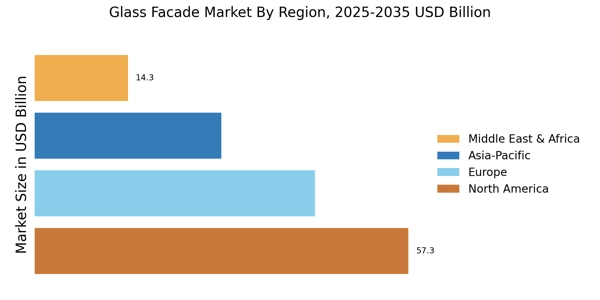
The North American glass facade market is primarily driven by increasing demand for energy-efficient buildings and sustainable construction practices. The region holds the largest market share at approximately 40%, with the U.S. leading the charge due to stringent building codes and regulations promoting energy efficiency. The growing trend of urbanization and commercial construction further fuels this demand, supported by government incentives for green building initiatives. Key players in this region include Alcoa Corporation, Guardian Glass, and Kawneer Company, which are at the forefront of innovation in glass technology. The competitive landscape is characterized by a mix of established companies and emerging players focusing on advanced materials and smart glass solutions. The U.S. market is expected to continue its growth trajectory, driven by technological advancements and a shift towards sustainable architecture.
Europe is a significant player in the glass facade market, holding the second-largest share at around 30%. The region's growth is propelled by stringent environmental regulations and a strong emphasis on sustainable architecture. Countries like Germany and France are leading the way, with policies that encourage the use of energy-efficient materials in construction. The European Union's Green Deal further catalyzes this trend, aiming for a climate-neutral economy by 2050, which directly impacts the glass facade market. Leading companies such as Schüco International KG and Saint-Gobain are pivotal in driving innovation and sustainability in the sector. The competitive landscape is robust, with numerous players focusing on high-performance glass solutions. The presence of advanced manufacturing facilities and research centers in Europe enhances the region's capability to meet the growing demand for innovative glass facade systems.
The Asia-Pacific region is witnessing rapid growth in the glass facade market, driven by urbanization and increasing investments in infrastructure. This region holds a market share of approximately 20%, with China and India being the largest contributors. The demand for modern architectural designs and energy-efficient buildings is on the rise, supported by government initiatives promoting sustainable construction practices. The region's growth is also fueled by a booming real estate sector and rising disposable incomes. Key players like Asahi Glass Co., Ltd. and Nippon Sheet Glass Co., Ltd. are expanding their operations to cater to the growing demand. The competitive landscape is evolving, with both local and international companies vying for market share. The presence of advanced manufacturing technologies and a focus on innovation are expected to drive further growth in the glass facade market across Asia-Pacific.
The Middle East and Africa region is emerging as a significant market for glass facades, driven by rapid urbanization and infrastructural development. This region holds a market share of approximately 10%, with countries like the UAE and South Africa leading the charge. The demand for modern architectural designs and luxury buildings is increasing, supported by government investments in mega projects and smart city initiatives. The region's growth is also influenced by a rising middle class and increased foreign investments. Key players such as Pilkington Group Limited and Sika AG are actively participating in this market, focusing on innovative glass solutions tailored to the region's unique needs. The competitive landscape is characterized by a mix of local and international companies, with a strong emphasis on quality and sustainability. As the region continues to develop, the glass facade market is expected to expand significantly, driven by ongoing construction projects and urban development.
The Glass Facade Market is currently characterized by a dynamic competitive landscape, driven by increasing urbanization, a growing emphasis on energy efficiency, and advancements in glass technology. Major players such as Saint-Gobain (France), Schüco International KG (Germany), and Guardian Glass (United States) are strategically positioning themselves through innovation and regional expansion. Saint-Gobain (France) focuses on sustainable building solutions, while Schüco International KG (Germany) emphasizes energy-efficient systems. Guardian Glass (United States) is enhancing its product portfolio with smart glass technologies, collectively shaping a competitive environment that prioritizes sustainability and technological advancement.Key business tactics within the Glass Facade Market include localizing manufacturing and optimizing supply chains to enhance responsiveness to regional demands. The market appears moderately fragmented, with several key players exerting influence through strategic partnerships and technological innovations. This structure allows for a diverse range of offerings, catering to various customer needs while fostering competition among established and emerging players.
In August Saint-Gobain (France) announced the launch of a new line of high-performance glass products designed to improve energy efficiency in commercial buildings. This strategic move not only aligns with global sustainability goals but also positions the company as a leader in the eco-friendly construction segment. By focusing on energy-efficient solutions, Saint-Gobain (France) is likely to attract environmentally conscious clients and enhance its market share.
In September Schüco International KG (Germany) unveiled a partnership with a leading technology firm to develop smart facade systems that integrate IoT capabilities. This collaboration signifies a shift towards digitalization in the construction sector, allowing for real-time monitoring and energy management. Such innovations may provide Schüco with a competitive edge, appealing to modern architects and builders seeking advanced solutions.
In July Guardian Glass (United States) expanded its manufacturing capabilities by investing in a new facility focused on producing high-performance glass for the North American market. This expansion is indicative of Guardian's commitment to meeting the rising demand for innovative glass solutions. By enhancing its production capacity, Guardian Glass (United States) is likely to strengthen its position in a competitive market, ensuring timely delivery and responsiveness to customer needs.
As of October current trends in the Glass Facade Market are increasingly defined by digitalization, sustainability, and the integration of artificial intelligence. Strategic alliances among key players are shaping the landscape, fostering innovation and enhancing product offerings. The competitive differentiation appears to be shifting from price-based competition to a focus on technological advancements and supply chain reliability. This evolution suggests that companies that prioritize innovation and sustainability will likely emerge as leaders in the Glass Facade Market.
August 2026: AGC Glass Europe announced an investment at its Lodelinsart facility in Belgium to expand its range of high-performance coated glass. The investment is aimed at strengthening AGC’s coated-glass offering for demanding architectural applications, including façade glazing, with improved solar-control and energy-performance characteristics.
August 2026: Saint-Gobain and AGC announced a partnership to develop a large-scale highly electrified furnace for flat-glass production. The project targets lower-carbon manufacturing of architectural glass, supporting the development of more sustainable glazing solutions for building façades.
July 2026: AGC Glass Europe announced a breakthrough in low-carbon laminated glass, further expanding its sustainability-focused glass portfolio. The development is relevant to façade applications where laminated glazing is used for safety, acoustic performance, solar control, and architectural design.
September 2025: Saint-Gobain Glass published its 2025 Glass for Façade Reference Book, featuring 37 architectural projects worldwide using its façade glass solutions. The projects include applications of the COOL-LITE® solar-control range and ORAÉ® low-carbon glass, highlighting the company's focus on energy-efficient and lower-carbon façade glazing.
April 2025: Gauzy unveiled an 11,000-square-foot smart-glass façade installation at the new MSC Miami Cruise Terminal. Gauzy's exterior-grade PDLC smart film covers approximately 75% of the terminal's glass façade, allowing the glazing to function as a transparent surface during the day and as a large digital display at night.
ガラスファサード市場は、2024年から2035年までの間に年平均成長率4.47%で成長すると予測されており、都市化、エネルギー効率の要求、建築の革新がその推進要因です。
新しい機会は以下にあります:
2035年までに、ガラスファサード市場は堅調な成長と革新を達成する見込みです。
| MARKET SIZE 2024 | 143.27(USD Billion) |
| MARKET SIZE 2025 | 149.68(USD Billion) |
| MARKET SIZE 2035 | 231.83(USD Billion) |
| COMPOUND ANNUAL GROWTH RATE (CAGR) | 4.47% (2025 - 2035) |
| REPORT COVERAGE | Revenue Forecast, Competitive Landscape, Growth Factors, and Trends |
| BASE YEAR | 2024 |
| Market Forecast Period | 2025 - 2035 |
| Historical Data | 2019 - 2024 |
| Market Forecast Units | USD Billion |
| Key Companies Profiled | Saint-Gobain (FR), Schüco International KG (DE), Alcoa Corporation (US), Guardian Glass (US), Kawneer Company (US), Asahi Glass Co., Ltd. (JP), Nippon Sheet Glass Co., Ltd. (JP), Pilkington Group Limited (GB), Sika AG (CH) |
| Segments Covered | Application, Material, Glazing Type, Shape, Opening Mechanism, Regional |
| Key Market Opportunities | Integration of energy-efficient technologies in the Glass Facade Market enhances sustainability and aesthetic appeal. |
| Key Market Dynamics | Rising demand for energy-efficient buildings drives innovation in glass facade technologies and sustainable design practices. |
| Countries Covered | North America, Europe, APAC, South America, MEA |
 Priya Nagrale

このレポートの無料サンプルを受け取るには、以下のフォームにご記入ください


“This is really good guys. Excellent work on a tight deadline. I will continue to use you going forward and recommend you to others. Nice job”
 Noah Malgeri
Co-Founder

“Thanks for sending the report it gives us a good global view of the Betaïne market.”
 Peter Groot koerkamp
Account and Business Manager

“We found the report very insightful! we found your research firm very helpful. I'm sending this email to secure our future business.”
 Younghwan Choi
Senior Retail Manager

“I am very pleased with how market segments have been defined in a relevant way for my purposes (such as "Portable Freezers & refrigerators" and "last-mile"). In general the report is well structured. Thanks very much for your efforts.”
 Mark Irwin
Management Consultant

“We got the report in time, we really thank you for your support in this process. I also thank to all of your team as they did a great job.”
 Akif Moroglu
Strategy & Business Development Director

“The Automotive 48V ECU Components Procurement Intelligence Study” was a complex project, but the Market Research Future (MRFR) team handled it with quality, agility, and customer-centricity. They delivered all requested data on time and within the agreed scope. The team, including Shubhendra Anand and Rahul Gotadki, was always readily available to clarify questions and swiftly implement necessary adjustments, driving the project to a successful conclusion within a very demanding timeframe.
I would also like to specifically commend Akshay Agarwal for his responsiveness and support at every stage—from our initial inquiry on May 6th through to final delivery on June 18th. His dedication made the entire process seamless.”
 Guilherme Gomes Martins
Product Management Director

“Thanks. It’s been a pleasure working with you, please use me as reference with any other Intel employees.”
 Joseph Aguayo
Sales Operations & Pricing Manager

“Thank you, this will be very helpful for OQS.”
 La Terria Dodd
Program Support Specialist

“I have been reading the first document or the study, ,the Global HVAC and FP market report 2021 till 2026. Must say, good info! I have not gone in depth at all parts, but got a good indication of the data inside!”
 Rob Kooiker
Group Product Manager HVAC & Fire Protection GMA