
×
  • Cat-intel
  • MedIntelliX
  • Resources
  • About Us
  • Hero Background
    English
    Chinese
    French
    Japanese
    Korean
    German
    Spanish

    Traffic Signal Controller Market Share

    ID: MRFR/AM/10479-HCR
    128 Pages
    Swapnil Palwe
    October 2025

    Traffic Signal Controller Market Research Report Information By Product Type (Standard Controller and Smart Controller), By Application (Urban and Suburbs), and By Region (North America, Europe, Asia-Pacific, and Rest Of The World) – Market Forecast Till 2035

    Share:
    Download PDF ×

    We do not share your information with anyone. However, we may send you emails based on your report interest from time to time. You may contact us at any time to opt-out.

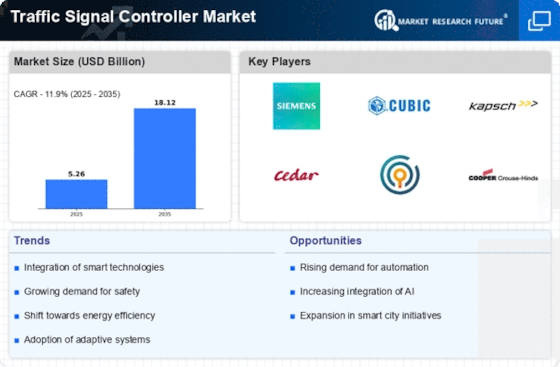
    Traffic Signal Controller Market Infographic
    Purchase Options

    Market Share

    Traffic Signal Controller Market Share Analysis

    In the realm of traffic signal controller systems, corporations appoint numerous strategies to set up their market positioning and increase their share. One huge method involves technological differentiation, wherein groups are aware of developing advanced and smart traffic sign manipulation structures. These systems might also comprise features like adaptive sign control generation, actual-time information analytics, or AI-pushed algorithms that optimize visitor flow based on modern-day conditions. By imparting state-of-the-art solutions that beautify visitor control efficiency and decrease congestion, companies attract municipalities or transportation departments in search of modern-day controllers to enhance avenue safety and decrease commute instances. Market segmentation plays a crucial position in positioning traffic signal controller manufacturers. Companies identify unique market segments based totally on factors like metropolis length, site visitors quantity, or infrastructure requirements. For instance, sure controllers are designed for high-visitors urban regions, focusing on coping with complicated intersections efficaciously. Meanwhile, other systems cater to smaller towns or suburban regions with less complicated site visitor patterns. Moreover, logo positioning and recognition notably impact market proportion inside the traffic signal controller industry. Companies put money into constructing a sturdy brand image by emphasizing reliability, sturdiness, or innovation in their products. Establishing popularity for imparting sturdy and dependable controllers no longer most effective attracts new customers but also fosters loyalty amongst existing ones. Brands that can be perceived as trustworthy and technologically advanced regularly have a facet in prevailing contracts or tenders over competitors. Strategic partnerships and collaborations are instrumental in expanding the market percentage for traffic signal controller businesses. Teaming up with metropolis planning government, transportation groups, or generation corporations lets those corporations get admission to new markets and possibilities. Partnerships permit the integration of complementary technology or information, mainly for the improvement of comprehensive site visitor control answers. Such collaborations beautify an organization's marketplace presence and open doorways to large tasks or government contracts, contributing to expanded market percentage. Furthermore, continuous innovation is pivotal in staying competitive within the traffic signal controller marketplace. Companies that put money into research and development to introduce new capabilities, enhance gadget performance, or align with evolving visitor policies generally tend to stay in advance. Adapting to changing desires, including accommodating electric-powered and autonomous cars or imposing eco-friendly answers, positions agencies as ahead-wondering leaders in the enterprise. In summary, the marketplace share positioning strategies in the traffic signal controller enterprise revolve around technological differentiation, cost management, market segmentation, emblem positioning, strategic partnerships, and innovation. Employing these techniques allows organizations to cope with diverse customer desires, establish a strong market presence, and stabilize an aggressive aspect in a usually evolving and rather competitive market panorama.


    Author
    Swapnil Palwe
    Team Lead - Research

    With a technical background as Bachelor's in Mechanical Engineering, with MBA in Operations Management , Swapnil has 6+ years of experience in market research, consulting and analytics with the tasks of data mining, analysis, and project execution. He is the POC for our clients, for their consulting projects running under the Automotive/A&D domain. Swapnil has worked on major projects in verticals such as Aerospace & Defense, Automotive and many other domain projects. He has worked on projects for fortune 500 companies' syndicate and consulting projects along with several government projects.

    Leave a Comment

    FAQs

    How much is the Traffic Signal Controller market?

    The Traffic Signal Controller Market size was valued at USD 5.26 Billion in 2024.

    What is the growth rate of the Traffic Signal Controller market?

    The global market is projected to grow at a CAGR of 11.90% during the forecast period, 2025-2034.

    Which region held the largest market share in the Traffic Signal Controller market?

    North America had the largest share in the global market

    Who are the key players in the Traffic Signal Controller market?

    The key players in the market are Aldridge Traffic Controllers, Traffic Technologies Pty Ltd, Siemens AG, Johnson Controllers, Econolite, Sumitomo Electric Mfg Co, Dynamic Traffic Systems, Sena Traffic Systems, Kyosan Electric Mfg Co Ltd, PPK Technology Sdn. Bhd, and Indra Sistemas, S.A.

    Which Product Type led the Traffic Signal Controller market?

    The Standard Controller Product Type dominated the market in 2022.

    Which Application had the largest market share in the Traffic Signal Controller market?

    The Urban Application had the largest share in the global market.

    Market Summary

    As per MRFR analysis, the Traffic Signal Controller Market Size was estimated at 5.259 USD Billion in 2024. The Traffic Signal Controller industry is projected to grow from 5.885 USD Billion in 2025 to 18.12 USD Billion by 2035, exhibiting a compound annual growth rate (CAGR) of 11.9 during the forecast period 2025 - 2035.

    Key Market Trends & Highlights

    The Traffic Signal Controller Market is poised for substantial growth driven by technological advancements and urbanization.

    • The integration of smart technologies is transforming traffic signal systems, enhancing efficiency and responsiveness.
    • Sustainability initiatives are increasingly influencing the design and implementation of traffic signal controllers.
    • Regulatory support for modernization is fostering innovation and investment in traffic management solutions.
    • Rising urbanization and government initiatives focused on road safety are key drivers propelling market expansion.

    Market Size & Forecast

    2024 Market Size 5.259 (USD Billion)
    2035 Market Size 18.12 (USD Billion)
    CAGR (2025 - 2035) 11.9%
    Largest Regional Market Share in 2024 North America

    Major Players

    <p>Siemens (DE), Cubic Corporation (US), Kapsch TrafficCom (AT), Cedar Communications (US), Civis Analytics (US), Crouse-Hinds (US), Cobalt (US), Cannon (US), Cedar Communications (US), Cubic Transportation Systems (US)</p>

    Market Trends

    The Traffic Signal Controller Market is currently experiencing a transformative phase, driven by advancements in technology and increasing urbanization. As cities expand and traffic congestion becomes a pressing issue, the demand for efficient traffic management solutions is on the rise. Modern traffic signal controllers are increasingly integrated with smart technologies, enabling real-time data analysis and adaptive signal control. This evolution not only enhances traffic flow but also contributes to improved safety for pedestrians and vehicles alike. Furthermore, the growing emphasis on sustainability is prompting municipalities to adopt energy-efficient systems, which may further influence market dynamics. In addition to technological advancements, regulatory frameworks are evolving to support the implementation of intelligent transportation systems. Governments are recognizing the importance of modernizing infrastructure to accommodate the needs of a growing population. This shift is likely to create opportunities for innovation within the Traffic Signal Controller Market. As stakeholders seek to enhance operational efficiency and reduce environmental impact, the market appears poised for growth. The interplay between technology, regulation, and urban development suggests a complex landscape that stakeholders must navigate to capitalize on emerging opportunities.

    Integration of Smart Technologies

    The Traffic Signal Controller Market is witnessing a notable trend towards the integration of smart technologies. This includes the use of sensors, cameras, and data analytics to optimize traffic flow and enhance safety. Such innovations allow for real-time adjustments to signal timings based on current traffic conditions, thereby improving overall efficiency.

    Focus on Sustainability

    There is a growing emphasis on sustainability within the Traffic Signal Controller Market. Municipalities are increasingly adopting energy-efficient systems and eco-friendly practices. This trend reflects a broader commitment to reducing carbon footprints and promoting environmentally responsible urban development.

    Regulatory Support for Modernization

    Regulatory frameworks are evolving to support the modernization of traffic management systems. Governments are recognizing the necessity of upgrading infrastructure to meet the demands of urbanization. This trend is likely to facilitate the adoption of advanced traffic signal controllers, fostering innovation and efficiency.

    The ongoing integration of advanced technologies in traffic signal controllers is poised to enhance traffic management efficiency and safety across urban landscapes.

    U.S. Department of Transportation

    Traffic Signal Controller Market Market Drivers

    Rising Urbanization

    The increasing trend of urbanization is a pivotal driver for the Traffic Signal Controller Market. As more individuals migrate to urban areas, the demand for efficient traffic management systems escalates. Urban centers are experiencing heightened traffic congestion, necessitating advanced traffic signal controllers to optimize flow and reduce delays. According to recent data, urban populations are projected to reach 68 percent by 2050, intensifying the need for smart traffic solutions. This surge in urbanization compels municipalities to invest in modern traffic signal systems, thereby propelling the Traffic Signal Controller Market forward. Furthermore, the integration of intelligent transportation systems within urban planning is likely to enhance the functionality of traffic signal controllers, making them indispensable in managing the complexities of urban traffic.

    Technological Advancements

    Technological advancements play a crucial role in shaping the Traffic Signal Controller Market. Innovations such as adaptive traffic signal control systems, which adjust signal timings based on real-time traffic conditions, are gaining traction. These systems utilize data analytics and machine learning algorithms to enhance traffic flow and minimize congestion. The market for intelligent traffic management solutions is expected to grow significantly, with estimates suggesting a compound annual growth rate of over 10 percent in the coming years. Additionally, the integration of Internet of Things (IoT) technology into traffic signal controllers allows for improved communication between vehicles and infrastructure, further optimizing traffic management. As cities increasingly adopt these technologies, the Traffic Signal Controller Market is likely to witness substantial growth, driven by the demand for smarter, more efficient traffic solutions.

    Growing Focus on Road Safety

    The growing focus on road safety is a significant driver for the Traffic Signal Controller Market. With rising concerns over traffic accidents and fatalities, there is an urgent need for effective traffic management solutions. Traffic signal controllers are essential in regulating vehicle and pedestrian movement, thereby enhancing safety at intersections. Recent statistics indicate that traffic-related deaths remain a pressing issue, prompting authorities to seek advanced solutions to mitigate risks. The implementation of smart traffic signal systems, which can adapt to real-time conditions, is likely to contribute to improved road safety outcomes. As public awareness of road safety increases, the demand for sophisticated traffic signal controllers is expected to rise, further propelling the Traffic Signal Controller Market.

    Environmental Sustainability Goals

    Environmental sustainability goals are increasingly influencing the Traffic Signal Controller Market. As cities strive to reduce their carbon footprints, there is a growing emphasis on implementing traffic management systems that promote eco-friendly practices. Traffic signal controllers that optimize traffic flow can significantly decrease vehicle emissions by minimizing idling times. Recent studies suggest that the adoption of intelligent traffic systems can lead to a reduction in greenhouse gas emissions by up to 30 percent. This alignment with sustainability objectives is prompting municipalities to invest in modern traffic signal solutions that not only enhance efficiency but also contribute to environmental goals. Consequently, the Traffic Signal Controller Market is likely to experience growth as cities prioritize sustainable transportation initiatives.

    Government Initiatives and Funding

    Government initiatives and funding are instrumental in driving the Traffic Signal Controller Market. Many governments are prioritizing the modernization of transportation infrastructure to enhance safety and efficiency. This focus is reflected in various funding programs aimed at upgrading traffic management systems. For instance, recent reports indicate that several countries have allocated significant budgets for smart city projects, which include the implementation of advanced traffic signal controllers. These initiatives not only aim to improve traffic flow but also to reduce emissions and promote sustainable urban mobility. As governments continue to invest in these projects, the Traffic Signal Controller Market is expected to benefit from increased demand for innovative traffic solutions that align with national transportation goals.

    Market Segment Insights

    By Type: Standard Controller (Largest) vs. Smart Controller (Fastest-Growing)

    <p>In the Traffic Signal Controller Market, the Standard Controller currently holds the largest share, dominating the market landscape due to its proven reliability and widespread adoption. Traditional traffic management systems have primarily relied on these controllers, ensuring a consistent performance in managing traffic flow across various intersections. Although Smart Controllers are gaining traction, the established presence of Standard Controllers continues to define the overall market distribution.</p>

    <p>Technology: Standard Controller (Dominant) vs. Smart Controller (Emerging)</p>

    <p>Standard Controllers are characterized by their robust and traditional architecture, which has effectively been serving traffic management needs for years. They offer a dependable and straightforward solution for controlling traffic signals, making them the preferred choice in various municipal applications. In contrast, Smart Controllers, fueled by advancements in technology, present innovative features such as real-time traffic monitoring and adaptive signal timing. This enables them to respond dynamically to changing traffic conditions, making them an appealing option for future infrastructure developments. As cities increasingly focus on smart transportation systems, the emergence of Smart Controllers is expected to disrupt the market significantly.</p>

    By Application: Urban (Largest) vs. Suburbs (Fastest-Growing)

    <p>In the Traffic Signal Controller Market, the Urban application segment dominates, reflecting a significant portion of overall market share. Urban areas benefit from higher traffic volumes, necessitating advanced traffic management systems that can optimize signal timings and reduce congestion. As cities continue to grow and develop, the urban application stands to maintain its leadership position, driven by robust infrastructure investments and the need for smart city implementations. Conversely, the Suburbs segment is gaining traction as suburban areas evolve and experience increased vehicular traffic. These regions are implementing smarter traffic solutions to manage developing roadways and population growth, making suburban traffic signal controllers an emerging focus in the industry.</p>

    <p>Application: Urban (Dominant) vs. Suburbs (Emerging)</p>

    <p>The Urban segment of traffic signal controllers is recognized for its advanced functionality in handling complex traffic scenarios seen in metropolitan areas. Urban controllers are equipped with sophisticated technologies, including adaptive signal control systems, which adapt to real-time traffic conditions and enhance flow efficiency. These systems are pivotal for reducing wait times and improving overall traffic management. In contrast, the Suburbs segment is witnessing rapid growth as suburban developments focus on smart solutions that mirror urban capabilities. These controllers are evolving to address the unique challenges faced by growing populations and are crucial for integrating new technologies like vehicle-to-infrastructure communication to improve traffic safety and efficiency in lower-density areas.</p>

    Get more detailed insights about Traffic Signal Controller Market Research Report—Global Forecast till 2035

    Regional Insights

    North America : Technological Innovation Leader

    North America is the largest market for traffic signal controllers, holding approximately 45% of the global market share. The region's growth is driven by increasing urbanization, the need for smart city solutions, and stringent traffic regulations aimed at reducing congestion and improving safety. Government initiatives promoting intelligent transportation systems further catalyze demand, making it a key player in the global market. The United States and Canada are the leading countries in this region, with significant investments in traffic management technologies. Major players like Siemens and Cubic Corporation dominate the market, focusing on innovative solutions that enhance traffic flow and safety. The competitive landscape is characterized by collaborations and partnerships among key stakeholders, ensuring continuous advancements in technology and service delivery.

    Europe : Sustainable Mobility Focus

    Europe is the second-largest market for traffic signal controllers, accounting for around 30% of the global market share. The region's growth is propelled by stringent environmental regulations and a strong push towards sustainable urban mobility solutions. Initiatives like the European Green Deal and various national policies are driving investments in smart traffic management systems, enhancing efficiency and reducing emissions. Leading countries such as Germany, France, and the UK are at the forefront of adopting advanced traffic signal technologies. The competitive landscape features key players like Kapsch TrafficCom and Siemens, who are innovating to meet regulatory demands. The presence of robust infrastructure and a focus on public transport integration further strengthen the market, making Europe a hub for traffic management innovations.

    Asia-Pacific : Emerging Market Potential

    Asia-Pacific is witnessing rapid growth in the traffic signal controller market, holding approximately 20% of the global market share. The region's expansion is driven by increasing urbanization, rising vehicle ownership, and government initiatives aimed at improving traffic management. Countries like China and India are investing heavily in smart city projects, which are expected to significantly boost demand for advanced traffic solutions in the coming years. China is the largest market in this region, followed by India and Japan, with a competitive landscape featuring both local and international players. Companies like Crouse-Hinds and Kapsch TrafficCom are actively participating in this growth, focusing on innovative technologies that cater to the unique challenges of urban traffic. The increasing adoption of IoT and AI in traffic management systems is also shaping the competitive dynamics in this market.

    Middle East and Africa : Infrastructure Development Focus

    The Middle East and Africa region is gradually emerging in the traffic signal controller market, holding about 5% of the global market share. The growth is primarily driven by significant investments in infrastructure development and urbanization. Governments are increasingly recognizing the importance of efficient traffic management systems to address congestion and enhance road safety, leading to a rise in demand for advanced traffic solutions. Countries like the UAE and South Africa are leading the way in adopting smart traffic technologies. The competitive landscape includes both local firms and international players, with companies like Cedar Communications making strides in the market. The focus on public-private partnerships is also fostering innovation and improving service delivery in traffic management, positioning the region for future growth.

    Key Players and Competitive Insights

    The Traffic Signal Controller Market is currently characterized by a dynamic competitive landscape, driven by technological advancements and increasing urbanization. Key players such as Siemens (DE), Cubic Corporation (US), and Kapsch TrafficCom (AT) are at the forefront, each adopting distinct strategies to enhance their market positioning. Siemens (DE) emphasizes innovation through the integration of smart technologies into their traffic management systems, aiming to improve traffic flow and reduce congestion. Meanwhile, Cubic Corporation (US) focuses on expanding its digital solutions, particularly in the realm of connected vehicles and smart city initiatives, thereby enhancing its operational capabilities. Kapsch TrafficCom (AT) is strategically investing in partnerships with local governments to implement advanced traffic signal systems, which reflects a commitment to regional expansion and localized solutions.

    The business tactics employed by these companies include localizing manufacturing and optimizing supply chains to enhance efficiency and responsiveness to market demands. The competitive structure of the Traffic Signal Controller Market appears moderately fragmented, with several players vying for market share. However, the collective influence of major companies like Siemens, Cubic, and Kapsch suggests a trend towards consolidation, as these firms leverage their technological expertise and market presence to gain a competitive edge.

    In August 2025, Siemens (DE) announced the launch of its new AI-driven traffic signal controller, which is designed to adapt in real-time to changing traffic conditions. This strategic move is significant as it positions Siemens as a leader in the integration of artificial intelligence within traffic management systems, potentially enhancing urban mobility and reducing travel times. Similarly, in September 2025, Cubic Corporation (US) unveiled a partnership with a major city to implement a comprehensive smart traffic management system. This collaboration is likely to bolster Cubic's presence in the smart city sector, aligning with the growing demand for integrated transportation solutions.

    Kapsch TrafficCom (AT) made headlines in July 2025 by securing a contract with a metropolitan area to upgrade its traffic signal infrastructure. This initiative not only underscores Kapsch's commitment to enhancing urban traffic systems but also reflects a broader trend of municipalities investing in modernized traffic solutions to address congestion and improve safety. Such strategic actions by these companies indicate a proactive approach to meeting the evolving needs of urban environments.

    As of October 2025, the Traffic Signal Controller Market is witnessing trends that emphasize digitalization, sustainability, and the integration of artificial intelligence. Strategic alliances among key players are increasingly shaping the competitive landscape, fostering innovation and collaboration. The shift from price-based competition to a focus on technological advancement and supply chain reliability is evident, suggesting that future differentiation will hinge on the ability to deliver innovative solutions that address the complexities of modern urban mobility.

    Key Companies in the Traffic Signal Controller Market market include

    Industry Developments

    • Q2 2024: Siemens Mobility launches new intelligent traffic signal controller platform for smart cities Siemens Mobility announced the launch of its next-generation traffic signal controller platform, designed to support AI-driven adaptive traffic management and integration with smart city infrastructure.
    • Q1 2024: SWARCO expands manufacturing capacity with new traffic signal controller facility in Germany SWARCO Group opened a new production facility in Germany dedicated to advanced traffic signal controllers, aiming to meet rising demand from European smart city projects.
    • Q2 2024: Econolite unveils Cobalt ATC 2.0 traffic signal controller with enhanced cybersecurity features Econolite introduced the Cobalt ATC 2.0, a new traffic signal controller featuring advanced cybersecurity protections and improved connectivity for urban traffic management systems.
    • Q2 2024: Sumitomo Electric Industries partners with NTT Data to develop AI-powered traffic signal controllers Sumitomo Electric Industries announced a strategic partnership with NTT Data to co-develop AI-powered traffic signal controllers for deployment in Japanese smart cities.
    • Q1 2024: Johnson Controls appoints new VP of Traffic Solutions to lead global signal controller business Johnson Controls named a new Vice President of Traffic Solutions, tasking the executive with expanding the company's global footprint in traffic signal controller technology.
    • Q2 2024: Cubic wins contract to supply adaptive traffic signal controllers for major US metropolitan area Cubic Corporation secured a contract to provide adaptive traffic signal controllers for a large metropolitan area in the United States, supporting the city's smart mobility initiative.
    • Q2 2024: Nippon Signal launches new V2X-enabled traffic signal controller for Japanese urban markets Nippon Signal introduced a new traffic signal controller with vehicle-to-everything (V2X) communication capabilities, targeting deployment in Japanese urban environments.
    • Q1 2024: Intelight receives regulatory approval for X3 Advanced Traffic Signal Controller in North America Intelight announced regulatory approval for its X3 Advanced Traffic Signal Controller, enabling commercial deployment across North American cities.
    • Q2 2024: PTV Group partners with Yunex Traffic to integrate adaptive signal control software with Yunex controllers PTV Group entered a partnership with Yunex Traffic to integrate its adaptive signal control software into Yunex's traffic signal controller hardware for European smart city projects.
    • Q1 2024: Temple Inc. launches new modular traffic signal controller for US municipal markets Temple Inc. released a modular traffic signal controller designed for flexible deployment in US municipal traffic management systems.
    • Q2 2024: Traffic Technologies secures contract to supply smart traffic signal controllers for Australian city Traffic Technologies Pty Ltd won a contract to supply smart traffic signal controllers for a major city in Australia, supporting the city's digital infrastructure upgrade.
    • Q2 2024: Hisense TransTech launches new cloud-connected traffic signal controller for Chinese urban deployments Hisense TransTech introduced a cloud-connected traffic signal controller aimed at improving traffic flow and management in rapidly growing Chinese cities.

    Future Outlook

    Traffic Signal Controller Market Future Outlook

    <p>The Traffic Signal Controller Market is projected to grow at 11.9% CAGR from 2024 to 2035, driven by urbanization, smart city initiatives, and technological advancements.</p>

    New opportunities lie in:

    • <p>Integration of AI-driven traffic management systems</p>
    • <p>Development of cloud-based signal control platforms</p>
    • <p>Expansion into emerging markets with tailored solutions</p>

    <p>By 2035, the market is expected to be robust, driven by innovation and increased demand for efficient traffic management.</p>

    Market Segmentation

    Traffic Signal Controller Market Type Outlook

    • Standard Controller
    • Smart Controller

    Traffic Signal Controller Market Application Outlook

    • Urban
    • Suburbs

    Report Scope

    MARKET SIZE 20245.259(USD Billion)
    MARKET SIZE 20255.885(USD Billion)
    MARKET SIZE 203518.12(USD Billion)
    COMPOUND ANNUAL GROWTH RATE (CAGR)11.9% (2024 - 2035)
    REPORT COVERAGERevenue Forecast, Competitive Landscape, Growth Factors, and Trends
    BASE YEAR2024
    Market Forecast Period2025 - 2035
    Historical Data2019 - 2024
    Market Forecast UnitsUSD Billion
    Key Companies ProfiledMarket analysis in progress
    Segments CoveredMarket segmentation analysis in progress
    Key Market OpportunitiesIntegration of smart technologies enhances efficiency in the Traffic Signal Controller Market.
    Key Market DynamicsTechnological advancements and regulatory changes drive innovation and competition in the Traffic Signal Controller market.
    Countries CoveredNorth America, Europe, APAC, South America, MEA

    FAQs

    How much is the Traffic Signal Controller market?

    The Traffic Signal Controller Market size was valued at USD 5.26 Billion in 2024.

    What is the growth rate of the Traffic Signal Controller market?

    The global market is projected to grow at a CAGR of 11.90% during the forecast period, 2025-2034.

    Which region held the largest market share in the Traffic Signal Controller market?

    North America had the largest share in the global market

    Who are the key players in the Traffic Signal Controller market?

    The key players in the market are Aldridge Traffic Controllers, Traffic Technologies Pty Ltd, Siemens AG, Johnson Controllers, Econolite, Sumitomo Electric Mfg Co, Dynamic Traffic Systems, Sena Traffic Systems, Kyosan Electric Mfg Co Ltd, PPK Technology Sdn. Bhd, and Indra Sistemas, S.A.

    Which Product Type led the Traffic Signal Controller market?

    The Standard Controller Product Type dominated the market in 2022.

    Which Application had the largest market share in the Traffic Signal Controller market?

    The Urban Application had the largest share in the global market.

    1. SECTION I: EXECUTIVE SUMMARY AND KEY HIGHLIGHTS
      1. | 1.1 EXECUTIVE SUMMARY
      2. | | 1.1.1 Market Overview
      3. | | 1.1.2 Key Findings
      4. | | 1.1.3 Market Segmentation
      5. | | 1.1.4 Competitive Landscape
      6. | | 1.1.5 Challenges and Opportunities
      7. | | 1.1.6 Future Outlook
    2. SECTION II: SCOPING, METHODOLOGY AND MARKET STRUCTURE
      1. | 2.1 MARKET INTRODUCTION
      2. | | 2.1.1 Definition
      3. | | 2.1.2 Scope of the study
      4. | | | 2.1.2.1 Research Objective
      5. | | | 2.1.2.2 Assumption
      6. | | | 2.1.2.3 Limitations
      7. | 2.2 RESEARCH METHODOLOGY
      8. | | 2.2.1 Overview
      9. | | 2.2.2 Data Mining
      10. | | 2.2.3 Secondary Research
      11. | | 2.2.4 Primary Research
      12. | | | 2.2.4.1 Primary Interviews and Information Gathering Process
      13. | | | 2.2.4.2 Breakdown of Primary Respondents
      14. | | 2.2.5 Forecasting Model
      15. | | 2.2.6 Market Size Estimation
      16. | | | 2.2.6.1 Bottom-Up Approach
      17. | | | 2.2.6.2 Top-Down Approach
      18. | | 2.2.7 Data Triangulation
      19. | | 2.2.8 Validation
    3. SECTION III: QUALITATIVE ANALYSIS
      1. | 3.1 MARKET DYNAMICS
      2. | | 3.1.1 Overview
      3. | | 3.1.2 Drivers
      4. | | 3.1.3 Restraints
      5. | | 3.1.4 Opportunities
      6. | 3.2 MARKET FACTOR ANALYSIS
      7. | | 3.2.1 Value chain Analysis
      8. | | 3.2.2 Porter's Five Forces Analysis
      9. | | | 3.2.2.1 Bargaining Power of Suppliers
      10. | | | 3.2.2.2 Bargaining Power of Buyers
      11. | | | 3.2.2.3 Threat of New Entrants
      12. | | | 3.2.2.4 Threat of Substitutes
      13. | | | 3.2.2.5 Intensity of Rivalry
      14. | | 3.2.3 COVID-19 Impact Analysis
      15. | | | 3.2.3.1 Market Impact Analysis
      16. | | | 3.2.3.2 Regional Impact
      17. | | | 3.2.3.3 Opportunity and Threat Analysis
    4. SECTION IV: QUANTITATIVE ANALYSIS
      1. | 4.1 Automobile, BY Type (USD Billion)
      2. | | 4.1.1 Standard Controller
      3. | | 4.1.2 Smart Controller
      4. | 4.2 Automobile, BY Application (USD Billion)
      5. | | 4.2.1 Urban
      6. | | 4.2.2 Suburbs
      7. | 4.3 Automobile, BY Region (USD Billion)
      8. | | 4.3.1 North America
      9. | | | 4.3.1.1 US
      10. | | | 4.3.1.2 Canada
      11. | | 4.3.2 Europe
      12. | | | 4.3.2.1 Germany
      13. | | | 4.3.2.2 UK
      14. | | | 4.3.2.3 France
      15. | | | 4.3.2.4 Russia
      16. | | | 4.3.2.5 Italy
      17. | | | 4.3.2.6 Spain
      18. | | | 4.3.2.7 Rest of Europe
      19. | | 4.3.3 APAC
      20. | | | 4.3.3.1 China
      21. | | | 4.3.3.2 India
      22. | | | 4.3.3.3 Japan
      23. | | | 4.3.3.4 South Korea
      24. | | | 4.3.3.5 Malaysia
      25. | | | 4.3.3.6 Thailand
      26. | | | 4.3.3.7 Indonesia
      27. | | | 4.3.3.8 Rest of APAC
      28. | | 4.3.4 South America
      29. | | | 4.3.4.1 Brazil
      30. | | | 4.3.4.2 Mexico
      31. | | | 4.3.4.3 Argentina
      32. | | | 4.3.4.4 Rest of South America
      33. | | 4.3.5 MEA
      34. | | | 4.3.5.1 GCC Countries
      35. | | | 4.3.5.2 South Africa
      36. | | | 4.3.5.3 Rest of MEA
    5. SECTION V: COMPETITIVE ANALYSIS
      1. | 5.1 Competitive Landscape
      2. | | 5.1.1 Overview
      3. | | 5.1.2 Competitive Analysis
      4. | | 5.1.3 Market share Analysis
      5. | | 5.1.4 Major Growth Strategy in the Automobile
      6. | | 5.1.5 Competitive Benchmarking
      7. | | 5.1.6 Leading Players in Terms of Number of Developments in the Automobile
      8. | | 5.1.7 Key developments and growth strategies
      9. | | | 5.1.7.1 New Product Launch/Service Deployment
      10. | | | 5.1.7.2 Merger & Acquisitions
      11. | | | 5.1.7.3 Joint Ventures
      12. | | 5.1.8 Major Players Financial Matrix
      13. | | | 5.1.8.1 Sales and Operating Income
      14. | | | 5.1.8.2 Major Players R&D Expenditure. 2023
      15. | 5.2 Company Profiles
      16. | | 5.2.1 Siemens (DE)
      17. | | | 5.2.1.1 Financial Overview
      18. | | | 5.2.1.2 Products Offered
      19. | | | 5.2.1.3 Key Developments
      20. | | | 5.2.1.4 SWOT Analysis
      21. | | | 5.2.1.5 Key Strategies
      22. | | 5.2.2 Cubic Corporation (US)
      23. | | | 5.2.2.1 Financial Overview
      24. | | | 5.2.2.2 Products Offered
      25. | | | 5.2.2.3 Key Developments
      26. | | | 5.2.2.4 SWOT Analysis
      27. | | | 5.2.2.5 Key Strategies
      28. | | 5.2.3 Kapsch TrafficCom (AT)
      29. | | | 5.2.3.1 Financial Overview
      30. | | | 5.2.3.2 Products Offered
      31. | | | 5.2.3.3 Key Developments
      32. | | | 5.2.3.4 SWOT Analysis
      33. | | | 5.2.3.5 Key Strategies
      34. | | 5.2.4 Cedar Communications (US)
      35. | | | 5.2.4.1 Financial Overview
      36. | | | 5.2.4.2 Products Offered
      37. | | | 5.2.4.3 Key Developments
      38. | | | 5.2.4.4 SWOT Analysis
      39. | | | 5.2.4.5 Key Strategies
      40. | | 5.2.5 Civis Analytics (US)
      41. | | | 5.2.5.1 Financial Overview
      42. | | | 5.2.5.2 Products Offered
      43. | | | 5.2.5.3 Key Developments
      44. | | | 5.2.5.4 SWOT Analysis
      45. | | | 5.2.5.5 Key Strategies
      46. | | 5.2.6 Crouse-Hinds (US)
      47. | | | 5.2.6.1 Financial Overview
      48. | | | 5.2.6.2 Products Offered
      49. | | | 5.2.6.3 Key Developments
      50. | | | 5.2.6.4 SWOT Analysis
      51. | | | 5.2.6.5 Key Strategies
      52. | | 5.2.7 Cobalt (US)
      53. | | | 5.2.7.1 Financial Overview
      54. | | | 5.2.7.2 Products Offered
      55. | | | 5.2.7.3 Key Developments
      56. | | | 5.2.7.4 SWOT Analysis
      57. | | | 5.2.7.5 Key Strategies
      58. | | 5.2.8 Cannon (US)
      59. | | | 5.2.8.1 Financial Overview
      60. | | | 5.2.8.2 Products Offered
      61. | | | 5.2.8.3 Key Developments
      62. | | | 5.2.8.4 SWOT Analysis
      63. | | | 5.2.8.5 Key Strategies
      64. | | 5.2.9 Cedar Communications (US)
      65. | | | 5.2.9.1 Financial Overview
      66. | | | 5.2.9.2 Products Offered
      67. | | | 5.2.9.3 Key Developments
      68. | | | 5.2.9.4 SWOT Analysis
      69. | | | 5.2.9.5 Key Strategies
      70. | | 5.2.10 Cubic Transportation Systems (US)
      71. | | | 5.2.10.1 Financial Overview
      72. | | | 5.2.10.2 Products Offered
      73. | | | 5.2.10.3 Key Developments
      74. | | | 5.2.10.4 SWOT Analysis
      75. | | | 5.2.10.5 Key Strategies
      76. | 5.3 Appendix
      77. | | 5.3.1 References
      78. | | 5.3.2 Related Reports
    6. LIST OF FIGURES
      1. | 6.1 MARKET SYNOPSIS
      2. | 6.2 NORTH AMERICA MARKET ANALYSIS
      3. | 6.3 US MARKET ANALYSIS BY TYPE
      4. | 6.4 US MARKET ANALYSIS BY APPLICATION
      5. | 6.5 CANADA MARKET ANALYSIS BY TYPE
      6. | 6.6 CANADA MARKET ANALYSIS BY APPLICATION
      7. | 6.7 EUROPE MARKET ANALYSIS
      8. | 6.8 GERMANY MARKET ANALYSIS BY TYPE
      9. | 6.9 GERMANY MARKET ANALYSIS BY APPLICATION
      10. | 6.10 UK MARKET ANALYSIS BY TYPE
      11. | 6.11 UK MARKET ANALYSIS BY APPLICATION
      12. | 6.12 FRANCE MARKET ANALYSIS BY TYPE
      13. | 6.13 FRANCE MARKET ANALYSIS BY APPLICATION
      14. | 6.14 RUSSIA MARKET ANALYSIS BY TYPE
      15. | 6.15 RUSSIA MARKET ANALYSIS BY APPLICATION
      16. | 6.16 ITALY MARKET ANALYSIS BY TYPE
      17. | 6.17 ITALY MARKET ANALYSIS BY APPLICATION
      18. | 6.18 SPAIN MARKET ANALYSIS BY TYPE
      19. | 6.19 SPAIN MARKET ANALYSIS BY APPLICATION
      20. | 6.20 REST OF EUROPE MARKET ANALYSIS BY TYPE
      21. | 6.21 REST OF EUROPE MARKET ANALYSIS BY APPLICATION
      22. | 6.22 APAC MARKET ANALYSIS
      23. | 6.23 CHINA MARKET ANALYSIS BY TYPE
      24. | 6.24 CHINA MARKET ANALYSIS BY APPLICATION
      25. | 6.25 INDIA MARKET ANALYSIS BY TYPE
      26. | 6.26 INDIA MARKET ANALYSIS BY APPLICATION
      27. | 6.27 JAPAN MARKET ANALYSIS BY TYPE
      28. | 6.28 JAPAN MARKET ANALYSIS BY APPLICATION
      29. | 6.29 SOUTH KOREA MARKET ANALYSIS BY TYPE
      30. | 6.30 SOUTH KOREA MARKET ANALYSIS BY APPLICATION
      31. | 6.31 MALAYSIA MARKET ANALYSIS BY TYPE
      32. | 6.32 MALAYSIA MARKET ANALYSIS BY APPLICATION
      33. | 6.33 THAILAND MARKET ANALYSIS BY TYPE
      34. | 6.34 THAILAND MARKET ANALYSIS BY APPLICATION
      35. | 6.35 INDONESIA MARKET ANALYSIS BY TYPE
      36. | 6.36 INDONESIA MARKET ANALYSIS BY APPLICATION
      37. | 6.37 REST OF APAC MARKET ANALYSIS BY TYPE
      38. | 6.38 REST OF APAC MARKET ANALYSIS BY APPLICATION
      39. | 6.39 SOUTH AMERICA MARKET ANALYSIS
      40. | 6.40 BRAZIL MARKET ANALYSIS BY TYPE
      41. | 6.41 BRAZIL MARKET ANALYSIS BY APPLICATION
      42. | 6.42 MEXICO MARKET ANALYSIS BY TYPE
      43. | 6.43 MEXICO MARKET ANALYSIS BY APPLICATION
      44. | 6.44 ARGENTINA MARKET ANALYSIS BY TYPE
      45. | 6.45 ARGENTINA MARKET ANALYSIS BY APPLICATION
      46. | 6.46 REST OF SOUTH AMERICA MARKET ANALYSIS BY TYPE
      47. | 6.47 REST OF SOUTH AMERICA MARKET ANALYSIS BY APPLICATION
      48. | 6.48 MEA MARKET ANALYSIS
      49. | 6.49 GCC COUNTRIES MARKET ANALYSIS BY TYPE
      50. | 6.50 GCC COUNTRIES MARKET ANALYSIS BY APPLICATION
      51. | 6.51 SOUTH AFRICA MARKET ANALYSIS BY TYPE
      52. | 6.52 SOUTH AFRICA MARKET ANALYSIS BY APPLICATION
      53. | 6.53 REST OF MEA MARKET ANALYSIS BY TYPE
      54. | 6.54 REST OF MEA MARKET ANALYSIS BY APPLICATION
      55. | 6.55 KEY BUYING CRITERIA OF AUTOMOBILE
      56. | 6.56 RESEARCH PROCESS OF MRFR
      57. | 6.57 DRO ANALYSIS OF AUTOMOBILE
      58. | 6.58 DRIVERS IMPACT ANALYSIS: AUTOMOBILE
      59. | 6.59 RESTRAINTS IMPACT ANALYSIS: AUTOMOBILE
      60. | 6.60 SUPPLY / VALUE CHAIN: AUTOMOBILE
      61. | 6.61 AUTOMOBILE, BY TYPE, 2024 (% SHARE)
      62. | 6.62 AUTOMOBILE, BY TYPE, 2024 TO 2035 (USD Billion)
      63. | 6.63 AUTOMOBILE, BY APPLICATION, 2024 (% SHARE)
      64. | 6.64 AUTOMOBILE, BY APPLICATION, 2024 TO 2035 (USD Billion)
      65. | 6.65 BENCHMARKING OF MAJOR COMPETITORS
    7. LIST OF TABLES
      1. | 7.1 LIST OF ASSUMPTIONS
      2. | | 7.1.1
      3. | 7.2 North America MARKET SIZE ESTIMATES; FORECAST
      4. | | 7.2.1 BY TYPE, 2025-2035 (USD Billion)
      5. | | 7.2.2 BY APPLICATION, 2025-2035 (USD Billion)
      6. | 7.3 US MARKET SIZE ESTIMATES; FORECAST
      7. | | 7.3.1 BY TYPE, 2025-2035 (USD Billion)
      8. | | 7.3.2 BY APPLICATION, 2025-2035 (USD Billion)
      9. | 7.4 Canada MARKET SIZE ESTIMATES; FORECAST
      10. | | 7.4.1 BY TYPE, 2025-2035 (USD Billion)
      11. | | 7.4.2 BY APPLICATION, 2025-2035 (USD Billion)
      12. | 7.5 Europe MARKET SIZE ESTIMATES; FORECAST
      13. | | 7.5.1 BY TYPE, 2025-2035 (USD Billion)
      14. | | 7.5.2 BY APPLICATION, 2025-2035 (USD Billion)
      15. | 7.6 Germany MARKET SIZE ESTIMATES; FORECAST
      16. | | 7.6.1 BY TYPE, 2025-2035 (USD Billion)
      17. | | 7.6.2 BY APPLICATION, 2025-2035 (USD Billion)
      18. | 7.7 UK MARKET SIZE ESTIMATES; FORECAST
      19. | | 7.7.1 BY TYPE, 2025-2035 (USD Billion)
      20. | | 7.7.2 BY APPLICATION, 2025-2035 (USD Billion)
      21. | 7.8 France MARKET SIZE ESTIMATES; FORECAST
      22. | | 7.8.1 BY TYPE, 2025-2035 (USD Billion)
      23. | | 7.8.2 BY APPLICATION, 2025-2035 (USD Billion)
      24. | 7.9 Russia MARKET SIZE ESTIMATES; FORECAST
      25. | | 7.9.1 BY TYPE, 2025-2035 (USD Billion)
      26. | | 7.9.2 BY APPLICATION, 2025-2035 (USD Billion)
      27. | 7.10 Italy MARKET SIZE ESTIMATES; FORECAST
      28. | | 7.10.1 BY TYPE, 2025-2035 (USD Billion)
      29. | | 7.10.2 BY APPLICATION, 2025-2035 (USD Billion)
      30. | 7.11 Spain MARKET SIZE ESTIMATES; FORECAST
      31. | | 7.11.1 BY TYPE, 2025-2035 (USD Billion)
      32. | | 7.11.2 BY APPLICATION, 2025-2035 (USD Billion)
      33. | 7.12 Rest of Europe MARKET SIZE ESTIMATES; FORECAST
      34. | | 7.12.1 BY TYPE, 2025-2035 (USD Billion)
      35. | | 7.12.2 BY APPLICATION, 2025-2035 (USD Billion)
      36. | 7.13 APAC MARKET SIZE ESTIMATES; FORECAST
      37. | | 7.13.1 BY TYPE, 2025-2035 (USD Billion)
      38. | | 7.13.2 BY APPLICATION, 2025-2035 (USD Billion)
      39. | 7.14 China MARKET SIZE ESTIMATES; FORECAST
      40. | | 7.14.1 BY TYPE, 2025-2035 (USD Billion)
      41. | | 7.14.2 BY APPLICATION, 2025-2035 (USD Billion)
      42. | 7.15 India MARKET SIZE ESTIMATES; FORECAST
      43. | | 7.15.1 BY TYPE, 2025-2035 (USD Billion)
      44. | | 7.15.2 BY APPLICATION, 2025-2035 (USD Billion)
      45. | 7.16 Japan MARKET SIZE ESTIMATES; FORECAST
      46. | | 7.16.1 BY TYPE, 2025-2035 (USD Billion)
      47. | | 7.16.2 BY APPLICATION, 2025-2035 (USD Billion)
      48. | 7.17 South Korea MARKET SIZE ESTIMATES; FORECAST
      49. | | 7.17.1 BY TYPE, 2025-2035 (USD Billion)
      50. | | 7.17.2 BY APPLICATION, 2025-2035 (USD Billion)
      51. | 7.18 Malaysia MARKET SIZE ESTIMATES; FORECAST
      52. | | 7.18.1 BY TYPE, 2025-2035 (USD Billion)
      53. | | 7.18.2 BY APPLICATION, 2025-2035 (USD Billion)
      54. | 7.19 Thailand MARKET SIZE ESTIMATES; FORECAST
      55. | | 7.19.1 BY TYPE, 2025-2035 (USD Billion)
      56. | | 7.19.2 BY APPLICATION, 2025-2035 (USD Billion)
      57. | 7.20 Indonesia MARKET SIZE ESTIMATES; FORECAST
      58. | | 7.20.1 BY TYPE, 2025-2035 (USD Billion)
      59. | | 7.20.2 BY APPLICATION, 2025-2035 (USD Billion)
      60. | 7.21 Rest of APAC MARKET SIZE ESTIMATES; FORECAST
      61. | | 7.21.1 BY TYPE, 2025-2035 (USD Billion)
      62. | | 7.21.2 BY APPLICATION, 2025-2035 (USD Billion)
      63. | 7.22 South America MARKET SIZE ESTIMATES; FORECAST
      64. | | 7.22.1 BY TYPE, 2025-2035 (USD Billion)
      65. | | 7.22.2 BY APPLICATION, 2025-2035 (USD Billion)
      66. | 7.23 Brazil MARKET SIZE ESTIMATES; FORECAST
      67. | | 7.23.1 BY TYPE, 2025-2035 (USD Billion)
      68. | | 7.23.2 BY APPLICATION, 2025-2035 (USD Billion)
      69. | 7.24 Mexico MARKET SIZE ESTIMATES; FORECAST
      70. | | 7.24.1 BY TYPE, 2025-2035 (USD Billion)
      71. | | 7.24.2 BY APPLICATION, 2025-2035 (USD Billion)
      72. | 7.25 Argentina MARKET SIZE ESTIMATES; FORECAST
      73. | | 7.25.1 BY TYPE, 2025-2035 (USD Billion)
      74. | | 7.25.2 BY APPLICATION, 2025-2035 (USD Billion)
      75. | 7.26 Rest of South America MARKET SIZE ESTIMATES; FORECAST
      76. | | 7.26.1 BY TYPE, 2025-2035 (USD Billion)
      77. | | 7.26.2 BY APPLICATION, 2025-2035 (USD Billion)
      78. | 7.27 MEA MARKET SIZE ESTIMATES; FORECAST
      79. | | 7.27.1 BY TYPE, 2025-2035 (USD Billion)
      80. | | 7.27.2 BY APPLICATION, 2025-2035 (USD Billion)
      81. | 7.28 GCC Countries MARKET SIZE ESTIMATES; FORECAST
      82. | | 7.28.1 BY TYPE, 2025-2035 (USD Billion)
      83. | | 7.28.2 BY APPLICATION, 2025-2035 (USD Billion)
      84. | 7.29 South Africa MARKET SIZE ESTIMATES; FORECAST
      85. | | 7.29.1 BY TYPE, 2025-2035 (USD Billion)
      86. | | 7.29.2 BY APPLICATION, 2025-2035 (USD Billion)
      87. | 7.30 Rest of MEA MARKET SIZE ESTIMATES; FORECAST
      88. | | 7.30.1 BY TYPE, 2025-2035 (USD Billion)
      89. | | 7.30.2 BY APPLICATION, 2025-2035 (USD Billion)
      90. | 7.31 PRODUCT LAUNCH/PRODUCT DEVELOPMENT/APPROVAL
      91. | | 7.31.1
      92. | 7.32 ACQUISITION/PARTNERSHIP
      93. | | 7.32.1

    Traffic Signal Controller Market Segmentation

    Traffic Signal Controller Market Product Type Outlook (USD Billion, 2018-2032)

    • Standard Controller
    • Smart Controller

    Traffic Signal Controller Market Application Outlook (USD Billion, 2018-2032)

    • Urban
    • Suburbs

    Traffic Signal Controller Market Regional Outlook (USD Billion, 2018-2032)

    • North America Outlook (USD Billion, 2018-2032)

      • Traffic Signal Controller Market by Product Type
        • Standard Controller
        • Smart Controller
      • Traffic Signal Controller Market by Application
        • Urban
        • Suburbs
      • US Outlook (USD Billion, 2018-2032)

      • Traffic Signal Controller Market by Product Type
        • Standard Controller
        • Smart Controller
      • Traffic Signal Controller Market by Application
        • Urban
        • Suburbs
      • Canada Outlook (USD Billion, 2018-2032)

      • Traffic Signal Controller Market by Product Type
        • Standard Controller
        • Smart Controller
      • Traffic Signal Controller Market by Application
        • Urban
        • Suburbs
    • Europe Outlook (USD Billion, 2018-2032)

      • Traffic Signal Controller Market by Product Type
        • Standard Controller
        • Smart Controller
      • Traffic Signal Controller Market by Application
        • Urban
        • Suburbs
      • Germany Outlook (USD Billion, 2018-2032)

      • Traffic Signal Controller Market by Product Type
        • Standard Controller
        • Smart Controller
      • Traffic Signal Controller Market by Application
        • Urban
        • Suburbs
      • France Outlook (USD Billion, 2018-2032)

      • Traffic Signal Controller Market by Product Type
        • Standard Controller
        • Smart Controller
      • Traffic Signal Controller Market by Application
        • Urban
        • Suburbs
      • UK Outlook (USD Billion, 2018-2032)

      • Traffic Signal Controller Market by Product Type
        • Standard Controller
        • Smart Controller
      • Traffic Signal Controller Market by Application
        • Urban
        • Suburbs
      • Italy Outlook (USD Billion, 2018-2032)

      • Traffic Signal Controller Market by Product Type
        • Standard Controller
        • Smart Controller
      • Traffic Signal Controller Market by Application
        • Urban
        • Suburbs
      • Spain Outlook (USD Billion, 2018-2032)

      • Traffic Signal Controller Market by Product Type
        • Standard Controller
        • Smart Controller
      • Traffic Signal Controller Market by Application
        • Urban
        • Suburbs
      • Rest Of Europe Outlook (USD Billion, 2018-2032)

      • Traffic Signal Controller Market by Product Type
        • Standard Controller
        • Smart Controller
      • Traffic Signal Controller Market by Application
        • Urban
        • Suburbs
    • Asia-Pacific Outlook (USD Billion, 2018-2032)

      • Traffic Signal Controller Market by Product Type
        • Standard Controller
        • Smart Controller
      • Traffic Signal Controller Market by Application
        • Urban
        • Suburbs
      • China Outlook (USD Billion, 2018-2032)

      • Traffic Signal Controller Market by Product Type
        • Standard Controller
        • Smart Controller
      • Traffic Signal Controller Market by Application
        • Urban
        • Suburbs
      • Japan Outlook (USD Billion, 2018-2032)

      • Traffic Signal Controller Market by Product Type
        • Standard Controller
        • Smart Controller
      • Traffic Signal Controller Market by Application
        • Urban
        • Suburbs
      • India Outlook (USD Billion, 2018-2032)

      • Traffic Signal Controller Market by Product Type
        • Standard Controller
        • Smart Controller
      • Traffic Signal Controller Market by Application
        • Urban
        • Suburbs
      • Australia Outlook (USD Billion, 2018-2032)

      • Traffic Signal Controller Market by Product Type
        • Standard Controller
        • Smart Controller
      • Traffic Signal Controller Market by Application
        • Urban
        • Suburbs
      • Rest of Asia-Pacific Outlook (USD Billion, 2018-2032)

      • Traffic Signal Controller Market by Product Type
        • Standard Controller
        • Smart Controller
      • Traffic Signal Controller Market by Application
        • Urban
        • Suburbs
    • Rest of the World Outlook (USD Billion, 2018-2032)

      • Traffic Signal Controller Market by Product Type
        • Standard Controller
        • Smart Controller
      • Traffic Signal Controller Market by Application
        • Urban
        • Suburbs
      • Middle East Outlook (USD Billion, 2018-2032)

      • Traffic Signal Controller Market by Product Type
        • Standard Controller
        • Smart Controller
      • Traffic Signal Controller Market by Application
        • Urban
        • Suburbs
      • Africa Outlook (USD Billion, 2018-2032)

      • Traffic Signal Controller Market by Product Type
        • Standard Controller
        • Smart Controller
      • Traffic Signal Controller Market by Application
        • Urban
        • Suburbs
      • Latin America Outlook (USD Billion, 2018-2032)

      • Traffic Signal Controller Market by Product Type
        • Standard Controller
        • Smart Controller
      • Traffic Signal Controller Market by Application
        • Urban
        • Suburbs
    Infographic

    Free Sample Request

    Kindly complete the form below to receive a free sample of this Report

    Get Free Sample

    Customer Strories

    “I am very pleased with how market segments have been defined in a relevant way for my purposes (such as "Portable Freezers & refrigerators" and "last-mile"). In general the report is well structured. Thanks very much for your efforts.”

    Victoria Milne

    Founder
    Case Study
    Chemicals and Materials

    Compare Licence

    ×
    Features License Type
    Single User Multiuser License Enterprise User
    Price $4,950 $5,950 $7,250
    Maximum User Access Limit 1 User Upto 10 Users Unrestricted Access Throughout the Organization
    Free Customization
    Direct Access to Analyst
    Deliverable Format
    Platform Access
    Discount on Next Purchase 10% 15% 15%
    Printable Versions