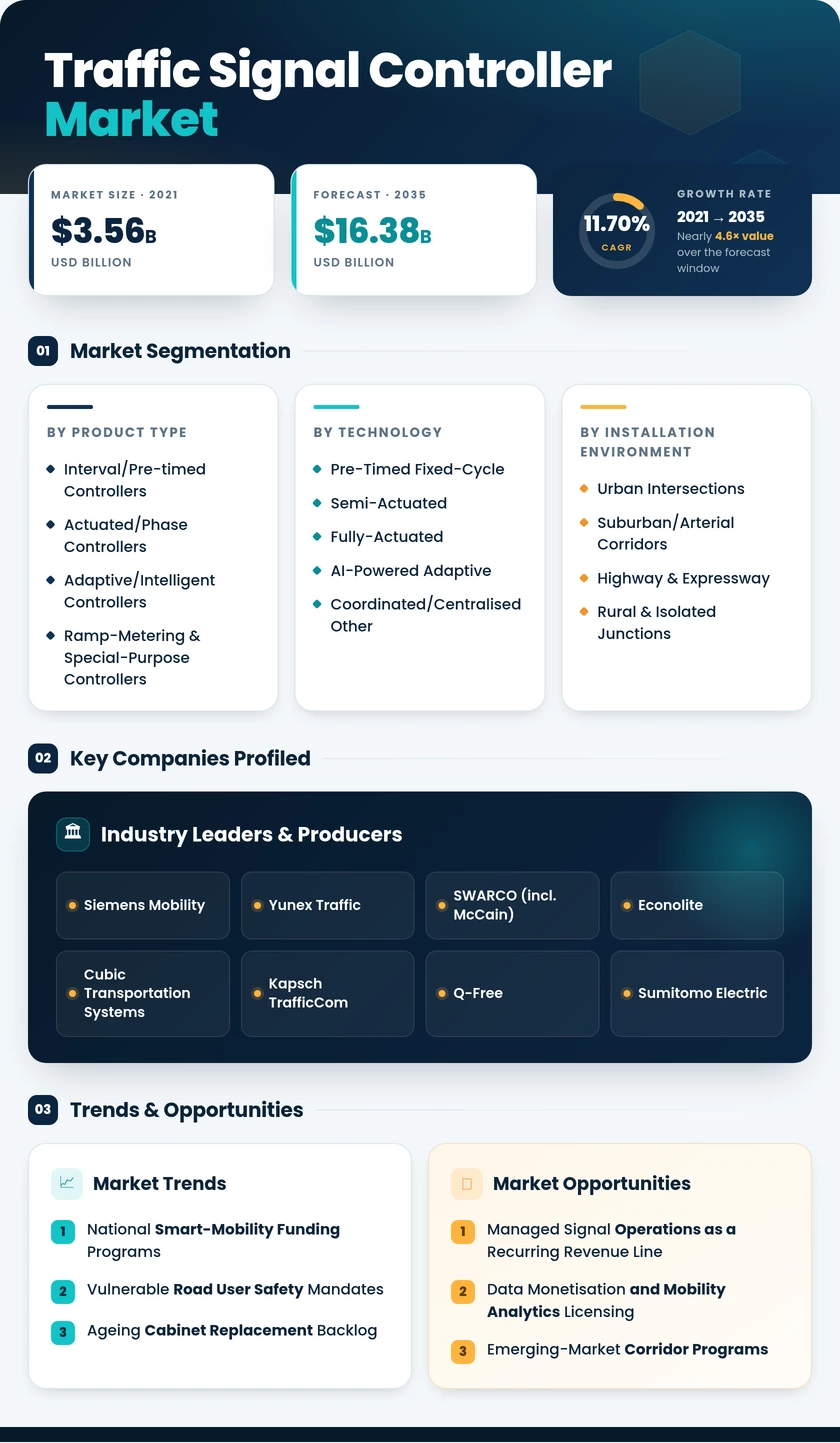
Segmentation Quick Reference
| Dimension | Sub-Segments | Dominant Segment | Fastest Growing Segment |
| By Product Type | Interval/Pre-timed Controllers; Actuated/Phase Controllers; Adaptive/Intelligent Controllers; Ramp-Metering & Special-Purpose Controllers | Actuated/Phase Controllers | Adaptive/Intelligent Controllers |
| By Technology | Pre-Timed Fixed-Cycle; Semi-Actuated; Fully-Actuated; AI-Powered Adaptive; Coordinated/Centralised Other | Fully-Actuated | AI-Powered Adaptive |
| By Installation Environment | Urban Intersections; Suburban/Arterial Corridors; Highway & Expressway; Rural & Isolated Junctions | Urban Intersections | Highway & Expressway |
| By Communication Interface | Wired; Wireless (RF/Mesh); Cellular-V2X; Hybrid/Other | Wired | Cellular-V2X |
| By End User | Municipal & City Traffic Agencies; State/National Highway Authorities; Smart-City Integrators; Private Campus & Industrial Operators | Municipal & City Traffic Agencies | Smart-City Integrators |
| By Geography | North America; Europe; Asia-Pacific; South America; Middle East & Africa | North America | Asia-Pacific |
Market Segmentation Overview
By Product Type
| Sub-Segment | Key Trend |
| Interval/Pre-timed Controllers | Steady decline as downtown grids convert to actuated operation |
| Actuated/Phase Controllers | Default arterial specification; ATC firmware migration underway |
| Adaptive/Intelligent Controllers | Retrofit modules lowering price barrier for mid-sized agencies |
| Ramp-Metering & Special-Purpose Controllers | Tied to managed-lane and freeway corridor programs |
Product-type demand splits along agency size. Large metropolitan authorities buy adaptive platforms outright, while smaller municipalities extend actuated hardware life through firmware upgrades and drop-in optimisation modules.
By Technology
| Sub-Segment | Key Trend |
| Pre-Timed Fixed-Cycle | Retained only where volumes are stable, and detection is impractical |
| Semi-Actuated | Common at minor-street intersections with light cross traffic |
| Fully-Actuated | Volume leader; benefits from falling detection sensor costs |
| AI-Powered Adaptive | Highest software content per intersection; edge inference emerging |
| Coordinated/Centralised Other | Regional network control layered above local controllers |
Technology migration follows detection availability more than budget. Once video or radar detection is installed, the incremental step from actuated to adaptive operation becomes a software decision rather than a capital project.
By Installation Environment
| Sub-Segment | Key Trend |
| Urban Intersections | Densest deployment base; pedestrian phase requirements rising |
| Suburban/Arterial Corridors | Coordination and green-wave programs drive replacement |
| Highway & Expressway | Ramp metering expansion in North America and Australia |
| Rural & Isolated Junctions | Safety-triggered upgrades with solar and battery backup |
Environment shapes specification more than any other dimension. Urban cabinets prioritise pedestrian and transit inputs; highway installations prioritise resilience, remote diagnostics, and integration with variable message systems.
By Communication Interface
| Sub-Segment | Key Trend |
| Wired | Preferred where conduit and fibre already exist |
| Wireless (RF/Mesh) | Avoids trenching cost in retrofit corridors |
| Cellular-V2X | Growth tied to connected-vehicle roadside unit rollout |
| Hybrid/Other | Phased migration path for multi-decade networks |
Interface choice is usually decided by civil cost, not technical preference. Agencies with existing fibre stay wired; those facing trenching quotes above USD 150 per metre move to wireless or cellular backhaul.
By End User
| Sub-Segment | Key Trend |
| Municipal & City Traffic Agencies | Own the majority of installed intersections globally |
| State/National Highway Authorities | Concentrated on freeway and corridor management |
| Smart-City Integrators | Absorbing procurement from understaffed agencies |
| Private Campus & Industrial Operators | Ports, airports, and large campuses adopting access control |
End-user mix is shifting quietly but consequentially. As integrators take on more turnkey city contracts, controller vendors increasingly sell through a systems partner rather than directly to the agency that operates the asset.


 Noah Malgeri
Co-Founder

 Peter Groot koerkamp
Account and Business Manager

 Younghwan Choi
Senior Retail Manager

 Mark Irwin
Management Consultant

 Akif Moroglu
Strategy & Business Development Director

 Guilherme Gomes Martins
Product Management Director

 Joseph Aguayo
Sales Operations & Pricing Manager

 La Terria Dodd
Program Support Specialist

 Rob Kooiker
Group Product Manager HVAC & Fire Protection GMA