
×
  • Cat-intel
  • MedIntelliX
  • Resources
  • About Us
  • Hero Background
    English
    Chinese
    French
    Japanese
    Korean
    German
    Spanish

    Logistic Software Market Share

    ID: MRFR/ICT/3011-HCR
    100 Pages
    Shubham Munde
    October 2025

    Logistic Software Market Research Report Information By Software Type (Warehouse Management, Labor Management, Transportation Management, and Data Management), By End User (Automotive, Government & Defense, Healthcare, Telecommunication and IT, Industrial, Engineering and Manufacturing, Oil & Gas, and Others), and By Region (North America, Europe, Asia-Pacific, and Rest Of The World) – ...

    Share:
    Download PDF ×

    We do not share your information with anyone. However, we may send you emails based on your report interest from time to time. You may contact us at any time to opt-out.

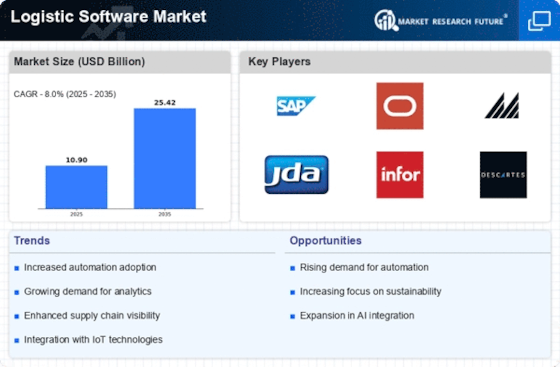
    Logistic Software Market Infographic
    Purchase Options

    Market Share

    Logistic Software Market Share Analysis

    In the dynamic landscape of the Logistic Software Market, market share positioning strategies play a pivotal role in determining the success of companies within this highly competitive industry. Companies operating in this sector employ a range of strategic approaches to secure and enhance their market share. One common strategy is differentiation, where companies focus on offering unique and innovative features that set their logistic software apart from competitors. This could include advanced analytics, real-time tracking capabilities, or customizable solutions tailored to specific industries. Another key strategy is cost leadership, wherein companies aim to provide logistic software solutions at a lower cost than competitors while maintaining a certain level of quality. This approach often involves economies of scale, efficient supply chain management, and strategic partnerships to reduce overall operational costs.

    By offering competitive pricing, companies can attract a broader customer base and gain a larger market share. Collaboration and partnerships are increasingly becoming a prevalent strategy in the Logistic Software Market. Companies seek strategic alliances with other businesses to enhance their software offerings, expand their market reach, and leverage each other's strengths. This collaborative approach enables companies to provide end-to-end solutions, incorporating various functionalities such as transportation management, inventory optimization, and supply chain visibility. Market segmentation is also a crucial aspect of market share positioning in the logistic software industry. Companies may focus on specific niches or industries, tailoring their solutions to meet the unique needs and challenges of those sectors. By concentrating efforts on a particular market segment, companies can establish themselves as experts in that domain and build a loyal customer base. Customer-centric strategies play a vital role in maintaining and expanding market share in the Logistic Software Market.

    Providing excellent customer support, regular updates, and user-friendly interfaces contribute to customer satisfaction and retention. Satisfied customers are more likely to become brand advocates, promoting the software within their networks and attracting new business. Innovation is a cornerstone of success in the Logistic Software Market, with companies constantly striving to stay ahead of the curve. The integration of emerging technologies, such as artificial intelligence, machine learning, and blockchain, into logistic software solutions can give companies a competitive edge. By offering cutting-edge features that address evolving industry needs, companies can attract new customers and retain existing ones. Global expansion is another avenue for companies seeking to enhance their market share positioning. With the increasing globalization of supply chains, logistic software providers are expanding their presence to serve customers in different regions. This involves adapting software to meet local regulations and specific market demands, ensuring a seamless experience for users across diverse geographical locations.


    Author
    Shubham Munde
    Research Analyst Level II

    With a technical background in information technology & semiconductors, Shubham has 4.5+ years of experience in market research and analytics with the tasks of data mining, analysis, and project execution. He is the POC for our clients, for their consulting projects running under the ICT/Semiconductor domain. Shubham holds a Bachelor’s in Information and Technology and a Master of Business Administration (MBA). Shubham has executed over 150 research projects for our clients under the brand name Market Research Future in the last 2 years. His core skill is building the research respondent relation for gathering the primary information from industry and market estimation for niche markets. He is having expertise in conducting secondary & primary research, market estimations, market projections, competitive analysis, analysing current market trends and market dynamics, deep-dive analysis on market scenarios, consumer behaviour, technological impact analysis, consulting, analytics, etc. He has worked on fortune 500 companies' syndicate and consulting projects along with several government projects. He has worked on the projects of top tech brands such as IBM, Google, Microsoft, AWS, Meta, Oracle, Cisco Systems, Samsung, Accenture, VMware, Schneider Electric, Dell, HP, Ericsson, and so many others. He has worked on Metaverse, Web 3.0, Zero-Trust security, cyber-security, blockchain, quantum computing, robotics, 5G technology, High-Performance computing, data centers, AI, automation, IT equipment, sensors, semiconductors, consumer electronics and so many tech domain projects.

    Leave a Comment

    FAQs

    How much is the Logistic Software market?

    The Logistic Software market size was valued at USD 10.4 Billion in 2023.

    What is the growth rate of the Logistic Software market?

    The market is projected to grow at a CAGR of 8.00% during the forecast period, 2024-2032.

    Which region held the largest market share in the Logistic Software market?

    Asia Pacific had the largest share in the market

    Who are the key players in the Logistic Software market?

    The key players in the market are Advantech Corporation, Digilogistics, UTI Worldwide Inc., Hexaware Technologies, IBM Corporation, JDA Software, Oracle, Samsung Electronics Co, SAP AG, and Tech Mahindra

    Which Software Type led the Logistic Software market?

    The Warehouse Management Software Types Software Type dominated the market in 2022.

    Which End User had the largest market share in the Logistic Software market?

    The Engineering and Manufacturing End User had the largest share in the market.

    Market Summary

    As per MRFR analysis, the Logistic Software Market Size was estimated at 10.9 USD Billion in 2024. The Logistic Software industry is projected to grow from 11.77 USD Billion in 2025 to 25.42 USD Billion by 2035, exhibiting a compound annual growth rate (CAGR) of 8.0 during the forecast period 2025 - 2035.

    Key Market Trends & Highlights

    The Logistic Software Market is experiencing a transformative shift towards automation and sustainability.

    • North America remains the largest market for logistic software, driven by advanced technological infrastructure.
    • The Asia-Pacific region is emerging as the fastest-growing market, fueled by rapid e-commerce expansion and digital transformation.
    • Warehouse Management continues to dominate the market, while Transportation Management is witnessing the highest growth rates.
    • Rising e-commerce demand and the integration of sustainability practices are key drivers propelling market growth.

    Market Size & Forecast

    2024 Market Size 10.9 (USD Billion)
    2035 Market Size 25.42 (USD Billion)
    CAGR (2025 - 2035) 8.0%
    Largest Regional Market Share in 2024 Asia Pacific

    Major Players

    <p>SAP (DE), Oracle (US), Manhattan Associates (US), JDA Software (US), Infor (US), Descartes Systems Group (CA), Cerasis (US), Kuebix (US), Softeon (US)</p>

    Market Trends

    The Logistic Software Market is currently experiencing a transformative phase, driven by advancements in technology and evolving consumer expectations. Companies are increasingly adopting sophisticated software solutions to enhance operational efficiency, streamline supply chain processes, and improve overall service delivery. This shift appears to be influenced by the growing demand for real-time data analytics, which enables organizations to make informed decisions swiftly. Furthermore, the integration of artificial intelligence and machine learning into logistic software is likely to optimize route planning and inventory management, thereby reducing costs and improving customer satisfaction. In addition, the emphasis on sustainability is becoming more pronounced within the Logistic Software Market. Businesses are recognizing the importance of minimizing their environmental impact, leading to the development of software that supports eco-friendly practices. This trend suggests a potential shift towards greener logistics solutions, which may include features for carbon footprint tracking and optimization of resource usage. As the market continues to evolve, it is essential for stakeholders to remain agile and responsive to these emerging trends, ensuring they leverage the latest innovations to maintain a competitive edge.

    Increased Automation

    The Logistic Software Market is witnessing a surge in automation technologies. Companies are implementing automated systems to handle repetitive tasks, which enhances productivity and reduces human error. This trend indicates a shift towards more efficient operations, allowing businesses to focus on strategic initiatives.

    Real-Time Data Utilization

    There is a growing emphasis on the use of real-time data within the Logistic Software Market. Organizations are leveraging data analytics to gain insights into supply chain dynamics, enabling them to respond promptly to market changes. This trend highlights the importance of agility in logistics management.

    Sustainability Initiatives

    Sustainability is becoming a focal point in the Logistic Software Market. Companies are increasingly seeking software solutions that facilitate eco-friendly practices, such as optimizing delivery routes to reduce emissions. This trend reflects a broader commitment to environmental responsibility in logistics operations.

    Logistic Software Market Market Drivers

    Regulatory Compliance

    The Logistic Software Market is significantly influenced by the need for regulatory compliance. As governments worldwide implement stricter regulations regarding transportation, safety, and environmental standards, logistics companies are compelled to adopt software solutions that ensure adherence to these regulations. In 2025, the logistics sector is expected to face increased scrutiny, with compliance costs potentially rising by 15 percent. Consequently, logistics software that offers features for tracking compliance and managing documentation is becoming essential. This necessity drives demand for innovative solutions within the Logistic Software Market, as companies strive to mitigate risks associated with non-compliance and enhance their operational integrity.

    Rising E-commerce Demand

    The Logistic Software Market is experiencing a notable surge due to the increasing demand for e-commerce solutions. As online shopping continues to gain traction, businesses are seeking efficient logistics software to manage their supply chains effectively. In 2025, the e-commerce sector is projected to reach a valuation of over 6 trillion USD, necessitating advanced logistics solutions to handle the complexities of order fulfillment, inventory management, and last-mile delivery. This trend is driving investments in logistics software, as companies aim to enhance their operational efficiency and customer satisfaction. The Logistic Software Market is thus positioned to benefit from this growing demand, as firms strive to optimize their logistics processes to meet the expectations of a rapidly evolving marketplace.

    Technological Advancements

    Technological advancements play a pivotal role in shaping the Logistic Software Market. Innovations such as artificial intelligence, machine learning, and the Internet of Things are transforming logistics operations. These technologies enable real-time tracking, predictive analytics, and automated decision-making, which enhance efficiency and reduce operational costs. In 2025, it is estimated that the adoption of AI in logistics could lead to a reduction in logistics costs by up to 30 percent. As companies increasingly recognize the value of integrating advanced technologies into their logistics operations, the demand for sophisticated logistics software is likely to rise. This trend indicates a robust growth trajectory for the Logistic Software Market, as businesses seek to leverage technology to gain a competitive edge.

    Focus on Supply Chain Resilience

    The Logistic Software Market is witnessing a heightened focus on supply chain resilience. Businesses are increasingly aware of the vulnerabilities within their supply chains and are seeking logistics software that can provide greater visibility and flexibility. In 2025, it is anticipated that companies will invest approximately 20 billion USD in technologies aimed at enhancing supply chain resilience. This investment reflects a shift towards proactive risk management and the need for adaptive logistics solutions. As organizations prioritize resilience, the demand for logistics software that can facilitate real-time monitoring, scenario planning, and agile response strategies is likely to grow. This trend underscores the evolving landscape of the Logistic Software Market, where adaptability becomes a key competitive advantage.

    Integration of Sustainability Practices

    The Logistic Software Market is increasingly influenced by the integration of sustainability practices. As environmental concerns gain prominence, logistics companies are seeking software solutions that support eco-friendly operations. In 2025, it is projected that the market for sustainable logistics solutions will reach 10 billion USD, driven by the need to reduce carbon footprints and enhance operational efficiency. Logistics software that enables route optimization, energy-efficient transportation, and waste reduction is becoming essential for companies aiming to meet sustainability goals. This trend not only reflects a growing commitment to environmental stewardship but also indicates a shift in consumer preferences towards sustainable practices. As a result, the Logistic Software Market is likely to see a surge in demand for solutions that align with these sustainability initiatives.

    Market Segment Insights

    Logistic Software: Software Type Insights

    <p>The Logistic Software market segmentation, based on Software Type, includes <a href="https://www.marketresearchfuture.com/reports/warehouse-management-system-market-2028">Warehouse Management</a>, Labor Management, Transportation Management, and Data Management. Warehouse management segment accounted for the largest revenue share in 2022. The day-to-day management of warehouses, distribution centres, and fulfilment centres is accomplished through the use of automated systems. Auditing, picking procedures, and inventory management are other components of these operations. Additionally, it lessens the paperwork and human errors that are made when picking and storing products manually in warehouses. Because of the time savings, service providers' staff members are more productive and efficient.</p>

    <p>These advantages will keep the WMS segment's market growth rising. Additionally, the WMS segment will increase the market more quickly than the transportation management segment.</p>

    <p>Figure 2: Logistic Software Market, by Software Type, 2022 &amp; 2032 (USD Billion)</p>

    Logistic Software End User Insights

    <p>The Logistic Software market segmentation, based on End User, includes Automotive, Government &amp; defense, Healthcare, Telecommunication and IT, Industrial, Engineering and manufacturing, Oil &amp; gas, and Others. Engineering and manufacturing segment dominated the Logistic Software market in 2022. The requirement for outsourcing inventory and raw materials has expanded as a result of the rising number of manufacturing facilities in developing nations like Mexico and India. For instance, the 'Make in India' effort of the Indian government places a great emphasis on the growth of the home manufacturing sector and may even stimulate indigenous production.</p>

    <p>Such activities are encouraging for the manufacturing segment's growth during the projection period.</p>

    Get more detailed insights about Logistic Software Market Research Report - Global Forecast 2035

    Regional Insights

    North America : Logistics Innovation Leader

    North America is the largest market for logistic software, holding approximately 45% of the global share. The region's growth is driven by advancements in technology, increasing e-commerce activities, and a strong regulatory framework that supports innovation. The demand for efficient supply chain management solutions is rising, fueled by the need for real-time tracking and data analytics. The United States is the leading country in this sector, with major players like Oracle, SAP, and Manhattan Associates headquartered here. The competitive landscape is characterized by continuous innovation and strategic partnerships among key players. Canada also plays a significant role, contributing to the market with its growing logistics sector and adoption of advanced software solutions.

    Europe : Emerging Logistics Powerhouse

    Europe is the second-largest market for logistic software, accounting for around 30% of the global market share. The region's growth is significantly influenced by sustainability initiatives and regulatory frameworks aimed at reducing carbon emissions. The European Union's Green Deal and various national policies are driving demand for efficient logistics solutions that comply with environmental standards. Leading countries include Germany, the UK, and France, where companies are increasingly adopting advanced logistic software to enhance operational efficiency. Key players like SAP and Infor are well-established in this market, fostering a competitive environment that encourages innovation and collaboration among logistics providers.

    Asia-Pacific : Rapidly Growing Market

    Asia-Pacific is witnessing rapid growth in the logistic software market, holding approximately 20% of the global share. The region's expansion is primarily driven by the booming e-commerce sector, increasing urbanization, and the need for efficient supply chain solutions. Countries like China and India are leading this growth, supported by favorable government policies and investments in infrastructure. China is the largest market in the region, with significant contributions from local players and international firms. The competitive landscape is evolving, with companies focusing on technology integration and customer-centric solutions. The presence of key players like JDA Software and Descartes Systems Group further enhances the market dynamics, fostering innovation and competition.

    Middle East and Africa : Emerging Logistics Frontier

    The Middle East and Africa region is emerging as a significant player in the logistic software market, holding about 5% of the global share. Growth is driven by substantial investments in infrastructure and logistics capabilities, particularly in countries like the UAE and South Africa. The region is witnessing a shift towards digital solutions to enhance supply chain efficiency and meet the demands of a growing consumer base. The competitive landscape is characterized by a mix of local and international players, with companies increasingly adopting advanced logistic software to streamline operations. The presence of key players is growing, and government initiatives are supporting the development of logistics hubs, further enhancing market potential.

    Key Players and Competitive Insights

    Leading market players are investing heavily in research and development in order to expand their product lines, which will help the Logistic Software market, grow even more. Market participants are also undertaking a variety of strategic activities to expand their footprint, with important market developments including new product launches, contractual agreements, mergers and acquisitions, higher investments, and collaboration with other organizations. To expand and survive in a more competitive and rising market climate, Logistic Software industry must offer cost-effective items.

    Manufacturing locally to minimize operational costs is one of the key business tactics used by manufacturers in the Logistic Software industry to benefit clients and increase the market sector. In recent years, the Logistic Software industry has offered some of the most significant advantages to medicine. Major players in the Logistic Software market, including Advantech Corporation, Digilogistics, UTI Worldwide Inc., Hexaware Technologies, IBM Corporation, JDA Software, Oracle, Samsung Electronics Co, SAP AG, and Tech Mahindra, are attempting to increase market demand by investing in research and development operations.

    Enterprise software and services are offered by Infor Inc (Infor). A variety of corporate business software products and solutions are available from the company, including cloud suite, supply chain management, human resource management, enterprise asset management, and customer relationship management. Additional services include advising, deployment, managed, and client support. Education services like transformation and training services are among Infor's other offerings. It benefits the automotive, chemical, distribution, fashion, financial services, food and beverage, manufacturing, and healthcare industries in addition to aerospace and defence. Asia-Pacific, Europe, and the Americas are the company's operating regions.

    The US city of New York City serves as the headquarters of Infor. To develop a supply chain solution, Infor Inc. teamed up with DB Schenker, a supplier of supply chain management and logistics solutions, in February 2022.

    A transport management system created by MercuryGate International is intended to leverage the speed of automation and the strength of data. The business provides all-inclusive logistics solutions that specifically target all customer groups, including shippers, third-party logistics providers (3PLs), freight forwarders, freight brokers, and carriers. As a result, shipping and inventory costs are reduced, order-to-delivery cycle times are sped up, and the automated movement of goods throughout the supply chain is made possible. MercuryGate International, Inc. improved its TMS solution in February 2022 by incorporating smart transportation capabilities like integrated analytics, artificial intelligence, and machine learning.

    Key Companies in the Logistic Software Market market include

    Industry Developments

    February 2022: To help businesses increase efficiency and generate value throughout their supply chains, Oracle Corp. recently announced the addition of new logistics management tools to Oracle Fusion Cloud Supply Chain & Manufacturing (SCM).

    Future Outlook

    Logistic Software Market Future Outlook

    <p>The Logistic Software Market is projected to grow at an 8.0% CAGR from 2024 to 2035, driven by automation, data analytics, and demand for real-time tracking.</p>

    New opportunities lie in:

    • <p>Integration of AI-driven predictive analytics for supply chain optimization.</p>
    • <p>Development of blockchain-based solutions for enhanced transparency.</p>
    • <p>Expansion of cloud-based logistics platforms for scalability and flexibility.</p>

    <p>By 2035, the market is expected to be robust, driven by technological advancements and increased demand for efficiency.</p>

    Market Segmentation

    Logistic Software End User Outlook

    • Automotive
    • Government & defense
    • Healthcare
    • Telecommunication and IT
    • Industrial
    • Engineering and manufacturing
    • Oil & gas
    • Others

    Logistic Software Regional Outlook

    North America
    • US
    • Canada

    Logistic Software: Software Type Outlook

    • Warehouse Management
    • Labor Management
    • Transportation Management
    • Data Management

    Report Scope

    MARKET SIZE 202410.9(USD Billion)
    MARKET SIZE 202511.77(USD Billion)
    MARKET SIZE 203525.42(USD Billion)
    COMPOUND ANNUAL GROWTH RATE (CAGR)8.0% (2024 - 2035)
    REPORT COVERAGERevenue Forecast, Competitive Landscape, Growth Factors, and Trends
    BASE YEAR2024
    Market Forecast Period2025 - 2035
    Historical Data2019 - 2024
    Market Forecast UnitsUSD Billion
    Key Companies ProfiledMarket analysis in progress
    Segments CoveredMarket segmentation analysis in progress
    Key Market OpportunitiesIntegration of artificial intelligence and machine learning enhances efficiency in the Logistic Software Market.
    Key Market DynamicsRising demand for automation and real-time tracking drives innovation in the Logistic Software Market.
    Countries CoveredNorth America, Europe, APAC, South America, MEA

    FAQs

    How much is the Logistic Software market?

    The Logistic Software market size was valued at USD 10.4 Billion in 2023.

    What is the growth rate of the Logistic Software market?

    The market is projected to grow at a CAGR of 8.00% during the forecast period, 2024-2032.

    Which region held the largest market share in the Logistic Software market?

    Asia Pacific had the largest share in the market

    Who are the key players in the Logistic Software market?

    The key players in the market are Advantech Corporation, Digilogistics, UTI Worldwide Inc., Hexaware Technologies, IBM Corporation, JDA Software, Oracle, Samsung Electronics Co, SAP AG, and Tech Mahindra

    Which Software Type led the Logistic Software market?

    The Warehouse Management Software Types Software Type dominated the market in 2022.

    Which End User had the largest market share in the Logistic Software market?

    The Engineering and Manufacturing End User had the largest share in the market.

    1. SECTION I: EXECUTIVE SUMMARY AND KEY HIGHLIGHTS
      1. | 1.1 EXECUTIVE SUMMARY
      2. | | 1.1.1 Market Overview
      3. | | 1.1.2 Key Findings
      4. | | 1.1.3 Market Segmentation
      5. | | 1.1.4 Competitive Landscape
      6. | | 1.1.5 Challenges and Opportunities
      7. | | 1.1.6 Future Outlook
    2. SECTION II: SCOPING, METHODOLOGY AND MARKET STRUCTURE
      1. | 2.1 MARKET INTRODUCTION
      2. | | 2.1.1 Definition
      3. | | 2.1.2 Scope of the study
      4. | | | 2.1.2.1 Research Objective
      5. | | | 2.1.2.2 Assumption
      6. | | | 2.1.2.3 Limitations
      7. | 2.2 RESEARCH METHODOLOGY
      8. | | 2.2.1 Overview
      9. | | 2.2.2 Data Mining
      10. | | 2.2.3 Secondary Research
      11. | | 2.2.4 Primary Research
      12. | | | 2.2.4.1 Primary Interviews and Information Gathering Process
      13. | | | 2.2.4.2 Breakdown of Primary Respondents
      14. | | 2.2.5 Forecasting Model
      15. | | 2.2.6 Market Size Estimation
      16. | | | 2.2.6.1 Bottom-Up Approach
      17. | | | 2.2.6.2 Top-Down Approach
      18. | | 2.2.7 Data Triangulation
      19. | | 2.2.8 Validation
    3. SECTION III: QUALITATIVE ANALYSIS
      1. | 3.1 MARKET DYNAMICS
      2. | | 3.1.1 Overview
      3. | | 3.1.2 Drivers
      4. | | 3.1.3 Restraints
      5. | | 3.1.4 Opportunities
      6. | 3.2 MARKET FACTOR ANALYSIS
      7. | | 3.2.1 Value chain Analysis
      8. | | 3.2.2 Porter's Five Forces Analysis
      9. | | | 3.2.2.1 Bargaining Power of Suppliers
      10. | | | 3.2.2.2 Bargaining Power of Buyers
      11. | | | 3.2.2.3 Threat of New Entrants
      12. | | | 3.2.2.4 Threat of Substitutes
      13. | | | 3.2.2.5 Intensity of Rivalry
      14. | | 3.2.3 COVID-19 Impact Analysis
      15. | | | 3.2.3.1 Market Impact Analysis
      16. | | | 3.2.3.2 Regional Impact
      17. | | | 3.2.3.3 Opportunity and Threat Analysis
    4. SECTION IV: QUANTITATIVE ANALYSIS
      1. | 4.1 Information and Communications Technology, BY Software Type (USD Billion)
      2. | | 4.1.1 Warehouse Management
      3. | | 4.1.2 Labor Management
      4. | | 4.1.3 Transportation Management
      5. | | 4.1.4 Data Management
      6. | 4.2 Information and Communications Technology, BY End User (USD Billion)
      7. | | 4.2.1 Automotive
      8. | | 4.2.2 Government & defense
      9. | | 4.2.3 Healthcare
      10. | | 4.2.4 Telecommunication and IT
      11. | | 4.2.5 Industrial
      12. | | 4.2.6 Engineering and manufacturing
      13. | | 4.2.7 Oil & gas
      14. | | 4.2.8 Others
      15. | 4.3 Information and Communications Technology, BY Region (USD Billion)
      16. | | 4.3.1 North America
      17. | | | 4.3.1.1 US
      18. | | | 4.3.1.2 Canada
      19. | | 4.3.2 Europe
      20. | | | 4.3.2.1 Germany
      21. | | | 4.3.2.2 UK
      22. | | | 4.3.2.3 France
      23. | | | 4.3.2.4 Russia
      24. | | | 4.3.2.5 Italy
      25. | | | 4.3.2.6 Spain
      26. | | | 4.3.2.7 Rest of Europe
      27. | | 4.3.3 APAC
      28. | | | 4.3.3.1 China
      29. | | | 4.3.3.2 India
      30. | | | 4.3.3.3 Japan
      31. | | | 4.3.3.4 South Korea
      32. | | | 4.3.3.5 Malaysia
      33. | | | 4.3.3.6 Thailand
      34. | | | 4.3.3.7 Indonesia
      35. | | | 4.3.3.8 Rest of APAC
      36. | | 4.3.4 South America
      37. | | | 4.3.4.1 Brazil
      38. | | | 4.3.4.2 Mexico
      39. | | | 4.3.4.3 Argentina
      40. | | | 4.3.4.4 Rest of South America
      41. | | 4.3.5 MEA
      42. | | | 4.3.5.1 GCC Countries
      43. | | | 4.3.5.2 South Africa
      44. | | | 4.3.5.3 Rest of MEA
    5. SECTION V: COMPETITIVE ANALYSIS
      1. | 5.1 Competitive Landscape
      2. | | 5.1.1 Overview
      3. | | 5.1.2 Competitive Analysis
      4. | | 5.1.3 Market share Analysis
      5. | | 5.1.4 Major Growth Strategy in the Information and Communications Technology
      6. | | 5.1.5 Competitive Benchmarking
      7. | | 5.1.6 Leading Players in Terms of Number of Developments in the Information and Communications Technology
      8. | | 5.1.7 Key developments and growth strategies
      9. | | | 5.1.7.1 New Product Launch/Service Deployment
      10. | | | 5.1.7.2 Merger & Acquisitions
      11. | | | 5.1.7.3 Joint Ventures
      12. | | 5.1.8 Major Players Financial Matrix
      13. | | | 5.1.8.1 Sales and Operating Income
      14. | | | 5.1.8.2 Major Players R&D Expenditure. 2023
      15. | 5.2 Company Profiles
      16. | | 5.2.1 SAP (DE)
      17. | | | 5.2.1.1 Financial Overview
      18. | | | 5.2.1.2 Products Offered
      19. | | | 5.2.1.3 Key Developments
      20. | | | 5.2.1.4 SWOT Analysis
      21. | | | 5.2.1.5 Key Strategies
      22. | | 5.2.2 Oracle (US)
      23. | | | 5.2.2.1 Financial Overview
      24. | | | 5.2.2.2 Products Offered
      25. | | | 5.2.2.3 Key Developments
      26. | | | 5.2.2.4 SWOT Analysis
      27. | | | 5.2.2.5 Key Strategies
      28. | | 5.2.3 Manhattan Associates (US)
      29. | | | 5.2.3.1 Financial Overview
      30. | | | 5.2.3.2 Products Offered
      31. | | | 5.2.3.3 Key Developments
      32. | | | 5.2.3.4 SWOT Analysis
      33. | | | 5.2.3.5 Key Strategies
      34. | | 5.2.4 JDA Software (US)
      35. | | | 5.2.4.1 Financial Overview
      36. | | | 5.2.4.2 Products Offered
      37. | | | 5.2.4.3 Key Developments
      38. | | | 5.2.4.4 SWOT Analysis
      39. | | | 5.2.4.5 Key Strategies
      40. | | 5.2.5 Infor (US)
      41. | | | 5.2.5.1 Financial Overview
      42. | | | 5.2.5.2 Products Offered
      43. | | | 5.2.5.3 Key Developments
      44. | | | 5.2.5.4 SWOT Analysis
      45. | | | 5.2.5.5 Key Strategies
      46. | | 5.2.6 Descartes Systems Group (CA)
      47. | | | 5.2.6.1 Financial Overview
      48. | | | 5.2.6.2 Products Offered
      49. | | | 5.2.6.3 Key Developments
      50. | | | 5.2.6.4 SWOT Analysis
      51. | | | 5.2.6.5 Key Strategies
      52. | | 5.2.7 Cerasis (US)
      53. | | | 5.2.7.1 Financial Overview
      54. | | | 5.2.7.2 Products Offered
      55. | | | 5.2.7.3 Key Developments
      56. | | | 5.2.7.4 SWOT Analysis
      57. | | | 5.2.7.5 Key Strategies
      58. | | 5.2.8 Kuebix (US)
      59. | | | 5.2.8.1 Financial Overview
      60. | | | 5.2.8.2 Products Offered
      61. | | | 5.2.8.3 Key Developments
      62. | | | 5.2.8.4 SWOT Analysis
      63. | | | 5.2.8.5 Key Strategies
      64. | | 5.2.9 Softeon (US)
      65. | | | 5.2.9.1 Financial Overview
      66. | | | 5.2.9.2 Products Offered
      67. | | | 5.2.9.3 Key Developments
      68. | | | 5.2.9.4 SWOT Analysis
      69. | | | 5.2.9.5 Key Strategies
      70. | 5.3 Appendix
      71. | | 5.3.1 References
      72. | | 5.3.2 Related Reports
    6. LIST OF FIGURES
      1. | 6.1 MARKET SYNOPSIS
      2. | 6.2 NORTH AMERICA MARKET ANALYSIS
      3. | 6.3 US MARKET ANALYSIS BY SOFTWARE TYPE
      4. | 6.4 US MARKET ANALYSIS BY END USER
      5. | 6.5 CANADA MARKET ANALYSIS BY SOFTWARE TYPE
      6. | 6.6 CANADA MARKET ANALYSIS BY END USER
      7. | 6.7 EUROPE MARKET ANALYSIS
      8. | 6.8 GERMANY MARKET ANALYSIS BY SOFTWARE TYPE
      9. | 6.9 GERMANY MARKET ANALYSIS BY END USER
      10. | 6.10 UK MARKET ANALYSIS BY SOFTWARE TYPE
      11. | 6.11 UK MARKET ANALYSIS BY END USER
      12. | 6.12 FRANCE MARKET ANALYSIS BY SOFTWARE TYPE
      13. | 6.13 FRANCE MARKET ANALYSIS BY END USER
      14. | 6.14 RUSSIA MARKET ANALYSIS BY SOFTWARE TYPE
      15. | 6.15 RUSSIA MARKET ANALYSIS BY END USER
      16. | 6.16 ITALY MARKET ANALYSIS BY SOFTWARE TYPE
      17. | 6.17 ITALY MARKET ANALYSIS BY END USER
      18. | 6.18 SPAIN MARKET ANALYSIS BY SOFTWARE TYPE
      19. | 6.19 SPAIN MARKET ANALYSIS BY END USER
      20. | 6.20 REST OF EUROPE MARKET ANALYSIS BY SOFTWARE TYPE
      21. | 6.21 REST OF EUROPE MARKET ANALYSIS BY END USER
      22. | 6.22 APAC MARKET ANALYSIS
      23. | 6.23 CHINA MARKET ANALYSIS BY SOFTWARE TYPE
      24. | 6.24 CHINA MARKET ANALYSIS BY END USER
      25. | 6.25 INDIA MARKET ANALYSIS BY SOFTWARE TYPE
      26. | 6.26 INDIA MARKET ANALYSIS BY END USER
      27. | 6.27 JAPAN MARKET ANALYSIS BY SOFTWARE TYPE
      28. | 6.28 JAPAN MARKET ANALYSIS BY END USER
      29. | 6.29 SOUTH KOREA MARKET ANALYSIS BY SOFTWARE TYPE
      30. | 6.30 SOUTH KOREA MARKET ANALYSIS BY END USER
      31. | 6.31 MALAYSIA MARKET ANALYSIS BY SOFTWARE TYPE
      32. | 6.32 MALAYSIA MARKET ANALYSIS BY END USER
      33. | 6.33 THAILAND MARKET ANALYSIS BY SOFTWARE TYPE
      34. | 6.34 THAILAND MARKET ANALYSIS BY END USER
      35. | 6.35 INDONESIA MARKET ANALYSIS BY SOFTWARE TYPE
      36. | 6.36 INDONESIA MARKET ANALYSIS BY END USER
      37. | 6.37 REST OF APAC MARKET ANALYSIS BY SOFTWARE TYPE
      38. | 6.38 REST OF APAC MARKET ANALYSIS BY END USER
      39. | 6.39 SOUTH AMERICA MARKET ANALYSIS
      40. | 6.40 BRAZIL MARKET ANALYSIS BY SOFTWARE TYPE
      41. | 6.41 BRAZIL MARKET ANALYSIS BY END USER
      42. | 6.42 MEXICO MARKET ANALYSIS BY SOFTWARE TYPE
      43. | 6.43 MEXICO MARKET ANALYSIS BY END USER
      44. | 6.44 ARGENTINA MARKET ANALYSIS BY SOFTWARE TYPE
      45. | 6.45 ARGENTINA MARKET ANALYSIS BY END USER
      46. | 6.46 REST OF SOUTH AMERICA MARKET ANALYSIS BY SOFTWARE TYPE
      47. | 6.47 REST OF SOUTH AMERICA MARKET ANALYSIS BY END USER
      48. | 6.48 MEA MARKET ANALYSIS
      49. | 6.49 GCC COUNTRIES MARKET ANALYSIS BY SOFTWARE TYPE
      50. | 6.50 GCC COUNTRIES MARKET ANALYSIS BY END USER
      51. | 6.51 SOUTH AFRICA MARKET ANALYSIS BY SOFTWARE TYPE
      52. | 6.52 SOUTH AFRICA MARKET ANALYSIS BY END USER
      53. | 6.53 REST OF MEA MARKET ANALYSIS BY SOFTWARE TYPE
      54. | 6.54 REST OF MEA MARKET ANALYSIS BY END USER
      55. | 6.55 KEY BUYING CRITERIA OF INFORMATION AND COMMUNICATIONS TECHNOLOGY
      56. | 6.56 RESEARCH PROCESS OF MRFR
      57. | 6.57 DRO ANALYSIS OF INFORMATION AND COMMUNICATIONS TECHNOLOGY
      58. | 6.58 DRIVERS IMPACT ANALYSIS: INFORMATION AND COMMUNICATIONS TECHNOLOGY
      59. | 6.59 RESTRAINTS IMPACT ANALYSIS: INFORMATION AND COMMUNICATIONS TECHNOLOGY
      60. | 6.60 SUPPLY / VALUE CHAIN: INFORMATION AND COMMUNICATIONS TECHNOLOGY
      61. | 6.61 INFORMATION AND COMMUNICATIONS TECHNOLOGY, BY SOFTWARE TYPE, 2024 (% SHARE)
      62. | 6.62 INFORMATION AND COMMUNICATIONS TECHNOLOGY, BY SOFTWARE TYPE, 2024 TO 2035 (USD Billion)
      63. | 6.63 INFORMATION AND COMMUNICATIONS TECHNOLOGY, BY END USER, 2024 (% SHARE)
      64. | 6.64 INFORMATION AND COMMUNICATIONS TECHNOLOGY, BY END USER, 2024 TO 2035 (USD Billion)
      65. | 6.65 BENCHMARKING OF MAJOR COMPETITORS
    7. LIST OF TABLES
      1. | 7.1 LIST OF ASSUMPTIONS
      2. | | 7.1.1
      3. | 7.2 North America MARKET SIZE ESTIMATES; FORECAST
      4. | | 7.2.1 BY SOFTWARE TYPE, 2025-2035 (USD Billion)
      5. | | 7.2.2 BY END USER, 2025-2035 (USD Billion)
      6. | 7.3 US MARKET SIZE ESTIMATES; FORECAST
      7. | | 7.3.1 BY SOFTWARE TYPE, 2025-2035 (USD Billion)
      8. | | 7.3.2 BY END USER, 2025-2035 (USD Billion)
      9. | 7.4 Canada MARKET SIZE ESTIMATES; FORECAST
      10. | | 7.4.1 BY SOFTWARE TYPE, 2025-2035 (USD Billion)
      11. | | 7.4.2 BY END USER, 2025-2035 (USD Billion)
      12. | 7.5 Europe MARKET SIZE ESTIMATES; FORECAST
      13. | | 7.5.1 BY SOFTWARE TYPE, 2025-2035 (USD Billion)
      14. | | 7.5.2 BY END USER, 2025-2035 (USD Billion)
      15. | 7.6 Germany MARKET SIZE ESTIMATES; FORECAST
      16. | | 7.6.1 BY SOFTWARE TYPE, 2025-2035 (USD Billion)
      17. | | 7.6.2 BY END USER, 2025-2035 (USD Billion)
      18. | 7.7 UK MARKET SIZE ESTIMATES; FORECAST
      19. | | 7.7.1 BY SOFTWARE TYPE, 2025-2035 (USD Billion)
      20. | | 7.7.2 BY END USER, 2025-2035 (USD Billion)
      21. | 7.8 France MARKET SIZE ESTIMATES; FORECAST
      22. | | 7.8.1 BY SOFTWARE TYPE, 2025-2035 (USD Billion)
      23. | | 7.8.2 BY END USER, 2025-2035 (USD Billion)
      24. | 7.9 Russia MARKET SIZE ESTIMATES; FORECAST
      25. | | 7.9.1 BY SOFTWARE TYPE, 2025-2035 (USD Billion)
      26. | | 7.9.2 BY END USER, 2025-2035 (USD Billion)
      27. | 7.10 Italy MARKET SIZE ESTIMATES; FORECAST
      28. | | 7.10.1 BY SOFTWARE TYPE, 2025-2035 (USD Billion)
      29. | | 7.10.2 BY END USER, 2025-2035 (USD Billion)
      30. | 7.11 Spain MARKET SIZE ESTIMATES; FORECAST
      31. | | 7.11.1 BY SOFTWARE TYPE, 2025-2035 (USD Billion)
      32. | | 7.11.2 BY END USER, 2025-2035 (USD Billion)
      33. | 7.12 Rest of Europe MARKET SIZE ESTIMATES; FORECAST
      34. | | 7.12.1 BY SOFTWARE TYPE, 2025-2035 (USD Billion)
      35. | | 7.12.2 BY END USER, 2025-2035 (USD Billion)
      36. | 7.13 APAC MARKET SIZE ESTIMATES; FORECAST
      37. | | 7.13.1 BY SOFTWARE TYPE, 2025-2035 (USD Billion)
      38. | | 7.13.2 BY END USER, 2025-2035 (USD Billion)
      39. | 7.14 China MARKET SIZE ESTIMATES; FORECAST
      40. | | 7.14.1 BY SOFTWARE TYPE, 2025-2035 (USD Billion)
      41. | | 7.14.2 BY END USER, 2025-2035 (USD Billion)
      42. | 7.15 India MARKET SIZE ESTIMATES; FORECAST
      43. | | 7.15.1 BY SOFTWARE TYPE, 2025-2035 (USD Billion)
      44. | | 7.15.2 BY END USER, 2025-2035 (USD Billion)
      45. | 7.16 Japan MARKET SIZE ESTIMATES; FORECAST
      46. | | 7.16.1 BY SOFTWARE TYPE, 2025-2035 (USD Billion)
      47. | | 7.16.2 BY END USER, 2025-2035 (USD Billion)
      48. | 7.17 South Korea MARKET SIZE ESTIMATES; FORECAST
      49. | | 7.17.1 BY SOFTWARE TYPE, 2025-2035 (USD Billion)
      50. | | 7.17.2 BY END USER, 2025-2035 (USD Billion)
      51. | 7.18 Malaysia MARKET SIZE ESTIMATES; FORECAST
      52. | | 7.18.1 BY SOFTWARE TYPE, 2025-2035 (USD Billion)
      53. | | 7.18.2 BY END USER, 2025-2035 (USD Billion)
      54. | 7.19 Thailand MARKET SIZE ESTIMATES; FORECAST
      55. | | 7.19.1 BY SOFTWARE TYPE, 2025-2035 (USD Billion)
      56. | | 7.19.2 BY END USER, 2025-2035 (USD Billion)
      57. | 7.20 Indonesia MARKET SIZE ESTIMATES; FORECAST
      58. | | 7.20.1 BY SOFTWARE TYPE, 2025-2035 (USD Billion)
      59. | | 7.20.2 BY END USER, 2025-2035 (USD Billion)
      60. | 7.21 Rest of APAC MARKET SIZE ESTIMATES; FORECAST
      61. | | 7.21.1 BY SOFTWARE TYPE, 2025-2035 (USD Billion)
      62. | | 7.21.2 BY END USER, 2025-2035 (USD Billion)
      63. | 7.22 South America MARKET SIZE ESTIMATES; FORECAST
      64. | | 7.22.1 BY SOFTWARE TYPE, 2025-2035 (USD Billion)
      65. | | 7.22.2 BY END USER, 2025-2035 (USD Billion)
      66. | 7.23 Brazil MARKET SIZE ESTIMATES; FORECAST
      67. | | 7.23.1 BY SOFTWARE TYPE, 2025-2035 (USD Billion)
      68. | | 7.23.2 BY END USER, 2025-2035 (USD Billion)
      69. | 7.24 Mexico MARKET SIZE ESTIMATES; FORECAST
      70. | | 7.24.1 BY SOFTWARE TYPE, 2025-2035 (USD Billion)
      71. | | 7.24.2 BY END USER, 2025-2035 (USD Billion)
      72. | 7.25 Argentina MARKET SIZE ESTIMATES; FORECAST
      73. | | 7.25.1 BY SOFTWARE TYPE, 2025-2035 (USD Billion)
      74. | | 7.25.2 BY END USER, 2025-2035 (USD Billion)
      75. | 7.26 Rest of South America MARKET SIZE ESTIMATES; FORECAST
      76. | | 7.26.1 BY SOFTWARE TYPE, 2025-2035 (USD Billion)
      77. | | 7.26.2 BY END USER, 2025-2035 (USD Billion)
      78. | 7.27 MEA MARKET SIZE ESTIMATES; FORECAST
      79. | | 7.27.1 BY SOFTWARE TYPE, 2025-2035 (USD Billion)
      80. | | 7.27.2 BY END USER, 2025-2035 (USD Billion)
      81. | 7.28 GCC Countries MARKET SIZE ESTIMATES; FORECAST
      82. | | 7.28.1 BY SOFTWARE TYPE, 2025-2035 (USD Billion)
      83. | | 7.28.2 BY END USER, 2025-2035 (USD Billion)
      84. | 7.29 South Africa MARKET SIZE ESTIMATES; FORECAST
      85. | | 7.29.1 BY SOFTWARE TYPE, 2025-2035 (USD Billion)
      86. | | 7.29.2 BY END USER, 2025-2035 (USD Billion)
      87. | 7.30 Rest of MEA MARKET SIZE ESTIMATES; FORECAST
      88. | | 7.30.1 BY SOFTWARE TYPE, 2025-2035 (USD Billion)
      89. | | 7.30.2 BY END USER, 2025-2035 (USD Billion)
      90. | 7.31 PRODUCT LAUNCH/PRODUCT DEVELOPMENT/APPROVAL
      91. | | 7.31.1
      92. | 7.32 ACQUISITION/PARTNERSHIP
      93. | | 7.32.1

    Logistic Software Market Segmentation

    Logistic Software Market Software Type Outlook (USD Billion, 2018-2032)

    Warehouse Management

    Labor Management

    Transportation Management

    Data Management

    Logistic Software Market End User Outlook (USD Billion, 2018-2032)

    Automotive

    Government & defense

    Healthcare

    Telecommunication and IT

    Industrial

    Engineering and manufacturing

    Oil & gas

    Others

    Logistic Software Market Regional Outlook (USD Billion, 2018-2032)

    North America Outlook (USD Billion, 2018-2032)

    Logistic Software Market by Software Type

    Warehouse Management

    Labor Management

    Transportation Management

    Data Management

    Logistic Software Market by End User

    Automotive

    Government & defense

    Healthcare

    Telecommunication and IT

    Industrial

    Engineering and manufacturing

    Oil & gas

    Others

    US Outlook (USD Billion, 2018-2032)

    Logistic Software Market by Software Type

    Warehouse Management

    Labor Management

    Transportation Management

    Data Management

    Logistic Software Market by End User

    Automotive

    Government & defense

    Healthcare

    Telecommunication and IT

    Industrial

    Engineering and manufacturing

    Oil & gas

    Others

    Canada Outlook (USD Billion, 2018-2032)

    Logistic Software Market by Software Type

    Warehouse Management

    Labor Management

    Transportation Management

    Data Management

    Logistic Software Market by End User

    Automotive

    Government & defense

    Healthcare

    Telecommunication and IT

    Industrial

    Engineering and manufacturing

    Oil & gas

    Others

    Europe Outlook (USD Billion, 2018-2032)

    Logistic Software Market by Software Type

    Warehouse Management

    Labor Management

    Transportation Management

    Data Management

    Logistic Software Market by End User

    Automotive

    Government & defense

    Healthcare

    Telecommunication and IT

    Industrial

    Engineering and manufacturing

    Oil & gas

    Others

    Germany Outlook (USD Billion, 2018-2032)

    Logistic Software Market by Software Type

    Warehouse Management

    Labor Management

    Transportation Management

    Data Management

    Logistic Software Market by End User

    Automotive

    Government & defense

    Healthcare

    Telecommunication and IT

    Industrial

    Engineering and manufacturing

    Oil & gas

    Others

    France Outlook (USD Billion, 2018-2032)

    Logistic Software Market by Software Type

    Warehouse Management

    Labor Management

    Transportation Management

    Data Management

    Logistic Software Market by End User

    Automotive

    Government & defense

    Healthcare

    Telecommunication and IT

    Industrial

    Engineering and manufacturing

    Oil & gas

    Others

    UK Outlook (USD Billion, 2018-2032)

    Logistic Software Market by Software Type

    Warehouse Management

    Labor Management

    Transportation Management

    Data Management

    Logistic Software Market by End User

    Automotive

    Government & defense

    Healthcare

    Telecommunication and IT

    Industrial

    Engineering and manufacturing

    Oil & gas

    Others

    Italy Outlook (USD Billion, 2018-2032)

    Logistic Software Market by Software Type

    Warehouse Management

    Labor Management

    Transportation Management

    Data Management

    Logistic Software Market by End User

    Automotive

    Government & defense

    Healthcare

    Telecommunication and IT

    Industrial

    Engineering and manufacturing

    Oil & gas

    Others

    Spain Outlook (USD Billion, 2018-2032)

    Logistic Software Market by Software Type

    Warehouse Management

    Labor Management

    Transportation Management

    Data Management

    Logistic Software Market by End User

    Automotive

    Government & defense

    Healthcare

    Telecommunication and IT

    Industrial

    Engineering and manufacturing

    Oil & gas

    Others

    Rest Of Europe Outlook (USD Billion, 2018-2032)

    Logistic Software Market by Software Type

    Warehouse Management

    Labor Management

    Transportation Management

    Data Management

    Logistic Software Market by End User

    Automotive

    Government & defense

    Healthcare

    Telecommunication and IT

    Industrial

    Engineering and manufacturing

    Oil & gas

    Others

    Asia-Pacific Outlook (USD Billion, 2018-2032)

    Logistic Software Market by Software Type

    Warehouse Management

    Labor Management

    Transportation Management

    Data Management

    Logistic Software Market by End User

    Automotive

    Government & defense

    Healthcare

    Telecommunication and IT

    Industrial

    Engineering and manufacturing

    Oil & gas

    Others

    China Outlook (USD Billion, 2018-2032)

    Logistic Software Market by Software Type

    Warehouse Management

    Labor Management

    Transportation Management

    Data Management

    Logistic Software Market by End User

    Automotive

    Government & defense

    Healthcare

    Telecommunication and IT

    Industrial

    Engineering and manufacturing

    Oil & gas

    Others

    Japan Outlook (USD Billion, 2018-2032)

    Logistic Software Market by Software Type

    Warehouse Management

    Labor Management

    Transportation Management

    Data Management

    Logistic Software Market by End User

    Automotive

    Government & defense

    Healthcare

    Telecommunication and IT

    Industrial

    Engineering and manufacturing

    Oil & gas

    Others

    India Outlook (USD Billion, 2018-2032)

    Logistic Software Market by Software Type

    Warehouse Management

    Labor Management

    Transportation Management

    Data Management

    Logistic Software Market by End User

    Automotive

    Government & defense

    Healthcare

    Telecommunication and IT

    Industrial

    Engineering and manufacturing

    Oil & gas

    Others

    Australia Outlook (USD Billion, 2018-2032)

    Logistic Software Market by Software Type

    Warehouse Management

    Labor Management

    Transportation Management

    Data Management

    Logistic Software Market by End User

    Automotive

    Government & defense

    Healthcare

    Telecommunication and IT

    Industrial

    Engineering and manufacturing

    Oil & gas

    Others

    Rest of Asia-Pacific Outlook (USD Billion, 2018-2032)

    Logistic Software Market by Software Type

    Warehouse Management

    Labor Management

    Transportation Management

    Data Management

    Logistic Software Market by End User

    Automotive

    Government & defense

    Healthcare

    Telecommunication and IT

    Industrial

    Engineering and manufacturing

    Oil & gas

    Others

    Rest of the World Outlook (USD Billion, 2018-2032)

    Logistic Software Market by Software Type

    Warehouse Management

    Labor Management

    Transportation Management

    Data Management

    Logistic Software Market by End User

    Automotive

    Government & defense

    Healthcare

    Telecommunication and IT

    Industrial

    Engineering and manufacturing

    Oil & gas

    Others

    Middle East Outlook (USD Billion, 2018-2032)

    Logistic Software Market by Software Type

    Warehouse Management

    Labor Management

    Transportation Management

    Data Management

    Logistic Software Market by End User

    Automotive

    Government & defense

    Healthcare

    Telecommunication and IT

    Industrial

    Engineering and manufacturing

    Oil & gas

    Others

    Africa Outlook (USD Billion, 2018-2032)

    Logistic Software Market by Software Type

    Warehouse Management

    Labor Management

    Transportation Management

    Data Management

    Logistic Software Market by End User

    Automotive

    Government & defense

    Healthcare

    Telecommunication and IT

    Industrial

    Engineering and manufacturing

    Oil & gas

    Others

    Latin America Outlook (USD Billion, 2018-2032)

    Logistic Software Market by Software Type

    Warehouse Management

    Labor Management

    Transportation Management

    Data Management

    Logistic Software Market by End User

    Automotive

    Government & defense

    Healthcare

    Telecommunication and IT

    Industrial

    Engineering and manufacturing

    Oil & gas

    Others

    Infographic

    Free Sample Request

    Kindly complete the form below to receive a free sample of this Report

    Get Free Sample

    Customer Strories

    “I am very pleased with how market segments have been defined in a relevant way for my purposes (such as "Portable Freezers & refrigerators" and "last-mile"). In general the report is well structured. Thanks very much for your efforts.”

    Victoria Milne

    Founder
    Case Study
    Chemicals and Materials

    Compare Licence

    ×
    Features License Type
    Single User Multiuser License Enterprise User
    Price $4,950 $5,950 $7,250
    Maximum User Access Limit 1 User Upto 10 Users Unrestricted Access Throughout the Organization
    Free Customization
    Direct Access to Analyst
    Deliverable Format
    Platform Access
    Discount on Next Purchase 10% 15% 15%
    Printable Versions