×
Request Free Sample ×

Kindly complete the form below to receive a free sample of this Report

* Please use a valid business email

Leading companies partner with us for data-driven Insights

clients tt-cursor
Hero Background
English
Chinese
French
Japanese
Korean
German
Spanish

Global Food Safety Testing Market Trends

ID: MRFR/FnB/0212-CR
100 Pages
Snehal Singh
September 2022

Food Safety Testing Market Size, Share, Industry Trend & Analysis Research Report Information By Contaminant (Pathogens, Pesticides, Toxins, GMOs, and Others), By Technology (Traditional and Rapid), By Food Type (Meat, Poultry, Seafood Products, Dairy Products, Cereals & Grains, Processed Food, Fruits & Vegetables, and Others), And By Region (North America, Europe, Asia-Pacific, And Rest Of The World) – Forecast Till 2035

Share:
Download PDF ×

We do not share your information with anyone. However, we may send you emails based on your report interest from time to time. You may contact us at any time to opt-out.

Global Food Safety Testing Market Infographic
Purchase Options

Market Trends

Key Emerging Trends in the Global Food Safety Testing Market

The global surge in incidents of food-borne illnesses has become a cause for concern. Recent statistics from the World Health Organization reveal that approximately 1 in 10 people worldwide falls ill each year due to contaminated food, resulting in 420,000 deaths annually. Notably, there has been an increase in reported cases of food-borne pathogens such as Salmonella, Campylobacter, and E. coli, according to the Centers for Disease Control and Prevention (CDC). In the United States alone, a report by the Foodborne Diseases Active Surveillance Network (FoodNet) indicated that in 2020, there were 18,462 reported food-borne infections, leading to 4,788 hospitalizations and 118 deaths. In response to this growing public health concern, regulatory bodies worldwide have implemented stringent regulations for the food processing and food service industries to ensure the safety of the global food supply chain. Food manufacturers are now obligated to conduct rigorous testing for contaminants at each stage of the supply chain. Consequently, the industry has embraced advanced technologies and equipment for various processes, including food processing, packaging, and storage. The rising demand for food safety testing is a global phenomenon driven by the need to mitigate the risk of food-borne illnesses and alleviate the economic burden on the healthcare sector. Governments and regulatory authorities are emphasizing the importance of robust food safety measures to protect consumers and maintain the integrity of the food supply chain. As a result, the adoption of advanced testing technologies is becoming imperative for food manufacturers to meet these stringent requirements. Beyond the challenges posed by naturally occurring pathogens, the specter of bioterrorism has also contributed to the growing demand for food safety testing services. The potential intentional contamination of the food supply chain has raised concerns about the need for proactive measures to detect and prevent such threats. This heightened awareness of bioterrorism risks has become a driving force behind the increased investment in food safety testing capabilities. The escalation of food-borne illnesses globally has prompted a robust response from governments, regulatory bodies, and the food industry. The adoption of advanced food safety testing technologies and equipment is crucial in addressing these challenges and ensuring the continued safety of the global food supply. As the threat landscape evolves, the focus on preventive measures, stringent regulations, and advanced testing capabilities will remain pivotal in safeguarding public health and the integrity of the food supply chain.

Author
Snehal Singh
Assistant Manager - Research

High acumen in analyzing complex macro & micro markets with more than 6 years of work experience in the field of market research. By implementing her analytical skills in forecasting and estimation into market research reports, she has expertise in Packaging, Construction, and Equipment domains. She handles a team size of 20-25 resources and ensures smooth running of the projects, associated marketing activities, and client servicing.

Leave a Comment

FAQs

What is the current valuation of the Food Safety Testing Market?

The Food Safety Testing Market was valued at 19.37 USD Billion in 2024.

What is the projected market size for the Food Safety Testing Market by 2035?

The market is projected to reach 41.2 USD Billion by 2035.

What is the expected CAGR for the Food Safety Testing Market during the forecast period 2025 - 2035?

The expected CAGR for the Food Safety Testing Market during 2025 - 2035 is 7.1%.

Which segment of contaminants shows the highest projected growth in the Food Safety Testing Market?

The Pathogens segment is projected to grow from 5.0 USD Billion in 2024 to 10.5 USD Billion by 2035.

How does the market for traditional testing compare to rapid testing in terms of valuation?

The traditional testing segment was valued at 10.0 USD Billion in 2024, while the rapid testing segment was valued at 9.37 USD Billion.

What are the key players in the Food Safety Testing Market?

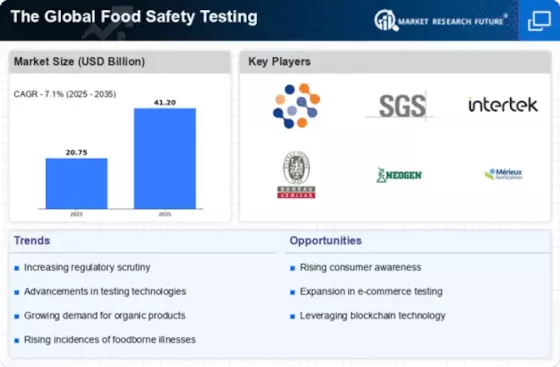
Key players include Eurofins Scientific, SGS SA, Intertek Group plc, and Bureau Veritas, among others.

Market Summary

As per MRFR analysis, The Global Food Safety Testing was estimated at 19.37 USD Billion in 2024. The food safety testing industry is projected to grow from 20.75 USD Billion in 2025 to 41.2 USD Billion by 2035, exhibiting a compound annual growth rate (CAGR) of 7.1 during the forecast period 2025 - 2035.

Key Market Trends & Highlights

The Global Food Safety Testing is poised for substantial growth driven by technological advancements and increasing regulatory demands.

  • Technological advancements in testing methods are revolutionizing the efficiency and accuracy of food safety assessments.
  • North America remains the largest market, while the Asia-Pacific region is emerging as the fastest-growing area for food safety testing.
  • Consumer demand for transparency in food sourcing is prompting companies to adopt more rigorous testing protocols.
  • Rising incidences of foodborne illnesses and increased regulatory compliance are key drivers propelling market expansion.

Market Size & Forecast

2024 Market Size 19.37 (USD Billion)
2035 Market Size 41.2 (USD Billion)
CAGR (2025 - 2035) 7.1%
Largest Regional Market Share in 2024 North America

Major Players

<p>Eurofins Scientific (LU), SGS SA (CH), Intertek Group plc (GB), Bureau Veritas (FR), Neogen Corporation (US), Mérieux Nutrisciences (FR), TÜV SÜD AG (DE), ALS Limited (AU), Food Safety Net Services (US)</p>

Market Trends

The Global Food Safety Testing is currently experiencing a dynamic evolution, driven by increasing consumer awareness regarding food quality and safety. Regulatory bodies across various regions are intensifying their scrutiny of food products, which compels manufacturers to adopt rigorous testing protocols. This heightened focus on food safety is not merely a response to consumer demand but also a proactive measure to mitigate potential health risks associated with contaminated food products. As a result, the market is witnessing a surge in the adoption of advanced testing technologies, which are designed to enhance the accuracy and efficiency of food safety assessments. Moreover, The Global Food Safety Testing is likely to benefit from the growing trend of globalization in food supply chains. As food products traverse international borders, the need for standardized testing methods becomes increasingly critical. This trend suggests that companies are investing in innovative solutions to ensure compliance with diverse regulatory requirements across different countries. Additionally, the rise of e-commerce in the food sector may further amplify the demand for reliable food safety testing, as consumers seek assurance regarding the quality of products purchased online. Overall, the market appears poised for continued growth, driven by evolving consumer expectations and regulatory landscapes.

Technological Advancements in Testing Methods

The Global Food Safety Testing is witnessing a notable shift towards the integration of advanced technologies. Innovations such as rapid testing methods and automation are enhancing the efficiency and accuracy of food safety assessments. These advancements not only streamline testing processes but also reduce the time required for results, thereby enabling quicker decision-making for manufacturers.

Increased Regulatory Compliance

There is a growing emphasis on regulatory compliance within The Global Food Safety Testing. Governments and international organizations are implementing stricter food safety regulations, compelling companies to adhere to higher standards. This trend indicates a shift towards more comprehensive testing protocols, ensuring that food products meet safety requirements before reaching consumers.

Consumer Demand for Transparency

The demand for transparency in food sourcing and safety is becoming increasingly pronounced among consumers. This trend suggests that companies are responding by providing detailed information about their testing processes and results. As consumers become more informed, they are likely to favor brands that prioritize food safety and demonstrate accountability in their practices.

Global Food Safety Testing Market Market Drivers

Increased Regulatory Compliance

Regulatory compliance is a critical driver in The Global Food Safety Testing Industry, as governments and international bodies impose stringent regulations to safeguard public health. The implementation of food safety standards, such as the Hazard Analysis and Critical Control Points (HACCP) and the Food Safety Modernization Act (FSMA), has heightened the need for rigorous testing protocols. This regulatory landscape compels food manufacturers and processors to invest in comprehensive testing solutions to avoid penalties and ensure product safety. The market is projected to witness a surge in demand for testing services, with a significant portion of the industry focusing on compliance-related testing. As regulations evolve, companies are likely to seek innovative testing solutions that not only meet current requirements but also anticipate future changes in the regulatory environment.

Consumer Demand for Transparency

The Global Food Safety Testing Industry is increasingly influenced by consumer demand for transparency in food sourcing and safety. As consumers become more aware of foodborne illnesses and their implications, they are actively seeking information about the safety and quality of the products they consume. This trend has led to a rise in demand for testing services that provide verifiable data on food safety. Companies that can demonstrate their commitment to transparency through rigorous testing are likely to gain a competitive edge in the market. The increasing prevalence of food recalls due to contamination has further amplified this demand, prompting manufacturers to adopt proactive testing measures. Market analysts suggest that the emphasis on transparency will continue to shape the industry, driving innovation in testing methodologies and increasing the overall market size.

Globalization of Food Supply Chains

The globalization of food supply chains presents both opportunities and challenges for The Global Food Safety Testing Industry. As food products are sourced from diverse geographical locations, the complexity of ensuring food safety increases. This interconnectedness necessitates comprehensive testing to address potential risks associated with cross-border trade. Regulatory bodies are responding by implementing stricter testing requirements for imported food products, thereby driving demand for testing services. The market is likely to see growth as companies seek to comply with international safety standards and ensure the integrity of their supply chains. Additionally, the need for consistent testing across various regions may lead to the development of standardized testing protocols, further influencing the dynamics of the food safety testing market.

Rising Incidence of Foodborne Illnesses

The rising incidence of foodborne illnesses is a significant driver for The Global Food Safety Testing Industry. With millions of cases reported annually, the public health implications are profound, prompting governments and organizations to prioritize food safety. This alarming trend has led to increased scrutiny of food products and heightened awareness among consumers regarding the importance of food safety testing. As a result, food manufacturers are compelled to implement rigorous testing protocols to mitigate risks and protect public health. The market is expected to expand as companies invest in advanced testing technologies to detect pathogens and contaminants effectively. Furthermore, the correlation between foodborne illnesses and economic losses underscores the necessity for robust testing solutions, thereby driving growth in the food safety testing sector.

Technological Advancements in Testing Methods

The Global Food Safety Testing Industry is experiencing a notable transformation due to rapid technological advancements. Innovations such as real-time PCR, next-generation sequencing, and biosensors are enhancing the accuracy and speed of food safety testing. These technologies enable the detection of pathogens and contaminants at unprecedented levels of sensitivity. For instance, the market for rapid testing methods is projected to grow significantly, with estimates suggesting a compound annual growth rate of over 10% in the coming years. This shift towards more sophisticated testing methods not only improves food safety but also reduces the time required for testing, thereby streamlining the supply chain. As a result, stakeholders in the food industry are increasingly adopting these advanced technologies to ensure compliance with safety standards and to meet consumer expectations.

Market Segment Insights

By Application: Microbiological Testing (Largest) vs. Chemical Testing (Fastest-Growing)

<p>In The Global Food Safety Testing, the application divides prominently across various testing categories, with Microbiological Testing holding the largest share. This segment includes essential methods for detecting harmful microorganisms in food products, ensuring consumer safety and regulatory compliance. Meanwhile, Chemical Testing is rapidly gaining traction and is recognized as the fastest-growing segment. This segment focuses on the identification of chemical contaminants and residues, reflecting increasing concerns over foodborne illnesses and toxic substances.</p>

<p>Microbiological Testing (Dominant) vs. Chemical Testing (Emerging)</p>

<p>Microbiological Testing is characterized by its critical role in food safety, targeting pathogens such as bacteria, viruses, and parasites. This segment is deeply entrenched in the regulatory frameworks of food safety, making it a dominant force in the market. On the other hand, Chemical Testing, considered an emerging segment, is propelled by growing awareness of food quality and safety. It addresses consumer demand for transparency regarding chemical exposures and food safety, thus expanding its market presence. Both segments are essential for maintaining high safety standards in the food industry, with evolving technologies enhancing testing efficiency and accuracy.</p>

By End Use: Food Manufacturers (Largest) vs. Testing Laboratories (Fastest-Growing)

<p>In The Global Food Safety Testing, the distribution of market share among various end users is pivotal in shaping industry strategies. Food manufacturers represent the largest segment, as they are increasingly focused on maintaining rigorous safety standards to ensure product integrity. Following them, food retailers and food service providers play significant roles, but they are often influenced by regulatory requirements initiated by government agencies and testing laboratories that ensure compliance with safety regulations. As the industry evolves, testing laboratories have emerged as the fastest-growing segment within this market. This growth is driven by the rising consumer awareness about food safety and the increasing number of foodborne illnesses. Moreover, technological advancements in testing methods and the need for accurate and rapid testing solutions are propelling laboratories to expand their services and capabilities, thereby fostering growth in this sector.</p>

<p>Food Manufacturers (Dominant) vs. Testing Laboratories (Emerging)</p>

<p>Food manufacturers hold a dominant position in The Global Food Safety Testing primarily due to their critical need for ensuring the safety and quality of food products. They invest heavily in safety testing to meet regulatory standards and consumer expectations, thus driving demand for comprehensive testing solutions. In contrast, testing laboratories are emerging as vital players in this market, focusing on innovation and the development of advanced testing technologies. The rise of testing laboratories is significantly influenced by the increasing complexity of food supply chains and the growing importance of traceability in food safety. This dynamic between established manufacturers and agile laboratories defines a competitive landscape that continuously evolves to address food safety challenges.</p>

By Technology: PCR Technology (Largest) vs. Immunoassay Technology (Fastest-Growing)

<p>In The Global Food Safety Testing, PCR Technology holds the largest market share, owing to its high sensitivity and ability to detect pathogens in food samples swiftly. It has become the go-to method for laboratories and food manufacturers looking to ensure product safety and compliance with regulatory standards. Meanwhile, Immunoassay Technology, while smaller in market share compared to PCR, is rapidly gaining traction, especially in the detection of specific allergens and toxins in food products. This segment benefits from its ease of use and quick turnaround times for results. The growth trends within this technology segment are primarily driven by the increasing incidence of foodborne illnesses and the need for more rapid and accurate testing methodologies. As food safety regulations tighten globally, both established technologies like PCR and emerging methods such as Immunoassay are seeing investments from the industry. Research and development activities are also focused on enhancing the efficiency of these technologies, ensuring they adapt to the evolving landscape of food safety challenges.</p>

<p>PCR Technology (Dominant) vs. Biosensors (Emerging)</p>

<p>PCR Technology is the dominant player in The Global Food Safety Testing due to its robust performance in pathogen detection. Its accuracy and speed have positioned it as the preferred choice among food manufacturers and laboratories, leading to widespread adoption. In contrast, Biosensors represent an emerging segment, leveraging cutting-edge technology to deliver real-time results on food safety analysis. They offer advantages such as portability and ease of integration into production lines. The growth of biosensor technology is being propelled by advancements in nanotechnology and the increasing consumer demand for on-the-go testing solutions, indicating a shift towards more innovative, user-friendly methods in food safety testing.</p>

Get more detailed insights about Food Safety Testing Market Research Report-Global Forecast till 2035

Regional Insights

North America : Market Leader in Food Safety

North America holds the largest share of The Global Food Safety Testing, valued at $9.5 billion in 2024. The region's growth is driven by stringent food safety regulations, increasing consumer awareness, and the rising incidence of foodborne illnesses. Regulatory bodies like the FDA enforce rigorous standards, fostering demand for advanced testing solutions. The market is also propelled by technological advancements in testing methodologies and a growing focus on supply chain transparency. The United States is the leading country in this region, hosting major players such as Neogen Corporation and Eurofins Scientific. The competitive landscape is characterized by a mix of established firms and innovative startups, all striving to enhance food safety protocols. The presence of key players ensures a robust market environment, with continuous investments in research and development to meet evolving consumer and regulatory demands.

Europe : Regulatory Framework Drives Growth

Europe's food safety testing market is valued at $5.5 billion, driven by stringent regulations and a proactive approach to food safety. The European Food Safety Authority (EFSA) plays a crucial role in establishing guidelines that ensure high standards across member states. The increasing focus on food quality and safety, coupled with rising consumer awareness, is propelling market growth. Additionally, the region is witnessing a surge in demand for organic and natural food products, further driving the need for comprehensive testing solutions. Leading countries in this region include Germany, France, and the UK, where major players like SGS SA and Bureau Veritas operate. The competitive landscape is marked by a mix of multinational corporations and local firms, all vying for market share. The presence of advanced laboratories and a strong emphasis on innovation in testing technologies contribute to a dynamic market environment, ensuring compliance with evolving regulations.

Asia-Pacific : Emerging Market with Potential

The Asia-Pacific region, valued at $3.5 billion, is rapidly emerging in The Global Food Safety Testing. The growth is fueled by increasing urbanization, rising disposable incomes, and a growing awareness of food safety among consumers. Governments are implementing stricter regulations to ensure food quality, which is further driving demand for testing services. The region is also experiencing a shift towards modern agricultural practices, necessitating advanced testing solutions to meet safety standards. Countries like China, India, and Japan are at the forefront of this growth, with significant investments in food safety infrastructure. The competitive landscape features both local and international players, including ALS Limited and Intertek Group plc. The presence of key players is vital for enhancing testing capabilities and ensuring compliance with international standards, thereby fostering consumer trust in food products.

Middle East and Africa : Developing Market with Challenges

The Middle East and Africa region, valued at $0.87 billion, is gradually developing its food safety testing market. The growth is driven by increasing food imports, rising consumer awareness, and the need for compliance with international food safety standards. However, challenges such as limited infrastructure and varying regulatory frameworks across countries hinder rapid market expansion. Governments are beginning to recognize the importance of food safety, leading to gradual improvements in regulations and testing capabilities. Countries like South Africa and the UAE are leading the way in adopting food safety measures, with a growing presence of international players. The competitive landscape is still evolving, with local firms working to enhance their testing services. The involvement of key players is crucial for building a robust food safety framework, ensuring that food products meet safety standards and consumer expectations.

Key Players and Competitive Insights

The Global Food Safety Testing is characterized by a dynamic competitive landscape, driven by increasing consumer awareness regarding food safety and stringent regulatory frameworks. Key players are actively engaging in strategies such as innovation, mergers and acquisitions, and regional expansion to enhance their market presence. For instance, Eurofins Scientific (LU) has positioned itself as a leader through continuous investment in advanced testing technologies and expanding its laboratory network globally. Similarly, SGS SA (CH) focuses on digital transformation and automation to streamline operations, thereby improving efficiency and service delivery. These strategies collectively contribute to a moderately fragmented market structure, where the influence of major players is significant but not overwhelming, allowing for the emergence of niche players.

In terms of business tactics, companies are increasingly localizing manufacturing and optimizing supply chains to respond swiftly to market demands. This approach not only reduces operational costs but also enhances responsiveness to local regulatory requirements. The competitive structure of the market appears to be moderately fragmented, with several key players exerting considerable influence while allowing smaller entities to thrive. The collective actions of these companies shape a landscape where innovation and operational efficiency are paramount.

In January 2026, Intertek Group plc (GB) announced the acquisition of a regional food safety testing laboratory in North America, which is expected to bolster its capabilities in providing comprehensive food safety solutions. This strategic move is likely to enhance Intertek's service offerings and expand its geographical footprint, thereby positioning the company to better meet the growing demand for food safety testing in the region. The acquisition underscores the importance of regional expertise in navigating local regulations and consumer preferences.

In December 2025, Neogen Corporation (US) launched a new line of rapid testing kits designed to detect foodborne pathogens in less than 24 hours. This innovation is indicative of Neogen's commitment to enhancing food safety through technological advancements. The rapid testing capabilities are expected to appeal to food manufacturers seeking to minimize downtime and ensure compliance with safety standards, thereby reinforcing Neogen's competitive edge in the market.

In November 2025, Mérieux Nutrisciences (FR) entered into a strategic partnership with a leading technology firm to integrate AI-driven analytics into its testing processes. This collaboration aims to enhance data accuracy and predictive capabilities, which could significantly improve food safety outcomes. The integration of AI reflects a broader trend within the industry towards leveraging technology to optimize testing processes and deliver more reliable results.

As of February 2026, current competitive trends in The Global Food Safety Testing are increasingly defined by digitalization, sustainability, and the integration of AI technologies. Strategic alliances are becoming more prevalent, as companies recognize the value of collaboration in enhancing their service offerings and operational efficiencies. Looking ahead, it is anticipated that competitive differentiation will evolve, shifting from traditional price-based competition to a focus on innovation, technological advancements, and supply chain reliability. This transition may ultimately redefine the parameters of success within the market.

Key Companies in the Global Food Safety Testing Market include

Industry Developments

December 2023: Neogen Corporation, a multinational company that provides food safety products, has recently released an ELISA Assay that employs a quantitative approach to detect allergens from walnuts.

September 2023: Launch of a new trend called DNAllergen real-time PCR kits, which was done by Gold Standard Diagnostics Inc., a global market leader in test kits, lab consumables and other testing technologies. It is now possible to detect certain specific allergens with the new methodology.

July 2023: Namely, Spectacular Labs Inc., an emerging pathogen testing company in pace with technology, was going to display a new pathogen testing platform that is more accurate, quicker and consists of more automation during the International Association for Food Protection (IAFP) 2023 Annual Meeting.

May 2023: Gold Standard Diagnostics Inc. has revealed its plans to launch a new line of plural allergen lateral flow devices, which consists of SENSIStrip Beta-Lactoglobulin, SENSIStrip Fish, SENSIStrip Papad, SENSIStrip Lysozyme, SENSIStrip Ovalbumin and SENSIStrip Brazil Nut. It employs rapid testing techniques to diagnose and identify allergens accurately.

September 2022: Romer Labs today lifted the veil on Richard Allen’s latest advancement in diagnostic solutions, particularly in identifying allergies in food and animal feed. The AgraStrip Pro Allergen test kits seamlessly connect to the AgraVision Pro System while also increasing the efficiency and accuracy in managing data and content on allergy testing.

July 2022: SGS has announced the establishment of a food analysis lab in Mexico. This brand new laboratory located at Naucalpan will assist the Mexican food sector in assuring quality control processes and regulatory requirements.

May 2022: Bureau Veritas, which provides testing, inspection and certification laboratory services, has opened its third microbiology laboratory in the United States, which is located in Reno, Nevada. It was set to provide rapid pathogen detection and microbiology indicator services for clients within the agriculture and food industries.

April 2022: Mérieux NutriSciences is a global leader in food safety, quality and sustainability, and in June 2022, the company expanded its portfolio after purchasing Hortec Pty Ltd in South Africa and Laboratorios Bromatológicos Araba SA in Spain. These acquisitions help the company expand in the South African market for pesticides and strengthen its geographic presence in Spain.

Future Outlook

Global Food Safety Testing Market Future Outlook

The Global Food Safety Testing is projected to grow at a 7.1% CAGR from 2024 to 2035, driven by increasing regulatory standards, consumer awareness, and technological advancements.

New opportunities lie in:

  • Development of rapid testing kits for on-site food analysis
  • Integration of AI-driven analytics for predictive food safety
  • Expansion of blockchain technology for traceability in food supply chains

By 2035, the market is expected to be robust, driven by innovation and heightened safety standards.

Market Segmentation

Global Food Safety Testing Market End Use Outlook

  • Food Manufacturers
  • Food Retailers
  • Food Service Providers
  • Government Agencies
  • Testing Laboratories

Global Food Safety Testing Market Technology Outlook

  • PCR Technology
  • Immunoassay Technology
  • Chromatography Technology
  • Mass Spectrometry Technology
  • Biosensors

Global Food Safety Testing Market Application Outlook

  • Microbiological Testing
  • Chemical Testing
  • Allergen Testing
  • Nutritional Testing
  • GMO Testing

Report Scope

MARKET SIZE 202419.37(USD Billion)
MARKET SIZE 202520.75(USD Billion)
MARKET SIZE 203541.2(USD Billion)
COMPOUND ANNUAL GROWTH RATE (CAGR)7.1% (2024 - 2035)
REPORT COVERAGERevenue Forecast, Competitive Landscape, Growth Factors, and Trends
BASE YEAR2024
Market Forecast Period2025 - 2035
Historical Data2019 - 2024
Market Forecast UnitsUSD Billion
Key Companies ProfiledEurofins Scientific (LU), SGS SA (CH), Intertek Group plc (GB), Bureau Veritas (FR), Neogen Corporation (US), Mérieux Nutrisciences (FR), TÜV SÜD AG (DE), ALS Limited (AU), Food Safety Net Services (US)
Segments CoveredApplication, End Use, Technology
Key Market OpportunitiesIntegration of advanced technologies enhances efficiency in The Global Food Safety Testing.
Key Market DynamicsRising consumer awareness drives demand for advanced food safety testing technologies and stringent regulatory compliance.
Countries CoveredNorth America, Europe, APAC, South America, MEA

FAQs

What is the current valuation of the Food Safety Testing Market?

The Food Safety Testing Market was valued at 19.37 USD Billion in 2024.

What is the projected market size for the Food Safety Testing Market by 2035?

The market is projected to reach 41.2 USD Billion by 2035.

What is the expected CAGR for the Food Safety Testing Market during the forecast period 2025 - 2035?

The expected CAGR for the Food Safety Testing Market during 2025 - 2035 is 7.1%.

Which segment of contaminants shows the highest projected growth in the Food Safety Testing Market?

The Pathogens segment is projected to grow from 5.0 USD Billion in 2024 to 10.5 USD Billion by 2035.

How does the market for traditional testing compare to rapid testing in terms of valuation?

The traditional testing segment was valued at 10.0 USD Billion in 2024, while the rapid testing segment was valued at 9.37 USD Billion.

What are the key players in the Food Safety Testing Market?

Key players include Eurofins Scientific, SGS SA, Intertek Group plc, and Bureau Veritas, among others.

  1. EXECUTIVE SUMMARY 15
    1. MARKET ATTRACTIVENESS ANALYSIS 16
      1. GLOBAL FOOD SAFETY TESTING MARKET, BY CONTAMINANT 17
      2. GLOBAL FOOD SAFETY TESTING MARKET, BY TECHNOLOGY 18
      3. GLOBAL FOOD SAFETY TESTING MARKET, BY FOOD TYPE 19
      4. GLOBAL FOOD SAFETY TESTING MARKET, BY REGION 20
  2. MARKET INTRODUCTION 21
    1. DEFINITION 21
    2. SCOPE OF THE STUDY 21
    3. RESEARCH OBJECTIVE 21
    4. MARKET STRUCTURE 22
    5. KEY BUYING CRITERIA 22
  3. RESEARCH METHODOLOGY 23
    1. RESEARCH PROCESS 23
    2. PRIMARY RESEARCH 24
    3. SECONDARY RESEARCH 25
    4. MARKET SIZE ESTIMATION 25
    5. FORECAST MODEL 27
    6. LIST OF ASSUMPTIONS 28
  4. MARKET INSIGHTS 29
  5. MARKET DYNAMICS 31
    1. INTRODUCTION 31
    2. DRIVERS 31
      1. INCREASED OUTBREAK OF FOOD-BORNE ILLNESSES WORLDWIDE 31
      2. STRINGENT FOOD SAFETY REGULATIONS 32
      3. DRIVERS IMPACT ANALYSIS 33
    3. RESTRAINTS 33
      1. LIMITED SUPPORTING INFRASTRUCTURE IN DEVELOPING COUNTRIES 33
      2. RESTRAINTS IMPACT ANALYSIS 34
    4. OPPORTUNITIES 34
      1. ADVANCES IN RAPID TECHNOLOGY 34
  6. MARKET FACTOR ANALYSIS 35
    1. SUPPLY CHAIN ANALYSIS 35
      1. RAW MATERIAL 35
      2. TESTING 36
      3. RESULT 36
    2. PORTER’S FIVE FORCES MODEL 36
      1. THREAT OF NEW ENTRANTS 37
      2. BARGAINING POWER OF SUPPLIERS 37
      3. BARGAINING POWER OF BUYERS 37
      4. THREAT OF SUBSTITUTES 37
      5. INTENSITY OF RIVALRY 37
  7. GLOBAL FOOD SAFETY TESTING MARKET, BY CONTAMINANT 38
    1. OVERVIEW 38
      1. GLOBAL FOOD SAFETY TESTING MARKET ESTIMATES & FORECAST, BY CONTAMINANT, 2023-2030 39
    2. PATHOGENS 39
      1. PATHOGENS: MARKET ESTIMATES & FORECAST, BY REGION, 2023-2030 40
    3. PESTICIDES 40
      1. PESTICIDES: MARKET ESTIMATES & FORECAST, BY REGION, 2023-2030 40
    4. TOXINS 41
      1. TOXINS: MARKET ESTIMATES & FORECAST, BY REGION, 2023-2030 41
    5. GMOS 41
      1. GMOS: MARKET ESTIMATES & FORECAST, BY REGION, 2023-2030 42
    6. OTHERS 42
      1. OTHERS: MARKET ESTIMATES & FORECAST, BY REGION, 2023-2030 42
  8. GLOBAL FOOD SAFETY TESTING MARKET, BY TECHNOLOGY 43
    1. OVERVIEW 43
      1. GLOBAL FOOD SAFETY TESTING MARKET ESTIMATES & FORECAST, BY TECHNOLOGY, 2023-2030 44
    2. TRADITIONAL 44
      1. TRADITIONAL: MARKET ESTIMATES & FORECAST, BY REGION, 2023-2030 45
    3. RAPID 45
      1. RAPID: MARKET ESTIMATES & FORECAST, BY REGION, 2023-2030 46
  9. GLOBAL FOOD SAFETY TESTING MARKET, BY FOOD TYPE 47
    1. OVERVIEW 47
      1. GLOBAL FOOD SAFETY TESTING MARKET ESTIMATES & FORECAST, BY FOOD TYPE, 2023-2030 48
    2. MEAT, POULTRY, & SEAFOOD PRODUCTS 48
      1. MEAT, POULTRY, & SEAFOOD PRODUCTS: MARKET ESTIMATES & FORECAST, BY REGION, 2023-2030 49
    3. DAIRY PRODUCTS 49
      1. DAIRY PRODUCTS: MARKET ESTIMATES & FORECAST, BY REGION, 2023-2030 49
    4. CEREALS & GRAINS 50
      1. CEREALS & GRAINS: MARKET ESTIMATES & FORECAST, BY REGION, 2023-2030 50
    5. PROCESSED FOOD 50
      1. PROCESSED FOOD: MARKET ESTIMATES & FORECAST, BY REGION, 2023-2030 51
    6. FRUITS & VEGETABLES 51
      1. FRUITS & VEGETABLES: MARKET ESTIMATES & FORECAST, BY REGION, 2023-2030 51
    7. OTHERS 52
      1. OTHERS: MARKET ESTIMATES & FORECAST, BY REGION, 2023-2030 52
  10. GLOBAL FOOD SAFETY TESTING MARKET, BY REGION 53
    1. OVERVIEW 53
    2. NORTH AMERICA 55
      1. US 58
      2. CANADA 60
      3. MEXICO 62
    3. EUROPE 64
      1. GERMANY 67
      2. UK 69
      3. FRANCE 71
      4. SPAIN 73
      5. ITALY 75
      6. REST OF EUROPE 77
    4. ASIA-PACIFIC 79
      1. CHINA 82
      2. JAPAN 84
      3. INDIA 86
      4. AUSTRALIA & NEW ZEALAND 88
      5. REST OF ASIA-PACIFIC 90
    5. REST OF THE WORLD 92
      1. SOUTH AMERICA 95
      2. MIDDLE EAST 97
      3. AFRICA 99
  11. COMPETITIVE LANDSCAPE 101
    1. INTRODUCTION 101
      1. MARKET STRATEGY ANALYSIS 101
    2. COMPETITIVE BENCHMARKING 102
    3. KEY DEVELOPMENTS & GROWTH STRATEGIES 103
      1. PRODUCT/SERVICE LAUNCHES 103
      2. MERGERS & ACQUISITIONS 103
      3. EXPANSIONS 105
      4. JOINT VENTURES 105
      5. PARTNERSHIPS 105
  12. COMPANY PROFILES 106
    1. SGS SA 106
      1. COMPANY OVERVIEW 106
      2. FINANCIAL OVERVIEW 106
      3. PRODUCTS OFFERED 107
      4. KEY DEVELOPMENTS 107
      5. SWOT ANALYSIS 108
      6. KEY STRATEGIES 108
    2. MICROBAC LABORATORIES, INC. 109
      1. COMPANY OVERVIEW 109
      2. FINANCIAL OVERVIEW 109
      3. PRODUCTS OFFERED 109
      4. KEY DEVELOPMENTS 109
      5. KEY STRATEGIES 109
    3. EUROFINS SCIENTIFIC 110
      1. COMPANY OVERVIEW 110
      2. FINANCIAL OVERVIEW 110
      3. PRODUCTS OFFERED 111
      4. KEY DEVELOPMENTS 111
      5. SWOT ANALYSIS 113
      6. KEY STRATEGIES 113
    4. BUREAU VERITAS 114
      1. COMPANY OVERVIEW 114
      2. FINANCIAL OVERVIEW 114
      3. PRODUCTS OFFERED 115
      4. KEY DEVELOPMENTS 115
      5. SWOT ANALYSIS 116
      6. KEY STRATEGIES 116
    5. INTERTEK GROUP PLC 117
      1. COMPANY OVERVIEW 117
      2. FINANCIAL OVERVIEW 117
      3. PRODUCTS OFFERED 118
      4. KEY DEVELOPMENTS 118
      5. SWOT ANALYSIS 119
      6. KEY STRATEGIES 119
    6. ALS LIMITED 120
      1. COMPANY OVERVIEW 120
      2. FINANCIAL OVERVIEW 120
      3. PRODUCTS OFFERED 121
      4. KEY DEVELOPMENTS 121
      5. SWOT ANALYSIS 122
      6. KEY STRATEGIES 122
    7. ASUREQUALITY LTD. 123
      1. COMPANY OVERVIEW 123
      2. FINANCIAL OVERVIEW 123
      3. PRODUCTS OFFERED 124
      4. KEY DEVELOPMENTS 124
      5. KEY STRATEGIES 124
    8. NEOGEN CORPORATION 125
      1. COMPANY OVERVIEW 125
      2. FINANCIAL OVERVIEW 125
      3. PRODUCTS OFFERED 126
      4. KEY DEVELOPMENTS 126
      5. KEY STRATEGIES 126
    9. TÜV SÜD 127
      1. COMPANY OVERVIEW 127
      2. FINANCIAL OVERVIEW 127
      3. PRODUCTS OFFERED 128
      4. KEY DEVELOPMENTS 128
      5. KEY STRATEGIES 128
    10. ADPEN LABORATORIES INC. 129
      1. COMPANY OVERVIEW 129
      2. FINANCIAL OVERVIEW 129
      3. PRODUCTS OFFERED 129
      4. KEY DEVELOPMENTS 129
      5. KEY STRATEGIES 129
  13. REFERENCES 130
  14. LIST OF TABLES
  15. PRIMARY INTERVIEWS 24
  16. LIST OF ASSUMPTIONS 28
  17. GLOBAL FOOD SAFETY TESTING MARKET ESTIMATES & FORECAST, BY CONTAMINANT, 2023-2030 (USD MILLION) 39
  18. PATHOGENS: MARKET ESTIMATES & FORECAST, BY REGION, 2023-2030 (USD MILLION) 40
  19. PESTICIDES: MARKET ESTIMATES & FORECAST, BY REGION, 2023-2030 (USD MILLION) 40
  20. TOXINS: MARKET ESTIMATES & FORECAST, BY REGION, 2023-2030 (USD MILLION) 41
  21. GMOS: MARKET ESTIMATES & FORECAST, BY REGION, 2023-2030 (USD MILLION) 42
  22. OTHERS: MARKET ESTIMATES & FORECAST, BY REGION, 2023-2030 (USD MILLION) 42
  23. GLOBAL FOOD SAFETY TESTING MARKET ESTIMATES & FORECAST, BY TECHNOLOGY, 2023-2030 (USD MILLION) 44
  24. TRADITIONAL: MARKET ESTIMATES & FORECAST, BY REGION, 2023-2030 (USD MILLION) 45
  25. RAPID: MARKET ESTIMATES & FORECAST, BY REGION, 2023-2030 (USD MILLION) 46
  26. GLOBAL FOOD SAFETY TESTING MARKET ESTIMATES & FORECAST, BY FOOD TYPE, 2023-2030 (USD MILLION) 48
  27. MEAT, POULTRY, & SEAFOOD PRODUCTS: MARKET ESTIMATES & FORECAST, BY REGION, 2023-2030 (USD MILLION) 49
  28. DAIRY PRODUCTS: MARKET ESTIMATES & FORECAST, BY REGION, 2023-2030 (USD MILLION) 49
  29. CEREALS & GRAINS: MARKET ESTIMATES & FORECAST, BY REGION, 2023-2030 (USD MILLION) 50
  30. PROCESSED FOOD: MARKET ESTIMATES & FORECAST, BY REGION, 2023-2030 (USD MILLION) 51
  31. FRUITS & VEGETABLES: MARKET ESTIMATES & FORECAST, BY REGION, 2023-2030 (USD MILLION) 51
  32. OTHERS: MARKET ESTIMATES & FORECAST, BY REGION, 2023-2030 (USD MILLION) 52
  33. GLOBAL FOOD SAFETY TESTING MARKET ESTIMATES & FORECAST, BY REGION, 2023-2030 (USD MILLION) 54
  34. NORTH AMERICA: MARKET ESTIMATES & FORECAST, BY COUNTRY, 2023-2030 (USD MILLION) 55
  35. NORTH AMERICA: FOOD SAFETY TESTING MARKET, BY CONTAMINANT, 2023-2030 (USD MILLION) 56
  36. NORTH AMERICA: FOOD SAFETY TESTING MARKET, BY TECHNOLOGY, 2023-2030 (USD MILLION) 57
  37. NORTH AMERICA: FOOD SAFETY TESTING MARKET, BY FOOD TYPE, 2023-2030 (USD MILLION) 57
  38. US: FOOD SAFETY TESTING MARKET, BY CONTAMINANT, 2023-2030 (USD MILLION) 58
  39. US: FOOD SAFETY TESTING MARKET, BY TECHNOLOGY, 2023-2030 (USD MILLION) 58
  40. US: FOOD SAFETY TESTING MARKET, BY FOOD TYPE, 2023-2030 (USD MILLION) 59
  41. CANADA: FOOD SAFETY TESTING MARKET, BY CONTAMINANT, 2023-2030 (USD MILLION) 60
  42. CANADA: FOOD SAFETY TESTING MARKET, BY TECHNOLOGY, 2023-2030 (USD MILLION) 60
  43. CANADA: FOOD SAFETY TESTING MARKET, BY FOOD TYPE, 2023-2030 (USD MILLION) 61
  44. MEXICO: FOOD SAFETY TESTING MARKET, BY CONTAMINANT, 2023-2030 (USD MILLION) 62
  45. MEXICO: FOOD SAFETY TESTING MARKET, BY TECHNOLOGY, 2023-2030 (USD MILLION) 63
  46. MEXICO: FOOD SAFETY TESTING MARKET, BY FOOD TYPE, 2023-2030 (USD MILLION) 63
  47. EUROPE: MARKET ESTIMATES & FORECAST, BY COUNTRY, 2023-2030 (USD MILLION) 64
  48. EUROPE: FOOD SAFETY TESTING MARKET, BY CONTAMINANT, 2023-2030 (USD MILLION) 65
  49. EUROPE: FOOD SAFETY TESTING MARKET, BY TECHNOLOGY, 2023-2030 (USD MILLION) 65
  50. EUROPE: FOOD SAFETY TESTING MARKET, BY FOOD TYPE, 2023-2030 (USD MILLION) 66
  51. GERMANY: FOOD SAFETY TESTING MARKET, BY CONTAMINANT, 2023-2030 (USD MILLION) 67
  52. GERMANY: FOOD SAFETY TESTING MARKET, BY TECHNOLOGY, 2023-2030 (USD MILLION) 67
  53. GERMANY: FOOD SAFETY TESTING MARKET, BY FOOD TYPE, 2023-2030 (USD MILLION) 68
  54. UK: FOOD SAFETY TESTING MARKET, BY CONTAMINANT, 2023-2030 (USD MILLION) 69
  55. UK: FOOD SAFETY TESTING MARKET, BY TECHNOLOGY, 2023-2030 (USD MILLION) 69
  56. UK: FOOD SAFETY TESTING MARKET, BY FOOD TYPE, 2023-2030 (USD MILLION) 70
  57. FRANCE: FOOD SAFETY TESTING MARKET, BY CONTAMINANT, 2023-2030 (USD MILLION) 71
  58. FRANCE: FOOD SAFETY TESTING MARKET, BY TECHNOLOGY, 2023-2030 (USD MILLION) 71
  59. FRANCE: FOOD SAFETY TESTING MARKET, BY FOOD TYPE, 2023-2030 (USD MILLION) 72
  60. SPAIN: FOOD SAFETY TESTING MARKET, BY CONTAMINANT, 2023-2030 (USD MILLION) 73
  61. SPAIN: FOOD SAFETY TESTING MARKET, BY TECHNOLOGY, 2023-2030 (USD MILLION) 73
  62. SPAIN: FOOD SAFETY TESTING MARKET, BY FOOD TYPE, 2023-2030 (USD MILLION) 74
  63. ITALY: FOOD SAFETY TESTING MARKET, BY CONTAMINANT, 2023-2030 (USD MILLION) 75
  64. ITALY: FOOD SAFETY TESTING MARKET, BY TECHNOLOGY, 2023-2030 (USD MILLION) 76
  65. ITALY: FOOD SAFETY TESTING MARKET, BY FOOD TYPE, 2023-2030 (USD MILLION) 76
  66. REST OF EUROPE: FOOD SAFETY TESTING MARKET, BY CONTAMINANT, 2023-2030 (USD MILLION) 77
  67. REST OF EUROPE: FOOD SAFETY TESTING MARKET, BY TECHNOLOGY, 2023-2030 (USD MILLION) 77
  68. REST OF EUROPE: FOOD SAFETY TESTING MARKET, BY FOOD TYPE, 2023-2030 (USD MILLION) 78
  69. ASIA-PACIFIC: MARKET ESTIMATES & FORECAST, BY COUNTRY, 2023-2030 (USD MILLION) 80
  70. ASIA-PACIFIC: FOOD SAFETY TESTING MARKET, BY CONTAMINANT, 2023-2030 (USD MILLION) 80
  71. ASIA-PACIFIC: FOOD SAFETY TESTING MARKET, BY TECHNOLOGY, 2023-2030 (USD MILLION) 81
  72. ASIA-PACIFIC: FOOD SAFETY TESTING MARKET, BY FOOD TYPE, 2023-2030 (USD MILLION) 81
  73. CHINA: FOOD SAFETY TESTING MARKET, BY CONTAMINANT, 2023-2030 (USD MILLION) 82
  74. CHINA: FOOD SAFETY TESTING MARKET, BY TECHNOLOGY, 2023-2030 (USD MILLION) 82
  75. CHINA: FOOD SAFETY TESTING MARKET, BY FOOD TYPE, 2023-2030 (USD MILLION) 83
  76. JAPAN: FOOD SAFETY TESTING MARKET, BY CONTAMINANT, 2023-2030 (USD MILLION) 84
  77. JAPAN: FOOD SAFETY TESTING MARKET, BY TECHNOLOGY, 2023-2030 (USD MILLION) 84
  78. JAPAN: FOOD SAFETY TESTING MARKET, BY FOOD TYPE, 2023-2030 (USD MILLION) 85
  79. INDIA: FOOD SAFETY TESTING MARKET, BY CONTAMINANT, 2023-2030 (USD MILLION) 86
  80. INDIA: FOOD SAFETY TESTING MARKET, BY TECHNOLOGY, 2023-2030 (USD MILLION) 87
  81. INDIA: FOOD SAFETY TESTING MARKET, BY FOOD TYPE, 2023-2030 (USD MILLION) 87
  82. AUSTRALIA & NEW ZEALAND: FOOD SAFETY TESTING MARKET, BY CONTAMINANT, 2023-2030 (USD MILLION) 88
  83. AUSTRALIA & NEW ZEALAND: FOOD SAFETY TESTING MARKET, BY TECHNOLOGY, 2023-2030 (USD MILLION) 88
  84. AUSTRALIA & NEW ZEALAND: FOOD SAFETY TESTING MARKET, BY FOOD TYPE, 2023-2030 (USD MILLION) 89
  85. REST OF ASIA-PACIFIC: FOOD SAFETY TESTING MARKET, BY CONTAMINANT, 2023-2030 (USD MILLION) 90
  86. REST OF ASIA-PACIFIC: FOOD SAFETY TESTING MARKET, BY TECHNOLOGY, 2023-2030 (USD MILLION) 90
  87. REST OF ASIA-PACIFIC: FOOD SAFETY TESTING MARKET, BY FOOD TYPE, 2023-2030 (USD MILLION) 91
  88. REST OF THE WORLD: MARKET ESTIMATES & FORECAST, BY REGION, 2023-2030 (USD MILLION) 92
  89. REST OF THE WORLD: FOOD SAFETY TESTING MARKET, BY CONTAMINANT, 2023-2030 (USD MILLION) 93
  90. REST OF THE WORLD: FOOD SAFETY TESTING MARKET, BY TECHNOLOGY, 2023-2030 (USD MILLION) 94
  91. REST OF THE WORLD: FOOD SAFETY TESTING MARKET, BY FOOD TYPE, 2023-2030 (USD MILLION) 94
  92. SOUTH AMERICA: FOOD SAFETY TESTING MARKET, BY CONTAMINANT, 2023-2030 (USD MILLION) 95
  93. SOUTH AMERICA: FOOD SAFETY TESTING MARKET, BY TECHNOLOGY, 2023-2030 (USD MILLION) 95
  94. SOUTH AMERICA: FOOD SAFETY TESTING MARKET, BY FOOD TYPE, 2023-2030 (USD MILLION) 96
  95. MIDDLE EAST: FOOD SAFETY TESTING MARKET, BY CONTAMINANT, 2023-2030 (USD MILLION) 97
  96. MIDDLE EAST: FOOD SAFETY TESTING MARKET, BY TECHNOLOGY, 2023-2030 (USD MILLION) 97
  97. MIDDLE EAST: FOOD SAFETY TESTING MARKET, BY FOOD TYPE, 2023-2030 (USD MILLION) 98
  98. AFRICA: FOOD SAFETY TESTING MARKET, BY CONTAMINANT, 2023-2030 (USD MILLION) 99
  99. AFRICA: FOOD SAFETY TESTING MARKET, BY TECHNOLOGY, 2023-2030 (USD MILLION) 100
  100. AFRICA: FOOD SAFETY TESTING MARKET, BY FOOD TYPE, 2023-2030 (USD MILLION) 100
  101. PRODUCT/SERVICE LAUNCHES 103
  102. MERGERS & ACQUISITIONS 103
  103. EXPANSIONS 105
  104. JOINT VENTURES 105
  105. PARTNERSHIPS 105
  106. SGS SA: PRODUCTS OFFERED 107
  107. SGS SA: KEY DEVELOPMENTS 107
  108. MICROBAC LABORATORIES, INC.: PRODUCTS OFFERED 109

Food Safety Testing Contaminant Outlook (USD Billion, 2019-2030)

Pathogens

Pesticides

Toxins

GMOs

Others

Food Safety Testing Technology Outlook (USD Billion, 2019-2030)

Traditional

Rapid

Food Safety Testing Food Type Outlook (USD Billion, 2019-2030)

Meat

Poultry

Seafood Products

Dairy Products

Cereals & Grains

Processed Food

Fruits & Vegetables

Others

Food Safety Testing Regional Outlook (USD Billion, 2019-2030)

North America Outlook (USD Billion, 2019-2030)

North America Food Safety Testing by Contaminant

Pathogens

Pesticides

Toxins

GMOs

Others

North America Food Safety Testing by Technology

Traditional

Rapid

North America Food Safety Testing by Food Type

Meat

Poultry

Seafood Products

Dairy Products

Cereals & Grains

Processed Food

Fruits & Vegetables

Others

US Outlook (USD Billion, 2019-2030)

US Food Safety Testing by Contaminant

Pathogens

Pesticides

Toxins

GMOs

Others

US Food Safety Testing by Technology

Traditional

Rapid

US Food Safety Testing by Food Type

Meat

Poultry

Seafood Products

Dairy Products

Cereals & Grains

Processed Food

Fruits & Vegetables

Others

CANADA Outlook (USD Billion, 2019-2030)

CANADA Food Safety Testing by Contaminant

Pathogens

Pesticides

Toxins

GMOs

Others

CANADA Food Safety Testing by Technology

Traditional

Rapid

CANADA Food Safety Testing by Food Type

Meat

Poultry

Seafood Products

Dairy Products

Cereals & Grains

Processed Food

Fruits & Vegetables

Others

Europe Outlook (USD Billion, 2019-2030)

Europe Food Safety Testing by Contaminant

Pathogens

Pesticides

Toxins

GMOs

Others

Europe Food Safety Testing by Technology

Traditional

Rapid

Europe Food Safety Testing by Food Type

Meat

Poultry

Seafood Products

Dairy Products

Cereals & Grains

Processed Food

Fruits & Vegetables

Others

Germany Outlook (USD Billion, 2019-2030)

Germany Food Safety Testing by Contaminant

Pathogens

Pesticides

Toxins

GMOs

Others

Germany Food Safety Testing by Technology

Traditional

Rapid

Germany Food Safety Testing by Food Type

Meat

Poultry

Seafood Products

Dairy Products

Cereals & Grains

Processed Food

Fruits & Vegetables

Others

France Outlook (USD Billion, 2019-2030)

France Food Safety Testing by Contaminant

Pathogens

Pesticides

Toxins

GMOs

Others

France Food Safety Testing by Technology

Traditional

Rapid

France Food Safety Testing by Food Type

Meat

Poultry

Seafood Products

Dairy Products

Cereals & Grains

Processed Food

Fruits & Vegetables

Others

UK Outlook (USD Billion, 2019-2030)

UK Food Safety Testing by Contaminant

Pathogens

Pesticides

Toxins

GMOs

Others

UK Food Safety Testing by Technology

Traditional

Rapid

UK Food Safety Testing by Food Type

Meat

Poultry

Seafood Products

Dairy Products

Cereals & Grains

Processed Food

Fruits & Vegetables

Others

ITALY Outlook (USD Billion, 2019-2030)

ITALY Food Safety Testing by Contaminant

Pathogens

Pesticides

Toxins

GMOs

Others

ITALY Food Safety Testing by Technology

Traditional

Rapid

ITALY Food Safety Testing by Food Type

Meat

Poultry

Seafood Products

Dairy Products

Cereals & Grains

Processed Food

Fruits & Vegetables

Others

SPAIN Outlook (USD Billion, 2019-2030)

Spain Food Safety Testing by Contaminant

Pathogens

Pesticides

Toxins

GMOs

Others

Spain Food Safety Testing by Technology

Traditional

Rapid

Spain Food Safety Testing by Food Type

Meat

Poultry

Seafood Products

Dairy Products

Cereals & Grains

Processed Food

Fruits & Vegetables

Others

Rest Of Europe Outlook (USD Billion, 2019-2030)

Rest Of Europe Food Safety Testing by Contaminant

Pathogens

Pesticides

Toxins

GMOs

Others

REST OF EUROPE Food Safety Testing by Technology

Traditional

Rapid

REST OF EUROPE Food Safety Testing by Food Type

Meat

Poultry

Seafood Products

Dairy Products

Cereals & Grains

Processed Food

Fruits & Vegetables

Others

Asia-Pacific Outlook (USD Billion, 2019-2030)

Asia-Pacific Food Safety Testing by Contaminant

Pathogens

Pesticides

Toxins

GMOs

Others

Asia-Pacific Food Safety Testing by Technology

Traditional

Rapid

Asia-Pacific Food Safety Testing by Food Type

Meat

Poultry

Seafood Products

Dairy Products

Cereals & Grains

Processed Food

Fruits & Vegetables

Others

China Outlook (USD Billion, 2019-2030)

China Food Safety Testing by Contaminant

Pathogens

Pesticides

Toxins

GMOs

Others

China Food Safety Testing by Technology

Traditional

Rapid

China Food Safety Testing by Food Type

Meat

Poultry

Seafood Products

Dairy Products

Cereals & Grains

Processed Food

Fruits & Vegetables

Others

Japan Outlook (USD Billion, 2019-2030)

Japan Food Safety Testing by Contaminant

Pathogens

Pesticides

Toxins

GMOs

Others

Japan Food Safety Testing by Technology

Traditional

Rapid

Japan Food Safety Testing by Food Type

Meat

Poultry

Seafood Products

Dairy Products

Cereals & Grains

Processed Food

Fruits & Vegetables

Others

India Outlook (USD Billion, 2019-2030)

India Food Safety Testing by Contaminant

Pathogens

Pesticides

Toxins

GMOs

Others

India Food Safety Testing by Technology

Traditional

Rapid

India Food Safety Testing by Food Type

Meat

Poultry

Seafood Products

Dairy Products

Cereals & Grains

Processed Food

Fruits & Vegetables

Others

Australia Outlook (USD Billion, 2019-2030)

Australia Food Safety Testing by Contaminant

Pathogens

Pesticides

Toxins

GMOs

Others

Australia Food Safety Testing by Technology

Traditional

Rapid

Australia Food Safety Testing by Food Type

Meat

Poultry

Seafood Products

Dairy Products

Cereals & Grains

Processed Food

Fruits & Vegetables

Others

Rest of Asia-Pacific Outlook (USD Billion, 2019-2030)

Rest of Asia-Pacific Food Safety Testing by Contaminant

Pathogens

Pesticides

Toxins

GMOs

Others

Rest of Asia-Pacific Food Safety Testing by Technology

Traditional

Rapid

Rest of Asia-Pacific Food Safety Testing by Food Type

Meat

Poultry

Seafood Products

Dairy Products

Cereals & Grains

Processed Food

Fruits & Vegetables

Others

Rest of the World Outlook (USD Billion, 2019-2030)

Rest of the World Food Safety Testing by Contaminant

Pathogens

Pesticides

Toxins

GMOs

Others

Rest of the World Food Safety Testing by Technology

Traditional

Rapid

Rest of the World Food Safety Testing by Food Type

Meat

Poultry

Seafood Products

Dairy Products

Cereals & Grains

Processed Food

Fruits & Vegetables

Others

Middle East Outlook (USD Billion, 2019-2030)

Middle East Food Safety Testing by Contaminant

Pathogens

Pesticides

Toxins

GMOs

Others

Middle East Food Safety Testing by Technology

Traditional

Rapid

Middle East Food Safety Testing by Food Type

Meat

Poultry

Seafood Products

Dairy Products

Cereals & Grains

Processed Food

Fruits & Vegetables

Others

Africa Outlook (USD Billion, 2019-2030)

Africa Food Safety Testing by Contaminant

Pathogens

Pesticides

Toxins

GMOs

Others

Africa Food Safety Testing by Technology

Traditional

Rapid

Africa Food Safety Testing by Food Type

Meat

Poultry

Seafood Products

Dairy Products

Cereals & Grains

Processed Food

Fruits & Vegetables

Others

Latin America Outlook (USD Billion, 2019-2030)

Latin America Food Safety Testing by Contaminant

Pathogens

Pesticides

Toxins

GMOs

Others

Latin America Food Safety Testing by Technology

Traditional

Rapid

Latin America Food Safety Testing by Food Type

Meat

Poultry

Seafood Products

Dairy Products

Cereals & Grains

Processed Food

Fruits & Vegetables

Others

Infographic

Free Sample Request

Kindly complete the form below to receive a free sample of this Report

Get Free Sample

Customer Strories

Compare Licence

×
Features License Type
Single User Multiuser License Enterprise User
Price $4,950 $5,950 $7,250
Maximum User Access Limit 1 User Upto 10 Users Unrestricted Access Throughout the Organization
Free Customization
Direct Access to Analyst
Deliverable Format
Platform Access
Discount on Next Purchase 10% 15% 15%
Printable Versions