
×
  • Cat-intel
  • MedIntelliX
  • Resources
  • About Us
  • Hero Background
    English
    Chinese
    French
    Japanese
    Korean
    German
    Spanish

    Generative AI in Energy Market Trends

    ID: MRFR/ICT/10664-HCR
    200 Pages
    Aarti Dhapte
    October 2025

    Generative AI in Energy Market Research Report By Application (Energy Management, Predictive Maintenance, Demand Forecasting, Grid Optimization), By Technology (Machine Learning, Natural Language Processing, Computer Vision, Robotics Process Automation), By End Use (Power Generation, Oil and Gas, Renewable Energy, Nuclear Energy), By Deployment Mode (Cloud, On-Premises, Hybrid) and By Regional ...

    Share:
    Download PDF ×

    We do not share your information with anyone. However, we may send you emails based on your report interest from time to time. You may contact us at any time to opt-out.

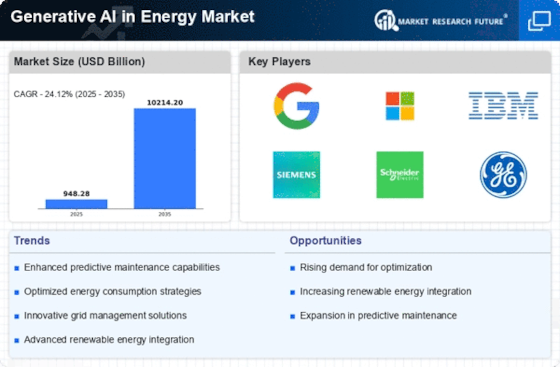
    Generative AI in Energy Market Infographic
    Purchase Options

    Market Trends

    Key Emerging Trends in the Generative AI in Energy Market

    Generative AI, a cutting-edge technology, has been making significant strides in various industries, including the energy sector. In recent years, market trends indicate a growing adoption of generative AI solutions in the energy market, promising transformative changes and enhanced efficiencies. One notable trend is the utilization of generative AI algorithms for optimizing energy production and distribution processes. These algorithms analyze vast amounts of data, ranging from weather patterns to demand forecasts, to generate optimal strategies for energy generation, storage, and distribution. By leveraging generative AI, energy companies can fine-tune their operations, minimize waste, and maximize output, ultimately leading to cost savings and improved sustainability.

    Another emerging trend in the energy market is the application of generative AI in predictive maintenance. Equipment failure and downtime can be costly for energy infrastructure, causing disruptions and financial losses. Generative AI algorithms can predict potential equipment failures by analyzing historical data and identifying patterns indicative of impending malfunctions. This proactive approach allows energy companies to schedule maintenance activities efficiently, minimizing downtime and optimizing asset utilization. Moreover, by implementing predictive maintenance powered by generative AI, companies can extend the lifespan of their equipment, reducing the need for frequent replacements and lowering overall operational costs

    Furthermore, generative AI is revolutionizing energy efficiency initiatives through the development of intelligent systems and devices. Smart grids, for example, leverage generative AI algorithms to optimize energy distribution and consumption in real-time. These systems analyze data from sensors embedded in infrastructure and consumer devices to dynamically adjust energy flows based on demand, availability, and pricing signals. By optimizing energy usage at both macro and micro levels, generative AI-driven smart grids contribute to a more resilient and sustainable energy ecosystem, reducing waste and greenhouse gas emissions.

    In addition to operational efficiency improvements, generative AI is driving innovation in renewable energy technologies. One notable trend is the use of generative AI for the design and optimization of solar panels, wind turbines, and other renewable energy systems. By simulating various configurations and environmental conditions, generative AI algorithms can identify optimal designs that maximize energy capture and efficiency. This iterative design process accelerates innovation in renewable energy technology, making clean energy sources more competitive and accessible.

    Moreover, generative AI is facilitating advancements in energy storage solutions, a critical component of transitioning to renewable energy sources. By analyzing consumption patterns and grid dynamics, generative AI algorithms can optimize the operation of energy storage systems, such as batteries and pumped hydro storage. These algorithms determine the most efficient times to charge and discharge energy storage units, balancing supply and demand fluctuations to ensure grid stability and reliability. As renewable energy sources become more prevalent, the role of energy storage in maintaining grid resilience grows, making generative AI-driven optimization crucial for maximizing the effectiveness of storage infrastructure.


    Author
    Aarti Dhapte
    Team Lead - Research

    She holds an experience of about 6+ years in Market Research and Business Consulting, working under the spectrum of Information Communication Technology, Telecommunications and Semiconductor domains. Aarti conceptualizes and implements a scalable business strategy and provides strategic leadership to the clients. Her expertise lies in market estimation, competitive intelligence, pipeline analysis, customer assessment, etc.

    Leave a Comment

    FAQs

    What is the projected market valuation for the Generative AI in Energy Market by 2035?

    <p>The projected market valuation for the Generative AI in Energy Market by 2035 is 10,214.2 USD Billion.</p>

    What was the overall market valuation of the Generative AI in Energy Market in 2024?

    <p>The overall market valuation of the Generative AI in Energy Market in 2024 was 948.28 USD Billion.</p>

    What is the expected CAGR for the Generative AI in Energy Market during the forecast period 2025 - 2035?

    <p>The expected CAGR for the Generative AI in Energy Market during the forecast period 2025 - 2035 is 24.12%.</p>

    Which companies are considered key players in the Generative AI in Energy Market?

    <p>Key players in the Generative AI in Energy Market include Google, Microsoft, IBM, Siemens, Schneider Electric, General Electric, Accenture, C3.ai, and Enel.</p>

    What are the main application segments of the Generative AI in Energy Market?

    <p>The main application segments include Energy Management, Predictive Maintenance, Demand Forecasting, and Grid Optimization.</p>

    How much was the valuation for the Demand Forecasting segment in 2024?

    <p>The valuation for the Demand Forecasting segment in 2024 was 300.0 USD Billion.</p>

    What is the projected valuation for the Renewable Energy segment by 2035?

    <p>The projected valuation for the Renewable Energy segment by 2035 is 4,000.0 USD Billion.</p>

    What technologies are driving the Generative AI in Energy Market?

    <p>Driving technologies include Machine Learning, Natural Language Processing, Computer Vision, and Robotics Process Automation.</p>

    What was the valuation for the Cloud deployment mode in 2024?

    <p>The valuation for the Cloud deployment mode in 2024 was 300.0 USD Billion.</p>

    What is the projected valuation for the Oil and Gas end-use segment by 2035?

    <p>The projected valuation for the Oil and Gas end-use segment by 2035 is 3,500.0 USD Billion.</p>

    Market Summary

    As per MRFR analysis, the Generative AI in Energy Market Size was estimated at 948.28 USD Billion in 2024. The Generative AI in Energy industry is projected to grow from 1177.01 USD Billion in 2025 to 10214.2 USD Billion by 2035, exhibiting a compound annual growth rate (CAGR) of 24.12 during the forecast period 2025 - 2035.

    Key Market Trends & Highlights

    The Generative AI in Energy Market is poised for substantial growth driven by technological advancements and increasing demand for efficiency.

    • Enhanced predictive maintenance is becoming a cornerstone for operational reliability in the energy sector.
    • AI-driven energy management systems are gaining traction, particularly in North America, to optimize resource allocation.
    • The integration of renewable energy sources is accelerating, especially in the Asia-Pacific region, as countries strive for sustainability.
    • Key market drivers include enhanced operational efficiency and improved decision-making processes, facilitating the adoption of AI technologies.

    Market Size & Forecast

    2024 Market Size 948.28 (USD Billion)
    2035 Market Size 10214.2 (USD Billion)
    CAGR (2025 - 2035) 24.12%
    Largest Regional Market Share in 2024 North America

    Major Players

    <p>Google (US), Microsoft (US), IBM (US), Siemens (DE), Schneider Electric (FR), General Electric (US), Accenture (IE), C3.ai (US), Enel (IT)</p>

    Market Trends

    The Generative AI in Energy Market is currently experiencing a transformative phase, driven by advancements in artificial intelligence technologies and the increasing demand for sustainable energy solutions. This market appears to be evolving rapidly. Organizations seek innovative ways to optimize energy production, distribution, and consumption. The integration of generative AI into energy systems may enhance predictive analytics, enabling more efficient resource management and reducing operational costs. Furthermore, the potential for AI-driven simulations and modeling could lead to improved decision-making processes, fostering a more resilient energy infrastructure. In addition, the Generative AI in Energy Market seems to be influenced by regulatory frameworks and environmental considerations. Governments worldwide are likely to promote the adoption of AI technologies to meet climate goals and enhance energy efficiency. As a result, collaborations between technology providers and energy companies may become increasingly common, facilitating the development of tailored solutions that address specific industry challenges. Overall, the Generative AI in Energy Market is poised for growth, with numerous opportunities for innovation and collaboration on the horizon.

    Enhanced Predictive Maintenance

    The Generative AI in Energy Market is witnessing a trend towards enhanced predictive maintenance strategies. By utilizing AI algorithms, energy companies can analyze vast amounts of operational data to predict equipment failures before they occur. This proactive approach not only minimizes downtime but also extends the lifespan of critical assets, ultimately leading to cost savings and improved reliability.

    AI-Driven Energy Management Systems

    Another notable trend is the emergence of AI-driven energy management systems. These systems leverage generative AI to optimize energy consumption across various sectors, including industrial, commercial, and residential. By analyzing real-time data, these systems can adjust energy usage patterns, leading to increased efficiency and reduced waste.

    Integration of Renewable Energy Sources

    The integration of renewable energy sources into existing grids is becoming increasingly feasible due to advancements in generative AI. This trend suggests that AI can facilitate the seamless incorporation of solar, wind, and other renewable energies into traditional energy systems. By optimizing the balance between supply and demand, generative AI may enhance grid stability and promote a more sustainable energy future.

    Generative AI in Energy Market Market Drivers

    Enhanced Operational Efficiency

    The integration of Generative AI in Energy Market appears to enhance operational efficiency across various sectors. By leveraging advanced algorithms, energy companies can optimize their supply chains, reduce waste, and improve resource allocation. For instance, predictive analytics powered by Generative AI can forecast energy demand with remarkable accuracy, potentially leading to a 20% reduction in operational costs. This efficiency not only benefits the companies but also contributes to a more sustainable energy ecosystem. As energy consumption patterns evolve, the ability to adapt and respond swiftly becomes crucial. Therefore, the adoption of Generative AI technologies is likely to be a driving force in achieving operational excellence in the energy sector.

    Improved Decision-Making Processes

    Generative AI in Energy Market is poised to revolutionize decision-making processes by providing data-driven insights. The ability to analyze vast datasets in real-time allows energy companies to make informed decisions regarding resource management and investment strategies. For example, a recent study indicates that organizations utilizing AI-driven analytics have experienced a 15% increase in decision-making speed. This acceleration is critical in a rapidly changing energy landscape, where timely decisions can lead to competitive advantages. Furthermore, the insights generated by AI can help identify emerging trends and potential risks, enabling companies to navigate uncertainties more effectively. Thus, the role of Generative AI in enhancing decision-making capabilities cannot be overstated.

    Cost Reduction in Energy Production

    Generative AI in Energy Market is associated with substantial cost reductions in energy production. By automating various processes and optimizing resource allocation, companies can significantly lower their operational expenses. For example, AI-driven predictive maintenance can reduce equipment downtime by up to 25%, leading to lower maintenance costs and increased productivity. Additionally, the ability to analyze market trends and consumer behavior allows companies to adjust their production strategies accordingly, further enhancing profitability. As energy prices fluctuate, the need for cost-effective production methods becomes increasingly pressing. Therefore, the adoption of Generative AI technologies is likely to be a key factor in driving down costs in the energy sector.

    Enhanced Customer Engagement and Experience

    The implementation of Generative AI in Energy Market is transforming customer engagement and experience. By utilizing AI-driven chatbots and personalized communication strategies, energy companies can provide tailored services to their customers. This approach not only improves customer satisfaction but also fosters loyalty. Data indicates that companies employing AI for customer interactions have seen a 20% increase in customer retention rates. Furthermore, AI can analyze customer usage patterns, enabling companies to offer customized energy solutions that meet individual needs. As the energy market becomes more competitive, enhancing customer experience through Generative AI will likely be a crucial differentiator for companies aiming to thrive in this evolving landscape.

    Facilitation of Renewable Energy Integration

    The role of Generative AI in Energy Market is increasingly vital in facilitating the integration of renewable energy sources. As the demand for clean energy rises, AI technologies can optimize the management of diverse energy inputs, such as solar and wind. For instance, AI algorithms can predict energy generation from renewable sources, allowing for better grid management and reducing reliance on fossil fuels. Reports suggest that the implementation of AI in energy systems could lead to a 30% increase in the efficiency of renewable energy utilization. This integration not only supports sustainability goals but also enhances energy security by diversifying energy sources. Consequently, Generative AI is likely to play a pivotal role in shaping the future of energy production.

    Market Segment Insights

    By Application: Energy Management (Largest) vs. Predictive Maintenance (Fastest-Growing)

    <p>The application segment of the Generative AI in Energy Market is characterized by a diverse array of functionalities aimed at optimizing energy usage and efficiency. Energy Management currently holds the largest market share, leveraging AI technologies to enhance energy consumption strategies and reduce wastage, especially in industrial settings. In contrast, Predictive Maintenance is rapidly gaining traction, offering innovative solutions that prevent equipment failures before they occur, thereby minimizing downtime and maintenance costs.</p>

    <p>Energy Management (Dominant) vs. Predictive Maintenance (Emerging)</p>

    <p>Energy Management employs advanced AI tools to analyze consumption patterns, optimize resource allocation, and drive sustainability initiatives, making it a crucial component in energy operations. It enables organizations to make informed decisions that align with regulatory standards while maximizing efficiency. On the other hand, Predictive Maintenance represents an emerging trend within the market, utilizing AI algorithms to forecast equipment needs based on real-time data, which is crucial for operational resilience. The integration of generative AI opens new avenues for both analysts and operators in refining maintenance schedules and enhancing system reliability.</p>

    By Technology: Machine Learning (Largest) vs. Natural Language Processing (Fastest-Growing)

    <p>In the Generative AI in Energy Market, Machine Learning stands as the largest segment, capturing a substantial share of the total market due to its widespread applications in predictive maintenance, optimization of energy consumption, and demand forecasting. Natural Language Processing, while currently smaller in proportion, is swiftly gaining traction and represents the fastest-growing technology segment as organizations seek innovative ways to analyze vast amounts of textual data and improve customer interactions.</p>

    <p>Technology: Machine Learning (Dominant) vs. Natural Language Processing (Emerging)</p>

    <p>Machine Learning has established itself as the dominant technology in the Generative AI in Energy Market, enabling sophisticated analytics and automation in processes such as energy distribution and consumption optimization. Its capabilities in data processing and predictive analytics make it essential for decision-making within energy sectors. Conversely, Natural Language Processing is poised to emerge as a crucial technology, enhancing user interactions through chatbots and intelligent systems that interpret human language. Its rapid evolution and ability to derive insights from unstructured data position it as a transformative force in the energy sector, offering valuable enhancements to operational efficiency and service delivery.</p>

    By End Use: Power Generation (Largest) vs. Renewable Energy (Fastest-Growing)

    <p>The Generative AI in Energy Market is witnessing a diverse distribution in its end-use segments, with Power Generation holding the largest market share. This segment is benefiting from the increasing demand for efficient electricity generation methods and real-time optimization processes powered by AI technologies. Meanwhile, Renewable Energy is emerging rapidly as an influential player, encouraged by environmental sustainability initiatives and advancements in AI-driven energy management systems. This shift indicates an evolving landscape where traditional energy sectors collaborate with innovative technologies to enhance performance and sustainability. Growth trends within the Generative AI in Energy Market are shaped by several factors. Specifically, the Power Generation sector is expanding due to rising energy demands and the necessity for smart grid solutions, while the Renewable Energy sector is experiencing the fastest growth attributed to significant investments and supportive government initiatives aimed at reducing carbon emissions. The adoption of AI technologies in these segments not only drives efficiency but also enhances decision-making processes, encouraging a transition towards more sustainable energy practices.</p>

    <p>Power Generation (Dominant) vs. Oil and Gas (Emerging)</p>

    <p>Power Generation stands out as the dominant segment in the Generative AI in Energy Market, primarily leveraging AI technologies to optimize energy generation and distribution processes. This segment benefits from established infrastructure and a crucial role in meeting the global electricity demand. In contrast, the Oil and Gas segment is emerging as a pivotal area for AI application, focusing on operational efficiency and predictive maintenance. Although it currently holds a smaller market presence compared to Power Generation, the Oil and Gas sector is significantly investing in generative AI to streamline exploration and production activities, making it a vital player in the evolving energy landscape.</p>

    By Deployment Mode: Cloud (Largest) vs. On-Premises (Fastest-Growing)

    <p>In the Generative AI in Energy Market, the deployment mode is pivotal, with the Cloud segment holding the largest market share. This segment benefits from scalability, flexibility, and lower upfront costs, making it the preferred choice for many energy companies. On-Premises solutions have a significant, though smaller, market presence, catering to organizations with stringent data security and compliance requirements. Hybrid models, meanwhile, are growing steadily, offering the best of both worlds to businesses seeking both security and flexibility in their deployment preferences. Growth trends indicate that while the Cloud remains dominant, On-Premises deployment is emerging as the fastest-growing mode. This rise is driven by the increasing need for enhanced security and control over data, particularly in sensitive energy sectors, as well as regulatory pressures that compel firms to manage their data more closely. Furthermore, advancements in hybrid models show that companies increasingly prefer a blended approach, allowing them to capitalize on the benefits of both Cloud and On-Premises solutions, fostering innovation and efficiency in energy operations.</p>

    <p>Cloud (Dominant) vs. On-Premises (Emerging)</p>

    <p>The Cloud deployment mode has established itself as the dominant player in the Generative AI in Energy Market. Its strengths lie in providing scalable resources, facilitating rapid deployment, and enabling cost-efficient operations, which are crucial in an industry marked by fluctuations in demand and resource availability. Companies leveraging Cloud solutions can quickly adapt to technological advancements and shifting market needs. In contrast, the On-Premises segment represents an emerging alternative, characterized by its focus on data control, security, and compliance that many energy firms require. On-Premises solutions enable organizations to manage their infrastructure directly, making it a vital choice for businesses handling sensitive energy data. While it may not have the expansive reach of Cloud, its growth signals a shift in market dynamics as companies seek tailored solutions that align with their strategic goals.</p>

    Get more detailed insights about Generative AI in Energy Market Research Report - Forecast till 2035

    Regional Insights

    North America : Innovation and Investment Hub

    North America is the largest market for Generative AI in the energy sector, holding approximately 45% of the global market share. The region benefits from significant investments in AI technologies, driven by a strong focus on sustainability and efficiency. Regulatory support, such as the U.S. Department of Energy's initiatives, further catalyzes growth, encouraging innovation and adoption of AI solutions in energy management. The United States is the dominant player, with major companies like Google, Microsoft, and IBM leading the charge. Canada is also emerging as a significant market, focusing on renewable energy solutions. The competitive landscape is characterized by collaborations between tech giants and energy firms, fostering advancements in AI applications for energy optimization and predictive maintenance.

    Europe : Sustainable Energy Transition Leader

    Europe is the second-largest market for Generative AI in the energy sector, accounting for around 30% of the global market share. The region's commitment to sustainability and the European Green Deal are key drivers of demand for AI technologies. Regulatory frameworks are increasingly supportive, promoting the integration of AI in energy systems to enhance efficiency and reduce carbon emissions. Leading countries include Germany, France, and Italy, with companies like Siemens, Schneider Electric, and Enel at the forefront. The competitive landscape is marked by a strong emphasis on innovation and collaboration among tech and energy sectors. European firms are leveraging AI to optimize energy consumption and improve grid management, positioning themselves as leaders in the global market.

    Asia-Pacific : Emerging Powerhouse in AI

    Asia-Pacific is witnessing rapid growth in the Generative AI energy market, holding approximately 20% of the global market share. The region's increasing energy demands, coupled with a push for renewable energy sources, are driving the adoption of AI technologies. Government initiatives in countries like China and India are pivotal, focusing on smart grid technologies and energy efficiency improvements. China is the largest market in the region, with significant investments from state-owned enterprises in AI applications for energy management. India is also emerging as a key player, with a growing number of startups focusing on AI solutions for energy efficiency. The competitive landscape is characterized by a mix of established companies and innovative startups, all vying for a share of the burgeoning market.

    Middle East and Africa : Resource-Rich Frontier

    The Middle East and Africa region is gradually adopting Generative AI in the energy sector, holding about 5% of the global market share. The region's rich natural resources and the need for efficient energy management are driving interest in AI technologies. Governments are increasingly recognizing the potential of AI to optimize energy production and consumption, with initiatives aimed at enhancing energy efficiency and sustainability. Leading countries include the United Arab Emirates and South Africa, where investments in AI technologies are on the rise. The competitive landscape is evolving, with both local and international players entering the market. Companies are focusing on AI applications for predictive maintenance and resource management, aiming to improve operational efficiency in the energy sector.

    Key Players and Competitive Insights

    The Generative AI in Energy Market is currently characterized by a dynamic competitive landscape, driven by the increasing demand for innovative solutions that enhance operational efficiency and sustainability. Major players such as Google (US), Microsoft (US), and Siemens (DE) are strategically positioning themselves through a combination of technological innovation and strategic partnerships. Google (US) focuses on leveraging its cloud computing capabilities to provide AI-driven analytics for energy management, while Microsoft (US) emphasizes its Azure platform to facilitate AI integration in energy systems. Siemens (DE), on the other hand, is concentrating on digital transformation initiatives that enhance grid management and renewable energy integration. Collectively, these strategies not only foster competition but also drive the market towards more sustainable energy solutions.

    In terms of business tactics, companies are increasingly localizing their operations and optimizing supply chains to enhance responsiveness to market demands. The competitive structure of the Generative AI in Energy Market appears moderately fragmented, with several key players exerting influence across various segments. This fragmentation allows for a diverse range of innovations and solutions, although it also necessitates that companies differentiate themselves through unique value propositions and technological advancements.

    In August 2025, Google (US) announced a partnership with a leading renewable energy provider to develop AI algorithms that optimize energy distribution in real-time. This strategic move is significant as it not only enhances Google's position in the energy sector but also aligns with global sustainability goals, potentially leading to more efficient energy consumption patterns. Such collaborations may serve to bolster Google's competitive edge by integrating advanced AI capabilities into practical energy solutions.

    In September 2025, Microsoft (US) unveiled a new suite of AI tools designed specifically for energy companies, aimed at improving predictive maintenance and operational efficiency. This initiative underscores Microsoft's commitment to driving digital transformation within the energy sector. By providing tailored solutions that address specific industry challenges, Microsoft is likely to strengthen its market presence and foster deeper customer relationships, which could be pivotal in a rapidly evolving landscape.

    In July 2025, Siemens (DE) launched a new AI-driven platform that enhances the management of decentralized energy resources. This platform is particularly relevant as it addresses the growing need for efficient integration of renewable energy sources into existing grids. Siemens' focus on innovation in this area suggests a proactive approach to meeting future energy demands, positioning the company as a leader in the transition towards a more sustainable energy ecosystem.

    As of October 2025, the competitive trends in the Generative AI in Energy Market are increasingly defined by digitalization, sustainability, and the integration of AI technologies. Strategic alliances among key players are shaping the landscape, fostering innovation and collaboration. Looking ahead, it appears that competitive differentiation will increasingly hinge on technological advancements and supply chain reliability, rather than solely on price. This shift indicates a broader trend towards innovation-driven competition, where companies that prioritize cutting-edge solutions and sustainable practices are likely to emerge as leaders in the market.

    Key Companies in the Generative AI in Energy Market market include

    Industry Developments

    Recent developments in the Generative AI in Energy Market indicate a significant push towards innovation and efficiency. Siemens has enhanced anomaly detection and asset diagnostics by incorporating AI tools into its SIPROTEC and SICAM grid management systems. Schneider Electric employs artificial intelligence (AI) in its EcoStruxure platform to optimize microgrids, forecast demand in real time, and conduct efficiency analyses.

    Both organizations have publicly increased their AI investments from 2023 to 2024 in order to improve the performance of smart grids.NVIDIA has been actively engaged in collaboration with energy firms to develop AI models for demand forecasting, renewable generation optimization, and energy-efficient data centers. However, there was no single initiative that was specifically emphasized in late 2023 that focused on generative AI energy models.GE Digital (a subsidiary of GE Vernova) has progressively expanded its strategy of integrating its Predix and Digital Twin platforms to provide ML-driven predictive maintenance for industrial equipment and turbines throughout 2023–2024.

    Future Outlook

    Generative AI in Energy Market Future Outlook

    <p>The Generative AI in Energy Market is projected to grow at a 24.12% CAGR from 2024 to 2035, driven by advancements in predictive analytics, operational efficiency, and renewable energy integration.</p>

    New opportunities lie in:

    • <p>Development of AI-driven predictive maintenance solutions for energy infrastructure.</p>
    • <p>Creation of personalized energy management platforms for consumers.</p>
    • <p>Implementation of AI-enhanced grid optimization technologies for utilities.</p>

    <p>By 2035, the market is expected to be robust, driven by innovative AI applications and increased energy efficiency.</p>

    Market Segmentation

    Generative AI in Energy Market End Use Outlook

    • Power Generation
    • Oil and Gas
    • Renewable Energy
    • Nuclear Energy

    Generative AI in Energy Market Technology Outlook

    • Machine Learning
    • Natural Language Processing
    • Computer Vision
    • Robotics Process Automation

    Generative AI in Energy Market Application Outlook

    • Energy Management
    • Predictive Maintenance
    • Demand Forecasting
    • Grid Optimization

    Generative AI in Energy Market Deployment Mode Outlook

    • Cloud
    • On-Premises
    • Hybrid

    Report Scope

    MARKET SIZE 2024948.28(USD Billion)
    MARKET SIZE 20251177.01(USD Billion)
    MARKET SIZE 203510214.2(USD Billion)
    COMPOUND ANNUAL GROWTH RATE (CAGR)24.12% (2024 - 2035)
    REPORT COVERAGERevenue Forecast, Competitive Landscape, Growth Factors, and Trends
    BASE YEAR2024
    Market Forecast Period2025 - 2035
    Historical Data2019 - 2024
    Market Forecast UnitsUSD Billion
    Key Companies ProfiledMarket analysis in progress
    Segments CoveredMarket segmentation analysis in progress
    Key Market OpportunitiesIntegration of Generative AI for optimizing energy consumption and enhancing predictive maintenance in renewable energy systems.
    Key Market DynamicsRising integration of Generative Artificial Intelligence enhances operational efficiency and innovation in energy sector applications.
    Countries CoveredNorth America, Europe, APAC, South America, MEA

    FAQs

    What is the projected market valuation for the Generative AI in Energy Market by 2035?

    <p>The projected market valuation for the Generative AI in Energy Market by 2035 is 10,214.2 USD Billion.</p>

    What was the overall market valuation of the Generative AI in Energy Market in 2024?

    <p>The overall market valuation of the Generative AI in Energy Market in 2024 was 948.28 USD Billion.</p>

    What is the expected CAGR for the Generative AI in Energy Market during the forecast period 2025 - 2035?

    <p>The expected CAGR for the Generative AI in Energy Market during the forecast period 2025 - 2035 is 24.12%.</p>

    Which companies are considered key players in the Generative AI in Energy Market?

    <p>Key players in the Generative AI in Energy Market include Google, Microsoft, IBM, Siemens, Schneider Electric, General Electric, Accenture, C3.ai, and Enel.</p>

    What are the main application segments of the Generative AI in Energy Market?

    <p>The main application segments include Energy Management, Predictive Maintenance, Demand Forecasting, and Grid Optimization.</p>

    How much was the valuation for the Demand Forecasting segment in 2024?

    <p>The valuation for the Demand Forecasting segment in 2024 was 300.0 USD Billion.</p>

    What is the projected valuation for the Renewable Energy segment by 2035?

    <p>The projected valuation for the Renewable Energy segment by 2035 is 4,000.0 USD Billion.</p>

    What technologies are driving the Generative AI in Energy Market?

    <p>Driving technologies include Machine Learning, Natural Language Processing, Computer Vision, and Robotics Process Automation.</p>

    What was the valuation for the Cloud deployment mode in 2024?

    <p>The valuation for the Cloud deployment mode in 2024 was 300.0 USD Billion.</p>

    What is the projected valuation for the Oil and Gas end-use segment by 2035?

    <p>The projected valuation for the Oil and Gas end-use segment by 2035 is 3,500.0 USD Billion.</p>

    1. SECTION I: EXECUTIVE SUMMARY AND KEY HIGHLIGHTS
      1. EXECUTIVE SUMMARY
        1. Market Overview
        2. Key Findings
        3. Market Segmentation
        4. Competitive Landscape
        5. Challenges and Opportunities
        6. Future Outlook
    2. SECTION II: SCOPING, METHODOLOGY AND MARKET STRUCTURE
      1. MARKET INTRODUCTION
        1. Definition
        2. Scope of the study
      2. RESEARCH METHODOLOGY
        1. Overview
        2. Data Mining
        3. Secondary Research
        4. Primary Research
        5. Forecasting Model
        6. Market Size Estimation
        7. Data Triangulation
        8. Validation
    3. SECTION III: QUALITATIVE ANALYSIS
      1. MARKET DYNAMICS
        1. Overview
        2. Drivers
        3. Restraints
        4. Opportunities
      2. MARKET FACTOR ANALYSIS
        1. Value chain Analysis
        2. Porter's Five Forces Analysis
        3. COVID-19 Impact Analysis
    4. SECTION IV: QUANTITATIVE ANALYSIS
      1. Information and Communications Technology, BY Application (USD Billion)
        1. Energy Management
        2. Predictive Maintenance
        3. Demand Forecasting
        4. Grid Optimization
      2. Information and Communications Technology, BY Technology (USD Billion)
        1. Machine Learning
        2. Natural Language Processing
        3. Computer Vision
        4. Robotics Process Automation
      3. Information and Communications Technology, BY End Use (USD Billion)
        1. Power Generation
        2. Oil and Gas
        3. Renewable Energy
        4. Nuclear Energy
      4. Information and Communications Technology, BY Deployment Mode (USD Billion)
        1. Cloud
        2. On-Premises
        3. Hybrid
      5. Information and Communications Technology, BY Region (USD Billion)
        1. North America
        2. Europe
        3. APAC
        4. South America
        5. MEA
    5. SECTION V: COMPETITIVE ANALYSIS
      1. Competitive Landscape
        1. Overview
        2. Competitive Analysis
        3. Market share Analysis
        4. Major Growth Strategy in the Information and Communications Technology
        5. Competitive Benchmarking
        6. Leading Players in Terms of Number of Developments in the Information and Communications Technology
        7. Key developments and growth strategies
        8. Major Players Financial Matrix
      2. Company Profiles
        1. Google (US)
        2. Microsoft (US)
        3. IBM (US)
        4. Siemens (DE)
        5. Schneider Electric (FR)
        6. General Electric (US)
        7. Accenture (IE)
        8. C3.ai (US)
        9. Enel (IT)
      3. Appendix
        1. References
        2. Related Reports
    6. LIST OF FIGURES
      1. MARKET SYNOPSIS
      2. NORTH AMERICA MARKET ANALYSIS
      3. US MARKET ANALYSIS BY APPLICATION
      4. US MARKET ANALYSIS BY TECHNOLOGY
      5. US MARKET ANALYSIS BY END USE
      6. US MARKET ANALYSIS BY DEPLOYMENT MODE
      7. CANADA MARKET ANALYSIS BY APPLICATION
      8. CANADA MARKET ANALYSIS BY TECHNOLOGY
      9. CANADA MARKET ANALYSIS BY END USE
      10. CANADA MARKET ANALYSIS BY DEPLOYMENT MODE
      11. EUROPE MARKET ANALYSIS
      12. GERMANY MARKET ANALYSIS BY APPLICATION
      13. GERMANY MARKET ANALYSIS BY TECHNOLOGY
      14. GERMANY MARKET ANALYSIS BY END USE
      15. GERMANY MARKET ANALYSIS BY DEPLOYMENT MODE
      16. UK MARKET ANALYSIS BY APPLICATION
      17. UK MARKET ANALYSIS BY TECHNOLOGY
      18. UK MARKET ANALYSIS BY END USE
      19. UK MARKET ANALYSIS BY DEPLOYMENT MODE
      20. FRANCE MARKET ANALYSIS BY APPLICATION
      21. FRANCE MARKET ANALYSIS BY TECHNOLOGY
      22. FRANCE MARKET ANALYSIS BY END USE
      23. FRANCE MARKET ANALYSIS BY DEPLOYMENT MODE
      24. RUSSIA MARKET ANALYSIS BY APPLICATION
      25. RUSSIA MARKET ANALYSIS BY TECHNOLOGY
      26. RUSSIA MARKET ANALYSIS BY END USE
      27. RUSSIA MARKET ANALYSIS BY DEPLOYMENT MODE
      28. ITALY MARKET ANALYSIS BY APPLICATION
      29. ITALY MARKET ANALYSIS BY TECHNOLOGY
      30. ITALY MARKET ANALYSIS BY END USE
      31. ITALY MARKET ANALYSIS BY DEPLOYMENT MODE
      32. SPAIN MARKET ANALYSIS BY APPLICATION
      33. SPAIN MARKET ANALYSIS BY TECHNOLOGY
      34. SPAIN MARKET ANALYSIS BY END USE
      35. SPAIN MARKET ANALYSIS BY DEPLOYMENT MODE
      36. REST OF EUROPE MARKET ANALYSIS BY APPLICATION
      37. REST OF EUROPE MARKET ANALYSIS BY TECHNOLOGY
      38. REST OF EUROPE MARKET ANALYSIS BY END USE
      39. REST OF EUROPE MARKET ANALYSIS BY DEPLOYMENT MODE
      40. APAC MARKET ANALYSIS
      41. CHINA MARKET ANALYSIS BY APPLICATION
      42. CHINA MARKET ANALYSIS BY TECHNOLOGY
      43. CHINA MARKET ANALYSIS BY END USE
      44. CHINA MARKET ANALYSIS BY DEPLOYMENT MODE
      45. INDIA MARKET ANALYSIS BY APPLICATION
      46. INDIA MARKET ANALYSIS BY TECHNOLOGY
      47. INDIA MARKET ANALYSIS BY END USE
      48. INDIA MARKET ANALYSIS BY DEPLOYMENT MODE
      49. JAPAN MARKET ANALYSIS BY APPLICATION
      50. JAPAN MARKET ANALYSIS BY TECHNOLOGY
      51. JAPAN MARKET ANALYSIS BY END USE
      52. JAPAN MARKET ANALYSIS BY DEPLOYMENT MODE
      53. SOUTH KOREA MARKET ANALYSIS BY APPLICATION
      54. SOUTH KOREA MARKET ANALYSIS BY TECHNOLOGY
      55. SOUTH KOREA MARKET ANALYSIS BY END USE
      56. SOUTH KOREA MARKET ANALYSIS BY DEPLOYMENT MODE
      57. MALAYSIA MARKET ANALYSIS BY APPLICATION
      58. MALAYSIA MARKET ANALYSIS BY TECHNOLOGY
      59. MALAYSIA MARKET ANALYSIS BY END USE
      60. MALAYSIA MARKET ANALYSIS BY DEPLOYMENT MODE
      61. THAILAND MARKET ANALYSIS BY APPLICATION
      62. THAILAND MARKET ANALYSIS BY TECHNOLOGY
      63. THAILAND MARKET ANALYSIS BY END USE
      64. THAILAND MARKET ANALYSIS BY DEPLOYMENT MODE
      65. INDONESIA MARKET ANALYSIS BY APPLICATION
      66. INDONESIA MARKET ANALYSIS BY TECHNOLOGY
      67. INDONESIA MARKET ANALYSIS BY END USE
      68. INDONESIA MARKET ANALYSIS BY DEPLOYMENT MODE
      69. REST OF APAC MARKET ANALYSIS BY APPLICATION
      70. REST OF APAC MARKET ANALYSIS BY TECHNOLOGY
      71. REST OF APAC MARKET ANALYSIS BY END USE
      72. REST OF APAC MARKET ANALYSIS BY DEPLOYMENT MODE
      73. SOUTH AMERICA MARKET ANALYSIS
      74. BRAZIL MARKET ANALYSIS BY APPLICATION
      75. BRAZIL MARKET ANALYSIS BY TECHNOLOGY
      76. BRAZIL MARKET ANALYSIS BY END USE
      77. BRAZIL MARKET ANALYSIS BY DEPLOYMENT MODE
      78. MEXICO MARKET ANALYSIS BY APPLICATION
      79. MEXICO MARKET ANALYSIS BY TECHNOLOGY
      80. MEXICO MARKET ANALYSIS BY END USE
      81. MEXICO MARKET ANALYSIS BY DEPLOYMENT MODE
      82. ARGENTINA MARKET ANALYSIS BY APPLICATION
      83. ARGENTINA MARKET ANALYSIS BY TECHNOLOGY
      84. ARGENTINA MARKET ANALYSIS BY END USE
      85. ARGENTINA MARKET ANALYSIS BY DEPLOYMENT MODE
      86. REST OF SOUTH AMERICA MARKET ANALYSIS BY APPLICATION
      87. REST OF SOUTH AMERICA MARKET ANALYSIS BY TECHNOLOGY
      88. REST OF SOUTH AMERICA MARKET ANALYSIS BY END USE
      89. REST OF SOUTH AMERICA MARKET ANALYSIS BY DEPLOYMENT MODE
      90. MEA MARKET ANALYSIS
      91. GCC COUNTRIES MARKET ANALYSIS BY APPLICATION
      92. GCC COUNTRIES MARKET ANALYSIS BY TECHNOLOGY
      93. GCC COUNTRIES MARKET ANALYSIS BY END USE
      94. GCC COUNTRIES MARKET ANALYSIS BY DEPLOYMENT MODE
      95. SOUTH AFRICA MARKET ANALYSIS BY APPLICATION
      96. SOUTH AFRICA MARKET ANALYSIS BY TECHNOLOGY
      97. SOUTH AFRICA MARKET ANALYSIS BY END USE
      98. SOUTH AFRICA MARKET ANALYSIS BY DEPLOYMENT MODE
      99. REST OF MEA MARKET ANALYSIS BY APPLICATION
      100. REST OF MEA MARKET ANALYSIS BY TECHNOLOGY
      101. REST OF MEA MARKET ANALYSIS BY END USE
      102. REST OF MEA MARKET ANALYSIS BY DEPLOYMENT MODE
      103. KEY BUYING CRITERIA OF INFORMATION AND COMMUNICATIONS TECHNOLOGY
      104. RESEARCH PROCESS OF MRFR
      105. DRO ANALYSIS OF INFORMATION AND COMMUNICATIONS TECHNOLOGY
      106. DRIVERS IMPACT ANALYSIS: INFORMATION AND COMMUNICATIONS TECHNOLOGY
      107. RESTRAINTS IMPACT ANALYSIS: INFORMATION AND COMMUNICATIONS TECHNOLOGY
      108. SUPPLY / VALUE CHAIN: INFORMATION AND COMMUNICATIONS TECHNOLOGY
      109. INFORMATION AND COMMUNICATIONS TECHNOLOGY, BY APPLICATION, 2024 (% SHARE)
      110. INFORMATION AND COMMUNICATIONS TECHNOLOGY, BY APPLICATION, 2024 TO 2035 (USD Billion)
      111. INFORMATION AND COMMUNICATIONS TECHNOLOGY, BY TECHNOLOGY, 2024 (% SHARE)
      112. INFORMATION AND COMMUNICATIONS TECHNOLOGY, BY TECHNOLOGY, 2024 TO 2035 (USD Billion)
      113. INFORMATION AND COMMUNICATIONS TECHNOLOGY, BY END USE, 2024 (% SHARE)
      114. INFORMATION AND COMMUNICATIONS TECHNOLOGY, BY END USE, 2024 TO 2035 (USD Billion)
      115. INFORMATION AND COMMUNICATIONS TECHNOLOGY, BY DEPLOYMENT MODE, 2024 (% SHARE)
      116. INFORMATION AND COMMUNICATIONS TECHNOLOGY, BY DEPLOYMENT MODE, 2024 TO 2035 (USD Billion)
      117. BENCHMARKING OF MAJOR COMPETITORS
    7. LIST OF TABLES
      1. LIST OF ASSUMPTIONS
      2. 7.1.1
      3. North America MARKET SIZE ESTIMATES; FORECAST
        1. BY APPLICATION, 2025-2035 (USD Billion)
        2. BY TECHNOLOGY, 2025-2035 (USD Billion)
        3. BY END USE, 2025-2035 (USD Billion)
        4. BY DEPLOYMENT MODE, 2025-2035 (USD Billion)
      4. US MARKET SIZE ESTIMATES; FORECAST
        1. BY APPLICATION, 2025-2035 (USD Billion)
        2. BY TECHNOLOGY, 2025-2035 (USD Billion)
        3. BY END USE, 2025-2035 (USD Billion)
        4. BY DEPLOYMENT MODE, 2025-2035 (USD Billion)
      5. Canada MARKET SIZE ESTIMATES; FORECAST
        1. BY APPLICATION, 2025-2035 (USD Billion)
        2. BY TECHNOLOGY, 2025-2035 (USD Billion)
        3. BY END USE, 2025-2035 (USD Billion)
        4. BY DEPLOYMENT MODE, 2025-2035 (USD Billion)
      6. Europe MARKET SIZE ESTIMATES; FORECAST
        1. BY APPLICATION, 2025-2035 (USD Billion)
        2. BY TECHNOLOGY, 2025-2035 (USD Billion)
        3. BY END USE, 2025-2035 (USD Billion)
        4. BY DEPLOYMENT MODE, 2025-2035 (USD Billion)
      7. Germany MARKET SIZE ESTIMATES; FORECAST
        1. BY APPLICATION, 2025-2035 (USD Billion)
        2. BY TECHNOLOGY, 2025-2035 (USD Billion)
        3. BY END USE, 2025-2035 (USD Billion)
        4. BY DEPLOYMENT MODE, 2025-2035 (USD Billion)
      8. UK MARKET SIZE ESTIMATES; FORECAST
        1. BY APPLICATION, 2025-2035 (USD Billion)
        2. BY TECHNOLOGY, 2025-2035 (USD Billion)
        3. BY END USE, 2025-2035 (USD Billion)
        4. BY DEPLOYMENT MODE, 2025-2035 (USD Billion)
      9. France MARKET SIZE ESTIMATES; FORECAST
        1. BY APPLICATION, 2025-2035 (USD Billion)
        2. BY TECHNOLOGY, 2025-2035 (USD Billion)
        3. BY END USE, 2025-2035 (USD Billion)
        4. BY DEPLOYMENT MODE, 2025-2035 (USD Billion)
      10. Russia MARKET SIZE ESTIMATES; FORECAST
        1. BY APPLICATION, 2025-2035 (USD Billion)
        2. BY TECHNOLOGY, 2025-2035 (USD Billion)
        3. BY END USE, 2025-2035 (USD Billion)
        4. BY DEPLOYMENT MODE, 2025-2035 (USD Billion)
      11. Italy MARKET SIZE ESTIMATES; FORECAST
        1. BY APPLICATION, 2025-2035 (USD Billion)
        2. BY TECHNOLOGY, 2025-2035 (USD Billion)
        3. BY END USE, 2025-2035 (USD Billion)
        4. BY DEPLOYMENT MODE, 2025-2035 (USD Billion)
      12. Spain MARKET SIZE ESTIMATES; FORECAST
        1. BY APPLICATION, 2025-2035 (USD Billion)
        2. BY TECHNOLOGY, 2025-2035 (USD Billion)
        3. BY END USE, 2025-2035 (USD Billion)
        4. BY DEPLOYMENT MODE, 2025-2035 (USD Billion)
      13. Rest of Europe MARKET SIZE ESTIMATES; FORECAST
        1. BY APPLICATION, 2025-2035 (USD Billion)
        2. BY TECHNOLOGY, 2025-2035 (USD Billion)
        3. BY END USE, 2025-2035 (USD Billion)
        4. BY DEPLOYMENT MODE, 2025-2035 (USD Billion)
      14. APAC MARKET SIZE ESTIMATES; FORECAST
        1. BY APPLICATION, 2025-2035 (USD Billion)
        2. BY TECHNOLOGY, 2025-2035 (USD Billion)
        3. BY END USE, 2025-2035 (USD Billion)
        4. BY DEPLOYMENT MODE, 2025-2035 (USD Billion)
      15. China MARKET SIZE ESTIMATES; FORECAST
        1. BY APPLICATION, 2025-2035 (USD Billion)
        2. BY TECHNOLOGY, 2025-2035 (USD Billion)
        3. BY END USE, 2025-2035 (USD Billion)
        4. BY DEPLOYMENT MODE, 2025-2035 (USD Billion)
      16. India MARKET SIZE ESTIMATES; FORECAST
        1. BY APPLICATION, 2025-2035 (USD Billion)
        2. BY TECHNOLOGY, 2025-2035 (USD Billion)
        3. BY END USE, 2025-2035 (USD Billion)
        4. BY DEPLOYMENT MODE, 2025-2035 (USD Billion)
      17. Japan MARKET SIZE ESTIMATES; FORECAST
        1. BY APPLICATION, 2025-2035 (USD Billion)
        2. BY TECHNOLOGY, 2025-2035 (USD Billion)
        3. BY END USE, 2025-2035 (USD Billion)
        4. BY DEPLOYMENT MODE, 2025-2035 (USD Billion)
      18. South Korea MARKET SIZE ESTIMATES; FORECAST
        1. BY APPLICATION, 2025-2035 (USD Billion)
        2. BY TECHNOLOGY, 2025-2035 (USD Billion)
        3. BY END USE, 2025-2035 (USD Billion)
        4. BY DEPLOYMENT MODE, 2025-2035 (USD Billion)
      19. Malaysia MARKET SIZE ESTIMATES; FORECAST
        1. BY APPLICATION, 2025-2035 (USD Billion)
        2. BY TECHNOLOGY, 2025-2035 (USD Billion)
        3. BY END USE, 2025-2035 (USD Billion)
        4. BY DEPLOYMENT MODE, 2025-2035 (USD Billion)
      20. Thailand MARKET SIZE ESTIMATES; FORECAST
        1. BY APPLICATION, 2025-2035 (USD Billion)
        2. BY TECHNOLOGY, 2025-2035 (USD Billion)
        3. BY END USE, 2025-2035 (USD Billion)
        4. BY DEPLOYMENT MODE, 2025-2035 (USD Billion)
      21. Indonesia MARKET SIZE ESTIMATES; FORECAST
        1. BY APPLICATION, 2025-2035 (USD Billion)
        2. BY TECHNOLOGY, 2025-2035 (USD Billion)
        3. BY END USE, 2025-2035 (USD Billion)
        4. BY DEPLOYMENT MODE, 2025-2035 (USD Billion)
      22. Rest of APAC MARKET SIZE ESTIMATES; FORECAST
        1. BY APPLICATION, 2025-2035 (USD Billion)
        2. BY TECHNOLOGY, 2025-2035 (USD Billion)
        3. BY END USE, 2025-2035 (USD Billion)
        4. BY DEPLOYMENT MODE, 2025-2035 (USD Billion)
      23. South America MARKET SIZE ESTIMATES; FORECAST
        1. BY APPLICATION, 2025-2035 (USD Billion)
        2. BY TECHNOLOGY, 2025-2035 (USD Billion)
        3. BY END USE, 2025-2035 (USD Billion)
        4. BY DEPLOYMENT MODE, 2025-2035 (USD Billion)
      24. Brazil MARKET SIZE ESTIMATES; FORECAST
        1. BY APPLICATION, 2025-2035 (USD Billion)
        2. BY TECHNOLOGY, 2025-2035 (USD Billion)
        3. BY END USE, 2025-2035 (USD Billion)
        4. BY DEPLOYMENT MODE, 2025-2035 (USD Billion)
      25. Mexico MARKET SIZE ESTIMATES; FORECAST
        1. BY APPLICATION, 2025-2035 (USD Billion)
        2. BY TECHNOLOGY, 2025-2035 (USD Billion)
        3. BY END USE, 2025-2035 (USD Billion)
        4. BY DEPLOYMENT MODE, 2025-2035 (USD Billion)
      26. Argentina MARKET SIZE ESTIMATES; FORECAST
        1. BY APPLICATION, 2025-2035 (USD Billion)
        2. BY TECHNOLOGY, 2025-2035 (USD Billion)
        3. BY END USE, 2025-2035 (USD Billion)
        4. BY DEPLOYMENT MODE, 2025-2035 (USD Billion)
      27. Rest of South America MARKET SIZE ESTIMATES; FORECAST
        1. BY APPLICATION, 2025-2035 (USD Billion)
        2. BY TECHNOLOGY, 2025-2035 (USD Billion)
        3. BY END USE, 2025-2035 (USD Billion)
        4. BY DEPLOYMENT MODE, 2025-2035 (USD Billion)
      28. MEA MARKET SIZE ESTIMATES; FORECAST
        1. BY APPLICATION, 2025-2035 (USD Billion)
        2. BY TECHNOLOGY, 2025-2035 (USD Billion)
        3. BY END USE, 2025-2035 (USD Billion)
        4. BY DEPLOYMENT MODE, 2025-2035 (USD Billion)
      29. GCC Countries MARKET SIZE ESTIMATES; FORECAST
        1. BY APPLICATION, 2025-2035 (USD Billion)
        2. BY TECHNOLOGY, 2025-2035 (USD Billion)
        3. BY END USE, 2025-2035 (USD Billion)
        4. BY DEPLOYMENT MODE, 2025-2035 (USD Billion)
      30. South Africa MARKET SIZE ESTIMATES; FORECAST
        1. BY APPLICATION, 2025-2035 (USD Billion)
        2. BY TECHNOLOGY, 2025-2035 (USD Billion)
        3. BY END USE, 2025-2035 (USD Billion)
        4. BY DEPLOYMENT MODE, 2025-2035 (USD Billion)
      31. Rest of MEA MARKET SIZE ESTIMATES; FORECAST
        1. BY APPLICATION, 2025-2035 (USD Billion)
        2. BY TECHNOLOGY, 2025-2035 (USD Billion)
        3. BY END USE, 2025-2035 (USD Billion)
        4. BY DEPLOYMENT MODE, 2025-2035 (USD Billion)
      32. PRODUCT LAUNCH/PRODUCT DEVELOPMENT/APPROVAL
      33. 7.31.1
      34. ACQUISITION/PARTNERSHIP
      35. 7.32.1

    Generative AI in Energy Market Segmentation


    • Generative AI in Energy Market By Application (USD Billion, 2019-2035)

      • Energy Management
      • Predictive Maintenance
      • Demand Forecasting
      • Grid Optimization


    • Generative AI in Energy Market By Technology (USD Billion, 2019-2035)

      • Machine Learning
      • Natural Language Processing
      • Computer Vision
      • Robotics Process Automation


    • Generative AI in Energy Market By End Use (USD Billion, 2019-2035)

      • Power Generation
      • Oil and Gas
      • Renewable Energy
      • Nuclear Energy


    • Generative AI in Energy Market By Deployment Mode (USD Billion, 2019-2035)

      • Cloud
      • On-Premises
      • Hybrid


    • Generative AI in Energy Market By Regional (USD Billion, 2019-2035)

      • North America
      • Europe
      • South America
      • Asia Pacific
      • Middle East and Africa


    Generative AI in Energy Market Regional Outlook (USD Billion, 2019-2035)


    • North America Outlook (USD Billion, 2019-2035)

      • North America Generative AI in Energy Market by Application Type

        • Energy Management
        • Predictive Maintenance
        • Demand Forecasting
        • Grid Optimization
      • North America Generative AI in Energy Market by Technology Type

        • Machine Learning
        • Natural Language Processing
        • Computer Vision
        • Robotics Process Automation
      • North America Generative AI in Energy Market by End Use Type

        • Power Generation
        • Oil and Gas
        • Renewable Energy
        • Nuclear Energy
      • North America Generative AI in Energy Market by Deployment Mode Type

        • Cloud
        • On-Premises
        • Hybrid
      • North America Generative AI in Energy Market by Regional Type

        • US
        • Canada
      • US Outlook (USD Billion, 2019-2035)
      • US Generative AI in Energy Market by Application Type

        • Energy Management
        • Predictive Maintenance
        • Demand Forecasting
        • Grid Optimization
      • US Generative AI in Energy Market by Technology Type

        • Machine Learning
        • Natural Language Processing
        • Computer Vision
        • Robotics Process Automation
      • US Generative AI in Energy Market by End Use Type

        • Power Generation
        • Oil and Gas
        • Renewable Energy
        • Nuclear Energy
      • US Generative AI in Energy Market by Deployment Mode Type

        • Cloud
        • On-Premises
        • Hybrid
      • CANADA Outlook (USD Billion, 2019-2035)
      • CANADA Generative AI in Energy Market by Application Type

        • Energy Management
        • Predictive Maintenance
        • Demand Forecasting
        • Grid Optimization
      • CANADA Generative AI in Energy Market by Technology Type

        • Machine Learning
        • Natural Language Processing
        • Computer Vision
        • Robotics Process Automation
      • CANADA Generative AI in Energy Market by End Use Type

        • Power Generation
        • Oil and Gas
        • Renewable Energy
        • Nuclear Energy
      • CANADA Generative AI in Energy Market by Deployment Mode Type

        • Cloud
        • On-Premises
        • Hybrid
    • Europe Outlook (USD Billion, 2019-2035)

      • Europe Generative AI in Energy Market by Application Type

        • Energy Management
        • Predictive Maintenance
        • Demand Forecasting
        • Grid Optimization
      • Europe Generative AI in Energy Market by Technology Type

        • Machine Learning
        • Natural Language Processing
        • Computer Vision
        • Robotics Process Automation
      • Europe Generative AI in Energy Market by End Use Type

        • Power Generation
        • Oil and Gas
        • Renewable Energy
        • Nuclear Energy
      • Europe Generative AI in Energy Market by Deployment Mode Type

        • Cloud
        • On-Premises
        • Hybrid
      • Europe Generative AI in Energy Market by Regional Type

        • Germany
        • UK
        • France
        • Russia
        • Italy
        • Spain
        • Rest of Europe
      • GERMANY Outlook (USD Billion, 2019-2035)
      • GERMANY Generative AI in Energy Market by Application Type

        • Energy Management
        • Predictive Maintenance
        • Demand Forecasting
        • Grid Optimization
      • GERMANY Generative AI in Energy Market by Technology Type

        • Machine Learning
        • Natural Language Processing
        • Computer Vision
        • Robotics Process Automation
      • GERMANY Generative AI in Energy Market by End Use Type

        • Power Generation
        • Oil and Gas
        • Renewable Energy
        • Nuclear Energy
      • GERMANY Generative AI in Energy Market by Deployment Mode Type

        • Cloud
        • On-Premises
        • Hybrid
      • UK Outlook (USD Billion, 2019-2035)
      • UK Generative AI in Energy Market by Application Type

        • Energy Management
        • Predictive Maintenance
        • Demand Forecasting
        • Grid Optimization
      • UK Generative AI in Energy Market by Technology Type

        • Machine Learning
        • Natural Language Processing
        • Computer Vision
        • Robotics Process Automation
      • UK Generative AI in Energy Market by End Use Type

        • Power Generation
        • Oil and Gas
        • Renewable Energy
        • Nuclear Energy
      • UK Generative AI in Energy Market by Deployment Mode Type

        • Cloud
        • On-Premises
        • Hybrid
      • FRANCE Outlook (USD Billion, 2019-2035)
      • FRANCE Generative AI in Energy Market by Application Type

        • Energy Management
        • Predictive Maintenance
        • Demand Forecasting
        • Grid Optimization
      • FRANCE Generative AI in Energy Market by Technology Type

        • Machine Learning
        • Natural Language Processing
        • Computer Vision
        • Robotics Process Automation
      • FRANCE Generative AI in Energy Market by End Use Type

        • Power Generation
        • Oil and Gas
        • Renewable Energy
        • Nuclear Energy
      • FRANCE Generative AI in Energy Market by Deployment Mode Type

        • Cloud
        • On-Premises
        • Hybrid
      • RUSSIA Outlook (USD Billion, 2019-2035)
      • RUSSIA Generative AI in Energy Market by Application Type

        • Energy Management
        • Predictive Maintenance
        • Demand Forecasting
        • Grid Optimization
      • RUSSIA Generative AI in Energy Market by Technology Type

        • Machine Learning
        • Natural Language Processing
        • Computer Vision
        • Robotics Process Automation
      • RUSSIA Generative AI in Energy Market by End Use Type

        • Power Generation
        • Oil and Gas
        • Renewable Energy
        • Nuclear Energy
      • RUSSIA Generative AI in Energy Market by Deployment Mode Type

        • Cloud
        • On-Premises
        • Hybrid
      • ITALY Outlook (USD Billion, 2019-2035)
      • ITALY Generative AI in Energy Market by Application Type

        • Energy Management
        • Predictive Maintenance
        • Demand Forecasting
        • Grid Optimization
      • ITALY Generative AI in Energy Market by Technology Type

        • Machine Learning
        • Natural Language Processing
        • Computer Vision
        • Robotics Process Automation
      • ITALY Generative AI in Energy Market by End Use Type

        • Power Generation
        • Oil and Gas
        • Renewable Energy
        • Nuclear Energy
      • ITALY Generative AI in Energy Market by Deployment Mode Type

        • Cloud
        • On-Premises
        • Hybrid
      • SPAIN Outlook (USD Billion, 2019-2035)
      • SPAIN Generative AI in Energy Market by Application Type

        • Energy Management
        • Predictive Maintenance
        • Demand Forecasting
        • Grid Optimization
      • SPAIN Generative AI in Energy Market by Technology Type

        • Machine Learning
        • Natural Language Processing
        • Computer Vision
        • Robotics Process Automation
      • SPAIN Generative AI in Energy Market by End Use Type

        • Power Generation
        • Oil and Gas
        • Renewable Energy
        • Nuclear Energy
      • SPAIN Generative AI in Energy Market by Deployment Mode Type

        • Cloud
        • On-Premises
        • Hybrid
      • REST OF EUROPE Outlook (USD Billion, 2019-2035)
      • REST OF EUROPE Generative AI in Energy Market by Application Type

        • Energy Management
        • Predictive Maintenance
        • Demand Forecasting
        • Grid Optimization
      • REST OF EUROPE Generative AI in Energy Market by Technology Type

        • Machine Learning
        • Natural Language Processing
        • Computer Vision
        • Robotics Process Automation
      • REST OF EUROPE Generative AI in Energy Market by End Use Type

        • Power Generation
        • Oil and Gas
        • Renewable Energy
        • Nuclear Energy
      • REST OF EUROPE Generative AI in Energy Market by Deployment Mode Type

        • Cloud
        • On-Premises
        • Hybrid
    • APAC Outlook (USD Billion, 2019-2035)

      • APAC Generative AI in Energy Market by Application Type

        • Energy Management
        • Predictive Maintenance
        • Demand Forecasting
        • Grid Optimization
      • APAC Generative AI in Energy Market by Technology Type

        • Machine Learning
        • Natural Language Processing
        • Computer Vision
        • Robotics Process Automation
      • APAC Generative AI in Energy Market by End Use Type

        • Power Generation
        • Oil and Gas
        • Renewable Energy
        • Nuclear Energy
      • APAC Generative AI in Energy Market by Deployment Mode Type

        • Cloud
        • On-Premises
        • Hybrid
      • APAC Generative AI in Energy Market by Regional Type

        • China
        • India
        • Japan
        • South Korea
        • Malaysia
        • Thailand
        • Indonesia
        • Rest of APAC
      • CHINA Outlook (USD Billion, 2019-2035)
      • CHINA Generative AI in Energy Market by Application Type

        • Energy Management
        • Predictive Maintenance
        • Demand Forecasting
        • Grid Optimization
      • CHINA Generative AI in Energy Market by Technology Type

        • Machine Learning
        • Natural Language Processing
        • Computer Vision
        • Robotics Process Automation
      • CHINA Generative AI in Energy Market by End Use Type

        • Power Generation
        • Oil and Gas
        • Renewable Energy
        • Nuclear Energy
      • CHINA Generative AI in Energy Market by Deployment Mode Type

        • Cloud
        • On-Premises
        • Hybrid
      • INDIA Outlook (USD Billion, 2019-2035)
      • INDIA Generative AI in Energy Market by Application Type

        • Energy Management
        • Predictive Maintenance
        • Demand Forecasting
        • Grid Optimization
      • INDIA Generative AI in Energy Market by Technology Type

        • Machine Learning
        • Natural Language Processing
        • Computer Vision
        • Robotics Process Automation
      • INDIA Generative AI in Energy Market by End Use Type

        • Power Generation
        • Oil and Gas
        • Renewable Energy
        • Nuclear Energy
      • INDIA Generative AI in Energy Market by Deployment Mode Type

        • Cloud
        • On-Premises
        • Hybrid
      • JAPAN Outlook (USD Billion, 2019-2035)
      • JAPAN Generative AI in Energy Market by Application Type

        • Energy Management
        • Predictive Maintenance
        • Demand Forecasting
        • Grid Optimization
      • JAPAN Generative AI in Energy Market by Technology Type

        • Machine Learning
        • Natural Language Processing
        • Computer Vision
        • Robotics Process Automation
      • JAPAN Generative AI in Energy Market by End Use Type

        • Power Generation
        • Oil and Gas
        • Renewable Energy
        • Nuclear Energy
      • JAPAN Generative AI in Energy Market by Deployment Mode Type

        • Cloud
        • On-Premises
        • Hybrid
      • SOUTH KOREA Outlook (USD Billion, 2019-2035)
      • SOUTH KOREA Generative AI in Energy Market by Application Type

        • Energy Management
        • Predictive Maintenance
        • Demand Forecasting
        • Grid Optimization
      • SOUTH KOREA Generative AI in Energy Market by Technology Type

        • Machine Learning
        • Natural Language Processing
        • Computer Vision
        • Robotics Process Automation
      • SOUTH KOREA Generative AI in Energy Market by End Use Type

        • Power Generation
        • Oil and Gas
        • Renewable Energy
        • Nuclear Energy
      • SOUTH KOREA Generative AI in Energy Market by Deployment Mode Type

        • Cloud
        • On-Premises
        • Hybrid
      • MALAYSIA Outlook (USD Billion, 2019-2035)
      • MALAYSIA Generative AI in Energy Market by Application Type

        • Energy Management
        • Predictive Maintenance
        • Demand Forecasting
        • Grid Optimization
      • MALAYSIA Generative AI in Energy Market by Technology Type

        • Machine Learning
        • Natural Language Processing
        • Computer Vision
        • Robotics Process Automation
      • MALAYSIA Generative AI in Energy Market by End Use Type

        • Power Generation
        • Oil and Gas
        • Renewable Energy
        • Nuclear Energy
      • MALAYSIA Generative AI in Energy Market by Deployment Mode Type

        • Cloud
        • On-Premises
        • Hybrid
      • THAILAND Outlook (USD Billion, 2019-2035)
      • THAILAND Generative AI in Energy Market by Application Type

        • Energy Management
        • Predictive Maintenance
        • Demand Forecasting
        • Grid Optimization
      • THAILAND Generative AI in Energy Market by Technology Type

        • Machine Learning
        • Natural Language Processing
        • Computer Vision
        • Robotics Process Automation
      • THAILAND Generative AI in Energy Market by End Use Type

        • Power Generation
        • Oil and Gas
        • Renewable Energy
        • Nuclear Energy
      • THAILAND Generative AI in Energy Market by Deployment Mode Type

        • Cloud
        • On-Premises
        • Hybrid
      • INDONESIA Outlook (USD Billion, 2019-2035)
      • INDONESIA Generative AI in Energy Market by Application Type

        • Energy Management
        • Predictive Maintenance
        • Demand Forecasting
        • Grid Optimization
      • INDONESIA Generative AI in Energy Market by Technology Type

        • Machine Learning
        • Natural Language Processing
        • Computer Vision
        • Robotics Process Automation
      • INDONESIA Generative AI in Energy Market by End Use Type

        • Power Generation
        • Oil and Gas
        • Renewable Energy
        • Nuclear Energy
      • INDONESIA Generative AI in Energy Market by Deployment Mode Type

        • Cloud
        • On-Premises
        • Hybrid
      • REST OF APAC Outlook (USD Billion, 2019-2035)
      • REST OF APAC Generative AI in Energy Market by Application Type

        • Energy Management
        • Predictive Maintenance
        • Demand Forecasting
        • Grid Optimization
      • REST OF APAC Generative AI in Energy Market by Technology Type

        • Machine Learning
        • Natural Language Processing
        • Computer Vision
        • Robotics Process Automation
      • REST OF APAC Generative AI in Energy Market by End Use Type

        • Power Generation
        • Oil and Gas
        • Renewable Energy
        • Nuclear Energy
      • REST OF APAC Generative AI in Energy Market by Deployment Mode Type

        • Cloud
        • On-Premises
        • Hybrid
    • South America Outlook (USD Billion, 2019-2035)

      • South America Generative AI in Energy Market by Application Type

        • Energy Management
        • Predictive Maintenance
        • Demand Forecasting
        • Grid Optimization
      • South America Generative AI in Energy Market by Technology Type

        • Machine Learning
        • Natural Language Processing
        • Computer Vision
        • Robotics Process Automation
      • South America Generative AI in Energy Market by End Use Type

        • Power Generation
        • Oil and Gas
        • Renewable Energy
        • Nuclear Energy
      • South America Generative AI in Energy Market by Deployment Mode Type

        • Cloud
        • On-Premises
        • Hybrid
      • South America Generative AI in Energy Market by Regional Type

        • Brazil
        • Mexico
        • Argentina
        • Rest of South America
      • BRAZIL Outlook (USD Billion, 2019-2035)
      • BRAZIL Generative AI in Energy Market by Application Type

        • Energy Management
        • Predictive Maintenance
        • Demand Forecasting
        • Grid Optimization
      • BRAZIL Generative AI in Energy Market by Technology Type

        • Machine Learning
        • Natural Language Processing
        • Computer Vision
        • Robotics Process Automation
      • BRAZIL Generative AI in Energy Market by End Use Type

        • Power Generation
        • Oil and Gas
        • Renewable Energy
        • Nuclear Energy
      • BRAZIL Generative AI in Energy Market by Deployment Mode Type

        • Cloud
        • On-Premises
        • Hybrid
      • MEXICO Outlook (USD Billion, 2019-2035)
      • MEXICO Generative AI in Energy Market by Application Type

        • Energy Management
        • Predictive Maintenance
        • Demand Forecasting
        • Grid Optimization
      • MEXICO Generative AI in Energy Market by Technology Type

        • Machine Learning
        • Natural Language Processing
        • Computer Vision
        • Robotics Process Automation
      • MEXICO Generative AI in Energy Market by End Use Type

        • Power Generation
        • Oil and Gas
        • Renewable Energy
        • Nuclear Energy
      • MEXICO Generative AI in Energy Market by Deployment Mode Type

        • Cloud
        • On-Premises
        • Hybrid
      • ARGENTINA Outlook (USD Billion, 2019-2035)
      • ARGENTINA Generative AI in Energy Market by Application Type

        • Energy Management
        • Predictive Maintenance
        • Demand Forecasting
        • Grid Optimization
      • ARGENTINA Generative AI in Energy Market by Technology Type

        • Machine Learning
        • Natural Language Processing
        • Computer Vision
        • Robotics Process Automation
      • ARGENTINA Generative AI in Energy Market by End Use Type

        • Power Generation
        • Oil and Gas
        • Renewable Energy
        • Nuclear Energy
      • ARGENTINA Generative AI in Energy Market by Deployment Mode Type

        • Cloud
        • On-Premises
        • Hybrid
      • REST OF SOUTH AMERICA Outlook (USD Billion, 2019-2035)
      • REST OF SOUTH AMERICA Generative AI in Energy Market by Application Type

        • Energy Management
        • Predictive Maintenance
        • Demand Forecasting
        • Grid Optimization
      • REST OF SOUTH AMERICA Generative AI in Energy Market by Technology Type

        • Machine Learning
        • Natural Language Processing
        • Computer Vision
        • Robotics Process Automation
      • REST OF SOUTH AMERICA Generative AI in Energy Market by End Use Type

        • Power Generation
        • Oil and Gas
        • Renewable Energy
        • Nuclear Energy
      • REST OF SOUTH AMERICA Generative AI in Energy Market by Deployment Mode Type

        • Cloud
        • On-Premises
        • Hybrid
    • MEA Outlook (USD Billion, 2019-2035)

      • MEA Generative AI in Energy Market by Application Type

        • Energy Management
        • Predictive Maintenance
        • Demand Forecasting
        • Grid Optimization
      • MEA Generative AI in Energy Market by Technology Type

        • Machine Learning
        • Natural Language Processing
        • Computer Vision
        • Robotics Process Automation
      • MEA Generative AI in Energy Market by End Use Type

        • Power Generation
        • Oil and Gas
        • Renewable Energy
        • Nuclear Energy
      • MEA Generative AI in Energy Market by Deployment Mode Type

        • Cloud
        • On-Premises
        • Hybrid
      • MEA Generative AI in Energy Market by Regional Type

        • GCC Countries
        • South Africa
        • Rest of MEA
      • GCC COUNTRIES Outlook (USD Billion, 2019-2035)
      • GCC COUNTRIES Generative AI in Energy Market by Application Type

        • Energy Management
        • Predictive Maintenance
        • Demand Forecasting
        • Grid Optimization
      • GCC COUNTRIES Generative AI in Energy Market by Technology Type

        • Machine Learning
        • Natural Language Processing
        • Computer Vision
        • Robotics Process Automation
      • GCC COUNTRIES Generative AI in Energy Market by End Use Type

        • Power Generation
        • Oil and Gas
        • Renewable Energy
        • Nuclear Energy
      • GCC COUNTRIES Generative AI in Energy Market by Deployment Mode Type

        • Cloud
        • On-Premises
        • Hybrid
      • SOUTH AFRICA Outlook (USD Billion, 2019-2035)
      • SOUTH AFRICA Generative AI in Energy Market by Application Type

        • Energy Management
        • Predictive Maintenance
        • Demand Forecasting
        • Grid Optimization
      • SOUTH AFRICA Generative AI in Energy Market by Technology Type

        • Machine Learning
        • Natural Language Processing
        • Computer Vision
        • Robotics Process Automation
      • SOUTH AFRICA Generative AI in Energy Market by End Use Type

        • Power Generation
        • Oil and Gas
        • Renewable Energy
        • Nuclear Energy
      • SOUTH AFRICA Generative AI in Energy Market by Deployment Mode Type

        • Cloud
        • On-Premises
        • Hybrid
      • REST OF MEA Outlook (USD Billion, 2019-2035)
      • REST OF MEA Generative AI in Energy Market by Application Type

        • Energy Management
        • Predictive Maintenance
        • Demand Forecasting
        • Grid Optimization
      • REST OF MEA Generative AI in Energy Market by Technology Type

        • Machine Learning
        • Natural Language Processing
        • Computer Vision
        • Robotics Process Automation
      • REST OF MEA Generative AI in Energy Market by End Use Type

        • Power Generation
        • Oil and Gas
        • Renewable Energy
        • Nuclear Energy
      • REST OF MEA Generative AI in Energy Market by Deployment Mode Type

        • Cloud
        • On-Premises
        • Hybrid


    Infographic

    Free Sample Request

    Kindly complete the form below to receive a free sample of this Report

    Get Free Sample

    Customer Strories

    “I am very pleased with how market segments have been defined in a relevant way for my purposes (such as "Portable Freezers & refrigerators" and "last-mile"). In general the report is well structured. Thanks very much for your efforts.”

    Victoria Milne

    Founder
    Case Study
    Chemicals and Materials

    Compare Licence

    ×
    Features License Type
    Single User Multiuser License Enterprise User
    Price $4,950 $5,950 $7,250
    Maximum User Access Limit 1 User Upto 10 Users Unrestricted Access Throughout the Organization
    Free Customization
    Direct Access to Analyst
    Deliverable Format
    Platform Access
    Discount on Next Purchase 10% 15% 15%
    Printable Versions