×
Hero Background
English
Chinese
French
Japanese
Korean
German
Spanish

Fracking Chemicals Market Share

ID: MRFR/CnM/4613-HCR
100 Pages
Chitranshi Jaiswal
October 2025

Global Fracking Chemicals Market Research Report  By Type (Gelling Agent, Friction Reducer, Corrosion Inhibitor, Biocide, Surfactant, Scale Inhibitor, Clay Stabilizer, Cross-Linkers, Ph Adjusting Agent, Iron Control Agent, and Others), Fluid Type (Water-Based, Oil-Based, and Foam-Based), And Region (Asia-Pacific, North America, Europe, Latin America, and the Middle East and Africa)—Forecast till 2035

Share:
Download PDF ×

We do not share your information with anyone. However, we may send you emails based on your report interest from time to time. You may contact us at any time to opt-out.

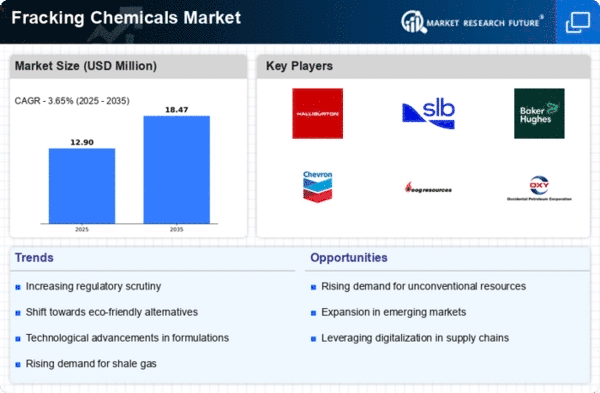
Fracking Chemicals Market Infographic
Purchase Options

Market Share

Fracking Chemicals Market Share Analysis

The Fracking Chemicals Market, a critical segment within the oil and gas industry, employs various market share positioning strategies to gain a competitive edge. One primary approach is differentiation, where companies focus on developing unique and innovative fracking chemicals. This involves investing in research and development to create formulations that enhance extraction efficiency, reduce environmental impact, or comply with stringent regulations. By offering differentiated products, companies can carve out a niche for themselves and attract customers seeking advanced solutions.

Another key strategy is cost leadership. Some players in the fracking chemicals market aim to capture a significant market share by optimizing production processes and achieving economies of scale. This allows them to offer products at lower prices without compromising quality. Cost-effective solutions become especially appealing to price-sensitive customers, enabling companies to broaden their customer base and establish a strong market presence.

Collaboration and strategic partnerships constitute yet another vital market positioning strategy. Companies in the fracking chemicals industry often collaborate with oil and gas producers, equipment manufacturers, and other stakeholders to create integrated solutions. By aligning their products with the broader value chain, these companies enhance their market visibility and strengthen relationships with key industry players. This collaborative approach can lead to exclusive contracts and long-term partnerships, securing a stable market share.

Geographical positioning is a crucial aspect of market share strategies in the fracking chemicals sector. The global nature of the industry demands a strategic presence in key regions with high fracking activities. Companies strategically locate their manufacturing facilities, distribution centers, and research hubs to optimize logistics and respond promptly to market demands. By aligning their operations with the geographical dynamics of the industry, companies can ensure a more efficient supply chain, better customer service, and a competitive advantage in local markets.

Innovation and sustainability are increasingly becoming pivotal factors in market share positioning. As environmental concerns grow, companies in the fracking chemicals market are adopting sustainable practices and developing eco-friendly formulations. Those at the forefront of innovation, creating chemicals that minimize environmental impact or improve overall sustainability, can attract environmentally conscious customers and gain a favorable market position. Sustainability is not only a moral imperative but also a strategic advantage in the evolving landscape of the fracking industry.

Furthermore, a customer-centric approach is paramount for sustained market share growth. Understanding the unique needs and challenges faced by customers allows companies to tailor their products and services accordingly. Offering customized solutions, responsive customer support, and value-added services contribute to customer loyalty and retention. Satisfied customers become advocates, promoting the company's products and enhancing its reputation in the market.
Author
Chitranshi Jaiswal
Research Analyst Level I

In her 3 years of experience in the market research field, she has handled critical cross-domain projects. She has an in-depth knowledge of market estimation & analysis, problem-solving, primary as well as secondary research, and team management.She holds an engineering degree and is an MBA professional from a well-known university, capable of evaluating the market and competitive conditions. An exceptional strategist with excellent communication skills and a passion for delivering cutting-edge & practical insights for the market. Proficient in multi-tasking, and can successfully deal with competing demands, while maintaining complete confidentiality. Generated business through active client and project development, networking, and high-quality responses. Her knowledge and skills have helped in making solid business decisions, securing funding from investors, and avoiding business failures.

Leave a Comment

FAQs

What are fracking chemicals?

Fracking chemicals are a wide range of chemicals used in oil and gas drilling operations to make the extraction of hydrocarbons an easier process.

What is the CAGR of the market?

The market is expected to exhibit a strong 6.54% CAGR over the forecast period from 2025-2035.

What is the major driver for the market?

The growing demand for fracking is the major driver for the fracking chemicals market.

Which is the leading regional market?

North America is the major regional market for fracking chemicals due to the growing preference for fracking in the region.

What are the leading market players?

Leading players in the fracking chemicals market include AkzoNobel, BASF, and Ashland, among others.

Market Summary

As per Market Research Future Analysis, the fracking chemicals market is projected to grow at a CAGR of 6.54% from 2024 to 2032. Fracking chemicals, essential for enhancing hydrocarbon extraction efficiency, vary in composition based on local regulations and water availability. They facilitate the extraction of oil and natural gas from low permeability reservoirs through hydraulic fracturing. The market is driven by rising global oil and gas demand, the shift towards horizontal drilling, and the development of unconventional oil and gas sources. However, concerns over the toxicity of some fracking chemicals may hinder growth. Companies are investing in R&D for eco-friendly alternatives, such as bio-based drill muds and non-toxic drilling fluids, which present growth opportunities.

Key Market Trends & Highlights

The fracking chemicals market is witnessing significant trends driven by technological advancements and regulatory changes.

  • Market growth driven by rising global oil & gas demand due to population expansion.
  • North America held the largest market share in 2018, fueled by the shale gas revolution.
  • Asia-Pacific expected to register the highest CAGR during the forecast period.
  • Investment in eco-friendly fracking chemicals is increasing due to regulatory pressures.

Market Size & Forecast

Market Size Forecast Growth CAGR of 6.54% from 2024 to 2032
Largest Regional Market Share in 2018 North America

Major Players

Key players include AkzoNobel N.V., Ashland Inc., Baker Hughes, Halliburton, Schlumberger, BASF SE, Chevron Phillips Chemical, Clariant International AG, DowDuPont, Albemarle Corporation, FTS International, Calfrac Well Services, and EOG Resources.

Market Trends

Fracking Chemicals Market Market Drivers

Rising Energy Prices

The Global Fracking Chemicals Market Industry is also influenced by the fluctuations in energy prices. As oil and gas prices rise, the economic viability of fracking becomes more attractive, prompting increased exploration and production activities. Higher energy prices incentivize operators to invest in fracking technologies and the associated chemicals necessary for extraction. This dynamic is particularly evident in regions where conventional oil production is declining, making fracking a more appealing option. Consequently, as energy prices continue to fluctuate, the demand for fracking chemicals is likely to experience corresponding increases, further propelling market growth.

Market Growth Projections

The Global Fracking Chemicals Market Industry is projected to witness substantial growth over the next decade. With a market value of 30.5 USD Billion in 2024 and an anticipated increase to 50.2 USD Billion by 2035, the industry is poised for a robust expansion. This growth is underpinned by a CAGR of 4.63% from 2025 to 2035, reflecting the increasing reliance on fracking as a method of oil and gas extraction. The market dynamics are influenced by various factors, including technological advancements, regulatory support, and the ongoing demand for energy. These projections suggest a promising future for the fracking chemicals sector.

Regulatory Support for Fracking

Regulatory frameworks are evolving to support the Global Fracking Chemicals Market Industry, as governments recognize the economic benefits of domestic energy production. In many regions, policies are being implemented to streamline the permitting process for fracking operations, thereby encouraging investment. This regulatory support is crucial in regions like the United States, where fracking has significantly boosted local economies and job creation. As regulatory environments become more favorable, the demand for fracking chemicals is expected to rise, facilitating the growth of the market. This trend indicates a potential for increased production and consumption of fracking chemicals in the coming years.

Increasing Demand for Natural Gas

The Global Fracking Chemicals Market Industry is experiencing a surge in demand for natural gas, driven by its role as a cleaner alternative to coal and oil. As countries strive to reduce carbon emissions, natural gas is increasingly viewed as a transitional fuel. In 2024, the market is projected to reach 30.5 USD Billion, reflecting this growing preference. The shift towards natural gas is particularly evident in regions such as North America and Europe, where regulatory frameworks are evolving to support its use. This trend is likely to bolster the fracking chemicals market, as enhanced extraction techniques require specialized chemical formulations.

Global Energy Transition Initiatives

The Global Fracking Chemicals Market Industry is being shaped by global energy transition initiatives aimed at reducing reliance on fossil fuels. While there is a push towards renewable energy sources, natural gas remains a key component of the energy mix during this transition. Governments and organizations are recognizing the role of fracking in providing a stable energy supply while renewable technologies are being developed. This dual approach is likely to sustain the demand for fracking chemicals as countries balance their energy portfolios. The market is expected to adapt to these changes, ensuring that fracking remains a viable option in the evolving energy landscape.

Technological Advancements in Fracking

Technological innovations are significantly influencing the Global Fracking Chemicals Market Industry. Enhanced oil recovery techniques and advanced fracking methods, such as horizontal drilling and multi-stage fracturing, are improving extraction efficiency. These advancements not only increase production rates but also reduce environmental impacts, making fracking more sustainable. As a result, the market is expected to grow at a CAGR of 4.63% from 2025 to 2035, reaching an estimated 50.2 USD Billion by 2035. Companies are investing in research and development to create more effective and environmentally friendly fracking chemicals, which is likely to further drive market growth.

Market Segment Insights

Regional Insights

Key Companies in the Fracking Chemicals Market market include

Industry Developments

October 2021

- Liberty Oilfield Services Inc., a Denver-based company, has announced the completion of acquiring a prominent supplier of proppant delivery equipment, software, and logistics solutions, PropX. The company reported a 12% in third-quarter revenue this year. Liberty becomes the send-largest provider of natural gas & oil producers with fracking and well-completion services, with this deal worth USD90 million. The deal comprised of USD5 million in cash and the other 5.8 million shares of Liberty’s common stock having net valued of over USD76.5 million based on a 30-day average closing share price of USD13.08.

PropX, established in 2016, is a prominent supplier of last-mile proppant delivery solutions, including logistics software and proppant handling equipment across the North American region. The company offers advanced eco-friendly technology coupled with benefits such as canceling out emissions, reducing noise, driving logistics efficiency, wellsite proppant handling equipment, and better dry and wet sand containers.

April 2021

- California is set to ban new oil fracking by 2024 under an executive order that Gov. Gavin Newsom, announced that with small fanfare following months of confusing mixed messages.The order came as a shock to the oil firms in the state but a narrow victory for environmentalists, who have been forcing Newsom to do more to combat fossil fuels, pollutions, and climate change pollution in disadvantaged communities.

Intended Audience
    • Fracking chemicals manufacturers
    • Traders and distributors of fracking chemicals
    • Research and development institutes
    • Potential investors
    • Raw material suppliers
    • Nationalized laboratory

Future Outlook

Fracking Chemicals Market Future Outlook

The Fracking Chemicals Market is projected to grow at a 4.63% CAGR from 2024 to 2035, driven by increasing energy demands, technological advancements, and regulatory support.

New opportunities lie in:

  • Invest in eco-friendly fracking chemicals to meet regulatory standards and consumer preferences.
  • Develop advanced data analytics tools for optimizing chemical usage and reducing costs.
  • Explore partnerships with renewable energy firms to diversify product offerings and enhance sustainability.

By 2035, the Fracking Chemicals Market is expected to achieve substantial growth, reflecting evolving industry dynamics and increased environmental considerations.

Market Segmentation

Report Scope

Report Attribute/Metric Details
  Market Size   2030 : Significant Value
  CAGR   6.54% 2030
  Base Year   2023
  Forecast Period   2024-2032
  Historical Data   2019 & 2020
  Forecast Units   Value (USD Million)
  Report Coverage   Revenue Forecast, Competitive Landscape, Growth Factors, and Trends
  Segments Covered   Type, Fluid Type
  Geographies Covered   North America, Europe, Asia-Pacific, and Rest of the World (RoW)
  Key Vendors   AkzoNobel N.V. (The Netherlands), Ashland Inc. (US), Baker Hughes Incorporated (US), Halliburton. (US), Schlumberger Limited (US), BASF SE (Germany), Chevron Phillips Chemical Company (US), Clariant International AG (Switzerland), DowDuPont (US), Albemarle Corporation. (US), FTS International Inc. (US), Calfrac Well Services Ltd. (Canada), and EOG Resources, Inc. (US)
  Key Market Opportunities   New product launches and R&D Amongst major key Players
  Key Market Drivers   Rising demand for oil & gas across the globe

FAQs

What are fracking chemicals?

Fracking chemicals are a wide range of chemicals used in oil and gas drilling operations to make the extraction of hydrocarbons an easier process.

What is the CAGR of the market?

The market is expected to exhibit a strong 6.54% CAGR over the forecast period from 2025-2035.

What is the major driver for the market?

The growing demand for fracking is the major driver for the fracking chemicals market.

Which is the leading regional market?

North America is the major regional market for fracking chemicals due to the growing preference for fracking in the region.

What are the leading market players?

Leading players in the fracking chemicals market include AkzoNobel, BASF, and Ashland, among others.

  1. Executive Summary
  2. Scope of the Report
    1. Market Definition
    2. Scope of the
    3. Study
    4. Markets Structure
  3. Market Research Methodology
    1. Research Process
    2. Secondary Research
    3. Primary Research
    4. Forecast Model
    5. List of Assumptions
  4. Market Landscape
    1. Supply Chain Analysis
      1. Manufacturers/Producers
      2. Distributors/Retailers/Wholesalers/E-Commerce
      3. End Users
      4. Bargaining
      5. Bargaining Power
      6. Threat of Substitutes
      7. Intensity of Rivalry
    2. Raw Material Suppliers
    3. Porter’s Five Forces Analysis
    4. Threat of New Entrants
    5. Power of Buyers
    6. of Suppliers
  5. Market
    1. Dynamics of the Global Fracking Chemicals Market
    2. Introduction
    3. Drivers
    4. Restraints
    5. Opportunities
    6. Challenges
    7. Trends/Technology
  6. Global Fracking
  7. Chemicals Market, by Type
    1. Introduction
      1. Market
    2. Gelling Agent
    3. Market Estimates & Forecast, 2020–2027
    4. Estimates & Forecast by Region, 2020–2027
    5. Friction
      1. Market
      2. Market Estimates &
    6. Reducer
    7. Estimates & Forecast, 2020–2027
    8. Forecast by Region, 2020–2027
    9. Corrosion Inhibitor
      1. Market Estimates
      2. Market Estimates & Forecast
      3. Market Estimates & Forecast, 2020–2027
      4. Market Estimates & Forecast by Region, 2020–2027
    10. & Forecast, 2020–2027
    11. by Region, 2020–2027
    12. Biocide
    13. Surfactant
      1. Market
    14. Market Estimates & Forecast, 2020–2027
    15. Estimates & Forecast by Region, 2020–2027
    16. Scale Inhibitor
      1. Market
      2. Market Estimates &
    17. Estimates & Forecast, 2020–2027
    18. Forecast by Region, 2020–2027
    19. Clay Stabilizer
      1. Market Estimates &
      2. Market Estimates & Forecast by Region,
      3. Market Estimates & Forecast, 2020–2027
      4. Market Estimates & Forecast by Region, 2020–2027
    20. Forecast, 2020–2027
    21. pH Adjusting Agent
    22. Cross Linker
      1. Market Estimates & Forecast, 2020–2027
    23. Market Estimates & Forecast by Region, 2020–2027
    24. Iron Control Agent
      1. Market
    25. Market Estimates & Forecast, 2020–2027
    26. Estimates & Forecast by Region, 2020–2027
    27. Others
      1. Market Estimates
      2. Market Estimates & Forecast
    28. & Forecast, 2020–2027
    29. by Region, 2020–2027
  8. Global Fracking Chemicals Market,
    1. by FluidType
    2. Introduction
    3. Water-Based
      1. Market Estimates & Forecast, 2020–2027
      2. Market Estimates & Forecast, 2020–2027
      3. Market Estimates & Forecast by Region, 2020–2027
      4. Market Estimates & Forecast, 2020–2027
      5. Market Estimates & Forecast by Region, 2020–2027
    4. Market Estimates & Forecast by Region, 2020–2027
    5. Oil-Based
    6. Foam-Based
  9. Global Fracking Chemicals Market, by Region
    1. Introduction
    2. North America
      1. Market Estimates &
      2. Market Estimates & Forecast
      3. Market Estimates & Forecast
      4. US
      5. Canada
      6. Market Estimates & Forecast, 2020–2027
      7. Market Estimates & Forecast by Type, 2020–2027
      8. UK
      9. Russia
      10. Poland
      11. Rest
      12. Market Estimates & Forecast,
      13. Market Estimates & Forecast by Type,
      14. Market Estimates & Forecast by Fluid
      15. China
      16. India
      17. Japan
      18. Australia
      19. Rest of Asia-Pacific
      20. Market Estimates &
      21. Market Estimates & Forecast
      22. Market Estimates & Forecast
      23. Turkey
      24. Israel
      25. North Africa
      26. GCC
      27. Rest of Middle East & Africa
    3. Forecast, 2020–2027
    4. by Type, 2020–2027
    5. by Fluid Type, 2020–2027
    6. & Forecast by Type, 2020–2027
    7. Market Estimates & Forecast, 2020–2027
    8. Market Estimates & Forecast by Fluid Type, 2020–2027
    9. Europe
    10. Market Estimates & Forecast by Fluid Type, 2020–2027
    11. Germany
    12. Market Estimates & Forecast, 2020–2027
    13. Market Estimates & Forecast by Fluid Type, 2020–2027
    14. France
    15. Market Estimates & Forecast, 2020–2027
    16. Market Estimates & Forecast by Fluid Type, 2020–2027
    17. Italy
    18. Market Estimates & Forecast, 2020–2027
    19. Market Estimates & Forecast by Fluid Type, 2020–2027
    20. Spain
    21. Market Estimates & Forecast, 2020–2027
    22. & Forecast by Fluid Type, 2020–2027
    23. & Forecast, 2020–2027
    24. Forecast by Fluid Type, 2020–2027
    25. & Forecast, 2020–2027
    26. Forecast by Fluid Type, 2020–2027
    27. Forecast, 2020–2027
    28. Forecast by Fluid Type, 2020–2027
    29. of Europe
    30. Market Estimates & Forecast, 2020–2027
    31. Market Estimates & Forecast by Fluid Type, 2020–2027
    32. Asia-Pacific
    33. Type, 2020–2027
    34. Market Estimates & Forecast by Type, 2020–2027
    35. by Fluid Type, 2020–2027
    36. & Forecast, 2020–2027
    37. & Forecast by Fluid Type, 2020–2027
    38. & Forecast, 2020–2027
    39. & Forecast by Fluid Type, 2020–2027
    40. & New Zealand
    41. Market Estimates & Forecast, 2020–2027
    42. by Type, 2020–2027
    43. Market Estimates & Forecast by Fluid Type, 2020–2027
    44. & Forecast by Type, 2020–2027
    45. Middle East & Africa
    46. Forecast, 2020–2027
    47. by Type, 2020–2027
    48. by Fluid Type, 2020–2027
    49. Market Estimates & Forecast by Type, 2020–2027
    50. Type, 2020–2027
    51. & Forecast by Type, 2020–2027
    52. & Forecast by Type, 2020–2027
    53. by Type, 2020–2027
    54. Market Estimates & Forecast by Fluid Type, 2020–2027
    55. & Forecast by Type, 2020–2027
    56. Latin America
      1. Market Estimates &
      2. Market Estimates & Forecast
      3. Market Estimates & Forecast
      4. Brazil
      5. Argentina
      6. Mexico
      7. Rest
    57. Forecast, 2020–2027
    58. by Type, 2020–2027
    59. by Fluid Type, 2020–2027
    60. Forecast, 2020–2027
    61. Forecast by Fluid Type, 2020–2027
    62. & Forecast, 2020–2027
    63. Forecast by Fluid Type, 2020–2027
    64. & Forecast, 2020–2027
    65. Forecast by Fluid Type, 2020–2027
    66. of Latin America
    67. Market Estimates & Forecast, 2020–2027
    68. Market Estimates & Forecast by Fluid Type, 2020–2027
    69. Company Landscape
    70. Introduction
    71. Market Strategies
    72. Key Development Analysis (Expansion/Merger & Acquisitions/Joint Venture/New
    73. Product Development/Agreement/Investment)
  10. Company
    1. Profiles
    2. AkzoNobel N.V.
      1. Company
      2. Financial Updates
      3. Product/Business Segment Overview
      4. Key Developments
      5. SWOT Analysis
    3. Overview
    4. Key Strategies
    5. Ashland
      1. Company Overview
      2. Key
      3. Key Developments
    6. Inc.
    7. Financial Updates
    8. Product/Business Segment Overview
    9. Strategies
    10. SWOT Analysis
    11. Baker Hughes Incorporated
      1. Financial Updates
      2. Product/Business Segment Overview
      3. Key Strategies
      4. SWOT Analysis
    12. Company Overview
    13. Key Developments
    14. Halliburton
      1. Company Overview
      2. Key
      3. Key Developments
    15. Financial Updates
    16. Product/Business Segment Overview
    17. Strategies
    18. SWOT Analysis
    19. Schlumberger Limited
      1. Financial Updates
      2. Product/Business Segment Overview
      3. Key Strategies
      4. SWOT Analysis
    20. Company Overview
    21. Key Developments
    22. BASF SE
      1. Company Overview
      2. Key
      3. Key Developments
    23. Financial Updates
    24. Product/Business Segment Overview
    25. Strategies
    26. SWOT Analysis
    27. Chevron Phillips Chemical
      1. Company Overview
      2. Key
      3. Key Developments
    28. Financial Updates
    29. Product/Business Segment Overview
    30. Strategies
    31. SWOT Analysis
    32. Clariant International AG
      1. Company Overview
      2. Product/Business
      3. Key Strategies
      4. Key Developments
    33. Financial Updates
    34. Segment Overview
    35. SWOT Analysis
    36. DowDuPont
      1. Financial Updates
      2. Product/Business Segment Overview
      3. Key Strategies
      4. SWOT Analysis
    37. Company Overview
    38. Key Developments
    39. Albemarle Corporation
      1. Company Overview
      2. Financial Updates
      3. Key Developments
      4. SWOT Analysis
    40. Product/Business Segment Overview
    41. Key Strategies
    42. FTS International Inc.
      1. Financial
      2. Product/Business Segment
      3. Key Strategies
      4. SWOT Analysis
    43. Company Overview
    44. Updates
    45. Overview
    46. Key Developments
    47. Calfrac Well Services Ltd.
      1. Company Overview
      2. Product/Business
      3. Key Strategies
      4. Key Developments
    48. Financial Updates
    49. Segment Overview
    50. SWOT Analysis
    51. EOG Resources, Inc.
      1. Company
      2. Financial Updates
      3. Product/Business Segment Overview
      4. Key Developments
      5. SWOT Analysis
    52. Overview
    53. Key Strategies
  11. Conclusion
  12. LIST OF TABLES
  13. Global
    1. Fracking Chemicals Market: By Region, 2020–2027
    2. Table 2
    3. North America Fracking Chemicals Market: By Country, 2020–2027
  14. Europe Fracking Chemicals Market: By Country, 2020–2027
  15. Asia-Pacific Fracking Chemicals Market: By
    1. Country, 2020–2027
  16. Middle East &
    1. Africa Fracking Chemicals Market: By Country, 2020–2027
    2. Table
  17. Latin America Fracking Chemicals Market: By Country, 2020–2027
  18. Global Fracking Chemicals Type Market: By
    1. Regions, 2020–2027
  19. North America Fracking
    1. Chemicals Type Market: By Country, 2020–2027
    2. Table 9
    3. Europe Fracking Chemicals Type Market: By Country, 2020–2027
    4. Table10 Asia-Pacific Fracking Chemicals Type Market: By Country,
    5. Table11 Middle East & Africa Fracking
    6. Chemicals Type Market: By Country, 2020–2027
    7. Table12
    8. Latin America Fracking Chemicals Type Market: By Country, 2020–2027
  20. Global Fracking Chemicals Fluid Type Market:
    1. By Regions, 2020–2027
    2. Table14 North America
    3. Fracking Chemicals Fluid Type Market: By Country, 2020–2027
    4. Table15
    5. Europe Fracking Chemicals Fluid Type Market: By Country, 2020–2027
    6. Table16 Asia-Pacific Fracking Chemicals Fluid Type Market: By
    7. Country, 2020–2027
    8. Table17 Middle East &
    9. Africa Fracking Chemicals Fluid Type Market: By Country, 2020–2027
    10. Table18 Latin America Fracking Chemicals by Fluid Type Market:
    11. By Country, 2020–2027
    12. Table19 Global Type Market:
    13. By Region, 2020–2027
    14. Table20 Global Fluid Type
    15. Market: By Region, 2020–2027
    16. Table21 North America
  21. Fracking Chemicals Market, by Country
    1. Table22 North
  22. America Fracking Chemicals Market, by Type
    1. Table23 North
  23. America Fracking Chemicals Market, by Fluid Type
    1. Table24
  24. Europe: Fracking Chemicals Market, by Country
    1. Table25
  25. Europe: Fracking Chemicals Market, by Type
    1. Table26
  26. Europe: Fracking Chemicals Market, by Fluid Type
    1. Table27
  27. Asia-Pacific: Fracking Chemicals Market, by Country
    1. Table28
  28. Asia-Pacific: Fracking Chemicals Market, by Type
    1. Table29
  29. Asia-Pacific: Fracking Chemicals Market, by Fluid Type
    1. Table30
  30. Middle East & Africa: Fracking Chemicals Market, by Country
    1. Table31 Middle East & Africa Fracking Chemicals Market,
    2. by Type
    3. Table32 Middle East & Africa: Fracking
  31. Chemicals Market, by Fluid Type
    1. Table33 Latin America:
  32. Fracking Chemicals Market, by Country
    1. Table34 Latin
  33. America Fracking Chemicals Market, by Type
    1. Table35 Latin
  34. America: Fracking Chemicals Market, by Fluid Type
  35. LIST OF FIGURES
  36. Global Fracking Chemicals Market Segmentation
  37. Forecast Research Methodology
    1. FIGURE 3
    2. Five Forces Analysis of the Global Fracking Chemicals Market
    3. FIGURE 4
    4. Value Chain of the Global Fracking Chemicals Market
    5. FIGURE 5
  38. Share of the Global Fracking Chemicals Market in 2020, by Country
  39. Global Fracking Chemicals Market, 2020–2027,
    1. FIGURE
  40. Global Fracking Chemicals Market Size, by Type, 2020
    1. FIGURE
  41. Share of the Global Fracking Chemicals Market, by Type, 2020–2027
  42. Global Fracking Chemicals Market Size, by Fluid Type, 2020
  43. FIGURE10 Share of the Global Fracking Chemicals Market, by Fluid Type,

Fracking Chemicals Market Segmentation

Market Segmentation Overview

  • Detailed segmentation data will be available in the full report
  • Comprehensive analysis by multiple parameters
  • Regional and country-level breakdowns
  • Market size forecasts by segment
Infographic

Free Sample Request

Kindly complete the form below to receive a free sample of this Report

Get Free Sample

Customer Strories

Compare Licence

×
Features License Type
Single User Multiuser License Enterprise User
Price $4,950 $5,950 $7,250
Maximum User Access Limit 1 User Upto 10 Users Unrestricted Access Throughout the Organization
Free Customization
Direct Access to Analyst
Deliverable Format
Platform Access
Discount on Next Purchase 10% 15% 15%
Printable Versions