×
  • Cat-intel
  • MedIntelliX
  • Resources
  • About Us
  • Hero Background
    English
    Chinese
    French
    Japanese
    Korean
    German
    Spanish

    Asia Pacific Cement Market Analysis

    ID: MRFR/CnM/11167-HCR
    111 Pages
    Chitranshi Jaiswal
    October 2025

    Asia Pacific Cement Market Research Report Information By Type (Portland, Blended, and Others), By Application (Residential and Non-Residential) – and Asia Pacific Market Forecast Till 2035

    Share:
    Download PDF ×

    We do not share your information with anyone. However, we may send you emails based on your report interest from time to time. You may contact us at any time to opt-out.

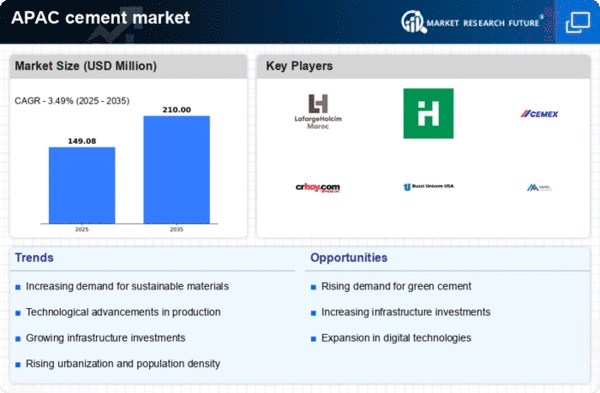
    Asia Pacific Cement Market Infographic
    Purchase Options

    Market Analysis

    In-depth Analysis of Asia Pacific Cement Market Industry Landscape

    The cement market in the Asia Pacific region has recently been identified as a market with a dynamic and shaping process due to the factors of the economy, demography and environment that are constantly changing. By considering both the internal and external factors which can drive industry, the dynamics of the market becomes one of the most important factors in the region.

    Economically, Asia - Pacific region is experienced rapid growth in cities and industries that require a huge infrastructure service and construction. The need for cement can we may concert for this portion of the market as the cement is used as a main constituent for erection of buildings, roads, bridges, and other areas of infrastructure. He population is increased in the same trend and the middle depths in countries like as China and India, just gave a support to constructing and thus to the dynamics which are between to be strong.

    The Asia Pacific cement industry can have a decided impact on the business processes and on the government policies and regulations sector. Lots of states on this continent carry out programs to push the environmentally sustainable and green construction enhancement trend in constructions, and consequently the focus has shifted to ecological cement products. This has even empowered innovation among the factory owners as they keep on researching and developing cement with very little carbon footprints coupled to increased environmental protection and sustainable development.

    Beyond that, global trends in the cement market for Asia-Pacific region, such as uneven prices for raw materials, swings in inter-state treaty terms, and the latest technology are at play especially. Asia Pacific region is one of the largest and most prominent players in the global cement trade, and any recent change in the outside environment will naturally affect the cement business environment of the Asia Pacific region to a considerable degree. The global nature of this interdependence renders the market prone to external shocks and conducting a business in such industry requires all the players to be quick to adapt.

    As in the Asia Pacific cement industry there is rivalry that is being shaped by the presence of international giants and some local and regional businesses. Competition is stiff, in line with production capacity, quality of service, pricing, and networks of distribution that touch upon it. While companies are continuously looking for connection trumps through mergers and acquisitions, partnerships or development within technology barely the next day.

    With environmental issues having an impact on market dynamics in Asia Pacific cement industry, this issue becomes a big part of the industries operations now and for the future as well. Nowadays, carbon is focal point in sustainability. Companies are evaluating new raw materials and manufacturing processes that lower down carbon emissions. The augmentation of filling population for green and eco-resolved construction stills going on that triggers the selection of alternative cement products. As a result, such (changing preferences of consumers) is a driving force for manufacturers to formulate a strategy that fits environment goals. This, consequently, is a factor affecting overall market dynamics.

    Author
    Chitranshi Jaiswal
    Research Analyst Level I

    In her 3 years of experience in the market research field, she has handled critical cross-domain projects. She has an in-depth knowledge of market estimation & analysis, problem-solving, primary as well as secondary research, and team management.She holds an engineering degree and is an MBA professional from a well-known university, capable of evaluating the market and competitive conditions. An exceptional strategist with excellent communication skills and a passion for delivering cutting-edge & practical insights for the market. Proficient in multi-tasking, and can successfully deal with competing demands, while maintaining complete confidentiality. Generated business through active client and project development, networking, and high-quality responses. Her knowledge and skills have helped in making solid business decisions, securing funding from investors, and avoiding business failures.

    Leave a Comment

    FAQs

    How much is the cement market?

    The Asia Pacific Cement market size was valued at USD 251.5 Billion in 2022.

    What is the growth rate of the cement market?

    Asia Pacific Cement Market is expected to grow with a CAGR of 3.6% in the period 2025-2035

    Who are the key players in the cement market?

    The key players in the market are CNBM International Corporation, Anhui Conch Cement Co., Ltd., Jidong Development Group Co., Ltd., LafargeHolcim Ltd and HeidelbergCement AG.

    Which type led the cement market?

    The blended category dominated the market in 2022.

    Which application had the largest market share in the cement market?

    Which application had the largest market share in the cement market?

    Market Summary

    As per Market Research Future Analysis, the Asia Pacific Cement Market was valued at USD 269.94 Billion in 2024 and is projected to grow to USD 398.39 Billion by 2035, with a CAGR of 3.60% from 2025 to 2035. Key drivers include rising infrastructure investments and increased demand for institutional buildings in healthcare and education. The market is significantly influenced by urbanization, government initiatives, and the growing popularity of green cement, which offers environmental benefits and improved performance in construction.

    Key Market Trends & Highlights

    The Asia Pacific Cement Market is experiencing notable trends driven by construction demands and sustainability.

    • Market Size in 2024: USD 269.94 Billion
    • Projected Market Size by 2035: USD 398.39 Billion
    • CAGR from 2025 to 2035: 3.60%
    • Blended cement led the market in 2022 due to its enhanced properties.

    Market Size & Forecast

    2024 Market Size USD 269.94 Billion
    2035 Market Size USD 398.39 Billion
    CAGR (2025-2035) 3.60%
    Leading countries China, Japan, India, Australia.

    Major Players

    Key companies include CNBM International Corporation, Anhui Conch Cement Co., Ltd., Jidong Development Group Co., Ltd., LafargeHolcim Ltd, and HeidelbergCement AG.

    Market Trends

    Increased demand for construction activities to accelerate market growth

    Population expansion will raise the need for residential areas, such as private bungalows and flats, which will affect market growth. Furthermore, the growing demand for amenities in residential areas is expected to accelerate the market's growth. The industry is also expected to increase as a result of the rising need for non-residential structures such industries, airports, offices, malls, and highways. Furthermore, because job opportunities and quality of life have increased, urbanisation is now required. The government's initiatives to support construction and infrastructure projects in emerging countries will drive up demand even further.

    Moreover, the increasing demand for precast products, such as panels, roof tiles, blocks, and others, will lead to an increase in product consumption globally. China is the world's largest producer and consumer. Therefore, the expansion of the building industry in this nation will increase market size.

    Another significant development in the industry is the growing demand for green cement. The main driver of the global market's expansion is the rise in building and construction activity. The need for green cement is driving up the price of alternative fuels made from waste, including fly ashes, solid recovered fuels, foundry sand, used oils, sewage sludge, animal ashes, and filter cakes. Additionally, the urgent need to reduce carbon dioxide emissions promotes the use of alternative fuels. Governments that encourage green architecture can enter the market soon and ensure sustainable building.

    When compared to OPC for a less alkaline mixture, green cement's endurance for a range of building projects is expected to have a substantial impact on the market's growth. It is anticipated that upcoming infrastructure projects including building bridges and pavements, nuclear power plants, and other projects will create a strong demand for profitable prospects in the market. Moreover, green cement's reduced water usage is also the primary driver of its rising demand in the building industry. Green cement provides superior fire resistance as well as great thermal insulation.

    The market will therefore be driven over the forecast period by the rising demand for green cement. Thus, driving the cement market revenue.

    Asia Pacific Cement Market Market Drivers

    Market Segment Insights

    Cement Type Insights

    The Asia Pacific Cement market segmentation, based on type includes Portland, Blended, and Others. The blended category led the market in 2022. This product is made by incorporating one or more additives in different amounts during the grinding process. Therefore, to improve its qualities for various uses, blended cement is a homogeneous mixture of portland cement with blending ingredients such fly ash, slag, limestone, and silica fumes. Because it may enhance concrete's workability, strength, durability, and chemical resistance, this substance is becoming more and more popular. It is also easier to work with and shape because it uses less water.

    Cement Application Insights

    The Asia Pacific Cement market segmentation, based on application, includes Residential and Non-Residential. The non-residential category generated the most income because infrastructure spending is growing. Infrastructure improvements and growing urbanization have raised demand for the good. In addition, it is anticipated that the industry would increase as a result of the expanding need for schools and hospitals.

    Figure 1: Asia Pacific Cement Market, by Application, 2022 & 2032 (USD Billion)

    Source: Secondary Research, Primary Research, Market Research Future Database and Analyst Review

    Get more detailed insights about Asia Pacific Cement Market Research Report—Forecast till 2035

    Regional Insights

    The Asia Pacific cement market is anticipated to grow at a significant rate over the forecast period. The countries of China, Japan, India, Australia, South Korea, and Indonesia control the majority of the Asia Pacific market. Growing industrialization, quick urbanization, and expanding infrastructure development are the main drivers of the market growth. Since some of the top industrial and export-oriented nations are located in Asia Pacific, the region is now leading the industry. Rapid economic expansion in a number of Asia Pacific nations is fostering the industrial sector and accelerating urbanization.

    Asia Pacific market is expanding thanks in large part to the efforts of China, India, Japan, and Australia.  Population expansion in Asia Pacific will further support cement demand over the projection period. The government of India's Smart City Mission has accelerated the nation's infrastructural development. Throughout the forecast period, the country's continuing infrastructure projects will be the main driver of cement demand. Cement is needed for these projects, and during the projected period, Asia Pacific cement industry will develop at the fastest rate possible.

    Figure 2: ASIA PACIFIC CEMENT MARKET SHARE BY REGION 2022 (USD Billion)

    ASIA PACIFIC CEMENT MARKET SHARE BY REGION 2022 (

    Source: Secondary Research, Primary Research, Market Research Future Database and Analyst Review

    Key Players and Competitive Insights

    Leading market players are investing heavily in research and development in order to expand their product lines, which will help the cement market, grow even more. Market participants are also undertaking a variety of strategic activities to expand their  footprint, with important market developments including new product launches, contractual agreements, mergers and acquisitions, higher investments, and collaboration with other organizations. To expand and survive in a more competitive and rising market climate, cement industry must offer cost-effective items.

    Industry Developments

    Market Segmentation

    Cement Type Outlook

    • Portland
    • Blended
    • Others

    Cement Regional Outlook

    Asia-Pacific
    • China
    • Japan
    • India
    • Australia
    • South Korea
    • Indonesia
    • Thailand
    • Vietnam
    • Malaysia
    • Singapore
    • Rest of Asia-Pacific

    Cement Application Outlook

    • Residential
    • Non-Residential

    Report Scope

    Report Attribute/Metric Details
    Market Size 2024 USD 269.94 Billion
    Market Size 2025 USD 279.66 Billion
    Market Size 2035 398.39 (Value (USD Billion))
    Compound Annual Growth Rate (CAGR) 3.60% (2025 - 2035)
    Base Year 2024
    Market Forecast Period 2025 - 2035
    Historical Data 2020-2024
    Market Forecast Units Value (USD Billion)
    Report Coverage Revenue Forecast, Market Competitive Landscape, Growth Factors, and Trends
    Segments Covered Type, Application, and Region
    Region Covered Asia Pacific
    Countries Covered China, Japan, India, Australia, South Korea, Indonesia, Thailand, Vietnam, Malaysia, Singapore, and Rest of Asia-Pacific
    Key Companies Profiled CNBM International Corporation, Anhui Conch Cement Co., Ltd., Jidong Development Group Co., Ltd., LafargeHolcim Ltd and HeidelbergCement AG
    Key Market Opportunities ·       Increased Government Programs and Funding for Infrastructure Projects
    Key Market Dynamics ·       Growing Need from Construction Projects ·       Growing Demand for Green Cement

    FAQs

    How much is the cement market?

    The Asia Pacific Cement market size was valued at USD 251.5 Billion in 2022.

    What is the growth rate of the cement market?

    Asia Pacific Cement Market is expected to grow with a CAGR of 3.6% in the period 2025-2035

    Who are the key players in the cement market?

    The key players in the market are CNBM International Corporation, Anhui Conch Cement Co., Ltd., Jidong Development Group Co., Ltd., LafargeHolcim Ltd and HeidelbergCement AG.

    Which type led the cement market?

    The blended category dominated the market in 2022.

    Which application had the largest market share in the cement market?

    Which application had the largest market share in the cement market?

    1. SECTION I: EXECUTIVE SUMMARY AND KEY HIGHLIGHTS
      1. | 1.1 EXECUTIVE SUMMARY
      2. | | 1.1.1 Market Overview
      3. | | 1.1.2 Key Findings
      4. | | 1.1.3 Market Segmentation
      5. | | 1.1.4 Competitive Landscape
      6. | | 1.1.5 Challenges and Opportunities
      7. | | 1.1.6 Future Outlook
    2. SECTION II: SCOPING, METHODOLOGY AND MARKET STRUCTURE
      1. | 2.1 MARKET INTRODUCTION
      2. | | 2.1.1 Definition
      3. | | 2.1.2 Scope of the study
      4. | | | 2.1.2.1 Research Objective
      5. | | | 2.1.2.2 Assumption
      6. | | | 2.1.2.3 Limitations
      7. | 2.2 RESEARCH METHODOLOGY
      8. | | 2.2.1 Overview
      9. | | 2.2.2 Data Mining
      10. | | 2.2.3 Secondary Research
      11. | | 2.2.4 Primary Research
      12. | | | 2.2.4.1 Primary Interviews and Information Gathering Process
      13. | | | 2.2.4.2 Breakdown of Primary Respondents
      14. | | 2.2.5 Forecasting Model
      15. | | 2.2.6 Market Size Estimation
      16. | | | 2.2.6.1 Bottom-Up Approach
      17. | | | 2.2.6.2 Top-Down Approach
      18. | | 2.2.7 Data Triangulation
      19. | | 2.2.8 Validation
    3. SECTION III: QUALITATIVE ANALYSIS
      1. | 3.1 MARKET DYNAMICS
      2. | | 3.1.1 Overview
      3. | | 3.1.2 Drivers
      4. | | 3.1.3 Restraints
      5. | | 3.1.4 Opportunities
      6. | 3.2 MARKET FACTOR ANALYSIS
      7. | | 3.2.1 Value chain Analysis
      8. | | 3.2.2 Porter's Five Forces Analysis
      9. | | | 3.2.2.1 Bargaining Power of Suppliers
      10. | | | 3.2.2.2 Bargaining Power of Buyers
      11. | | | 3.2.2.3 Threat of New Entrants
      12. | | | 3.2.2.4 Threat of Substitutes
      13. | | | 3.2.2.5 Intensity of Rivalry
      14. | | 3.2.3 COVID-19 Impact Analysis
      15. | | | 3.2.3.1 Market Impact Analysis
      16. | | | 3.2.3.2 Regional Impact
      17. | | | 3.2.3.3 Opportunity and Threat Analysis
    4. SECTION IV: QUANTITATIVE ANALYSIS
      1. | 4.1 Chemicals and Materials, BY Type (USD Billion)
      2. | | 4.1.1 Portland
      3. | | 4.1.2 Blended
      4. | | 4.1.3 Others
      5. | 4.2 Chemicals and Materials, BY Application (USD Billion)
      6. | | 4.2.1 Residential
      7. | | 4.2.2 Non-Residential
      8. | 4.3 Chemicals and Materials, BY Region (USD Billion)
      9. | | 4.3.1 North America
      10. | | | 4.3.1.1 US
      11. | | | 4.3.1.2 Canada
      12. | | 4.3.2 Europe
      13. | | | 4.3.2.1 Germany
      14. | | | 4.3.2.2 UK
      15. | | | 4.3.2.3 France
      16. | | | 4.3.2.4 Russia
      17. | | | 4.3.2.5 Italy
      18. | | | 4.3.2.6 Spain
      19. | | | 4.3.2.7 Rest of Europe
      20. | | 4.3.3 APAC
      21. | | | 4.3.3.1 China
      22. | | | 4.3.3.2 India
      23. | | | 4.3.3.3 Japan
      24. | | | 4.3.3.4 South Korea
      25. | | | 4.3.3.5 Malaysia
      26. | | | 4.3.3.6 Thailand
      27. | | | 4.3.3.7 Indonesia
      28. | | | 4.3.3.8 Rest of APAC
      29. | | 4.3.4 South America
      30. | | | 4.3.4.1 Brazil
      31. | | | 4.3.4.2 Mexico
      32. | | | 4.3.4.3 Argentina
      33. | | | 4.3.4.4 Rest of South America
      34. | | 4.3.5 MEA
      35. | | | 4.3.5.1 GCC Countries
      36. | | | 4.3.5.2 South Africa
      37. | | | 4.3.5.3 Rest of MEA
    5. SECTION V: COMPETITIVE ANALYSIS
      1. | 5.1 Competitive Landscape
      2. | | 5.1.1 Overview
      3. | | 5.1.2 Competitive Analysis
      4. | | 5.1.3 Market share Analysis
      5. | | 5.1.4 Major Growth Strategy in the Chemicals and Materials
      6. | | 5.1.5 Competitive Benchmarking
      7. | | 5.1.6 Leading Players in Terms of Number of Developments in the Chemicals and Materials
      8. | | 5.1.7 Key developments and growth strategies
      9. | | | 5.1.7.1 New Product Launch/Service Deployment
      10. | | | 5.1.7.2 Merger & Acquisitions
      11. | | | 5.1.7.3 Joint Ventures
      12. | | 5.1.8 Major Players Financial Matrix
      13. | | | 5.1.8.1 Sales and Operating Income
      14. | | | 5.1.8.2 Major Players R&D Expenditure. 2023
      15. | 5.2 Company Profiles
      16. | | 5.2.1 LafargeHolcim (CH)
      17. | | | 5.2.1.1 Financial Overview
      18. | | | 5.2.1.2 Products Offered
      19. | | | 5.2.1.3 Key Developments
      20. | | | 5.2.1.4 SWOT Analysis
      21. | | | 5.2.1.5 Key Strategies
      22. | | 5.2.2 China National Building Material (CN)
      23. | | | 5.2.2.1 Financial Overview
      24. | | | 5.2.2.2 Products Offered
      25. | | | 5.2.2.3 Key Developments
      26. | | | 5.2.2.4 SWOT Analysis
      27. | | | 5.2.2.5 Key Strategies
      28. | | 5.2.3 HeidelbergCement (DE)
      29. | | | 5.2.3.1 Financial Overview
      30. | | | 5.2.3.2 Products Offered
      31. | | | 5.2.3.3 Key Developments
      32. | | | 5.2.3.4 SWOT Analysis
      33. | | | 5.2.3.5 Key Strategies
      34. | | 5.2.4 Taiwan Cement Corporation (TW)
      35. | | | 5.2.4.1 Financial Overview
      36. | | | 5.2.4.2 Products Offered
      37. | | | 5.2.4.3 Key Developments
      38. | | | 5.2.4.4 SWOT Analysis
      39. | | | 5.2.4.5 Key Strategies
      40. | | 5.2.5 UltraTech Cement (IN)
      41. | | | 5.2.5.1 Financial Overview
      42. | | | 5.2.5.2 Products Offered
      43. | | | 5.2.5.3 Key Developments
      44. | | | 5.2.5.4 SWOT Analysis
      45. | | | 5.2.5.5 Key Strategies
      46. | | 5.2.6 Cemex Holdings Philippines (PH)
      47. | | | 5.2.6.1 Financial Overview
      48. | | | 5.2.6.2 Products Offered
      49. | | | 5.2.6.3 Key Developments
      50. | | | 5.2.6.4 SWOT Analysis
      51. | | | 5.2.6.5 Key Strategies
      52. | | 5.2.7 Siam Cement Group (TH)
      53. | | | 5.2.7.1 Financial Overview
      54. | | | 5.2.7.2 Products Offered
      55. | | | 5.2.7.3 Key Developments
      56. | | | 5.2.7.4 SWOT Analysis
      57. | | | 5.2.7.5 Key Strategies
      58. | | 5.2.8 Asia Cement Corporation (TW)
      59. | | | 5.2.8.1 Financial Overview
      60. | | | 5.2.8.2 Products Offered
      61. | | | 5.2.8.3 Key Developments
      62. | | | 5.2.8.4 SWOT Analysis
      63. | | | 5.2.8.5 Key Strategies
      64. | | 5.2.9 Shree Cement (IN)
      65. | | | 5.2.9.1 Financial Overview
      66. | | | 5.2.9.2 Products Offered
      67. | | | 5.2.9.3 Key Developments
      68. | | | 5.2.9.4 SWOT Analysis
      69. | | | 5.2.9.5 Key Strategies
      70. | 5.3 Appendix
      71. | | 5.3.1 References
      72. | | 5.3.2 Related Reports
    6. LIST OF FIGURES
      1. | 6.1 MARKET SYNOPSIS
      2. | 6.2 NORTH AMERICA MARKET ANALYSIS
      3. | 6.3 US MARKET ANALYSIS BY TYPE
      4. | 6.4 US MARKET ANALYSIS BY APPLICATION
      5. | 6.5 CANADA MARKET ANALYSIS BY TYPE
      6. | 6.6 CANADA MARKET ANALYSIS BY APPLICATION
      7. | 6.7 EUROPE MARKET ANALYSIS
      8. | 6.8 GERMANY MARKET ANALYSIS BY TYPE
      9. | 6.9 GERMANY MARKET ANALYSIS BY APPLICATION
      10. | 6.10 UK MARKET ANALYSIS BY TYPE
      11. | 6.11 UK MARKET ANALYSIS BY APPLICATION
      12. | 6.12 FRANCE MARKET ANALYSIS BY TYPE
      13. | 6.13 FRANCE MARKET ANALYSIS BY APPLICATION
      14. | 6.14 RUSSIA MARKET ANALYSIS BY TYPE
      15. | 6.15 RUSSIA MARKET ANALYSIS BY APPLICATION
      16. | 6.16 ITALY MARKET ANALYSIS BY TYPE
      17. | 6.17 ITALY MARKET ANALYSIS BY APPLICATION
      18. | 6.18 SPAIN MARKET ANALYSIS BY TYPE
      19. | 6.19 SPAIN MARKET ANALYSIS BY APPLICATION
      20. | 6.20 REST OF EUROPE MARKET ANALYSIS BY TYPE
      21. | 6.21 REST OF EUROPE MARKET ANALYSIS BY APPLICATION
      22. | 6.22 APAC MARKET ANALYSIS
      23. | 6.23 CHINA MARKET ANALYSIS BY TYPE
      24. | 6.24 CHINA MARKET ANALYSIS BY APPLICATION
      25. | 6.25 INDIA MARKET ANALYSIS BY TYPE
      26. | 6.26 INDIA MARKET ANALYSIS BY APPLICATION
      27. | 6.27 JAPAN MARKET ANALYSIS BY TYPE
      28. | 6.28 JAPAN MARKET ANALYSIS BY APPLICATION
      29. | 6.29 SOUTH KOREA MARKET ANALYSIS BY TYPE
      30. | 6.30 SOUTH KOREA MARKET ANALYSIS BY APPLICATION
      31. | 6.31 MALAYSIA MARKET ANALYSIS BY TYPE
      32. | 6.32 MALAYSIA MARKET ANALYSIS BY APPLICATION
      33. | 6.33 THAILAND MARKET ANALYSIS BY TYPE
      34. | 6.34 THAILAND MARKET ANALYSIS BY APPLICATION
      35. | 6.35 INDONESIA MARKET ANALYSIS BY TYPE
      36. | 6.36 INDONESIA MARKET ANALYSIS BY APPLICATION
      37. | 6.37 REST OF APAC MARKET ANALYSIS BY TYPE
      38. | 6.38 REST OF APAC MARKET ANALYSIS BY APPLICATION
      39. | 6.39 SOUTH AMERICA MARKET ANALYSIS
      40. | 6.40 BRAZIL MARKET ANALYSIS BY TYPE
      41. | 6.41 BRAZIL MARKET ANALYSIS BY APPLICATION
      42. | 6.42 MEXICO MARKET ANALYSIS BY TYPE
      43. | 6.43 MEXICO MARKET ANALYSIS BY APPLICATION
      44. | 6.44 ARGENTINA MARKET ANALYSIS BY TYPE
      45. | 6.45 ARGENTINA MARKET ANALYSIS BY APPLICATION
      46. | 6.46 REST OF SOUTH AMERICA MARKET ANALYSIS BY TYPE
      47. | 6.47 REST OF SOUTH AMERICA MARKET ANALYSIS BY APPLICATION
      48. | 6.48 MEA MARKET ANALYSIS
      49. | 6.49 GCC COUNTRIES MARKET ANALYSIS BY TYPE
      50. | 6.50 GCC COUNTRIES MARKET ANALYSIS BY APPLICATION
      51. | 6.51 SOUTH AFRICA MARKET ANALYSIS BY TYPE
      52. | 6.52 SOUTH AFRICA MARKET ANALYSIS BY APPLICATION
      53. | 6.53 REST OF MEA MARKET ANALYSIS BY TYPE
      54. | 6.54 REST OF MEA MARKET ANALYSIS BY APPLICATION
      55. | 6.55 KEY BUYING CRITERIA OF CHEMICALS AND MATERIALS
      56. | 6.56 RESEARCH PROCESS OF MRFR
      57. | 6.57 DRO ANALYSIS OF CHEMICALS AND MATERIALS
      58. | 6.58 DRIVERS IMPACT ANALYSIS: CHEMICALS AND MATERIALS
      59. | 6.59 RESTRAINTS IMPACT ANALYSIS: CHEMICALS AND MATERIALS
      60. | 6.60 SUPPLY / VALUE CHAIN: CHEMICALS AND MATERIALS
      61. | 6.61 CHEMICALS AND MATERIALS, BY TYPE, 2024 (% SHARE)
      62. | 6.62 CHEMICALS AND MATERIALS, BY TYPE, 2024 TO 2035 (USD Billion)
      63. | 6.63 CHEMICALS AND MATERIALS, BY APPLICATION, 2024 (% SHARE)
      64. | 6.64 CHEMICALS AND MATERIALS, BY APPLICATION, 2024 TO 2035 (USD Billion)
      65. | 6.65 BENCHMARKING OF MAJOR COMPETITORS
    7. LIST OF TABLES
      1. | 7.1 LIST OF ASSUMPTIONS
      2. | | 7.1.1
      3. | 7.2 North America MARKET SIZE ESTIMATES; FORECAST
      4. | | 7.2.1 BY TYPE, 2025-2035 (USD Billion)
      5. | | 7.2.2 BY APPLICATION, 2025-2035 (USD Billion)
      6. | 7.3 US MARKET SIZE ESTIMATES; FORECAST
      7. | | 7.3.1 BY TYPE, 2025-2035 (USD Billion)
      8. | | 7.3.2 BY APPLICATION, 2025-2035 (USD Billion)
      9. | 7.4 Canada MARKET SIZE ESTIMATES; FORECAST
      10. | | 7.4.1 BY TYPE, 2025-2035 (USD Billion)
      11. | | 7.4.2 BY APPLICATION, 2025-2035 (USD Billion)
      12. | 7.5 Europe MARKET SIZE ESTIMATES; FORECAST
      13. | | 7.5.1 BY TYPE, 2025-2035 (USD Billion)
      14. | | 7.5.2 BY APPLICATION, 2025-2035 (USD Billion)
      15. | 7.6 Germany MARKET SIZE ESTIMATES; FORECAST
      16. | | 7.6.1 BY TYPE, 2025-2035 (USD Billion)
      17. | | 7.6.2 BY APPLICATION, 2025-2035 (USD Billion)
      18. | 7.7 UK MARKET SIZE ESTIMATES; FORECAST
      19. | | 7.7.1 BY TYPE, 2025-2035 (USD Billion)
      20. | | 7.7.2 BY APPLICATION, 2025-2035 (USD Billion)
      21. | 7.8 France MARKET SIZE ESTIMATES; FORECAST
      22. | | 7.8.1 BY TYPE, 2025-2035 (USD Billion)
      23. | | 7.8.2 BY APPLICATION, 2025-2035 (USD Billion)
      24. | 7.9 Russia MARKET SIZE ESTIMATES; FORECAST
      25. | | 7.9.1 BY TYPE, 2025-2035 (USD Billion)
      26. | | 7.9.2 BY APPLICATION, 2025-2035 (USD Billion)
      27. | 7.10 Italy MARKET SIZE ESTIMATES; FORECAST
      28. | | 7.10.1 BY TYPE, 2025-2035 (USD Billion)
      29. | | 7.10.2 BY APPLICATION, 2025-2035 (USD Billion)
      30. | 7.11 Spain MARKET SIZE ESTIMATES; FORECAST
      31. | | 7.11.1 BY TYPE, 2025-2035 (USD Billion)
      32. | | 7.11.2 BY APPLICATION, 2025-2035 (USD Billion)
      33. | 7.12 Rest of Europe MARKET SIZE ESTIMATES; FORECAST
      34. | | 7.12.1 BY TYPE, 2025-2035 (USD Billion)
      35. | | 7.12.2 BY APPLICATION, 2025-2035 (USD Billion)
      36. | 7.13 APAC MARKET SIZE ESTIMATES; FORECAST
      37. | | 7.13.1 BY TYPE, 2025-2035 (USD Billion)
      38. | | 7.13.2 BY APPLICATION, 2025-2035 (USD Billion)
      39. | 7.14 China MARKET SIZE ESTIMATES; FORECAST
      40. | | 7.14.1 BY TYPE, 2025-2035 (USD Billion)
      41. | | 7.14.2 BY APPLICATION, 2025-2035 (USD Billion)
      42. | 7.15 India MARKET SIZE ESTIMATES; FORECAST
      43. | | 7.15.1 BY TYPE, 2025-2035 (USD Billion)
      44. | | 7.15.2 BY APPLICATION, 2025-2035 (USD Billion)
      45. | 7.16 Japan MARKET SIZE ESTIMATES; FORECAST
      46. | | 7.16.1 BY TYPE, 2025-2035 (USD Billion)
      47. | | 7.16.2 BY APPLICATION, 2025-2035 (USD Billion)
      48. | 7.17 South Korea MARKET SIZE ESTIMATES; FORECAST
      49. | | 7.17.1 BY TYPE, 2025-2035 (USD Billion)
      50. | | 7.17.2 BY APPLICATION, 2025-2035 (USD Billion)
      51. | 7.18 Malaysia MARKET SIZE ESTIMATES; FORECAST
      52. | | 7.18.1 BY TYPE, 2025-2035 (USD Billion)
      53. | | 7.18.2 BY APPLICATION, 2025-2035 (USD Billion)
      54. | 7.19 Thailand MARKET SIZE ESTIMATES; FORECAST
      55. | | 7.19.1 BY TYPE, 2025-2035 (USD Billion)
      56. | | 7.19.2 BY APPLICATION, 2025-2035 (USD Billion)
      57. | 7.20 Indonesia MARKET SIZE ESTIMATES; FORECAST
      58. | | 7.20.1 BY TYPE, 2025-2035 (USD Billion)
      59. | | 7.20.2 BY APPLICATION, 2025-2035 (USD Billion)
      60. | 7.21 Rest of APAC MARKET SIZE ESTIMATES; FORECAST
      61. | | 7.21.1 BY TYPE, 2025-2035 (USD Billion)
      62. | | 7.21.2 BY APPLICATION, 2025-2035 (USD Billion)
      63. | 7.22 South America MARKET SIZE ESTIMATES; FORECAST
      64. | | 7.22.1 BY TYPE, 2025-2035 (USD Billion)
      65. | | 7.22.2 BY APPLICATION, 2025-2035 (USD Billion)
      66. | 7.23 Brazil MARKET SIZE ESTIMATES; FORECAST
      67. | | 7.23.1 BY TYPE, 2025-2035 (USD Billion)
      68. | | 7.23.2 BY APPLICATION, 2025-2035 (USD Billion)
      69. | 7.24 Mexico MARKET SIZE ESTIMATES; FORECAST
      70. | | 7.24.1 BY TYPE, 2025-2035 (USD Billion)
      71. | | 7.24.2 BY APPLICATION, 2025-2035 (USD Billion)
      72. | 7.25 Argentina MARKET SIZE ESTIMATES; FORECAST
      73. | | 7.25.1 BY TYPE, 2025-2035 (USD Billion)
      74. | | 7.25.2 BY APPLICATION, 2025-2035 (USD Billion)
      75. | 7.26 Rest of South America MARKET SIZE ESTIMATES; FORECAST
      76. | | 7.26.1 BY TYPE, 2025-2035 (USD Billion)
      77. | | 7.26.2 BY APPLICATION, 2025-2035 (USD Billion)
      78. | 7.27 MEA MARKET SIZE ESTIMATES; FORECAST
      79. | | 7.27.1 BY TYPE, 2025-2035 (USD Billion)
      80. | | 7.27.2 BY APPLICATION, 2025-2035 (USD Billion)
      81. | 7.28 GCC Countries MARKET SIZE ESTIMATES; FORECAST
      82. | | 7.28.1 BY TYPE, 2025-2035 (USD Billion)
      83. | | 7.28.2 BY APPLICATION, 2025-2035 (USD Billion)
      84. | 7.29 South Africa MARKET SIZE ESTIMATES; FORECAST
      85. | | 7.29.1 BY TYPE, 2025-2035 (USD Billion)
      86. | | 7.29.2 BY APPLICATION, 2025-2035 (USD Billion)
      87. | 7.30 Rest of MEA MARKET SIZE ESTIMATES; FORECAST
      88. | | 7.30.1 BY TYPE, 2025-2035 (USD Billion)
      89. | | 7.30.2 BY APPLICATION, 2025-2035 (USD Billion)
      90. | 7.31 PRODUCT LAUNCH/PRODUCT DEVELOPMENT/APPROVAL
      91. | | 7.31.1
      92. | 7.32 ACQUISITION/PARTNERSHIP
      93. | | 7.32.1

    Asia Pacific Cement Market Segmentation

    Market Segmentation Overview

    • Detailed segmentation data will be available in the full report
    • Comprehensive analysis by multiple parameters
    • Regional and country-level breakdowns
    • Market size forecasts by segment
    Infographic

    Free Sample Request

    Kindly complete the form below to receive a free sample of this Report

    Get Free Sample

    Customer Strories

    “I am very pleased with how market segments have been defined in a relevant way for my purposes (such as "Portable Freezers & refrigerators" and "last-mile"). In general the report is well structured. Thanks very much for your efforts.”

    Victoria Milne

    Founder
    Case Study
    Chemicals and Materials

    Compare Licence

    ×
    Features License Type
    Single User Multiuser License Enterprise User
    Price $4,950 $5,950 $7,250
    Maximum User Access Limit 1 User Upto 10 Users Unrestricted Access Throughout the Organization
    Free Customization
    Direct Access to Analyst
    Deliverable Format
    Platform Access
    Discount on Next Purchase 10% 15% 15%
    Printable Versions