Linalool-Markt Zusammenfassung
Wichtige Markttrends & Highlights
Marktgröße & Prognose
| CAGR (2025 - 2035) | 2.94% |
| CAGR (2025 - 2035) | 2.94% |
The Linalool Market is currently experiencing a dynamic phase characterized by evolving consumer preferences and increasing applications across various industries. This compound, known for its pleasant floral scent, is widely utilized in the fragrance and cosmetics sectors, as well as in food and beverage formulations. The growing trend towards natural and organic products appears to be driving demand for linalool derived from plant sources, as consumers become more conscious of ingredient origins. Furthermore, the expansion of the aromatherapy industry, which often incorporates linalool for its calming properties, suggests a potential for growth in this segment. In addition to the rising interest in natural products, regulatory frameworks are also influencing the Linalool Market. Stricter regulations regarding synthetic ingredients may lead manufacturers to seek out linalool as a safer alternative. This shift could enhance the market's appeal among companies aiming to align with sustainability goals. Overall, the Linalool Market seems poised for continued expansion, driven by both consumer demand and regulatory changes that favor natural ingredients.
The Linalool Market is witnessing an increasing preference for natural ingredients, as consumers gravitate towards products that are perceived as safer and more environmentally friendly. This trend is particularly evident in the cosmetics and personal care sectors, where linalool sourced from botanical origins is favored.
The aromatherapy sector is expanding, with linalool being a key component due to its soothing properties. This growth is likely to enhance the market's visibility and acceptance, as more individuals seek holistic wellness solutions that incorporate natural fragrances.
Stricter regulations surrounding synthetic compounds are prompting manufacturers to explore natural alternatives like linalool. This regulatory shift may encourage companies to reformulate products, thereby increasing the market's attractiveness to businesses focused on compliance and sustainability.
The Linalool Market is witnessing a rise in popularity of essential oils, where linalool is a prominent component. Essential oils are increasingly utilized for their therapeutic benefits, particularly in aromatherapy. The growing awareness of mental health and wellness is driving consumers towards natural remedies, including essential oils that contain linalool. Market analysis indicates that the essential oils market is projected to grow at a rate of 8% annually, which is likely to bolster the demand for linalool. This trend underscores the potential of linalool in promoting relaxation and stress relief, thereby enhancing its appeal in the Linalool Market.
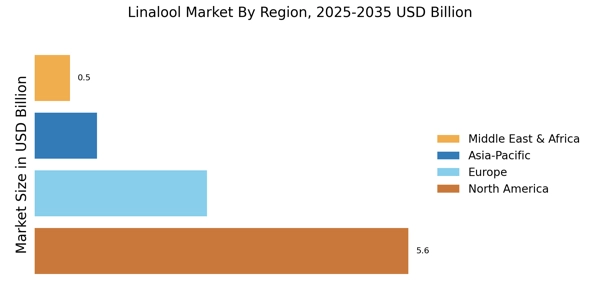
The North American linalool market is driven by increasing consumer demand for natural fragrances and flavors, particularly in the food and beverage sector. The U.S. holds the largest market share at approximately 65%, followed by Canada at around 20%. Regulatory support for natural ingredients is further propelling growth, with initiatives aimed at reducing synthetic additives in consumer products. Leading the market, the U.S. is home to major players like International Flavors & Fragrances Inc. and BASF SE, which are investing in sustainable sourcing and production methods. The competitive landscape is characterized by innovation in product formulations and a focus on eco-friendly practices. As consumer preferences shift towards natural products, the market is expected to expand significantly in the coming years.
Europe is witnessing a robust growth in the linalool market, driven by stringent regulations favoring natural ingredients in cosmetics and food products. Germany and France are the largest markets, holding approximately 30% and 25% of the market share, respectively. The European Union's regulations on fragrance ingredients are catalyzing demand for linalool, as manufacturers seek compliant and sustainable options. Key players like Givaudan SA and Firmenich SA are leading the charge in innovation, focusing on sustainable sourcing and production. The competitive landscape is marked by collaborations and partnerships aimed at enhancing product offerings. As consumer awareness regarding sustainability increases, the market is poised for continued growth, with a strong emphasis on eco-friendly practices and compliance with regulatory standards.
The Asia-Pacific linalool market is experiencing rapid growth, driven by rising disposable incomes and increasing demand for personal care products. China and Japan are the largest markets, accounting for approximately 40% and 25% of the market share, respectively. The region's growth is further supported by a shift towards natural and organic products, aligning with global trends in consumer preferences. China's expanding fragrance industry, coupled with the presence of key players like Takasago International Corporation and Kao Corporation, is enhancing the competitive landscape. The market is characterized by a mix of local and international players, all vying for a share in this burgeoning sector. As the demand for linalool continues to rise, the region is set to become a significant player in the global market.
The Middle East and Africa linalool market is in its nascent stages but shows significant potential for growth. The region is characterized by increasing demand for natural fragrances in personal care and household products. The UAE and South Africa are the leading markets, holding approximately 30% and 20% of the market share, respectively. Regulatory frameworks are gradually evolving to support the use of natural ingredients, which is expected to drive market growth. The competitive landscape is still developing, with local manufacturers beginning to emerge alongside established global players. Companies are focusing on product innovation and sustainability to capture market share. As consumer awareness of natural products increases, the linalool market in this region is anticipated to expand, driven by both local and international demand.
April 2026: BASF officially commissioned its new world-scale linalool production plant in Ludwigshafen, Germany. Commercial production of linalool started in April 2026 following a triple-digit million-euro investment. The expanded capacity is integrated into BASF's citral value chain and is intended to improve supply reliability for fragrance and flavor customers. The project also created 60 new jobs at the Ludwigshafen site.
April 2026: BASF made products from its expanded linalool and menthol capacities available to customers following successful production at the Ludwigshafen site. The new linalool capacity forms part of BASF's broader investment across the citral value chain, with the company's new Zhanjiang citral plant supplying feedstock to the downstream linalool and menthol operations.
July 2026: dsm-firmenich reported 5% like-for-like sales growth in H1 2026, with its Perfumery & Beauty business benefiting from continued customer demand. The company is executing its 2026–2028 action plan to accelerate growth across its fragrance and beauty businesses, supporting continued development of aroma and fragrance ingredients used in consumer products.
February 2026: Givaudan expanded its fragrance-precursor portfolio with the launch of Scentaurus™ PolyDoux, an oxygen-activated technology designed to release long-lasting fruity raspberry and powdery vanilla notes in personal-care and laundry applications. The launch reflects continued investment in advanced fragrance technologies and long-lasting scent delivery.
Der Linalool-Markt wird voraussichtlich von 2024 bis 2035 mit einer durchschnittlichen jährlichen Wachstumsrate (CAGR) von 2,94 % wachsen, angetrieben durch die steigende Nachfrage in den Bereichen Kosmetik, Lebensmittel und Duftstoffe.
Neue Möglichkeiten liegen in:
Bis 2035 wird erwartet, dass der Linalool-Markt ein robustes Wachstum erzielt, das sich an den sich wandelnden Verbraucherpräferenzen orientiert.
| MARKET SIZE 2024 | 8.563(USD Billion) |
| MARKET SIZE 2025 | 8.815(USD Billion) |
| MARKET SIZE 2035 | 11.78(USD Billion) |
| COMPOUND ANNUAL GROWTH RATE (CAGR) | 2.94% (2025 - 2035) |
| REPORT COVERAGE | Revenue Forecast, Competitive Landscape, Growth Factors, and Trends |
| BASE YEAR | 2024 |
| Market Forecast Period | 2025 - 2035 |
| Historical Data | 2019 - 2024 |
| Market Forecast Units | USD Billion |
| Key Companies Profiled | BASF SE (DE), Givaudan SA (CH), Symrise AG (DE), Firmenich SA (CH), Takasago International Corporation (JP), Kao Corporation (JP), International Flavors & Fragrances Inc. (US), Austrian Aromatics GmbH (AT) |
| Segments Covered | Application, Purity, Extraction Method, Source, Regional |
| Key Market Opportunities | Growing demand for natural fragrances and cosmetics fuels expansion in the Linalool Market. |
| Key Market Dynamics | Rising demand for natural fragrances drives innovation and competition in the Linalool market. |
| Countries Covered | North America, Europe, APAC, South America, MEA |
 Priya Nagrale

Bitte füllen Sie das folgende Formular aus, um ein kostenloses Muster dieses Berichts zu erhalten


“This is really good guys. Excellent work on a tight deadline. I will continue to use you going forward and recommend you to others. Nice job”
 Noah Malgeri
Co-Founder

“Thanks for sending the report it gives us a good global view of the Betaïne market.”
 Peter Groot koerkamp
Account and Business Manager

“We found the report very insightful! we found your research firm very helpful. I'm sending this email to secure our future business.”
 Younghwan Choi
Senior Retail Manager

“I am very pleased with how market segments have been defined in a relevant way for my purposes (such as "Portable Freezers & refrigerators" and "last-mile"). In general the report is well structured. Thanks very much for your efforts.”
 Mark Irwin
Management Consultant

“We got the report in time, we really thank you for your support in this process. I also thank to all of your team as they did a great job.”
 Akif Moroglu
Strategy & Business Development Director

“The Automotive 48V ECU Components Procurement Intelligence Study” was a complex project, but the Market Research Future (MRFR) team handled it with quality, agility, and customer-centricity. They delivered all requested data on time and within the agreed scope. The team, including Shubhendra Anand and Rahul Gotadki, was always readily available to clarify questions and swiftly implement necessary adjustments, driving the project to a successful conclusion within a very demanding timeframe.
I would also like to specifically commend Akshay Agarwal for his responsiveness and support at every stage—from our initial inquiry on May 6th through to final delivery on June 18th. His dedication made the entire process seamless.”
 Guilherme Gomes Martins
Product Management Director

“Thanks. It’s been a pleasure working with you, please use me as reference with any other Intel employees.”
 Joseph Aguayo
Sales Operations & Pricing Manager

“Thank you, this will be very helpful for OQS.”
 La Terria Dodd
Program Support Specialist

“I have been reading the first document or the study, ,the Global HVAC and FP market report 2021 till 2026. Must say, good info! I have not gone in depth at all parts, but got a good indication of the data inside!”
 Rob Kooiker
Group Product Manager HVAC & Fire Protection GMA