Markt für Gehirnerschütterungen Zusammenfassung
Wichtige Markttrends & Highlights
Marktgröße & Prognose
| CAGR (2025 - 2035) | 5.6% |
| CAGR (2025 - 2035) | 5.6% |
The Concussions Market is currently experiencing a notable evolution, driven by increasing awareness regarding the long-term effects of concussions and the necessity for effective management strategies. This heightened consciousness among healthcare professionals, athletes, and the general public has led to a surge in demand for innovative diagnostic tools and treatment options.
Furthermore, advancements in technology are facilitating the development of more precise imaging techniques and wearable devices that monitor brain activity, thereby enhancing the ability to detect and manage concussions effectively. As a result, stakeholders in the Concussions Market are focusing on research and development to create solutions that address the complexities associated with concussion management.
In addition to technological advancements, regulatory frameworks are evolving to ensure better safety standards in sports and recreational activities. This shift is likely to encourage organizations to adopt comprehensive concussion protocols, which may further stimulate market growth. Moreover, educational initiatives aimed at promoting awareness about concussion risks and prevention strategies are gaining traction, potentially influencing behavior among athletes and coaches.
Overall, the Concussions Market appears poised for growth, with a multifaceted approach that encompasses innovation, regulation, and education, all contributing to improved outcomes for individuals affected by concussions.
The Concussions Market is witnessing a trend towards the integration of advanced technologies in diagnostic processes. Innovations such as artificial intelligence and machine learning are being utilized to enhance the accuracy of concussion assessments, allowing for quicker and more reliable diagnoses. This trend is likely to improve patient outcomes and streamline treatment protocols.
There is a growing emphasis on preventive strategies within the Concussions Market. Organizations are increasingly implementing educational programs aimed at raising awareness about concussion risks and promoting safe practices in sports. This proactive approach may lead to a reduction in incidence rates and foster a culture of safety.
The Concussions Market is influenced by evolving regulatory frameworks that mandate stricter safety protocols in sports and recreational activities. These changes are compelling organizations to adopt comprehensive concussion management policies, which could enhance the overall safety of athletes and contribute to market expansion.
Technological innovations in medical devices and diagnostic tools are transforming the Concussions Market. The development of advanced imaging techniques, such as MRI and CT scans, has improved the accuracy of concussion diagnoses, enabling healthcare professionals to make informed decisions regarding treatment.
Furthermore, wearable technology that monitors head impacts is gaining traction, providing real-time data that can help prevent concussions. The market for these technologies is projected to grow, driven by the increasing demand for effective and efficient diagnostic solutions. As healthcare providers adopt these advancements, the overall quality of care for concussion patients is expected to improve, further propelling market growth.
The increasing awareness surrounding the risks associated with concussions is a pivotal driver in the Concussions Market. Educational campaigns and advocacy from health organizations have heightened public consciousness about the long-term effects of concussions, particularly in contact sports. This awareness has led to a surge in demand for diagnostic tools and treatment options, as individuals seek to understand and mitigate the risks.
According to recent data, the prevalence of diagnosed concussions has risen significantly, indicating a growing recognition of the condition. As more individuals become informed about the potential consequences of concussions, the market is likely to expand, with a focus on innovative solutions for prevention and management.
The rising participation rates in contact sports, particularly among youth, is a significant driver in the Concussions Market. As more children and adolescents engage in sports such as football, hockey, and rugby, the incidence of concussions is likely to increase. This trend has prompted schools and sports organizations to implement stricter safety protocols and concussion management programs.
Consequently, there is a growing demand for educational resources, training programs, and protective equipment designed to minimize the risk of concussions. The market is responding to this need by offering a variety of products aimed at enhancing player safety and promoting awareness of concussion-related issues.
Regulatory bodies are increasingly recognizing the importance of effective concussion management, which serves as a crucial driver in the Concussions Market. New guidelines and policies aimed at improving the safety of athletes have been established, mandating that organizations implement comprehensive concussion protocols.
This regulatory support not only enhances the safety of participants but also drives the demand for related products and services, including training programs for coaches and medical staff. As compliance with these regulations becomes essential, the market is likely to see growth in areas such as educational materials and concussion assessment tools, reflecting the commitment to athlete safety.
Investment in research and development within the Concussions Market is on the rise, driven by the need for innovative solutions to address the complexities of concussion management. Funding from both public and private sectors is being directed towards studies that explore the long-term effects of concussions and the efficacy of various treatment options.
This influx of capital is fostering the development of new therapies, diagnostic tools, and preventive measures. As research continues to unveil new insights into concussion management, the market is expected to expand, offering a wider array of products and services aimed at improving outcomes for individuals affected by concussions.
Im Markt für Gehirnerschütterungen hat das Diagnosesegment derzeit einen erheblichen Anteil am Markt, dank der etablierten Praktiken und Technologien zur Identifizierung von Gehirnerschütterungen. Diagnosetechniken, einschließlich klinischer Bewertungen und fortschrittlicher Bildgebungstechniken, sind integraler Bestandteil des Managements von Gehirnerschütterungen und tragen zur robusten Marktpräsenz bei. Im Gegensatz dazu gewinnt das Behandlungsssegment, obwohl es derzeit kleiner ist, schnell an Bedeutung, da innovative Therapien und Rehabilitationstechniken entwickelt werden, um die langfristigen Auswirkungen von Gehirnerschütterungen zu adressieren.
Diagnose: Klinische Bewertung (Dominant) vs. Behandlung: Rehabilitationstechniken (Aufkommend)
Das Diagnosesegment, insbesondere klinische Bewertungen, bleibt im Markt für Gehirnerschütterungen dominant, da es eine entscheidende Rolle bei der frühen Erkennung und Intervention spielt. Standardisierte Protokolle und fortschrittliche Bildgebungswerkzeuge verbessern die Effizienz dieser Bewertungen und gewährleisten eine genaue Diagnose. Auf der anderen Seite befinden sich Behandlungsmethoden, insbesondere Rehabilitationstechniken, in einer aufkommenden Phase, die durch ihre wachsende Bedeutung im langfristigen Management von Gehirnerschütterungen gekennzeichnet ist. Dieses Segment entwickelt sich weiter, mit einem Anstieg personalisierter Behandlungspläne und multidisziplinärer Ansätze, was einen Wandel hin zu einer ganzheitlichen Versorgung zeigt, während das Bewusstsein für die Auswirkungen von Gehirnerschütterungen zunimmt.
Im Markt für Gehirnerschütterungen halten Krankenhäuser und Kliniken den größten Anteil, da sie von etablierten Infrastrukturen und umfassenden Patientenversorgungskapazitäten profitieren. Sie waren entscheidend bei der Diagnose und dem Management von Gehirnerschütterungsfällen, da sie Zugang zu fortschrittlichen Medizintechnologien und einer breiten Palette von Spezialisten haben. Diagnostikzentren hingegen erweitern ihren Marktanteil, da sie spezialisierte Dienstleistungen anbieten, die speziell auf Gehirnerschütterungsbewertungen ausgerichtet sind, was mehr Patienten anzieht, die schnelle und genaue Diagnosen suchen. Die Wachstumstrends zeigen einen signifikanten Wandel hin zur Expansion von Diagnostikzentren, angetrieben durch das steigende Bewusstsein für die Auswirkungen von Gehirnerschütterungen und die Nachfrage nach sofortigen Bewertungs- und Behandlungsoptionen. Darüber hinaus entwickeln sich Krankenhäuser und Kliniken weiter, indem sie innovative Technologien und Behandlungsansätze integrieren, was ihre Attraktivität für Patienten weiter erhöht. Mit dem Wachstum von Kampagnen zur Sensibilisierung für Gehirnerschütterungen und dem zunehmenden Fokus auf sportbedingte Kopfverletzungen sind beide Segmente auf bemerkenswertes Wachstum in den kommenden Jahren vorbereitet.
Krankenhäuser und Kliniken (Dominant) vs. Diagnostikzentren (Aufkommend)
Krankenhäuser und Kliniken stellen das dominante Segment im Markt für Gehirnerschütterungen dar, gekennzeichnet durch ihren umfassenden Ansatz zur Patientenversorgung, einschließlich fortschrittlicher Bildgebungstechnologien und multidisziplinärer Teams. Sie bieten eine breite Palette von Dienstleistungen, von der ersten Bewertung bis zur fortlaufenden Rehabilitation, und gewährleisten so einen ganzheitlichen Ansatz zur Behandlung von Gehirnerschütterungen. Diagnostikzentren, obwohl sie aufkommend sind, gewinnen schnell an Bedeutung, da sie fokussierte Dienstleistungen für die Diagnose von Gehirnerschütterungen anbieten. Sie bedienen einen Nischenmarkt und bieten optimierte Dienstleistungen für Patienten, die schnelle Bewertungen benötigen. Mit dem zunehmenden Bewusstsein für die Bedeutung der frühen Erkennung und Behandlung nutzen Diagnostikzentren moderne Diagnosetools, was sie im Gesundheitswesen günstig positioniert.
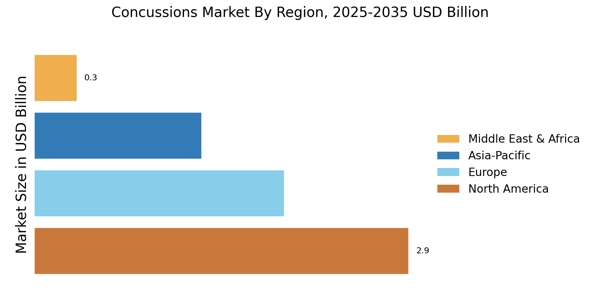
By region, the study provides the market insights into North America, Europe, Asia-Pacific and Rest of the World. The North American Concussions Market area will dominate this market, because to the continent's higher prevalence of concussions caused by car accidents and sports injuries, as well as increased government activities and awareness campaigns linked to concussion prevention, diagnosis, and treatment. According to the American Physical Therapy Association (APTA), around 8.6 million sports injuries are documented in this region each year.
Further, the major countries studied in the market report are The US, Canada, German, France, the UK, Italy, Spain, China, Japan, India, Australia, South Korea, and Brazil.
Europe Concussions Market accounts for the second-largest market share due to rising awareness of the significance of concussions and their potential long-term consequences. Further, the German Concussions Market held the largest market share, and the UK Concussions Market was the fastest growing market in the European region
The Asia-Pacific Concussions Market is expected to grow at the fastest CAGR from 2023 to 2032. This is due to causes such as an older population that is more sensitive to falls, an increase in the number of road accidents, and violence. Moreover, China’s Concussions Market held the largest market share, and the Indian Concussions Market was the fastest growing market in the Asia-Pacific region.
Leading market players are investing heavily in research and development in order to expand their product lines, which will help the Concussions Market, grow even more. Market participants are also undertaking a variety of strategic activities to expand their footprint, with important market developments including new product launches, contractual agreements, mergers and acquisitions, higher investments, and collaboration with other organizations. To expand and survive in a more competitive and rising market climate, Concussionsindustry must offer cost-effective items.
Manufacturing locally to minimize operational costs is one of the key business tactics used by manufacturers in the Concussions industry to benefit clients and increase the market sector. In recent years, the Concussions industry has offered some of the most significant advantages to medicine. Major players in the Concussions Market, including Advanced Brain Monitoring, Inc. BioDirection, Inc. BrainScope Company, Inc. InfraScan, Inc, and Nova Signal Corporation, and others, are attempting to increase market demand by investing in research and development operations.
Acorda Therapeutics, Inc. is a biotechnology business headquartered in Pearl River, New York. The company creates medicines to help people with Parkinson's disease, multiple sclerosis, and other neurological illnesses improve their neurological function. In the United States, Acorda Therapeutics develops and markets the medications Inbrija (levodopa inhalation powder) and Ampyra (dalfampridine). In 2020, Acorda Therapeutics has formed a strategic alliance with the Medical University of South Carolina to develop and commercialize a new concussion therapy.
The collaboration planned to use Acorda's neuroscience expertise and the university's experience in concussion research to create new treatment choices for patients. Eli Lilly and corporation is a pharmaceutical corporation based in Indianapolis, Indiana, with offices in 18 countries. Its products are sold in over 125 countries. Colonel Eli Lilly, a pharmaceutical chemist and American Civil War veteran, created and named the corporation in 1876. Colonel Eli Lilly, a pharmaceutical chemist and Union army veteran of the American Civil War, founded the corporation.
Lilly was president of the corporation until his death in 1898. In 2020, Eli Lilly and business announced a collaboration with Imago BioSciences, a biotechnology business, to investigate a viable treatment for concussions. The collaboration planned to use Imago's small molecule inhibitor technology to target the immune system and reduce post-concussion inflammation.
In March 2026, Northwell Health's North Shore University Hospital, a Level I trauma center, began using Abbott's i-STAT Alinity TBI whole-blood test (measuring GFAP and UCH-L1 biomarkers) in its emergency department to assess suspected concussion/mild TBI in about 15 minutes. It's a real-world clinical adoption milestone (not just a regulatory clearance) showing Abbott's TBI diagnostic moving into high-volume ER settings, reinforcing its lead in the objective concussion-testing segment of the market. (Source: northwell.edu)
In December 2025, Medtronic announced U.S. clearance of a new indication for its Onyx Liquid Embolic System — middle meningeal artery embolization as an adjunct to surgery for symptomatic subacute/chronic subdural hematoma — based on the EMBOLISE trial (published in NEJM, Nov 2024), showing ~63% reduction in recurrence/re-operation when combined with surgery. cSDH is a traumatic brain injury commonly caused by head trauma/falls — adjacent to, but distinct from, "concussion" in the strict mTBI sense. I'm flagging this explicitly: it's real, dated, and TBI-related, but it is not a concussion-specific product, so treat it as adjacent-market context rather than a direct concussion-market development. (Source: news.medtronic.com)
Der Markt für Gehirnerschütterungen wird voraussichtlich von 2025 bis 2035 mit einer CAGR von 5,6% wachsen, angetrieben durch ein erhöhtes Bewusstsein, fortschrittliche Diagnosetechnologien und verbesserte Behandlungsoptionen.
Neue Möglichkeiten liegen in:
Bis 2035 wird der Markt für Gehirnerschütterungen voraussichtlich robust sein, was bedeutende Fortschritte und ein erhöhtes Marktbeteiligung widerspiegelt.
| MARKET SIZE 2024 | 6.336(USD Billion) |
| MARKET SIZE 2025 | 6.691(USD Billion) |
| MARKET SIZE 2035 | 11.54(USD Billion) |
| COMPOUND ANNUAL GROWTH RATE (CAGR) | 5.6% (2025 - 2035) |
| REPORT COVERAGE | Revenue Forecast, Competitive Landscape, Growth Factors, and Trends |
| BASE YEAR | 2024 |
| Market Forecast Period | 2025 - 2035 |
| Historical Data | 2019 - 2024 |
| Market Forecast Units | USD Billion |
| Key Companies Profiled | Abbott Laboratories (US), Medtronic (US), Boston Scientific (US), Stryker Corporation (US), Cortech Solutions (US), Zynex Medical (US), Neurotech Pharmaceuticals (US), Huntleigh Healthcare (GB), B. Braun Melsungen AG (DE) |
| Segments Covered | Diagnosis & Treatment, End-User, Region |
| Key Market Opportunities | Advancements in diagnostic technologies enhance early detection and treatment options in the Concussions Market. |
| Key Market Dynamics | Rising awareness of concussion risks drives demand for advanced diagnostic tools and treatment options in the healthcare sector. |
| Countries Covered | North America, Europe, APAC, South America, MEA |
Der Markt für Gehirnerschütterungen wurde im Jahr 2024 mit 6,336 Milliarden USD bewertet.
Der Markt wird voraussichtlich bis 2035 11,54 Milliarden USD erreichen.
Die erwartete CAGR für den Markt für Gehirnerschütterungen im Zeitraum 2025 - 2035 beträgt 5,6%.
Der Markt ist nach Diagnose & Behandlung und nach Endbenutzer segmentiert.
Das Diagnosesegment wird voraussichtlich von 2,5 Milliarden USD auf 4,5 Milliarden USD bis 2035 wachsen.
Das Behandlungsegment wird voraussichtlich von 3,836 Milliarden USD auf 7,04 Milliarden USD bis 2035 steigen.
Krankenhäuser und Kliniken werden voraussichtlich von 2,5 Milliarden USD auf 4,5 Milliarden USD bis 2035 wachsen.
Wichtige Akteure wie Abbott Laboratories und Medtronic sind entscheidend für die Förderung von Innovationen und das Marktwachstum.
Diagnosetzentren werden voraussichtlich von 1,5 Milliarden USD auf 2,5 Milliarden USD bis 2035 wachsen.
Die Kostenträger werden voraussichtlich von 2,336 Milliarden USD auf 4,54 Milliarden USD bis 2035 steigen, was ihre wachsende Bedeutung anzeigt.
The secondary research process involved comprehensive analysis of neurological health databases, traumatic brain injury (TBI) surveillance systems, peer-reviewed neurotrauma journals, clinical neurology publications, and authoritative health organizations. Key sources included the US Centers for Disease Control and Prevention (CDC) Traumatic Brain Injury Surveillance System, National Center for Injury Prevention and Control (NCIPC), US Food & Drug Administration (FDA) Center for Devices and Radiological Health (CDRH) 510(k) clearances for neurodiagnostic devices, National Institutes of Health (NIH) National Institute of Neurological Disorders and Stroke (NINDS), National Center for Biotechnology Information (NCBI/PubMed) database for concussion biomarker studies, World Health Organization (WHO) Neurology and Brain Health Atlas, Brain Injury Association of America (BIAA) statistical reports, European Brain Injury Consortium (EBIC), Organisation for Economic Co-operation and Development (OECD) Health Statistics, EU Eurostat Health Database, National Collegiate Athletic Association (NCAA) Injury Surveillance Program, National Athletic Trainers' Association (NATA) position statements, and national neurotrauma registries from key markets including the Canadian Brain Injury Association, UK National Health Service (NHS) Digital TBI statistics, and Australian Institute of Health and Welfare (AIHW) brain injury reports. These sources were utilized to collect TBI incidence and prevalence data, concussion diagnosis protocol statistics, regulatory approval pathways for neurodiagnostic devices, clinical safety and efficacy studies for imaging technologies and biomarkers, sports-related concussion trends, military TBI surveillance data, reimbursement coding dynamics (CPT/ICD-10), and market landscape analysis for advanced diagnostic technologies including quantitative EEG, functional near-infrared spectroscopy (fNIRS), blood biomarker assays (GFAP, UCH-L1), and magnetic resonance imaging (MRI) sequences.
During the primary research process, qualitative and quantitative insights regarding concussion diagnosis and management protocols were obtained through interviews with supply-side and demand-side stakeholders. The supply-side sources consisted of CEOs, VPs of R&D, regulatory affairs directors, and commercial leaders from neurodiagnostic device manufacturers, medical imaging companies, and concussion biomarker developers. Board-certified neurologists, neurosurgeons, emergency medicine physicians, sports medicine specialists, athletic trainers, and procurement directors from level I trauma centers, academic medical centers, sports medicine clinics, rehabilitation facilities, and hospital radiology departments comprised demand-side sources. Primary research has confirmed the product development timelines for portable concussion assessment devices, validated market segmentation across diagnostic modalities (imaging, biomarkers, neurocognitive testing), and gathered insights on clinical adoption patterns of point-of-care testing, pricing strategies for wearable monitoring devices, and reimbursement dynamics for concussion protocols.
Primary Respondent Breakdown:
By Designation: C-level Primaries (32%), Director Level (31%), Others (37%)
By Region: North America (32%), Europe (30%), Asia-Pacific (28%), Rest of World (10%)
Global market valuation was derived through revenue mapping of diagnostic device portfolios and concussion management procedure volume analysis. The methodology included:
Identification of 40+ key manufacturers across North America, Europe, Asia-Pacific, and Latin America specializing in neuroimaging equipment, portable diagnostic devices, biomarker testing platforms, and concussion management software
Product mapping across diagnostic technologies (CT/MRI imaging, quantitative EEG, fNIRS, ocular tracking, blood biomarker assays) and treatment modalities (neuromodulation devices, pharmacological interventions, rehabilitation protocols)
Analysis of reported and modeled annual revenues specific to concussion/TBI product portfolios, including FDA-cleared and CE-marked neurodiagnostic devices
Coverage of manufacturers representing 75-80% of global market share in 2024, with particular emphasis on companies developing AI-integrated concussion assessment platforms and wearable impact sensors
Extrapolation using bottom-up (procedure volume × ASP by country/setting, segmented by emergency department visits, sports medicine clinics, and military screening programs) and top-down (manufacturer revenue validation, distributor channel analysis) approaches to derive segment-specific valuations for diagnosis and treatment markets
Bitte füllen Sie das folgende Formular aus, um ein kostenloses Muster dieses Berichts zu erhalten
“This is really good guys. Excellent work on a tight deadline. I will continue to use you going forward and recommend you to others. Nice job”
“Thanks for sending the report it gives us a good global view of the Betaïne market.”
“We found the report very insightful! we found your research firm very helpful. I'm sending this email to secure our future business.”
“I am very pleased with how market segments have been defined in a relevant way for my purposes (such as "Portable Freezers & refrigerators" and "last-mile"). In general the report is well structured. Thanks very much for your efforts.”
“We got the report in time, we really thank you for your support in this process. I also thank to all of your team as they did a great job.”
“The Automotive 48V ECU Components Procurement Intelligence Study” was a complex project, but the Market Research Future (MRFR) team handled it with quality, agility, and customer-centricity. They delivered all requested data on time and within the agreed scope. The team, including Shubhendra Anand and Rahul Gotadki, was always readily available to clarify questions and swiftly implement necessary adjustments, driving the project to a successful conclusion within a very demanding timeframe.
I would also like to specifically commend Akshay Agarwal for his responsiveness and support at every stage—from our initial inquiry on May 6th through to final delivery on June 18th. His dedication made the entire process seamless.”
“Thanks. It’s been a pleasure working with you, please use me as reference with any other Intel employees.”
“Thank you, this will be very helpful for OQS.”
“I have been reading the first document or the study, ,the Global HVAC and FP market report 2021 till 2026. Must say, good info! I have not gone in depth at all parts, but got a good indication of the data inside!”