An Overview of the Maritime Security Industry
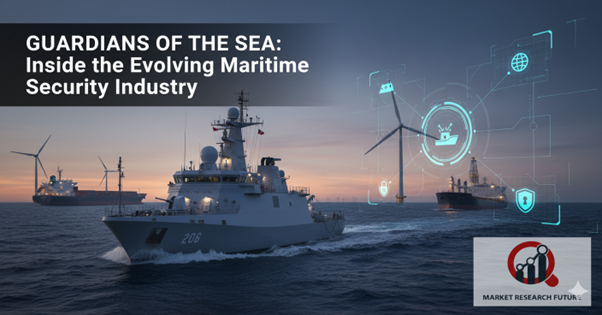
A Look at the Maritime Security Industry
The maritime security industry is a key part of global trade and transportation, making sure that goods, energy, and people can move safely across international waters. As trade around the world grows, the need for better ways to keep ships safe is greater than ever. As countries upgrade their ports and improve their naval capabilities, there is a growing need for technologies that keep ships, cargo, and coastal infrastructure safe from new threats like piracy, trafficking, illegal immigration, and cyber-attacks.
The seas have always been the main route for trade around the world, but now the focus is on maritime defense systems that are based on new ideas. The industry is going through a huge change as it combines automation, AI-based surveillance, and predictive analytics to make maritime ecosystems smarter and more resilient.
Getting through Uncertainty with Strength and New Ideas
The pandemic put every part of global logistics to the test, and the maritime industry was no different. Ports and shipping lines had problems, but making trade safe and easy became a top priority. The crisis showed how weak global supply chains are and how badly we need security systems that can adapt and use data.
Even though ships moved less during the pandemic, threats like smuggling, piracy, and illegal trafficking continued. Many ports didn't have the right systems in place to find and deal with these risks, which showed serious weaknesses in maritime defense.
After the event, shipowners and port authorities are now putting automation, remote surveillance, and advanced monitoring tools at the top of their lists of things to do to make sure their operations are safe in the future. The move toward smart, strong port infrastructure is changing the way maritime trade is protected in the future.
What could be the Reasons for Maritime Security?
Today, maritime security is driven by the need to protect complex logistics networks around the world while also making sure that marine operations can continue. Technology is changing very quickly, and this has opened up a lot of possibilities in this area. To make port and ship security as good as it can be, you need to use automation, AI, and real-time data analytics.
New technologies like electronic barriers, self-driving surface vehicles, underwater acoustic defense systems, and advanced radar detection are changing the way we protect our ships. These new ideas make it possible to respond more quickly and be more aware of what's going on.
Cybersecurity has also become a major area of focus. The risk of cyber threats grows exponentially as more ports and ships start using digital management systems. It is now just as important to protect communication systems and sensitive information as it is to protect against physical threats. GPS tracking, digital twins, and AI-enabled monitoring all work together to help maritime authorities stay one step ahead of possible threats while also improving efficiency and following environmental rules.
What are the Limits?
Even though technology is moving quickly, some problems that have been around for a long time still exist. Piracy is still one of the biggest threats to maritime security, especially in areas where surveillance is limited. Even though systems for finding and following illegal activities are getting better, sharing information between countries and agencies is still hard.
Because the maritime industry relies on smooth data exchange, it is easy for things to go wrong. To fight threats in real time, nations, ports, and ships must be able to talk to each other clearly. In 2025, one of the most important things for businesses is still to build secure, interoperable networks.
What are the Different Parts of the Maritime Security Industry?
The maritime security business works through a number of levels of protection:
- By system: screening and scanning, surveillance and tracking, access control, communications, and detectors.
- By threats: fixing weak spots in deep-water areas and around ports.
- By use: protecting ships and ports, keeping an eye on the coast, and protecting shipyards.
In terms of regions, there are North America, Europe, Asia-Pacific, and the Rest of the World.
Asia-Pacific is still growing quickly as of 2025 because of more defense programs and geopolitical tensions. India, Japan, and China are all putting more money into research and development and building up their navies to protect their waters. On the other hand, North America and Europe are spending money on cybersecurity and advanced surveillance integration to keep control of complicated maritime operations.
Latin America, the Middle East, and Africa are also becoming important markets. To protect their maritime economies, they are focusing on coastal monitoring and threat intelligence.
Who are the Main Companies in the Maritime Security Business?
Established defense and technology companies that are working on next-generation monitoring systems are some of the most important players in global maritime security. These companies are always coming up with new ideas in areas such as unmanned surface vehicles, integrated radar systems, AI-driven analytics, and multi-sensor detection solutions.
Technology companies and naval authorities are working together strategically to make maritime networks smarter and more connected. The focus is on creating systems that improve situational awareness, speed up response times, and make maritime domain control stronger.
Looking Forward
As the world moves deeper into the digital age, maritime security will change from reactive defense to proactive intelligence. Combining automation, AI, and cybersecurity solutions is raising the bar for safety at sea.
The maritime security industry will keep coming up with new ideas to make sure that every ship, port, and cargo shipment moves safely, accurately, and with confidence. This is because oceans are still the main routes for global trade.
Related Report


Leave a Comment