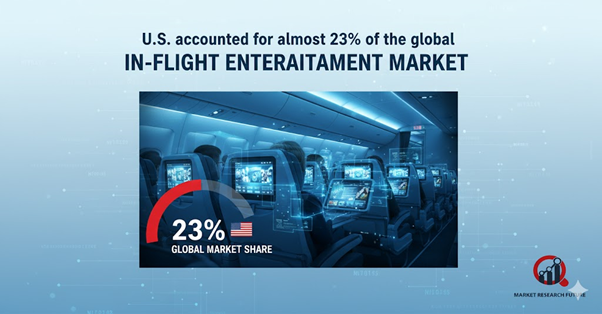
US Accounted for Almost 23% of the Global In-flight Entertainment Market
Market Overview:
With the escalating number of passengers travelling via airplanes, the demand for in-flight entertainment devices is expected to surge. The size of the in-flight entertainment market, therefore, is likely to reach USD 7.88 billion by 2035 at an impressive CAGR of 8.7% through the forecast period. The ecosystem was valued at USD 3.15 billion in 2024.
Over the next 20 years, it is expected that the US air passenger traffic will increase by 484 million passengers and reach over 1 billion. In addition, the flourishing digital media sector and the existence of major communication and content service providers are expected to aid the growth of the in-flight entertainment market in the US.
Moreover, the development and upgrade of both satellite and ATG technology by key players, such as Gogo, SmartSky Networks, and others, in this country is boosting the in-flight entertainment market growth.
The Middle East and Africa: Promising Growth Avenue
The Middle East and Africa region has been witnessing a phenomenal increase in economic activities, of late. The major factors driving the economy of the region are increased air travel and rising tourism.
As the region is located at the crossroads of Asia, Africa, and Europe, its local airlines, led by Emirates, Qatar Airways, and Etihad Airlines, are well-positioned to compete for the global air traffic.
Due to the rapid increase in the number of aircraft in the region, it is expected that there will be a significant and simultaneous impact on the in-flight entertainment market as well.
South America: A Budding Market
A few countries in this region are witnessing a period of political and economic instability. However, factors such as growing tourism and subsequent air passenger traffic increase, coupled with initiatives undertaken by airlines to implement in-flight solutions, are expected to aid in the growth of the market.
For instance, airlines such as Avianca, LATAM, and others are keen on providing onboard connectivity services. Moreover, the steadily rising investments in the aviation industry are expected to further boost the scope of the in-flight entertainment market in this region.
Data Connectivity: The Fastest Growing Service Type Market Segment
This segment covers all the aspects associated with the in-flight connectivity solution, such as internet browsing, text messaging, cell phone usage, and email. Data connectivity services were initially offered only by a couple of airlines, especially the American-based ones.
Now, this trend is being observed in other regions, such as Europe, the Asia Pacific, and others, and initiatives are being undertaken by both satellite service providers and airlines to create a seamless solution onboard the aircraft.
Countries, including India, are also liberalizing the regulations in order to pave the way for the development of this solution.
Moreover, companies such as Gogo and Inmarsat are upgrading their offerings and developing new solutions to improve the connection speeds. Hence, the data connectivity segment is estimated to grow at the fastest pace during the forecast period.
Hardware: The Largest Product Type Market Segment
The hardware segment of the in-flight entertainment market comprises mostly the tangible aspects associated with in-flight systems, such as monitors, switch panels, and others.
It covers both portable hardware, such as dockable seat display unit, removable storage unit, and others, as well as non-portable hardware, such as embedded seat-back unit, seat electronic box, and others. These components add bulk and weight to seats and are now becoming technologically archaic.
Hence, factors such as the focus of airlines/aircraft manufacturers towards reducing the weight of the aircraft, cutting down expenses associated with maintaining IFEC hardware, and the burgeoning BYOD concept are deterring the growth of the hardware segment.
However, aircraft manufacturers, such as Airbus, still perceive in-seat IFE as an ideal solution for long-haul flights. Therefore, the hardware market segment is projected to remain the largest market during the forecast period.
Burgeoning BYOD Concept: Tremendous Opportunity for Market Growth
The conventional IFEC system implementation requires a sizable investment. It also requires extensive cabling and adds bulk and weight to seats, which causes aircraft to burn fuel more quickly, ultimately increasing the cost of air travel.
Thus, owing to these factors and the emerging trend of personalization and the wireless IFE concept, airlines are focusing on streaming content to passengers’ devices. Passengers also favor their devices for in-flight entertainment.
Similarly, the findings of the SITA Passenger IT Trends Survey suggest that passengers are more likely to consume in-flight entertainment via their own electronic devices. Hence, the emergence of the BYOD (bring your own device) concept offers tremendous growth opportunities for the in-flight entertainment market.
Contracts and Agreements: Growth strategy
Extensive research in this market has brought to light that contracts and agreements are a key strategy extensively adopted by the players. It is followed by new product development and mergers and acquisitions.
Global Eagle Entertainment Inc. completed the acquisition of all remaining shares of Advanced Inflight Alliance AG to solidify its position as an in-flight content and connectivity provider.