Request Free Sample ×

Kindly complete the form below to receive a free sample of this Report

* Please use a valid business email

Leading companies partner with us for data-driven Insights

clients tt-cursor
Hero Background
English
Chinese
French
Japanese
Korean
German
Spanish

Wound Care Market Analysis

ID: MRFR/HC/0421-CR
208 Pages
Rahul Gotadki
July 2025

Wound Care Market Research Report: Size, Share, Trend Analysis By Product Type (Dressings, Advanced Wound Care, Traditional Wound Care, Sutures, Gauze), By Wound Type (Chronic Wounds, Acute Wounds, Surgical Wounds, Burns), By End Users (Hospitals, Home Healthcare, Ambulatory Surgical Centers, Clinics), By Applications (Diabetic Ulcers, Pressure Ulcers, Venous Leg Ulcers, Traumatic Wounds) - Growth Outlook & Industry Forecast 2025 To 2035

Share:
Download PDF ×

We do not share your information with anyone. However, we may send you emails based on your report interest from time to time. You may contact us at any time to opt-out.

Wound Care Market Infographic
Purchase Options

Market Analysis

In-depth Analysis of Wound Care Market Industry Landscape

Wound care market is a growing market segment of healthcare industry, catalysed by massive increase in cases of chronic wounds, surgical procedures and world-wide aging population. There is a remarkable growth in the wound care market signifficantly marked by a positive compound annual growth rate (CAGR) over this past decade. It has been projected to continue growing, buoyed by factors like increasing knowledge of sophisticated wound treatment products, and increasing incidence of chronic diseases. The market is divided into a range of products which include dressings, bandages, surgical tapes, and wound closure. Traditional methods of treatment are getting replaced by methods which take different approaches to healing such as bioactive dressings and growth factors. Prominent competitors in the wound care market include Smith & Nephew, Johnson & Johnson, 3M, Molnlycke Health Care and ConvaTec. These companies are coming up with strategic alliances, product advancements and Mergers to improve the market positioning. Technological advances move the market dynamics. The arrival of smart dressings, visionary materials, and the utilization of telemedicine for wound observation will be the development of old age of sustainable self-sufficiency healing cures. This demand for wound care products gets supplemented with a rise in the chronic health issues like diabetes, obesity, and cardiovascular diseases. Chronic illnesses normally lead delays in wound wound healing hence demanding advanced and specialist wound solutions. There is more influenced on developing countries in the health warehouses and also a reform in the supply of health care. This in addition to the increasing market awareness for wound care provides key market opportunities in these regions. Legal restrictions regarding the pricing and reimbursement of wound care products are due to the cost containment measures particularly, in the developed countries. The players have to negotiate the barriers, access, and the adaption which has to be made at sub-national levels. Wound care product environmental impact is becoming a more recognized factor. Other aspects that market players are looking at are materials that are environmentally friendly and packaging that is sustainable in order to be in tune with the broader trend that is, corporate social responsibility. The wound care market is poised for continued growth, driven by technological advancements, demographic trends, and the evolving healthcare landscape. Strategic investments in research and development, along with a focus on addressing unmet medical needs, will shape the market dynamics in the foreseeable future.


Author
Author Profile
Rahul Gotadki
Research Manager

He holds an experience of about 9+ years in Market Research and Business Consulting, working under the spectrum of Life Sciences and Healthcare domains. Rahul conceptualizes and implements a scalable business strategy and provides strategic leadership to the clients. His expertise lies in market estimation, competitive intelligence, pipeline analysis, customer assessment, etc.

Leave a Comment

FAQs

What is the current valuation of the Wound Care Market as of 2024?

<p>The Wound Care Market was valued at 23.69 USD Billion in 2024.</p>

What is the projected market size for the market in 2035?

The market is projected to reach 47.13 USD Billion by 2035.

What is the expected CAGR for the market during the forecast period 2025 - 2035?

The expected CAGR for the market during 2025 - 2035 is 6.45%.

Which segment of the Wound Care Market had the highest valuation in 2024?

<p>In 2024, the Dressings segment had the highest valuation at 16.0 USD Billion.</p>

What are the key players in the Wound Care Market?

Key players include Smith &amp; Nephew, Mölnlycke Health Care, 3M, and B. Braun Melsungen AG.

How does the valuation of Advanced Wound Care compare to Traditional Wound Care in 2024?

<p>In 2024, Advanced Wound Care was valued at 14.0 USD Billion, whereas Traditional Wound Care was valued at 10.0 USD Billion.</p>

What is the valuation of the Surgical Wounds segment in 2024?

<p>The Surgical Wounds segment was valued at 16.0 USD Billion in 2024.</p>

Which end user segment is expected to grow the most by 2035?

<p>The Hospitals segment is expected to grow significantly, reaching 19.0 USD Billion by 2035.</p>

What is the valuation of Traumatic Wounds in 2024?

<p>Traumatic Wounds had a valuation of 17.13 USD Billion in 2024.</p>

How does the market for Diabetic Ulcers compare to Pressure Ulcers in 2024?

<p>In 2024, the market for Diabetic Ulcers was valued at 10.0 USD Billion, while Pressure Ulcers reached 12.0 USD Billion.</p>

Market Summary

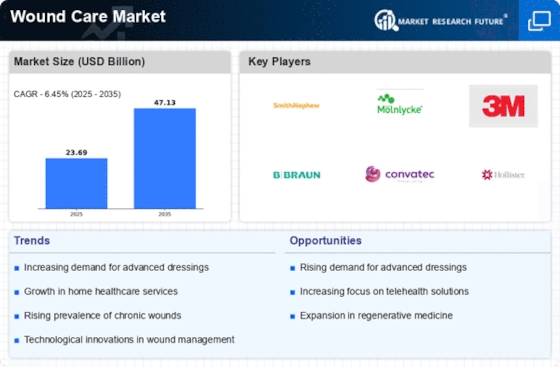
According to Market Research Future analysis, the Wound Care Market size was valued at USD 23.69 Billion in 2024 and the market is projected to grow from USD 25.22 Billion in 2025 to USD 47.13 Billion by 2035, exhibiting a CAGR of 6.4% during the forecast period 2025–2035. North America led the market with over 42.10% share, generating around USD 9.5 billion in revenue.
 
Rising prevalence of chronic diseases and increasing geriatric population are major growth drivers for the wound care market. Growing incidence of diabetic ulcers and pressure injuries is accelerating demand for advanced wound care products and improving long-term patient management outcomes globally.
 
WHO estimates over 422 million people live with diabetes globally, a major cause of chronic wounds, while IHME reports increasing global burden of non-communicable diseases exceeding 70% of total deaths. This growing patient pool significantly drives sustained demand for wound care treatments.

Key Market Trends & Highlights

The Wound Care Market is experiencing robust growth driven by technological advancements and an increasing focus on chronic wound management.

  • North America holds 40% market share, with the United States contributing 79% of regional revenue in 2024. Dressings segment dominates with 58% share, driven by high usage in basic wound management across healthcare settings globally. Chronic wounds lead with 62% share, supported by rising diabetes prevalence and increasing aging population worldwide. Diabetic ulcers account for 44% share, fueled by over 422 million global diabetes cases driving long-term wound care demand.

Market Size & Forecast

2024 Market Size 23.69 (USD Billion)
2035 Market Size 47.13 (USD Billion)
CAGR (2025 - 2035) 6.45%
Largest Regional Market Share in 2024 North America

Major Players

Companies such as Smith &amp; Nephew (GB), Mölnlycke Health Care (SE), 3M (US), B. Braun Melsungen AG (DE), ConvaTec Group PLC (GB), Hollister Incorporated (US), Medtronic (US), Acelity (US), Coloplast A/S (DK) are some of the major participants in the global market.

Market Trends

The Wound Care Market is currently experiencing a dynamic evolution, driven by advancements in technology and increasing awareness of effective wound management practices across the wound healing market. The integration of innovative materials and techniques, including products from the antimicrobial regenerative wound matrix market, is reshaping the landscape, as healthcare providers seek to enhance patient outcomes and reduce recovery times.

Additionally, the growing prevalence of chronic wounds, alongside an aging population, is contributing to heightened demand for specialized wound care products. This aligns with expanding opportunities across the active market, wound care products market, and the broader wound healing market size expansion.  

Moreover, the emphasis on personalized medicine and tailored treatment approaches is likely to influence the Wound Care Market significantly. As healthcare systems evolve, there is a noticeable shift towards more individualized care plans that consider the unique characteristics of each wound. This trend suggests that manufacturers and providers — including emerging orthopedic supply companies entering wound management — must remain agile..

Technological Advancements

The Wound Care Market is witnessing a surge in technological innovations, including smart dressings, portable devices, and telemedicine solutions. These advancements are driving innovation across the global wound care medical group ecosystem and supporting the development of new wound care products and improved treatment efficiency.

European Centre for Disease Prevention and Control (ECDC) highlights increasing adoption of advanced medical technologies across healthcare systems, improving treatment outcomes. Pan American Health Organization (PAHO) reports rising integration of digital health and innovative care solutions, enhancing efficiency and accessibility of advanced wound management practices globally.

Increased Focus on Chronic Wounds

There is a growing recognition of the challenges posed by chronic wounds, supported by expanding wound care statistics and rising clinical demand. Healthcare providers are prioritizing specialized wound care solutions tailored to manage these complex conditions.

World Health Organization (WHO) reports that chronic diseases account for nearly 74% of global deaths, significantly increasing chronic wound cases. Centers for Disease Control and Prevention (CDC) estimates 37.3 million adults in the U.S. have diabetes, a major contributor to chronic wounds, supporting rising demand for specialized care solutions.

Personalized Treatment Approaches

The shift towards personalized medicine is influencing the Wound Care Market, as healthcare professionals increasingly adopt individualized treatment plans. This approach aims to address the specific needs of patients, enhancing the overall effectiveness of wound management.

UNICEF emphasizes growing global focus on patient-centered healthcare to improve outcomes, while United Nations Population Fund (UNFPA) highlights increasing demand for tailored treatment strategies, particularly among aging populations. These trends support personalized wound care approaches, improving healing rates and patient-specific treatment effectiveness globally.

Wound Care Market Market Drivers

Increased Healthcare Expenditure

The Wound Care Market is benefiting from rising healthcare expenditures across various regions. Governments and private sectors are investing more in healthcare infrastructure, which includes wound care services. This increase in funding allows for better access to advanced wound care products and treatments.
 
Data indicates that healthcare spending is expected to rise, leading to improved patient outcomes and a greater focus on preventive care. As healthcare systems prioritize wound management, the demand for innovative solutions in the market is likely to surge, reflecting a positive outlook for market growth.

Rising Incidence of Chronic Wounds

The Wound Care Market is experiencing a notable increase in the prevalence of chronic wounds, such as diabetic ulcers and pressure sores. This rise is attributed to an aging population and the growing incidence of diabetes and obesity. According to recent data, chronic wounds affect millions of individuals, leading to a substantial demand for advanced wound care products.
 
The market is projected to expand as healthcare providers seek effective solutions to manage these complex conditions. The increasing awareness of wound care management and the need for specialized treatment options further drive this trend, indicating a robust growth trajectory for the market.

Rising Incidence of Surgical Procedures

The Wound Care Market is also influenced by the rising incidence of surgical procedures, which often result in postoperative wounds. As surgical techniques advance and become more common, the need for effective wound care management solutions increases.
 
Data suggests that the number of surgical procedures is on the rise, leading to a corresponding demand for advance wound care products that facilitate healing and prevent complications. This trend indicates a growing market for postoperative wound management solutions, as healthcare providers seek to enhance patient recovery experiences. The interplay between surgical advancements and wound management needs is likely to shape the future of the market.

Technological Innovations in Wound Care

Technological advancements are significantly shaping the Wound Care Market. Innovations such as bioengineered skin substitutes, advanced dressings, and negative pressure wound therapy are enhancing treatment efficacy. The integration of smart technologies, including wound monitoring systems, is also gaining traction.
 
These innovations not only improve healing outcomes but also reduce healthcare costs associated with prolonged wound care. The market is witnessing a shift towards more sophisticated products that cater to the specific needs of patients, suggesting a dynamic evolution in the market. As these technologies become more accessible, they are likely to drive further growth in the sector.

Growing Awareness of Wound Care Management

There is a growing awareness regarding the importance of effective wound care management within the Wound Care Market. Educational initiatives aimed at healthcare professionals and patients are fostering a better understanding of wound healing processes and the available treatment options. This heightened awareness is leading to increased demand for specialized wound care products and services.
 
As patients become more informed about their treatment choices, they are more likely to seek advanced solutions, thereby driving growth in the Wound Care Market. The emphasis on patient education and self-management is expected to continue influencing market dynamics.

Market Segment Insights

By Type: Dressings (Largest) vs. Advanced Wound Care (Fastest-Growing)

The segment distribution showcases dressings as the largest contributor in the wound care market, with a 58% share. This category includes various products designed for wound management, catering to diverse consumer needs. Dressings not only offer foundational care but also serve as essential components in comprehensive wound treatment plans, establishing their dominance in the market. On the other hand, advanced wound care is recognized as the fastest-growing segment, driven by technological advancements and the increasing prevalence of chronic wounds. The integration of innovative materials and techniques in advanced wound care products promotes better healing outcomes and addresses specific patient needs, facilitating rapid adoption in clinical settings and among consumers.

Dressings (Dominant) vs. Advanced Wound Care (Emerging)

Dressings, encompassing a range of traditional and modern products, remain the dominant segment in the market due to their widespread use in primary care treatments. They are designed to protect wounds, promote healing, and prevent infection. With innovations such as hydrocolloid and foam dressings, this segment has adapted to meet evolving healthcare standards. Conversely, advanced wound care is emerging swiftly, leveraging state-of-the-art technologies such as bioengineered skin substitutes and synthetic dressings. This segment is characterized by its focus on improving healing rates for complex and chronic wounds, fueled by an aging population and increased diabetic conditions.

By Wound Type: Chronic Wounds (Largest) vs. Acute Wounds (Fastest-Growing)

In the wound care market, chronic wounds represent the largest segment, with a 62% share, resulting from conditions such as diabetes and pressure ulcers. This segment dominates market share due to the increasing prevalence of chronic diseases and an aging population worldwide. In contrast, acute wounds, often resulting from injuries or surgical procedures, are gaining traction as a significant market segment, particularly due to rising awareness and advancements in wound management technologies.

Chronic Wounds (Dominant) vs. Surgical Wounds (Emerging)

Chronic wounds, characterized by prolonged healing times, are a dominant force in the market, driven by a higher prevalence of diabetes and other persistent health conditions. This segment showcases advanced treatments like bioengineered skin substitutes, enhancing patient outcomes. Meanwhile, surgical wounds, an emerging type, have seen growth propelled by an increase in surgical procedures and a focus on post-operative care management. Innovations in suturing techniques and dressings are enhancing surgical wound care, establishing this segment as a critical area for investment and development.

By End User: Hospitals (Largest) vs. Home Healthcare (Fastest-Growing)

In the Wound Care Market, hospitals hold the largest share of 64% of the end-user segment, driven significantly by the high volume of surgical procedures and complex wound management needs encountered in these facilities. The market distribution highlights that hospitals are preferred locations due to their advanced resources, specialized care teams, and availability of advanced wound care products. Home healthcare, while smaller in comparison, is gaining traction as patients lean towards more flexible care options, preferring treatment in the comfort of their homes as a viable alternative to traditional settings.

Hospitals (Dominant) vs. Home Healthcare (Emerging)

Hospitals remain the dominant end user in the Wound Care Market, equipped with comprehensive facilities that enable them to manage a wide range of wound types effectively. They offer specialized services, including advanced surgical interventions and post-operative wound care, catering to complex cases. In contrast, home healthcare is an emerging segment, characterized by its focus on patient autonomy and comfort. It is increasingly supported by telehealth innovations and mobile wound care solutions, offering accessibility to patients who require regular treatment but prefer to avoid hospital visits. This trend towards home-based care may be bolstered by patient preference and the healthcare industry's push towards value-based care models.

By Application: Diabetic Ulcers (Largest) vs. Pressure Ulcers (Fastest-Growing)

The application segment is notably dominated by diabetic ulcers, which capture the largest Wound Care Market share at 44%, due to the rising prevalence of diabetes and associated complications. Following closely are Pressure Ulcers, which are increasingly recognized for their significant impact on patient care in healthcare settings. Other notable segments include Venous Leg Ulcers and Traumatic Wounds, each contributing to the market by addressing specific healthcare needs.

Wound Care Applications: Diabetic Ulcers (Dominant) vs. Pressure Ulcers (Emerging)

Diabetic Ulcers are a dominant segment within the market, attributable to the increasing incidence of diabetes and its complications leading to chronic wounds. The focus on diabetic management has driven innovation in wound care products, enhancing healing rates. In contrast, Pressure Ulcers represent an emerging segment gaining traction due to heightened awareness in healthcare environments regarding patient comfort and safety. Advancements in technology and care protocols are propelling growth in this area, as effective prevention and treatment regimens are vital for improving quality of care and reducing hospital-related complications.

Get more detailed insights about Wound Care Market Research Report—Global Forecast till 2035

Regional Insights

North America : Market Leader in Wound Care Market

North America leads in the Wound Care Market Size, accounting for over 42.10% of the global revenue in 2024. Supported by advanced healthcare infrastructure, strong R&D investments, and participation from leading wound management companies and top wound care companies. Regulatory support from agencies like the FDA further catalyzes market expansion, ensuring safety and efficacy in wound care products.

The United States holds 79% share with an estimated value of USD 7.49 Billion, driven by advanced healthcare infrastructure and high chronic disease burden, while Canada holds 21% share with USD 1.99 Billion supported by increasing wound care awareness.

The U.S. is the primary contributor, followed by Canada, which is experiencing a growing demand for innovative wound care solutions. The competitive landscape in North America is robust, featuring key players such as 3M, Smith & Nephew, and Medtronic. These companies are investing heavily in R&D to develop advanced wound care products, including bioactive dressings and negative pressure wound therapy systems. The presence of established healthcare infrastructure and increasing healthcare expenditure also bolster market growth, making it a focal point for innovation in wound care.

Europe : Emerging Innovations in Wound Care Market

Europe Wound Care Market size was valued at USD 7.11 billion in 2024, making it the second-largest regional market with a 30% share. The region is witnessing significant growth due to rising incidences of diabetes and obesity, which lead to chronic wounds. Regulatory frameworks, such as the EU Medical Device Regulation, are enhancing product safety and efficacy, thereby boosting consumer confidence and market demand.

Germany contributing 28% share valued at USD 1.99 Billion driven by strong healthcare systems, while the UK holds 22% share with USD 1.56 Billion supported by rising elderly population and chronic wound cases.

Countries like Germany and the UK are leading the market, driven by advanced healthcare systems and increasing awareness of wound care solutions. The competitive landscape in Europe is characterized by a mix of established players and innovative startups. Key companies like Mölnlycke Health Care and B. Braun Melsungen AG are at the forefront, focusing on developing advanced wound care products.

The presence of a strong distribution network and collaborations with healthcare providers further enhance market penetration. The emphasis on research and development is also fostering innovation, making Europe a hub for cutting-edge wound care technologies.

Asia-Pacific : Rapid Growth in Emerging Markets

Asia-Pacific is an emerging powerhouse in the wound care market, holding approximately 20% of the global share. Asia-Pacific is witnessing rapid expansion with countries such as China and India driving adoption. Regional developments include localized initiatives like wound care thailand programs and emerging distribution networks. Countries like China and India are witnessing rapid urbanization and healthcare improvements, which are driving demand for effective wound management solutions.

China accounts for 34% share valued at USD 1.61 Billion driven by large patient population, while Japan holds 26% share with USD 1.23 Billion supported by advanced medical technologies and aging demographics.

Regulatory bodies are also becoming more supportive, facilitating market entry for innovative products. The competitive landscape in Asia-Pacific is evolving, with both local and international players vying for market share. Companies like Acelity and ConvaTec are expanding their presence through strategic partnerships and localized product offerings. The region's diverse healthcare needs are prompting manufacturers to innovate, leading to the introduction of cost-effective and efficient wound care solutions. This dynamic environment presents significant opportunities for growth and investment in the wound care sector.

Middle East and Africa : Untapped Potential in Wound Care Market

The Middle East and Africa represent a resource-rich frontier in the wound care market, accounting for approximately 10% of the global share. The region is experiencing growth driven by increasing healthcare investments, rising incidences of chronic diseases, and a growing awareness of advanced wound care solutions. Countries like South Africa and the UAE are leading the market, supported by government initiatives aimed at improving healthcare infrastructure and access to medical technologies.

Saudi Arabia holding 38% share valued at USD 0.90 Billion driven by healthcare investments, while South Africa holds 27% share with USD 0.64 Billion supported by improving wound care infrastructure.

The competitive landscape in the Middle East and Africa is characterized by a mix of local and international players. Companies are focusing on expanding their product offerings and enhancing distribution networks to meet the growing demand. The presence of key players such as Coloplast A/S and Hollister Incorporated is notable, as they are actively involved in developing tailored solutions for the region's unique healthcare challenges. This presents a significant opportunity for growth and innovation in the market.

Key Players and Competitive Insights

The Wound Care Market reflects a dynamic competitive landscape shaped by technology, demographics, and rising chronic wound prevalence. Companies such as Coloplast and Derma Sciences demonstrate strong innovation capabilities and active participation across the wound care industry value chain. Companies operating within this space are continually innovating to address unmet healthcare needs and adapt to changing market conditions.
 
The competitive insights within this market offer an understanding of the strategies employed by leading firms, regional dynamics, and growth opportunities that exist amid a rapidly evolving healthcare environment. Stakeholders are keenly focused on enhancing product offerings, establishing strategic collaborations, and expanding their global footprint to maintain a competitive edge.
 
Coloplast has established a notable presence in the Wound Care Market, differentiating itself through innovative product development and a commitment to high-quality standards. The company's strength lies in its comprehensive range of advanced wound care products that cater to varying clinical needs, emphasizing user friendliness, effectiveness, and safety.
 
Coloplast's market strategy involves leveraging its extensive research and development capabilities to introduce cutting-edge solutions that enhance the healing process while minimizing patient discomfort. Furthermore, the company's strong distribution channels and partnerships with healthcare professionals enable it to effectively penetrate diverse markets, solidifying its position as a reliable player in the wound care sector.

Derma Sciences operates with a focused strategy in the Wound Care Market, offering a portfolio of specialized products and services designed to manage and promote wound healing effectively. The company boasts strengths in innovative advanced wound care solutions, contributing to its favorable reputation in the healthcare community. Derma Sciences has made significant strides in expanding its market presence through strategic acquisitions and alliances, allowing it to enhance its product offerings and bolster its footprint in key regions.
 
Their key products include advanced dressings that utilize patented technology aimed at optimizing healing times and improving outcomes for patients. Additionally, the company's focus on research and development ensures it stays at the forefront of wound care advancements, further solidifying its competitive stance in the global arena.

Key Companies in the Wound Care Market include

Industry Developments

Recent changes in the wound closure devices market show rapid growth due to improvements in surgical procedures and increasing demand for efficient closure technologies. Educational collaborations and training initiatives similar to global wound academy programs are helping improve practitioner knowledge and adoption of advanced solutions.

DEC 2025 - The Adavance wound care market is expanding rapidly due to advancements in advanced dressings, negative-pressure therapy, and biologics that support faster tissue repair. Chronic wound cases driven by diabetes and aging populations remain the primary market catalysts. Innovation pipelines show strong activity, especially in bioengineered skin substitutes and antimicrobial technologies. Healthcare systems are also emphasizing home-based wound management, increasing the uptake of portable devices and smart monitoring tools.

Flexibility for CTPs/Skin Substitutes: Advocacy by industry groups successfully convinced Medicare Administrative Contractors (MACs) to remove arbitrary application limitations and extend the episode of care for Cellular and Tissue-Based Products (CTPs) in treating Diabetic Foot Ulcers (DFUs) and VLUs. The final Local Coverage Determinations (LCDs) went into effect around April 2025, allowing clinicians more flexibility in applying advanced therapies.

Solventum Acquires Acera Surgical (Up to $850M): In a major move in late 2025, Solventum (spun off from 3M) acquired Acera Surgical, positioning itself strongly in the high-growth synthetic tissue matrices category. Acera's Restrata product line, which mimics the human extracellular matrix (ECM), accelerates the adoption of advanced tissue regeneration solutions in acute care settings. This follows Solventum's broader strategy to refocus and optimize its portfolio.

There have been a number of important changes in the Wound Care Market lately. In October 2023, Smith & Nephew said they would be releasing a new line of advanced wound dressings that would speed up the healing process and improve patient outcomes. Coloplast added new hydrocolloid dressings to its product line in September 2023. These dressings are specifically designed for chronic wounds, which gives patients more treatment options and better care. The purchase of Acelity by 3M in October 2019 was a major event in history.

This strategic move greatly improved 3M's position in the market and added to its advanced wound management portfolio. The market keeps growing quickly because there are more and more chronic wounds and more and more surgeries happening around the world. As of 2024, reliable sources say that the market's compound annual growth rate (CAGR) will be about 6% over the next five years.

Integra LifeSciences also expanded its global reach by entering new markets in the Asia-Pacific region in November 2023. This made its advanced wound care products easier to get to. Johnson & Johnson and other companies have kept spending a lot of money on research and development over the past two years. They have come up with new ways to heal wounds and have changed their products to meet the needs of patients and healthcare providers.

Future Outlook

Wound Care Market Future Outlook

The Wound Care Market size is projected to reach USD 47.13 billion by 2035, growing at a CAGR of 6.4%, driven by technological advancements, an aging population, and increasing chronic diseases.

New opportunities lie in:

  • <p>Development of advanced bioactive dressings for enhanced healing Expansion of telehealth services for wound management Investment in AI-driven wound assessment tools for improved patient outcomes</p>

By 2035, the Wound Care Market is expected to achieve substantial growth and innovation.

Market Segmentation

Wound Care Market Type Outlook

  • Dressings
  • Advanced Wound Care
  • Traditional Wound Care
  • Sutures
  • Gauze

Wound Care Market End User Outlook

  • Hospitals
  • Home Healthcare
  • Ambulatory Surgical Centers
  • Clinics

Wound Care Market Wound Type Outlook

  • Chronic Wounds
  • Acute Wounds
  • Surgical Wounds
  • Burns

Wound Care Market Application Outlook

  • Diabetic Ulcers
  • Pressure Ulcers
  • Venous Leg Ulcers
  • Traumatic Wounds

Report Scope

MARKET SIZE 2024 23.69(USD Billion)
MARKET SIZE 2025 25.22(USD Billion)
MARKET SIZE 2035 47.13(USD Billion)
COMPOUND ANNUAL GROWTH RATE (CAGR) 6.45% (2025 - 2035)
REPORT COVERAGE Revenue Forecast, Competitive Landscape, Growth Factors, and Trends
BASE YEAR 2024
Market Forecast Period 2025 - 2035
Historical Data 2019 - 2024
Market Forecast Units USD Billion
Key Companies Profiled Smith & Nephew (GB), Mölnlycke Health Care (SE), 3M (US), B. Braun Melsungen AG (DE), ConvaTec Group PLC (GB), Hollister Incorporated (US), Medtronic (US), Acelity (US), Coloplast A/S (DK)
Segments Covered Product Type, Wound Type, End Users, Applications
Key Market Opportunities Integration of advanced biomaterials and digital health technologies in the market.
Key Market Dynamics Rising demand for advanced wound care products drives innovation and competition among manufacturers in the market.
Countries Covered North America, Europe, APAC, South America, MEA

FAQs

What is the current valuation of the Wound Care Market as of 2024?

<p>The Wound Care Market was valued at 23.69 USD Billion in 2024.</p>

What is the projected market size for the market in 2035?

The market is projected to reach 47.13 USD Billion by 2035.

What is the expected CAGR for the market during the forecast period 2025 - 2035?

The expected CAGR for the market during 2025 - 2035 is 6.45%.

Which segment of the Wound Care Market had the highest valuation in 2024?

<p>In 2024, the Dressings segment had the highest valuation at 16.0 USD Billion.</p>

What are the key players in the Wound Care Market?

Key players include Smith &amp; Nephew, Mölnlycke Health Care, 3M, and B. Braun Melsungen AG.

How does the valuation of Advanced Wound Care compare to Traditional Wound Care in 2024?

<p>In 2024, Advanced Wound Care was valued at 14.0 USD Billion, whereas Traditional Wound Care was valued at 10.0 USD Billion.</p>

What is the valuation of the Surgical Wounds segment in 2024?

<p>The Surgical Wounds segment was valued at 16.0 USD Billion in 2024.</p>

Which end user segment is expected to grow the most by 2035?

<p>The Hospitals segment is expected to grow significantly, reaching 19.0 USD Billion by 2035.</p>

What is the valuation of Traumatic Wounds in 2024?

<p>Traumatic Wounds had a valuation of 17.13 USD Billion in 2024.</p>

How does the market for Diabetic Ulcers compare to Pressure Ulcers in 2024?

<p>In 2024, the market for Diabetic Ulcers was valued at 10.0 USD Billion, while Pressure Ulcers reached 12.0 USD Billion.</p>

  1. SECTION I: EXECUTIVE SUMMARY AND KEY HIGHLIGHTS |
    1. EXECUTIVE SUMMARY | |
      1. Market Overview | |
      2. Key Findings | |
      3. Market Segmentation | |
      4. Competitive Landscape | |
      5. Challenges and Opportunities | |
      6. Future Outlook 2
  2. SECTION II: SCOPING, METHODOLOGY AND MARKET STRUCTURE |
    1. MARKET INTRODUCTION | |
      1. Definition | |
      2. Scope of the study | | |
    2. RESEARCH METHODOLOGY | |
      1. Overview | |
      2. Data Mining | |
      3. Secondary Research | |
      4. Primary Research | | |
      5. Forecasting Model | |
      6. Market Size Estimation | | |
      7. Data Triangulation | |
      8. Validation 3
  3. SECTION III: QUALITATIVE ANALYSIS |
    1. MARKET DYNAMICS | |
      1. Overview | |
      2. Drivers | |
      3. Restraints | |
      4. Opportunities |
    2. MARKET FACTOR ANALYSIS | |
      1. Value chain Analysis | |
      2. Porter's Five Forces Analysis | | |
      3. COVID-19 Impact Analysis | | |
  4. SECTION IV: QUANTITATIVE ANALYSIS |
    1. Healthcare, BY Type (USD Billion) | |
      1. Dressings | |
      2. Advanced Wound Care | |
      3. Traditional Wound Care | |
      4. Sutures | |
      5. Gauze |
    2. Healthcare, BY Wound Type (USD Billion) | |
      1. Chronic Wounds | |
      2. Acute Wounds | |
      3. Surgical Wounds | |
      4. Burns |
    3. Healthcare, BY End User (USD Billion) | |
      1. Hospitals | |
      2. Home Healthcare | |
      3. Ambulatory Surgical Centers | |
      4. Clinics |
    4. Healthcare, BY Application (USD Billion) | |
      1. Diabetic Ulcers | |
      2. Pressure Ulcers | |
      3. Venous Leg Ulcers | |
      4. Traumatic Wounds |
    5. Healthcare, BY Region (USD Billion) | |
      1. North America | | |
      2. Europe | | |
      3. APAC | | |
      4. South America | | |
      5. MEA | | |
  5. SECTION V: COMPETITIVE ANALYSIS |
    1. Competitive Landscape | |
      1. Overview | |
      2. Competitive Analysis | |
      3. Market share Analysis | |
      4. Major Growth Strategy in the Healthcare | |
      5. Competitive Benchmarking | |
      6. Leading Players in Terms of Number of Developments in the Healthcare | |
      7. Key developments and growth strategies | | |
      8. Major Players Financial Matrix | | |
    2. Company Profiles | |
      1. Smith & Nephew (GB) | | |
      2. Mölnlycke Health Care (SE) | | |
      3. 3M (US) | | |
      4. B. Braun Melsungen AG (DE) | | |
      5. ConvaTec Group PLC (GB) | | |
      6. Hollister Incorporated (US) | | |
      7. Medtronic (US) | | |
      8. Acelity (US) | | |
      9. Coloplast A/S (DK) | | |
    3. Appendix | |
      1. References | |
      2. Related Reports 6 LIST OF FIGURES |
    4. MARKET SYNOPSIS |
    5. NORTH AMERICA MARKET ANALYSIS |
    6. US MARKET ANALYSIS BY TYPE |
    7. US MARKET ANALYSIS BY WOUND TYPE |
    8. US MARKET ANALYSIS BY END USER |
    9. US MARKET ANALYSIS BY APPLICATION |
    10. CANADA MARKET ANALYSIS BY TYPE |
    11. CANADA MARKET ANALYSIS BY WOUND TYPE |
    12. CANADA MARKET ANALYSIS BY END USER |
    13. CANADA MARKET ANALYSIS BY APPLICATION |
    14. EUROPE MARKET ANALYSIS |
    15. GERMANY MARKET ANALYSIS BY TYPE |
    16. GERMANY MARKET ANALYSIS BY WOUND TYPE |
    17. GERMANY MARKET ANALYSIS BY END USER |
    18. GERMANY MARKET ANALYSIS BY APPLICATION |
    19. UK MARKET ANALYSIS BY TYPE |
    20. UK MARKET ANALYSIS BY WOUND TYPE |
    21. UK MARKET ANALYSIS BY END USER |
    22. UK MARKET ANALYSIS BY APPLICATION |
    23. FRANCE MARKET ANALYSIS BY TYPE |
    24. FRANCE MARKET ANALYSIS BY WOUND TYPE |
    25. FRANCE MARKET ANALYSIS BY END USER |
    26. FRANCE MARKET ANALYSIS BY APPLICATION |
    27. RUSSIA MARKET ANALYSIS BY TYPE |
    28. RUSSIA MARKET ANALYSIS BY WOUND TYPE |
    29. RUSSIA MARKET ANALYSIS BY END USER |
    30. RUSSIA MARKET ANALYSIS BY APPLICATION |
    31. ITALY MARKET ANALYSIS BY TYPE |
    32. ITALY MARKET ANALYSIS BY WOUND TYPE |
    33. ITALY MARKET ANALYSIS BY END USER |
    34. ITALY MARKET ANALYSIS BY APPLICATION |
    35. SPAIN MARKET ANALYSIS BY TYPE |
    36. SPAIN MARKET ANALYSIS BY WOUND TYPE |
    37. SPAIN MARKET ANALYSIS BY END USER |
    38. SPAIN MARKET ANALYSIS BY APPLICATION |
    39. REST OF EUROPE MARKET ANALYSIS BY TYPE |
    40. REST OF EUROPE MARKET ANALYSIS BY WOUND TYPE |
    41. REST OF EUROPE MARKET ANALYSIS BY END USER |
    42. REST OF EUROPE MARKET ANALYSIS BY APPLICATION |
    43. APAC MARKET ANALYSIS |
    44. CHINA MARKET ANALYSIS BY TYPE |
    45. CHINA MARKET ANALYSIS BY WOUND TYPE |
    46. CHINA MARKET ANALYSIS BY END USER |
    47. CHINA MARKET ANALYSIS BY APPLICATION |
    48. INDIA MARKET ANALYSIS BY TYPE |
    49. INDIA MARKET ANALYSIS BY WOUND TYPE |
    50. INDIA MARKET ANALYSIS BY END USER |
    51. INDIA MARKET ANALYSIS BY APPLICATION |
    52. JAPAN MARKET ANALYSIS BY TYPE |
    53. JAPAN MARKET ANALYSIS BY WOUND TYPE |
    54. JAPAN MARKET ANALYSIS BY END USER |
    55. JAPAN MARKET ANALYSIS BY APPLICATION |
    56. SOUTH KOREA MARKET ANALYSIS BY TYPE |
    57. SOUTH KOREA MARKET ANALYSIS BY WOUND TYPE |
    58. SOUTH KOREA MARKET ANALYSIS BY END USER |
    59. SOUTH KOREA MARKET ANALYSIS BY APPLICATION |
    60. MALAYSIA MARKET ANALYSIS BY TYPE |
    61. MALAYSIA MARKET ANALYSIS BY WOUND TYPE |
    62. MALAYSIA MARKET ANALYSIS BY END USER |
    63. MALAYSIA MARKET ANALYSIS BY APPLICATION |
    64. THAILAND MARKET ANALYSIS BY TYPE |
    65. THAILAND MARKET ANALYSIS BY WOUND TYPE |
    66. THAILAND MARKET ANALYSIS BY END USER |
    67. THAILAND MARKET ANALYSIS BY APPLICATION |
    68. INDONESIA MARKET ANALYSIS BY TYPE |
    69. INDONESIA MARKET ANALYSIS BY WOUND TYPE |
    70. INDONESIA MARKET ANALYSIS BY END USER |
    71. INDONESIA MARKET ANALYSIS BY APPLICATION |
    72. REST OF APAC MARKET ANALYSIS BY TYPE |
    73. REST OF APAC MARKET ANALYSIS BY WOUND TYPE |
    74. REST OF APAC MARKET ANALYSIS BY END USER |
    75. REST OF APAC MARKET ANALYSIS BY APPLICATION |
    76. SOUTH AMERICA MARKET ANALYSIS |
    77. BRAZIL MARKET ANALYSIS BY TYPE |
    78. BRAZIL MARKET ANALYSIS BY WOUND TYPE |
    79. BRAZIL MARKET ANALYSIS BY END USER |
    80. BRAZIL MARKET ANALYSIS BY APPLICATION |
    81. MEXICO MARKET ANALYSIS BY TYPE |
    82. MEXICO MARKET ANALYSIS BY WOUND TYPE |
    83. MEXICO MARKET ANALYSIS BY END USER |
    84. MEXICO MARKET ANALYSIS BY APPLICATION |
    85. ARGENTINA MARKET ANALYSIS BY TYPE |
    86. ARGENTINA MARKET ANALYSIS BY WOUND TYPE |
    87. ARGENTINA MARKET ANALYSIS BY END USER |
    88. ARGENTINA MARKET ANALYSIS BY APPLICATION |
    89. REST OF SOUTH AMERICA MARKET ANALYSIS BY TYPE |
    90. REST OF SOUTH AMERICA MARKET ANALYSIS BY WOUND TYPE |
    91. REST OF SOUTH AMERICA MARKET ANALYSIS BY END USER |
    92. REST OF SOUTH AMERICA MARKET ANALYSIS BY APPLICATION |
    93. MEA MARKET ANALYSIS |
    94. GCC COUNTRIES MARKET ANALYSIS BY TYPE |
    95. GCC COUNTRIES MARKET ANALYSIS BY WOUND TYPE |
    96. GCC COUNTRIES MARKET ANALYSIS BY END USER |
    97. GCC COUNTRIES MARKET ANALYSIS BY APPLICATION |
    98. SOUTH AFRICA MARKET ANALYSIS BY TYPE |
    99. SOUTH AFRICA MARKET ANALYSIS BY WOUND TYPE |
    100. SOUTH AFRICA MARKET ANALYSIS BY END USER |
    101. SOUTH AFRICA MARKET ANALYSIS BY APPLICATION |
    102. REST OF MEA MARKET ANALYSIS BY TYPE |
    103. REST OF MEA MARKET ANALYSIS BY WOUND TYPE |
    104. REST OF MEA MARKET ANALYSIS BY END USER |
    105. REST OF MEA MARKET ANALYSIS BY APPLICATION |
    106. KEY BUYING CRITERIA OF HEALTHCARE |
    107. RESEARCH PROCESS OF MRFR |
    108. DRO ANALYSIS OF HEALTHCARE |
    109. DRIVERS IMPACT ANALYSIS: HEALTHCARE |
    110. RESTRAINTS IMPACT ANALYSIS: HEALTHCARE |
    111. SUPPLY / VALUE CHAIN: HEALTHCARE |
    112. HEALTHCARE, BY TYPE, 2024 (% SHARE) |
    113. HEALTHCARE, BY TYPE, 2024 TO 2035 (USD Billion) |
    114. HEALTHCARE, BY WOUND TYPE, 2024 (% SHARE) |
    115. HEALTHCARE, BY WOUND TYPE, 2024 TO 2035 (USD Billion) |
    116. HEALTHCARE, BY END USER, 2024 (% SHARE) |
    117. HEALTHCARE, BY END USER, 2024 TO 2035 (USD Billion) |
    118. HEALTHCARE, BY APPLICATION, 2024 (% SHARE) |
    119. HEALTHCARE, BY APPLICATION, 2024 TO 2035 (USD Billion) |
    120. BENCHMARKING OF MAJOR COMPETITORS 7 LIST OF TABLES |
    121. LIST OF ASSUMPTIONS | |
      1. |
    122. North America MARKET SIZE ESTIMATES; FORECAST | |
      1. BY TYPE, 2025-2035 (USD Billion) | |
      2. BY WOUND TYPE, 2025-2035 (USD Billion) | |
      3. BY END USER, 2025-2035 (USD Billion) | |
      4. BY APPLICATION, 2025-2035 (USD Billion) |
    123. US MARKET SIZE ESTIMATES; FORECAST | |
      1. BY TYPE, 2025-2035 (USD Billion) | |
      2. BY WOUND TYPE, 2025-2035 (USD Billion) | |
      3. BY END USER, 2025-2035 (USD Billion) | |
      4. BY APPLICATION, 2025-2035 (USD Billion) |
    124. Canada MARKET SIZE ESTIMATES; FORECAST | |
      1. BY TYPE, 2025-2035 (USD Billion) | |
      2. BY WOUND TYPE, 2025-2035 (USD Billion) | |
      3. BY END USER, 2025-2035 (USD Billion) | |
      4. BY APPLICATION, 2025-2035 (USD Billion) |
    125. Europe MARKET SIZE ESTIMATES; FORECAST | |
      1. BY TYPE, 2025-2035 (USD Billion) | |
      2. BY WOUND TYPE, 2025-2035 (USD Billion) | |
      3. BY END USER, 2025-2035 (USD Billion) | |
      4. BY APPLICATION, 2025-2035 (USD Billion) |
    126. Germany MARKET SIZE ESTIMATES; FORECAST | |
      1. BY TYPE, 2025-2035 (USD Billion) | |
      2. BY WOUND TYPE, 2025-2035 (USD Billion) | |
      3. BY END USER, 2025-2035 (USD Billion) | |
      4. BY APPLICATION, 2025-2035 (USD Billion) |
    127. UK MARKET SIZE ESTIMATES; FORECAST | |
      1. BY TYPE, 2025-2035 (USD Billion) | |
      2. BY WOUND TYPE, 2025-2035 (USD Billion) | |
      3. BY END USER, 2025-2035 (USD Billion) | |
      4. BY APPLICATION, 2025-2035 (USD Billion) |
    128. France MARKET SIZE ESTIMATES; FORECAST | |
      1. BY TYPE, 2025-2035 (USD Billion) | |
      2. BY WOUND TYPE, 2025-2035 (USD Billion) | |
      3. BY END USER, 2025-2035 (USD Billion) | |
      4. BY APPLICATION, 2025-2035 (USD Billion) |
    129. Russia MARKET SIZE ESTIMATES; FORECAST | |
      1. BY TYPE, 2025-2035 (USD Billion) | |
      2. BY WOUND TYPE, 2025-2035 (USD Billion) | |
      3. BY END USER, 2025-2035 (USD Billion) | |
      4. BY APPLICATION, 2025-2035 (USD Billion) |
    130. Italy MARKET SIZE ESTIMATES; FORECAST | |
      1. BY TYPE, 2025-2035 (USD Billion) | |
      2. BY WOUND TYPE, 2025-2035 (USD Billion) | |
      3. BY END USER, 2025-2035 (USD Billion) | |
      4. BY APPLICATION, 2025-2035 (USD Billion) |
    131. Spain MARKET SIZE ESTIMATES; FORECAST | |
      1. BY TYPE, 2025-2035 (USD Billion) | |
      2. BY WOUND TYPE, 2025-2035 (USD Billion) | |
      3. BY END USER, 2025-2035 (USD Billion) | |
      4. BY APPLICATION, 2025-2035 (USD Billion) |
    132. Rest of Europe MARKET SIZE ESTIMATES; FORECAST | |
      1. BY TYPE, 2025-2035 (USD Billion) | |
      2. BY WOUND TYPE, 2025-2035 (USD Billion) | |
      3. BY END USER, 2025-2035 (USD Billion) | |
      4. BY APPLICATION, 2025-2035 (USD Billion) |
    133. APAC MARKET SIZE ESTIMATES; FORECAST | |
      1. BY TYPE, 2025-2035 (USD Billion) | |
      2. BY WOUND TYPE, 2025-2035 (USD Billion) | |
      3. BY END USER, 2025-2035 (USD Billion) | |
      4. BY APPLICATION, 2025-2035 (USD Billion) |
    134. China MARKET SIZE ESTIMATES; FORECAST | |
      1. BY TYPE, 2025-2035 (USD Billion) | |
      2. BY WOUND TYPE, 2025-2035 (USD Billion) | |
      3. BY END USER, 2025-2035 (USD Billion) | |
      4. BY APPLICATION, 2025-2035 (USD Billion) |
    135. India MARKET SIZE ESTIMATES; FORECAST | |
      1. BY TYPE, 2025-2035 (USD Billion) | |
      2. BY WOUND TYPE, 2025-2035 (USD Billion) | |
      3. BY END USER, 2025-2035 (USD Billion) | |
      4. BY APPLICATION, 2025-2035 (USD Billion) |
    136. Japan MARKET SIZE ESTIMATES; FORECAST | |
      1. BY TYPE, 2025-2035 (USD Billion) | |
      2. BY WOUND TYPE, 2025-2035 (USD Billion) | |
      3. BY END USER, 2025-2035 (USD Billion) | |
      4. BY APPLICATION, 2025-2035 (USD Billion) |
    137. South Korea MARKET SIZE ESTIMATES; FORECAST | |
      1. BY TYPE, 2025-2035 (USD Billion) | |
      2. BY WOUND TYPE, 2025-2035 (USD Billion) | |
      3. BY END USER, 2025-2035 (USD Billion) | |
      4. BY APPLICATION, 2025-2035 (USD Billion) |
    138. Malaysia MARKET SIZE ESTIMATES; FORECAST | |
      1. BY TYPE, 2025-2035 (USD Billion) | |
      2. BY WOUND TYPE, 2025-2035 (USD Billion) | |
      3. BY END USER, 2025-2035 (USD Billion) | |
      4. BY APPLICATION, 2025-2035 (USD Billion) |
    139. Thailand MARKET SIZE ESTIMATES; FORECAST | |
      1. BY TYPE, 2025-2035 (USD Billion) | |
      2. BY WOUND TYPE, 2025-2035 (USD Billion) | |
      3. BY END USER, 2025-2035 (USD Billion) | |
      4. BY APPLICATION, 2025-2035 (USD Billion) |
    140. Indonesia MARKET SIZE ESTIMATES; FORECAST | |
      1. BY TYPE, 2025-2035 (USD Billion) | |
      2. BY WOUND TYPE, 2025-2035 (USD Billion) | |
      3. BY END USER, 2025-2035 (USD Billion) | |
      4. BY APPLICATION, 2025-2035 (USD Billion) |
    141. Rest of APAC MARKET SIZE ESTIMATES; FORECAST | |
      1. BY TYPE, 2025-2035 (USD Billion) | |
      2. BY WOUND TYPE, 2025-2035 (USD Billion) | |
      3. BY END USER, 2025-2035 (USD Billion) | |
      4. BY APPLICATION, 2025-2035 (USD Billion) |
    142. South America MARKET SIZE ESTIMATES; FORECAST | |
      1. BY TYPE, 2025-2035 (USD Billion) | |
      2. BY WOUND TYPE, 2025-2035 (USD Billion) | |
      3. BY END USER, 2025-2035 (USD Billion) | |
      4. BY APPLICATION, 2025-2035 (USD Billion) |
    143. Brazil MARKET SIZE ESTIMATES; FORECAST | |
      1. BY TYPE, 2025-2035 (USD Billion) | |
      2. BY WOUND TYPE, 2025-2035 (USD Billion) | |
      3. BY END USER, 2025-2035 (USD Billion) | |
      4. BY APPLICATION, 2025-2035 (USD Billion) |
    144. Mexico MARKET SIZE ESTIMATES; FORECAST | |
      1. BY TYPE, 2025-2035 (USD Billion) | |
      2. BY WOUND TYPE, 2025-2035 (USD Billion) | |
      3. BY END USER, 2025-2035 (USD Billion) | |
      4. BY APPLICATION, 2025-2035 (USD Billion) |
    145. Argentina MARKET SIZE ESTIMATES; FORECAST | |
      1. BY TYPE, 2025-2035 (USD Billion) | |
      2. BY WOUND TYPE, 2025-2035 (USD Billion) | |
      3. BY END USER, 2025-2035 (USD Billion) | |
      4. BY APPLICATION, 2025-2035 (USD Billion) |
    146. Rest of South America MARKET SIZE ESTIMATES; FORECAST | |
      1. BY TYPE, 2025-2035 (USD Billion) | |
      2. BY WOUND TYPE, 2025-2035 (USD Billion) | |
      3. BY END USER, 2025-2035 (USD Billion) | |
      4. BY APPLICATION, 2025-2035 (USD Billion) |
    147. MEA MARKET SIZE ESTIMATES; FORECAST | |
      1. BY TYPE, 2025-2035 (USD Billion) | |
      2. BY WOUND TYPE, 2025-2035 (USD Billion) | |
      3. BY END USER, 2025-2035 (USD Billion) | |
      4. BY APPLICATION, 2025-2035 (USD Billion) |
    148. GCC Countries MARKET SIZE ESTIMATES; FORECAST | |
      1. BY TYPE, 2025-2035 (USD Billion) | |
      2. BY WOUND TYPE, 2025-2035 (USD Billion) | |
      3. BY END USER, 2025-2035 (USD Billion) | |
      4. BY APPLICATION, 2025-2035 (USD Billion) |
    149. South Africa MARKET SIZE ESTIMATES; FORECAST | |
      1. BY TYPE, 2025-2035 (USD Billion) | |
      2. BY WOUND TYPE, 2025-2035 (USD Billion) | |
      3. BY END USER, 2025-2035 (USD Billion) | |
      4. BY APPLICATION, 2025-2035 (USD Billion) |
    150. Rest of MEA MARKET SIZE ESTIMATES; FORECAST | |
      1. BY TYPE, 2025-2035 (USD Billion) | |
      2. BY WOUND TYPE, 2025-2035 (USD Billion) | |
      3. BY END USER, 2025-2035 (USD Billion) | |
      4. BY APPLICATION, 2025-2035 (USD Billion) |
    151. PRODUCT LAUNCH/PRODUCT DEVELOPMENT/APPROVAL | |
      1. |
    152. ACQUISITION/PARTNERSHIP | |

Healthcare Market Segmentation

Healthcare By Type (USD Billion, 2025-2035)

  • Dressings
  • Advanced Wound Care
  • Traditional Wound Care
  • Sutures
  • Gauze

Healthcare By Wound Type (USD Billion, 2025-2035)

  • Chronic Wounds
  • Acute Wounds
  • Surgical Wounds
  • Burns

Healthcare By End User (USD Billion, 2025-2035)

  • Hospitals
  • Home Healthcare
  • Ambulatory Surgical Centers
  • Clinics

Healthcare By Application (USD Billion, 2025-2035)

  • Diabetic Ulcers
  • Pressure Ulcers
  • Venous Leg Ulcers
  • Traumatic Wounds
Infographic

Free Sample Request

Kindly complete the form below to receive a free sample of this Report

Get Free Sample

Customer Strories

Compare Licence

×
Features License Type
Single User Multiuser License Enterprise User
Price $4,950 $5,950 $7,250
Maximum User Access Limit 1 User Upto 10 Users Unrestricted Access Throughout the Organization
Free Customization
Direct Access to Analyst
Deliverable Format
Platform Access
Discount on Next Purchase 10% 15% 15%
Printable Versions