
×
Hero Background
English
Chinese
French
Japanese
Korean
German
Spanish

Wood Chipper Market Trends

ID: MRFR/PCM/17345-HCR
128 Pages
Snehal Singh
October 2025

Wood Chipper Market Research Report Information By Product Type (Disc Type, Drum Type and Screw Type), By Fuel Type (Diesel Engine, Petrol Engine and Electric Driven), By Capacity (10-250 kg/hr, 250-3000 kg/hr, 3000-10000 kg/hr and Above 10000 kg/hr) By End Use (Construction, Forestry & Biomass, Paper & Pulp, Timber Factories & Sawmills and Others), And By Region (North America, Europe, Asia-Pacific, And Rest Of The World) –Market Forecast Till 2035

Share:
Download PDF ×

We do not share your information with anyone. However, we may send you emails based on your report interest from time to time. You may contact us at any time to opt-out.

Wood Chipper Market Infographic
Purchase Options

Market Trends

Key Emerging Trends in the Wood Chipper Market

The wood chipper market is experiencing significant trends driven by several factors influencing both demand and supply dynamics. One noticeable trend is the increasing emphasis on sustainability and environmental conservation, prompting a shift towards more eco-friendly and efficient wood chipping solutions. This trend is fueled by growing awareness among consumers and regulatory bodies regarding the importance of reducing carbon footprints and preserving forests. As a result, manufacturers are innovating to develop wood chippers that are more energy-efficient, produce fewer emissions, and utilize sustainable materials in their construction.

Another prominent trend in the wood chipper market is the rise of compact and portable models. With the expansion of landscaping and gardening activities in both residential and commercial sectors, there is a growing demand for smaller, maneuverable wood chippers that can easily access tight spaces and handle smaller volumes of wood waste. These compact models are favored by homeowners, landscaping professionals, and small-scale businesses for their convenience and versatility.

Furthermore, technological advancements are playing a crucial role in shaping market trends. Manufacturers are integrating cutting-edge features such as advanced safety mechanisms, remote monitoring capabilities, and automation to enhance the efficiency and user experience of wood chippers. These technological innovations not only improve productivity but also contribute to the overall safety of operators and bystanders, thereby driving adoption among a wider range of users.

The wood chipper market is also witnessing a trend towards customization and specialization. As the requirements of end-users become more diverse and specific, there is a growing demand for tailor-made wood chipping solutions that can meet unique needs and applications. Manufacturers are offering a range of customization options, including different power sources, chipping capacities, and cutting mechanisms, to cater to various industries such as forestry, agriculture, construction, and landscaping.

Moreover, the market is experiencing increased competition, leading to price competitiveness and product differentiation. With the entry of new players and the expansion of existing manufacturers into new geographical regions, there is a greater emphasis on product innovation and value-added services to gain a competitive edge. This competitive landscape is driving manufacturers to continuously improve their offerings in terms of performance, durability, and cost-effectiveness to attract and retain customers in a crowded market.

On the supply side, the wood chipper market is influenced by factors such as raw material availability, manufacturing processes, and distribution networks. Fluctuations in wood supply, driven by factors such as weather conditions, forest management policies, and logging activities, can impact the production and pricing of wood chippers. Additionally, advancements in manufacturing technologies, such as CNC machining and 3D printing, are enabling manufacturers to produce wood chippers more efficiently and cost-effectively, leading to greater economies of scale and lower prices for consumers.


Author
Snehal Singh
Assistant Manager - Research

High acumen in analyzing complex macro & micro markets with more than 6 years of work experience in the field of market research. By implementing her analytical skills in forecasting and estimation into market research reports, she has expertise in Packaging, Construction, and Equipment domains. She handles a team size of 20-25 resources and ensures smooth running of the projects, associated marketing activities, and client servicing.

Leave a Comment

FAQs

What is the projected market valuation of the Wood Chipper Market by 2035?

The Wood Chipper Market is projected to reach a valuation of 0.8294 USD Billion by 2035.

What was the market valuation of the Wood Chipper Market in 2024?

In 2024, the Wood Chipper Market had a valuation of 0.5502 USD Billion.

What is the expected CAGR for the Wood Chipper Market during the forecast period 2025 - 2035?

The expected CAGR for the Wood Chipper Market during the forecast period 2025 - 2035 is 3.8%.

Which product type segments are included in the Wood Chipper Market?

The Wood Chipper Market includes Disc Type, Drum Type, and Screw Type segments.

What are the projected valuations for the different fuel types in the Wood Chipper Market?

Projected valuations for fuel types include Diesel Engine at 0.2201 - 0.3303 USD Billion, Petrol Engine at 0.1101 - 0.1652 USD Billion, and Electric Driven at 0.22 - 0.334 USD Billion.

What capacity segments are present in the Wood Chipper Market?

Capacity segments in the Wood Chipper Market include 10-250 kg/hr, 250-3000 kg/hr, 3000-10000 kg/hr, and Above 10000 kg/hr.

Market Summary

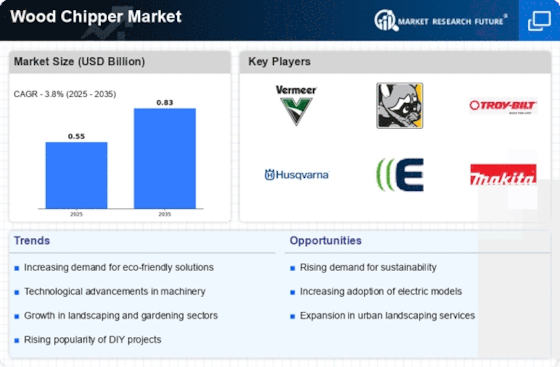
As per MRFR analysis, the Wood Chipper Market Size was estimated at 0.5502 USD Billion in 2024. The Wood Chipper industry is projected to grow from 0.5711 in 2025 to 0.8294 by 2035, exhibiting a compound annual growth rate (CAGR) of 3.8 during the forecast period 2025 - 2035.

Key Market Trends & Highlights

The Wood Chipper Market is experiencing a dynamic shift towards sustainability and technological innovation.

  • The market is increasingly driven by a focus on sustainability and environmental consciousness.
  • North America remains the largest market, while Asia-Pacific is emerging as the fastest-growing region.
  • The drum type wood chippers dominate the market, whereas electric-driven models are witnessing rapid growth.
  • Key drivers include the rising demand for landscaping services and regulatory support for sustainable practices.

Market Size & Forecast

2024 Market Size 0.5502 (USD Billion)
2035 Market Size 0.8294 (USD Billion)
CAGR (2025 - 2035) 3.8%
Largest Regional Market Share in 2024 North America

Major Players

<p>Vermeer Corporation (US), Bandit Industries Inc. (US), Troy-Bilt LLC (US), Husqvarna AB (SE), ECHO Inc. (US), Makita Corporation (JP), Stihl AG & Co. KG (DE), Woodchuck (US), Altec Industries Inc. (US)</p>

Market Trends

The Wood Chipper Market is currently experiencing a notable evolution, driven by various factors that influence consumer preferences and technological advancements. As environmental concerns gain prominence, there is a growing inclination towards sustainable practices, which has led to an increased demand for efficient wood chippers. These machines are not only utilized in landscaping and forestry but also find applications in waste management, where they contribute to reducing landfill waste. The integration of advanced features, such as electric power options and enhanced safety mechanisms, appears to be reshaping the competitive landscape, attracting a diverse range of customers from both residential and commercial sectors. Moreover, the Wood Chipper Market seems to be benefiting from the rise in outdoor activities and gardening trends. As more individuals engage in landscaping and home improvement projects, the need for reliable and effective wood chippers becomes apparent. This trend is further supported by the increasing availability of rental services, which provide access to high-quality equipment without the burden of ownership. Consequently, the market is likely to witness continued growth as manufacturers innovate and adapt to meet the evolving demands of consumers, ensuring that wood chippers remain an essential tool for various applications.

Sustainability Focus

The Wood Chipper Market is increasingly influenced by a shift towards sustainable practices. Consumers are more inclined to choose equipment that minimizes environmental impact, leading to a rise in demand for eco-friendly wood chippers.

Technological Advancements

Innovations in technology are transforming the Wood Chipper Market. Features such as electric power options and enhanced safety mechanisms are becoming standard, appealing to a broader customer base.

Growth in Outdoor Activities

The popularity of gardening and outdoor projects is driving demand in the Wood Chipper Market. As more individuals engage in landscaping, the need for efficient wood chippers is becoming more pronounced.

Wood Chipper Market Market Drivers

Growth in Urban Forestry Initiatives

The Wood Chipper Market is benefiting from the growth of urban forestry initiatives aimed at enhancing green spaces in urban areas. As cities strive to improve air quality and promote biodiversity, there is a concerted effort to plant and maintain trees. This trend necessitates effective tree care and maintenance practices, including the use of wood chippers for managing tree debris. Urban forestry programs often require the removal of dead or hazardous trees, generating a substantial amount of organic waste that can be processed using wood chippers. As municipalities invest in these initiatives, the demand for wood chippers is expected to rise, reflecting a broader commitment to creating sustainable urban environments.

Increased Demand for Landscaping Services

The Wood Chipper Market experiences a notable surge in demand for landscaping services, driven by urbanization and the growing trend of outdoor beautification. As more homeowners and businesses invest in landscaping, the need for efficient waste management solutions becomes paramount. Wood chippers play a crucial role in transforming tree branches, leaves, and other organic waste into mulch or compost, thereby enhancing the aesthetic appeal of outdoor spaces. According to recent data, the landscaping services sector is projected to grow at a compound annual growth rate of approximately 5.5% over the next five years. This growth directly correlates with the rising sales of wood chippers, as landscaping professionals increasingly rely on these machines to streamline their operations and improve service delivery.

Technological Innovations in Wood Chippers

The Wood Chipper Market is witnessing a wave of technological innovations that enhance the efficiency and performance of wood chippers. Manufacturers are increasingly integrating advanced features such as automated feeding systems, improved blade designs, and enhanced safety mechanisms. These innovations not only improve the operational efficiency of wood chippers but also expand their applicability across various sectors, including landscaping, forestry, and waste management. Market data suggests that the introduction of electric and hybrid wood chippers is gaining traction, appealing to environmentally conscious consumers. As technology continues to evolve, the wood chipper market is likely to experience increased competition and growth, driven by the demand for more efficient and user-friendly machines.

Regulatory Support for Sustainable Practices

The Wood Chipper Market is positively influenced by regulatory frameworks that promote sustainable practices in waste management and forestry. Governments are increasingly implementing policies aimed at reducing landfill waste and encouraging recycling of organic materials. These regulations often incentivize the use of wood chippers, as they facilitate the conversion of yard waste into reusable products. For instance, initiatives that support composting and mulching are likely to drive the adoption of wood chippers among both commercial and residential users. As municipalities adopt stricter waste management policies, the demand for wood chippers is expected to rise, reflecting a broader commitment to environmental sustainability and resource conservation.

Rising Awareness of Environmental Sustainability

The Wood Chipper Market is significantly impacted by the increasing awareness of environmental sustainability among consumers and businesses alike. As society becomes more conscious of the ecological footprint of waste disposal, there is a growing preference for eco-friendly solutions. Wood chippers enable users to recycle organic waste effectively, thereby reducing the volume of waste sent to landfills. This trend is supported by data indicating that approximately 30% of municipal solid waste consists of organic materials, which can be processed using wood chippers. Consequently, the heightened focus on sustainability is likely to drive the demand for wood chippers, as more individuals and organizations seek to adopt environmentally responsible practices.

Market Segment Insights

Wood Chipper Market Product Type Insights

The Wood Chipper Market segmentation, based on product type includes Disc Type, Drum Type and Screw Type. The disc type segment dominated the market, accounting for 35% of market revenue (0.18 Billion). Disc type wood chippers have captured the largest market share due to their efficiency and versatility. These chippers are adept at processing a wide range of wood materials, including branches and logs. Their robust disc cutting mechanism ensures effective and consistent chipping, making them suitable for various applications, from residential landscaping to commercial forestry.

Additionally, disc type Wood Chippers are known for their durability and low maintenance requirements, contributing to their popularity among users. Their ability to handle different wood sizes and types positions them as a preferred choice, driving their dominance in the Wood Chipper Market.

Drum type Wood Chippers are experiencing the highest Compound Annual Growth Rate (CAGR) in the market due to their efficiency and suitability for specific applications. These chippers excel in chipping smaller, uniform wood materials, making them increasingly popular for biomass and pellet production. Drum chippers offer a consistent and controlled chipping process, contributing to the growing demand for renewable energy sources. Their effectiveness in producing uniform wood chips for various industries, coupled with a rising emphasis on sustainable practices, positions drum type Wood Chippers for significant growth, leading to their highest CAGR in the Wood Chipper Market.

Wood Chipper Market Fuel Type Insights

The Wood Chipper Market segmentation, based on fuel type, includes Diesel Engine, Petrol Engine and Electric Driven. The diesel engine category generated the most income (40%). Diesel engine fuel type has secured the largest market share in the Wood Chipper industry due to its advantages in terms of power, efficiency, and versatility. Diesel-powered Wood Chippers offer high torque, making them capable of handling heavy-duty tasks such as chipping large branches and logs. Additionally, diesel engines provide greater mobility without reliance on external power sources, making them suitable for various environments.

The robust and reliable nature of diesel engines contributes to their popularity, particularly in commercial and industrial settings, establishing them as the preferred choice and capturing the largest market share in the Wood Chipper Market.

Petrol engine fuel type is experiencing the highest Compound Annual Growth Rate (CAGR) in the Wood Chipper Market due to its increasing popularity for residential and small-scale commercial applications. Petrol-powered Wood Chippers are favored for their ease of use, portability, and lower emissions compared to diesel alternatives. They are well-suited for lighter tasks like garden waste and tree pruning, appealing to a broader consumer base. As environmental concerns and regulations drive demand for cleaner options, petrol engine Wood Chippers are witnessing significant growth, leading to the highest CAGR in the market.

Figure 1: Wood Chipper Market, by Fuel Type, 2022 & 2032 (USD Billion)Source: Secondary Research, Primary Research, Market Research Future Database and Analyst Review

Wood Chipper Market Capacity Insights

The Wood Chipper Market segmentation, based on capacity, includes 10-250 kg/hr, 250-3000 kg/hr, 3000-10000 kg/hr and Above 10000 kg/hr). The 10-250 kg/hr category generated the most income (20.4%). The 10-250 kg/hr capacity range has captured the largest market share in the Wood Chipper industry due to its versatility and applicability across diverse user needs. This capacity range caters to a broad spectrum of users, including residential, landscaping, and small-scale commercial applications. Wood Chippers within this range offer an optimal balance between power and efficiency, making them suitable for various tasks such as garden waste processing and tree pruning.

The flexibility and adaptability of Wood Chippers in the 10-250 kg/hr capacity range contribute to their widespread adoption, securing the largest market share.

The 3000-10000 kg/hr capacity range is experiencing the highest Compound Annual Growth Rate (CAGR) in the Wood Chipper Market due to its appeal in industrial and large-scale applications. Wood Chippers within this range are well-suited for heavy-duty tasks, such as forestry operations and biomass processing for energy production. As the demand for efficient wood processing solutions increases in industrial settings, the higher throughput capabilities of chippers in the 3000-10000 kg/hr capacity range drive their growth, leading to the highest CAGR in the Wood Chipper Market.

Wood Chipper Market End-Use Insights

The Wood Chipper Market segmentation, based on end-use, includes Construction, Forestry & Biomass, Paper & Pulp, Timber Factories & Sawmills and Other. Construction end-use has captured the largest market share in the Wood Chipper industry due to the extensive use of Wood Chippers in land clearing, site preparation, and waste management during construction projects. Wood Chippers efficiently process tree limbs, branches, and other wood debris, contributing to a cleaner and more organized construction site.

The versatility of Wood Chippers in handling various wood materials aligns with the diverse needs of the construction sector, making them a crucial tool in enhancing efficiency and sustainability in construction-related activities, hence capturing the largest market share.

Get more detailed insights about Wood Chipper Market Research Report- Global Forecast by 2035

Regional Insights

North America : Market Leader in Wood Chippers

North America is the largest market for wood chippers, accounting for approximately 45% of the global market share. The growth is driven by increasing demand for landscaping and forestry services, alongside stringent regulations promoting sustainable practices. The region's robust infrastructure and high disposable income further fuel market expansion. The United States is the primary contributor, with key players like Vermeer Corporation and Bandit Industries leading the market. The competitive landscape is characterized by innovation and technological advancements, with companies focusing on eco-friendly solutions to meet regulatory standards. Canada also plays a significant role, contributing to the overall market dynamics.

Europe : Emerging Market with Regulations

Europe is witnessing significant growth in the wood chipper market, holding approximately 30% of the global share. The demand is driven by increasing environmental regulations and a shift towards sustainable forestry practices. Countries like Germany and the UK are leading this growth, supported by government initiatives promoting green technologies. Germany stands out as a key player, with companies like Stihl AG & Co. KG and Husqvarna AB dominating the market. The competitive landscape is marked by a focus on innovation and compliance with EU regulations, which encourage the adoption of advanced wood chipper technologies. The presence of established manufacturers and a growing emphasis on eco-friendly products further enhance market prospects.

Asia-Pacific : Rapid Growth and Adoption

The Asia-Pacific region is emerging as a significant player in the wood chipper market, accounting for about 20% of the global share. The growth is fueled by rapid urbanization, increasing demand for landscaping, and government initiatives promoting afforestation. Countries like Japan and Australia are at the forefront, with rising investments in forestry and agricultural sectors driving market expansion. Japan's technological advancements in wood chipper manufacturing are noteworthy, with companies like Makita Corporation leading the charge. The competitive landscape is evolving, with new entrants focusing on cost-effective solutions to cater to the growing demand. The region's diverse market dynamics present both challenges and opportunities for existing and new players.

Middle East and Africa : Untapped Potential in Market

The Middle East and Africa region is gradually emerging in the wood chipper market, holding around 5% of the global share. The growth is primarily driven by increasing awareness of sustainable practices and the need for efficient waste management solutions. Countries like South Africa and the UAE are beginning to invest in forestry and landscaping, creating new opportunities for market players. The competitive landscape is still developing, with a few key players like Altec Industries Inc. starting to establish a foothold. The region's potential is largely untapped, and as governments focus on environmental sustainability, the demand for wood chippers is expected to rise. This presents a unique opportunity for manufacturers to expand their presence in this emerging market.

Key Players and Competitive Insights

Manufacturing locally to minimize operational costs is one of the key business tactics used by manufacturers in the Wood Chipper industry to benefit clients and increase the market sector. In recent years, the Wood Chipper industry has offered some of the most significant advantages to medicine. Major players in the Wood Chipper Market, including Vermeer Corporation, Bandit Industries, Inc., Morbark, LLC, J.P. Carlton Company, Terex Corporation, Peterson Pacific Corp., Schliesing Maschinenbau GmbH, Albach Maschinenbau GmbH, GreenMech Ltd. And TS Manufacturing Co. and others, are attempting to increase market demand by investing in research and development operations.

Vermeer Corporation, a prominent player in the Wood Chipper Market, is renowned for its innovative solutions in environmental and agricultural industries. The company specializes in the manufacturing of Wood Chippers, stump grinders, and other equipment. Vermeer's Wood Chippers are known for their durability, efficiency, and advanced features. With a commitment to sustainability, Vermeer focuses on creating machines that enhance productivity while minimizing environmental impact. The company's diverse product portfolio and presence have solidified its position as a leading player in the Wood Chipper Market.

Vermeer Corporation continues to drive advancements in wood processing technology, catering to the evolving needs of industries involved in landscaping, forestry, and biomass production.

Peterson Pacific Corp. is a key player in the Wood Chipper Market, specializing in the design and manufacturing of high-quality wood processing equipment. With a focus on innovation, the company produces a range of horizontal grinders, chippers, and other forestry machinery. Peterson's Wood Chippers are known for their reliability, efficiency, and rugged construction, making them suitable for a variety of applications, including biomass production and land clearing. The company's commitment to customer satisfaction, coupled with its emphasis on environmentally responsible solutions, has contributed to its success in the Wood Chipper industry.

Peterson Pacific Corp. continues to play a pivotal role in advancing technology for wood processing and forestry applications.

Key Companies in the Wood Chipper Market market include

Industry Developments

March 2022: Volvo Construction Equipment (Volvo CE) has unveiled its latest initiative, the Compact Business Unit. This strategic move involves the establishment of a specialized business unit exclusively focused on the comprehensive range of compact equipment machines and solutions. The objective behind this dedicated unit is to stimulate growth and enhance profitability within this crucial and expanding product category. Volvo CE's emphasis on creating a distinct business unit underscores its commitment to addressing the unique needs of the compact equipment market, marking a significant step forward in the company's efforts to fortify its presence and success in this evolving segment.

January 2022: Caterpillar has introduced the MH3050, a novel material handler, showcasing enhanced performance, reliability, and a comfortable premium cab. The 3050 incorporates an advanced electrohydraulic system to optimize the balance between power and efficiency, resulting in improved cycle times for handling more material within the same timeframe, ultimately boosting profit potential. This addition expands Caterpillar's material handler lineup, offering advanced solutions for industrial applications. The MH3050 underlines Caterpillar's commitment to innovation, providing a versatile and efficient solution to meet the evolving needs of material handling in various industrial settings.

Future Outlook

Wood Chipper Market Future Outlook

<p>The Wood Chipper Market is projected to grow at a 3.8% CAGR from 2024 to 2035, driven by increasing demand for sustainable waste management and landscaping solutions.</p>

New opportunities lie in:

  • <p>Development of electric wood chippers for eco-friendly operations.</p>
  • <p>Expansion into emerging markets with tailored product offerings.</p>
  • <p>Integration of smart technology for enhanced operational efficiency.</p>

<p>By 2035, the Wood Chipper Market is expected to solidify its position as a key player in sustainable forestry solutions.</p>

Market Segmentation

Wood Chipper Market End-Use Outlook

  • Construction
  • Forestry & Biomass
  • Paper & Pulp
  • Timber Factories & Sawmills
  • Other

Wood Chipper Market Capacity Outlook

  • 10-250 kg/hr
  • 250-3000 kg/hr
  • 3000-10000 kg/hr
  • Above 10000 kg/hr

Wood Chipper Market Fuel Type Outlook

  • Diesel Engine
  • Petrol Engine
  • Electric Driven

Wood Chipper Market Product Type Outlook

  • Disc Type
  • Drum Type
  • Screw Type

Report Scope

MARKET SIZE 20240.5502(USD Billion)
MARKET SIZE 20250.5711(USD Billion)
MARKET SIZE 20350.8294(USD Billion)
COMPOUND ANNUAL GROWTH RATE (CAGR)3.8% (2024 - 2035)
REPORT COVERAGERevenue Forecast, Competitive Landscape, Growth Factors, and Trends
BASE YEAR2024
Market Forecast Period2025 - 2035
Historical Data2019 - 2024
Market Forecast UnitsUSD Billion
Key Companies ProfiledMarket analysis in progress
Segments CoveredMarket segmentation analysis in progress
Key Market OpportunitiesGrowing demand for eco-friendly landscaping solutions drives innovation in the Wood Chipper Market.
Key Market DynamicsRising demand for eco-friendly landscaping solutions drives innovation and competition in the wood chipper market.
Countries CoveredNorth America, Europe, APAC, South America, MEA

FAQs

What is the projected market valuation of the Wood Chipper Market by 2035?

The Wood Chipper Market is projected to reach a valuation of 0.8294 USD Billion by 2035.

What was the market valuation of the Wood Chipper Market in 2024?

In 2024, the Wood Chipper Market had a valuation of 0.5502 USD Billion.

What is the expected CAGR for the Wood Chipper Market during the forecast period 2025 - 2035?

The expected CAGR for the Wood Chipper Market during the forecast period 2025 - 2035 is 3.8%.

Which product type segments are included in the Wood Chipper Market?

The Wood Chipper Market includes Disc Type, Drum Type, and Screw Type segments.

What are the projected valuations for the different fuel types in the Wood Chipper Market?

Projected valuations for fuel types include Diesel Engine at 0.2201 - 0.3303 USD Billion, Petrol Engine at 0.1101 - 0.1652 USD Billion, and Electric Driven at 0.22 - 0.334 USD Billion.

What capacity segments are present in the Wood Chipper Market?

Capacity segments in the Wood Chipper Market include 10-250 kg/hr, 250-3000 kg/hr, 3000-10000 kg/hr, and Above 10000 kg/hr.

  1. SECTION I: EXECUTIVE SUMMARY AND KEY HIGHLIGHTS
    1. EXECUTIVE SUMMARY
      1. Market Overview
      2. Key Findings
      3. Market Segmentation
      4. Competitive Landscape
      5. Challenges and Opportunities
      6. Future Outlook
  2. SECTION II: SCOPING, METHODOLOGY AND MARKET STRUCTURE
    1. MARKET INTRODUCTION
      1. Definition
      2. Scope of the study
    2. RESEARCH METHODOLOGY
      1. Overview
      2. Data Mining
      3. Secondary Research
      4. Primary Research
      5. Forecasting Model
      6. Market Size Estimation
      7. Data Triangulation
      8. Validation
  3. SECTION III: QUALITATIVE ANALYSIS
    1. MARKET DYNAMICS
      1. Overview
      2. Drivers
      3. Restraints
      4. Opportunities
    2. MARKET FACTOR ANALYSIS
      1. Value chain Analysis
      2. Porter's Five Forces Analysis
      3. COVID-19 Impact Analysis
  4. SECTION IV: QUANTITATIVE ANALYSIS
    1. Packaging & Transport, BY Product Type (USD Billion)
      1. Disc Type
      2. Drum Type
      3. Screw Type
    2. Packaging & Transport, BY Fuel Type (USD Billion)
      1. Diesel Engine
      2. Petrol Engine
      3. Electric Driven
    3. Packaging & Transport, BY Capacity (USD Billion)
      1. 10-250 kg/hr
      2. 250-3000 kg/hr
      3. 3000-10000 kg/hr
      4. Above 10000 kg/hr
    4. Packaging & Transport, BY End-Use (USD Billion)
      1. Construction
      2. Forestry & Biomass
      3. Paper & Pulp
      4. Timber Factories & Sawmills
      5. Other
    5. Packaging & Transport, BY Region (USD Billion)
      1. North America
      2. Europe
      3. APAC
      4. South America
      5. MEA
  5. SECTION V: COMPETITIVE ANALYSIS
    1. Competitive Landscape
      1. Overview
      2. Competitive Analysis
      3. Market share Analysis
      4. Major Growth Strategy in the Packaging & Transport
      5. Competitive Benchmarking
      6. Leading Players in Terms of Number of Developments in the Packaging & Transport
      7. Key developments and growth strategies
      8. Major Players Financial Matrix
    2. Company Profiles
      1. Vermeer Corporation (US)
      2. Bandit Industries Inc. (US)
      3. Troy-Bilt LLC (US)
      4. Husqvarna AB (SE)
      5. ECHO Inc. (US)
      6. Makita Corporation (JP)
      7. Stihl AG & Co. KG (DE)
      8. Woodchuck (US)
      9. Altec Industries Inc. (US)
    3. Appendix
      1. References
      2. Related Reports
  6. LIST OF FIGURES
    1. MARKET SYNOPSIS
    2. NORTH AMERICA MARKET ANALYSIS
    3. US MARKET ANALYSIS BY PRODUCT TYPE
    4. US MARKET ANALYSIS BY FUEL TYPE
    5. US MARKET ANALYSIS BY CAPACITY
    6. US MARKET ANALYSIS BY END-USE
    7. CANADA MARKET ANALYSIS BY PRODUCT TYPE
    8. CANADA MARKET ANALYSIS BY FUEL TYPE
    9. CANADA MARKET ANALYSIS BY CAPACITY
    10. CANADA MARKET ANALYSIS BY END-USE
    11. EUROPE MARKET ANALYSIS
    12. GERMANY MARKET ANALYSIS BY PRODUCT TYPE
    13. GERMANY MARKET ANALYSIS BY FUEL TYPE
    14. GERMANY MARKET ANALYSIS BY CAPACITY
    15. GERMANY MARKET ANALYSIS BY END-USE
    16. UK MARKET ANALYSIS BY PRODUCT TYPE
    17. UK MARKET ANALYSIS BY FUEL TYPE
    18. UK MARKET ANALYSIS BY CAPACITY
    19. UK MARKET ANALYSIS BY END-USE
    20. FRANCE MARKET ANALYSIS BY PRODUCT TYPE
    21. FRANCE MARKET ANALYSIS BY FUEL TYPE
    22. FRANCE MARKET ANALYSIS BY CAPACITY
    23. FRANCE MARKET ANALYSIS BY END-USE
    24. RUSSIA MARKET ANALYSIS BY PRODUCT TYPE
    25. RUSSIA MARKET ANALYSIS BY FUEL TYPE
    26. RUSSIA MARKET ANALYSIS BY CAPACITY
    27. RUSSIA MARKET ANALYSIS BY END-USE
    28. ITALY MARKET ANALYSIS BY PRODUCT TYPE
    29. ITALY MARKET ANALYSIS BY FUEL TYPE
    30. ITALY MARKET ANALYSIS BY CAPACITY
    31. ITALY MARKET ANALYSIS BY END-USE
    32. SPAIN MARKET ANALYSIS BY PRODUCT TYPE
    33. SPAIN MARKET ANALYSIS BY FUEL TYPE
    34. SPAIN MARKET ANALYSIS BY CAPACITY
    35. SPAIN MARKET ANALYSIS BY END-USE
    36. REST OF EUROPE MARKET ANALYSIS BY PRODUCT TYPE
    37. REST OF EUROPE MARKET ANALYSIS BY FUEL TYPE
    38. REST OF EUROPE MARKET ANALYSIS BY CAPACITY
    39. REST OF EUROPE MARKET ANALYSIS BY END-USE
    40. APAC MARKET ANALYSIS
    41. CHINA MARKET ANALYSIS BY PRODUCT TYPE
    42. CHINA MARKET ANALYSIS BY FUEL TYPE
    43. CHINA MARKET ANALYSIS BY CAPACITY
    44. CHINA MARKET ANALYSIS BY END-USE
    45. INDIA MARKET ANALYSIS BY PRODUCT TYPE
    46. INDIA MARKET ANALYSIS BY FUEL TYPE
    47. INDIA MARKET ANALYSIS BY CAPACITY
    48. INDIA MARKET ANALYSIS BY END-USE
    49. JAPAN MARKET ANALYSIS BY PRODUCT TYPE
    50. JAPAN MARKET ANALYSIS BY FUEL TYPE
    51. JAPAN MARKET ANALYSIS BY CAPACITY
    52. JAPAN MARKET ANALYSIS BY END-USE
    53. SOUTH KOREA MARKET ANALYSIS BY PRODUCT TYPE
    54. SOUTH KOREA MARKET ANALYSIS BY FUEL TYPE
    55. SOUTH KOREA MARKET ANALYSIS BY CAPACITY
    56. SOUTH KOREA MARKET ANALYSIS BY END-USE
    57. MALAYSIA MARKET ANALYSIS BY PRODUCT TYPE
    58. MALAYSIA MARKET ANALYSIS BY FUEL TYPE
    59. MALAYSIA MARKET ANALYSIS BY CAPACITY
    60. MALAYSIA MARKET ANALYSIS BY END-USE
    61. THAILAND MARKET ANALYSIS BY PRODUCT TYPE
    62. THAILAND MARKET ANALYSIS BY FUEL TYPE
    63. THAILAND MARKET ANALYSIS BY CAPACITY
    64. THAILAND MARKET ANALYSIS BY END-USE
    65. INDONESIA MARKET ANALYSIS BY PRODUCT TYPE
    66. INDONESIA MARKET ANALYSIS BY FUEL TYPE
    67. INDONESIA MARKET ANALYSIS BY CAPACITY
    68. INDONESIA MARKET ANALYSIS BY END-USE
    69. REST OF APAC MARKET ANALYSIS BY PRODUCT TYPE
    70. REST OF APAC MARKET ANALYSIS BY FUEL TYPE
    71. REST OF APAC MARKET ANALYSIS BY CAPACITY
    72. REST OF APAC MARKET ANALYSIS BY END-USE
    73. SOUTH AMERICA MARKET ANALYSIS
    74. BRAZIL MARKET ANALYSIS BY PRODUCT TYPE
    75. BRAZIL MARKET ANALYSIS BY FUEL TYPE
    76. BRAZIL MARKET ANALYSIS BY CAPACITY
    77. BRAZIL MARKET ANALYSIS BY END-USE
    78. MEXICO MARKET ANALYSIS BY PRODUCT TYPE
    79. MEXICO MARKET ANALYSIS BY FUEL TYPE
    80. MEXICO MARKET ANALYSIS BY CAPACITY
    81. MEXICO MARKET ANALYSIS BY END-USE
    82. ARGENTINA MARKET ANALYSIS BY PRODUCT TYPE
    83. ARGENTINA MARKET ANALYSIS BY FUEL TYPE
    84. ARGENTINA MARKET ANALYSIS BY CAPACITY
    85. ARGENTINA MARKET ANALYSIS BY END-USE
    86. REST OF SOUTH AMERICA MARKET ANALYSIS BY PRODUCT TYPE
    87. REST OF SOUTH AMERICA MARKET ANALYSIS BY FUEL TYPE
    88. REST OF SOUTH AMERICA MARKET ANALYSIS BY CAPACITY
    89. REST OF SOUTH AMERICA MARKET ANALYSIS BY END-USE
    90. MEA MARKET ANALYSIS
    91. GCC COUNTRIES MARKET ANALYSIS BY PRODUCT TYPE
    92. GCC COUNTRIES MARKET ANALYSIS BY FUEL TYPE
    93. GCC COUNTRIES MARKET ANALYSIS BY CAPACITY
    94. GCC COUNTRIES MARKET ANALYSIS BY END-USE
    95. SOUTH AFRICA MARKET ANALYSIS BY PRODUCT TYPE
    96. SOUTH AFRICA MARKET ANALYSIS BY FUEL TYPE
    97. SOUTH AFRICA MARKET ANALYSIS BY CAPACITY
    98. SOUTH AFRICA MARKET ANALYSIS BY END-USE
    99. REST OF MEA MARKET ANALYSIS BY PRODUCT TYPE
    100. REST OF MEA MARKET ANALYSIS BY FUEL TYPE
    101. REST OF MEA MARKET ANALYSIS BY CAPACITY
    102. REST OF MEA MARKET ANALYSIS BY END-USE
    103. KEY BUYING CRITERIA OF PACKAGING & TRANSPORT
    104. RESEARCH PROCESS OF MRFR
    105. DRO ANALYSIS OF PACKAGING & TRANSPORT
    106. DRIVERS IMPACT ANALYSIS: PACKAGING & TRANSPORT
    107. RESTRAINTS IMPACT ANALYSIS: PACKAGING & TRANSPORT
    108. SUPPLY / VALUE CHAIN: PACKAGING & TRANSPORT
    109. PACKAGING & TRANSPORT, BY PRODUCT TYPE, 2024 (% SHARE)
    110. PACKAGING & TRANSPORT, BY PRODUCT TYPE, 2024 TO 2035 (USD Billion)
    111. PACKAGING & TRANSPORT, BY FUEL TYPE, 2024 (% SHARE)
    112. PACKAGING & TRANSPORT, BY FUEL TYPE, 2024 TO 2035 (USD Billion)
    113. PACKAGING & TRANSPORT, BY CAPACITY, 2024 (% SHARE)
    114. PACKAGING & TRANSPORT, BY CAPACITY, 2024 TO 2035 (USD Billion)
    115. PACKAGING & TRANSPORT, BY END-USE, 2024 (% SHARE)
    116. PACKAGING & TRANSPORT, BY END-USE, 2024 TO 2035 (USD Billion)
    117. BENCHMARKING OF MAJOR COMPETITORS
  7. LIST OF TABLES
    1. LIST OF ASSUMPTIONS
    2. North America MARKET SIZE ESTIMATES; FORECAST
      1. BY PRODUCT TYPE, 2025-2035 (USD Billion)
      2. BY FUEL TYPE, 2025-2035 (USD Billion)
      3. BY CAPACITY, 2025-2035 (USD Billion)
      4. BY END-USE, 2025-2035 (USD Billion)
    3. US MARKET SIZE ESTIMATES; FORECAST
      1. BY PRODUCT TYPE, 2025-2035 (USD Billion)
      2. BY FUEL TYPE, 2025-2035 (USD Billion)
      3. BY CAPACITY, 2025-2035 (USD Billion)
      4. BY END-USE, 2025-2035 (USD Billion)
    4. Canada MARKET SIZE ESTIMATES; FORECAST
      1. BY PRODUCT TYPE, 2025-2035 (USD Billion)
      2. BY FUEL TYPE, 2025-2035 (USD Billion)
      3. BY CAPACITY, 2025-2035 (USD Billion)
      4. BY END-USE, 2025-2035 (USD Billion)
    5. Europe MARKET SIZE ESTIMATES; FORECAST
      1. BY PRODUCT TYPE, 2025-2035 (USD Billion)
      2. BY FUEL TYPE, 2025-2035 (USD Billion)
      3. BY CAPACITY, 2025-2035 (USD Billion)
      4. BY END-USE, 2025-2035 (USD Billion)
    6. Germany MARKET SIZE ESTIMATES; FORECAST
      1. BY PRODUCT TYPE, 2025-2035 (USD Billion)
      2. BY FUEL TYPE, 2025-2035 (USD Billion)
      3. BY CAPACITY, 2025-2035 (USD Billion)
      4. BY END-USE, 2025-2035 (USD Billion)
    7. UK MARKET SIZE ESTIMATES; FORECAST
      1. BY PRODUCT TYPE, 2025-2035 (USD Billion)
      2. BY FUEL TYPE, 2025-2035 (USD Billion)
      3. BY CAPACITY, 2025-2035 (USD Billion)
      4. BY END-USE, 2025-2035 (USD Billion)
    8. France MARKET SIZE ESTIMATES; FORECAST
      1. BY PRODUCT TYPE, 2025-2035 (USD Billion)
      2. BY FUEL TYPE, 2025-2035 (USD Billion)
      3. BY CAPACITY, 2025-2035 (USD Billion)
      4. BY END-USE, 2025-2035 (USD Billion)
    9. Russia MARKET SIZE ESTIMATES; FORECAST
      1. BY PRODUCT TYPE, 2025-2035 (USD Billion)
      2. BY FUEL TYPE, 2025-2035 (USD Billion)
      3. BY CAPACITY, 2025-2035 (USD Billion)
      4. BY END-USE, 2025-2035 (USD Billion)
    10. Italy MARKET SIZE ESTIMATES; FORECAST
      1. BY PRODUCT TYPE, 2025-2035 (USD Billion)
      2. BY FUEL TYPE, 2025-2035 (USD Billion)
      3. BY CAPACITY, 2025-2035 (USD Billion)
      4. BY END-USE, 2025-2035 (USD Billion)
    11. Spain MARKET SIZE ESTIMATES; FORECAST
      1. BY PRODUCT TYPE, 2025-2035 (USD Billion)
      2. BY FUEL TYPE, 2025-2035 (USD Billion)
      3. BY CAPACITY, 2025-2035 (USD Billion)
      4. BY END-USE, 2025-2035 (USD Billion)
    12. Rest of Europe MARKET SIZE ESTIMATES; FORECAST
      1. BY PRODUCT TYPE, 2025-2035 (USD Billion)
      2. BY FUEL TYPE, 2025-2035 (USD Billion)
      3. BY CAPACITY, 2025-2035 (USD Billion)
      4. BY END-USE, 2025-2035 (USD Billion)
    13. APAC MARKET SIZE ESTIMATES; FORECAST
      1. BY PRODUCT TYPE, 2025-2035 (USD Billion)
      2. BY FUEL TYPE, 2025-2035 (USD Billion)
      3. BY CAPACITY, 2025-2035 (USD Billion)
      4. BY END-USE, 2025-2035 (USD Billion)
    14. China MARKET SIZE ESTIMATES; FORECAST
      1. BY PRODUCT TYPE, 2025-2035 (USD Billion)
      2. BY FUEL TYPE, 2025-2035 (USD Billion)
      3. BY CAPACITY, 2025-2035 (USD Billion)
      4. BY END-USE, 2025-2035 (USD Billion)
    15. India MARKET SIZE ESTIMATES; FORECAST
      1. BY PRODUCT TYPE, 2025-2035 (USD Billion)
      2. BY FUEL TYPE, 2025-2035 (USD Billion)
      3. BY CAPACITY, 2025-2035 (USD Billion)
      4. BY END-USE, 2025-2035 (USD Billion)
    16. Japan MARKET SIZE ESTIMATES; FORECAST
      1. BY PRODUCT TYPE, 2025-2035 (USD Billion)
      2. BY FUEL TYPE, 2025-2035 (USD Billion)
      3. BY CAPACITY, 2025-2035 (USD Billion)
      4. BY END-USE, 2025-2035 (USD Billion)
    17. South Korea MARKET SIZE ESTIMATES; FORECAST
      1. BY PRODUCT TYPE, 2025-2035 (USD Billion)
      2. BY FUEL TYPE, 2025-2035 (USD Billion)
      3. BY CAPACITY, 2025-2035 (USD Billion)
      4. BY END-USE, 2025-2035 (USD Billion)
    18. Malaysia MARKET SIZE ESTIMATES; FORECAST
      1. BY PRODUCT TYPE, 2025-2035 (USD Billion)
      2. BY FUEL TYPE, 2025-2035 (USD Billion)
      3. BY CAPACITY, 2025-2035 (USD Billion)
      4. BY END-USE, 2025-2035 (USD Billion)
    19. Thailand MARKET SIZE ESTIMATES; FORECAST
      1. BY PRODUCT TYPE, 2025-2035 (USD Billion)
      2. BY FUEL TYPE, 2025-2035 (USD Billion)
      3. BY CAPACITY, 2025-2035 (USD Billion)
      4. BY END-USE, 2025-2035 (USD Billion)
    20. Indonesia MARKET SIZE ESTIMATES; FORECAST
      1. BY PRODUCT TYPE, 2025-2035 (USD Billion)
      2. BY FUEL TYPE, 2025-2035 (USD Billion)
      3. BY CAPACITY, 2025-2035 (USD Billion)
      4. BY END-USE, 2025-2035 (USD Billion)
    21. Rest of APAC MARKET SIZE ESTIMATES; FORECAST
      1. BY PRODUCT TYPE, 2025-2035 (USD Billion)
      2. BY FUEL TYPE, 2025-2035 (USD Billion)
      3. BY CAPACITY, 2025-2035 (USD Billion)
      4. BY END-USE, 2025-2035 (USD Billion)
    22. South America MARKET SIZE ESTIMATES; FORECAST
      1. BY PRODUCT TYPE, 2025-2035 (USD Billion)
      2. BY FUEL TYPE, 2025-2035 (USD Billion)
      3. BY CAPACITY, 2025-2035 (USD Billion)
      4. BY END-USE, 2025-2035 (USD Billion)
    23. Brazil MARKET SIZE ESTIMATES; FORECAST
      1. BY PRODUCT TYPE, 2025-2035 (USD Billion)
      2. BY FUEL TYPE, 2025-2035 (USD Billion)
      3. BY CAPACITY, 2025-2035 (USD Billion)
      4. BY END-USE, 2025-2035 (USD Billion)
    24. Mexico MARKET SIZE ESTIMATES; FORECAST
      1. BY PRODUCT TYPE, 2025-2035 (USD Billion)
      2. BY FUEL TYPE, 2025-2035 (USD Billion)
      3. BY CAPACITY, 2025-2035 (USD Billion)
      4. BY END-USE, 2025-2035 (USD Billion)
    25. Argentina MARKET SIZE ESTIMATES; FORECAST
      1. BY PRODUCT TYPE, 2025-2035 (USD Billion)
      2. BY FUEL TYPE, 2025-2035 (USD Billion)
      3. BY CAPACITY, 2025-2035 (USD Billion)
      4. BY END-USE, 2025-2035 (USD Billion)
    26. Rest of South America MARKET SIZE ESTIMATES; FORECAST
      1. BY PRODUCT TYPE, 2025-2035 (USD Billion)
      2. BY FUEL TYPE, 2025-2035 (USD Billion)
      3. BY CAPACITY, 2025-2035 (USD Billion)
      4. BY END-USE, 2025-2035 (USD Billion)
    27. MEA MARKET SIZE ESTIMATES; FORECAST
      1. BY PRODUCT TYPE, 2025-2035 (USD Billion)
      2. BY FUEL TYPE, 2025-2035 (USD Billion)
      3. BY CAPACITY, 2025-2035 (USD Billion)
      4. BY END-USE, 2025-2035 (USD Billion)
    28. GCC Countries MARKET SIZE ESTIMATES; FORECAST
      1. BY PRODUCT TYPE, 2025-2035 (USD Billion)
      2. BY FUEL TYPE, 2025-2035 (USD Billion)
      3. BY CAPACITY, 2025-2035 (USD Billion)
      4. BY END-USE, 2025-2035 (USD Billion)
    29. South Africa MARKET SIZE ESTIMATES; FORECAST
      1. BY PRODUCT TYPE, 2025-2035 (USD Billion)
      2. BY FUEL TYPE, 2025-2035 (USD Billion)
      3. BY CAPACITY, 2025-2035 (USD Billion)
      4. BY END-USE, 2025-2035 (USD Billion)
    30. Rest of MEA MARKET SIZE ESTIMATES; FORECAST
      1. BY PRODUCT TYPE, 2025-2035 (USD Billion)
      2. BY FUEL TYPE, 2025-2035 (USD Billion)
      3. BY CAPACITY, 2025-2035 (USD Billion)
      4. BY END-USE, 2025-2035 (USD Billion)
    31. PRODUCT LAUNCH/PRODUCT DEVELOPMENT/APPROVAL
    32. ACQUISITION/PARTNERSHIP

Market Segmentation

Wood Chipper Product Type Outlook (USD Billion, 2018-2032)

  • Disc Type
  • Drum Type
  • Screw Type

Wood Chipper Fuel Type Outlook (USD Billion, 2018-2032)

  • Diesel Engine
  • Petrol Engine
  • Electric Driven

Wood Chipper Capacity Outlook (USD Billion, 2018-2032)

  • 10-250 kg/hr
  • 250-3000 kg/hr
  • 3000-10000 kg/hr
  • Above 10000 kg/hr

Wood Chipper End-Use Outlook (USD Billion, 2018-2032)

  • Forestry & Biomass
  • Paper & Pulp
  • Timber Factories & Sawmills
  • Others

Wood Chipper Regional Outlook (USD Billion, 2018-2032)

  • North America Outlook (USD Billion, 2018-2032)

    • North America Wood Chipper by Product Type
      • Disc Type
      • Drum Type
      • Screw Type
    • North America Wood Chipper by Fuel Type
      • Diesel Engine
      • Petrol Engine
      • Electric Driven
    • North America Wood Chipper by Capacity
      • 10-250 kg/hr
      • 250-3000 kg/hr
      • 3000-10000 kg/hr
      • Above 10000 kg/hr
    • North America Wood Chipper by End-Use
      • Forestry & Biomass
      • Paper & Pulp
      • Timber Factories & Sawmills
      • Others
    • US Outlook (USD Billion, 2018-2032)

    • US Wood Chipper by Product Type
      • Disc Type
      • Drum Type
      • Screw Type
    • US Wood Chipper by Fuel Type
      • Diesel Engine
      • Petrol Engine
      • Electric Driven
    • US Wood Chipper by Capacity
      • 10-250 kg/hr
      • 250-3000 kg/hr
      • 3000-10000 kg/hr
      • Above 10000 kg/hr
    • US Wood Chipper by End-Use
      • Forestry & Biomass
      • Paper & Pulp
      • Timber Factories & Sawmills
      • Others
    • CANADA Outlook (USD Billion, 2018-2032)

    • Canada Wood Chipper by Product Type
      • Disc Type
      • Drum Type
      • Screw Type
    • Canada Wood Chipper by Fuel Type
      • Diesel Engine
      • Petrol Engine
      • Electric Driven
    • Canada Wood Chipper by Capacity
      • 10-250 kg/hr
      • 250-3000 kg/hr
      • 3000-10000 kg/hr
      • Above 10000 kg/hr
    • Canada Wood Chipper by End-Use
      • Forestry & Biomass
      • Paper & Pulp
      • Timber Factories & Sawmills
      • Others
  • Europe Outlook (USD Billion, 2018-2032)

    • Europe Wood Chipper by Product Type
      • Disc Type
      • Drum Type
      • Screw Type
    • Europe Wood Chipper by Fuel Type
      • Diesel Engine
      • Petrol Engine
      • Electric Driven
    • Europe Wood Chipper by Capacity
      • 10-250 kg/hr
      • 250-3000 kg/hr
      • 3000-10000 kg/hr
      • Above 10000 kg/hr
    • Europe Wood Chipper by End-Use
      • Forestry & Biomass
      • Paper & Pulp
      • Timber Factories & Sawmills
      • Others
    • Germany Outlook (USD Billion, 2018-2032)

    • Germany Wood Chipper by Product Type
      • Disc Type
      • Drum Type
      • Screw Type
    • Germany Wood Chipper by Fuel Type
      • Diesel Engine
      • Petrol Engine
      • Electric Driven
    • Germany Wood Chipper by Capacity
      • 10-250 kg/hr
      • 250-3000 kg/hr
      • 3000-10000 kg/hr
      • Above 10000 kg/hr
    • Germany Wood Chipper by End-Use
      • Forestry & Biomass
      • Paper & Pulp
      • Timber Factories & Sawmills
      • Others
    • France Outlook (USD Billion, 2018-2032)

    • France Wood Chipper by Product Type
      • Disc Type
      • Drum Type
      • Screw Type
    • France Wood Chipper by Fuel Type
      • Diesel Engine
      • Petrol Engine
      • Electric Driven
    • France Wood Chipper by Capacity
      • 10-250 kg/hr
      • 250-3000 kg/hr
      • 3000-10000 kg/hr
      • Above 10000 kg/hr
    • France Wood Chipper by End-Use
      • Forestry & Biomass
      • Paper & Pulp
      • Timber Factories & Sawmills
      • Others
    • UK Outlook (USD Billion, 2018-2032)

    • UK Wood Chipper by Product Type
      • Disc Type
      • Drum Type
      • Screw Type
    • UK Wood Chipper by Fuel Type
      • Diesel Engine
      • Petrol Engine
      • Electric Driven
    • UK Wood Chipper by Capacity
      • 10-250 kg/hr
      • 250-3000 kg/hr
      • 3000-10000 kg/hr
      • Above 10000 kg/hr
    • UK Wood Chipper by End-Use
      • Forestry & Biomass
      • Paper & Pulp
      • Timber Factories & Sawmills
      • Others
    • ITALY Outlook (USD Billion, 2018-2032)

    • Italy Wood Chipper by Product Type
      • Disc Type
      • Drum Type
      • Screw Type
    • Italy Wood Chipper by Fuel Type
      • Diesel Engine
      • Petrol Engine
      • Electric Driven
    • Italy Wood Chipper by Capacity
      • 10-250 kg/hr
      • 250-3000 kg/hr
      • 3000-10000 kg/hr
      • Above 10000 kg/hr
    • Italy Wood Chipper by End-Use
      • Forestry & Biomass
      • Paper & Pulp
      • Timber Factories & Sawmills
      • Others
    • SPAIN Outlook (USD Billion, 2018-2032)

    • Spain Wood Chipper by Product Type
      • Disc Type
      • Drum Type
      • Screw Type
    • Spain Wood Chipper by Fuel Type
      • Diesel Engine
      • Petrol Engine
      • Electric Driven
    • Spain Wood Chipper by Capacity
      • 10-250 kg/hr
      • 250-3000 kg/hr
      • 3000-10000 kg/hr
      • Above 10000 kg/hr
    • Spain Wood Chipper by End-Use
      • Forestry & Biomass
      • Paper & Pulp
      • Timber Factories & Sawmills
      • Others
    • Rest Of Europe Outlook (USD Billion, 2018-2032)

    • Rest of Europe Wood Chipper by Product Type
      • Disc Type
      • Drum Type
      • Screw Type
    • Rest of Europe Wood Chipper by Fuel Type
      • Diesel Engine
      • Petrol Engine
      • Electric Driven
    • Rest of Europe Wood Chipper by Capacity
      • 10-250 kg/hr
      • 250-3000 kg/hr
      • 3000-10000 kg/hr
      • Above 10000 kg/hr
    • Rest of Europe Wood Chipper by End-Use
      • Forestry & Biomass
      • Paper & Pulp
      • Timber Factories & Sawmills
      • Others
  • Asia-Pacific Outlook (USD Billion, 2018-2032)

    • Asia-Pacific Wood Chipper by Product Type
      • Disc Type
      • Drum Type
      • Screw Type
    • Asia-Pacific Wood Chipper by Fuel Type
      • Diesel Engine
      • Petrol Engine
      • Electric Driven
    • Asia-Pacific Wood Chipper by Capacity
      • 10-250 kg/hr
      • 250-3000 kg/hr
      • 3000-10000 kg/hr
      • Above 10000 kg/hr
    • Asia-Pacific Wood Chipper by End-Use
      • Forestry & Biomass
      • Paper & Pulp
      • Timber Factories & Sawmills
      • Others
    • China Outlook (USD Billion, 2018-2032)

    • China Wood Chipper by Product Type
      • Disc Type
      • Drum Type
      • Screw Type
    • China Wood Chipper by Fuel Type
      • Diesel Engine
      • Petrol Engine
      • Electric Driven
    • China Wood Chipper by Capacity
      • 10-250 kg/hr
      • 250-3000 kg/hr
      • 3000-10000 kg/hr
      • Above 10000 kg/hr
    • China Wood Chipper by End-Use
      • Forestry & Biomass
      • Paper & Pulp
      • Timber Factories & Sawmills
      • Others
    • Japan Outlook (USD Billion, 2018-2032)

    • Japan Wood Chipper by Product Type
      • Disc Type
      • Drum Type
      • Screw Type
    • Japan Wood Chipper by Fuel Type
      • Diesel Engine
      • Petrol Engine
      • Electric Driven
    • Japan Wood Chipper by Capacity
      • 10-250 kg/hr
      • 250-3000 kg/hr
      • 3000-10000 kg/hr
      • Above 10000 kg/hr
    • Japan Wood Chipper by End-Use
      • Forestry & Biomass
      • Paper & Pulp
      • Timber Factories & Sawmills
      • Others
    • India Outlook (USD Billion, 2018-2032)

    • India Wood Chipper by Product Type
      • Disc Type
      • Drum Type
      • Screw Type
    • India Wood Chipper by Fuel Type
      • Diesel Engine
      • Petrol Engine
      • Electric Driven
    • India Wood Chipper by Capacity
      • 10-250 kg/hr
      • 250-3000 kg/hr
      • 3000-10000 kg/hr
      • Above 10000 kg/hr
    • India Wood Chipper by End-Use
      • Forestry & Biomass
      • Paper & Pulp
      • Timber Factories & Sawmills
      • Others
    • Australia Outlook (USD Billion, 2018-2032)

    • Australia Wood Chipper by Product Type
      • Disc Type
      • Drum Type
      • Screw Type
    • Australia Wood Chipper by Fuel Type
      • Diesel Engine
      • Petrol Engine
      • Electric Driven
    • Australia Wood Chipper by Capacity
      • 10-250 kg/hr
      • 250-3000 kg/hr
      • 3000-10000 kg/hr
      • Above 10000 kg/hr
    • Australia Wood Chipper by End-Use
      • Forestry & Biomass
      • Paper & Pulp
      • Timber Factories & Sawmills
      • Others
    • Rest of Asia-Pacific Outlook (USD Billion, 2018-2032)

    • Rest of Asia-Pacific Wood Chipper by Product Type
      • Disc Type
      • Drum Type
      • Screw Type
    • Rest of Asia-Pacific Wood Chipper by Fuel Type
      • Diesel Engine
      • Petrol Engine
      • Electric Driven
    • Rest of Asia-Pacific Wood Chipper by Capacity
      • 10-250 kg/hr
      • 250-3000 kg/hr
      • 3000-10000 kg/hr
      • Above 10000 kg/hr
    • Rest of Asia-Pacific Wood Chipper by End-Use
      • Forestry & Biomass
      • Paper & Pulp
      • Timber Factories & Sawmills
      • Others
  • Rest of the World Outlook (USD Billion, 2018-2032)

    • Rest of the World Wood Chipper by Product Type
      • Disc Type
      • Drum Type
      • Screw Type
    • Rest of the World Wood Chipper by Fuel Type
      • Diesel Engine
      • Petrol Engine
      • Electric Driven
    • Rest of the World Wood Chipper by Capacity
      • 10-250 kg/hr
      • 250-3000 kg/hr
      • 3000-10000 kg/hr
      • Above 10000 kg/hr
    • Rest of the World Wood Chipper by End-Use
      • Forestry & Biomass
      • Paper & Pulp
      • Timber Factories & Sawmills
      • Others
    • Middle East Outlook (USD Billion, 2018-2032)

    • Middle East Wood Chipper by Product Type
      • Disc Type
      • Drum Type
      • Screw Type
    • Middle East Wood Chipper by Fuel Type
      • Diesel Engine
      • Petrol Engine
      • Electric Driven
    • Middle East Wood Chipper by Capacity
      • 10-250 kg/hr
      • 250-3000 kg/hr
      • 3000-10000 kg/hr
      • Above 10000 kg/hr
    • Middle East Wood Chipper by End-Use
      • Forestry & Biomass
      • Paper & Pulp
      • Timber Factories & Sawmills
      • Others
    • Africa Outlook (USD Billion, 2018-2032)

    • Africa Wood Chipper by Product Type
      • Disc Type
      • Drum Type
      • Screw Type
    • Africa Wood Chipper by Fuel Type
      • Diesel Engine
      • Petrol Engine
      • Electric Driven
    • Africa Wood Chipper by Capacity
      • 10-250 kg/hr
      • 250-3000 kg/hr
      • 3000-10000 kg/hr
      • Above 10000 kg/hr
    • Africa Wood Chipper by End-Use
      • Forestry & Biomass
      • Paper & Pulp
      • Timber Factories & Sawmills
      • Others
    • Latin America Outlook (USD Billion, 2018-2032)

    • Latin America Wood Chipper by Product Type
      • Disc Type
      • Drum Type
      • Screw Type
    • Latin America Wood Chipper by Fuel Type
      • Diesel Engine
      • Petrol Engine
      • Electric Driven
    • Latin America Wood Chipper by Capacity
      • 10-250 kg/hr
      • 250-3000 kg/hr
      • 3000-10000 kg/hr
      • Above 10000 kg/hr
    • Latin America Wood Chipper by End-Use
      • Forestry & Biomass
      • Paper & Pulp
      • Timber Factories & Sawmills
      • Others

Infographic

Free Sample Request

Kindly complete the form below to receive a free sample of this Report

Get Free Sample

Customer Strories

Compare Licence

×
Features License Type
Single User Multiuser License Enterprise User
Price $4,950 $5,950 $7,250
Maximum User Access Limit 1 User Upto 10 Users Unrestricted Access Throughout the Organization
Free Customization
Direct Access to Analyst
Deliverable Format
Platform Access
Discount on Next Purchase 10% 15% 15%
Printable Versions