
×
Hero Background
English
Chinese
French
Japanese
Korean
German
Spanish

Wireless IoT Sensors Market Size

ID: MRFR/SEM/6797-CR
170 Pages
Ankit Gupta
January 2020

Wireless IoT Sensors Market Research Report Information By Component (Hardware, Service and Software), By Type (Image Sensor, Motion Sensor, Proximity Sensor, Pressure Sensor, Magnetometer, Humidity Sensor, Temperature Sensor, Touch Sensor, Accelerometer, Gyroscope, Flow Sensor and Others), By Technology (Wi-Fi, Bluetooth, ZigBee, NFC, Z-Wave, RFID, and Others), By Vertical (Industrial IoT, Consumer lot, and Commercial loT) And By Region (North America, Europe, Asia-Pacific, And Rest Of The World) – Industry Forecast Till 2035

Share:
Download PDF ×

We do not share your information with anyone. However, we may send you emails based on your report interest from time to time. You may contact us at any time to opt-out.

Wireless IoT Sensors Market Infographic
Purchase Options

Wireless Iot Sensors Size

Wireless IoT Sensors Market Growth Projections and Opportunities

The expansion of the global wireless IoT sensors market is propelled by several factors, including the increasing adoption of connected wearable devices and the continual rise in internet penetration. However, potential obstacles to market growth lie in concerns related to data security and the inherent risk of operational failures.

Projections for the global wireless IoT sensors market indicate a robust Compound Annual Growth Rate (CAGR) of approximately 32.87% during the forecast period, aiming to reach a substantial valuation of USD 40,728.6 million by 2025. In the landscape of 2018, North America emerged as the dominant force, commanding a market share of 36.20%, closely followed by Europe and Asia-Pacific, with shares of 26.61% and 23.45%, respectively.

The market's comprehensive segmentation is based on type, component, technology, vertical, and region. Among these, the image sensor segment seized the forefront in 2018, securing a share of 14.25%, equivalent to USD 850.6 million. Forecasts anticipate the image sensor segment to sustain its dominance, projecting the highest CAGR of 31.71% from 2019 to 2025. In terms of components, the hardware segment took the lead with a commanding market share of 56.15% in 2018, translating to a value of USD 3,352.7 million. Expectations point to the hardware segment maintaining its prominence, with the highest projected CAGR of 32.66% from 2019 to 2025. In the realm of technology, the Wi-Fi segment led the market in 2018, holding a share of 27.40% and accounting for USD 1,635.8 million. Foreseen as the frontrunner, the Wi-Fi segment is anticipated to achieve the highest CAGR of 32.95% from 2019 to 2025. Moving on to verticals, the Industrial IoT segment dominated in 2018, claiming a share of 40.87% and contributing USD 2,440.5 million. This segment is poised to sustain its dominance, with the highest projected CAGR of 33.23% from 2019 to 2025.

While the growth prospects of the global wireless IoT sensors market appear promising, potential impediments loom, specifically related to concerns regarding data security and the risk of operational failures. As technological advancements drive the evolution of IoT sensors, stakeholders must navigate these challenges to harness the market's full potential. In summary, the market's trajectory is marked by significant growth, propelled by key drivers, yet tempered by challenges that necessitate strategic considerations for sustained success in this dynamic landscape.
Wireless IoT Sensors Market Size Graph
Author
Ankit Gupta
Senior Research Analyst

Ankit Gupta is an analyst in market research industry in ICT and SEMI industry. With post-graduation in "Telecom and Marketing Management" and graduation in "Electronics and Telecommunication" vertical he is well versed with recent development in ICT industry as a whole. Having worked on more than 150+ reports including consultation for fortune 500 companies such as Microsoft and Rio Tinto in identifying solutions with respect to business problems his opinions are inclined towards mixture of technical and managerial aspects.

Leave a Comment

FAQs

What is the projected market valuation for the Wireless IoT Sensors Market in 2035?

The Wireless IoT Sensors Market is projected to reach a valuation of 132.73 USD Billion by 2035.

What was the market valuation for the Wireless IoT Sensors Market in 2024?

In 2024, the Wireless IoT Sensors Market was valued at 11.49 USD Billion.

What is the expected CAGR for the Wireless IoT Sensors Market during the forecast period 2025 - 2035?

The expected CAGR for the Wireless IoT Sensors Market during the forecast period 2025 - 2035 is 24.91%.

Which segment of the Wireless IoT Sensors Market had the highest valuation in 2024?

In 2024, the Software segment had the highest valuation at 5.74 USD Billion.

What are the key players in the Wireless IoT Sensors Market?

Key players in the Wireless IoT Sensors Market include Honeywell, Siemens, Bosch, Texas Instruments, and Qualcomm.

Which type of sensor is projected to have the highest market value in 2035?

The Accelerometer is projected to have the highest market value among sensor types, reaching 16.0 USD Billion by 2035.

Market Summary

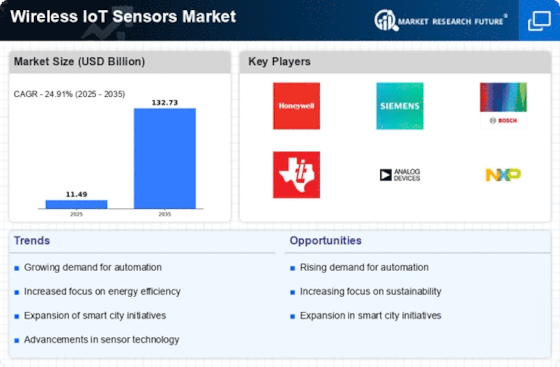
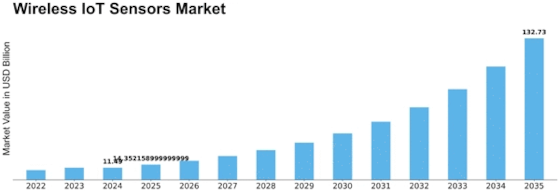
As per MRFR analysis, the Wireless IoT Sensors Market was estimated at 11.49 USD Billion in 2024. The Wireless IoT Sensors industry is projected to grow from 14.35 USD Billion in 2025 to 132.73 USD Billion by 2035, exhibiting a compound annual growth rate (CAGR) of 24.91 during the forecast period 2025 - 2035.

Key Market Trends & Highlights

The Wireless IoT Sensors Market is poised for substantial growth driven by technological advancements and increasing demand across various sectors.

  • North America remains the largest market for wireless IoT sensors, driven by robust infrastructure and technological adoption.
  • Asia-Pacific is emerging as the fastest-growing region, fueled by rapid urbanization and smart city initiatives.
  • The hardware segment dominates the market, while the service segment is experiencing the fastest growth due to increasing demand for integrated solutions.
  • Key market drivers include the growing demand for smart home solutions and the rise in industrial automation, particularly in North America.

Market Size & Forecast

2024 Market Size 11.49 (USD Billion)
2035 Market Size 132.73 (USD Billion)
CAGR (2025 - 2035) 24.91%
Largest Regional Market Share in 2024 North America

Major Players

<p>Honeywell (US), Siemens (DE), Bosch (DE), Texas Instruments (US), Analog Devices (US), NXP Semiconductors (NL), STMicroelectronics (CH), Qualcomm (US), Cisco Systems (US), IBM (US)</p>

Market Trends

The Wireless IoT Sensors Market is currently experiencing a transformative phase, driven by advancements in technology and increasing demand for automation across various sectors. The proliferation of smart devices and the growing emphasis on data-driven decision-making are propelling the adoption of wireless sensors. These devices facilitate real-time monitoring and control, enhancing operational efficiency and enabling predictive maintenance. As industries seek to optimize processes and reduce costs, the integration of wireless IoT sensors into existing systems appears to be a strategic priority. Furthermore, the rise of smart cities and the Internet of Things ecosystem is likely to further stimulate market growth, as these initiatives rely heavily on sensor technology to gather and analyze data for improved urban management. In addition, the Wireless IoT Sensors Market is characterized by a diverse range of applications, spanning healthcare, agriculture, manufacturing, and environmental monitoring. Each sector presents unique challenges and opportunities, suggesting that tailored solutions will be essential for success. The ongoing development of low-power, high-efficiency sensors indicates a shift towards sustainability, as organizations aim to minimize energy consumption while maximizing performance. Overall, the market landscape is evolving rapidly, with innovation and collaboration among stakeholders playing a crucial role in shaping its future trajectory.

Increased Focus on Sustainability

The Wireless IoT Sensors Market is witnessing a growing emphasis on sustainable practices. Companies are increasingly seeking solutions that not only enhance efficiency but also reduce environmental impact. This trend is likely to drive the development of energy-efficient sensors and promote the use of renewable energy sources in sensor operations.

Expansion of Smart City Initiatives

The rise of smart city projects is significantly influencing the Wireless IoT Sensors Market. As urban areas strive to improve infrastructure and services, the demand for sensors that monitor traffic, air quality, and energy usage is expected to surge. This trend indicates a shift towards integrated urban management systems.

Advancements in Data Analytics

The integration of advanced data analytics with wireless IoT sensors is transforming how data is utilized across industries. Enhanced analytical capabilities allow for better insights and decision-making, suggesting that organizations will increasingly rely on these technologies to drive operational improvements and innovation.

Wireless IoT Sensors Market Market Drivers

Emergence of 5G Technology

The Wireless IoT Sensors Market is poised for growth due to the emergence of 5G technology, which promises to revolutionize connectivity for IoT devices. The deployment of 5G networks is expected to enhance the performance of wireless sensors by providing faster data transmission and lower latency. This technological advancement is likely to facilitate the deployment of more sophisticated IoT applications across various sectors, including transportation, healthcare, and smart homes. The 5G market is projected to reach 700 billion dollars by 2025, creating a conducive environment for the proliferation of wireless IoT sensors. As industries leverage the capabilities of 5G, the demand for advanced wireless sensors is expected to escalate, indicating a significant shift in the IoT landscape.

Rise in Industrial Automation

The Wireless IoT Sensors Market is significantly influenced by the rise in industrial automation across various sectors. Industries are increasingly adopting IoT solutions to enhance operational efficiency and reduce costs. The market for industrial IoT is expected to surpass 200 billion dollars by 2025, with wireless sensors being integral to this transformation. These sensors enable real-time data collection and monitoring, which facilitates predictive maintenance and minimizes downtime. Moreover, the ability to remotely monitor equipment and processes enhances decision-making capabilities, thereby driving the demand for wireless IoT sensors in manufacturing and logistics. This trend indicates a shift towards more connected and intelligent industrial environments.

Increased Investment in Smart Cities

The Wireless IoT Sensors Market is significantly impacted by increased investment in smart city initiatives. Governments and municipalities are allocating substantial resources to develop smart infrastructure, which relies heavily on wireless IoT sensors for data collection and management. The smart city market is anticipated to reach over 500 billion dollars by 2025, with wireless sensors playing a crucial role in traffic management, waste management, and energy efficiency. These sensors provide real-time data that informs city planning and resource allocation, enhancing urban living conditions. The emphasis on sustainability and efficient resource management further propels the demand for wireless IoT sensors in urban environments, indicating a transformative shift in how cities operate.

Advancements in Healthcare Monitoring

The Wireless IoT Sensors Market is witnessing advancements in healthcare monitoring technologies, which are reshaping patient care. The integration of wireless sensors in medical devices allows for continuous monitoring of patients' vital signs, leading to improved health outcomes. The healthcare IoT market is projected to reach approximately 100 billion dollars by 2025, with wireless sensors being a critical component. These sensors facilitate remote patient monitoring, enabling healthcare providers to track patients' conditions in real-time. This capability not only enhances patient engagement but also reduces hospital readmission rates, thereby driving the adoption of wireless IoT sensors in the healthcare sector. The ongoing innovations in sensor technology further bolster this trend.

Growing Demand for Smart Home Solutions

The Wireless IoT Sensors Market is experiencing a notable surge in demand for smart home solutions. As consumers increasingly seek convenience and energy efficiency, the integration of wireless sensors into home automation systems becomes essential. According to recent data, the smart home market is projected to reach a valuation of over 150 billion dollars by 2025, with wireless IoT sensors playing a pivotal role in this growth. These sensors facilitate real-time monitoring and control of home appliances, enhancing user experience and energy management. Furthermore, the proliferation of mobile applications that interface with these sensors allows for seamless user engagement, thereby driving the adoption of wireless IoT technologies in residential settings.

Market Segment Insights

Wireless IoT Sensors Market Component Insights

<p>Based on components, the Wireless IoT Sensors Market segmentation includes Hardware, Service and Software. The hardware segment dominated the market because hardware is the essential Component of wireless IoT sensors, as it provides the physical capabilities for sensing, processing, and transmitting data.</p>

<p>Figure 1: WIRELESS IoT SENSORS MARKET SHARE BY COMPONENT, (USD Billion)</p>

<p>Source: Secondary Research, Primary Research, MRFR Database and Analyst Review</p>

Wireless IoT Sensors Market Type Insights

<p>The Wireless IoT Sensors Market segmentation, based on type, includes Image Sensors, Motion Sensor, Proximity Sensor, Pressure Sensor, Magnetometers, <a href="https://www.marketresearchfuture.com/reports/humidity-sensor-market-5589">Humidity Sensor</a>, Temperature Sensor, Touch Sensor, Accelerometers, Gyroscopes, Flow Sensor and others. The temperature sensor segment dominated the market; the temperature of air, water, and other gases can significantly impact the performance of machines and equipment. The temperature of patients can also be a critical indicator of their health. These providers offer a variety of temperature sensor solutions that can be the specific requirements of different applications.</p>

Wireless IoT Sensors Market Technology Insights

<p>The Wireless IoT Sensors Market segmentation, based on Technology, includes Wi-Fi, <a href="https://www.marketresearchfuture.com/reports/chip-antenna-market-1582">Bluetooth</a>, ZigBee, NFC, Z-Wave, RFID others. The Wi-Fi segment dominated the market because Wi-Fi is a mature and widely adopted technology offering high data rates and long range. This makes it ideal for applications that require transmitting large amounts of data, such as video streaming and remote monitoring.</p>

Wireless IoT Sensors Market Insights

<p>Based on Vertical, the Wireless IoT Sensors Market segmentation includes Industrial IoT, Consumer lot, and Commercial loT. The industrial IoT segment dominated the market because industrial IoT applications are typically characterized by high data rates and long-range requirements, which are well-suited to wireless technologies such as Wi-Fi and ZigBee.</p>

Get more detailed insights about Wireless IoT Sensors Market Research Report - Global Forecast till 2035

Regional Insights

North America : Technology Leadership and Innovation

North America is the largest market for Wireless IoT Sensors Market, holding approximately 40% of the global market share. The region's growth is driven by rapid technological advancements, increasing demand for smart devices, and supportive government regulations promoting IoT adoption. The U.S. leads in innovation, while Canada follows closely, contributing to the region's robust market dynamics. The competitive landscape is characterized by the presence of major players such as Honeywell, Texas Instruments, and Qualcomm. These companies are investing heavily in R&D to enhance their product offerings. The U.S. government is also fostering IoT initiatives, which further stimulates market growth. The integration of IoT in various sectors, including healthcare and manufacturing, is expected to drive demand significantly.

Europe : Emerging Market with Strong Regulations

Europe is the second-largest market for Wireless IoT Sensors Market, accounting for around 30% of the global market share. The region's growth is propelled by stringent regulations aimed at enhancing energy efficiency and sustainability. The European Union's Green Deal and Digital Strategy are key drivers, promoting the adoption of IoT technologies across various sectors, including smart cities and industrial automation. Leading countries in this region include Germany, France, and the Netherlands, with Germany being the largest market. Major players like Siemens and Bosch are at the forefront, leveraging their technological expertise to innovate. The competitive landscape is robust, with a focus on collaboration between public and private sectors to advance IoT solutions. This synergy is expected to enhance market penetration and drive future growth.

Asia-Pacific : Rapid Growth and Adoption

Asia-Pacific is witnessing rapid growth in the Wireless IoT Sensors Market, holding approximately 25% of the global market share. The region's expansion is driven by increasing urbanization, rising disposable incomes, and a growing emphasis on smart city initiatives. Countries like China and India are leading this growth, supported by government policies that encourage technological innovation and infrastructure development. China is the largest market in the region, with significant investments in IoT technologies. The competitive landscape features key players such as NXP Semiconductors and STMicroelectronics, who are focusing on enhancing their product portfolios. The region's diverse industrial base, including manufacturing and agriculture, is increasingly adopting IoT solutions, further propelling market growth and innovation.

Middle East and Africa : Untapped Potential and Growth

The Middle East and Africa region is gradually emerging in the Wireless IoT Sensors Market, currently holding about 5% of the global market share. The growth is primarily driven by increasing investments in smart infrastructure and a rising demand for automation across various sectors. Countries like the UAE and South Africa are leading the charge, with government initiatives aimed at enhancing digital transformation and connectivity. The competitive landscape is still developing, with local and international players vying for market share. Companies are focusing on partnerships and collaborations to enhance their offerings. The region's unique challenges, such as varying levels of technological adoption, present both opportunities and hurdles for market players looking to expand their footprint in this promising market.

Key Players and Competitive Insights

The Wireless IoT Sensors Market is currently characterized by a dynamic competitive landscape, driven by rapid technological advancements and increasing demand for smart solutions across various sectors. Key players such as Honeywell (US), Siemens (DE), and Bosch (DE) are strategically positioning themselves through innovation and partnerships, thereby enhancing their operational focus. Honeywell (US) emphasizes its commitment to sustainability and energy efficiency, while Siemens (DE) leverages its expertise in automation and digitalization to create integrated solutions. Bosch (DE) appears to be concentrating on expanding its product portfolio through strategic acquisitions, which collectively shapes a competitive environment that is increasingly focused on technological differentiation and customer-centric solutions.

In terms of business tactics, companies are localizing manufacturing and optimizing supply chains to enhance responsiveness to market demands. The market structure is moderately fragmented, with a mix of established players and emerging startups. This fragmentation allows for diverse offerings, yet the collective influence of key players like Texas Instruments (US) and Qualcomm (US) is significant, as they drive innovation and set industry standards.

In August 2025, Honeywell (US) announced the launch of a new line of wireless IoT sensors designed for smart building applications. This strategic move not only reinforces Honeywell's commitment to sustainability but also positions the company to capitalize on the growing trend of smart city initiatives. By integrating advanced analytics and AI capabilities, Honeywell aims to enhance operational efficiency and reduce energy consumption in urban environments.

In September 2025, Siemens (DE) unveiled a partnership with a leading telecommunications provider to develop next-generation IoT solutions for industrial applications. This collaboration is strategically important as it allows Siemens to leverage 5G technology, enhancing the connectivity and performance of its IoT sensors. Such partnerships are likely to accelerate the adoption of IoT solutions in various industries, thereby strengthening Siemens' market position.

In July 2025, Bosch (DE) completed the acquisition of a startup specializing in advanced sensor technologies. This acquisition is indicative of Bosch's strategy to enhance its technological capabilities and expand its product offerings in the IoT space. By integrating innovative sensor technologies, Bosch aims to provide more comprehensive solutions that meet the evolving needs of its customers, particularly in the automotive and industrial sectors.

As of October 2025, current competitive trends in the Wireless IoT Sensors Market are heavily influenced by digitalization, sustainability, and the integration of artificial intelligence. Strategic alliances are increasingly shaping the landscape, enabling companies to pool resources and expertise to drive innovation. Looking ahead, competitive differentiation is likely to evolve from traditional price-based competition to a focus on technological innovation, reliability in supply chains, and the ability to deliver sustainable solutions. This shift underscores the importance of adaptability and forward-thinking strategies in maintaining a competitive edge in the rapidly evolving market.

Key Companies in the Wireless IoT Sensors Market market include

Industry Developments

July 2020: Texas Instruments (TI) presents the industry's first zero-slip Hall-effect current sensor. The TMCS1100 and TMCS1101 provide the lowest and highest accuracy in time and temperature while providing 3kVrms isolation, which is particularly important for AC or DC high voltage systems such as motor drives, solar inverters, energy storage and power supplies.

June 2020: TE Connectivity offers LVDT position sensors. These sensors provide standard and custom solutions based on hydraulic application requirements for ICT field equipment and machinery.

Future Outlook

Wireless IoT Sensors Market Future Outlook

<p>The Wireless IoT Sensors Market is projected to grow at a 24.91% CAGR from 2024 to 2035, driven by advancements in connectivity, increased automation, and demand for real-time data analytics.</p>

New opportunities lie in:

  • <p>Development of smart agriculture monitoring systems</p>
  • <p>Integration of IoT sensors in smart city infrastructure</p>
  • <p>Expansion of predictive maintenance solutions for industrial applications</p>

<p>By 2035, the market is expected to be robust, driven by innovation and widespread adoption.</p>

Market Segmentation

Wireless IoT Sensors Market Type Outlook

  • Image Sensor
  • Motion Sensor
  • Proximity Sensor
  • Pressure Sensor
  • Magnetometer
  • Humidity Sensor
  • Temperature Sensor
  • Touch Sensor
  • Accelerometer
  • Gyroscope
  • Flow Sensor
  • Others

Wireless IoT Sensors Market Vertical Outlook

  • Industrial IoT
  • Consumer IoT
  • Commercial IoT

Wireless IoT Sensors Market Component Outlook

  • Hardware
  • Service
  • Software

Wireless IoT Sensors Market Technology Outlook

  • Wi-Fi
  • Bluetooth
  • ZigBee
  • NFC
  • Z-Wave
  • RFID
  • Others

Report Scope

MARKET SIZE 202411.49(USD Billion)
MARKET SIZE 202514.35(USD Billion)
MARKET SIZE 2035132.73(USD Billion)
COMPOUND ANNUAL GROWTH RATE (CAGR)24.91% (2024 - 2035)
REPORT COVERAGERevenue Forecast, Competitive Landscape, Growth Factors, and Trends
BASE YEAR2024
Market Forecast Period2025 - 2035
Historical Data2019 - 2024
Market Forecast UnitsUSD Billion
Key Companies ProfiledMarket analysis in progress
Segments CoveredMarket segmentation analysis in progress
Key Market OpportunitiesIntegration of advanced analytics and machine learning enhances Wireless IoT Sensors Market applications across various industries.
Key Market DynamicsRising demand for real-time data analytics drives innovation in Wireless Internet of Things sensor technologies.
Countries CoveredNorth America, Europe, APAC, South America, MEA

FAQs

What is the projected market valuation for the Wireless IoT Sensors Market in 2035?

The Wireless IoT Sensors Market is projected to reach a valuation of 132.73 USD Billion by 2035.

What was the market valuation for the Wireless IoT Sensors Market in 2024?

In 2024, the Wireless IoT Sensors Market was valued at 11.49 USD Billion.

What is the expected CAGR for the Wireless IoT Sensors Market during the forecast period 2025 - 2035?

The expected CAGR for the Wireless IoT Sensors Market during the forecast period 2025 - 2035 is 24.91%.

Which segment of the Wireless IoT Sensors Market had the highest valuation in 2024?

In 2024, the Software segment had the highest valuation at 5.74 USD Billion.

What are the key players in the Wireless IoT Sensors Market?

Key players in the Wireless IoT Sensors Market include Honeywell, Siemens, Bosch, Texas Instruments, and Qualcomm.

Which type of sensor is projected to have the highest market value in 2035?

The Accelerometer is projected to have the highest market value among sensor types, reaching 16.0 USD Billion by 2035.

  1. SECTION I: EXECUTIVE SUMMARY AND KEY HIGHLIGHTS
    1. EXECUTIVE SUMMARY
      1. Market Overview
      2. Key Findings
      3. Market Segmentation
      4. Competitive Landscape
      5. Challenges and Opportunities
      6. Future Outlook
  2. SECTION II: SCOPING, METHODOLOGY AND MARKET STRUCTURE
    1. MARKET INTRODUCTION
      1. Definition
      2. Scope of the study
    2. RESEARCH METHODOLOGY
      1. Overview
      2. Data Mining
      3. Secondary Research
      4. Primary Research
      5. Forecasting Model
      6. Market Size Estimation
      7. Data Triangulation
      8. Validation
  3. SECTION III: QUALITATIVE ANALYSIS
    1. MARKET DYNAMICS
      1. Overview
      2. Drivers
      3. Restraints
      4. Opportunities
    2. MARKET FACTOR ANALYSIS
      1. Value chain Analysis
      2. Porter's Five Forces Analysis
      3. COVID-19 Impact Analysis
  4. SECTION IV: QUANTITATIVE ANALYSIS
    1. Semiconductor & Electronics, BY Component (USD Billion)
      1. Hardware
      2. Service
      3. Software
    2. Semiconductor & Electronics, BY Type (USD Billion)
      1. Image Sensor
      2. Motion Sensor
      3. Proximity Sensor
      4. Pressure Sensor
      5. Magnetometer
      6. Humidity Sensor
      7. Temperature Sensor
      8. Touch Sensor
      9. Accelerometer
      10. Gyroscope
      11. Flow Sensor
      12. Others
    3. Semiconductor & Electronics, BY Technology (USD Billion)
      1. Wi-Fi
      2. Bluetooth
      3. ZigBee
      4. NFC
      5. Z-Wave
      6. RFID
      7. Others
    4. Semiconductor & Electronics, BY Vertical (USD Billion)
      1. Industrial IoT
      2. Consumer IoT
      3. Commercial IoT
    5. Semiconductor & Electronics, BY Region (USD Billion)
      1. North America
      2. Europe
      3. APAC
      4. South America
      5. MEA
  5. SECTION V: COMPETITIVE ANALYSIS
    1. Competitive Landscape
      1. Overview
      2. Competitive Analysis
      3. Market share Analysis
      4. Major Growth Strategy in the Semiconductor & Electronics
      5. Competitive Benchmarking
      6. Leading Players in Terms of Number of Developments in the Semiconductor & Electronics
      7. Key developments and growth strategies
      8. Major Players Financial Matrix
    2. Company Profiles
      1. Honeywell (US)
      2. Siemens (DE)
      3. Bosch (DE)
      4. Texas Instruments (US)
      5. Analog Devices (US)
      6. NXP Semiconductors (NL)
      7. STMicroelectronics (CH)
      8. Qualcomm (US)
      9. Cisco Systems (US)
      10. IBM (US)
    3. Appendix
      1. References
      2. Related Reports
  6. LIST OF FIGURES
    1. MARKET SYNOPSIS
    2. NORTH AMERICA MARKET ANALYSIS
    3. US MARKET ANALYSIS BY COMPONENT
    4. US MARKET ANALYSIS BY TYPE
    5. US MARKET ANALYSIS BY TECHNOLOGY
    6. US MARKET ANALYSIS BY VERTICAL
    7. CANADA MARKET ANALYSIS BY COMPONENT
    8. CANADA MARKET ANALYSIS BY TYPE
    9. CANADA MARKET ANALYSIS BY TECHNOLOGY
    10. CANADA MARKET ANALYSIS BY VERTICAL
    11. EUROPE MARKET ANALYSIS
    12. GERMANY MARKET ANALYSIS BY COMPONENT
    13. GERMANY MARKET ANALYSIS BY TYPE
    14. GERMANY MARKET ANALYSIS BY TECHNOLOGY
    15. GERMANY MARKET ANALYSIS BY VERTICAL
    16. UK MARKET ANALYSIS BY COMPONENT
    17. UK MARKET ANALYSIS BY TYPE
    18. UK MARKET ANALYSIS BY TECHNOLOGY
    19. UK MARKET ANALYSIS BY VERTICAL
    20. FRANCE MARKET ANALYSIS BY COMPONENT
    21. FRANCE MARKET ANALYSIS BY TYPE
    22. FRANCE MARKET ANALYSIS BY TECHNOLOGY
    23. FRANCE MARKET ANALYSIS BY VERTICAL
    24. RUSSIA MARKET ANALYSIS BY COMPONENT
    25. RUSSIA MARKET ANALYSIS BY TYPE
    26. RUSSIA MARKET ANALYSIS BY TECHNOLOGY
    27. RUSSIA MARKET ANALYSIS BY VERTICAL
    28. ITALY MARKET ANALYSIS BY COMPONENT
    29. ITALY MARKET ANALYSIS BY TYPE
    30. ITALY MARKET ANALYSIS BY TECHNOLOGY
    31. ITALY MARKET ANALYSIS BY VERTICAL
    32. SPAIN MARKET ANALYSIS BY COMPONENT
    33. SPAIN MARKET ANALYSIS BY TYPE
    34. SPAIN MARKET ANALYSIS BY TECHNOLOGY
    35. SPAIN MARKET ANALYSIS BY VERTICAL
    36. REST OF EUROPE MARKET ANALYSIS BY COMPONENT
    37. REST OF EUROPE MARKET ANALYSIS BY TYPE
    38. REST OF EUROPE MARKET ANALYSIS BY TECHNOLOGY
    39. REST OF EUROPE MARKET ANALYSIS BY VERTICAL
    40. APAC MARKET ANALYSIS
    41. CHINA MARKET ANALYSIS BY COMPONENT
    42. CHINA MARKET ANALYSIS BY TYPE
    43. CHINA MARKET ANALYSIS BY TECHNOLOGY
    44. CHINA MARKET ANALYSIS BY VERTICAL
    45. INDIA MARKET ANALYSIS BY COMPONENT
    46. INDIA MARKET ANALYSIS BY TYPE
    47. INDIA MARKET ANALYSIS BY TECHNOLOGY
    48. INDIA MARKET ANALYSIS BY VERTICAL
    49. JAPAN MARKET ANALYSIS BY COMPONENT
    50. JAPAN MARKET ANALYSIS BY TYPE
    51. JAPAN MARKET ANALYSIS BY TECHNOLOGY
    52. JAPAN MARKET ANALYSIS BY VERTICAL
    53. SOUTH KOREA MARKET ANALYSIS BY COMPONENT
    54. SOUTH KOREA MARKET ANALYSIS BY TYPE
    55. SOUTH KOREA MARKET ANALYSIS BY TECHNOLOGY
    56. SOUTH KOREA MARKET ANALYSIS BY VERTICAL
    57. MALAYSIA MARKET ANALYSIS BY COMPONENT
    58. MALAYSIA MARKET ANALYSIS BY TYPE
    59. MALAYSIA MARKET ANALYSIS BY TECHNOLOGY
    60. MALAYSIA MARKET ANALYSIS BY VERTICAL
    61. THAILAND MARKET ANALYSIS BY COMPONENT
    62. THAILAND MARKET ANALYSIS BY TYPE
    63. THAILAND MARKET ANALYSIS BY TECHNOLOGY
    64. THAILAND MARKET ANALYSIS BY VERTICAL
    65. INDONESIA MARKET ANALYSIS BY COMPONENT
    66. INDONESIA MARKET ANALYSIS BY TYPE
    67. INDONESIA MARKET ANALYSIS BY TECHNOLOGY
    68. INDONESIA MARKET ANALYSIS BY VERTICAL
    69. REST OF APAC MARKET ANALYSIS BY COMPONENT
    70. REST OF APAC MARKET ANALYSIS BY TYPE
    71. REST OF APAC MARKET ANALYSIS BY TECHNOLOGY
    72. REST OF APAC MARKET ANALYSIS BY VERTICAL
    73. SOUTH AMERICA MARKET ANALYSIS
    74. BRAZIL MARKET ANALYSIS BY COMPONENT
    75. BRAZIL MARKET ANALYSIS BY TYPE
    76. BRAZIL MARKET ANALYSIS BY TECHNOLOGY
    77. BRAZIL MARKET ANALYSIS BY VERTICAL
    78. MEXICO MARKET ANALYSIS BY COMPONENT
    79. MEXICO MARKET ANALYSIS BY TYPE
    80. MEXICO MARKET ANALYSIS BY TECHNOLOGY
    81. MEXICO MARKET ANALYSIS BY VERTICAL
    82. ARGENTINA MARKET ANALYSIS BY COMPONENT
    83. ARGENTINA MARKET ANALYSIS BY TYPE
    84. ARGENTINA MARKET ANALYSIS BY TECHNOLOGY
    85. ARGENTINA MARKET ANALYSIS BY VERTICAL
    86. REST OF SOUTH AMERICA MARKET ANALYSIS BY COMPONENT
    87. REST OF SOUTH AMERICA MARKET ANALYSIS BY TYPE
    88. REST OF SOUTH AMERICA MARKET ANALYSIS BY TECHNOLOGY
    89. REST OF SOUTH AMERICA MARKET ANALYSIS BY VERTICAL
    90. MEA MARKET ANALYSIS
    91. GCC COUNTRIES MARKET ANALYSIS BY COMPONENT
    92. GCC COUNTRIES MARKET ANALYSIS BY TYPE
    93. GCC COUNTRIES MARKET ANALYSIS BY TECHNOLOGY
    94. GCC COUNTRIES MARKET ANALYSIS BY VERTICAL
    95. SOUTH AFRICA MARKET ANALYSIS BY COMPONENT
    96. SOUTH AFRICA MARKET ANALYSIS BY TYPE
    97. SOUTH AFRICA MARKET ANALYSIS BY TECHNOLOGY
    98. SOUTH AFRICA MARKET ANALYSIS BY VERTICAL
    99. REST OF MEA MARKET ANALYSIS BY COMPONENT
    100. REST OF MEA MARKET ANALYSIS BY TYPE
    101. REST OF MEA MARKET ANALYSIS BY TECHNOLOGY
    102. REST OF MEA MARKET ANALYSIS BY VERTICAL
    103. KEY BUYING CRITERIA OF SEMICONDUCTOR & ELECTRONICS
    104. RESEARCH PROCESS OF MRFR
    105. DRO ANALYSIS OF SEMICONDUCTOR & ELECTRONICS
    106. DRIVERS IMPACT ANALYSIS: SEMICONDUCTOR & ELECTRONICS
    107. RESTRAINTS IMPACT ANALYSIS: SEMICONDUCTOR & ELECTRONICS
    108. SUPPLY / VALUE CHAIN: SEMICONDUCTOR & ELECTRONICS
    109. SEMICONDUCTOR & ELECTRONICS, BY COMPONENT, 2024 (% SHARE)
    110. SEMICONDUCTOR & ELECTRONICS, BY COMPONENT, 2024 TO 2035 (USD Billion)
    111. SEMICONDUCTOR & ELECTRONICS, BY TYPE, 2024 (% SHARE)
    112. SEMICONDUCTOR & ELECTRONICS, BY TYPE, 2024 TO 2035 (USD Billion)
    113. SEMICONDUCTOR & ELECTRONICS, BY TECHNOLOGY, 2024 (% SHARE)
    114. SEMICONDUCTOR & ELECTRONICS, BY TECHNOLOGY, 2024 TO 2035 (USD Billion)
    115. SEMICONDUCTOR & ELECTRONICS, BY VERTICAL, 2024 (% SHARE)
    116. SEMICONDUCTOR & ELECTRONICS, BY VERTICAL, 2024 TO 2035 (USD Billion)
    117. BENCHMARKING OF MAJOR COMPETITORS
  7. LIST OF TABLES
    1. LIST OF ASSUMPTIONS
    2. North America MARKET SIZE ESTIMATES; FORECAST
      1. BY COMPONENT, 2025-2035 (USD Billion)
      2. BY TYPE, 2025-2035 (USD Billion)
      3. BY TECHNOLOGY, 2025-2035 (USD Billion)
      4. BY VERTICAL, 2025-2035 (USD Billion)
    3. US MARKET SIZE ESTIMATES; FORECAST
      1. BY COMPONENT, 2025-2035 (USD Billion)
      2. BY TYPE, 2025-2035 (USD Billion)
      3. BY TECHNOLOGY, 2025-2035 (USD Billion)
      4. BY VERTICAL, 2025-2035 (USD Billion)
    4. Canada MARKET SIZE ESTIMATES; FORECAST
      1. BY COMPONENT, 2025-2035 (USD Billion)
      2. BY TYPE, 2025-2035 (USD Billion)
      3. BY TECHNOLOGY, 2025-2035 (USD Billion)
      4. BY VERTICAL, 2025-2035 (USD Billion)
    5. Europe MARKET SIZE ESTIMATES; FORECAST
      1. BY COMPONENT, 2025-2035 (USD Billion)
      2. BY TYPE, 2025-2035 (USD Billion)
      3. BY TECHNOLOGY, 2025-2035 (USD Billion)
      4. BY VERTICAL, 2025-2035 (USD Billion)
    6. Germany MARKET SIZE ESTIMATES; FORECAST
      1. BY COMPONENT, 2025-2035 (USD Billion)
      2. BY TYPE, 2025-2035 (USD Billion)
      3. BY TECHNOLOGY, 2025-2035 (USD Billion)
      4. BY VERTICAL, 2025-2035 (USD Billion)
    7. UK MARKET SIZE ESTIMATES; FORECAST
      1. BY COMPONENT, 2025-2035 (USD Billion)
      2. BY TYPE, 2025-2035 (USD Billion)
      3. BY TECHNOLOGY, 2025-2035 (USD Billion)
      4. BY VERTICAL, 2025-2035 (USD Billion)
    8. France MARKET SIZE ESTIMATES; FORECAST
      1. BY COMPONENT, 2025-2035 (USD Billion)
      2. BY TYPE, 2025-2035 (USD Billion)
      3. BY TECHNOLOGY, 2025-2035 (USD Billion)
      4. BY VERTICAL, 2025-2035 (USD Billion)
    9. Russia MARKET SIZE ESTIMATES; FORECAST
      1. BY COMPONENT, 2025-2035 (USD Billion)
      2. BY TYPE, 2025-2035 (USD Billion)
      3. BY TECHNOLOGY, 2025-2035 (USD Billion)
      4. BY VERTICAL, 2025-2035 (USD Billion)
    10. Italy MARKET SIZE ESTIMATES; FORECAST
      1. BY COMPONENT, 2025-2035 (USD Billion)
      2. BY TYPE, 2025-2035 (USD Billion)
      3. BY TECHNOLOGY, 2025-2035 (USD Billion)
      4. BY VERTICAL, 2025-2035 (USD Billion)
    11. Spain MARKET SIZE ESTIMATES; FORECAST
      1. BY COMPONENT, 2025-2035 (USD Billion)
      2. BY TYPE, 2025-2035 (USD Billion)
      3. BY TECHNOLOGY, 2025-2035 (USD Billion)
      4. BY VERTICAL, 2025-2035 (USD Billion)
    12. Rest of Europe MARKET SIZE ESTIMATES; FORECAST
      1. BY COMPONENT, 2025-2035 (USD Billion)
      2. BY TYPE, 2025-2035 (USD Billion)
      3. BY TECHNOLOGY, 2025-2035 (USD Billion)
      4. BY VERTICAL, 2025-2035 (USD Billion)
    13. APAC MARKET SIZE ESTIMATES; FORECAST
      1. BY COMPONENT, 2025-2035 (USD Billion)
      2. BY TYPE, 2025-2035 (USD Billion)
      3. BY TECHNOLOGY, 2025-2035 (USD Billion)
      4. BY VERTICAL, 2025-2035 (USD Billion)
    14. China MARKET SIZE ESTIMATES; FORECAST
      1. BY COMPONENT, 2025-2035 (USD Billion)
      2. BY TYPE, 2025-2035 (USD Billion)
      3. BY TECHNOLOGY, 2025-2035 (USD Billion)
      4. BY VERTICAL, 2025-2035 (USD Billion)
    15. India MARKET SIZE ESTIMATES; FORECAST
      1. BY COMPONENT, 2025-2035 (USD Billion)
      2. BY TYPE, 2025-2035 (USD Billion)
      3. BY TECHNOLOGY, 2025-2035 (USD Billion)
      4. BY VERTICAL, 2025-2035 (USD Billion)
    16. Japan MARKET SIZE ESTIMATES; FORECAST
      1. BY COMPONENT, 2025-2035 (USD Billion)
      2. BY TYPE, 2025-2035 (USD Billion)
      3. BY TECHNOLOGY, 2025-2035 (USD Billion)
      4. BY VERTICAL, 2025-2035 (USD Billion)
    17. South Korea MARKET SIZE ESTIMATES; FORECAST
      1. BY COMPONENT, 2025-2035 (USD Billion)
      2. BY TYPE, 2025-2035 (USD Billion)
      3. BY TECHNOLOGY, 2025-2035 (USD Billion)
      4. BY VERTICAL, 2025-2035 (USD Billion)
    18. Malaysia MARKET SIZE ESTIMATES; FORECAST
      1. BY COMPONENT, 2025-2035 (USD Billion)
      2. BY TYPE, 2025-2035 (USD Billion)
      3. BY TECHNOLOGY, 2025-2035 (USD Billion)
      4. BY VERTICAL, 2025-2035 (USD Billion)
    19. Thailand MARKET SIZE ESTIMATES; FORECAST
      1. BY COMPONENT, 2025-2035 (USD Billion)
      2. BY TYPE, 2025-2035 (USD Billion)
      3. BY TECHNOLOGY, 2025-2035 (USD Billion)
      4. BY VERTICAL, 2025-2035 (USD Billion)
    20. Indonesia MARKET SIZE ESTIMATES; FORECAST
      1. BY COMPONENT, 2025-2035 (USD Billion)
      2. BY TYPE, 2025-2035 (USD Billion)
      3. BY TECHNOLOGY, 2025-2035 (USD Billion)
      4. BY VERTICAL, 2025-2035 (USD Billion)
    21. Rest of APAC MARKET SIZE ESTIMATES; FORECAST
      1. BY COMPONENT, 2025-2035 (USD Billion)
      2. BY TYPE, 2025-2035 (USD Billion)
      3. BY TECHNOLOGY, 2025-2035 (USD Billion)
      4. BY VERTICAL, 2025-2035 (USD Billion)
    22. South America MARKET SIZE ESTIMATES; FORECAST
      1. BY COMPONENT, 2025-2035 (USD Billion)
      2. BY TYPE, 2025-2035 (USD Billion)
      3. BY TECHNOLOGY, 2025-2035 (USD Billion)
      4. BY VERTICAL, 2025-2035 (USD Billion)
    23. Brazil MARKET SIZE ESTIMATES; FORECAST
      1. BY COMPONENT, 2025-2035 (USD Billion)
      2. BY TYPE, 2025-2035 (USD Billion)
      3. BY TECHNOLOGY, 2025-2035 (USD Billion)
      4. BY VERTICAL, 2025-2035 (USD Billion)
    24. Mexico MARKET SIZE ESTIMATES; FORECAST
      1. BY COMPONENT, 2025-2035 (USD Billion)
      2. BY TYPE, 2025-2035 (USD Billion)
      3. BY TECHNOLOGY, 2025-2035 (USD Billion)
      4. BY VERTICAL, 2025-2035 (USD Billion)
    25. Argentina MARKET SIZE ESTIMATES; FORECAST
      1. BY COMPONENT, 2025-2035 (USD Billion)
      2. BY TYPE, 2025-2035 (USD Billion)
      3. BY TECHNOLOGY, 2025-2035 (USD Billion)
      4. BY VERTICAL, 2025-2035 (USD Billion)
    26. Rest of South America MARKET SIZE ESTIMATES; FORECAST
      1. BY COMPONENT, 2025-2035 (USD Billion)
      2. BY TYPE, 2025-2035 (USD Billion)
      3. BY TECHNOLOGY, 2025-2035 (USD Billion)
      4. BY VERTICAL, 2025-2035 (USD Billion)
    27. MEA MARKET SIZE ESTIMATES; FORECAST
      1. BY COMPONENT, 2025-2035 (USD Billion)
      2. BY TYPE, 2025-2035 (USD Billion)
      3. BY TECHNOLOGY, 2025-2035 (USD Billion)
      4. BY VERTICAL, 2025-2035 (USD Billion)
    28. GCC Countries MARKET SIZE ESTIMATES; FORECAST
      1. BY COMPONENT, 2025-2035 (USD Billion)
      2. BY TYPE, 2025-2035 (USD Billion)
      3. BY TECHNOLOGY, 2025-2035 (USD Billion)
      4. BY VERTICAL, 2025-2035 (USD Billion)
    29. South Africa MARKET SIZE ESTIMATES; FORECAST
      1. BY COMPONENT, 2025-2035 (USD Billion)
      2. BY TYPE, 2025-2035 (USD Billion)
      3. BY TECHNOLOGY, 2025-2035 (USD Billion)
      4. BY VERTICAL, 2025-2035 (USD Billion)
    30. Rest of MEA MARKET SIZE ESTIMATES; FORECAST
      1. BY COMPONENT, 2025-2035 (USD Billion)
      2. BY TYPE, 2025-2035 (USD Billion)
      3. BY TECHNOLOGY, 2025-2035 (USD Billion)
      4. BY VERTICAL, 2025-2035 (USD Billion)
    31. PRODUCT LAUNCH/PRODUCT DEVELOPMENT/APPROVAL
    32. ACQUISITION/PARTNERSHIP

Wireless IoT Sensors Market Segmentation

Market Segmentation Overview

  • Detailed segmentation data will be available in the full report
  • Comprehensive analysis by multiple parameters
  • Regional and country-level breakdowns
  • Market size forecasts by segment
Infographic

Free Sample Request

Kindly complete the form below to receive a free sample of this Report

Get Free Sample

Customer Strories

Compare Licence

×
Features License Type
Single User Multiuser License Enterprise User
Price $4,950 $5,950 $7,250
Maximum User Access Limit 1 User Upto 10 Users Unrestricted Access Throughout the Organization
Free Customization
Direct Access to Analyst
Deliverable Format
Platform Access
Discount on Next Purchase 10% 15% 15%
Printable Versions