Request Free Sample ×

Kindly complete the form below to receive a free sample of this Report

* Please use a valid business email

Leading companies partner with us for data-driven Insights

clients tt-cursor
Hero Background
English
Chinese
French
Japanese
Korean
German
Spanish

Windows and Doors Market Size

ID: MRFR/PCM/10475-HCR
128 Pages
Harshita Gorde
April 2026

Windows and Doors Market Research Report Information by Product (Doors and Windows), By Application (Swinging, Sliding, Folding, Revolving and Others), By End User (Residential and Non-residential), By Material (Wood, Metal and Plastic) and By Region (North America, Europe, Asia-Pacific, and Rest of the World) –Market Forecast Till 2035

Share:
Download PDF ×

We do not share your information with anyone. However, we may send you emails based on your report interest from time to time. You may contact us at any time to opt-out.

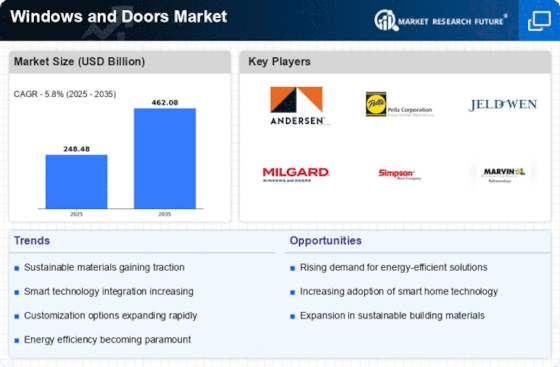
Windows and Doors Market Infographic
Purchase Options

Windows Doors Size

Windows and Doors Market Growth Projections and Opportunities

The windows and doors market is influenced by various market factors that shape its dynamics. One significant factor is the state of the construction industry. As the construction sector thrives, so does the demand for windows and doors. Economic conditions play a crucial role here; during economic booms, more construction projects are initiated, leading to higher demand for windows and doors. Conversely, during economic downturns, construction activity slows down, impacting the market for windows and doors negatively.

Another influential factor is technological advancements. Innovations in materials, manufacturing processes, and design significantly impact the windows and doors market. For instance, the development of energy-efficient windows and doors in response to growing environmental concerns and stringent regulations has been a major trend. Consumers are increasingly seeking products that offer better insulation, durability, and aesthetics, driving manufacturers to invest in research and development to meet these demands.

Moreover, consumer preferences and lifestyle trends also shape the market for windows and doors. For instance, there is a growing trend towards larger windows and doors, which allow more natural light into buildings and create a seamless indoor-outdoor connection. Additionally, there is increasing demand for customizable options, as consumers seek products that reflect their personal style and preferences. This has led to a proliferation of options in terms of materials, finishes, and designs in the market.

Furthermore, government policies and regulations play a significant role in shaping the windows and doors market. Regulations related to building codes, energy efficiency standards, and environmental sustainability impact the types of products that can be used in construction projects. For example, many governments offer incentives or subsidies for the installation of energy-efficient windows and doors, which has driven adoption in both residential and commercial sectors.

Globalization also has an impact on the windows and doors market. With the expansion of international trade, manufacturers have access to a wider range of materials and technologies, allowing them to produce high-quality products at competitive prices. Additionally, globalization has led to increased competition among manufacturers, driving innovation and efficiency in the market.

Lastly, demographic trends influence the demand for windows and doors. For instance, population growth, urbanization, and demographic shifts such as an aging population can all impact the market dynamics. As urbanization accelerates, there is a higher demand for residential and commercial buildings, driving the need for windows and doors. Similarly, an aging population may require products that are more accessible and user-friendly, leading to the development of specialized designs and features.
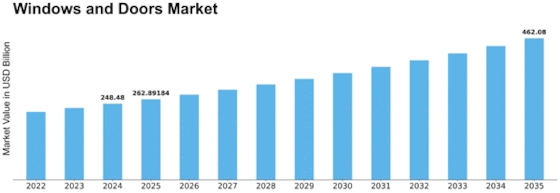

Windows and Doors Market Size Graph
Author
Author Profile
Harshita Gorde
Research Analyst

Harshita Post graduate MBA in Business Administration from Welingkar Institute, Mumbai and 5 years of experience in the field of product market research. As a Research Analyst, I have cross-domain experience in packaging, and industrial Automation & Equipment. I am currently looking after the research process of packaging, logistics & transportation, and industrial automation & equipment at Market Research Future Reports. My responsibilities at the organization involve handling syndicate and custom reports as well as responding to client inquiries, and organize, co-ordinate with a group of 5 to 6 persons to manage all workflows.

Leave a Comment

FAQs

What is the current valuation of the windows and doors market?

<p>The overall market valuation reached 189.5 USD Billion in 2024.</p>

What is the projected market size for the windows and doors market by 2035?

<p>The market is expected to grow to 261.7 USD Billion by 2035.</p>

What is the expected CAGR for the windows and doors market during the forecast period?

<p>The anticipated CAGR for the windows and doors market from 2025 to 2035 is 2.98%.</p>

Which companies are considered key players in the windows and doors market?

<p>Key players include Andersen Corporation, Pella Corporation, Jeld-Wen Holding, Inc., and Marvin Windows and Doors.</p>

What are the primary applications of windows and doors in the market?

<p>The market segments by application include Residential, Commercial, Industrial, and Institutional.</p>

How does the valuation of the residential segment compare to the commercial segment?

<p>In 2024, the residential segment was valued at 75.0 to 105.0 USD Billion, while the commercial segment ranged from 45.0 to 65.0 USD Billion.</p>

What materials are predominantly used in the windows and doors market?

<p>The primary materials include Wood, Vinyl, Aluminum, and Fiberglass, with Vinyl valued at 50.0 to 70.0 USD Billion in 2024.</p>

What types of windows are most popular in the market?

<p>The most popular types include Double-Hung, Sliding, Casement, and Awning windows, with Double-Hung valued at 74.5 to 105.7 USD Billion.</p>

What energy efficiency ratings are available in the windows and doors market?

<p>Energy efficiency ratings are categorized as Low, Medium, High, and Ultra-High, with High rated at 60.0 to 80.0 USD Billion.</p>

What design styles are prevalent in the windows and doors market?

<p>The market features design styles such as Traditional, Modern, Contemporary, and Rustic, with Rustic valued at 54.5 to 76.7 USD Billion.</p>

Market Summary

As per Market Research Future analysis, the Windows and Doors Market Size was estimated at 201.63 USD Billion in 2024. The Windows and Doors industry is projected to grow from 212.7 USD Billion in 2025 to 363.4 USD Billion by 2035, exhibiting a compound annual growth rate (CAGR) of 5.50% during the forecast period 2025 - 2035

Key Market Trends & Highlights

The Windows and Doors Market is experiencing a dynamic shift towards sustainability and technological integration.

  • The North American region remains the largest market for windows and doors, driven by robust construction activities. Asia-Pacific is emerging as the fastest-growing region, fueled by increasing urbanization and infrastructure development. Doors represent the largest segment, while windows are witnessing the fastest growth due to rising demand for energy-efficient solutions. Key market drivers include rising construction activities and stringent energy efficiency regulations, which are shaping consumer preferences.

Market Size & Forecast

2024 Market Size 201.63 (USD Billion)
2035 Market Size 363.4 (USD Billion)
CAGR (2025 - 2035) 5.50%
Largest Regional Market Share in 2024 North America

Major Players

Andersen Corporation, JELD‑WEN Holding, Inc., Pella Corporation, Marvin Windows and Doors, Fenesta Building Systems, Deceuninck Group, YKK AP Inc., Masonite International, Atrium Windows &amp; Doors, and MI Windows &amp; Doors.

Market Trends

The Windows and Doors Market is currently experiencing a dynamic evolution, driven by various factors including technological advancements, changing consumer preferences, and sustainability concerns. As energy efficiency becomes increasingly paramount, manufacturers are innovating to produce products that not only meet but exceed regulatory standards. This shift towards eco-friendly materials and designs appears to resonate with consumers, who are more inclined to invest in solutions that promise long-term savings and environmental benefits. Furthermore, the integration of smart technology into windows and doors is gaining traction, suggesting a potential transformation in how these products are perceived and utilized in residential and commercial spaces. In addition to technological innovations, the Windows and Doors Market is witnessing a growing trend towards customization. Homeowners and builders alike seem to favor tailored solutions that reflect personal style and functional needs. This inclination towards bespoke products may lead to a more competitive landscape, as companies strive to differentiate themselves through unique offerings. Overall, the market appears poised for continued growth, with a focus on sustainability, technology, and customization shaping its future trajectory.

Sustainability Focus

The Windows and Doors Market is increasingly prioritizing sustainability, with manufacturers adopting eco-friendly materials and energy-efficient designs. This trend reflects a broader societal shift towards environmental responsibility, as consumers seek products that minimize their carbon footprint.

Smart Technology Integration

The incorporation of smart technology into windows and doors is becoming more prevalent, enhancing functionality and convenience. Features such as automated opening mechanisms and integrated security systems are appealing to tech-savvy consumers, indicating a shift in market dynamics.

Customization and Personalization

There is a notable trend towards customization in the Windows and Doors Market, as consumers desire products that align with their individual tastes and requirements. This demand for personalized solutions is prompting manufacturers to offer a wider array of options, fostering a competitive environment.

Windows and Doors Market Market Drivers

Technological Advancements

Technological advancements play a pivotal role in shaping the Windows and Doors Market. Innovations such as smart windows, which can adjust their tint based on sunlight exposure, and automated door systems are gaining traction among consumers. These technologies not only enhance convenience but also improve energy efficiency, aligning with the growing demand for smart home solutions. The integration of IoT devices in windows and doors allows for remote monitoring and control, appealing to tech-savvy homeowners. Market analysis indicates that the smart window segment is expected to grow at a compound annual growth rate of over 10% in the coming years. As these technologies become more mainstream, the Windows and Doors Market is likely to experience a significant transformation, driven by consumer preferences for modern, high-tech solutions.

Energy Efficiency Regulations

The Windows and Doors Market is increasingly influenced by stringent energy efficiency regulations imposed by governments worldwide. These regulations aim to reduce energy consumption and greenhouse gas emissions, prompting manufacturers to innovate and produce energy-efficient products. For instance, the implementation of energy performance standards has led to a rise in demand for double-glazed and triple-glazed windows, which offer superior insulation. Market data suggests that energy-efficient windows can reduce heating and cooling costs by up to 30%, making them an attractive option for consumers. As awareness of environmental issues grows, the Windows and Doors Market is likely to see a continued shift towards products that comply with these regulations, thereby enhancing market growth and sustainability.

Rising Construction Activities

The Windows and Doors Market experiences a notable boost due to the increasing construction activities across various sectors. As urbanization continues to expand, the demand for residential and commercial buildings rises, leading to a heightened need for windows and doors. In recent years, construction spending has shown a steady upward trend, with estimates indicating a growth rate of approximately 4.5% annually. This surge in construction not only drives the demand for new installations but also stimulates the replacement market, as older buildings require updated windows and doors to meet modern standards. Consequently, the Windows and Doors Market is poised to benefit significantly from this ongoing construction boom, as builders and homeowners alike seek quality products that enhance aesthetics and energy efficiency.

Aesthetic Trends and Customization

The Windows and Doors Market is significantly influenced by evolving aesthetic trends and the growing demand for customization. Homeowners increasingly seek products that not only serve functional purposes but also enhance the visual appeal of their properties. This trend has led to a rise in demand for customizable windows and doors, allowing consumers to select materials, colors, and designs that reflect their personal style. Market data indicates that the customization segment is projected to grow by approximately 6% annually, as more consumers prioritize unique and tailored solutions. Additionally, the influence of architectural styles on window and door designs further drives this trend, as homeowners aim to achieve cohesive aesthetics. Consequently, the Windows and Doors Market is adapting to these preferences, offering a wider range of customizable options to meet consumer demands.

Renovation and Remodeling Activities

The Windows and Doors Market is experiencing a surge in demand driven by increased renovation and remodeling activities. As homeowners invest in upgrading their living spaces, the need for modern, energy-efficient windows and doors becomes paramount. Recent data suggests that the home improvement market has expanded significantly, with renovations accounting for a substantial portion of overall construction spending. This trend is particularly evident in older homes, where outdated windows and doors are replaced to enhance energy efficiency and aesthetic appeal. The Windows and Doors Market stands to benefit from this renovation boom, as consumers seek high-quality products that not only improve functionality but also add value to their properties. As the trend towards home improvement continues, the market is likely to see sustained growth in the coming years.

Market Segment Insights

By Application: Residential (Largest) vs. Commercial (Fastest-Growing)

<p>The windows and doors market is significantly divided among different application segments, with residential structures taking the lead in market share. Residential applications are emphasized due to the ongoing trends in home renovations and new builds, making them a primary focus for manufacturers and suppliers. Meanwhile, the commercial segment is gaining momentum, driven by the expansion of office spaces, retail environments, and institutional buildings, thus showcasing a competitive market landscape. In terms of growth patterns, the residential segment continues to flourish as homeowners look to enhance energy efficiency and aesthetics. The commercial segment, however, is emerging as the fastest-growing area, spurred by increasing urbanization and demand for modern office designs. Advancements in window and door technologies contribute to sustainability, appealing to both sectors and driving overall market growth.</p>

<p>Residential (Dominant) vs. Industrial (Emerging)</p>

<p>In the windows and doors market, the residential segment dominates, characterized by a wide range of style and design options appealing to homeowners. This sector prioritizes customization and energy efficiency, making it a favorable choice for property enhancement. Conversely, the industrial segment is categorized as an emerging sector, making headway with manufacturers focusing on durability and functionality in their products. As industrial facilities increasingly prioritize energy savings and sustainability, tailored solutions in windows and doors are gaining traction. The construction of industrial plants often demands robust and specialized door systems, thereby allowing the industrial application to slowly carve a niche in the overall market.</p>

By Material: Wood (Largest) vs. Vinyl (Fastest-Growing)

<p>In the windows and doors market, the material segment reflects a diverse distribution among wood, vinyl, aluminum, and fiberglass. Wood has maintained its position as the largest share due to its classic aesthetic appeal and traditional usage in residential buildings. While aluminum and fiberglass hold their ground in specialized applications, it's vinyl that has rapidly gained traction over the past few years, appealing to modern consumers looking for energy efficiency and affordability.</p>

<p>Vinyl (Dominant) vs. Aluminum (Emerging)</p>

<p>Vinyl windows and doors dominate the material segment due to their versatility, energy efficiency, and low maintenance requirements, making them a favored choice among homeowners and builders alike. Meanwhile, aluminum has emerged as a notable candidate, gaining popularity for its strength and sleek profile. Its lightweight nature allows for larger window designs and innovative architectural solutions. While vinyl stands strong in insulation and cost-effectiveness, aluminum is carving out a space in high-end markets, where aesthetics and durability are paramount.</p>

By Type: Sliding (Largest) vs. Casement (Fastest-Growing)

<p>In the windows and doors market, the distribution of market share among different types is quite varied. Sliding doors and windows currently hold the largest share due to their increasing preference among consumers for seamless integration with outdoor spaces. Other types, such as casement windows, also play significant roles as they offer excellent ventilation and unobstructed views, thus carving out their place in this competitive market. Awning and double-hung styles maintain a steady presence, appealing to specific customer needs and aesthetic tastes. Analyzing growth trends, casement windows emerge as the fastest-growing segment in the market. This growth is driven by shifts in consumer preferences towards energy efficiency, design flexibility, and increased durability. Innovations in materials and manufacturing processes also contribute, making casement styles more appealing. Meanwhile, sliding doors successfully capture the market's attention by enhancing aesthetic value and functionality, leading to their sustained market dominance.</p>

<p>Sliding (Dominant) vs. Awning (Emerging)</p>

<p>Sliding doors represent a dominant force in the windows and doors market due to their exceptional space-saving design and versatility in modern architectural styles. They offer broad views and easy access to outdoor areas, appealing to homeowners seeking to maximize natural light. On the other hand, awning windows are emerging as a popular choice, particularly in homes designed for optimal ventilation and aesthetic appeal. Their design allows for superior airflow, even during rainy weather, sealing tightly when closed to enhance energy efficiency. As consumer demand shifts towards functional designs that enhance living spaces, both sliding and awning types stand out for their unique benefits and contribution to today's residential architecture.</p>

By Energy Efficiency Rating: High (Largest) vs. Ultra-High (Fastest-Growing)

<p>In the windows and doors market, the energy efficiency rating segments exhibit a clear distribution where 'High' efficiency rated products currently dominate consumer preference, owing to increased awareness regarding energy costs and sustainability. Following closely is the 'Ultra-High' category, which, although smaller in overall market share, is gaining momentum rapidly as consumers shift toward greener, more efficient alternatives for home and commercial spaces. Growth in this segment is driven by stringent building regulations and enhanced consumer knowledge about energy savings. Manufacturers are innovating to improve efficiency ratings, with the 'Ultra-High' segment being propelled by advances in technology and materials that enhance thermal performance and reduce energy loss. This shift represents a critical evolution in consumer habits, favoring products that provide long-term savings and environmental benefits.</p>

<p>High (Dominant) vs. Medium (Emerging)</p>

<p>The 'High' energy efficiency rating is currently the dominant segment in the windows and doors market, offering superior insulation and performance, appealing to environmentally conscious consumers and builders aiming to meet high standards. This segment’s widespread acceptance is attributed to established technology that balances cost and efficiency, making it a preferred choice for homeowners. Conversely, the 'Medium' efficiency category is emerging, signaling a shift towards more affordable options that still provide reasonable energy savings. While it lacks the advanced features of 'High' rated products, the 'Medium' segment attracts budget-conscious consumers or those in regions with milder climates. Understanding the characteristics and positions of these segments is crucial for manufacturers to strategize their product offerings effectively.</p>

By Design Style: Traditional (Largest) vs. Modern (Fastest-Growing)

<p>In the windows and doors market, the design style segment is characterized by a diverse range of aesthetic preferences, with Traditional styles holding the largest market share due to their timeless appeal and widespread acceptance among homeowners. However, Modern styles are rapidly gaining traction, appealing to consumers who prioritize sleek lines and minimalism. Together, these segments significantly influence purchasing decisions, shaping the overall landscape of the market.</p>

<p>Traditional (Dominant) vs. Modern (Emerging)</p>

<p>Traditional design style remains a dominant force in the windows and doors market, attracting consumers with its classic appeal and compatibility with a variety of architectural styles. Traditional windows and doors often feature ornate details and craftsmanship that resonate with historical aesthetics. On the other hand, Modern design is identified as an emerging segment driven by a younger demographic seeking innovative designs, energy efficiency, and functionality. Modern entries emphasize expansive glass features and straightforward lines, offering a blend of style and practicality. As preferences shift, the competition between these styles continues to evolve, making adaptability vital for manufacturers.</p>

Get more detailed insights about Windows and Doors Market Research Report—Global Forecast till 2035

Regional Insights

North America : Market Leader in Innovation

North America is the largest market for windows and doors, holding approximately 40% of the global market share. Key growth drivers include a booming construction sector, increasing demand for energy-efficient products, and favorable government regulations promoting sustainable building practices. The U.S. is the largest contributor, followed by Canada, which together account for a significant portion of the market share. The competitive landscape is dominated by major players such as Andersen Corporation, Pella Corporation, and Jeld-Wen Holding, Inc. These companies are focusing on innovation and sustainability to meet consumer demands. The presence of established brands and a robust distribution network further enhance market growth. The region is also witnessing a trend towards smart home technologies, which is expected to drive future demand.

Europe : Sustainable Building Practices

Europe is witnessing a significant transformation in the windows and doors market, driven by stringent regulations aimed at enhancing energy efficiency and sustainability. The region holds approximately 30% of the global market share, with Germany and the UK being the largest markets. Regulatory catalysts, such as the EU's Green Deal, are pushing manufacturers to innovate and adopt eco-friendly practices, thereby boosting demand for high-performance products. Leading countries like Germany, France, and the UK are home to key players such as Velux Group and Jeld-Wen. The competitive landscape is characterized by a mix of established brands and emerging companies focusing on sustainable solutions. The market is also seeing increased investment in R&D to develop advanced materials and technologies, ensuring compliance with evolving regulations and consumer preferences.

Asia-Pacific : Emerging Market Potential

Asia-Pacific is rapidly emerging as a significant player in the windows and doors market, holding approximately 25% of the global market share. The region's growth is primarily driven by rapid urbanization, increasing disposable incomes, and a growing middle class. Countries like China and India are leading this growth, with substantial investments in infrastructure and residential projects, which are expected to further boost demand for windows and doors. China is the largest market in the region, followed by India and Japan. The competitive landscape features both local and international players, with companies focusing on affordability and innovation. The presence of key players such as Jeld-Wen and Andersen Corporation is notable, as they adapt their offerings to meet the diverse needs of the region's consumers. The market is also witnessing a shift towards energy-efficient products, aligning with global sustainability trends.

Middle East and Africa : Untapped Market Opportunities

The Middle East and Africa region is gradually emerging in the windows and doors market, currently holding about 5% of the global market share. The growth is primarily driven by large-scale infrastructure projects and urban development initiatives, particularly in countries like the UAE and South Africa. Government investments in housing and commercial projects are acting as catalysts for market expansion, creating a demand for high-quality windows and doors. Leading countries in this region include the UAE, South Africa, and Saudi Arabia, where the competitive landscape is characterized by a mix of local and international manufacturers. Key players are increasingly focusing on customization and quality to cater to the unique demands of the market. The region's potential for growth is significant, as urbanization and economic development continue to rise, presenting opportunities for both established and new entrants in the market.

Key Players and Competitive Insights

Leading market players are investing heavily in research and development in order to expand their product lines, which will help the Windows and doors market, grow even more. Market participants are also undertaking a variety of strategic activities to expand their global footprint, with important market developments including new product launches, contractual agreements, mergers and acquisitions, higher investments, and collaboration with other organizations. To expand and survive in a more competitive and rising market climate, Windows and doors industry must offer cost-effective items.Manufacturing locally to minimize operational costs is one of the key business tactics used by manufacturers in the global Windows and doors industry to benefit clients and increase the market sector. In recent years, the Windows and doors industry has offered some of the most significant advantages to medicine.Major players in the Windows and doors market, including Sanwa Holdings Corporation (Horton Automatics Inc,), YKK Corporation, JELD-WEN Holding, Inc., Marvin, MI Windows and Doors Market, LLC., DCM Shriram Ltd. (Fenesta Building System)s, Pella Corporation, LIXIL Corporation, Cornerstone Building Brands, Inc. (Atrium Corporation), Andersen Corporation and others, are attempting to increase market demand by investing in research and development operations.Products are produced by the company JELD-WEN Holding Inc (JELD-WEN) for both interior and exterior building. The company designs, manufactures, and sells a wide range of interior and exterior products made of wood, metal, and composite materials. Its product portfolio also includes doors, wood, vinyl, and aluminum windows in addition to other items for new construction, remodeling, and repair of both houses and non-residential constructions. Under the JELD-WEN brand names, which also include Swedoor, DANA, Corinthian, Stegbar, Breezeway, and Trend, the company sells its products. In addition, JELD-WEN offers glass, stairs, trim board, cabinets, screens, moldings, lumber, and shower enclosures.The company distributes its products through a number of channels, including direct building product dealers, wholesale distributors, and retail home stores. It offers products to clients, contractors, and home builders. It runs businesses in North America, Europe, and Australasia. The JELD-WEN corporate office is located in Charlotte, North Carolina, in the US.Windows and door systems are produced and supplied by Pella Corp (Pella). Windows, patio doors, entry door systems, garage doors, and storm doors are among the company's product offerings. It offers doors made of fiberglass, glass, steel, and wood. Pella offers windows and doors with integrated security sensors that can be managed from inside the home. The business provides financing services, in-home consultations, and replacement services. The Pella, Architect Series, Designer Series, Pella ProLine, Pella Impervia, and Encompass by Pella brands are used to sell the company's products. The business is active in both the US and Canada.The US city of Pella, Iowa, is home to Pella.

Key Companies in the Windows and Doors Market include

Industry Developments

In March of 2023, Marvin, a leading brand in the windows and doors sector, initiated the sale of Elevate Bi-Fold doors for outdoor use. Such aspects pertaining to folding doors are fueling the demand for folding doors.

Likewise, Fenesta Building System, an important door manufacturer, also in August 2020 launched aluminum window and door systems that encompass all the application requirements of retail and institutional clients.

In January 2025, ASSA ABLOY purchased 3millID and Third Millennium, which both specialize in physical access control readers and credentials. 3millID is located in the US and Third Millennium is situated in the United Kingdom. This purchase is likely to solidify ASSA ABLOY's standing in the physical access control market and diversify its technologies.

 In December 2024, ASSA ABLOY purchased Premier Steel Doors and Frames, a US company that focuses on designing and manufacturing hollow metal doors and frames, building metal doors, aluminum windows and metal building structures. This purchase, made on, represents a new strategic direction for ASSA ABLOY to expand its product lines and improve brand visibility, especially in the southern regions of the United States.

In September 2023 - Pella has recently launched its popular Hidden Screen product on the Lifestyle Series Wood Windows, which can exclusively be purchased at Lowe's, the sole vendor for Pella's Hidden Screen. The Lifestyle series double-hung wood windows with Hidden screens are now available at over 1700 Lowe's stores and on Lowes.com. 

In May 2024, YKK AP Inc. and Kandenko Co., Ltd. entered into a commercial partnership for the purpose of improving Building Integrated Photovoltaics (BIPV). The collaboration aims to develop energy solutions for walls and windows of commercial buildings with an emphasis on carbon neutrality. The scope of the agreement will cover demonstrational testing with perovskite solar cells and several other technologies.

In March 2023, Fenesta, an Indian manufacturer of doors and windows, inaugurated G Interiors, a franchisee showroom located at Kadapa in Andhra Pradesh. The store features an array of products, including uPVC and aluminum windows and doors, as well as interior and designer doors. With this initiative, Fenesta has expanded its presence beyond 350 outlets.

Future Outlook

Windows and Doors Market Future Outlook

The Windows and Doors Market is projected to grow at a 5.50% CAGR from 2025 to 2035, driven by urbanization, energy efficiency demands, and technological advancements.

New opportunities lie in:

  • <p>Expansion into <a href="https://www.marketresearchfuture.com/reports/smart-window-market-9595" target="_blank" title="smart window">smart window</a> technologies for energy management. Development of eco-friendly materials for sustainable construction. Implementation of automated manufacturing processes to reduce costs.</p>

By 2035, the market is expected to achieve robust growth, driven by innovation and sustainability.

Market Segmentation

Windows and Doors Market Product Outlook

  • Doors
  • Windows

Windows and Doors Market End User Outlook

  • Residential
  • Non-residential

Windows and Doors Market Material Outlook

  • Wood
  • Metal
  • Plastic

Windows and Doors Market Application Outlook

  • Swinging
  • Sliding
  • Folding
  • Revolving
  • Others

Report Scope

MARKET SIZE 2024 201.63 (USD Billion)
MARKET SIZE 2025 212.7 (USD Billion)
MARKET SIZE 2035 363.4 (USD Billion)
COMPOUND ANNUAL GROWTH RATE (CAGR) 5.50% (2025 - 2035)
REPORT COVERAGE Revenue Forecast, Competitive Landscape, Growth Factors, and Trends
BASE YEAR 2024
Market Forecast Period 2025 - 2035
Historical Data 2019 - 2024
Market Forecast Units USD Billion
Key Companies Profiled Andersen Corporation, JELD‑WEN Holding, Inc., Pella Corporation, Marvin Windows and Doors, Fenesta Building Systems, Deceuninck Group, YKK AP Inc., Masonite International, Atrium Windows & Doors, and MI Windows & Doors.
Segments Covered Product, Application, End User, Material, Region
Key Market Opportunities Integration of smart technology in the Windows and Doors Market enhances energy efficiency and consumer convenience.
Key Market Dynamics Rising demand for energy-efficient solutions drives innovation and competition in the Windows and Doors Market.
Countries Covered North America, Europe, APAC, South America, MEA

FAQs

What is the current valuation of the windows and doors market?

<p>The overall market valuation reached 189.5 USD Billion in 2024.</p>

What is the projected market size for the windows and doors market by 2035?

<p>The market is expected to grow to 261.7 USD Billion by 2035.</p>

What is the expected CAGR for the windows and doors market during the forecast period?

<p>The anticipated CAGR for the windows and doors market from 2025 to 2035 is 2.98%.</p>

Which companies are considered key players in the windows and doors market?

<p>Key players include Andersen Corporation, Pella Corporation, Jeld-Wen Holding, Inc., and Marvin Windows and Doors.</p>

What are the primary applications of windows and doors in the market?

<p>The market segments by application include Residential, Commercial, Industrial, and Institutional.</p>

How does the valuation of the residential segment compare to the commercial segment?

<p>In 2024, the residential segment was valued at 75.0 to 105.0 USD Billion, while the commercial segment ranged from 45.0 to 65.0 USD Billion.</p>

What materials are predominantly used in the windows and doors market?

<p>The primary materials include Wood, Vinyl, Aluminum, and Fiberglass, with Vinyl valued at 50.0 to 70.0 USD Billion in 2024.</p>

What types of windows are most popular in the market?

<p>The most popular types include Double-Hung, Sliding, Casement, and Awning windows, with Double-Hung valued at 74.5 to 105.7 USD Billion.</p>

What energy efficiency ratings are available in the windows and doors market?

<p>Energy efficiency ratings are categorized as Low, Medium, High, and Ultra-High, with High rated at 60.0 to 80.0 USD Billion.</p>

What design styles are prevalent in the windows and doors market?

<p>The market features design styles such as Traditional, Modern, Contemporary, and Rustic, with Rustic valued at 54.5 to 76.7 USD Billion.</p>

  1. SECTION I: EXECUTIVE SUMMARY AND KEY HIGHLIGHTS
    1. | 1.1 EXECUTIVE SUMMARY
    2. | | 1.1.1 Market Overview
    3. | | 1.1.2 Key Findings
    4. | | 1.1.3 Market Segmentation
    5. | | 1.1.4 Competitive Landscape
    6. | | 1.1.5 Challenges and Opportunities
    7. | | 1.1.6 Future Outlook
  2. SECTION II: SCOPING, METHODOLOGY AND MARKET STRUCTURE
    1. | 2.1 MARKET INTRODUCTION
    2. | | 2.1.1 Definition
    3. | | 2.1.2 Scope of the study
    4. | | | 2.1.2.1 Research Objective
    5. | | | 2.1.2.2 Assumption
    6. | | | 2.1.2.3 Limitations
    7. | 2.2 RESEARCH METHODOLOGY
    8. | | 2.2.1 Overview
    9. | | 2.2.2 Data Mining
    10. | | 2.2.3 Secondary Research
    11. | | 2.2.4 Primary Research
    12. | | | 2.2.4.1 Primary Interviews and Information Gathering Process
    13. | | | 2.2.4.2 Breakdown of Primary Respondents
    14. | | 2.2.5 Forecasting Model
    15. | | 2.2.6 Market Size Estimation
    16. | | | 2.2.6.1 Bottom-Up Approach
    17. | | | 2.2.6.2 Top-Down Approach
    18. | | 2.2.7 Data Triangulation
    19. | | 2.2.8 Validation
  3. SECTION III: QUALITATIVE ANALYSIS
    1. | 3.1 MARKET DYNAMICS
    2. | | 3.1.1 Overview
    3. | | 3.1.2 Drivers
    4. | | 3.1.3 Restraints
    5. | | 3.1.4 Opportunities
    6. | 3.2 MARKET FACTOR ANALYSIS
    7. | | 3.2.1 Value chain Analysis
    8. | | 3.2.2 Porter's Five Forces Analysis
    9. | | | 3.2.2.1 Bargaining Power of Suppliers
    10. | | | 3.2.2.2 Bargaining Power of Buyers
    11. | | | 3.2.2.3 Threat of New Entrants
    12. | | | 3.2.2.4 Threat of Substitutes
    13. | | | 3.2.2.5 Intensity of Rivalry
    14. | | 3.2.3 COVID-19 Impact Analysis
    15. | | | 3.2.3.1 Market Impact Analysis
    16. | | | 3.2.3.2 Regional Impact
    17. | | | 3.2.3.3 Opportunity and Threat Analysis
  4. SECTION IV: QUANTITATIVE ANALYSIS
    1. | 4.1 Packaging & Transport, BY Application (USD Billion)
    2. | | 4.1.1 Residential
    3. | | 4.1.2 Commercial
    4. | | 4.1.3 Industrial
    5. | | 4.1.4 Institutional
    6. | 4.2 Packaging & Transport, BY Material (USD Billion)
    7. | | 4.2.1 Wood
    8. | | 4.2.2 Vinyl
    9. | | 4.2.3 Aluminum
    10. | | 4.2.4 Fiberglass
    11. | 4.3 Packaging & Transport, BY Type (USD Billion)
    12. | | 4.3.1 Sliding
    13. | | 4.3.2 Casement
    14. | | 4.3.3 Awning
    15. | | 4.3.4 Double-Hung
    16. | 4.4 Packaging & Transport, BY Energy Efficiency Rating (USD Billion)
    17. | | 4.4.1 Low
    18. | | 4.4.2 Medium
    19. | | 4.4.3 High
    20. | | 4.4.4 Ultra-High
    21. | 4.5 Packaging & Transport, BY Design Style (USD Billion)
    22. | | 4.5.1 Traditional
    23. | | 4.5.2 Modern
    24. | | 4.5.3 Contemporary
    25. | | 4.5.4 Rustic
    26. | 4.6 Packaging & Transport, BY Region (USD Billion)
    27. | | 4.6.1 North America
    28. | | | 4.6.1.1 US
    29. | | | 4.6.1.2 Canada
    30. | | 4.6.2 Europe
    31. | | | 4.6.2.1 Germany
    32. | | | 4.6.2.2 UK
    33. | | | 4.6.2.3 France
    34. | | | 4.6.2.4 Russia
    35. | | | 4.6.2.5 Italy
    36. | | | 4.6.2.6 Spain
    37. | | | 4.6.2.7 Rest of Europe
    38. | | 4.6.3 APAC
    39. | | | 4.6.3.1 China
    40. | | | 4.6.3.2 India
    41. | | | 4.6.3.3 Japan
    42. | | | 4.6.3.4 South Korea
    43. | | | 4.6.3.5 Malaysia
    44. | | | 4.6.3.6 Thailand
    45. | | | 4.6.3.7 Indonesia
    46. | | | 4.6.3.8 Rest of APAC
    47. | | 4.6.4 South America
    48. | | | 4.6.4.1 Brazil
    49. | | | 4.6.4.2 Mexico
    50. | | | 4.6.4.3 Argentina
    51. | | | 4.6.4.4 Rest of South America
    52. | | 4.6.5 MEA
    53. | | | 4.6.5.1 GCC Countries
    54. | | | 4.6.5.2 South Africa
    55. | | | 4.6.5.3 Rest of MEA
  5. SECTION V: COMPETITIVE ANALYSIS
    1. | 5.1 Competitive Landscape
    2. | | 5.1.1 Overview
    3. | | 5.1.2 Competitive Analysis
    4. | | 5.1.3 Market share Analysis
    5. | | 5.1.4 Major Growth Strategy in the Packaging & Transport
    6. | | 5.1.5 Competitive Benchmarking
    7. | | 5.1.6 Leading Players in Terms of Number of Developments in the Packaging & Transport
    8. | | 5.1.7 Key developments and growth strategies
    9. | | | 5.1.7.1 New Product Launch/Service Deployment
    10. | | | 5.1.7.2 Merger & Acquisitions
    11. | | | 5.1.7.3 Joint Ventures
    12. | | 5.1.8 Major Players Financial Matrix
    13. | | | 5.1.8.1 Sales and Operating Income
    14. | | | 5.1.8.2 Major Players R&D Expenditure. 2023
    15. | 5.2 Company Profiles
    16. | | 5.2.1 Andersen Corporation (US)
    17. | | | 5.2.1.1 Financial Overview
    18. | | | 5.2.1.2 Products Offered
    19. | | | 5.2.1.3 Key Developments
    20. | | | 5.2.1.4 SWOT Analysis
    21. | | | 5.2.1.5 Key Strategies
    22. | | 5.2.2 Pella Corporation (US)
    23. | | | 5.2.2.1 Financial Overview
    24. | | | 5.2.2.2 Products Offered
    25. | | | 5.2.2.3 Key Developments
    26. | | | 5.2.2.4 SWOT Analysis
    27. | | | 5.2.2.5 Key Strategies
    28. | | 5.2.3 Jeld-Wen Holding, Inc. (US)
    29. | | | 5.2.3.1 Financial Overview
    30. | | | 5.2.3.2 Products Offered
    31. | | | 5.2.3.3 Key Developments
    32. | | | 5.2.3.4 SWOT Analysis
    33. | | | 5.2.3.5 Key Strategies
    34. | | 5.2.4 Milgard Windows & Doors (US)
    35. | | | 5.2.4.1 Financial Overview
    36. | | | 5.2.4.2 Products Offered
    37. | | | 5.2.4.3 Key Developments
    38. | | | 5.2.4.4 SWOT Analysis
    39. | | | 5.2.4.5 Key Strategies
    40. | | 5.2.5 Simonton Windows (US)
    41. | | | 5.2.5.1 Financial Overview
    42. | | | 5.2.5.2 Products Offered
    43. | | | 5.2.5.3 Key Developments
    44. | | | 5.2.5.4 SWOT Analysis
    45. | | | 5.2.5.5 Key Strategies
    46. | | 5.2.6 Marvin Windows and Doors (US)
    47. | | | 5.2.6.1 Financial Overview
    48. | | | 5.2.6.2 Products Offered
    49. | | | 5.2.6.3 Key Developments
    50. | | | 5.2.6.4 SWOT Analysis
    51. | | | 5.2.6.5 Key Strategies
    52. | | 5.2.7 Therma-Tru Doors (US)
    53. | | | 5.2.7.1 Financial Overview
    54. | | | 5.2.7.2 Products Offered
    55. | | | 5.2.7.3 Key Developments
    56. | | | 5.2.7.4 SWOT Analysis
    57. | | | 5.2.7.5 Key Strategies
    58. | | 5.2.8 Atrium Windows and Doors (US)
    59. | | | 5.2.8.1 Financial Overview
    60. | | | 5.2.8.2 Products Offered
    61. | | | 5.2.8.3 Key Developments
    62. | | | 5.2.8.4 SWOT Analysis
    63. | | | 5.2.8.5 Key Strategies
    64. | | 5.2.9 Velux Group (DK)
    65. | | | 5.2.9.1 Financial Overview
    66. | | | 5.2.9.2 Products Offered
    67. | | | 5.2.9.3 Key Developments
    68. | | | 5.2.9.4 SWOT Analysis
    69. | | | 5.2.9.5 Key Strategies
    70. | 5.3 Appendix
    71. | | 5.3.1 References
    72. | | 5.3.2 Related Reports
  6. LIST OF FIGURES
    1. | 6.1 MARKET SYNOPSIS
    2. | 6.2 NORTH AMERICA MARKET ANALYSIS
    3. | 6.3 US MARKET ANALYSIS BY APPLICATION
    4. | 6.4 US MARKET ANALYSIS BY MATERIAL
    5. | 6.5 US MARKET ANALYSIS BY TYPE
    6. | 6.6 US MARKET ANALYSIS BY ENERGY EFFICIENCY RATING
    7. | 6.7 US MARKET ANALYSIS BY DESIGN STYLE
    8. | 6.8 CANADA MARKET ANALYSIS BY APPLICATION
    9. | 6.9 CANADA MARKET ANALYSIS BY MATERIAL
    10. | 6.10 CANADA MARKET ANALYSIS BY TYPE
    11. | 6.11 CANADA MARKET ANALYSIS BY ENERGY EFFICIENCY RATING
    12. | 6.12 CANADA MARKET ANALYSIS BY DESIGN STYLE
    13. | 6.13 EUROPE MARKET ANALYSIS
    14. | 6.14 GERMANY MARKET ANALYSIS BY APPLICATION
    15. | 6.15 GERMANY MARKET ANALYSIS BY MATERIAL
    16. | 6.16 GERMANY MARKET ANALYSIS BY TYPE
    17. | 6.17 GERMANY MARKET ANALYSIS BY ENERGY EFFICIENCY RATING
    18. | 6.18 GERMANY MARKET ANALYSIS BY DESIGN STYLE
    19. | 6.19 UK MARKET ANALYSIS BY APPLICATION
    20. | 6.20 UK MARKET ANALYSIS BY MATERIAL
    21. | 6.21 UK MARKET ANALYSIS BY TYPE
    22. | 6.22 UK MARKET ANALYSIS BY ENERGY EFFICIENCY RATING
    23. | 6.23 UK MARKET ANALYSIS BY DESIGN STYLE
    24. | 6.24 FRANCE MARKET ANALYSIS BY APPLICATION
    25. | 6.25 FRANCE MARKET ANALYSIS BY MATERIAL
    26. | 6.26 FRANCE MARKET ANALYSIS BY TYPE
    27. | 6.27 FRANCE MARKET ANALYSIS BY ENERGY EFFICIENCY RATING
    28. | 6.28 FRANCE MARKET ANALYSIS BY DESIGN STYLE
    29. | 6.29 RUSSIA MARKET ANALYSIS BY APPLICATION
    30. | 6.30 RUSSIA MARKET ANALYSIS BY MATERIAL
    31. | 6.31 RUSSIA MARKET ANALYSIS BY TYPE
    32. | 6.32 RUSSIA MARKET ANALYSIS BY ENERGY EFFICIENCY RATING
    33. | 6.33 RUSSIA MARKET ANALYSIS BY DESIGN STYLE
    34. | 6.34 ITALY MARKET ANALYSIS BY APPLICATION
    35. | 6.35 ITALY MARKET ANALYSIS BY MATERIAL
    36. | 6.36 ITALY MARKET ANALYSIS BY TYPE
    37. | 6.37 ITALY MARKET ANALYSIS BY ENERGY EFFICIENCY RATING
    38. | 6.38 ITALY MARKET ANALYSIS BY DESIGN STYLE
    39. | 6.39 SPAIN MARKET ANALYSIS BY APPLICATION
    40. | 6.40 SPAIN MARKET ANALYSIS BY MATERIAL
    41. | 6.41 SPAIN MARKET ANALYSIS BY TYPE
    42. | 6.42 SPAIN MARKET ANALYSIS BY ENERGY EFFICIENCY RATING
    43. | 6.43 SPAIN MARKET ANALYSIS BY DESIGN STYLE
    44. | 6.44 REST OF EUROPE MARKET ANALYSIS BY APPLICATION
    45. | 6.45 REST OF EUROPE MARKET ANALYSIS BY MATERIAL
    46. | 6.46 REST OF EUROPE MARKET ANALYSIS BY TYPE
    47. | 6.47 REST OF EUROPE MARKET ANALYSIS BY ENERGY EFFICIENCY RATING
    48. | 6.48 REST OF EUROPE MARKET ANALYSIS BY DESIGN STYLE
    49. | 6.49 APAC MARKET ANALYSIS
    50. | 6.50 CHINA MARKET ANALYSIS BY APPLICATION
    51. | 6.51 CHINA MARKET ANALYSIS BY MATERIAL
    52. | 6.52 CHINA MARKET ANALYSIS BY TYPE
    53. | 6.53 CHINA MARKET ANALYSIS BY ENERGY EFFICIENCY RATING
    54. | 6.54 CHINA MARKET ANALYSIS BY DESIGN STYLE
    55. | 6.55 INDIA MARKET ANALYSIS BY APPLICATION
    56. | 6.56 INDIA MARKET ANALYSIS BY MATERIAL
    57. | 6.57 INDIA MARKET ANALYSIS BY TYPE
    58. | 6.58 INDIA MARKET ANALYSIS BY ENERGY EFFICIENCY RATING
    59. | 6.59 INDIA MARKET ANALYSIS BY DESIGN STYLE
    60. | 6.60 JAPAN MARKET ANALYSIS BY APPLICATION
    61. | 6.61 JAPAN MARKET ANALYSIS BY MATERIAL
    62. | 6.62 JAPAN MARKET ANALYSIS BY TYPE
    63. | 6.63 JAPAN MARKET ANALYSIS BY ENERGY EFFICIENCY RATING
    64. | 6.64 JAPAN MARKET ANALYSIS BY DESIGN STYLE
    65. | 6.65 SOUTH KOREA MARKET ANALYSIS BY APPLICATION
    66. | 6.66 SOUTH KOREA MARKET ANALYSIS BY MATERIAL
    67. | 6.67 SOUTH KOREA MARKET ANALYSIS BY TYPE
    68. | 6.68 SOUTH KOREA MARKET ANALYSIS BY ENERGY EFFICIENCY RATING
    69. | 6.69 SOUTH KOREA MARKET ANALYSIS BY DESIGN STYLE
    70. | 6.70 MALAYSIA MARKET ANALYSIS BY APPLICATION
    71. | 6.71 MALAYSIA MARKET ANALYSIS BY MATERIAL
    72. | 6.72 MALAYSIA MARKET ANALYSIS BY TYPE
    73. | 6.73 MALAYSIA MARKET ANALYSIS BY ENERGY EFFICIENCY RATING
    74. | 6.74 MALAYSIA MARKET ANALYSIS BY DESIGN STYLE
    75. | 6.75 THAILAND MARKET ANALYSIS BY APPLICATION
    76. | 6.76 THAILAND MARKET ANALYSIS BY MATERIAL
    77. | 6.77 THAILAND MARKET ANALYSIS BY TYPE
    78. | 6.78 THAILAND MARKET ANALYSIS BY ENERGY EFFICIENCY RATING
    79. | 6.79 THAILAND MARKET ANALYSIS BY DESIGN STYLE
    80. | 6.80 INDONESIA MARKET ANALYSIS BY APPLICATION
    81. | 6.81 INDONESIA MARKET ANALYSIS BY MATERIAL
    82. | 6.82 INDONESIA MARKET ANALYSIS BY TYPE
    83. | 6.83 INDONESIA MARKET ANALYSIS BY ENERGY EFFICIENCY RATING
    84. | 6.84 INDONESIA MARKET ANALYSIS BY DESIGN STYLE
    85. | 6.85 REST OF APAC MARKET ANALYSIS BY APPLICATION
    86. | 6.86 REST OF APAC MARKET ANALYSIS BY MATERIAL
    87. | 6.87 REST OF APAC MARKET ANALYSIS BY TYPE
    88. | 6.88 REST OF APAC MARKET ANALYSIS BY ENERGY EFFICIENCY RATING
    89. | 6.89 REST OF APAC MARKET ANALYSIS BY DESIGN STYLE
    90. | 6.90 SOUTH AMERICA MARKET ANALYSIS
    91. | 6.91 BRAZIL MARKET ANALYSIS BY APPLICATION
    92. | 6.92 BRAZIL MARKET ANALYSIS BY MATERIAL
    93. | 6.93 BRAZIL MARKET ANALYSIS BY TYPE
    94. | 6.94 BRAZIL MARKET ANALYSIS BY ENERGY EFFICIENCY RATING
    95. | 6.95 BRAZIL MARKET ANALYSIS BY DESIGN STYLE
    96. | 6.96 MEXICO MARKET ANALYSIS BY APPLICATION
    97. | 6.97 MEXICO MARKET ANALYSIS BY MATERIAL
    98. | 6.98 MEXICO MARKET ANALYSIS BY TYPE
    99. | 6.99 MEXICO MARKET ANALYSIS BY ENERGY EFFICIENCY RATING
    100. | 6.100 MEXICO MARKET ANALYSIS BY DESIGN STYLE
    101. | 6.101 ARGENTINA MARKET ANALYSIS BY APPLICATION
    102. | 6.102 ARGENTINA MARKET ANALYSIS BY MATERIAL
    103. | 6.103 ARGENTINA MARKET ANALYSIS BY TYPE
    104. | 6.104 ARGENTINA MARKET ANALYSIS BY ENERGY EFFICIENCY RATING
    105. | 6.105 ARGENTINA MARKET ANALYSIS BY DESIGN STYLE
    106. | 6.106 REST OF SOUTH AMERICA MARKET ANALYSIS BY APPLICATION
    107. | 6.107 REST OF SOUTH AMERICA MARKET ANALYSIS BY MATERIAL
    108. | 6.108 REST OF SOUTH AMERICA MARKET ANALYSIS BY TYPE
    109. | 6.109 REST OF SOUTH AMERICA MARKET ANALYSIS BY ENERGY EFFICIENCY RATING
    110. | 6.110 REST OF SOUTH AMERICA MARKET ANALYSIS BY DESIGN STYLE
    111. | 6.111 MEA MARKET ANALYSIS
    112. | 6.112 GCC COUNTRIES MARKET ANALYSIS BY APPLICATION
    113. | 6.113 GCC COUNTRIES MARKET ANALYSIS BY MATERIAL
    114. | 6.114 GCC COUNTRIES MARKET ANALYSIS BY TYPE
    115. | 6.115 GCC COUNTRIES MARKET ANALYSIS BY ENERGY EFFICIENCY RATING
    116. | 6.116 GCC COUNTRIES MARKET ANALYSIS BY DESIGN STYLE
    117. | 6.117 SOUTH AFRICA MARKET ANALYSIS BY APPLICATION
    118. | 6.118 SOUTH AFRICA MARKET ANALYSIS BY MATERIAL
    119. | 6.119 SOUTH AFRICA MARKET ANALYSIS BY TYPE
    120. | 6.120 SOUTH AFRICA MARKET ANALYSIS BY ENERGY EFFICIENCY RATING
    121. | 6.121 SOUTH AFRICA MARKET ANALYSIS BY DESIGN STYLE
    122. | 6.122 REST OF MEA MARKET ANALYSIS BY APPLICATION
    123. | 6.123 REST OF MEA MARKET ANALYSIS BY MATERIAL
    124. | 6.124 REST OF MEA MARKET ANALYSIS BY TYPE
    125. | 6.125 REST OF MEA MARKET ANALYSIS BY ENERGY EFFICIENCY RATING
    126. | 6.126 REST OF MEA MARKET ANALYSIS BY DESIGN STYLE
    127. | 6.127 KEY BUYING CRITERIA OF PACKAGING & TRANSPORT
    128. | 6.128 RESEARCH PROCESS OF MRFR
    129. | 6.129 DRO ANALYSIS OF PACKAGING & TRANSPORT
    130. | 6.130 DRIVERS IMPACT ANALYSIS: PACKAGING & TRANSPORT
    131. | 6.131 RESTRAINTS IMPACT ANALYSIS: PACKAGING & TRANSPORT
    132. | 6.132 SUPPLY / VALUE CHAIN: PACKAGING & TRANSPORT
    133. | 6.133 PACKAGING & TRANSPORT, BY APPLICATION, 2024 (% SHARE)
    134. | 6.134 PACKAGING & TRANSPORT, BY APPLICATION, 2024 TO 2035 (USD Billion)
    135. | 6.135 PACKAGING & TRANSPORT, BY MATERIAL, 2024 (% SHARE)
    136. | 6.136 PACKAGING & TRANSPORT, BY MATERIAL, 2024 TO 2035 (USD Billion)
    137. | 6.137 PACKAGING & TRANSPORT, BY TYPE, 2024 (% SHARE)
    138. | 6.138 PACKAGING & TRANSPORT, BY TYPE, 2024 TO 2035 (USD Billion)
    139. | 6.139 PACKAGING & TRANSPORT, BY ENERGY EFFICIENCY RATING, 2024 (% SHARE)
    140. | 6.140 PACKAGING & TRANSPORT, BY ENERGY EFFICIENCY RATING, 2024 TO 2035 (USD Billion)
    141. | 6.141 PACKAGING & TRANSPORT, BY DESIGN STYLE, 2024 (% SHARE)
    142. | 6.142 PACKAGING & TRANSPORT, BY DESIGN STYLE, 2024 TO 2035 (USD Billion)
    143. | 6.143 BENCHMARKING OF MAJOR COMPETITORS
  7. LIST OF TABLES
    1. | 7.1 LIST OF ASSUMPTIONS
    2. | | 7.1.1
    3. | 7.2 North America MARKET SIZE ESTIMATES; FORECAST
    4. | | 7.2.1 BY APPLICATION, 2025-2035 (USD Billion)
    5. | | 7.2.2 BY MATERIAL, 2025-2035 (USD Billion)
    6. | | 7.2.3 BY TYPE, 2025-2035 (USD Billion)
    7. | | 7.2.4 BY ENERGY EFFICIENCY RATING, 2025-2035 (USD Billion)
    8. | | 7.2.5 BY DESIGN STYLE, 2025-2035 (USD Billion)
    9. | 7.3 US MARKET SIZE ESTIMATES; FORECAST
    10. | | 7.3.1 BY APPLICATION, 2025-2035 (USD Billion)
    11. | | 7.3.2 BY MATERIAL, 2025-2035 (USD Billion)
    12. | | 7.3.3 BY TYPE, 2025-2035 (USD Billion)
    13. | | 7.3.4 BY ENERGY EFFICIENCY RATING, 2025-2035 (USD Billion)
    14. | | 7.3.5 BY DESIGN STYLE, 2025-2035 (USD Billion)
    15. | 7.4 Canada MARKET SIZE ESTIMATES; FORECAST
    16. | | 7.4.1 BY APPLICATION, 2025-2035 (USD Billion)
    17. | | 7.4.2 BY MATERIAL, 2025-2035 (USD Billion)
    18. | | 7.4.3 BY TYPE, 2025-2035 (USD Billion)
    19. | | 7.4.4 BY ENERGY EFFICIENCY RATING, 2025-2035 (USD Billion)
    20. | | 7.4.5 BY DESIGN STYLE, 2025-2035 (USD Billion)
    21. | 7.5 Europe MARKET SIZE ESTIMATES; FORECAST
    22. | | 7.5.1 BY APPLICATION, 2025-2035 (USD Billion)
    23. | | 7.5.2 BY MATERIAL, 2025-2035 (USD Billion)
    24. | | 7.5.3 BY TYPE, 2025-2035 (USD Billion)
    25. | | 7.5.4 BY ENERGY EFFICIENCY RATING, 2025-2035 (USD Billion)
    26. | | 7.5.5 BY DESIGN STYLE, 2025-2035 (USD Billion)
    27. | 7.6 Germany MARKET SIZE ESTIMATES; FORECAST
    28. | | 7.6.1 BY APPLICATION, 2025-2035 (USD Billion)
    29. | | 7.6.2 BY MATERIAL, 2025-2035 (USD Billion)
    30. | | 7.6.3 BY TYPE, 2025-2035 (USD Billion)
    31. | | 7.6.4 BY ENERGY EFFICIENCY RATING, 2025-2035 (USD Billion)
    32. | | 7.6.5 BY DESIGN STYLE, 2025-2035 (USD Billion)
    33. | 7.7 UK MARKET SIZE ESTIMATES; FORECAST
    34. | | 7.7.1 BY APPLICATION, 2025-2035 (USD Billion)
    35. | | 7.7.2 BY MATERIAL, 2025-2035 (USD Billion)
    36. | | 7.7.3 BY TYPE, 2025-2035 (USD Billion)
    37. | | 7.7.4 BY ENERGY EFFICIENCY RATING, 2025-2035 (USD Billion)
    38. | | 7.7.5 BY DESIGN STYLE, 2025-2035 (USD Billion)
    39. | 7.8 France MARKET SIZE ESTIMATES; FORECAST
    40. | | 7.8.1 BY APPLICATION, 2025-2035 (USD Billion)
    41. | | 7.8.2 BY MATERIAL, 2025-2035 (USD Billion)
    42. | | 7.8.3 BY TYPE, 2025-2035 (USD Billion)
    43. | | 7.8.4 BY ENERGY EFFICIENCY RATING, 2025-2035 (USD Billion)
    44. | | 7.8.5 BY DESIGN STYLE, 2025-2035 (USD Billion)
    45. | 7.9 Russia MARKET SIZE ESTIMATES; FORECAST
    46. | | 7.9.1 BY APPLICATION, 2025-2035 (USD Billion)
    47. | | 7.9.2 BY MATERIAL, 2025-2035 (USD Billion)
    48. | | 7.9.3 BY TYPE, 2025-2035 (USD Billion)
    49. | | 7.9.4 BY ENERGY EFFICIENCY RATING, 2025-2035 (USD Billion)
    50. | | 7.9.5 BY DESIGN STYLE, 2025-2035 (USD Billion)
    51. | 7.10 Italy MARKET SIZE ESTIMATES; FORECAST
    52. | | 7.10.1 BY APPLICATION, 2025-2035 (USD Billion)
    53. | | 7.10.2 BY MATERIAL, 2025-2035 (USD Billion)
    54. | | 7.10.3 BY TYPE, 2025-2035 (USD Billion)
    55. | | 7.10.4 BY ENERGY EFFICIENCY RATING, 2025-2035 (USD Billion)
    56. | | 7.10.5 BY DESIGN STYLE, 2025-2035 (USD Billion)
    57. | 7.11 Spain MARKET SIZE ESTIMATES; FORECAST
    58. | | 7.11.1 BY APPLICATION, 2025-2035 (USD Billion)
    59. | | 7.11.2 BY MATERIAL, 2025-2035 (USD Billion)
    60. | | 7.11.3 BY TYPE, 2025-2035 (USD Billion)
    61. | | 7.11.4 BY ENERGY EFFICIENCY RATING, 2025-2035 (USD Billion)
    62. | | 7.11.5 BY DESIGN STYLE, 2025-2035 (USD Billion)
    63. | 7.12 Rest of Europe MARKET SIZE ESTIMATES; FORECAST
    64. | | 7.12.1 BY APPLICATION, 2025-2035 (USD Billion)
    65. | | 7.12.2 BY MATERIAL, 2025-2035 (USD Billion)
    66. | | 7.12.3 BY TYPE, 2025-2035 (USD Billion)
    67. | | 7.12.4 BY ENERGY EFFICIENCY RATING, 2025-2035 (USD Billion)
    68. | | 7.12.5 BY DESIGN STYLE, 2025-2035 (USD Billion)
    69. | 7.13 APAC MARKET SIZE ESTIMATES; FORECAST
    70. | | 7.13.1 BY APPLICATION, 2025-2035 (USD Billion)
    71. | | 7.13.2 BY MATERIAL, 2025-2035 (USD Billion)
    72. | | 7.13.3 BY TYPE, 2025-2035 (USD Billion)
    73. | | 7.13.4 BY ENERGY EFFICIENCY RATING, 2025-2035 (USD Billion)
    74. | | 7.13.5 BY DESIGN STYLE, 2025-2035 (USD Billion)
    75. | 7.14 China MARKET SIZE ESTIMATES; FORECAST
    76. | | 7.14.1 BY APPLICATION, 2025-2035 (USD Billion)
    77. | | 7.14.2 BY MATERIAL, 2025-2035 (USD Billion)
    78. | | 7.14.3 BY TYPE, 2025-2035 (USD Billion)
    79. | | 7.14.4 BY ENERGY EFFICIENCY RATING, 2025-2035 (USD Billion)
    80. | | 7.14.5 BY DESIGN STYLE, 2025-2035 (USD Billion)
    81. | 7.15 India MARKET SIZE ESTIMATES; FORECAST
    82. | | 7.15.1 BY APPLICATION, 2025-2035 (USD Billion)
    83. | | 7.15.2 BY MATERIAL, 2025-2035 (USD Billion)
    84. | | 7.15.3 BY TYPE, 2025-2035 (USD Billion)
    85. | | 7.15.4 BY ENERGY EFFICIENCY RATING, 2025-2035 (USD Billion)
    86. | | 7.15.5 BY DESIGN STYLE, 2025-2035 (USD Billion)
    87. | 7.16 Japan MARKET SIZE ESTIMATES; FORECAST
    88. | | 7.16.1 BY APPLICATION, 2025-2035 (USD Billion)
    89. | | 7.16.2 BY MATERIAL, 2025-2035 (USD Billion)
    90. | | 7.16.3 BY TYPE, 2025-2035 (USD Billion)
    91. | | 7.16.4 BY ENERGY EFFICIENCY RATING, 2025-2035 (USD Billion)
    92. | | 7.16.5 BY DESIGN STYLE, 2025-2035 (USD Billion)
    93. | 7.17 South Korea MARKET SIZE ESTIMATES; FORECAST
    94. | | 7.17.1 BY APPLICATION, 2025-2035 (USD Billion)
    95. | | 7.17.2 BY MATERIAL, 2025-2035 (USD Billion)
    96. | | 7.17.3 BY TYPE, 2025-2035 (USD Billion)
    97. | | 7.17.4 BY ENERGY EFFICIENCY RATING, 2025-2035 (USD Billion)
    98. | | 7.17.5 BY DESIGN STYLE, 2025-2035 (USD Billion)
    99. | 7.18 Malaysia MARKET SIZE ESTIMATES; FORECAST
    100. | | 7.18.1 BY APPLICATION, 2025-2035 (USD Billion)
    101. | | 7.18.2 BY MATERIAL, 2025-2035 (USD Billion)
    102. | | 7.18.3 BY TYPE, 2025-2035 (USD Billion)
    103. | | 7.18.4 BY ENERGY EFFICIENCY RATING, 2025-2035 (USD Billion)
    104. | | 7.18.5 BY DESIGN STYLE, 2025-2035 (USD Billion)
    105. | 7.19 Thailand MARKET SIZE ESTIMATES; FORECAST
    106. | | 7.19.1 BY APPLICATION, 2025-2035 (USD Billion)
    107. | | 7.19.2 BY MATERIAL, 2025-2035 (USD Billion)
    108. | | 7.19.3 BY TYPE, 2025-2035 (USD Billion)
    109. | | 7.19.4 BY ENERGY EFFICIENCY RATING, 2025-2035 (USD Billion)
    110. | | 7.19.5 BY DESIGN STYLE, 2025-2035 (USD Billion)
    111. | 7.20 Indonesia MARKET SIZE ESTIMATES; FORECAST
    112. | | 7.20.1 BY APPLICATION, 2025-2035 (USD Billion)
    113. | | 7.20.2 BY MATERIAL, 2025-2035 (USD Billion)
    114. | | 7.20.3 BY TYPE, 2025-2035 (USD Billion)
    115. | | 7.20.4 BY ENERGY EFFICIENCY RATING, 2025-2035 (USD Billion)
    116. | | 7.20.5 BY DESIGN STYLE, 2025-2035 (USD Billion)
    117. | 7.21 Rest of APAC MARKET SIZE ESTIMATES; FORECAST
    118. | | 7.21.1 BY APPLICATION, 2025-2035 (USD Billion)
    119. | | 7.21.2 BY MATERIAL, 2025-2035 (USD Billion)
    120. | | 7.21.3 BY TYPE, 2025-2035 (USD Billion)
    121. | | 7.21.4 BY ENERGY EFFICIENCY RATING, 2025-2035 (USD Billion)
    122. | | 7.21.5 BY DESIGN STYLE, 2025-2035 (USD Billion)
    123. | 7.22 South America MARKET SIZE ESTIMATES; FORECAST
    124. | | 7.22.1 BY APPLICATION, 2025-2035 (USD Billion)
    125. | | 7.22.2 BY MATERIAL, 2025-2035 (USD Billion)
    126. | | 7.22.3 BY TYPE, 2025-2035 (USD Billion)
    127. | | 7.22.4 BY ENERGY EFFICIENCY RATING, 2025-2035 (USD Billion)
    128. | | 7.22.5 BY DESIGN STYLE, 2025-2035 (USD Billion)
    129. | 7.23 Brazil MARKET SIZE ESTIMATES; FORECAST
    130. | | 7.23.1 BY APPLICATION, 2025-2035 (USD Billion)
    131. | | 7.23.2 BY MATERIAL, 2025-2035 (USD Billion)
    132. | | 7.23.3 BY TYPE, 2025-2035 (USD Billion)
    133. | | 7.23.4 BY ENERGY EFFICIENCY RATING, 2025-2035 (USD Billion)
    134. | | 7.23.5 BY DESIGN STYLE, 2025-2035 (USD Billion)
    135. | 7.24 Mexico MARKET SIZE ESTIMATES; FORECAST
    136. | | 7.24.1 BY APPLICATION, 2025-2035 (USD Billion)
    137. | | 7.24.2 BY MATERIAL, 2025-2035 (USD Billion)
    138. | | 7.24.3 BY TYPE, 2025-2035 (USD Billion)
    139. | | 7.24.4 BY ENERGY EFFICIENCY RATING, 2025-2035 (USD Billion)
    140. | | 7.24.5 BY DESIGN STYLE, 2025-2035 (USD Billion)
    141. | 7.25 Argentina MARKET SIZE ESTIMATES; FORECAST
    142. | | 7.25.1 BY APPLICATION, 2025-2035 (USD Billion)
    143. | | 7.25.2 BY MATERIAL, 2025-2035 (USD Billion)
    144. | | 7.25.3 BY TYPE, 2025-2035 (USD Billion)
    145. | | 7.25.4 BY ENERGY EFFICIENCY RATING, 2025-2035 (USD Billion)
    146. | | 7.25.5 BY DESIGN STYLE, 2025-2035 (USD Billion)
    147. | 7.26 Rest of South America MARKET SIZE ESTIMATES; FORECAST
    148. | | 7.26.1 BY APPLICATION, 2025-2035 (USD Billion)
    149. | | 7.26.2 BY MATERIAL, 2025-2035 (USD Billion)
    150. | | 7.26.3 BY TYPE, 2025-2035 (USD Billion)
    151. | | 7.26.4 BY ENERGY EFFICIENCY RATING, 2025-2035 (USD Billion)
    152. | | 7.26.5 BY DESIGN STYLE, 2025-2035 (USD Billion)
    153. | 7.27 MEA MARKET SIZE ESTIMATES; FORECAST
    154. | | 7.27.1 BY APPLICATION, 2025-2035 (USD Billion)
    155. | | 7.27.2 BY MATERIAL, 2025-2035 (USD Billion)
    156. | | 7.27.3 BY TYPE, 2025-2035 (USD Billion)
    157. | | 7.27.4 BY ENERGY EFFICIENCY RATING, 2025-2035 (USD Billion)
    158. | | 7.27.5 BY DESIGN STYLE, 2025-2035 (USD Billion)
    159. | 7.28 GCC Countries MARKET SIZE ESTIMATES; FORECAST
    160. | | 7.28.1 BY APPLICATION, 2025-2035 (USD Billion)
    161. | | 7.28.2 BY MATERIAL, 2025-2035 (USD Billion)
    162. | | 7.28.3 BY TYPE, 2025-2035 (USD Billion)
    163. | | 7.28.4 BY ENERGY EFFICIENCY RATING, 2025-2035 (USD Billion)
    164. | | 7.28.5 BY DESIGN STYLE, 2025-2035 (USD Billion)
    165. | 7.29 South Africa MARKET SIZE ESTIMATES; FORECAST
    166. | | 7.29.1 BY APPLICATION, 2025-2035 (USD Billion)
    167. | | 7.29.2 BY MATERIAL, 2025-2035 (USD Billion)
    168. | | 7.29.3 BY TYPE, 2025-2035 (USD Billion)
    169. | | 7.29.4 BY ENERGY EFFICIENCY RATING, 2025-2035 (USD Billion)
    170. | | 7.29.5 BY DESIGN STYLE, 2025-2035 (USD Billion)
    171. | 7.30 Rest of MEA MARKET SIZE ESTIMATES; FORECAST
    172. | | 7.30.1 BY APPLICATION, 2025-2035 (USD Billion)
    173. | | 7.30.2 BY MATERIAL, 2025-2035 (USD Billion)
    174. | | 7.30.3 BY TYPE, 2025-2035 (USD Billion)
    175. | | 7.30.4 BY ENERGY EFFICIENCY RATING, 2025-2035 (USD Billion)
    176. | | 7.30.5 BY DESIGN STYLE, 2025-2035 (USD Billion)
    177. | 7.31 PRODUCT LAUNCH/PRODUCT DEVELOPMENT/APPROVAL
    178. | | 7.31.1
    179. | 7.32 ACQUISITION/PARTNERSHIP
    180. | | 7.32.1

Packaging & Transport Market Segmentation

Packaging & Transport By Application (USD Billion, 2025-2035)

  • Residential
  • Commercial
  • Industrial
  • Institutional

Packaging & Transport By Material (USD Billion, 2025-2035)

  • Wood
  • Vinyl
  • Aluminum
  • Fiberglass

Packaging & Transport By Type (USD Billion, 2025-2035)

  • Sliding
  • Casement
  • Awning
  • Double-Hung

Packaging & Transport By Energy Efficiency Rating (USD Billion, 2025-2035)

  • Low
  • Medium
  • High
  • Ultra-High

Packaging & Transport By Design Style (USD Billion, 2025-2035)

  • Traditional
  • Modern
  • Contemporary
  • Rustic
Infographic

Free Sample Request

Kindly complete the form below to receive a free sample of this Report

Get Free Sample

Customer Strories

Compare Licence

×
Features License Type
Single User Multiuser License Enterprise User
Price $4,950 $5,950 $7,250
Maximum User Access Limit 1 User Upto 10 Users Unrestricted Access Throughout the Organization
Free Customization
Direct Access to Analyst
Deliverable Format
Platform Access
Discount on Next Purchase 10% 15% 15%
Printable Versions
%>