Request Free Sample ×

Kindly complete the form below to receive a free sample of this Report

* Please use a valid business email

Leading companies partner with us for data-driven Insights

clients tt-cursor
Hero Background
English
Chinese
French
Japanese
Korean
German
Spanish

Whey Permeate Market Trends

ID: MRFR/FnB/9273-CR
110 Pages
Snehal Singh
November 2022

Whey Permeate Market Size, Share, Industry Trend & Analysis Research Report Information By Application (Food and Beverages, Animal Feed And Others) And By Region (North America, Europe, Asia-Pacific, And Rest Of The World) – Forecast Till 2035

Share:
Download PDF ×

We do not share your information with anyone. However, we may send you emails based on your report interest from time to time. You may contact us at any time to opt-out.

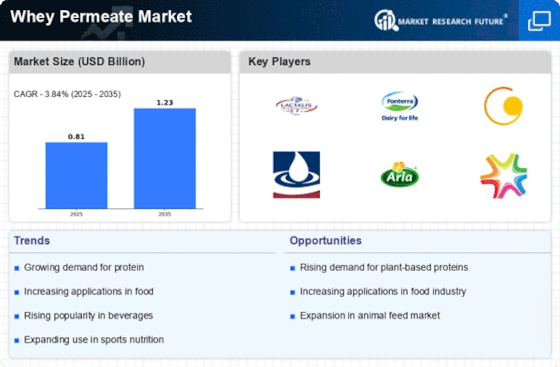
Whey Permeate Market Infographic
Purchase Options

Market Trends

Introduction

Whey permeate market is experiencing a major change with the confluence of macro-factors. The development of dairy industry and the advancement of technology are making the permeate production process more efficient and effective. Regulatory pressures are causing the permeate industry to move towards a more sustainable and clean process. And the changing preferences of consumers towards health and well-being are increasing the demand for food and beverage products with health benefits, such as whey permeate. These macro-factors are of strategic importance for market participants, as they are not only influencing product development and innovation, but also affecting the competitive landscape.

Top Trends

  1. Increased Demand for Clean Label Products
    In the meantime, as consumers are increasingly demanding natural products, manufacturers are increasingly using whey permeate as a natural ingredient. This is a consequence of the fact that 60% of consumers prefer fewer artificial additives. The trend towards more transparency in the supply chain and in the production process also increases brand loyalty. In the future, the trend towards cleaner labelling is likely to be reinforced by stricter labelling regulations.
  2. Sustainability Initiatives in Dairy Production
    In the dairy industry, too, the environment is becoming an important part of the business, and companies such as Arla Foods are introducing sustainable practices. They have learned that 70 per cent of consumers are prepared to pay more for products from sustainable farming. And that means more investment in the development of renewable energy and reduction of waste. Eventually, as sustainability becomes a differentiator, companies will be forced to adopt greener practices to meet consumer expectations.
  3. Growth in Functional Foods and Beverages
    In the case of whey permeate, it is the rise of the ‘functional food’ trend that is driving its use in health-related products. According to data, the ‘functional food’ market is set to grow at a rate of 8 per cent a year. Whey permeate, with its high nutritional profile, can be used to enhance the nutritional profile of these foods. Using this trend, companies are creating new products to meet the needs of health-conscious consumers. In the future, the trend is likely to lead to an increase in research and development into the use of whey permeate in ‘functional’ foods.
  4. Expansion of E-commerce Channels
    The distribution of whey is changing, and the share of e-commerce in the sales of whey is increasing significantly. According to industry reports, e-commerce grocery sales have increased by more than 30% in the past year. Adapting to the situation, companies are enhancing their digital presence and adjusting their supply chains to e-commerce. It is hoped that this trend will lead to a closer relationship with consumers and a more individualized approach to marketing and customer service.
  5. Innovations in Dairy Processing Technologies
    In recent years, the development of milk processing has improved the efficiency of whey permeation. Various companies have invested in modern filtration and separation techniques, which have increased yields by up to twenty per cent. This trend is reducing production costs and improving the quality of the finished products. The next step will probably be the integration of artificial intelligence and automation into the process, which will increase efficiency even further and reduce wastage.
  6. Rising Popularity of Plant-Based Alternatives
    Whey permeate is a dairy alternative. The market for plant-based foods is projected to grow at a rate of 10 per cent a year, which has prompted dairy companies to develop hybrid products. This trend is bringing together the worlds of dairy and plant-based foods to create new products. Whey permeate is one of these products. The future may bring a new generation of formulations that combine whey permeate with plant-based proteins.
  7. Focus on Nutritional Fortification
    The fortification of foodstuffs is becoming a priority. The whey permeate is used to increase the nutritive value of various products. It has been shown by research that fortified foods improve the nutritional status, especially in vulnerable populations. The companies are taking advantage of this trend to develop products that meet a particular need, such as the fortification of food with proteins. In the future, it may be the regulatory framework that encourages the use of fortified products.
  8. Increased Regulatory Scrutiny
    Various food-safety authorities are increasing their scrutiny of the quality and safety of food ingredients, including whey permeate. Recent guidelines emphasize the need for transparency in determining the origin of food ingredients. This is affecting how companies formulate their products. These developments are causing companies to invest in compliance and quality assurance. Eventually, stricter regulations could affect the sourcing of ingredients and the labeling of products.
  9. Emergence of Personalized Nutrition
    Customized nutrition is growing in importance. The whey permeate can be adapted to individual dietary needs. Customized nutrition has been proven to be beneficial for health, thereby creating a demand for custom-made products. Whey permeate companies are therefore exploring the use of data to develop a whey permeate solution that is tailored to individual needs. In the future, it is possible that the technology will develop to such an extent that dietary preferences can be adapted in real time.
  10. Global Supply Chain Resilience
    Despite recent disruptions, supply chain resilience is a focus of attention in the whey permeate market. Companies are diversifying their suppliers and investing in local sourcing to mitigate risks. A survey of companies shows that forty per cent are prioritising a flexible supply chain to help them adapt to market changes. This trend may result in more resilient supply chains that can withstand the most severe disruptions and guarantee stable product availability.

Conclusion: Navigating the Whey Permeate Landscape

The Whey Permeate Market 2024 is characterized by an intense and highly fragmented competition with the presence of a large number of players from the old and new economy. In terms of geography, the demand for whey permeate is growing in North America and Europe, driven by rising health awareness and the growing popularity of high-protein diets. Strategically, vendors should rely on advanced capabilities such as artificial intelligence for predicting the future, automation for achieving operational efficiency and meeting consumer expectations. The importance of product flexibility will also increase with the evolution of consumer preferences. Companies that successfully combine these capabilities will continue to lead, while those that fail to adapt will find it difficult to survive in the changing environment.

Author
Author Profile
Snehal Singh
Manager - Research

High acumen in analyzing complex macro & micro markets with more than 6 years of work experience in the field of market research. By implementing her analytical skills in forecasting and estimation into market research reports, she has expertise in Packaging, Construction, and Equipment domains. She handles a team size of 20-25 resources and ensures smooth running of the projects, associated marketing activities, and client servicing.

Leave a Comment

FAQs

What is the current valuation of the Whey Permeate Market as of 2024?

<p>The Whey Permeate Market was valued at 0.81 USD Billion in 2024.</p>

What is the projected market valuation for Whey Permeate by 2035?

<p>The market is projected to reach a valuation of 1.226 USD Billion by 2035.</p>

What is the expected CAGR for the Whey Permeate Market during the forecast period 2025 - 2035?

<p>The expected CAGR for the Whey Permeate Market during the forecast period 2025 - 2035 is 3.84%.</p>

Which application segments are driving the Whey Permeate Market?

<p>The key application segments include Food and Beverages, Animal Feed, and Others.</p>

What were the valuations for the Food and Beverages segment in 2024?

<p>In 2024, the Food and Beverages segment was valued at 0.45 USD Billion.</p>

How much did the Animal Feed segment contribute to the Whey Permeate Market in 2024?

The Animal Feed segment contributed 0.25 USD Billion to the market in 2024.

Who are the leading players in the Whey Permeate Market?

Key players in the market include Lactalis, Fonterra, Glanbia, and Dairy Farmers of America.

What is the projected growth trend for the Others segment in the Whey Permeate Market?

The Others segment is projected to decline slightly, with a valuation of 0.06 USD Billion by 2035.

How does the performance of the Whey Permeate Market compare across its segments?

The Food and Beverages segment shows the highest growth potential, while the Others segment appears to be decreasing.

What factors might influence the growth of the Whey Permeate Market in the coming years?

Factors such as increasing demand in food applications and animal nutrition are likely to influence market growth.

Market Summary

As per Market Research Future analysis, the Whey Permeate Market Size was estimated at 0.81 USD Billion in 2024. The Whey Permeate industry is projected to grow from USD 0.8411 Billion in 2025 to USD 1.226 Billion by 2035, exhibiting a compound annual growth rate (CAGR) of 3.84% during the forecast period 2025 - 2035

Key Market Trends & Highlights

The Whey Permeate Market is experiencing robust growth driven by health trends and technological advancements.

  • The demand for protein-rich ingredients continues to rise, particularly in North America, which remains the largest market for whey permeate. In Asia-Pacific, the market is expanding rapidly, driven by increasing health consciousness and a growing appetite for functional foods. Technological advancements in processing are enhancing the quality and efficiency of whey permeate production, benefiting both food and beverage applications. Key market drivers include the expansion of dairy processing facilities and the rising demand for sustainable and clean label products.

Market Size & Forecast

2024 Market Size 0.81 (USD Billion)
2035 Market Size 1.226 (USD Billion)
CAGR (2025 - 2035) 3.84%
Largest Regional Market Share in 2024 North America

Major Players

Lactalis (FR), Fonterra (NZ), Glanbia (IE), Dairy Farmers of America (US), Arla Foods (DK), FrieslandCampina (NL), Saputo (CA), Agropur (CA), <a href="https://www.hilmar.com/cheese/">Hilmar Cheese Company</a> (US)

Market Trends

The Whey Permeate Market is currently experiencing a notable transformation, driven by evolving consumer preferences and increasing demand for protein-rich ingredients. This market segment, which primarily consists of whey permeate derived from cheese production, is gaining traction due to its versatility in various applications, including food and beverage, nutritional supplements, and animal feed. As health-conscious consumers seek alternatives that offer both nutritional benefits and cost-effectiveness, whey permeate emerges as a favorable option. Furthermore, the growing trend towards clean label products is prompting manufacturers to explore natural and minimally processed ingredients, thereby enhancing the appeal of whey permeate in the marketplace and shaping broader whey permeate market trends.

In addition to changing consumer behavior, the Whey Permeate Market is influenced by advancements in processing technologies and an expanding range of applications. Innovations in extraction and purification methods are likely to improve the quality and functionality of whey permeate, making it more attractive to food manufacturers. Moreover, the increasing incorporation of whey permeate in functional foods and beverages aligns with the rising trend of protein fortification. As the market continues to evolve, stakeholders must remain vigilant to emerging trends and consumer demands to capitalize on growth opportunities highlighted through ongoing whey permeate market analysis.

Rising Demand for Protein-Rich Ingredients

The Whey Permeate Market is witnessing a surge in demand for protein-rich components, as consumers increasingly prioritize health and wellness. This trend is evident in the growing popularity of protein-enriched foods and beverages, which are perceived as beneficial for muscle recovery and overall health, contributing to expanding whey permeate market share globally.

Focus on Clean Label Products

There is a marked shift towards clean label products, with consumers seeking transparency in ingredient sourcing and processing. Whey permeate, being a natural byproduct, aligns well with this trend, appealing to manufacturers aiming to meet consumer expectations for simplicity and authenticity.

Technological Advancements in Processing

Innovations in processing technologies are enhancing the quality and functionality of whey permeate. These advancements enable manufacturers to optimize extraction methods, thereby improving the ingredient's application potential across various sectors, including food, beverages, and animal nutrition, supporting deeper whey permeate market analysis insights.

Whey Permeate Market Market Drivers

Increasing Health Consciousness

The Whey Permeate Market is experiencing a notable surge in demand driven by increasing health consciousness among consumers. As individuals become more aware of the nutritional benefits associated with protein intake, the appeal of whey permeate as a cost-effective source of protein is amplified. This trend is particularly evident in the food and beverage sector, where manufacturers are incorporating whey permeate into various products to enhance their nutritional profiles. According to recent data, the protein supplement market is projected to grow significantly, which bodes well for the whey permeate segment. The shift towards healthier eating habits is likely to sustain this momentum, positioning whey permeate as a preferred ingredient in health-oriented formulations.

Rising Demand for Functional Foods

The Whey Permeate Market is benefiting from the rising demand for functional foods, which are designed to provide health benefits beyond basic nutrition. Consumers are increasingly seeking products that support their health and wellness goals, and whey permeate fits this criterion due to its high protein content and functional properties. The incorporation of whey permeate into functional food products, such as protein bars and beverages, is becoming more prevalent. Market data suggests that the functional food sector is on an upward trend, with a growing consumer base willing to invest in health-enhancing products. This trend is likely to create new opportunities for whey permeate, positioning it as a key ingredient in the development of innovative functional food offerings.

Growth of the Sports Nutrition Sector

The Whey Permeate Market is experiencing growth fueled by the expansion of the sports nutrition sector. As more individuals engage in fitness and athletic activities, the demand for protein-rich supplements and foods is on the rise. Whey permeate, with its high protein content and functional benefits, is increasingly being incorporated into sports nutrition products. Market analysis indicates that the sports nutrition market is projected to grow significantly, driven by a rising number of health-conscious consumers and athletes seeking effective recovery solutions. This trend presents a substantial opportunity for whey permeate, as it aligns with the needs of consumers looking for convenient and nutritious options to support their active lifestyles.

Expansion of Dairy Processing Facilities

The Whey Permeate Market is poised for growth due to the expansion of dairy processing facilities. As dairy producers seek to optimize their operations, the production of whey permeate has become increasingly viable. Enhanced processing technologies allow for the efficient extraction of whey permeate, which can be utilized in various applications, including animal feed and food products. Recent statistics indicate that the dairy processing sector is expanding, with investments in new facilities and upgrades to existing ones. This expansion not only increases the availability of whey permeate but also enhances its marketability as a sustainable ingredient. The synergy between dairy processing advancements and whey permeate production is likely to bolster the industry's growth trajectory.

Sustainability and Waste Reduction Initiatives

The Whey Permeate Market is increasingly influenced by sustainability and waste reduction initiatives within the food sector. As companies strive to minimize waste and utilize by-products effectively, whey permeate emerges as a valuable resource. The dairy industry generates substantial amounts of whey, and repurposing this by-product into whey permeate not only reduces waste but also adds value to the production process. Recent initiatives aimed at promoting sustainable practices are likely to enhance the attractiveness of whey permeate as an ingredient. This focus on sustainability aligns with consumer preferences for environmentally friendly products, potentially driving demand for whey permeate in various applications, including food and animal nutrition.

Market Segment Insights

By Application: Food and Beverages (Largest) vs. Animal Feed (Fastest-Growing)

The Whey Permeate Market showcases a diverse range of applications, with the Food and Beverages segment holding the largest share, reinforcing overall whey permeate market share leadership. This segment benefits from the widespread demand for protein-rich formulations, offering consumers a wide array of options such as dairy products, snacks, and beverages. On the other hand, the Animal Feed segment is rapidly expanding, driven by the increasing focus on livestock nutrition and the need for balanced animal diet formulations that include whey permeate as a cost-effective ingredient. Growth trends indicate a significant push towards innovative and health-conscious food products within the Food and Beverages sector. Meanwhile, the Animal Feed application is experiencing robust growth due to rising concerns over animal welfare and sustainable farming practices. The rising popularity of whey permeate as a nutritional supplement further supports its adoption in both sectors, ensuring continued expansion in the whey permeate market overall.

Food and Beverages (Dominant) vs. Animal Feed (Emerging)

The Food and Beverages segment stands as the dominant application in the Whey Permeate Market, characterized by its extensive integration within product formulations aimed at health-conscious consumers. This segment thrives on the rising trend of protein fortification, where whey permeate is utilized to enhance nutritional value without compromising taste. In contrast, the Animal Feed segment is labeled as emerging due to its rapid adoption by farmers and feed manufacturers. As awareness grows regarding the significance of high-quality feed ingredients, whey permeate is increasingly recognized for its benefits in supporting livestock growth and overall health. Both segments exhibit unique characteristics and promise substantial trends aligned with broader whey permeate market analysis findings.

Get more detailed insights about Whey Permeate Market Size, Share, Demand Forecast 2035 | MRFR

Regional Insights

North America : Market Leader in Whey Permeate Market

North America is the largest market for whey permeate, holding approximately 45% of the global share. The region benefits from a robust dairy industry, increasing health consciousness among consumers, and a growing demand for protein-rich products. Regulatory support for dairy production and exports further catalyzes market growth, with initiatives aimed at enhancing food safety and quality standards. The United States and Canada are the leading countries in this market, with major players like Dairy Farmers of America and Hilmar Cheese Company dominating the landscape and strengthening regional whey permeate market share. The competitive environment is characterized by strategic partnerships and innovations in product offerings. The presence of established companies ensures a steady supply chain and contributes to the overall market stability.

Europe : Emerging Market with Potential

Europe is the second-largest market for whey permeate, accounting for about 30% of the global share. The region's growth is driven by increasing demand for dairy products, health trends favoring protein consumption, and supportive regulations that promote sustainable dairy farming practices. The European Union's Common Agricultural Policy plays a crucial role in stabilizing the market and ensuring quality standards. Leading countries in this region include Germany, France, and the Netherlands, where companies like FrieslandCampina and Arla Foods are key players. The competitive landscape is marked by innovation in product development and a focus on sustainability. The presence of established dairy cooperatives enhances market dynamics, fostering collaboration and efficiency in production.

Asia-Pacific : Rapidly Growing Market Segment

Asia-Pacific is witnessing rapid growth in the whey permeate market, holding approximately 20% of the global share. The region's expanding population, rising disposable incomes, and changing dietary preferences are significant drivers of demand. Additionally, government initiatives aimed at improving dairy production and quality standards are fostering a conducive environment for market expansion. Countries like China, Australia, and New Zealand are at the forefront of this growth, with Fonterra being a prominent player. The competitive landscape is evolving, with local and international companies vying for market share. Innovations in product offerings and strategic partnerships are common as businesses seek to capitalize on the growing health-conscious consumer base.

Middle East and Africa : Untapped Market Potential

The Middle East and Africa region is gradually emerging in the whey permeate market, currently holding about 5% of the global share. The growth is driven by increasing urbanization, a shift towards healthier diets, and rising awareness of the nutritional benefits of whey permeate. Regulatory frameworks are evolving to support dairy production, enhancing food safety and quality standards in the region. Leading countries include South Africa and the UAE, where local dairy companies are beginning to explore whey permeate applications. The competitive landscape is still developing, with opportunities for both local and international players to enter the market. As consumer preferences shift, the demand for whey permeate is expected to rise, presenting significant growth potential for stakeholders.

Key Players and Competitive Insights

The Whey Permeate Market is characterized by a dynamic competitive landscape, driven by increasing demand for dairy-based ingredients in various food applications. Key players such as Lactalis (FR), Fonterra (NZ), and Glanbia (IE) are strategically positioned to leverage their extensive supply chains and innovative product offerings. Lactalis (FR) focuses on expanding its global footprint through strategic acquisitions, while Fonterra (NZ) emphasizes sustainability and product diversification to cater to evolving consumer preferences. Glanbia (IE) is enhancing its operational efficiency through digital transformation initiatives, which collectively shape a competitive environment that is increasingly focused on innovation and sustainability.The market structure appears moderately fragmented, with several players vying for market share. Key business tactics include localizing manufacturing to reduce costs and optimize supply chains. This approach not only enhances operational efficiency but also allows companies to respond swiftly to regional market demands. The collective influence of these major players fosters a competitive atmosphere where agility and responsiveness are paramount.
In August Lactalis (FR) announced the acquisition of a regional dairy processing facility in the United States, aimed at bolstering its production capacity for whey permeate. This strategic move is likely to enhance Lactalis's ability to meet the growing demand for whey-based products in North America, thereby solidifying its market position. The acquisition underscores the company's commitment to expanding its operational capabilities and responding to market trends.
In July Fonterra (NZ) launched a new line of whey permeate products that are specifically designed for the health and wellness sector. This initiative reflects Fonterra's strategic focus on innovation and product development, catering to the increasing consumer demand for healthier food options. By diversifying its product portfolio, Fonterra positions itself as a leader in the health-oriented segment of the whey permeate market.
In September Glanbia (IE) unveiled a new digital platform aimed at enhancing supply chain transparency and efficiency. This platform is expected to streamline operations and improve customer engagement, aligning with Glanbia's strategy of integrating technology into its business processes. The introduction of this digital solution may provide Glanbia with a competitive edge in an increasingly tech-driven market.
As of October current competitive trends in the Whey Permeate Market indicate a strong emphasis on digitalization, sustainability, and the integration of artificial intelligence in operations. Strategic alliances among key players are shaping the landscape, fostering innovation and collaborative efforts to address market challenges. Looking ahead, competitive differentiation is likely to evolve from traditional price-based competition to a focus on innovation, technological advancements, and supply chain reliability, as companies strive to meet the demands of a more discerning consumer base.

Key Companies in the Whey Permeate Market include

Industry Developments

In June 2020, Idaho Milk Products, a company that converts raw milk into milk protein concentrate and milk permeate, announced a US$ 26 million expansion facility in Michigan, U.S. This facility is intended to enhance the company's overall manufacturing capacity by 1 million pounds per day, allowing the company to extend its product portfolio.

In September 2019, Glanbia Ingredients collaborates in Ireland with AgriChemWhey, a European Commission project. This initiative was primarily supported by the Bio-based Industries Joint Technology Initiative in partnership with an EU research consortia, engineering, and business interests. The major goal is to develop technology that converts dairy products into high-value commercial products. The first goal is to build a $ 41.2 million integrated biorefinery that will process 25,000 tons of whey permeate and whey pearl lactose each year into polylactic acid, L-lactic acid, minerals for human nutrition, and bio-based fertilizers.

As a result, Bio-Based Industries Joint Technology Initiative encourages more permeate production, so propelling the permeate market forward.

In September 2022, Dyet Nutrition, an established Indian nutritional supplement firm, has introduced a new line of vanilla and chocolate-flavored whey protein concentrates. The goal of this launch is to provide high-quality supplements for bodybuilders, athletes, and people wishing to improve their overall fitness.

Q2 2024: Dry whey prices hit $0.625/lb in June 2024 – a 5-year high – even as cheese plants flood the market with excess whey USDA data released in June 2024 showed dry whey prices reaching a five-year high, reflecting increased demand and market volatility for whey and its derivatives, including whey permeate.

Q4 2024: Trade war likely to significantly alter global dry whey and lactose trade Ongoing trade tensions in 2024 are expected to reshape global trade routes for dry whey and whey permeate, with China and the U.S. adjusting export and import strategies due to tariffs and shifting demand.

Future Outlook

Whey Permeate Market Future Outlook

The Whey Permeate Market is projected to grow at a 3.84% CAGR from 2025 to 2035, driven by increasing demand for protein-rich ingredients and sustainable food solutions.

New opportunities lie in:

  • <p>Expansion into plant-based protein formulations</p>
  • <p> </p>
  • <p>Development of customized whey permeate blends for specific dietary needs</p>
  • <p>Investment in advanced processing technologies to enhance product quality</p>

By 2035, the Whey Permeate Market is expected to achieve robust growth and increased market penetration.

Market Segmentation

Whey Permeate Market Application Outlook

  • Food and Beverages
  • Animal Feed
  • Others

Report Scope

MARKET SIZE 2024 0.81(USD Billion)
MARKET SIZE 2025 0.8411(USD Billion)
MARKET SIZE 2035 1.226(USD Billion)
COMPOUND ANNUAL GROWTH RATE (CAGR) 3.84% (2025 - 2035)
REPORT COVERAGE Revenue Forecast, Competitive Landscape, Growth Factors, and Trends
BASE YEAR 2024
Market Forecast Period 2025 - 2035
Historical Data 2019 - 2024
Market Forecast Units USD Billion
Key Companies Profiled Lactalis (FR), Fonterra (NZ), Glanbia (IE), Dairy Farmers of America (US), Arla Foods (DK), FrieslandCampina (NL), Saputo (CA), Agropur (CA), Hilmar Cheese Company (US)
Segments Covered Application, Region
Key Market Opportunities Growing demand for plant-based protein alternatives enhances opportunities in the Whey Permeate Market.
Key Market Dynamics Rising demand for clean label products drives innovation and competition in the whey permeate market.
Countries Covered North America, Europe, APAC, South America, MEA

FAQs

What is the current valuation of the Whey Permeate Market as of 2024?

<p>The Whey Permeate Market was valued at 0.81 USD Billion in 2024.</p>

What is the projected market valuation for Whey Permeate by 2035?

<p>The market is projected to reach a valuation of 1.226 USD Billion by 2035.</p>

What is the expected CAGR for the Whey Permeate Market during the forecast period 2025 - 2035?

<p>The expected CAGR for the Whey Permeate Market during the forecast period 2025 - 2035 is 3.84%.</p>

Which application segments are driving the Whey Permeate Market?

<p>The key application segments include Food and Beverages, Animal Feed, and Others.</p>

What were the valuations for the Food and Beverages segment in 2024?

<p>In 2024, the Food and Beverages segment was valued at 0.45 USD Billion.</p>

How much did the Animal Feed segment contribute to the Whey Permeate Market in 2024?

The Animal Feed segment contributed 0.25 USD Billion to the market in 2024.

Who are the leading players in the Whey Permeate Market?

Key players in the market include Lactalis, Fonterra, Glanbia, and Dairy Farmers of America.

What is the projected growth trend for the Others segment in the Whey Permeate Market?

The Others segment is projected to decline slightly, with a valuation of 0.06 USD Billion by 2035.

How does the performance of the Whey Permeate Market compare across its segments?

The Food and Beverages segment shows the highest growth potential, while the Others segment appears to be decreasing.

What factors might influence the growth of the Whey Permeate Market in the coming years?

Factors such as increasing demand in food applications and animal nutrition are likely to influence market growth.

  1. SECTION I: EXECUTIVE SUMMARY AND KEY HIGHLIGHTS
    1. | 1.1 EXECUTIVE SUMMARY
    2. | | 1.1.1 Market Overview
    3. | | 1.1.2 Key Findings
    4. | | 1.1.3 Market Segmentation
    5. | | 1.1.4 Competitive Landscape
    6. | | 1.1.5 Challenges and Opportunities
    7. | | 1.1.6 Future Outlook
  2. SECTION II: SCOPING, METHODOLOGY AND MARKET STRUCTURE
    1. | 2.1 MARKET INTRODUCTION
    2. | | 2.1.1 Definition
    3. | | 2.1.2 Scope of the study
    4. | | | 2.1.2.1 Research Objective
    5. | | | 2.1.2.2 Assumption
    6. | | | 2.1.2.3 Limitations
    7. | 2.2 RESEARCH METHODOLOGY
    8. | | 2.2.1 Overview
    9. | | 2.2.2 Data Mining
    10. | | 2.2.3 Secondary Research
    11. | | 2.2.4 Primary Research
    12. | | | 2.2.4.1 Primary Interviews and Information Gathering Process
    13. | | | 2.2.4.2 Breakdown of Primary Respondents
    14. | | 2.2.5 Forecasting Model
    15. | | 2.2.6 Market Size Estimation
    16. | | | 2.2.6.1 Bottom-Up Approach
    17. | | | 2.2.6.2 Top-Down Approach
    18. | | 2.2.7 Data Triangulation
    19. | | 2.2.8 Validation
  3. SECTION III: QUALITATIVE ANALYSIS
    1. | 3.1 MARKET DYNAMICS
    2. | | 3.1.1 Overview
    3. | | 3.1.2 Drivers
    4. | | 3.1.3 Restraints
    5. | | 3.1.4 Opportunities
    6. | 3.2 MARKET FACTOR ANALYSIS
    7. | | 3.2.1 Value chain Analysis
    8. | | 3.2.2 Porter's Five Forces Analysis
    9. | | | 3.2.2.1 Bargaining Power of Suppliers
    10. | | | 3.2.2.2 Bargaining Power of Buyers
    11. | | | 3.2.2.3 Threat of New Entrants
    12. | | | 3.2.2.4 Threat of Substitutes
    13. | | | 3.2.2.5 Intensity of Rivalry
    14. | | 3.2.3 COVID-19 Impact Analysis
    15. | | | 3.2.3.1 Market Impact Analysis
    16. | | | 3.2.3.2 Regional Impact
    17. | | | 3.2.3.3 Opportunity and Threat Analysis
  4. SECTION IV: QUANTITATIVE ANALYSIS
    1. | 4.1 Food, Beverages & Nutrition, BY Application (USD Billion)
    2. | | 4.1.1 Food and Beverages
    3. | | 4.1.2 Animal Feed
    4. | | 4.1.3 Others
    5. | 4.2 Food, Beverages & Nutrition, BY Region (USD Billion)
    6. | | 4.2.1 North America
    7. | | | 4.2.1.1 US
    8. | | | 4.2.1.2 Canada
    9. | | 4.2.2 Europe
    10. | | | 4.2.2.1 Germany
    11. | | | 4.2.2.2 UK
    12. | | | 4.2.2.3 France
    13. | | | 4.2.2.4 Russia
    14. | | | 4.2.2.5 Italy
    15. | | | 4.2.2.6 Spain
    16. | | | 4.2.2.7 Rest of Europe
    17. | | 4.2.3 APAC
    18. | | | 4.2.3.1 China
    19. | | | 4.2.3.2 India
    20. | | | 4.2.3.3 Japan
    21. | | | 4.2.3.4 South Korea
    22. | | | 4.2.3.5 Malaysia
    23. | | | 4.2.3.6 Thailand
    24. | | | 4.2.3.7 Indonesia
    25. | | | 4.2.3.8 Rest of APAC
    26. | | 4.2.4 South America
    27. | | | 4.2.4.1 Brazil
    28. | | | 4.2.4.2 Mexico
    29. | | | 4.2.4.3 Argentina
    30. | | | 4.2.4.4 Rest of South America
    31. | | 4.2.5 MEA
    32. | | | 4.2.5.1 GCC Countries
    33. | | | 4.2.5.2 South Africa
    34. | | | 4.2.5.3 Rest of MEA
  5. SECTION V: COMPETITIVE ANALYSIS
    1. | 5.1 Competitive Landscape
    2. | | 5.1.1 Overview
    3. | | 5.1.2 Competitive Analysis
    4. | | 5.1.3 Market share Analysis
    5. | | 5.1.4 Major Growth Strategy in the Food, Beverages & Nutrition
    6. | | 5.1.5 Competitive Benchmarking
    7. | | 5.1.6 Leading Players in Terms of Number of Developments in the Food, Beverages & Nutrition
    8. | | 5.1.7 Key developments and growth strategies
    9. | | | 5.1.7.1 New Product Launch/Service Deployment
    10. | | | 5.1.7.2 Merger & Acquisitions
    11. | | | 5.1.7.3 Joint Ventures
    12. | | 5.1.8 Major Players Financial Matrix
    13. | | | 5.1.8.1 Sales and Operating Income
    14. | | | 5.1.8.2 Major Players R&D Expenditure. 2023
    15. | 5.2 Company Profiles
    16. | | 5.2.1 Lactalis (FR)
    17. | | | 5.2.1.1 Financial Overview
    18. | | | 5.2.1.2 Products Offered
    19. | | | 5.2.1.3 Key Developments
    20. | | | 5.2.1.4 SWOT Analysis
    21. | | | 5.2.1.5 Key Strategies
    22. | | 5.2.2 Fonterra (NZ)
    23. | | | 5.2.2.1 Financial Overview
    24. | | | 5.2.2.2 Products Offered
    25. | | | 5.2.2.3 Key Developments
    26. | | | 5.2.2.4 SWOT Analysis
    27. | | | 5.2.2.5 Key Strategies
    28. | | 5.2.3 Glanbia (IE)
    29. | | | 5.2.3.1 Financial Overview
    30. | | | 5.2.3.2 Products Offered
    31. | | | 5.2.3.3 Key Developments
    32. | | | 5.2.3.4 SWOT Analysis
    33. | | | 5.2.3.5 Key Strategies
    34. | | 5.2.4 Dairy Farmers of America (US)
    35. | | | 5.2.4.1 Financial Overview
    36. | | | 5.2.4.2 Products Offered
    37. | | | 5.2.4.3 Key Developments
    38. | | | 5.2.4.4 SWOT Analysis
    39. | | | 5.2.4.5 Key Strategies
    40. | | 5.2.5 Arla Foods (DK)
    41. | | | 5.2.5.1 Financial Overview
    42. | | | 5.2.5.2 Products Offered
    43. | | | 5.2.5.3 Key Developments
    44. | | | 5.2.5.4 SWOT Analysis
    45. | | | 5.2.5.5 Key Strategies
    46. | | 5.2.6 FrieslandCampina (NL)
    47. | | | 5.2.6.1 Financial Overview
    48. | | | 5.2.6.2 Products Offered
    49. | | | 5.2.6.3 Key Developments
    50. | | | 5.2.6.4 SWOT Analysis
    51. | | | 5.2.6.5 Key Strategies
    52. | | 5.2.7 Saputo (CA)
    53. | | | 5.2.7.1 Financial Overview
    54. | | | 5.2.7.2 Products Offered
    55. | | | 5.2.7.3 Key Developments
    56. | | | 5.2.7.4 SWOT Analysis
    57. | | | 5.2.7.5 Key Strategies
    58. | | 5.2.8 Agropur (CA)
    59. | | | 5.2.8.1 Financial Overview
    60. | | | 5.2.8.2 Products Offered
    61. | | | 5.2.8.3 Key Developments
    62. | | | 5.2.8.4 SWOT Analysis
    63. | | | 5.2.8.5 Key Strategies
    64. | | 5.2.9 Hilmar Cheese Company (US)
    65. | | | 5.2.9.1 Financial Overview
    66. | | | 5.2.9.2 Products Offered
    67. | | | 5.2.9.3 Key Developments
    68. | | | 5.2.9.4 SWOT Analysis
    69. | | | 5.2.9.5 Key Strategies
    70. | 5.3 Appendix
    71. | | 5.3.1 References
    72. | | 5.3.2 Related Reports
  6. LIST OF FIGURES
    1. | 6.1 MARKET SYNOPSIS
    2. | 6.2 NORTH AMERICA MARKET ANALYSIS
    3. | 6.3 US MARKET ANALYSIS BY APPLICATION
    4. | 6.4 CANADA MARKET ANALYSIS BY APPLICATION
    5. | 6.5 EUROPE MARKET ANALYSIS
    6. | 6.6 GERMANY MARKET ANALYSIS BY APPLICATION
    7. | 6.7 UK MARKET ANALYSIS BY APPLICATION
    8. | 6.8 FRANCE MARKET ANALYSIS BY APPLICATION
    9. | 6.9 RUSSIA MARKET ANALYSIS BY APPLICATION
    10. | 6.10 ITALY MARKET ANALYSIS BY APPLICATION
    11. | 6.11 SPAIN MARKET ANALYSIS BY APPLICATION
    12. | 6.12 REST OF EUROPE MARKET ANALYSIS BY APPLICATION
    13. | 6.13 APAC MARKET ANALYSIS
    14. | 6.14 CHINA MARKET ANALYSIS BY APPLICATION
    15. | 6.15 INDIA MARKET ANALYSIS BY APPLICATION
    16. | 6.16 JAPAN MARKET ANALYSIS BY APPLICATION
    17. | 6.17 SOUTH KOREA MARKET ANALYSIS BY APPLICATION
    18. | 6.18 MALAYSIA MARKET ANALYSIS BY APPLICATION
    19. | 6.19 THAILAND MARKET ANALYSIS BY APPLICATION
    20. | 6.20 INDONESIA MARKET ANALYSIS BY APPLICATION
    21. | 6.21 REST OF APAC MARKET ANALYSIS BY APPLICATION
    22. | 6.22 SOUTH AMERICA MARKET ANALYSIS
    23. | 6.23 BRAZIL MARKET ANALYSIS BY APPLICATION
    24. | 6.24 MEXICO MARKET ANALYSIS BY APPLICATION
    25. | 6.25 ARGENTINA MARKET ANALYSIS BY APPLICATION
    26. | 6.26 REST OF SOUTH AMERICA MARKET ANALYSIS BY APPLICATION
    27. | 6.27 MEA MARKET ANALYSIS
    28. | 6.28 GCC COUNTRIES MARKET ANALYSIS BY APPLICATION
    29. | 6.29 SOUTH AFRICA MARKET ANALYSIS BY APPLICATION
    30. | 6.30 REST OF MEA MARKET ANALYSIS BY APPLICATION
    31. | 6.31 KEY BUYING CRITERIA OF FOOD, BEVERAGES & NUTRITION
    32. | 6.32 RESEARCH PROCESS OF MRFR
    33. | 6.33 DRO ANALYSIS OF FOOD, BEVERAGES & NUTRITION
    34. | 6.34 DRIVERS IMPACT ANALYSIS: FOOD, BEVERAGES & NUTRITION
    35. | 6.35 RESTRAINTS IMPACT ANALYSIS: FOOD, BEVERAGES & NUTRITION
    36. | 6.36 SUPPLY / VALUE CHAIN: FOOD, BEVERAGES & NUTRITION
    37. | 6.37 FOOD, BEVERAGES & NUTRITION, BY APPLICATION, 2024 (% SHARE)
    38. | 6.38 FOOD, BEVERAGES & NUTRITION, BY APPLICATION, 2024 TO 2035 (USD Billion)
    39. | 6.39 BENCHMARKING OF MAJOR COMPETITORS
  7. LIST OF TABLES
    1. | 7.1 LIST OF ASSUMPTIONS
    2. | | 7.1.1
    3. | 7.2 North America MARKET SIZE ESTIMATES; FORECAST
    4. | | 7.2.1 BY APPLICATION, 2025-2035 (USD Billion)
    5. | 7.3 US MARKET SIZE ESTIMATES; FORECAST
    6. | | 7.3.1 BY APPLICATION, 2025-2035 (USD Billion)
    7. | 7.4 Canada MARKET SIZE ESTIMATES; FORECAST
    8. | | 7.4.1 BY APPLICATION, 2025-2035 (USD Billion)
    9. | 7.5 Europe MARKET SIZE ESTIMATES; FORECAST
    10. | | 7.5.1 BY APPLICATION, 2025-2035 (USD Billion)
    11. | 7.6 Germany MARKET SIZE ESTIMATES; FORECAST
    12. | | 7.6.1 BY APPLICATION, 2025-2035 (USD Billion)
    13. | 7.7 UK MARKET SIZE ESTIMATES; FORECAST
    14. | | 7.7.1 BY APPLICATION, 2025-2035 (USD Billion)
    15. | 7.8 France MARKET SIZE ESTIMATES; FORECAST
    16. | | 7.8.1 BY APPLICATION, 2025-2035 (USD Billion)
    17. | 7.9 Russia MARKET SIZE ESTIMATES; FORECAST
    18. | | 7.9.1 BY APPLICATION, 2025-2035 (USD Billion)
    19. | 7.10 Italy MARKET SIZE ESTIMATES; FORECAST
    20. | | 7.10.1 BY APPLICATION, 2025-2035 (USD Billion)
    21. | 7.11 Spain MARKET SIZE ESTIMATES; FORECAST
    22. | | 7.11.1 BY APPLICATION, 2025-2035 (USD Billion)
    23. | 7.12 Rest of Europe MARKET SIZE ESTIMATES; FORECAST
    24. | | 7.12.1 BY APPLICATION, 2025-2035 (USD Billion)
    25. | 7.13 APAC MARKET SIZE ESTIMATES; FORECAST
    26. | | 7.13.1 BY APPLICATION, 2025-2035 (USD Billion)
    27. | 7.14 China MARKET SIZE ESTIMATES; FORECAST
    28. | | 7.14.1 BY APPLICATION, 2025-2035 (USD Billion)
    29. | 7.15 India MARKET SIZE ESTIMATES; FORECAST
    30. | | 7.15.1 BY APPLICATION, 2025-2035 (USD Billion)
    31. | 7.16 Japan MARKET SIZE ESTIMATES; FORECAST
    32. | | 7.16.1 BY APPLICATION, 2025-2035 (USD Billion)
    33. | 7.17 South Korea MARKET SIZE ESTIMATES; FORECAST
    34. | | 7.17.1 BY APPLICATION, 2025-2035 (USD Billion)
    35. | 7.18 Malaysia MARKET SIZE ESTIMATES; FORECAST
    36. | | 7.18.1 BY APPLICATION, 2025-2035 (USD Billion)
    37. | 7.19 Thailand MARKET SIZE ESTIMATES; FORECAST
    38. | | 7.19.1 BY APPLICATION, 2025-2035 (USD Billion)
    39. | 7.20 Indonesia MARKET SIZE ESTIMATES; FORECAST
    40. | | 7.20.1 BY APPLICATION, 2025-2035 (USD Billion)
    41. | 7.21 Rest of APAC MARKET SIZE ESTIMATES; FORECAST
    42. | | 7.21.1 BY APPLICATION, 2025-2035 (USD Billion)
    43. | 7.22 South America MARKET SIZE ESTIMATES; FORECAST
    44. | | 7.22.1 BY APPLICATION, 2025-2035 (USD Billion)
    45. | 7.23 Brazil MARKET SIZE ESTIMATES; FORECAST
    46. | | 7.23.1 BY APPLICATION, 2025-2035 (USD Billion)
    47. | 7.24 Mexico MARKET SIZE ESTIMATES; FORECAST
    48. | | 7.24.1 BY APPLICATION, 2025-2035 (USD Billion)
    49. | 7.25 Argentina MARKET SIZE ESTIMATES; FORECAST
    50. | | 7.25.1 BY APPLICATION, 2025-2035 (USD Billion)
    51. | 7.26 Rest of South America MARKET SIZE ESTIMATES; FORECAST
    52. | | 7.26.1 BY APPLICATION, 2025-2035 (USD Billion)
    53. | 7.27 MEA MARKET SIZE ESTIMATES; FORECAST
    54. | | 7.27.1 BY APPLICATION, 2025-2035 (USD Billion)
    55. | 7.28 GCC Countries MARKET SIZE ESTIMATES; FORECAST
    56. | | 7.28.1 BY APPLICATION, 2025-2035 (USD Billion)
    57. | 7.29 South Africa MARKET SIZE ESTIMATES; FORECAST
    58. | | 7.29.1 BY APPLICATION, 2025-2035 (USD Billion)
    59. | 7.30 Rest of MEA MARKET SIZE ESTIMATES; FORECAST
    60. | | 7.30.1 BY APPLICATION, 2025-2035 (USD Billion)
    61. | 7.31 PRODUCT LAUNCH/PRODUCT DEVELOPMENT/APPROVAL
    62. | | 7.31.1
    63. | 7.32 ACQUISITION/PARTNERSHIP
    64. | | 7.32.1

Food, Beverages & Nutrition Market Segmentation

Food, Beverages & Nutrition By Application (USD Billion, 2025-2035)

  • Food and Beverages
  • Animal Feed
  • Others
Infographic

Free Sample Request

Kindly complete the form below to receive a free sample of this Report

Get Free Sample

Customer Strories

Compare Licence

×
Features License Type
Single User Multiuser License Enterprise User
Price $4,950 $5,950 $7,250
Maximum User Access Limit 1 User Upto 10 Users Unrestricted Access Throughout the Organization
Free Customization
Direct Access to Analyst
Deliverable Format
Platform Access
Discount on Next Purchase 10% 15% 15%
Printable Versions