Request Free Sample ×

Kindly complete the form below to receive a free sample of this Report

* Please use a valid business email

Leading companies partner with us for data-driven Insights

clients tt-cursor
Hero Background
English
Chinese
French
Japanese
Korean
German
Spanish

Wet Chemicals for Electronics Semiconductor Application Market Trends

ID: MRFR/CnM/10473-HCR
128 Pages
Priya Nagrale
April 2026

Wet Chemicals for Electronics Semiconductor Application Market Research Report Information By Product (Acetic Acid, Hydrogen Peroxide, Hydrochloric Acid, Ammonium Hydroxide, Nitric Acid, Sulfuric Acid, Phosphoric Acid, and Others), By Application (Cleaning, Etching, Printed Circuit Board Manufacturing, Integrated Circuit, and Others), and By Region (North America, Europe, Asia-Pacific, and Rest Of The World) – Market Forecast Till 2035

Share:
Download PDF ×

We do not share your information with anyone. However, we may send you emails based on your report interest from time to time. You may contact us at any time to opt-out.

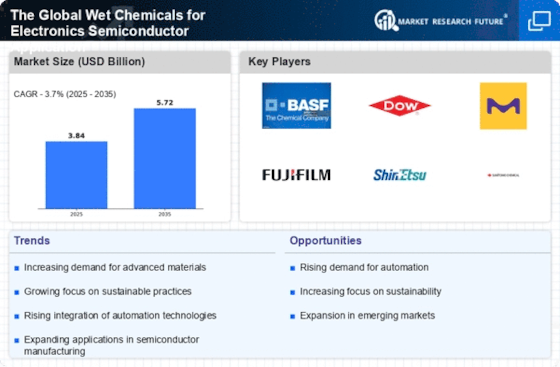
Wet Chemicals for Electronics Semiconductor Application Market Infographic
Purchase Options

Market Trends

Key Emerging Trends in the Wet Chemicals for Electronics Semiconductor Application Market

The market for wet chemicals used in electronics semiconductor applications is experiencing significant trends that are reshaping the industry and influencing its growth. One prominent trend is the increasing demand for wet chemicals driven by the rapid expansion of the global electronics industry. With the proliferation of electronic devices such as smartphones, laptops, tablets, and wearable gadgets, there is a growing need for high-performance semiconductor components. Wet chemicals play a crucial role in the fabrication and processing of semiconductors, enabling the production of advanced integrated circuits, memory chips, and other electronic components that power modern devices. As the electronics industry continues to innovate and evolve, the demand for specialized wet chemicals is expected to rise to meet the stringent requirements of semiconductor manufacturing processes.

Moreover, there is a growing emphasis on miniaturization, performance enhancement, and energy efficiency in semiconductor manufacturing, driving the adoption of advanced wet chemical solutions. Semiconductor manufacturers are increasingly relying on wet chemicals for critical processes such as cleaning, etching, stripping, and planarization to achieve tighter design tolerances, higher yields, and improved device performance. Advanced wet chemical formulations with superior purity, stability, and precision control are essential for achieving the stringent specifications and reliability standards required in semiconductor fabrication. As the demand for smaller, faster, and more energy-efficient electronic devices continues to grow, the importance of high-quality wet chemicals in semiconductor manufacturing is expected to increase.

Furthermore, the market is witnessing increasing demand for environmentally friendly and sustainable wet chemical solutions in semiconductor manufacturing. With growing concerns about environmental pollution, regulatory compliance, and corporate sustainability goals, semiconductor manufacturers are seeking alternatives to conventional wet chemicals that pose risks to human health and the environment. Environmentally friendly wet chemical formulations that minimize hazardous emissions, reduce water and energy consumption, and enable safer handling and disposal are gaining traction in the industry. Additionally, the development of green chemistry principles and eco-friendly manufacturing practices is driving innovation in wet chemical technology, leading to the emergence of sustainable alternatives that offer comparable performance to traditional chemicals.

Additionally, the market for wet chemicals in electronics semiconductor applications is experiencing a shift towards specialty formulations tailored to specific manufacturing processes and device requirements. Semiconductor manufacturers are increasingly demanding wet chemicals with customized properties such as high selectivity, low defectivity, and excellent uniformity to meet the evolving needs of advanced semiconductor fabrication technologies. Specialty wet chemicals are essential for addressing challenges such as pattern collapse, line edge roughness, and device scaling limitations in next-generation semiconductor devices. As semiconductor technology continues to advance, the demand for specialty wet chemicals that enable the production of cutting-edge devices is expected to grow, driving market expansion and fostering innovation in wet chemical formulations.

Moreover, the COVID-19 pandemic has had a significant impact on the market for wet chemicals used in electronics semiconductor applications, leading to disruptions in supply chains, fluctuations in demand, and changes in manufacturing practices. While the pandemic initially resulted in reduced industrial activity and demand for electronics, the accelerated adoption of remote work, online learning, and digitalization has led to increased demand for electronic devices such as laptops, tablets, and communication equipment. Semiconductor manufacturers are adapting to the new normal by implementing hygiene and safety protocols, optimizing production processes, and investing in digital transformation initiatives to enhance resilience and agility in response to future disruptions.

Author
Author Profile
Priya Nagrale
Senior Research Analyst

With an experience of over five years in market research industry (Chemicals & Materials domain), I gather and analyze market data from diverse sources to produce results, which are then presented back to a client. Also, provide recommendations based on the findings. As a Senior Research Analyst, I perform quality checks (QC) for market estimations, QC for reports, and handle queries and work extensively on client customizations. Also, handle the responsibilities of client proposals, report planning, report finalization, and execution

Leave a Comment

FAQs

What is the projected market valuation for The Global Wet Chemicals for Electronics Semiconductor Application in 2035?

<p>The projected market valuation for 2035 is 5.723 USD Billion.</p>

What was the overall market valuation for this sector in 2024?

<p>The overall market valuation was 3.837 USD Billion in 2024.</p>

What is the expected CAGR for the market during the forecast period 2025 - 2035?

<p>The expected CAGR for the market during the forecast period 2025 - 2035 is 3.7%.</p>

Which companies are considered key players in The Global Wet Chemicals for Electronics Semiconductor Application?

<p>Key players include BASF SE, Dow Inc., Merck KGaA, Fujifilm Corporation, Shin-Etsu Chemical Co., Ltd., Sumitomo Chemical Co., Ltd., Air Products and Chemicals, Inc., KMG Chemicals, Inc., and Eastman Chemical Company.</p>

What segment is projected to have the highest valuation in the application category by 2035?

<p>The Integrated Circuit segment is projected to reach a valuation of 1.6 USD Billion by 2035.</p>

How much is the Cleaning segment expected to grow by 2035?

<p>The Cleaning segment is expected to grow to 0.95 USD Billion by 2035.</p>

What is the valuation range for Acetic Acid in the market?

The valuation range for Acetic Acid is projected between 0.5 and 0.7 USD Billion.

Which application segment had a valuation of 0.6 USD Billion in 2024?

The Printed Circuit Board Manufacturing application segment had a valuation of 0.6 USD Billion in 2024.

What is the projected valuation for the Others segment in the product category by 2035?

The Others segment in the product category is projected to reach a valuation of 1.373 USD Billion by 2035.

What is the expected growth trend for Hydrogen Peroxide in the market?

Hydrogen Peroxide is expected to grow to a valuation of 0.6 USD Billion by 2035.

Market Summary

As per Market Research Future analysis, The Global Wet Chemicals for Electronics Semiconductor Application Market was estimated at 3.837 USD Billion in 2024. The market is projected to grow from 3.979 USD Billion in 2025 to 5.723 USD Billion by 2035, exhibiting a compound annual growth rate (CAGR) of 3.7% during the forecast period 2025 - 2035

Key Market Trends & Highlights

The Global Wet Chemicals for Electronics Semiconductor Application Market is poised for substantial growth driven by technological advancements and sustainability initiatives.

  • North America remains the largest market for wet chemicals, driven by robust consumer electronics demand. Asia-Pacific is emerging as the fastest-growing region, fueled by rapid advancements in semiconductor manufacturing technologies. Acetic Acid continues to dominate as the largest segment, while Hydrogen Peroxide is recognized as the fastest-growing segment in the market. Key market drivers include the rising demand for consumer electronics and increased investment in semiconductor research and development.

Market Size & Forecast

2024 Market Size 3.837 (USD Billion)
2035 Market Size 5.723 (USD Billion)
CAGR (2025 - 2035) 3.7%
Largest Regional Market Share in 2024 North America

Major Players

BASF SE (DE), Dow Inc. (US), Merck KGaA (DE), Fujifilm Corporation (JP), Shin-Etsu Chemical Co., Ltd. (JP), Sumitomo Chemical Co., Ltd. (JP), Air Products and Chemicals, Inc. (US), KMG Chemicals, Inc. (US), Eastman Chemical Company (US)

Market Trends

The Global Wet Chemicals for Electronics Semiconductor Application Market is currently experiencing a dynamic evolution, driven by the increasing demand for advanced semiconductor technologies. As electronic devices become more sophisticated, the need for high-purity wet chemicals is paramount. These chemicals play a crucial role in various processes, including cleaning, etching, and photoresist applications. The market appears to be influenced by several factors, including technological advancements, the growing trend of miniaturization in electronics, and the rising adoption of electric vehicles. Furthermore, the expansion of the Internet of Things (IoT) is likely to propel the demand for semiconductors, thereby impacting the wet chemicals market positively. In addition, sustainability concerns are becoming increasingly relevant within The Global Wet Chemicals for Electronics Semiconductor Application Market. Manufacturers are exploring eco-friendly alternatives to traditional chemicals, which may lead to innovations in product formulations. This shift towards greener solutions could enhance the market's appeal to environmentally conscious consumers and regulatory bodies. Moreover, the ongoing globalization of supply chains suggests that companies may seek to optimize their sourcing strategies, potentially affecting the competitive landscape. Overall, the market appears poised for growth, with various trends indicating a shift towards more sustainable and technologically advanced solutions.

Sustainability Initiatives

The focus on sustainability within The Global Wet Chemicals for Electronics Semiconductor Application Market is intensifying. Companies are increasingly prioritizing eco-friendly alternatives to traditional chemicals, which may lead to innovative product developments. This trend reflects a broader commitment to environmental responsibility and could enhance market attractiveness.

Technological Advancements

Rapid technological advancements are shaping The Global Wet Chemicals for Electronics Semiconductor Application Market. As semiconductor technologies evolve, the demand for high-purity wet chemicals is likely to increase. This trend is driven by the need for precision in manufacturing processes, which is essential for producing advanced electronic devices.

Miniaturization of Electronics

The ongoing trend of miniaturization in electronics is significantly impacting The Global Wet Chemicals for Electronics Semiconductor Application Market. As devices become smaller and more complex, the requirement for specialized wet chemicals is expected to grow. This trend underscores the importance of adapting chemical formulations to meet the needs of modern semiconductor applications.

Wet Chemicals for Electronics Semiconductor Application Market Market Drivers

Expansion of Automotive Electronics

The expansion of automotive electronics is a notable driver for the Wet Chemicals for Electronics Semiconductor Application Market. With the automotive sector increasingly integrating advanced electronic systems, the demand for semiconductors is surging. The automotive semiconductor market is anticipated to reach approximately 100 billion USD by 2025, driven by the rise of electric vehicles and autonomous driving technologies. This growth necessitates the use of high-quality wet chemicals in the production of semiconductors that power these advanced systems. As automotive manufacturers seek to enhance vehicle performance and safety, the reliance on specialized wet chemicals becomes more pronounced, thereby propelling market growth.

Rising Demand for Consumer Electronics

The increasing demand for consumer electronics is a primary driver for the Wet Chemicals for Electronics Semiconductor Application Market. As more consumers seek advanced electronic devices, manufacturers are compelled to enhance production capabilities. This surge in demand is reflected in the semiconductor market, which is projected to reach a valuation of approximately 600 billion USD by 2025. Consequently, the need for high-quality wet chemicals, essential for semiconductor fabrication processes, is likely to escalate. The growth in sectors such as smartphones, tablets, and wearables further amplifies this trend, necessitating innovative chemical solutions to meet stringent performance and reliability standards. Thus, the interplay between consumer electronics demand and semiconductor production is pivotal for the wet chemicals market.

Growing Focus on Renewable Energy Solutions

The Global Wet Chemicals for Electronics Semiconductor Application Industry. As the demand for solar panels and energy-efficient devices rises, the semiconductor sector is adapting to support these technologies. The solar energy market is projected to grow at a compound annual growth rate of over 20% through 2025, which in turn increases the need for specialized wet chemicals used in photovoltaic cell production. This trend highlights the interdependence between renewable energy initiatives and semiconductor manufacturing, suggesting that the wet chemicals market will benefit from the increasing emphasis on sustainable energy solutions.

Advancements in Semiconductor Manufacturing Technologies

Technological advancements in semiconductor manufacturing are significantly influencing the Wet Chemicals for Electronics Semiconductor Application Market. Innovations such as extreme ultraviolet lithography and atomic layer deposition are reshaping production processes, requiring specialized wet chemicals to ensure optimal performance. The semiconductor industry is expected to invest over 150 billion USD in research and development by 2025, indicating a robust focus on enhancing manufacturing capabilities. These advancements necessitate the use of high-purity chemicals that can withstand the rigorous demands of modern fabrication techniques. As manufacturers strive for greater efficiency and miniaturization, the role of wet chemicals becomes increasingly critical, driving market growth.

Increased Investment in Semiconductor Research and Development

Increased investment in semiconductor research and development is a crucial driver for the Wet Chemicals for Electronics Semiconductor Application Market. Governments and private entities are channeling substantial resources into semiconductor innovation, with global investments expected to exceed 200 billion USD by 2025. This influx of capital is aimed at enhancing production techniques and developing next-generation semiconductor technologies. As research progresses, the demand for high-purity wet chemicals, essential for experimental and production processes, is likely to rise. The focus on developing advanced materials and processes underscores the importance of wet chemicals in achieving breakthroughs in semiconductor applications, thereby fostering market expansion.

Market Segment Insights

By Product: Acetic Acid (Largest) vs. Hydrogen Peroxide (Fastest-Growing)

In The Global Wet Chemicals for Electronics Semiconductor Application Market, Acetic Acid holds the largest market share among the various product segments, reflecting its widespread application and importance in semiconductor manufacturing processes. Following closely is <a href="https://www.marketresearchfuture.com/reports/hydrogen-peroxide-market-7396" target="_blank" title="hydrogen peroxide">Hydrogen Peroxide</a>, which is rapidly gaining traction due to its efficacy in cleaning and etching applications, showcasing a significant uptick in demand among semiconductor manufacturers as they seek to improve yield and reduce contamination risks.

Acetic Acid (Dominant) vs. Hydrogen Peroxide (Emerging)

Acetic Acid is recognized as a dominant player in The Global Wet Chemicals for Electronics Semiconductor Application Market due to its versatility and essential role in various processes, ranging from photoresist formulations to cleaning agents. Its stable demand is driven by the ongoing advancements in semiconductor technologies as manufacturers increasingly rely on high-purity chemicals. Meanwhile, Hydrogen Peroxide is emerging as a critical component in the market, particularly valued for its environmentally friendly properties and effectiveness in removing organic contaminants. Its rapid growth can be attributed to the push towards cleaner production processes among semiconductor manufacturers, indicating a shift towards integrating greener solutions in traditional chemical applications.

By Application: Cleaning (Largest) vs. Etching (Fastest-Growing)

In The Global Wet Chemicals for Electronics Semiconductor Application Market, the application segments are clearly defined by their market share distribution. Cleaning, as the largest segment, solidifies its influence due to the essential role it plays in semiconductor manufacturing processes. Other notable segments include Etching, Printed Circuit Board Manufacturing, Integrated Circuit applications, and Others, each contributing valuable market shares to the overall landscape. The competition among these segments drives innovation and impacts the pace at which they evolve within the market.

Cleaning (Dominant) vs. Etching (Emerging)

The Cleaning application in The Global Wet Chemicals for Electronics Semiconductor Application Market serves a crucial function by ensuring <a href="https://www.marketresearchfuture.com/reports/high-purity-isobutylene-market-7143">high-purity</a> standards and surface cleanliness for semiconductor components. This segment dominates due to the significant demand for cleanliness in producing quality electronic devices. Meanwhile, the Etching segment, recognized as an emerging force, is witnessing substantial growth propelled by advancements in semiconductor fabrication technologies. As fabrication processes become more intricate, the need for precise etching solutions intensifies, leading to increased investments and innovation in this segment. Together, these two applications highlight the diverse requirements of semiconductor manufacturers and their strategies to maintain competitive advantages.

Get more detailed insights about Wet Chemicals for Electronics Semiconductor Application Market Research Report—Global Forecast till 2035

Regional Insights

By region, the study provides the market insights into North America, Europe, Asia-Pacific and Rest of the World. The North America Wet Chemicals for Electronics Semiconductor Application Market dominated this market in 2022 (45.80%). Wet chemicals are becoming more and more in demand for applications using semiconductor devices, which explains this. Further, the U.S. Wet Chemicals for Electronics Semiconductor Application Market held the largest market share, and the Canada Wet Chemicals for Electronics Semiconductor Application Market was the fastest growing market in the North America region.

Further, the major countries studied in the market report are The US, Canada, German, France, the UK, Italy, Spain, China, Japan, India, Australia, South Korea, and Brazil.

Figure 2: WET CHEMICALS FOR ELECTRONICS SEMICONDUCTOR APPLICATION MARKET SHARE BY REGION 2022 (USD Billion)

Product: Secondary Research, Primary Research, MRFR Database and Analyst Review

Europe Wet Chemicals for Electronics Semiconductor Application Market accounted for the healthy market share in 2022. This is brought on by the rising demand for electronics coming from France, Italy, and other European nations. Further, the German Wet Chemicals for Electronics Semiconductor Application Market held the largest market share, and the U.K Wet Chemicals for Electronics Semiconductor Application Market was the fastest growing market in the European region

The Asia Pacific Wet Chemicals for Electronics Semiconductor Application Market is expected to register significant growth from 2023 to 2032. This is because there are many makers of microelectronic devices and there is a rising demand for consumer goods. Population growth, rising disposable income, and economic expansion in China, South Korea, and Taiwan are all contributing factors to the rise in demand. During the projection period, these elements are anticipated to increase demand for electronic wet chemicals in the region.

Moreover, China’s Wet Chemicals for Electronics Semiconductor Application Market held the largest market share, and the Indian Wet Chemicals for Electronics Semiconductor Application Market was the fastest growing market in the Asia-Pacific region.

Key Players and Competitive Insights

Leading market players are investing heavily in research and development in order to expand their product lines, which will help the Wet Chemicals for Electronics Semiconductor Application Market, grow even more. Market participants are also undertaking a variety of strategic activities to expand their global footprint, with important market developments including new product launches, contractual agreements, mergers and acquisitions, higher investments, and collaboration with other organizations. To expand and survive in a more competitive and rising market climate, Wet Chemicals for Electronics Semiconductor Application industry must offer cost-effective items.

Manufacturing locally to minimize operational costs is one of the key business tactics used by manufacturers in the global Wet Chemicals for Electronics Semiconductor Application industry to benefit clients and increase the market sector. In recent years, the Wet Chemicals for Electronics Semiconductor Application industry has offered some of the most significant advantages to medicine. Major players in the Wet Chemicals for Electronics Semiconductor Application Market, including BASF SE, Honeywell International LLC, Eastman Chemical Company, Solvay, Avantor Inc., Fujifilm Corporation, Kanto Chemical Co. Inc., and T.N.C. Industrial Co. Ltd, are attempting to increase market demand by investing in research and development operations.

BASF SE (BASF) is a company that produces chemicals. It manufactures, markets, and sells chemicals, polymers, crop protection products, and performance items. The company's product line includes solvents, adhesives, surfactants, fuel additives, electronic chemicals, pigments, paints, food additives, fungicides, and herbicides. The company works with a wide range of industries, including those related to building, woodworking, agriculture, electronics and electrical, paints and coatings, transportation, home care, nutrition, and chemicals. In partnership with international customers, partners, and researchers, BASF carries out R&D. The company's operations are supported by a global network of production facilities.

It can be found all over the world, including in North America, Europe, Asia, South America, Africa, and the Middle East. The BASF corporate headquarters are in Ludwigshafen, Germany.

In May BASF SE established a sulfuric acid production facility in China to produce sulfuric acid of the highest quality for use in semiconductor manufacturing procedures.

A producer of photography and information solutions, Fujifilm Corp. Optical devices, digital cameras, imaging sensor materials, functional films, graphic systems, recording media, touchscreen panel materials, nutritional supplement products, hair care products, X-ray imaging devices, ultrasound devices, interchangeable lenses for digital cameras, electronic materials and industrial products, office printers, and other products are all part of the company's product portfolio. Medical systems, graphic systems, optical tools, recording medium, industrial goods, display materials, and inkjets are among the business products made by Fujifilm. Both businesses and individual people can purchase its goods.

Through subsidiaries, the corporation runs its operations in the Americas, Europe, the Middle East and Africa, and Asia-Pacific. Tokyo, Japan serves as the home base for Fujifilm. FUJIFILM announced an expansion of its electronic materials manufacturing and development plant in Mesa, Arizona, in February 2019. The business has declared its dedication to upholding its position as a market leader in the provision of a wide array of high purity electronic chemicals.

Key Companies in the Wet Chemicals for Electronics Semiconductor Application Market include

Industry Developments

July 2022: By acquiring CMC Materials, Entegris solidified its position as the world's top supplier of electronic materials. This acquisition strengthened its position as the most complete portfolio in the industry and improved operating capabilities for applications in the semiconductor ecosystem and in fab environments.

July 2022: Entegris, Gelest Inc., Lam Research Corp., and these companies recently announced a strategic partnership that would give semiconductor manufacturers all over the world dependable access to precursor chemicals for Lam's ground-breaking dry photoresist technology for extreme ultraviolet (EUV) lithography.

To provide better quality, Eastman introduces a new electronic grade solvent in 2024. Robust line of EastaPure solvents that fulfill standards for semiconductor purity and dependability now includes high purity isopropyl alcohol. The newest product in the EastaPure electronic chemicals series, Eastman electronic grade isopropyl alcohol (IPA), provides American semiconductor makers with a solvent that is produced here with consistent quality and availability.

Future Outlook

Wet Chemicals for Electronics Semiconductor Application Market Future Outlook

The Global Wet Chemicals for Electronics Semiconductor Application Market is projected to grow at a 3.7% CAGR from 2025 to 2035, driven by technological advancements and increasing demand for semiconductors.

New opportunities lie in:

  • Development of eco-friendly wet chemical formulations
  • Expansion into emerging markets with tailored solutions
  • Investment in automated chemical dispensing technologies

By 2035, the market is expected to achieve robust growth, reflecting evolving industry needs.

Market Segmentation

Wet Chemicals for Electronics Semiconductor Application Market Product Outlook

  • Acetic Acid
  • Hydrogen Peroxide
  • Hydrochloric Acid
  • Ammonium Hydroxide
  • Nitric Acid
  • Sulfuric Acid
  • Phosphoric Acid
  • Others

Wet Chemicals for Electronics Semiconductor Application Market Application Outlook

  • Cleaning
  • Etching
  • Printed Circuit Board Manufacturing
  • Integrated Circuit
  • Others

Report Scope

MARKET SIZE 2024 3.837(USD Billion)
MARKET SIZE 2025 3.979(USD Billion)
MARKET SIZE 2035 5.723(USD Billion)
COMPOUND ANNUAL GROWTH RATE (CAGR) 3.7% (2025 - 2035)
REPORT COVERAGE Revenue Forecast, Competitive Landscape, Growth Factors, and Trends
BASE YEAR 2024
Market Forecast Period 2025 - 2035
Historical Data 2019 - 2024
Market Forecast Units USD Billion
Key Companies Profiled BASF SE (DE), Dow Inc. (US), Merck KGaA (DE), Fujifilm Corporation (JP), Shin-Etsu Chemical Co., Ltd. (JP), Sumitomo Chemical Co., Ltd. (JP), Air Products and Chemicals, Inc. (US), KMG Chemicals, Inc. (US), Eastman Chemical Company (US)
Segments Covered Product, Application, Region
Key Market Opportunities Advancements in semiconductor manufacturing processes drive demand for innovative wet chemical solutions in electronics.
Key Market Dynamics Rising demand for advanced semiconductor manufacturing drives innovation in wet chemical processes and regulatory compliance.
Countries Covered North America, Europe, APAC, South America, MEA

FAQs

What is the projected market valuation for The Global Wet Chemicals for Electronics Semiconductor Application in 2035?

<p>The projected market valuation for 2035 is 5.723 USD Billion.</p>

What was the overall market valuation for this sector in 2024?

<p>The overall market valuation was 3.837 USD Billion in 2024.</p>

What is the expected CAGR for the market during the forecast period 2025 - 2035?

<p>The expected CAGR for the market during the forecast period 2025 - 2035 is 3.7%.</p>

Which companies are considered key players in The Global Wet Chemicals for Electronics Semiconductor Application?

<p>Key players include BASF SE, Dow Inc., Merck KGaA, Fujifilm Corporation, Shin-Etsu Chemical Co., Ltd., Sumitomo Chemical Co., Ltd., Air Products and Chemicals, Inc., KMG Chemicals, Inc., and Eastman Chemical Company.</p>

What segment is projected to have the highest valuation in the application category by 2035?

<p>The Integrated Circuit segment is projected to reach a valuation of 1.6 USD Billion by 2035.</p>

How much is the Cleaning segment expected to grow by 2035?

<p>The Cleaning segment is expected to grow to 0.95 USD Billion by 2035.</p>

What is the valuation range for Acetic Acid in the market?

The valuation range for Acetic Acid is projected between 0.5 and 0.7 USD Billion.

Which application segment had a valuation of 0.6 USD Billion in 2024?

The Printed Circuit Board Manufacturing application segment had a valuation of 0.6 USD Billion in 2024.

What is the projected valuation for the Others segment in the product category by 2035?

The Others segment in the product category is projected to reach a valuation of 1.373 USD Billion by 2035.

What is the expected growth trend for Hydrogen Peroxide in the market?

Hydrogen Peroxide is expected to grow to a valuation of 0.6 USD Billion by 2035.

  1. SECTION I: EXECUTIVE SUMMARY AND KEY HIGHLIGHTS
    1. | 1.1 EXECUTIVE SUMMARY
    2. | | 1.1.1 Market Overview
    3. | | 1.1.2 Key Findings
    4. | | 1.1.3 Market Segmentation
    5. | | 1.1.4 Competitive Landscape
    6. | | 1.1.5 Challenges and Opportunities
    7. | | 1.1.6 Future Outlook
  2. SECTION II: SCOPING, METHODOLOGY AND MARKET STRUCTURE
    1. | 2.1 MARKET INTRODUCTION
    2. | | 2.1.1 Definition
    3. | | 2.1.2 Scope of the study
    4. | | | 2.1.2.1 Research Objective
    5. | | | 2.1.2.2 Assumption
    6. | | | 2.1.2.3 Limitations
    7. | 2.2 RESEARCH METHODOLOGY
    8. | | 2.2.1 Overview
    9. | | 2.2.2 Data Mining
    10. | | 2.2.3 Secondary Research
    11. | | 2.2.4 Primary Research
    12. | | | 2.2.4.1 Primary Interviews and Information Gathering Process
    13. | | | 2.2.4.2 Breakdown of Primary Respondents
    14. | | 2.2.5 Forecasting Model
    15. | | 2.2.6 Market Size Estimation
    16. | | | 2.2.6.1 Bottom-Up Approach
    17. | | | 2.2.6.2 Top-Down Approach
    18. | | 2.2.7 Data Triangulation
    19. | | 2.2.8 Validation
  3. SECTION III: QUALITATIVE ANALYSIS
    1. | 3.1 MARKET DYNAMICS
    2. | | 3.1.1 Overview
    3. | | 3.1.2 Drivers
    4. | | 3.1.3 Restraints
    5. | | 3.1.4 Opportunities
    6. | 3.2 MARKET FACTOR ANALYSIS
    7. | | 3.2.1 Value chain Analysis
    8. | | 3.2.2 Porter's Five Forces Analysis
    9. | | | 3.2.2.1 Bargaining Power of Suppliers
    10. | | | 3.2.2.2 Bargaining Power of Buyers
    11. | | | 3.2.2.3 Threat of New Entrants
    12. | | | 3.2.2.4 Threat of Substitutes
    13. | | | 3.2.2.5 Intensity of Rivalry
    14. | | 3.2.3 COVID-19 Impact Analysis
    15. | | | 3.2.3.1 Market Impact Analysis
    16. | | | 3.2.3.2 Regional Impact
    17. | | | 3.2.3.3 Opportunity and Threat Analysis
  4. SECTION IV: QUANTITATIVE ANALYSIS
    1. | 4.1 Chemicals and Materials, BY Product (USD Billion)
    2. | | 4.1.1 Acetic Acid
    3. | | 4.1.2 Hydrogen Peroxide
    4. | | 4.1.3 Hydrochloric Acid
    5. | | 4.1.4 Ammonium Hydroxide
    6. | | 4.1.5 Nitric Acid
    7. | | 4.1.6 Sulfuric Acid
    8. | | 4.1.7 Phosphoric Acid
    9. | | 4.1.8 Others
    10. | 4.2 Chemicals and Materials, BY Application (USD Billion)
    11. | | 4.2.1 Cleaning
    12. | | 4.2.2 Etching
    13. | | 4.2.3 Printed Circuit Board Manufacturing
    14. | | 4.2.4 Integrated Circuit
    15. | | 4.2.5 Others
    16. | 4.3 Chemicals and Materials, BY Region (USD Billion)
    17. | | 4.3.1 North America
    18. | | | 4.3.1.1 US
    19. | | | 4.3.1.2 Canada
    20. | | 4.3.2 Europe
    21. | | | 4.3.2.1 Germany
    22. | | | 4.3.2.2 UK
    23. | | | 4.3.2.3 France
    24. | | | 4.3.2.4 Russia
    25. | | | 4.3.2.5 Italy
    26. | | | 4.3.2.6 Spain
    27. | | | 4.3.2.7 Rest of Europe
    28. | | 4.3.3 APAC
    29. | | | 4.3.3.1 China
    30. | | | 4.3.3.2 India
    31. | | | 4.3.3.3 Japan
    32. | | | 4.3.3.4 South Korea
    33. | | | 4.3.3.5 Malaysia
    34. | | | 4.3.3.6 Thailand
    35. | | | 4.3.3.7 Indonesia
    36. | | | 4.3.3.8 Rest of APAC
    37. | | 4.3.4 South America
    38. | | | 4.3.4.1 Brazil
    39. | | | 4.3.4.2 Mexico
    40. | | | 4.3.4.3 Argentina
    41. | | | 4.3.4.4 Rest of South America
    42. | | 4.3.5 MEA
    43. | | | 4.3.5.1 GCC Countries
    44. | | | 4.3.5.2 South Africa
    45. | | | 4.3.5.3 Rest of MEA
  5. SECTION V: COMPETITIVE ANALYSIS
    1. | 5.1 Competitive Landscape
    2. | | 5.1.1 Overview
    3. | | 5.1.2 Competitive Analysis
    4. | | 5.1.3 Market share Analysis
    5. | | 5.1.4 Major Growth Strategy in the Chemicals and Materials
    6. | | 5.1.5 Competitive Benchmarking
    7. | | 5.1.6 Leading Players in Terms of Number of Developments in the Chemicals and Materials
    8. | | 5.1.7 Key developments and growth strategies
    9. | | | 5.1.7.1 New Product Launch/Service Deployment
    10. | | | 5.1.7.2 Merger & Acquisitions
    11. | | | 5.1.7.3 Joint Ventures
    12. | | 5.1.8 Major Players Financial Matrix
    13. | | | 5.1.8.1 Sales and Operating Income
    14. | | | 5.1.8.2 Major Players R&D Expenditure. 2023
    15. | 5.2 Company Profiles
    16. | | 5.2.1 BASF SE (DE)
    17. | | | 5.2.1.1 Financial Overview
    18. | | | 5.2.1.2 Products Offered
    19. | | | 5.2.1.3 Key Developments
    20. | | | 5.2.1.4 SWOT Analysis
    21. | | | 5.2.1.5 Key Strategies
    22. | | 5.2.2 Dow Inc. (US)
    23. | | | 5.2.2.1 Financial Overview
    24. | | | 5.2.2.2 Products Offered
    25. | | | 5.2.2.3 Key Developments
    26. | | | 5.2.2.4 SWOT Analysis
    27. | | | 5.2.2.5 Key Strategies
    28. | | 5.2.3 Merck KGaA (DE)
    29. | | | 5.2.3.1 Financial Overview
    30. | | | 5.2.3.2 Products Offered
    31. | | | 5.2.3.3 Key Developments
    32. | | | 5.2.3.4 SWOT Analysis
    33. | | | 5.2.3.5 Key Strategies
    34. | | 5.2.4 Fujifilm Corporation (JP)
    35. | | | 5.2.4.1 Financial Overview
    36. | | | 5.2.4.2 Products Offered
    37. | | | 5.2.4.3 Key Developments
    38. | | | 5.2.4.4 SWOT Analysis
    39. | | | 5.2.4.5 Key Strategies
    40. | | 5.2.5 Shin-Etsu Chemical Co., Ltd. (JP)
    41. | | | 5.2.5.1 Financial Overview
    42. | | | 5.2.5.2 Products Offered
    43. | | | 5.2.5.3 Key Developments
    44. | | | 5.2.5.4 SWOT Analysis
    45. | | | 5.2.5.5 Key Strategies
    46. | | 5.2.6 Sumitomo Chemical Co., Ltd. (JP)
    47. | | | 5.2.6.1 Financial Overview
    48. | | | 5.2.6.2 Products Offered
    49. | | | 5.2.6.3 Key Developments
    50. | | | 5.2.6.4 SWOT Analysis
    51. | | | 5.2.6.5 Key Strategies
    52. | | 5.2.7 Air Products and Chemicals, Inc. (US)
    53. | | | 5.2.7.1 Financial Overview
    54. | | | 5.2.7.2 Products Offered
    55. | | | 5.2.7.3 Key Developments
    56. | | | 5.2.7.4 SWOT Analysis
    57. | | | 5.2.7.5 Key Strategies
    58. | | 5.2.8 KMG Chemicals, Inc. (US)
    59. | | | 5.2.8.1 Financial Overview
    60. | | | 5.2.8.2 Products Offered
    61. | | | 5.2.8.3 Key Developments
    62. | | | 5.2.8.4 SWOT Analysis
    63. | | | 5.2.8.5 Key Strategies
    64. | | 5.2.9 Eastman Chemical Company (US)
    65. | | | 5.2.9.1 Financial Overview
    66. | | | 5.2.9.2 Products Offered
    67. | | | 5.2.9.3 Key Developments
    68. | | | 5.2.9.4 SWOT Analysis
    69. | | | 5.2.9.5 Key Strategies
    70. | 5.3 Appendix
    71. | | 5.3.1 References
    72. | | 5.3.2 Related Reports
  6. LIST OF FIGURES
    1. | 6.1 MARKET SYNOPSIS
    2. | 6.2 NORTH AMERICA MARKET ANALYSIS
    3. | 6.3 US MARKET ANALYSIS BY PRODUCT
    4. | 6.4 US MARKET ANALYSIS BY APPLICATION
    5. | 6.5 CANADA MARKET ANALYSIS BY PRODUCT
    6. | 6.6 CANADA MARKET ANALYSIS BY APPLICATION
    7. | 6.7 EUROPE MARKET ANALYSIS
    8. | 6.8 GERMANY MARKET ANALYSIS BY PRODUCT
    9. | 6.9 GERMANY MARKET ANALYSIS BY APPLICATION
    10. | 6.10 UK MARKET ANALYSIS BY PRODUCT
    11. | 6.11 UK MARKET ANALYSIS BY APPLICATION
    12. | 6.12 FRANCE MARKET ANALYSIS BY PRODUCT
    13. | 6.13 FRANCE MARKET ANALYSIS BY APPLICATION
    14. | 6.14 RUSSIA MARKET ANALYSIS BY PRODUCT
    15. | 6.15 RUSSIA MARKET ANALYSIS BY APPLICATION
    16. | 6.16 ITALY MARKET ANALYSIS BY PRODUCT
    17. | 6.17 ITALY MARKET ANALYSIS BY APPLICATION
    18. | 6.18 SPAIN MARKET ANALYSIS BY PRODUCT
    19. | 6.19 SPAIN MARKET ANALYSIS BY APPLICATION
    20. | 6.20 REST OF EUROPE MARKET ANALYSIS BY PRODUCT
    21. | 6.21 REST OF EUROPE MARKET ANALYSIS BY APPLICATION
    22. | 6.22 APAC MARKET ANALYSIS
    23. | 6.23 CHINA MARKET ANALYSIS BY PRODUCT
    24. | 6.24 CHINA MARKET ANALYSIS BY APPLICATION
    25. | 6.25 INDIA MARKET ANALYSIS BY PRODUCT
    26. | 6.26 INDIA MARKET ANALYSIS BY APPLICATION
    27. | 6.27 JAPAN MARKET ANALYSIS BY PRODUCT
    28. | 6.28 JAPAN MARKET ANALYSIS BY APPLICATION
    29. | 6.29 SOUTH KOREA MARKET ANALYSIS BY PRODUCT
    30. | 6.30 SOUTH KOREA MARKET ANALYSIS BY APPLICATION
    31. | 6.31 MALAYSIA MARKET ANALYSIS BY PRODUCT
    32. | 6.32 MALAYSIA MARKET ANALYSIS BY APPLICATION
    33. | 6.33 THAILAND MARKET ANALYSIS BY PRODUCT
    34. | 6.34 THAILAND MARKET ANALYSIS BY APPLICATION
    35. | 6.35 INDONESIA MARKET ANALYSIS BY PRODUCT
    36. | 6.36 INDONESIA MARKET ANALYSIS BY APPLICATION
    37. | 6.37 REST OF APAC MARKET ANALYSIS BY PRODUCT
    38. | 6.38 REST OF APAC MARKET ANALYSIS BY APPLICATION
    39. | 6.39 SOUTH AMERICA MARKET ANALYSIS
    40. | 6.40 BRAZIL MARKET ANALYSIS BY PRODUCT
    41. | 6.41 BRAZIL MARKET ANALYSIS BY APPLICATION
    42. | 6.42 MEXICO MARKET ANALYSIS BY PRODUCT
    43. | 6.43 MEXICO MARKET ANALYSIS BY APPLICATION
    44. | 6.44 ARGENTINA MARKET ANALYSIS BY PRODUCT
    45. | 6.45 ARGENTINA MARKET ANALYSIS BY APPLICATION
    46. | 6.46 REST OF SOUTH AMERICA MARKET ANALYSIS BY PRODUCT
    47. | 6.47 REST OF SOUTH AMERICA MARKET ANALYSIS BY APPLICATION
    48. | 6.48 MEA MARKET ANALYSIS
    49. | 6.49 GCC COUNTRIES MARKET ANALYSIS BY PRODUCT
    50. | 6.50 GCC COUNTRIES MARKET ANALYSIS BY APPLICATION
    51. | 6.51 SOUTH AFRICA MARKET ANALYSIS BY PRODUCT
    52. | 6.52 SOUTH AFRICA MARKET ANALYSIS BY APPLICATION
    53. | 6.53 REST OF MEA MARKET ANALYSIS BY PRODUCT
    54. | 6.54 REST OF MEA MARKET ANALYSIS BY APPLICATION
    55. | 6.55 KEY BUYING CRITERIA OF CHEMICALS AND MATERIALS
    56. | 6.56 RESEARCH PROCESS OF MRFR
    57. | 6.57 DRO ANALYSIS OF CHEMICALS AND MATERIALS
    58. | 6.58 DRIVERS IMPACT ANALYSIS: CHEMICALS AND MATERIALS
    59. | 6.59 RESTRAINTS IMPACT ANALYSIS: CHEMICALS AND MATERIALS
    60. | 6.60 SUPPLY / VALUE CHAIN: CHEMICALS AND MATERIALS
    61. | 6.61 CHEMICALS AND MATERIALS, BY PRODUCT, 2024 (% SHARE)
    62. | 6.62 CHEMICALS AND MATERIALS, BY PRODUCT, 2024 TO 2035 (USD Billion)
    63. | 6.63 CHEMICALS AND MATERIALS, BY APPLICATION, 2024 (% SHARE)
    64. | 6.64 CHEMICALS AND MATERIALS, BY APPLICATION, 2024 TO 2035 (USD Billion)
    65. | 6.65 BENCHMARKING OF MAJOR COMPETITORS
  7. LIST OF TABLES
    1. | 7.1 LIST OF ASSUMPTIONS
    2. | | 7.1.1
    3. | 7.2 North America MARKET SIZE ESTIMATES; FORECAST
    4. | | 7.2.1 BY PRODUCT, 2025-2035 (USD Billion)
    5. | | 7.2.2 BY APPLICATION, 2025-2035 (USD Billion)
    6. | 7.3 US MARKET SIZE ESTIMATES; FORECAST
    7. | | 7.3.1 BY PRODUCT, 2025-2035 (USD Billion)
    8. | | 7.3.2 BY APPLICATION, 2025-2035 (USD Billion)
    9. | 7.4 Canada MARKET SIZE ESTIMATES; FORECAST
    10. | | 7.4.1 BY PRODUCT, 2025-2035 (USD Billion)
    11. | | 7.4.2 BY APPLICATION, 2025-2035 (USD Billion)
    12. | 7.5 Europe MARKET SIZE ESTIMATES; FORECAST
    13. | | 7.5.1 BY PRODUCT, 2025-2035 (USD Billion)
    14. | | 7.5.2 BY APPLICATION, 2025-2035 (USD Billion)
    15. | 7.6 Germany MARKET SIZE ESTIMATES; FORECAST
    16. | | 7.6.1 BY PRODUCT, 2025-2035 (USD Billion)
    17. | | 7.6.2 BY APPLICATION, 2025-2035 (USD Billion)
    18. | 7.7 UK MARKET SIZE ESTIMATES; FORECAST
    19. | | 7.7.1 BY PRODUCT, 2025-2035 (USD Billion)
    20. | | 7.7.2 BY APPLICATION, 2025-2035 (USD Billion)
    21. | 7.8 France MARKET SIZE ESTIMATES; FORECAST
    22. | | 7.8.1 BY PRODUCT, 2025-2035 (USD Billion)
    23. | | 7.8.2 BY APPLICATION, 2025-2035 (USD Billion)
    24. | 7.9 Russia MARKET SIZE ESTIMATES; FORECAST
    25. | | 7.9.1 BY PRODUCT, 2025-2035 (USD Billion)
    26. | | 7.9.2 BY APPLICATION, 2025-2035 (USD Billion)
    27. | 7.10 Italy MARKET SIZE ESTIMATES; FORECAST
    28. | | 7.10.1 BY PRODUCT, 2025-2035 (USD Billion)
    29. | | 7.10.2 BY APPLICATION, 2025-2035 (USD Billion)
    30. | 7.11 Spain MARKET SIZE ESTIMATES; FORECAST
    31. | | 7.11.1 BY PRODUCT, 2025-2035 (USD Billion)
    32. | | 7.11.2 BY APPLICATION, 2025-2035 (USD Billion)
    33. | 7.12 Rest of Europe MARKET SIZE ESTIMATES; FORECAST
    34. | | 7.12.1 BY PRODUCT, 2025-2035 (USD Billion)
    35. | | 7.12.2 BY APPLICATION, 2025-2035 (USD Billion)
    36. | 7.13 APAC MARKET SIZE ESTIMATES; FORECAST
    37. | | 7.13.1 BY PRODUCT, 2025-2035 (USD Billion)
    38. | | 7.13.2 BY APPLICATION, 2025-2035 (USD Billion)
    39. | 7.14 China MARKET SIZE ESTIMATES; FORECAST
    40. | | 7.14.1 BY PRODUCT, 2025-2035 (USD Billion)
    41. | | 7.14.2 BY APPLICATION, 2025-2035 (USD Billion)
    42. | 7.15 India MARKET SIZE ESTIMATES; FORECAST
    43. | | 7.15.1 BY PRODUCT, 2025-2035 (USD Billion)
    44. | | 7.15.2 BY APPLICATION, 2025-2035 (USD Billion)
    45. | 7.16 Japan MARKET SIZE ESTIMATES; FORECAST
    46. | | 7.16.1 BY PRODUCT, 2025-2035 (USD Billion)
    47. | | 7.16.2 BY APPLICATION, 2025-2035 (USD Billion)
    48. | 7.17 South Korea MARKET SIZE ESTIMATES; FORECAST
    49. | | 7.17.1 BY PRODUCT, 2025-2035 (USD Billion)
    50. | | 7.17.2 BY APPLICATION, 2025-2035 (USD Billion)
    51. | 7.18 Malaysia MARKET SIZE ESTIMATES; FORECAST
    52. | | 7.18.1 BY PRODUCT, 2025-2035 (USD Billion)
    53. | | 7.18.2 BY APPLICATION, 2025-2035 (USD Billion)
    54. | 7.19 Thailand MARKET SIZE ESTIMATES; FORECAST
    55. | | 7.19.1 BY PRODUCT, 2025-2035 (USD Billion)
    56. | | 7.19.2 BY APPLICATION, 2025-2035 (USD Billion)
    57. | 7.20 Indonesia MARKET SIZE ESTIMATES; FORECAST
    58. | | 7.20.1 BY PRODUCT, 2025-2035 (USD Billion)
    59. | | 7.20.2 BY APPLICATION, 2025-2035 (USD Billion)
    60. | 7.21 Rest of APAC MARKET SIZE ESTIMATES; FORECAST
    61. | | 7.21.1 BY PRODUCT, 2025-2035 (USD Billion)
    62. | | 7.21.2 BY APPLICATION, 2025-2035 (USD Billion)
    63. | 7.22 South America MARKET SIZE ESTIMATES; FORECAST
    64. | | 7.22.1 BY PRODUCT, 2025-2035 (USD Billion)
    65. | | 7.22.2 BY APPLICATION, 2025-2035 (USD Billion)
    66. | 7.23 Brazil MARKET SIZE ESTIMATES; FORECAST
    67. | | 7.23.1 BY PRODUCT, 2025-2035 (USD Billion)
    68. | | 7.23.2 BY APPLICATION, 2025-2035 (USD Billion)
    69. | 7.24 Mexico MARKET SIZE ESTIMATES; FORECAST
    70. | | 7.24.1 BY PRODUCT, 2025-2035 (USD Billion)
    71. | | 7.24.2 BY APPLICATION, 2025-2035 (USD Billion)
    72. | 7.25 Argentina MARKET SIZE ESTIMATES; FORECAST
    73. | | 7.25.1 BY PRODUCT, 2025-2035 (USD Billion)
    74. | | 7.25.2 BY APPLICATION, 2025-2035 (USD Billion)
    75. | 7.26 Rest of South America MARKET SIZE ESTIMATES; FORECAST
    76. | | 7.26.1 BY PRODUCT, 2025-2035 (USD Billion)
    77. | | 7.26.2 BY APPLICATION, 2025-2035 (USD Billion)
    78. | 7.27 MEA MARKET SIZE ESTIMATES; FORECAST
    79. | | 7.27.1 BY PRODUCT, 2025-2035 (USD Billion)
    80. | | 7.27.2 BY APPLICATION, 2025-2035 (USD Billion)
    81. | 7.28 GCC Countries MARKET SIZE ESTIMATES; FORECAST
    82. | | 7.28.1 BY PRODUCT, 2025-2035 (USD Billion)
    83. | | 7.28.2 BY APPLICATION, 2025-2035 (USD Billion)
    84. | 7.29 South Africa MARKET SIZE ESTIMATES; FORECAST
    85. | | 7.29.1 BY PRODUCT, 2025-2035 (USD Billion)
    86. | | 7.29.2 BY APPLICATION, 2025-2035 (USD Billion)
    87. | 7.30 Rest of MEA MARKET SIZE ESTIMATES; FORECAST
    88. | | 7.30.1 BY PRODUCT, 2025-2035 (USD Billion)
    89. | | 7.30.2 BY APPLICATION, 2025-2035 (USD Billion)
    90. | 7.31 PRODUCT LAUNCH/PRODUCT DEVELOPMENT/APPROVAL
    91. | | 7.31.1
    92. | 7.32 ACQUISITION/PARTNERSHIP
    93. | | 7.32.1

Chemicals and Materials Market Segmentation

Chemicals and Materials By Product (USD Billion, 2025-2035)

  • Acetic Acid
  • Hydrogen Peroxide
  • Hydrochloric Acid
  • Ammonium Hydroxide
  • Nitric Acid
  • Sulfuric Acid
  • Phosphoric Acid
  • Others

Chemicals and Materials By Application (USD Billion, 2025-2035)

  • Cleaning
  • Etching
  • Printed Circuit Board Manufacturing
  • Integrated Circuit
  • Others
Infographic

Free Sample Request

Kindly complete the form below to receive a free sample of this Report

Get Free Sample

Customer Strories

Compare Licence

×
Features License Type
Single User Multiuser License Enterprise User
Price $4,950 $5,950 $7,250
Maximum User Access Limit 1 User Upto 10 Users Unrestricted Access Throughout the Organization
Free Customization
Direct Access to Analyst
Deliverable Format
Platform Access
Discount on Next Purchase 10% 15% 15%
Printable Versions
%>