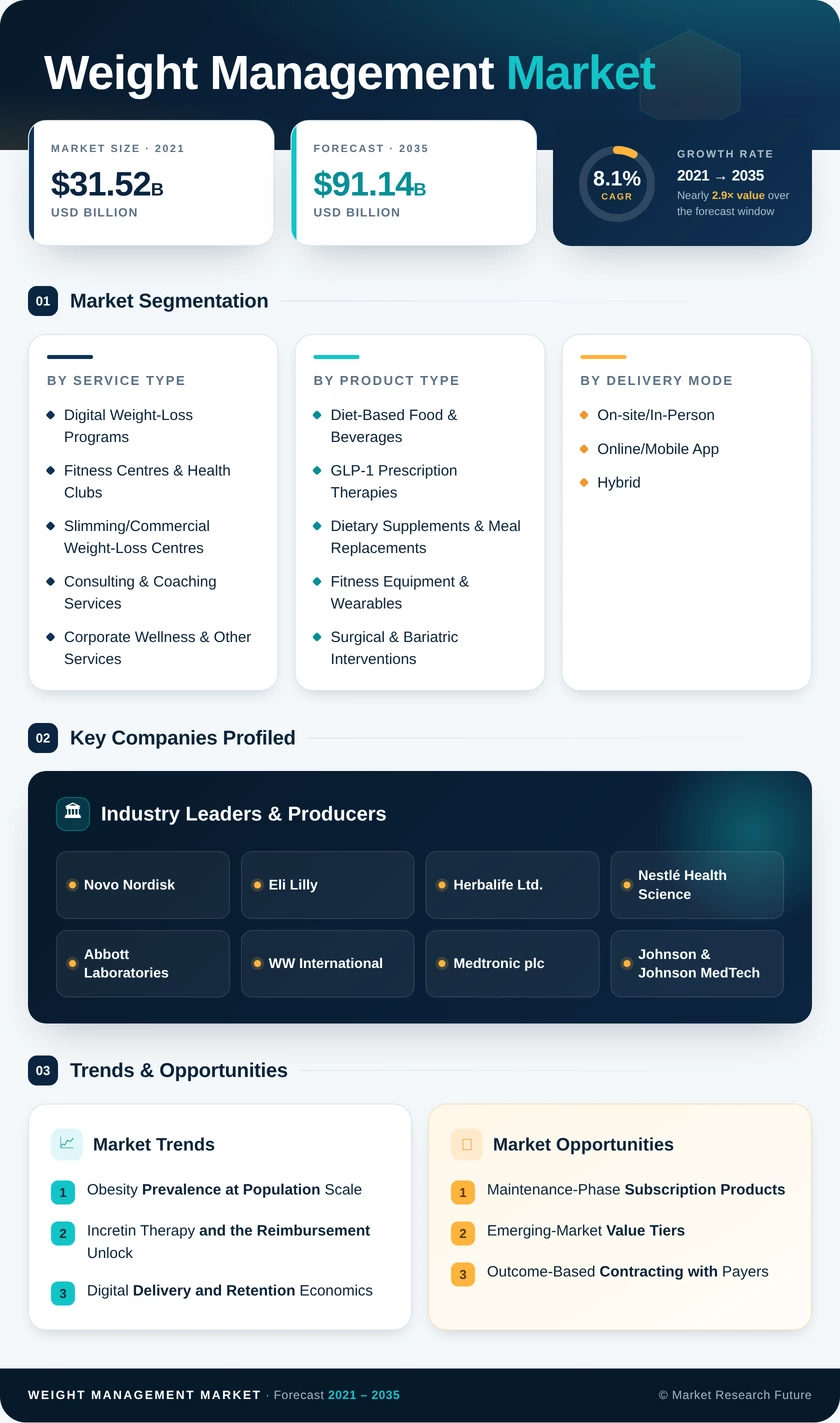
Segmentation Quick Reference
| Dimension | Sub-Segments | Dominant Segment | Fastest Growing Segment |
| By Service Type | Digital Weight-Loss Programs; Fitness Centres & Health Clubs; Slimming/Commercial Weight-Loss Centres; Consulting & Coaching Services; Corporate Wellness & Other Services | Fitness Centres & Health Clubs | Digital Weight-Loss Programs |
| By Product Type | Diet-Based Food & Beverages; GLP-1 Prescription Therapies; Dietary Supplements & Meal Replacements; Fitness Equipment & Wearables; Surgical & Bariatric Interventions | Diet-Based Food & Beverages | GLP-1 Prescription Therapies |
| By Delivery Mode | On-site/In-Person; Online/Mobile App; Hybrid | On-site/In-Person | Online/Mobile App |
| By Consumer Goal | Weight Loss; Weight Maintenance; Medical Obesity Management | Weight Loss | Medical Obesity Management |
| By Geography | North America; Europe; Asia-Pacific; South America; Middle East & Africa | North America | Asia-Pacific |
Market Segmentation Overview
By Service Type
| Sub-Segment | Key Trend |
| Digital Weight-Loss Programs | Subscription tiers now bundle supervised pharmacotherapy with coaching |
| Fitness Centres & Health Clubs | Clubs add body-composition scanning and dietitian access to defend share |
| Slimming/Commercial Weight-Loss Centres | Franchise networks consolidating; footprints shrinking in mature cities |
| Consulting & Coaching Services | Referral volume rising from primary care and endocrinology |
| Corporate Wellness & Other Services | Multi-year employer contracts with outcome clauses becoming standard |
Service economics are diverging. Fixed-cost formats defend revenue through clinical add-ons, while asset-light digital operators scale on marginal-cost-near-zero subscriber growth — a gap that will widen through 2035.
By Product Type
| Sub-Segment | Key Trend |
| Diet-Based Food & Beverages | Reformulation toward high-protein, high-fibre profiles for therapy users |
| GLP-1 Prescription Therapies | Oral formulations and capacity expansion easing access constraints |
| Dietary Supplements & Meal Replacements | Claims enforcement tightening; premium clinical positioning emerging |
| Fitness Equipment & Wearables | Connected devices monetised through data-linked coaching services |
| Surgical & Bariatric Interventions | Procedure volumes plateauing as pharmacotherapy substitutes mid-BMI cases |
Product share is being redistributed rather than expanded. Prescription therapy growth pulls spend from discretionary categories while simultaneously creating adjacent demand for protein-forward nutrition and muscle-preservation formats.
By Delivery Mode
| Sub-Segment | Key Trend |
| On-site/In-Person | Retains accountability advantage for high-BMI and post-surgical cohorts |
| Online/Mobile App | Lowest cost-to-serve; strongest growth across Asia-Pacific and Latin America |
| Hybrid | Highest twelve-month retention; preferred format in enterprise tenders |
Delivery mode is now the clearest predictor of retention. Hybrid designs pair periodic clinical contact with continuous digital engagement, capturing most of the adherence benefit of in-person care at a materially lower cost base.
By Consumer Goal
| Sub-Segment | Key Trend |
| Weight Loss | Largest pool; increasingly medicalised through supervised protocols |
| Weight Maintenance | Underserved phase; emerging low-intensity subscription tiers |
| Medical Obesity Management | Reimbursement-backed weight reduction therapies driving margin migration |
Intent determines willingness to pay. Clinically framed pathways attract insurance funding and longer contract tenures, whereas purely aesthetic demand remains discretionary and highly sensitive to macroeconomic conditions.


 Noah Malgeri
Co-Founder

 Peter Groot koerkamp
Account and Business Manager

 Younghwan Choi
Senior Retail Manager

 Mark Irwin
Management Consultant

 Akif Moroglu
Strategy & Business Development Director

 Guilherme Gomes Martins
Product Management Director

 Joseph Aguayo
Sales Operations & Pricing Manager

 La Terria Dodd
Program Support Specialist

 Rob Kooiker
Group Product Manager HVAC & Fire Protection GMA