Request Free Sample ×

Kindly complete the form below to receive a free sample of this Report

* Please use a valid business email

Leading companies partner with us for data-driven Insights

clients tt-cursor
Hero Background

Webcam Market

ID: MRFR/SEM/6572-CR
150 Pages
Ankit Gupta
November 2023

Webcam Market Size, Share and Research Report By Product (USB, Wireless), By Technology (Analog, Digital), By Distribution Channel (Brick & Mortar, E-Commerce), By End-User (Security & Surveillance, Entertainment, Videoconference, Live Events, Visual Marketing,) And By Region (North America, Europe, Asia-Pacific, Middle East & Africa, and South America) – Industry Forecast Till 2035

Share:
Download PDF ×

We do not share your information with anyone. However, we may send you emails based on your report interest from time to time. You may contact us at any time to opt-out.

Webcam Market Infographic
Purchase Options

Webcam Market Summary

As per Market Research Future analysis, the Webcam Market Size was estimated at 9.17 USD Billion in 2024. The Webcam industry is projected to grow from 9.75 USD Billion in 2025 to 17.99 USD Billion by 2035, exhibiting a compound annual growth rate (CAGR) of 6.32% during the forecast period 2025 - 2035

Key Market Trends & Highlights

The Webcam Market is experiencing robust growth driven by technological advancements and evolving consumer needs.

  • The North American region remains the largest market for webcams, reflecting a strong demand for video conferencing solutions.
  • The Asia-Pacific region is emerging as the fastest-growing market, fueled by increasing internet penetration and digital engagement.
  • The USB segment continues to dominate the market, while the wireless segment is rapidly gaining traction due to its convenience and flexibility.
  • Key market drivers include the rising demand for video conferencing and the surge in content creation, particularly in the e-learning and telehealth sectors.

Market Size & Forecast

2024 Market Size 9.17 (USD Billion)
2035 Market Size 17.99 (USD Billion)
CAGR (2025 - 2035) 6.32%

Major Players

Logitech (CH), Microsoft (US), Razer (US), Acer (TW), Dell (US), HP (US), Creative (SG), Sony (JP), ASUS (TW)

Our Impact
Enabled $4.3B Revenue Impact for Fortune 500 and Leading Multinationals
Partnering with 2000+ Global Organizations Each Year
30K+ Citations by Top-Tier Firms in the Industry

Webcam Market Trends

The Webcam Market is currently experiencing a dynamic evolution, driven by the increasing demand for high-quality video communication across various sectors. As remote work and online interactions become more prevalent, the necessity for reliable and advanced webcam technology appears to be on the rise. This trend is further fueled by the growing popularity of streaming services and content creation, which necessitate superior visual quality and enhanced features. Manufacturers are responding to these demands by innovating and introducing products that cater to both casual users and professional content creators. Moreover, the integration of artificial intelligence and machine learning into webcam technology is likely to enhance user experience significantly. Features such as automatic background blurring, facial recognition, and improved low-light performance are becoming standard in many new models. This technological advancement not only improves the functionality of webcams but also broadens their appeal to a wider audience. As the market continues to expand, it seems that the focus will remain on delivering high-performance devices that meet the evolving needs of consumers and businesses alike.

Rise of Remote Work

The Webcam Market is witnessing a notable increase in demand due to the rise of remote work. As more individuals and organizations adopt flexible work arrangements, the need for effective communication tools has surged. Webcams are essential for virtual meetings, enabling clearer interactions and fostering collaboration among remote teams.

Enhanced Streaming Capabilities

There is a growing trend towards enhanced streaming capabilities within the Webcam Market. Content creators, gamers, and influencers are seeking high-quality webcams that provide superior video resolution and frame rates. This demand is driving manufacturers to innovate and develop products that cater specifically to the needs of this segment.

Integration of Smart Features

The integration of smart features into webcams is becoming increasingly prevalent. Technologies such as AI-driven enhancements, automatic adjustments for lighting, and advanced image stabilization are being incorporated into new models. These features not only improve user experience but also make webcams more versatile for various applications.

Webcam Market Drivers

Growing E-Learning Sector

The Webcam Market is experiencing growth driven by the expanding e-learning sector. As educational institutions increasingly adopt online learning platforms, the demand for webcams has surged. Recent statistics indicate that the e-learning market is projected to reach a valuation of over 300 billion dollars by 2025, highlighting the critical role of webcams in facilitating remote education. High-quality webcams are essential for delivering interactive and engaging learning experiences, allowing educators to connect with students effectively. This trend has prompted manufacturers to focus on developing webcams that cater specifically to the needs of educators and students, incorporating features such as high-definition video, built-in microphones, and compatibility with various online learning tools. The Webcam Market is thus positioned to capitalize on the growing emphasis on digital education.

Surge in Content Creation

The Webcam Market is significantly influenced by the rising trend of content creation across various platforms. With the proliferation of social media and streaming services, individuals and businesses are increasingly investing in high-quality webcams to produce engaging content. Data indicates that the number of content creators has doubled in recent years, leading to a heightened demand for webcams that deliver exceptional video quality and performance. This trend is particularly evident among gamers, vloggers, and educators who require reliable equipment for live streaming and online tutorials. As a result, manufacturers are innovating to provide advanced features such as 4K resolution, low-light performance, and integrated software solutions. The Webcam Market is thus positioned to benefit from this growing community of content creators seeking to enhance their production quality.

Integration of Artificial Intelligence

The integration of artificial intelligence (AI) into webcam technology is emerging as a transformative driver within the Webcam Market. AI capabilities enable features such as facial recognition, background blurring, and automatic framing, which enhance user experience and functionality. This technological advancement is particularly appealing to professionals who require seamless video quality during virtual meetings. Market analysis suggests that the adoption of AI-driven webcams is expected to increase by over 20% in the coming years, as users seek devices that can adapt to their environments and improve video clarity. Furthermore, the incorporation of AI can lead to more efficient bandwidth usage, making it a compelling choice for users in areas with limited internet connectivity. The Webcam Market is thus evolving to meet the demands of a tech-savvy audience that values innovation.

Increased Demand for Video Conferencing

The Webcam Market experiences a notable surge in demand for video conferencing solutions. As organizations increasingly adopt remote work policies, the necessity for high-quality webcams has become paramount. According to recent data, the video conferencing segment is projected to grow at a compound annual growth rate of approximately 15% over the next five years. This growth is driven by the need for effective communication tools that facilitate collaboration among remote teams. Consequently, manufacturers are focusing on developing webcams that offer superior video quality, enhanced audio features, and user-friendly interfaces. The Webcam Market is thus witnessing innovations aimed at meeting the evolving needs of businesses and individuals alike, ensuring that video conferencing remains a viable alternative to in-person meetings.

Rising Popularity of Telehealth Services

The Webcam Market is significantly impacted by the increasing popularity of telehealth services. As healthcare providers expand their offerings to include virtual consultations, the demand for reliable webcams has intensified. Data suggests that the telehealth market is expected to grow at a rate of approximately 25% annually, driven by the need for accessible healthcare solutions. Webcams play a crucial role in enabling healthcare professionals to conduct remote consultations, ensuring that patients receive timely medical advice. This trend has led to innovations in webcam technology, with manufacturers focusing on features such as enhanced image quality and secure data transmission. The Webcam Market is thus adapting to meet the specific requirements of the healthcare sector, ensuring that telehealth services remain effective and user-friendly.

Market Segment Insights

By Product: USB (Largest) vs. Wireless (Fastest-Growing)

In the webcam market, the USB segment dominates with a significant share, making it the preferred choice among consumers and businesses alike. This popularity stems from its widespread compatibility and reliability, providing consistent performance across various platforms. In contrast, the Wireless segment, while smaller in market share, is rapidly gaining traction, especially among tech-savvy users who prioritize mobility and convenience.

USB (Dominant) vs. Wireless (Emerging)

The USB webcam segment is characterized by its robust demand due to its compatibility with most computers and devices, along with its straightforward plug-and-play installation. As remote work and online communication continue to rise, USB webcams are favored for their stability and high-quality image capture. On the other hand, the Wireless segment, which offers untethered functionality, is emerging as a favorite among users looking for versatility and ease of use. With advancements in battery technology and streaming quality, wireless webcams are expected to appeal to a growing segment of users who value flexibility in their stream setups.

By Technology: Digital (Largest) vs. Analog (Fastest-Growing)

In the Webcam Market, the Digital segment holds the largest market share, driven by advancements in technology and consumer preferences for high-definition video quality. Digital webcams are widely adopted in various sectors, including education and corporate communications, as they offer superior image clarity and functionality. On the other hand, the Analog segment, while smaller, remains significant as it appeals to consumers in niche markets who prefer traditional technology and are often drawn by lower costs and simplicity.

Technology: Digital (Dominant) vs. Analog (Emerging)

Digital webcams are the dominant technology in the Webcam Market, characterized by high-resolution capabilities, advanced features like autofocus, and integration with modern devices. Their versatility makes them ideal for diverse applications, from video conferencing to streaming. Conversely, the Analog segment is seen as emerging, as it captures a specific audience that values the straightforward use and affordability associated with traditional webcam technology. While Analog webcams lag in advanced features, their appeal lies in being less complex and more accessible for budget-conscious consumers. As such, both segments serve distinct markets and preferences, contributing to a balanced technology ecosystem.

By Distribution Channel: E-Commerce (Largest) vs. Brick & Mortar (Fastest-Growing)

In the Webcam Market, E-Commerce currently dominates the distribution channels, capturing the largest share of consumer purchases. This trend has been accelerated by the convenience of online shopping, appealing to a broad demographic seeking various webcam brands and features. On the other hand, Brick & Mortar stores, while holding a smaller market share, have witnessed a resurgence, particularly in urban areas where consumers prefer hands-on experience before making a purchase. The tactile nature of in-store shopping enhances consumer confidence in product quality and suitability. The growth of E-Commerce in the Webcam Market continues to be driven by advancements in technology and increased internet penetration. Events such as the rise of remote work and online learning have significantly boosted demand for webcams, pushing retailers to optimize their online presence. Conversely, Brick & Mortar stores are adapting by integrating experiential retail strategies, offering personalized services, and creating engaging in-store displays to attract customers. Overall, both channels are expected to evolve, catering to diverse consumer preferences as the market grows.

E-Commerce (Dominant) vs. Brick & Mortar (Emerging)

E-Commerce stands as the dominant player in the Webcam Market distribution channels, capitalizing on the surge in digital buying habits and the demand for a wide array of products. This channel offers unparalleled convenience, allowing consumers to compare prices, read detailed reviews, and have products delivered directly to their homes. The competitive landscape is further enhanced by online retailers offering special promotions and bundled products, appealing to budget-conscious buyers. Conversely, Brick & Mortar stores are emerging as a viable option in the webcam market, as consumers increasingly value the opportunity to interact with products physically. These stores are focusing on creating immersive shopping experiences, expert advice, and immediate product availability, addressing the need for a personal touch and reassurance that online purchasing sometimes lacks. With evolving strategies, both channels are essential in meeting the demands of diverse consumer behaviors.

By End-User: Videoconference (Largest) vs. Security & Surveillance (Fastest-Growing)

The Webcam Market has a diverse range of end-user segments, with the videoconference category holding the largest share. This is driven by the rise of remote work and virtual meetings, creating a substantial demand for high-quality webcams. Following videoconferencing, segments such as entertainment and live events also contribute to market dynamics, but security and surveillance is quickly gaining traction. The latter reflects a growing awareness of the need for security solutions in both personal and commercial settings. In recent years, sectors like security and surveillance have experienced rapid growth, fueled by technological advancements and the proliferation of smart home devices. The increased focus on remote monitoring and the integration of webcams into various security systems are key drivers for this segment. Meanwhile, entertainment and videoconferencing segments continue to evolve, driven by high-definition video quality and an increasing number of online interactions across platforms.

Videoconferencing (Dominant) vs. Security & Surveillance (Emerging)

Videoconferencing has established itself as the dominant segment in the webcam market, characterized by its essential role in facilitating virtual meetings and communication. This segment appeals to businesses and individuals seeking to enhance their online interactions through clear visuals and sound. Companies are investing in high-definition webcams to improve meeting experiences, leading to a strong demand for quality video solutions. In contrast, the security and surveillance segment is emerging, as it adapts to modern technological trends such as remote monitoring and AI-enhanced features. Security webcams are increasingly integrated into smart home systems, providing users with real-time monitoring capabilities, thus expanding their market presence and driving innovation in the sector.

Get more detailed insights about Webcam Market

Regional Insights

North America : Tech-Driven Market Growth

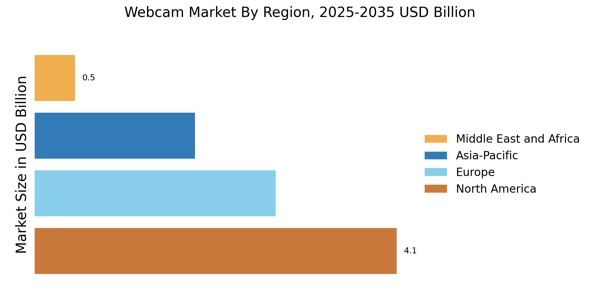
North America is the largest market for webcams, accounting for approximately 45% of the global share. The growth is driven by the increasing demand for remote work solutions and online education, alongside advancements in technology. Regulatory support for digital infrastructure and cybersecurity is also a significant catalyst for market expansion. The U.S. and Canada are the primary contributors to this growth, with a strong focus on innovation and quality standards. The competitive landscape in North America is dominated by key players such as Logitech, Microsoft, and Razer. These companies are continuously innovating to meet the rising demand for high-quality webcams. The presence of major tech hubs in cities like Silicon Valley and Seattle further enhances the market's growth potential. Additionally, partnerships with educational institutions and businesses are fostering a robust ecosystem for webcam adoption.

Europe : Emerging Market with Potential

Europe is the second-largest market for webcams, holding around 30% of the global share. The region is experiencing significant growth due to the increasing adoption of digital communication tools and remote working practices. Regulatory initiatives aimed at enhancing digital connectivity and cybersecurity are also propelling market demand. Countries like Germany and the UK are leading this growth, supported by favorable government policies and investments in technology infrastructure. Leading countries in Europe include Germany, the UK, and France, where the presence of major players like Logitech and Microsoft is notable. The competitive landscape is characterized by a mix of established brands and emerging startups focusing on innovative webcam solutions. The European market is also witnessing collaborations between tech companies and educational institutions to enhance digital learning experiences, further driving demand.

Asia-Pacific : Rapid Growth and Innovation

Asia-Pacific is witnessing rapid growth in the webcam market, accounting for approximately 20% of the global share. The region's expansion is driven by increasing internet penetration, the rise of e-commerce, and a growing emphasis on online education. Countries like China and India are at the forefront, supported by government initiatives aimed at enhancing digital literacy and connectivity. The regulatory environment is becoming more favorable, encouraging investments in technology and innovation. China, Japan, and India are the leading countries in this region, with a competitive landscape featuring both local and international players. Companies like Acer and ASUS are capitalizing on the growing demand for affordable yet high-quality webcams. The presence of a large consumer base and increasing disposable incomes are further fueling market growth, making Asia-Pacific a key player in The Webcam Market.

Middle East and Africa : Untapped Market Opportunities

The Middle East and Africa region is gradually emerging in the webcam market, holding about 5% of the global share. The growth is primarily driven by increasing internet access and the rising trend of remote work and online education. Countries like South Africa and the UAE are leading this growth, supported by government initiatives aimed at improving digital infrastructure and connectivity. The regulatory landscape is evolving, creating opportunities for market expansion and investment. In this region, the competitive landscape is still developing, with a mix of local and international players. Companies like Creative and Sony are establishing a presence, focusing on affordable webcam solutions tailored to the needs of consumers. The growing youth population and increasing demand for digital communication tools are expected to drive further growth in the coming years, making this region a potential hotspot for webcam market development.

Webcam Market Regional Image

Key Players and Competitive Insights

The Webcam Market is currently characterized by a dynamic competitive landscape, driven by rapid technological advancements and increasing demand for high-quality video communication solutions. Major players such as Logitech (CH), Microsoft (US), and Razer (US) are at the forefront, each adopting distinct strategies to enhance their market positioning. Logitech (CH) continues to focus on innovation, particularly in developing advanced features for remote work and gaming applications, while Microsoft (US) leverages its software ecosystem to integrate webcams seamlessly into its Teams platform. Razer (US), known for its gaming peripherals, emphasizes high-performance webcams tailored for streamers, thus catering to a niche yet growing segment of the market. Collectively, these strategies contribute to a competitive environment that is increasingly centered around technological differentiation and user experience.In terms of business tactics, companies are increasingly localizing manufacturing to mitigate supply chain disruptions and optimize logistics. This approach appears to be particularly relevant in the context of the Webcam Market, which is moderately fragmented, with several key players vying for market share. The collective influence of these companies shapes a landscape where innovation and operational efficiency are paramount, allowing them to respond swiftly to changing consumer preferences and market demands.

In August Logitech (CH) announced the launch of its new line of AI-powered webcams designed to enhance video quality through real-time image processing. This strategic move not only reinforces Logitech's commitment to innovation but also positions the company to capture a larger share of the remote work and content creation markets. The integration of AI technology into their products is likely to set a new standard for video quality, thereby enhancing user engagement and satisfaction.

In September Microsoft (US) unveiled a partnership with a leading cloud service provider to enhance the functionality of its webcams within the Teams platform. This collaboration aims to improve video conferencing capabilities by integrating cloud-based features such as virtual backgrounds and enhanced security measures. Such strategic alliances indicate Microsoft's focus on creating a comprehensive ecosystem that supports remote collaboration, potentially increasing user retention and attracting new customers.

In July Razer (US) expanded its product line by introducing a webcam specifically designed for gamers, featuring customizable lighting and high-definition streaming capabilities. This launch reflects Razer's strategy to cater to the growing demand for specialized gaming equipment, thereby solidifying its position in the competitive landscape. By focusing on the unique needs of gamers, Razer is likely to enhance brand loyalty and drive sales in this niche market.

As of October the Webcam Market is witnessing trends that emphasize digitalization, sustainability, and the integration of artificial intelligence. Companies are increasingly forming strategic alliances to enhance their technological capabilities and market reach. The competitive differentiation is shifting from price-based competition to a focus on innovation, technology, and supply chain reliability. This evolution suggests that future success in the Webcam Market will hinge on the ability to deliver cutting-edge solutions that meet the diverse needs of consumers.

Key Companies in the Webcam Market include

Industry Developments

  • In August 2023, EPOS Expand Vision 1 review, the webcam is a fusion of sleek design & 4K clarity. The Expand Vision 1 is touted to be the ideal addition to one’s hybrid work setup. When operating remotely, the clarity of the transmitted image matters a lot. In my experience, the 4K resolution does not disappoint. From dimly lit offices to sunlit rooms, the visuals come across crisp.
  • In June 2023, BenQ introduced two new webcams for professionals seeking high-quality video conferencing solutions: the Ideacam S1 Pro and Ideacam S1 Plus. These cameras include numerous shooting modes and an 8MP Sony CMOS sensor. The Ideacam S1 series boasts a resolution of up to 3264x2448 p and a 15X macro lens that can zoom in on any surface or material to provide detailed photos.
  • In August 2022, Insta360 announced the release of a new AI-powered webcam (Link). The Insta360 Link is a 4K AI-powered webcam with a three-axis gimbal. It is very handy while educating, presenting, or live broadcasting. Here's a quick rundown of what this camera has to offer.

Future Outlook

Webcam Market Future Outlook

The Webcam Market is projected to grow at a 6.32% CAGR from 2025 to 2035, driven by increasing remote work, online education, and demand for high-quality video streaming.

New opportunities lie in:

  • Development of AI-enhanced webcams for improved user experience.
  • Expansion into smart home integration for seamless connectivity.
  • Creation of subscription-based services for premium video features.

By 2035, the Webcam Market is expected to be robust, reflecting substantial growth and innovation.

Market Segmentation

Webcam Market Product Outlook

  • USB
  • Wireless

Webcam Market End-User Outlook

  • Security & Surveillance
  • Entertainment
  • Videoconference
  • Live Events
  • Visual Marketing
  • Others

Webcam Market Technology Outlook

  • Analog
  • Digital

Webcam Market Distribution Channel Outlook

  • Brick & Mortar
  • E-Commerce

Report Scope

MARKET SIZE 2024 9.17(USD Billion)
MARKET SIZE 2025 9.75(USD Billion)
MARKET SIZE 2035 17.99(USD Billion)
COMPOUND ANNUAL GROWTH RATE (CAGR) 6.32% (2025 - 2035)
REPORT COVERAGE Revenue Forecast, Competitive Landscape, Growth Factors, and Trends
BASE YEAR 2024
Market Forecast Period 2025 - 2035
Historical Data 2019 - 2024
Market Forecast Units USD Billion
Key Companies Profiled Logitech (CH), Microsoft (US), Razer (US), Acer (TW), Dell (US), HP (US), Creative (SG), Sony (JP), ASUS (TW)
Segments Covered Product, Technology, Distribution Channel, End-User, Region
Key Market Opportunities Integration of artificial intelligence for enhanced video quality and user experience in the Webcam Market.
Key Market Dynamics Rising demand for high-definition video quality drives innovation and competition in the webcam market.
Countries Covered North America, Europe, APAC, South America, MEA

Market Highlights

Author
Author
Author Profile
Ankit Gupta LinkedIn
Team Lead - Research
Ankit Gupta is a seasoned market intelligence and strategic research professional with over six plus years of experience in the ICT and Semiconductor industries. With academic roots in Telecom, Marketing, and Electronics, he blends technical insight with business strategy. Ankit has led 200+ projects, including work for Fortune 500 clients like Microsoft and Rio Tinto, covering market sizing, tech forecasting, and go-to-market strategies. Known for bridging engineering and enterprise decision-making, his insights support growth, innovation, and investment planning across diverse technology markets.
Co-Author
Co-Author Profile
Shubham Munde LinkedIn
Team Lead - Research
Shubham brings over 7 years of expertise in Market Intelligence and Strategic Consulting, with a strong focus on the Automotive, Aerospace, and Defense sectors. Backed by a solid foundation in semiconductors, electronics, and software, he has successfully delivered high-impact syndicated and custom research on a global scale. His core strengths include market sizing, forecasting, competitive intelligence, consumer insights, and supply chain mapping. Widely recognized for developing scalable growth strategies, Shubham empowers clients to navigate complex markets and achieve a lasting competitive edge. Trusted by start-ups and Fortune 500 companies alike, he consistently converts challenges into strategic opportunities that drive sustainable growth.
Leave a Comment

FAQs

What is the projected market valuation of the Webcam Market by 2035?

The Webcam Market is projected to reach a valuation of 17.99 USD Billion by 2035.

What was the market valuation of the Webcam Market in 2024?

In 2024, the Webcam Market had a valuation of 9.17 USD Billion.

What is the expected CAGR for the Webcam Market during the forecast period 2025 - 2035?

The expected CAGR for the Webcam Market during the forecast period 2025 - 2035 is 6.32%.

Which companies are considered key players in the Webcam Market?

Key players in the Webcam Market include Logitech, Microsoft, Razer, Acer, Dell, HP, Creative, Sony, and ASUS.

What are the projected revenues for USB and Wireless webcams by 2035?

By 2035, USB webcams are projected to generate revenues between 10.0 USD Billion, while Wireless webcams may reach 7.99 USD Billion.

How do the revenues from E-Commerce and Brick & Mortar distribution channels compare in 2035?

In 2035, E-Commerce is expected to generate revenues of 10.87 USD Billion, surpassing Brick & Mortar's projected 7.12 USD Billion.

What are the expected revenue figures for Digital and Analog webcam technologies by 2035?

By 2035, Digital webcam technology is projected to generate revenues of 12.74 USD Billion, while Analog technology may reach 5.25 USD Billion.

Which end-user segments are anticipated to drive growth in the Webcam Market?

The Videoconference segment is expected to drive growth, with projected revenues of 5.0 USD Billion by 2035, alongside Entertainment and Security & Surveillance.

What is the revenue outlook for the Live Events and Visual Marketing segments by 2035?

By 2035, the Live Events segment is projected to generate 2.0 USD Billion, while Visual Marketing may reach 2.0 USD Billion.

How does the Webcam Market's growth potential compare across different segments?

The Webcam Market's growth potential appears robust across segments, with notable increases in Digital technology and E-Commerce distribution channels.

Research Approach

Secondary Research

The secondary research process involved comprehensive analysis of regulatory databases, industry standards, consumer electronics associations, and authoritative technology publications. Key sources included the Federal Communications Commission (FCC), European Telecommunications Standards Institute (ETSI), International Electrotechnical Commission (IEC), National Institute of Standards and Technology (NIST), British Standards Institution (BSI), Consumer Technology Association (CTA), Telecommunications Industry Association (TIA), International Organization for Standardization (ISO) technical committees for imaging equipment, National Center for Education Statistics (NCES), Bureau of Labor Statistics (BLS) remote work data, OECD Broadband Statistics, Eurostat Digital Economy and Society Database, China Ministry of Industry and Information Technology (MIIT), , and national telecommunications authority reports from key markets.

These sources were employed to compile shipment statistics, regulatory compliance data, connectivity standards, trends in remote work adoption, e-learning infrastructure analysis, and competitive landscape mapping for USB webcams, wireless webcams, analog systems, and digital imaging technologies.

Primary Research

Qualitative and quantitative insights were obtained by interviewing supply-side and demand-side stakeholders during the primary research process. CEOs, VPs of Product Management, hardware engineering leaders, and commercial directors from webcam manufacturers, ODMs, and optical sensor suppliers comprised supply-side sources. Chief Information Officers (CIOs), IT procurement managers, educational technology directors, security system integrators, and content production leads from enterprise corporations, educational institutions, healthcare systems, and digital media agencies constituted demand-side sources. Market segmentation was verified, product roadmap timelines were confirmed, and insights regarding technology adoption patterns, pricing strategies, and distribution channel dynamics were obtained through primary research.

Primary Respondent Breakdown:

• By Designation: C-level Primaries (40%), Director Level (30%), Others (30%)

• By Region: North America (38%), Europe (25%), Asia-Pacific (32%), Rest of World (5%)

Market Size Estimation

Revenue mapping and shipment volume analysis were implemented to determine global market valuation. The methodology comprised the following:

Identification of over 45 significant manufacturers in North America, Europe, Asia-Pacific, and Latin America

Product mapping across analog, digital, wireless, and Wi-Fi-enabled imaging categories

Analysis of annual revenues that are specific to webcam product portfolios, as reported and modeled

Manufacturers that account for 70-75% of the global market share in 2024 are included in the coverage.

For the security & surveillance, videoconferencing, entertainment, live events, and visual marketing end-use segments, segment-specific valuations are derived through extrapolation using bottom-up (shipment volume × ASP by country) and top-down (manufacturer revenue validation) approaches.

Download Free Sample

Kindly complete the form below to receive a free sample of this Report

Compare Licence

×
Features License Type
Single User Multiuser License Enterprise User
Price $4,950 $5,950 $7,250
Maximum User Access Limit 1 User Upto 10 Users Unrestricted Access Throughout the Organization
Free Customization
Direct Access to Analyst
Deliverable Format
Platform Access
Discount on Next Purchase 10% 15% 15%
Printable Versions