
Request Free Sample ×

Kindly complete the form below to receive a free sample of this Report

* Please use a valid business email

Leading companies partner with us for data-driven Insights

clients tt-cursor
Hero Background
English
Chinese
French
Japanese
Korean
German
Spanish

Web3 in E-Commerce Retail Market Analysis

ID: MRFR/ICT/10728-HCR
128 Pages
Ankit Gupta
Last Updated: April 06, 2026

Web3 in E-Commerce & Retail Market Research Report Information By Type (Public, Private, Consortium, Hybrid), By Application (Cryptocurrency, Conversational AI, Data & Transaction Storage, Payments, Smart Contracts, Others) And By Region (North America, Europe, Asia-Pacific, And Rest Of The World) –Market Forecast Till 2035.

Share:
Download PDF ×

We do not share your information with anyone. However, we may send you emails based on your report interest from time to time. You may contact us at any time to opt-out.

Web3 in E-Commerce Retail Market Infographic
Purchase Options

Market Analysis

In-depth Analysis of Web3 in E-Commerce Retail Market Industry Landscape

By utilizing blockchain technology, Web3 is revolutionizing e-commerce and retail markets into a decentralized platform interwoven by an ecosystem. Firstly, transaction security is guaranteed since Web3 is decentralized. The blockchain technology that underpins Web3 provides secure storage of data that cannot be tampered with, thereby minimizing fraud and creating trust among consumers. In addition to this, it eliminates intermediaries, leading to a peer-to-peer economy, hence low costs associated with peer-to-peer transactions, unlike traditional e-commerce platforms, which engage intermediaries, resulting in high fees charged due to longer processing times before clearing takes place. Web3's key feature is that smart contracts automate contractual agreements without involving third parties when they execute them accordingly. In reference to e-commerce & retail, this translates to faster and more reliable transactions. Smart contracts can be used for many purposes, including order fulfillment, payment processing, and supply chain management. Furthermore, Web3 is heavily focused on decentralized finance (DeFi); thus, it has a significant impact on e-commerce and retail markets. This means that businesses have alternatives for financing and streamlining their financial operations due to the increasing availability of decentralized financial services. With more inclusive finances, smaller firms are now able to compete on an equal footing with established players in the industry, and this fosters market innovation and diversity. Moreover, one important market factor associated with Web3 is the integration of non-fungible tokens (NFTs) into e-commerce and retail sectors. NFTs offer tokenization of digital or physical assets, which enables businesses to produce unique and scarce products that are different from others. The E-commerce & Retail Market does not only rely on different platforms but also needs interoperability for its success in terms of web3 technologies being used across platforms where they can be applied as well as other devices all over the world today. There is better coordination between various links of supply chains through seamlessness sharing data within them, thereby enhancing collaboration among actors involved in such chains both within organizations operating internationally or locally, leading to improved operations throughout these channels, for example, multinational corporations who usually centralize their supply chain activities can optimize them cut down redundant costs caused by inefficiencies so that they could serve end users much better by responding quicker whenever there is need to do so.


Author
Author Profile
Ankit Gupta
Team Lead - Research

Ankit Gupta is a seasoned market intelligence and strategic research professional with over six plus years of experience in the ICT and Semiconductor industries. With academic roots in Telecom, Marketing, and Electronics, he blends technical insight with business strategy. Ankit has led 200+ projects, including work for Fortune 500 clients like Microsoft and Rio Tinto, covering market sizing, tech forecasting, and go-to-market strategies. Known for bridging engineering and enterprise decision-making, his insights support growth, innovation, and investment planning across diverse technology markets.

Leave a Comment

FAQs

What is the projected market valuation for Web3 in E-Commerce & Retail by 2035?

<p>The projected market valuation for Web3 in E-Commerce & Retail is expected to reach 824.02 USD Billion by 2035.</p>

What was the market valuation for Web3 in E-Commerce & Retail in 2024?

<p>The overall market valuation for Web3 in E-Commerce & Retail was 13.02 USD Billion in 2024.</p>

What is the expected CAGR for the Web3 in E-Commerce & Retail Market from 2025 to 2035?

<p>The expected CAGR for the Web3 in E-Commerce & Retail Market during the forecast period 2025 - 2035 is 45.8%.</p>

Which companies are considered key players in the Web3 in E-Commerce & Retail Market?

<p>Key players in the market include Amazon, Alibaba, Walmart, Shopify, eBay, Rakuten, Zalando, JD.com, and Pinduoduo.</p>

What are the main segments of the Web3 in E-Commerce & Retail Market?

<p>The main segments include Type and Application, with various subcategories such as Public, Private, Cryptocurrency, and Payments.</p>

How much is the Payments segment valued at in the Web3 in E-Commerce & Retail Market?

<p>The Payments segment is valued at 3.0 USD Billion, indicating its importance in the market.</p>

What is the valuation of the Data & Transaction Storage application in the market?

The Data &amp; Transaction Storage application is valued at 3.0 USD Billion, reflecting its critical role in Web3.

What does the market data suggest about the growth of Cryptocurrency in Web3 E-Commerce?

The Cryptocurrency segment is valued at 2.5 USD Billion, suggesting a growing interest in digital currencies within E-Commerce.

How does the market performance of Private and Public segments compare?

The Private segment is valued at 4.02 USD Billion, while the Public segment is valued at 3.91 USD Billion, indicating a competitive landscape.

What might be the implications of the projected growth for retailers in the Web3 space?

The projected growth could lead to increased investment and innovation among retailers, enhancing customer experiences and operational efficiencies.

Market Summary

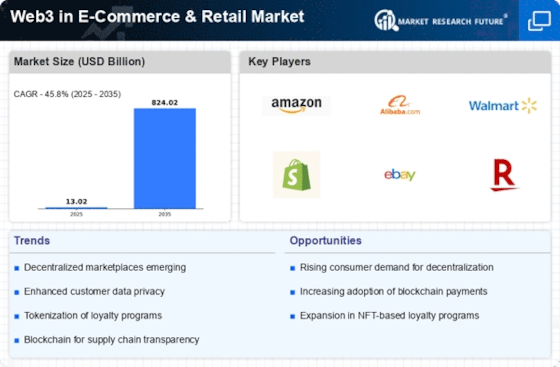
As per Market Research Future analysis, the Web3 in E-Commerce & Retail Market was estimated at 13.02 USD Billion in 2024. The Web3 in E-Commerce & Retail industry is projected to grow from 18.98 USD Billion in 2025 to 824.02 USD Billion by 2035, exhibiting a compound annual growth rate (CAGR) of 45.8% during the forecast period 2025 - 2035

Key Market Trends & Highlights

The Web3 in E-Commerce and Retail Market is evolving towards decentralized solutions and enhanced customer engagement.

  • Decentralized identity solutions are gaining traction in North America, facilitating secure customer interactions. The tokenization of assets is becoming increasingly prevalent in the Asia-Pacific region, driving new business models. Enhanced customer engagement through Web3 technologies is reshaping the public segment, which remains the largest in the market. Market drivers such as decentralized finance integration and NFTs as new revenue streams are propelling growth in the private and cryptocurrency segments.

Market Size & Forecast

2024 Market Size 13.02 (USD Billion)
2035 Market Size 824.02 (USD Billion)
CAGR (2025 - 2035) 45.8%
Largest Regional Market Share in 2024 North America

Major Players

Amazon (US), Alibaba (CN), Walmart (US), Shopify (CA), eBay (US), Rakuten (JP), Zalando (DE), JD.com (CN), Pinduoduo (CN)

Market Trends

The Web3 in E-Commerce & Retail Market is currently undergoing a transformative phase, characterized by the integration of decentralized technologies that enhance consumer engagement and streamline transactions. This evolution appears to be driven by a growing demand for transparency, security, and user control over personal data. As businesses increasingly adopt blockchain solutions, they seem to foster trust and loyalty among consumers, who are becoming more discerning about their online interactions. Furthermore, the rise of decentralized finance (DeFi) is likely to reshape payment systems, enabling seamless cross-border transactions and reducing reliance on traditional banking infrastructures. In addition, the emergence of non-fungible tokens (NFTs) is creating new avenues for brands to connect with their audiences. Retailers are exploring innovative ways to leverage NFTs for exclusive product offerings and loyalty programs, which may enhance customer retention. The Web3 in E-Commerce & Retail Market appears poised for substantial growth, as companies navigate the complexities of this new digital landscape. As the market evolves, it is essential for stakeholders to remain agile and responsive to emerging trends, ensuring they capitalize on the opportunities presented by this paradigm shift.

Decentralized Identity Solutions

The adoption of decentralized identity solutions is gaining traction, allowing consumers to manage their personal information securely. This trend may lead to enhanced privacy and control, as users can choose what data to share with retailers, potentially transforming the customer experience.

Tokenization of Assets

Tokenization of assets is emerging as a pivotal trend, enabling retailers to convert physical goods into digital tokens. This process could facilitate fractional ownership and broaden access to high-value items, thereby attracting a diverse range of consumers.

Enhanced Customer Engagement through Web3

Web3 technologies are fostering deeper customer engagement by enabling interactive and immersive shopping experiences. Retailers are likely to utilize augmented reality and virtual reality to create unique environments, enhancing the overall shopping journey.

Web3 in E-Commerce Retail Market Market Drivers

NFTs as New Revenue Streams

Non-fungible tokens (NFTs) are becoming a transformative element in the Web3 in E-Commerce & Retail Market, providing retailers with innovative ways to generate revenue. By creating unique digital assets, brands can engage customers in novel ways, such as offering exclusive products or experiences. The NFT market has seen explosive growth, with sales reaching over 10 billion USD in 2025 alone. This trend suggests that retailers who embrace NFTs may not only enhance their brand visibility but also tap into new customer segments, particularly among younger, tech-savvy consumers who value digital ownership.

Community-Driven Marketplaces

The rise of community-driven marketplaces is reshaping the Web3 in E-Commerce & Retail Market, as consumers increasingly seek platforms that prioritize user engagement and collaboration. These decentralized marketplaces allow users to participate in decision-making processes, fostering a sense of ownership and loyalty. Research indicates that platforms with community governance models can see up to 50% higher user retention rates. By leveraging community input, retailers can better align their offerings with consumer preferences, potentially leading to increased sales and customer satisfaction.

Smart Contracts for Automation

Smart contracts are emerging as a pivotal driver in the Web3 in E-Commerce & Retail Market, enabling automated transactions and agreements without the need for intermediaries. These self-executing contracts, coded on blockchain platforms, can streamline processes such as order fulfillment and payment processing. The potential for reducing operational costs is significant, with estimates suggesting that businesses could save up to 30% in transaction costs by implementing smart contracts. Furthermore, the transparency and immutability of these contracts enhance trust between consumers and retailers, potentially leading to increased customer loyalty and repeat purchases.

Decentralized Finance Integration

The integration of decentralized finance (DeFi) into the Web3 in E-Commerce & Retail Market is reshaping traditional payment systems. By leveraging blockchain technology, businesses can facilitate peer-to-peer transactions without intermediaries, reducing costs and increasing transaction speed. In 2025, it is estimated that the DeFi market could reach a valuation of over 200 billion USD, indicating a substantial shift in how financial transactions are conducted. This integration not only enhances security but also provides consumers with more control over their financial data. As retailers adopt DeFi solutions, they may experience improved cash flow and reduced fraud, thereby fostering a more resilient e-commerce ecosystem.

Enhanced Data Privacy and Security

In an era where data breaches are increasingly common, the Web3 in E-Commerce & Retail Market offers enhanced data privacy and security through decentralized systems. By utilizing blockchain technology, businesses can ensure that customer data is stored securely and accessed only by authorized parties. This shift is particularly relevant as consumers become more aware of their data rights; a recent survey indicated that 70% of consumers are concerned about how their data is used. By prioritizing data privacy, retailers can build stronger relationships with their customers, fostering trust and encouraging more frequent transactions.

Market Segment Insights

By Type: Public (Largest) vs. Private (Fastest-Growing)

<p>In the Web3 in E-Commerce & Retail Market, the distribution of market share among the various type segments reveals significant insights. The Public segment stands out as the largest, driven by its widespread adoption and integration into mainstream e-commerce platforms. Conversely, the Private segment is gaining traction, rapidly expanding its footprint as businesses seek secure, tailored solutions to enhance customer engagement and streamline operations. As businesses increasingly recognize the potential of blockchain technology, growth trends are heavily influenced by factors such as rising demand for transparency, enhanced security, and a focus on data privacy. The Private segment, in particular, is characterized by its flexible framework, attracting retailers looking for innovative solutions that cater to specific operational needs. Meanwhile, the Public segment benefits from a robust ecosystem promoting open access and interoperability, further solidifying its leading position in the market.</p>

<p>Public (Dominant) vs. Private (Emerging)</p>

<p>The Public segment in the Web3 in E-Commerce & Retail Market dominates the landscape with its expansive reach and ability to facilitate open transactions across diverse platforms. This type allows for unrestricted access to a network that encourages innovation and collaboration among various stakeholders, thereby driving overall market growth. On the other hand, the Private segment is considered an emerging player, characterized by its focus on creating tailored blockchain solutions for specific enterprises. This type prioritizes security and control, appealing to businesses that require a confidential environment to manage sensitive user data and transactions. As companies increasingly prioritize user privacy and personalized experiences, the Private segment's position is set to strengthen significantly, offering dynamic solutions that can adapt to evolving market demands.</p>

By Application: Payments (Largest) vs. Cryptocurrency (Fastest-Growing)

<p>In the Web3 in E-Commerce & Retail Market, Payments emerge as the largest application segment, commanding a significant market share. This dominance is attributed to the growing adoption of blockchain-based payment systems that offer enhanced security and efficiency. Conversely, Cryptocurrency has rapidly gained traction, showcasing itself as the fastest-growing application. This surge is driven by increasing consumer interest in decentralized finance, as well as the rise of digital currencies becoming increasingly accepted by major retailers.</p>

<p>Payments (Dominant) vs. Cryptocurrency (Emerging)</p>

<p>Payments in the Web3 in E-Commerce & Retail Market represent a mature and widely adopted segment, enabling seamless transaction processing with minimal fees. This segment focuses on integrating blockchain technology to facilitate secure and instant transactions, attracting both consumers and businesses. On the other hand, Cryptocurrency is emerging as a vital component of this market, appealing to users seeking decentralized alternatives to traditional payment methods. Its potential for value appreciation and decentralization positions it strategically in today’s digital economy. As more retailers start accepting cryptocurrencies, consumer confidence is expected to grow, further fueling its adoption.</p>

Get more detailed insights about Web3 in E-Commerce & Retail Market Research Report – Forecast till 2035

Regional Insights

North America : Digital Innovation Leader

North America is poised to dominate the Web3 in E-Commerce & Retail market, holding approximately 45% of the global share. Key growth drivers include increasing consumer demand for decentralized platforms, enhanced security, and transparency in transactions. Regulatory support from government initiatives is also fostering innovation, making it a fertile ground for Web3 technologies. The U.S. and Canada are the largest markets, with the U.S. alone accounting for about 35% of the market share. Leading the charge in this region are major players like Amazon, Walmart, and Shopify, who are integrating Web3 solutions to enhance customer experiences. The competitive landscape is characterized by rapid technological advancements and strategic partnerships. Companies are leveraging blockchain for supply chain transparency and customer loyalty programs, positioning themselves as pioneers in the evolving retail ecosystem.

Europe : Regulatory Framework Enhancer

Europe is emerging as a significant player in the Web3 in E-Commerce & Retail market, holding around 30% of the global market share. The region's growth is driven by stringent regulations promoting data privacy and consumer protection, which align well with Web3 principles. Countries like Germany and France are at the forefront, with a strong emphasis on innovation and sustainability, contributing to a robust demand for decentralized retail solutions. The competitive landscape features key players such as Zalando and various local startups that are adopting Web3 technologies to enhance customer engagement. The presence of established e-commerce giants alongside innovative newcomers creates a dynamic market environment. As European consumers increasingly seek transparency and security, the adoption of blockchain and decentralized applications is expected to rise significantly.

Asia-Pacific : Emerging Market Powerhouse

Asia-Pacific is rapidly becoming a powerhouse in the Web3 in E-Commerce & Retail market, accounting for approximately 25% of the global share. The region's growth is fueled by a tech-savvy population, increasing smartphone penetration, and a burgeoning middle class. Countries like China and Japan are leading the charge, with significant investments in blockchain technology and decentralized applications, creating a favorable environment for Web3 innovations. The competitive landscape is vibrant, with major players like Alibaba, JD.com, and Rakuten actively exploring Web3 solutions to enhance their offerings. The region is characterized by a mix of established e-commerce giants and agile startups, all vying for market share. As consumer preferences shift towards more secure and transparent shopping experiences, the demand for Web3 solutions is expected to surge, further solidifying Asia-Pacific's position in the global market.

Middle East and Africa : Resource-Rich Frontier

The Middle East and Africa are on the cusp of a Web3 revolution in E-Commerce & Retail, holding about 5% of the global market share. The region's growth is driven by increasing internet penetration, mobile commerce adoption, and a youthful population eager for innovative solutions. Countries like South Africa and the UAE are leading the way, with government initiatives supporting digital transformation and blockchain technology adoption. The competitive landscape is still developing, with local players and international companies exploring Web3 opportunities. The presence of key players is growing, as businesses recognize the potential of decentralized platforms to enhance customer engagement and streamline operations. As the region continues to invest in digital infrastructure, the Web3 market is expected to expand significantly, offering new avenues for growth and innovation.

Key Players and Competitive Insights

Leading market players are investing heavily in research and development in order to expand their product lines, which will help the Web3 in E-Commerce & Retail market, grow even more. Market participants are also undertaking a variety of strategic activities to expand their global footprint, with important market developments including new product launches, contractual agreements, mergers and acquisitions, higher investments, and collaboration with other organizations. To expand and survive in a more competitive and rising market climate, Web3 in E-Commerce & Retail industry must offer cost-effective items. Manufacturing locally to minimize operational costs is one of the key business tactics used by manufacturers in the global Web3 in E-Commerce & Retail industry to benefit clients and increase the market sector. In recent years, the Web3 in E-Commerce & Retail industry has offered some of the most significant advantages to medicine. Major players in the Web3 in E-Commerce & Retail market, including Filecoin, Web3 Foundation, Zel Technologies Limited, Livepeer Inc, Brunswick Corporation, Helium Systems Inc, Kusama, Polygon Technology, Kadena LLC, Ocean Protocol Foundation Ltd, others, are attempting to increase market demand by investing in research and development operations. Reliable and secure data storage is provided via the Filecoin decentralized storage network. It is based on the IPFS system, which stores data decentralized from any one server or central authority via content addressing. Filecoin miners earn Filecoin (FIL) tokens in return for providing the network with storage space. When compared to traditional centralized storage options, Filecoin offers a number of advantages. Data is not stored on a single server that might be hacked or shut down, making it safer from the start. Data is replicated across many network nodes, enhancing its dependability. Thirdly, it is more economical because customers only pay for the storage they actually use. Founded in 1845, the American company formerly known as the Brunswick-Balke-Collender Company, now operates under the name Brunswick Corporation. Over the years, Brunswick has gained a reputation for its extensive portfolio of product development, manufacturing, and distribution. With a global presence spanning 24 countries, Brunswick currently employs more than 13,000 individuals. Within its diverse array of offerings, Brunswick owns and manages several renowned boating brands, including Sea Ray, Boston Whaler, Bayliner, Mercury Marine, Attwood, Lund, Crestliner, Mastervolt, MotorGuide, Harris Pontoons, Freedom Boat Club, Princecraft, Heyday, Lowe, Uttern, Quicksilver, and CZone. In June 2019, BRUNSWICK Company forged a partnership agreement with VIR zoom, marking a significant milestone. The collaboration aimed to introduce a revolutionary product known as the VIR zoom solution. This innovative endeavor was set to enhance the user experience of Life Fitness' se3 explore bikes, turning them into immersive virtual reality experiences, provided the collaboration was executed successfully.

Key Companies in the Web3 in E-Commerce Retail Market include

Industry Developments

Future Outlook

Web3 in E-Commerce Retail Market Future Outlook

The Web3 in E-Commerce &amp; Retail Market is projected to grow at a 45.8% CAGR from 2025 to 2035, driven by enhanced consumer engagement, decentralized finance, and blockchain technology.

New opportunities lie in:

  • <p>Integration of <a href="https://www.marketresearchfuture.com/reports/decentralized-identity-market-11652">decentralized identity </a>solutions for secure transactions. Development of NFT-based loyalty programs to enhance customer retention. Implementation of smart contracts for automated supply chain management.</p>

By 2035, the market is expected to be a cornerstone of digital commerce, reshaping retail dynamics.

Market Segmentation

Web3 in E-Commerce Retail Market Type Outlook

  • Public
  • Private
  • Consortium
  • Hybrid

Web3 in E-Commerce Retail Market Application Outlook

  • Cryptocurrency
  • Conversational AI
  • Data & Transaction Storage
  • Payments
  • Smart Contracts
  • Others

Report Scope

MARKET SIZE 2024 13.02(USD Billion)
MARKET SIZE 2025 18.98(USD Billion)
MARKET SIZE 2035 824.02(USD Billion)
COMPOUND ANNUAL GROWTH RATE (CAGR) 45.8% (2025 - 2035)
REPORT COVERAGE Revenue Forecast, Competitive Landscape, Growth Factors, and Trends
BASE YEAR 2024
Market Forecast Period 2025 - 2035
Historical Data 2019 - 2024
Market Forecast Units USD Billion
Key Companies Profiled Amazon (US), Alibaba (CN), Walmart (US), Shopify (CA), eBay (US), Rakuten (JP), Zalando (DE), JD.com (CN), Pinduoduo (CN)
Segments Covered Type, Application, Region
Key Market Opportunities Integration of decentralized finance solutions enhances consumer trust and engagement in the Web3 in E-Commerce & Retail Market.
Key Market Dynamics Emerging decentralized platforms reshape consumer engagement and transaction processes in the evolving e-commerce and retail landscape.
Countries Covered North America, Europe, APAC, South America, MEA

FAQs

What is the projected market valuation for Web3 in E-Commerce & Retail by 2035?

<p>The projected market valuation for Web3 in E-Commerce & Retail is expected to reach 824.02 USD Billion by 2035.</p>

What was the market valuation for Web3 in E-Commerce & Retail in 2024?

<p>The overall market valuation for Web3 in E-Commerce & Retail was 13.02 USD Billion in 2024.</p>

What is the expected CAGR for the Web3 in E-Commerce & Retail Market from 2025 to 2035?

<p>The expected CAGR for the Web3 in E-Commerce & Retail Market during the forecast period 2025 - 2035 is 45.8%.</p>

Which companies are considered key players in the Web3 in E-Commerce & Retail Market?

<p>Key players in the market include Amazon, Alibaba, Walmart, Shopify, eBay, Rakuten, Zalando, JD.com, and Pinduoduo.</p>

What are the main segments of the Web3 in E-Commerce & Retail Market?

<p>The main segments include Type and Application, with various subcategories such as Public, Private, Cryptocurrency, and Payments.</p>

How much is the Payments segment valued at in the Web3 in E-Commerce & Retail Market?

<p>The Payments segment is valued at 3.0 USD Billion, indicating its importance in the market.</p>

What is the valuation of the Data & Transaction Storage application in the market?

The Data &amp; Transaction Storage application is valued at 3.0 USD Billion, reflecting its critical role in Web3.

What does the market data suggest about the growth of Cryptocurrency in Web3 E-Commerce?

The Cryptocurrency segment is valued at 2.5 USD Billion, suggesting a growing interest in digital currencies within E-Commerce.

How does the market performance of Private and Public segments compare?

The Private segment is valued at 4.02 USD Billion, while the Public segment is valued at 3.91 USD Billion, indicating a competitive landscape.

What might be the implications of the projected growth for retailers in the Web3 space?

The projected growth could lead to increased investment and innovation among retailers, enhancing customer experiences and operational efficiencies.

  1. SECTION I: EXECUTIVE SUMMARY AND KEY HIGHLIGHTS
    1. | 1.1 EXECUTIVE SUMMARY
    2. | | 1.1.1 Market Overview
    3. | | 1.1.2 Key Findings
    4. | | 1.1.3 Market Segmentation
    5. | | 1.1.4 Competitive Landscape
    6. | | 1.1.5 Challenges and Opportunities
    7. | | 1.1.6 Future Outlook
  2. SECTION II: SCOPING, METHODOLOGY AND MARKET STRUCTURE
    1. | 2.1 MARKET INTRODUCTION
    2. | | 2.1.1 Definition
    3. | | 2.1.2 Scope of the study
    4. | | | 2.1.2.1 Research Objective
    5. | | | 2.1.2.2 Assumption
    6. | | | 2.1.2.3 Limitations
    7. | 2.2 RESEARCH METHODOLOGY
    8. | | 2.2.1 Overview
    9. | | 2.2.2 Data Mining
    10. | | 2.2.3 Secondary Research
    11. | | 2.2.4 Primary Research
    12. | | | 2.2.4.1 Primary Interviews and Information Gathering Process
    13. | | | 2.2.4.2 Breakdown of Primary Respondents
    14. | | 2.2.5 Forecasting Model
    15. | | 2.2.6 Market Size Estimation
    16. | | | 2.2.6.1 Bottom-Up Approach
    17. | | | 2.2.6.2 Top-Down Approach
    18. | | 2.2.7 Data Triangulation
    19. | | 2.2.8 Validation
  3. SECTION III: QUALITATIVE ANALYSIS
    1. | 3.1 MARKET DYNAMICS
    2. | | 3.1.1 Overview
    3. | | 3.1.2 Drivers
    4. | | 3.1.3 Restraints
    5. | | 3.1.4 Opportunities
    6. | 3.2 MARKET FACTOR ANALYSIS
    7. | | 3.2.1 Value chain Analysis
    8. | | 3.2.2 Porter's Five Forces Analysis
    9. | | | 3.2.2.1 Bargaining Power of Suppliers
    10. | | | 3.2.2.2 Bargaining Power of Buyers
    11. | | | 3.2.2.3 Threat of New Entrants
    12. | | | 3.2.2.4 Threat of Substitutes
    13. | | | 3.2.2.5 Intensity of Rivalry
    14. | | 3.2.3 COVID-19 Impact Analysis
    15. | | | 3.2.3.1 Market Impact Analysis
    16. | | | 3.2.3.2 Regional Impact
    17. | | | 3.2.3.3 Opportunity and Threat Analysis
  4. SECTION IV: QUANTITATIVE ANALYSIS
    1. | 4.1 Information and Communications Technology, BY Type (USD Billion)
    2. | | 4.1.1 Public
    3. | | 4.1.2 Private
    4. | | 4.1.3 Consortium
    5. | | 4.1.4 Hybrid
    6. | 4.2 Information and Communications Technology, BY Application (USD Billion)
    7. | | 4.2.1 Cryptocurrency
    8. | | 4.2.2 Conversational AI
    9. | | 4.2.3 Data & Transaction Storage
    10. | | 4.2.4 Payments
    11. | | 4.2.5 Smart Contracts
    12. | | 4.2.6 Others
    13. | 4.3 Information and Communications Technology, BY Region (USD Billion)
    14. | | 4.3.1 North America
    15. | | | 4.3.1.1 US
    16. | | | 4.3.1.2 Canada
    17. | | 4.3.2 Europe
    18. | | | 4.3.2.1 Germany
    19. | | | 4.3.2.2 UK
    20. | | | 4.3.2.3 France
    21. | | | 4.3.2.4 Russia
    22. | | | 4.3.2.5 Italy
    23. | | | 4.3.2.6 Spain
    24. | | | 4.3.2.7 Rest of Europe
    25. | | 4.3.3 APAC
    26. | | | 4.3.3.1 China
    27. | | | 4.3.3.2 India
    28. | | | 4.3.3.3 Japan
    29. | | | 4.3.3.4 South Korea
    30. | | | 4.3.3.5 Malaysia
    31. | | | 4.3.3.6 Thailand
    32. | | | 4.3.3.7 Indonesia
    33. | | | 4.3.3.8 Rest of APAC
    34. | | 4.3.4 South America
    35. | | | 4.3.4.1 Brazil
    36. | | | 4.3.4.2 Mexico
    37. | | | 4.3.4.3 Argentina
    38. | | | 4.3.4.4 Rest of South America
    39. | | 4.3.5 MEA
    40. | | | 4.3.5.1 GCC Countries
    41. | | | 4.3.5.2 South Africa
    42. | | | 4.3.5.3 Rest of MEA
  5. SECTION V: COMPETITIVE ANALYSIS
    1. | 5.1 Competitive Landscape
    2. | | 5.1.1 Overview
    3. | | 5.1.2 Competitive Analysis
    4. | | 5.1.3 Market share Analysis
    5. | | 5.1.4 Major Growth Strategy in the Information and Communications Technology
    6. | | 5.1.5 Competitive Benchmarking
    7. | | 5.1.6 Leading Players in Terms of Number of Developments in the Information and Communications Technology
    8. | | 5.1.7 Key developments and growth strategies
    9. | | | 5.1.7.1 New Product Launch/Service Deployment
    10. | | | 5.1.7.2 Merger & Acquisitions
    11. | | | 5.1.7.3 Joint Ventures
    12. | | 5.1.8 Major Players Financial Matrix
    13. | | | 5.1.8.1 Sales and Operating Income
    14. | | | 5.1.8.2 Major Players R&D Expenditure. 2023
    15. | 5.2 Company Profiles
    16. | | 5.2.1 Amazon (US)
    17. | | | 5.2.1.1 Financial Overview
    18. | | | 5.2.1.2 Products Offered
    19. | | | 5.2.1.3 Key Developments
    20. | | | 5.2.1.4 SWOT Analysis
    21. | | | 5.2.1.5 Key Strategies
    22. | | 5.2.2 Alibaba (CN)
    23. | | | 5.2.2.1 Financial Overview
    24. | | | 5.2.2.2 Products Offered
    25. | | | 5.2.2.3 Key Developments
    26. | | | 5.2.2.4 SWOT Analysis
    27. | | | 5.2.2.5 Key Strategies
    28. | | 5.2.3 Walmart (US)
    29. | | | 5.2.3.1 Financial Overview
    30. | | | 5.2.3.2 Products Offered
    31. | | | 5.2.3.3 Key Developments
    32. | | | 5.2.3.4 SWOT Analysis
    33. | | | 5.2.3.5 Key Strategies
    34. | | 5.2.4 Shopify (CA)
    35. | | | 5.2.4.1 Financial Overview
    36. | | | 5.2.4.2 Products Offered
    37. | | | 5.2.4.3 Key Developments
    38. | | | 5.2.4.4 SWOT Analysis
    39. | | | 5.2.4.5 Key Strategies
    40. | | 5.2.5 eBay (US)
    41. | | | 5.2.5.1 Financial Overview
    42. | | | 5.2.5.2 Products Offered
    43. | | | 5.2.5.3 Key Developments
    44. | | | 5.2.5.4 SWOT Analysis
    45. | | | 5.2.5.5 Key Strategies
    46. | | 5.2.6 Rakuten (JP)
    47. | | | 5.2.6.1 Financial Overview
    48. | | | 5.2.6.2 Products Offered
    49. | | | 5.2.6.3 Key Developments
    50. | | | 5.2.6.4 SWOT Analysis
    51. | | | 5.2.6.5 Key Strategies
    52. | | 5.2.7 Zalando (DE)
    53. | | | 5.2.7.1 Financial Overview
    54. | | | 5.2.7.2 Products Offered
    55. | | | 5.2.7.3 Key Developments
    56. | | | 5.2.7.4 SWOT Analysis
    57. | | | 5.2.7.5 Key Strategies
    58. | | 5.2.8 JD.com (CN)
    59. | | | 5.2.8.1 Financial Overview
    60. | | | 5.2.8.2 Products Offered
    61. | | | 5.2.8.3 Key Developments
    62. | | | 5.2.8.4 SWOT Analysis
    63. | | | 5.2.8.5 Key Strategies
    64. | | 5.2.9 Pinduoduo (CN)
    65. | | | 5.2.9.1 Financial Overview
    66. | | | 5.2.9.2 Products Offered
    67. | | | 5.2.9.3 Key Developments
    68. | | | 5.2.9.4 SWOT Analysis
    69. | | | 5.2.9.5 Key Strategies
    70. | 5.3 Appendix
    71. | | 5.3.1 References
    72. | | 5.3.2 Related Reports
  6. LIST OF FIGURES
    1. | 6.1 MARKET SYNOPSIS
    2. | 6.2 NORTH AMERICA MARKET ANALYSIS
    3. | 6.3 US MARKET ANALYSIS BY TYPE
    4. | 6.4 US MARKET ANALYSIS BY APPLICATION
    5. | 6.5 CANADA MARKET ANALYSIS BY TYPE
    6. | 6.6 CANADA MARKET ANALYSIS BY APPLICATION
    7. | 6.7 EUROPE MARKET ANALYSIS
    8. | 6.8 GERMANY MARKET ANALYSIS BY TYPE
    9. | 6.9 GERMANY MARKET ANALYSIS BY APPLICATION
    10. | 6.10 UK MARKET ANALYSIS BY TYPE
    11. | 6.11 UK MARKET ANALYSIS BY APPLICATION
    12. | 6.12 FRANCE MARKET ANALYSIS BY TYPE
    13. | 6.13 FRANCE MARKET ANALYSIS BY APPLICATION
    14. | 6.14 RUSSIA MARKET ANALYSIS BY TYPE
    15. | 6.15 RUSSIA MARKET ANALYSIS BY APPLICATION
    16. | 6.16 ITALY MARKET ANALYSIS BY TYPE
    17. | 6.17 ITALY MARKET ANALYSIS BY APPLICATION
    18. | 6.18 SPAIN MARKET ANALYSIS BY TYPE
    19. | 6.19 SPAIN MARKET ANALYSIS BY APPLICATION
    20. | 6.20 REST OF EUROPE MARKET ANALYSIS BY TYPE
    21. | 6.21 REST OF EUROPE MARKET ANALYSIS BY APPLICATION
    22. | 6.22 APAC MARKET ANALYSIS
    23. | 6.23 CHINA MARKET ANALYSIS BY TYPE
    24. | 6.24 CHINA MARKET ANALYSIS BY APPLICATION
    25. | 6.25 INDIA MARKET ANALYSIS BY TYPE
    26. | 6.26 INDIA MARKET ANALYSIS BY APPLICATION
    27. | 6.27 JAPAN MARKET ANALYSIS BY TYPE
    28. | 6.28 JAPAN MARKET ANALYSIS BY APPLICATION
    29. | 6.29 SOUTH KOREA MARKET ANALYSIS BY TYPE
    30. | 6.30 SOUTH KOREA MARKET ANALYSIS BY APPLICATION
    31. | 6.31 MALAYSIA MARKET ANALYSIS BY TYPE
    32. | 6.32 MALAYSIA MARKET ANALYSIS BY APPLICATION
    33. | 6.33 THAILAND MARKET ANALYSIS BY TYPE
    34. | 6.34 THAILAND MARKET ANALYSIS BY APPLICATION
    35. | 6.35 INDONESIA MARKET ANALYSIS BY TYPE
    36. | 6.36 INDONESIA MARKET ANALYSIS BY APPLICATION
    37. | 6.37 REST OF APAC MARKET ANALYSIS BY TYPE
    38. | 6.38 REST OF APAC MARKET ANALYSIS BY APPLICATION
    39. | 6.39 SOUTH AMERICA MARKET ANALYSIS
    40. | 6.40 BRAZIL MARKET ANALYSIS BY TYPE
    41. | 6.41 BRAZIL MARKET ANALYSIS BY APPLICATION
    42. | 6.42 MEXICO MARKET ANALYSIS BY TYPE
    43. | 6.43 MEXICO MARKET ANALYSIS BY APPLICATION
    44. | 6.44 ARGENTINA MARKET ANALYSIS BY TYPE
    45. | 6.45 ARGENTINA MARKET ANALYSIS BY APPLICATION
    46. | 6.46 REST OF SOUTH AMERICA MARKET ANALYSIS BY TYPE
    47. | 6.47 REST OF SOUTH AMERICA MARKET ANALYSIS BY APPLICATION
    48. | 6.48 MEA MARKET ANALYSIS
    49. | 6.49 GCC COUNTRIES MARKET ANALYSIS BY TYPE
    50. | 6.50 GCC COUNTRIES MARKET ANALYSIS BY APPLICATION
    51. | 6.51 SOUTH AFRICA MARKET ANALYSIS BY TYPE
    52. | 6.52 SOUTH AFRICA MARKET ANALYSIS BY APPLICATION
    53. | 6.53 REST OF MEA MARKET ANALYSIS BY TYPE
    54. | 6.54 REST OF MEA MARKET ANALYSIS BY APPLICATION
    55. | 6.55 KEY BUYING CRITERIA OF INFORMATION AND COMMUNICATIONS TECHNOLOGY
    56. | 6.56 RESEARCH PROCESS OF MRFR
    57. | 6.57 DRO ANALYSIS OF INFORMATION AND COMMUNICATIONS TECHNOLOGY
    58. | 6.58 DRIVERS IMPACT ANALYSIS: INFORMATION AND COMMUNICATIONS TECHNOLOGY
    59. | 6.59 RESTRAINTS IMPACT ANALYSIS: INFORMATION AND COMMUNICATIONS TECHNOLOGY
    60. | 6.60 SUPPLY / VALUE CHAIN: INFORMATION AND COMMUNICATIONS TECHNOLOGY
    61. | 6.61 INFORMATION AND COMMUNICATIONS TECHNOLOGY, BY TYPE, 2024 (% SHARE)
    62. | 6.62 INFORMATION AND COMMUNICATIONS TECHNOLOGY, BY TYPE, 2024 TO 2035 (USD Billion)
    63. | 6.63 INFORMATION AND COMMUNICATIONS TECHNOLOGY, BY APPLICATION, 2024 (% SHARE)
    64. | 6.64 INFORMATION AND COMMUNICATIONS TECHNOLOGY, BY APPLICATION, 2024 TO 2035 (USD Billion)
    65. | 6.65 BENCHMARKING OF MAJOR COMPETITORS
  7. LIST OF TABLES
    1. | 7.1 LIST OF ASSUMPTIONS
    2. | | 7.1.1
    3. | 7.2 North America MARKET SIZE ESTIMATES; FORECAST
    4. | | 7.2.1 BY TYPE, 2025-2035 (USD Billion)
    5. | | 7.2.2 BY APPLICATION, 2025-2035 (USD Billion)
    6. | 7.3 US MARKET SIZE ESTIMATES; FORECAST
    7. | | 7.3.1 BY TYPE, 2025-2035 (USD Billion)
    8. | | 7.3.2 BY APPLICATION, 2025-2035 (USD Billion)
    9. | 7.4 Canada MARKET SIZE ESTIMATES; FORECAST
    10. | | 7.4.1 BY TYPE, 2025-2035 (USD Billion)
    11. | | 7.4.2 BY APPLICATION, 2025-2035 (USD Billion)
    12. | 7.5 Europe MARKET SIZE ESTIMATES; FORECAST
    13. | | 7.5.1 BY TYPE, 2025-2035 (USD Billion)
    14. | | 7.5.2 BY APPLICATION, 2025-2035 (USD Billion)
    15. | 7.6 Germany MARKET SIZE ESTIMATES; FORECAST
    16. | | 7.6.1 BY TYPE, 2025-2035 (USD Billion)
    17. | | 7.6.2 BY APPLICATION, 2025-2035 (USD Billion)
    18. | 7.7 UK MARKET SIZE ESTIMATES; FORECAST
    19. | | 7.7.1 BY TYPE, 2025-2035 (USD Billion)
    20. | | 7.7.2 BY APPLICATION, 2025-2035 (USD Billion)
    21. | 7.8 France MARKET SIZE ESTIMATES; FORECAST
    22. | | 7.8.1 BY TYPE, 2025-2035 (USD Billion)
    23. | | 7.8.2 BY APPLICATION, 2025-2035 (USD Billion)
    24. | 7.9 Russia MARKET SIZE ESTIMATES; FORECAST
    25. | | 7.9.1 BY TYPE, 2025-2035 (USD Billion)
    26. | | 7.9.2 BY APPLICATION, 2025-2035 (USD Billion)
    27. | 7.10 Italy MARKET SIZE ESTIMATES; FORECAST
    28. | | 7.10.1 BY TYPE, 2025-2035 (USD Billion)
    29. | | 7.10.2 BY APPLICATION, 2025-2035 (USD Billion)
    30. | 7.11 Spain MARKET SIZE ESTIMATES; FORECAST
    31. | | 7.11.1 BY TYPE, 2025-2035 (USD Billion)
    32. | | 7.11.2 BY APPLICATION, 2025-2035 (USD Billion)
    33. | 7.12 Rest of Europe MARKET SIZE ESTIMATES; FORECAST
    34. | | 7.12.1 BY TYPE, 2025-2035 (USD Billion)
    35. | | 7.12.2 BY APPLICATION, 2025-2035 (USD Billion)
    36. | 7.13 APAC MARKET SIZE ESTIMATES; FORECAST
    37. | | 7.13.1 BY TYPE, 2025-2035 (USD Billion)
    38. | | 7.13.2 BY APPLICATION, 2025-2035 (USD Billion)
    39. | 7.14 China MARKET SIZE ESTIMATES; FORECAST
    40. | | 7.14.1 BY TYPE, 2025-2035 (USD Billion)
    41. | | 7.14.2 BY APPLICATION, 2025-2035 (USD Billion)
    42. | 7.15 India MARKET SIZE ESTIMATES; FORECAST
    43. | | 7.15.1 BY TYPE, 2025-2035 (USD Billion)
    44. | | 7.15.2 BY APPLICATION, 2025-2035 (USD Billion)
    45. | 7.16 Japan MARKET SIZE ESTIMATES; FORECAST
    46. | | 7.16.1 BY TYPE, 2025-2035 (USD Billion)
    47. | | 7.16.2 BY APPLICATION, 2025-2035 (USD Billion)
    48. | 7.17 South Korea MARKET SIZE ESTIMATES; FORECAST
    49. | | 7.17.1 BY TYPE, 2025-2035 (USD Billion)
    50. | | 7.17.2 BY APPLICATION, 2025-2035 (USD Billion)
    51. | 7.18 Malaysia MARKET SIZE ESTIMATES; FORECAST
    52. | | 7.18.1 BY TYPE, 2025-2035 (USD Billion)
    53. | | 7.18.2 BY APPLICATION, 2025-2035 (USD Billion)
    54. | 7.19 Thailand MARKET SIZE ESTIMATES; FORECAST
    55. | | 7.19.1 BY TYPE, 2025-2035 (USD Billion)
    56. | | 7.19.2 BY APPLICATION, 2025-2035 (USD Billion)
    57. | 7.20 Indonesia MARKET SIZE ESTIMATES; FORECAST
    58. | | 7.20.1 BY TYPE, 2025-2035 (USD Billion)
    59. | | 7.20.2 BY APPLICATION, 2025-2035 (USD Billion)
    60. | 7.21 Rest of APAC MARKET SIZE ESTIMATES; FORECAST
    61. | | 7.21.1 BY TYPE, 2025-2035 (USD Billion)
    62. | | 7.21.2 BY APPLICATION, 2025-2035 (USD Billion)
    63. | 7.22 South America MARKET SIZE ESTIMATES; FORECAST
    64. | | 7.22.1 BY TYPE, 2025-2035 (USD Billion)
    65. | | 7.22.2 BY APPLICATION, 2025-2035 (USD Billion)
    66. | 7.23 Brazil MARKET SIZE ESTIMATES; FORECAST
    67. | | 7.23.1 BY TYPE, 2025-2035 (USD Billion)
    68. | | 7.23.2 BY APPLICATION, 2025-2035 (USD Billion)
    69. | 7.24 Mexico MARKET SIZE ESTIMATES; FORECAST
    70. | | 7.24.1 BY TYPE, 2025-2035 (USD Billion)
    71. | | 7.24.2 BY APPLICATION, 2025-2035 (USD Billion)
    72. | 7.25 Argentina MARKET SIZE ESTIMATES; FORECAST
    73. | | 7.25.1 BY TYPE, 2025-2035 (USD Billion)
    74. | | 7.25.2 BY APPLICATION, 2025-2035 (USD Billion)
    75. | 7.26 Rest of South America MARKET SIZE ESTIMATES; FORECAST
    76. | | 7.26.1 BY TYPE, 2025-2035 (USD Billion)
    77. | | 7.26.2 BY APPLICATION, 2025-2035 (USD Billion)
    78. | 7.27 MEA MARKET SIZE ESTIMATES; FORECAST
    79. | | 7.27.1 BY TYPE, 2025-2035 (USD Billion)
    80. | | 7.27.2 BY APPLICATION, 2025-2035 (USD Billion)
    81. | 7.28 GCC Countries MARKET SIZE ESTIMATES; FORECAST
    82. | | 7.28.1 BY TYPE, 2025-2035 (USD Billion)
    83. | | 7.28.2 BY APPLICATION, 2025-2035 (USD Billion)
    84. | 7.29 South Africa MARKET SIZE ESTIMATES; FORECAST
    85. | | 7.29.1 BY TYPE, 2025-2035 (USD Billion)
    86. | | 7.29.2 BY APPLICATION, 2025-2035 (USD Billion)
    87. | 7.30 Rest of MEA MARKET SIZE ESTIMATES; FORECAST
    88. | | 7.30.1 BY TYPE, 2025-2035 (USD Billion)
    89. | | 7.30.2 BY APPLICATION, 2025-2035 (USD Billion)
    90. | 7.31 PRODUCT LAUNCH/PRODUCT DEVELOPMENT/APPROVAL
    91. | | 7.31.1
    92. | 7.32 ACQUISITION/PARTNERSHIP
    93. | | 7.32.1

Information and Communications Technology Market Segmentation

Information and Communications Technology By Type (USD Billion, 2025-2035)

  • Public
  • Private
  • Consortium
  • Hybrid

Information and Communications Technology By Application (USD Billion, 2025-2035)

  • Cryptocurrency
  • Conversational AI
  • Data & Transaction Storage
  • Payments
  • Smart Contracts
  • Others
Infographic

Free Sample Request

Kindly complete the form below to receive a free sample of this Report

Get Free Sample

Customer Strories

Compare Licence

×
Features License Type
Single User Multiuser License Enterprise User
Price $4,950 $5,950 $7,250
Maximum User Access Limit 1 User Upto 10 Users Unrestricted Access Throughout the Organization
Free Customization
Direct Access to Analyst
Deliverable Format
Platform Access
Discount on Next Purchase 10% 15% 15%
Printable Versions