Request Free Sample ×

Kindly complete the form below to receive a free sample of this Report

* Please use a valid business email

Leading companies partner with us for data-driven Insights

clients tt-cursor
Hero Background
English
Chinese
French
Japanese
Korean
German
Spanish

Wearable Technology Components Market Share

ID: MRFR/SEM/0316-HCR
170 Pages
Aarti Dhapte
March 2026

Wearable Technology Components Market Size, Share and Research Report By Component Type (Sensors, Processors, Batteries, Displays, Connectivity Modules), By End Use (Healthcare, Fitness and Wellness, Entertainment, Military and Defense, Industrial), By Product Type (Smartwatches, Fitness Trackers, Smart Glasses, Wearable Medical Devices, Hearables), By Technology (Bluetooth, Wi-Fi, NFC, Zigbee, Cellular) and By Regional (North America, Europe, South America, Asia Pacific, Middle East and Africa) – Industry Forecast Till 2035

Share:
Download PDF ×

We do not share your information with anyone. However, we may send you emails based on your report interest from time to time. You may contact us at any time to opt-out.

Wearable Technology Components Market Infographic
Purchase Options

Market Share

Wearable Technology Components Market Share Analysis

In the ever-evolving landscape of the Wearable Technology Components Market, companies deploy diverse strategies to secure market share and establish themselves as leaders in this dynamic industry. One foundational strategy involves continuous innovation in wearable technology components. Companies invest significantly in research and development to create components with improved functionality, reduced size, enhanced power efficiency, and compatibility with various wearable devices. By offering cutting-edge solutions, these companies attract manufacturers seeking state-of-the-art components, positioning themselves as innovators in a market driven by the demand for compact, efficient, and feature-rich wearable technology.

Cost leadership is another pivotal strategy within the Wearable Technology Components Market. Companies strive to provide cost-effective solutions by optimizing manufacturing processes, sourcing materials efficiently, and improving overall operational efficiency. Offering wearable technology components at competitive prices without compromising on quality appeals to a broad spectrum of wearable device manufacturers, particularly in the consumer electronics sector where cost efficiency is a crucial factor. Strategic partnerships with suppliers and distributors contribute to maintaining a streamlined supply chain, enhancing the overall cost-effectiveness of wearable technology components.

Market segmentation plays a crucial role in effective market share positioning within the Wearable Technology Components Market. Companies identify specific wearable device categories or applications with unique component requirements, such as fitness trackers, smartwatches, or healthcare wearables. Tailoring their components to address the distinct needs of these segments allows companies to capture a significant market share within specific niches. For example, a company may focus on providing power-efficient sensors specifically designed for healthcare wearables, meeting the stringent requirements of continuous monitoring and extended battery life.

Strategic collaborations and partnerships are instrumental in enhancing market share within the Wearable Technology Components Market. Companies often form alliances with key players in related industries, such as wearable device manufacturers, semiconductor companies, or health tech firms. These collaborations facilitate the integration of wearable technology components into diverse devices and applications, ensuring compatibility and interoperability. Additionally, partnerships with research institutions or academic organizations contribute to the development of innovative component technologies, reinforcing a company's position as a leader in the market.

Effective marketing and brand positioning are critical components of market share strategies within the Wearable Technology Components Market. Companies invest in marketing efforts to showcase the benefits of their components, emphasizing factors such as efficiency, accuracy, and adaptability to different wearable device scenarios. Building a strong brand identity establishes trust and credibility, influencing wearable device manufacturers to choose specific components over competitors. Companies leverage digital marketing channels, participate in industry events, and engage with potential clients to reinforce their market presence and connect with a broader audience.


Author
Author Profile
Aarti Dhapte
AVP - Research

A consulting professional focused on helping businesses navigate complex markets through structured research and strategic insights. I partner with clients to solve high-impact business problems across market entry strategy, competitive intelligence, and opportunity assessment. Over the course of my experience, I have led and contributed to 100+ market research and consulting engagements, delivering insights across multiple industries and geographies, and supporting strategic decisions linked to $500M+ market opportunities. My core expertise lies in building robust market sizing, forecasting, and commercial models (top-down and bottom-up), alongside deep-dive competitive and industry analysis. I have played a key role in shaping go-to-market strategies, investment cases, and growth roadmaps, enabling clients to make confident, data-backed decisions in dynamic markets.

Leave a Comment

FAQs

What is the projected market valuation for the Wearable Technology Components Market in 2035?

<p>The projected market valuation for the Wearable Technology Components Market in 2035 is 123.38 USD Billion.</p>

What was the overall market valuation for the Wearable Technology Components Market in 2024?

<p>The overall market valuation for the Wearable Technology Components Market in 2024 was 38.87 USD Billion.</p>

What is the expected CAGR for the Wearable Technology Components Market during the forecast period 2025 - 2035?

<p>The expected CAGR for the Wearable Technology Components Market during the forecast period 2025 - 2035 is 11.07%.</p>

Which companies are considered key players in the Wearable Technology Components Market?

<p>Key players in the Wearable Technology Components Market include Apple Inc, Samsung Electronics, Sony Corporation, Garmin Ltd, and Fitbit LLC.</p>

What are the projected revenues for the Sensors segment by 2035?

<p>The projected revenues for the Sensors segment are expected to reach 25.0 USD Billion by 2035.</p>

How much is the Fitness and Wellness segment projected to generate by 2035?

<p>The Fitness and Wellness segment is projected to generate 30.0 USD Billion by 2035.</p>

What is the expected revenue for Smartwatches in 2035?

<p>The expected revenue for Smartwatches in 2035 is 35.0 USD Billion.</p>

What are the projected revenues for the Connectivity Modules segment by 2035?

<p>The projected revenues for the Connectivity Modules segment are anticipated to reach 28.38 USD Billion by 2035.</p>

What is the expected revenue for Cellular technology in 2035?

<p>The expected revenue for Cellular technology is projected to be 41.38 USD Billion by 2035.</p>

What is the anticipated revenue for Wearable Medical Devices by 2035?

<p>The anticipated revenue for Wearable Medical Devices is expected to reach 30.0 USD Billion by 2035.</p>

Market Summary

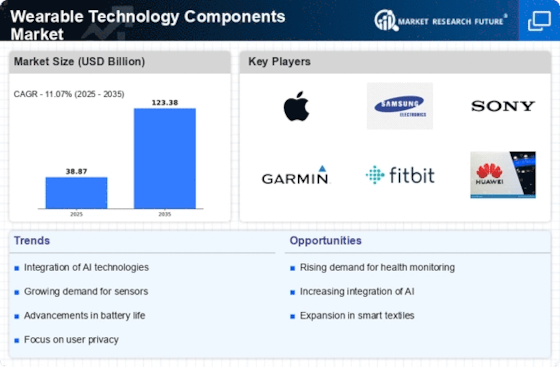
As per Market Research Future analysis, the Wearable Technology Components Market was estimated at 38.87 USD Billion in 2024. The wearable technology components industry is projected to grow from 43.18 USD Billion in 2025 to 123.38 USD Billion by 2035, exhibiting a compound annual growth rate (CAGR) of 11.07% during the forecast period 2025 - 2035

Key Market Trends & Highlights

The Wearable Technology Components Market is experiencing robust growth driven by technological advancements and increasing consumer demand.

  • The integration of advanced sensors is enhancing the functionality of wearable devices, particularly in North America. Energy efficiency remains a focal point as manufacturers strive to extend battery life in wearable technology. The market is expanding into diverse applications, with significant growth observed in the fitness and wellness segment in Asia-Pacific. Rising health awareness and consumer demand for smart devices are key drivers propelling the growth of the healthcare segment.

Market Size & Forecast

2024 Market Size 38.87 (USD Billion)
2035 Market Size 123.38 (USD Billion)
CAGR (2025 - 2035) 11.07%
Largest Regional Market Share in 2024 North America

Major Players

Apple Inc (US), Samsung Electronics (KR), Sony Corporation (JP), Garmin Ltd (US), Fitbit LLC (US), Huawei Technologies Co., Ltd (CN), Xiaomi Corporation (CN), Fossil Group, Inc. (US), LG Electronics (KR)

Market Trends

The Wearable Technology Components Market is currently experiencing a dynamic evolution, driven by advancements in technology and increasing consumer demand for health and fitness monitoring devices. This market encompasses a variety of components, including sensors, batteries, and connectivity modules, which are integral to the functionality of wearable devices. As consumers become more health-conscious, the integration of sophisticated sensors that monitor vital signs and physical activity is becoming increasingly prevalent. Furthermore, the rise of the Internet of Things (IoT) is facilitating seamless connectivity between wearable devices and other smart technologies, enhancing user experience and engagement. In addition to health and fitness applications, the Wearable Technology Components Market is expanding into sectors such as entertainment and communication. This diversification suggests a growing recognition of the potential for wearables to enhance daily life beyond traditional uses. Manufacturers are likely to focus on developing lightweight, energy-efficient components that offer improved performance and longer battery life. As the market continues to mature, collaboration between technology firms and healthcare providers may emerge, fostering innovation and creating new opportunities for growth. Overall, the Wearable Technology Components Market appears poised for sustained expansion, driven by technological advancements and evolving consumer preferences.

Integration of Advanced Sensors

The incorporation of advanced sensors into wearable devices is a prominent trend within the Wearable Technology Components Market. These sensors enable precise monitoring of various health metrics, such as heart rate, sleep patterns, and physical activity levels. As consumers increasingly prioritize health and wellness, the demand for wearables equipped with sophisticated sensors is likely to rise, driving innovation in this segment.

Focus on Energy Efficiency

Energy efficiency is becoming a critical consideration in the design of components for wearable technology. Manufacturers are striving to develop batteries and power management systems that extend the operational life of devices. This trend not only enhances user satisfaction but also aligns with growing environmental concerns, as consumers seek sustainable technology solutions.

Expansion into Diverse Applications

The Wearable Technology Components Market is witnessing an expansion into various applications beyond fitness and health. Industries such as entertainment, gaming, and workplace safety are increasingly adopting wearable technology. This diversification indicates a broader acceptance of wearables in everyday life, suggesting that manufacturers may explore new functionalities to cater to a wider audience.

Wearable Technology Components Market Market Drivers

Rising Health Awareness

The increasing awareness regarding health and fitness among consumers appears to be a primary driver for the Wearable Technology Components Market. As individuals become more health-conscious, the demand for wearable devices that monitor vital signs, track physical activity, and provide health insights is likely to surge. According to recent data, the market for health-focused wearables is projected to grow at a compound annual growth rate of over 20% in the coming years. This trend indicates a robust appetite for components that facilitate health monitoring, such as sensors and batteries, thereby propelling the overall market forward.

Technological Advancements

Technological innovations in the field of wearable technology are significantly influencing the Wearable Technology Components Market. The integration of advanced sensors, improved battery life, and enhanced connectivity options are driving the development of more sophisticated wearable devices. For instance, the introduction of flexible displays and miniaturized components has enabled manufacturers to create more compact and efficient products. This evolution is reflected in the market, where the demand for high-performance components is expected to increase, potentially leading to a market valuation exceeding several billion dollars by the end of the decade.

Growing Adoption in Healthcare

The healthcare sector's increasing adoption of wearable technology is a notable driver for the Wearable Technology Components Market. Wearable devices are being utilized for remote patient monitoring, chronic disease management, and post-operative care, which enhances patient outcomes and reduces healthcare costs. Recent statistics indicate that the healthcare wearables segment is anticipated to account for a substantial share of the overall market, with projections suggesting it could reach a valuation of over 30 billion dollars by 2027. This trend underscores the critical role of components such as sensors and communication modules in facilitating these applications.

Consumer Demand for Smart Devices

The rising consumer demand for smart devices is propelling the Wearable Technology Components Market. As consumers increasingly seek multifunctional devices that integrate seamlessly into their daily lives, the need for advanced components that support features like notifications, GPS tracking, and fitness monitoring is likely to grow. Market analysis suggests that the smartwatch segment alone could witness a growth rate of approximately 15% annually, indicating a strong preference for wearables that combine style with functionality. This trend necessitates the continuous innovation of components to meet evolving consumer expectations.

Increased Investment in Research and Development

The surge in investment in research and development within the wearable technology sector is a significant driver for the Wearable Technology Components Market. Companies are allocating substantial resources to innovate and enhance their product offerings, focusing on improving performance, durability, and user experience. This investment is likely to lead to breakthroughs in component technology, such as more efficient batteries and advanced sensors. As a result, the market is expected to experience accelerated growth, with forecasts indicating that R&D spending could reach billions of dollars annually, further stimulating the demand for high-quality components.

Market Segment Insights

By Component Type: Sensors (Largest) vs. Processors (Fastest-Growing)

In the Wearable Technology Components Market, the distribution of market share among component types reveals that sensors currently hold the largest share, driven by their essential role in data collection and health monitoring functionalities. Processors, while trailing in share, represent a dynamic area of growth as processing power continues to improve, enhancing the capabilities of wearable devices. Battery technology also retains a significant position, providing the necessary power to support extended device usage, while displays and connectivity modules round out the component offerings with their specific functionalities.

Components: Sensors (Dominant) vs. Processors (Emerging)

Sensors are pivotal in the Wearable Technology Components Market, acting as the first point of data acquisition for various health metrics like heart rate, activity tracking, and sleep analysis. This dominance stems from their crucial role in enhancing the functionality of wearables, making them indispensable for end-users. In contrast, processors are emerging rapidly, with advances in miniaturization and efficiency, allowing for smarter and more capable devices. The push for seamless connectivity and integrated functionality positions processors as a vital component in future wearables, signaling a trend where they must evolve to keep pace with growing application demands and user expectations.

By End Use: Healthcare (Largest) vs. Fitness and Wellness (Fastest-Growing)

The Wearable Technology Components Market is significantly shaped by various end-use applications, predominantly healthcare and fitness. Healthcare accounts for the largest share, driven by increasing demand for remote patient monitoring and chronic disease management solutions. Following closely is the fitness and wellness segment, tapping into the wellness trend fueled by growing health consciousness among consumers. Together, these segments establish a formidable landscape, reflecting their integral role in the market's evolution.

Healthcare (Dominant) vs. Fitness and Wellness (Emerging)

Healthcare remains the dominant sector in the Wearable Technology Components Market, as innovations like smart medical devices and health tracking applications have revolutionized patient care. This segment benefits from advancements in technology, leading to improved diagnostics and patient engagement. On the other hand, fitness and wellness represent an emerging segment, rapidly gaining traction due to a global shift toward proactive health management. With a surge in fitness tracking solutions and wellness applications, this segment is experiencing unprecedented growth, appealing to a broader audience seeking healthier lifestyles. The demand for customizable health solutions further drives innovations in this space.

By Product Type: Smartwatches (Largest) vs. Fitness Trackers (Fastest-Growing)

The wearable technology components market has experienced significant diversification with smartwatches leading in market share, largely due to their multifunctional capabilities including fitness tracking, notifications, and personal assistance. Fitness trackers, while slightly lower in overall market share, are gaining momentum among health-conscious consumers, driven by increasing awareness of fitness and health monitoring. Smart glasses and hearables also hold niches within specific demographics, complemented by wearable medical devices aimed at monitoring chronic conditions and enhancing patient care. The growth in this segment can be attributed to technological advancements, increasing consumer interest in health and fitness, and the ongoing integration of wearables with mobile technology. As consumers seek more interconnected and intelligent devices, smartwatches and fitness trackers are poised for continued expansion while hearables and smart glasses are entering growth phases as they become more accessible and user-friendly. The integration of AI and improved battery technology is further accelerating market adoption across all categories.

Smartwatches (Dominant) vs. Wearable Medical Devices (Emerging)

Smartwatches dominate the wearable technology components market due to their versatility and comprehensive features that cater to a broad audience, including fitness enthusiasts, tech-savvy users, and professionals needing to stay connected. They typically include advanced features such as heart rate monitoring, GPS tracking, and compatibility with various apps, making them essential lifestyle accessories. In contrast, wearable medical devices represent an emerging segment characterized by their focus on health monitoring and patient care; these devices specifically target chronic conditions and facilitate remote healthcare services. Their growth is driven by an aging population and increased emphasis on preventive healthcare. As the technology behind medical wearables continues to evolve, their market position is strengthening, promising wider acceptance and a growing market share.

By Technology: Bluetooth (Largest) vs. Wi-Fi (Fastest-Growing)

The wearable technology components market showcases a diverse technology segmentation, with Bluetooth leading in market share due to its prevalent use in various wearables, including fitness trackers, smartwatches, and health monitoring devices. Wi-Fi follows closely, making significant contributions with its capability to support high data throughput and connectivity for more advanced wearable applications. NFC, Zigbee, and Cellular technology segments also play crucial roles but hold smaller shares in the overall distribution, as they are primarily utilized in specialized applications.

Bluetooth: Dominant vs. Wi-Fi: Emerging

Bluetooth technology remains dominant in the wearable technology components market due to its low energy consumption and robust range in short-distance communication. This makes it particularly suitable for a wide array of consumer wearables focused on fitness, health monitoring, and convenience. In contrast, Wi-Fi has been emerging as a critical technology, especially in wearables that require higher data transfer rates, such as smart glasses and health monitoring devices that transmit substantial amounts of data in real-time. As consumer demands for greater data capabilities increase, Wi-Fi's role is expected to grow, highlighted by expanding applications in health infrastructure.

Get more detailed insights about Wearable Technology Components Market Research Report - Forecast 2035

Regional Insights

The Wearable Technology Components Market is poised for significant growth across various regions. In 2023, the North America market held a robust valuation of 15.0 USD Billion, making it a dominant player, driven by high technology adoption and consumer demand for innovative devices. Europe followed with a valuation of 9.0 USD Billion, as a strong focus on health and fitness among the population fuels market growth.

The Asia-Pacific (APAC) region, with a valuation of 7.0 USD Billion, is emerging as a key growth driver due to rapid urbanization and increased disposable income.South America, with a lesser valuation of 2.5 USD Billion, reflects growing interest but remains in the early stages of market penetration. Lastly, the Middle East and Africa (MEA) stand at 1.5 USD Billion, highlighting significant potential for future expansion as awareness of wearable technology increases.

This regional segmentation illustrates the diverse growth landscape and varying levels of market maturity, with North America leading as a majority holder in the Wearable Technology Components Market revenue, while APAC shows promising development potential.

Key Players and Competitive Insights

The Wearable Technology Components Market is characterized by a dynamic competitive landscape driven by rapid technological advancements and increasing consumer demand for smart devices. The market comprises a diverse range of players, including established tech giants, innovative startups, and component manufacturers, all striving to capture a share of this growing sector. As wearable technology continues to evolve, companies are focusing on enhanced functionalities, improved user experiences, and integrated health monitoring capabilities, all while navigating challenges such as supply chain disruptions and fluctuating raw material prices.
The ability to innovate and adapt to changing consumer preferences is paramount, making competitive insights a crucial aspect for companies looking to maintain or enhance their standing in the market.
Apple has solidified its presence in the Wearable Technology Components Market through its strong ecosystem of products that seamlessly integrate with its hardware and software. The company leverages its brand loyalty and extensive distribution channels to promote its wearable devices, such as smartwatches and fitness trackers. Key strengths of Apple in this market include its ability to deliver high-quality design, user-friendly interfaces, and an extensive range of health and fitness features that appeal to a broad demographic.
Furthermore, Apple's investment in research and development allows it to stay at the forefront of technology trends, ensuring that it continually introduces innovative features that enhance user engagement and satisfaction. This combination of brand power, technological proficiency, and market agility positions Apple uniquely in the competitive landscape of wearable technology components.
Intel, on the other hand, plays a pivotal role in the Wearable Technology Components Market through its focus on developing cutting-edge microprocessors and chips that power various wearable devices. The company is known for its technological innovation and commitment to enhancing device performance and functionality. Intel's strengths include its strong research capabilities and established partnerships with numerous device manufacturers, providing it with a robust platform to drive its wearable technology initiatives. By delivering high-performance computing solutions, Intel enables manufacturers to create more sophisticated wearable devices with enhanced processing capabilities and energy efficiency.
This strategic positioning allows Intel to capitalize on the growing demand for wearable technology, emphasizing its role as a foundational component supplier in this vibrant market.

Key Companies in the Wearable Technology Components Market include

Industry Developments

Recent developments in the Wearable Technology Components Market indicate significant advancements and competitive dynamics among key players. Companies like Apple and Samsung Electronics continue to enhance their wearables with health-monitoring features, making their products more appealing to consumers seeking fitness and wellness solutions. Meanwhile, Qualcomm and STMicroelectronics are investing in next-generation chipsets to improve performance and battery life in smartwatches and fitness trackers. Intel and Microchip Technology are focusing on IoT integration, creating a seamless connection between devices, which is becoming increasingly relevant in this space.

Notably, Fitbit and Garmin are expanding their markets by diversifying product lines, aiming to attract different segments, from casual wearers to professional athletes.

There are reports of potential mergers and acquisitions among these giants as they look to consolidate their positions and leverage synergies in R&D and distribution. For instance, there is speculation surrounding partnerships that may involve Tesla's interest in wearable technology for enhancing user experience in its vehicles. Overall, the market is witnessing strong investment trends and strategic collaborations as these companies push the boundaries of wearable technology, significantly impacting their growth projections and market valuations.

Future Outlook

Wearable Technology Components Market Future Outlook

The Wearable Technology Components Market is projected to grow at an 11.07% CAGR from 2025 to 2035, driven by advancements in sensor technology, increased health awareness, and demand for connectivity.

New opportunities lie in:

  • Development of advanced biometric sensors for health monitoring devices.
  • Integration of AI algorithms for personalized user experiences.
  • Expansion into emerging markets with tailored wearable solutions.

By 2035, the market is expected to be robust, driven by innovation and diverse applications.

Market Segmentation

Wearable Technology Components Market End Use Outlook

  • Healthcare
  • Fitness and Wellness
  • Entertainment
  • Military and Defense
  • Industrial

Wearable Technology Components Market Technology Outlook

  • Bluetooth
  • Wi-Fi
  • NFC
  • Zigbee
  • Cellular

Wearable Technology Components Market Product Type Outlook

  • Smartwatches
  • Fitness Trackers
  • Smart Glasses
  • Wearable Medical Devices
  • Hearables

Wearable Technology Components Market Component Type Outlook

  • Sensors
  • Processors
  • Batteries
  • Displays
  • Connectivity Modules

Report Scope

MARKET SIZE 2024 38.87(USD Billion)
MARKET SIZE 2025 43.18(USD Billion)
MARKET SIZE 2035 123.38(USD Billion)
COMPOUND ANNUAL GROWTH RATE (CAGR) 11.07% (2025 - 2035)
REPORT COVERAGE Revenue Forecast, Competitive Landscape, Growth Factors, and Trends
BASE YEAR 2024
Market Forecast Period 2025 - 2035
Historical Data 2019 - 2024
Market Forecast Units USD Billion
Key Companies Profiled Apple Inc (US), Samsung Electronics (KR), Sony Corporation (JP), Garmin Ltd (US), Fitbit LLC (US), Huawei Technologies Co., Ltd (CN), Xiaomi Corporation (CN), Fossil Group, Inc. (US), LG Electronics (KR)
Segments Covered Component Type, End Use, Product Type, Technology, Regional
Key Market Opportunities Integration of advanced sensors and artificial intelligence in the Wearable Technology Components Market.
Key Market Dynamics Rising demand for advanced sensors drives innovation and competition in the wearable technology components market.
Countries Covered North America, Europe, APAC, South America, MEA

FAQs

What is the projected market valuation for the Wearable Technology Components Market in 2035?

<p>The projected market valuation for the Wearable Technology Components Market in 2035 is 123.38 USD Billion.</p>

What was the overall market valuation for the Wearable Technology Components Market in 2024?

<p>The overall market valuation for the Wearable Technology Components Market in 2024 was 38.87 USD Billion.</p>

What is the expected CAGR for the Wearable Technology Components Market during the forecast period 2025 - 2035?

<p>The expected CAGR for the Wearable Technology Components Market during the forecast period 2025 - 2035 is 11.07%.</p>

Which companies are considered key players in the Wearable Technology Components Market?

<p>Key players in the Wearable Technology Components Market include Apple Inc, Samsung Electronics, Sony Corporation, Garmin Ltd, and Fitbit LLC.</p>

What are the projected revenues for the Sensors segment by 2035?

<p>The projected revenues for the Sensors segment are expected to reach 25.0 USD Billion by 2035.</p>

How much is the Fitness and Wellness segment projected to generate by 2035?

<p>The Fitness and Wellness segment is projected to generate 30.0 USD Billion by 2035.</p>

What is the expected revenue for Smartwatches in 2035?

<p>The expected revenue for Smartwatches in 2035 is 35.0 USD Billion.</p>

What are the projected revenues for the Connectivity Modules segment by 2035?

<p>The projected revenues for the Connectivity Modules segment are anticipated to reach 28.38 USD Billion by 2035.</p>

What is the expected revenue for Cellular technology in 2035?

<p>The expected revenue for Cellular technology is projected to be 41.38 USD Billion by 2035.</p>

What is the anticipated revenue for Wearable Medical Devices by 2035?

<p>The anticipated revenue for Wearable Medical Devices is expected to reach 30.0 USD Billion by 2035.</p>

  1. SECTION I: EXECUTIVE SUMMARY AND KEY HIGHLIGHTS
    1. | 1.1 EXECUTIVE SUMMARY
    2. | | 1.1.1 Market Overview
    3. | | 1.1.2 Key Findings
    4. | | 1.1.3 Market Segmentation
    5. | | 1.1.4 Competitive Landscape
    6. | | 1.1.5 Challenges and Opportunities
    7. | | 1.1.6 Future Outlook
  2. SECTION II: SCOPING, METHODOLOGY AND MARKET STRUCTURE
    1. | 2.1 MARKET INTRODUCTION
    2. | | 2.1.1 Definition
    3. | | 2.1.2 Scope of the study
    4. | | | 2.1.2.1 Research Objective
    5. | | | 2.1.2.2 Assumption
    6. | | | 2.1.2.3 Limitations
    7. | 2.2 RESEARCH METHODOLOGY
    8. | | 2.2.1 Overview
    9. | | 2.2.2 Data Mining
    10. | | 2.2.3 Secondary Research
    11. | | 2.2.4 Primary Research
    12. | | | 2.2.4.1 Primary Interviews and Information Gathering Process
    13. | | | 2.2.4.2 Breakdown of Primary Respondents
    14. | | 2.2.5 Forecasting Model
    15. | | 2.2.6 Market Size Estimation
    16. | | | 2.2.6.1 Bottom-Up Approach
    17. | | | 2.2.6.2 Top-Down Approach
    18. | | 2.2.7 Data Triangulation
    19. | | 2.2.8 Validation
  3. SECTION III: QUALITATIVE ANALYSIS
    1. | 3.1 MARKET DYNAMICS
    2. | | 3.1.1 Overview
    3. | | 3.1.2 Drivers
    4. | | 3.1.3 Restraints
    5. | | 3.1.4 Opportunities
    6. | 3.2 MARKET FACTOR ANALYSIS
    7. | | 3.2.1 Value chain Analysis
    8. | | 3.2.2 Porter's Five Forces Analysis
    9. | | | 3.2.2.1 Bargaining Power of Suppliers
    10. | | | 3.2.2.2 Bargaining Power of Buyers
    11. | | | 3.2.2.3 Threat of New Entrants
    12. | | | 3.2.2.4 Threat of Substitutes
    13. | | | 3.2.2.5 Intensity of Rivalry
    14. | | 3.2.3 COVID-19 Impact Analysis
    15. | | | 3.2.3.1 Market Impact Analysis
    16. | | | 3.2.3.2 Regional Impact
    17. | | | 3.2.3.3 Opportunity and Threat Analysis
  4. SECTION IV: QUANTITATIVE ANALYSIS
    1. | 4.1 Semiconductor & Electronics, BY Component Type (USD Billion)
    2. | | 4.1.1 Sensors
    3. | | 4.1.2 Processors
    4. | | 4.1.3 Batteries
    5. | | 4.1.4 Displays
    6. | | 4.1.5 Connectivity Modules
    7. | 4.2 Semiconductor & Electronics, BY End Use (USD Billion)
    8. | | 4.2.1 Healthcare
    9. | | 4.2.2 Fitness and Wellness
    10. | | 4.2.3 Entertainment
    11. | | 4.2.4 Military and Defense
    12. | | 4.2.5 Industrial
    13. | 4.3 Semiconductor & Electronics, BY Product Type (USD Billion)
    14. | | 4.3.1 Smartwatches
    15. | | 4.3.2 Fitness Trackers
    16. | | 4.3.3 Smart Glasses
    17. | | 4.3.4 Wearable Medical Devices
    18. | | 4.3.5 Hearables
    19. | 4.4 Semiconductor & Electronics, BY Technology (USD Billion)
    20. | | 4.4.1 Bluetooth
    21. | | 4.4.2 Wi-Fi
    22. | | 4.4.3 NFC
    23. | | 4.4.4 Zigbee
    24. | | 4.4.5 Cellular
    25. | 4.5 Semiconductor & Electronics, BY Region (USD Billion)
    26. | | 4.5.1 North America
    27. | | | 4.5.1.1 US
    28. | | | 4.5.1.2 Canada
    29. | | 4.5.2 Europe
    30. | | | 4.5.2.1 Germany
    31. | | | 4.5.2.2 UK
    32. | | | 4.5.2.3 France
    33. | | | 4.5.2.4 Russia
    34. | | | 4.5.2.5 Italy
    35. | | | 4.5.2.6 Spain
    36. | | | 4.5.2.7 Rest of Europe
    37. | | 4.5.3 APAC
    38. | | | 4.5.3.1 China
    39. | | | 4.5.3.2 India
    40. | | | 4.5.3.3 Japan
    41. | | | 4.5.3.4 South Korea
    42. | | | 4.5.3.5 Malaysia
    43. | | | 4.5.3.6 Thailand
    44. | | | 4.5.3.7 Indonesia
    45. | | | 4.5.3.8 Rest of APAC
    46. | | 4.5.4 South America
    47. | | | 4.5.4.1 Brazil
    48. | | | 4.5.4.2 Mexico
    49. | | | 4.5.4.3 Argentina
    50. | | | 4.5.4.4 Rest of South America
    51. | | 4.5.5 MEA
    52. | | | 4.5.5.1 GCC Countries
    53. | | | 4.5.5.2 South Africa
    54. | | | 4.5.5.3 Rest of MEA
  5. SECTION V: COMPETITIVE ANALYSIS
    1. | 5.1 Competitive Landscape
    2. | | 5.1.1 Overview
    3. | | 5.1.2 Competitive Analysis
    4. | | 5.1.3 Market share Analysis
    5. | | 5.1.4 Major Growth Strategy in the Semiconductor & Electronics
    6. | | 5.1.5 Competitive Benchmarking
    7. | | 5.1.6 Leading Players in Terms of Number of Developments in the Semiconductor & Electronics
    8. | | 5.1.7 Key developments and growth strategies
    9. | | | 5.1.7.1 New Product Launch/Service Deployment
    10. | | | 5.1.7.2 Merger & Acquisitions
    11. | | | 5.1.7.3 Joint Ventures
    12. | | 5.1.8 Major Players Financial Matrix
    13. | | | 5.1.8.1 Sales and Operating Income
    14. | | | 5.1.8.2 Major Players R&D Expenditure. 2023
    15. | 5.2 Company Profiles
    16. | | 5.2.1 Apple Inc (US)
    17. | | | 5.2.1.1 Financial Overview
    18. | | | 5.2.1.2 Products Offered
    19. | | | 5.2.1.3 Key Developments
    20. | | | 5.2.1.4 SWOT Analysis
    21. | | | 5.2.1.5 Key Strategies
    22. | | 5.2.2 Samsung Electronics (KR)
    23. | | | 5.2.2.1 Financial Overview
    24. | | | 5.2.2.2 Products Offered
    25. | | | 5.2.2.3 Key Developments
    26. | | | 5.2.2.4 SWOT Analysis
    27. | | | 5.2.2.5 Key Strategies
    28. | | 5.2.3 Sony Corporation (JP)
    29. | | | 5.2.3.1 Financial Overview
    30. | | | 5.2.3.2 Products Offered
    31. | | | 5.2.3.3 Key Developments
    32. | | | 5.2.3.4 SWOT Analysis
    33. | | | 5.2.3.5 Key Strategies
    34. | | 5.2.4 Garmin Ltd (US)
    35. | | | 5.2.4.1 Financial Overview
    36. | | | 5.2.4.2 Products Offered
    37. | | | 5.2.4.3 Key Developments
    38. | | | 5.2.4.4 SWOT Analysis
    39. | | | 5.2.4.5 Key Strategies
    40. | | 5.2.5 Fitbit LLC (US)
    41. | | | 5.2.5.1 Financial Overview
    42. | | | 5.2.5.2 Products Offered
    43. | | | 5.2.5.3 Key Developments
    44. | | | 5.2.5.4 SWOT Analysis
    45. | | | 5.2.5.5 Key Strategies
    46. | | 5.2.6 Huawei Technologies Co., Ltd (CN)
    47. | | | 5.2.6.1 Financial Overview
    48. | | | 5.2.6.2 Products Offered
    49. | | | 5.2.6.3 Key Developments
    50. | | | 5.2.6.4 SWOT Analysis
    51. | | | 5.2.6.5 Key Strategies
    52. | | 5.2.7 Xiaomi Corporation (CN)
    53. | | | 5.2.7.1 Financial Overview
    54. | | | 5.2.7.2 Products Offered
    55. | | | 5.2.7.3 Key Developments
    56. | | | 5.2.7.4 SWOT Analysis
    57. | | | 5.2.7.5 Key Strategies
    58. | | 5.2.8 Fossil Group, Inc. (US)
    59. | | | 5.2.8.1 Financial Overview
    60. | | | 5.2.8.2 Products Offered
    61. | | | 5.2.8.3 Key Developments
    62. | | | 5.2.8.4 SWOT Analysis
    63. | | | 5.2.8.5 Key Strategies
    64. | | 5.2.9 LG Electronics (KR)
    65. | | | 5.2.9.1 Financial Overview
    66. | | | 5.2.9.2 Products Offered
    67. | | | 5.2.9.3 Key Developments
    68. | | | 5.2.9.4 SWOT Analysis
    69. | | | 5.2.9.5 Key Strategies
    70. | 5.3 Appendix
    71. | | 5.3.1 References
    72. | | 5.3.2 Related Reports
  6. LIST OF FIGURES
    1. | 6.1 MARKET SYNOPSIS
    2. | 6.2 NORTH AMERICA MARKET ANALYSIS
    3. | 6.3 US MARKET ANALYSIS BY COMPONENT TYPE
    4. | 6.4 US MARKET ANALYSIS BY END USE
    5. | 6.5 US MARKET ANALYSIS BY PRODUCT TYPE
    6. | 6.6 US MARKET ANALYSIS BY TECHNOLOGY
    7. | 6.7 CANADA MARKET ANALYSIS BY COMPONENT TYPE
    8. | 6.8 CANADA MARKET ANALYSIS BY END USE
    9. | 6.9 CANADA MARKET ANALYSIS BY PRODUCT TYPE
    10. | 6.10 CANADA MARKET ANALYSIS BY TECHNOLOGY
    11. | 6.11 EUROPE MARKET ANALYSIS
    12. | 6.12 GERMANY MARKET ANALYSIS BY COMPONENT TYPE
    13. | 6.13 GERMANY MARKET ANALYSIS BY END USE
    14. | 6.14 GERMANY MARKET ANALYSIS BY PRODUCT TYPE
    15. | 6.15 GERMANY MARKET ANALYSIS BY TECHNOLOGY
    16. | 6.16 UK MARKET ANALYSIS BY COMPONENT TYPE
    17. | 6.17 UK MARKET ANALYSIS BY END USE
    18. | 6.18 UK MARKET ANALYSIS BY PRODUCT TYPE
    19. | 6.19 UK MARKET ANALYSIS BY TECHNOLOGY
    20. | 6.20 FRANCE MARKET ANALYSIS BY COMPONENT TYPE
    21. | 6.21 FRANCE MARKET ANALYSIS BY END USE
    22. | 6.22 FRANCE MARKET ANALYSIS BY PRODUCT TYPE
    23. | 6.23 FRANCE MARKET ANALYSIS BY TECHNOLOGY
    24. | 6.24 RUSSIA MARKET ANALYSIS BY COMPONENT TYPE
    25. | 6.25 RUSSIA MARKET ANALYSIS BY END USE
    26. | 6.26 RUSSIA MARKET ANALYSIS BY PRODUCT TYPE
    27. | 6.27 RUSSIA MARKET ANALYSIS BY TECHNOLOGY
    28. | 6.28 ITALY MARKET ANALYSIS BY COMPONENT TYPE
    29. | 6.29 ITALY MARKET ANALYSIS BY END USE
    30. | 6.30 ITALY MARKET ANALYSIS BY PRODUCT TYPE
    31. | 6.31 ITALY MARKET ANALYSIS BY TECHNOLOGY
    32. | 6.32 SPAIN MARKET ANALYSIS BY COMPONENT TYPE
    33. | 6.33 SPAIN MARKET ANALYSIS BY END USE
    34. | 6.34 SPAIN MARKET ANALYSIS BY PRODUCT TYPE
    35. | 6.35 SPAIN MARKET ANALYSIS BY TECHNOLOGY
    36. | 6.36 REST OF EUROPE MARKET ANALYSIS BY COMPONENT TYPE
    37. | 6.37 REST OF EUROPE MARKET ANALYSIS BY END USE
    38. | 6.38 REST OF EUROPE MARKET ANALYSIS BY PRODUCT TYPE
    39. | 6.39 REST OF EUROPE MARKET ANALYSIS BY TECHNOLOGY
    40. | 6.40 APAC MARKET ANALYSIS
    41. | 6.41 CHINA MARKET ANALYSIS BY COMPONENT TYPE
    42. | 6.42 CHINA MARKET ANALYSIS BY END USE
    43. | 6.43 CHINA MARKET ANALYSIS BY PRODUCT TYPE
    44. | 6.44 CHINA MARKET ANALYSIS BY TECHNOLOGY
    45. | 6.45 INDIA MARKET ANALYSIS BY COMPONENT TYPE
    46. | 6.46 INDIA MARKET ANALYSIS BY END USE
    47. | 6.47 INDIA MARKET ANALYSIS BY PRODUCT TYPE
    48. | 6.48 INDIA MARKET ANALYSIS BY TECHNOLOGY
    49. | 6.49 JAPAN MARKET ANALYSIS BY COMPONENT TYPE
    50. | 6.50 JAPAN MARKET ANALYSIS BY END USE
    51. | 6.51 JAPAN MARKET ANALYSIS BY PRODUCT TYPE
    52. | 6.52 JAPAN MARKET ANALYSIS BY TECHNOLOGY
    53. | 6.53 SOUTH KOREA MARKET ANALYSIS BY COMPONENT TYPE
    54. | 6.54 SOUTH KOREA MARKET ANALYSIS BY END USE
    55. | 6.55 SOUTH KOREA MARKET ANALYSIS BY PRODUCT TYPE
    56. | 6.56 SOUTH KOREA MARKET ANALYSIS BY TECHNOLOGY
    57. | 6.57 MALAYSIA MARKET ANALYSIS BY COMPONENT TYPE
    58. | 6.58 MALAYSIA MARKET ANALYSIS BY END USE
    59. | 6.59 MALAYSIA MARKET ANALYSIS BY PRODUCT TYPE
    60. | 6.60 MALAYSIA MARKET ANALYSIS BY TECHNOLOGY
    61. | 6.61 THAILAND MARKET ANALYSIS BY COMPONENT TYPE
    62. | 6.62 THAILAND MARKET ANALYSIS BY END USE
    63. | 6.63 THAILAND MARKET ANALYSIS BY PRODUCT TYPE
    64. | 6.64 THAILAND MARKET ANALYSIS BY TECHNOLOGY
    65. | 6.65 INDONESIA MARKET ANALYSIS BY COMPONENT TYPE
    66. | 6.66 INDONESIA MARKET ANALYSIS BY END USE
    67. | 6.67 INDONESIA MARKET ANALYSIS BY PRODUCT TYPE
    68. | 6.68 INDONESIA MARKET ANALYSIS BY TECHNOLOGY
    69. | 6.69 REST OF APAC MARKET ANALYSIS BY COMPONENT TYPE
    70. | 6.70 REST OF APAC MARKET ANALYSIS BY END USE
    71. | 6.71 REST OF APAC MARKET ANALYSIS BY PRODUCT TYPE
    72. | 6.72 REST OF APAC MARKET ANALYSIS BY TECHNOLOGY
    73. | 6.73 SOUTH AMERICA MARKET ANALYSIS
    74. | 6.74 BRAZIL MARKET ANALYSIS BY COMPONENT TYPE
    75. | 6.75 BRAZIL MARKET ANALYSIS BY END USE
    76. | 6.76 BRAZIL MARKET ANALYSIS BY PRODUCT TYPE
    77. | 6.77 BRAZIL MARKET ANALYSIS BY TECHNOLOGY
    78. | 6.78 MEXICO MARKET ANALYSIS BY COMPONENT TYPE
    79. | 6.79 MEXICO MARKET ANALYSIS BY END USE
    80. | 6.80 MEXICO MARKET ANALYSIS BY PRODUCT TYPE
    81. | 6.81 MEXICO MARKET ANALYSIS BY TECHNOLOGY
    82. | 6.82 ARGENTINA MARKET ANALYSIS BY COMPONENT TYPE
    83. | 6.83 ARGENTINA MARKET ANALYSIS BY END USE
    84. | 6.84 ARGENTINA MARKET ANALYSIS BY PRODUCT TYPE
    85. | 6.85 ARGENTINA MARKET ANALYSIS BY TECHNOLOGY
    86. | 6.86 REST OF SOUTH AMERICA MARKET ANALYSIS BY COMPONENT TYPE
    87. | 6.87 REST OF SOUTH AMERICA MARKET ANALYSIS BY END USE
    88. | 6.88 REST OF SOUTH AMERICA MARKET ANALYSIS BY PRODUCT TYPE
    89. | 6.89 REST OF SOUTH AMERICA MARKET ANALYSIS BY TECHNOLOGY
    90. | 6.90 MEA MARKET ANALYSIS
    91. | 6.91 GCC COUNTRIES MARKET ANALYSIS BY COMPONENT TYPE
    92. | 6.92 GCC COUNTRIES MARKET ANALYSIS BY END USE
    93. | 6.93 GCC COUNTRIES MARKET ANALYSIS BY PRODUCT TYPE
    94. | 6.94 GCC COUNTRIES MARKET ANALYSIS BY TECHNOLOGY
    95. | 6.95 SOUTH AFRICA MARKET ANALYSIS BY COMPONENT TYPE
    96. | 6.96 SOUTH AFRICA MARKET ANALYSIS BY END USE
    97. | 6.97 SOUTH AFRICA MARKET ANALYSIS BY PRODUCT TYPE
    98. | 6.98 SOUTH AFRICA MARKET ANALYSIS BY TECHNOLOGY
    99. | 6.99 REST OF MEA MARKET ANALYSIS BY COMPONENT TYPE
    100. | 6.100 REST OF MEA MARKET ANALYSIS BY END USE
    101. | 6.101 REST OF MEA MARKET ANALYSIS BY PRODUCT TYPE
    102. | 6.102 REST OF MEA MARKET ANALYSIS BY TECHNOLOGY
    103. | 6.103 KEY BUYING CRITERIA OF SEMICONDUCTOR & ELECTRONICS
    104. | 6.104 RESEARCH PROCESS OF MRFR
    105. | 6.105 DRO ANALYSIS OF SEMICONDUCTOR & ELECTRONICS
    106. | 6.106 DRIVERS IMPACT ANALYSIS: SEMICONDUCTOR & ELECTRONICS
    107. | 6.107 RESTRAINTS IMPACT ANALYSIS: SEMICONDUCTOR & ELECTRONICS
    108. | 6.108 SUPPLY / VALUE CHAIN: SEMICONDUCTOR & ELECTRONICS
    109. | 6.109 SEMICONDUCTOR & ELECTRONICS, BY COMPONENT TYPE, 2024 (% SHARE)
    110. | 6.110 SEMICONDUCTOR & ELECTRONICS, BY COMPONENT TYPE, 2024 TO 2035 (USD Billion)
    111. | 6.111 SEMICONDUCTOR & ELECTRONICS, BY END USE, 2024 (% SHARE)
    112. | 6.112 SEMICONDUCTOR & ELECTRONICS, BY END USE, 2024 TO 2035 (USD Billion)
    113. | 6.113 SEMICONDUCTOR & ELECTRONICS, BY PRODUCT TYPE, 2024 (% SHARE)
    114. | 6.114 SEMICONDUCTOR & ELECTRONICS, BY PRODUCT TYPE, 2024 TO 2035 (USD Billion)
    115. | 6.115 SEMICONDUCTOR & ELECTRONICS, BY TECHNOLOGY, 2024 (% SHARE)
    116. | 6.116 SEMICONDUCTOR & ELECTRONICS, BY TECHNOLOGY, 2024 TO 2035 (USD Billion)
    117. | 6.117 BENCHMARKING OF MAJOR COMPETITORS
  7. LIST OF TABLES
    1. | 7.1 LIST OF ASSUMPTIONS
    2. | | 7.1.1
    3. | 7.2 North America MARKET SIZE ESTIMATES; FORECAST
    4. | | 7.2.1 BY COMPONENT TYPE, 2025-2035 (USD Billion)
    5. | | 7.2.2 BY END USE, 2025-2035 (USD Billion)
    6. | | 7.2.3 BY PRODUCT TYPE, 2025-2035 (USD Billion)
    7. | | 7.2.4 BY TECHNOLOGY, 2025-2035 (USD Billion)
    8. | 7.3 US MARKET SIZE ESTIMATES; FORECAST
    9. | | 7.3.1 BY COMPONENT TYPE, 2025-2035 (USD Billion)
    10. | | 7.3.2 BY END USE, 2025-2035 (USD Billion)
    11. | | 7.3.3 BY PRODUCT TYPE, 2025-2035 (USD Billion)
    12. | | 7.3.4 BY TECHNOLOGY, 2025-2035 (USD Billion)
    13. | 7.4 Canada MARKET SIZE ESTIMATES; FORECAST
    14. | | 7.4.1 BY COMPONENT TYPE, 2025-2035 (USD Billion)
    15. | | 7.4.2 BY END USE, 2025-2035 (USD Billion)
    16. | | 7.4.3 BY PRODUCT TYPE, 2025-2035 (USD Billion)
    17. | | 7.4.4 BY TECHNOLOGY, 2025-2035 (USD Billion)
    18. | 7.5 Europe MARKET SIZE ESTIMATES; FORECAST
    19. | | 7.5.1 BY COMPONENT TYPE, 2025-2035 (USD Billion)
    20. | | 7.5.2 BY END USE, 2025-2035 (USD Billion)
    21. | | 7.5.3 BY PRODUCT TYPE, 2025-2035 (USD Billion)
    22. | | 7.5.4 BY TECHNOLOGY, 2025-2035 (USD Billion)
    23. | 7.6 Germany MARKET SIZE ESTIMATES; FORECAST
    24. | | 7.6.1 BY COMPONENT TYPE, 2025-2035 (USD Billion)
    25. | | 7.6.2 BY END USE, 2025-2035 (USD Billion)
    26. | | 7.6.3 BY PRODUCT TYPE, 2025-2035 (USD Billion)
    27. | | 7.6.4 BY TECHNOLOGY, 2025-2035 (USD Billion)
    28. | 7.7 UK MARKET SIZE ESTIMATES; FORECAST
    29. | | 7.7.1 BY COMPONENT TYPE, 2025-2035 (USD Billion)
    30. | | 7.7.2 BY END USE, 2025-2035 (USD Billion)
    31. | | 7.7.3 BY PRODUCT TYPE, 2025-2035 (USD Billion)
    32. | | 7.7.4 BY TECHNOLOGY, 2025-2035 (USD Billion)
    33. | 7.8 France MARKET SIZE ESTIMATES; FORECAST
    34. | | 7.8.1 BY COMPONENT TYPE, 2025-2035 (USD Billion)
    35. | | 7.8.2 BY END USE, 2025-2035 (USD Billion)
    36. | | 7.8.3 BY PRODUCT TYPE, 2025-2035 (USD Billion)
    37. | | 7.8.4 BY TECHNOLOGY, 2025-2035 (USD Billion)
    38. | 7.9 Russia MARKET SIZE ESTIMATES; FORECAST
    39. | | 7.9.1 BY COMPONENT TYPE, 2025-2035 (USD Billion)
    40. | | 7.9.2 BY END USE, 2025-2035 (USD Billion)
    41. | | 7.9.3 BY PRODUCT TYPE, 2025-2035 (USD Billion)
    42. | | 7.9.4 BY TECHNOLOGY, 2025-2035 (USD Billion)
    43. | 7.10 Italy MARKET SIZE ESTIMATES; FORECAST
    44. | | 7.10.1 BY COMPONENT TYPE, 2025-2035 (USD Billion)
    45. | | 7.10.2 BY END USE, 2025-2035 (USD Billion)
    46. | | 7.10.3 BY PRODUCT TYPE, 2025-2035 (USD Billion)
    47. | | 7.10.4 BY TECHNOLOGY, 2025-2035 (USD Billion)
    48. | 7.11 Spain MARKET SIZE ESTIMATES; FORECAST
    49. | | 7.11.1 BY COMPONENT TYPE, 2025-2035 (USD Billion)
    50. | | 7.11.2 BY END USE, 2025-2035 (USD Billion)
    51. | | 7.11.3 BY PRODUCT TYPE, 2025-2035 (USD Billion)
    52. | | 7.11.4 BY TECHNOLOGY, 2025-2035 (USD Billion)
    53. | 7.12 Rest of Europe MARKET SIZE ESTIMATES; FORECAST
    54. | | 7.12.1 BY COMPONENT TYPE, 2025-2035 (USD Billion)
    55. | | 7.12.2 BY END USE, 2025-2035 (USD Billion)
    56. | | 7.12.3 BY PRODUCT TYPE, 2025-2035 (USD Billion)
    57. | | 7.12.4 BY TECHNOLOGY, 2025-2035 (USD Billion)
    58. | 7.13 APAC MARKET SIZE ESTIMATES; FORECAST
    59. | | 7.13.1 BY COMPONENT TYPE, 2025-2035 (USD Billion)
    60. | | 7.13.2 BY END USE, 2025-2035 (USD Billion)
    61. | | 7.13.3 BY PRODUCT TYPE, 2025-2035 (USD Billion)
    62. | | 7.13.4 BY TECHNOLOGY, 2025-2035 (USD Billion)
    63. | 7.14 China MARKET SIZE ESTIMATES; FORECAST
    64. | | 7.14.1 BY COMPONENT TYPE, 2025-2035 (USD Billion)
    65. | | 7.14.2 BY END USE, 2025-2035 (USD Billion)
    66. | | 7.14.3 BY PRODUCT TYPE, 2025-2035 (USD Billion)
    67. | | 7.14.4 BY TECHNOLOGY, 2025-2035 (USD Billion)
    68. | 7.15 India MARKET SIZE ESTIMATES; FORECAST
    69. | | 7.15.1 BY COMPONENT TYPE, 2025-2035 (USD Billion)
    70. | | 7.15.2 BY END USE, 2025-2035 (USD Billion)
    71. | | 7.15.3 BY PRODUCT TYPE, 2025-2035 (USD Billion)
    72. | | 7.15.4 BY TECHNOLOGY, 2025-2035 (USD Billion)
    73. | 7.16 Japan MARKET SIZE ESTIMATES; FORECAST
    74. | | 7.16.1 BY COMPONENT TYPE, 2025-2035 (USD Billion)
    75. | | 7.16.2 BY END USE, 2025-2035 (USD Billion)
    76. | | 7.16.3 BY PRODUCT TYPE, 2025-2035 (USD Billion)
    77. | | 7.16.4 BY TECHNOLOGY, 2025-2035 (USD Billion)
    78. | 7.17 South Korea MARKET SIZE ESTIMATES; FORECAST
    79. | | 7.17.1 BY COMPONENT TYPE, 2025-2035 (USD Billion)
    80. | | 7.17.2 BY END USE, 2025-2035 (USD Billion)
    81. | | 7.17.3 BY PRODUCT TYPE, 2025-2035 (USD Billion)
    82. | | 7.17.4 BY TECHNOLOGY, 2025-2035 (USD Billion)
    83. | 7.18 Malaysia MARKET SIZE ESTIMATES; FORECAST
    84. | | 7.18.1 BY COMPONENT TYPE, 2025-2035 (USD Billion)
    85. | | 7.18.2 BY END USE, 2025-2035 (USD Billion)
    86. | | 7.18.3 BY PRODUCT TYPE, 2025-2035 (USD Billion)
    87. | | 7.18.4 BY TECHNOLOGY, 2025-2035 (USD Billion)
    88. | 7.19 Thailand MARKET SIZE ESTIMATES; FORECAST
    89. | | 7.19.1 BY COMPONENT TYPE, 2025-2035 (USD Billion)
    90. | | 7.19.2 BY END USE, 2025-2035 (USD Billion)
    91. | | 7.19.3 BY PRODUCT TYPE, 2025-2035 (USD Billion)
    92. | | 7.19.4 BY TECHNOLOGY, 2025-2035 (USD Billion)
    93. | 7.20 Indonesia MARKET SIZE ESTIMATES; FORECAST
    94. | | 7.20.1 BY COMPONENT TYPE, 2025-2035 (USD Billion)
    95. | | 7.20.2 BY END USE, 2025-2035 (USD Billion)
    96. | | 7.20.3 BY PRODUCT TYPE, 2025-2035 (USD Billion)
    97. | | 7.20.4 BY TECHNOLOGY, 2025-2035 (USD Billion)
    98. | 7.21 Rest of APAC MARKET SIZE ESTIMATES; FORECAST
    99. | | 7.21.1 BY COMPONENT TYPE, 2025-2035 (USD Billion)
    100. | | 7.21.2 BY END USE, 2025-2035 (USD Billion)
    101. | | 7.21.3 BY PRODUCT TYPE, 2025-2035 (USD Billion)
    102. | | 7.21.4 BY TECHNOLOGY, 2025-2035 (USD Billion)
    103. | 7.22 South America MARKET SIZE ESTIMATES; FORECAST
    104. | | 7.22.1 BY COMPONENT TYPE, 2025-2035 (USD Billion)
    105. | | 7.22.2 BY END USE, 2025-2035 (USD Billion)
    106. | | 7.22.3 BY PRODUCT TYPE, 2025-2035 (USD Billion)
    107. | | 7.22.4 BY TECHNOLOGY, 2025-2035 (USD Billion)
    108. | 7.23 Brazil MARKET SIZE ESTIMATES; FORECAST
    109. | | 7.23.1 BY COMPONENT TYPE, 2025-2035 (USD Billion)
    110. | | 7.23.2 BY END USE, 2025-2035 (USD Billion)
    111. | | 7.23.3 BY PRODUCT TYPE, 2025-2035 (USD Billion)
    112. | | 7.23.4 BY TECHNOLOGY, 2025-2035 (USD Billion)
    113. | 7.24 Mexico MARKET SIZE ESTIMATES; FORECAST
    114. | | 7.24.1 BY COMPONENT TYPE, 2025-2035 (USD Billion)
    115. | | 7.24.2 BY END USE, 2025-2035 (USD Billion)
    116. | | 7.24.3 BY PRODUCT TYPE, 2025-2035 (USD Billion)
    117. | | 7.24.4 BY TECHNOLOGY, 2025-2035 (USD Billion)
    118. | 7.25 Argentina MARKET SIZE ESTIMATES; FORECAST
    119. | | 7.25.1 BY COMPONENT TYPE, 2025-2035 (USD Billion)
    120. | | 7.25.2 BY END USE, 2025-2035 (USD Billion)
    121. | | 7.25.3 BY PRODUCT TYPE, 2025-2035 (USD Billion)
    122. | | 7.25.4 BY TECHNOLOGY, 2025-2035 (USD Billion)
    123. | 7.26 Rest of South America MARKET SIZE ESTIMATES; FORECAST
    124. | | 7.26.1 BY COMPONENT TYPE, 2025-2035 (USD Billion)
    125. | | 7.26.2 BY END USE, 2025-2035 (USD Billion)
    126. | | 7.26.3 BY PRODUCT TYPE, 2025-2035 (USD Billion)
    127. | | 7.26.4 BY TECHNOLOGY, 2025-2035 (USD Billion)
    128. | 7.27 MEA MARKET SIZE ESTIMATES; FORECAST
    129. | | 7.27.1 BY COMPONENT TYPE, 2025-2035 (USD Billion)
    130. | | 7.27.2 BY END USE, 2025-2035 (USD Billion)
    131. | | 7.27.3 BY PRODUCT TYPE, 2025-2035 (USD Billion)
    132. | | 7.27.4 BY TECHNOLOGY, 2025-2035 (USD Billion)
    133. | 7.28 GCC Countries MARKET SIZE ESTIMATES; FORECAST
    134. | | 7.28.1 BY COMPONENT TYPE, 2025-2035 (USD Billion)
    135. | | 7.28.2 BY END USE, 2025-2035 (USD Billion)
    136. | | 7.28.3 BY PRODUCT TYPE, 2025-2035 (USD Billion)
    137. | | 7.28.4 BY TECHNOLOGY, 2025-2035 (USD Billion)
    138. | 7.29 South Africa MARKET SIZE ESTIMATES; FORECAST
    139. | | 7.29.1 BY COMPONENT TYPE, 2025-2035 (USD Billion)
    140. | | 7.29.2 BY END USE, 2025-2035 (USD Billion)
    141. | | 7.29.3 BY PRODUCT TYPE, 2025-2035 (USD Billion)
    142. | | 7.29.4 BY TECHNOLOGY, 2025-2035 (USD Billion)
    143. | 7.30 Rest of MEA MARKET SIZE ESTIMATES; FORECAST
    144. | | 7.30.1 BY COMPONENT TYPE, 2025-2035 (USD Billion)
    145. | | 7.30.2 BY END USE, 2025-2035 (USD Billion)
    146. | | 7.30.3 BY PRODUCT TYPE, 2025-2035 (USD Billion)
    147. | | 7.30.4 BY TECHNOLOGY, 2025-2035 (USD Billion)
    148. | 7.31 PRODUCT LAUNCH/PRODUCT DEVELOPMENT/APPROVAL
    149. | | 7.31.1
    150. | 7.32 ACQUISITION/PARTNERSHIP
    151. | | 7.32.1

Semiconductor & Electronics Market Segmentation

Semiconductor & Electronics By Component Type (USD Billion, 2025-2035)

  • Sensors
  • Processors
  • Batteries
  • Displays
  • Connectivity Modules

Semiconductor & Electronics By End Use (USD Billion, 2025-2035)

  • Healthcare
  • Fitness and Wellness
  • Entertainment
  • Military and Defense
  • Industrial

Semiconductor & Electronics By Product Type (USD Billion, 2025-2035)

  • Smartwatches
  • Fitness Trackers
  • Smart Glasses
  • Wearable Medical Devices
  • Hearables

Semiconductor & Electronics By Technology (USD Billion, 2025-2035)

  • Bluetooth
  • Wi-Fi
  • NFC
  • Zigbee
  • Cellular
Infographic

Free Sample Request

Kindly complete the form below to receive a free sample of this Report

Get Free Sample

Customer Strories

Compare Licence

×
Features License Type
Single User Multiuser License Enterprise User
Price $4,455 $5,355 $6,525
Maximum User Access Limit 1 User Upto 10 Users Unrestricted Access Throughout the Organization
Free Customization
Direct Access to Analyst
Deliverable Format
Platform Access
Discount on Next Purchase 10% 15% 15%
Printable Versions