• Cat-intel
  • MedIntelliX
  • Resources
  • About Us
  • Hero Background
    English
    Chinese
    French
    Japanese
    Korean
    German
    Spanish

    Wearable Materials Market Trends

    ID: MRFR/CnM/6930-HCR
    111 Pages
    Priya Nagrale
    October 2025

    Wearable Materials Market Research Report Information By Type (Silicon, Polyurethanes, and Fluroelastomers), By Application (Fitness Trackers, Smart Glass, Smart Clothing, and Wearable Camera) And By Region (North America, Europe, Asia-Pacific, And Rest Of The World) –Market Forecast Till 2035

    Share:
    Download PDF ×

    We do not share your information with anyone. However, we may send you emails based on your report interest from time to time. You may contact us at any time to opt-out.

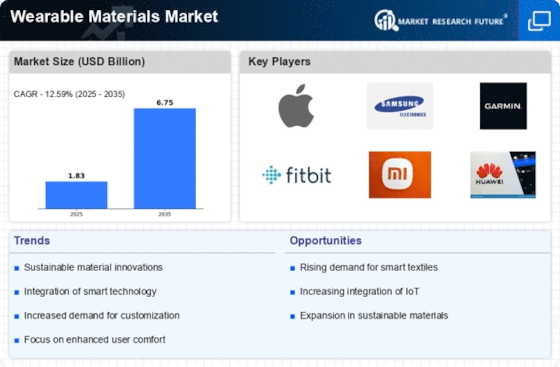
    Wearable Materials Market Infographic
    Purchase Options

    Market Trends

    Key Emerging Trends in the Wearable Materials Market

    Wearable Materials are witnessing significant trends at present, which are reflective of shifts in demand and applications across various sectors of wearable technology. Wearable materials include advanced textiles, polymers, and components used in manufacturing smart clothing and wearable devices. One notable trend in this industry is the growing overlap between smart capabilities and everyday clothes. Additionally, the healthcare sector plays a vital role in shaping the wearable material markets. For instance, wearable medical devices like smart patches or continuous monitoring systems require flexible, durable materials that are biocompatible. Wearable technologies should provide comfort to patients who use them while ensuring their effectiveness; all these aspects have led to further advancement in remote patient monitoring principles, leading to personalized healthcare solutions. What's more important here is that this particular fashion trend revolves around preventive medicine/healthcare with reference to non-invasive diagnostic tools. Sustainable consumption patterns emerge as one of the key trends observed within the wearable inputs market today. Manufacturing firms increasingly opt for recyclable, eco-friendly options when producing electronic accessories/wearables, etc. Thus, manufacturers are adopting sustainable alternatives such as biobased polymers or recycled products aimed at reducing the overall environmental impact resulting from the consumption of wearable gadgets. Further, sports and fitness industries contribute to fashion within the wearables' market space; hence, athletes are taking up gear fitted with sensors that help monitor and track performance. Wearable materials in sports apparel are designed to enhance comfort, provide moisture-wicking properties, and accommodate sensors that track metrics such as heart rate and body temperature. This move has been driven by the need to have facts on board concerning athletic achievements as well as personal wellness. Collaboration and partnership among wearable materials companies are increasing. Companies collaborate to conduct joint research on new uses and the development of novel formulations of wearable technology materials. Furthermore, wearables market trends are affected by technological advancements. In an ongoing process, researchers are working towards improving the properties such as stretchability, conductivity, and washability of these wearable materials while manufacturers continue to improve them. This includes flexible electronics, conductive textiles, and advanced polymers that can be used under regular wearing conditions without any damage done to them or change in their appearance over time, among others. Stretchable devices also form part of innovations in this sector, which makes them adaptable and effective for solutions in the wearables area amid its ever-changing environment regarding technology.


    Author
    Priya Nagrale
    Senior Research Analyst

    With an experience of over five years in market research industry (Chemicals & Materials domain), I gather and analyze market data from diverse sources to produce results, which are then presented back to a client. Also, provide recommendations based on the findings. As a Senior Research Analyst, I perform quality checks (QC) for market estimations, QC for reports, and handle queries and work extensively on client customizations. Also, handle the responsibilities of client proposals, report planning, report finalization, and execution

    Leave a Comment

    FAQs

    How much is the Wearable Materials Market?

    The Wearable Materials market size was valued at USD 1.60 Billion in 2024.

    What is the growth rate of the Wearable Materials market?

    Wearable Materials Market is projected to register a CAGR of 12.59% from 2025-2035

    Which region held the largest market share in the Wearable Materials market?

    North America had the largest share in the Wearable Materials Market.

    Who are the key players in the Wearable Materials market?

    The key players in the Wearable Materials Market are Elkem Silicones(Bluesil), Momentive (Silopren LSR), The Lubrizol Corporation (Estane), Solvay (Tecnoflon), BASF SE, DuPont, Wacker Chemie AG, Koninklijke DSM N V, Arkema S. A.

    Which type led the Wearable Materials market?

    The Polyurethanes category dominated the Wearable Materials Market in 2024.

    Which application had the largest market share in the Wearable Materials market?

    The Fitness Trackers had the largest share in the Wearable Materials Market.

    Market Summary

    As per Market Research Future Analysis, the Global Wearable Materials Market was valued at USD 1.83 Billion in 2024 and is projected to reach USD 6.75 Billion by 2035, growing at a CAGR of 12.59% from 2025 to 2035. The market is driven by the rising demand for fitness tracking devices and the increasing popularity of the Internet of Things. Key segments include polyurethanes, which dominate the market with 35% revenue share, and applications in fitness trackers, smart clothing, and smart glass. North America leads the market, followed by Europe and Asia-Pacific, with the latter expected to grow at the fastest rate.

    Key Market Trends & Highlights

    The wearable materials market is experiencing significant growth driven by several key trends.

    • Market Size in 2024: USD 1.83 Billion; projected to reach USD 6.75 Billion by 2035.
    • CAGR of 12.59% during the forecast period (2024 - 2032).
    • Polyurethanes account for 35% of market revenue, widely used in smart devices.
    • Asia-Pacific expected to grow at the fastest CAGR from 2023 to 2032.

    Market Size & Forecast

    2024 Market Size USD 1.83 Billion
    2035 Market Size USD 6.75 Billion
    CAGR 12.59%
    Largest Regional Market Share in 2024 North America

    Major Players

    Key players include Elkem Silicones, Momentive, The Lubrizol Corporation, Solvay, BASF SE, DuPont, Wacker Chemie AG, Koninklijke DSM N V, Arkema S. A.

    Market Trends

    Growing Demand in Smart Clothing industries is driving the market growth.

    Market CAGR for wearable materials is being driven by the rising number of  fabrics integrated with electronic components and technologies, enabling them to interact with the wearer or the environment. This trend is revolutionizing the wearable material market by combining traditional textiles with advanced functionalities. The integration of sensors, conductive fibers, and energy storage components into fabrics allows for the development of intelligent garments capable of monitoring vital signs, tracking movement, and even providing therapeutic benefits.

    The market for smart textiles is expanding across various sectors, including sports and fitness, healthcare, fashion, and military applications. For example, in the sports industry, smart textiles can measure heart rate, body temperature, and hydration levels, providing athletes with real-time data for performance optimization and injury prevention. In healthcare, e-textiles can monitor patients remotely, enhancing their comfort and reducing the need for frequent hospital visits.

    With the growing emphasis on sustainability and environmental responsibility, the wearable material market is witnessing a shift towards eco-friendly alternatives. Consumers are increasingly demanding products that minimize their ecological footprint, prompting manufacturers to explore sustainable materials and production methods. Biodegradable polymers, recycled fabrics, and organic textiles are gaining traction in the wearable material industry. These materials offer reduced environmental impact during their production, use, and disposal. For instance, some companies are developing wearables made from recycled plastics, reducing waste and promoting the circular economy. Wearable devices are no longer limited to basic fitness trackers or smart watches.

    The industry is experiencing a surge in demand for wearables with advanced functionalities and enhanced user experiences. This trend is driving the development of innovative materials that can deliver improved performance, comfort, and aesthetics.

    The wearable material market is experiencing significant growth and innovation, driven by emerging trends such as smart textiles, sustainable materials, and advanced functionalities. The integration of electronics into fabrics, the adoption of eco-friendly materials, and the focus on enhanced user experiences are shaping the future of wearable technology. As consumer demand continues to evolve, manufacturers and researchers must stay at the forefront of these trends to deliver cutting-edge wearable devices that meet the needs of a diverse and ever- expanding market driving the Wearable Materials market revenue.

    The increasing integration of advanced textiles and smart technologies in wearable materials suggests a transformative shift in consumer preferences towards multifunctional and sustainable products.

    U.S. Department of Commerce

    Wearable Materials Market Market Drivers

    Market Growth Projections

    The Global Wearable Materials Market Industry is expected to experience robust growth in the coming years. Projections indicate that the market will reach a value of 1.83 USD Billion in 2024 and is anticipated to grow to 6.75 USD Billion by 2035. This growth trajectory suggests a compound annual growth rate (CAGR) of 12.6% from 2025 to 2035. The increasing adoption of wearable technology across various sectors, coupled with advancements in materials science, is likely to drive this expansion. As consumer demand for innovative and functional wearables continues to rise, the market is set to evolve significantly.

    Integration of IoT in Wearable Devices

    The integration of Internet of Things (IoT) technology into wearable devices is transforming the Global Wearable Materials Market Industry. IoT-enabled wearables can collect and transmit data seamlessly, allowing for enhanced user experiences and improved functionality. For instance, smart fitness trackers can sync with mobile applications to provide users with personalized insights and recommendations. This connectivity not only enhances the utility of wearables but also encourages manufacturers to explore new materials that support advanced features. As IoT adoption continues to rise, the demand for innovative wearable materials is expected to grow, contributing to the overall market expansion.

    Growing Interest in Fitness and Wellness

    The increasing focus on fitness and wellness among consumers is significantly influencing the Global Wearable Materials Market Industry. As more individuals prioritize health and fitness, the demand for wearables that assist in tracking physical activity and health metrics is surging. Wearable devices such as fitness bands and smartwatches are becoming essential tools for fitness enthusiasts. This trend is likely to drive manufacturers to invest in advanced materials that enhance the functionality and comfort of these devices. Consequently, the market is poised for substantial growth, with projections indicating a market value of 1.83 USD Billion in 2024.

    Increasing Consumer Awareness and Adoption

    Consumer awareness regarding the benefits of wearable technology is on the rise, which is positively impacting the Global Wearable Materials Market Industry. As individuals become more informed about the functionalities and advantages of wearables, such as fitness tracking and health monitoring, the adoption rate is expected to increase. This trend is particularly evident among younger demographics who are more inclined to integrate technology into their daily lives. The growing acceptance of wearables is likely to drive demand for innovative materials that enhance comfort and usability, further propelling market growth in the coming years.

    Rising Demand for Health Monitoring Devices

    The increasing prevalence of chronic diseases and the growing emphasis on preventive healthcare are driving the demand for health monitoring devices. The Global Wearable Materials Market Industry is witnessing a surge in the adoption of wearable technology that facilitates real-time health tracking. For instance, smartwatches equipped with sensors for heart rate and blood oxygen levels are becoming commonplace. This trend is expected to contribute to the market's growth, with projections indicating a market value of 1.83 USD Billion in 2024. As consumers become more health-conscious, the integration of advanced materials in wearables is likely to enhance user experience and functionality.

    Technological Advancements in Wearable Materials

    Innovations in materials science are significantly influencing the Global Wearable Materials Market Industry. The development of lightweight, flexible, and durable materials is enabling manufacturers to create more comfortable and efficient wearable devices. For example, the incorporation of conductive fabrics and smart textiles allows for seamless integration of technology into everyday clothing. These advancements not only improve the performance of wearables but also expand their applications across various sectors, including sports, healthcare, and fashion. As a result, the market is projected to grow at a compound annual growth rate (CAGR) of 12.6% from 2025 to 2035, reaching an estimated value of 6.75 USD Billion by 2035.

    Market Segment Insights

    Wearable Materials Type Insights

    The Wearable Materials market segmentation, based on type includes Silicon, Polyurethanes, and Fluoroelastomers. The polyurethanes segment dominated the market, accounting for 35% of market revenue (78.48 Billion). In developing economies, category growth is driven by their excellent flexibility, durability, and lightweight nature. They are widely used in smart watches, fitness bands, and smart clothing. Polymers offer a wide range of options such as polyethylene terephthalate (PET), polyurethane (PU), and silicone, each with unique properties suited for different applications.

    Wearable Materials Application Insights

    The Wearable Materials market segmentation, based on application includes Fitness Trackers, Smart Glass, Smart Clothing, and Wearable Camera. The fitness trackers category generated the most income. These devices require lightweight, flexible, and skin-friendly materials that can withstand daily usage. Polymers, particularly silicone, are widely employed in consumer electronics due to their flexibility, water resistance, and ease of customization.

    Figure1: Wearable Materials Market, by Application, 2022 & 2032 (USD Billion)

    Source: Secondary Research, Primary Research, Market Research Future Database and Analyst Review

    Get more detailed insights about Wearable Materials Market Research Report - Forecast till 2035

    Regional Insights

    By region, the study provides the market insights into North America, Europe, Asia-Pacific and Rest of the World. The North American Wearable Materials market area will dominate this market, owing to witnessed significant growth in the adoption of wearable devices, including smartwatches, fitness trackers, and virtual reality headsets. The demand for high-quality and durable materials in wearables has been on the rise, driving the market for wearable materials in this region.

    Further, the major countries studiedin the market reportare TheUS, Canada, German, France, the UK, Italy, Spain, China, Japan, India, Australia, South Korea, and Brazil.

    Figure2: WEARABLE MATERIALS MARKET SHARE BY REGION 2022 (USD Billion)

    WEARABLE MATERIALS MARKET SHARE BY REGION 2022

    Source: Secondary Research, Primary Research, Market Research Future Database and Analyst Review

    Europe Wearable Materials market accounts for the second-largest market share due to increasing focus on wearable healthcare devices, particularly for monitoring chronic conditions and promoting personal wellness. Wearable material manufacturers in Europe have been catering to the demand for comfortable, breathable, and skin-friendly materials for wearable devices.

    The Asia-Pacific Wearable Materials Market is expected to grow at the fastest CAGR from 2023 to 2032. This is due to the demand for affordable and innovative wearable materials has been high in this region, promoting the growth of the market. Moreover, China’s Wearable Materials market held the largest market share, and the Indian Wearable Materials market was the fastest growing market in the Asia-Pacific region.

    Key Players and Competitive Insights

    Leading market players are investing heavily in research and development in order to expand their product lines, which will help the Wearable Materials market, grow even more. Market participants are also undertaking a variety of strategic activities to expand their footprint, with important market developments including Elkem Silicones, (Bluesil), Momentive (Silopren LSR), The Lubrizol Corporation (Estane), Solvay (Tecnoflon), BASF SE,  , Wacker Chemie AG, Koninklijke DSM N V, Arkema S. A. with other organizations. To expand and survive in a more competitive and rising market climate, Wearable Materials industry must offer cost-effective items.

    Manufacturing locally to minimize operational costs is one of the key business tactics used by manufacturers in the Wearable Materials industry to benefit clients and increase the market sector. In recent years, the Wearable Materials industry has offered some of the most significant advantages to medicine. Major players in the Wearable Materials market, including, Elkem Silicones(Bluesi, Momentive (Silopren LSR), The Lubrizol Corporation (Estane), Solvay (Tecnoflon), BASF SE, DuPont, Wacker Chemie AG, Koninklijke DSM N V, Arkema S. A. and others, are attempting to increase market demand by investing in research and development operations.

    Key Companies in the Wearable Materials Market market include

    Industry Developments

    March 2022: Researches in the United Kingdom has invented a new energy-harvesting technology that will allow wearable devices to be constructed solely of recycled waste materials and driven exclusive by human activity. The advanced technology institute at the University of Surrey have announced that the technology is being translated into smartwatches.

    January 2022: Wearable devices are smart electronic equipment assimilated with the clothing or worn on the individual as accessories or grafts. They are made up of bio-compatible materials and have characteristics like durability, flexibility, stiffness, firmness, lightness of weight, color stability.

    February 2021: Wearable materials are majorly used to make wearable devices owing to their properties such as flexibility, and lightweight nature. Wearable materials have wide applications in the healthcare sector in order to monitor wide-ranging symptoms of the body with comfort and ease.

    Future Outlook

    Wearable Materials Market Future Outlook

    The Wearable Materials Market is projected to grow at a 12.59% CAGR from 2025 to 2035, driven by advancements in smart textiles, increasing health awareness, and rising demand for fitness tracking.

    New opportunities lie in:

    • Develop innovative smart textiles for enhanced user comfort and functionality.
    • Leverage AI for personalized health monitoring solutions in wearable devices.
    • Expand partnerships with tech firms to integrate IoT capabilities into wearable materials.

    By 2035, the Wearable Materials Market is expected to achieve substantial growth, reflecting evolving consumer needs and technological advancements.

    Market Segmentation

    Wearable Materials Type Outlook

    • Silicone
    • Polyurethanes
    • Fluroelastomers

    Wearable Materials Regional Outlook

    North America
    • US
    • Canada

    Wearable Materials Application Channel Outlook

    • Fitness Trackers
    • Smart Glass
    • Smart Clothing
    • Wearable Camera

    Report Scope

    Report Attribute/Metric Details
    Market Size 2024 USD 1.83 Billion
    Market Size 2035 6.75 (Value (USD Billion))
    Compound Annual Growth Rate (CAGR) 12.59% (2025 - 2035)
    Base Year 2024
    Market Forecast Period 2025 - 2035
    Historical Data 2018- 2022
    Market Forecast Units Value (USD Billion)
    Report Coverage Revenue Forecast, Market Competitive Landscape, Growth Factors, and Trends
    Segments Covered Type, Distribution Channel, and Region
    Geographies Covered North America, Europe, AsiaPacific, and the Rest of the World
    Countries Covered The US, Canada, German, France, UK, Italy, Spain, China, Japan, India, Australia, South Korea, and Brazil
    Key Companies Profiled  Elkem Silicones(Bluesil, Momentive (Silopren LSR), The Lubrizol Corporation (Estane), Solvay (Tecnoflon), BASF SE, DuPont, Wacker Chemie AG, Koninklijke DSM N V, Arkema S. A.
    Key Market Opportunities High cost involved with the manufacturing of devices
    Key Market Dynamics Growing demand for fitness tracing wearable devices. Rising popularity of the Internet of Things
    Market Size 2025 2.06 (Value (USD Billion))

    FAQs

    How much is the Wearable Materials Market?

    The Wearable Materials market size was valued at USD 1.60 Billion in 2024.

    What is the growth rate of the Wearable Materials market?

    Wearable Materials Market is projected to register a CAGR of 12.59% from 2025-2035

    Which region held the largest market share in the Wearable Materials market?

    North America had the largest share in the Wearable Materials Market.

    Who are the key players in the Wearable Materials market?

    The key players in the Wearable Materials Market are Elkem Silicones(Bluesil), Momentive (Silopren LSR), The Lubrizol Corporation (Estane), Solvay (Tecnoflon), BASF SE, DuPont, Wacker Chemie AG, Koninklijke DSM N V, Arkema S. A.

    Which type led the Wearable Materials market?

    The Polyurethanes category dominated the Wearable Materials Market in 2024.

    Which application had the largest market share in the Wearable Materials market?

    The Fitness Trackers had the largest share in the Wearable Materials Market.

    1. SECTION I: EXECUTIVE SUMMARY AND KEY HIGHLIGHTS
      1. | 1.1 EXECUTIVE SUMMARY
      2. | | 1.1.1 Market Overview
      3. | | 1.1.2 Key Findings
      4. | | 1.1.3 Market Segmentation
      5. | | 1.1.4 Competitive Landscape
      6. | | 1.1.5 Challenges and Opportunities
      7. | | 1.1.6 Future Outlook
    2. SECTION II: SCOPING, METHODOLOGY AND MARKET STRUCTURE
      1. | 2.1 MARKET INTRODUCTION
      2. | | 2.1.1 Definition
      3. | | 2.1.2 Scope of the study
      4. | | | 2.1.2.1 Research Objective
      5. | | | 2.1.2.2 Assumption
      6. | | | 2.1.2.3 Limitations
      7. | 2.2 RESEARCH METHODOLOGY
      8. | | 2.2.1 Overview
      9. | | 2.2.2 Data Mining
      10. | | 2.2.3 Secondary Research
      11. | | 2.2.4 Primary Research
      12. | | | 2.2.4.1 Primary Interviews and Information Gathering Process
      13. | | | 2.2.4.2 Breakdown of Primary Respondents
      14. | | 2.2.5 Forecasting Model
      15. | | 2.2.6 Market Size Estimation
      16. | | | 2.2.6.1 Bottom-Up Approach
      17. | | | 2.2.6.2 Top-Down Approach
      18. | | 2.2.7 Data Triangulation
      19. | | 2.2.8 Validation
    3. SECTION III: QUALITATIVE ANALYSIS
      1. | 3.1 MARKET DYNAMICS
      2. | | 3.1.1 Overview
      3. | | 3.1.2 Drivers
      4. | | 3.1.3 Restraints
      5. | | 3.1.4 Opportunities
      6. | 3.2 MARKET FACTOR ANALYSIS
      7. | | 3.2.1 Value chain Analysis
      8. | | 3.2.2 Porter's Five Forces Analysis
      9. | | | 3.2.2.1 Bargaining Power of Suppliers
      10. | | | 3.2.2.2 Bargaining Power of Buyers
      11. | | | 3.2.2.3 Threat of New Entrants
      12. | | | 3.2.2.4 Threat of Substitutes
      13. | | | 3.2.2.5 Intensity of Rivalry
      14. | | 3.2.3 COVID-19 Impact Analysis
      15. | | | 3.2.3.1 Market Impact Analysis
      16. | | | 3.2.3.2 Regional Impact
      17. | | | 3.2.3.3 Opportunity and Threat Analysis
    4. SECTION IV: QUANTITATIVE ANALYSIS
      1. | 4.1 Chemicals and Materials, BY Type (USD Billion)
      2. | | 4.1.1 Silicone
      3. | | 4.1.2 Polyurethanes
      4. | | 4.1.3 Fluoroelastomers
      5. | 4.2 Chemicals and Materials, BY Application (USD Billion)
      6. | | 4.2.1 Fitness Trackers
      7. | | 4.2.2 Smart Glass
      8. | | 4.2.3 Smart Clothing
      9. | | 4.2.4 Wearable Camera
      10. | 4.3 Chemicals and Materials, BY Region (USD Billion)
      11. | | 4.3.1 North America
      12. | | | 4.3.1.1 US
      13. | | | 4.3.1.2 Canada
      14. | | 4.3.2 Europe
      15. | | | 4.3.2.1 Germany
      16. | | | 4.3.2.2 UK
      17. | | | 4.3.2.3 France
      18. | | | 4.3.2.4 Russia
      19. | | | 4.3.2.5 Italy
      20. | | | 4.3.2.6 Spain
      21. | | | 4.3.2.7 Rest of Europe
      22. | | 4.3.3 APAC
      23. | | | 4.3.3.1 China
      24. | | | 4.3.3.2 India
      25. | | | 4.3.3.3 Japan
      26. | | | 4.3.3.4 South Korea
      27. | | | 4.3.3.5 Malaysia
      28. | | | 4.3.3.6 Thailand
      29. | | | 4.3.3.7 Indonesia
      30. | | | 4.3.3.8 Rest of APAC
      31. | | 4.3.4 South America
      32. | | | 4.3.4.1 Brazil
      33. | | | 4.3.4.2 Mexico
      34. | | | 4.3.4.3 Argentina
      35. | | | 4.3.4.4 Rest of South America
      36. | | 4.3.5 MEA
      37. | | | 4.3.5.1 GCC Countries
      38. | | | 4.3.5.2 South Africa
      39. | | | 4.3.5.3 Rest of MEA
    5. SECTION V: COMPETITIVE ANALYSIS
      1. | 5.1 Competitive Landscape
      2. | | 5.1.1 Overview
      3. | | 5.1.2 Competitive Analysis
      4. | | 5.1.3 Market share Analysis
      5. | | 5.1.4 Major Growth Strategy in the Chemicals and Materials
      6. | | 5.1.5 Competitive Benchmarking
      7. | | 5.1.6 Leading Players in Terms of Number of Developments in the Chemicals and Materials
      8. | | 5.1.7 Key developments and growth strategies
      9. | | | 5.1.7.1 New Product Launch/Service Deployment
      10. | | | 5.1.7.2 Merger & Acquisitions
      11. | | | 5.1.7.3 Joint Ventures
      12. | | 5.1.8 Major Players Financial Matrix
      13. | | | 5.1.8.1 Sales and Operating Income
      14. | | | 5.1.8.2 Major Players R&D Expenditure. 2023
      15. | 5.2 Company Profiles
      16. | | 5.2.1 Apple Inc. (US)
      17. | | | 5.2.1.1 Financial Overview
      18. | | | 5.2.1.2 Products Offered
      19. | | | 5.2.1.3 Key Developments
      20. | | | 5.2.1.4 SWOT Analysis
      21. | | | 5.2.1.5 Key Strategies
      22. | | 5.2.2 Samsung Electronics (KR)
      23. | | | 5.2.2.1 Financial Overview
      24. | | | 5.2.2.2 Products Offered
      25. | | | 5.2.2.3 Key Developments
      26. | | | 5.2.2.4 SWOT Analysis
      27. | | | 5.2.2.5 Key Strategies
      28. | | 5.2.3 Garmin Ltd. (US)
      29. | | | 5.2.3.1 Financial Overview
      30. | | | 5.2.3.2 Products Offered
      31. | | | 5.2.3.3 Key Developments
      32. | | | 5.2.3.4 SWOT Analysis
      33. | | | 5.2.3.5 Key Strategies
      34. | | 5.2.4 Fitbit LLC (US)
      35. | | | 5.2.4.1 Financial Overview
      36. | | | 5.2.4.2 Products Offered
      37. | | | 5.2.4.3 Key Developments
      38. | | | 5.2.4.4 SWOT Analysis
      39. | | | 5.2.4.5 Key Strategies
      40. | | 5.2.5 Xiaomi Corporation (CN)
      41. | | | 5.2.5.1 Financial Overview
      42. | | | 5.2.5.2 Products Offered
      43. | | | 5.2.5.3 Key Developments
      44. | | | 5.2.5.4 SWOT Analysis
      45. | | | 5.2.5.5 Key Strategies
      46. | | 5.2.6 Huawei Technologies Co., Ltd. (CN)
      47. | | | 5.2.6.1 Financial Overview
      48. | | | 5.2.6.2 Products Offered
      49. | | | 5.2.6.3 Key Developments
      50. | | | 5.2.6.4 SWOT Analysis
      51. | | | 5.2.6.5 Key Strategies
      52. | | 5.2.7 Sony Corporation (JP)
      53. | | | 5.2.7.1 Financial Overview
      54. | | | 5.2.7.2 Products Offered
      55. | | | 5.2.7.3 Key Developments
      56. | | | 5.2.7.4 SWOT Analysis
      57. | | | 5.2.7.5 Key Strategies
      58. | | 5.2.8 Polar Electro Oy (FI)
      59. | | | 5.2.8.1 Financial Overview
      60. | | | 5.2.8.2 Products Offered
      61. | | | 5.2.8.3 Key Developments
      62. | | | 5.2.8.4 SWOT Analysis
      63. | | | 5.2.8.5 Key Strategies
      64. | | 5.2.9 Withings (FR)
      65. | | | 5.2.9.1 Financial Overview
      66. | | | 5.2.9.2 Products Offered
      67. | | | 5.2.9.3 Key Developments
      68. | | | 5.2.9.4 SWOT Analysis
      69. | | | 5.2.9.5 Key Strategies
      70. | 5.3 Appendix
      71. | | 5.3.1 References
      72. | | 5.3.2 Related Reports
    6. LIST OF FIGURES
      1. | 6.1 MARKET SYNOPSIS
      2. | 6.2 NORTH AMERICA MARKET ANALYSIS
      3. | 6.3 US MARKET ANALYSIS BY TYPE
      4. | 6.4 US MARKET ANALYSIS BY APPLICATION
      5. | 6.5 CANADA MARKET ANALYSIS BY TYPE
      6. | 6.6 CANADA MARKET ANALYSIS BY APPLICATION
      7. | 6.7 EUROPE MARKET ANALYSIS
      8. | 6.8 GERMANY MARKET ANALYSIS BY TYPE
      9. | 6.9 GERMANY MARKET ANALYSIS BY APPLICATION
      10. | 6.10 UK MARKET ANALYSIS BY TYPE
      11. | 6.11 UK MARKET ANALYSIS BY APPLICATION
      12. | 6.12 FRANCE MARKET ANALYSIS BY TYPE
      13. | 6.13 FRANCE MARKET ANALYSIS BY APPLICATION
      14. | 6.14 RUSSIA MARKET ANALYSIS BY TYPE
      15. | 6.15 RUSSIA MARKET ANALYSIS BY APPLICATION
      16. | 6.16 ITALY MARKET ANALYSIS BY TYPE
      17. | 6.17 ITALY MARKET ANALYSIS BY APPLICATION
      18. | 6.18 SPAIN MARKET ANALYSIS BY TYPE
      19. | 6.19 SPAIN MARKET ANALYSIS BY APPLICATION
      20. | 6.20 REST OF EUROPE MARKET ANALYSIS BY TYPE
      21. | 6.21 REST OF EUROPE MARKET ANALYSIS BY APPLICATION
      22. | 6.22 APAC MARKET ANALYSIS
      23. | 6.23 CHINA MARKET ANALYSIS BY TYPE
      24. | 6.24 CHINA MARKET ANALYSIS BY APPLICATION
      25. | 6.25 INDIA MARKET ANALYSIS BY TYPE
      26. | 6.26 INDIA MARKET ANALYSIS BY APPLICATION
      27. | 6.27 JAPAN MARKET ANALYSIS BY TYPE
      28. | 6.28 JAPAN MARKET ANALYSIS BY APPLICATION
      29. | 6.29 SOUTH KOREA MARKET ANALYSIS BY TYPE
      30. | 6.30 SOUTH KOREA MARKET ANALYSIS BY APPLICATION
      31. | 6.31 MALAYSIA MARKET ANALYSIS BY TYPE
      32. | 6.32 MALAYSIA MARKET ANALYSIS BY APPLICATION
      33. | 6.33 THAILAND MARKET ANALYSIS BY TYPE
      34. | 6.34 THAILAND MARKET ANALYSIS BY APPLICATION
      35. | 6.35 INDONESIA MARKET ANALYSIS BY TYPE
      36. | 6.36 INDONESIA MARKET ANALYSIS BY APPLICATION
      37. | 6.37 REST OF APAC MARKET ANALYSIS BY TYPE
      38. | 6.38 REST OF APAC MARKET ANALYSIS BY APPLICATION
      39. | 6.39 SOUTH AMERICA MARKET ANALYSIS
      40. | 6.40 BRAZIL MARKET ANALYSIS BY TYPE
      41. | 6.41 BRAZIL MARKET ANALYSIS BY APPLICATION
      42. | 6.42 MEXICO MARKET ANALYSIS BY TYPE
      43. | 6.43 MEXICO MARKET ANALYSIS BY APPLICATION
      44. | 6.44 ARGENTINA MARKET ANALYSIS BY TYPE
      45. | 6.45 ARGENTINA MARKET ANALYSIS BY APPLICATION
      46. | 6.46 REST OF SOUTH AMERICA MARKET ANALYSIS BY TYPE
      47. | 6.47 REST OF SOUTH AMERICA MARKET ANALYSIS BY APPLICATION
      48. | 6.48 MEA MARKET ANALYSIS
      49. | 6.49 GCC COUNTRIES MARKET ANALYSIS BY TYPE
      50. | 6.50 GCC COUNTRIES MARKET ANALYSIS BY APPLICATION
      51. | 6.51 SOUTH AFRICA MARKET ANALYSIS BY TYPE
      52. | 6.52 SOUTH AFRICA MARKET ANALYSIS BY APPLICATION
      53. | 6.53 REST OF MEA MARKET ANALYSIS BY TYPE
      54. | 6.54 REST OF MEA MARKET ANALYSIS BY APPLICATION
      55. | 6.55 KEY BUYING CRITERIA OF CHEMICALS AND MATERIALS
      56. | 6.56 RESEARCH PROCESS OF MRFR
      57. | 6.57 DRO ANALYSIS OF CHEMICALS AND MATERIALS
      58. | 6.58 DRIVERS IMPACT ANALYSIS: CHEMICALS AND MATERIALS
      59. | 6.59 RESTRAINTS IMPACT ANALYSIS: CHEMICALS AND MATERIALS
      60. | 6.60 SUPPLY / VALUE CHAIN: CHEMICALS AND MATERIALS
      61. | 6.61 CHEMICALS AND MATERIALS, BY TYPE, 2024 (% SHARE)
      62. | 6.62 CHEMICALS AND MATERIALS, BY TYPE, 2024 TO 2035 (USD Billion)
      63. | 6.63 CHEMICALS AND MATERIALS, BY APPLICATION, 2024 (% SHARE)
      64. | 6.64 CHEMICALS AND MATERIALS, BY APPLICATION, 2024 TO 2035 (USD Billion)
      65. | 6.65 BENCHMARKING OF MAJOR COMPETITORS
    7. LIST OF TABLES
      1. | 7.1 LIST OF ASSUMPTIONS
      2. | | 7.1.1
      3. | 7.2 North America MARKET SIZE ESTIMATES; FORECAST
      4. | | 7.2.1 BY TYPE, 2025-2035 (USD Billion)
      5. | | 7.2.2 BY APPLICATION, 2025-2035 (USD Billion)
      6. | 7.3 US MARKET SIZE ESTIMATES; FORECAST
      7. | | 7.3.1 BY TYPE, 2025-2035 (USD Billion)
      8. | | 7.3.2 BY APPLICATION, 2025-2035 (USD Billion)
      9. | 7.4 Canada MARKET SIZE ESTIMATES; FORECAST
      10. | | 7.4.1 BY TYPE, 2025-2035 (USD Billion)
      11. | | 7.4.2 BY APPLICATION, 2025-2035 (USD Billion)
      12. | 7.5 Europe MARKET SIZE ESTIMATES; FORECAST
      13. | | 7.5.1 BY TYPE, 2025-2035 (USD Billion)
      14. | | 7.5.2 BY APPLICATION, 2025-2035 (USD Billion)
      15. | 7.6 Germany MARKET SIZE ESTIMATES; FORECAST
      16. | | 7.6.1 BY TYPE, 2025-2035 (USD Billion)
      17. | | 7.6.2 BY APPLICATION, 2025-2035 (USD Billion)
      18. | 7.7 UK MARKET SIZE ESTIMATES; FORECAST
      19. | | 7.7.1 BY TYPE, 2025-2035 (USD Billion)
      20. | | 7.7.2 BY APPLICATION, 2025-2035 (USD Billion)
      21. | 7.8 France MARKET SIZE ESTIMATES; FORECAST
      22. | | 7.8.1 BY TYPE, 2025-2035 (USD Billion)
      23. | | 7.8.2 BY APPLICATION, 2025-2035 (USD Billion)
      24. | 7.9 Russia MARKET SIZE ESTIMATES; FORECAST
      25. | | 7.9.1 BY TYPE, 2025-2035 (USD Billion)
      26. | | 7.9.2 BY APPLICATION, 2025-2035 (USD Billion)
      27. | 7.10 Italy MARKET SIZE ESTIMATES; FORECAST
      28. | | 7.10.1 BY TYPE, 2025-2035 (USD Billion)
      29. | | 7.10.2 BY APPLICATION, 2025-2035 (USD Billion)
      30. | 7.11 Spain MARKET SIZE ESTIMATES; FORECAST
      31. | | 7.11.1 BY TYPE, 2025-2035 (USD Billion)
      32. | | 7.11.2 BY APPLICATION, 2025-2035 (USD Billion)
      33. | 7.12 Rest of Europe MARKET SIZE ESTIMATES; FORECAST
      34. | | 7.12.1 BY TYPE, 2025-2035 (USD Billion)
      35. | | 7.12.2 BY APPLICATION, 2025-2035 (USD Billion)
      36. | 7.13 APAC MARKET SIZE ESTIMATES; FORECAST
      37. | | 7.13.1 BY TYPE, 2025-2035 (USD Billion)
      38. | | 7.13.2 BY APPLICATION, 2025-2035 (USD Billion)
      39. | 7.14 China MARKET SIZE ESTIMATES; FORECAST
      40. | | 7.14.1 BY TYPE, 2025-2035 (USD Billion)
      41. | | 7.14.2 BY APPLICATION, 2025-2035 (USD Billion)
      42. | 7.15 India MARKET SIZE ESTIMATES; FORECAST
      43. | | 7.15.1 BY TYPE, 2025-2035 (USD Billion)
      44. | | 7.15.2 BY APPLICATION, 2025-2035 (USD Billion)
      45. | 7.16 Japan MARKET SIZE ESTIMATES; FORECAST
      46. | | 7.16.1 BY TYPE, 2025-2035 (USD Billion)
      47. | | 7.16.2 BY APPLICATION, 2025-2035 (USD Billion)
      48. | 7.17 South Korea MARKET SIZE ESTIMATES; FORECAST
      49. | | 7.17.1 BY TYPE, 2025-2035 (USD Billion)
      50. | | 7.17.2 BY APPLICATION, 2025-2035 (USD Billion)
      51. | 7.18 Malaysia MARKET SIZE ESTIMATES; FORECAST
      52. | | 7.18.1 BY TYPE, 2025-2035 (USD Billion)
      53. | | 7.18.2 BY APPLICATION, 2025-2035 (USD Billion)
      54. | 7.19 Thailand MARKET SIZE ESTIMATES; FORECAST
      55. | | 7.19.1 BY TYPE, 2025-2035 (USD Billion)
      56. | | 7.19.2 BY APPLICATION, 2025-2035 (USD Billion)
      57. | 7.20 Indonesia MARKET SIZE ESTIMATES; FORECAST
      58. | | 7.20.1 BY TYPE, 2025-2035 (USD Billion)
      59. | | 7.20.2 BY APPLICATION, 2025-2035 (USD Billion)
      60. | 7.21 Rest of APAC MARKET SIZE ESTIMATES; FORECAST
      61. | | 7.21.1 BY TYPE, 2025-2035 (USD Billion)
      62. | | 7.21.2 BY APPLICATION, 2025-2035 (USD Billion)
      63. | 7.22 South America MARKET SIZE ESTIMATES; FORECAST
      64. | | 7.22.1 BY TYPE, 2025-2035 (USD Billion)
      65. | | 7.22.2 BY APPLICATION, 2025-2035 (USD Billion)
      66. | 7.23 Brazil MARKET SIZE ESTIMATES; FORECAST
      67. | | 7.23.1 BY TYPE, 2025-2035 (USD Billion)
      68. | | 7.23.2 BY APPLICATION, 2025-2035 (USD Billion)
      69. | 7.24 Mexico MARKET SIZE ESTIMATES; FORECAST
      70. | | 7.24.1 BY TYPE, 2025-2035 (USD Billion)
      71. | | 7.24.2 BY APPLICATION, 2025-2035 (USD Billion)
      72. | 7.25 Argentina MARKET SIZE ESTIMATES; FORECAST
      73. | | 7.25.1 BY TYPE, 2025-2035 (USD Billion)
      74. | | 7.25.2 BY APPLICATION, 2025-2035 (USD Billion)
      75. | 7.26 Rest of South America MARKET SIZE ESTIMATES; FORECAST
      76. | | 7.26.1 BY TYPE, 2025-2035 (USD Billion)
      77. | | 7.26.2 BY APPLICATION, 2025-2035 (USD Billion)
      78. | 7.27 MEA MARKET SIZE ESTIMATES; FORECAST
      79. | | 7.27.1 BY TYPE, 2025-2035 (USD Billion)
      80. | | 7.27.2 BY APPLICATION, 2025-2035 (USD Billion)
      81. | 7.28 GCC Countries MARKET SIZE ESTIMATES; FORECAST
      82. | | 7.28.1 BY TYPE, 2025-2035 (USD Billion)
      83. | | 7.28.2 BY APPLICATION, 2025-2035 (USD Billion)
      84. | 7.29 South Africa MARKET SIZE ESTIMATES; FORECAST
      85. | | 7.29.1 BY TYPE, 2025-2035 (USD Billion)
      86. | | 7.29.2 BY APPLICATION, 2025-2035 (USD Billion)
      87. | 7.30 Rest of MEA MARKET SIZE ESTIMATES; FORECAST
      88. | | 7.30.1 BY TYPE, 2025-2035 (USD Billion)
      89. | | 7.30.2 BY APPLICATION, 2025-2035 (USD Billion)
      90. | 7.31 PRODUCT LAUNCH/PRODUCT DEVELOPMENT/APPROVAL
      91. | | 7.31.1
      92. | 7.32 ACQUISITION/PARTNERSHIP
      93. | | 7.32.1

    Wearable Materials Market Type Outlook (USD Billion, 2018-2032)

    • Silicone
    • Polyurethanes
    • Fluroelastomers

    Wearable Materials Market Application Outlook (USD Billion, 2018-2032)

    • Fitness Trackers
    • Smart Glass
    • Smart Clothing
    • Wearable Camera

    Wearable Materials Market Regional Outlook (USD Billion, 2018-2032)

    • North America Outlook (USD Billion, 2018-2032)

      • North America Wearable Materials Market by Type
        • Silicone
        • Polyurethanes
        • Fluroelastomers
      • North America Wearable Materials Market by Application
        • Fitness Trackers
        • Smart Glass
        • Smart Clothing
        • Wearable Camera
      • US Outlook (USD Billion, 2018-2032)

      • US Wearable Materials Market by Type
        • Silicone
        • Polyurethanes
        • Fluroelastomers
      • US Wearable Materials Market by Application
        • Fitness Trackers
        • Smart Glass
        • Smart Clothing
        • Wearable Camera
      • CANADA Outlook (USD Billion, 2018-2032)

      • CANADA Wearable Materials Market by Type
        • Silicone
        • Polyurethanes
        • Fluroelastomers
      • CANADAWearable Materials Market by Application
        • Fitness Trackers
        • Smart Glass
        • Smart Clothing
        • Wearable Camera
    • Europe Outlook (USD Billion, 2018-2032)

      • Europe Wearable Materials Market by Type
        • Silicone
        • Polyurethanes
        • Fluroelastomers
      • Europe Wearable Materials Market by Application
        • Fitness Trackers
        • Smart Glass
        • Smart Clothing
        • Wearable Camera
      • Germany Outlook (USD Billion, 2018-2032)

      • Germany Wearable Materials Market by Type
        • Silicone
        • Polyurethanes
        • Fluroelastomers
      • Germany Wearable Materials Market by Application
        • Fitness Trackers
        • Smart Glass
        • Smart Clothing
        • Wearable Camera
      • France Outlook (USD Billion, 2018-2032)

      • France Wearable Materials Market by Type
        • Silicone
        • Polyurethanes
        • Fluroelastomers
      • France Wearable Materials Market by Application
        • Fitness Trackers
        • Smart Glass
        • Smart Clothing
        • Wearable Camera
      • UK Outlook (USD Billion, 2018-2032)

      • UK Wearable Materials Market by Type
        • Silicone
        • Polyurethanes
        • Fluroelastomers
      • UK Wearable Materials Market by Application
        • Fitness Trackers
        • Smart Glass
        • Smart Clothing
        • Wearable Camera
      • ITALY Outlook (USD Billion, 2018-2032)

      • ITALY Wearable Materials Market by Type
        • Silicone
        • Polyurethanes
        • Fluroelastomers
      • ITALY Wearable Materials Market by Application
        • Fitness Trackers
        • Smart Glass
        • Smart Clothing
        • Wearable Camera
      • SPAIN Outlook (USD Billion, 2018-2032)

      • Spain Wearable Materials Market by Type
        • Silicone
        • Polyurethanes
        • Fluroelastomers
      • Spain Wearable Materials Market by Application
        • Fitness Trackers
        • Smart Glass
        • Smart Clothing
        • Wearable Camera
      • Rest Of Europe Outlook (USD Billion, 2018-2032)

      • Rest Of Europe Wearable Materials Market by Type
        • Silicone
        • Polyurethanes
        • Fluroelastomers
      • REST OF EUROPE Wearable Materials Market by Application
        • Fitness Trackers
        • Smart Glass
        • Smart Clothing
        • Wearable Camera
    • Asia-Pacific Outlook (USD Billion, 2018-2032)

      • Asia-Pacific Wearable Materials Market by Type
        • Silicone
        • Polyurethanes
        • Fluroelastomers
      • Asia-Pacific Wearable Materials Market by Application
        • Fitness Trackers
        • Smart Glass
        • Smart Clothing
        • Wearable Camera
      • China Outlook (USD Billion, 2018-2032)

      • China Wearable Materials Market by Type
        • Silicone
        • Polyurethanes
        • Fluroelastomers
      • China Wearable Materials Market by Application
        • Fitness Trackers
        • Smart Glass
        • Smart Clothing
        • Wearable Camera
      • Japan Outlook (USD Billion, 2018-2032)

      • Japan Wearable Materials Market by Type
        • Silicone
        • Polyurethanes
        • Fluroelastomers
      • Japan Wearable Materials Market by Application
        • Fitness Trackers
        • Smart Glass
        • Smart Clothing
        • Wearable Camera
      • India Outlook (USD Billion, 2018-2032)

      • India Wearable Materials Market by Type
        • Silicone
        • Polyurethanes
        • Fluroelastomers
      • India Wearable Materials Market by Application
        • Fitness Trackers
        • Smart Glass
        • Smart Clothing
        • Wearable Camera
      • Australia Outlook (USD Billion, 2018-2032)

      • Australia Wearable Materials Market by Type
        • Silicone
        • Polyurethanes
        • Fluroelastomers
      • Australia Wearable Materials Market by Application
        • Fitness Trackers
        • Smart Glass
        • Smart Clothing
        • Wearable Camera
      • Rest of Asia-Pacific Outlook (USD Billion, 2018-2032)

      • Rest of Asia-Pacific Wearable Materials Market by Type
        • Silicone
        • Polyurethanes
        • Fluroelastomers
      • Rest of Asia-Pacific Wearable Materials Market by Application
        • Fitness Trackers
        • Smart Glass
        • Smart Clothing
        • Wearable Camera
    • Rest of the World Outlook (USD Billion, 2018-2032)

      • Rest of the World Wearable Materials Market by Type
        • Silicone
        • Polyurethanes
        • Fluroelastomers
      • Rest of the World Wearable Materials Market by Application
        • Fitness Trackers
        • Smart Glass
        • Smart Clothing
        • Wearable Camera
      • Middle East Outlook (USD Billion, 2018-2032)

      • Middle East Wearable Materials Market by Type
        • Silicone
        • Polyurethanes
        • Fluroelastomers
      • Middle East Wearable Materials Market by Application
        • Fitness Trackers
        • Smart Glass
        • Smart Clothing
        • Wearable Camera
      • Africa Outlook (USD Billion, 2018-2032)

      • Africa Wearable Materials Market by Type
        • Silicone
        • Polyurethanes
        • Fluroelastomers
      • Africa Wearable Materials Market by Application
        • Fitness Trackers
        • Smart Glass
        • Smart Clothing
        • Wearable Camera
      • Latin America Outlook (USD Billion, 2018-2032)

      • Latin America Wearable Materials Market by Type
        • Silicone
        • Polyurethanes
        • Fluroelastomers
      • Latin America Wearable Materials Market by Application
        • Fitness Trackers
        • Smart Glass
        • Smart Clothing
        • Wearable Camera
    Infographic

    Free Sample Request

    Kindly complete the form below to receive a free sample of this Report

    Get Free Sample

    Customer Strories

    “I am very pleased with how market segments have been defined in a relevant way for my purposes (such as "Portable Freezers & refrigerators" and "last-mile"). In general the report is well structured. Thanks very much for your efforts.”

    Victoria Milne

    Founder
    Case Study
    Chemicals and Materials

    Compare Licence

    ×
    Features License Type
    Single User Multiuser License Enterprise User
    Price $4,950 $5,950 $7,250
    Maximum User Access Limit 1 User Upto 10 Users Unrestricted Access Throughout the Organization
    Free Customization
    Direct Access to Analyst
    Deliverable Format
    Platform Access
    Discount on Next Purchase 10% 15% 15%
    Printable Versions