×
Hero Background
English
Chinese
French
Japanese
Korean
German
Spanish

Wearable Display Device Materials Market Share

ID: MRFR/CnM/6285-CR
272 Pages
Anshula Mandaokar
April 2019

Wearable Display Device Materials Market Research Report Information by Substrate (Glass, Polycarbonate), Adhesives (Silicone, Polyurethane), Coatings (Conductive), End-Uses Industry (Smart Glass, Smart Watches, Fitness Trackers) and Region Forecast till 2035

Share:
Download PDF ×

We do not share your information with anyone. However, we may send you emails based on your report interest from time to time. You may contact us at any time to opt-out.

Wearable Display Device Materials Market Infographic
Purchase Options

Market Share

Wearable Display Device Materials Market Share Analysis

In the Wearable Display Device Materials Market, strategic market share positioning is vital for companies to establish themselves as key players and secure a significant portion of the market. These positioning strategies involve deliberate efforts to differentiate products, target specific customer segments, and communicate value propositions effectively.

Specialization in High-Performance Materials: Companies can differentiate themselves in the Wearable Display Device Materials Market by specializing in the production of high-performance materials specifically designed for wearable displays. These materials may include advanced polymers, flexible substrates, and transparent conductive films that offer superior durability, flexibility, and optical properties. By focusing on materials tailored to meet the unique requirements of wearable displays, companies can attract customers seeking reliable and innovative solutions, thereby gaining a competitive edge in the market.

Customization and Tailored Solutions: Offering customization and tailored solutions can be a strategic positioning strategy in the Wearable Display Device Materials Market. Companies can work closely with wearable device manufacturers to develop materials that meet their specific design requirements and performance criteria. By providing personalized solutions, companies can address the diverse needs of customers and differentiate themselves from competitors offering off-the-shelf materials. Customization can also foster stronger relationships with customers, leading to long-term partnerships and increased market share.

Focus on Lightweight and Flexible Materials: Lightweight and flexible materials are highly desirable for wearable display devices due to their comfort and usability. Companies can position themselves as leaders in the market by focusing on the development of lightweight and flexible materials such as thin-film transistors (TFTs), organic light-emitting diodes (OLEDs), and flexible substrates. By offering materials that enable the design of sleek and comfortable wearable devices, companies can appeal to consumers' preferences and gain a competitive advantage in the market.

Investment in Research and Development: Investing in research and development (R&D) is essential for companies seeking to position themselves as innovators in the Wearable Display Device Materials Market. By continuously improving existing materials and developing new technologies, companies can stay ahead of market trends and meet evolving customer demands. Investing in R&D can also lead to the discovery of breakthrough materials with enhanced performance characteristics, enabling companies to differentiate their offerings and capture market share.

Partnerships with Device Manufacturers: Forming strategic partnerships with wearable device manufacturers can help companies strengthen their market position and expand their reach. By collaborating closely with device manufacturers, companies can ensure that their materials are integrated seamlessly into wearable devices and meet the manufacturers' quality standards. Partnerships can also provide companies with access to new markets, distribution channels, and customer insights, facilitating market expansion and increasing market share.

Emphasis on Environmental Sustainability: With growing concerns about environmental sustainability, companies can differentiate themselves in the Wearable Display Device Materials Market by emphasizing the use of eco-friendly materials and manufacturing processes. By offering materials that are recyclable, biodegradable, or sourced from sustainable materials, companies can appeal to environmentally conscious consumers and gain a competitive advantage. Emphasizing environmental sustainability can also enhance brand reputation and attract customers seeking ethical and responsible products, thereby increasing market share.

Global Market Expansion: Expanding into new geographical markets can be a strategic positioning strategy for companies looking to increase their market share in the Wearable Display Device Materials Market. By targeting emerging markets with growing demand for wearable devices, companies can tap into new customer bases and diversify their revenue streams. Global market expansion can also help companies mitigate risks associated with market fluctuations in specific regions and maintain a competitive edge in the rapidly evolving wearable technology industry.


Author
Anshula Mandaokar
Team Lead - Research

Anshula Mandaokar holds an academic degree in Chemical Engineering and has been contributing to the field for more than 5 years. She has expertise in Market Research and Business Consulting and serves as a Team Lead for a reputed Market Research firm under the Chemicals and Materials domain spectrum. She has worked on multiple projects, generating explicit results in a quick turnaround time. Her understanding of data interpretation justifies her role as a leader.

Leave a Comment

FAQs

What are the top market players in the wearable display device materials market in the global market?

The most prominent market player in the wearable display market in the global market are Master Bond Inc. (U.S.), Covestro AG (Germany), Solvay (Belgium), 3M (U.S.), Arkema SA (France), Wacker Chemie AG (Germany), DowDuPont (U.S.), BASF SE (Germany), and many others.

What are the expected growth rate and valuation of the wearable display device materials market in the global market during the forecasted period?

The wearable display device materials market in the global market is expected to show a high CAGR of 13.05% and is expected to reach USD 4,157.2 million during the forecasted period 2025-2035

Which region has the largest share in the wearable display device materials market in the global market during the forecasted period?

The largest share in the wearable display device materials market in the global market is held by the Asia-Pacific region as it is expected to show a high CAGR of 14.5% owing to an increase in the advancement in technology followed by North America.

Market Summary

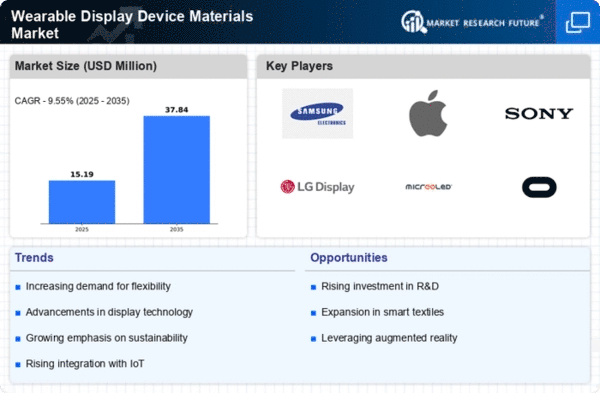
As per MRFR analysis, the Wearable Display Device Materials Market was estimated at 13.87 USD Million in 2024. The wearable display device materials industry is projected to grow from 15.2 USD Million in 2025 to 37.84 USD Million by 2035, exhibiting a compound annual growth rate (CAGR) of 9.55 during the forecast period 2025 - 2035.

Key Market Trends & Highlights

The Wearable Display Device Materials Market is poised for substantial growth driven by technological advancements and evolving consumer preferences.

  • Sustainability in material selection is becoming a pivotal trend, particularly in North America, where eco-friendly materials are increasingly prioritized.
  • The integration of advanced technologies, such as MicroLED displays, is gaining traction in the Asia-Pacific region, reflecting a shift towards more efficient and vibrant display solutions.
  • Customization and personalization are emerging as key factors, especially in the healthcare segment, which remains the largest market for wearable display devices.
  • Rising demand for wearable technology and advancements in display technologies are significant drivers propelling market growth, particularly in the fitness segment, which is currently the fastest-growing.

Market Size & Forecast

2024 Market Size 13.87 (USD Million)
2035 Market Size 37.84 (USD Million)
CAGR (2025 - 2035) 9.55%
Largest Regional Market Share in 2024 North America

Major Players

<p>Samsung Electronics (KR), LG Display (KR), Apple (US), Sony Corporation (JP), MicroOLED (FR), Oculus (US), Vuzix Corporation (US), Google (US), Panasonic (JP), Sharp Corporation (JP)</p>

Market Trends

The Wearable Display Device Materials Market is currently experiencing a transformative phase, driven by advancements in technology and increasing consumer demand for innovative devices. As the market evolves, manufacturers are focusing on developing materials that enhance the functionality and aesthetics of wearable displays. This includes the integration of flexible substrates, lightweight components, and high-resolution displays, which are essential for improving user experience. Furthermore, sustainability is becoming a crucial consideration, with companies exploring eco-friendly materials to meet the growing expectations of environmentally conscious consumers. In addition to technological advancements, the Wearable Display Device Materials Market is influenced by the rising trend of health and fitness monitoring. Wearable devices are increasingly being utilized for tracking health metrics, which necessitates the use of durable and reliable materials. This trend is likely to propel the demand for advanced materials that can withstand daily wear and tear while providing accurate data. As the market continues to expand, collaboration between material scientists and device manufacturers appears essential for fostering innovation and meeting the diverse needs of consumers.

Sustainability in Material Selection

The emphasis on sustainability is reshaping the Wearable Display Device Materials Market. Manufacturers are increasingly prioritizing eco-friendly materials, which not only reduce environmental impact but also appeal to a growing segment of consumers who value sustainability. This trend suggests a shift towards biodegradable and recyclable materials, potentially influencing the entire supply chain.

Integration of Advanced Technologies

The incorporation of advanced technologies, such as augmented reality and artificial intelligence, is significantly impacting the Wearable Display Device Materials Market. These technologies require materials that can support high-resolution displays and interactive features, indicating a need for continuous innovation in material development to meet these demands.

Customization and Personalization

Customization is becoming a prominent trend within the Wearable Display Device Materials Market. Consumers are increasingly seeking personalized devices that reflect their individual preferences and lifestyles. This trend may drive manufacturers to explore diverse materials and designs, enhancing the overall user experience.

Wearable Display Device Materials Market Market Drivers

Market Growth Projections

The Global Wearable Display Device Materials Market Industry is projected to witness substantial growth over the coming years. With a market value expected to reach 45.67 USD Billion in 2024 and further expand to 112.34 USD Billion by 2035, the industry is poised for a robust trajectory. This growth is underpinned by a compound annual growth rate of 8.53% from 2025 to 2035, indicating a strong demand for innovative materials that enhance wearable technology. The increasing integration of smart features into everyday devices is likely to drive this expansion, as consumers seek more functionality and improved user experiences.

Rising Demand for Smart Wearables

The Global Wearable Display Device Materials Market Industry experiences a surge in demand for smart wearables, driven by consumer preferences for health monitoring and fitness tracking. As individuals increasingly seek devices that provide real-time data, the market is projected to reach 45.67 USD Billion in 2024. This growth is indicative of a broader trend towards integrating technology into daily life, where wearable devices serve not only functional purposes but also enhance lifestyle choices. The proliferation of smartwatches and fitness bands exemplifies this trend, as manufacturers innovate with materials that enhance durability and display quality, thereby attracting a wider consumer base.

Emergence of Augmented Reality Applications

The emergence of augmented reality applications is reshaping the Global Wearable Display Device Materials Market Industry. As AR technology becomes more mainstream, the demand for wearable devices that support immersive experiences is on the rise. This trend is particularly evident in sectors such as gaming, education, and training, where AR enhances user engagement and learning outcomes. Manufacturers are increasingly focusing on developing materials that facilitate high-quality displays and user interaction, thereby expanding the market's potential. The integration of AR capabilities into wearable devices is expected to drive innovation and growth, positioning the industry for a dynamic future.

Growing Health Awareness and Fitness Trends

Growing health awareness and fitness trends are driving the Global Wearable Display Device Materials Market Industry. As consumers become more health-conscious, the demand for wearable devices that monitor health metrics such as heart rate, sleep patterns, and physical activity increases. This trend is reflected in the rising sales of fitness trackers and smartwatches, which utilize advanced materials for better performance and user comfort. The market's expansion is further supported by the integration of health-related features in wearable technology, appealing to a broader audience. This shift towards proactive health management is likely to sustain growth in the industry for years to come.

Increased Investment in Research and Development

Increased investment in research and development plays a pivotal role in shaping the Global Wearable Display Device Materials Market Industry. Companies are allocating substantial resources to explore new materials that enhance the functionality and aesthetics of wearable devices. This focus on innovation is likely to yield breakthroughs in lightweight, flexible materials that can withstand daily wear and tear. As a result, the market is anticipated to expand significantly, with projections indicating a rise to 112.34 USD Billion by 2035. This commitment to R&D not only fosters technological advancements but also positions companies to meet evolving consumer demands effectively.

Technological Advancements in Display Technologies

Technological advancements in display technologies significantly influence the Global Wearable Display Device Materials Market Industry. Innovations such as OLED and microLED displays offer superior image quality and energy efficiency, which are crucial for wearable devices. These advancements not only improve user experience but also extend battery life, a critical factor for consumer acceptance. As manufacturers adopt these cutting-edge technologies, the market is expected to grow at a CAGR of 8.53% from 2025 to 2035. This growth trajectory suggests a robust future for the industry, as enhanced display capabilities become a key differentiator in a competitive landscape.

Market Segment Insights

By Application: Healthcare (Largest) vs. Fitness (Fastest-Growing)

<p>The Wearable Display Device Materials Market exhibits a diverse application landscape, prominently featuring healthcare, fitness, entertainment, military, and industrial segments. Among these, the healthcare segment holds the largest market share, fueled by the increasing integration of wearable technology in medical diagnostics and patient monitoring. Fitness applications follow closely behind, capturing attention with a surge in consumer interest in health tracking and wearable fitness devices, reflecting a growing global emphasis on personal health and wellness.</p>

<p>Fitness: Dominant vs. Healthcare: Emerging</p>

<p>While the healthcare segment has traditionally been a foundational pillar in the wearable display device materials market, the fitness segment is rapidly establishing itself as an emerging powerhouse. The increasing prevalence of fitness tracking devices powered by advanced display technologies illustrates a significant shift in consumer preferences towards proactive health management. Wearable displays for fitness activities not only provide real-time performance data but also integrate seamlessly with mobile applications, enhancing user engagement. As consumers prioritize health and fitness, manufacturers are innovating to cater to this demand, focusing on lighter materials and enhanced display capabilities that resonate with fitness enthusiasts.</p>

By Material Type: Organic Light Emitting Diode (Largest) vs. MicroLED (Fastest-Growing)

<p>In the Wearable Display Device Materials Market, the distribution of market share among material types reveals a significant preference for Organic Light Emitting Diodes (OLEDs), which dominate due to their superior display quality and energy efficiency. Liquid Crystal Displays (LCDs) and Quantum Dots also hold notable shares, capitalizing on their established technology and cost-effectiveness. Electroluminescent materials, while less significant in market share, present appealing features for specific applications. The entry of advanced materials is beginning to reshape the competitive landscape.</p>

<p>Technology: OLED (Dominant) vs. MicroLED (Emerging)</p>

<p>Organic Light Emitting Diodes (OLEDs) are characterized by their ability to create vivid colors and deep contrasts, making them a leading choice for wearable displays. Their dominance arises from factors such as lightweight design, flexibility, and low power consumption. In contrast, MicroLED technology, recognized as the emerging competitor, offers high brightness and excellent efficiency, which may appeal to high-performance wearable devices. MicroLEDs are still in the early stages of market adoption but are rapidly gaining traction due to their potential for superior durability and robustness in various environments.</p>

By End Use: Smartwatches (Largest) vs. Augmented Reality Glasses (Fastest-Growing)

<p>In the Wearable Display Device Materials Market, Smartwatches hold a dominant position, reflecting their widespread adoption and increasing integration of advanced functionalities. This segment appeals to a diverse consumer base due to its multifunctional capability, blending health and lifestyle applications seamlessly. In comparison, Augmented Reality Glasses are rapidly gaining traction, particularly within niche markets, thanks to their innovative appeal and the growing interest from industries like gaming and education.</p>

<p>Smartwatches (Dominant) vs. Wearable Fitness Trackers (Emerging)</p>

<p>Smartwatches continue to dominate the Wearable Display Device Materials Market, characterized by their multifunctionality, enhanced user interfaces, and rich feature sets that cater to both personal and professional needs. This segment extensively utilizes advanced materials for displays, ensuring durability and high performance. On the other hand, Wearable Fitness Trackers represent an emerging segment focused primarily on health and fitness monitoring. These devices are becoming increasingly integrated with smartwatch features, driving demand for lightweight and breathable materials that enhance user comfort during physical activities.</p>

Get more detailed insights about Wearable Display Device Materials Market Research Report—Forecast till 2035

Regional Insights

North America : Market Leader in Innovation

North America is poised to maintain its leadership in the Wearable Display Device Materials Market, holding a significant market share of 5.56 in 2024. The region's growth is driven by rapid technological advancements, increasing consumer demand for smart devices, and supportive regulatory frameworks. The presence of major tech companies and a robust supply chain further catalyze market expansion, making it a hub for innovation in wearable technology. The competitive landscape in North America is characterized by key players such as Apple, Google, and Oculus, who are continuously investing in R&D to enhance product offerings. The U.S. leads the market, supported by a strong consumer base and high disposable income. Additionally, collaborations between tech giants and startups are fostering innovation, ensuring that North America remains at the forefront of the wearable display materials sector.

Europe : Emerging Market with Potential

Europe is witnessing a growing interest in wearable display devices, with a market size of 3.5. The region's growth is fueled by increasing health awareness, demand for fitness tracking, and advancements in display technologies. Regulatory support for health-related wearables and sustainability initiatives are also driving market dynamics, making Europe a promising landscape for innovation in wearable materials. Leading countries such as Germany, France, and the UK are at the forefront of this market, with significant investments from companies like LG Display and MicroOLED. The competitive landscape is evolving, with a mix of established players and emerging startups focusing on niche applications. The European market is characterized by a strong emphasis on quality and sustainability, aligning with consumer preferences for eco-friendly products.

Asia-Pacific : Rapid Growth and Adoption

Asia-Pacific is rapidly emerging as a key player in the Wearable Display Device Materials Market, with a market size of 4.0. The region's growth is driven by increasing smartphone penetration, rising disposable incomes, and a tech-savvy population. Countries like China, Japan, and South Korea are leading the charge, supported by favorable government policies and investments in technology development, which are propelling the demand for wearable devices. The competitive landscape is vibrant, with major players like Samsung Electronics and Sony Corporation dominating the market. The presence of a robust manufacturing base and a focus on innovation are key factors contributing to the region's growth. Additionally, collaborations between tech companies and research institutions are fostering advancements in wearable display technologies, ensuring a dynamic market environment.

Middle East and Africa : Emerging Market Opportunities

The Middle East and Africa region is gradually emerging in the Wearable Display Device Materials Market, with a market size of 0.81. The growth is primarily driven by increasing smartphone adoption and a rising interest in health and fitness tracking devices. Government initiatives aimed at promoting technology adoption and digital health are also contributing to market dynamics, creating opportunities for growth in this sector. Countries like South Africa and the UAE are leading the way, with a growing number of startups focusing on wearable technologies. The competitive landscape is still developing, with both local and international players vying for market share. As consumer awareness increases and infrastructure improves, the region is expected to see significant growth in wearable display materials, making it an attractive market for investment.

Key Players and Competitive Insights

The Wearable Display Device Materials Market is currently characterized by a dynamic competitive landscape, driven by rapid technological advancements and increasing consumer demand for innovative wearable devices. Key players such as Samsung Electronics (KR), Apple (US), and LG Display (KR) are at the forefront, each adopting distinct strategies to enhance their market positioning. Samsung Electronics (KR) focuses on innovation in flexible display technologies, while Apple (US) emphasizes seamless integration of hardware and software in its wearable devices. LG Display (KR) is investing heavily in OLED technology, which is pivotal for high-quality displays in wearables. Collectively, these strategies contribute to a competitive environment that is increasingly centered around technological differentiation and consumer-centric design.

In terms of business tactics, companies are localizing manufacturing to reduce lead times and optimize supply chains, which is crucial in a market that demands agility. The competitive structure of the market appears moderately fragmented, with several players vying for market share. However, the influence of major companies is substantial, as they set trends and standards that smaller firms often follow. This interplay between large and small players fosters a competitive atmosphere that encourages innovation and responsiveness to market needs.

In November 2025, Apple (US) announced a partnership with a leading semiconductor manufacturer to develop next-generation display technologies for its wearable devices. This strategic move is likely to enhance Apple's capabilities in producing high-performance displays, thereby solidifying its competitive edge in the market. The collaboration suggests a commitment to maintaining leadership through technological advancement and could lead to significant improvements in user experience.

In October 2025, Samsung Electronics (KR) unveiled a new line of flexible OLED displays specifically designed for smart glasses. This initiative not only showcases Samsung's commitment to innovation but also positions the company to capitalize on the growing trend of augmented reality (AR) in wearables. The introduction of these displays may redefine user interaction with wearable technology, indicating a shift towards more immersive experiences.

In September 2025, LG Display (KR) expanded its production capacity for OLED panels, aiming to meet the increasing demand from wearable device manufacturers. This expansion is indicative of LG's strategic focus on scaling operations to support the burgeoning market for high-quality displays. By enhancing production capabilities, LG Display (KR) is likely to strengthen its market position and respond effectively to the evolving needs of its clients.

As of December 2025, current trends in the Wearable Display Device Materials Market are heavily influenced by digitalization, sustainability, and the integration of artificial intelligence (AI). Strategic alliances among key players are shaping the landscape, fostering innovation and enhancing supply chain resilience. The competitive differentiation is expected to evolve, with a notable shift from price-based competition towards a focus on technological innovation and reliability in supply chains. This transition underscores the importance of adaptability and forward-thinking strategies in maintaining a competitive advantage.

Key Companies in the Wearable Display Device Materials Market market include

Industry Developments

In January 2020

The smart-hearing company, namely Nuheara, has launched the IQbuds2 MAX earbuds. This product consists of many unique features like the cancellation of active noise, personalization, and soundscape, which is growing its demand among the consumers. Moreover, this product produces fine tunes that are helpful for the environment.

In May 2020

The prominent player Garmin has launched its quatix 6X Solar, which is a new feature in the marine GPS. This product has a unique feature that it uses solar energy rather than using electric charging with an aim to expand its battery life.

Future Outlook

Wearable Display Device Materials Market Future Outlook

<p>The Wearable Display Device Materials Market is projected to grow at a 9.55% CAGR from 2024 to 2035, driven by technological advancements, increasing consumer demand, and enhanced functionalities.</p>

New opportunities lie in:

  • <p>Development of lightweight, flexible materials for enhanced user comfort.</p>
  • <p>Integration of smart textiles with display capabilities for fashion applications.</p>
  • <p>Expansion into healthcare wearables with advanced monitoring features.</p>

<p>By 2035, the market is expected to achieve substantial growth, driven by innovation and diverse applications.</p>

Market Segmentation

Wearable Display Device Materials Market End Use Outlook

  • Smartwatches
  • Augmented Reality Glasses
  • Virtual Reality Headsets
  • Smart Clothing
  • Wearable Fitness Trackers

Wearable Display Device Materials Market Application Outlook

  • Healthcare
  • Fitness
  • Entertainment
  • Military
  • Industrial

Wearable Display Device Materials Market Material Type Outlook

  • Organic Light Emitting Diode
  • Liquid Crystal Display
  • MicroLED
  • Electroluminescent
  • Quantum Dot

Report Scope

MARKET SIZE 202413.87(USD Million)
MARKET SIZE 202515.2(USD Million)
MARKET SIZE 203537.84(USD Million)
COMPOUND ANNUAL GROWTH RATE (CAGR)9.55% (2024 - 2035)
REPORT COVERAGERevenue Forecast, Competitive Landscape, Growth Factors, and Trends
BASE YEAR2024
Market Forecast Period2025 - 2035
Historical Data2019 - 2024
Market Forecast UnitsUSD Million
Key Companies ProfiledSamsung Electronics (KR), LG Display (KR), Apple (US), Sony Corporation (JP), MicroOLED (FR), Oculus (US), Vuzix Corporation (US), Google (US), Panasonic (JP), Sharp Corporation (JP)
Segments CoveredApplication, Material Type, End Use
Key Market OpportunitiesAdvancements in flexible materials enhance user experience in the Wearable Display Device Materials Market.
Key Market DynamicsTechnological advancements in materials drive innovation and competition in the wearable display device sector.
Countries CoveredNorth America, Europe, APAC, South America, MEA

FAQs

What are the top market players in the wearable display device materials market in the global market?

The most prominent market player in the wearable display market in the global market are Master Bond Inc. (U.S.), Covestro AG (Germany), Solvay (Belgium), 3M (U.S.), Arkema SA (France), Wacker Chemie AG (Germany), DowDuPont (U.S.), BASF SE (Germany), and many others.

What are the expected growth rate and valuation of the wearable display device materials market in the global market during the forecasted period?

The wearable display device materials market in the global market is expected to show a high CAGR of 13.05% and is expected to reach USD 4,157.2 million during the forecasted period 2025-2035

Which region has the largest share in the wearable display device materials market in the global market during the forecasted period?

The largest share in the wearable display device materials market in the global market is held by the Asia-Pacific region as it is expected to show a high CAGR of 14.5% owing to an increase in the advancement in technology followed by North America.

  1. Executive Summary
  2. Market Introduction
    1. Market Definition 24
    2. Scope Of The Study 24
    3. List Of
    4. Assumptions 24
    5. Market Structure 25
  3. Market Insights
    1. Market Insights 27
  4. Research Methodology
    1. Research Process 31
    2. Primary Research 32
    3. Secondary
    4. Research 33
    5. Market Size Estimation 33
    6. Forecast Model
  5. Market Dynamics
    1. Introduction 36
    2. Drivers
      1. Increasing Demand For Silicone-Based Adhesives In The Manufacturing
      2. Rapid Development In The Internet Of Things
      3. Increasing Use Of Wearable Smart Glasses 39
    3. Of Wearable Devices 37
    4. (IoT) Technology 38
    5. Restraint 40
      1. Increasing Cost Of Wearable Devices Due
    6. To Technological Advancements 40
    7. Opportunities 41
      1. Increasing Application Of Wearable Devices In Numerous End-Use Industries
    8. Development Of Wearable Smart Safety Helmets For The Mining Industry 41
    9. Trends 41
      1. Innovation In Adhesive Materials Used
    10. In The Manufacturing Of Medical Wearable Devices 41
  6. Market Factor Analysis
    1. Supply Chain Analysis 43
      1. Raw Material Suppliers 43
      2. Wearable Device Display Materials Manufacturers 44
      3. End-Use Industries 44
    2. Distribution Channel 44
    3. Porter’s
      1. Threat Of New Entrants 45
      2. Threat Of Substitutes 45
      3. Bargaining Power Of Buyers 45
    4. Five Forces Model 44
    5. Threat Of Rivalry 45
    6. Bargaining Power Of Suppliers 45
  7. Market Price Analysis 2020-2027
  8. Global Wearable
  9. Device Display Materials Market, By Substrates
    1. Introduction 49
    2. Glass 50
    3. Fiber 51
    4. Polycarbonates 52
    5. Others 54
  10. Global Wearable Device Display Materials Market,
    1. By Adhesives
    2. Introduction 56
    3. Silicone 57
    4. Epoxy 58
    5. Acrylic 59
    6. Polyurethane 60
    7. Others 62
  11. Global Wearable Device Display Materials Market, By
    1. Coatings
    2. Introduction 64
    3. Parylene 66
    4. Superhydrophobic 67
    5. Piezoresistive 68
    6. Conductive
    7. Others 70
  12. Global Wearable Device Display Materials
  13. Market, By End-Use Industry
    1. Introduction 73
    2. Smart
    3. Glass 74
    4. Smart Watches 75
    5. Wearable Cameras 77
    6. Fitness Trackers 78
    7. Others 79
  14. Global
  15. Wearable Device Display Materials Market, By Region
    1. Introduction
    2. North America 88
      1. US 92
      2. Canada
    3. Europe 101
      1. Germany 106
      2. France
      3. UK 113
      4. Italy 117
      5. Russia
      6. Spain 125
      7. The Netherlands 129
      8. Poland 137
      9. Rest Of Europe 141
    4. Belgium 133
    5. Asia-Pacific 146
      1. China 151
      2. Japan
      3. India 159
      4. South Korea 163
      5. Thailand 171
      6. Malaysia
      7. Indonesia 179
      8. Rest Of Asia-Pacific 183
    6. Australia And New Zealand 167
    7. Latin America 187
      1. Mexico 191
      2. Brazil
      3. Argentina 199
      4. Rest Of Latin America 203
    8. Middle East And Africa 208
      1. Turkey 213
      2. UAE 221
      3. Saudi Arabia 225
      4. Israel 228
      5. North Africa 232
      6. Rest
    9. South Africa 217
    10. Of Middle East And Africa 236
  16. Competitive Landscape
    1. Introduction 242
    2. Market Strategy Analysis 242
  17. Company
    1. Profiles
    2. BASF SE 245
      1. Company Overview 245
      2. Financial Overview 245
      3. Products Offered 246
      4. Key Developments 246
      5. SWOT Analysis 246
    3. Key Strategies 246
    4. DowDuPont 247
      1. Company Overview
      2. Financial Overview 247
      3. Products Offered
      4. Key Developments 248
      5. SWOT Analysis 249
      6. Key Strategies 249
    5. Wacker Chemie AG 250
      1. Company Overview 250
      2. Financial Overview 250
      3. Products Offered 251
      4. Key Developments 251
      5. Key Strategies 251
    6. SWOT Analysis 251
    7. Arkema SA_x005F_x000B_
      1. Company Overview 252
      2. Financial Overview
      3. Products Offered 253
      4. Key Developments 253
      5. SWOT Analysis 253
      6. Key Strategies 253
      7. Company Overview 254
      8. Financial Overview
      9. Products Offered 255
      10. Key Developments 255
      11. SWOT Analysis 255
      12. Key Strategies 256
      13. Company Overview 257
      14. Products Offered 258
      15. SWOT Analysis 258
      16. Key Strategies
    8. 3M 254
    9. Eastman Chemical Company 257
    10. Financial Overview 257
    11. Key Developments 258
    12. Solvay 259
      1. Company Overview 259
      2. Products Offered 260
      3. SWOT Analysis 260
      4. Key Strategies
    13. Financial Overview 259
    14. Key Developments 260
    15. Covestro AG 261
      1. Company Overview 261
      2. Financial Overview 261
      3. Products Offered 262
      4. Key Developments 263
      5. SWOT Analysis 263
    16. Key Strategies 263
    17. Henkel AG & Co. KGaA 264
      1. Financial Overview 264
      2. Key Developments 265
      3. SWOT
      4. Key Strategies 266
    18. Company Overview 264
    19. Products Offered 265
    20. Analysis 266
    21. Master Bond Inc
      1. Company Overview 267
      2. Financial Overview
      3. Products Offered 267
      4. Key Developments
      5. SWOT Analysis 268
      6. Key Strategies 268
  18. Conclusion
    1. Key Findings 270
  19. List Of Tables
  20. MARKET SYNOPSIS 22
  21. LIST
    1. OF ASSUMPTIONS 24
  22. GLOBAL WEARABLE DEVICE DISPLAY MATERIALS MARKET
    1. PRICING (USD/TON) (2020–2027) 47
  23. GLOBAL WEARABLE DEVICE
  24. DISPLAY MATERIALS MARKET, BY SUBSTRATES, 2020‒2027 (USD MILLION) 49
    1. TABLE
  25. GLOBAL WEARABLE DEVICE DISPLAY MATERIALS MARKET, BY SUBSTRATES, 2020‒2027 (KILO
    1. TONS) 50
  26. GLASS: GLOBAL WEARABLE DEVICE DISPLAY MATERIALS MARKET,
    1. BY REGION, 2020‒2027 (USD MILLION) 51
  27. GLASS: GLOBAL WEARABLE
  28. DEVICE DISPLAY MATERIALS MARKET, BY REGION, 2020‒2027 (KILO TONS) 51
    1. TABLE
  29. FIBER: GLOBAL WEARABLE DEVICE DISPLAY MATERIALS MARKET, BY REGION, 2020‒2027 (USD
    1. MILLION) 52
  30. FIBER: GLOBAL WEARABLE DEVICE DISPLAY MATERIALS MARKET,
    1. BY REGION, 2020‒2027 (KILO TONS) 52
  31. POLYCARBONATES: GLOBAL WEARABLE
  32. DEVICE DISPLAY MATERIALS MARKET, BY REGION, 2020‒2027 (USD MILLION) 53
  33. POLYCARBONATES: GLOBAL WEARABLE DEVICE DISPLAY MATERIALS MARKET, BY REGION,
  34. OTHERS: GLOBAL WEARABLE DEVICE DISPLAY
  35. MATERIALS MARKET, BY REGION, 2020‒2027 (USD MILLION) 54
  36. OTHERS:
  37. GLOBAL WEARABLE DEVICE DISPLAY MATERIALS MARKET, BY REGION, 2020‒2027 (KILO TONS)
  38. GLOBAL WEARABLE DEVICE DISPLAY MATERIALS MARKET, BY ADHESIVES,
  39. GLOBAL WEARABLE DEVICE DISPLAY MATERIALS
  40. MARKET, BY ADHESIVES, 2020‒2027 (KILO TONS) 57
  41. SILICONE: GLOBAL
  42. WEARABLE DEVICE DISPLAY MATERIALS MARKET, BY REGION, 2020‒2027 (USD MILLION) 58
  43. SILICONE: GLOBAL WEARABLE DEVICE DISPLAY MATERIALS MARKET, BY REGION,
  44. EPOXY: GLOBAL WEARABLE DEVICE DISPLAY
  45. MATERIALS MARKET, BY REGION, 2020‒2027 (USD MILLION) 59
  46. EPOXY:
  47. GLOBAL WEARABLE DEVICE DISPLAY MATERIALS MARKET, BY REGION, 2020‒2027 (KILO TONS)
  48. ACRYLIC: GLOBAL WEARABLE DEVICE DISPLAY MATERIALS MARKET,
    1. BY REGION, 2020‒2027 (USD MILLION) 60
  49. ACRYLIC: GLOBAL WEARABLE
  50. DEVICE DISPLAY MATERIALS MARKET, BY REGION, 2020‒2027 (KILO TONS) 60
    1. TABLE
  51. POLYURETHANE: GLOBAL WEARABLE DEVICE DISPLAY MATERIALS MARKET, BY REGION, 2020‒2027
    1. (USD MILLION) 61
  52. POLYURETHANE: GLOBAL WEARABLE DEVICE DISPLAY
  53. MATERIALS MARKET, BY REGION, 2020‒2027 (KILO TONS) 61
  54. OTHERS:
  55. GLOBAL WEARABLE DEVICE DISPLAY MATERIALS MARKET, BY REGION, 2020‒2027 (USD MILLION)
  56. OTHERS: GLOBAL WEARABLE DEVICE DISPLAY MATERIALS MARKET,
    1. BY REGION, 2020‒2027 (KILO TONS) 62
  57. GLOBAL WEARABLE DEVICE DISPLAY
  58. MATERIALS MARKET, BY COATINGS, 2020‒2027 (USD MILLION) 64
  59. GLOBAL
  60. WEARABLE DEVICE DISPLAY MATERIALS MARKET, BY COATINGS, 2020‒2027 (KILO TONS) 65
  61. PARYLENE: GLOBAL WEARABLE DEVICE DISPLAY MATERIALS MARKET, BY REGION,
  62. PARYLENE: GLOBAL WEARABLE DEVICE
  63. DISPLAY MATERIALS MARKET, BY REGION, 2020‒2027 (KILO TONS) 66
    1. TABLE 30
  64. SUPERHYDROPHOBIC: GLOBAL WEARABLE DEVICE DISPLAY MATERIALS MARKET, BY REGION, 2020‒2027
    1. (USD MILLION) 67
  65. SUPERHYDROPHOBIC: GLOBAL WEARABLE DEVICE DISPLAY
  66. MATERIALS MARKET, BY REGION, 2020‒2027 (KILO TONS) 67
  67. PIEZORESISTIVE:
  68. GLOBAL WEARABLE DEVICE DISPLAY MATERIALS MARKET, BY REGION, 2020‒2027 (USD MILLION)
  69. PIEZORESISTIVE: GLOBAL WEARABLE DEVICE DISPLAY MATERIALS
  70. MARKET, BY REGION, 2020‒2027 (KILO TONS) 68
  71. CONDUCTIVE: GLOBAL
  72. WEARABLE DEVICE DISPLAY MATERIALS MARKET, BY REGION, 2020‒2027 (USD MILLION) 69
  73. CONDUCTIVE: GLOBAL WEARABLE DEVICE DISPLAY MATERIALS MARKET, BY
    1. REGION, 2020‒2027 (KILO TONS) 69
  74. OTHERS: GLOBAL WEARABLE DEVICE
  75. DISPLAY MATERIALS MARKET, BY REGION, 2020‒2027 (USD MILLION) 70
    1. TABLE
  76. OTHERS: GLOBAL WEARABLE DEVICE DISPLAY MATERIALS MARKET, BY REGION, 2020‒2027
    1. (KILO TONS) 70
  77. GLOBAL WEARABLE DEVICE DISPLAY MATERIALS MARKET,
    1. BY END-USE INDUSTRY, 2020‒2027 (USD MILLION) 73
  78. GLOBAL WEARABLE
  79. DEVICE DISPLAY MATERIALS MARKET, BY END-USE INDUSTRY, 2020‒2027 (KILO TONS) 74
  80. SMART GLASS: GLOBAL WEARABLE DEVICE DISPLAY MATERIALS MARKET, BY
    1. REGION, 2020‒2027 (USD MILLION) 75
  81. SMART GLASS: GLOBAL WEARABLE
  82. DEVICE DISPLAY MATERIALS MARKET, BY REGION, 2020‒2027 (KILO TONS) 75
    1. TABLE
  83. SMART WATCHES: GLOBAL WEARABLE DEVICE DISPLAY MATERIALS MARKET, BY REGION, 2020‒2027
    1. (USD MILLION) 76
  84. SMART WATCHES: GLOBAL WEARABLE DEVICE DISPLAY
  85. MATERIALS MARKET, BY REGION, 2020‒2027 (KILO TONS) 76
  86. WEARABLE
  87. CAMERAS: GLOBAL WEARABLE DEVICE DISPLAY MATERIALS MARKET, BY REGION, 2020‒2027 (USD
    1. MILLION) 77
  88. WEARABLE CAMERAS: GLOBAL WEARABLE DEVICE DISPLAY
  89. MATERIALS MARKET, BY REGION, 2020‒2027 (KILO TONS) 77
  90. FITNESS
  91. TRACKERS: GLOBAL WEARABLE DEVICE DISPLAY MATERIALS MARKET, BY REGION, 2020‒2027
    1. (USD MILLION) 78
  92. FITNESS TRACKERS: GLOBAL WEARABLE DEVICE DISPLAY
  93. MATERIALS MARKET, BY REGION, 2020‒2027 (KILO TONS) 78
  94. OTHERS:
  95. GLOBAL WEARABLE DEVICE DISPLAY MATERIALS MARKET, BY REGION, 2020‒2027 (USD MILLION)
  96. OTHERS: GLOBAL WEARABLE DEVICE DISPLAY MATERIALS MARKET,
    1. BY REGION, 2020‒2027 (KILO TONS) 79
  97. GLOBAL WEARABLE DEVICE DISPLAY
  98. MATERIALS MARKET, BY REGION, 2020‒2027 (USD MILLION) 83
  99. GLOBAL
  100. WEARABLE DEVICE DISPLAY MATERIALS MARKET, BY REGION, 2020‒2027 (KILO TONS) 84
  101. GLOBAL WEARABLE DEVICE DISPLAY MATERIALS MARKET, BY SUBSTRATES,
  102. GLOBAL WEARABLE DEVICE DISPLAY MATERIALS
  103. MARKET, BY SUBSTRATES, 2020‒2027 (KILO TONS) 84
  104. GLOBAL WEARABLE
  105. DEVICE DISPLAY MATERIALS MARKET, BY ADHESIVES, 2020‒2027 (USD MILLION) 85
  106. GLOBAL WEARABLE DEVICE DISPLAY MATERIALS MARKET, BY ADHESIVES, 2020‒2027
    1. (KILO TONS) 85
  107. GLOBAL WEARABLE DEVICE DISPLAY MATERIALS MARKET,
    1. BY COATINGS, 2020‒2027 (USD MILLION) 86
  108. GLOBAL WEARABLE DEVICE
  109. DISPLAY MATERIALS MARKET, BY COATINGS, 2020‒2027 (KILO TONS) 86
    1. TABLE
  110. GLOBAL WEARABLE DEVICE DISPLAY MATERIALS MARKET, BY END-USE INDUSTRY, 2020‒2027
    1. (USD MILLION) 87
  111. GLOBAL WEARABLE DEVICE DISPLAY MATERIALS MARKET,
    1. BY END-USE INDUSTRY, 2020‒2027 (KILO TONS) 87
  112. NORTH AMERICA:
  113. WEARABLE DEVICE DISPLAY MATERIALS MARKET, BY COUNTRY, 2020‒2027 (USD MILLION) 88
  114. NORTH AMERICA: WEARABLE DEVICE DISPLAY MATERIALS MARKET, BY COUNTRY,
  115. NORTH AMERICA: WEARABLE DEVICE DISPLAY
  116. MATERIALS MARKET, BY SUBSTRATES, 2020‒2027 (USD MILLION) 88
    1. TABLE 63
  117. NORTH AMERICA: WEARABLE DEVICE DISPLAY MATERIALS MARKET, BY SUBSTRATES, 2020‒2027
    1. (KILO TONS) 89
  118. NORTH AMERICA: WEARABLE DEVICE DISPLAY MATERIALS
  119. MARKET, BY ADHESIVES, 2020‒2027 (USD MILLION) 89
  120. NORTH AMERICA:
  121. WEARABLE DEVICE DISPLAY MATERIALS MARKET, BY ADHESIVES, 2020‒2027 (KILO TONS) 90
  122. NORTH AMERICA: WEARABLE DEVICE DISPLAY MATERIALS MARKET, BY COATINGS,
  123. NORTH AMERICA: WEARABLE DEVICE DISPLAY
  124. MATERIALS MARKET, BY COATINGS, 2020‒2027 (KILO TONS) 91
  125. NORTH
  126. AMERICA: WEARABLE DEVICE DISPLAY MATERIALS MARKET, BY END-USE INDUSTRY, 2020‒2027
    1. (USD MILLION) 91
  127. NORTH AMERICA: WEARABLE DEVICE DISPLAY MATERIALS
  128. MARKET, BY END-USE INDUSTRY, 2020‒2027 (KILO TONS) 92
  129. US: WEARABLE
  130. DEVICE DISPLAY MATERIALS MARKET, BY SUBSTRATES, 2020‒2027 (USD MILLION) 92
  131. US: WEARABLE DEVICE DISPLAY MATERIALS MARKET, BY SUBSTRATES, 2020‒2027
    1. (KILO TONS) 93
  132. US: WEARABLE DEVICE DISPLAY MATERIALS MARKET,
    1. BY ADHESIVES, 2020‒2027 (USD MILLION) 93
  133. US: WEARABLE DEVICE
  134. DISPLAY MATERIALS MARKET, BY ADHESIVES, 2020‒2027 (KILO TONS) 94
    1. TABLE
  135. US: WEARABLE DEVICE DISPLAY MATERIALS MARKET, BY COATINGS, 2020‒2027 (USD MILLION)
  136. US: WEARABLE DEVICE DISPLAY MATERIALS MARKET, BY COATINGS,
  137. US: WEARABLE DEVICE DISPLAY MATERIALS
  138. MARKET, BY END-USE INDUSTRY, 2020‒2027 (USD MILLION) 95
  139. US:
  140. WEARABLE DEVICE DISPLAY MATERIALS MARKET, BY END-USE INDUSTRY, 2020‒2027 (KILO TONS)
  141. CANADA: WEARABLE DEVICE DISPLAY MATERIALS MARKET, BY SUBSTRATES,
  142. CANADA: WEARABLE DEVICE DISPLAY MATERIALS
  143. MARKET, BY SUBSTRATES, 2020‒2027 (KILO TONS) 97
  144. CANADA: WEARABLE
  145. DEVICE DISPLAY MATERIALS MARKET, BY ADHESIVES, 2020‒2027 (USD MILLION) 97
  146. CANADA: WEARABLE DEVICE DISPLAY MATERIALS MARKET, BY ADHESIVES, 2020‒2027
    1. (KILO TONS) 98
  147. CANADA: WEARABLE DEVICE DISPLAY MATERIALS MARKET,
    1. BY COATINGS, 2020‒2027 (USD MILLION) 98
  148. CANADA: WEARABLE DEVICE
  149. DISPLAY MATERIALS MARKET, BY COATINGS, 2020‒2027 (KILO TONS) 99
    1. TABLE
  150. CANADA: WEARABLE DEVICE DISPLAY MATERIALS MARKET, BY END-USE INDUSTRY, 2020‒2027
    1. (USD MILLION) 99
  151. CANADA: WEARABLE DEVICE DISPLAY MATERIALS MARKET,
    1. BY END-USE INDUSTRY, 2020‒2027 (KILO TONS) 100
  152. EUROPE: WEARABLE
  153. DEVICE DISPLAY MATERIALS MARKET, BY COUNTRY, 2020‒2027 (USD MILLION) 101
  154. EUROPE: WEARABLE DEVICE DISPLAY MATERIALS MARKET, BY COUNTRY, 2020‒2027
    1. (KILO TONS) 101
  155. EUROPE: WEARABLE DEVICE DISPLAY MATERIALS MARKET,
    1. BY SUBSTRATES, 2020‒2027 (USD MILLION) 102
  156. EUROPE: WEARABLE
  157. DEVICE DISPLAY MATERIALS MARKET, BY SUBSTRATES, 2020‒2027 (KILO TONS) 102
  158. EUROPE: WEARABLE DEVICE DISPLAY MATERIALS MARKET, BY ADHESIVES, 2020‒2027
    1. (USD MILLION) 103
  159. EUROPE: WEARABLE DEVICE DISPLAY MATERIALS
  160. MARKET, BY ADHESIVES, 2020‒2027 (KILO TONS) 103
  161. EUROPE: WEARABLE
  162. DEVICE DISPLAY MATERIALS MARKET, BY COATINGS, 2020‒2027 (USD MILLION) 104
  163. EUROPE: WEARABLE DEVICE DISPLAY MATERIALS MARKET, BY COATINGS, 2020‒2027
    1. (KILO TONS) 104
  164. EUROPE: WEARABLE DEVICE DISPLAY MATERIALS MARKET,
    1. BY END-USE INDUSTRY, 2020‒2027 (USD MILLION) 105
  165. EUROPE: WEARABLE
  166. DEVICE DISPLAY MATERIALS MARKET, BY END-USE INDUSTRY, 2020‒2027 (KILO TONS) 105
  167. GERMANY: WEARABLE DEVICE DISPLAY MATERIALS MARKET, BY SUBSTRATES,
  168. GERMANY: WEARABLE DEVICE DISPLAY
  169. MATERIALS MARKET, BY SUBSTRATES, 2020‒2027 (KILO TONS) 106
  170. GERMANY:
  171. WEARABLE DEVICE DISPLAY MATERIALS MARKET, BY ADHESIVES, 2020‒2027 (USD MILLION)
  172. GERMANY: WEARABLE DEVICE DISPLAY MATERIALS MARKET, BY ADHESIVES,
  173. GERMANY: WEARABLE DEVICE DISPLAY
  174. MATERIALS MARKET, BY COATINGS, 2020‒2027 (USD MILLION) 107
    1. TABLE 101
  175. GERMANY: WEARABLE DEVICE DISPLAY MATERIALS MARKET, BY COATINGS, 2020‒2027 (KILO
    1. TONS) 108
  176. GERMANY: WEARABLE DEVICE DISPLAY MATERIALS MARKET,
    1. BY END-USE INDUSTRY, 2020‒2027 (USD MILLION) 108
  177. GERMANY: WEARABLE
  178. DEVICE DISPLAY MATERIALS MARKET, BY END-USE INDUSTRY, 2020‒2027 (KILO TONS) 109
  179. FRANCE: WEARABLE DEVICE DISPLAY MATERIALS MARKET, BY SUBSTRATES,
  180. FRANCE: WEARABLE DEVICE DISPLAY
  181. MATERIALS MARKET, BY SUBSTRATES, 2020‒2027 (KILO TONS) 110
    1. TABLE 106
  182. FRANCE: WEARABLE DEVICE DISPLAY MATERIALS MARKET, BY ADHESIVES, 2020‒2027 (USD MILLION)
  183. FRANCE: WEARABLE DEVICE DISPLAY MATERIALS MARKET, BY ADHESIVES,
  184. FRANCE: WEARABLE DEVICE DISPLAY MATERIALS
  185. MARKET, BY COATINGS, 2020‒2027 (USD MILLION) 111
  186. FRANCE: WEARABLE
  187. DEVICE DISPLAY MATERIALS MARKET, BY COATINGS, 2020‒2027 (KILO TONS) 112
  188. FRANCE: WEARABLE DEVICE DISPLAY MATERIALS MARKET, BY END-USE INDUSTRY,
  189. FRANCE: WEARABLE DEVICE DISPLAY
  190. MATERIALS MARKET, BY END-USE INDUSTRY, 2020‒2027 (KILO TONS) 113
    1. TABLE
  191. UK: WEARABLE DEVICE DISPLAY MATERIALS MARKET, BY SUBSTRATES, 2020‒2027 (USD
    1. MILLION) 113
  192. UK: WEARABLE DEVICE DISPLAY MATERIALS MARKET,
    1. BY SUBSTRATES, 2020‒2027 (KILO TONS) 114
  193. UK: WEARABLE DEVICE
  194. DISPLAY MATERIALS MARKET, BY ADHESIVES, 2020‒2027 (USD MILLION) 114
    1. TABLE
  195. UK: WEARABLE DEVICE DISPLAY MATERIALS MARKET, BY ADHESIVES, 2020‒2027 (KILO
    1. TONS) 115
  196. UK: WEARABLE DEVICE DISPLAY MATERIALS MARKET, BY
    1. COATINGS, 2020‒2027 (USD MILLION) 115
  197. UK: WEARABLE DEVICE DISPLAY
  198. MATERIALS MARKET, BY COATINGS, 2020‒2027 (KILO TONS) 116
  199. UK:
  200. WEARABLE DEVICE DISPLAY MATERIALS MARKET, BY END-USE INDUSTRY, 2020‒2027 (USD MILLION)
  201. UK: WEARABLE DEVICE DISPLAY MATERIALS MARKET, BY END-USE
    1. INDUSTRY, 2020‒2027 (KILO TONS) 117
  202. ITALY: WEARABLE DEVICE
  203. DISPLAY MATERIALS MARKET, BY SUBSTRATES, 2020‒2027 (USD MILLION) 117
    1. TABLE
  204. ITALY: WEARABLE DEVICE DISPLAY MATERIALS MARKET, BY SUBSTRATES, 2020‒2027 (KILO
    1. TONS) 118
  205. ITALY: WEARABLE DEVICE DISPLAY MATERIALS MARKET,
    1. BY ADHESIVES, 2020‒2027 (USD MILLION) 118
  206. ITALY: WEARABLE DEVICE
  207. DISPLAY MATERIALS MARKET, BY ADHESIVES, 2020‒2027 (KILO TONS) 119
    1. TABLE
  208. ITALY: WEARABLE DEVICE DISPLAY MATERIALS MARKET, BY COATINGS, 2020‒2027 (USD
    1. MILLION) 119
  209. ITALY: WEARABLE DEVICE DISPLAY MATERIALS MARKET,
    1. BY COATINGS, 2020‒2027 (KILO TONS) 120
  210. ITALY: WEARABLE DEVICE
  211. DISPLAY MATERIALS MARKET, BY END-USE INDUSTRY, 2020‒2027 (USD MILLION) 120
  212. ITALY: WEARABLE DEVICE DISPLAY MATERIALS MARKET, BY END-USE INDUSTRY,
  213. RUSSIA: WEARABLE DEVICE DISPLAY MATERIALS
  214. MARKET, BY SUBSTRATES, 2020‒2027 (USD MILLION) 121
  215. RUSSIA:
  216. WEARABLE DEVICE DISPLAY MATERIALS MARKET, BY SUBSTRATES, 2020‒2027 (KILO TONS) 122
  217. RUSSIA: WEARABLE DEVICE DISPLAY MATERIALS MARKET, BY ADHESIVES,
  218. RUSSIA: WEARABLE DEVICE DISPLAY
  219. MATERIALS MARKET, BY ADHESIVES, 2020‒2027 (KILO TONS) 123
  220. RUSSIA:
  221. WEARABLE DEVICE DISPLAY MATERIALS MARKET, BY COATINGS, 2020‒2027 (USD MILLION) 123
  222. RUSSIA: WEARABLE DEVICE DISPLAY MATERIALS MARKET, BY COATINGS,
  223. RUSSIA: WEARABLE DEVICE DISPLAY MATERIALS
  224. MARKET, BY END-USE INDUSTRY, 2020‒2027 (USD MILLION) 124
  225. RUSSIA:
  226. WEARABLE DEVICE DISPLAY MATERIALS MARKET, BY END-USE INDUSTRY, 2020‒2027 (KILO TONS)
  227. SPAIN: WEARABLE DEVICE DISPLAY MATERIALS MARKET, BY SUBSTRATES,
  228. SPAIN: WEARABLE DEVICE DISPLAY
  229. MATERIALS MARKET, BY SUBSTRATES, 2020‒2027 (KILO TONS) 126
    1. TABLE 138
  230. SPAIN: WEARABLE DEVICE DISPLAY MATERIALS MARKET, BY ADHESIVES, 2020‒2027 (USD MILLION)
  231. SPAIN: WEARABLE DEVICE DISPLAY MATERIALS MARKET, BY ADHESIVES,
  232. SPAIN: WEARABLE DEVICE DISPLAY MATERIALS
  233. MARKET, BY COATINGS, 2020‒2027 (USD MILLION) 127
  234. SPAIN: WEARABLE
  235. DEVICE DISPLAY MATERIALS MARKET, BY COATINGS, 2020‒2027 (KILO TONS) 128
  236. SPAIN: WEARABLE DEVICE DISPLAY MATERIALS MARKET, BY END-USE INDUSTRY,
  237. SPAIN: WEARABLE DEVICE DISPLAY
  238. MATERIALS MARKET, BY END-USE INDUSTRY, 2020‒2027 (KILO TONS) 129
    1. TABLE
  239. THE NETHERLANDS: WEARABLE DEVICE DISPLAY MATERIALS MARKET, BY SUBSTRATES, 2020‒2027
    1. (USD MILLION) 129
  240. THE NETHERLANDS: WEARABLE DEVICE DISPLAY
  241. MATERIALS MARKET, BY SUBSTRATES, 2020‒2027 (KILO TONS) 130
    1. TABLE 146
  242. THE NETHERLANDS: WEARABLE DEVICE DISPLAY MATERIALS MARKET, BY ADHESIVES, 2020‒2027
    1. (USD MILLION) 130
  243. THE NETHERLANDS: WEARABLE DEVICE DISPLAY
  244. MATERIALS MARKET, BY ADHESIVES, 2020‒2027 (KILO TONS) 131
  245. THE
  246. NETHERLANDS: WEARABLE DEVICE DISPLAY MATERIALS MARKET, BY COATINGS, 2020‒2027 (USD
    1. MILLION) 131
  247. THE NETHERLANDS: WEARABLE DEVICE DISPLAY MATERIALS
  248. MARKET, BY COATINGS, 2020‒2027 (KILO TONS) 132
  249. THE NETHERLANDS:
  250. WEARABLE DEVICE DISPLAY MATERIALS MARKET, BY END-USE INDUSTRY, 2020‒2027 (USD MILLION)
  251. THE NETHERLANDS: WEARABLE DEVICE DISPLAY MATERIALS MARKET,
    1. BY END-USE INDUSTRY, 2020‒2027 (KILO TONS) 133
  252. BELGIUM: WEARABLE
  253. DEVICE DISPLAY MATERIALS MARKET, BY SUBSTRATES, 2020‒2027 (USD MILLION) 133
  254. BELGIUM: WEARABLE DEVICE DISPLAY MATERIALS MARKET, BY SUBSTRATES, 2020‒2027
    1. (KILO TONS) 134
  255. BELGIUM: WEARABLE DEVICE DISPLAY MATERIALS
  256. MARKET, BY ADHESIVES, 2020‒2027 (USD MILLION) 134
  257. BELGIUM:
  258. WEARABLE DEVICE DISPLAY MATERIALS MARKET, BY ADHESIVES, 2020‒2027 (KILO TONS) 135
  259. BELGIUM: WEARABLE DEVICE DISPLAY MATERIALS MARKET, BY COATINGS,
  260. BELGIUM: WEARABLE DEVICE DISPLAY
  261. MATERIALS MARKET, BY COATINGS, 2020‒2027 (KILO TONS) 136
  262. BELGIUM:
  263. WEARABLE DEVICE DISPLAY MATERIALS MARKET, BY END-USE INDUSTRY, 2020‒2027 (USD MILLION)
  264. BELGIUM: WEARABLE DEVICE DISPLAY MATERIALS MARKET, BY END-USE
    1. INDUSTRY, 2020‒2027 (KILO TONS) 137
  265. POLAND: WEARABLE DEVICE
  266. DISPLAY MATERIALS MARKET, BY SUBSTRATES, 2020‒2027 (USD MILLION) 137
    1. TABLE
  267. POLAND: WEARABLE DEVICE DISPLAY MATERIALS MARKET, BY SUBSTRATES, 2020‒2027 (KILO
    1. TONS) 138
  268. POLAND: WEARABLE DEVICE DISPLAY MATERIALS MARKET,
    1. BY ADHESIVES, 2020‒2027 (USD MILLION) 138
  269. POLAND: WEARABLE
  270. DEVICE DISPLAY MATERIALS MARKET, BY ADHESIVES, 2020‒2027 (KILO TONS) 139
  271. POLAND: WEARABLE DEVICE DISPLAY MATERIALS MARKET, BY COATINGS, 2020‒2027
    1. (USD MILLION) 139
  272. POLAND: WEARABLE DEVICE DISPLAY MATERIALS
  273. MARKET, BY COATINGS, 2020‒2027 (KILO TONS) 140
  274. POLAND: WEARABLE
  275. DEVICE DISPLAY MATERIALS MARKET, BY END-USE INDUSTRY, 2020‒2027 (USD MILLION) 140
  276. POLAND: WEARABLE DEVICE DISPLAY MATERIALS MARKET, BY END-USE INDUSTRY,
  277. REST OF EUROPE: WEARABLE DEVICE DISPLAY
  278. MATERIALS MARKET, BY SUBSTRATES, 2020‒2027 (USD MILLION) 141
    1. TABLE 169
  279. REST OF EUROPE: WEARABLE DEVICE DISPLAY MATERIALS MARKET, BY SUBSTRATES, 2020‒2027
    1. (KILO TONS) 142
  280. REST OF EUROPE: WEARABLE DEVICE DISPLAY MATERIALS
  281. MARKET, BY ADHESIVES, 2020‒2027 (USD MILLION) 142
  282. REST OF EUROPE:
  283. WEARABLE DEVICE DISPLAY MATERIALS MARKET, BY ADHESIVES, 2020‒2027 (KILO TONS) 143
  284. REST OF EUROPE: WEARABLE DEVICE DISPLAY MATERIALS MARKET, BY COATINGS,
  285. REST OF EUROPE: WEARABLE DEVICE
  286. DISPLAY MATERIALS MARKET, BY COATINGS, 2020‒2027 (KILO TONS) 144
    1. TABLE
  287. REST OF EUROPE: WEARABLE DEVICE DISPLAY MATERIALS MARKET, BY END-USE INDUSTRY,
  288. REST OF EUROPE: WEARABLE DEVICE
  289. DISPLAY MATERIALS MARKET, BY END-USE INDUSTRY, 2020‒2027 (KILO TONS) 145
  290. ASIA-PACIFIC: WEARABLE DEVICE DISPLAY MATERIALS MARKET, BY COUNTRY,
  291. ASIA-PACIFIC: WEARABLE DEVICE DISPLAY
  292. MATERIALS MARKET, BY COUNTRY, 2020‒2027 (KILO TONS) 146
  293. ASIA-PACIFIC:
  294. WEARABLE DEVICE DISPLAY MATERIALS MARKET, BY SUBSTRATES, 2020‒2027 (USD MILLION)
  295. ASIA-PACIFIC: WEARABLE DEVICE DISPLAY MATERIALS MARKET,
    1. BY SUBSTRATES, 2020‒2027 (KILO TONS) 147
  296. ASIA-PACIFIC: WEARABLE
  297. DEVICE DISPLAY MATERIALS MARKET, BY ADHESIVES, 2020‒2027 (USD MILLION) 148
  298. ASIA-PACIFIC: WEARABLE DEVICE DISPLAY MATERIALS MARKET, BY ADHESIVES,
  299. ASIA-PACIFIC: WEARABLE DEVICE DISPLAY
  300. MATERIALS MARKET, BY COATINGS, 2020‒2027 (USD MILLION) 149
    1. TABLE 183
  301. ASIA-PACIFIC: WEARABLE DEVICE DISPLAY MATERIALS MARKET, BY COATINGS, 2020‒2027 (KILO
    1. TONS) 149
  302. ASIA-PACIFIC: WEARABLE DEVICE DISPLAY MATERIALS MARKET,
    1. BY END-USE INDUSTRY, 2020‒2027 (USD MILLION) 150
  303. ASIA-PACIFIC:
  304. WEARABLE DEVICE DISPLAY MATERIALS MARKET, BY END-USE INDUSTRY, 2020‒2027 (KILO TONS)
  305. CHINA: WEARABLE DEVICE DISPLAY MATERIALS MARKET, BY SUBSTRATES,
  306. CHINA: WEARABLE DEVICE DISPLAY
  307. MATERIALS MARKET, BY SUBSTRATES, 2020‒2027 (KILO TONS) 151
    1. TABLE 188
  308. CHINA: WEARABLE DEVICE DISPLAY MATERIALS MARKET, BY ADHESIVES, 2020‒2027 (USD MILLION)
  309. CHINA: WEARABLE DEVICE DISPLAY MATERIALS MARKET, BY ADHESIVES,
  310. CHINA: WEARABLE DEVICE DISPLAY MATERIALS
  311. MARKET, BY COATINGS, 2020‒2027 (USD MILLION) 153
  312. CHINA: WEARABLE
  313. DEVICE DISPLAY MATERIALS MARKET, BY COATINGS, 2020‒2027 (KILO TONS) 153
  314. CHINA: WEARABLE DEVICE DISPLAY MATERIALS MARKET, BY END-USE INDUSTRY,
  315. CHINA: WEARABLE DEVICE DISPLAY
  316. MATERIALS MARKET, BY END-USE INDUSTRY, 2020‒2027 (KILO TONS) 154
    1. TABLE
  317. JAPAN: WEARABLE DEVICE DISPLAY MATERIALS MARKET, BY SUBSTRATES, 2020‒2027 (USD
    1. MILLION) 155
  318. JAPAN: WEARABLE DEVICE DISPLAY MATERIALS MARKET,
    1. BY SUBSTRATES, 2020‒2027 (KILO TONS) 155
  319. JAPAN: WEARABLE DEVICE
  320. DISPLAY MATERIALS MARKET, BY ADHESIVES, 2020‒2027 (USD MILLION) 156
    1. TABLE
  321. JAPAN: WEARABLE DEVICE DISPLAY MATERIALS MARKET, BY ADHESIVES, 2020‒2027 (KILO
    1. TONS) 156
  322. JAPAN: WEARABLE DEVICE DISPLAY MATERIALS MARKET,
    1. BY COATINGS, 2020‒2027 (USD MILLION) 157
  323. JAPAN: WEARABLE DEVICE
  324. DISPLAY MATERIALS MARKET, BY COATINGS, 2020‒2027 (KILO TONS) 157
    1. TABLE
  325. JAPAN: WEARABLE DEVICE DISPLAY MATERIALS MARKET, BY END-USE INDUSTRY, 2020‒2027
    1. (USD MILLION) 158
  326. JAPAN: WEARABLE DEVICE DISPLAY MATERIALS
  327. MARKET, BY END-USE INDUSTRY, 2020‒2027 (KILO TONS) 158
  328. INDIA:
  329. WEARABLE DEVICE DISPLAY MATERIALS MARKET, BY SUBSTRATES, 2020‒2027 (USD MILLION)
  330. INDIA: WEARABLE DEVICE DISPLAY MATERIALS MARKET, BY SUBSTRATES,
  331. INDIA: WEARABLE DEVICE DISPLAY MATERIALS
  332. MARKET, BY ADHESIVES, 2020‒2027 (USD MILLION) 160
  333. INDIA: WEARABLE
  334. DEVICE DISPLAY MATERIALS MARKET, BY ADHESIVES, 2020‒2027 (KILO TONS) 160
  335. INDIA: WEARABLE DEVICE DISPLAY MATERIALS MARKET, BY COATINGS, 2020‒2027
    1. (USD MILLION) 161
  336. INDIA: WEARABLE DEVICE DISPLAY MATERIALS
  337. MARKET, BY COATINGS, 2020‒2027 (KILO TONS) 161
  338. INDIA: WEARABLE
  339. DEVICE DISPLAY MATERIALS MARKET, BY END-USE INDUSTRY, 2020‒2027 (USD MILLION) 162
  340. INDIA: WEARABLE DEVICE DISPLAY MATERIALS MARKET, BY END-USE INDUSTRY,
  341. SOUTH KOREA: WEARABLE DEVICE DISPLAY
  342. MATERIALS MARKET, BY SUBSTRATES, 2020‒2027 (USD MILLION) 163
    1. TABLE 211
  343. SOUTH KOREA: WEARABLE DEVICE DISPLAY MATERIALS MARKET, BY SUBSTRATES, 2020‒2027
    1. (KILO TONS) 163
  344. SOUTH KOREA: WEARABLE DEVICE DISPLAY MATERIALS
  345. MARKET, BY ADHESIVES, 2020‒2027 (USD MILLION) 164
  346. SOUTH KOREA:
  347. WEARABLE DEVICE DISPLAY MATERIALS MARKET, BY ADHESIVES, 2020‒2027 (KILO TONS) 164
  348. SOUTH KOREA: WEARABLE DEVICE DISPLAY MATERIALS MARKET, BY COATINGS,
  349. SOUTH KOREA: WEARABLE DEVICE DISPLAY
  350. MATERIALS MARKET, BY COATINGS, 2020‒2027 (KILO TONS) 165
  351. SOUTH
  352. KOREA: WEARABLE DEVICE DISPLAY MATERIALS MARKET, BY END-USE INDUSTRY, 2020‒2027
    1. (USD MILLION) 166
  353. SOUTH KOREA: WEARABLE DEVICE DISPLAY MATERIALS
  354. MARKET, BY END-USE INDUSTRY, 2020‒2027 (KILO TONS) 166
  355. AUSTRALIA
  356. AND NEW ZEALAND: WEARABLE DEVICE DISPLAY MATERIALS MARKET, BY SUBSTRATES, 2020‒2027
    1. (USD MILLION) 167
  357. AUSTRALIA AND NEW ZEALAND: WEARABLE DEVICE
  358. DISPLAY MATERIALS MARKET, BY SUBSTRATES, 2020‒2027 (KILO TONS) 167
    1. TABLE
  359. AUSTRALIA AND NEW ZEALAND: WEARABLE DEVICE DISPLAY MATERIALS MARKET, BY ADHESIVES,
  360. AUSTRALIA AND NEW ZEALAND: WEARABLE
  361. DEVICE DISPLAY MATERIALS MARKET, BY ADHESIVES, 2020‒2027 (KILO TONS) 168
  362. AUSTRALIA AND NEW ZEALAND: WEARABLE DEVICE DISPLAY MATERIALS MARKET,
    1. BY COATINGS, 2020‒2027 (USD MILLION) 169
  363. AUSTRALIA AND NEW
  364. ZEALAND: WEARABLE DEVICE DISPLAY MATERIALS MARKET, BY COATINGS, 2020‒2027 (KILO
    1. TONS) 169
  365. AUSTRALIA AND NEW ZEALAND: WEARABLE DEVICE DISPLAY
  366. MATERIALS MARKET, BY END-USE INDUSTRY, 2020‒2027 (USD MILLION) 170

Wearable Display Device Materials Market Segmentation

Market Segmentation Overview

  • Detailed segmentation data will be available in the full report
  • Comprehensive analysis by multiple parameters
  • Regional and country-level breakdowns
  • Market size forecasts by segment
Infographic

Free Sample Request

Kindly complete the form below to receive a free sample of this Report

Get Free Sample

Customer Strories

Compare Licence

×
Features License Type
Single User Multiuser License Enterprise User
Price $4,950 $5,950 $7,250
Maximum User Access Limit 1 User Upto 10 Users Unrestricted Access Throughout the Organization
Free Customization
Direct Access to Analyst
Deliverable Format
Platform Access
Discount on Next Purchase 10% 15% 15%
Printable Versions