
Request Free Sample ×

Kindly complete the form below to receive a free sample of this Report

* Please use a valid business email

Leading companies partner with us for data-driven Insights

clients tt-cursor
Hero Background
English
Chinese
French
Japanese
Korean
German
Spanish

Waveguide Market Trends

ID: MRFR/SEM/10298-HCR
128 Pages
Ankit Gupta
Last Updated: April 06, 2026

Waveguide Market Size, Share and Research Report By Component (Adapters, Couplers, Loads & Filters, Isolators & Circulators, Phase Shifters, Power Combiners, Pressure Windows, and Others), By Type (Rectangular Waveguide, Circular Waveguide, Single Ridged Waveguide, Double Ridged Waveguide, and Elliptical Waveguide), By End User (Aerospace & Defense, Medical, Industrial, and Others), and By Region (North America, Europe, Asia-Pacific, and Rest Of The World) – Industry Forecast Till 2035

Share:
Download PDF ×

We do not share your information with anyone. However, we may send you emails based on your report interest from time to time. You may contact us at any time to opt-out.

Waveguide Market Infographic
Purchase Options

Market Trends

Key Emerging Trends in the Waveguide Market

The Waveguide Market is witnessing several notable trends that are shaping its trajectory and influencing the preferences of both manufacturers and consumers. One prominent trend is the rapid integration of advanced materials and manufacturing techniques. The demand for higher efficiency and performance has led to the exploration and adoption of innovative materials in waveguide manufacturing, along with precision fabrication processes, contributing to improved product quality and functionality.

Another significant trend is the increasing adoption of waveguide technology in the context of 5G networks. As 5G continues to roll out globally, the demand for high-frequency communication components, such as waveguides, has surged. This trend is driving manufacturers to develop and optimize waveguide solutions that can handle the unique requirements of 5G infrastructure. The seamless integration of waveguides into 5G networks is becoming a key focus area for industry players.

Miniaturization is a prevailing trend in the Waveguide Market, driven by the need for compact and lightweight components in various applications. The development of smaller and more efficient waveguide solutions is particularly crucial in industries like aerospace, where space constraints are significant. Miniaturization trends also extend to emerging technologies, such as wearable devices and IoT applications, where compact waveguide components find increasing relevance.

The growing emphasis on sustainability is influencing market trends in the Waveguide Market. Manufacturers are increasingly incorporating eco-friendly materials and processes into their production methods, responding to the global push for sustainable technologies. This trend aligns with broader industry efforts to reduce the environmental impact of electronic components, including waveguides.

Customization is gaining traction as a market trend, reflecting the diverse applications of waveguide technology across various industries. Manufacturers are offering customizable solutions to meet the specific needs of different sectors, such as telecommunications, defense, and medical imaging. This trend allows end-users to procure waveguide components tailored to their unique requirements, fostering a more versatile and adaptable market.

The advent of Industry 4.0 and smart manufacturing is influencing how waveguide components are produced and utilized. Integration with digital technologies, such as IoT sensors and data analytics, enables real-time monitoring of waveguide performance, predictive maintenance, and overall optimization. This trend enhances the efficiency and reliability of waveguide systems, catering to the evolving needs of the modern manufacturing landscape.

Collaborations and partnerships are emerging as a noteworthy trend in the Waveguide Market. Companies are increasingly forming strategic alliances to leverage each other's strengths, share expertise, and drive joint innovations. These collaborations aim to accelerate the development of cutting-edge waveguide solutions, enhance market presence, and address the challenges posed by the rapidly evolving technological landscape.

The rise of edge computing is influencing the deployment of waveguide technology, particularly in applications where low latency and high data transfer rates are critical. Edge computing capabilities are becoming more integrated with waveguide systems, enabling faster and more efficient data processing at the source. This trend is particularly relevant in industries such as autonomous vehicles, where real-time communication is paramount.


Author
Author Profile
Ankit Gupta
Team Lead - Research

Ankit Gupta is a seasoned market intelligence and strategic research professional with over six plus years of experience in the ICT and Semiconductor industries. With academic roots in Telecom, Marketing, and Electronics, he blends technical insight with business strategy. Ankit has led 200+ projects, including work for Fortune 500 clients like Microsoft and Rio Tinto, covering market sizing, tech forecasting, and go-to-market strategies. Known for bridging engineering and enterprise decision-making, his insights support growth, innovation, and investment planning across diverse technology markets.

Leave a Comment

FAQs

What is the projected market valuation of the Waveguide Market by 2035?

<p>The Waveguide Market is projected to reach a valuation of 3.715 USD Billion by 2035.</p>

What was the market valuation of the Waveguide Market in 2024?

<p>In 2024, the Waveguide Market had a valuation of 1.917 USD Billion.</p>

What is the expected CAGR for the Waveguide Market during the forecast period 2025 - 2035?

<p>The expected CAGR for the Waveguide Market during the forecast period 2025 - 2035 is 6.2%.</p>

Which companies are considered key players in the Waveguide Market?

<p>Key players in the Waveguide Market include Teledyne Technologies, Nokia, Mitsubishi Electric, and Harris Corporation.</p>

What are the main components of the Waveguide Market and their valuations?

<p>Main components include Adapters, Couplers, and Isolators & Circulators, with valuations ranging from 0.15 to 0.6 USD Billion.</p>

How does the valuation of Rectangular Waveguides compare to Circular Waveguides?

<p>Rectangular Waveguides are valued between 0.767 and 1.487 USD Billion, while Circular Waveguides range from 0.487 to 0.947 USD Billion.</p>

What end-user segments are driving the Waveguide Market?

End-user segments include Aerospace &amp; Defense, Medical, and Industrial, with Aerospace &amp; Defense valued between 0.575 and 0.975 USD Billion.

What is the valuation range for Power Combiners in the Waveguide Market?

The valuation range for Power Combiners in the Waveguide Market is between 0.2 and 0.4 USD Billion.

What is the expected growth trend for the Waveguide Market from 2025 to 2035?

The Waveguide Market is expected to experience a growth trend, driven by a CAGR of 6.2% from 2025 to 2035.

What are the projected valuations for Loads & Filters in the Waveguide Market?

The projected valuations for Loads &amp; Filters in the Waveguide Market range from 0.2 to 0.4 USD Billion.

Market Summary

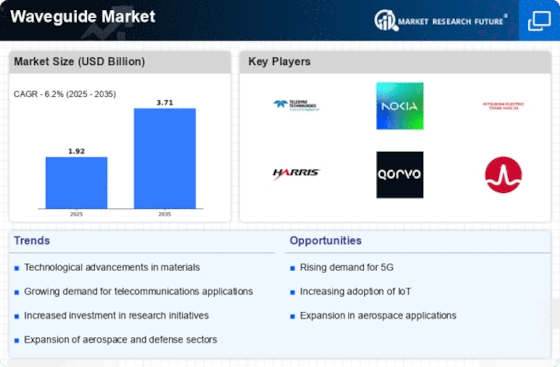
As per Market Research Future analysis, the Waveguide Market Size was estimated at 1.917 USD Billion in 2024. The Waveguide industry is projected to grow from 2.035 USD Billion in 2025 to 3.715 USD Billion by 2035, exhibiting a compound annual growth rate (CAGR) of 6.2% during the forecast period 2025 - 2035

Key Market Trends & Highlights

The Waveguide Market is poised for substantial growth driven by technological advancements and increasing demand across various sectors.

  • North America remains the largest market for waveguides, driven by robust telecommunications infrastructure. Asia-Pacific is emerging as the fastest-growing region, fueled by rapid technological adoption and innovation. Adapters represent the largest segment in the waveguide market, while isolators and circulators are experiencing the fastest growth. Technological advancements and the growing demand in the telecommunications sector are key drivers propelling market expansion.

Market Size & Forecast

2024 Market Size 1.917 (USD Billion)
2035 Market Size 3.715 (USD Billion)
CAGR (2025 - 2035) 6.2%
Largest Regional Market Share in 2024 North America

Major Players

Teledyne Technologies (US), Nokia (FI), Mitsubishi Electric (JP), Harris Corporation (US), Qorvo (US), Broadcom Inc. (US), Amphenol Corporation (US), Rohde &amp; Schwarz (DE), Keysight Technologies (US)

Market Trends

The Waveguide Market is currently experiencing a dynamic evolution, driven by advancements in technology and increasing demand across various sectors. This market encompasses a range of applications, including telecommunications, aerospace, and medical devices, where the need for efficient signal transmission is paramount. As industries continue to innovate, the integration of waveguide technology into new products and systems appears to be a focal point. The growing emphasis on high-frequency applications and the miniaturization of devices further contribute to the market's expansion. Moreover, the Waveguide Market is likely to benefit from the rising trend of smart technologies and the Internet of Things (IoT). These developments necessitate robust communication infrastructures, which waveguides can effectively support. The ongoing research and development efforts aimed at enhancing waveguide materials and designs suggest a promising future. As the market adapts to the evolving technological landscape, it may witness increased collaboration among manufacturers and end-users to optimize performance and meet specific application requirements.

Technological Advancements

The Waveguide Market is witnessing rapid technological advancements that enhance performance and efficiency. Innovations in materials and manufacturing processes are enabling the production of more compact and lightweight waveguides, which are essential for modern applications. This trend indicates a shift towards higher frequency operations, allowing for improved data transmission rates.

Growing Demand in Telecommunications

The telecommunications sector is driving substantial growth within the Waveguide Market. As the need for faster and more reliable communication networks escalates, waveguides are increasingly utilized in various applications, including satellite communications and fiber optics. This trend highlights the critical role of waveguides in supporting next-generation communication technologies.

Integration with Smart Technologies

The integration of waveguide technology with smart devices and IoT applications is emerging as a significant trend. As industries seek to enhance connectivity and data transfer capabilities, waveguides are becoming integral components in smart systems. This trend suggests a broader adoption of waveguide solutions across diverse sectors, including healthcare and automotive.

Waveguide Market Market Drivers

Integration with Smart Technologies

The integration of waveguides with smart technologies is emerging as a significant driver in the Waveguide Market. As smart devices proliferate, the need for efficient data transmission and processing becomes critical. Waveguides are increasingly being utilized in applications such as smart sensors, IoT devices, and autonomous systems, where high-frequency signals are essential. This trend is likely to expand the market, as industries seek to enhance connectivity and data transfer rates. Recent projections indicate that the market for waveguides in smart technology applications could grow by approximately 15% annually, reflecting the increasing reliance on advanced communication solutions. The synergy between waveguides and smart technologies is expected to foster innovation and create new opportunities within the industry.

Emerging Applications in Medical Technology

The Waveguide Market is witnessing a burgeoning interest in medical technology applications, particularly in imaging and diagnostic equipment. Waveguides are being utilized in various medical devices, including endoscopes and optical coherence tomography systems, where precise light transmission is crucial. The market for waveguides in medical applications is expected to expand, with growth rates projected at around 12% annually. This increase is driven by the rising demand for minimally invasive procedures and advanced imaging techniques. As healthcare providers seek to improve patient outcomes through innovative technologies, the integration of waveguides into medical devices is likely to play a pivotal role in shaping the future of medical diagnostics and treatment.

Growing Demand in Telecommunications Sector

The telecommunications sector is a primary driver of the Waveguide Market, as the demand for high-speed data transmission continues to escalate. With the proliferation of 5G networks and the increasing need for bandwidth, waveguides are becoming essential components in modern communication systems. The market for waveguides in telecommunications is anticipated to witness substantial growth, with estimates suggesting a market size increase of over 20% by 2026. This growth is fueled by the necessity for efficient signal transmission over long distances, which waveguides facilitate effectively. Additionally, the shift towards fiber-optic technologies is further propelling the adoption of waveguides, as they complement existing infrastructure and enhance overall network performance.

Rising Applications in Aerospace and Defense

The aerospace and defense sectors are becoming increasingly reliant on advanced communication systems, thereby driving the Waveguide Market. Waveguides are critical in radar systems, satellite communications, and electronic warfare applications, where precision and reliability are paramount. The market for waveguides in these sectors is projected to grow significantly, with estimates suggesting a compound annual growth rate of around 10% over the next few years. This growth is attributed to the ongoing modernization of defense systems and the increasing demand for secure communication channels. As nations invest in advanced technologies to enhance their defense capabilities, the role of waveguides in ensuring effective communication and data transfer becomes more vital.

Technological Advancements in Waveguide Market

The Waveguide Market is currently experiencing a surge in technological advancements, particularly in the development of materials and manufacturing processes. Innovations such as low-loss dielectric waveguides and photonic crystal waveguides are enhancing performance and efficiency. These advancements are expected to drive the market, as they allow for better signal integrity and reduced attenuation. Furthermore, the integration of advanced simulation tools in the design phase is streamlining production, thereby reducing costs. According to recent data, the waveguide segment is projected to grow at a compound annual growth rate of approximately 8% over the next five years, indicating a robust demand for these technologies. As industries increasingly rely on high-frequency applications, the need for advanced waveguide solutions becomes more pronounced.

Market Segment Insights

By Component: Adapters (Largest) vs. Isolators & Circulators (Fastest-Growing)

<p>In the Waveguide Market, the component segment is diverse, comprising adapters, couplers, loads & filters, isolators & circulators, phase shifters, power combiners, pressure windows, and others. Notably, adapters hold the largest market share due to their extensive applications across various industries. On the other hand, isolators & circulators are gaining traction, particularly in telecommunications and aerospace, making them one of the fastest-growing segments within this category. The market dynamics for this segment are driven by technological advancements and increasing demands for high-frequency applications. Adapters are continuing to dominate primarily because of their versatility, while isolators & circulators benefit from the growing need for efficient signal processing and protection in waveguide systems. The ongoing innovations in materials and designs are also propelling growth across these component values.</p>

<p>Adapters (Dominant) vs. Isolators & Circulators (Emerging)</p>

<p>Adapters are pivotal in the Waveguide Market, serving as crucial interfaces that enable the seamless integration of different components. Their dominance stems from their versatility, catering to various applications like RF communication, satellite systems, and radar. On the other hand, isolators & circulators, although emerging, are increasingly recognized for their essential role in improving signal integrity and preventing signal distortion. The growing focus on high-performance waveguide systems in sectors like telecommunications and aerospace has positioned isolators & circulators as key players. As demand rises for efficient and reliable RF solutions, these components are set to gain significant market traction, creating opportunities for innovation and enhancement in their functionality.</p>

By Type: Rectangular Waveguide (Largest) vs. Circular Waveguide (Fastest-Growing)

<p>The Waveguide Market showcases varying market share among its types, with Rectangular Waveguides leading as the dominant choice for many applications due to their ability to efficiently guide electromagnetic waves. This segment capitalizes on their superior performance in applications such as telecommunications and radar, making them a staple in both commercial and military sectors. In contrast, Circular Waveguides possess unique advantages for specific high-frequency applications, fostering a steady growth trajectory that appeals to niche markets. Recent trends indicate a strong growth trajectory for Circular Waveguides, attributed to their increasing adoption in advanced communication systems and satellite operations. The demand for higher bandwidth and improved signal quality drives innovation within this segment, facilitating the development of more efficient designs. Additionally, the integration of waveguide technology into emerging sectors like 5G and IoT further propels growth, highlighting the evolving nature of waveguide applications in modern technology landscapes.</p>

<p>Rectangular Waveguide (Dominant) vs. Single Ridged Waveguide (Emerging)</p>

<p>The Rectangular Waveguide remains the dominant type in the Waveguide Market, characterized by its robust design and versatility across numerous applications. Its shape enables efficient transmission of signals, making it an ideal choice for a variety of industries, including communications, aerospace, and defense. On the other hand, the Single Ridged Waveguide is emerging as a competitive alternative, particularly due to its ability to support broader bandwidths while maintaining a compact form factor. This emerging technology is rapidly gaining traction in specific applications that demand lightweight and efficient wave propagation, marking a potential shift in preferences as more industries seek to optimize performance without compromising on size.</p>

By End User: Aerospace & Defense (Largest) vs. Medical (Fastest-Growing)

<p>The waveguide market is notably segmented by end users, where Aerospace & Defense holds a substantial share of the overall market. This sector is pivotal for the manufacturing and deployment of advanced communication systems and radar technologies, which utilize waveguides for superior signal transmission. Medical applications, while smaller in market share, are rapidly gaining traction through technological advancements aimed at enhancing imaging systems and diagnostic tools that leverage waveguides for optimized performance.</p>

<p>End User: Aerospace & Defense (Dominant) vs. Medical (Emerging)</p>

<p>The Aerospace & Defense segment is characterized by its rigorous standards and heavy investments in research and development, positioning it as the dominant force in the waveguide market. This sector relies on waveguides for applications including radar systems, satellite communications, and electronic warfare, which demand high precision and reliability. Meanwhile, the Medical sector is emerging rapidly, driven by innovations in engineered medical devices and imaging technologies. This segment’s growth is fueled by the increasing need for enhancements in MRI and endoscopic procedures that improve patient outcomes and accuracy, demonstrating the transformative potential of waveguides in modern healthcare.</p>

Get more detailed insights about Waveguide Market Research Report—Global Forecast till 2035

Regional Insights

North America : Innovation and Technology Hub

North America is the largest market for waveguides, holding approximately 45% of the global share. The region's growth is driven by advancements in telecommunications, aerospace, and defense sectors, alongside increasing demand for high-frequency applications. Regulatory support for 5G deployment and military modernization initiatives further catalyze market expansion. The U.S. is the primary contributor, followed by Canada, which is rapidly adopting waveguide technologies to enhance its communication infrastructure. The competitive landscape in North America is robust, featuring key players such as Teledyne Technologies, Harris Corporation, and Qorvo. These companies are investing heavily in R&D to innovate waveguide solutions that meet the evolving demands of high-speed data transmission. The presence of established firms and a strong focus on technological advancements position North America as a leader in the waveguide market.

Europe : Emerging Market with Regulations

Europe is witnessing significant growth in the waveguide market, accounting for approximately 30% of the global share. The region benefits from stringent regulations promoting high-quality communication systems, particularly in the telecommunications and automotive sectors. The European Union's initiatives to enhance digital infrastructure and support for 5G technology are key drivers of this growth. Countries like Germany and the UK are leading the charge, with substantial investments in waveguide technologies. Germany stands out as a leader in the waveguide market, with major players like Rohde & Schwarz and Nokia driving innovation. The competitive landscape is characterized by a mix of established companies and emerging startups focusing on advanced waveguide solutions. The presence of a skilled workforce and strong research institutions further enhances Europe's position in the global market.

Asia-Pacific : Rapidly Growing Market Potential

Asia-Pacific is an emerging powerhouse in the waveguide market, holding around 20% of the global share. The region's growth is fueled by increasing investments in telecommunications infrastructure, particularly in countries like China and Japan. The demand for high-speed internet and mobile connectivity is driving the adoption of waveguide technologies. Government initiatives aimed at enhancing digital communication networks are also significant catalysts for market growth. China is the largest market in the region, with companies like Mitsubishi Electric and Keysight Technologies leading the way. The competitive landscape is evolving, with numerous local players entering the market to meet the growing demand. The focus on innovation and collaboration among industry stakeholders is expected to further accelerate the adoption of waveguide solutions across Asia-Pacific.

Middle East and Africa : Resource-Rich Frontier for Growth

The Middle East and Africa region is gradually emerging in the waveguide market, currently holding about 5% of the global share. The growth is primarily driven by increasing investments in telecommunications and infrastructure development, particularly in the Gulf Cooperation Council (GCC) countries. The demand for advanced communication systems and the push for digital transformation are key factors propelling market expansion. Regulatory frameworks are evolving to support these initiatives, enhancing the region's attractiveness for waveguide technologies. Countries like the UAE and South Africa are at the forefront of this growth, with a rising number of local and international players entering the market. The competitive landscape is characterized by partnerships and collaborations aimed at leveraging technological advancements. As the region continues to invest in its digital infrastructure, the waveguide market is expected to see significant growth in the coming years.

Key Players and Competitive Insights

Leading market players are investing heavily in research and development in order to expand their product lines, which will help the Waveguide Market, grow even more. Market participants are also undertaking a variety of strategic activities to expand their global footprint, with important market developments including new product launches, contractual agreements, mergers and acquisitions, higher investments, and collaboration with other organizations. To expand and survive in a more competitive and rising market climate, Waveguide Market End User must offer cost-effective items.
Manufacturing locally to minimize operational costs is one of the key business tactics used by manufacturers in the global Waveguide Market End User to benefit clients and increase the market sector. In recent years, the Waveguide Market End User has offered some of the most significant advantages to medicine. Major players in the Waveguide Market, including Penn Engineering Components, Jupiter Microwave Components Inc., Quantic Electronics, Amphenol RF, Delta Electronics, Inc., Samtec, Cobham Advanced Electronic Solutions, Ducommun Incorporated, ETL Systems Ltd., Smiths Interconnect, DigiLens Inc., and Flann Microwave Ltd., are attempting to increase market demand by investing in research and development operations.
High energy density capacitors are produced by Quantic Electronics for difficult defence and aerospace applications. The business provides the industry's leading power-dense capacitor technology and is frequently specified for defence, aerospace, and energy exploration applications where high reliability and SWaP (space, weight, and power) savings are critical design considerations, providing a solution for uses such as downhole drilling, radar, laser, and amplifier. Quantic Electronics announced the acquisition of Corry Micronics in March 2021.
Diplexers, RF (Radio Frequency)/microwave filters, low-noise amplifiers, multiplexers, RF switches, power amplifiers, waveguide components, power dividers, couplers, and programmable RF switch matrices were among the products offered by Corry Micronics.
Manufacturer and distributor of ceramics, speciality glasses, and related products, Corning Inc. The company sells ceramic substrates and filters for automotive and diesel applications, glass and plastic labware, serum, and equipment for drug discovery, as well as glass and plastic substrates that are used in LCD televisions, notebook computers, flat panel desktop monitors, and laptops. For the semiconductor, consumer electronics, aerospace and defence, optical, and telecommunications businesses, it also produces advanced optics and speciality glasses. The corporation conducts business in the Middle East, Africa, Europe, the Americas, and Asia-Pacific.
U.S. company Corning has its headquarters in Corning, New York. electronics company Corning Incorporated (US) introduced the new 2.0 high-index glass composition in February 2022 to enhance the growth of mixed and augmented reality (AR/MR) diffractive waveguides for wearable electronics.

Key Companies in the Waveguide Market include

Industry Developments

Future Outlook

Waveguide Market Future Outlook

The Waveguide Market is projected to grow at a 6.2% CAGR from 2025 to 2035, driven by advancements in telecommunications, aerospace applications, and increased demand for high-frequency devices.

New opportunities lie in:

  • Development of advanced materials for lightweight waveguides
  • Integration of waveguides in 5G infrastructure
  • Expansion into emerging markets with tailored solutions

By 2035, the Waveguide Market is expected to achieve substantial growth and innovation.

Market Segmentation

Waveguide Market Type Outlook

  • Rectangular Waveguide
  • Circular Waveguide
  • Single Ridged Waveguide
  • Double Ridged Waveguide
  • Elliptical Waveguide

Waveguide Market End User Outlook

  • Aerospace & Defense
  • Medical
  • Industrial
  • Others

Waveguide Market Component Outlook

  • Adapters
  • Couplers
  • Loads & Filters
  • Isolators & Circulators
  • Phase Shifters
  • Power Combiners
  • Pressure Windows
  • Others

Report Scope

MARKET SIZE 2024 1.917(USD Billion)
MARKET SIZE 2025 2.035(USD Billion)
MARKET SIZE 2035 3.715(USD Billion)
COMPOUND ANNUAL GROWTH RATE (CAGR) 6.2% (2025 - 2035)
REPORT COVERAGE Revenue Forecast, Competitive Landscape, Growth Factors, and Trends
BASE YEAR 2024
Market Forecast Period 2025 - 2035
Historical Data 2019 - 2024
Market Forecast Units USD Billion
Key Companies Profiled Teledyne Technologies (US), Nokia (FI), Mitsubishi Electric (JP), Harris Corporation (US), Qorvo (US), Broadcom Inc. (US), Amphenol Corporation (US), Rohde & Schwarz (DE), Keysight Technologies (US)
Segments Covered Component, Type, End User, Region
Key Market Opportunities Advancements in telecommunications and aerospace sectors drive demand for innovative Waveguide Market solutions.
Key Market Dynamics Technological advancements drive demand for waveguides in telecommunications and aerospace applications, enhancing competitive market dynamics.
Countries Covered North America, Europe, APAC, South America, MEA

FAQs

What is the projected market valuation of the Waveguide Market by 2035?

<p>The Waveguide Market is projected to reach a valuation of 3.715 USD Billion by 2035.</p>

What was the market valuation of the Waveguide Market in 2024?

<p>In 2024, the Waveguide Market had a valuation of 1.917 USD Billion.</p>

What is the expected CAGR for the Waveguide Market during the forecast period 2025 - 2035?

<p>The expected CAGR for the Waveguide Market during the forecast period 2025 - 2035 is 6.2%.</p>

Which companies are considered key players in the Waveguide Market?

<p>Key players in the Waveguide Market include Teledyne Technologies, Nokia, Mitsubishi Electric, and Harris Corporation.</p>

What are the main components of the Waveguide Market and their valuations?

<p>Main components include Adapters, Couplers, and Isolators & Circulators, with valuations ranging from 0.15 to 0.6 USD Billion.</p>

How does the valuation of Rectangular Waveguides compare to Circular Waveguides?

<p>Rectangular Waveguides are valued between 0.767 and 1.487 USD Billion, while Circular Waveguides range from 0.487 to 0.947 USD Billion.</p>

What end-user segments are driving the Waveguide Market?

End-user segments include Aerospace &amp; Defense, Medical, and Industrial, with Aerospace &amp; Defense valued between 0.575 and 0.975 USD Billion.

What is the valuation range for Power Combiners in the Waveguide Market?

The valuation range for Power Combiners in the Waveguide Market is between 0.2 and 0.4 USD Billion.

What is the expected growth trend for the Waveguide Market from 2025 to 2035?

The Waveguide Market is expected to experience a growth trend, driven by a CAGR of 6.2% from 2025 to 2035.

What are the projected valuations for Loads & Filters in the Waveguide Market?

The projected valuations for Loads &amp; Filters in the Waveguide Market range from 0.2 to 0.4 USD Billion.

  1. SECTION I: EXECUTIVE SUMMARY AND KEY HIGHLIGHTS
    1. | 1.1 EXECUTIVE SUMMARY
    2. | | 1.1.1 Market Overview
    3. | | 1.1.2 Key Findings
    4. | | 1.1.3 Market Segmentation
    5. | | 1.1.4 Competitive Landscape
    6. | | 1.1.5 Challenges and Opportunities
    7. | | 1.1.6 Future Outlook
  2. SECTION II: SCOPING, METHODOLOGY AND MARKET STRUCTURE
    1. | 2.1 MARKET INTRODUCTION
    2. | | 2.1.1 Definition
    3. | | 2.1.2 Scope of the study
    4. | | | 2.1.2.1 Research Objective
    5. | | | 2.1.2.2 Assumption
    6. | | | 2.1.2.3 Limitations
    7. | 2.2 RESEARCH METHODOLOGY
    8. | | 2.2.1 Overview
    9. | | 2.2.2 Data Mining
    10. | | 2.2.3 Secondary Research
    11. | | 2.2.4 Primary Research
    12. | | | 2.2.4.1 Primary Interviews and Information Gathering Process
    13. | | | 2.2.4.2 Breakdown of Primary Respondents
    14. | | 2.2.5 Forecasting Model
    15. | | 2.2.6 Market Size Estimation
    16. | | | 2.2.6.1 Bottom-Up Approach
    17. | | | 2.2.6.2 Top-Down Approach
    18. | | 2.2.7 Data Triangulation
    19. | | 2.2.8 Validation
  3. SECTION III: QUALITATIVE ANALYSIS
    1. | 3.1 MARKET DYNAMICS
    2. | | 3.1.1 Overview
    3. | | 3.1.2 Drivers
    4. | | 3.1.3 Restraints
    5. | | 3.1.4 Opportunities
    6. | 3.2 MARKET FACTOR ANALYSIS
    7. | | 3.2.1 Value chain Analysis
    8. | | 3.2.2 Porter's Five Forces Analysis
    9. | | | 3.2.2.1 Bargaining Power of Suppliers
    10. | | | 3.2.2.2 Bargaining Power of Buyers
    11. | | | 3.2.2.3 Threat of New Entrants
    12. | | | 3.2.2.4 Threat of Substitutes
    13. | | | 3.2.2.5 Intensity of Rivalry
    14. | | 3.2.3 COVID-19 Impact Analysis
    15. | | | 3.2.3.1 Market Impact Analysis
    16. | | | 3.2.3.2 Regional Impact
    17. | | | 3.2.3.3 Opportunity and Threat Analysis
  4. SECTION IV: QUANTITATIVE ANALYSIS
    1. | 4.1 Semiconductor & Electronics, BY Component (USD Billion)
    2. | | 4.1.1 Adapters
    3. | | 4.1.2 Couplers
    4. | | 4.1.3 Loads & Filters
    5. | | 4.1.4 Isolators & Circulators
    6. | | 4.1.5 Phase Shifters
    7. | | 4.1.6 Power Combiners
    8. | | 4.1.7 Pressure Windows
    9. | | 4.1.8 Others
    10. | 4.2 Semiconductor & Electronics, BY Type (USD Billion)
    11. | | 4.2.1 Rectangular Waveguide
    12. | | 4.2.2 Circular Waveguide
    13. | | 4.2.3 Single Ridged Waveguide
    14. | | 4.2.4 Double Ridged Waveguide
    15. | | 4.2.5 Elliptical Waveguide
    16. | 4.3 Semiconductor & Electronics, BY End User (USD Billion)
    17. | | 4.3.1 Aerospace & Defense
    18. | | 4.3.2 Medical
    19. | | 4.3.3 Industrial
    20. | | 4.3.4 Others
    21. | 4.4 Semiconductor & Electronics, BY Region (USD Billion)
    22. | | 4.4.1 North America
    23. | | | 4.4.1.1 US
    24. | | | 4.4.1.2 Canada
    25. | | 4.4.2 Europe
    26. | | | 4.4.2.1 Germany
    27. | | | 4.4.2.2 UK
    28. | | | 4.4.2.3 France
    29. | | | 4.4.2.4 Russia
    30. | | | 4.4.2.5 Italy
    31. | | | 4.4.2.6 Spain
    32. | | | 4.4.2.7 Rest of Europe
    33. | | 4.4.3 APAC
    34. | | | 4.4.3.1 China
    35. | | | 4.4.3.2 India
    36. | | | 4.4.3.3 Japan
    37. | | | 4.4.3.4 South Korea
    38. | | | 4.4.3.5 Malaysia
    39. | | | 4.4.3.6 Thailand
    40. | | | 4.4.3.7 Indonesia
    41. | | | 4.4.3.8 Rest of APAC
    42. | | 4.4.4 South America
    43. | | | 4.4.4.1 Brazil
    44. | | | 4.4.4.2 Mexico
    45. | | | 4.4.4.3 Argentina
    46. | | | 4.4.4.4 Rest of South America
    47. | | 4.4.5 MEA
    48. | | | 4.4.5.1 GCC Countries
    49. | | | 4.4.5.2 South Africa
    50. | | | 4.4.5.3 Rest of MEA
  5. SECTION V: COMPETITIVE ANALYSIS
    1. | 5.1 Competitive Landscape
    2. | | 5.1.1 Overview
    3. | | 5.1.2 Competitive Analysis
    4. | | 5.1.3 Market share Analysis
    5. | | 5.1.4 Major Growth Strategy in the Semiconductor & Electronics
    6. | | 5.1.5 Competitive Benchmarking
    7. | | 5.1.6 Leading Players in Terms of Number of Developments in the Semiconductor & Electronics
    8. | | 5.1.7 Key developments and growth strategies
    9. | | | 5.1.7.1 New Product Launch/Service Deployment
    10. | | | 5.1.7.2 Merger & Acquisitions
    11. | | | 5.1.7.3 Joint Ventures
    12. | | 5.1.8 Major Players Financial Matrix
    13. | | | 5.1.8.1 Sales and Operating Income
    14. | | | 5.1.8.2 Major Players R&D Expenditure. 2023
    15. | 5.2 Company Profiles
    16. | | 5.2.1 Teledyne Technologies (US)
    17. | | | 5.2.1.1 Financial Overview
    18. | | | 5.2.1.2 Products Offered
    19. | | | 5.2.1.3 Key Developments
    20. | | | 5.2.1.4 SWOT Analysis
    21. | | | 5.2.1.5 Key Strategies
    22. | | 5.2.2 Nokia (FI)
    23. | | | 5.2.2.1 Financial Overview
    24. | | | 5.2.2.2 Products Offered
    25. | | | 5.2.2.3 Key Developments
    26. | | | 5.2.2.4 SWOT Analysis
    27. | | | 5.2.2.5 Key Strategies
    28. | | 5.2.3 Mitsubishi Electric (JP)
    29. | | | 5.2.3.1 Financial Overview
    30. | | | 5.2.3.2 Products Offered
    31. | | | 5.2.3.3 Key Developments
    32. | | | 5.2.3.4 SWOT Analysis
    33. | | | 5.2.3.5 Key Strategies
    34. | | 5.2.4 Harris Corporation (US)
    35. | | | 5.2.4.1 Financial Overview
    36. | | | 5.2.4.2 Products Offered
    37. | | | 5.2.4.3 Key Developments
    38. | | | 5.2.4.4 SWOT Analysis
    39. | | | 5.2.4.5 Key Strategies
    40. | | 5.2.5 Qorvo (US)
    41. | | | 5.2.5.1 Financial Overview
    42. | | | 5.2.5.2 Products Offered
    43. | | | 5.2.5.3 Key Developments
    44. | | | 5.2.5.4 SWOT Analysis
    45. | | | 5.2.5.5 Key Strategies
    46. | | 5.2.6 Broadcom Inc. (US)
    47. | | | 5.2.6.1 Financial Overview
    48. | | | 5.2.6.2 Products Offered
    49. | | | 5.2.6.3 Key Developments
    50. | | | 5.2.6.4 SWOT Analysis
    51. | | | 5.2.6.5 Key Strategies
    52. | | 5.2.7 Amphenol Corporation (US)
    53. | | | 5.2.7.1 Financial Overview
    54. | | | 5.2.7.2 Products Offered
    55. | | | 5.2.7.3 Key Developments
    56. | | | 5.2.7.4 SWOT Analysis
    57. | | | 5.2.7.5 Key Strategies
    58. | | 5.2.8 Rohde & Schwarz (DE)
    59. | | | 5.2.8.1 Financial Overview
    60. | | | 5.2.8.2 Products Offered
    61. | | | 5.2.8.3 Key Developments
    62. | | | 5.2.8.4 SWOT Analysis
    63. | | | 5.2.8.5 Key Strategies
    64. | | 5.2.9 Keysight Technologies (US)
    65. | | | 5.2.9.1 Financial Overview
    66. | | | 5.2.9.2 Products Offered
    67. | | | 5.2.9.3 Key Developments
    68. | | | 5.2.9.4 SWOT Analysis
    69. | | | 5.2.9.5 Key Strategies
    70. | 5.3 Appendix
    71. | | 5.3.1 References
    72. | | 5.3.2 Related Reports
  6. LIST OF FIGURES
    1. | 6.1 MARKET SYNOPSIS
    2. | 6.2 NORTH AMERICA MARKET ANALYSIS
    3. | 6.3 US MARKET ANALYSIS BY COMPONENT
    4. | 6.4 US MARKET ANALYSIS BY TYPE
    5. | 6.5 US MARKET ANALYSIS BY END USER
    6. | 6.6 CANADA MARKET ANALYSIS BY COMPONENT
    7. | 6.7 CANADA MARKET ANALYSIS BY TYPE
    8. | 6.8 CANADA MARKET ANALYSIS BY END USER
    9. | 6.9 EUROPE MARKET ANALYSIS
    10. | 6.10 GERMANY MARKET ANALYSIS BY COMPONENT
    11. | 6.11 GERMANY MARKET ANALYSIS BY TYPE
    12. | 6.12 GERMANY MARKET ANALYSIS BY END USER
    13. | 6.13 UK MARKET ANALYSIS BY COMPONENT
    14. | 6.14 UK MARKET ANALYSIS BY TYPE
    15. | 6.15 UK MARKET ANALYSIS BY END USER
    16. | 6.16 FRANCE MARKET ANALYSIS BY COMPONENT
    17. | 6.17 FRANCE MARKET ANALYSIS BY TYPE
    18. | 6.18 FRANCE MARKET ANALYSIS BY END USER
    19. | 6.19 RUSSIA MARKET ANALYSIS BY COMPONENT
    20. | 6.20 RUSSIA MARKET ANALYSIS BY TYPE
    21. | 6.21 RUSSIA MARKET ANALYSIS BY END USER
    22. | 6.22 ITALY MARKET ANALYSIS BY COMPONENT
    23. | 6.23 ITALY MARKET ANALYSIS BY TYPE
    24. | 6.24 ITALY MARKET ANALYSIS BY END USER
    25. | 6.25 SPAIN MARKET ANALYSIS BY COMPONENT
    26. | 6.26 SPAIN MARKET ANALYSIS BY TYPE
    27. | 6.27 SPAIN MARKET ANALYSIS BY END USER
    28. | 6.28 REST OF EUROPE MARKET ANALYSIS BY COMPONENT
    29. | 6.29 REST OF EUROPE MARKET ANALYSIS BY TYPE
    30. | 6.30 REST OF EUROPE MARKET ANALYSIS BY END USER
    31. | 6.31 APAC MARKET ANALYSIS
    32. | 6.32 CHINA MARKET ANALYSIS BY COMPONENT
    33. | 6.33 CHINA MARKET ANALYSIS BY TYPE
    34. | 6.34 CHINA MARKET ANALYSIS BY END USER
    35. | 6.35 INDIA MARKET ANALYSIS BY COMPONENT
    36. | 6.36 INDIA MARKET ANALYSIS BY TYPE
    37. | 6.37 INDIA MARKET ANALYSIS BY END USER
    38. | 6.38 JAPAN MARKET ANALYSIS BY COMPONENT
    39. | 6.39 JAPAN MARKET ANALYSIS BY TYPE
    40. | 6.40 JAPAN MARKET ANALYSIS BY END USER
    41. | 6.41 SOUTH KOREA MARKET ANALYSIS BY COMPONENT
    42. | 6.42 SOUTH KOREA MARKET ANALYSIS BY TYPE
    43. | 6.43 SOUTH KOREA MARKET ANALYSIS BY END USER
    44. | 6.44 MALAYSIA MARKET ANALYSIS BY COMPONENT
    45. | 6.45 MALAYSIA MARKET ANALYSIS BY TYPE
    46. | 6.46 MALAYSIA MARKET ANALYSIS BY END USER
    47. | 6.47 THAILAND MARKET ANALYSIS BY COMPONENT
    48. | 6.48 THAILAND MARKET ANALYSIS BY TYPE
    49. | 6.49 THAILAND MARKET ANALYSIS BY END USER
    50. | 6.50 INDONESIA MARKET ANALYSIS BY COMPONENT
    51. | 6.51 INDONESIA MARKET ANALYSIS BY TYPE
    52. | 6.52 INDONESIA MARKET ANALYSIS BY END USER
    53. | 6.53 REST OF APAC MARKET ANALYSIS BY COMPONENT
    54. | 6.54 REST OF APAC MARKET ANALYSIS BY TYPE
    55. | 6.55 REST OF APAC MARKET ANALYSIS BY END USER
    56. | 6.56 SOUTH AMERICA MARKET ANALYSIS
    57. | 6.57 BRAZIL MARKET ANALYSIS BY COMPONENT
    58. | 6.58 BRAZIL MARKET ANALYSIS BY TYPE
    59. | 6.59 BRAZIL MARKET ANALYSIS BY END USER
    60. | 6.60 MEXICO MARKET ANALYSIS BY COMPONENT
    61. | 6.61 MEXICO MARKET ANALYSIS BY TYPE
    62. | 6.62 MEXICO MARKET ANALYSIS BY END USER
    63. | 6.63 ARGENTINA MARKET ANALYSIS BY COMPONENT
    64. | 6.64 ARGENTINA MARKET ANALYSIS BY TYPE
    65. | 6.65 ARGENTINA MARKET ANALYSIS BY END USER
    66. | 6.66 REST OF SOUTH AMERICA MARKET ANALYSIS BY COMPONENT
    67. | 6.67 REST OF SOUTH AMERICA MARKET ANALYSIS BY TYPE
    68. | 6.68 REST OF SOUTH AMERICA MARKET ANALYSIS BY END USER
    69. | 6.69 MEA MARKET ANALYSIS
    70. | 6.70 GCC COUNTRIES MARKET ANALYSIS BY COMPONENT
    71. | 6.71 GCC COUNTRIES MARKET ANALYSIS BY TYPE
    72. | 6.72 GCC COUNTRIES MARKET ANALYSIS BY END USER
    73. | 6.73 SOUTH AFRICA MARKET ANALYSIS BY COMPONENT
    74. | 6.74 SOUTH AFRICA MARKET ANALYSIS BY TYPE
    75. | 6.75 SOUTH AFRICA MARKET ANALYSIS BY END USER
    76. | 6.76 REST OF MEA MARKET ANALYSIS BY COMPONENT
    77. | 6.77 REST OF MEA MARKET ANALYSIS BY TYPE
    78. | 6.78 REST OF MEA MARKET ANALYSIS BY END USER
    79. | 6.79 KEY BUYING CRITERIA OF SEMICONDUCTOR & ELECTRONICS
    80. | 6.80 RESEARCH PROCESS OF MRFR
    81. | 6.81 DRO ANALYSIS OF SEMICONDUCTOR & ELECTRONICS
    82. | 6.82 DRIVERS IMPACT ANALYSIS: SEMICONDUCTOR & ELECTRONICS
    83. | 6.83 RESTRAINTS IMPACT ANALYSIS: SEMICONDUCTOR & ELECTRONICS
    84. | 6.84 SUPPLY / VALUE CHAIN: SEMICONDUCTOR & ELECTRONICS
    85. | 6.85 SEMICONDUCTOR & ELECTRONICS, BY COMPONENT, 2024 (% SHARE)
    86. | 6.86 SEMICONDUCTOR & ELECTRONICS, BY COMPONENT, 2024 TO 2035 (USD Billion)
    87. | 6.87 SEMICONDUCTOR & ELECTRONICS, BY TYPE, 2024 (% SHARE)
    88. | 6.88 SEMICONDUCTOR & ELECTRONICS, BY TYPE, 2024 TO 2035 (USD Billion)
    89. | 6.89 SEMICONDUCTOR & ELECTRONICS, BY END USER, 2024 (% SHARE)
    90. | 6.90 SEMICONDUCTOR & ELECTRONICS, BY END USER, 2024 TO 2035 (USD Billion)
    91. | 6.91 BENCHMARKING OF MAJOR COMPETITORS
  7. LIST OF TABLES
    1. | 7.1 LIST OF ASSUMPTIONS
    2. | | 7.1.1
    3. | 7.2 North America MARKET SIZE ESTIMATES; FORECAST
    4. | | 7.2.1 BY COMPONENT, 2025-2035 (USD Billion)
    5. | | 7.2.2 BY TYPE, 2025-2035 (USD Billion)
    6. | | 7.2.3 BY END USER, 2025-2035 (USD Billion)
    7. | 7.3 US MARKET SIZE ESTIMATES; FORECAST
    8. | | 7.3.1 BY COMPONENT, 2025-2035 (USD Billion)
    9. | | 7.3.2 BY TYPE, 2025-2035 (USD Billion)
    10. | | 7.3.3 BY END USER, 2025-2035 (USD Billion)
    11. | 7.4 Canada MARKET SIZE ESTIMATES; FORECAST
    12. | | 7.4.1 BY COMPONENT, 2025-2035 (USD Billion)
    13. | | 7.4.2 BY TYPE, 2025-2035 (USD Billion)
    14. | | 7.4.3 BY END USER, 2025-2035 (USD Billion)
    15. | 7.5 Europe MARKET SIZE ESTIMATES; FORECAST
    16. | | 7.5.1 BY COMPONENT, 2025-2035 (USD Billion)
    17. | | 7.5.2 BY TYPE, 2025-2035 (USD Billion)
    18. | | 7.5.3 BY END USER, 2025-2035 (USD Billion)
    19. | 7.6 Germany MARKET SIZE ESTIMATES; FORECAST
    20. | | 7.6.1 BY COMPONENT, 2025-2035 (USD Billion)
    21. | | 7.6.2 BY TYPE, 2025-2035 (USD Billion)
    22. | | 7.6.3 BY END USER, 2025-2035 (USD Billion)
    23. | 7.7 UK MARKET SIZE ESTIMATES; FORECAST
    24. | | 7.7.1 BY COMPONENT, 2025-2035 (USD Billion)
    25. | | 7.7.2 BY TYPE, 2025-2035 (USD Billion)
    26. | | 7.7.3 BY END USER, 2025-2035 (USD Billion)
    27. | 7.8 France MARKET SIZE ESTIMATES; FORECAST
    28. | | 7.8.1 BY COMPONENT, 2025-2035 (USD Billion)
    29. | | 7.8.2 BY TYPE, 2025-2035 (USD Billion)
    30. | | 7.8.3 BY END USER, 2025-2035 (USD Billion)
    31. | 7.9 Russia MARKET SIZE ESTIMATES; FORECAST
    32. | | 7.9.1 BY COMPONENT, 2025-2035 (USD Billion)
    33. | | 7.9.2 BY TYPE, 2025-2035 (USD Billion)
    34. | | 7.9.3 BY END USER, 2025-2035 (USD Billion)
    35. | 7.10 Italy MARKET SIZE ESTIMATES; FORECAST
    36. | | 7.10.1 BY COMPONENT, 2025-2035 (USD Billion)
    37. | | 7.10.2 BY TYPE, 2025-2035 (USD Billion)
    38. | | 7.10.3 BY END USER, 2025-2035 (USD Billion)
    39. | 7.11 Spain MARKET SIZE ESTIMATES; FORECAST
    40. | | 7.11.1 BY COMPONENT, 2025-2035 (USD Billion)
    41. | | 7.11.2 BY TYPE, 2025-2035 (USD Billion)
    42. | | 7.11.3 BY END USER, 2025-2035 (USD Billion)
    43. | 7.12 Rest of Europe MARKET SIZE ESTIMATES; FORECAST
    44. | | 7.12.1 BY COMPONENT, 2025-2035 (USD Billion)
    45. | | 7.12.2 BY TYPE, 2025-2035 (USD Billion)
    46. | | 7.12.3 BY END USER, 2025-2035 (USD Billion)
    47. | 7.13 APAC MARKET SIZE ESTIMATES; FORECAST
    48. | | 7.13.1 BY COMPONENT, 2025-2035 (USD Billion)
    49. | | 7.13.2 BY TYPE, 2025-2035 (USD Billion)
    50. | | 7.13.3 BY END USER, 2025-2035 (USD Billion)
    51. | 7.14 China MARKET SIZE ESTIMATES; FORECAST
    52. | | 7.14.1 BY COMPONENT, 2025-2035 (USD Billion)
    53. | | 7.14.2 BY TYPE, 2025-2035 (USD Billion)
    54. | | 7.14.3 BY END USER, 2025-2035 (USD Billion)
    55. | 7.15 India MARKET SIZE ESTIMATES; FORECAST
    56. | | 7.15.1 BY COMPONENT, 2025-2035 (USD Billion)
    57. | | 7.15.2 BY TYPE, 2025-2035 (USD Billion)
    58. | | 7.15.3 BY END USER, 2025-2035 (USD Billion)
    59. | 7.16 Japan MARKET SIZE ESTIMATES; FORECAST
    60. | | 7.16.1 BY COMPONENT, 2025-2035 (USD Billion)
    61. | | 7.16.2 BY TYPE, 2025-2035 (USD Billion)
    62. | | 7.16.3 BY END USER, 2025-2035 (USD Billion)
    63. | 7.17 South Korea MARKET SIZE ESTIMATES; FORECAST
    64. | | 7.17.1 BY COMPONENT, 2025-2035 (USD Billion)
    65. | | 7.17.2 BY TYPE, 2025-2035 (USD Billion)
    66. | | 7.17.3 BY END USER, 2025-2035 (USD Billion)
    67. | 7.18 Malaysia MARKET SIZE ESTIMATES; FORECAST
    68. | | 7.18.1 BY COMPONENT, 2025-2035 (USD Billion)
    69. | | 7.18.2 BY TYPE, 2025-2035 (USD Billion)
    70. | | 7.18.3 BY END USER, 2025-2035 (USD Billion)
    71. | 7.19 Thailand MARKET SIZE ESTIMATES; FORECAST
    72. | | 7.19.1 BY COMPONENT, 2025-2035 (USD Billion)
    73. | | 7.19.2 BY TYPE, 2025-2035 (USD Billion)
    74. | | 7.19.3 BY END USER, 2025-2035 (USD Billion)
    75. | 7.20 Indonesia MARKET SIZE ESTIMATES; FORECAST
    76. | | 7.20.1 BY COMPONENT, 2025-2035 (USD Billion)
    77. | | 7.20.2 BY TYPE, 2025-2035 (USD Billion)
    78. | | 7.20.3 BY END USER, 2025-2035 (USD Billion)
    79. | 7.21 Rest of APAC MARKET SIZE ESTIMATES; FORECAST
    80. | | 7.21.1 BY COMPONENT, 2025-2035 (USD Billion)
    81. | | 7.21.2 BY TYPE, 2025-2035 (USD Billion)
    82. | | 7.21.3 BY END USER, 2025-2035 (USD Billion)
    83. | 7.22 South America MARKET SIZE ESTIMATES; FORECAST
    84. | | 7.22.1 BY COMPONENT, 2025-2035 (USD Billion)
    85. | | 7.22.2 BY TYPE, 2025-2035 (USD Billion)
    86. | | 7.22.3 BY END USER, 2025-2035 (USD Billion)
    87. | 7.23 Brazil MARKET SIZE ESTIMATES; FORECAST
    88. | | 7.23.1 BY COMPONENT, 2025-2035 (USD Billion)
    89. | | 7.23.2 BY TYPE, 2025-2035 (USD Billion)
    90. | | 7.23.3 BY END USER, 2025-2035 (USD Billion)
    91. | 7.24 Mexico MARKET SIZE ESTIMATES; FORECAST
    92. | | 7.24.1 BY COMPONENT, 2025-2035 (USD Billion)
    93. | | 7.24.2 BY TYPE, 2025-2035 (USD Billion)
    94. | | 7.24.3 BY END USER, 2025-2035 (USD Billion)
    95. | 7.25 Argentina MARKET SIZE ESTIMATES; FORECAST
    96. | | 7.25.1 BY COMPONENT, 2025-2035 (USD Billion)
    97. | | 7.25.2 BY TYPE, 2025-2035 (USD Billion)
    98. | | 7.25.3 BY END USER, 2025-2035 (USD Billion)
    99. | 7.26 Rest of South America MARKET SIZE ESTIMATES; FORECAST
    100. | | 7.26.1 BY COMPONENT, 2025-2035 (USD Billion)
    101. | | 7.26.2 BY TYPE, 2025-2035 (USD Billion)
    102. | | 7.26.3 BY END USER, 2025-2035 (USD Billion)
    103. | 7.27 MEA MARKET SIZE ESTIMATES; FORECAST
    104. | | 7.27.1 BY COMPONENT, 2025-2035 (USD Billion)
    105. | | 7.27.2 BY TYPE, 2025-2035 (USD Billion)
    106. | | 7.27.3 BY END USER, 2025-2035 (USD Billion)
    107. | 7.28 GCC Countries MARKET SIZE ESTIMATES; FORECAST
    108. | | 7.28.1 BY COMPONENT, 2025-2035 (USD Billion)
    109. | | 7.28.2 BY TYPE, 2025-2035 (USD Billion)
    110. | | 7.28.3 BY END USER, 2025-2035 (USD Billion)
    111. | 7.29 South Africa MARKET SIZE ESTIMATES; FORECAST
    112. | | 7.29.1 BY COMPONENT, 2025-2035 (USD Billion)
    113. | | 7.29.2 BY TYPE, 2025-2035 (USD Billion)
    114. | | 7.29.3 BY END USER, 2025-2035 (USD Billion)
    115. | 7.30 Rest of MEA MARKET SIZE ESTIMATES; FORECAST
    116. | | 7.30.1 BY COMPONENT, 2025-2035 (USD Billion)
    117. | | 7.30.2 BY TYPE, 2025-2035 (USD Billion)
    118. | | 7.30.3 BY END USER, 2025-2035 (USD Billion)
    119. | 7.31 PRODUCT LAUNCH/PRODUCT DEVELOPMENT/APPROVAL
    120. | | 7.31.1
    121. | 7.32 ACQUISITION/PARTNERSHIP
    122. | | 7.32.1

Semiconductor & Electronics Market Segmentation

Semiconductor & Electronics By Component (USD Billion, 2025-2035)

  • Adapters
  • Couplers
  • Loads & Filters
  • Isolators & Circulators
  • Phase Shifters
  • Power Combiners
  • Pressure Windows
  • Others

Semiconductor & Electronics By Type (USD Billion, 2025-2035)

  • Rectangular Waveguide
  • Circular Waveguide
  • Single Ridged Waveguide
  • Double Ridged Waveguide
  • Elliptical Waveguide

Semiconductor & Electronics By End User (USD Billion, 2025-2035)

  • Aerospace & Defense
  • Medical
  • Industrial
  • Others
Infographic

Free Sample Request

Kindly complete the form below to receive a free sample of this Report

Get Free Sample

Customer Strories

Compare Licence

×
Features License Type
Single User Multiuser License Enterprise User
Price $4,950 $5,950 $7,250
Maximum User Access Limit 1 User Upto 10 Users Unrestricted Access Throughout the Organization
Free Customization
Direct Access to Analyst
Deliverable Format
Platform Access
Discount on Next Purchase 10% 15% 15%
Printable Versions