×
Hero Background
English
Chinese
French
Japanese
Korean
German
Spanish

Waterstop Market Share

ID: MRFR/PCM/2189-HCR
110 Pages
Sakshi Gupta
October 2025

Waterstop Market by Type (External Waterstop, Internal Waterstop, Expansion Waterstop), by Material (PVC Waterstop, Rubber Waterstop And Other) and Region - Forecast 2024- 2032

Share:
Download PDF ×

We do not share your information with anyone. However, we may send you emails based on your report interest from time to time. You may contact us at any time to opt-out.

Waterstop Market Infographic
Purchase Options

Market Share

Waterstop Market Share Analysis

To dominate the Waterstop Market, players use several market share positioning techniques. These techniques are vital for companies seeking to stand apart from a diversified competition. Companies often differentiate their waterstop solutions by quality, features, and performance. Businesses try to gain market share by supplying unique and superior items to customers seeking specialized or advanced solutions.

Pricing is another key technique. Waterstop Market companies use competitive pricing to get an edge. This could mean undercutting competitors to attract price-sensitive customers or charging more to indicate quality and uniqueness. Effective pricing strategies affect immediate sales and long-term market share by altering customer attitudes. Waterstop Market market share positioning includes strategic partnerships and collaborations.

Additionally, marketing and brand-building efforts affect market share. Companies invest in robust marketing strategies to promote their waterstop solutions, gain reputation, and generate favorable brand image. Effective branding attracts new customers and builds loyalty among existing ones, sustaining and gaining market share.

Waterstop Market expansion by geography is another option. By expanding into new markets, companies often gain market share. This can be done through smart acquisitions, local distributor alliances, or direct presence in critical markets. Geographic expansion allows organizations to reach new customers, diversify their consumer base, and reduce market reliance hazards.

Companies seeking a large Waterstop Market share must innovate and offer new products. Companies can address client needs with cutting-edge solutions by staying ahead of technology and industry trends. Innovative products make companies seem like industry leaders, which attracts and maintains customers.

Finally, consumer satisfaction and service can greatly affect market share. Excellent customer service and strong client connections help companies retain customers and gain word-of-mouth recommendations. Satisfied clients return and boost the company's reputation, influencing new buyers.

Author
Sakshi Gupta
Research Analyst Level II

I have about two years of experience working in the consumer goods and retail industries and I am a biotech graduate.A tech-savvy analytically focused professional with a strong capabilities in identification, concept generation, and strategy evaluation. I can produce data-driven solutions while fusing unusual viewpoints with original concepts. I have been extensively working on business case studies, competitive & comparative analyses, and strategic reports. My primary areas of experience include client management, financial analysis, supply chain evaluation, market entry strategy evaluation, and estimating and forecasting market size.

Leave a Comment

FAQs

What is the current valuation of the Waterstop Market as of 2024?

The Waterstop Market was valued at 2272.36 USD Million in 2024.

What is the projected market valuation for the Waterstop Market in 2035?

The projected valuation for the Waterstop Market in 2035 is 4040.69 USD Million.

What is the expected CAGR for the Waterstop Market during the forecast period 2025 - 2035?

The expected CAGR for the Waterstop Market during the forecast period 2025 - 2035 is 5.37%.

Which companies are considered key players in the Waterstop Market?

Key players in the Waterstop Market include Sika AG, BASF SE, GCP Applied Technologies Inc., and others.

What are the main application segments of the Waterstop Market?

Main application segments include water reservoirs and canals, bridges and tunnels, and wastewater treatment facilities.

Market Summary

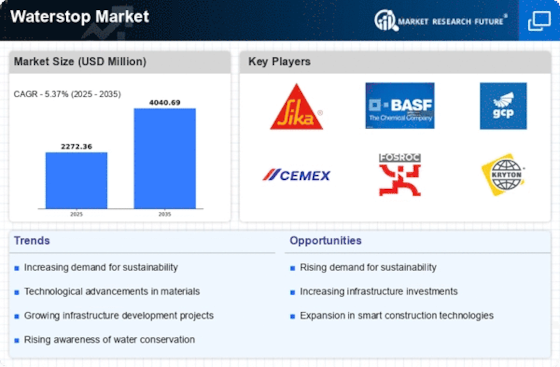
As per MRFR analysis, the Waterstop Market Size was estimated at 2272.36 USD Million in 2024. The Waterstop industry is projected to grow from 2394.43 USD Million in 2025 to 4040.69 USD Million by 2035, exhibiting a compound annual growth rate (CAGR) of 5.37 during the forecast period 2025 - 2035.

Key Market Trends & Highlights

The Waterstop Market is experiencing a robust growth trajectory driven by sustainability and technological advancements.

  • The North American region remains the largest market for waterstop solutions, reflecting a strong demand for water infrastructure. Asia-Pacific is identified as the fastest-growing region, propelled by rapid urbanization and infrastructure development. Water reservoirs and canals represent the largest market segments, catering to extensive water management needs. The rising demand for water infrastructure and increased investment in construction projects are key drivers of market growth.

Market Size & Forecast

2024 Market Size 2272.36 (USD Million)
2035 Market Size 4040.69 (USD Million)
CAGR (2025 - 2035) 5.37%
Largest Regional Market Share in 2024 Asia Pacific

Major Players

<p>Sika AG (CH), BASF SE (DE), GCP Applied Technologies Inc. (US), Cemex S.A.B. de C.V. (MX), Fosroc International Ltd. (GB), Kryton International Inc. (CA), Tremco Incorporated (US), Mapei S.p.A. (IT), Bentonite Performance Minerals LLC (US)</p>

Market Trends

The Waterstop Market is currently experiencing a dynamic evolution, driven by increasing infrastructure development and a growing emphasis on water management solutions. As urbanization accelerates, the demand for effective waterproofing systems in construction projects appears to rise. This trend is particularly evident in regions where water-related challenges are prevalent, necessitating robust solutions to prevent leakage and water damage. Furthermore, advancements in materials technology are likely to enhance the performance and durability of waterstops, making them more appealing to construction professionals. In addition, sustainability considerations are becoming increasingly relevant within the Waterstop Market. Stakeholders are showing a preference for eco-friendly materials and practices, which may influence product development and selection. The integration of innovative designs that facilitate easier installation and maintenance could also play a crucial role in shaping market dynamics. As the industry adapts to these evolving demands, it seems poised for continued growth, with opportunities for both established players and new entrants to capitalize on emerging trends.

Sustainability Focus

The Waterstop Market is witnessing a shift towards sustainable practices, with an increasing number of stakeholders prioritizing eco-friendly materials. This trend reflects a broader commitment to environmental responsibility, influencing product development and selection.

Technological Advancements

Innovations in materials technology are enhancing the performance and longevity of waterstops. These advancements are likely to attract construction professionals seeking reliable solutions for waterproofing, thereby driving market growth.

Urbanization and Infrastructure Development

Rapid urbanization is fueling the demand for effective waterproofing systems in construction projects. As cities expand, the need for robust solutions to manage water-related challenges becomes more pronounced, impacting the Waterstop Market.

Waterstop Market Market Drivers

Regulatory Compliance and Standards

Stringent regulations regarding water management and construction practices are shaping the Waterstop Market. Governments and regulatory bodies are increasingly enforcing standards that mandate the use of effective waterstops in various construction projects. These regulations aim to mitigate water-related issues, such as flooding and structural damage, which can have severe economic implications. As a result, construction companies are compelled to integrate waterstops into their projects to comply with these regulations. The market for waterstops is likely to expand as adherence to these standards becomes more critical, with estimates suggesting a potential increase in market size by 8% annually. This regulatory landscape is a significant driver for the Waterstop Market, influencing purchasing decisions and product development.

Rising Demand for Water Infrastructure

The increasing need for robust water infrastructure is a primary driver in the Waterstop Market. As urban populations expand, the demand for effective water management systems intensifies. This trend is particularly evident in developing regions, where investments in water infrastructure are projected to reach substantial figures. For instance, the water infrastructure sector is expected to grow at a compound annual growth rate of approximately 6% over the next five years. This growth is likely to spur the adoption of waterstops, which are essential for preventing water ingress in construction projects. Consequently, the Waterstop Market is poised to benefit from this rising demand, as stakeholders seek reliable solutions to enhance the durability and longevity of water-related structures.

Increased Investment in Construction Projects

The surge in construction activities across various sectors is a significant driver for the Waterstop Market. With governments and private entities investing heavily in infrastructure projects, the need for effective water management solutions becomes paramount. Reports indicate that the construction industry is projected to grow by 5% annually, with a notable emphasis on water-related projects. This growth is likely to create a favorable environment for waterstop manufacturers, as construction firms seek reliable products to ensure the integrity of their structures. The Waterstop Market stands to gain from this trend, as the integration of waterstops becomes essential in safeguarding against water damage in new developments.

Technological Innovations in Waterstop Solutions

Technological advancements are revolutionizing the Waterstop Market, leading to the development of more efficient and durable products. Innovations such as advanced materials and smart waterstop systems are enhancing the performance of waterstops in various applications. For example, the introduction of hydrophilic waterstops, which expand upon contact with water, offers improved sealing capabilities. This trend is supported by research indicating that the market for advanced waterstop technologies is expected to grow by 10% over the next few years. As construction practices evolve, the demand for innovative waterstop solutions is likely to increase, positioning the Waterstop Market at the forefront of construction technology.

Growing Awareness of Environmental Sustainability

The increasing awareness of environmental sustainability is influencing the Waterstop Market significantly. As stakeholders prioritize eco-friendly construction practices, the demand for sustainable water management solutions rises. Waterstops that are made from recycled materials or that contribute to energy efficiency are becoming more sought after. This shift is reflected in market trends, with a projected growth rate of 7% for sustainable waterstop products over the next few years. The emphasis on sustainability not only aligns with regulatory requirements but also resonates with consumers and businesses aiming to reduce their environmental footprint. Thus, the Waterstop Market is likely to experience growth driven by this heightened focus on sustainability.

Market Segment Insights

By Application: Water Reservoirs and Canals (Largest) vs. Storage Tanks (Fastest-Growing)

<p>In the Waterstop Market, the application segment is distinctly driven by water reservoirs and canals, which hold the largest share due to their critical role in water management and distribution. Other significant applications include storage tanks and <a href="https://www.marketresearchfuture.com/reports/wastewater-treatment-services-market-12043">wastewater treatment</a> facilities, which collectively contribute to a balanced market. Bridges and tunnels also play a role, although they represent a smaller portion of the overall market.</p>

<p>Water Reservoirs and Canals (Dominant) vs. Storage Tanks (Emerging)</p>

<p>The water reservoirs and canals segment is a dominant force in the Waterstop Market, providing essential infrastructure for storing and transporting large quantities of water. This segment benefits from ongoing investment in water conservation and management initiatives. On the other hand, storage tanks are emerging rapidly, primarily driven by increasing residential and industrial demands for water storage solutions. The growth in this application reflects trends towards sustainable water use, as companies are more inclined to implement innovative storage technologies to improve efficiency and environmental safety.</p>

By End-Users: Waterstop Market Welding Irons (Largest) vs. Hog Rings (Fastest-Growing)

<p>The Waterstop Market is segmented into various end-user categories, with Waterstop Market welding irons dominating the landscape. These tools are essential for creating watertight seals, asserting their prominent position in projects that demand high reliability. Conversely, hog rings and hog ring pliers represent a burgeoning segment, gaining traction among end users who seek versatile and cost-effective solutions for securing materials in place.</p>

<p>Hog Rings (Dominant) vs. Hog Ring Pliers (Emerging)</p>

<p>Hog rings have established themselves as the dominant force in the waterstop market due to their robust application in various sealing and fastening tasks. Their reliability and ease of use make them a preferred choice among professionals in <a href="https://www.marketresearchfuture.com/reports/construction-market-16065">construction</a> and industrial sectors. On the other hand, hog ring pliers are emerging as a vital tool that complements hog rings. They enhance application accuracy and efficiency, quickly capturing the interest of both new and established players, making them a significant focus for future growth in the market.</p>

By Type: External Waterstops (Largest) vs. Expansion Waterstops (Fastest-Growing)

<p>In the Waterstop Market, the distribution of market share shows that External Waterstops hold the largest portion, primarily due to their widespread use in various construction projects. Their efficacy in preventing water ingress has made them the preferred choice across sectors such as infrastructure and residential construction, significantly influencing their market dominance. Meanwhile, Internal Waterstops represent a smaller segment, yet they play a crucial role in specific applications where water retention is critical, thus contributing to diversified product offerings in the market. The growth trends for these segments indicate a dynamic market landscape. Specifically, Expansion Waterstops are emerging as the fastest-growing category, driven by increasing construction activities and the rising need for structures that can adapt to varying environmental conditions. Factors such as advancements in materials technology and heightened awareness regarding waterproofing solutions are propelling the growth of Internal and Expansion Waterstops, showcasing a transition towards more innovative and effective water management solutions in construction.</p>

<p>External Waterstops (Dominant) vs. Expansion Waterstops (Emerging)</p>

<p>External Waterstops are widely recognized as the dominant segment within the Waterstop Market, favored for their reliability and effectiveness in blocking water infiltration at construction joints and critical structural points. These products are often utilized in major construction projects due to their versatility and performance across various environmental conditions. In contrast, Expansion Waterstops are categorized as an emerging segment, with a focus on providing solutions that can accommodate movement and changes in joint geometry. They are increasingly sought after as modern construction techniques place greater emphasis on flexibility and resilience against water damage. The growing adoption of these innovative solutions aligns with the trends towards sustainable building practices and advanced design methodologies in the construction industry.</p>

By Material: PVC Waterstops (Largest) vs. Rubber Waterstops (Fastest-Growing)

<p>In the Waterstop Market, the material segment is primarily dominated by <a href="https://www.marketresearchfuture.com/reports/polyvinyl-chloride-market-1043">PVC</a> Waterstops, which hold the largest market share due to their cost-effectiveness and reliable performance in various applications. Rubber Waterstops are also significant, gaining traction as they offer enhanced flexibility and durability compared to traditional materials. Metal Waterstops, while essential in certain niche applications, account for a smaller part of the market, and the 'Others' category includes innovative materials that are emerging but currently hold limited share.</p>

<p>Material: PVC Waterstops (Dominant) vs. Rubber Waterstops (Emerging)</p>

<p>PVC Waterstops are characterized by their excellent resistance to water and chemical penetration, making them suitable for underground structures and construction projects where water tightness is critical. They are often preferred due to their affordability and ease of installation. On the other hand, Rubber Waterstops are emerging as a strong alternative, offering better performance in terms of flexibility, elasticity, and aging resistance. These features make them increasingly popular in projects requiring long-lasting solutions under various temperature conditions. As environmental awareness increases, both materials are witnessing innovations aimed at enhancing their sustainability, positioning them favorably in the evolving Waterstop Market.</p>

Get more detailed insights about Global Waterstop Market Research Report- Forecast 2035

Regional Insights

North America : Market Leader in Waterstop Market Solutions

North America is the largest market for waterstop solutions, holding approximately 40% of the global market share. The growth is driven by increasing infrastructure projects, stringent regulations on water management, and a rising demand for durable construction materials. The U.S. and Canada are the primary contributors, with significant investments in public infrastructure and commercial buildings fueling demand. The competitive landscape is characterized by the presence of major players such as Sika AG, GCP Applied Technologies, and Kryton International. These companies are focusing on innovation and sustainability to meet the growing demand. The U.S. market is particularly robust, supported by government initiatives aimed at enhancing water conservation and management practices, ensuring a steady growth trajectory for waterstop solutions.

Europe : Innovative Solutions and Sustainability

Europe is witnessing significant growth in the waterstop market, accounting for approximately 30% of the global share. The region's growth is propelled by stringent environmental regulations, increasing awareness of water conservation, and a surge in construction activities. Countries like Germany and the UK are leading the market, driven by their commitment to sustainable building practices and infrastructure development. The competitive landscape in Europe is marked by key players such as BASF SE and Mapei S.p.A., who are investing in innovative solutions to enhance product performance. The European market is also characterized by a strong emphasis on research and development, with companies focusing on eco-friendly materials. As the region continues to prioritize sustainability, the demand for advanced waterstop solutions is expected to rise significantly.

Asia-Pacific : Emerging Market with High Potential

The Asia-Pacific region is rapidly emerging as a significant player in the waterstop market, holding around 25% of the global market share. The growth is driven by urbanization, increasing construction activities, and government initiatives aimed at improving infrastructure. Countries like China and India are at the forefront, with substantial investments in public works and housing projects, contributing to the rising demand for waterstop solutions. The competitive landscape is evolving, with both local and international players vying for market share. Companies such as Fosroc International and Tremco Incorporated are expanding their presence in the region. The focus is on developing cost-effective and high-performance products to cater to the diverse needs of the construction industry. As the region continues to grow, the demand for innovative waterstop solutions is expected to increase significantly.

Middle East and Africa : Resource-Rich with Growing Demand

The Middle East and Africa region is witnessing a growing demand for waterstop solutions, accounting for approximately 5% of the global market share. The growth is driven by increasing infrastructure projects, particularly in the Gulf Cooperation Council (GCC) countries, where investments in construction and real estate are on the rise. The region's focus on water conservation and management is also a significant catalyst for market growth. Leading countries in this region include the UAE and South Africa, where major construction projects are underway. The competitive landscape features key players like Bentonite Performance Minerals, who are adapting their offerings to meet local market needs. As the region continues to develop, the demand for effective waterstop solutions is expected to grow, driven by both public and private sector investments.

Key Players and Competitive Insights

The Waterstop Market is currently characterized by a dynamic competitive landscape, driven by increasing infrastructure development and a growing emphasis on water management solutions. Key players such as Sika AG (Switzerland), BASF SE (Germany), and Kryton International Inc. (Canada) are strategically positioning themselves through innovation and regional expansion. Sika AG (Switzerland) focuses on enhancing its product portfolio with advanced waterstop solutions, while BASF SE (Germany) emphasizes sustainability in its offerings, aligning with global environmental standards. These strategies collectively shape a competitive environment that is increasingly focused on technological advancements and sustainable practices.

In terms of business tactics, companies are localizing manufacturing to reduce costs and optimize supply chains, which is particularly relevant in a moderately fragmented market. The competitive structure allows for both established players and emerging companies to coexist, with larger firms leveraging their resources to innovate and smaller firms often focusing on niche markets. This duality creates a robust ecosystem where collaboration and competition drive market growth.

In August 2025, Sika AG (Switzerland) announced the launch of a new line of eco-friendly waterstop products designed to meet stringent environmental regulations. This strategic move not only enhances Sika's product offerings but also positions the company as a leader in sustainable construction solutions, potentially attracting environmentally conscious clients and projects.

In September 2025, BASF SE (Germany) entered into a partnership with a leading construction firm to develop integrated water management systems that utilize their waterstop technologies. This collaboration is significant as it allows BASF to leverage its chemical expertise while expanding its market reach, thereby enhancing its competitive edge in the water management sector.

In July 2025, Kryton International Inc. (Canada) expanded its operations into Southeast Asia by establishing a new manufacturing facility. This expansion is crucial as it not only increases Kryton's production capacity but also allows the company to cater to the growing demand for waterstop solutions in emerging markets, thereby solidifying its global presence.

As of October 2025, the Waterstop Market is witnessing trends such as digitalization and sustainability becoming central to competitive strategies. Companies are increasingly forming strategic alliances to enhance their technological capabilities and market reach. The shift from price-based competition to a focus on innovation, technology, and supply chain reliability is evident, suggesting that future competitive differentiation will hinge on these factors. As the market evolves, companies that prioritize sustainable practices and technological integration are likely to emerge as leaders.

Key Companies in the Waterstop Market market include

Industry Developments

  •         Trelleborg's anti-vibration solutions have considerably boosted its anti-vibration production capacity in India with the establishment of a state-of-the-art solution manufacturing plant in Bangalore. The new 6,200 square meter location, which opened in April 2019, considerably improves Trelleborg's production capacity for anti-vibration systems in the region and allows local manufacturing of Trelleborg's portfolio for the rail sector. Once operational, the installation will result in enhanced distribution and shorter delivery times for specifiers while reflecting Trelleborg's high manufacturing standards for anti-vibration systems established over seven decades.

Global Waterstops Market Scope

Global Waterstops Market, By Type

  • External Waterstops
  • Internal Waterstops
  • Expansion Waterstops

Global Waterstops Market, By Material

  • PVC Waterstops
  • Rubber Waterstops
  • Metal Waterstop Market
  • Others

Global Waterstops Market, By Region

  •         North America

o    the U.S o    Canada

  •         Europe

o    Germany o    UK o    France o    BENELUX o    Rest of Europe

  •         Asia Pacific

o    China o    Japan o    South Korea o    Rest of APAC

  •         MEA

o    Saudi Arabia o    UAE o    Rest of MEA

  •         Latin America

o    Brazil o    Rest of LATAM

Future Outlook

Waterstop Market Future Outlook

<p>The Waterstop Market is projected to grow at a 5.37% CAGR from 2024 to 2035, driven by increasing infrastructure investments, stringent regulations, and rising demand for waterproofing solutions.</p>

New opportunities lie in:

  • <p>Development of eco-friendly waterstop materials for sustainable construction projects.</p><p>Expansion into emerging markets with tailored waterproofing solutions.</p><p>Integration of smart technology in waterstop systems for enhanced monitoring and performance.</p>

<p>By 2035, the Waterstop Market is expected to achieve robust growth, driven by innovation and strategic market positioning.</p>

Market Segmentation

Waterstop Market Type Outlook

  • External Waterstops
  • Internal Waterstops
  • Expansion Waterstops

Waterstop Market Material Outlook

  • PVC Waterstops
  • Rubber Waterstops
  • Metal Waterstop
  • Others

Waterstop Market End-Users Outlook

  • Waterstop welding irons
  • Hog rings
  • Hog rings pliers
  • Others

Waterstop Market Application Outlook

  • Water reservoirs and canals
  • Bridges and tunnels
  • Storage tanks
  • Wastewater treatment facilities
  • Others

Report Scope

MARKET SIZE 20242272.36(USD Million)
MARKET SIZE 20252394.43(USD Million)
MARKET SIZE 20354040.69(USD Million)
COMPOUND ANNUAL GROWTH RATE (CAGR)5.37% (2024 - 2035)
REPORT COVERAGERevenue Forecast, Competitive Landscape, Growth Factors, and Trends
BASE YEAR2024
Market Forecast Period2025 - 2035
Historical Data2019 - 2024
Market Forecast UnitsUSD Million
Key Companies ProfiledMarket analysis in progress
Segments CoveredMarket segmentation analysis in progress
Key Market OpportunitiesIntegration of advanced materials and technologies enhances performance in the Waterstop Market.
Key Market DynamicsRising demand for durable waterstops driven by infrastructure development and stringent regulatory standards in construction.
Countries CoveredNorth America, Europe, APAC, South America, MEA

FAQs

What is the current valuation of the Waterstop Market as of 2024?

The Waterstop Market was valued at 2272.36 USD Million in 2024.

What is the projected market valuation for the Waterstop Market in 2035?

The projected valuation for the Waterstop Market in 2035 is 4040.69 USD Million.

What is the expected CAGR for the Waterstop Market during the forecast period 2025 - 2035?

The expected CAGR for the Waterstop Market during the forecast period 2025 - 2035 is 5.37%.

Which companies are considered key players in the Waterstop Market?

Key players in the Waterstop Market include Sika AG, BASF SE, GCP Applied Technologies Inc., and others.

What are the main application segments of the Waterstop Market?

Main application segments include water reservoirs and canals, bridges and tunnels, and wastewater treatment facilities.

  1. SECTION I: EXECUTIVE SUMMARY AND KEY HIGHLIGHTS
    1. EXECUTIVE SUMMARY
      1. Market Overview
      2. Key Findings
      3. Market Segmentation
      4. Competitive Landscape
      5. Challenges and Opportunities
      6. Future Outlook
  2. SECTION II: SCOPING, METHODOLOGY AND MARKET STRUCTURE
    1. MARKET INTRODUCTION
      1. Definition
      2. Scope of the study
    2. RESEARCH METHODOLOGY
      1. Overview
      2. Data Mining
      3. Secondary Research
      4. Primary Research
      5. Forecasting Model
      6. Market Size Estimation
      7. Data Triangulation
      8. Validation
  3. SECTION III: QUALITATIVE ANALYSIS
    1. MARKET DYNAMICS
      1. Overview
      2. Drivers
      3. Restraints
      4. Opportunities
    2. MARKET FACTOR ANALYSIS
      1. Value chain Analysis
      2. Porter's Five Forces Analysis
      3. COVID-19 Impact Analysis
  4. SECTION IV: QUANTITATIVE ANALYSIS
    1. Packaging & Transport, BY Application (USD Million)
      1. Water reservoirs and canals
      2. Bridges and tunnels
      3. Storage tanks
      4. Wastewater treatment facilities
      5. Others
    2. Packaging & Transport, BY End-Users (USD Million)
      1. Waterstop welding irons
      2. Hog rings
      3. Hog rings pliers
      4. Others
    3. Packaging & Transport, BY Type (USD Million)
      1. External Waterstops
      2. Internal Waterstops
      3. Expansion Waterstops
    4. Packaging & Transport, BY Material (USD Million)
      1. PVC Waterstops
      2. Rubber Waterstops
      3. Metal Waterstop
      4. Others
    5. Packaging & Transport, BY Region (USD Million)
      1. North America
      2. Europe
      3. APAC
      4. South America
      5. MEA
  5. SECTION V: COMPETITIVE ANALYSIS
    1. Competitive Landscape
      1. Overview
      2. Competitive Analysis
      3. Market share Analysis
      4. Major Growth Strategy in the Packaging & Transport
      5. Competitive Benchmarking
      6. Leading Players in Terms of Number of Developments in the Packaging & Transport
      7. Key developments and growth strategies
      8. Major Players Financial Matrix
    2. Company Profiles
      1. Sika AG (CH)
      2. BASF SE (DE)
      3. GCP Applied Technologies Inc. (US)
      4. Cemex S.A.B. de C.V. (MX)
      5. Fosroc International Ltd. (GB)
      6. Kryton International Inc. (CA)
      7. Tremco Incorporated (US)
      8. Mapei S.p.A. (IT)
      9. Bentonite Performance Minerals LLC (US)
    3. Appendix
      1. References
      2. Related Reports
  6. LIST OF FIGURES
    1. MARKET SYNOPSIS
    2. NORTH AMERICA MARKET ANALYSIS
    3. US MARKET ANALYSIS BY APPLICATION
    4. US MARKET ANALYSIS BY END-USERS
    5. US MARKET ANALYSIS BY TYPE
    6. US MARKET ANALYSIS BY MATERIAL
    7. CANADA MARKET ANALYSIS BY APPLICATION
    8. CANADA MARKET ANALYSIS BY END-USERS
    9. CANADA MARKET ANALYSIS BY TYPE
    10. CANADA MARKET ANALYSIS BY MATERIAL
    11. EUROPE MARKET ANALYSIS
    12. GERMANY MARKET ANALYSIS BY APPLICATION
    13. GERMANY MARKET ANALYSIS BY END-USERS
    14. GERMANY MARKET ANALYSIS BY TYPE
    15. GERMANY MARKET ANALYSIS BY MATERIAL
    16. UK MARKET ANALYSIS BY APPLICATION
    17. UK MARKET ANALYSIS BY END-USERS
    18. UK MARKET ANALYSIS BY TYPE
    19. UK MARKET ANALYSIS BY MATERIAL
    20. FRANCE MARKET ANALYSIS BY APPLICATION
    21. FRANCE MARKET ANALYSIS BY END-USERS
    22. FRANCE MARKET ANALYSIS BY TYPE
    23. FRANCE MARKET ANALYSIS BY MATERIAL
    24. RUSSIA MARKET ANALYSIS BY APPLICATION
    25. RUSSIA MARKET ANALYSIS BY END-USERS
    26. RUSSIA MARKET ANALYSIS BY TYPE
    27. RUSSIA MARKET ANALYSIS BY MATERIAL
    28. ITALY MARKET ANALYSIS BY APPLICATION
    29. ITALY MARKET ANALYSIS BY END-USERS
    30. ITALY MARKET ANALYSIS BY TYPE
    31. ITALY MARKET ANALYSIS BY MATERIAL
    32. SPAIN MARKET ANALYSIS BY APPLICATION
    33. SPAIN MARKET ANALYSIS BY END-USERS
    34. SPAIN MARKET ANALYSIS BY TYPE
    35. SPAIN MARKET ANALYSIS BY MATERIAL
    36. REST OF EUROPE MARKET ANALYSIS BY APPLICATION
    37. REST OF EUROPE MARKET ANALYSIS BY END-USERS
    38. REST OF EUROPE MARKET ANALYSIS BY TYPE
    39. REST OF EUROPE MARKET ANALYSIS BY MATERIAL
    40. APAC MARKET ANALYSIS
    41. CHINA MARKET ANALYSIS BY APPLICATION
    42. CHINA MARKET ANALYSIS BY END-USERS
    43. CHINA MARKET ANALYSIS BY TYPE
    44. CHINA MARKET ANALYSIS BY MATERIAL
    45. INDIA MARKET ANALYSIS BY APPLICATION
    46. INDIA MARKET ANALYSIS BY END-USERS
    47. INDIA MARKET ANALYSIS BY TYPE
    48. INDIA MARKET ANALYSIS BY MATERIAL
    49. JAPAN MARKET ANALYSIS BY APPLICATION
    50. JAPAN MARKET ANALYSIS BY END-USERS
    51. JAPAN MARKET ANALYSIS BY TYPE
    52. JAPAN MARKET ANALYSIS BY MATERIAL
    53. SOUTH KOREA MARKET ANALYSIS BY APPLICATION
    54. SOUTH KOREA MARKET ANALYSIS BY END-USERS
    55. SOUTH KOREA MARKET ANALYSIS BY TYPE
    56. SOUTH KOREA MARKET ANALYSIS BY MATERIAL
    57. MALAYSIA MARKET ANALYSIS BY APPLICATION
    58. MALAYSIA MARKET ANALYSIS BY END-USERS
    59. MALAYSIA MARKET ANALYSIS BY TYPE
    60. MALAYSIA MARKET ANALYSIS BY MATERIAL
    61. THAILAND MARKET ANALYSIS BY APPLICATION
    62. THAILAND MARKET ANALYSIS BY END-USERS
    63. THAILAND MARKET ANALYSIS BY TYPE
    64. THAILAND MARKET ANALYSIS BY MATERIAL
    65. INDONESIA MARKET ANALYSIS BY APPLICATION
    66. INDONESIA MARKET ANALYSIS BY END-USERS
    67. INDONESIA MARKET ANALYSIS BY TYPE
    68. INDONESIA MARKET ANALYSIS BY MATERIAL
    69. REST OF APAC MARKET ANALYSIS BY APPLICATION
    70. REST OF APAC MARKET ANALYSIS BY END-USERS
    71. REST OF APAC MARKET ANALYSIS BY TYPE
    72. REST OF APAC MARKET ANALYSIS BY MATERIAL
    73. SOUTH AMERICA MARKET ANALYSIS
    74. BRAZIL MARKET ANALYSIS BY APPLICATION
    75. BRAZIL MARKET ANALYSIS BY END-USERS
    76. BRAZIL MARKET ANALYSIS BY TYPE
    77. BRAZIL MARKET ANALYSIS BY MATERIAL
    78. MEXICO MARKET ANALYSIS BY APPLICATION
    79. MEXICO MARKET ANALYSIS BY END-USERS
    80. MEXICO MARKET ANALYSIS BY TYPE
    81. MEXICO MARKET ANALYSIS BY MATERIAL
    82. ARGENTINA MARKET ANALYSIS BY APPLICATION
    83. ARGENTINA MARKET ANALYSIS BY END-USERS
    84. ARGENTINA MARKET ANALYSIS BY TYPE
    85. ARGENTINA MARKET ANALYSIS BY MATERIAL
    86. REST OF SOUTH AMERICA MARKET ANALYSIS BY APPLICATION
    87. REST OF SOUTH AMERICA MARKET ANALYSIS BY END-USERS
    88. REST OF SOUTH AMERICA MARKET ANALYSIS BY TYPE
    89. REST OF SOUTH AMERICA MARKET ANALYSIS BY MATERIAL
    90. MEA MARKET ANALYSIS
    91. GCC COUNTRIES MARKET ANALYSIS BY APPLICATION
    92. GCC COUNTRIES MARKET ANALYSIS BY END-USERS
    93. GCC COUNTRIES MARKET ANALYSIS BY TYPE
    94. GCC COUNTRIES MARKET ANALYSIS BY MATERIAL
    95. SOUTH AFRICA MARKET ANALYSIS BY APPLICATION
    96. SOUTH AFRICA MARKET ANALYSIS BY END-USERS
    97. SOUTH AFRICA MARKET ANALYSIS BY TYPE
    98. SOUTH AFRICA MARKET ANALYSIS BY MATERIAL
    99. REST OF MEA MARKET ANALYSIS BY APPLICATION
    100. REST OF MEA MARKET ANALYSIS BY END-USERS
    101. REST OF MEA MARKET ANALYSIS BY TYPE
    102. REST OF MEA MARKET ANALYSIS BY MATERIAL
    103. KEY BUYING CRITERIA OF PACKAGING & TRANSPORT
    104. RESEARCH PROCESS OF MRFR
    105. DRO ANALYSIS OF PACKAGING & TRANSPORT
    106. DRIVERS IMPACT ANALYSIS: PACKAGING & TRANSPORT
    107. RESTRAINTS IMPACT ANALYSIS: PACKAGING & TRANSPORT
    108. SUPPLY / VALUE CHAIN: PACKAGING & TRANSPORT
    109. PACKAGING & TRANSPORT, BY APPLICATION, 2024 (% SHARE)
    110. PACKAGING & TRANSPORT, BY APPLICATION, 2024 TO 2035 (USD Million)
    111. PACKAGING & TRANSPORT, BY END-USERS, 2024 (% SHARE)
    112. PACKAGING & TRANSPORT, BY END-USERS, 2024 TO 2035 (USD Million)
    113. PACKAGING & TRANSPORT, BY TYPE, 2024 (% SHARE)
    114. PACKAGING & TRANSPORT, BY TYPE, 2024 TO 2035 (USD Million)
    115. PACKAGING & TRANSPORT, BY MATERIAL, 2024 (% SHARE)
    116. PACKAGING & TRANSPORT, BY MATERIAL, 2024 TO 2035 (USD Million)
    117. BENCHMARKING OF MAJOR COMPETITORS
  7. LIST OF TABLES
    1. LIST OF ASSUMPTIONS
    2. North America MARKET SIZE ESTIMATES; FORECAST
      1. BY APPLICATION, 2025-2035 (USD Million)
      2. BY END-USERS, 2025-2035 (USD Million)
      3. BY TYPE, 2025-2035 (USD Million)
      4. BY MATERIAL, 2025-2035 (USD Million)
    3. US MARKET SIZE ESTIMATES; FORECAST
      1. BY APPLICATION, 2025-2035 (USD Million)
      2. BY END-USERS, 2025-2035 (USD Million)
      3. BY TYPE, 2025-2035 (USD Million)
      4. BY MATERIAL, 2025-2035 (USD Million)
    4. Canada MARKET SIZE ESTIMATES; FORECAST
      1. BY APPLICATION, 2025-2035 (USD Million)
      2. BY END-USERS, 2025-2035 (USD Million)
      3. BY TYPE, 2025-2035 (USD Million)
      4. BY MATERIAL, 2025-2035 (USD Million)
    5. Europe MARKET SIZE ESTIMATES; FORECAST
      1. BY APPLICATION, 2025-2035 (USD Million)
      2. BY END-USERS, 2025-2035 (USD Million)
      3. BY TYPE, 2025-2035 (USD Million)
      4. BY MATERIAL, 2025-2035 (USD Million)
    6. Germany MARKET SIZE ESTIMATES; FORECAST
      1. BY APPLICATION, 2025-2035 (USD Million)
      2. BY END-USERS, 2025-2035 (USD Million)
      3. BY TYPE, 2025-2035 (USD Million)
      4. BY MATERIAL, 2025-2035 (USD Million)
    7. UK MARKET SIZE ESTIMATES; FORECAST
      1. BY APPLICATION, 2025-2035 (USD Million)
      2. BY END-USERS, 2025-2035 (USD Million)
      3. BY TYPE, 2025-2035 (USD Million)
      4. BY MATERIAL, 2025-2035 (USD Million)
    8. France MARKET SIZE ESTIMATES; FORECAST
      1. BY APPLICATION, 2025-2035 (USD Million)
      2. BY END-USERS, 2025-2035 (USD Million)
      3. BY TYPE, 2025-2035 (USD Million)
      4. BY MATERIAL, 2025-2035 (USD Million)
    9. Russia MARKET SIZE ESTIMATES; FORECAST
      1. BY APPLICATION, 2025-2035 (USD Million)
      2. BY END-USERS, 2025-2035 (USD Million)
      3. BY TYPE, 2025-2035 (USD Million)
      4. BY MATERIAL, 2025-2035 (USD Million)
    10. Italy MARKET SIZE ESTIMATES; FORECAST
      1. BY APPLICATION, 2025-2035 (USD Million)
      2. BY END-USERS, 2025-2035 (USD Million)
      3. BY TYPE, 2025-2035 (USD Million)
      4. BY MATERIAL, 2025-2035 (USD Million)
    11. Spain MARKET SIZE ESTIMATES; FORECAST
      1. BY APPLICATION, 2025-2035 (USD Million)
      2. BY END-USERS, 2025-2035 (USD Million)
      3. BY TYPE, 2025-2035 (USD Million)
      4. BY MATERIAL, 2025-2035 (USD Million)
    12. Rest of Europe MARKET SIZE ESTIMATES; FORECAST
      1. BY APPLICATION, 2025-2035 (USD Million)
      2. BY END-USERS, 2025-2035 (USD Million)
      3. BY TYPE, 2025-2035 (USD Million)
      4. BY MATERIAL, 2025-2035 (USD Million)
    13. APAC MARKET SIZE ESTIMATES; FORECAST
      1. BY APPLICATION, 2025-2035 (USD Million)
      2. BY END-USERS, 2025-2035 (USD Million)
      3. BY TYPE, 2025-2035 (USD Million)
      4. BY MATERIAL, 2025-2035 (USD Million)
    14. China MARKET SIZE ESTIMATES; FORECAST
      1. BY APPLICATION, 2025-2035 (USD Million)
      2. BY END-USERS, 2025-2035 (USD Million)
      3. BY TYPE, 2025-2035 (USD Million)
      4. BY MATERIAL, 2025-2035 (USD Million)
    15. India MARKET SIZE ESTIMATES; FORECAST
      1. BY APPLICATION, 2025-2035 (USD Million)
      2. BY END-USERS, 2025-2035 (USD Million)
      3. BY TYPE, 2025-2035 (USD Million)
      4. BY MATERIAL, 2025-2035 (USD Million)
    16. Japan MARKET SIZE ESTIMATES; FORECAST
      1. BY APPLICATION, 2025-2035 (USD Million)
      2. BY END-USERS, 2025-2035 (USD Million)
      3. BY TYPE, 2025-2035 (USD Million)
      4. BY MATERIAL, 2025-2035 (USD Million)
    17. South Korea MARKET SIZE ESTIMATES; FORECAST
      1. BY APPLICATION, 2025-2035 (USD Million)
      2. BY END-USERS, 2025-2035 (USD Million)
      3. BY TYPE, 2025-2035 (USD Million)
      4. BY MATERIAL, 2025-2035 (USD Million)
    18. Malaysia MARKET SIZE ESTIMATES; FORECAST
      1. BY APPLICATION, 2025-2035 (USD Million)
      2. BY END-USERS, 2025-2035 (USD Million)
      3. BY TYPE, 2025-2035 (USD Million)
      4. BY MATERIAL, 2025-2035 (USD Million)
    19. Thailand MARKET SIZE ESTIMATES; FORECAST
      1. BY APPLICATION, 2025-2035 (USD Million)
      2. BY END-USERS, 2025-2035 (USD Million)
      3. BY TYPE, 2025-2035 (USD Million)
      4. BY MATERIAL, 2025-2035 (USD Million)
    20. Indonesia MARKET SIZE ESTIMATES; FORECAST
      1. BY APPLICATION, 2025-2035 (USD Million)
      2. BY END-USERS, 2025-2035 (USD Million)
      3. BY TYPE, 2025-2035 (USD Million)
      4. BY MATERIAL, 2025-2035 (USD Million)
    21. Rest of APAC MARKET SIZE ESTIMATES; FORECAST
      1. BY APPLICATION, 2025-2035 (USD Million)
      2. BY END-USERS, 2025-2035 (USD Million)
      3. BY TYPE, 2025-2035 (USD Million)
      4. BY MATERIAL, 2025-2035 (USD Million)
    22. South America MARKET SIZE ESTIMATES; FORECAST
      1. BY APPLICATION, 2025-2035 (USD Million)
      2. BY END-USERS, 2025-2035 (USD Million)
      3. BY TYPE, 2025-2035 (USD Million)
      4. BY MATERIAL, 2025-2035 (USD Million)
    23. Brazil MARKET SIZE ESTIMATES; FORECAST
      1. BY APPLICATION, 2025-2035 (USD Million)
      2. BY END-USERS, 2025-2035 (USD Million)
      3. BY TYPE, 2025-2035 (USD Million)
      4. BY MATERIAL, 2025-2035 (USD Million)
    24. Mexico MARKET SIZE ESTIMATES; FORECAST
      1. BY APPLICATION, 2025-2035 (USD Million)
      2. BY END-USERS, 2025-2035 (USD Million)
      3. BY TYPE, 2025-2035 (USD Million)
      4. BY MATERIAL, 2025-2035 (USD Million)
    25. Argentina MARKET SIZE ESTIMATES; FORECAST
      1. BY APPLICATION, 2025-2035 (USD Million)
      2. BY END-USERS, 2025-2035 (USD Million)
      3. BY TYPE, 2025-2035 (USD Million)
      4. BY MATERIAL, 2025-2035 (USD Million)
    26. Rest of South America MARKET SIZE ESTIMATES; FORECAST
      1. BY APPLICATION, 2025-2035 (USD Million)
      2. BY END-USERS, 2025-2035 (USD Million)
      3. BY TYPE, 2025-2035 (USD Million)
      4. BY MATERIAL, 2025-2035 (USD Million)
    27. MEA MARKET SIZE ESTIMATES; FORECAST
      1. BY APPLICATION, 2025-2035 (USD Million)
      2. BY END-USERS, 2025-2035 (USD Million)
      3. BY TYPE, 2025-2035 (USD Million)
      4. BY MATERIAL, 2025-2035 (USD Million)
    28. GCC Countries MARKET SIZE ESTIMATES; FORECAST
      1. BY APPLICATION, 2025-2035 (USD Million)
      2. BY END-USERS, 2025-2035 (USD Million)
      3. BY TYPE, 2025-2035 (USD Million)
      4. BY MATERIAL, 2025-2035 (USD Million)
    29. South Africa MARKET SIZE ESTIMATES; FORECAST
      1. BY APPLICATION, 2025-2035 (USD Million)
      2. BY END-USERS, 2025-2035 (USD Million)
      3. BY TYPE, 2025-2035 (USD Million)
      4. BY MATERIAL, 2025-2035 (USD Million)
    30. Rest of MEA MARKET SIZE ESTIMATES; FORECAST
      1. BY APPLICATION, 2025-2035 (USD Million)
      2. BY END-USERS, 2025-2035 (USD Million)
      3. BY TYPE, 2025-2035 (USD Million)
      4. BY MATERIAL, 2025-2035 (USD Million)
    31. PRODUCT LAUNCH/PRODUCT DEVELOPMENT/APPROVAL
    32. ACQUISITION/PARTNERSHIP

Global Waterstop Market Segmentation

Market Segmentation Overview

  • Detailed segmentation data will be available in the full report
  • Comprehensive analysis by multiple parameters
  • Regional and country-level breakdowns
  • Market size forecasts by segment
Infographic

Free Sample Request

Kindly complete the form below to receive a free sample of this Report

Get Free Sample

Customer Strories

Compare Licence

×
Features License Type
Single User Multiuser License Enterprise User
Price $4,950 $5,950 $7,250
Maximum User Access Limit 1 User Upto 10 Users Unrestricted Access Throughout the Organization
Free Customization
Direct Access to Analyst
Deliverable Format
Platform Access
Discount on Next Purchase 10% 15% 15%
Printable Versions