×
Request Free Sample ×

Kindly complete the form below to receive a free sample of this Report

* Please use a valid business email

Leading companies partner with us for data-driven Insights

clients tt-cursor
Hero Background
English
Chinese
French
Japanese
Korean
German
Spanish

Waterproofing Membrane Market Analysis

ID: MRFR/CnM/7034-HCR
111 Pages
Chitranshi Jaiswal
October 2025

Waterproofing Membrane Market Size, Share & Industry Analysis Research Report Information by Material (Modified Bitumen, PVC, TPO, EPDM, HDPE, LDPE), by Type (Liquid-applied Membranes, Sheet Based Membranes), by Application (Roofing and Walls, Water and Waste Management, Building Structures, Tunnel Liners, Bridges & Highways), And by Region (North America, Europe, Asia-Pacific, Latin America, Middle east & South Africa) - Forecast Till 2035

Share:
Download PDF ×

We do not share your information with anyone. However, we may send you emails based on your report interest from time to time. You may contact us at any time to opt-out.

Waterproofing Membrane Market Infographic
Purchase Options

Market Analysis

In-depth Analysis of Waterproofing Membrane Market Industry Landscape

The surge in demand for 2K-polyurethane, particularly within two-component polyurethane liquid applied membrane solutions, has been remarkable over the past decade. This growth can be attributed to the efficient application method offered by the two-component technology, making it particularly well-suited for large surface areas and industrial applications. One of its standout features is its rapid curing property, allowing for swift over-coatings and significantly reducing application time.

Beyond its application efficiency, the two-component polyurethane liquid membrane boasts a wide array of physical and chemical properties that further fuel its demand. These include exceptional weather resistance and UV stability, making it resilient against harsh environmental conditions. Its mechanical and chemical resistance adds to its durability, while its fast drying capability at room temperature stands out as a practical advantage. Additionally, the coating's attributes such as excellent clarity, resilience, and an attractive finish have significantly contributed to its popularity in the market.

Another driving factor for the increased demand for 2K-polyurethane coatings is their eco-friendly nature. Being solvent-free and 100% solid, they present an environmentally conscious and sustainable waterproofing solution. This aspect aligns with the global push towards more eco-friendly construction practices and contributes to the rising preference for such solutions in liquid roofing systems. The combined benefits of these features—application efficiency, exceptional physical and chemical properties, and eco-friendliness—have collectively propelled the increasing demand for 2K-polyurethane coatings in the global liquid roofing market.

With an ever-growing emphasis on environmental concerns, both governments and end-users have significantly heightened their demands for green and eco-friendly coatings. This trend has been further amplified by consumers' increased focus on health, safety, and adherence to stringent environmental regulations within various coating application areas. Consequently, there's been a notable surge in customer demand for environmentally friendly products, which has motivated manufacturers to adopt practices that reduce the use of volatile organic compounds (VOCs) in coatings.

To address these concerns, manufacturers have shifted towards solvent-free coating products that prioritize environmental sustainability. Water-borne coatings, for instance, have emerged as an eco-friendly alternative as they contain minimal solvents, typically less than 5%, and predominantly use water as a diluent to disperse resin instead of organic solvents, which are known to emit VOCs. This transformation aligns with the increasing preference for environmentally conscious solutions.

The detrimental impact of VOCs on health cannot be overstated. VOCs are known to contribute to the formation of ground-level ozone and urban smog, both of which have adverse effects on human health and the environment. Ground-level ozone can exacerbate respiratory conditions, lead to lung inflammation, and aggravate asthma, among other health issues. Additionally, urban smog poses risks to the respiratory system and is a contributing factor to various environmental problems. Therefore, the shift towards solvent-free and water-borne coatings not only addresses environmental concerns but also positively impacts human health by reducing the harmful effects associated with VOC emissions. As customers increasingly prioritize health and environmental consciousness, the adoption of these eco-friendly coatings is expected to continue growing in response to these heightened demands.

Author
Chitranshi Jaiswal
Research Analyst Level I

In her 3 years of experience in the market research field, she has handled critical cross-domain projects. She has an in-depth knowledge of market estimation & analysis, problem-solving, primary as well as secondary research, and team management.She holds an engineering degree and is an MBA professional from a well-known university, capable of evaluating the market and competitive conditions. An exceptional strategist with excellent communication skills and a passion for delivering cutting-edge & practical insights for the market. Proficient in multi-tasking, and can successfully deal with competing demands, while maintaining complete confidentiality. Generated business through active client and project development, networking, and high-quality responses. Her knowledge and skills have helped in making solid business decisions, securing funding from investors, and avoiding business failures.

Leave a Comment

FAQs

How much is the Waterproofing Membrane market?

The Waterproofing Membrane market is USD 22.1 billion in 2021

What is the growth rate of the Waterproofing Membrane market?

The Waterproofing Membrane market is expected to grow at a CAGR of 6.87%

Which region held the largest market share in the Waterproofing Membrane market?

Asia-Pacific held the largest market share in the Waterproofing Membrane market

Who are the key players in the Waterproofing Membrane market?

BASF SE (Germany), Sika AG (Switzerland), Mapei SpA (Italy), Fosroc Inc (UK), are the key players

Which Type led the Waterproofing Membrane market?

Liquid-applied Membranes led the Waterproofing Membrane market

Which application had the largest market share in the Waterproofing Membrane market?

Roofing and Walls had the largest market share in the Waterproofing Membrane market

Market Summary

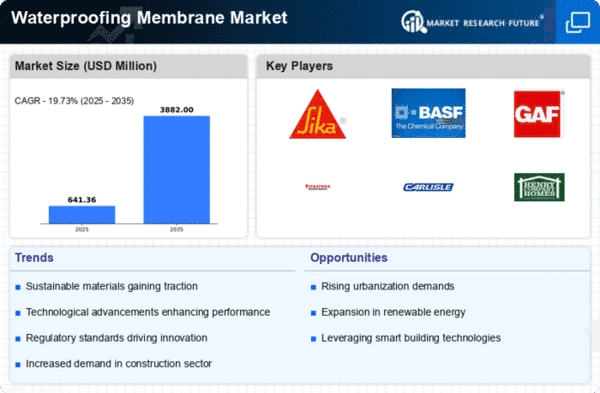
As per MRFR analysis, the Waterproofing Membrane Market Size was estimated at 535.67 USD Million in 2024. The Waterproofing Membrane industry is projected to grow from 641.34 in 2025 to 3882.0 by 2035, exhibiting a compound annual growth rate (CAGR) of 19.73 during the forecast period 2025 - 2035.

Key Market Trends & Highlights

The Waterproofing Membrane Market is poised for substantial growth driven by sustainability and technological advancements.

  • The market is increasingly influenced by a focus on sustainability, with manufacturers prioritizing eco-friendly materials. Technological advancements are enhancing the performance and durability of waterproofing solutions, particularly in roofing applications. North America remains the largest market, while the Asia-Pacific region is experiencing rapid growth due to urbanization and infrastructure development. Rising construction activities and increased awareness of water damage are key drivers propelling the demand for waterproofing membranes, especially in the bituminous and polymer segments.

Market Size & Forecast

2024 Market Size 535.67 (USD Million)
2035 Market Size 3882.0 (USD Million)
CAGR (2025 - 2035) 19.73%
Largest Regional Market Share in 2024 North America

Major Players

<p>Sika AG (CH), BASF SE (DE), GAF Materials Corporation (US), Firestone Building Products (US), Carlisle Companies Incorporated (US), Henry Company (US), Kemper System America, Inc. (US), Mapei S.p.A. (IT), Noxudol (SE)</p>

Market Trends

The Waterproofing Membrane Market is currently experiencing a notable transformation, driven by various factors that influence construction and infrastructure development. The increasing emphasis on sustainable building practices appears to be a significant catalyst, as more stakeholders seek materials that not only provide effective moisture protection but also contribute to environmental conservation. Innovations in membrane technology, such as the development of eco-friendly materials, are likely to enhance the appeal of these products, making them more attractive to a broader range of consumers. Furthermore, the rising awareness of the importance of waterproofing in preventing structural damage and prolonging the lifespan of buildings suggests a growing demand for high-quality solutions in this sector. In addition to sustainability, the Waterproofing Membrane Market is also shaped by advancements in application techniques and product performance. The emergence of smart membranes, which can adapt to environmental conditions, indicates a shift towards more sophisticated solutions that offer enhanced functionality. As urbanization continues to accelerate, the need for reliable waterproofing solutions in both residential and commercial projects is expected to increase. This trend may lead to a more competitive landscape, with manufacturers striving to differentiate their offerings through innovation and superior performance. Overall, the Waterproofing Membrane Market is poised for growth, driven by a combination of technological advancements and evolving consumer preferences.

Sustainability Focus

The trend towards sustainable construction practices is gaining momentum, with stakeholders increasingly prioritizing eco-friendly materials. This shift is likely to drive demand for waterproofing membranes that are not only effective but also environmentally responsible.

Technological Advancements

Innovations in membrane technology are transforming the market landscape. The introduction of smart membranes, which can respond to varying environmental conditions, suggests a move towards more advanced and efficient waterproofing solutions.

Urbanization and Infrastructure Development

As urban areas expand, the need for reliable waterproofing solutions in construction projects is becoming more pronounced. This trend indicates a growing market for waterproofing membranes, particularly in urban settings where infrastructure resilience is critical.

Waterproofing Membrane Market Market Drivers

Rising Construction Activities

The Global Waterproofing Membrane Market Industry is experiencing growth driven by an increase in construction activities worldwide. Urbanization and infrastructure development are leading to a surge in demand for waterproofing solutions in residential, commercial, and industrial projects. For instance, the global construction market is projected to reach 25.7 USD Billion in 2024, indicating a robust need for effective waterproofing membranes to protect structures from water damage. This trend is particularly evident in regions with high rainfall and flooding risks, where waterproofing membranes are essential for ensuring the longevity and durability of buildings.

Market Segment Insights

By Application: Roofing (Largest) vs. Basements (Fastest-Growing)

<p>In the Waterproofing <a href="https://www.marketresearchfuture.com/reports/membranes-market-10760">Membrane Market</a>, the application segment is prominently led by roofing, which constitutes the largest share within the market, driven by increasing demand for sustainable and durable roofing solutions. Other applications, such as basements, boast a significant portion as well, reflecting growing awareness of moisture control and structural integrity, particularly in residential and commercial buildings. Bridges, tunnels, and parking structures also contribute to the segmentation, catering to various infrastructure projects that require robust waterproofing solutions.</p>

<p>Roofing (Dominant) vs. Basements (Emerging)</p>

<p>Roofing applications dominate the Waterproofing Membrane Market due to the rising focus on energy-efficient building practices and innovative roofing technologies. These membranes are crucial in providing weatherproofing and extending the lifespan of roofs. Conversely, basement applications are emerging rapidly, as property owners and developers increasingly recognize the importance of damp prevention and moisture control in underground spaces. The growth in urbanization and the construction of underground facilities significantly enhance the demand for high-quality basement waterproofing solutions. Both segments play a pivotal role in advancing waterproofing technologies within the market.</p>

By Material Type: Bituminous Membrane (Largest) vs. Polymer Membrane (Fastest-Growing)

<p>In the Waterproofing Membrane Market, the material type plays a crucial role in determining the overall performance and application suitability. Currently, Bituminous Membrane holds the largest market share due to its widespread use in flat roofs and foundations, characterized by its excellent waterproofing qualities and durability. Following closely, Polymer Membrane is emerging as a strong contender, favored for its versatility and flexibility, leading to an increasing preference in various construction applications.</p>

<p>Bituminous Membrane (Dominant) vs. Polymer Membrane (Emerging)</p>

<p>Bituminous Membranes are known for their robust performance in waterproofing, being particularly dominant in commercial roofing due to their cost-effectiveness and enduring nature. They consist of asphalt and other modifiers, providing excellent adhesion and impermeability. On the other hand, Polymer Membranes, including TPO and PVC, are rapidly becoming the preferred choice among builders and architects due to their ease of installation and enhanced energy efficiency. This segment is witnessing significant development as environmental sustainability becomes crucial, making it attractive for applications where flexibility and lightweight characteristics are required.</p>

By End Use: Residential (Largest) vs. Commercial (Fastest-Growing)

<p>In the Waterproofing Membrane Market, the residential segment remains the largest, driven by the increasing demand for home construction and renovations that require durable waterproofing solutions. This segment's prominence is attributed to a growing homeowner awareness of the importance of water protection against damages. Meanwhile, the commercial segment is rapidly gaining traction, fueled by a surge in infrastructure projects and commercial developments demanding high-quality waterproofing membranes to ensure long-lasting protection against water infiltration. The growth trends in these segments are influenced by various factors such as urbanization and regulatory standards favoring waterproofing solutions in building codes, which play a crucial role in the adoption rates. Furthermore, technological advancements and the introduction of eco-friendly waterproofing membranes are driving innovation within the market, particularly in the commercial sector, where there is a strong push for sustainability and energy efficiency in buildings.</p>

<p>Residential (Dominant) vs. Industrial (Emerging)</p>

<p>The residential waterproofing membrane segment is characterized by its dominance, driven by a robust appetite for home renovations and proactive measures to safeguard properties against moisture damage. Residential applications prioritize ease of installation and cost-effectiveness, leading to the widespread adoption of user-friendly membrane solutions. On the other hand, the industrial segment is emerging, representing an evolving market segment that caters to specific industrial applications such as manufacturing plants and warehouses. This segment is gaining ground due to the increased awareness of the risks associated with water damage in industrial facilities, leading to heightened interest in specialized waterproofing solutions that offer enhanced durability and performance.</p>

By Installation Method: Sheet Membrane (Largest) vs. Liquid Applied Membrane (Fastest-Growing)

<p>In the Waterproofing Membrane Market, the share distribution is predominantly led by Sheet Membrane, recognized for its robustness and ease of installation. Liquid Applied Membrane follows closely, gaining significant traction due to its versatility and effectiveness in various applications. Spray Applied Membrane, while valuable, currently holds a smaller market share, serving niche segments where quick application is essential. The growth trends indicate that Liquid Applied Membrane is emerging as the fastest-growing segment, fueled by increasing demand for labor efficiency and improved seal quality. The trend towards sustainable building practices is also spurring growth in this segment, as Liquid Applied Membrane can be installed with less waste and fewer resources. Furthermore, innovations in materials technology continue to enhance the performance and applicability of each installation method, expanding their respective market presence.</p>

<p>Sheet Membrane (Dominant) vs. Spray Applied Membrane (Emerging)</p>

<p>In the Waterproofing Membrane Market, Sheet Membrane is dominant due to its longstanding reliability and superior performance under various environmental conditions. This method is well-suited for large surfaces, providing a consistent and durable seal. Its widespread acceptance stems from its applicability in both commercial and residential sectors. In contrast, Spray Applied Membrane, while currently an emerging segment, is gaining ground due to advancements in application technologies. It offers unique benefits like rapid installation and adaptability to complex surfaces, making it attractive for modern construction projects. As innovation drives efficiency, the Spray Applied Membrane segment is projected to expand, catering particularly to construction scenarios demanding quick turnaround times.</p>

By Functionality: Waterproofing (Largest) vs. Vapor Barrier (Fastest-Growing)

<p>In the Waterproofing Membrane Market, the distribution of market share reveals that the Waterproofing segment holds the largest proportion, followed by the Vapor Barrier segment, which is experiencing rapid growth. The Chemical Resistance and Thermal Insulation segments also play significant roles, though they are comparatively smaller. As end-users increasingly prioritize long-lasting protection in various applications, the importance of these functionalities comes to the forefront.</p>

<p>Waterproofing: Conventional (Dominant) vs. Vapor Barrier (Emerging)</p>

<p>The Waterproofing segment remains dominant due to its extensive application in construction and infrastructure projects, ensuring structures remain dry and protected from water damage. Traditional membranes have proven effective over time, leading to customer loyalty and sustained demand. Meanwhile, the Vapor Barrier segment, while emerging, is gaining traction as awareness of moisture control technologies increases. It is particularly relevant in regions with high humidity and for energy-efficient buildings. The shift towards sustainable building practices is driving innovation in both segments, enabling them to adapt and meet evolving market requirements.</p>

Get more detailed insights about Waterproofing Membrane Market Research Report - Global Forecast till 2035

Regional Insights

North America : Market Leader in Waterproofing

North America is poised to maintain its leadership in the waterproofing membrane market, holding a significant share of 267.84 million in 2024. The region's growth is driven by increasing construction activities, stringent building codes, and a rising demand for sustainable building solutions. Regulatory support for energy-efficient buildings further propels market expansion, as stakeholders seek to comply with environmental standards and enhance durability in construction materials. The United States stands out as the primary market, with key players like Sika AG, GAF Materials Corporation, and Firestone Building Products leading the charge. The competitive landscape is characterized by innovation and strategic partnerships, as companies invest in R&D to develop advanced waterproofing solutions. This focus on technology and quality positions North America as a hub for cutting-edge waterproofing products, ensuring continued market growth.

Europe : Emerging Market Dynamics

Europe's waterproofing membrane market is experiencing robust growth, with a market size of 145.7 million in 2024. The region benefits from increasing urbanization, a focus on infrastructure development, and stringent regulations aimed at enhancing building safety and sustainability. The European Union's commitment to green building initiatives and energy efficiency standards acts as a catalyst for market expansion, driving demand for high-performance waterproofing solutions. Leading countries such as Germany, France, and the UK are at the forefront of this growth, with major players like BASF SE and Mapei S.p.A. actively participating in the market. The competitive landscape is marked by innovation and a strong emphasis on eco-friendly products. As companies adapt to regulatory changes and consumer preferences, the European market is set to witness significant advancements in waterproofing technologies.

Asia-Pacific : Rapid Growth Potential

The Asia-Pacific waterproofing membrane market is on a growth trajectory, with a market size of 90.0 million in 2024. This growth is fueled by rapid urbanization, increasing construction activities, and a rising awareness of the importance of waterproofing in building longevity. Governments in the region are implementing regulations to improve building standards, which further drives demand for effective waterproofing solutions across various sectors, including residential and commercial construction. Countries like China, India, and Japan are leading the charge, with a competitive landscape featuring both local and international players. Companies such as Henry Company and Noxudol are expanding their presence, focusing on innovative products tailored to regional needs. As the market evolves, the emphasis on quality and sustainability will shape the future of waterproofing solutions in Asia-Pacific.

Middle East and Africa : Emerging Market Opportunities

The Middle East and Africa waterproofing membrane market is gradually emerging, with a market size of 32.13 million in 2024. The region's growth is driven by increasing infrastructure projects, urbanization, and a growing awareness of the need for effective waterproofing solutions in construction. Governments are investing in large-scale projects, which creates opportunities for waterproofing manufacturers to cater to the rising demand for durable and efficient building materials. Countries like the UAE and South Africa are key players in this market, with a competitive landscape that includes both local and international companies. As the region continues to develop, the presence of key players and their focus on innovative solutions will be crucial in shaping the future of the waterproofing membrane market in the Middle East and Africa.

Key Players and Competitive Insights

The Waterproofing Membrane Market is currently characterized by a dynamic competitive landscape, driven by increasing construction activities and a growing emphasis on sustainable building practices. Key players such as Sika AG (CH), BASF SE (DE), and GAF Materials Corporation (US) are strategically positioning themselves through innovation and regional expansion. Sika AG (CH) focuses on developing advanced membrane technologies that enhance durability and environmental performance, while BASF SE (DE) emphasizes sustainable solutions that align with global environmental standards. GAF Materials Corporation (US) is enhancing its market presence through strategic partnerships and product diversification, collectively shaping a competitive environment that prioritizes innovation and sustainability.The market structure appears moderately fragmented, with several players vying for market share. Key business tactics include localizing manufacturing to reduce costs and optimize supply chains, which is becoming increasingly vital in a globalized economy. The collective influence of these major companies is significant, as they not only drive technological advancements but also set industry standards that smaller players often follow.

In November Sika AG (CH) announced the launch of a new line of eco-friendly waterproofing membranes designed to meet stringent environmental regulations. This strategic move underscores Sika's commitment to sustainability and positions the company favorably in a market that increasingly values environmentally responsible products. The introduction of these membranes is likely to enhance Sika's competitive edge, particularly among environmentally conscious consumers and businesses.

In October BASF SE (DE) expanded its production capacity for waterproofing membranes in Europe, responding to rising demand in the construction sector. This expansion not only strengthens BASF's market position but also reflects a proactive approach to supply chain optimization. By increasing production capabilities, BASF is better equipped to meet customer needs and mitigate potential supply chain disruptions, which is crucial in today's volatile market.

In September GAF Materials Corporation (US) entered into a strategic partnership with a leading technology firm to integrate AI-driven analytics into its product development processes. This collaboration aims to enhance product performance and customer satisfaction by leveraging data-driven insights. The integration of AI is expected to streamline operations and foster innovation, positioning GAF as a forward-thinking leader in the waterproofing membrane sector.

As of December current competitive trends indicate a strong shift towards digitalization, sustainability, and the integration of advanced technologies such as AI. Strategic alliances are increasingly shaping the landscape, enabling companies to pool resources and expertise to drive innovation. The competitive differentiation is likely to evolve from traditional price-based competition to a focus on technological advancements, sustainability, and supply chain reliability, reflecting the changing priorities of consumers and businesses alike.

Key Companies in the Waterproofing Membrane Market include

Industry Developments

August 2021: Carlisle Construction Materials (CCM) has announced its new TPO manufacturing line, which will produce the commercial roofing industry’s first 16-foot-wide TPO membranes. The new production line will add to CCM’s industry-leading production capacity with the widest TPO sheets on the market.

Future Outlook

Waterproofing Membrane Market Future Outlook

<p>The Waterproofing Membrane Market is poised for growth at a 19.73% CAGR from 2025 to 2035, driven by urbanization, infrastructure development, and increasing environmental regulations.</p>

New opportunities lie in:

  • <p>Expansion into emerging markets with tailored waterproofing solutions. Development of eco-friendly membranes to meet sustainability demands. Integration of smart technology for real-time monitoring of membrane performance.</p>

<p>By 2035, the market is expected to achieve substantial growth, reflecting evolving industry needs.</p>

Market Segmentation

Waterproofing Membrane Market End Use Outlook

  • Residential
  • Commercial
  • Industrial
  • Infrastructure

Waterproofing Membrane Market Application Outlook

  • Roofing
  • Basements
  • Bridges
  • Tunnels
  • Parking Structures

Waterproofing Membrane Market Functionality Outlook

  • Waterproofing
  • Vapor Barrier
  • Thermal Insulation
  • Chemical Resistance

Waterproofing Membrane Market Material Type Outlook

  • Bituminous Membrane
  • Polymer Membrane
  • Cementitious Membrane
  • Liquid Membrane

Waterproofing Membrane Market Installation Method Outlook

  • Sheet Membrane
  • Liquid Applied Membrane
  • Spray Applied Membrane

Report Scope

MARKET SIZE 2024 535.67(USD Million)
MARKET SIZE 2025 641.34(USD Million)
MARKET SIZE 2035 3882.0(USD Million)
COMPOUND ANNUAL GROWTH RATE (CAGR) 19.73% (2025 - 2035)
REPORT COVERAGE Revenue Forecast, Competitive Landscape, Growth Factors, and Trends
BASE YEAR 2024
Market Forecast Period 2025 - 2035
Historical Data 2019 - 2024
Market Forecast Units USD Million
Key Companies Profiled Sika AG (CH), BASF SE (DE), GAF Materials Corporation (US), Firestone Building Products (US), Carlisle Companies Incorporated (US), Henry Company (US), Kemper System America, Inc. (US), Mapei S.p.A. (IT), Noxudol (SE)
Segments Covered Application, Material Type, End Use, Installation Method, Functionality
Key Market Opportunities Integration of sustainable materials in the Waterproofing Membrane Market enhances eco-friendly construction practices.
Key Market Dynamics Rising demand for sustainable construction practices drives innovation in waterproofing membrane technologies and materials.
Countries Covered North America, Europe, APAC, South America, MEA

FAQs

How much is the Waterproofing Membrane market?

The Waterproofing Membrane market is USD 22.1 billion in 2021

What is the growth rate of the Waterproofing Membrane market?

The Waterproofing Membrane market is expected to grow at a CAGR of 6.87%

Which region held the largest market share in the Waterproofing Membrane market?

Asia-Pacific held the largest market share in the Waterproofing Membrane market

Who are the key players in the Waterproofing Membrane market?

BASF SE (Germany), Sika AG (Switzerland), Mapei SpA (Italy), Fosroc Inc (UK), are the key players

Which Type led the Waterproofing Membrane market?

Liquid-applied Membranes led the Waterproofing Membrane market

Which application had the largest market share in the Waterproofing Membrane market?

Roofing and Walls had the largest market share in the Waterproofing Membrane market

  1. SECTION I: EXECUTIVE SUMMARY AND KEY HIGHLIGHTS
    1. | 1.1 EXECUTIVE SUMMARY
    2. | 1.1.1 Market Overview
    3. | 1.1.2 Key Findings
    4. | 1.1.3 Market Segmentation
    5. | 1.1.4 Competitive Landscape
    6. | 1.1.5 Challenges and Opportunities
    7. | 1.1.6 Future Outlook
  2. SECTION II: SCOPING, METHODOLOGY AND MARKET STRUCTURE
    1. | 2.1 MARKET INTRODUCTION
    2. | 2.1.1 Definition
    3. | 2.1.2 Scope of the study
    4. |-- 2.1.2.1 Research Objective
    5. |-- 2.1.2.2 Assumption
    6. |-- 2.1.2.3 Limitations
    7. | 2.2 RESEARCH METHODOLOGY
    8. | 2.2.1 Overview
    9. | 2.2.2 Data Mining
    10. | 2.2.3 Secondary Research
    11. | 2.2.4 Primary Research
    12. |-- 2.2.4.1 Primary Interviews and Information Gathering Process
    13. |-- 2.2.4.2 Breakdown of Primary Respondents
    14. | 2.2.5 Forecasting Model
    15. | 2.2.6 Market Size Estimation
    16. |-- 2.2.6.1 Bottom-Up Approach
    17. |-- 2.2.6.2 Top-Down Approach
    18. | 2.2.7 Data Triangulation
    19. | 2.2.8 Validation
  3. SECTION III: QUALITATIVE ANALYSIS
    1. | 3.1 MARKET DYNAMICS
    2. | 3.1.1 Overview
    3. | 3.1.2 Drivers
    4. | 3.1.3 Restraints
    5. | 3.1.4 Opportunities
    6. | 3.2 MARKET FACTOR ANALYSIS
    7. | 3.2.1 Value chain Analysis
    8. | 3.2.2 Porter's Five Forces Analysis
    9. |-- 3.2.2.1 Bargaining Power of Suppliers
    10. |-- 3.2.2.2 Bargaining Power of Buyers
    11. |-- 3.2.2.3 Threat of New Entrants
    12. |-- 3.2.2.4 Threat of Substitutes
    13. |-- 3.2.2.5 Intensity of Rivalry
    14. | 3.2.3 COVID-19 Impact Analysis
    15. |-- 3.2.3.1 Market Impact Analysis
    16. |-- 3.2.3.2 Regional Impact
    17. |-- 3.2.3.3 Opportunity and Threat Analysis
  4. SECTION IV: QUANTITATIVE ANALYSIS
    1. | 4.1 Chemicals and Materials, BY Application (USD Million)
    2. | 4.1.1 Roofing
    3. | 4.1.2 Basements
    4. | 4.1.3 Bridges
    5. | 4.1.4 Tunnels
    6. | 4.1.5 Parking Structures
    7. | 4.2 Chemicals and Materials, BY Material Type (USD Million)
    8. | 4.2.1 Bituminous Membrane
    9. | 4.2.2 Polymer Membrane
    10. | 4.2.3 Cementitious Membrane
    11. | 4.2.4 Liquid Membrane
    12. | 4.3 Chemicals and Materials, BY End Use (USD Million)
    13. | 4.3.1 Residential
    14. | 4.3.2 Commercial
    15. | 4.3.3 Industrial
    16. | 4.3.4 Infrastructure
    17. | 4.4 Chemicals and Materials, BY Installation Method (USD Million)
    18. | 4.4.1 Sheet Membrane
    19. | 4.4.2 Liquid Applied Membrane
    20. | 4.4.3 Spray Applied Membrane
    21. | 4.5 Chemicals and Materials, BY Functionality (USD Million)
    22. | 4.5.1 Waterproofing
    23. | 4.5.2 Vapor Barrier
    24. | 4.5.3 Thermal Insulation
    25. | 4.5.4 Chemical Resistance
    26. | 4.6 Chemicals and Materials, BY Region (USD Million)
    27. | 4.6.1 North America
    28. |-- 4.6.1.1 US
    29. |-- 4.6.1.2 Canada
    30. | 4.6.2 Europe
    31. |-- 4.6.2.1 Germany
    32. |-- 4.6.2.2 UK
    33. |-- 4.6.2.3 France
    34. |-- 4.6.2.4 Russia
    35. |-- 4.6.2.5 Italy
    36. |-- 4.6.2.6 Spain
    37. |-- 4.6.2.7 Rest of Europe
    38. | 4.6.3 APAC
    39. |-- 4.6.3.1 China
    40. |-- 4.6.3.2 India
    41. |-- 4.6.3.3 Japan
    42. |-- 4.6.3.4 South Korea
    43. |-- 4.6.3.5 Malaysia
    44. |-- 4.6.3.6 Thailand
    45. |-- 4.6.3.7 Indonesia
    46. |-- 4.6.3.8 Rest of APAC
    47. | 4.6.4 South America
    48. |-- 4.6.4.1 Brazil
    49. |-- 4.6.4.2 Mexico
    50. |-- 4.6.4.3 Argentina
    51. |-- 4.6.4.4 Rest of South America
    52. | 4.6.5 MEA
    53. |-- 4.6.5.1 GCC Countries
    54. |-- 4.6.5.2 South Africa
    55. |-- 4.6.5.3 Rest of MEA
  5. SECTION V: COMPETITIVE ANALYSIS
    1. | 5.1 Competitive Landscape
    2. | 5.1.1 Overview
    3. | 5.1.2 Competitive Analysis
    4. | 5.1.3 Market share Analysis
    5. | 5.1.4 Major Growth Strategy in the Chemicals and Materials
    6. | 5.1.5 Competitive Benchmarking
    7. | 5.1.6 Leading Players in Terms of Number of Developments in the Chemicals and Materials
    8. | 5.1.7 Key developments and growth strategies
    9. |-- 5.1.7.1 New Product Launch/Service Deployment
    10. |-- 5.1.7.2 Merger & Acquisitions
    11. |-- 5.1.7.3 Joint Ventures
    12. | 5.1.8 Major Players Financial Matrix
    13. |-- 5.1.8.1 Sales and Operating Income
    14. |-- 5.1.8.2 Major Players R&D Expenditure. 2023
    15. | 5.2 Company Profiles
    16. | 5.2.1 Sika AG (CH)
    17. |-- 5.2.1.1 Financial Overview
    18. |-- 5.2.1.2 Products Offered
    19. |-- 5.2.1.3 Key Developments
    20. |-- 5.2.1.4 SWOT Analysis
    21. |-- 5.2.1.5 Key Strategies
    22. | 5.2.2 BASF SE (DE)
    23. |-- 5.2.2.1 Financial Overview
    24. |-- 5.2.2.2 Products Offered
    25. |-- 5.2.2.3 Key Developments
    26. |-- 5.2.2.4 SWOT Analysis
    27. |-- 5.2.2.5 Key Strategies
    28. | 5.2.3 GAF Materials Corporation (US)
    29. |-- 5.2.3.1 Financial Overview
    30. |-- 5.2.3.2 Products Offered
    31. |-- 5.2.3.3 Key Developments
    32. |-- 5.2.3.4 SWOT Analysis
    33. |-- 5.2.3.5 Key Strategies
    34. | 5.2.4 Firestone Building Products (US)
    35. |-- 5.2.4.1 Financial Overview
    36. |-- 5.2.4.2 Products Offered
    37. |-- 5.2.4.3 Key Developments
    38. |-- 5.2.4.4 SWOT Analysis
    39. |-- 5.2.4.5 Key Strategies
    40. | 5.2.5 Carlisle Companies Incorporated (US)
    41. |-- 5.2.5.1 Financial Overview
    42. |-- 5.2.5.2 Products Offered
    43. |-- 5.2.5.3 Key Developments
    44. |-- 5.2.5.4 SWOT Analysis
    45. |-- 5.2.5.5 Key Strategies
    46. | 5.2.6 Henry Company (US)
    47. |-- 5.2.6.1 Financial Overview
    48. |-- 5.2.6.2 Products Offered
    49. |-- 5.2.6.3 Key Developments
    50. |-- 5.2.6.4 SWOT Analysis
    51. |-- 5.2.6.5 Key Strategies
    52. | 5.2.7 Kemper System America, Inc. (US)
    53. |-- 5.2.7.1 Financial Overview
    54. |-- 5.2.7.2 Products Offered
    55. |-- 5.2.7.3 Key Developments
    56. |-- 5.2.7.4 SWOT Analysis
    57. |-- 5.2.7.5 Key Strategies
    58. | 5.2.8 Mapei S.p.A. (IT)
    59. |-- 5.2.8.1 Financial Overview
    60. |-- 5.2.8.2 Products Offered
    61. |-- 5.2.8.3 Key Developments
    62. |-- 5.2.8.4 SWOT Analysis
    63. |-- 5.2.8.5 Key Strategies
    64. | 5.2.9 Noxudol (SE)
    65. |-- 5.2.9.1 Financial Overview
    66. |-- 5.2.9.2 Products Offered
    67. |-- 5.2.9.3 Key Developments
    68. |-- 5.2.9.4 SWOT Analysis
    69. |-- 5.2.9.5 Key Strategies
    70. | 5.3 Appendix
    71. | 5.3.1 References
    72. | 5.3.2 Related Reports

Chemicals and Materials Market Segmentation

Chemicals and Materials By Application (USD Million, 2025-2035)

  • Roofing
  • Basements
  • Bridges
  • Tunnels
  • Parking Structures

Chemicals and Materials By Material Type (USD Million, 2025-2035)

  • Bituminous Membrane
  • Polymer Membrane
  • Cementitious Membrane
  • Liquid Membrane

Chemicals and Materials By End Use (USD Million, 2025-2035)

  • Residential
  • Commercial
  • Industrial
  • Infrastructure

Chemicals and Materials By Installation Method (USD Million, 2025-2035)

  • Sheet Membrane
  • Liquid Applied Membrane
  • Spray Applied Membrane

Chemicals and Materials By Functionality (USD Million, 2025-2035)

  • Waterproofing
  • Vapor Barrier
  • Thermal Insulation
  • Chemical Resistance
Infographic

Free Sample Request

Kindly complete the form below to receive a free sample of this Report

Get Free Sample

Customer Strories

Compare Licence

×
Features License Type
Single User Multiuser License Enterprise User
Price $4,950 $5,950 $7,250
Maximum User Access Limit 1 User Upto 10 Users Unrestricted Access Throughout the Organization
Free Customization
Direct Access to Analyst
Deliverable Format
Platform Access
Discount on Next Purchase 10% 15% 15%
Printable Versions