Request Free Sample ×

Kindly complete the form below to receive a free sample of this Report

* Please use a valid business email

Leading companies partner with us for data-driven Insights

clients tt-cursor
Hero Background
English
Chinese
French
Japanese
Korean
German
Spanish

Water Desalination Market Share

ID: MRFR/EnP/10265-HCR
128 Pages
Anshula Mandaokar
April 2026

Water Desalination Market Research Report Information by Source (Seawater, Brackish water, Surface Water (River and Stream), Wastewater, and Others), by Technology ( Membrane Technology [Reverse Osmosis, Electrodialysis, Electrodialysis Reversal, Membrane Distillation, Nanofiltration And Other Membrane Technology] And Thermal Technology [Multi-stage Flash Distillation, Multi-effect Distillation And Vapor Compression Distillation] And By Region – Global Industry Size, Share, Growth, Trends and Forecast To 2035

Share:
Download PDF ×

We do not share your information with anyone. However, we may send you emails based on your report interest from time to time. You may contact us at any time to opt-out.

Water Desalination Market Infographic
Purchase Options

Market Share

Water Desalination Market Share Analysis

Companies use a variety of market share positioning strategies in the Water Desalination Market, which is always changing, to gain a competitive advantage and establish a strong presence. Differentiation, in which businesses focus on providing novel and distinct desalination technologies or solutions, is a notable strategy. Organizations try to draw in ecologically cognizant purchasers and lay out a standing for imaginative arrangements by separating themselves from contenders through cutting edge film advances, energy-effective cycles, or naturally capable practices.

One more critical methodology is cost administration, in which organizations try to turn into the market's most minimal expense makers. This technique every now and again involves lessening in general costs through the enhancement of functional effectiveness, smoothing out of creation cycles, and use of economies of scale. By maintaining competitive pricing without sacrificing product quality, businesses can expand their market presence and attract cost-conscious customers in areas where water scarcity is an urgent concern.

Moreover, essential unions and cooperative associations are fundamental for deciding piece of the pie in the water desalination industry. Partnerships among enterprises and innovation suppliers, research establishments, or government offices are every now and again framed to get to assets, trade information, and speed up the advancement of state-of-the-art desalination arrangements. These cooperative endeavours work with the trading of information as well as increment market infiltration through the investigation of undiscovered geographic locales and shopper fragments.

Topographical development addresses an extra basic methodology executed by associations working inside the water desalination industry. Businesses strategically focus their efforts in areas where there is a pressing need for clean water solutions or severe water scarcity in regions where water quality and availability vary significantly. Through the foundation of a strong presence in these locales by means of vital collusions, acquisitions, or direct ventures, associations can achieve a significant piece of the market and position themselves as essential entertainers in handling native water issues.

Market division is one more predominant strategy utilized by organizations trying to satisfy the shifted needs of their customer base. Organizations can decisively catch specialty markets and increment their designated portion of the overall industry by conceiving desalination arrangements that take care of the particular requirements of individual client sections, including modern, metropolitan, and private. This procedure empowers the customization of promoting systems, item advancement, and administration contributions to actually handle the particular impediments experienced by different buyer fragments.

Strategies for gaining a market share in the water desalination sector must include constant innovation and research and development. In light of developing ecological worries and mechanical headways, organizations put resources into examination to work on the reasonableness, manageability, and effectiveness of desalination processes. Businesses not only set themselves apart from rivals and establish themselves as leaders in providing cutting-edge desalination solutions by staying up to date on technological developments.

The market for desalination of water is recognized by a broad exhibit of ways to deal with laying out piece of the pie, each modified to address the particular necessities and impediments of the area. Through separation, cost administration, cooperation, geological extension, market division, or development, enterprises move the market decisively to situate themselves as significant competitors chasing open and reasonable water arrangements. Considering the heightening worldwide interest for consumable water, the viability of these methodologies will fundamentally impact the serious landscape of the desalination business.

Author
Author Profile
Anshula Mandaokar
Team Lead - Research

Anshula Mandaokar holds an academic degree in Chemical Engineering and has been contributing to the field for more than 5 years. She has expertise in Market Research and Business Consulting and serves as a Team Lead for a reputed Market Research firm under the Chemicals and Materials domain spectrum. She has worked on multiple projects, generating explicit results in a quick turnaround time. Her understanding of data interpretation justifies her role as a leader.

Leave a Comment

FAQs

What is the current valuation of the Water Desalination Market as of 2024?

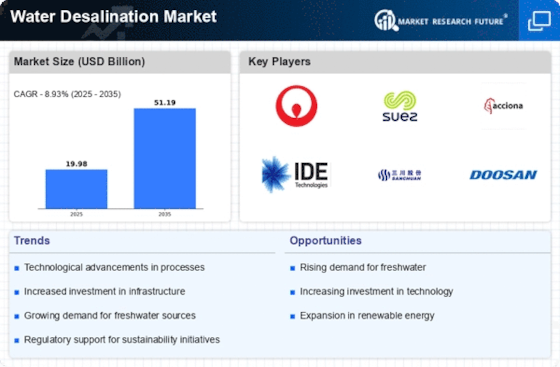
<p>The Water Desalination Market was valued at 19.98 USD Billion in 2024.</p>

What is the projected market valuation for the Water Desalination Market in 2035?

<p>The market is projected to reach a valuation of 51.19 USD Billion by 2035.</p>

What is the expected CAGR for the Water Desalination Market during the forecast period 2025 - 2035?

<p>The expected CAGR for the Water Desalination Market during 2025 - 2035 is 8.93%.</p>

Which companies are considered key players in the Water Desalination Market?

<p>Key players in the market include Veolia, Suez, Acciona, IDE Technologies, and Fujian Sanchuan Water Treatment.</p>

What are the main sources of water used in desalination, and their market values?

<p>Seawater, with a market value of 20.0 USD Billion, is the primary source, followed by brackish water at 10.0 USD Billion.</p>

How does membrane technology compare to thermal technology in terms of market valuation?

<p>Membrane technology is projected to reach 25.0 USD Billion, while thermal technology is expected to reach 26.19 USD Billion.</p>

What applications dominate the Water Desalination Market?

Municipal applications lead the market with a valuation of 23.12 USD Billion, followed by industrial applications at 20.15 USD Billion.

What is the market value range for wastewater desalination?

The market value for wastewater desalination is projected to range from 2.0 to 5.0 USD Billion.

What is the expected growth trend for the Water Desalination Market in the coming years?

The market is likely to experience robust growth, driven by increasing demand for freshwater resources.

How do the projected values for 'Others' in the source segment compare?

The 'Others' category in the source segment is expected to range from 2.98 to 8.19 USD Billion.

Market Summary

As per Market Research Future analysis, the Water Desalination Market Size was estimated at 19.98 USD Billion in 2024. The Water Desalination industry is projected to grow from 21.76 USD Billion in 2025 to 51.19 USD Billion by 2035, exhibiting a compound annual growth rate (CAGR) of 8.9% during the forecast period 2025 - 2035

Key Market Trends & Highlights

The Water Desalination Market is poised for substantial growth driven by technological advancements and increasing demand for clean water.

  • North America remains the largest market for water desalination, primarily due to its advanced infrastructure and regulatory support. The Asia-Pacific region is emerging as the fastest-growing market, fueled by rapid urbanization and increasing water scarcity. Seawater desalination continues to dominate the market, while brackish water desalination is experiencing the fastest growth due to its cost-effectiveness. Key market drivers include rising demand for clean water and government initiatives aimed at addressing environmental concerns and sustainability.

Market Size & Forecast

2024 Market Size 19.98 (USD Billion)
2035 Market Size 51.19 (USD Billion)
CAGR (2025 - 2035) 8.93%
Largest Regional Market Share in 2024 MEA

Major Players

<a href="https://www.veoliawatertechnologies.com/en/applications/desalination">Veolia</a> (FR), Suez (FR), Acciona (ES), IDE Technologies (IL), Fujian Sanchuan Water Treatment (CN), <a href="https://www.doosan.com/en/media-center/press-release_view?id=20172268">Doosan Heavy Industries &amp; Construction</a> (KR), Hyflux (SG), Toray Industries (JP), Aqualia (ES)

Market Trends

The Water Desalination Market is currently experiencing a notable transformation driven by various factors, including increasing water scarcity and the growing demand for fresh water in arid regions. This market appears to be expanding as governments and private entities invest in advanced technologies to enhance desalination processes. Innovations such as reverse osmosis and solar desalination are gaining traction, suggesting a shift towards more sustainable and energy-efficient solutions. Furthermore, the rising awareness of environmental impacts associated with traditional water sourcing methods is likely to propel the adoption of desalination technologies.

In addition, the global Water Desalination Market seems to be influenced by regulatory frameworks that encourage the development of alternative water sources. As climate change continues to exacerbate water shortages, the urgency for reliable and sustainable water supply solutions becomes increasingly apparent. This scenario indicates a potential for growth in both the public and private sectors, as stakeholders seek to address the pressing challenges of water availability. Overall, the Water Desalination Market share is influenced by significant advancements, with a focus on sustainability and efficiency in water production.

Technological Advancements

The Water Desalination Market is witnessing a surge in technological innovations aimed at improving efficiency and reducing costs. Emerging methods, such as forward osmosis and membrane distillation, are being explored to enhance the desalination process. These advancements may lead to more effective water treatment solutions, potentially making desalination more accessible to various regions.

Sustainability Initiatives

There is a growing emphasis on sustainability within the Water Desalination Market, as stakeholders increasingly prioritize environmentally friendly practices. The integration of renewable energy sources, such as solar and wind power, into desalination processes is becoming more prevalent. This trend suggests a commitment to reducing the carbon footprint associated with water production.

Regulatory Support

The Water Desalination Market appears to benefit from supportive regulatory frameworks that encourage investment in alternative water sources. Governments are likely to implement policies that promote the development of desalination projects, recognizing the need for reliable water supply solutions. This regulatory backing may stimulate growth and innovation within the sector.

Water Desalination Market Market Drivers

Increasing Water Scarcity

The escalating issue of water scarcity is a primary driver for the Water Desalination Market. As populations grow and industrial demands rise, freshwater resources are becoming increasingly strained. Reports indicate that by 2025, nearly 1.8 billion people will live in regions with absolute water scarcity. This dire situation compels governments and private entities to seek alternative water sources, with desalination emerging as a viable solution. The Water Desalination Market is witnessing heightened investments as countries aim to secure sustainable water supplies. Furthermore, regions prone to drought are particularly inclined to adopt desalination technologies, thereby expanding the market's reach and potential.

Technological Innovations

Technological advancements play a crucial role in shaping the Water Desalination Market. Innovations such as reverse osmosis and forward osmosis are enhancing the efficiency and cost-effectiveness of desalination processes. Recent developments have led to a reduction in energy consumption, which is a significant operational cost in desalination plants. For instance, the introduction of energy recovery devices has been shown to improve energy efficiency by up to 90%. As these technologies continue to evolve, they are likely to attract further investment and interest, thereby propelling the growth of the Water Desalination Market. Enhanced performance and lower costs may also lead to wider adoption in both developed and developing regions.

Rising Demand for Clean Water

The increasing demand for clean and potable water is a significant driver for the Water Desalination Market. Urbanization and industrialization have led to a surge in water consumption, with many regions facing challenges in meeting this demand through traditional sources. The World Health Organization estimates that by 2025, two-thirds of the world’s population could be living under water-stressed conditions. This scenario necessitates the exploration of alternative water sources, including desalination. As a result, investments in desalination infrastructure are expected to rise, with the Water Desalination Market poised for substantial growth. The need for reliable and safe drinking water is likely to remain a priority for governments and organizations worldwide.

Government Initiatives and Funding

Government initiatives and funding are pivotal in advancing the Water Desalination Market. Many governments are recognizing the critical need for alternative water sources and are implementing policies to support desalination projects. Financial incentives, grants, and subsidies are being offered to encourage investment in desalination technologies. For instance, several countries have established national water strategies that prioritize desalination as a key component of their water supply plans. This proactive approach not only facilitates the development of new desalination plants but also enhances existing facilities. As governments continue to prioritize water security, the Water Desalination Market is likely to experience robust growth driven by these supportive measures.

Environmental Concerns and Sustainability

Environmental concerns are increasingly influencing the Water Desalination Market. As awareness of climate change and its impacts grows, there is a pressing need for sustainable water management practices. Desalination, when implemented with renewable energy sources, can provide a sustainable solution to water scarcity. The integration of solar and wind energy into desalination processes is gaining traction, potentially reducing the carbon footprint associated with traditional methods. This shift towards sustainability is likely to attract investments and support from both public and private sectors, further driving the growth of the Water Desalination Market. The emphasis on eco-friendly practices may also enhance the public perception of desalination as a viable water source.

Market Segment Insights

By Source: Seawater (Largest) vs. Brackish Water (Fastest-Growing)

<p>In the Water Desalination Market, seawater is the predominant source, commanding the largest share due to its vast availability and established processing technologies. The majority of desalination plants are designed to treat seawater, contributing significantly to overall production capacities. Brackish water, while a smaller segment, is gaining traction as a viable source, especially in regions where freshwater resources are scarce. The expanding applications of desalination technology further influence this distribution, revealing a dynamic market landscape. Growth trends indicate that the brackish water desalination segment is on the rise, fueled by increasing demand for freshwater in arid and semi-arid regions. Advances in membrane technologies and energy-efficient processes are making brackish water treatment more accessible and cost-effective. Additionally, government initiatives to promote sustainable water management are further driving investments and innovations in this area, highlighting a shift towards more diverse water sourcing solutions.</p>

<p>Seawater: Dominant vs. Wastewater: Emerging</p>

<p>Seawater desalination stands as the dominant player in the market, recognized for its scalability and technical maturity. It is often the first choice for large-scale desalination projects due to its ability to produce significant quantities of potable water from an abundant resource. On the other hand, wastewater desalination is emerging as a crucial option, particularly in urban areas where water reclamation and reuse are becoming essential for sustainable water management. This segment is characterized by innovative treatment technologies that enhance purification processes, making them increasingly viable. The comparative advantages of these two sources lie in their distinct operational processes and the specific regional needs they address, with seawater being favored for its volume and wastewater for its sustainability.</p>

By Technology: Membrane Technology (Largest) vs. Thermal Technology (Fastest-Growing)

<p>In the Water Desalination Market, the distribution of market share is significantly skewed towards Membrane Technology, which holds a prominent position due to its efficiency and lower operational costs. This technology accounts for the largest proportion of the market, driven by advancements in membrane materials and designs that enhance salt rejection while minimizing energy consumption. In contrast, Thermal Technology, while traditionally seen as less efficient, is gaining traction and capturing a growing share of the market as it adapts to modern demands and integrates with renewable energy sources, positioning itself as a robust alternative for specific applications.</p>

<p>Technology: Membrane (Dominant) vs. Thermal (Emerging)</p>

<p>Membrane Technology is considered the dominant force in the Water Desalination Market due to its established infrastructure and technological advancements that have improved its efficiency over the years. This segment utilizes selective permeability membranes to separate salt and other impurities from water, making it an ideal choice for various applications, especially in regions with limited freshwater resources. On the other hand, Thermal Technology is emerging as a viable alternative, particularly in industrial applications where waste heat can be utilized to power the desalination process. Though it is slower to adopt, its potential for integration with green technologies positions it for significant growth in the coming years, particularly in regions exploring sustainable solutions for water scarcity.</p>

By Application: Municipal (Largest) vs. Industrial (Fastest-Growing)

<p>In the Water Desalination Market, the application segment is primarily divided into Municipal, Industrial, and Others. The Municipal application dominates this segment, accounting for a significant share of the overall market. This is largely due to the increasing demand for clean drinking water driven by population growth and urbanization. Additionally, many governments are investing in infrastructure projects aimed at enhancing water supply systems, further solidifying the dominance of the Municipal application. On the other hand, the Industrial application is emerging as the fastest-growing segment within the Water Desalination Market. This growth is propelled by the rising demand for freshwater in industries, such as oil and gas, power generation, and manufacturing processes. Moreover, the growing need for water treatment and recycling solutions in industrial operations is driving investments in desalination technology, leading to efficiency and sustainability improvements in water usage across various sectors.</p>

<p>Municipal (Dominant) vs. Industrial (Emerging)</p>

<p>The Municipal segment is characterized by its substantial contribution to global water supplies, primarily focusing on providing potable water to urban populations. Driven by significant government initiatives and public funding, this segment sees continuous innovation in desalination technologies aimed at maximizing efficiency and environmental sustainability. In contrast, the Industrial segment reflects a rapidly evolving market that caters to diverse industries requiring high-quality water for various operations. This segment is classified as emerging due to its increasing reliance on desalination processes to suffice water needs, especially in water-scarce regions. The growth of this segment is further fueled by advances in technology that improve the economic feasibility of desalination for industrial applications, ensuring a steady supply of quality water.</p>

Get more detailed insights about Water Desalination Market Research Report—Global Forecast till 2035

Regional Insights

North America : Innovation and Sustainability Focus

North America is witnessing significant growth in the water desalination market, driven by increasing water scarcity and stringent environmental regulations. The region holds approximately 30% of the global market share, with the United States being the largest market, followed by Canada. Regulatory support for innovative technologies and sustainable practices is propelling demand, particularly in coastal areas where freshwater resources are limited. The competitive landscape is characterized by major players such as IDE Technologies and Acciona, who are investing in advanced desalination technologies. The U.S. government is actively promoting research and development in this sector, enhancing the market's growth potential. Additionally, partnerships between public and private sectors are fostering innovation, ensuring a robust pipeline of projects aimed at addressing water shortages across the region.

Europe : Sustainable Solutions for Water Scarcity

Europe is emerging as a key player in the water desalination market, driven by increasing demand for sustainable water solutions and regulatory frameworks promoting environmental protection. The region accounts for approximately 25% of the global market share, with Spain and France leading the way. The European Union's commitment to water sustainability and climate change initiatives is catalyzing investments in desalination technologies, particularly in Mediterranean countries facing water stress. Leading countries like Spain are home to major players such as Acciona and Suez, who are at the forefront of innovative desalination projects. The competitive landscape is marked by collaborations between governments and private entities, focusing on research and development. The EU's Green Deal and water management policies are further enhancing the market's growth prospects, ensuring a sustainable approach to water resource management.

Asia-Pacific : Rapid Growth in Water Demand

Asia-Pacific is rapidly becoming a significant player in the water desalination market, driven by increasing urbanization and industrialization. The region holds approximately 20% of the global market share, with countries like China and India leading the demand. Government initiatives aimed at addressing water scarcity and improving water quality are key growth drivers, supported by investments in advanced desalination technologies and infrastructure development. China is witnessing a surge in desalination projects, with key players like Fujian Sanchuan Water Treatment and Toray Industries leading the charge. The competitive landscape is evolving, with both domestic and international companies vying for market share. Additionally, regional collaborations and partnerships are fostering innovation, ensuring that the Asia-Pacific region remains at the forefront of desalination advancements, addressing the pressing water challenges faced by its growing population.

Middle East and Africa : Resource-Rich Yet Water-Scarce

The Middle East and Africa region is a critical market for water desalination, driven by extreme water scarcity and a growing population. This region holds approximately 25% of the global market share, with countries like Saudi Arabia and the UAE leading in desalination capacity. The harsh climate and limited freshwater resources necessitate the adoption of desalination technologies, supported by government initiatives and investments in infrastructure. Saudi Arabia is the largest market, with significant contributions from key players such as Doosan Heavy Industries and Hyflux. The competitive landscape is characterized by a mix of local and international firms, all striving to meet the increasing demand for potable water. Furthermore, regional collaborations and investments in renewable energy sources for desalination processes are enhancing the sustainability of water supply solutions in this arid region.

Key Players and Competitive Insights

Major market players are spending extensively on R&D to increase their product lines, which will help industrial water treatment grow even more. Market participants are also taking a range of strategic initiatives to grow their worldwide footprint, including new product launches, contractual agreements, mergers and acquisitions, increased investments, and collaboration with other organizations. Competitors in the water desalination Industry are expanding their market presence globally as the market is expected to boom in the future. Veolia group (Veolia) is a French corporation that offers a variety of water, energy, and materials solutions, with an emphasis on waste recovery, in order to encourage the transition to a circular economy. The firm develops and implements specialized solutions to deliver, protect, and renew resources while boosting their environmental, economic, and social efficiency. Veolia Water Technologies is a division of the Veolia company and the world's top water treatment expert. The firm specializes in the design and delivery of drinking water or wastewater treatment facilities, as well as smaller standardized water treatment equipment for industrial or municipal clients. Suez Group is a provider of environmental management solutions. Its service offering comprises water distribution and treatment services such as the production and delivery of drinking water, water cycle management, wastewater treatment and reuse, and water control. Sorting and dismantling, collecting and logistics, sanitation, non-hazardous and hazardous waste landfilling, and urban development services are all part of the company's recycling and waste recovery services. Suez services the food and beverage, chemical and pharmaceutical, construction, site deconstruction and soil decontamination, mining and metals, oil & gas, refining and petrochemical, power, pulp and paper, healthcare, retail, automotive, transportation and aviation industries.

Key Companies in the Water Desalination Market include

Industry Developments

October 2023 -A prominent supplier of solar-powered seawater and brackish water desalination solutions, OSMOSUN®, on October 23rd discloses the creation of OSMOSUN MA in Morocco, an equal-stake joint venture together with Moroccan industrial group PCS. The commercial and industrial collaboration is absolutely in line with OSMOSUN's deployment strategy across West and North Africa, a precedence region for the group.

In conjunction with some of its partners, Adolphe Merkle Institute (AMI) researchers in June 2024 have devised a state-of-the-art technique to produce thin membranes that convert energy the way biological cell ones do. This discovery could be significant for areas such as desalination and implantable artificial electric organs.

Nemmeli is near Chennai, where the Chief Minister of Tamil Nadu, M K Stalin, inaugurated a desalination plant in February 2024.

Assistant Professor Jovan Kamcev leads a project funded by the U.S. Department of Energy (DOE) and the National Alliance for Water Innovation (NAWI) in April 2023.

During President Emmanuel Macron's official visit to China on April 5-7th, 2023, these parties signed an agreement including SUEZ; Wanhua Chemical Group (Wanhua), which is based in China; and China Railway Shanghai Engineering Bureau Group (CRSH), for seawater desalination industrial use application.

This was through a special purpose vehicle developed by Marubeni Corporation together with Transelec Holdings Rentas Limitada who, were well-known power transmission firm in Chile, established a desalination and water transmission venture for Corporación Nacional del Cobre de Chile in March 2023.

The BMC’s desalination plant project, according to Municipal Commissioner and administrator Chahal, would be around Manori, while the work order is likely issued by August, probably in February 2023. When the tender is finalized, bids will be called for on an internationally competitive basis.

August 2022: ACCIONA has been granted the design and construction of a seawater desalination plant in Collahuasi's Patache Port, approximately 70 kilometers south of Iquique in Chile's Tarapacá region. For the next two years, the business will be in charge of the plant's operation and maintenance, which has a capacity of 1,050 liters per second.

April 2022: Veolia Water Technologies, a Veolia group business and leading water treatment provider, announces the Asia Pacific launch of the Barrel, an integrated plug-and-play reverse osmosis (RO) technology.

January 2022: Doosan Heavy Industries & Construction signed a memorandum of understanding on a seawater desalination project in Egypt, marking the company's debut into the desalination sector in Egypt. The Memorandum of Understanding (MOU) was signed with Hassan Allam, a major Egyptian developer and large-scale construction firm, and Almar Water Solutions, a company founded through a Saudi Arabia-Spain joint venture, to collaborate on a reverse osmosis (RO) seawater desalination project.

Future Outlook

Water Desalination Market Future Outlook

The Water Desalination Market is projected to grow at an 8.93% CAGR from 2024 to 2035, driven by increasing water scarcity, technological advancements, and rising demand for potable water.<br>The future of the Water Desalination Market is vital as global populations face increasing freshwater scarcity and deteriorating environmental conditions. Driven by the urgent need for drought-resilient infrastructure, the market will expand through the integration of renewable energy sources, artificial intelligence for membrane optimization, and the rising adoption of high-efficiency reverse osmosis technologies across coastal urban centers.

New opportunities lie in:

  • <p>Development of modular desalination units for remote areas Investment in renewable energy-powered desalination plants Partnerships with agricultural sectors for sustainable water solutions</p>

Water Desalination Market analysis reveals that by 2035, the market is expected to be robust, addressing global water challenges effectively.

Market Segmentation

Water Desalination Market Source Outlook

  • Seawater
  • Brackish Water
  • Surface Water (River and Streams)
  • Wastewater
  • Others

Water Desalination Market Technology Outlook

  • Membrane Technology
  • Thermal Technology

Water Desalination Market Application Outlook

  • Municipal
  • Industrial
  • Others

Report Scope

MARKET SIZE 2024 19.98(USD Billion)
MARKET SIZE 2025 21.76(USD Billion)
MARKET SIZE 2035 51.19(USD Billion)
COMPOUND ANNUAL GROWTH RATE (CAGR) 8.93% (2025 - 2035)
REPORT COVERAGE Revenue Forecast, Competitive Landscape, Growth Factors, and Trends
BASE YEAR 2024
Market Forecast Period 2025 - 2035
Historical Data 2019 - 2024
Market Forecast Units USD Billion
Key Companies Profiled Veolia (FR), Suez (FR), Acciona (ES), IDE Technologies (IL), Fujian Sanchuan Water Treatment (CN), Doosan Heavy Industries & Construction (KR), Hyflux (SG), Toray Industries (JP), Aqualia (ES)
Segments Covered Source, Technology, Region – Global Industry Size, Share, Growth, Trends and Forecast To 2035
Key Market Opportunities Advancements in energy-efficient desalination technologies enhance sustainability in the Water Desalination Market.
Key Market Dynamics Technological advancements and regulatory pressures drive innovation and competition in the water desalination market.
Countries Covered North America, Europe, APAC, South America, MEA

FAQs

What is the current valuation of the Water Desalination Market as of 2024?

<p>The Water Desalination Market was valued at 19.98 USD Billion in 2024.</p>

What is the projected market valuation for the Water Desalination Market in 2035?

<p>The market is projected to reach a valuation of 51.19 USD Billion by 2035.</p>

What is the expected CAGR for the Water Desalination Market during the forecast period 2025 - 2035?

<p>The expected CAGR for the Water Desalination Market during 2025 - 2035 is 8.93%.</p>

Which companies are considered key players in the Water Desalination Market?

<p>Key players in the market include Veolia, Suez, Acciona, IDE Technologies, and Fujian Sanchuan Water Treatment.</p>

What are the main sources of water used in desalination, and their market values?

<p>Seawater, with a market value of 20.0 USD Billion, is the primary source, followed by brackish water at 10.0 USD Billion.</p>

How does membrane technology compare to thermal technology in terms of market valuation?

<p>Membrane technology is projected to reach 25.0 USD Billion, while thermal technology is expected to reach 26.19 USD Billion.</p>

What applications dominate the Water Desalination Market?

Municipal applications lead the market with a valuation of 23.12 USD Billion, followed by industrial applications at 20.15 USD Billion.

What is the market value range for wastewater desalination?

The market value for wastewater desalination is projected to range from 2.0 to 5.0 USD Billion.

What is the expected growth trend for the Water Desalination Market in the coming years?

The market is likely to experience robust growth, driven by increasing demand for freshwater resources.

How do the projected values for 'Others' in the source segment compare?

The 'Others' category in the source segment is expected to range from 2.98 to 8.19 USD Billion.

  1. SECTION I: EXECUTIVE SUMMARY AND KEY HIGHLIGHTS
    1. | 1.1 EXECUTIVE SUMMARY
    2. | | 1.1.1 Market Overview
    3. | | 1.1.2 Key Findings
    4. | | 1.1.3 Market Segmentation
    5. | | 1.1.4 Competitive Landscape
    6. | | 1.1.5 Challenges and Opportunities
    7. | | 1.1.6 Future Outlook
  2. SECTION II: SCOPING, METHODOLOGY AND MARKET STRUCTURE
    1. | 2.1 MARKET INTRODUCTION
    2. | | 2.1.1 Definition
    3. | | 2.1.2 Scope of the study
    4. | | | 2.1.2.1 Research Objective
    5. | | | 2.1.2.2 Assumption
    6. | | | 2.1.2.3 Limitations
    7. | 2.2 RESEARCH METHODOLOGY
    8. | | 2.2.1 Overview
    9. | | 2.2.2 Data Mining
    10. | | 2.2.3 Secondary Research
    11. | | 2.2.4 Primary Research
    12. | | | 2.2.4.1 Primary Interviews and Information Gathering Process
    13. | | | 2.2.4.2 Breakdown of Primary Respondents
    14. | | 2.2.5 Forecasting Model
    15. | | 2.2.6 Market Size Estimation
    16. | | | 2.2.6.1 Bottom-Up Approach
    17. | | | 2.2.6.2 Top-Down Approach
    18. | | 2.2.7 Data Triangulation
    19. | | 2.2.8 Validation
  3. SECTION III: QUALITATIVE ANALYSIS
    1. | 3.1 MARKET DYNAMICS
    2. | | 3.1.1 Overview
    3. | | 3.1.2 Drivers
    4. | | 3.1.3 Restraints
    5. | | 3.1.4 Opportunities
    6. | 3.2 MARKET FACTOR ANALYSIS
    7. | | 3.2.1 Value chain Analysis
    8. | | 3.2.2 Porter's Five Forces Analysis
    9. | | | 3.2.2.1 Bargaining Power of Suppliers
    10. | | | 3.2.2.2 Bargaining Power of Buyers
    11. | | | 3.2.2.3 Threat of New Entrants
    12. | | | 3.2.2.4 Threat of Substitutes
    13. | | | 3.2.2.5 Intensity of Rivalry
    14. | | 3.2.3 COVID-19 Impact Analysis
    15. | | | 3.2.3.1 Market Impact Analysis
    16. | | | 3.2.3.2 Regional Impact
    17. | | | 3.2.3.3 Opportunity and Threat Analysis
  4. SECTION IV: QUANTITATIVE ANALYSIS
    1. | 4.1 Energy & Power, BY Source (USD Billion)
    2. | | 4.1.1 Seawater
    3. | | 4.1.2 Brackish Water
    4. | | 4.1.3 Surface Water (River and Streams)
    5. | | 4.1.4 Wastewater
    6. | | 4.1.5 Others
    7. | 4.2 Energy & Power, BY Technology (USD Billion)
    8. | | 4.2.1 Membrane Technology
    9. | | 4.2.2 Thermal Technology
    10. | 4.3 Energy & Power, BY Application (USD Billion)
    11. | | 4.3.1 Municipal
    12. | | 4.3.2 Industrial
    13. | | 4.3.3 Others
    14. | 4.4 Energy & Power, BY Region (USD Billion)
    15. | | 4.4.1 North America
    16. | | | 4.4.1.1 US
    17. | | | 4.4.1.2 Canada
    18. | | 4.4.2 Europe
    19. | | | 4.4.2.1 Germany
    20. | | | 4.4.2.2 UK
    21. | | | 4.4.2.3 France
    22. | | | 4.4.2.4 Russia
    23. | | | 4.4.2.5 Italy
    24. | | | 4.4.2.6 Spain
    25. | | | 4.4.2.7 Rest of Europe
    26. | | 4.4.3 APAC
    27. | | | 4.4.3.1 China
    28. | | | 4.4.3.2 India
    29. | | | 4.4.3.3 Japan
    30. | | | 4.4.3.4 South Korea
    31. | | | 4.4.3.5 Malaysia
    32. | | | 4.4.3.6 Thailand
    33. | | | 4.4.3.7 Indonesia
    34. | | | 4.4.3.8 Rest of APAC
    35. | | 4.4.4 South America
    36. | | | 4.4.4.1 Brazil
    37. | | | 4.4.4.2 Mexico
    38. | | | 4.4.4.3 Argentina
    39. | | | 4.4.4.4 Rest of South America
    40. | | 4.4.5 MEA
    41. | | | 4.4.5.1 GCC Countries
    42. | | | 4.4.5.2 South Africa
    43. | | | 4.4.5.3 Rest of MEA
  5. SECTION V: COMPETITIVE ANALYSIS
    1. | 5.1 Competitive Landscape
    2. | | 5.1.1 Overview
    3. | | 5.1.2 Competitive Analysis
    4. | | 5.1.3 Market share Analysis
    5. | | 5.1.4 Major Growth Strategy in the Energy & Power
    6. | | 5.1.5 Competitive Benchmarking
    7. | | 5.1.6 Leading Players in Terms of Number of Developments in the Energy & Power
    8. | | 5.1.7 Key developments and growth strategies
    9. | | | 5.1.7.1 New Product Launch/Service Deployment
    10. | | | 5.1.7.2 Merger & Acquisitions
    11. | | | 5.1.7.3 Joint Ventures
    12. | | 5.1.8 Major Players Financial Matrix
    13. | | | 5.1.8.1 Sales and Operating Income
    14. | | | 5.1.8.2 Major Players R&D Expenditure. 2023
    15. | 5.2 Company Profiles
    16. | | 5.2.1 Veolia (FR)
    17. | | | 5.2.1.1 Financial Overview
    18. | | | 5.2.1.2 Products Offered
    19. | | | 5.2.1.3 Key Developments
    20. | | | 5.2.1.4 SWOT Analysis
    21. | | | 5.2.1.5 Key Strategies
    22. | | 5.2.2 Suez (FR)
    23. | | | 5.2.2.1 Financial Overview
    24. | | | 5.2.2.2 Products Offered
    25. | | | 5.2.2.3 Key Developments
    26. | | | 5.2.2.4 SWOT Analysis
    27. | | | 5.2.2.5 Key Strategies
    28. | | 5.2.3 Acciona (ES)
    29. | | | 5.2.3.1 Financial Overview
    30. | | | 5.2.3.2 Products Offered
    31. | | | 5.2.3.3 Key Developments
    32. | | | 5.2.3.4 SWOT Analysis
    33. | | | 5.2.3.5 Key Strategies
    34. | | 5.2.4 IDE Technologies (IL)
    35. | | | 5.2.4.1 Financial Overview
    36. | | | 5.2.4.2 Products Offered
    37. | | | 5.2.4.3 Key Developments
    38. | | | 5.2.4.4 SWOT Analysis
    39. | | | 5.2.4.5 Key Strategies
    40. | | 5.2.5 Fujian Sanchuan Water Treatment (CN)
    41. | | | 5.2.5.1 Financial Overview
    42. | | | 5.2.5.2 Products Offered
    43. | | | 5.2.5.3 Key Developments
    44. | | | 5.2.5.4 SWOT Analysis
    45. | | | 5.2.5.5 Key Strategies
    46. | | 5.2.6 Doosan Heavy Industries & Construction (KR)
    47. | | | 5.2.6.1 Financial Overview
    48. | | | 5.2.6.2 Products Offered
    49. | | | 5.2.6.3 Key Developments
    50. | | | 5.2.6.4 SWOT Analysis
    51. | | | 5.2.6.5 Key Strategies
    52. | | 5.2.7 Hyflux (SG)
    53. | | | 5.2.7.1 Financial Overview
    54. | | | 5.2.7.2 Products Offered
    55. | | | 5.2.7.3 Key Developments
    56. | | | 5.2.7.4 SWOT Analysis
    57. | | | 5.2.7.5 Key Strategies
    58. | | 5.2.8 Toray Industries (JP)
    59. | | | 5.2.8.1 Financial Overview
    60. | | | 5.2.8.2 Products Offered
    61. | | | 5.2.8.3 Key Developments
    62. | | | 5.2.8.4 SWOT Analysis
    63. | | | 5.2.8.5 Key Strategies
    64. | | 5.2.9 Aqualia (ES)
    65. | | | 5.2.9.1 Financial Overview
    66. | | | 5.2.9.2 Products Offered
    67. | | | 5.2.9.3 Key Developments
    68. | | | 5.2.9.4 SWOT Analysis
    69. | | | 5.2.9.5 Key Strategies
    70. | 5.3 Appendix
    71. | | 5.3.1 References
    72. | | 5.3.2 Related Reports
  6. LIST OF FIGURES
    1. | 6.1 MARKET SYNOPSIS
    2. | 6.2 NORTH AMERICA MARKET ANALYSIS
    3. | 6.3 US MARKET ANALYSIS BY SOURCE
    4. | 6.4 US MARKET ANALYSIS BY TECHNOLOGY
    5. | 6.5 US MARKET ANALYSIS BY APPLICATION
    6. | 6.6 CANADA MARKET ANALYSIS BY SOURCE
    7. | 6.7 CANADA MARKET ANALYSIS BY TECHNOLOGY
    8. | 6.8 CANADA MARKET ANALYSIS BY APPLICATION
    9. | 6.9 EUROPE MARKET ANALYSIS
    10. | 6.10 GERMANY MARKET ANALYSIS BY SOURCE
    11. | 6.11 GERMANY MARKET ANALYSIS BY TECHNOLOGY
    12. | 6.12 GERMANY MARKET ANALYSIS BY APPLICATION
    13. | 6.13 UK MARKET ANALYSIS BY SOURCE
    14. | 6.14 UK MARKET ANALYSIS BY TECHNOLOGY
    15. | 6.15 UK MARKET ANALYSIS BY APPLICATION
    16. | 6.16 FRANCE MARKET ANALYSIS BY SOURCE
    17. | 6.17 FRANCE MARKET ANALYSIS BY TECHNOLOGY
    18. | 6.18 FRANCE MARKET ANALYSIS BY APPLICATION
    19. | 6.19 RUSSIA MARKET ANALYSIS BY SOURCE
    20. | 6.20 RUSSIA MARKET ANALYSIS BY TECHNOLOGY
    21. | 6.21 RUSSIA MARKET ANALYSIS BY APPLICATION
    22. | 6.22 ITALY MARKET ANALYSIS BY SOURCE
    23. | 6.23 ITALY MARKET ANALYSIS BY TECHNOLOGY
    24. | 6.24 ITALY MARKET ANALYSIS BY APPLICATION
    25. | 6.25 SPAIN MARKET ANALYSIS BY SOURCE
    26. | 6.26 SPAIN MARKET ANALYSIS BY TECHNOLOGY
    27. | 6.27 SPAIN MARKET ANALYSIS BY APPLICATION
    28. | 6.28 REST OF EUROPE MARKET ANALYSIS BY SOURCE
    29. | 6.29 REST OF EUROPE MARKET ANALYSIS BY TECHNOLOGY
    30. | 6.30 REST OF EUROPE MARKET ANALYSIS BY APPLICATION
    31. | 6.31 APAC MARKET ANALYSIS
    32. | 6.32 CHINA MARKET ANALYSIS BY SOURCE
    33. | 6.33 CHINA MARKET ANALYSIS BY TECHNOLOGY
    34. | 6.34 CHINA MARKET ANALYSIS BY APPLICATION
    35. | 6.35 INDIA MARKET ANALYSIS BY SOURCE
    36. | 6.36 INDIA MARKET ANALYSIS BY TECHNOLOGY
    37. | 6.37 INDIA MARKET ANALYSIS BY APPLICATION
    38. | 6.38 JAPAN MARKET ANALYSIS BY SOURCE
    39. | 6.39 JAPAN MARKET ANALYSIS BY TECHNOLOGY
    40. | 6.40 JAPAN MARKET ANALYSIS BY APPLICATION
    41. | 6.41 SOUTH KOREA MARKET ANALYSIS BY SOURCE
    42. | 6.42 SOUTH KOREA MARKET ANALYSIS BY TECHNOLOGY
    43. | 6.43 SOUTH KOREA MARKET ANALYSIS BY APPLICATION
    44. | 6.44 MALAYSIA MARKET ANALYSIS BY SOURCE
    45. | 6.45 MALAYSIA MARKET ANALYSIS BY TECHNOLOGY
    46. | 6.46 MALAYSIA MARKET ANALYSIS BY APPLICATION
    47. | 6.47 THAILAND MARKET ANALYSIS BY SOURCE
    48. | 6.48 THAILAND MARKET ANALYSIS BY TECHNOLOGY
    49. | 6.49 THAILAND MARKET ANALYSIS BY APPLICATION
    50. | 6.50 INDONESIA MARKET ANALYSIS BY SOURCE
    51. | 6.51 INDONESIA MARKET ANALYSIS BY TECHNOLOGY
    52. | 6.52 INDONESIA MARKET ANALYSIS BY APPLICATION
    53. | 6.53 REST OF APAC MARKET ANALYSIS BY SOURCE
    54. | 6.54 REST OF APAC MARKET ANALYSIS BY TECHNOLOGY
    55. | 6.55 REST OF APAC MARKET ANALYSIS BY APPLICATION
    56. | 6.56 SOUTH AMERICA MARKET ANALYSIS
    57. | 6.57 BRAZIL MARKET ANALYSIS BY SOURCE
    58. | 6.58 BRAZIL MARKET ANALYSIS BY TECHNOLOGY
    59. | 6.59 BRAZIL MARKET ANALYSIS BY APPLICATION
    60. | 6.60 MEXICO MARKET ANALYSIS BY SOURCE
    61. | 6.61 MEXICO MARKET ANALYSIS BY TECHNOLOGY
    62. | 6.62 MEXICO MARKET ANALYSIS BY APPLICATION
    63. | 6.63 ARGENTINA MARKET ANALYSIS BY SOURCE
    64. | 6.64 ARGENTINA MARKET ANALYSIS BY TECHNOLOGY
    65. | 6.65 ARGENTINA MARKET ANALYSIS BY APPLICATION
    66. | 6.66 REST OF SOUTH AMERICA MARKET ANALYSIS BY SOURCE
    67. | 6.67 REST OF SOUTH AMERICA MARKET ANALYSIS BY TECHNOLOGY
    68. | 6.68 REST OF SOUTH AMERICA MARKET ANALYSIS BY APPLICATION
    69. | 6.69 MEA MARKET ANALYSIS
    70. | 6.70 GCC COUNTRIES MARKET ANALYSIS BY SOURCE
    71. | 6.71 GCC COUNTRIES MARKET ANALYSIS BY TECHNOLOGY
    72. | 6.72 GCC COUNTRIES MARKET ANALYSIS BY APPLICATION
    73. | 6.73 SOUTH AFRICA MARKET ANALYSIS BY SOURCE
    74. | 6.74 SOUTH AFRICA MARKET ANALYSIS BY TECHNOLOGY
    75. | 6.75 SOUTH AFRICA MARKET ANALYSIS BY APPLICATION
    76. | 6.76 REST OF MEA MARKET ANALYSIS BY SOURCE
    77. | 6.77 REST OF MEA MARKET ANALYSIS BY TECHNOLOGY
    78. | 6.78 REST OF MEA MARKET ANALYSIS BY APPLICATION
    79. | 6.79 KEY BUYING CRITERIA OF ENERGY & POWER
    80. | 6.80 RESEARCH PROCESS OF MRFR
    81. | 6.81 DRO ANALYSIS OF ENERGY & POWER
    82. | 6.82 DRIVERS IMPACT ANALYSIS: ENERGY & POWER
    83. | 6.83 RESTRAINTS IMPACT ANALYSIS: ENERGY & POWER
    84. | 6.84 SUPPLY / VALUE CHAIN: ENERGY & POWER
    85. | 6.85 ENERGY & POWER, BY SOURCE, 2024 (% SHARE)
    86. | 6.86 ENERGY & POWER, BY SOURCE, 2024 TO 2035 (USD Billion)
    87. | 6.87 ENERGY & POWER, BY TECHNOLOGY, 2024 (% SHARE)
    88. | 6.88 ENERGY & POWER, BY TECHNOLOGY, 2024 TO 2035 (USD Billion)
    89. | 6.89 ENERGY & POWER, BY APPLICATION, 2024 (% SHARE)
    90. | 6.90 ENERGY & POWER, BY APPLICATION, 2024 TO 2035 (USD Billion)
    91. | 6.91 BENCHMARKING OF MAJOR COMPETITORS
  7. LIST OF TABLES
    1. | 7.1 LIST OF ASSUMPTIONS
    2. | | 7.1.1
    3. | 7.2 North America MARKET SIZE ESTIMATES; FORECAST
    4. | | 7.2.1 BY SOURCE, 2025-2035 (USD Billion)
    5. | | 7.2.2 BY TECHNOLOGY, 2025-2035 (USD Billion)
    6. | | 7.2.3 BY APPLICATION, 2025-2035 (USD Billion)
    7. | 7.3 US MARKET SIZE ESTIMATES; FORECAST
    8. | | 7.3.1 BY SOURCE, 2025-2035 (USD Billion)
    9. | | 7.3.2 BY TECHNOLOGY, 2025-2035 (USD Billion)
    10. | | 7.3.3 BY APPLICATION, 2025-2035 (USD Billion)
    11. | 7.4 Canada MARKET SIZE ESTIMATES; FORECAST
    12. | | 7.4.1 BY SOURCE, 2025-2035 (USD Billion)
    13. | | 7.4.2 BY TECHNOLOGY, 2025-2035 (USD Billion)
    14. | | 7.4.3 BY APPLICATION, 2025-2035 (USD Billion)
    15. | 7.5 Europe MARKET SIZE ESTIMATES; FORECAST
    16. | | 7.5.1 BY SOURCE, 2025-2035 (USD Billion)
    17. | | 7.5.2 BY TECHNOLOGY, 2025-2035 (USD Billion)
    18. | | 7.5.3 BY APPLICATION, 2025-2035 (USD Billion)
    19. | 7.6 Germany MARKET SIZE ESTIMATES; FORECAST
    20. | | 7.6.1 BY SOURCE, 2025-2035 (USD Billion)
    21. | | 7.6.2 BY TECHNOLOGY, 2025-2035 (USD Billion)
    22. | | 7.6.3 BY APPLICATION, 2025-2035 (USD Billion)
    23. | 7.7 UK MARKET SIZE ESTIMATES; FORECAST
    24. | | 7.7.1 BY SOURCE, 2025-2035 (USD Billion)
    25. | | 7.7.2 BY TECHNOLOGY, 2025-2035 (USD Billion)
    26. | | 7.7.3 BY APPLICATION, 2025-2035 (USD Billion)
    27. | 7.8 France MARKET SIZE ESTIMATES; FORECAST
    28. | | 7.8.1 BY SOURCE, 2025-2035 (USD Billion)
    29. | | 7.8.2 BY TECHNOLOGY, 2025-2035 (USD Billion)
    30. | | 7.8.3 BY APPLICATION, 2025-2035 (USD Billion)
    31. | 7.9 Russia MARKET SIZE ESTIMATES; FORECAST
    32. | | 7.9.1 BY SOURCE, 2025-2035 (USD Billion)
    33. | | 7.9.2 BY TECHNOLOGY, 2025-2035 (USD Billion)
    34. | | 7.9.3 BY APPLICATION, 2025-2035 (USD Billion)
    35. | 7.10 Italy MARKET SIZE ESTIMATES; FORECAST
    36. | | 7.10.1 BY SOURCE, 2025-2035 (USD Billion)
    37. | | 7.10.2 BY TECHNOLOGY, 2025-2035 (USD Billion)
    38. | | 7.10.3 BY APPLICATION, 2025-2035 (USD Billion)
    39. | 7.11 Spain MARKET SIZE ESTIMATES; FORECAST
    40. | | 7.11.1 BY SOURCE, 2025-2035 (USD Billion)
    41. | | 7.11.2 BY TECHNOLOGY, 2025-2035 (USD Billion)
    42. | | 7.11.3 BY APPLICATION, 2025-2035 (USD Billion)
    43. | 7.12 Rest of Europe MARKET SIZE ESTIMATES; FORECAST
    44. | | 7.12.1 BY SOURCE, 2025-2035 (USD Billion)
    45. | | 7.12.2 BY TECHNOLOGY, 2025-2035 (USD Billion)
    46. | | 7.12.3 BY APPLICATION, 2025-2035 (USD Billion)
    47. | 7.13 APAC MARKET SIZE ESTIMATES; FORECAST
    48. | | 7.13.1 BY SOURCE, 2025-2035 (USD Billion)
    49. | | 7.13.2 BY TECHNOLOGY, 2025-2035 (USD Billion)
    50. | | 7.13.3 BY APPLICATION, 2025-2035 (USD Billion)
    51. | 7.14 China MARKET SIZE ESTIMATES; FORECAST
    52. | | 7.14.1 BY SOURCE, 2025-2035 (USD Billion)
    53. | | 7.14.2 BY TECHNOLOGY, 2025-2035 (USD Billion)
    54. | | 7.14.3 BY APPLICATION, 2025-2035 (USD Billion)
    55. | 7.15 India MARKET SIZE ESTIMATES; FORECAST
    56. | | 7.15.1 BY SOURCE, 2025-2035 (USD Billion)
    57. | | 7.15.2 BY TECHNOLOGY, 2025-2035 (USD Billion)
    58. | | 7.15.3 BY APPLICATION, 2025-2035 (USD Billion)
    59. | 7.16 Japan MARKET SIZE ESTIMATES; FORECAST
    60. | | 7.16.1 BY SOURCE, 2025-2035 (USD Billion)
    61. | | 7.16.2 BY TECHNOLOGY, 2025-2035 (USD Billion)
    62. | | 7.16.3 BY APPLICATION, 2025-2035 (USD Billion)
    63. | 7.17 South Korea MARKET SIZE ESTIMATES; FORECAST
    64. | | 7.17.1 BY SOURCE, 2025-2035 (USD Billion)
    65. | | 7.17.2 BY TECHNOLOGY, 2025-2035 (USD Billion)
    66. | | 7.17.3 BY APPLICATION, 2025-2035 (USD Billion)
    67. | 7.18 Malaysia MARKET SIZE ESTIMATES; FORECAST
    68. | | 7.18.1 BY SOURCE, 2025-2035 (USD Billion)
    69. | | 7.18.2 BY TECHNOLOGY, 2025-2035 (USD Billion)
    70. | | 7.18.3 BY APPLICATION, 2025-2035 (USD Billion)
    71. | 7.19 Thailand MARKET SIZE ESTIMATES; FORECAST
    72. | | 7.19.1 BY SOURCE, 2025-2035 (USD Billion)
    73. | | 7.19.2 BY TECHNOLOGY, 2025-2035 (USD Billion)
    74. | | 7.19.3 BY APPLICATION, 2025-2035 (USD Billion)
    75. | 7.20 Indonesia MARKET SIZE ESTIMATES; FORECAST
    76. | | 7.20.1 BY SOURCE, 2025-2035 (USD Billion)
    77. | | 7.20.2 BY TECHNOLOGY, 2025-2035 (USD Billion)
    78. | | 7.20.3 BY APPLICATION, 2025-2035 (USD Billion)
    79. | 7.21 Rest of APAC MARKET SIZE ESTIMATES; FORECAST
    80. | | 7.21.1 BY SOURCE, 2025-2035 (USD Billion)
    81. | | 7.21.2 BY TECHNOLOGY, 2025-2035 (USD Billion)
    82. | | 7.21.3 BY APPLICATION, 2025-2035 (USD Billion)
    83. | 7.22 South America MARKET SIZE ESTIMATES; FORECAST
    84. | | 7.22.1 BY SOURCE, 2025-2035 (USD Billion)
    85. | | 7.22.2 BY TECHNOLOGY, 2025-2035 (USD Billion)
    86. | | 7.22.3 BY APPLICATION, 2025-2035 (USD Billion)
    87. | 7.23 Brazil MARKET SIZE ESTIMATES; FORECAST
    88. | | 7.23.1 BY SOURCE, 2025-2035 (USD Billion)
    89. | | 7.23.2 BY TECHNOLOGY, 2025-2035 (USD Billion)
    90. | | 7.23.3 BY APPLICATION, 2025-2035 (USD Billion)
    91. | 7.24 Mexico MARKET SIZE ESTIMATES; FORECAST
    92. | | 7.24.1 BY SOURCE, 2025-2035 (USD Billion)
    93. | | 7.24.2 BY TECHNOLOGY, 2025-2035 (USD Billion)
    94. | | 7.24.3 BY APPLICATION, 2025-2035 (USD Billion)
    95. | 7.25 Argentina MARKET SIZE ESTIMATES; FORECAST
    96. | | 7.25.1 BY SOURCE, 2025-2035 (USD Billion)
    97. | | 7.25.2 BY TECHNOLOGY, 2025-2035 (USD Billion)
    98. | | 7.25.3 BY APPLICATION, 2025-2035 (USD Billion)
    99. | 7.26 Rest of South America MARKET SIZE ESTIMATES; FORECAST
    100. | | 7.26.1 BY SOURCE, 2025-2035 (USD Billion)
    101. | | 7.26.2 BY TECHNOLOGY, 2025-2035 (USD Billion)
    102. | | 7.26.3 BY APPLICATION, 2025-2035 (USD Billion)
    103. | 7.27 MEA MARKET SIZE ESTIMATES; FORECAST
    104. | | 7.27.1 BY SOURCE, 2025-2035 (USD Billion)
    105. | | 7.27.2 BY TECHNOLOGY, 2025-2035 (USD Billion)
    106. | | 7.27.3 BY APPLICATION, 2025-2035 (USD Billion)
    107. | 7.28 GCC Countries MARKET SIZE ESTIMATES; FORECAST
    108. | | 7.28.1 BY SOURCE, 2025-2035 (USD Billion)
    109. | | 7.28.2 BY TECHNOLOGY, 2025-2035 (USD Billion)
    110. | | 7.28.3 BY APPLICATION, 2025-2035 (USD Billion)
    111. | 7.29 South Africa MARKET SIZE ESTIMATES; FORECAST
    112. | | 7.29.1 BY SOURCE, 2025-2035 (USD Billion)
    113. | | 7.29.2 BY TECHNOLOGY, 2025-2035 (USD Billion)
    114. | | 7.29.3 BY APPLICATION, 2025-2035 (USD Billion)
    115. | 7.30 Rest of MEA MARKET SIZE ESTIMATES; FORECAST
    116. | | 7.30.1 BY SOURCE, 2025-2035 (USD Billion)
    117. | | 7.30.2 BY TECHNOLOGY, 2025-2035 (USD Billion)
    118. | | 7.30.3 BY APPLICATION, 2025-2035 (USD Billion)
    119. | 7.31 PRODUCT LAUNCH/PRODUCT DEVELOPMENT/APPROVAL
    120. | | 7.31.1
    121. | 7.32 ACQUISITION/PARTNERSHIP
    122. | | 7.32.1

Energy & Power Market Segmentation

Energy & Power By Source (USD Billion, 2025-2035)

  • Seawater
  • Brackish Water
  • Surface Water (River and Streams)
  • Wastewater
  • Others

Energy & Power By Technology (USD Billion, 2025-2035)

  • Membrane Technology
  • Thermal Technology

Energy & Power By Application (USD Billion, 2025-2035)

  • Municipal
  • Industrial
  • Others
Infographic

Free Sample Request

Kindly complete the form below to receive a free sample of this Report

Get Free Sample

Customer Strories

Compare Licence

×
Features License Type
Single User Multiuser License Enterprise User
Price $4,950 $5,950 $7,250
Maximum User Access Limit 1 User Upto 10 Users Unrestricted Access Throughout the Organization
Free Customization
Direct Access to Analyst
Deliverable Format
Platform Access
Discount on Next Purchase 10% 15% 15%
Printable Versions
%>