Request Free Sample ×

Kindly complete the form below to receive a free sample of this Report

* Please use a valid business email

Leading companies partner with us for data-driven Insights

clients tt-cursor
Hero Background
English
Chinese
French
Japanese
Korean
German
Spanish

Watch Market Trends

ID: MRFR/CG/6555-HCR
128 Pages
Pradeep Nandi
March 2026

Watch Market Size, Share, Industry Trend & Analysis Research Report By Type (Analog Watches, Digital Watches, Smartwatches, Hybrid Watches), By Material (Metal, Plastic, Leather, Ceramic, Glass), By Functionality (Time Display, Chronograph, Water Resistance, Heart Rate Monitor, GPS Tracking), By Target Audience (Men, Women, Unisex, Children) and By Regional (North America, Europe, South America, Asia Pacific, Middle East and Africa)- Forecast to 2035

Share:
Download PDF ×

We do not share your information with anyone. However, we may send you emails based on your report interest from time to time. You may contact us at any time to opt-out.

Watch Market Infographic
Purchase Options

Market Trends

Key Emerging Trends in the Watch Market

Importantly advancing, the watch business notices various patterns that reflect buyer inclinations, mechanical turns of events, and design. These progressions altogether influence the direction of the watch business, affecting the advancement of pivotal watches and moulding shopper inclinations. The watch market is seeing an expansion in the fame of smartwatches and wearable innovation, which pander to mechanically slanted shoppers by giving warnings, wellness following, pulse checking, and cell phone availability. The watch business is encountering a resurgence of one of a kind propelled plan, which focus on changeless class and legacy appeal to draw in clients looking for wistfulness. Style and chic collection to oblige an assortment of purchaser inclinations, the watch business gives a broad cluster of plans, crossing from downplayed to trying, with an accentuation on adjustable highlights, uncommon dial developments, and lash varieties. The watch business is at present going through a change towards supportable and moral practices, as proven by the reception of reused materials, capable assembling, and endeavours to lessen ecological damage by watch brands. The watch business is presently encountering a critical flood in customization and personalization. Brands are offering particular credits like case materials, dial setups, lashes, and etchings with an end goal to reinforce shopper reliability. The commencement of watches can be followed back to the way that they join customary style with different shrewd capabilities, interesting to shoppers looking for a harmony among extravagance and present-day comfort. Plan that Is Impartial and Comprehensive Sexually unbiased examples are being presented by brands in the watch business, giving plans that are generally engaging and reasonable for a large number of people, in this way rising above traditional orientation limitations. The watch business is at present encountering a flood in interest from gatherers and devotees because of its high-quality craftsmanship and restricted releases, which effectively raise the watches' collectability and selectiveness. In all actuality, the watch business is embracing a limitless number of patterns, including smartwatches, rare, propelled plans, design variety, customization, maintainability, inclusivity, and high-quality craftsmanship, to oblige the differing financial plans and inclinations of purchasers.

Author
Author Profile
Pradeep Nandi
Senior Research Analyst

I have a bachelor's degree in mechanical engineering and an MBA. I have more than two years of expertise in the retail, food, and beverage, chemical, and material industries, and hence have developed a sound cross-domain expertise. A firm believer in lifelong learning and sharing of knowledge. Having a proclivity for hatching ideas and trying to absorb as much information as possible in a short amount of time. Introducing corporates to the data and insight, which enables them to move from probability to possibility, has been my key areas of interest. 

Leave a Comment

FAQs

What is the current valuation of the Watch Market in 2025?

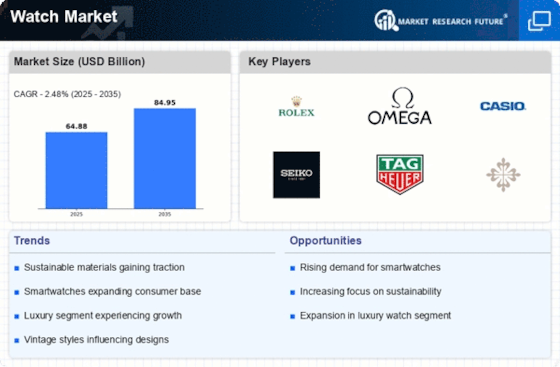
<p>The Watch Market valuation stands at 64.88 USD Billion in 2024, and it is projected to grow to 84.95 USD Billion by 2035.</p>

What is the expected CAGR for the Watch Market from 2025 to 2035?

<p>The expected CAGR for the Watch Market during the forecast period 2025 - 2035 is 2.48%.</p>

Which companies are considered key players in the Watch Market?

<p>Key players in the Watch Market include Rolex, Omega, Casio, Seiko, Tag Heuer, Patek Philippe, Audemars Piguet, Fossil Group, and Citizen.</p>

How do the sales of smartwatches compare to analog and digital watches?

<p>In 2024, smartwatches generated 25.0 USD Billion, while analog watches accounted for 20.0 USD Billion and digital watches for 15.0 USD Billion.</p>

What are the projected sales figures for hybrid watches by 2035?

<p>Sales of hybrid watches are expected to reach approximately 6.95 USD Billion by 2035.</p>

What materials are predominantly used in watch manufacturing?

<p>The primary materials used in watch manufacturing include metal, plastic, leather, ceramic, and glass, with metal sales projected at 25.0 USD Billion in 2024.</p>

What functionalities are most sought after in watches?

<p>The most sought-after functionalities include time display, chronograph, water resistance, heart rate monitor, and GPS tracking, with time display expected to reach 32.0 USD Billion by 2035.</p>

How does the target audience for watches break down by gender?

<p>In 2024, the target audience for watches included men at 25.0 USD Billion, women at 20.0 USD Billion, and unisex at 10.0 USD Billion.</p>

What is the projected growth for plastic watches by 2035?

<p>Plastic watches are projected to grow from 15.0 USD Billion in 2024 to approximately 20.0 USD Billion by 2035.</p>

What trends are influencing the Watch Market in 2025?

<p>Trends influencing the Watch Market in 2025 include the increasing popularity of smartwatches and hybrid watches, alongside a growing demand for diverse functionalities.</p>

Market Summary

The global watch market was valued at USD 64.88 billion in 2024 and is projected to reach USD 84.95 billion by 2035, growing at a CAGR of 2.4%. Growth is driven by rising affluence in emerging markets, accelerating smartwatch adoption, a luxury analog revival, and expanding e-commerce access. By segment, smartwatches lead in revenue while analog watches are the fastest-growing type; metal dominates materials while plastic gains ground among younger buyers; and GPS tracking is the fastest-growing functionality as health and outdoor lifestyles reshape consumer expectations. Men represent the largest target audience, though the women's segment is growing at the fastest pace as brands invest in tailored designs and smart health features. Regionally, North America leads at USD 23.0 billion, Europe follows at USD 18.0 billion, and Asia-Pacific — valued at USD 15.0 billion — is the fastest-growing market, with China and India at the forefront. Competitively, the market spans three tiers: luxury houses such as Rolex, Patek Philippe, and Omega competing on heritage and exclusivity; mid-market players including Seiko, Casio, and Fossil navigating quality and value; and technology leaders like Apple dominating the smartwatch segment — with all three tiers increasingly converging as brands balance craftsmanship, connectivity, and sustainability to capture the next generation of global watch consumers.

Key Market Trends & Highlights

The watch market is currently experiencing a dynamic shift towards personalization and technology integration.

  • Personalization and customization are becoming increasingly prevalent in consumer preferences across the watch market. Smartwatches dominate the market, while analog watches are witnessing rapid growth due to their nostalgic appeal. North America remains the largest market, whereas the Asia-Pacific region is emerging as the fastest-growing segment. Rising demand for luxury watches and technological advancements in manufacturing are key drivers influencing market trends.

Market Size & Forecast

2024 Market Size 64.88 (USD Billion)
2035 Market Size 84.95 (USD Billion)
CAGR (2025 - 2035) 2.48%
Largest Regional Market Share in 2024 North America

Major Players

<a href="https://www.rolex.com/watches">Rolex</a> (CH), Omega (CH), Casio (JP), <a href="https://www.seikowatches.com/in-en/watchfinder">Seiko</a> (JP), Tag Heuer (CH), Patek Philippe (CH), Audemars Piguet (CH), Fossil Group (US), Citizen (JP)

Market Trends

The Watch Market is currently experiencing a dynamic evolution, characterized by shifting consumer preferences and technological advancements. As individuals increasingly seek personalization and unique designs, brands are adapting their offerings to cater to these desires. This trend is evident in the rise of customizable timepieces, which allow consumers to express their individuality. Furthermore, the integration of smart technology into traditional watch designs is reshaping the landscape, appealing to tech-savvy consumers who value functionality alongside aesthetics and driving growth within the apple watch market and broader smartwatch ecosystem. This convergence of style and innovation suggests a promising future for the industry, as it navigates the balance between heritage and modernity.

In addition to personalization and technology, sustainability is becoming a focal point within the Watch Market. Brands are increasingly prioritizing eco-friendly materials and ethical production practices, responding to a growing consumer demand for responsible consumption. This shift not only enhances brand reputation but also aligns with broader societal values. As the market continues to evolve, it appears that the interplay of these trends will significantly influence the direction of the Watch Market, potentially leading to new opportunities and challenges for manufacturers and retailers alike within the evolving market watch landscape.

Personalization and Customization

Consumers are increasingly drawn to unique and personalized timepieces, prompting brands to offer customizable options. This trend allows individuals to express their identity through their watches, fostering a deeper emotional connection with the product.

Integration of Smart Technology

The blending of traditional watchmaking with smart technology is reshaping consumer expectations. This trend appeals to those who seek functionality and connectivity, enhancing the overall user experience while maintaining classic aesthetics and supporting expansion of the apple watch market and smartwatch category.

Sustainability and Ethical Practices

A growing emphasis on sustainability is evident as brands adopt eco-friendly materials and ethical production methods. This shift reflects a broader societal movement towards responsible consumption, influencing purchasing decisions in the Watch Market, including segments within the luxury watch market.

Watch Market Market Drivers

Evolving Consumer Preferences

Consumer preferences are rapidly evolving within the Watch Market, influenced by lifestyle changes and cultural shifts. There is a growing inclination towards unique and personalized timepieces, as consumers seek to express individuality through their accessories. This trend is evident in the rising popularity of customizable watches, where consumers can select materials, colors, and features that reflect their personal style. Additionally, the demand for multifunctional watches that cater to active lifestyles is on the rise. As a result, brands are diversifying their offerings to include sport and adventure-oriented models, which appeal to a broader demographic. This evolution in consumer preferences is likely to shape the future landscape of the Watch Market.

Rising Demand for Luxury Watches

The Watch Market is currently experiencing a notable increase in demand for luxury timepieces. This trend is driven by a growing affluent consumer base that values craftsmanship, exclusivity, and status. In recent years, the luxury watch segment has shown resilience, with sales projected to reach approximately 50 billion dollars by 2025. This growth is attributed to the increasing disposable income of consumers, particularly in emerging markets. Furthermore, the allure of luxury watches as investment pieces has gained traction, as they often appreciate in value over time. The Watch Market is thus witnessing a shift where consumers are not merely purchasing watches for utility but as symbols of prestige and wealth.

Expansion of E-commerce Platforms

The Watch Market is witnessing a significant shift towards e-commerce, driven by changing shopping behaviors and technological advancements. Online retail platforms are becoming increasingly popular, providing consumers with convenient access to a wide range of watch brands and styles. This trend is supported by data indicating that online sales in the watch sector are expected to account for over 30% of total sales by 2025. The rise of social media and influencer marketing has further propelled this shift, as consumers are more inclined to purchase watches they discover online. Consequently, traditional brick-and-mortar retailers are adapting by enhancing their online presence, thereby transforming the Watch Market into a more digitally-driven landscape.

Increased Focus on Sustainability

Sustainability has become a pivotal concern within the Watch Market, as consumers increasingly prioritize eco-friendly practices. Brands are responding by adopting sustainable materials and ethical sourcing methods, which resonate with environmentally conscious consumers. The market is witnessing a rise in the use of recycled metals and conflict-free gemstones, reflecting a commitment to reducing environmental impact. Reports indicate that nearly 70% of consumers are willing to pay more for sustainable products, which is influencing purchasing decisions in the watch sector. This shift towards sustainability not only enhances brand reputation but also aligns with the values of a new generation of consumers, thereby driving growth in the Watch Market.

Technological Advancements in Watch Manufacturing

Technological innovations are reshaping the Watch Market, enhancing both the functionality and aesthetic appeal of timepieces. Advanced manufacturing techniques, such as 3D printing and precision engineering, allow for the creation of intricate designs that were previously unattainable. Additionally, the integration of smart technology into traditional watchmaking has led to the emergence of hybrid models that combine classic aesthetics with modern features. The market for smartwatches is projected to grow significantly, with estimates suggesting a compound annual growth rate of over 20% in the coming years. This convergence of technology and traditional watchmaking is likely to attract a broader audience, thereby expanding the Watch Market.

Market Segment Insights

By Type: Smartwatches (Largest) vs. Analog Watches (Fastest-Growing)

In the Watch Market, Smartwatches dominate the segment with their extensive range of functionalities, seamlessly integrating technology into traditional timekeeping. This segment has captured a significant share of the market, showcasing the shift towards multifunctional devices that cater to modern consumer needs. Conversely, Analog Watches, while considered more traditional, have begun to experience a resurgence, appealing to consumers who appreciate classic designs and craftsmanship. This segment has captured a significant share of the market, showcasing the shift towards multifunctional devices that cater to modern consumer needs and driving momentum in the apple watch market. Conversely, Analog Watches, while considered more traditional, have begun to experience a resurgence, appealing to consumers who appreciate classic designs and craftsmanship, particularly within the luxury watch market.

Wrist Wear: Smartwatches (Dominant) vs. Analog Watches (Emerging)

Smartwatches have emerged as the dominant force in the market due to their multifunctionality, which includes fitness tracking, notification alerts, and compatibility with various apps. This versatility appeals to a broad demographic, especially those leading active lifestyles who seek technology that complements their daily routine, strengthening growth in the apple watch market. As an emerging segment, Analog Watches have carved out their own niche, focusing on timeless designs and craftsmanship that resonate with collectors and fashion enthusiasts, reinforcing the luxury watch market presence. Their appeal lies in the artistry of traditional watchmaking, often seen as status symbols, that evoke personal and emotional connections. The contrasting characteristics of Smartwatches and Analog Watches indicate a market that caters to both modern technological needs and classic aesthetic values.

By Material: Metal (Largest) vs. Plastic (Fastest-Growing)

The 'Material' segment in the watch market showcases a diverse distribution of material types, with metal leading as the largest category due to its perception of durability and luxury, supporting growth across the luxury watch market. The classic appeal of metal watches continues to attract consumers, making it a staple in the market. Following metal, plastic has gained significant traction, particularly among younger demographics, appealing to their desire for affordability and customization. Other materials like leather, ceramic, and glass contribute to niche markets, each serving distinct consumer preferences and needs.

Metal (Dominant) vs. Plastic (Emerging)

Metal watches have established themselves as the dominant force in the watch market, favored for their robustness and timeless elegance. The use of premium metals such as stainless steel and titanium not only enhances durability but also caters to high-end luxury consumers seeking prestigious timepieces. In contrast, plastic watches represent the emerging trend characterized by vibrancy, versatility, and cost-effectiveness. Their lightweight nature and wide-ranging designs resonate with the youthful audience, appealing to those who value style and functionality over traditional materials. This dynamic duo reflects the evolving landscape of the watch market, where consumers increasingly seek personalization alongside quality.

By Functionality: Time Display (Largest) vs. GPS Tracking (Fastest-Growing)

The functionality segment in the watch market showcases a diverse distribution among various features, with Time Display being the largest segment due to its fundamental role in watch utility. Other functionalities like Chronograph and Water Resistance also have significant shares, appealing to users who seek specific features for enhanced usability and performance. Heart Rate Monitors and GPS Tracking, while not as widespread, are gaining traction as consumers increasingly prioritize fitness and outdoor activities, thereby complementing Time Display functionality. The growth trends in this segment are driven by an evolving consumer landscape that favors multifunctionality in wearables. Features like GPS Tracking are fast becoming essential for athletes and fitness enthusiasts, making this one of the fastest-growing segments in the market. Additionally, advancements in technology continue to enhance functionalities, leading to innovative designs that cater to varied consumer preferences, boosting overall market demand for smartwatches equipped with these features.

Heart Rate Monitor (Dominant) vs. GPS Tracking (Emerging)

Heart Rate Monitors have established themselves as a dominant feature in the watch market, especially with the integration of <a href="https://www.marketresearchfuture.com/reports/wireless-health-fitness-devices-market-1347">health and fitness tracking</a> capabilities. Consumers increasingly demand devices that not only tell time but also contribute to their wellness routines. As a result, brands are improving their heart rate monitoring technology to provide accurate and real-time data. Conversely, GPS Tracking is emerging as a vital feature among outdoor enthusiasts and fitness lovers. Although it currently holds a smaller market share compared to heart rate monitors, the growing popularity of outdoor sports and fitness activities suggests an upward trajectory for GPS functionalities. Both features work synergistically, catering to a market that seeks enhanced health monitoring while engaging in various activities.

By Target Audience: Men (Largest) vs. Women (Fastest-Growing)

In the Watch Market, the target audience is primarily segmented into four components: Men, Women, Unisex, and Children. Currently, the Men's segment holds the largest market share, driven by a strong demand for luxury and smartwatches designed specifically for male consumers. This segment has seen gradual growth due to the influence of fashion trends and technological advancements that cater to male preferences in design and functionality. Conversely, the Women's segment is gaining momentum as brands increasingly introduce fashionable and functional timepieces specifically targeted towards women, with innovative designs and smart technology features, reflecting their concentration on aesthetics as well as utility.

Target Audience: Men (Dominant) vs. Women (Emerging)

The Men's segment in the watch market is characterized by a diverse range of offerings from traditional <a href="https://www.marketresearchfuture.com/reports/luxury-watch-market-10897">luxury watches</a> to modern smartwatches, appealing to fashion-conscious and tech-savvy individuals alike. This segment reflects a blend of rugged durability and elegance, attracting consumers who value sophistication and performance. On the other hand, the Women's segment is rapidly evolving, marked by vibrant designs and multi-functionality that resonate with modern women's lifestyles. Emerging trends focus on smaller sizes, colorful straps, and smart features that align with active lifestyles, establishing this segment as increasingly competitive as brands recognize the growing purchasing power and influence of female consumers.

Get more detailed insights about Watch Market Research Report - Forecast till 2035

Regional Insights

North America leads the global watch market at USD 23.0 billion in 2024, underpinned by high consumer spending power, strong smartwatch penetration — particularly Apple Watch — and a well-established luxury retail infrastructure. The U.S. remains the single largest national market globally.

Europe follows at USD 18.0 billion, driven by its dual role as both a major consumer market and the heartland of luxury watchmaking. Switzerland, Germany, and the UK anchor demand for premium mechanical timepieces, while e-commerce channels are expanding access across Southern and Eastern Europe.

Asia-Pacific, valued at USD 15.0 billion, is the fastest-growing regional market. China drives the bulk of luxury watch demand in the region, while India is rapidly emerging as a high-growth frontier supported by a young aspirational consumer base. Japan and South Korea maintain sophisticated domestic markets with strong local brand loyalty.

South America (USD 5.0 billion) and Middle East & Africa (USD 3.88 billion) remain emerging markets but represent meaningful long-term opportunity — particularly in the Gulf states, where luxury consumption is deeply embedded in consumer culture, and in Brazil, where a growing middle class is expanding the affordable and mid-market watch segments.

Key Players and Competitive Insights

The global watch market is highly fragmented, spanning Swiss luxury conglomerates, Japanese precision manufacturers, American tech giants, and fast-growing Asian OEMs. Competition plays out across three distinct tiers:
Luxury Tier — Rolex, Patek Philippe, and Audemars Piguet dominate through exclusivity, heritage, and supply-constrained desirability. These brands compete less on price than on legacy, craftsmanship, and resale value. Omega and TAG Heuer operate in the accessible luxury space, leveraging high-profile sponsorships and aspirational positioning to attract a broader affluent audience.
Mid-Market Tier — Seiko, Citizen, and Casio anchor this segment with strong reputations for quality, reliability, and innovation. Seiko's Grand Seiko line is increasingly challenging Swiss luxury at the premium end, while Casio's G-Shock franchise dominates rugged sport utility globally. Fossil Group competes through licensed fashion brand partnerships, though it faces mounting pressure from smartwatch substitution in its core price range.
Technology Tier — While not listed among traditional watch players, Apple is the dominant force in the smartwatch segment globally, with its Apple Watch holding the largest share of the connected wearables market. Samsung, Garmin, and emerging Chinese brands (Huawei, Xiaomi) intensify competition in this tier, continuously raising feature benchmarks and compressing margins across the category.
The overarching competitive dynamic is one of convergence — luxury brands are investing in digital retail and smart hybrid models, while technology companies are refining aesthetics and build quality to compete with fashion and mid-market watchmakers.

Key Companies in the Watch Market include

Industry Developments

TAG Heuer New CEO — March 2026 After the unexpected departure of its previous leader, TAG Heuer announced that Béatrice Goasglas — currently president of the brand's Americas division — will take over as CEO starting May 1, 2026. (Source: National Today)

Rolex & Tudor Price Hikes — January 2026 The 2026 catalogs for both Rolex and Tudor leaked widely on social media just before New Year, revealing sharp price increases effective January 1 — driven by record gold prices, a weaker dollar, general inflation, and the 15% US tariff on Swiss watch imports. (Source: Fratello)

Watches & Wonders Geneva 2026 — Upcoming (April 2026) In about one month, Watches and Wonders Geneva 2026 opens its doors for its most ambitious edition yet, with 66 exhibiting brands, seven days of programming split between professional and public sessions, and a Montreux Jazz Festival partnership. (Source: National Today)

E-Commerce & Younger Buyers Reshaping Retail — March 2026 The global watch market, estimated at $85.33 billion in 2025, is drawing in a new generation of buyers who view timepieces less as accessories and more as collectible assets. Independent online sellers are gaining ground against traditional brick-and-mortar dealers as younger buyers increasingly treat luxury watches as long-term investments. (Source: Barringtonwatchwinders)

Japan Challenging Switzerland — Early 2026 Citizen Watch Company increased sales by 6.6% and volumes by 11% in the financial year ended March 2025, with watch-only turnover equivalent to the combined size of Tudor and TAG Heuer — emerging as a serious challenger to Swiss mid-tier brands like Tissot, Swatch, and Longines. (Source: Fratello)

Future Outlook

Watch Market Future Outlook

The Watch Market is projected to grow at a 2.48% CAGR from 2025 to 2035, driven by technological advancements, evolving consumer preferences, and sustainability trends.

New opportunities lie in:

  • <p>Expansion into smart wearable technology markets Development of eco-friendly watch materials Personalized watch customization services for consumers</p>

By 2035, the watch market is expected to achieve robust growth, reflecting evolving consumer demands and innovative strategies.

Market Segmentation

Watch Market Type Outlook

  • Analog Watches
  • Digital Watches
  • Smartwatches
  • Hybrid Watches

Watch Market Material Outlook

  • Metal
  • Plastic
  • Leather
  • Ceramic
  • Glass

Watch Market Functionality Outlook

  • Time Display
  • Chronograph
  • Water Resistance
  • Heart Rate Monitor
  • GPS Tracking

Watch Market Target Audience Outlook

  • Men
  • Women
  • Unisex
  • Children

Report Scope

MARKET SIZE 2024 64.88(USD Billion)
MARKET SIZE 2025 66.49(USD Billion)
MARKET SIZE 2035 84.95(USD Billion)
COMPOUND ANNUAL GROWTH RATE (CAGR) 2.48% (2025 - 2035)
REPORT COVERAGE Revenue Forecast, Competitive Landscape, Growth Factors, and Trends
BASE YEAR 2024
Market Forecast Period 2025 - 2035
Historical Data 2019 - 2024
Market Forecast Units USD Billion
Key Companies Profiled Rolex (CH), Omega (CH), Casio (JP), Seiko (JP), Tag Heuer (CH), Patek Philippe (CH), Audemars Piguet (CH), Fossil Group (US), Citizen (JP)
Segments Covered Type, Material, Functionality, Target Audience, Regional
Key Market Opportunities Integration of smart technology in traditional timepieces enhances consumer engagement in the Watch Market.
Key Market Dynamics Shifting consumer preferences towards smartwatches drive innovation and competition in the traditional watch market.
Countries Covered North America, Europe, APAC, South America, MEA

FAQs

What is the current valuation of the Watch Market in 2025?

<p>The Watch Market valuation stands at 64.88 USD Billion in 2024, and it is projected to grow to 84.95 USD Billion by 2035.</p>

What is the expected CAGR for the Watch Market from 2025 to 2035?

<p>The expected CAGR for the Watch Market during the forecast period 2025 - 2035 is 2.48%.</p>

Which companies are considered key players in the Watch Market?

<p>Key players in the Watch Market include Rolex, Omega, Casio, Seiko, Tag Heuer, Patek Philippe, Audemars Piguet, Fossil Group, and Citizen.</p>

How do the sales of smartwatches compare to analog and digital watches?

<p>In 2024, smartwatches generated 25.0 USD Billion, while analog watches accounted for 20.0 USD Billion and digital watches for 15.0 USD Billion.</p>

What are the projected sales figures for hybrid watches by 2035?

<p>Sales of hybrid watches are expected to reach approximately 6.95 USD Billion by 2035.</p>

What materials are predominantly used in watch manufacturing?

<p>The primary materials used in watch manufacturing include metal, plastic, leather, ceramic, and glass, with metal sales projected at 25.0 USD Billion in 2024.</p>

What functionalities are most sought after in watches?

<p>The most sought-after functionalities include time display, chronograph, water resistance, heart rate monitor, and GPS tracking, with time display expected to reach 32.0 USD Billion by 2035.</p>

How does the target audience for watches break down by gender?

<p>In 2024, the target audience for watches included men at 25.0 USD Billion, women at 20.0 USD Billion, and unisex at 10.0 USD Billion.</p>

What is the projected growth for plastic watches by 2035?

<p>Plastic watches are projected to grow from 15.0 USD Billion in 2024 to approximately 20.0 USD Billion by 2035.</p>

What trends are influencing the Watch Market in 2025?

<p>Trends influencing the Watch Market in 2025 include the increasing popularity of smartwatches and hybrid watches, alongside a growing demand for diverse functionalities.</p>

  1. SECTION I: EXECUTIVE SUMMARY AND KEY HIGHLIGHTS
    1. | 1.1 EXECUTIVE SUMMARY
    2. | | 1.1.1 Market Overview
    3. | | 1.1.2 Key Findings
    4. | | 1.1.3 Market Segmentation
    5. | | 1.1.4 Competitive Landscape
    6. | | 1.1.5 Challenges and Opportunities
    7. | | 1.1.6 Future Outlook
  2. SECTION II: SCOPING, METHODOLOGY AND MARKET STRUCTURE
    1. | 2.1 MARKET INTRODUCTION
    2. | | 2.1.1 Definition
    3. | | 2.1.2 Scope of the study
    4. | | | 2.1.2.1 Research Objective
    5. | | | 2.1.2.2 Assumption
    6. | | | 2.1.2.3 Limitations
    7. | 2.2 RESEARCH METHODOLOGY
    8. | | 2.2.1 Overview
    9. | | 2.2.2 Data Mining
    10. | | 2.2.3 Secondary Research
    11. | | 2.2.4 Primary Research
    12. | | | 2.2.4.1 Primary Interviews and Information Gathering Process
    13. | | | 2.2.4.2 Breakdown of Primary Respondents
    14. | | 2.2.5 Forecasting Model
    15. | | 2.2.6 Market Size Estimation
    16. | | | 2.2.6.1 Bottom-Up Approach
    17. | | | 2.2.6.2 Top-Down Approach
    18. | | 2.2.7 Data Triangulation
    19. | | 2.2.8 Validation
  3. SECTION III: QUALITATIVE ANALYSIS
    1. | 3.1 MARKET DYNAMICS
    2. | | 3.1.1 Overview
    3. | | 3.1.2 Drivers
    4. | | 3.1.3 Restraints
    5. | | 3.1.4 Opportunities
    6. | 3.2 MARKET FACTOR ANALYSIS
    7. | | 3.2.1 Value chain Analysis
    8. | | 3.2.2 Porter's Five Forces Analysis
    9. | | | 3.2.2.1 Bargaining Power of Suppliers
    10. | | | 3.2.2.2 Bargaining Power of Buyers
    11. | | | 3.2.2.3 Threat of New Entrants
    12. | | | 3.2.2.4 Threat of Substitutes
    13. | | | 3.2.2.5 Intensity of Rivalry
    14. | | 3.2.3 COVID-19 Impact Analysis
    15. | | | 3.2.3.1 Market Impact Analysis
    16. | | | 3.2.3.2 Regional Impact
    17. | | | 3.2.3.3 Opportunity and Threat Analysis
  4. SECTION IV: QUANTITATIVE ANALYSIS
    1. | 4.1 Consumer and Retail, BY Type (USD Billion)
    2. | | 4.1.1 Analog Watches
    3. | | 4.1.2 Digital Watches
    4. | | 4.1.3 Smartwatches
    5. | | 4.1.4 Hybrid Watches
    6. | 4.2 Consumer and Retail, BY Material (USD Billion)
    7. | | 4.2.1 Metal
    8. | | 4.2.2 Plastic
    9. | | 4.2.3 Leather
    10. | | 4.2.4 Ceramic
    11. | | 4.2.5 Glass
    12. | 4.3 Consumer and Retail, BY Functionality (USD Billion)
    13. | | 4.3.1 Time Display
    14. | | 4.3.2 Chronograph
    15. | | 4.3.3 Water Resistance
    16. | | 4.3.4 Heart Rate Monitor
    17. | | 4.3.5 GPS Tracking
    18. | 4.4 Consumer and Retail, BY Target Audience (USD Billion)
    19. | | 4.4.1 Men
    20. | | 4.4.2 Women
    21. | | 4.4.3 Unisex
    22. | | 4.4.4 Children
    23. | 4.5 Consumer and Retail, BY Region (USD Billion)
    24. | | 4.5.1 North America
    25. | | | 4.5.1.1 US
    26. | | | 4.5.1.2 Canada
    27. | | 4.5.2 Europe
    28. | | | 4.5.2.1 Germany
    29. | | | 4.5.2.2 UK
    30. | | | 4.5.2.3 France
    31. | | | 4.5.2.4 Russia
    32. | | | 4.5.2.5 Italy
    33. | | | 4.5.2.6 Spain
    34. | | | 4.5.2.7 Rest of Europe
    35. | | 4.5.3 APAC
    36. | | | 4.5.3.1 China
    37. | | | 4.5.3.2 India
    38. | | | 4.5.3.3 Japan
    39. | | | 4.5.3.4 South Korea
    40. | | | 4.5.3.5 Malaysia
    41. | | | 4.5.3.6 Thailand
    42. | | | 4.5.3.7 Indonesia
    43. | | | 4.5.3.8 Rest of APAC
    44. | | 4.5.4 South America
    45. | | | 4.5.4.1 Brazil
    46. | | | 4.5.4.2 Mexico
    47. | | | 4.5.4.3 Argentina
    48. | | | 4.5.4.4 Rest of South America
    49. | | 4.5.5 MEA
    50. | | | 4.5.5.1 GCC Countries
    51. | | | 4.5.5.2 South Africa
    52. | | | 4.5.5.3 Rest of MEA
  5. SECTION V: COMPETITIVE ANALYSIS
    1. | 5.1 Competitive Landscape
    2. | | 5.1.1 Overview
    3. | | 5.1.2 Competitive Analysis
    4. | | 5.1.3 Market share Analysis
    5. | | 5.1.4 Major Growth Strategy in the Consumer and Retail
    6. | | 5.1.5 Competitive Benchmarking
    7. | | 5.1.6 Leading Players in Terms of Number of Developments in the Consumer and Retail
    8. | | 5.1.7 Key developments and growth strategies
    9. | | | 5.1.7.1 New Product Launch/Service Deployment
    10. | | | 5.1.7.2 Merger & Acquisitions
    11. | | | 5.1.7.3 Joint Ventures
    12. | | 5.1.8 Major Players Financial Matrix
    13. | | | 5.1.8.1 Sales and Operating Income
    14. | | | 5.1.8.2 Major Players R&D Expenditure. 2023
    15. | 5.2 Company Profiles
    16. | | 5.2.1 Rolex (CH)
    17. | | | 5.2.1.1 Financial Overview
    18. | | | 5.2.1.2 Products Offered
    19. | | | 5.2.1.3 Key Developments
    20. | | | 5.2.1.4 SWOT Analysis
    21. | | | 5.2.1.5 Key Strategies
    22. | | 5.2.2 Omega (CH)
    23. | | | 5.2.2.1 Financial Overview
    24. | | | 5.2.2.2 Products Offered
    25. | | | 5.2.2.3 Key Developments
    26. | | | 5.2.2.4 SWOT Analysis
    27. | | | 5.2.2.5 Key Strategies
    28. | | 5.2.3 Casio (JP)
    29. | | | 5.2.3.1 Financial Overview
    30. | | | 5.2.3.2 Products Offered
    31. | | | 5.2.3.3 Key Developments
    32. | | | 5.2.3.4 SWOT Analysis
    33. | | | 5.2.3.5 Key Strategies
    34. | | 5.2.4 Seiko (JP)
    35. | | | 5.2.4.1 Financial Overview
    36. | | | 5.2.4.2 Products Offered
    37. | | | 5.2.4.3 Key Developments
    38. | | | 5.2.4.4 SWOT Analysis
    39. | | | 5.2.4.5 Key Strategies
    40. | | 5.2.5 Tag Heuer (CH)
    41. | | | 5.2.5.1 Financial Overview
    42. | | | 5.2.5.2 Products Offered
    43. | | | 5.2.5.3 Key Developments
    44. | | | 5.2.5.4 SWOT Analysis
    45. | | | 5.2.5.5 Key Strategies
    46. | | 5.2.6 Patek Philippe (CH)
    47. | | | 5.2.6.1 Financial Overview
    48. | | | 5.2.6.2 Products Offered
    49. | | | 5.2.6.3 Key Developments
    50. | | | 5.2.6.4 SWOT Analysis
    51. | | | 5.2.6.5 Key Strategies
    52. | | 5.2.7 Audemars Piguet (CH)
    53. | | | 5.2.7.1 Financial Overview
    54. | | | 5.2.7.2 Products Offered
    55. | | | 5.2.7.3 Key Developments
    56. | | | 5.2.7.4 SWOT Analysis
    57. | | | 5.2.7.5 Key Strategies
    58. | | 5.2.8 Fossil Group (US)
    59. | | | 5.2.8.1 Financial Overview
    60. | | | 5.2.8.2 Products Offered
    61. | | | 5.2.8.3 Key Developments
    62. | | | 5.2.8.4 SWOT Analysis
    63. | | | 5.2.8.5 Key Strategies
    64. | | 5.2.9 Citizen (JP)
    65. | | | 5.2.9.1 Financial Overview
    66. | | | 5.2.9.2 Products Offered
    67. | | | 5.2.9.3 Key Developments
    68. | | | 5.2.9.4 SWOT Analysis
    69. | | | 5.2.9.5 Key Strategies
    70. | 5.3 Appendix
    71. | | 5.3.1 References
    72. | | 5.3.2 Related Reports
  6. LIST OF FIGURES
    1. | 6.1 MARKET SYNOPSIS
    2. | 6.2 NORTH AMERICA MARKET ANALYSIS
    3. | 6.3 US MARKET ANALYSIS BY TYPE
    4. | 6.4 US MARKET ANALYSIS BY MATERIAL
    5. | 6.5 US MARKET ANALYSIS BY FUNCTIONALITY
    6. | 6.6 US MARKET ANALYSIS BY TARGET AUDIENCE
    7. | 6.7 CANADA MARKET ANALYSIS BY TYPE
    8. | 6.8 CANADA MARKET ANALYSIS BY MATERIAL
    9. | 6.9 CANADA MARKET ANALYSIS BY FUNCTIONALITY
    10. | 6.10 CANADA MARKET ANALYSIS BY TARGET AUDIENCE
    11. | 6.11 EUROPE MARKET ANALYSIS
    12. | 6.12 GERMANY MARKET ANALYSIS BY TYPE
    13. | 6.13 GERMANY MARKET ANALYSIS BY MATERIAL
    14. | 6.14 GERMANY MARKET ANALYSIS BY FUNCTIONALITY
    15. | 6.15 GERMANY MARKET ANALYSIS BY TARGET AUDIENCE
    16. | 6.16 UK MARKET ANALYSIS BY TYPE
    17. | 6.17 UK MARKET ANALYSIS BY MATERIAL
    18. | 6.18 UK MARKET ANALYSIS BY FUNCTIONALITY
    19. | 6.19 UK MARKET ANALYSIS BY TARGET AUDIENCE
    20. | 6.20 FRANCE MARKET ANALYSIS BY TYPE
    21. | 6.21 FRANCE MARKET ANALYSIS BY MATERIAL
    22. | 6.22 FRANCE MARKET ANALYSIS BY FUNCTIONALITY
    23. | 6.23 FRANCE MARKET ANALYSIS BY TARGET AUDIENCE
    24. | 6.24 RUSSIA MARKET ANALYSIS BY TYPE
    25. | 6.25 RUSSIA MARKET ANALYSIS BY MATERIAL
    26. | 6.26 RUSSIA MARKET ANALYSIS BY FUNCTIONALITY
    27. | 6.27 RUSSIA MARKET ANALYSIS BY TARGET AUDIENCE
    28. | 6.28 ITALY MARKET ANALYSIS BY TYPE
    29. | 6.29 ITALY MARKET ANALYSIS BY MATERIAL
    30. | 6.30 ITALY MARKET ANALYSIS BY FUNCTIONALITY
    31. | 6.31 ITALY MARKET ANALYSIS BY TARGET AUDIENCE
    32. | 6.32 SPAIN MARKET ANALYSIS BY TYPE
    33. | 6.33 SPAIN MARKET ANALYSIS BY MATERIAL
    34. | 6.34 SPAIN MARKET ANALYSIS BY FUNCTIONALITY
    35. | 6.35 SPAIN MARKET ANALYSIS BY TARGET AUDIENCE
    36. | 6.36 REST OF EUROPE MARKET ANALYSIS BY TYPE
    37. | 6.37 REST OF EUROPE MARKET ANALYSIS BY MATERIAL
    38. | 6.38 REST OF EUROPE MARKET ANALYSIS BY FUNCTIONALITY
    39. | 6.39 REST OF EUROPE MARKET ANALYSIS BY TARGET AUDIENCE
    40. | 6.40 APAC MARKET ANALYSIS
    41. | 6.41 CHINA MARKET ANALYSIS BY TYPE
    42. | 6.42 CHINA MARKET ANALYSIS BY MATERIAL
    43. | 6.43 CHINA MARKET ANALYSIS BY FUNCTIONALITY
    44. | 6.44 CHINA MARKET ANALYSIS BY TARGET AUDIENCE
    45. | 6.45 INDIA MARKET ANALYSIS BY TYPE
    46. | 6.46 INDIA MARKET ANALYSIS BY MATERIAL
    47. | 6.47 INDIA MARKET ANALYSIS BY FUNCTIONALITY
    48. | 6.48 INDIA MARKET ANALYSIS BY TARGET AUDIENCE
    49. | 6.49 JAPAN MARKET ANALYSIS BY TYPE
    50. | 6.50 JAPAN MARKET ANALYSIS BY MATERIAL
    51. | 6.51 JAPAN MARKET ANALYSIS BY FUNCTIONALITY
    52. | 6.52 JAPAN MARKET ANALYSIS BY TARGET AUDIENCE
    53. | 6.53 SOUTH KOREA MARKET ANALYSIS BY TYPE
    54. | 6.54 SOUTH KOREA MARKET ANALYSIS BY MATERIAL
    55. | 6.55 SOUTH KOREA MARKET ANALYSIS BY FUNCTIONALITY
    56. | 6.56 SOUTH KOREA MARKET ANALYSIS BY TARGET AUDIENCE
    57. | 6.57 MALAYSIA MARKET ANALYSIS BY TYPE
    58. | 6.58 MALAYSIA MARKET ANALYSIS BY MATERIAL
    59. | 6.59 MALAYSIA MARKET ANALYSIS BY FUNCTIONALITY
    60. | 6.60 MALAYSIA MARKET ANALYSIS BY TARGET AUDIENCE
    61. | 6.61 THAILAND MARKET ANALYSIS BY TYPE
    62. | 6.62 THAILAND MARKET ANALYSIS BY MATERIAL
    63. | 6.63 THAILAND MARKET ANALYSIS BY FUNCTIONALITY
    64. | 6.64 THAILAND MARKET ANALYSIS BY TARGET AUDIENCE
    65. | 6.65 INDONESIA MARKET ANALYSIS BY TYPE
    66. | 6.66 INDONESIA MARKET ANALYSIS BY MATERIAL
    67. | 6.67 INDONESIA MARKET ANALYSIS BY FUNCTIONALITY
    68. | 6.68 INDONESIA MARKET ANALYSIS BY TARGET AUDIENCE
    69. | 6.69 REST OF APAC MARKET ANALYSIS BY TYPE
    70. | 6.70 REST OF APAC MARKET ANALYSIS BY MATERIAL
    71. | 6.71 REST OF APAC MARKET ANALYSIS BY FUNCTIONALITY
    72. | 6.72 REST OF APAC MARKET ANALYSIS BY TARGET AUDIENCE
    73. | 6.73 SOUTH AMERICA MARKET ANALYSIS
    74. | 6.74 BRAZIL MARKET ANALYSIS BY TYPE
    75. | 6.75 BRAZIL MARKET ANALYSIS BY MATERIAL
    76. | 6.76 BRAZIL MARKET ANALYSIS BY FUNCTIONALITY
    77. | 6.77 BRAZIL MARKET ANALYSIS BY TARGET AUDIENCE
    78. | 6.78 MEXICO MARKET ANALYSIS BY TYPE
    79. | 6.79 MEXICO MARKET ANALYSIS BY MATERIAL
    80. | 6.80 MEXICO MARKET ANALYSIS BY FUNCTIONALITY
    81. | 6.81 MEXICO MARKET ANALYSIS BY TARGET AUDIENCE
    82. | 6.82 ARGENTINA MARKET ANALYSIS BY TYPE
    83. | 6.83 ARGENTINA MARKET ANALYSIS BY MATERIAL
    84. | 6.84 ARGENTINA MARKET ANALYSIS BY FUNCTIONALITY
    85. | 6.85 ARGENTINA MARKET ANALYSIS BY TARGET AUDIENCE
    86. | 6.86 REST OF SOUTH AMERICA MARKET ANALYSIS BY TYPE
    87. | 6.87 REST OF SOUTH AMERICA MARKET ANALYSIS BY MATERIAL
    88. | 6.88 REST OF SOUTH AMERICA MARKET ANALYSIS BY FUNCTIONALITY
    89. | 6.89 REST OF SOUTH AMERICA MARKET ANALYSIS BY TARGET AUDIENCE
    90. | 6.90 MEA MARKET ANALYSIS
    91. | 6.91 GCC COUNTRIES MARKET ANALYSIS BY TYPE
    92. | 6.92 GCC COUNTRIES MARKET ANALYSIS BY MATERIAL
    93. | 6.93 GCC COUNTRIES MARKET ANALYSIS BY FUNCTIONALITY
    94. | 6.94 GCC COUNTRIES MARKET ANALYSIS BY TARGET AUDIENCE
    95. | 6.95 SOUTH AFRICA MARKET ANALYSIS BY TYPE
    96. | 6.96 SOUTH AFRICA MARKET ANALYSIS BY MATERIAL
    97. | 6.97 SOUTH AFRICA MARKET ANALYSIS BY FUNCTIONALITY
    98. | 6.98 SOUTH AFRICA MARKET ANALYSIS BY TARGET AUDIENCE
    99. | 6.99 REST OF MEA MARKET ANALYSIS BY TYPE
    100. | 6.100 REST OF MEA MARKET ANALYSIS BY MATERIAL
    101. | 6.101 REST OF MEA MARKET ANALYSIS BY FUNCTIONALITY
    102. | 6.102 REST OF MEA MARKET ANALYSIS BY TARGET AUDIENCE
    103. | 6.103 KEY BUYING CRITERIA OF CONSUMER AND RETAIL
    104. | 6.104 RESEARCH PROCESS OF MRFR
    105. | 6.105 DRO ANALYSIS OF CONSUMER AND RETAIL
    106. | 6.106 DRIVERS IMPACT ANALYSIS: CONSUMER AND RETAIL
    107. | 6.107 RESTRAINTS IMPACT ANALYSIS: CONSUMER AND RETAIL
    108. | 6.108 SUPPLY / VALUE CHAIN: CONSUMER AND RETAIL
    109. | 6.109 CONSUMER AND RETAIL, BY TYPE, 2024 (% SHARE)
    110. | 6.110 CONSUMER AND RETAIL, BY TYPE, 2024 TO 2035 (USD Billion)
    111. | 6.111 CONSUMER AND RETAIL, BY MATERIAL, 2024 (% SHARE)
    112. | 6.112 CONSUMER AND RETAIL, BY MATERIAL, 2024 TO 2035 (USD Billion)
    113. | 6.113 CONSUMER AND RETAIL, BY FUNCTIONALITY, 2024 (% SHARE)
    114. | 6.114 CONSUMER AND RETAIL, BY FUNCTIONALITY, 2024 TO 2035 (USD Billion)
    115. | 6.115 CONSUMER AND RETAIL, BY TARGET AUDIENCE, 2024 (% SHARE)
    116. | 6.116 CONSUMER AND RETAIL, BY TARGET AUDIENCE, 2024 TO 2035 (USD Billion)
    117. | 6.117 BENCHMARKING OF MAJOR COMPETITORS
  7. LIST OF TABLES
    1. | 7.1 LIST OF ASSUMPTIONS
    2. | | 7.1.1
    3. | 7.2 North America MARKET SIZE ESTIMATES; FORECAST
    4. | | 7.2.1 BY TYPE, 2025-2035 (USD Billion)
    5. | | 7.2.2 BY MATERIAL, 2025-2035 (USD Billion)
    6. | | 7.2.3 BY FUNCTIONALITY, 2025-2035 (USD Billion)
    7. | | 7.2.4 BY TARGET AUDIENCE, 2025-2035 (USD Billion)
    8. | 7.3 US MARKET SIZE ESTIMATES; FORECAST
    9. | | 7.3.1 BY TYPE, 2025-2035 (USD Billion)
    10. | | 7.3.2 BY MATERIAL, 2025-2035 (USD Billion)
    11. | | 7.3.3 BY FUNCTIONALITY, 2025-2035 (USD Billion)
    12. | | 7.3.4 BY TARGET AUDIENCE, 2025-2035 (USD Billion)
    13. | 7.4 Canada MARKET SIZE ESTIMATES; FORECAST
    14. | | 7.4.1 BY TYPE, 2025-2035 (USD Billion)
    15. | | 7.4.2 BY MATERIAL, 2025-2035 (USD Billion)
    16. | | 7.4.3 BY FUNCTIONALITY, 2025-2035 (USD Billion)
    17. | | 7.4.4 BY TARGET AUDIENCE, 2025-2035 (USD Billion)
    18. | 7.5 Europe MARKET SIZE ESTIMATES; FORECAST
    19. | | 7.5.1 BY TYPE, 2025-2035 (USD Billion)
    20. | | 7.5.2 BY MATERIAL, 2025-2035 (USD Billion)
    21. | | 7.5.3 BY FUNCTIONALITY, 2025-2035 (USD Billion)
    22. | | 7.5.4 BY TARGET AUDIENCE, 2025-2035 (USD Billion)
    23. | 7.6 Germany MARKET SIZE ESTIMATES; FORECAST
    24. | | 7.6.1 BY TYPE, 2025-2035 (USD Billion)
    25. | | 7.6.2 BY MATERIAL, 2025-2035 (USD Billion)
    26. | | 7.6.3 BY FUNCTIONALITY, 2025-2035 (USD Billion)
    27. | | 7.6.4 BY TARGET AUDIENCE, 2025-2035 (USD Billion)
    28. | 7.7 UK MARKET SIZE ESTIMATES; FORECAST
    29. | | 7.7.1 BY TYPE, 2025-2035 (USD Billion)
    30. | | 7.7.2 BY MATERIAL, 2025-2035 (USD Billion)
    31. | | 7.7.3 BY FUNCTIONALITY, 2025-2035 (USD Billion)
    32. | | 7.7.4 BY TARGET AUDIENCE, 2025-2035 (USD Billion)
    33. | 7.8 France MARKET SIZE ESTIMATES; FORECAST
    34. | | 7.8.1 BY TYPE, 2025-2035 (USD Billion)
    35. | | 7.8.2 BY MATERIAL, 2025-2035 (USD Billion)
    36. | | 7.8.3 BY FUNCTIONALITY, 2025-2035 (USD Billion)
    37. | | 7.8.4 BY TARGET AUDIENCE, 2025-2035 (USD Billion)
    38. | 7.9 Russia MARKET SIZE ESTIMATES; FORECAST
    39. | | 7.9.1 BY TYPE, 2025-2035 (USD Billion)
    40. | | 7.9.2 BY MATERIAL, 2025-2035 (USD Billion)
    41. | | 7.9.3 BY FUNCTIONALITY, 2025-2035 (USD Billion)
    42. | | 7.9.4 BY TARGET AUDIENCE, 2025-2035 (USD Billion)
    43. | 7.10 Italy MARKET SIZE ESTIMATES; FORECAST
    44. | | 7.10.1 BY TYPE, 2025-2035 (USD Billion)
    45. | | 7.10.2 BY MATERIAL, 2025-2035 (USD Billion)
    46. | | 7.10.3 BY FUNCTIONALITY, 2025-2035 (USD Billion)
    47. | | 7.10.4 BY TARGET AUDIENCE, 2025-2035 (USD Billion)
    48. | 7.11 Spain MARKET SIZE ESTIMATES; FORECAST
    49. | | 7.11.1 BY TYPE, 2025-2035 (USD Billion)
    50. | | 7.11.2 BY MATERIAL, 2025-2035 (USD Billion)
    51. | | 7.11.3 BY FUNCTIONALITY, 2025-2035 (USD Billion)
    52. | | 7.11.4 BY TARGET AUDIENCE, 2025-2035 (USD Billion)
    53. | 7.12 Rest of Europe MARKET SIZE ESTIMATES; FORECAST
    54. | | 7.12.1 BY TYPE, 2025-2035 (USD Billion)
    55. | | 7.12.2 BY MATERIAL, 2025-2035 (USD Billion)
    56. | | 7.12.3 BY FUNCTIONALITY, 2025-2035 (USD Billion)
    57. | | 7.12.4 BY TARGET AUDIENCE, 2025-2035 (USD Billion)
    58. | 7.13 APAC MARKET SIZE ESTIMATES; FORECAST
    59. | | 7.13.1 BY TYPE, 2025-2035 (USD Billion)
    60. | | 7.13.2 BY MATERIAL, 2025-2035 (USD Billion)
    61. | | 7.13.3 BY FUNCTIONALITY, 2025-2035 (USD Billion)
    62. | | 7.13.4 BY TARGET AUDIENCE, 2025-2035 (USD Billion)
    63. | 7.14 China MARKET SIZE ESTIMATES; FORECAST
    64. | | 7.14.1 BY TYPE, 2025-2035 (USD Billion)
    65. | | 7.14.2 BY MATERIAL, 2025-2035 (USD Billion)
    66. | | 7.14.3 BY FUNCTIONALITY, 2025-2035 (USD Billion)
    67. | | 7.14.4 BY TARGET AUDIENCE, 2025-2035 (USD Billion)
    68. | 7.15 India MARKET SIZE ESTIMATES; FORECAST
    69. | | 7.15.1 BY TYPE, 2025-2035 (USD Billion)
    70. | | 7.15.2 BY MATERIAL, 2025-2035 (USD Billion)
    71. | | 7.15.3 BY FUNCTIONALITY, 2025-2035 (USD Billion)
    72. | | 7.15.4 BY TARGET AUDIENCE, 2025-2035 (USD Billion)
    73. | 7.16 Japan MARKET SIZE ESTIMATES; FORECAST
    74. | | 7.16.1 BY TYPE, 2025-2035 (USD Billion)
    75. | | 7.16.2 BY MATERIAL, 2025-2035 (USD Billion)
    76. | | 7.16.3 BY FUNCTIONALITY, 2025-2035 (USD Billion)
    77. | | 7.16.4 BY TARGET AUDIENCE, 2025-2035 (USD Billion)
    78. | 7.17 South Korea MARKET SIZE ESTIMATES; FORECAST
    79. | | 7.17.1 BY TYPE, 2025-2035 (USD Billion)
    80. | | 7.17.2 BY MATERIAL, 2025-2035 (USD Billion)
    81. | | 7.17.3 BY FUNCTIONALITY, 2025-2035 (USD Billion)
    82. | | 7.17.4 BY TARGET AUDIENCE, 2025-2035 (USD Billion)
    83. | 7.18 Malaysia MARKET SIZE ESTIMATES; FORECAST
    84. | | 7.18.1 BY TYPE, 2025-2035 (USD Billion)
    85. | | 7.18.2 BY MATERIAL, 2025-2035 (USD Billion)
    86. | | 7.18.3 BY FUNCTIONALITY, 2025-2035 (USD Billion)
    87. | | 7.18.4 BY TARGET AUDIENCE, 2025-2035 (USD Billion)
    88. | 7.19 Thailand MARKET SIZE ESTIMATES; FORECAST
    89. | | 7.19.1 BY TYPE, 2025-2035 (USD Billion)
    90. | | 7.19.2 BY MATERIAL, 2025-2035 (USD Billion)
    91. | | 7.19.3 BY FUNCTIONALITY, 2025-2035 (USD Billion)
    92. | | 7.19.4 BY TARGET AUDIENCE, 2025-2035 (USD Billion)
    93. | 7.20 Indonesia MARKET SIZE ESTIMATES; FORECAST
    94. | | 7.20.1 BY TYPE, 2025-2035 (USD Billion)
    95. | | 7.20.2 BY MATERIAL, 2025-2035 (USD Billion)
    96. | | 7.20.3 BY FUNCTIONALITY, 2025-2035 (USD Billion)
    97. | | 7.20.4 BY TARGET AUDIENCE, 2025-2035 (USD Billion)
    98. | 7.21 Rest of APAC MARKET SIZE ESTIMATES; FORECAST
    99. | | 7.21.1 BY TYPE, 2025-2035 (USD Billion)
    100. | | 7.21.2 BY MATERIAL, 2025-2035 (USD Billion)
    101. | | 7.21.3 BY FUNCTIONALITY, 2025-2035 (USD Billion)
    102. | | 7.21.4 BY TARGET AUDIENCE, 2025-2035 (USD Billion)
    103. | 7.22 South America MARKET SIZE ESTIMATES; FORECAST
    104. | | 7.22.1 BY TYPE, 2025-2035 (USD Billion)
    105. | | 7.22.2 BY MATERIAL, 2025-2035 (USD Billion)
    106. | | 7.22.3 BY FUNCTIONALITY, 2025-2035 (USD Billion)
    107. | | 7.22.4 BY TARGET AUDIENCE, 2025-2035 (USD Billion)
    108. | 7.23 Brazil MARKET SIZE ESTIMATES; FORECAST
    109. | | 7.23.1 BY TYPE, 2025-2035 (USD Billion)
    110. | | 7.23.2 BY MATERIAL, 2025-2035 (USD Billion)
    111. | | 7.23.3 BY FUNCTIONALITY, 2025-2035 (USD Billion)
    112. | | 7.23.4 BY TARGET AUDIENCE, 2025-2035 (USD Billion)
    113. | 7.24 Mexico MARKET SIZE ESTIMATES; FORECAST
    114. | | 7.24.1 BY TYPE, 2025-2035 (USD Billion)
    115. | | 7.24.2 BY MATERIAL, 2025-2035 (USD Billion)
    116. | | 7.24.3 BY FUNCTIONALITY, 2025-2035 (USD Billion)
    117. | | 7.24.4 BY TARGET AUDIENCE, 2025-2035 (USD Billion)
    118. | 7.25 Argentina MARKET SIZE ESTIMATES; FORECAST
    119. | | 7.25.1 BY TYPE, 2025-2035 (USD Billion)
    120. | | 7.25.2 BY MATERIAL, 2025-2035 (USD Billion)
    121. | | 7.25.3 BY FUNCTIONALITY, 2025-2035 (USD Billion)
    122. | | 7.25.4 BY TARGET AUDIENCE, 2025-2035 (USD Billion)
    123. | 7.26 Rest of South America MARKET SIZE ESTIMATES; FORECAST
    124. | | 7.26.1 BY TYPE, 2025-2035 (USD Billion)
    125. | | 7.26.2 BY MATERIAL, 2025-2035 (USD Billion)
    126. | | 7.26.3 BY FUNCTIONALITY, 2025-2035 (USD Billion)
    127. | | 7.26.4 BY TARGET AUDIENCE, 2025-2035 (USD Billion)
    128. | 7.27 MEA MARKET SIZE ESTIMATES; FORECAST
    129. | | 7.27.1 BY TYPE, 2025-2035 (USD Billion)
    130. | | 7.27.2 BY MATERIAL, 2025-2035 (USD Billion)
    131. | | 7.27.3 BY FUNCTIONALITY, 2025-2035 (USD Billion)
    132. | | 7.27.4 BY TARGET AUDIENCE, 2025-2035 (USD Billion)
    133. | 7.28 GCC Countries MARKET SIZE ESTIMATES; FORECAST
    134. | | 7.28.1 BY TYPE, 2025-2035 (USD Billion)
    135. | | 7.28.2 BY MATERIAL, 2025-2035 (USD Billion)
    136. | | 7.28.3 BY FUNCTIONALITY, 2025-2035 (USD Billion)
    137. | | 7.28.4 BY TARGET AUDIENCE, 2025-2035 (USD Billion)
    138. | 7.29 South Africa MARKET SIZE ESTIMATES; FORECAST
    139. | | 7.29.1 BY TYPE, 2025-2035 (USD Billion)
    140. | | 7.29.2 BY MATERIAL, 2025-2035 (USD Billion)
    141. | | 7.29.3 BY FUNCTIONALITY, 2025-2035 (USD Billion)
    142. | | 7.29.4 BY TARGET AUDIENCE, 2025-2035 (USD Billion)
    143. | 7.30 Rest of MEA MARKET SIZE ESTIMATES; FORECAST
    144. | | 7.30.1 BY TYPE, 2025-2035 (USD Billion)
    145. | | 7.30.2 BY MATERIAL, 2025-2035 (USD Billion)
    146. | | 7.30.3 BY FUNCTIONALITY, 2025-2035 (USD Billion)
    147. | | 7.30.4 BY TARGET AUDIENCE, 2025-2035 (USD Billion)
    148. | 7.31 PRODUCT LAUNCH/PRODUCT DEVELOPMENT/APPROVAL
    149. | | 7.31.1
    150. | 7.32 ACQUISITION/PARTNERSHIP
    151. | | 7.32.1

Consumer and Retail Market Segmentation

Consumer and Retail By Type (USD Billion, 2025-2035)

  • Analog Watches
  • Digital Watches
  • Smartwatches
  • Hybrid Watches

Consumer and Retail By Material (USD Billion, 2025-2035)

  • Metal
  • Plastic
  • Leather
  • Ceramic
  • Glass

Consumer and Retail By Functionality (USD Billion, 2025-2035)

  • Time Display
  • Chronograph
  • Water Resistance
  • Heart Rate Monitor
  • GPS Tracking

Consumer and Retail By Target Audience (USD Billion, 2025-2035)

  • Men
  • Women
  • Unisex
  • Children
Infographic

Free Sample Request

Kindly complete the form below to receive a free sample of this Report

Get Free Sample

Customer Strories

Compare Licence

×
Features License Type
Single User Multiuser License Enterprise User
Price $4,950 $5,950 $7,250
Maximum User Access Limit 1 User Upto 10 Users Unrestricted Access Throughout the Organization
Free Customization
Direct Access to Analyst
Deliverable Format
Platform Access
Discount on Next Purchase 10% 15% 15%
Printable Versions