Request Free Sample ×

Kindly complete the form below to receive a free sample of this Report

* Please use a valid business email

Leading companies partner with us for data-driven Insights

clients tt-cursor
Hero Background
English
Chinese
French
Japanese
Korean
German
Spanish

Washing Machine Market Trends

ID: MRFR/CG/10886-HCR
128 Pages
Pradeep Nandi
Last Updated: April 16, 2026

Washing Machine Market Size, Share, Industry Trend & Analysis Research Report: By Type (Front Load, Top Load, Washer Dryer Combo, Compact), By Technology (Fully Automatic, Semi-Automatic, Manual), By Capacity (Below 6 Kg, 6-8 Kg, Above 8 Kg), By End Use (Residential, Commercial) and By Regional (North America, Europe, South America, Asia Pacific, Middle East and Africa)- Forecast to 2035

Share:
Download PDF ×

We do not share your information with anyone. However, we may send you emails based on your report interest from time to time. You may contact us at any time to opt-out.

Washing Machine Market Infographic
Purchase Options

Market Trends

Key Emerging Trends in the Washing Machine Market

In the competitive landscape of the washing machine market, brands employ various market share positioning strategies to differentiate themselves and gain a competitive edge. One primary strategy is product differentiation, where brands focus on offering unique features, technologies, or design elements to stand out in the market. For example, some brands emphasize advanced washing technologies such as steam cleaning, smart sensors for water and energy efficiency, or specialized cycles for delicate fabrics or stain removal. By highlighting these distinct features, brands can appeal to specific consumer needs and preferences, positioning themselves as leaders in innovation and performance.

Strategic pricing is another key aspect of market share positioning in the washing machine market. Brands often adopt different pricing strategies to target specific market segments and gain market share. Value-oriented brands may focus on offering affordable options with basic features and functionalities, appealing to price-sensitive consumers seeking budget-friendly appliances. Premium brands, on the other hand, may position their products at higher price points, emphasizing superior build quality, advanced technologies, and enhanced user experiences to attract discerning consumers willing to pay a premium for quality and performance.

Furthermore, effective distribution channel management is crucial for market share positioning in the washing machine market. Brands must ensure widespread availability and visibility of their products across various retail channels to reach a broad customer base. Leveraging a mix of traditional brick-and-mortar retailers, online platforms, and specialty appliance stores enables brands to maximize their market penetration and capture sales opportunities in both urban and rural areas. Moreover, partnerships with distributors, dealers, and appliance retailers help streamline distribution logistics and ensure efficient supply chain management, contributing to market share growth and brand success.

Brand building and marketing play a significant role in market share positioning strategies for washing machine brands. Investing in brand building activities such as advertising campaigns, sponsorships, endorsements, and experiential marketing events helps brands create awareness, establish brand equity, and foster consumer loyalty. By crafting compelling messaging and resonating with target audiences, brands can differentiate themselves from competitors and influence purchase decisions. Moreover, digital marketing platforms, social media channels, and influencer collaborations offer brands opportunities to engage with consumers, drive brand advocacy, and generate buzz around their products, contributing to market share growth and brand success.

Additionally, product innovation and portfolio expansion are essential strategies for market share positioning in the washing machine market. Brands must continuously innovate and introduce new products or variants to address changing consumer preferences, emerging trends, and evolving market dynamics. Expanding product portfolios to include offerings such as compact and space-saving models, energy-efficient appliances, or connected and smart-enabled washers allows brands to cater to a broader range of consumer needs and preferences, driving market share growth and differentiation in a competitive market landscape.

Author
Author Profile
Pradeep Nandi
Senior Research Analyst

I have a bachelor's degree in mechanical engineering and an MBA. I have more than two years of expertise in the retail, food, and beverage, chemical, and material industries, and hence have developed a sound cross-domain expertise. A firm believer in lifelong learning and sharing of knowledge. Having a proclivity for hatching ideas and trying to absorb as much information as possible in a short amount of time. Introducing corporates to the data and insight, which enables them to move from probability to possibility, has been my key areas of interest. 

Leave a Comment

FAQs

What is the current valuation of the Washing Machine Market in 2024?

<p>The Washing Machine Market was valued at 62.46 USD Billion in 2024.</p>

What is the projected market size for the Washing Machine Market by 2035?

The market is projected to reach 101.39 USD Billion by 2035.

What is the expected CAGR for the Washing Machine Market during the forecast period 2025 - 2035?

The expected CAGR for the Washing Machine Market during 2025 - 2035 is 4.5%.

Which segment of washing machines had the highest valuation in 2024?

In 2024, the Front Load segment had the highest valuation at 39.0 USD Billion.

What are the projected valuations for the Top Load washing machine segment by 2035?

The Top Load segment is projected to reach 30.0 USD Billion by 2035.

How does the valuation of Fully Automatic washing machines compare to Semi-Automatic ones in 2024?

In 2024, Fully Automatic washing machines were valued at 30.0 USD Billion, whereas Semi-Automatic ones were valued at 20.0 USD Billion.

What is the market valuation for washing machines with a capacity above 8 Kg in 2024?

The market valuation for washing machines with a capacity above 8 Kg was 24.96 USD Billion in 2024.

Which companies are considered key players in the Washing Machine Market?

Key players in the market include Whirlpool, LG Electronics, Samsung, Bosch, Electrolux, Miele, Panasonic, GE Appliances, and Haier.

What is the projected valuation for the Residential washing machine segment by 2035?

The Residential washing machine segment is projected to reach 60.83 USD Billion by 2035.

What was the valuation of the Compact washing machine segment in 2024?

The Compact washing machine segment was valued at 7.46 USD Billion in 2024.

Market Summary

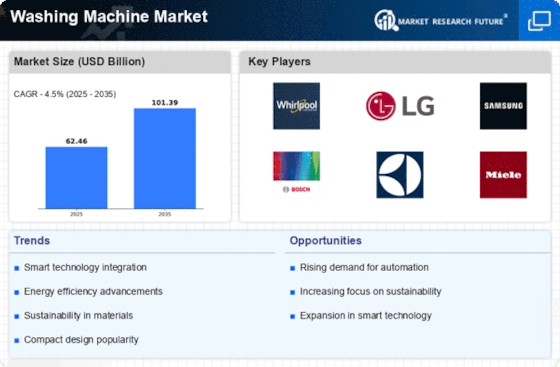
As per Market Research Future analysis, the Washing Machine Market Size was estimated at 62.46 USD Billion in 2024. The Washing Machine industry is projected to grow from 65.27 USD Billion in 2025 to 101.39 USD Billion by 2035, exhibiting a compound annual growth rate (CAGR) of 4.5% during the forecast period 2025 - 2035

Key Market Trends & Highlights

The washing machine market is experiencing a transformative shift towards smart technology and sustainability.

  • Smart technology integration is becoming increasingly prevalent, enhancing user convenience and efficiency. A strong focus on sustainability is driving manufacturers to develop eco-friendly washing machines with reduced water and energy consumption. North America remains the largest market, while the Asia-Pacific region is emerging as the fastest-growing market for washing machines. Rising disposable income and urbanization trends are key drivers propelling the demand for front load and fully automatic washing machines.

Market Size & Forecast

2024 Market Size 62.46 (USD Billion)
2035 Market Size 101.39 (USD Billion)
CAGR (2025 - 2035) 4.5%
Largest Regional Market Share in 2024 Asia Pacific

Major Players

<a href="https://www.whirlpoolindia.com/washing-machines">Whirlpool</a> (US), LG Electronics (KR), Samsung (KR), Bosch (DE), Electrolux (SE), Miele (DE), Panasonic (JP), GE Appliances (US), <a href="https://www.haier.com/in/washing-machines/">Haier</a> (CN)

Market Trends

The Washing Machine Market is currently experiencing a dynamic transformation driven by evolving consumer preferences and technological advancements. As households increasingly prioritize convenience and efficiency, manufacturers are responding by integrating smart technologies into their products. This shift not only enhances user experience but also aligns with the growing trend towards sustainability, as energy-efficient models gain traction among environmentally conscious consumers. Furthermore, the rise of e-commerce platforms has revolutionized the way washing machines are marketed and sold, allowing for greater accessibility and a wider range of options for buyers. In addition to technological innovations, the Washing Machine Market is witnessing a diversification of product offerings. Brands are expanding their portfolios to include various types of washing machines, such as front-loaders, top-loaders, and compact models, catering to different consumer needs and preferences. This diversification is further complemented by the increasing demand for aesthetically pleasing designs that fit seamlessly into modern home interiors. As the market continues to evolve, it appears poised for sustained growth, driven by a combination of innovation, consumer demand, and changing lifestyles.

Smart Technology Integration

The incorporation of smart technology into washing machines is becoming increasingly prevalent. Features such as remote control, app connectivity, and automated settings enhance user convenience and efficiency. This trend reflects a broader movement towards smart home devices, appealing to tech-savvy consumers.

Sustainability Focus

There is a noticeable shift towards energy-efficient and environmentally friendly washing machines. Consumers are increasingly seeking products that minimize water and energy consumption, aligning with global sustainability goals. This trend is prompting manufacturers to innovate and develop greener technologies.

Diverse Product Offerings

The Washing Machine Market is expanding its range of products to meet varied consumer preferences. From compact models for small spaces to high-capacity machines for larger households, the diversity in offerings allows consumers to choose appliances that best fit their lifestyles.

Washing Machine Market Market Drivers

E-commerce Growth

The rapid growth of e-commerce is transforming the way consumers purchase appliances, including those in the Washing Machine Market. Online shopping platforms provide consumers with a wider selection of products, competitive pricing, and the convenience of home delivery. Recent data shows that online sales of home appliances have surged by approximately 30% in the last year alone. This trend indicates that consumers are increasingly comfortable making significant purchases online, which could lead to a shift in market dynamics. As e-commerce continues to expand, it is likely to play a pivotal role in shaping the future of the Washing Machine Market.

Urbanization Trends

Urbanization trends are playing a crucial role in the expansion of the Washing Machine Market. As more individuals migrate to urban areas, the demand for household appliances, including washing machines, is on the rise. Urban dwellers often seek convenience and time-saving solutions, making washing machines an essential part of modern living. Recent statistics indicate that urban populations are expected to increase by over 25% in the next decade, which could lead to a substantial uptick in washing machine sales. This demographic shift suggests that the Washing Machine Market is poised for growth as urbanization continues to reshape consumer needs.

Rising Disposable Income

The increasing disposable income among consumers appears to be a pivotal driver for the Washing Machine Market. As households experience enhanced financial stability, they are more inclined to invest in modern appliances, including washing machines. This trend is particularly evident in emerging economies, where a growing middle class is seeking convenience and efficiency in household chores. According to recent data, the average household expenditure on home appliances has risen by approximately 15% over the past few years. This shift indicates a potential for sustained growth in the Washing Machine Market, as consumers prioritize quality and advanced features in their purchases.

Environmental Regulations

The implementation of stringent environmental regulations is shaping the Washing Machine Market. Governments worldwide are increasingly mandating energy-efficient appliances to reduce carbon footprints and promote sustainability. This regulatory landscape encourages manufacturers to innovate and produce washing machines that comply with energy efficiency standards. Data indicates that energy-efficient washing machines can reduce water and electricity consumption by up to 30% compared to traditional models. As consumers become more environmentally conscious, the demand for eco-friendly washing machines is likely to rise, further propelling the Washing Machine Market as manufacturers adapt to these regulatory changes.

Technological Advancements

Technological advancements are significantly influencing the Washing Machine Market. Innovations such as smart washing machines, which offer connectivity features and energy-efficient operations, are becoming increasingly popular. The integration of IoT technology allows consumers to control their appliances remotely, enhancing convenience and efficiency. Market data suggests that the segment of smart washing machines is projected to grow at a compound annual growth rate of around 20% over the next five years. This trend indicates that consumers are not only looking for functionality but also for modern features that align with their tech-savvy lifestyles, thereby driving the Washing Machine Market forward.

Market Segment Insights

By Type: Front Load (Largest) vs. Top Load (Fastest-Growing)

In the Washing Machine Market, the distribution among the 'Type' segment reveals that front load washing machines dominate with a significant market share. Their superior energy efficiency, cleaning performance, and gentle treatment of fabrics make them a preferred choice for many consumers. Top load machines, while trailing in share, are experiencing robust growth due to their ease of use and quicker wash cycles, appealing to a demographic seeking convenience. The growth trends for the Type segment indicate a competitive landscape where front load machines continue to excel but face increasing pressure from top load and compact models. Washer dryer combos are emerging as a versatile solution for urban living, driving innovations and offering convenience, contributing to the market's dynamic nature.

Front Load (Dominant) vs. Washer Dryer Combo (Emerging)

Front load washing machines are recognized for their high efficiency, better cleaning capabilities, and lower water usage compared to their top load counterparts. These machines are engineered for performance and often feature advanced options like steam cleaning and smartphone connectivity. In contrast, washer dryer combos are gaining traction as an emerging segment, particularly in urban markets where space is limited. They offer the convenience of washing and drying in a single unit, although they may compromise slightly on performance compared to dedicated machines. This segment's growth is fueled by the increasing trend of compact living spaces and the desire for multifunctional appliances, catering to modern consumers' needs.

By Technology: Fully Automatic (Largest) vs. Semi-Automatic (Fastest-Growing)

The washing machine market is prominently segmented into fully automatic, semi-automatic, and manual technologies. Among these, fully automatic washing machines hold the largest market share, appealing to consumers seeking convenience and higher efficiency. Semi-automatic washing machines follow, contributing significantly to market dynamics due to their affordability and user control. On the other hand, the manual segment has shown declining popularity as consumer preferences shift towards more automated solutions, limiting its market presence.

Technology: Fully Automatic (Dominant) vs. Semi-Automatic (Emerging)

Fully automatic washing machines are characterized by their ease of use, as they handle the entire washing process with minimal user input. This technology appeals immensely to urban consumers seeking convenience and time savings, driving its dominance in the market. In contrast, semi-automatic washing machines are gaining traction as an emerging market segment, particularly among budget-conscious consumers. They offer flexibility, allowing users greater control over the washing process, which is advantageous in regions where water supply varies. As demand for efficient and user-friendly appliances increases, the semi-automatic segment is expected to grow rapidly.

By Capacity: 6-8 Kg (Largest) vs. Above 8 Kg (Fastest-Growing)

In the Washing Machine Market, the capacity segments show varied distribution with 6-8 Kg units capturing the largest market share due to their balance of efficiency and convenience for average households. Below 6 Kg models cater to niche markets, often preferred by small families or urban dwellers with limited space. Conversely, the Above 8 Kg category is steadily gaining traction, appealing to larger families and eco-conscious consumers seeking energy-efficient solutions. As consumer preferences shift toward practicality and sustainability, these segments thus reveal distinct characteristics. Growth trends in the Washing Machine Market indicate that the Above 8 Kg segment is poised to become the fastest-growing category, bolstered by rising demand for larger capacities that accommodate modern lifestyles. The global trend towards efficiency and sustainability also drives this growth, as manufacturers innovate to create energy-saving models without sacrificing performance. Moreover, advancements in washing technology further enhance the appeal of larger machines, integrating smart features that attract tech-savvy consumers and contribute to a dynamic evolution within this segment.

6-8 Kg (Dominant) vs. Above 8 Kg (Emerging)

The 6-8 Kg segment remains dominant in the Washing Machine Market, strategically positioned as the ideal choice for most households. It balances size, functionality, and efficiency, catering to average suburban families looking to meet everyday laundry needs without overwhelming energy consumption or space requirements. This capacity range is often equipped with a variety of features that address common user concerns, such as time-saving quick wash cycles and advanced stain removal functions. On the other hand, the Above 8 Kg capacity segment is emerging as a vital player in the market, driven by shifting consumer preferences towards larger loads and sustainable practices. This segment appeals particularly to larger families and consumers who value eco-friendly features, making it a vital area for innovation and growth as brands strive to offer not only larger machines but also energy-efficient solutions.

By End Use: Residential (Largest) vs. Commercial (Fastest-Growing)

The washing machine market is segmented into residential and commercial end uses. The residential segment holds the largest share, driven by an increasing number of households and rising disposable income, leading to higher spending on home appliances. On the other hand, the commercial segment, despite being smaller, is growing rapidly due to the expansion of laundromats and the hospitality industry, highlighting a shift towards faster and more efficient washing solutions in commercial settings.

End Use: Residential (Dominant) vs. Commercial (Emerging)

The residential segment of the washing machine market remains the dominant force, characterized by a wide range of products tailored to consumer needs, from basic models to high-end smart appliances. This segment benefits from trends including smart home technology and energy efficiency, appealing to environmentally conscious consumers. In contrast, the commercial segment is emerging as a significant player, driven by the demand for heavy-duty washing solutions in businesses like hotels and gyms. Commercial machines prioritize speed, capacity, and durability, often incorporating advanced technology to enhance performance. This shift in consumer preference towards convenience and efficiency fuels the commercial washing machine market's growth.

Get more detailed insights about Washing Machine Market Research Report – Forecast till 2035

Regional Insights

North America : Market Leader in Innovation

North America is the largest market for washing machines, holding approximately 35% of the global share. The region's growth is driven by increasing consumer demand for smart appliances, energy efficiency, and advanced features. Regulatory initiatives aimed at energy conservation and sustainability further bolster market expansion. The U.S. and Canada are the primary contributors, with a growing trend towards eco-friendly products and smart technology integration. The competitive landscape is dominated by key players such as Whirlpool, GE Appliances, and LG Electronics. These companies are focusing on innovation and customer-centric designs to capture market share. The presence of established brands and a strong distribution network enhances market accessibility. Additionally, the trend towards online shopping is reshaping consumer purchasing behavior, leading to increased sales through e-commerce platforms.

Europe : Sustainability and Efficiency Focus

Europe is the second-largest market for washing machines, accounting for around 30% of the global market share. The region's growth is significantly influenced by stringent regulations aimed at energy efficiency and environmental sustainability. The EU's Ecodesign Directive mandates energy-saving standards, driving manufacturers to innovate and produce eco-friendly models. This regulatory environment fosters a competitive landscape focused on sustainability and efficiency. Leading countries in this market include Germany, France, and the UK, where consumer preferences are shifting towards high-efficiency appliances. Major players like Bosch, Miele, and Electrolux are investing in R&D to meet these demands. The competitive landscape is characterized by a mix of established brands and emerging players, all striving to enhance product offerings and meet regulatory standards. The emphasis on sustainability is reshaping product development and marketing strategies across the region.

Asia-Pacific : Emerging Market with High Growth

Asia-Pacific is witnessing rapid growth in the washing machine market, holding approximately 25% of the global share. The region's expansion is driven by urbanization, rising disposable incomes, and changing lifestyles. Countries like China and India are leading this growth, with increasing demand for modern appliances. Government initiatives promoting manufacturing and technology adoption further enhance market potential, making it a key area for future investments. China is the largest market in the region, followed by India, where the presence of local and international brands is strong. Key players such as Haier, LG Electronics, and Samsung are competing aggressively to capture market share. The competitive landscape is marked by innovation in product features and pricing strategies tailored to local consumer preferences. The growing trend of online shopping is also influencing purchasing behavior, leading to increased sales through digital channels.

Middle East and Africa : Untapped Potential in Appliances

The Middle East and Africa region is emerging as a significant market for washing machines, holding about 10% of the global share. The growth is driven by increasing urbanization, rising incomes, and a shift towards modern living standards. Countries like South Africa and the UAE are leading the market, with a growing middle class that demands efficient and technologically advanced appliances. Economic diversification efforts in these regions are also contributing to market growth. The competitive landscape features both local and international brands, with companies like Samsung and LG Electronics making substantial inroads. The market is characterized by a mix of price-sensitive consumers and those seeking premium products. As e-commerce continues to grow, manufacturers are adapting their strategies to cater to the evolving preferences of consumers, focusing on convenience and accessibility.

Key Players and Competitive Insights

The Washing Machine Market is currently characterized by a dynamic competitive landscape, driven by technological advancements, sustainability initiatives, and evolving consumer preferences. Major players such as Whirlpool (US), LG Electronics (KR), and Bosch (DE) are strategically positioned to leverage these trends. Whirlpool (US) focuses on innovation in energy-efficient appliances, while LG Electronics (KR) emphasizes smart technology integration, enhancing user experience through IoT capabilities. Bosch (DE), on the other hand, is committed to sustainability, aiming to reduce its carbon footprint through eco-friendly manufacturing processes. Collectively, these strategies not only enhance their market presence but also shape a competitive environment that increasingly prioritizes technological sophistication and environmental responsibility.Key business tactics within the Washing Machine Market include localizing manufacturing and optimizing supply chains to enhance efficiency and responsiveness to market demands. The market structure appears moderately fragmented, with several key players exerting influence over various segments. This fragmentation allows for niche players to thrive, while larger corporations capitalize on economies of scale and brand recognition. The collective influence of these key players fosters a competitive atmosphere where innovation and customer-centric approaches are paramount.

In September LG Electronics (KR) announced the launch of its latest line of AI-powered washing machines, which utilize machine learning to optimize wash cycles based on fabric type and load size. This strategic move underscores LG's commitment to enhancing user convenience and energy efficiency, potentially setting a new standard in the market. The integration of AI not only differentiates LG's offerings but also aligns with the growing consumer demand for smart home solutions.

In August Bosch (DE) unveiled its new sustainability initiative aimed at achieving carbon neutrality in its manufacturing processes by 2026. This initiative reflects Bosch's proactive approach to environmental stewardship and positions the company favorably among eco-conscious consumers. By prioritizing sustainability, Bosch not only enhances its brand image but also addresses regulatory pressures and market expectations regarding environmental impact.

In July Whirlpool (US) entered a strategic partnership with a leading tech firm to develop a new range of connected appliances that integrate seamlessly with smart home ecosystems. This collaboration is indicative of Whirlpool's focus on digital transformation and its recognition of the growing importance of connectivity in consumer appliances. By enhancing its product offerings with smart technology, Whirlpool aims to capture a larger share of the tech-savvy consumer segment.

As of October the Washing Machine Market is witnessing trends that emphasize digitalization, sustainability, and the integration of artificial intelligence. Strategic alliances among key players are increasingly shaping the competitive landscape, fostering innovation and enhancing product offerings. The shift from price-based competition to a focus on technological advancement and supply chain reliability is evident, suggesting that future competitive differentiation will hinge on the ability to innovate and respond to consumer needs effectively.

Key Companies in the Washing Machine Market include

Industry Developments

Recent developments in the Global Washing Machine Market are reflective of evolving consumer preferences and technological advancements. Companies such as Panasonic, Hisense, GE Appliances, and Whirlpool are investing heavily in energy-efficient models and smart home technologies. The demand for washing machines with advanced features like artificial intelligence and IoT compatibility is markedly increasing. In June 2023, Electrolux announced the acquisition of a smart appliance startup to enhance its product offerings. Additionally, in July 2023, Haier expanded its footprint in Europe, integrating local distribution networks to boost market penetration.

Companies like LG Electronics and Bosch are also countering competitive pressures by offering innovative solutions and sustainable practices, aligning with global sustainability mandates. Furthermore, Toshiba and Siemens released upgraded models showcasing low water and energy consumption, tapping into conscious consumer trends. The market has seen consistent growth, particularly in the Asia-Pacific region, attributed to urbanization and increased disposable incomes, suggesting a promising future for key players like Miele and Samsung Electronics. Overall, these occurrences are driving transformation and heightened competition within the global landscape of washing machine manufacturers.

Future Outlook

Washing Machine Market Future Outlook

The Washing Machine Market is projected to grow at a 4.5% CAGR from 2025 to 2035, driven by technological advancements, sustainability trends, and increasing consumer demand for energy-efficient appliances.

New opportunities lie in:

  • Expansion into smart washing machine technology integration</p><p>Development of eco-friendly washing solutions and <a href="https://www.marketresearchfuture.com/reports/laundry-detergents-market-6949">detergents</a></p><p>Partnerships with e-commerce platforms for direct-to-consumer sales

By 2035, the washing machine market is expected to achieve robust growth, reflecting evolving consumer preferences and technological innovations.

Market Segmentation

Washing Machine Market Type Outlook

  • Front Load
  • Top Load
  • Washer Dryer Combo
  • Compact

Washing Machine Market End Use Outlook

  • Residential
  • Commercial

Washing Machine Market Capacity Outlook

  • Below 6 Kg
  • 6-8 Kg
  • Above 8 Kg

Washing Machine Market Technology Outlook

  • Fully Automatic
  • Semi-Automatic
  • Manual

Report Scope

MARKET SIZE 2024 62.46(USD Billion)
MARKET SIZE 2025 65.27(USD Billion)
MARKET SIZE 2035 101.39(USD Billion)
COMPOUND ANNUAL GROWTH RATE (CAGR) 4.5% (2025 - 2035)
REPORT COVERAGE Revenue Forecast, Competitive Landscape, Growth Factors, and Trends
BASE YEAR 2024
Market Forecast Period 2025 - 2035
Historical Data 2019 - 2024
Market Forecast Units USD Billion
Key Companies Profiled Whirlpool (US), LG Electronics (KR), Samsung (KR), Bosch (DE), Electrolux (SE), Miele (DE), Panasonic (JP), GE Appliances (US), Haier (CN)
Segments Covered Type, Technology, Capacity, End Use, Regional
Key Market Opportunities Integration of smart technology and energy-efficient features in the Washing Machine Market.
Key Market Dynamics Technological advancements and sustainability concerns drive innovation and competition in the washing machine market.
Countries Covered North America, Europe, APAC, South America, MEA

FAQs

What is the current valuation of the Washing Machine Market in 2024?

<p>The Washing Machine Market was valued at 62.46 USD Billion in 2024.</p>

What is the projected market size for the Washing Machine Market by 2035?

The market is projected to reach 101.39 USD Billion by 2035.

What is the expected CAGR for the Washing Machine Market during the forecast period 2025 - 2035?

The expected CAGR for the Washing Machine Market during 2025 - 2035 is 4.5%.

Which segment of washing machines had the highest valuation in 2024?

In 2024, the Front Load segment had the highest valuation at 39.0 USD Billion.

What are the projected valuations for the Top Load washing machine segment by 2035?

The Top Load segment is projected to reach 30.0 USD Billion by 2035.

How does the valuation of Fully Automatic washing machines compare to Semi-Automatic ones in 2024?

In 2024, Fully Automatic washing machines were valued at 30.0 USD Billion, whereas Semi-Automatic ones were valued at 20.0 USD Billion.

What is the market valuation for washing machines with a capacity above 8 Kg in 2024?

The market valuation for washing machines with a capacity above 8 Kg was 24.96 USD Billion in 2024.

Which companies are considered key players in the Washing Machine Market?

Key players in the market include Whirlpool, LG Electronics, Samsung, Bosch, Electrolux, Miele, Panasonic, GE Appliances, and Haier.

What is the projected valuation for the Residential washing machine segment by 2035?

The Residential washing machine segment is projected to reach 60.83 USD Billion by 2035.

What was the valuation of the Compact washing machine segment in 2024?

The Compact washing machine segment was valued at 7.46 USD Billion in 2024.

  1. SECTION I: EXECUTIVE SUMMARY AND KEY HIGHLIGHTS
    1. | 1.1 EXECUTIVE SUMMARY
    2. | | 1.1.1 Market Overview
    3. | | 1.1.2 Key Findings
    4. | | 1.1.3 Market Segmentation
    5. | | 1.1.4 Competitive Landscape
    6. | | 1.1.5 Challenges and Opportunities
    7. | | 1.1.6 Future Outlook
  2. SECTION II: SCOPING, METHODOLOGY AND MARKET STRUCTURE
    1. | 2.1 MARKET INTRODUCTION
    2. | | 2.1.1 Definition
    3. | | 2.1.2 Scope of the study
    4. | | | 2.1.2.1 Research Objective
    5. | | | 2.1.2.2 Assumption
    6. | | | 2.1.2.3 Limitations
    7. | 2.2 RESEARCH METHODOLOGY
    8. | | 2.2.1 Overview
    9. | | 2.2.2 Data Mining
    10. | | 2.2.3 Secondary Research
    11. | | 2.2.4 Primary Research
    12. | | | 2.2.4.1 Primary Interviews and Information Gathering Process
    13. | | | 2.2.4.2 Breakdown of Primary Respondents
    14. | | 2.2.5 Forecasting Model
    15. | | 2.2.6 Market Size Estimation
    16. | | | 2.2.6.1 Bottom-Up Approach
    17. | | | 2.2.6.2 Top-Down Approach
    18. | | 2.2.7 Data Triangulation
    19. | | 2.2.8 Validation
  3. SECTION III: QUALITATIVE ANALYSIS
    1. | 3.1 MARKET DYNAMICS
    2. | | 3.1.1 Overview
    3. | | 3.1.2 Drivers
    4. | | 3.1.3 Restraints
    5. | | 3.1.4 Opportunities
    6. | 3.2 MARKET FACTOR ANALYSIS
    7. | | 3.2.1 Value chain Analysis
    8. | | 3.2.2 Porter's Five Forces Analysis
    9. | | | 3.2.2.1 Bargaining Power of Suppliers
    10. | | | 3.2.2.2 Bargaining Power of Buyers
    11. | | | 3.2.2.3 Threat of New Entrants
    12. | | | 3.2.2.4 Threat of Substitutes
    13. | | | 3.2.2.5 Intensity of Rivalry
    14. | | 3.2.3 COVID-19 Impact Analysis
    15. | | | 3.2.3.1 Market Impact Analysis
    16. | | | 3.2.3.2 Regional Impact
    17. | | | 3.2.3.3 Opportunity and Threat Analysis
  4. SECTION IV: QUANTITATIVE ANALYSIS
    1. | 4.1 Consumer and Retail, BY Type (USD Billion)
    2. | | 4.1.1 Front Load
    3. | | 4.1.2 Top Load
    4. | | 4.1.3 Washer Dryer Combo
    5. | | 4.1.4 Compact
    6. | 4.2 Consumer and Retail, BY Technology (USD Billion)
    7. | | 4.2.1 Fully Automatic
    8. | | 4.2.2 Semi-Automatic
    9. | | 4.2.3 Manual
    10. | 4.3 Consumer and Retail, BY Capacity (USD Billion)
    11. | | 4.3.1 Below 6 Kg
    12. | | 4.3.2 6-8 Kg
    13. | | 4.3.3 Above 8 Kg
    14. | 4.4 Consumer and Retail, BY End Use (USD Billion)
    15. | | 4.4.1 Residential
    16. | | 4.4.2 Commercial
    17. | 4.5 Consumer and Retail, BY Region (USD Billion)
    18. | | 4.5.1 North America
    19. | | | 4.5.1.1 US
    20. | | | 4.5.1.2 Canada
    21. | | 4.5.2 Europe
    22. | | | 4.5.2.1 Germany
    23. | | | 4.5.2.2 UK
    24. | | | 4.5.2.3 France
    25. | | | 4.5.2.4 Russia
    26. | | | 4.5.2.5 Italy
    27. | | | 4.5.2.6 Spain
    28. | | | 4.5.2.7 Rest of Europe
    29. | | 4.5.3 APAC
    30. | | | 4.5.3.1 China
    31. | | | 4.5.3.2 India
    32. | | | 4.5.3.3 Japan
    33. | | | 4.5.3.4 South Korea
    34. | | | 4.5.3.5 Malaysia
    35. | | | 4.5.3.6 Thailand
    36. | | | 4.5.3.7 Indonesia
    37. | | | 4.5.3.8 Rest of APAC
    38. | | 4.5.4 South America
    39. | | | 4.5.4.1 Brazil
    40. | | | 4.5.4.2 Mexico
    41. | | | 4.5.4.3 Argentina
    42. | | | 4.5.4.4 Rest of South America
    43. | | 4.5.5 MEA
    44. | | | 4.5.5.1 GCC Countries
    45. | | | 4.5.5.2 South Africa
    46. | | | 4.5.5.3 Rest of MEA
  5. SECTION V: COMPETITIVE ANALYSIS
    1. | 5.1 Competitive Landscape
    2. | | 5.1.1 Overview
    3. | | 5.1.2 Competitive Analysis
    4. | | 5.1.3 Market share Analysis
    5. | | 5.1.4 Major Growth Strategy in the Consumer and Retail
    6. | | 5.1.5 Competitive Benchmarking
    7. | | 5.1.6 Leading Players in Terms of Number of Developments in the Consumer and Retail
    8. | | 5.1.7 Key developments and growth strategies
    9. | | | 5.1.7.1 New Product Launch/Service Deployment
    10. | | | 5.1.7.2 Merger & Acquisitions
    11. | | | 5.1.7.3 Joint Ventures
    12. | | 5.1.8 Major Players Financial Matrix
    13. | | | 5.1.8.1 Sales and Operating Income
    14. | | | 5.1.8.2 Major Players R&D Expenditure. 2023
    15. | 5.2 Company Profiles
    16. | | 5.2.1 Whirlpool (US)
    17. | | | 5.2.1.1 Financial Overview
    18. | | | 5.2.1.2 Products Offered
    19. | | | 5.2.1.3 Key Developments
    20. | | | 5.2.1.4 SWOT Analysis
    21. | | | 5.2.1.5 Key Strategies
    22. | | 5.2.2 LG Electronics (KR)
    23. | | | 5.2.2.1 Financial Overview
    24. | | | 5.2.2.2 Products Offered
    25. | | | 5.2.2.3 Key Developments
    26. | | | 5.2.2.4 SWOT Analysis
    27. | | | 5.2.2.5 Key Strategies
    28. | | 5.2.3 Samsung (KR)
    29. | | | 5.2.3.1 Financial Overview
    30. | | | 5.2.3.2 Products Offered
    31. | | | 5.2.3.3 Key Developments
    32. | | | 5.2.3.4 SWOT Analysis
    33. | | | 5.2.3.5 Key Strategies
    34. | | 5.2.4 Bosch (DE)
    35. | | | 5.2.4.1 Financial Overview
    36. | | | 5.2.4.2 Products Offered
    37. | | | 5.2.4.3 Key Developments
    38. | | | 5.2.4.4 SWOT Analysis
    39. | | | 5.2.4.5 Key Strategies
    40. | | 5.2.5 Electrolux (SE)
    41. | | | 5.2.5.1 Financial Overview
    42. | | | 5.2.5.2 Products Offered
    43. | | | 5.2.5.3 Key Developments
    44. | | | 5.2.5.4 SWOT Analysis
    45. | | | 5.2.5.5 Key Strategies
    46. | | 5.2.6 Miele (DE)
    47. | | | 5.2.6.1 Financial Overview
    48. | | | 5.2.6.2 Products Offered
    49. | | | 5.2.6.3 Key Developments
    50. | | | 5.2.6.4 SWOT Analysis
    51. | | | 5.2.6.5 Key Strategies
    52. | | 5.2.7 Panasonic (JP)
    53. | | | 5.2.7.1 Financial Overview
    54. | | | 5.2.7.2 Products Offered
    55. | | | 5.2.7.3 Key Developments
    56. | | | 5.2.7.4 SWOT Analysis
    57. | | | 5.2.7.5 Key Strategies
    58. | | 5.2.8 GE Appliances (US)
    59. | | | 5.2.8.1 Financial Overview
    60. | | | 5.2.8.2 Products Offered
    61. | | | 5.2.8.3 Key Developments
    62. | | | 5.2.8.4 SWOT Analysis
    63. | | | 5.2.8.5 Key Strategies
    64. | | 5.2.9 Haier (CN)
    65. | | | 5.2.9.1 Financial Overview
    66. | | | 5.2.9.2 Products Offered
    67. | | | 5.2.9.3 Key Developments
    68. | | | 5.2.9.4 SWOT Analysis
    69. | | | 5.2.9.5 Key Strategies
    70. | 5.3 Appendix
    71. | | 5.3.1 References
    72. | | 5.3.2 Related Reports
  6. LIST OF FIGURES
    1. | 6.1 MARKET SYNOPSIS
    2. | 6.2 NORTH AMERICA MARKET ANALYSIS
    3. | 6.3 US MARKET ANALYSIS BY TYPE
    4. | 6.4 US MARKET ANALYSIS BY TECHNOLOGY
    5. | 6.5 US MARKET ANALYSIS BY CAPACITY
    6. | 6.6 US MARKET ANALYSIS BY END USE
    7. | 6.7 CANADA MARKET ANALYSIS BY TYPE
    8. | 6.8 CANADA MARKET ANALYSIS BY TECHNOLOGY
    9. | 6.9 CANADA MARKET ANALYSIS BY CAPACITY
    10. | 6.10 CANADA MARKET ANALYSIS BY END USE
    11. | 6.11 EUROPE MARKET ANALYSIS
    12. | 6.12 GERMANY MARKET ANALYSIS BY TYPE
    13. | 6.13 GERMANY MARKET ANALYSIS BY TECHNOLOGY
    14. | 6.14 GERMANY MARKET ANALYSIS BY CAPACITY
    15. | 6.15 GERMANY MARKET ANALYSIS BY END USE
    16. | 6.16 UK MARKET ANALYSIS BY TYPE
    17. | 6.17 UK MARKET ANALYSIS BY TECHNOLOGY
    18. | 6.18 UK MARKET ANALYSIS BY CAPACITY
    19. | 6.19 UK MARKET ANALYSIS BY END USE
    20. | 6.20 FRANCE MARKET ANALYSIS BY TYPE
    21. | 6.21 FRANCE MARKET ANALYSIS BY TECHNOLOGY
    22. | 6.22 FRANCE MARKET ANALYSIS BY CAPACITY
    23. | 6.23 FRANCE MARKET ANALYSIS BY END USE
    24. | 6.24 RUSSIA MARKET ANALYSIS BY TYPE
    25. | 6.25 RUSSIA MARKET ANALYSIS BY TECHNOLOGY
    26. | 6.26 RUSSIA MARKET ANALYSIS BY CAPACITY
    27. | 6.27 RUSSIA MARKET ANALYSIS BY END USE
    28. | 6.28 ITALY MARKET ANALYSIS BY TYPE
    29. | 6.29 ITALY MARKET ANALYSIS BY TECHNOLOGY
    30. | 6.30 ITALY MARKET ANALYSIS BY CAPACITY
    31. | 6.31 ITALY MARKET ANALYSIS BY END USE
    32. | 6.32 SPAIN MARKET ANALYSIS BY TYPE
    33. | 6.33 SPAIN MARKET ANALYSIS BY TECHNOLOGY
    34. | 6.34 SPAIN MARKET ANALYSIS BY CAPACITY
    35. | 6.35 SPAIN MARKET ANALYSIS BY END USE
    36. | 6.36 REST OF EUROPE MARKET ANALYSIS BY TYPE
    37. | 6.37 REST OF EUROPE MARKET ANALYSIS BY TECHNOLOGY
    38. | 6.38 REST OF EUROPE MARKET ANALYSIS BY CAPACITY
    39. | 6.39 REST OF EUROPE MARKET ANALYSIS BY END USE
    40. | 6.40 APAC MARKET ANALYSIS
    41. | 6.41 CHINA MARKET ANALYSIS BY TYPE
    42. | 6.42 CHINA MARKET ANALYSIS BY TECHNOLOGY
    43. | 6.43 CHINA MARKET ANALYSIS BY CAPACITY
    44. | 6.44 CHINA MARKET ANALYSIS BY END USE
    45. | 6.45 INDIA MARKET ANALYSIS BY TYPE
    46. | 6.46 INDIA MARKET ANALYSIS BY TECHNOLOGY
    47. | 6.47 INDIA MARKET ANALYSIS BY CAPACITY
    48. | 6.48 INDIA MARKET ANALYSIS BY END USE
    49. | 6.49 JAPAN MARKET ANALYSIS BY TYPE
    50. | 6.50 JAPAN MARKET ANALYSIS BY TECHNOLOGY
    51. | 6.51 JAPAN MARKET ANALYSIS BY CAPACITY
    52. | 6.52 JAPAN MARKET ANALYSIS BY END USE
    53. | 6.53 SOUTH KOREA MARKET ANALYSIS BY TYPE
    54. | 6.54 SOUTH KOREA MARKET ANALYSIS BY TECHNOLOGY
    55. | 6.55 SOUTH KOREA MARKET ANALYSIS BY CAPACITY
    56. | 6.56 SOUTH KOREA MARKET ANALYSIS BY END USE
    57. | 6.57 MALAYSIA MARKET ANALYSIS BY TYPE
    58. | 6.58 MALAYSIA MARKET ANALYSIS BY TECHNOLOGY
    59. | 6.59 MALAYSIA MARKET ANALYSIS BY CAPACITY
    60. | 6.60 MALAYSIA MARKET ANALYSIS BY END USE
    61. | 6.61 THAILAND MARKET ANALYSIS BY TYPE
    62. | 6.62 THAILAND MARKET ANALYSIS BY TECHNOLOGY
    63. | 6.63 THAILAND MARKET ANALYSIS BY CAPACITY
    64. | 6.64 THAILAND MARKET ANALYSIS BY END USE
    65. | 6.65 INDONESIA MARKET ANALYSIS BY TYPE
    66. | 6.66 INDONESIA MARKET ANALYSIS BY TECHNOLOGY
    67. | 6.67 INDONESIA MARKET ANALYSIS BY CAPACITY
    68. | 6.68 INDONESIA MARKET ANALYSIS BY END USE
    69. | 6.69 REST OF APAC MARKET ANALYSIS BY TYPE
    70. | 6.70 REST OF APAC MARKET ANALYSIS BY TECHNOLOGY
    71. | 6.71 REST OF APAC MARKET ANALYSIS BY CAPACITY
    72. | 6.72 REST OF APAC MARKET ANALYSIS BY END USE
    73. | 6.73 SOUTH AMERICA MARKET ANALYSIS
    74. | 6.74 BRAZIL MARKET ANALYSIS BY TYPE
    75. | 6.75 BRAZIL MARKET ANALYSIS BY TECHNOLOGY
    76. | 6.76 BRAZIL MARKET ANALYSIS BY CAPACITY
    77. | 6.77 BRAZIL MARKET ANALYSIS BY END USE
    78. | 6.78 MEXICO MARKET ANALYSIS BY TYPE
    79. | 6.79 MEXICO MARKET ANALYSIS BY TECHNOLOGY
    80. | 6.80 MEXICO MARKET ANALYSIS BY CAPACITY
    81. | 6.81 MEXICO MARKET ANALYSIS BY END USE
    82. | 6.82 ARGENTINA MARKET ANALYSIS BY TYPE
    83. | 6.83 ARGENTINA MARKET ANALYSIS BY TECHNOLOGY
    84. | 6.84 ARGENTINA MARKET ANALYSIS BY CAPACITY
    85. | 6.85 ARGENTINA MARKET ANALYSIS BY END USE
    86. | 6.86 REST OF SOUTH AMERICA MARKET ANALYSIS BY TYPE
    87. | 6.87 REST OF SOUTH AMERICA MARKET ANALYSIS BY TECHNOLOGY
    88. | 6.88 REST OF SOUTH AMERICA MARKET ANALYSIS BY CAPACITY
    89. | 6.89 REST OF SOUTH AMERICA MARKET ANALYSIS BY END USE
    90. | 6.90 MEA MARKET ANALYSIS
    91. | 6.91 GCC COUNTRIES MARKET ANALYSIS BY TYPE
    92. | 6.92 GCC COUNTRIES MARKET ANALYSIS BY TECHNOLOGY
    93. | 6.93 GCC COUNTRIES MARKET ANALYSIS BY CAPACITY
    94. | 6.94 GCC COUNTRIES MARKET ANALYSIS BY END USE
    95. | 6.95 SOUTH AFRICA MARKET ANALYSIS BY TYPE
    96. | 6.96 SOUTH AFRICA MARKET ANALYSIS BY TECHNOLOGY
    97. | 6.97 SOUTH AFRICA MARKET ANALYSIS BY CAPACITY
    98. | 6.98 SOUTH AFRICA MARKET ANALYSIS BY END USE
    99. | 6.99 REST OF MEA MARKET ANALYSIS BY TYPE
    100. | 6.100 REST OF MEA MARKET ANALYSIS BY TECHNOLOGY
    101. | 6.101 REST OF MEA MARKET ANALYSIS BY CAPACITY
    102. | 6.102 REST OF MEA MARKET ANALYSIS BY END USE
    103. | 6.103 KEY BUYING CRITERIA OF CONSUMER AND RETAIL
    104. | 6.104 RESEARCH PROCESS OF MRFR
    105. | 6.105 DRO ANALYSIS OF CONSUMER AND RETAIL
    106. | 6.106 DRIVERS IMPACT ANALYSIS: CONSUMER AND RETAIL
    107. | 6.107 RESTRAINTS IMPACT ANALYSIS: CONSUMER AND RETAIL
    108. | 6.108 SUPPLY / VALUE CHAIN: CONSUMER AND RETAIL
    109. | 6.109 CONSUMER AND RETAIL, BY TYPE, 2024 (% SHARE)
    110. | 6.110 CONSUMER AND RETAIL, BY TYPE, 2024 TO 2035 (USD Billion)
    111. | 6.111 CONSUMER AND RETAIL, BY TECHNOLOGY, 2024 (% SHARE)
    112. | 6.112 CONSUMER AND RETAIL, BY TECHNOLOGY, 2024 TO 2035 (USD Billion)
    113. | 6.113 CONSUMER AND RETAIL, BY CAPACITY, 2024 (% SHARE)
    114. | 6.114 CONSUMER AND RETAIL, BY CAPACITY, 2024 TO 2035 (USD Billion)
    115. | 6.115 CONSUMER AND RETAIL, BY END USE, 2024 (% SHARE)
    116. | 6.116 CONSUMER AND RETAIL, BY END USE, 2024 TO 2035 (USD Billion)
    117. | 6.117 BENCHMARKING OF MAJOR COMPETITORS
  7. LIST OF TABLES
    1. | 7.1 LIST OF ASSUMPTIONS
    2. | | 7.1.1
    3. | 7.2 North America MARKET SIZE ESTIMATES; FORECAST
    4. | | 7.2.1 BY TYPE, 2025-2035 (USD Billion)
    5. | | 7.2.2 BY TECHNOLOGY, 2025-2035 (USD Billion)
    6. | | 7.2.3 BY CAPACITY, 2025-2035 (USD Billion)
    7. | | 7.2.4 BY END USE, 2025-2035 (USD Billion)
    8. | 7.3 US MARKET SIZE ESTIMATES; FORECAST
    9. | | 7.3.1 BY TYPE, 2025-2035 (USD Billion)
    10. | | 7.3.2 BY TECHNOLOGY, 2025-2035 (USD Billion)
    11. | | 7.3.3 BY CAPACITY, 2025-2035 (USD Billion)
    12. | | 7.3.4 BY END USE, 2025-2035 (USD Billion)
    13. | 7.4 Canada MARKET SIZE ESTIMATES; FORECAST
    14. | | 7.4.1 BY TYPE, 2025-2035 (USD Billion)
    15. | | 7.4.2 BY TECHNOLOGY, 2025-2035 (USD Billion)
    16. | | 7.4.3 BY CAPACITY, 2025-2035 (USD Billion)
    17. | | 7.4.4 BY END USE, 2025-2035 (USD Billion)
    18. | 7.5 Europe MARKET SIZE ESTIMATES; FORECAST
    19. | | 7.5.1 BY TYPE, 2025-2035 (USD Billion)
    20. | | 7.5.2 BY TECHNOLOGY, 2025-2035 (USD Billion)
    21. | | 7.5.3 BY CAPACITY, 2025-2035 (USD Billion)
    22. | | 7.5.4 BY END USE, 2025-2035 (USD Billion)
    23. | 7.6 Germany MARKET SIZE ESTIMATES; FORECAST
    24. | | 7.6.1 BY TYPE, 2025-2035 (USD Billion)
    25. | | 7.6.2 BY TECHNOLOGY, 2025-2035 (USD Billion)
    26. | | 7.6.3 BY CAPACITY, 2025-2035 (USD Billion)
    27. | | 7.6.4 BY END USE, 2025-2035 (USD Billion)
    28. | 7.7 UK MARKET SIZE ESTIMATES; FORECAST
    29. | | 7.7.1 BY TYPE, 2025-2035 (USD Billion)
    30. | | 7.7.2 BY TECHNOLOGY, 2025-2035 (USD Billion)
    31. | | 7.7.3 BY CAPACITY, 2025-2035 (USD Billion)
    32. | | 7.7.4 BY END USE, 2025-2035 (USD Billion)
    33. | 7.8 France MARKET SIZE ESTIMATES; FORECAST
    34. | | 7.8.1 BY TYPE, 2025-2035 (USD Billion)
    35. | | 7.8.2 BY TECHNOLOGY, 2025-2035 (USD Billion)
    36. | | 7.8.3 BY CAPACITY, 2025-2035 (USD Billion)
    37. | | 7.8.4 BY END USE, 2025-2035 (USD Billion)
    38. | 7.9 Russia MARKET SIZE ESTIMATES; FORECAST
    39. | | 7.9.1 BY TYPE, 2025-2035 (USD Billion)
    40. | | 7.9.2 BY TECHNOLOGY, 2025-2035 (USD Billion)
    41. | | 7.9.3 BY CAPACITY, 2025-2035 (USD Billion)
    42. | | 7.9.4 BY END USE, 2025-2035 (USD Billion)
    43. | 7.10 Italy MARKET SIZE ESTIMATES; FORECAST
    44. | | 7.10.1 BY TYPE, 2025-2035 (USD Billion)
    45. | | 7.10.2 BY TECHNOLOGY, 2025-2035 (USD Billion)
    46. | | 7.10.3 BY CAPACITY, 2025-2035 (USD Billion)
    47. | | 7.10.4 BY END USE, 2025-2035 (USD Billion)
    48. | 7.11 Spain MARKET SIZE ESTIMATES; FORECAST
    49. | | 7.11.1 BY TYPE, 2025-2035 (USD Billion)
    50. | | 7.11.2 BY TECHNOLOGY, 2025-2035 (USD Billion)
    51. | | 7.11.3 BY CAPACITY, 2025-2035 (USD Billion)
    52. | | 7.11.4 BY END USE, 2025-2035 (USD Billion)
    53. | 7.12 Rest of Europe MARKET SIZE ESTIMATES; FORECAST
    54. | | 7.12.1 BY TYPE, 2025-2035 (USD Billion)
    55. | | 7.12.2 BY TECHNOLOGY, 2025-2035 (USD Billion)
    56. | | 7.12.3 BY CAPACITY, 2025-2035 (USD Billion)
    57. | | 7.12.4 BY END USE, 2025-2035 (USD Billion)
    58. | 7.13 APAC MARKET SIZE ESTIMATES; FORECAST
    59. | | 7.13.1 BY TYPE, 2025-2035 (USD Billion)
    60. | | 7.13.2 BY TECHNOLOGY, 2025-2035 (USD Billion)
    61. | | 7.13.3 BY CAPACITY, 2025-2035 (USD Billion)
    62. | | 7.13.4 BY END USE, 2025-2035 (USD Billion)
    63. | 7.14 China MARKET SIZE ESTIMATES; FORECAST
    64. | | 7.14.1 BY TYPE, 2025-2035 (USD Billion)
    65. | | 7.14.2 BY TECHNOLOGY, 2025-2035 (USD Billion)
    66. | | 7.14.3 BY CAPACITY, 2025-2035 (USD Billion)
    67. | | 7.14.4 BY END USE, 2025-2035 (USD Billion)
    68. | 7.15 India MARKET SIZE ESTIMATES; FORECAST
    69. | | 7.15.1 BY TYPE, 2025-2035 (USD Billion)
    70. | | 7.15.2 BY TECHNOLOGY, 2025-2035 (USD Billion)
    71. | | 7.15.3 BY CAPACITY, 2025-2035 (USD Billion)
    72. | | 7.15.4 BY END USE, 2025-2035 (USD Billion)
    73. | 7.16 Japan MARKET SIZE ESTIMATES; FORECAST
    74. | | 7.16.1 BY TYPE, 2025-2035 (USD Billion)
    75. | | 7.16.2 BY TECHNOLOGY, 2025-2035 (USD Billion)
    76. | | 7.16.3 BY CAPACITY, 2025-2035 (USD Billion)
    77. | | 7.16.4 BY END USE, 2025-2035 (USD Billion)
    78. | 7.17 South Korea MARKET SIZE ESTIMATES; FORECAST
    79. | | 7.17.1 BY TYPE, 2025-2035 (USD Billion)
    80. | | 7.17.2 BY TECHNOLOGY, 2025-2035 (USD Billion)
    81. | | 7.17.3 BY CAPACITY, 2025-2035 (USD Billion)
    82. | | 7.17.4 BY END USE, 2025-2035 (USD Billion)
    83. | 7.18 Malaysia MARKET SIZE ESTIMATES; FORECAST
    84. | | 7.18.1 BY TYPE, 2025-2035 (USD Billion)
    85. | | 7.18.2 BY TECHNOLOGY, 2025-2035 (USD Billion)
    86. | | 7.18.3 BY CAPACITY, 2025-2035 (USD Billion)
    87. | | 7.18.4 BY END USE, 2025-2035 (USD Billion)
    88. | 7.19 Thailand MARKET SIZE ESTIMATES; FORECAST
    89. | | 7.19.1 BY TYPE, 2025-2035 (USD Billion)
    90. | | 7.19.2 BY TECHNOLOGY, 2025-2035 (USD Billion)
    91. | | 7.19.3 BY CAPACITY, 2025-2035 (USD Billion)
    92. | | 7.19.4 BY END USE, 2025-2035 (USD Billion)
    93. | 7.20 Indonesia MARKET SIZE ESTIMATES; FORECAST
    94. | | 7.20.1 BY TYPE, 2025-2035 (USD Billion)
    95. | | 7.20.2 BY TECHNOLOGY, 2025-2035 (USD Billion)
    96. | | 7.20.3 BY CAPACITY, 2025-2035 (USD Billion)
    97. | | 7.20.4 BY END USE, 2025-2035 (USD Billion)
    98. | 7.21 Rest of APAC MARKET SIZE ESTIMATES; FORECAST
    99. | | 7.21.1 BY TYPE, 2025-2035 (USD Billion)
    100. | | 7.21.2 BY TECHNOLOGY, 2025-2035 (USD Billion)
    101. | | 7.21.3 BY CAPACITY, 2025-2035 (USD Billion)
    102. | | 7.21.4 BY END USE, 2025-2035 (USD Billion)
    103. | 7.22 South America MARKET SIZE ESTIMATES; FORECAST
    104. | | 7.22.1 BY TYPE, 2025-2035 (USD Billion)
    105. | | 7.22.2 BY TECHNOLOGY, 2025-2035 (USD Billion)
    106. | | 7.22.3 BY CAPACITY, 2025-2035 (USD Billion)
    107. | | 7.22.4 BY END USE, 2025-2035 (USD Billion)
    108. | 7.23 Brazil MARKET SIZE ESTIMATES; FORECAST
    109. | | 7.23.1 BY TYPE, 2025-2035 (USD Billion)
    110. | | 7.23.2 BY TECHNOLOGY, 2025-2035 (USD Billion)
    111. | | 7.23.3 BY CAPACITY, 2025-2035 (USD Billion)
    112. | | 7.23.4 BY END USE, 2025-2035 (USD Billion)
    113. | 7.24 Mexico MARKET SIZE ESTIMATES; FORECAST
    114. | | 7.24.1 BY TYPE, 2025-2035 (USD Billion)
    115. | | 7.24.2 BY TECHNOLOGY, 2025-2035 (USD Billion)
    116. | | 7.24.3 BY CAPACITY, 2025-2035 (USD Billion)
    117. | | 7.24.4 BY END USE, 2025-2035 (USD Billion)
    118. | 7.25 Argentina MARKET SIZE ESTIMATES; FORECAST
    119. | | 7.25.1 BY TYPE, 2025-2035 (USD Billion)
    120. | | 7.25.2 BY TECHNOLOGY, 2025-2035 (USD Billion)
    121. | | 7.25.3 BY CAPACITY, 2025-2035 (USD Billion)
    122. | | 7.25.4 BY END USE, 2025-2035 (USD Billion)
    123. | 7.26 Rest of South America MARKET SIZE ESTIMATES; FORECAST
    124. | | 7.26.1 BY TYPE, 2025-2035 (USD Billion)
    125. | | 7.26.2 BY TECHNOLOGY, 2025-2035 (USD Billion)
    126. | | 7.26.3 BY CAPACITY, 2025-2035 (USD Billion)
    127. | | 7.26.4 BY END USE, 2025-2035 (USD Billion)
    128. | 7.27 MEA MARKET SIZE ESTIMATES; FORECAST
    129. | | 7.27.1 BY TYPE, 2025-2035 (USD Billion)
    130. | | 7.27.2 BY TECHNOLOGY, 2025-2035 (USD Billion)
    131. | | 7.27.3 BY CAPACITY, 2025-2035 (USD Billion)
    132. | | 7.27.4 BY END USE, 2025-2035 (USD Billion)
    133. | 7.28 GCC Countries MARKET SIZE ESTIMATES; FORECAST
    134. | | 7.28.1 BY TYPE, 2025-2035 (USD Billion)
    135. | | 7.28.2 BY TECHNOLOGY, 2025-2035 (USD Billion)
    136. | | 7.28.3 BY CAPACITY, 2025-2035 (USD Billion)
    137. | | 7.28.4 BY END USE, 2025-2035 (USD Billion)
    138. | 7.29 South Africa MARKET SIZE ESTIMATES; FORECAST
    139. | | 7.29.1 BY TYPE, 2025-2035 (USD Billion)
    140. | | 7.29.2 BY TECHNOLOGY, 2025-2035 (USD Billion)
    141. | | 7.29.3 BY CAPACITY, 2025-2035 (USD Billion)
    142. | | 7.29.4 BY END USE, 2025-2035 (USD Billion)
    143. | 7.30 Rest of MEA MARKET SIZE ESTIMATES; FORECAST
    144. | | 7.30.1 BY TYPE, 2025-2035 (USD Billion)
    145. | | 7.30.2 BY TECHNOLOGY, 2025-2035 (USD Billion)
    146. | | 7.30.3 BY CAPACITY, 2025-2035 (USD Billion)
    147. | | 7.30.4 BY END USE, 2025-2035 (USD Billion)
    148. | 7.31 PRODUCT LAUNCH/PRODUCT DEVELOPMENT/APPROVAL
    149. | | 7.31.1
    150. | 7.32 ACQUISITION/PARTNERSHIP
    151. | | 7.32.1

Consumer and Retail Market Segmentation

Consumer and Retail By Type (USD Billion, 2025-2035)

  • Front Load
  • Top Load
  • Washer Dryer Combo
  • Compact

Consumer and Retail By Technology (USD Billion, 2025-2035)

  • Fully Automatic
  • Semi-Automatic
  • Manual

Consumer and Retail By Capacity (USD Billion, 2025-2035)

  • Below 6 Kg
  • 6-8 Kg
  • Above 8 Kg

Consumer and Retail By End Use (USD Billion, 2025-2035)

  • Residential
  • Commercial
Infographic

Free Sample Request

Kindly complete the form below to receive a free sample of this Report

Get Free Sample

Customer Strories

Compare Licence

×
Features License Type
Single User Multiuser License Enterprise User
Price $4,950 $5,950 $7,250
Maximum User Access Limit 1 User Upto 10 Users Unrestricted Access Throughout the Organization
Free Customization
Direct Access to Analyst
Deliverable Format
Platform Access
Discount on Next Purchase 10% 15% 15%
Printable Versions