×
Request Free Sample ×

Kindly complete the form below to receive a free sample of this Report

* Please use a valid business email

Leading companies partner with us for data-driven Insights

clients tt-cursor
Hero Background
English
Chinese
French
Japanese
Korean
German
Spanish

Wasabi Market Size

ID: MRFR/FnB/6370-HCR
128 Pages
Snehal Singh
October 2025

Wasabi Market Size, Share, Industry Trend & Analysis Research Report Information By Type (Fresh Wasabi, Wasabi Sauce, and Wasabi Powder), By Packaging (Bottles, Tubes, Pouches and Sachets, and Others), And By Region (North America, Europe, Asia-Pacific, And Rest Of The World) –Market Size, Share, Industry Trend & Analysis Forecast Till 2035

Share:
Download PDF ×

We do not share your information with anyone. However, we may send you emails based on your report interest from time to time. You may contact us at any time to opt-out.

Wasabi Market Infographic
×
Wasabi Market Infographic Full View
Purchase Options

Wasabi Size

Market Size Snapshot

Year Value
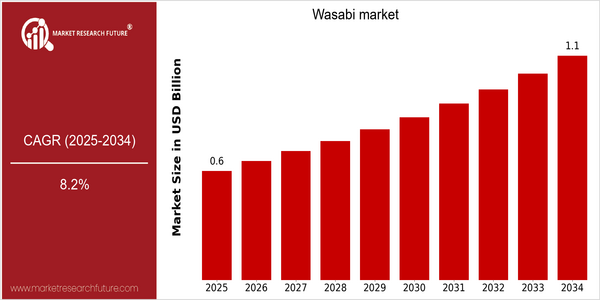
2025 USD 0.55 Billion
2034 USD 1.12 Billion
CAGR (2025-2034) 8.2 %

Note – Market size depicts the revenue generated over the financial year

The market for wasabi is expected to grow at a fast rate, from a value of $ 550,000 in 2025 to $ 1.1 billion in 2034. The annual increase in value is 8.2 percent, a significant CAGR. This growth is due to the popularity of wasabi, especially in the field of food and health. The number of consumers who are health conscious is growing, and the demand for natural and organic foods is on the rise. The uniqueness of the taste of wasabi and its supposed health benefits also make it a desirable product. The wasabi market is a result of many factors. Agricultural advances, such as hydroponics and controlled environment agriculture, have greatly increased the efficiency and yield of wasabi production. Also, the fusion cuisine and the addition of wasabi to a wide variety of food products, such as sauces, snacks, and drinks, have increased the demand for wasabi. The major players in the market, such as Pacific Farms and The Wasabi Company, have been active in strategic alliances and product development to meet the growing demand. This is expected to further stimulate the market, and wasabi is expected to continue to be a desirable ingredient in both traditional and modern cuisine.
home-ubuntu-www-mrf_ne_design-batch-5-cp-wasabi-market size

Regional Market Size

Regional Deep Dive

Wasabi is characterized by the growing interest in Japanese cuisine and the increasing demand for unusual flavours in various food applications. In North America and Europe, the growing popularity of Asian fusion cuisine and sushi is driving the market. In Asia-Pacific, traditional consumption is still strong. The market is influenced by the availability of real wasabi and horseradish substitutes, the awareness of the health benefits of wasabi, and the need for sustainable cultivation. In the end, the wasabi market is growing as consumers are looking for authentic, high-quality products.

Europe

  • European consumers are becoming more adventurous with their food choices, leading to a growing interest in wasabi-flavored products, including snacks and sauces, with companies like The Wasabi Company capitalizing on this trend.
  • Regulatory changes in food labeling and authenticity standards are pushing manufacturers to ensure that their wasabi products are genuine, which is expected to enhance consumer trust and market growth.

Asia Pacific

  • Japan remains the largest producer of authentic wasabi, with traditional farms in regions like Ibaraki Prefecture facing challenges from climate change, prompting initiatives to adopt sustainable farming practices.
  • The increasing health consciousness among consumers in countries like South Korea and China is driving interest in wasabi for its potential health benefits, including anti-inflammatory properties and high antioxidant content.

Latin America

  • In Latin America, the fusion of traditional cuisines with Asian flavors is gaining traction, leading to an increased interest in wasabi as a flavor enhancer in various dishes.
  • Local agricultural initiatives are exploring the cultivation of wasabi in regions with suitable climates, aiming to reduce reliance on imports and promote local production.

North America

  • The rise of sushi bars and Japanese restaurants has significantly increased the demand for authentic wasabi, leading to a surge in imports from Japan and local cultivation efforts by companies like Pacific Wasabi Farms.
  • Innovations in wasabi cultivation techniques, such as hydroponics and controlled-environment agriculture, are being explored by startups like Wasabi Power, which aim to enhance yield and quality while reducing environmental impact.

Middle East And Africa

  • The Middle East is witnessing a growing trend of incorporating wasabi into gourmet cuisine, with high-end restaurants experimenting with wasabi-infused dishes, which is expanding the market's reach.
  • Local distributors are beginning to import wasabi products to cater to the rising demand among expatriates and food enthusiasts, with companies like Al Haramain Foods leading the charge.

Did You Know?

“Did you know that authentic wasabi is notoriously difficult to grow and can take up to two years to mature, making it one of the most expensive condiments in the world?” — The Wasabi Company

Segmental Market Size

Wasabi is a market segment that is growing at a steady pace, largely because of the growing interest of consumers in the unique taste and health benefits of wasabi. The increasing popularity of Japanese cuisine around the world and the rising awareness of the health benefits of wasabi are the main driving forces behind the growth of this market. Moreover, the growing trend for authenticity in food has prompted more restaurants and food manufacturers to include wasabi in their menus. At present, the use of wasabi is at a mature stage. For example, companies like Kikkoman and S&B Foods have established a strong presence in the retail and food service industries. The main applications of wasabi are as a condiment for sashimi and nigiri, in sauces and dressings. In addition, macro-level trends, such as the focus on clean label and sustainable production, are driving growth in this market. Also, the advancement of agricultural practices and food processing methods are improving the quality and availability of wasabi.

Future Outlook

The Wasabi Market is expected to grow at a CAGR of 8.2 per cent from 2025 to 2034. Wasabi is used as a flavoring in sauces, dressings, and snacks. Wasabi is a premium ingredient. The demand for premium and unique ingredients is expected to increase. In addition, the technological developments in wasabi production and processing are expected to play an important role in the market. The hydroponics and controlled environment farming are expected to increase the production efficiency and quality of wasabi and make it more available to consumers. Wasabi is a good source of vitamin C and has anti-inflammatory and antioxidant properties. The health benefits of wasabi are also expected to increase the demand for wasabi. The growth of the plant-based diet and the use of wasabi in health-conscious products are expected to contribute to the growth of the wasabi market.

Wasabi Market Size Graph
Author
Snehal Singh
Assistant Manager - Research

High acumen in analyzing complex macro & micro markets with more than 6 years of work experience in the field of market research. By implementing her analytical skills in forecasting and estimation into market research reports, she has expertise in Packaging, Construction, and Equipment domains. She handles a team size of 20-25 resources and ensures smooth running of the projects, associated marketing activities, and client servicing.

Leave a Comment

FAQs

How much is the Wasabi market?

The Wasabi market size was valued at USD 0.47 Billion in 2023.

What is the growth rate of the Wasabi market?

The market is foreseen to grow at a CAGR of 8.2% during the forecast period, 2025-2034.

Which region held largest market share in the Wasabi market?

Asia Pacific had largest share of the market

Who are the key players in the Wasabi market?

The key players in the market are Coast Wasabi, The Wasabi Company, Kinjirushi Wasabi Co. Ltd., World Wasabi Inc., Real Wasabi LLC, Pacific Coast Wasabi, S&B Foods Inc., Silver Spring Foods Ltd., Eden Foods, Wasabi Essentials Ltd., Walgreens Farms.

Which type led the Wasabi market?

The fresh wasabi category dominated the market in 2023.

Which packaging had largest market share in the Wasabi market?

The bottles segment had the largest share in the market.

Market Summary

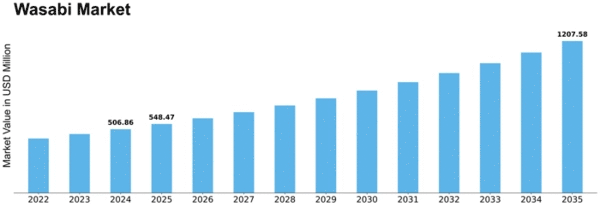
As per MRFR analysis, the Wasabi Market Size was estimated at 506.86 USD Million in 2024. The Wasabi industry is projected to grow from 548.48 in 2025 to 1207.58 by 2035, exhibiting a compound annual growth rate (CAGR) of 8.21 during the forecast period 2025 - 2035.

Key Market Trends & Highlights

The Wasabi Market is experiencing a dynamic shift driven by authenticity and innovative culinary applications.

  • The demand for authentic wasabi products is rising, particularly in North America, which remains the largest market.
  • E-commerce channels are expanding, facilitating greater access to wasabi products across diverse consumer bases.
  • Innovative culinary applications are emerging, with the cosmetic industry showing the fastest growth in wasabi utilization.
  • Key market drivers include growing health consciousness and the rising popularity of Japanese cuisine, influencing both the food and cosmetic segments.

Market Size & Forecast

2024 Market Size 506.86 (USD Million)
2035 Market Size 1207.58 (USD Million)
CAGR (2025 - 2035) 8.21%
Largest Regional Market Share in 2024 Asia-Pacific

Major Players

Mizkan Holdings (JP), Kinjirushi (JP), S&B Foods (JP), Oregon Wasabi (US), Pacific Wasabi (US), Wasabi Power (US), Wasabi Farms (US), The Wasabi Company (GB)

Market Trends

The Wasabi Market is currently experiencing a notable evolution, driven by increasing consumer interest in authentic culinary experiences and the growing popularity of Japanese cuisine worldwide. This market appears to be expanding as more individuals seek out unique flavors and health benefits associated with wasabi. The demand for fresh wasabi, as opposed to imitation products, seems to be on the rise, suggesting a shift towards quality over quantity. Additionally, the market is likely influenced by the growing trend of gourmet cooking and the incorporation of wasabi into various dishes beyond traditional sushi, such as sauces and dressings. Furthermore, the Wasabi Market is also witnessing a surge in online sales channels, which may facilitate greater accessibility for consumers. As e-commerce continues to thrive, specialty food retailers and producers are increasingly leveraging digital platforms to reach a broader audience. This trend indicates a potential for growth in niche markets, where consumers are willing to pay a premium for authentic wasabi products. Overall, the Wasabi Market appears poised for continued expansion, driven by evolving consumer preferences and innovative marketing strategies that highlight the unique attributes of this distinctive ingredient.

Rising Demand for Authenticity

Consumers are increasingly seeking authentic culinary experiences, leading to a heightened interest in genuine wasabi products. This trend suggests a preference for quality over imitation, as individuals become more discerning about the ingredients they use in their cooking.

Expansion of E-commerce Channels

The growth of online shopping is transforming the Wasabi Market, as more consumers turn to digital platforms for specialty food purchases. This shift indicates a potential for increased accessibility and convenience, allowing niche producers to reach wider audiences.

Innovative Culinary Applications

Wasabi is being incorporated into a variety of dishes beyond traditional sushi, such as sauces, dressings, and gourmet recipes. This trend reflects a broader culinary exploration, where chefs and home cooks alike experiment with wasabi to enhance flavors.

Wasabi Market Market Drivers

Health Benefits of Wasabi

The Global Wasabi Industry benefits from the increasing awareness of the health advantages associated with wasabi consumption. Rich in antioxidants and possessing anti-inflammatory properties, wasabi is gaining recognition as a functional food. Research indicates that wasabi may aid in digestion and boost the immune system, appealing to health-conscious consumers. This growing interest in health-oriented products is likely to expand the market, as consumers seek out natural ingredients that contribute to their well-being. Consequently, the health benefits of wasabi are expected to play a pivotal role in the industry's growth, potentially contributing to the market's expansion towards an estimated 1.21 USD Billion by 2035.

Expansion of E-commerce Platforms

The rise of e-commerce platforms is reshaping the Global Wasabi Industry by providing consumers with easier access to wasabi products. Online retailers are increasingly offering a variety of wasabi-based items, from sauces to snacks, catering to a broader audience. This expansion allows consumers to purchase authentic wasabi products from the comfort of their homes, thus driving sales. The convenience of online shopping, coupled with targeted marketing strategies, is likely to attract new customers and enhance brand visibility. As e-commerce continues to grow, it is expected to play a crucial role in the market's expansion, contributing to the anticipated increase in market value over the coming years.

Growing Popularity of Asian Cuisine

The Global Wasabi Industry is significantly influenced by the rising popularity of Asian cuisine worldwide. As more consumers embrace diverse culinary experiences, wasabi is increasingly featured in various dishes beyond traditional sushi. This trend is evident in the incorporation of wasabi into fusion cuisine, snacks, and sauces, appealing to a wider demographic. The growing interest in Asian flavors is likely to drive demand for wasabi products, as consumers seek to replicate authentic dining experiences at home. This shift in culinary preferences may contribute to the market's growth, aligning with the projected increase in market value to 1.21 USD Billion by 2035.

Rising Demand for Authentic Cuisine

The Global Wasabi Industry experiences a notable surge in demand for authentic Japanese cuisine, particularly in Western countries. As culinary enthusiasts increasingly seek genuine flavors, the appeal of wasabi as a condiment has grown. This trend is evidenced by the projected market value of 0.51 USD Billion in 2024, reflecting a growing consumer preference for traditional ingredients. Restaurants and food manufacturers are incorporating wasabi into various dishes, enhancing their offerings. This shift towards authenticity not only boosts wasabi sales but also encourages the cultivation of wasabi, which is often considered a delicacy. Thus, the rising demand for authentic cuisine significantly drives the Global Wasabi Industry.

Innovations in Cultivation Techniques

Advancements in agricultural practices are transforming the Global Wasabi Industry. Innovative cultivation techniques, such as hydroponics and controlled environment agriculture, are being adopted to enhance wasabi production. These methods not only increase yield but also improve the quality of the product, making it more appealing to consumers. As a result, producers can meet the rising demand while ensuring sustainability. The implementation of these technologies may lead to a more robust supply chain, ultimately supporting the market's growth trajectory. With a projected CAGR of 8.19% for the period from 2025 to 2035, innovations in cultivation techniques are likely to significantly influence the Global Wasabi Industry.

Market Segment Insights

By Application: Food Industry (Largest) vs. Cosmetic Industry (Fastest-Growing)

In the Wasabi Market, the Food Industry dominates the application segment, leveraging the product's unique flavor and health benefits. This sector contributes significantly to market share, catering to restaurants and food manufacturers that prefer wasabi as a key ingredient in various dishes. Conversely, the Cosmetic Industry is emerging rapidly, attracting attention for its natural properties, often utilized in skincare and beauty products. This increasing demand is driven by consumer trends favoring organic and plant-based ingredients. The growth trajectory for the Food Industry remains stable, supported by the expanding culinary interest in authentic wasabi flavors. Meanwhile, the Cosmetic Industry is witnessing a surge as personal care brands integrate wasabi due to its antioxidant properties. Market drivers include rising health awareness, demand for unique flavor profiles in the food sector, and an inclination towards natural ingredients in cosmetics, propelling both industries forward in the Wasabi Market.

Food Industry (Dominant) vs. Cosmetic Industry (Emerging)

The Food Industry holds a dominant position in the Wasabi Market, characterized by a robust demand from restaurants and gourmet food producers. This segment is well-established, capitalizing on wasabi's rich flavors that enhance traditional dishes, particularly in Japanese cuisine. Its widespread acceptance in The Wasabi support. In contrast, the Cosmetic Industry is rapidly emerging, driven by a consumer shift towards natural and organic products. Brands are increasingly integrating wasabi into their formulations, recognizing its potential benefits, such as anti-inflammatory and antibacterial properties. This shift reflects a growing trend among consumers who prioritize health-focused ingredients, paving the way for wasabi's innovative applications in cosmetics.

By Form: Paste (Largest) vs. Powder (Fastest-Growing)

In the Wasabi Market, the form segment is primarily divided into four main categories: Paste, Powder, Fresh Wasabi, and Wasabi Sauce. Among these, Paste has established itself as the largest segment, favored for its convenience and strong flavor profile, making it a staple in both retail and food service. Powder, while currently smaller in market share, is rapidly gaining traction due to its versatility in culinary applications and consumer preferences shifting towards premium products.

Paste (Dominant) vs. Powder (Emerging)

Paste is the dominant form in the wasabi market, widely utilized across various culinary traditions for its robust flavor, ease of use, and long shelf life. Its popularity in restaurants and home kitchens drives significant demand, especially in prepared foods. In contrast, Powder is an emerging segment that appeals to consumers seeking authenticity and purity in flavor. As interest in ethnic cuisines rises, Powder is increasingly recognized for its ability to blend into sauces, dressings, and marinades, thus presenting a fresh opportunity for growth and innovation.

By Distribution Channel: Online Retail (Largest) vs. Supermarkets (Fastest-Growing)

In the Wasabi Market, distribution channels are diversifying, with Online Retail occupying the largest share, due to increasing consumer preference for shopping convenience. Supermarkets also play a significant role, acting as a crucial point for consumers seeking fresh and quality wasabi. Specialty Stores and Food Service have smaller shares but are vital for niche market segments and culinary applications. The varied channels cater to different segments of the market, ensuring availability across demographics and preferences.

Online Retail (Dominant) vs. Food Service (Emerging)

Online Retail dominates the Wasabi Market, distinguishing itself through convenience and accessibility. Major e-commerce platforms offer consumers a wide range of organic and specialty wasabi products, meeting the demand for convenience while driving sales growth. In contrast, the Food Service segment is an emerging player, targeting restaurants and food establishments that seek high-quality ingredients for their dishes. As trends in culinary arts evolve, the demand for authentic wasabi among chefs is on the rise, providing a unique growth opportunity for this segment.

By End Use: Household (Largest) vs. Commercial (Fastest-Growing)

In the Wasabi Market, the end-use segment is divided among Household, Commercial, and Industrial applications. The Household segment holds the largest market share, being favored for its traditional use in home cooking and sushi preparation. On the other hand, the Commercial segment is witnessing rapid growth, driven by increasing demand in restaurants and food service establishments that seek to enhance their culinary offerings with authentic flavors and high-quality wasabi products. The growth trends show a significant uptick in the Commercial segment, primarily due to an expanding culinary culture and rising consumer inclination towards gourmet food experiences. This trend is further fueled by innovative food products incorporating wasabi, along with marketing campaigns promoting its health benefits. Additionally, social media influences and the growth of international cuisine are propelling the Commercial segment to become one of the fastest-growing sectors in the Wasabi Market.

End Use: Household (Dominant) vs. Commercial (Emerging)

The Household segment remains dominant in the Wasabi Market, centered on traditional consumers who utilize wasabi in home kitchens for sushi and various Asian dishes. This segment thrives on loyalty to authentic flavors, ensuring steady demand. Meanwhile, the Commercial segment is emerging rapidly, driven by chefs and food establishments seeking unique ingredients to elevate culinary experiences. This segment is characterized by a focus on quality sourcing, with many vendors offering premium wasabi products to meet the demands of discerning customers. The trend towards health-conscious eating and fusion cuisine is also expanding the Commercial segment, allowing it to cater to a broader audience, thus nurturing innovation while solidifying its place in the market.

Get more detailed insights about Wasabi Market Research Report - Forecast till 2035

Regional Insights

North America : Growing Demand for Authentic Flavors

The North American wasabi market is projected to reach $80.0 million by December 2025, driven by increasing consumer interest in authentic and exotic flavors. The demand for wasabi in culinary applications, particularly in sushi and Asian cuisine, is on the rise. Regulatory support for food safety and quality standards is also a significant catalyst for market growth, ensuring that consumers have access to high-quality products. Leading the market are the United States and Canada, where key players like Oregon Wasabi and Pacific Wasabi are making substantial contributions. The competitive landscape is characterized by a mix of established brands and emerging players, all vying for market share. The presence of companies such as Mizkan Holdings and S&B Foods further enhances the market's dynamism, ensuring a diverse range of wasabi products for consumers.

Europe : Emerging Market for Specialty Foods

Europe's wasabi market is estimated at $70.0 million, reflecting a growing interest in specialty foods among consumers. The demand for authentic wasabi is being driven by the increasing popularity of Asian cuisine and the trend towards gourmet cooking. Regulatory frameworks in the EU are supportive of food innovation, which encourages the introduction of new wasabi products into the market. Countries like the UK, Germany, and France are leading the charge in wasabi consumption, with a notable presence of key players such as The Wasabi Company. The competitive landscape is evolving, with both local producers and international brands competing for market share. The increasing availability of wasabi in gourmet food stores and online platforms is further enhancing its visibility and accessibility.

Asia-Pacific : Dominating The Wasabi

The Asia-Pacific region dominates The Wasabi, with a staggering market size of $300.0 million. This growth is fueled by the region's rich culinary heritage and the increasing incorporation of wasabi in various dishes. The demand is further supported by favorable regulations that promote agricultural innovation and food safety, ensuring high-quality wasabi production. Japan, being the birthplace of wasabi, remains a key player, alongside emerging markets like China and South Korea. Major companies such as Kinjirushi and S&B Foods are pivotal in shaping the competitive landscape. The presence of these established brands, combined with a growing number of local producers, ensures a robust supply chain and diverse product offerings for consumers.

Middle East and Africa : Niche Market with Growth Potential

The Middle East and Africa wasabi market is valued at $56.86 million, representing a niche yet growing segment. The increasing interest in Asian cuisine and the rise of gourmet dining experiences are key drivers of demand in this region. Regulatory bodies are beginning to recognize the potential of specialty foods, which may lead to more supportive policies for wasabi cultivation and distribution. Countries like South Africa and the UAE are emerging as significant markets for wasabi, with local chefs and restaurants increasingly incorporating it into their menus. The competitive landscape is still developing, with a few key players and local producers beginning to enter the market, indicating potential for future growth and expansion.

Key Players and Competitive Insights

The Wasabi Market is currently characterized by a dynamic competitive landscape, driven by increasing consumer interest in authentic culinary experiences and the growing popularity of Japanese cuisine globally. Key players such as Mizkan Holdings (Japan), Kinjirushi (Japan), and Oregon Wasabi (US) are strategically positioned to leverage these trends. Mizkan Holdings (Japan) focuses on innovation in product offerings, particularly in developing new wasabi-based sauces and condiments, which cater to evolving consumer tastes. Kinjirushi (Japan) emphasizes regional expansion, enhancing its distribution networks to penetrate new markets, while Oregon Wasabi (US) is dedicated to sustainable farming practices, which resonate with environmentally conscious consumers. Collectively, these strategies contribute to a competitive environment that is increasingly focused on quality, sustainability, and consumer engagement.In terms of business tactics, companies are localizing manufacturing to reduce costs and improve supply chain efficiency. The Wasabi Market appears moderately fragmented, with several players vying for market share. However, the influence of key players is substantial, as they set quality standards and consumer expectations. This competitive structure encourages innovation and collaboration among companies, fostering a vibrant market atmosphere.

In November Oregon Wasabi (US) announced a partnership with a leading organic food retailer to expand its product line into organic wasabi products. This strategic move is significant as it aligns with the growing consumer demand for organic and sustainably sourced foods, potentially enhancing the company's market presence and brand reputation. By tapping into the organic segment, Oregon Wasabi (US) may attract a new customer base, thereby increasing its sales and market share.

In October Mizkan Holdings (Japan) launched a new line of wasabi-infused sauces aimed at the gourmet cooking segment. This initiative reflects the company's commitment to innovation and its understanding of current culinary trends. By diversifying its product offerings, Mizkan Holdings (Japan) not only strengthens its competitive position but also addresses the increasing consumer preference for unique flavor profiles in cooking.

In September Kinjirushi (Japan) completed the acquisition of a local wasabi farm in the United States, enhancing its supply chain capabilities and ensuring a steady supply of high-quality wasabi. This acquisition is strategically important as it allows Kinjirushi (Japan) to control production quality and costs, thereby improving its competitive edge in the market. Such vertical integration may also enable the company to respond more swiftly to market demands and fluctuations.

As of December the Wasabi Market is witnessing trends such as digitalization, sustainability, and the integration of AI in production processes. Companies are increasingly forming strategic alliances to enhance their competitive positioning and operational efficiency. The shift from price-based competition to a focus on innovation, technology, and supply chain reliability is evident. Moving forward, competitive differentiation will likely hinge on the ability to innovate and adapt to changing consumer preferences, with sustainability becoming a core component of brand identity.

Key Companies in the Wasabi Market include

Industry Developments

  • Q3 2025: Wasabi Market looks to expand despite profit dive London sushi restaurant chain Wasabi Market announced plans to open new restaurants across the UK and is working with franchise partners to accelerate growth, despite reporting a 74.85% decline in after-tax profit for 2024.

Future Outlook

Wasabi Market Future Outlook

The Wasabi is projected to grow at an 8.21% CAGR from 2024 to 2035, driven by increasing demand in culinary applications and health benefits.

New opportunities lie in:

  • Expansion of wasabi-based product lines in gourmet food sectors.
  • Development of sustainable wasabi farming techniques to enhance supply.
  • Investment in wasabi extraction technologies for health supplement markets.

By 2035, the Wasabi Market is expected to achieve robust growth, solidifying its position in the global food industry.

Market Segmentation

Wasabi Market Form Outlook

  • Paste
  • Powder
  • Fresh Wasabi
  • Wasabi Sauce

Wasabi Market End Use Outlook

  • Household
  • Commercial
  • Industrial

Wasabi Market Application Outlook

  • Food Industry
  • Cosmetic Industry
  • Pharmaceutical Industry
  • Nutraceutical Industry

Wasabi Market Distribution Channel Outlook

  • Online Retail
  • Supermarkets
  • Specialty Stores
  • Food Service

Report Scope

MARKET SIZE 2024506.86(USD Million)
MARKET SIZE 2025548.48(USD Million)
MARKET SIZE 20351207.58(USD Million)
COMPOUND ANNUAL GROWTH RATE (CAGR)8.21% (2025 - 2035)
REPORT COVERAGERevenue Forecast, Competitive Landscape, Growth Factors, and Trends
BASE YEAR2024
Market Forecast Period2025 - 2035
Historical Data2019 - 2024
Market Forecast UnitsUSD Million
Key Companies ProfiledMizkan Holdings (JP), Kinjirushi (JP), S&B Foods (JP), Oregon Wasabi (US), Pacific Wasabi (US), Wasabi Power (US), Wasabi Farms (US), The Wasabi Company (GB)
Segments CoveredApplication, Form, Distribution Channel, End Use
Key Market OpportunitiesGrowing demand for authentic wasabi products in gourmet cuisine and health-conscious consumer segments.
Key Market DynamicsRising consumer demand for authentic flavors drives innovation and competition in the wasabi market.

Countries CoveredNorth America, Europe, APAC, South America, MEA

FAQs

How much is the Wasabi market?

The Wasabi market size was valued at USD 0.47 Billion in 2023.

What is the growth rate of the Wasabi market?

The market is foreseen to grow at a CAGR of 8.2% during the forecast period, 2025-2034.

Which region held largest market share in the Wasabi market?

Asia Pacific had largest share of the market

Who are the key players in the Wasabi market?

The key players in the market are Coast Wasabi, The Wasabi Company, Kinjirushi Wasabi Co. Ltd., World Wasabi Inc., Real Wasabi LLC, Pacific Coast Wasabi, S&B Foods Inc., Silver Spring Foods Ltd., Eden Foods, Wasabi Essentials Ltd., Walgreens Farms.

Which type led the Wasabi market?

The fresh wasabi category dominated the market in 2023.

Which packaging had largest market share in the Wasabi market?

The bottles segment had the largest share in the market.

  1. SECTION I: EXECUTIVE SUMMARY AND KEY HIGHLIGHTS
    1. | 1.1 EXECUTIVE SUMMARY
  2. SECTION II: SCOPING, METHODOLOGY AND MARKET STRUCTURE
    1. | 2.1 MARKET INTRODUCTION
    2. | 2.2 RESEARCH METHODOLOGY
  3. SECTION III: QUALITATIVE ANALYSIS
    1. | 3.1 MARKET DYNAMICS
    2. | 3.2 MARKET FACTOR ANALYSIS
  4. SECTION IV: QUANTITATIVE ANALYSIS
    1. | 4.1 Food, Beverages & Nutrition, BY Application (USD Million)
    2. | 4.2 Food, Beverages & Nutrition, BY Form (USD Million)
    3. | 4.3 Food, Beverages & Nutrition, BY Distribution Channel (USD Million)
    4. | 4.4 Food, Beverages & Nutrition, BY End Use (USD Million)
    5. | 4.5 Food, Beverages & Nutrition, BY Region (USD Million)
  5. SECTION V: COMPETITIVE ANALYSIS
    1. | 5.1 Competitive Landscape
    2. | 5.2 Company Profiles
    3. | 5.3 Appendix

Wasabi Market Segmentation

Market Segmentation Overview

  • Detailed segmentation data will be available in the full report
  • Comprehensive analysis by multiple parameters
  • Regional and country-level breakdowns
  • Market size forecasts by segment
Infographic

Free Sample Request

Kindly complete the form below to receive a free sample of this Report

Get Free Sample

Customer Strories

Compare Licence

×
Features License Type
Single User Multiuser License Enterprise User
Price $4,950 $5,950 $7,250
Maximum User Access Limit 1 User Upto 10 Users Unrestricted Access Throughout the Organization
Free Customization
Direct Access to Analyst
Deliverable Format
Platform Access
Discount on Next Purchase 10% 15% 15%
Printable Versions