Request Free Sample ×

Kindly complete the form below to receive a free sample of this Report

* Please use a valid business email

Leading companies partner with us for data-driven Insights

clients tt-cursor
Hero Background
English
Chinese
French
Japanese
Korean
German
Spanish

Wall Art Market Analysis

ID: MRFR/CG/10977-HCR
128 Pages
Snehal Singh
December 2024

Wall Art Market Size, Share, Industry Trend & Analysis Research Report Information By Sales Channel (Dealers and Auction Houses), By Material (Canvas, Paper and Others), By Type (Fine, Abstract, Modern and Others), And By Region (North America, Europe, Asia-Pacific, And Rest Of The World) – Forecast Till 2035

Share:
Download PDF ×

We do not share your information with anyone. However, we may send you emails based on your report interest from time to time. You may contact us at any time to opt-out.

Wall Art Market Infographic
Purchase Options

Market Analysis

In-depth Analysis of Wall Art Market Industry Landscape

The dynamics of the wall art industry provide a complex picture shaped by a variety of elements, including changing consumer preferences, creative trends, technical advancements, shifts in the economy, changes in lifestyles, and business tactics. Wall art serves customers looking for individualized and beautiful home décor solutions. It comes in a variety of mediums, including paintings, prints, posters, and ornamental items. The wall art market's dynamics are significantly shaped by consumer preferences. Contemporary buyers want for wall art that not only accentuates their interior design aesthetics but also captures their unique personalities and design tastes. This has created a need for a wide range of adaptable and varied art pieces that suit different preferences, from eclectic and traditional to modern and minimalist. The market for distinctive and expressive wall art is driven by consumers' preference for wall art that gives their living spaces more character and individuality. The way the wall art industry operates is greatly influenced by changing styles and artistic trends. Trends in art are influenced by shifting society norms and personal preferences, which affect the kinds of artwork that buyers want to buy. The market showcases a diverse range of creative expressions, spanning from traditional classics to contemporary and abstract items. Furthermore, wall art's appeal has grown with the introduction of digital art and graphic designs, which provide creative and adaptable solutions that appeal to a generation that was raised in the digital age. Developments in technology have a big impact on how the wall art business operates. Wall art creation, marketing, and experience have all undergone radical changes because to digital printing methods, internet marketplaces, and augmented reality technology. With the help of these developments, artists and manufacturers can now create exquisite replicas, personalize pieces of art, and offer immersive experiences to customers looking for digital or interactive wall art installations. The dynamics of the wall art sector are also influenced by market trends and economic variables. Variations in consumer buying habits, disposable income, and interior design trends impact the market demand for particular kinds of wall art. Customers' propensity to spend money on wall art pieces that increase visual appeal and represent personal taste is influenced by a number of factors, including the housing market, consumer confidence, and economic stability.

Author
Author Profile
Snehal Singh
Manager - Research

High acumen in analyzing complex macro & micro markets with more than 6 years of work experience in the field of market research. By implementing her analytical skills in forecasting and estimation into market research reports, she has expertise in Packaging, Construction, and Equipment domains. She handles a team size of 20-25 resources and ensures smooth running of the projects, associated marketing activities, and client servicing.

Leave a Comment

FAQs

What is the current valuation of The Global Wall Art?

<p>The Global Wall Art was valued at 64.06 USD Billion in 2024.</p>

What is the projected market size for The Global Wall Art by 2035?

<p>The market is projected to reach 120.37 USD Billion by 2035.</p>

What is the expected CAGR for The Global Wall Art during the forecast period?

<p>The expected CAGR for The Global Wall Art from 2025 to 2035 is 5.9%.</p>

Which companies are considered key players in The Global Wall Art?

<p>Key players include IKEA, Wayfair, Society6, Etsy, Art.com, Saatchi Art, Zazzle, Redbubble, and Fine Art America.</p>

How are sales channels segmented in The Global Wall Art?

<p>Sales channels are segmented into Dealers and Auction Houses, with both valued at approximately 60.19 USD Billion.</p>

What materials are primarily used in wall art, and how are they valued?

<p>Materials include Canvas valued at 45.0 USD Billion, Paper at 35.0 USD Billion, and Others at 40.37 USD Billion.</p>

What types of wall art are most popular in the market?

Popular types include Modern art valued at 40.0 USD Billion, Fine art at 30.0 USD Billion, and Abstract art at 25.0 USD Billion.

How does the market performance of wall art compare across different segments?

The market performance varies, with the highest valuation in the Modern art segment, followed by Fine and Abstract art.

What trends are influencing the growth of The Global Wall Art?

Trends include increasing consumer interest in home decor and the rise of online platforms like Etsy and Society6.

What factors could impact the future growth of The Global Wall Art?

Factors may include changing consumer preferences, economic conditions, and the expansion of e-commerce platforms.

Market Summary

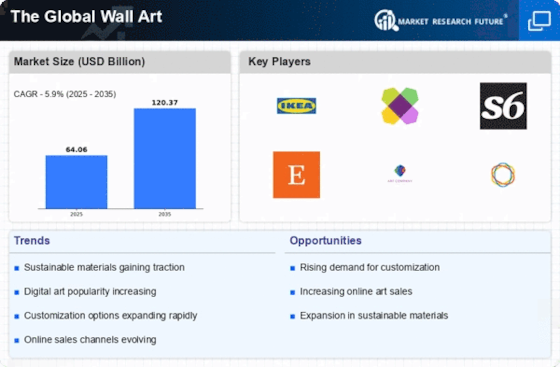
As per Market Research Future analysis, The Global Wall Art Market Size was estimated at 64.06 USD Billion in 2024. The wall art industry is projected to grow from 67.84 USD Billion in 2025 to 120.37 USD Billion by 2035, exhibiting a compound annual growth rate (CAGR) of 5.9% during the forecast period 2025 - 2035

Key Market Trends & Highlights

The Global Wall Art Market is experiencing dynamic growth driven by evolving consumer preferences and technological advancements.

  • The rise of digital art is reshaping the traditional wall art landscape, particularly in North America. Sustainability in art production is becoming increasingly important, reflecting a broader societal shift towards eco-consciousness in Asia-Pacific. Customization and personalization are gaining traction, allowing consumers to create unique art pieces that resonate with their individual tastes. Increasing urbanization and the influence of social media are major drivers propelling the demand for wall art, especially in the dealer segment.

Market Size & Forecast

2024 Market Size 64.06 (USD Billion)
2035 Market Size 120.37 (USD Billion)
CAGR (2025 - 2035) 5.9%
Largest Regional Market Share in 2024 North America

Major Players

IKEA (SE), Wayfair (US), Society6 (US), Etsy (US), Art.com (US), Saatchi Art (US), Zazzle (US), Redbubble (AU), Fine Art America (US)

Market Trends

The Global Wall Art Market is currently experiencing a dynamic evolution, characterized by a growing appreciation for diverse artistic expressions and innovative designs. This market encompasses a wide array of products, including paintings, prints, and decorative wall hangings, appealing to various consumer preferences. As individuals increasingly seek to personalize their living spaces, the demand for unique and aesthetically pleasing wall art continues to rise. Furthermore, the integration of technology in art creation and distribution is reshaping traditional paradigms, allowing artists to reach broader audiences and consumers to access a wider selection of artworks. In addition, sustainability appears to be a pivotal factor influencing purchasing decisions within The Global Wall Art Market. Consumers are becoming more conscious of the environmental impact of their choices, leading to a preference for eco-friendly materials and practices. This shift suggests that artists and manufacturers who prioritize sustainable methods may gain a competitive edge. Overall, The Global Wall Art Market is poised for continued growth, driven by evolving consumer tastes, technological advancements, and a heightened awareness of sustainability in art production.

Rise of Digital Art

The emergence of digital art is transforming The Global Wall Art Market. Artists are increasingly utilizing digital platforms to create and showcase their work, appealing to tech-savvy consumers. This trend not only broadens the scope of artistic expression but also facilitates easier access to art for a global audience.

Sustainability in Art Production

Sustainability is becoming a crucial consideration in The Global Wall Art Market. Consumers are showing a preference for artworks created from eco-friendly materials and processes. This trend indicates a shift towards responsible consumption, prompting artists and manufacturers to adopt greener practices.

Customization and Personalization

The demand for customized wall art is on the rise within The Global Wall Art Market. Consumers are increasingly seeking personalized pieces that reflect their individual tastes and experiences. This trend highlights the importance of unique artistic expressions that resonate with personal narratives.

Wall Art Market Market Drivers

E-commerce Expansion

The expansion of e-commerce platforms is transforming the way consumers access and purchase wall art. With the rise of online shopping, the wall art market is experiencing a shift in consumer behavior, as individuals increasingly prefer the convenience of browsing and purchasing art from the comfort of their homes. Data indicates that online sales of wall art have surged, with a notable increase in the number of platforms offering diverse styles and price ranges. This accessibility allows consumers to explore a wider array of options, potentially leading to higher sales volumes. Additionally, the ability to customize and order art online may further enhance consumer engagement, suggesting that e-commerce will continue to play a pivotal role in the growth of the wall art market.

Increasing Urbanization

The trend of urbanization appears to be a significant driver for the wall art market. As more individuals move to urban areas, the demand for home decor, including wall art, is likely to rise. Urban dwellers often seek to personalize their living spaces, which may lead to an increase in the consumption of various art forms. The wall art market is projected to benefit from this demographic shift, as urban residents tend to invest in aesthetics that reflect their personality and lifestyle. Furthermore, the growing number of apartments and smaller living spaces may encourage the use of wall art as a means to enhance visual appeal without occupying physical space. This trend suggests a potential growth trajectory for the wall art market, as urbanization continues to reshape living environments.

Influence of Social Media

Social media platforms are playing a crucial role in shaping trends within the wall art market. The visual nature of platforms such as Instagram and Pinterest encourages users to share and discover art, which may lead to increased interest and demand for various styles. Influencers and artists often showcase their work on these platforms, creating a ripple effect that can drive consumer purchasing decisions. As users engage with art content, they may be more inclined to invest in wall art that resonates with their personal tastes. This phenomenon indicates that social media is not only a marketing tool but also a catalyst for trends, potentially leading to a dynamic and evolving wall art market.

Growing Interest in Home Decor

The increasing interest in home decor is a notable driver for the wall art market. As individuals spend more time at home, particularly in personal spaces, there is a heightened focus on creating aesthetically pleasing environments. This trend is reflected in the rising sales of home decor items, including wall art, which serves as a key element in enhancing interior design. Market data suggests that consumers are willing to invest in unique and expressive pieces that reflect their style and personality. This growing emphasis on home aesthetics indicates a robust potential for the wall art market, as individuals seek to transform their living spaces into personalized sanctuaries.

Cultural and Artistic Diversity

The increasing appreciation for cultural and artistic diversity is influencing the wall art market. As globalization continues to connect different cultures, consumers are becoming more interested in art that reflects diverse backgrounds and narratives. This trend is evident in the rising demand for artworks that celebrate various cultural heritages, which may lead to a broader range of offerings in the wall art market. Artists are increasingly inspired by global influences, resulting in unique pieces that resonate with a wide audience. This cultural exchange not only enriches the market but also suggests a potential for growth as consumers seek to incorporate diverse artistic expressions into their homes.

Market Segment Insights

By Sales Channel: Dealers (Largest) vs. Auction Houses (Fastest-Growing)

The Global Wall Art Market displays a varied distribution of sales channels, with dealers currently holding the largest market share. Dealers, as a primary sales channel, benefit from established customer relationships and broad inventories, catering to diverse consumer preferences. Conversely, auction houses, while smaller in volume, are gaining attention for high-value pieces, making them an increasingly popular choice among discerning collectors seeking unique artworks. This dynamic is shaping the overall sales landscape in the wall art sector.

Dealers (Dominant) vs. Auction Houses (Emerging)

Dealers play a dominant role in The Global Wall Art Market, often serving as intermediaries between artists and consumers. They leverage extensive networks and marketing strategies to promote various art styles, ensuring sustained customer engagement. On the other hand, auction houses, characterized as the emerging sales channel, are rapidly carving out a niche by offering rare and sought-after pieces to specialized audiences. This evolution is driven by shifting consumer preferences toward exclusive and investment-worthy artworks, fueling growth and innovation in auction platforms. Both sales channels remain pivotal, as they cater to different segments of the market, reinforcing the overall health and diversity of the Global Wall Art industry.

By Material: Canvas (Largest) vs. Paper (Fastest-Growing)

In The Global Wall Art Market, the material segment showcases a diverse distribution among its primary categories: Canvas, Paper, and Others. Canvas remains the dominant choice for consumers seeking durable and high-quality wall art that offers an unmatched visual impact. Meanwhile, the Paper segment is gaining traction rapidly, appealing to artists and consumers alike who favor its versatility and affordability. As tastes evolve, the market sees a growing interest in unconventional materials, represented in the 'Others' category, which includes innovative substrates and eco-friendly options. The growth trends in this segment are significantly driven by the increasing demand for personalized and unique wall decor among consumers. The popularity of online platforms for art sales has further propelled the Paper segment, which is favored for it its ease of printing and shipping. Moreover, sustainability trends are fostering interest in material diversity, providing opportunities for new entrants in the market to introduce alternative materials that align with contemporary consumer values. Overall, innovation and changing aesthetic preferences are defining the trajectory of the material segment in wall art.

Canvas (Dominant) vs. Paper (Emerging)

Canvas has established itself as the dominant material in The Global Wall Art Market due to its aesthetic appeal and durability, which makes it a preferred choice for both artists and consumers. It can withstand varying environmental conditions without compromising print quality, thus maintaining its attractiveness over long periods. Furthermore, canvases allow artists to experiment with texture and depth, making their artwork stand out. In contrast, the Paper segment is emerging as a strong competitor, particularly favored by budget-conscious consumers and artists. It supports a wide array of artistic styles and printing techniques while being cost-effective and lightweight, which enhances its appeal in online art sales. As consumer preferences shift towards personalization and unique designs, both segments are expected to play crucial roles in the evolving landscape of wall art.

By Type: Fine (Largest) vs. Abstract (Fastest-Growing)

In The Global Wall Art Market, the Fine art segment constitutes the largest share, appealing to a diverse audience that appreciates traditional aesthetics and craftsmanship. The Abstract art segment, while smaller, is experiencing rapid growth as consumers and collectors seek innovative expression and emotional depth in their art choices. Over recent years, the market has seen a shift towards digital channels, increasing accessibility to fine and abstract art, further influencing market distribution dynamics. Growth trends in the wall art market are driven by evolving consumer preferences toward personalization and unique decor. Abstract art, in particular, is resonating well with millennials and Gen Z consumers who value originality and artistic expression. The trend has led to a rise in independent artists and platforms that showcase abstract works, contributing to its status as the fastest-growing segment in the market.

Fine Art: (Dominant) vs. Abstract Art (Emerging)

Fine art remains the dominant force in The Global Wall Art Market, recognized for its traditional significance and aesthetic appeal. It includes classic works that often reflect historical context and cultural values, attracting art enthusiasts of all ages. In contrast, Abstract art represents the emerging trend, capturing the interest of a younger demographic seeking pieces that evoke personal interpretations and emotions. The appeal of Abstract art lies in its versatility, allowing it to fit various interior styles and preferences. While Fine art continues to command respect and stability in the market, Abstract art is carving its niche by offering innovative and contemporary expressions that cater to the desires of modern consumers.

Get more detailed insights about Wall Art Market Research Report – Forecast till 2035

Regional Insights

By region, the study provides the market insights into North America, Europe, Asia-Pacific and Rest of the World. The North American wall art market area will dominate this market. Due to the significant demand from American customers for artisan-made home decor items including paintings, drawings, and sculptures, this region is leading the world wall art market.

In a poll of more than 2,000 Americans done in 2022 by the art printing company Canvas pop, 51% of the respondents said they preferred buying pieces of art that had personal significance for their homes, while 39% said they preferred buying works of art that complemented their home decor demands.

Further, the major countries studied in the market report are the US, Canada, German, France, the UK, Italy, Spain, China, Japan, India, Australia, South Korea, and Brazil.

Figure 2:  WALL ART MARKET SHARE BY REGION 2022 (USD Billion)

Source Secondary Research, Primary Research, Market Research Future Database and Analyst Review

Europe wall art market accounts for the second-largest market share because more people are visiting art museums in France and the United Kingdom, which is boosting the region's sales of wall artworks. According to data provided by the UK government, 51% of U.K. respondents reported visiting a museum at least once in 2019–20, up from 42% in 2005–2006. Growth in the regional industry is also being fueled by Europeans' growing knowledge of the accessibility of digital artworks.

Further, the German wall art market held the largest market share, and the UK wall art market was the fastest growing market in the European region.

The Asia-Pacific Wall Art Market is expected to grow at the fastest CAGR from 2023 to 2032 because of India's and China's expanding construction of residential and commercial infrastructure, which is boosting consumer demand for wall décor goods. According to data released by the People's Republic of China (PRC), sales of commercial real estate in the nation reached 498.5 million square meters in 2020, an increase of 0.3% from 2019. The demand for goods in the Asia Pacific region will also be boosted by changing home design and renovation trends in these nations.

Moreover, China’s wall art market held the largest market share, and the Indian wall art market was the fastest growing market in the Asia-Pacific region.

Key Players and Competitive Insights

Leading market players are investing heavily in research and development in order to expand their product lines, which will help the wall art market grow even more. Market participants are also undertaking a variety of strategic activities to expand their footprint, with important market developments including new product launches, contractual agreements, mergers and acquisitions, higher investments, and collaboration with other organizations. To expand and survive in a more competitive and rising market climate, the wall art industry must offer cost-effective items.Manufacturing locally to minimize operational costs is one of the key business tactics used by manufacturers in the wall art industry to benefit clients and increase the market sector. In recent years, the wall art industry has offered some of the most significant advantages to medicine. Major players in the wall art market are attempting to increase market demand by investing in research and development operations includes Saatchi Art (U.S.), Minted LLC. (U.S.), Artspace LLC (U.S.), Artfinder (U.K.), Artsy (U.S.), Art.com (U.S.), The Tellenge Store (India), Artisera (India), Zatista LLC (U.S.), and Seven Wall Art Market Corporation (U.S.).The online store Minted LLC sells high-end design and lifestyle products. Independent artists and designers from all around the world created the products offered on the marketplace. The business was established in 2007 and is now based in California, America. The company offers a variety of goods, such as stationery, art, and home decor.Artspace LLC is an online retailer of modern art that was established in 2011 with the intention of promoting artists and bringing art to a broader audience. A carefully curated collection of artworks is available at Artspace, including mixed-media pieces, sculptures, paintings, prints, and more. With a wide selection of artworks, it has expanded its market reach to become a significant player in the online art market.

Key Companies in the Wall Art Market include

Industry Developments

  • Q1 2025: At Phillips, meanwhile, Martin Wilson will take the reigns as CEO this year, taking over from Stephen Brooks. Phillips, a major global auction house with a significant wall art business, appointed Martin Wilson as CEO in 2025, succeeding Stephen Brooks. The company’s executive chairman Ed Dolman also left his post in the same period.
  • Q1 2025: Christie’s also comes off a year of major expansion, having opened a new Hong Kong headquarters last year. Christie’s, a leading auction house with a substantial wall art segment, completed a major business expansion by opening a new Hong Kong headquarters in late 2024, strengthening its presence in the Asia-Pacific art market.
  • Q1 2024: Christie’s reported a staggering 41% year-over-year increase in private transactions in 2024 Christie’s, a top auction house dealing in wall art, announced a 41% year-over-year increase in private sales transactions in 2024, reflecting a significant business development in its private sales division.
  • Q1 2024: Saatchi Art (USA) collaborated with digital artists to launch an NFT-integrated wall art series, blending physical artwork with digital ownership experiences. Saatchi Art launched a new NFT-integrated wall art series in February 2024, partnering with digital artists to offer collectors both physical and digital ownership experiences.

Future Outlook

Wall Art Market Future Outlook

The Global Wall Art Market is projected to grow at a 5.9% CAGR from 2025 to 2035, driven by increasing consumer interest in home decor and digital art innovations.

New opportunities lie in:

  • <p>Expansion into augmented reality art experiences for consumers Development of subscription-based art rental services Collaboration with interior designers for curated wall art collections</p>

By 2035, the market is expected to be robust, reflecting evolving consumer preferences and innovative offerings.

Market Segmentation

Wall Art Market Type Outlook

  • Fine
  • Abstract
  • Modern
  • Others

Wall Art Market Material Outlook

  • Canvas
  • Paper
  • Others

Wall Art Market Sales Channel Outlook

  • Dealers
  • Auction Houses

Report Scope

MARKET SIZE 2024 64.06(USD Billion)
MARKET SIZE 2025 67.84(USD Billion)
MARKET SIZE 2035 120.37(USD Billion)
COMPOUND ANNUAL GROWTH RATE (CAGR) 5.9% (2025 - 2035)
REPORT COVERAGE Revenue Forecast, Competitive Landscape, Growth Factors, and Trends
BASE YEAR 2024
Market Forecast Period 2025 - 2035
Historical Data 2019 - 2024
Market Forecast Units USD Billion
Key Companies Profiled IKEA (SE), Wayfair (US), Society6 (US), Etsy (US), Art.com (US), Saatchi Art (US), Zazzle (US), Redbubble (AU), Fine Art America (US)
Segments Covered Sales Channel, Material, Type, Region
Key Market Opportunities Integration of augmented reality technology enhances consumer engagement in The Global Wall Art.
Key Market Dynamics Rising consumer preference for personalized art is reshaping competitive dynamics in the wall art market.
Countries Covered North America, Europe, APAC, South America, MEA

FAQs

What is the current valuation of The Global Wall Art?

<p>The Global Wall Art was valued at 64.06 USD Billion in 2024.</p>

What is the projected market size for The Global Wall Art by 2035?

<p>The market is projected to reach 120.37 USD Billion by 2035.</p>

What is the expected CAGR for The Global Wall Art during the forecast period?

<p>The expected CAGR for The Global Wall Art from 2025 to 2035 is 5.9%.</p>

Which companies are considered key players in The Global Wall Art?

<p>Key players include IKEA, Wayfair, Society6, Etsy, Art.com, Saatchi Art, Zazzle, Redbubble, and Fine Art America.</p>

How are sales channels segmented in The Global Wall Art?

<p>Sales channels are segmented into Dealers and Auction Houses, with both valued at approximately 60.19 USD Billion.</p>

What materials are primarily used in wall art, and how are they valued?

<p>Materials include Canvas valued at 45.0 USD Billion, Paper at 35.0 USD Billion, and Others at 40.37 USD Billion.</p>

What types of wall art are most popular in the market?

Popular types include Modern art valued at 40.0 USD Billion, Fine art at 30.0 USD Billion, and Abstract art at 25.0 USD Billion.

How does the market performance of wall art compare across different segments?

The market performance varies, with the highest valuation in the Modern art segment, followed by Fine and Abstract art.

What trends are influencing the growth of The Global Wall Art?

Trends include increasing consumer interest in home decor and the rise of online platforms like Etsy and Society6.

What factors could impact the future growth of The Global Wall Art?

Factors may include changing consumer preferences, economic conditions, and the expansion of e-commerce platforms.

  1. SECTION I: EXECUTIVE SUMMARY AND KEY HIGHLIGHTS
    1. | 1.1 EXECUTIVE SUMMARY
    2. | | 1.1.1 Market Overview
    3. | | 1.1.2 Key Findings
    4. | | 1.1.3 Market Segmentation
    5. | | 1.1.4 Competitive Landscape
    6. | | 1.1.5 Challenges and Opportunities
    7. | | 1.1.6 Future Outlook
  2. SECTION II: SCOPING, METHODOLOGY AND MARKET STRUCTURE
    1. | 2.1 MARKET INTRODUCTION
    2. | | 2.1.1 Definition
    3. | | 2.1.2 Scope of the study
    4. | | | 2.1.2.1 Research Objective
    5. | | | 2.1.2.2 Assumption
    6. | | | 2.1.2.3 Limitations
    7. | 2.2 RESEARCH METHODOLOGY
    8. | | 2.2.1 Overview
    9. | | 2.2.2 Data Mining
    10. | | 2.2.3 Secondary Research
    11. | | 2.2.4 Primary Research
    12. | | | 2.2.4.1 Primary Interviews and Information Gathering Process
    13. | | | 2.2.4.2 Breakdown of Primary Respondents
    14. | | 2.2.5 Forecasting Model
    15. | | 2.2.6 Market Size Estimation
    16. | | | 2.2.6.1 Bottom-Up Approach
    17. | | | 2.2.6.2 Top-Down Approach
    18. | | 2.2.7 Data Triangulation
    19. | | 2.2.8 Validation
  3. SECTION III: QUALITATIVE ANALYSIS
    1. | 3.1 MARKET DYNAMICS
    2. | | 3.1.1 Overview
    3. | | 3.1.2 Drivers
    4. | | 3.1.3 Restraints
    5. | | 3.1.4 Opportunities
    6. | 3.2 MARKET FACTOR ANALYSIS
    7. | | 3.2.1 Value chain Analysis
    8. | | 3.2.2 Porter's Five Forces Analysis
    9. | | | 3.2.2.1 Bargaining Power of Suppliers
    10. | | | 3.2.2.2 Bargaining Power of Buyers
    11. | | | 3.2.2.3 Threat of New Entrants
    12. | | | 3.2.2.4 Threat of Substitutes
    13. | | | 3.2.2.5 Intensity of Rivalry
    14. | | 3.2.3 COVID-19 Impact Analysis
    15. | | | 3.2.3.1 Market Impact Analysis
    16. | | | 3.2.3.2 Regional Impact
    17. | | | 3.2.3.3 Opportunity and Threat Analysis
  4. SECTION IV: QUANTITATIVE ANALYSIS
    1. | 4.1 Consumer and Retail, BY Sales Channel (USD Billion)
    2. | | 4.1.1 Dealers
    3. | | 4.1.2 Auction Houses
    4. | 4.2 Consumer and Retail, BY Material (USD Billion)
    5. | | 4.2.1 Canvas
    6. | | 4.2.2 Paper
    7. | | 4.2.3 Others
    8. | 4.3 Consumer and Retail, BY Type (USD Billion)
    9. | | 4.3.1 Fine
    10. | | 4.3.2 Abstract
    11. | | 4.3.3 Modern
    12. | | 4.3.4 Others
    13. | 4.4 Consumer and Retail, BY Region (USD Billion)
    14. | | 4.4.1 North America
    15. | | | 4.4.1.1 US
    16. | | | 4.4.1.2 Canada
    17. | | 4.4.2 Europe
    18. | | | 4.4.2.1 Germany
    19. | | | 4.4.2.2 UK
    20. | | | 4.4.2.3 France
    21. | | | 4.4.2.4 Russia
    22. | | | 4.4.2.5 Italy
    23. | | | 4.4.2.6 Spain
    24. | | | 4.4.2.7 Rest of Europe
    25. | | 4.4.3 APAC
    26. | | | 4.4.3.1 China
    27. | | | 4.4.3.2 India
    28. | | | 4.4.3.3 Japan
    29. | | | 4.4.3.4 South Korea
    30. | | | 4.4.3.5 Malaysia
    31. | | | 4.4.3.6 Thailand
    32. | | | 4.4.3.7 Indonesia
    33. | | | 4.4.3.8 Rest of APAC
    34. | | 4.4.4 South America
    35. | | | 4.4.4.1 Brazil
    36. | | | 4.4.4.2 Mexico
    37. | | | 4.4.4.3 Argentina
    38. | | | 4.4.4.4 Rest of South America
    39. | | 4.4.5 MEA
    40. | | | 4.4.5.1 GCC Countries
    41. | | | 4.4.5.2 South Africa
    42. | | | 4.4.5.3 Rest of MEA
  5. SECTION V: COMPETITIVE ANALYSIS
    1. | 5.1 Competitive Landscape
    2. | | 5.1.1 Overview
    3. | | 5.1.2 Competitive Analysis
    4. | | 5.1.3 Market share Analysis
    5. | | 5.1.4 Major Growth Strategy in the Consumer and Retail
    6. | | 5.1.5 Competitive Benchmarking
    7. | | 5.1.6 Leading Players in Terms of Number of Developments in the Consumer and Retail
    8. | | 5.1.7 Key developments and growth strategies
    9. | | | 5.1.7.1 New Product Launch/Service Deployment
    10. | | | 5.1.7.2 Merger & Acquisitions
    11. | | | 5.1.7.3 Joint Ventures
    12. | | 5.1.8 Major Players Financial Matrix
    13. | | | 5.1.8.1 Sales and Operating Income
    14. | | | 5.1.8.2 Major Players R&D Expenditure. 2023
    15. | 5.2 Company Profiles
    16. | | 5.2.1 IKEA (SE)
    17. | | | 5.2.1.1 Financial Overview
    18. | | | 5.2.1.2 Products Offered
    19. | | | 5.2.1.3 Key Developments
    20. | | | 5.2.1.4 SWOT Analysis
    21. | | | 5.2.1.5 Key Strategies
    22. | | 5.2.2 Wayfair (US)
    23. | | | 5.2.2.1 Financial Overview
    24. | | | 5.2.2.2 Products Offered
    25. | | | 5.2.2.3 Key Developments
    26. | | | 5.2.2.4 SWOT Analysis
    27. | | | 5.2.2.5 Key Strategies
    28. | | 5.2.3 Society6 (US)
    29. | | | 5.2.3.1 Financial Overview
    30. | | | 5.2.3.2 Products Offered
    31. | | | 5.2.3.3 Key Developments
    32. | | | 5.2.3.4 SWOT Analysis
    33. | | | 5.2.3.5 Key Strategies
    34. | | 5.2.4 Etsy (US)
    35. | | | 5.2.4.1 Financial Overview
    36. | | | 5.2.4.2 Products Offered
    37. | | | 5.2.4.3 Key Developments
    38. | | | 5.2.4.4 SWOT Analysis
    39. | | | 5.2.4.5 Key Strategies
    40. | | 5.2.5 Art.com (US)
    41. | | | 5.2.5.1 Financial Overview
    42. | | | 5.2.5.2 Products Offered
    43. | | | 5.2.5.3 Key Developments
    44. | | | 5.2.5.4 SWOT Analysis
    45. | | | 5.2.5.5 Key Strategies
    46. | | 5.2.6 Saatchi Art (US)
    47. | | | 5.2.6.1 Financial Overview
    48. | | | 5.2.6.2 Products Offered
    49. | | | 5.2.6.3 Key Developments
    50. | | | 5.2.6.4 SWOT Analysis
    51. | | | 5.2.6.5 Key Strategies
    52. | | 5.2.7 Zazzle (US)
    53. | | | 5.2.7.1 Financial Overview
    54. | | | 5.2.7.2 Products Offered
    55. | | | 5.2.7.3 Key Developments
    56. | | | 5.2.7.4 SWOT Analysis
    57. | | | 5.2.7.5 Key Strategies
    58. | | 5.2.8 Redbubble (AU)
    59. | | | 5.2.8.1 Financial Overview
    60. | | | 5.2.8.2 Products Offered
    61. | | | 5.2.8.3 Key Developments
    62. | | | 5.2.8.4 SWOT Analysis
    63. | | | 5.2.8.5 Key Strategies
    64. | | 5.2.9 Fine Art America (US)
    65. | | | 5.2.9.1 Financial Overview
    66. | | | 5.2.9.2 Products Offered
    67. | | | 5.2.9.3 Key Developments
    68. | | | 5.2.9.4 SWOT Analysis
    69. | | | 5.2.9.5 Key Strategies
    70. | 5.3 Appendix
    71. | | 5.3.1 References
    72. | | 5.3.2 Related Reports
  6. LIST OF FIGURES
    1. | 6.1 MARKET SYNOPSIS
    2. | 6.2 NORTH AMERICA MARKET ANALYSIS
    3. | 6.3 US MARKET ANALYSIS BY SALES CHANNEL
    4. | 6.4 US MARKET ANALYSIS BY MATERIAL
    5. | 6.5 US MARKET ANALYSIS BY TYPE
    6. | 6.6 CANADA MARKET ANALYSIS BY SALES CHANNEL
    7. | 6.7 CANADA MARKET ANALYSIS BY MATERIAL
    8. | 6.8 CANADA MARKET ANALYSIS BY TYPE
    9. | 6.9 EUROPE MARKET ANALYSIS
    10. | 6.10 GERMANY MARKET ANALYSIS BY SALES CHANNEL
    11. | 6.11 GERMANY MARKET ANALYSIS BY MATERIAL
    12. | 6.12 GERMANY MARKET ANALYSIS BY TYPE
    13. | 6.13 UK MARKET ANALYSIS BY SALES CHANNEL
    14. | 6.14 UK MARKET ANALYSIS BY MATERIAL
    15. | 6.15 UK MARKET ANALYSIS BY TYPE
    16. | 6.16 FRANCE MARKET ANALYSIS BY SALES CHANNEL
    17. | 6.17 FRANCE MARKET ANALYSIS BY MATERIAL
    18. | 6.18 FRANCE MARKET ANALYSIS BY TYPE
    19. | 6.19 RUSSIA MARKET ANALYSIS BY SALES CHANNEL
    20. | 6.20 RUSSIA MARKET ANALYSIS BY MATERIAL
    21. | 6.21 RUSSIA MARKET ANALYSIS BY TYPE
    22. | 6.22 ITALY MARKET ANALYSIS BY SALES CHANNEL
    23. | 6.23 ITALY MARKET ANALYSIS BY MATERIAL
    24. | 6.24 ITALY MARKET ANALYSIS BY TYPE
    25. | 6.25 SPAIN MARKET ANALYSIS BY SALES CHANNEL
    26. | 6.26 SPAIN MARKET ANALYSIS BY MATERIAL
    27. | 6.27 SPAIN MARKET ANALYSIS BY TYPE
    28. | 6.28 REST OF EUROPE MARKET ANALYSIS BY SALES CHANNEL
    29. | 6.29 REST OF EUROPE MARKET ANALYSIS BY MATERIAL
    30. | 6.30 REST OF EUROPE MARKET ANALYSIS BY TYPE
    31. | 6.31 APAC MARKET ANALYSIS
    32. | 6.32 CHINA MARKET ANALYSIS BY SALES CHANNEL
    33. | 6.33 CHINA MARKET ANALYSIS BY MATERIAL
    34. | 6.34 CHINA MARKET ANALYSIS BY TYPE
    35. | 6.35 INDIA MARKET ANALYSIS BY SALES CHANNEL
    36. | 6.36 INDIA MARKET ANALYSIS BY MATERIAL
    37. | 6.37 INDIA MARKET ANALYSIS BY TYPE
    38. | 6.38 JAPAN MARKET ANALYSIS BY SALES CHANNEL
    39. | 6.39 JAPAN MARKET ANALYSIS BY MATERIAL
    40. | 6.40 JAPAN MARKET ANALYSIS BY TYPE
    41. | 6.41 SOUTH KOREA MARKET ANALYSIS BY SALES CHANNEL
    42. | 6.42 SOUTH KOREA MARKET ANALYSIS BY MATERIAL
    43. | 6.43 SOUTH KOREA MARKET ANALYSIS BY TYPE
    44. | 6.44 MALAYSIA MARKET ANALYSIS BY SALES CHANNEL
    45. | 6.45 MALAYSIA MARKET ANALYSIS BY MATERIAL
    46. | 6.46 MALAYSIA MARKET ANALYSIS BY TYPE
    47. | 6.47 THAILAND MARKET ANALYSIS BY SALES CHANNEL
    48. | 6.48 THAILAND MARKET ANALYSIS BY MATERIAL
    49. | 6.49 THAILAND MARKET ANALYSIS BY TYPE
    50. | 6.50 INDONESIA MARKET ANALYSIS BY SALES CHANNEL
    51. | 6.51 INDONESIA MARKET ANALYSIS BY MATERIAL
    52. | 6.52 INDONESIA MARKET ANALYSIS BY TYPE
    53. | 6.53 REST OF APAC MARKET ANALYSIS BY SALES CHANNEL
    54. | 6.54 REST OF APAC MARKET ANALYSIS BY MATERIAL
    55. | 6.55 REST OF APAC MARKET ANALYSIS BY TYPE
    56. | 6.56 SOUTH AMERICA MARKET ANALYSIS
    57. | 6.57 BRAZIL MARKET ANALYSIS BY SALES CHANNEL
    58. | 6.58 BRAZIL MARKET ANALYSIS BY MATERIAL
    59. | 6.59 BRAZIL MARKET ANALYSIS BY TYPE
    60. | 6.60 MEXICO MARKET ANALYSIS BY SALES CHANNEL
    61. | 6.61 MEXICO MARKET ANALYSIS BY MATERIAL
    62. | 6.62 MEXICO MARKET ANALYSIS BY TYPE
    63. | 6.63 ARGENTINA MARKET ANALYSIS BY SALES CHANNEL
    64. | 6.64 ARGENTINA MARKET ANALYSIS BY MATERIAL
    65. | 6.65 ARGENTINA MARKET ANALYSIS BY TYPE
    66. | 6.66 REST OF SOUTH AMERICA MARKET ANALYSIS BY SALES CHANNEL
    67. | 6.67 REST OF SOUTH AMERICA MARKET ANALYSIS BY MATERIAL
    68. | 6.68 REST OF SOUTH AMERICA MARKET ANALYSIS BY TYPE
    69. | 6.69 MEA MARKET ANALYSIS
    70. | 6.70 GCC COUNTRIES MARKET ANALYSIS BY SALES CHANNEL
    71. | 6.71 GCC COUNTRIES MARKET ANALYSIS BY MATERIAL
    72. | 6.72 GCC COUNTRIES MARKET ANALYSIS BY TYPE
    73. | 6.73 SOUTH AFRICA MARKET ANALYSIS BY SALES CHANNEL
    74. | 6.74 SOUTH AFRICA MARKET ANALYSIS BY MATERIAL
    75. | 6.75 SOUTH AFRICA MARKET ANALYSIS BY TYPE
    76. | 6.76 REST OF MEA MARKET ANALYSIS BY SALES CHANNEL
    77. | 6.77 REST OF MEA MARKET ANALYSIS BY MATERIAL
    78. | 6.78 REST OF MEA MARKET ANALYSIS BY TYPE
    79. | 6.79 KEY BUYING CRITERIA OF CONSUMER AND RETAIL
    80. | 6.80 RESEARCH PROCESS OF MRFR
    81. | 6.81 DRO ANALYSIS OF CONSUMER AND RETAIL
    82. | 6.82 DRIVERS IMPACT ANALYSIS: CONSUMER AND RETAIL
    83. | 6.83 RESTRAINTS IMPACT ANALYSIS: CONSUMER AND RETAIL
    84. | 6.84 SUPPLY / VALUE CHAIN: CONSUMER AND RETAIL
    85. | 6.85 CONSUMER AND RETAIL, BY SALES CHANNEL, 2024 (% SHARE)
    86. | 6.86 CONSUMER AND RETAIL, BY SALES CHANNEL, 2024 TO 2035 (USD Billion)
    87. | 6.87 CONSUMER AND RETAIL, BY MATERIAL, 2024 (% SHARE)
    88. | 6.88 CONSUMER AND RETAIL, BY MATERIAL, 2024 TO 2035 (USD Billion)
    89. | 6.89 CONSUMER AND RETAIL, BY TYPE, 2024 (% SHARE)
    90. | 6.90 CONSUMER AND RETAIL, BY TYPE, 2024 TO 2035 (USD Billion)
    91. | 6.91 BENCHMARKING OF MAJOR COMPETITORS
  7. LIST OF TABLES
    1. | 7.1 LIST OF ASSUMPTIONS
    2. | | 7.1.1
    3. | 7.2 North America MARKET SIZE ESTIMATES; FORECAST
    4. | | 7.2.1 BY SALES CHANNEL, 2025-2035 (USD Billion)
    5. | | 7.2.2 BY MATERIAL, 2025-2035 (USD Billion)
    6. | | 7.2.3 BY TYPE, 2025-2035 (USD Billion)
    7. | 7.3 US MARKET SIZE ESTIMATES; FORECAST
    8. | | 7.3.1 BY SALES CHANNEL, 2025-2035 (USD Billion)
    9. | | 7.3.2 BY MATERIAL, 2025-2035 (USD Billion)
    10. | | 7.3.3 BY TYPE, 2025-2035 (USD Billion)
    11. | 7.4 Canada MARKET SIZE ESTIMATES; FORECAST
    12. | | 7.4.1 BY SALES CHANNEL, 2025-2035 (USD Billion)
    13. | | 7.4.2 BY MATERIAL, 2025-2035 (USD Billion)
    14. | | 7.4.3 BY TYPE, 2025-2035 (USD Billion)
    15. | 7.5 Europe MARKET SIZE ESTIMATES; FORECAST
    16. | | 7.5.1 BY SALES CHANNEL, 2025-2035 (USD Billion)
    17. | | 7.5.2 BY MATERIAL, 2025-2035 (USD Billion)
    18. | | 7.5.3 BY TYPE, 2025-2035 (USD Billion)
    19. | 7.6 Germany MARKET SIZE ESTIMATES; FORECAST
    20. | | 7.6.1 BY SALES CHANNEL, 2025-2035 (USD Billion)
    21. | | 7.6.2 BY MATERIAL, 2025-2035 (USD Billion)
    22. | | 7.6.3 BY TYPE, 2025-2035 (USD Billion)
    23. | 7.7 UK MARKET SIZE ESTIMATES; FORECAST
    24. | | 7.7.1 BY SALES CHANNEL, 2025-2035 (USD Billion)
    25. | | 7.7.2 BY MATERIAL, 2025-2035 (USD Billion)
    26. | | 7.7.3 BY TYPE, 2025-2035 (USD Billion)
    27. | 7.8 France MARKET SIZE ESTIMATES; FORECAST
    28. | | 7.8.1 BY SALES CHANNEL, 2025-2035 (USD Billion)
    29. | | 7.8.2 BY MATERIAL, 2025-2035 (USD Billion)
    30. | | 7.8.3 BY TYPE, 2025-2035 (USD Billion)
    31. | 7.9 Russia MARKET SIZE ESTIMATES; FORECAST
    32. | | 7.9.1 BY SALES CHANNEL, 2025-2035 (USD Billion)
    33. | | 7.9.2 BY MATERIAL, 2025-2035 (USD Billion)
    34. | | 7.9.3 BY TYPE, 2025-2035 (USD Billion)
    35. | 7.10 Italy MARKET SIZE ESTIMATES; FORECAST
    36. | | 7.10.1 BY SALES CHANNEL, 2025-2035 (USD Billion)
    37. | | 7.10.2 BY MATERIAL, 2025-2035 (USD Billion)
    38. | | 7.10.3 BY TYPE, 2025-2035 (USD Billion)
    39. | 7.11 Spain MARKET SIZE ESTIMATES; FORECAST
    40. | | 7.11.1 BY SALES CHANNEL, 2025-2035 (USD Billion)
    41. | | 7.11.2 BY MATERIAL, 2025-2035 (USD Billion)
    42. | | 7.11.3 BY TYPE, 2025-2035 (USD Billion)
    43. | 7.12 Rest of Europe MARKET SIZE ESTIMATES; FORECAST
    44. | | 7.12.1 BY SALES CHANNEL, 2025-2035 (USD Billion)
    45. | | 7.12.2 BY MATERIAL, 2025-2035 (USD Billion)
    46. | | 7.12.3 BY TYPE, 2025-2035 (USD Billion)
    47. | 7.13 APAC MARKET SIZE ESTIMATES; FORECAST
    48. | | 7.13.1 BY SALES CHANNEL, 2025-2035 (USD Billion)
    49. | | 7.13.2 BY MATERIAL, 2025-2035 (USD Billion)
    50. | | 7.13.3 BY TYPE, 2025-2035 (USD Billion)
    51. | 7.14 China MARKET SIZE ESTIMATES; FORECAST
    52. | | 7.14.1 BY SALES CHANNEL, 2025-2035 (USD Billion)
    53. | | 7.14.2 BY MATERIAL, 2025-2035 (USD Billion)
    54. | | 7.14.3 BY TYPE, 2025-2035 (USD Billion)
    55. | 7.15 India MARKET SIZE ESTIMATES; FORECAST
    56. | | 7.15.1 BY SALES CHANNEL, 2025-2035 (USD Billion)
    57. | | 7.15.2 BY MATERIAL, 2025-2035 (USD Billion)
    58. | | 7.15.3 BY TYPE, 2025-2035 (USD Billion)
    59. | 7.16 Japan MARKET SIZE ESTIMATES; FORECAST
    60. | | 7.16.1 BY SALES CHANNEL, 2025-2035 (USD Billion)
    61. | | 7.16.2 BY MATERIAL, 2025-2035 (USD Billion)
    62. | | 7.16.3 BY TYPE, 2025-2035 (USD Billion)
    63. | 7.17 South Korea MARKET SIZE ESTIMATES; FORECAST
    64. | | 7.17.1 BY SALES CHANNEL, 2025-2035 (USD Billion)
    65. | | 7.17.2 BY MATERIAL, 2025-2035 (USD Billion)
    66. | | 7.17.3 BY TYPE, 2025-2035 (USD Billion)
    67. | 7.18 Malaysia MARKET SIZE ESTIMATES; FORECAST
    68. | | 7.18.1 BY SALES CHANNEL, 2025-2035 (USD Billion)
    69. | | 7.18.2 BY MATERIAL, 2025-2035 (USD Billion)
    70. | | 7.18.3 BY TYPE, 2025-2035 (USD Billion)
    71. | 7.19 Thailand MARKET SIZE ESTIMATES; FORECAST
    72. | | 7.19.1 BY SALES CHANNEL, 2025-2035 (USD Billion)
    73. | | 7.19.2 BY MATERIAL, 2025-2035 (USD Billion)
    74. | | 7.19.3 BY TYPE, 2025-2035 (USD Billion)
    75. | 7.20 Indonesia MARKET SIZE ESTIMATES; FORECAST
    76. | | 7.20.1 BY SALES CHANNEL, 2025-2035 (USD Billion)
    77. | | 7.20.2 BY MATERIAL, 2025-2035 (USD Billion)
    78. | | 7.20.3 BY TYPE, 2025-2035 (USD Billion)
    79. | 7.21 Rest of APAC MARKET SIZE ESTIMATES; FORECAST
    80. | | 7.21.1 BY SALES CHANNEL, 2025-2035 (USD Billion)
    81. | | 7.21.2 BY MATERIAL, 2025-2035 (USD Billion)
    82. | | 7.21.3 BY TYPE, 2025-2035 (USD Billion)
    83. | 7.22 South America MARKET SIZE ESTIMATES; FORECAST
    84. | | 7.22.1 BY SALES CHANNEL, 2025-2035 (USD Billion)
    85. | | 7.22.2 BY MATERIAL, 2025-2035 (USD Billion)
    86. | | 7.22.3 BY TYPE, 2025-2035 (USD Billion)
    87. | 7.23 Brazil MARKET SIZE ESTIMATES; FORECAST
    88. | | 7.23.1 BY SALES CHANNEL, 2025-2035 (USD Billion)
    89. | | 7.23.2 BY MATERIAL, 2025-2035 (USD Billion)
    90. | | 7.23.3 BY TYPE, 2025-2035 (USD Billion)
    91. | 7.24 Mexico MARKET SIZE ESTIMATES; FORECAST
    92. | | 7.24.1 BY SALES CHANNEL, 2025-2035 (USD Billion)
    93. | | 7.24.2 BY MATERIAL, 2025-2035 (USD Billion)
    94. | | 7.24.3 BY TYPE, 2025-2035 (USD Billion)
    95. | 7.25 Argentina MARKET SIZE ESTIMATES; FORECAST
    96. | | 7.25.1 BY SALES CHANNEL, 2025-2035 (USD Billion)
    97. | | 7.25.2 BY MATERIAL, 2025-2035 (USD Billion)
    98. | | 7.25.3 BY TYPE, 2025-2035 (USD Billion)
    99. | 7.26 Rest of South America MARKET SIZE ESTIMATES; FORECAST
    100. | | 7.26.1 BY SALES CHANNEL, 2025-2035 (USD Billion)
    101. | | 7.26.2 BY MATERIAL, 2025-2035 (USD Billion)
    102. | | 7.26.3 BY TYPE, 2025-2035 (USD Billion)
    103. | 7.27 MEA MARKET SIZE ESTIMATES; FORECAST
    104. | | 7.27.1 BY SALES CHANNEL, 2025-2035 (USD Billion)
    105. | | 7.27.2 BY MATERIAL, 2025-2035 (USD Billion)
    106. | | 7.27.3 BY TYPE, 2025-2035 (USD Billion)
    107. | 7.28 GCC Countries MARKET SIZE ESTIMATES; FORECAST
    108. | | 7.28.1 BY SALES CHANNEL, 2025-2035 (USD Billion)
    109. | | 7.28.2 BY MATERIAL, 2025-2035 (USD Billion)
    110. | | 7.28.3 BY TYPE, 2025-2035 (USD Billion)
    111. | 7.29 South Africa MARKET SIZE ESTIMATES; FORECAST
    112. | | 7.29.1 BY SALES CHANNEL, 2025-2035 (USD Billion)
    113. | | 7.29.2 BY MATERIAL, 2025-2035 (USD Billion)
    114. | | 7.29.3 BY TYPE, 2025-2035 (USD Billion)
    115. | 7.30 Rest of MEA MARKET SIZE ESTIMATES; FORECAST
    116. | | 7.30.1 BY SALES CHANNEL, 2025-2035 (USD Billion)
    117. | | 7.30.2 BY MATERIAL, 2025-2035 (USD Billion)
    118. | | 7.30.3 BY TYPE, 2025-2035 (USD Billion)
    119. | 7.31 PRODUCT LAUNCH/PRODUCT DEVELOPMENT/APPROVAL
    120. | | 7.31.1
    121. | 7.32 ACQUISITION/PARTNERSHIP
    122. | | 7.32.1

Consumer and Retail Market Segmentation

Consumer and Retail By Sales Channel (USD Billion, 2025-2035)

  • Dealers
  • Auction Houses

Consumer and Retail By Material (USD Billion, 2025-2035)

  • Canvas
  • Paper
  • Others

Consumer and Retail By Type (USD Billion, 2025-2035)

  • Fine
  • Abstract
  • Modern
  • Others
Infographic

Free Sample Request

Kindly complete the form below to receive a free sample of this Report

Get Free Sample

Customer Strories

Compare Licence

×
Features License Type
Single User Multiuser License Enterprise User
Price $4,950 $5,950 $7,250
Maximum User Access Limit 1 User Upto 10 Users Unrestricted Access Throughout the Organization
Free Customization
Direct Access to Analyst
Deliverable Format
Platform Access
Discount on Next Purchase 10% 15% 15%
Printable Versions