
×
Hero Background
English
Chinese
French
Japanese
Korean
German
Spanish

Viscosity Index Improvers Market Share

ID: MRFR/CnM/10035-HCR
128 Pages
Anshula Mandaokar
October 2025

Viscosity Index Improvers Market Research Report Information By Type (Polymethacrylate, Olefin Copolymer, and Polyisobutylene), By End-User (Manufacturing, Food Processing, Mining, Construction, and Power generation), And By Region (North America, Europe, Asia-Pacific, And Rest Of The World) –Market Forecast Till 2035

Share:
Download PDF ×

We do not share your information with anyone. However, we may send you emails based on your report interest from time to time. You may contact us at any time to opt-out.

Viscosity Index Improvers Market Infographic
Purchase Options

Market Share

Viscosity Index Improvers Market Share Analysis

The Viscosity Index Improvers(VIIs) market is one of the pivotal segments in the global lubricant additives industry where VIIs are intended at increasing the performance of lubricating oils. Many sectors such as automotive, industrial, and aerospace use VIIs in great quantity to guarantee uninterrupted operation of their machinery while the market for these products is still quite a competitive one. A myriad of market share positioning strategies are used by companies engaged in the sector to enhance their competitiveness and also to strengthen their presence.

However, the primary strategy followed by the players in this market is product innovation. On-going research and development work targets the creation of innovative high-tech VIIs, which have very valuable features. VIIs with enhanced shear stability, thermal stability and compatibility with the various base oils are a focal point for us to develop. Through the development of specific products that are creative, firms try to differentiate themselves from rivals, acquire new customers and retain the existing ones.

Strategic alliances and partnerships are also commonly applied for the enhancement of market share and positioning. Companies usually collaborate with the lubricant manufacturers or oil refiners (OEMs) to ready the finished lubricant products in the integration of VIIs. These partnerships bring not only an opportunity to reach a wider customer base but also the ability to utilize any partners' distribution channels and brand reputation. Through targeting VIIs in the required sectors together with other strong industry players, companies can then achieve maximum market share.

Growing the market is one of the important components in the positioning strategy of Viscosity Index Improvers industry. This includes going over geographic boundaries to meet new markets and areas. Companies tend to focus on new economies that are turning into industrialized states with growing automotive production, which is where the fastest growth in demand for lubricants is to be found. Through the development of an influential presence within the various markets, businesses are able to increase diversity of customer base and decrease dependence on few market places that make the market share position of the company stronger.

Another most important strategy applied by the companies in the VIIs industry is the cost leadership. Through production that is based on the main principles of economies of scale, inclusive of such elements as low cost materials and perfect distribution channel, the company will achieve cost advantages. Providing VIIs at competitive prices accompanied with high-quality products would help businesses to gain price – sensitive customers and eventually the market share. It is also economical for manufacturing which allows prices to be adjusted if the market is volatile, therefore is a competitive method.


Author
Anshula Mandaokar
Team Lead - Research

Anshula Mandaokar holds an academic degree in Chemical Engineering and has been contributing to the field for more than 5 years. She has expertise in Market Research and Business Consulting and serves as a Team Lead for a reputed Market Research firm under the Chemicals and Materials domain spectrum. She has worked on multiple projects, generating explicit results in a quick turnaround time. Her understanding of data interpretation justifies her role as a leader.

Leave a Comment

FAQs

What is the projected market valuation for the Viscosity Index Improvers Market in 2035?

The projected market valuation for the Viscosity Index Improvers Market in 2035 is 0.3524 USD Billion.

What was the overall market valuation for the Viscosity Index Improvers Market in 2024?

The overall market valuation for the Viscosity Index Improvers Market in 2024 was 0.1709 USD Billion.

What is the expected CAGR for the Viscosity Index Improvers Market during the forecast period 2025 - 2035?

The expected CAGR for the Viscosity Index Improvers Market during the forecast period 2025 - 2035 is 6.8%.

Which companies are considered key players in the Viscosity Index Improvers Market?

Key players in the Viscosity Index Improvers Market include BASF SE, Chevron Oronite Company LLC, Evonik Industries AG, and others.

What are the main types of Viscosity Index Improvers and their market valuations?

The main types include Polymethacrylate, Olefin Copolymer, and Polyisobutylene, with valuations ranging from 0.0525 to 0.1261 USD Billion.

Which end-user segments are driving the Viscosity Index Improvers Market?

The end-user segments driving the market include Manufacturing, Food Processing, and Mining, with valuations from 0.0283 to 0.0935 USD Billion.

Market Summary

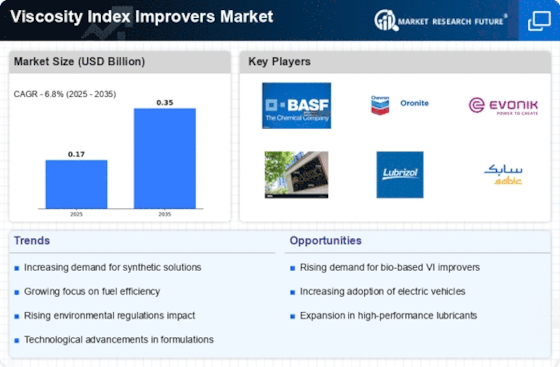
As per MRFR analysis, the Viscosity Index Improvers Market Size was estimated at 0.1709 USD Billion in 2024. The Viscosity Index Improvers industry is projected to grow from 0.1825 in 2025 to 0.3524 by 2035, exhibiting a compound annual growth rate (CAGR) of 6.8 during the forecast period 2025 - 2035.

Key Market Trends & Highlights

The Viscosity Index Improvers Market is experiencing a dynamic evolution driven by technological advancements and regulatory influences.

  • The market is witnessing a notable shift towards bio-based products, reflecting growing environmental concerns.
  • Technological advancements in formulations are enhancing the performance and efficiency of viscosity index improvers.
  • North America remains the largest market, while the Asia-Pacific region is emerging as the fastest-growing area for these products.
  • The increasing demand for high-performance lubricants and regulatory compliance are key drivers propelling market growth.

Market Size & Forecast

2024 Market Size 0.1709 (USD Billion)
2035 Market Size 0.3524 (USD Billion)
CAGR (2025 - 2035) 6.8%
Largest Regional Market Share in 2024 North America

Major Players

<p>BASF SE (DE), Chevron Oronite Company LLC (US), Evonik Industries AG (DE), Afton Chemical Corporation (US), Lubrizol Corporation (US), SABIC (SA), Innospec Inc. (US), TotalEnergies SE (FR), Clariant AG (CH)</p>

Market Trends

The Viscosity Index Improvers Market is currently experiencing a dynamic phase characterized by evolving consumer preferences and technological advancements. The demand for high-performance lubricants is on the rise, driven by the automotive and industrial sectors seeking enhanced efficiency and sustainability. This market appears to be influenced by stringent environmental regulations, prompting manufacturers to innovate and develop products that not only meet performance standards but also adhere to eco-friendly practices. As a result, the landscape is shifting towards bio-based and synthetic viscosity index improvers, which may offer superior performance while minimizing environmental impact. Moreover, the competitive nature of the Viscosity Index Improvers Market is fostering collaborations and partnerships among key players. These alliances seem to be aimed at leveraging research and development capabilities to create advanced formulations that cater to diverse applications. The increasing focus on energy efficiency and the need for longer-lasting lubricants are likely to drive further growth in this sector. Overall, the Viscosity Index Improvers Market is poised for continued evolution, with innovation and sustainability at the forefront of its trajectory.

Shift Towards Bio-based Products

There is a noticeable trend towards the adoption of bio-based viscosity index improvers. This shift is largely driven by growing environmental concerns and the demand for sustainable solutions. Manufacturers are increasingly focusing on developing products derived from renewable resources, which may offer comparable or superior performance to traditional petroleum-based options.

Technological Advancements in Formulations

The Viscosity Index Improvers Market is witnessing significant technological advancements in product formulations. Innovations in polymer chemistry are enabling the creation of more effective and efficient improvers. These advancements could lead to improved performance characteristics, such as enhanced thermal stability and better shear resistance, which are crucial for modern applications.

Regulatory Influences on Product Development

Regulatory frameworks are playing a pivotal role in shaping the Viscosity Index Improvers Market. Stricter environmental regulations are compelling manufacturers to reformulate their products to comply with new standards. This regulatory pressure may drive innovation, as companies seek to develop compliant products that do not compromise on performance.

Viscosity Index Improvers Market Market Drivers

Growth in Automotive Sector

The Viscosity Index Improvers Market is significantly influenced by the growth of the automotive sector, which is projected to expand at a compound annual growth rate of approximately 4% over the next few years. This growth is largely attributed to the rising production of vehicles, particularly in emerging markets where automotive manufacturing is on the rise. As vehicles become more sophisticated, the demand for advanced lubricants that incorporate viscosity index improvers is likely to increase. These improvers are essential for ensuring that engine oils maintain their viscosity under varying operational conditions, thereby enhancing engine performance and longevity. The automotive industry's shift towards electric vehicles also presents new opportunities for viscosity index improvers, as these vehicles require specialized lubricants to optimize efficiency.

Rising Demand for Energy Efficiency

The Viscosity Index Improvers Market is significantly impacted by the rising demand for energy efficiency across various sectors. As industries strive to reduce operational costs and enhance productivity, the need for lubricants that minimize energy consumption is becoming paramount. Viscosity index improvers play a crucial role in this context, as they help maintain optimal viscosity levels, thereby reducing friction and energy loss in machinery and engines. The global push for energy-efficient solutions is reflected in the increasing investments in research and development aimed at creating advanced viscosity index improvers. This trend is expected to drive market growth, with estimates suggesting a potential increase in demand by 6% over the next five years, as industries prioritize sustainability and efficiency.

Increasing Demand for High-Performance Lubricants

The Viscosity Index Improvers Market is experiencing a notable surge in demand for high-performance lubricants, driven by the automotive and industrial sectors. As machinery and engines operate under more extreme conditions, the need for lubricants that maintain optimal viscosity across varying temperatures becomes critical. This trend is reflected in the projected growth of the lubricant market, which is expected to reach USD 150 billion by 2026. Consequently, viscosity index improvers play a pivotal role in enhancing the performance of these lubricants, ensuring they meet the stringent requirements of modern applications. The increasing focus on energy efficiency and sustainability further propels this demand, as consumers and manufacturers alike seek products that not only perform well but also contribute to reduced environmental impact.

Regulatory Compliance and Environmental Standards

The Viscosity Index Improvers Market is increasingly shaped by stringent regulatory compliance and environmental standards. Governments worldwide are implementing regulations aimed at reducing emissions and promoting the use of environmentally friendly products. This has led to a growing demand for viscosity index improvers that are not only effective but also compliant with these regulations. The market is adapting to these changes by developing bio-based and biodegradable viscosity index improvers, which are gaining traction among manufacturers. As a result, the industry is expected to see a shift towards more sustainable practices, with a projected increase in the market share of eco-friendly products. This trend not only aligns with regulatory requirements but also meets the evolving preferences of consumers who are becoming more environmentally conscious.

Technological Innovations in Viscosity Index Improvers

The Viscosity Index Improvers Market is witnessing a wave of technological innovations that are enhancing the performance and efficiency of these additives. Recent advancements in polymer chemistry have led to the development of new formulations that offer superior viscosity stability and lower volatility. This is particularly relevant as industries seek to improve the performance of lubricants under extreme conditions. The market for viscosity index improvers is projected to grow at a rate of 5% annually, driven by these innovations. Furthermore, the integration of nanotechnology in the formulation of viscosity index improvers is expected to revolutionize the industry, providing products that not only improve viscosity but also offer additional benefits such as reduced friction and wear.

Market Segment Insights

Viscosity Index Improvers Market Type Insights

Based on type, the Viscosity Index Improvers Market segmentation includes polymethacrylate, olefin copolymer, and polyisobutylene. The olefin copolymer segment dominated the market in 2022. Due to industrial and automotive applications, viscosity Index Improvers based on Olefin Copolymers are in higher demand on the international market. Over the forecast period, the global market for Olefin Copolymer-based Viscosity Index Improvers Market is anticipated to expand due to increased demand for lubricants from end-user industries such as the automotive and construction sectors. The Olefin Copolymer-based Viscosity Index Improvers Market will be driven by technological progress and product innovation.

Figure 1: Viscosity Index Improvers Market, by Type, 2022 & 2032 (USD billion)

Source: Secondary Research, Primary Research, Market Research Future Database and Analyst Review

Viscosity Index Improvers Market End-User Insights

Based on End-User, the Viscosity Index Improvers Market segmentation includes manufacturing, food processing, mining, construction, and power generation. The manufacturing category generated the most income. During operation, the engine temperature of an automobile fluctuates dramatically. Automobile lubricants control engine friction and wear, shield the engine from rust, cool the pistons, and shield the engine oil in the sump from combustion vapors.

When engine oil/lubricant included in an automobile engine is exposed to extreme temperature swings, typically between 40 and 100°C, it begins to thin, leading to engine oil/lubricant evaporation, resulting in engine damage or knocking out due to high friction between internal engine parts.x

In March 2023, ABB completed the Marunda 2.0 oil blending plant extension project, which doubled output despite tripling it within three years during pandemic challenges.

Get more detailed insights about Viscosity Index Improvers Market Research Report—Global Forecast till 2035

Regional Insights

North America : Innovation and Demand Surge

North America is witnessing robust growth in the Viscosity Index Improvers Market, driven by increasing automotive production and stringent fuel efficiency regulations. The region holds approximately 40% of the global market share, making it the largest market. The demand for high-performance lubricants in various industries, including automotive and manufacturing, is a significant growth driver. Regulatory catalysts, such as the EPA's stringent emissions standards, further boost the market's expansion. The United States is the leading country in this region, with major players like Chevron Oronite and Lubrizol Corporation dominating the landscape. The competitive environment is characterized by continuous innovation and strategic partnerships among key players. Canada also contributes significantly to the market, focusing on sustainable and high-performance solutions. The presence of established companies ensures a dynamic market with ongoing advancements in product offerings.

Europe : Regulatory Framework Drives Growth

Europe is emerging as a significant player in the Viscosity Index Improvers Market, driven by stringent environmental regulations and a shift towards sustainable lubricants. The region accounts for approximately 30% of the global market share, making it the second-largest market. The European Union's regulations on emissions and fuel efficiency are key catalysts for growth, pushing manufacturers to innovate and develop high-performance products that meet these standards. Germany and France are the leading countries in this market, with major companies like BASF and TotalEnergies leading the charge. The competitive landscape is marked by a focus on research and development, with companies investing heavily in innovative solutions. The presence of a well-established automotive industry further fuels demand for advanced lubricants, ensuring a vibrant market environment. The European Chemicals Agency emphasizes the importance of sustainable practices in the industry, which is shaping future developments.

Asia-Pacific : Emerging Markets and Growth Potential

Asia-Pacific is rapidly becoming a powerhouse in the Viscosity Index Improvers Market, driven by increasing industrialization and automotive production. The region holds approximately 25% of the global market share, reflecting its growing importance. Countries like China and India are witnessing a surge in demand for high-performance lubricants, spurred by rising vehicle ownership and industrial activities. Regulatory support for cleaner technologies is also enhancing market growth. China is the largest market in the region, with significant contributions from local and international players. The competitive landscape is characterized by a mix of established companies and emerging players, fostering innovation and competitive pricing. India is also a key player, focusing on sustainable solutions to meet the growing demand. The presence of major companies like SABIC and Innospec Inc. ensures a dynamic market with ongoing advancements in product offerings.

Middle East and Africa : Resource-Rich Market Opportunities

The Middle East and Africa region is witnessing gradual growth in the Viscosity Index Improvers Market, driven by increasing oil production and a growing automotive sector. The region holds approximately 5% of the global market share, with potential for significant expansion. Countries like Saudi Arabia and South Africa are focusing on enhancing their manufacturing capabilities, which is expected to drive demand for high-performance lubricants. Regulatory frameworks are evolving to support sustainable practices in the industry. Saudi Arabia is the leading country in this region, with a strong presence of key players like SABIC. The competitive landscape is characterized by a focus on local production and partnerships with international companies to enhance product offerings. South Africa is also emerging as a significant market, with increasing investments in infrastructure and automotive industries. The region's resource-rich environment presents unique opportunities for growth in the Viscosity Index Improvers Market.

Key Players and Competitive Insights

Leading market players have shifted their focus to emerging regions to meet the rising demand for viscosity index improvers. Market players are also adopting various strategic activities to expand their global footprint, with key market developments including introducing new products, conducting research and development, and merging and acquiring.

Players in the global Viscosity Index Improvers industry manufacture locally to cut transportation costs. Major players in the Viscosity Index Improvers Market include Evonik Industries, Lubrizol Corporation, Chevron Oronite Company LLC, Afton Chemical Corporation, Infineum International Limite, Sanyo Chemical Industries, Ltd., Nanjing Runyou Chemical industry Additive Co., Ltd., Shenyang Great Wall Lubricating Oil Manufacturing Co., Ltd., Jilin Xingyun Chemical, Shanghai High-Lube Additives, Bariyan Oil & Lubricants Pvt. Ltd., BPT Chemicals Co, Ltd, Brad-Chem Ltd, Chetas Biochem, Croda Lubricants, and Innov Oil.

The Oil Additives Team at Evonik offers an extensive selection of viscosity index improvers for affordable blending of high-performance driveline lubricants with superior thickening effectiveness. VISCOPLEX® solutions enable optimal energy efficiency, reduced torque loss, lower operating temperatures, and long-lasting component life. Functionalized variants permit the extension of fluid service life.

Companies such as Afton provide a variety of polymer-based viscosity index improvers that are effective in various mineral oil lubricant applications. Afton offers a variety of liquid and solid Olefin Copolymer (OCP) viscosity index improvers. These OCP VIIs are oil-soluble and compatible with a variety of lubricant formulations. Additionally, the company provides numerous Polymethacrylate (PMA)-based viscosity index improvers (VII) that can be utilized in various industrial and automotive lubricant formulations. Afton's HiTEC Viscosity Index Improvers Market can be utilized in various non-lubricant applications.

Evonik Oil Additives CIS partnered with ADCO to improve energy efficiency and productivity in construction, agricultural, mining and manufacturing equipment lubricants throughout Russia and neighboring countries.

Lubrizol Advanced Materials Inc., inventor and world's largest CPVC compound manufacturer and Prince Pipes and Fittings Ltd. signed a FlowGuard® CPVC Processor agreement to manufacture and sell Prince FlowGuard® Plus CPVC (Chlorinated polyvinyl chloride) pipes & fittings in India; starting September Prince Pipes & Fittings will sell FlowGuard Plus products across India.

Key Companies in the Viscosity Index Improvers Market market include

Industry Developments

November 2022 Evonik's Oil Additives business division restructured its product distribution in Greece, naming Brenntag Bulgaria EOOD as its new distribution partner.

August 2022 Evonik's Oil Additives division restructured its products' distribution structure in CIS countries, announcing ADCO as its new distribution partner. The lubricant additives company develops formulation solutions and base oil technologies that increase energy productivity and effectiveness of industrial lubricants for construction, agricultural, mining, and manufacturing equipment.

In February 2024, Chevron achieved record-breaking oil-equivalent production of 3.1 million barrels per day — up 14% in the United States. In July 2023, Chevron Phillips Chemical announced that it would expand its VII production capacity to meet the growing demand for VIIs in automotive and industrial applications.

Future Outlook

Viscosity Index Improvers Market Future Outlook

<p>The Viscosity Index Improvers Market is projected to grow at a 6.8% CAGR from 2024 to 2035, driven by increasing demand in automotive and industrial applications.</p>

New opportunities lie in:

  • <p>Development of bio-based viscosity index improvers for eco-friendly formulations.</p>
  • <p>Expansion into emerging markets with tailored product offerings.</p>
  • <p>Investment in R&D for high-performance additives to enhance product efficiency.</p>

<p>By 2035, the market is expected to achieve robust growth, solidifying its position in the global landscape.</p>

Market Segmentation

Viscosity Index Improvers Market Type Outlook

  • Polymethacrylate
  • Olefin Copolymer
  • Polyisobutylene

Viscosity Index Improvers Market End-User Outlook

  • Manufacturing
  • Food processing
  • Mining
  • Construction
  • Power generation

Report Scope

MARKET SIZE 20240.1709(USD Billion)
MARKET SIZE 20250.1825(USD Billion)
MARKET SIZE 20350.3524(USD Billion)
COMPOUND ANNUAL GROWTH RATE (CAGR)6.8% (2024 - 2035)
REPORT COVERAGERevenue Forecast, Competitive Landscape, Growth Factors, and Trends
BASE YEAR2024
Market Forecast Period2025 - 2035
Historical Data2019 - 2024
Market Forecast UnitsUSD Billion
Key Companies ProfiledMarket analysis in progress
Segments CoveredMarket segmentation analysis in progress
Key Market OpportunitiesGrowing demand for high-performance lubricants drives innovation in Viscosity Index Improvers Market.
Key Market DynamicsRising demand for high-performance lubricants drives innovation in viscosity index improvers and enhances competitive dynamics.
Countries CoveredNorth America, Europe, APAC, South America, MEA

FAQs

What is the projected market valuation for the Viscosity Index Improvers Market in 2035?

The projected market valuation for the Viscosity Index Improvers Market in 2035 is 0.3524 USD Billion.

What was the overall market valuation for the Viscosity Index Improvers Market in 2024?

The overall market valuation for the Viscosity Index Improvers Market in 2024 was 0.1709 USD Billion.

What is the expected CAGR for the Viscosity Index Improvers Market during the forecast period 2025 - 2035?

The expected CAGR for the Viscosity Index Improvers Market during the forecast period 2025 - 2035 is 6.8%.

Which companies are considered key players in the Viscosity Index Improvers Market?

Key players in the Viscosity Index Improvers Market include BASF SE, Chevron Oronite Company LLC, Evonik Industries AG, and others.

What are the main types of Viscosity Index Improvers and their market valuations?

The main types include Polymethacrylate, Olefin Copolymer, and Polyisobutylene, with valuations ranging from 0.0525 to 0.1261 USD Billion.

Which end-user segments are driving the Viscosity Index Improvers Market?

The end-user segments driving the market include Manufacturing, Food Processing, and Mining, with valuations from 0.0283 to 0.0935 USD Billion.

  1. SECTION I: EXECUTIVE SUMMARY AND KEY HIGHLIGHTS
    1. EXECUTIVE SUMMARY
      1. Market Overview
      2. Key Findings
      3. Market Segmentation
      4. Competitive Landscape
      5. Challenges and Opportunities
      6. Future Outlook
  2. SECTION II: SCOPING, METHODOLOGY AND MARKET STRUCTURE
    1. MARKET INTRODUCTION
      1. Definition
      2. Scope of the study
    2. RESEARCH METHODOLOGY
      1. Overview
      2. Data Mining
      3. Secondary Research
      4. Primary Research
      5. Forecasting Model
      6. Market Size Estimation
      7. Data Triangulation
      8. Validation
  3. SECTION III: QUALITATIVE ANALYSIS
    1. MARKET DYNAMICS
      1. Overview
      2. Drivers
      3. Restraints
      4. Opportunities
    2. MARKET FACTOR ANALYSIS
      1. Value chain Analysis
      2. Porter's Five Forces Analysis
      3. COVID-19 Impact Analysis
  4. SECTION IV: QUANTITATIVE ANALYSIS
    1. Chemicals and Materials, BY Type (USD Billion)
      1. Polymethacrylate
      2. Olefin Copolymer
      3. Polyisobutylene
    2. Chemicals and Materials, BY End-User (USD Billion)
      1. Manufacturing
      2. Food processing
      3. Mining
      4. Construction
      5. Power generation
    3. Chemicals and Materials, BY Region (USD Billion)
      1. North America
      2. Europe
      3. APAC
      4. South America
      5. MEA
  5. SECTION V: COMPETITIVE ANALYSIS
    1. Competitive Landscape
      1. Overview
      2. Competitive Analysis
      3. Market share Analysis
      4. Major Growth Strategy in the Chemicals and Materials
      5. Competitive Benchmarking
      6. Leading Players in Terms of Number of Developments in the Chemicals and Materials
      7. Key developments and growth strategies
      8. Major Players Financial Matrix
    2. Company Profiles
      1. BASF SE (DE)
      2. Chevron Oronite Company LLC (US)
      3. Evonik Industries AG (DE)
      4. Afton Chemical Corporation (US)
      5. Lubrizol Corporation (US)
      6. SABIC (SA)
      7. Innospec Inc. (US)
      8. TotalEnergies SE (FR)
      9. Clariant AG (CH)
    3. Appendix
      1. References
      2. Related Reports
  6. LIST OF FIGURES
    1. MARKET SYNOPSIS
    2. NORTH AMERICA MARKET ANALYSIS
    3. US MARKET ANALYSIS BY TYPE
    4. US MARKET ANALYSIS BY END-USER
    5. CANADA MARKET ANALYSIS BY TYPE
    6. CANADA MARKET ANALYSIS BY END-USER
    7. EUROPE MARKET ANALYSIS
    8. GERMANY MARKET ANALYSIS BY TYPE
    9. GERMANY MARKET ANALYSIS BY END-USER
    10. UK MARKET ANALYSIS BY TYPE
    11. UK MARKET ANALYSIS BY END-USER
    12. FRANCE MARKET ANALYSIS BY TYPE
    13. FRANCE MARKET ANALYSIS BY END-USER
    14. RUSSIA MARKET ANALYSIS BY TYPE
    15. RUSSIA MARKET ANALYSIS BY END-USER
    16. ITALY MARKET ANALYSIS BY TYPE
    17. ITALY MARKET ANALYSIS BY END-USER
    18. SPAIN MARKET ANALYSIS BY TYPE
    19. SPAIN MARKET ANALYSIS BY END-USER
    20. REST OF EUROPE MARKET ANALYSIS BY TYPE
    21. REST OF EUROPE MARKET ANALYSIS BY END-USER
    22. APAC MARKET ANALYSIS
    23. CHINA MARKET ANALYSIS BY TYPE
    24. CHINA MARKET ANALYSIS BY END-USER
    25. INDIA MARKET ANALYSIS BY TYPE
    26. INDIA MARKET ANALYSIS BY END-USER
    27. JAPAN MARKET ANALYSIS BY TYPE
    28. JAPAN MARKET ANALYSIS BY END-USER
    29. SOUTH KOREA MARKET ANALYSIS BY TYPE
    30. SOUTH KOREA MARKET ANALYSIS BY END-USER
    31. MALAYSIA MARKET ANALYSIS BY TYPE
    32. MALAYSIA MARKET ANALYSIS BY END-USER
    33. THAILAND MARKET ANALYSIS BY TYPE
    34. THAILAND MARKET ANALYSIS BY END-USER
    35. INDONESIA MARKET ANALYSIS BY TYPE
    36. INDONESIA MARKET ANALYSIS BY END-USER
    37. REST OF APAC MARKET ANALYSIS BY TYPE
    38. REST OF APAC MARKET ANALYSIS BY END-USER
    39. SOUTH AMERICA MARKET ANALYSIS
    40. BRAZIL MARKET ANALYSIS BY TYPE
    41. BRAZIL MARKET ANALYSIS BY END-USER
    42. MEXICO MARKET ANALYSIS BY TYPE
    43. MEXICO MARKET ANALYSIS BY END-USER
    44. ARGENTINA MARKET ANALYSIS BY TYPE
    45. ARGENTINA MARKET ANALYSIS BY END-USER
    46. REST OF SOUTH AMERICA MARKET ANALYSIS BY TYPE
    47. REST OF SOUTH AMERICA MARKET ANALYSIS BY END-USER
    48. MEA MARKET ANALYSIS
    49. GCC COUNTRIES MARKET ANALYSIS BY TYPE
    50. GCC COUNTRIES MARKET ANALYSIS BY END-USER
    51. SOUTH AFRICA MARKET ANALYSIS BY TYPE
    52. SOUTH AFRICA MARKET ANALYSIS BY END-USER
    53. REST OF MEA MARKET ANALYSIS BY TYPE
    54. REST OF MEA MARKET ANALYSIS BY END-USER
    55. KEY BUYING CRITERIA OF CHEMICALS AND MATERIALS
    56. RESEARCH PROCESS OF MRFR
    57. DRO ANALYSIS OF CHEMICALS AND MATERIALS
    58. DRIVERS IMPACT ANALYSIS: CHEMICALS AND MATERIALS
    59. RESTRAINTS IMPACT ANALYSIS: CHEMICALS AND MATERIALS
    60. SUPPLY / VALUE CHAIN: CHEMICALS AND MATERIALS
    61. CHEMICALS AND MATERIALS, BY TYPE, 2024 (% SHARE)
    62. CHEMICALS AND MATERIALS, BY TYPE, 2024 TO 2035 (USD Billion)
    63. CHEMICALS AND MATERIALS, BY END-USER, 2024 (% SHARE)
    64. CHEMICALS AND MATERIALS, BY END-USER, 2024 TO 2035 (USD Billion)
    65. BENCHMARKING OF MAJOR COMPETITORS
  7. LIST OF TABLES
    1. LIST OF ASSUMPTIONS
    2. North America MARKET SIZE ESTIMATES; FORECAST
      1. BY TYPE, 2025-2035 (USD Billion)
      2. BY END-USER, 2025-2035 (USD Billion)
    3. US MARKET SIZE ESTIMATES; FORECAST
      1. BY TYPE, 2025-2035 (USD Billion)
      2. BY END-USER, 2025-2035 (USD Billion)
    4. Canada MARKET SIZE ESTIMATES; FORECAST
      1. BY TYPE, 2025-2035 (USD Billion)
      2. BY END-USER, 2025-2035 (USD Billion)
    5. Europe MARKET SIZE ESTIMATES; FORECAST
      1. BY TYPE, 2025-2035 (USD Billion)
      2. BY END-USER, 2025-2035 (USD Billion)
    6. Germany MARKET SIZE ESTIMATES; FORECAST
      1. BY TYPE, 2025-2035 (USD Billion)
      2. BY END-USER, 2025-2035 (USD Billion)
    7. UK MARKET SIZE ESTIMATES; FORECAST
      1. BY TYPE, 2025-2035 (USD Billion)
      2. BY END-USER, 2025-2035 (USD Billion)
    8. France MARKET SIZE ESTIMATES; FORECAST
      1. BY TYPE, 2025-2035 (USD Billion)
      2. BY END-USER, 2025-2035 (USD Billion)
    9. Russia MARKET SIZE ESTIMATES; FORECAST
      1. BY TYPE, 2025-2035 (USD Billion)
      2. BY END-USER, 2025-2035 (USD Billion)
    10. Italy MARKET SIZE ESTIMATES; FORECAST
      1. BY TYPE, 2025-2035 (USD Billion)
      2. BY END-USER, 2025-2035 (USD Billion)
    11. Spain MARKET SIZE ESTIMATES; FORECAST
      1. BY TYPE, 2025-2035 (USD Billion)
      2. BY END-USER, 2025-2035 (USD Billion)
    12. Rest of Europe MARKET SIZE ESTIMATES; FORECAST
      1. BY TYPE, 2025-2035 (USD Billion)
      2. BY END-USER, 2025-2035 (USD Billion)
    13. APAC MARKET SIZE ESTIMATES; FORECAST
      1. BY TYPE, 2025-2035 (USD Billion)
      2. BY END-USER, 2025-2035 (USD Billion)
    14. China MARKET SIZE ESTIMATES; FORECAST
      1. BY TYPE, 2025-2035 (USD Billion)
      2. BY END-USER, 2025-2035 (USD Billion)
    15. India MARKET SIZE ESTIMATES; FORECAST
      1. BY TYPE, 2025-2035 (USD Billion)
      2. BY END-USER, 2025-2035 (USD Billion)
    16. Japan MARKET SIZE ESTIMATES; FORECAST
      1. BY TYPE, 2025-2035 (USD Billion)
      2. BY END-USER, 2025-2035 (USD Billion)
    17. South Korea MARKET SIZE ESTIMATES; FORECAST
      1. BY TYPE, 2025-2035 (USD Billion)
      2. BY END-USER, 2025-2035 (USD Billion)
    18. Malaysia MARKET SIZE ESTIMATES; FORECAST
      1. BY TYPE, 2025-2035 (USD Billion)
      2. BY END-USER, 2025-2035 (USD Billion)
    19. Thailand MARKET SIZE ESTIMATES; FORECAST
      1. BY TYPE, 2025-2035 (USD Billion)
      2. BY END-USER, 2025-2035 (USD Billion)
    20. Indonesia MARKET SIZE ESTIMATES; FORECAST
      1. BY TYPE, 2025-2035 (USD Billion)
      2. BY END-USER, 2025-2035 (USD Billion)
    21. Rest of APAC MARKET SIZE ESTIMATES; FORECAST
      1. BY TYPE, 2025-2035 (USD Billion)
      2. BY END-USER, 2025-2035 (USD Billion)
    22. South America MARKET SIZE ESTIMATES; FORECAST
      1. BY TYPE, 2025-2035 (USD Billion)
      2. BY END-USER, 2025-2035 (USD Billion)
    23. Brazil MARKET SIZE ESTIMATES; FORECAST
      1. BY TYPE, 2025-2035 (USD Billion)
      2. BY END-USER, 2025-2035 (USD Billion)
    24. Mexico MARKET SIZE ESTIMATES; FORECAST
      1. BY TYPE, 2025-2035 (USD Billion)
      2. BY END-USER, 2025-2035 (USD Billion)
    25. Argentina MARKET SIZE ESTIMATES; FORECAST
      1. BY TYPE, 2025-2035 (USD Billion)
      2. BY END-USER, 2025-2035 (USD Billion)
    26. Rest of South America MARKET SIZE ESTIMATES; FORECAST
      1. BY TYPE, 2025-2035 (USD Billion)
      2. BY END-USER, 2025-2035 (USD Billion)
    27. MEA MARKET SIZE ESTIMATES; FORECAST
      1. BY TYPE, 2025-2035 (USD Billion)
      2. BY END-USER, 2025-2035 (USD Billion)
    28. GCC Countries MARKET SIZE ESTIMATES; FORECAST
      1. BY TYPE, 2025-2035 (USD Billion)
      2. BY END-USER, 2025-2035 (USD Billion)
    29. South Africa MARKET SIZE ESTIMATES; FORECAST
      1. BY TYPE, 2025-2035 (USD Billion)
      2. BY END-USER, 2025-2035 (USD Billion)
    30. Rest of MEA MARKET SIZE ESTIMATES; FORECAST
      1. BY TYPE, 2025-2035 (USD Billion)
      2. BY END-USER, 2025-2035 (USD Billion)
    31. PRODUCT LAUNCH/PRODUCT DEVELOPMENT/APPROVAL
    32. ACQUISITION/PARTNERSHIP


 Viscosity Index Improvers Market Segmentation

Viscosity Index Improvers Type Outlook (USD Billion, 2018-2032)

  • Polymethacrylate
  • Olefin Copolymer
  • Polyisobutylene

Viscosity Index Improvers End-User Outlook (USD Billion, 2018-2032)

  • Manufacturing
  • Food processing
  • Mining
  • Construction
  • Power generation

Viscosity Index Improvers Regional Outlook (USD Billion, 2018-2032)

  • North America Outlook (USD Billion, 2018-2032)

    • North America Viscosity Index Improvers by Type
      • Polymethacrylate
      • Olefin Copolymer
      • Polyisobutylene
    • North America Viscosity Index Improvers by End-User
      • Manufacturing
      • Food processing
      • Mining
      • Construction
      • Power generation
    • US Outlook (USD Billion, 2018-2032)

    • US Viscosity Index Improvers by Type
      • Polymethacrylate
      • Olefin Copolymer
      • Polyisobutylene
    • US Viscosity Index Improvers by End-User
      • Manufacturing
      • Food processing
      • Mining
      • Construction
      • Power generation
    • CANADA Outlook (USD Billion, 2018-2032)

    • CANADA Viscosity Index Improvers by Type
      • Polymethacrylate
      • Olefin Copolymer
      • Polyisobutylene
    • CANADA Viscosity Index Improvers by End-User
      • Manufacturing
      • Food processing
      • Mining
      • Construction
      • Power generation
  • Europe Outlook (USD Billion, 2018-2032)

    • Europe Viscosity Index Improvers by Type
      • Polymethacrylate
      • Olefin Copolymer
      • Polyisobutylene
    • Europe Viscosity Index Improvers by End-User
      • Manufacturing
      • Food processing
      • Mining
      • Construction
      • Power generation
    • Germany Outlook (USD Billion, 2018-2032)

    • Germany Viscosity Index Improvers by Type
      • Polymethacrylate
      • Olefin Copolymer
      • Polyisobutylene
    • Germany Viscosity Index Improvers by End-User
      • Manufacturing
      • Food processing
      • Mining
      • Construction
      • Power generation
    • France Outlook (USD Billion, 2018-2032)

    • France Viscosity Index Improvers by Type
      • Polymethacrylate
      • Olefin Copolymer
      • Polyisobutylene
    • France Viscosity Index Improvers by End-User
      • Manufacturing
      • Food processing
      • Mining
      • Construction
      • Power generation
    • UK Outlook (USD Billion, 2018-2032)

    • UK Viscosity Index Improvers by Type
      • Polymethacrylate
      • Olefin Copolymer
      • Polyisobutylene
    • UK Viscosity Index Improvers by End-User
      • Manufacturing
      • Food processing
      • Mining
      • Construction
      • Power generation
    • ITALY Outlook (USD Billion, 2018-2032)

    • ITALY Viscosity Index Improvers by Type
      • Polymethacrylate
      • Olefin Copolymer
      • Polyisobutylene
    • ITALY Viscosity Index Improvers by End-User
      • Manufacturing
      • Food processing
      • Mining
      • Construction
      • Power generation
    • SPAIN Outlook (USD Billion, 2018-2032)

    • Spain Viscosity Index Improvers by Type
      • Polymethacrylate
      • Olefin Copolymer
      • Polyisobutylene
    • Spain Viscosity Index Improvers by End-User
      • Manufacturing
      • Food processing
      • Mining
      • Construction
      • Power generation
    • Rest Of Europe Outlook (USD Billion, 2018-2032)

    • Rest Of Europe Viscosity Index Improvers by Type
      • Polymethacrylate
      • Olefin Copolymer
      • Polyisobutylene
    • REST OF EUROPE Viscosity Index Improvers by End-User
      • Manufacturing
      • Food processing
      • Mining
      • Construction
      • Power generation
  • Asia-Pacific Outlook (USD Billion, 2018-2032)

    • Asia-Pacific Viscosity Index Improvers by Type
      • Polymethacrylate
      • Olefin Copolymer
      • Polyisobutylene
    • Asia-Pacific Viscosity Index Improvers by End-User
      • Manufacturing
      • Food processing
      • Mining
      • Construction
      • Power generation
    • China Outlook (USD Billion, 2018-2032)

    • China Viscosity Index Improvers by Type
      • Polymethacrylate
      • Olefin Copolymer
      • Polyisobutylene
    • China Viscosity Index Improvers by End-User
      • Manufacturing
      • Food processing
      • Mining
      • Construction
      • Power generation
    • Japan Outlook (USD Billion, 2018-2032)

    • Japan Viscosity Index Improvers by Type
      • Polymethacrylate
      • Olefin Copolymer
      • Polyisobutylene
    • Japan Viscosity Index Improvers by End-User
      • Manufacturing
      • Food processing
      • Mining
      • Construction
      • Power generation
    • India Outlook (USD Billion, 2018-2032)

    • India Viscosity Index Improvers by Type
      • Polymethacrylate
      • Olefin Copolymer
      • Polyisobutylene
    • India Viscosity Index Improvers by End-User
      • Manufacturing
      • Food processing
      • Mining
      • Construction
      • Power generation
    • Australia Outlook (USD Billion, 2018-2032)

    • Australia Viscosity Index Improvers by Type
      • Polymethacrylate
      • Olefin Copolymer
      • Polyisobutylene
    • Australia Viscosity Index Improvers by End-User
      • Manufacturing
      • Food processing
      • Mining
      • Construction
      • Power generation
    • Rest of Asia-Pacific Outlook (USD Billion, 2018-2032)

    • Rest of Asia-Pacific Viscosity Index Improvers by Type
      • Polymethacrylate
      • Olefin Copolymer
      • Polyisobutylene
    • Rest of Asia-Pacific Viscosity Index Improvers by End-User
      • Manufacturing
      • Food processing
      • Mining
      • Construction
      • Power generation
  • Rest of the World Outlook (USD Billion, 2018-2032)

    • Rest of the World Viscosity Index Improvers by Type
      • Polymethacrylate
      • Olefin Copolymer
      • Polyisobutylene
    • Rest of the World Viscosity Index Improvers by End-User
      • Manufacturing
      • Food processing
      • Mining
      • Construction
      • Power generation
    • Middle East Outlook (USD Billion, 2018-2032)

    • Middle East Viscosity Index Improvers by Type
      • Polymethacrylate
      • Olefin Copolymer
      • Polyisobutylene
    • Middle East Viscosity Index Improvers by End-User
      • Manufacturing
      • Food processing
      • Mining
      • Construction
      • Power generation
    • Africa Outlook (USD Billion, 2018-2032)

    • Africa Viscosity Index Improvers by Type
      • Polymethacrylate
      • Olefin Copolymer
      • Polyisobutylene
    • Africa Viscosity Index Improvers by End-User
      • Manufacturing
      • Food processing
      • Mining
      • Construction
      • Power generation
    • Latin America Outlook (USD Billion, 2018-2032)

    • Latin America Viscosity Index Improvers by Type
      • Polymethacrylate
      • Olefin Copolymer
      • Polyisobutylene
    • Latin America Viscosity Index Improvers by End-User
      • Manufacturing
      • Food processing
      • Mining
      • Construction
      • Power generation


Infographic

Free Sample Request

Kindly complete the form below to receive a free sample of this Report

Get Free Sample

Customer Strories

Compare Licence

×
Features License Type
Single User Multiuser License Enterprise User
Price $4,950 $5,950 $7,250
Maximum User Access Limit 1 User Upto 10 Users Unrestricted Access Throughout the Organization
Free Customization
Direct Access to Analyst
Deliverable Format
Platform Access
Discount on Next Purchase 10% 15% 15%
Printable Versions