
×
Request Free Sample ×

Kindly complete the form below to receive a free sample of this Report

* Please use a valid business email

Leading companies partner with us for data-driven Insights

clients tt-cursor
Hero Background
English
Chinese
French
Japanese
Korean
German
Spanish

Virtual Private Server Market Analysis

ID: MRFR/ICT/6284-HCR
100 Pages
Ankit Gupta
October 2025

Virtual Private Server Market Size, Share and Trends Analysis Report by Service Type (Fully Managed, Self-Managed), by Component [Operating System, Servers (Cloud VPS, VPS SSD)], Organization Size (SME), by Industry Vertical (BFSI), and Region (North America and Asia-Pacific till 2030VPS solutions \n

Share:
Download PDF ×

We do not share your information with anyone. However, we may send you emails based on your report interest from time to time. You may contact us at any time to opt-out.

Virtual Private Server Market Infographic
Purchase Options

Market Analysis

In-depth Analysis of Virtual Private Server Market Industry Landscape

There are many factors which have shaped the landscape of this market in recent years, and it has witnessed a rapid growth as well as lots of changes. The digital transformation of businesses has increased demand for scalable and flexible hosting services, making the market for virtual private servers (VPS) a significant cog in the larger cloud computing ecosystem. Rising adoption of VPS by businesses of all sizes is one key factor among the market's dynamics. Highly economical and scalable according to resource needs, VPS hosting is attractive to small-and medium sized enterprises (SMEs). In contrast, bigger businesses value the higher performance and individual resources that VPS provides over shared hosting. This variety of demand has given rise to a dynamic market in which providers meet the needs of various clients with different hosting requirements. Advances in technology are an important factor affecting VPS's market dynamics. As hardware capabilities improve, VPS providers can offer more robust and powerful virtualization solutions. The result has been higher performance, better resource allocation and greater overall reliability. This culminates in VPS being the perfect solution for companies who place big demands on their hosting environment. The VPS market's competitive landscape is thus marked by numerous service providers, all vying for a piece of the growing pie. It has resulted in novel service offerings, pricing models and customer support processes that have all benefited users. Now, providers differentiate themselves through options like managed services and customizability. There are tons of choices for businesses to choose from. Security has been playing an increasingly important part in shaping VPS market conditions. As cyber threats surge, business are now more focused than ever on protecting their digital assets. In fact, with its own separate virtual environments, VPS provides a safer platform for hosting than shared ones. In response to this demand, providers have adopted advanced security measures such as firewalls and DDoS protection. They've also begun performing regular security audits, skyrocketing the VPS market even higher. Another trend in the VPS market is one toward managed VPS services. As businesses concentrate on their core competencies, MANY opt for managed VPS solutions which transfer the technical complexities of running a server to the hosting provider. This trend is convenient for businesses because they can focus on their business while the provider takes care of server maintenance, updating and other bug fixing.


Author
Ankit Gupta
Senior Research Analyst

Ankit Gupta is an analyst in market research industry in ICT and SEMI industry. With post-graduation in "Telecom and Marketing Management" and graduation in "Electronics and Telecommunication" vertical he is well versed with recent development in ICT industry as a whole. Having worked on more than 150+ reports including consultation for fortune 500 companies such as Microsoft and Rio Tinto in identifying solutions with respect to business problems his opinions are inclined towards mixture of technical and managerial aspects.

Leave a Comment

FAQs

What is the virtual private server market size?

The market can record a growth rate of 14.53% in the coming years.

What is expected to be the market size by 2024?

The market size is set to increase to USD 7.8 Billion by 2030.

Which are the leading vendors operating in this market?

The most renowned companies in the market are GoDaddy (US), InMotion Hosting (US), Rackspace (US), DigitalOcean (US), TekTonic (US), OVH Group (France), A2 Hosting (US), Amazon Web Services (US), Liquid Web (US), United Internet (UK), DreamHost (US), Linode (US), Vultr (US), Endurance International Group (US), Plesk (Switzerland), and others.

Which region accounted for the biggest share in the global market in the year 2018?

North America accounted for the biggest share in the global market in the year 2018.

Which verticals are adopting virtual private servers in the market?

IT & telecom, healthcare and life sciences, energy and utilities, retail and e-commerce, financial services and insurance (BFSI), banking, government and defense, are the verticals are adopting virtual private servers in the market.

Market Summary

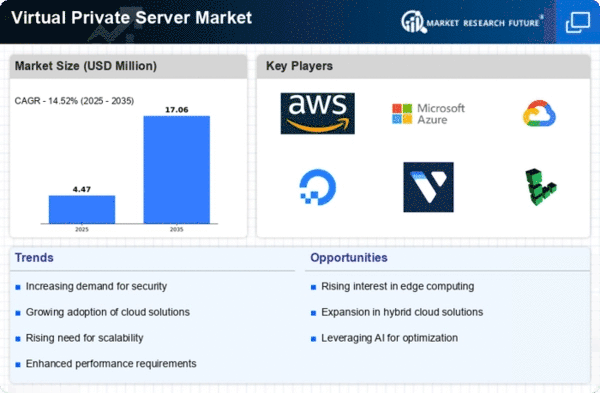
As per MRFR analysis, the Virtual Private Server Market Size was estimated at 3.9 USD Million in 2024. The Virtual Private Server industry is projected to grow from 4.39 in 2025 to 17.06 by 2035, exhibiting a compound annual growth rate (CAGR) of 14.52 during the forecast period 2025 - 2035.

Key Market Trends & Highlights

The Virtual Private Server Market is experiencing robust growth driven by security demands and service innovations.

  • The market is witnessing an increased demand for security solutions, particularly in North America, which remains the largest market.
  • There is a notable shift towards managed services, as small enterprises seek to optimize their IT resources.
  • Hybrid solutions are gaining traction, especially in the Asia-Pacific region, which is recognized as the fastest-growing market.
  • Key drivers include the rising need for scalability and enhanced performance requirements, particularly among web hosting and medium enterprise segments.

Market Size & Forecast

2024 Market Size 3.9 (USD Million)
2035 Market Size 17.06 (USD Million)
CAGR (2025 - 2035) 14.52%
Largest Regional Market Share in 2024 North America

Major Players

<p>Amazon Web Services (US), Microsoft Azure (US), Google Cloud (US), DigitalOcean (US), Vultr (US), Linode (US), OVHcloud (FR), Alibaba Cloud (CN), IBM Cloud (US)</p>

Market Trends

The Virtual Private Server Market is currently experiencing a notable transformation, driven by the increasing demand for secure and scalable hosting solutions. Organizations are increasingly recognizing the advantages of virtual private servers, which offer enhanced control and flexibility compared to traditional shared hosting. This shift appears to be influenced by the growing reliance on digital infrastructure, as businesses seek to optimize their online presence while ensuring data security. Furthermore, the rise of remote work and digital services has led to a surge in the need for reliable and efficient server solutions, prompting many companies to explore virtual private server options. In addition, the Virtual Private Server Market seems to be evolving with advancements in technology, particularly in virtualization and cloud computing. These innovations are likely to enhance the performance and capabilities of virtual private servers, making them more appealing to a broader range of users. As organizations continue to prioritize cost-effectiveness and operational efficiency, the demand for virtual private servers is expected to grow. This trend indicates a shift towards more sophisticated hosting solutions that cater to diverse business needs, ultimately shaping the future landscape of the Virtual Private Server Market.

Increased Demand for Security

The Virtual Private Server Market is witnessing a heightened focus on security features. As cyber threats become more sophisticated, businesses are prioritizing secure hosting environments. Virtual private servers provide enhanced security measures, such as dedicated resources and isolated environments, which appeal to organizations looking to protect sensitive data.

Shift Towards Managed Services

There is a noticeable trend towards managed services within the Virtual Private Server Market. Companies are increasingly opting for managed virtual private servers, where service providers handle maintenance, updates, and security. This shift allows businesses to focus on core operations while ensuring their server environments are professionally managed.

Growing Adoption of Hybrid Solutions

The Virtual Private Server Market is also experiencing a rise in hybrid solutions, combining on-premises infrastructure with cloud-based services. This trend reflects the desire for flexibility and scalability, as organizations seek to leverage the benefits of both environments. Hybrid solutions enable businesses to optimize their resources while maintaining control over critical applications.

Virtual Private Server Market Market Drivers

Market Growth Projections

The Global Virtual Private Server Market Industry is poised for substantial growth, with projections indicating a market size of 3.95 USD Billion in 2024 and an impressive increase to 15.4 USD Billion by 2035. This growth trajectory suggests a compound annual growth rate of 13.15% from 2025 to 2035. Such figures highlight the increasing reliance on VPS solutions across various sectors, driven by factors such as cost efficiency, security, and the need for scalable resources. The market dynamics indicate a robust future for VPS technologies, reflecting the evolving demands of businesses in a digital-first world.

Emergence of Remote Work Trends

The emergence of remote work trends is reshaping the Global Virtual Private Server Market Industry. As more organizations adopt flexible work arrangements, the need for reliable and secure remote access to company resources becomes paramount. VPS solutions offer a viable option for businesses to provide employees with secure environments to access applications and data from various locations. This shift not only enhances productivity but also necessitates robust IT infrastructure, driving the demand for VPS services. The anticipated growth of the market to 15.4 USD Billion by 2035 reflects the long-term implications of remote work on the Global Virtual Private Server Market Industry.

Increased Focus on Data Security

In the current landscape, the Global Virtual Private Server Market Industry is witnessing heightened emphasis on data security. As cyber threats become more sophisticated, businesses are prioritizing secure hosting environments. VPS solutions often provide enhanced security features, such as dedicated IP addresses and customizable firewalls, which appeal to organizations handling sensitive information. This focus on security is driving adoption rates, as companies seek to mitigate risks associated with data breaches. The anticipated growth of the market to 15.4 USD Billion by 2035 underscores the importance of security in influencing purchasing decisions within the Global Virtual Private Server Market Industry.

Expansion of E-Commerce Platforms

The expansion of e-commerce platforms is a pivotal driver for the Global Virtual Private Server Market Industry. As online retail continues to flourish, businesses require reliable hosting solutions to support their operations. VPS provides the necessary resources to handle increased traffic and transactions, ensuring optimal performance during peak periods. This demand is further amplified by the need for scalability, allowing e-commerce businesses to adjust their resources according to fluctuating market conditions. The growth trajectory of the market, projected to reach 3.95 USD Billion in 2024, highlights the critical role VPS plays in supporting the burgeoning e-commerce sector within the Global Virtual Private Server Market Industry.

Growing Adoption of Cloud Computing

The Global Virtual Private Server Market Industry is significantly influenced by the growing adoption of cloud computing technologies. As organizations increasingly migrate their operations to the cloud, the demand for VPS solutions that offer both flexibility and control rises. VPS allows businesses to leverage cloud benefits while maintaining a degree of isolation from other users, which is particularly appealing for those concerned about performance and security. This trend is expected to contribute to a compound annual growth rate of 13.15% from 2025 to 2035, reflecting the ongoing transformation in how businesses utilize technology within the Global Virtual Private Server Market Industry.

Rising Demand for Cost-Effective Solutions

The Global Virtual Private Server Market Industry experiences a notable surge in demand for cost-effective hosting solutions. Businesses, particularly small to medium-sized enterprises, are increasingly adopting VPS due to its affordability compared to dedicated servers. With the market projected to reach 3.95 USD Billion in 2024, organizations are drawn to the flexibility and scalability that VPS offers. This trend indicates a shift in how companies allocate their IT budgets, favoring solutions that provide robust performance without the high costs associated with traditional hosting. As a result, the Global Virtual Private Server Market Industry is likely to expand significantly.

Market Segment Insights

By Application: Web Hosting (Largest) vs. Game Hosting (Fastest-Growing)

<p>In the Virtual Private Server Market, the application segment is characterized by a diverse range of values, with Web Hosting leading the market share significantly. This segment benefits from the increased demand for online presence, as businesses transition to digital platforms. Game Hosting is emerging rapidly, attracting attention with a growing cohort of online gaming enthusiasts and platforms that require robust server solutions. Application Development, Data Backup, and Virtual Desktop hold smaller but vital shares, catering to specialized needs within the tech industry.</p>

<p>Application Development (Dominant) vs. Data Backup (Emerging)</p>

<p>In the realm of Virtual Private Servers, Application Development stands out as a dominant sector due to its necessity for scalable and flexible hosting environments. Businesses are increasingly leveraging VPS solutions for development purposes, fostering rapid deployment cycles and improved collaboration. Meanwhile, Data Backup is recognized as an emerging segment, fueled by the rising awareness of data security and the need for reliable backup solutions. While Application Development thrives on customizable environments tailored for innovation, Data Backup focuses on providing secure, redundant storage options for various data types, ensuring business continuity and mitigating data loss risks.</p>

By End Use: Small Enterprises (Largest) vs. Medium Enterprises (Fastest-Growing)

<p>In the Virtual Private Server (VPS) market, small enterprises hold the largest share, driven by their need for affordable solutions that offer essential features without the burden of maintaining physical servers. This segment typically consists of startups and small businesses that prioritize cost-effectiveness and scalability in their operations. On the other hand, medium enterprises are emerging rapidly in the VPS landscape, as they increasingly transition from traditional hosting services to virtual private servers for enhanced performance and control over their hosting environments.</p>

<p>Small Enterprises (Dominant) vs. Medium Enterprises (Emerging)</p>

<p>Small enterprises dominate the Virtual Private Server market due to their drive for economical yet efficient hosting solutions. They typically require flexibility and scalability, which VPS provides without significant upfront costs associated with dedicated servers. The growing trend of digital transformation among small businesses is fueling this dominance, allowing them to leverage VPS to gain a competitive edge. Conversely, medium enterprises are recognized as an emerging segment as they adopt VPS to enhance their operational capabilities. This shift is influenced by the need for customized hosting solutions that support a larger volume of traffic and increased data needs, making VPS an attractive choice for those looking to optimize their IT investments while ensuring security and reliability.</p>

By Deployment Type: Public Cloud (Largest) vs. Private Cloud (Fastest-Growing)

<p>The Virtual Private Server Market is currently dominated by public cloud deployments, making up the majority of the market share. This segment appeals to businesses seeking scalability, cost-effectiveness, and accessibility without the need for extensive infrastructure management. Private cloud, however, is witnessing swift growth as organizations increasingly prioritize security and compliance, leading to a notable uptick in its adoption compared to other deployment types. As businesses strive for customized solutions, the demand for private cloud options continues to rise. In terms of growth trends, the public cloud remains a reliable choice due to its ease of deployment and flexibility. However, the surge in remote work and the need for enhanced data protection have spurred interest in private clouds, encouraging enterprises to invest in dedicated resources. Hybrid cloud solutions, combining both public and private models, are also emerging as businesses seek to balance the benefits of both, thus driving sustained growth in this segment.</p>

<p>Public Cloud (Dominant) vs. Private Cloud (Emerging)</p>

<p>Public cloud solutions are characterized by their availability and ease of access, which contribute to their dominance in the Virtual Private Server Market. These platforms offer scalability, allowing businesses to adjust their resources based on demand, making them ideal for startups and SMEs seeking flexibility. Conversely, private cloud solutions are increasingly recognized as an emerging alternative, particularly for larger enterprises that require strict data governance, security, and compliance measures. Organizations value private clouds for their ability to provide tailored environments that meet specific operational and regulatory needs. As the business landscape evolves, the intricate balance between public accessibility and private security continues to shape the future of VPS deployments.</p>

By Service Model: Infrastructure as a Service (Largest) vs. Platform as a Service (Fastest-Growing)

<p>The Virtual Private Server Market is seeing diverse service models that cater to various customer needs. Currently, Infrastructure as a Service (IaaS) holds the largest market share due to its ability to provide scalable and flexible resources, appealing to businesses that require high availability and control over their IT infrastructure. In contrast, Platform as a Service (PaaS) is rapidly gaining traction, enabling developers to focus on deploying applications without managing the underlying hardware or software layers, thus making it the fastest-growing segment.</p>

<p>Service Models: IaaS (Dominant) vs. PaaS (Emerging)</p>

<p>Infrastructure as a Service (IaaS) remains the dominant force in the Virtual Private Server Market, mainly due to its comprehensive offerings that include virtualized computing resources over the internet. Businesses leverage IaaS for its flexibility, allowing them to scale operations without significant hardware investments. On the other hand, Platform as a Service (PaaS) is emerging as a vital player, simplifying the application development process. By providing an environment for building, testing, and deploying applications, PaaS attracts developers who seek a faster, more streamlined development cycle. As organizations increasingly adopt cloud solutions, both IaaS and PaaS are positioned to strengthen their foothold in the market, catering to diverse operational needs.</p>

By Management Type: Managed Services (Largest) vs. Unmanaged Services (Fastest-Growing)

<p>The Virtual Private Server (VPS) market showcases a diverse distribution of management types, with Managed Services holding the largest share. This segment is particularly favored by businesses seeking hassle-free operations, allowing them to focus on core competencies without the burden of server management. In contrast, Unmanaged Services, while smaller in share, are rapidly gaining traction among tech-savvy users and startups that prefer direct control over their server environments, enabling them to customize setups per specific needs. As businesses increasingly pivot towards cloud solutions, the growth of Unmanaged Services is driven by the rising demand for flexibility and cost-effectiveness. Conversely, Managed Services benefit from organizations prioritizing security, support, and stability—essential aspects for businesses reliant on virtualized infrastructure. Overall, the management type segment is witnessing a dynamic shift that aligns with the evolving demands of users in the VPS market.</p>

<p>Managed Services (Dominant) vs. Unmanaged Services (Emerging)</p>

<p>Managed Services represent the dominant force within the Virtual Private Server market due to their comprehensive approach to server management. They facilitate continuous monitoring, regular updates, and dedicated support, catering to businesses that prefer a hands-off approach to server maintenance. Scope for scalability also remains a compelling factor for long-term investment. On the other hand, Unmanaged Services, though emerging, are capturing a growing audience among developers and startups who value flexibility and control over their hosting environment. This segment allows users to conduct customization as per project requirements but demands technical knowledge and active management, which can be a barrier for some. Both segments are critical to the evolving landscape of virtual private servers, driven by varying user needs.</p>

Get more detailed insights about Virtual Private Server Market Research Report — Global Forecast till 2035

Regional Insights

North America : Leading Market Innovators

North America continues to lead the Virtual Private Server (VPS) market, holding a significant share of 2.0 in 2025. The region's growth is driven by increasing demand for cloud services, enhanced security measures, and regulatory support for data privacy. Companies are rapidly adopting VPS solutions to improve operational efficiency and scalability, further fueled by the rise of remote work and digital transformation initiatives. The competitive landscape is robust, with key players like Amazon Web Services, Microsoft Azure, and Google Cloud dominating the market. The U.S. remains the largest contributor, supported by a strong technological infrastructure and a high concentration of data centers. This competitive environment fosters innovation, ensuring that North America remains at the forefront of VPS advancements.

Europe : Emerging Digital Landscape

Europe's Virtual Private Server market is projected to reach 1.2 by 2025, driven by increasing digitalization and the demand for flexible hosting solutions. Regulatory frameworks such as GDPR have catalyzed the need for secure and compliant VPS offerings, encouraging businesses to migrate to cloud-based infrastructures. The region's focus on sustainability and energy efficiency also plays a crucial role in shaping market dynamics. Leading countries like Germany, the UK, and France are at the forefront of this growth, with a strong presence of local and international providers. Companies such as OVHcloud and Alibaba Cloud are expanding their services to meet the rising demand. The competitive landscape is characterized by innovation and strategic partnerships, positioning Europe as a key player in The Virtual Private Server.

Asia-Pacific : Rapidly Growing Market

The Asia-Pacific region is witnessing a surge in the Virtual Private Server market, projected to reach 0.9 by 2025. This growth is fueled by increasing internet penetration, the rise of e-commerce, and a growing number of SMEs seeking cost-effective hosting solutions. Governments are also promoting digital initiatives, which further enhances the demand for VPS services across various sectors. Countries like China, India, and Japan are leading the charge, with major players such as Alibaba Cloud and local providers expanding their offerings. The competitive landscape is evolving, with a focus on affordability and scalability. As businesses increasingly adopt cloud technologies, the Asia-Pacific region is set to become a significant player in The Virtual Private Server.

Middle East and Africa : Emerging Tech Hub

The Middle East and Africa region is poised for growth in the Virtual Private Server market, expected to reach 0.7 by 2025. Factors driving this growth include increasing internet connectivity, a burgeoning startup ecosystem, and government initiatives aimed at enhancing digital infrastructure. The demand for VPS solutions is rising as businesses seek reliable and scalable hosting options to support their operations. Leading countries such as the UAE and South Africa are at the forefront, with a mix of local and international providers entering the market. The competitive landscape is characterized by innovation and investment in technology, positioning the region as a promising market for VPS solutions. As digital transformation accelerates, the Middle East and Africa are set to capture a larger share of The Virtual Private Server.

Key Players and Competitive Insights

The Virtual Private Server Market is currently characterized by a dynamic competitive landscape, driven by increasing demand for scalable and flexible hosting solutions. Major players such as Amazon Web Services (US), Microsoft Azure (US), and Google Cloud (US) are at the forefront, leveraging their extensive infrastructure and technological prowess to capture market share. These companies focus on innovation and digital transformation, continuously enhancing their service offerings to meet the evolving needs of businesses. Their strategies, which include regional expansion and strategic partnerships, collectively shape a competitive environment that is both robust and rapidly evolving.

The market structure appears moderately fragmented, with a mix of established giants and emerging players. Key business tactics such as localizing services and optimizing supply chains are prevalent among these companies, allowing them to cater to diverse customer needs effectively. The influence of major players is significant, as they set benchmarks for service quality and technological advancements, thereby impacting the overall market dynamics.

In November 2025, Amazon Web Services (US) announced the launch of its new serverless computing platform, which aims to enhance operational efficiency for developers. This strategic move is likely to position AWS as a leader in the serverless architecture space, enabling businesses to reduce costs and improve scalability. The introduction of this platform reflects AWS's commitment to innovation and its ability to adapt to changing market demands.

In October 2025, Microsoft Azure (US) expanded its data center footprint in Europe, opening two new facilities in Germany. This expansion is strategically important as it allows Microsoft to better serve its European clientele while complying with stringent data protection regulations. By enhancing its local presence, Azure is likely to strengthen its competitive position against regional players and improve service delivery.

In September 2025, Google Cloud (US) entered into a partnership with a leading AI firm to integrate advanced machine learning capabilities into its VPS offerings. This collaboration is expected to enhance the performance and security of Google Cloud's services, making them more attractive to businesses seeking cutting-edge technology solutions. The integration of AI into VPS services may also set a new standard in the market, pushing competitors to innovate further.

As of December 2025, current trends in the Virtual Private Server Market include a strong emphasis on digitalization, sustainability, and AI integration. Strategic alliances are increasingly shaping the competitive landscape, as companies recognize the value of collaboration in driving innovation. Looking ahead, competitive differentiation is likely to evolve, with a shift from price-based competition to a focus on technological innovation and supply chain reliability. This transition suggests that companies will need to invest in advanced technologies and sustainable practices to maintain their competitive edge.

Key Companies in the Virtual Private Server Market include

Industry Developments

  • Q2 2024: OVHcloud launches new range of VPS solutions with enhanced performance and security OVHcloud announced the launch of a new generation of Virtual Private Server Market (VPS) offerings, featuring improved hardware, increased scalability, and advanced security features to address growing customer demand for flexible and secure hosting.
  • Q2 2024: IONOS Expands VPS Portfolio with New Data Center in North America IONOS opened a new data center in North America to expand its Virtual Private Server Market (VPS) services, aiming to improve latency and data sovereignty for its U.S. and Canadian customers.
  • Q2 2024: Kamatera Announces Partnership with CloudLinux to Enhance VPS Security Kamatera entered into a partnership with CloudLinux to integrate advanced security and resource isolation features into its VPS hosting platform, targeting enterprise and developer customers.
  • Q3 2024: Hostinger Launches AI-Powered VPS Management Platform Hostinger introduced a new AI-powered management platform for its VPS customers, enabling automated server optimization, predictive maintenance, and enhanced user experience.
  • Q3 2024: DigitalOcean Appoints New Chief Technology Officer to Drive VPS Innovation DigitalOcean announced the appointment of a new CTO, with a mandate to accelerate product development and innovation in its VPS and cloud infrastructure offerings.
  • Q3 2024: Vultr Secures $100 Million in Growth Funding to Expand VPS Infrastructure Vultr raised $100 million in growth funding to expand its global VPS infrastructure, focusing on new data center locations and enhanced network capabilities.
  • Q4 2024: Linode (Akamai) Unveils Next-Gen VPS with Arm-Based Processors Linode, now part of Akamai, launched a new line of VPS products powered by Arm-based processors, offering improved energy efficiency and performance for cloud workloads.
  • Q4 2024: Hetzner Online Opens New Data Center in Finland for VPS Services Hetzner Online opened a new data center in Finland, expanding its VPS hosting capacity and providing customers with additional options for data residency and redundancy.
  • Q1 2025: Alibaba Cloud Launches High-Performance VPS for AI and Machine Learning Workloads Alibaba Cloud introduced a new VPS product line optimized for AI and machine learning applications, featuring GPU acceleration and high-speed networking.
  • Q1 2025: Contabo Partners with Cloudflare to Integrate DDoS Protection into VPS Offerings Contabo announced a partnership with Cloudflare to provide integrated DDoS protection for its VPS customers, enhancing security and uptime for hosted applications.
  • Q2 2025: DreamHost Expands VPS Services to Asia-Pacific with New Singapore Data Center DreamHost launched a new data center in Singapore, extending its VPS hosting services to the Asia-Pacific region to meet growing demand for local cloud infrastructure.
  • Q2 2025: GoDaddy Introduces Managed VPS Hosting for Small Businesses GoDaddy launched a new managed VPS hosting service tailored for small businesses, offering simplified management, automated backups, and enhanced support.
  • Market Overview 
  • Covid 19 Analysis
  • Market Dynamic
  • Drivers
  • Opportunities
  • Restraints 
  • Challenges
  • Cumulative Growth Analysis
  • Value Chain Analysis
  • Segmentation Overview 
  • By Application 
  • By End-Users
  • Regional Analysis
  • Competitive landscape

Virtual Private Server Market (VPS) Market Segments

By Operating System (OS)

  • Windows
  • Linux

By Organization Size

  • Large enterprises
  • Small and Medium-sized Enterprises (SMEs)

By Vertical

  • Banking, Financial Services, and Insurance (BFSI)
  • Government and Defense
  • IT and Telecommunication
  • Manufacturing
  • Retail
  • Healthcare
  • Others (Travel and Hospitality, Media and Entertainment, and Education)

By Region

North America

  • US
  • Canada

Europe

  • UK
  • Germany
  • Rest of Europe

Asia Pacific (APAC)

  • Australia and New Zealand (ANZ)
  • India
  • China
  • Rest of APAC

The Middle East and Africa (MEA)

  • Middle East
  • Africa

Latin America

  • Brazil
  • Mexico
  • Rest of Latin America

Future Outlook

Virtual Private Server Market Future Outlook

<p>The Virtual Private Server Market is projected to grow at a 14.52% CAGR from 2024 to 2035, driven by increasing demand for cloud services and enhanced data security.</p>

New opportunities lie in:

  • <p>Expansion of managed VPS services for SMEs</p>
  • <p>Development of hybrid cloud solutions integrating VPS</p>
  • <p>Launch of specialized VPS for gaming and e-commerce sectors</p>

<p>By 2035, the market is expected to be robust, reflecting substantial growth and innovation.</p>

Market Segmentation

Virtual Private Server Market End Use Outlook

  • Small Enterprises
  • Medium Enterprises
  • Large Enterprises
  • Government
  • Educational Institutions

Virtual Private Server Market Application Outlook

  • Web Hosting
  • Game Hosting
  • Application Development
  • Data Backup
  • Virtual Desktop

Virtual Private Server Market Service Model Outlook

  • Infrastructure as a Service
  • Platform as a Service
  • Software as a Service

Virtual Private Server Market Deployment Type Outlook

  • Public Cloud
  • Private Cloud
  • Hybrid Cloud
  • On-Premises

Virtual Private Server Market Management Type Outlook

  • Managed Services
  • Unmanaged Services
  • Self-Managed Services

Report Scope

MARKET SIZE 20243.9(USD Million)
MARKET SIZE 20254.39(USD Million)
MARKET SIZE 203517.06(USD Million)
COMPOUND ANNUAL GROWTH RATE (CAGR)14.52% (2024 - 2035)
REPORT COVERAGERevenue Forecast, Competitive Landscape, Growth Factors, and Trends
BASE YEAR2024
Market Forecast Period2025 - 2035
Historical Data2019 - 2024
Market Forecast UnitsUSD Million
Key Companies ProfiledAmazon Web Services (US), Microsoft Azure (US), Google Cloud (US), DigitalOcean (US), Vultr (US), Linode (US), OVHcloud (FR), Alibaba Cloud (CN), IBM Cloud (US)
Segments CoveredApplication, End Use, Deployment Type, Service Model, Management Type
Key Market OpportunitiesGrowing demand for scalable cloud solutions drives innovation in the Virtual Private Server Market.
Key Market DynamicsRising demand for scalable solutions drives competition and innovation in the Virtual Private Server market.
Countries CoveredNorth America, Europe, APAC, South America, MEA

FAQs

What is the virtual private server market size?

The market can record a growth rate of 14.53% in the coming years.

What is expected to be the market size by 2024?

The market size is set to increase to USD 7.8 Billion by 2030.

Which are the leading vendors operating in this market?

The most renowned companies in the market are GoDaddy (US), InMotion Hosting (US), Rackspace (US), DigitalOcean (US), TekTonic (US), OVH Group (France), A2 Hosting (US), Amazon Web Services (US), Liquid Web (US), United Internet (UK), DreamHost (US), Linode (US), Vultr (US), Endurance International Group (US), Plesk (Switzerland), and others.

Which region accounted for the biggest share in the global market in the year 2018?

North America accounted for the biggest share in the global market in the year 2018.

Which verticals are adopting virtual private servers in the market?

IT &amp; telecom, healthcare and life sciences, energy and utilities, retail and e-commerce, financial services and insurance (BFSI), banking, government and defense, are the verticals are adopting virtual private servers in the market.

  1. Executive Summary
    1. Market Attractiveness Analysis
      1. Global Virtual Private Server (VPS) Market, by Service Type
      2. Global Virtual Private Server (VPS) Market, by Component
      3. Global Virtual Private Server (VPS) Market, by Organization Size
      4. Global Virtual Private Server (VPS) Market, by Industry Vertical
      5. Virtual Private Server (VPS) Market, by Region
  2. Scope of the Report
    1. Market Definition
    2. Scope of the Study
    3. Market Structure
  3. Market Research Methodology
    1. Research Process
    2. Primary Research
    3. Secondary Research
    4. Market Size Estimation
    5. Forecast Model
    6. List of Assumptions
  4. Market Insights
  5. Industry Overview of the Global Virtual Private Server (VPS) Market
    1. Introduction
    2. Drivers
      1. Drivers: Impact Analysis
    3. Restraints
      1. Restraints: Impact Analysis
    4. Opportunities
  6. Market Factor Analysis
    1. Porter’s Five Forces Analysis
      1. Threat of New Entrants
      2. Bargaining Power of Suppliers
      3. Bargaining Power of Buyers
      4. Threat of Substitutes
      5. Segment Rivalry
    2. Value Chain/Supply Chain of the Global Virtual Private Server (VPS) Market
  7. Global Virtual Private Server (VPS) Market, by Service Type
    1. Introduction
    2. Fully Managed Services
      1. Market Estimates & Forecast, 2020–2027
      2. Market Estimates & Forecast, by Region, 2020–2027
    3. Self-Managed Services
      1. Market Estimates & Forecast, 2020–2027
      2. Market Estimates & Forecast, 2020–2027
  8. Global Virtual Private Server (VPS) Market, by Component
    1. Introduction
    2. Servers
      1. VPS Solid State Drives (SSD)
      2. VPS cloud RAM
      3. Cloud VPS
    3. Operating System
      1. Windows
      2. Linux
      3. Others
  9. Global Virtual Private Server (VPS) Market, by Organization Size
    1. Introduction
    2. Large Enterprises
      1. Market Estimates & Forecast, 2020–2027
      2. Market Estimates & Forecast, by Region, 2020–2027
    3. Small and Medium-Sized Enterprises
      1. Market Estimates & Forecast, 2020–2027
      2. Market Estimates & Forecast, by Region, 2020–2027
  10. Global Virtual Private Server (VPS) Market, by Industry Vertical
    1. Introduction
    2. BFSI
      1. Market Estimates & Forecast, 2020–2027
      2. Market Estimates & Forecast, by Region, 2020–2027
    3. Healthcare and Life Sciences
      1. Market Estimates & Forecast, 2020–2027
      2. Market Estimates & Forecast, by Region, 2020–2027
    4. IT & Telecommunications
      1. Market Estimates & Forecast, 2020–2027
      2. Market Estimates & Forecast, by Region, 2020–2027
    5. Retail & E-commerce
      1. Market Estimates & Forecast, 2020–2027
      2. Market Estimates & Forecast, by Region, 2020–2027
    6. Energy and Utilities
      1. Market Estimates & Forecast, 2020–2027
      2. Market Estimates & Forecast, by Region, 2020–2027
    7. Others
      1. Market Estimates & Forecast, 2020–2027
      2. Market Estimates & Forecast, by Region, 2020–2027
  11. Global Virtual Private Server (VPS) Market, by Region
    1. Introduction
    2. North America
      1. Market Estimates & Forecast, 2020–2027
      2. Market Estimates & Forecast, by Service Type, 2020–2027
      3. Market Estimates & Forecast, by Component, 2020–2027
      4. Market Estimates & Forecast, by Organization Size, 2020–2027
      5. Market Estimates & Forecast, by Industry Vertical, 2020–2027
      6. US
      7. Canada
      8. Mexico
    3. Europe
      1. Market Estimates & Forecast, 2020–2027
      2. Market Estimates & Forecast, by Service Type, 2020–2027
      3. Market Estimates & Forecast, by Component, 2020–2027
      4. Market Estimates & Forecast, by Organization Size, 2020–2027
      5. Market Estimates & Forecast, by Industry Vertical, 2020–2027
      6. Germany
      7. France
      8. UK
      9. Rest of Europe
    4. Asia-Pacific
      1. Market Estimates & Forecast, 2020–2027
      2. Market Estimates & Forecast, by Service Type, 2020–2027
      3. Market Estimates & Forecast, by Component, 2020–2027
      4. Market Estimates & Forecast, by Organization Size, 2020–2027
      5. Market Estimates & Forecast, by Industry Vertical, 2020–2027
      6. China
      7. India
      8. Japan
      9. Rest of Asia-Pacific
    5. Middle East & Africa
      1. Market Estimates & Forecast, by Service Type, 2020–2027
      2. Market Estimates & Forecast, by Component, 2020–2027
      3. Market Estimates & Forecast, by Organization Size, 2020–2027
      4. Market Estimates & Forecast, by Industry Vertical, 2020–2027
    6. South America
      1. Market Estimates & Forecast, by Service Type, 2020–2027
      2. Market Estimates & Forecast, by Component, 2020–2027
      3. Market Estimates & Forecast, by Organization Size, 2020–2027
      4. Market Estimates & Forecast, by Industry Vertical, 2020–2027
  12. Company Landscape
    1. Competitive Overview
    2. Competitor Dashboard
    3. Major Growth Strategies in the Global Virtual Private Server (VPS) Market
    4. Competitive Benchmarking
    5. Market Share Analysis
    6. XXXX: The Leading Player in Terms of the Number of Developments in the Global Virtual Private Server (VPS) Market
    7. Key Developments & Growth Strategies
      1. Product Launches/Service Deployment
      2. Mergers & Acquisitions
      3. Joint Ventures
      4. Business Expansion
  13. Company Profiles
    1. DreamHost.
      1. Company Overview
      2. Product/Business Segment Overview
      3. Financial Updates
      4. Key Developments
    2. InMotion Hosting
      1. Company Overview
      2. Product/Business Segment Overview
      3. Financial Updates
      4. Key Developments
    3. TekTonic
      1. Company Overview
      2. Product/Business Segment Overview
      3. Financial Updates
      4. Key Developments
    4. GoDaddy
      1. Company Overview
      2. Product/Business Segment Overview
      3. Financial Updates
      4. Key Developments
    5. Endurance International Group
      1. Company Overview
      2. Product/Business Segment Overview
      3. Financial Updates
      4. Key Developments
    6. OVH Group
      1. Company Overview
      2. Product/Business Segment Overview
      3. Financial Updates
      4. Key Developments
    7. DigitalOcean.
      1. Company Overview
      2. Product/Business Segment Overview
      3. Financial Updates
      4. Key Developments
    8. Plesk
      1. Company Overview
      2. Product/Business Segment Overview
      3. Financial Updates
      4. Key Developments
    9. Rackspace.
      1. Company Overview
      2. Product/Business Segment Overview
      3. Financial Updates
      4. Key Developments
    10. A2 Hosting.
      1. Company Overview
      2. Product/Business Segment Overview
      3. Financial Updates
      4. Key Developments
    11. Amazon Web Services
      1. Company Overview
      2. Product/Business Segment Overview
      3. Financial Updates
      4. Key Developments
    12. United Internet
      1. Company Overview
      2. Product/Business Segment Overview
      3. Financial Updates
      4. Key Developments
    13. United Internet
      1. Company Overview
      2. Product/Business Segment Overview
      3. Financial Updates
      4. Key Developments
    14. Linode
      1. Company Overview
      2. Product/Business Segment Overview
      3. Financial Updates
      4. Key Developments
    15. Vultr
      1. Company Overview
      2. Product/Business Segment Overview
      3. Financial Updates
      4. Key Developments
  14. LIST OF TABLES
  15. Global Virtual Private Server (VPS) Market, by Region, 2020–2027
  16. North America: Virtual Private Server (VPS) Market, by Country, 2020–2027
  17. Europe: Virtual Private Server (VPS) Market, by Country, 2020–2027
  18. Asia-Pacific: Virtual Private Server (VPS) Market, by Country, 2020–2027
  19. Middle East & Africa: Virtual Private Server (VPS) Market, by Country, 2020–2027
  20. South America: Virtual Private Server (VPS) Market, by Country, 2020–2027
  21. Global Virtual Private Server (VPS) Service Type Market, by Region, 2020–2027
  22. North America: Virtual Private Server (VPS) Service Type Market, by Country, 2020–2027
  23. Europe: Virtual Private Server (VPS) Service Type Market, by Country, 2020–2027
  24. Table10 Asia-Pacific: Virtual Private Server (VPS) Service Type Market, by Country, 2020–2027
  25. Table11 Middle East & Africa: Virtual Private Server (VPS) Service Type Market, by Country, 2020–2027
  26. Table12 South America: Virtual Private Server (VPS) Service Type Market, by Country, 2020–2027
  27. Table13 Global Virtual Private Server (VPS) Component Market, by Region, 2020–2027
  28. Table14 North America: Virtual Private Server (VPS) Component Market, by Country, 2020–2027
  29. Table15 Europe: Virtual Private Server (VPS) Component Market, by Country, 2020–2027
  30. Table16 Asia-Pacific: Virtual Private Server (VPS) Component Market, by Country, 2020–2027
  31. Table17 Middle East & Africa: Virtual Private Server (VPS) Component Market, by Country, 2020–2027
  32. Table18 South America: Virtual Private Server (VPS) Component Market, by Country, 2020–2027
  33. Table19 Global Virtual Private Server (VPS) Organization Size Market, by Region, 2020–2027
  34. Table20 North America: Virtual Private Server (VPS) Organization Size Market, by Country, 2020–2027
  35. Table21 Europe: Virtual Private Server (VPS) Organization Size Market, by Country, 2020–2027
  36. Table22 Asia-Pacific: Virtual Private Server (VPS) Organization Size Market, by Country, 2020–2027
  37. Table23 Middle East & Africa: Virtual Private Server (VPS) Organization Size Market, by Country, 2020–2027
  38. Table24 South America: Virtual Private Server (VPS) Organization Size Market, by Country, 2020–2027
  39. Table25 Global Virtual Private Server (VPS) Industry Vertical Market, by Region, 2020–2027
  40. North America: Virtual Private Server (VPS) Industry Vertical Market, by Country, 2020–2027
  41. Table27 Europe: Virtual Private Server (VPS) Industry Vertical Market, by Country, 2020–2027
  42. Table28 Asia-Pacific: Virtual Private Server (VPS) Industry Vertical Market, by Country, 2020–2027
  43. Table29 Middle East & Africa: Virtual Private Server (VPS) Industry Vertical Market, by Country, 2020–2027
  44. Table30 South America: Virtual Private Server (VPS) Industry Vertical Market, by Country, 2020–2027
  45. LIST OF FIGURES
  46. Global Virtual Private Server (VPS) Market Segmentation
  47. Forecast Methodology
  48. Porter’s Five Forces Analysis of the Global Virtual Private Server (VPS) Market
  49. Value Chain of the Global Virtual Private Server (VPS) Market
  50. Share of the Global Virtual Private Server (VPS) Market, by Country, 2020 (in %)
  51. Global Virtual Private Server (VPS) Market, 2020–2027
  52. Sub-Segments of Service Type
  53. Global Virtual Private Server (VPS) Market Size, by Service Type, 2017
  54. Share of the Global Virtual Private Server (VPS) Market, by Service Type, 2020–2027
  55. Global Virtual Private Server (VPS) Market Size, by Component, 2017
  56. Share of the Global Virtual Private Server (VPS) Market, by Component, 2020–2027
  57. Global Virtual Private Server (VPS) Market Size, by Industry Vertical, 2020–2027
  58. Share of the Global Virtual Private Server (VPS) Market, by Industry Vertical, 2020–2027

Virtual Private Server Market Segmentation

Market Segmentation Overview

  • Detailed segmentation data will be available in the full report
  • Comprehensive analysis by multiple parameters
  • Regional and country-level breakdowns
  • Market size forecasts by segment
Infographic

Free Sample Request

Kindly complete the form below to receive a free sample of this Report

Get Free Sample

Customer Strories

Compare Licence

×
Features License Type
Single User Multiuser License Enterprise User
Price $4,950 $5,950 $7,250
Maximum User Access Limit 1 User Upto 10 Users Unrestricted Access Throughout the Organization
Free Customization
Direct Access to Analyst
Deliverable Format
Platform Access
Discount on Next Purchase 10% 15% 15%
Printable Versions