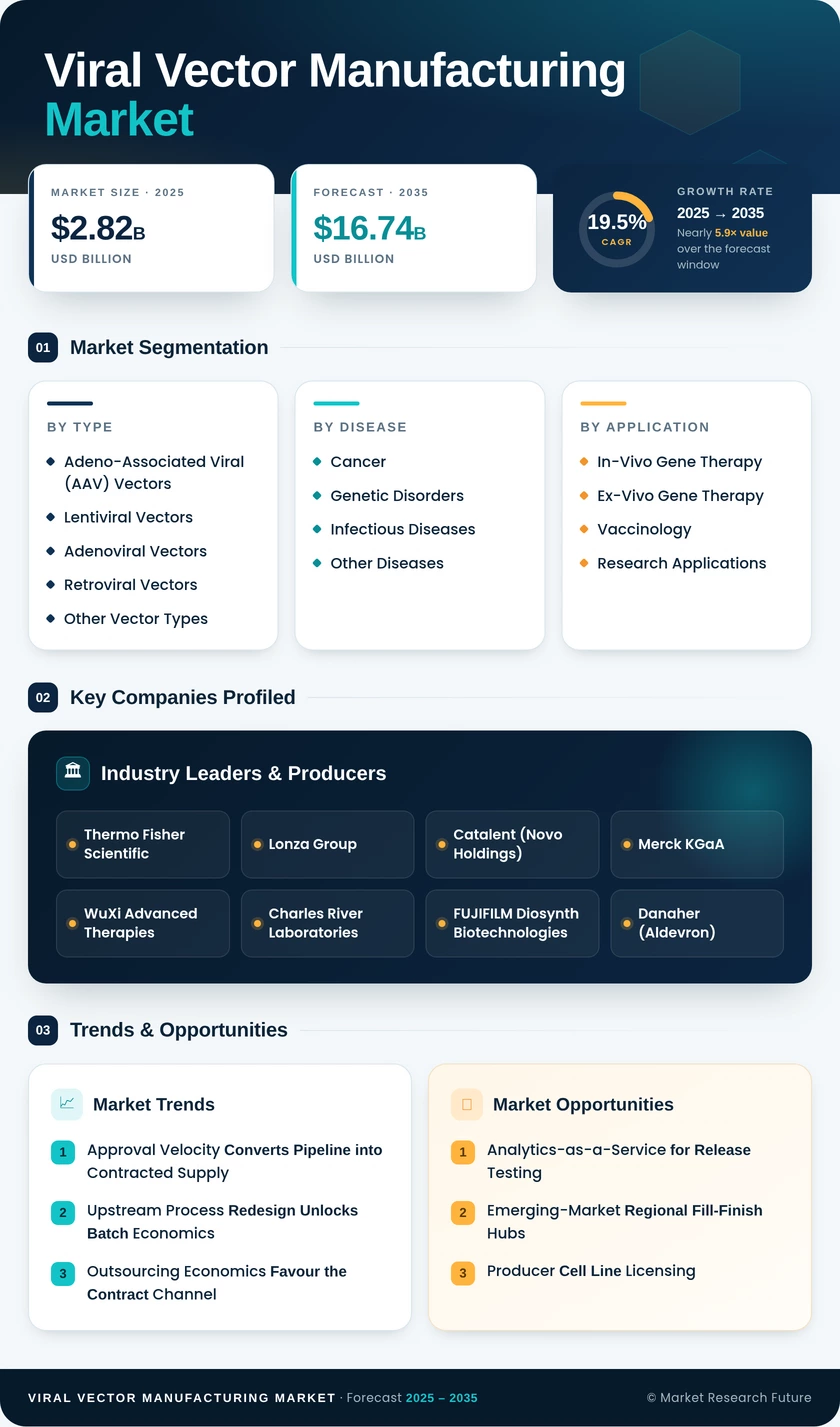
Segmentation Quick Reference
| Dimension | Sub-Segments | Dominant Segment | Fastest Growing Segment |
| By Vector Type | Adeno-Associated Viral (AAV) Vectors; Lentiviral Vectors; Adenoviral Vectors; Retroviral Vectors; Other Vector Types | Adeno-Associated Viral (AAV) Vectors | Other Vector Types |
| By Disease | Cancer; Genetic Disorders; Infectious Diseases; Other Diseases | Cancer | Infectious Diseases |
| By Application | In-Vivo Gene Therapy; Ex-Vivo Gene Therapy; Vaccinology; Research Applications | In-Vivo Gene Therapy | Vaccinology |
| By Mode of Manufacturing | In-House Manufacturing; CDMOs | CDMOs | CDMOs |
| By Geography | North America; Europe; Asia-Pacific; South America; Middle East & Africa | North America | Asia-Pacific |
Market Segmentation Overview
By Vector Type
| Sub-Segment | Key Trend |
| Adeno-Associated Viral (AAV) Vectors | Serotype engineering for tissue-specific targeting and reduced immunogenicity |
| Lentiviral Vectors | Stable producer cell lines replacing transient transfection at commercial scale |
| Adenoviral Vectors | Repositioning toward oncolytic virotherapy after vaccine demand normalisation |
| Retroviral Vectors | Gradual displacement by lentiviral systems outside legacy protocols |
| Other Vector Types | Herpes simplex and hybrid systems entering early clinical validation |
Vector choice increasingly reflects manufacturability as much as biology. Sponsors now model cost-of-goods at candidate selection rather than after Phase I, which favours serotypes with established purification routes and multiple qualified supply sites.
By Disease
| Sub-Segment | Key Trend |
| Cancer | Solid-tumour CAR-T and armoured constructs expanding vector volume per patient |
| Genetic Disorders | Ultra-rare indications creating campaign-style, low-frequency batch demand |
| Infectious Diseases | HIV functional cure programmes reviving lentiviral research supply |
| Other Diseases | Cardiac and autoimmune candidates entering first-in-human studies |
Indication mix drives batch scheduling more than total revenue. Oncology delivers predictable recurring throughput, while rare-disease programmes create sharp, short-lived capacity spikes that complicate CDMO utilisation planning.
By Application
| Sub-Segment | Key Trend |
| In-Vivo Gene Therapy | High-dose systemic administration multiplying vector genome requirements |
| Ex-Vivo Gene Therapy | Automated closed-system transduction shortening vein-to-vein times |
| Vaccinology | Pandemic-preparedness stockpile contracts sustaining baseline demand |
| Research Applications | Standardised catalogue vectors compressing preclinical lead times |
Application economics diverge sharply. In-vivo programmes buy volume and negotiate on cost per vector genome; ex-vivo buyers pay premiums for turnaround certainty and slot reliability.
By Mode of Manufacturing
| Sub-Segment | Key Trend |
| In-House Manufacturing | Post-approval internalisation by large pharma for supply sovereignty |
| CDMOs | Reservation-based contracting and platform designation reuse |
Outsourcing remains the default through the forecast decade. The decisive variable is portfolio depth — sponsors crossing three commercial assets consistently begin internalising, while everyone below that threshold stays contracted.

 Noah Malgeri
Co-Founder
Noah Malgeri
Co-Founder

 Peter Groot koerkamp
Account and Business Manager
Peter Groot koerkamp
Account and Business Manager

 Younghwan Choi
Senior Retail Manager
Younghwan Choi
Senior Retail Manager

 Mark Irwin
Management Consultant
Mark Irwin
Management Consultant

 Akif Moroglu
Strategy & Business Development Director
Akif Moroglu
Strategy & Business Development Director

 Guilherme Gomes Martins
Product Management Director
Guilherme Gomes Martins
Product Management Director

 Joseph Aguayo
Sales Operations & Pricing Manager
Joseph Aguayo
Sales Operations & Pricing Manager

 La Terria Dodd
Program Support Specialist
La Terria Dodd
Program Support Specialist

 Rob Kooiker
Group Product Manager HVAC & Fire Protection GMA
Rob Kooiker
Group Product Manager HVAC & Fire Protection GMA