×
Request Free Sample ×

Kindly complete the form below to receive a free sample of this Report

* Please use a valid business email

Leading companies partner with us for data-driven Insights

clients tt-cursor
Hero Background
English
Chinese
French
Japanese
Korean
German
Spanish

Vinyl Acetate Homopolymer Emulsion Market Analysis

ID: MRFR/CnM/2726-HCR
136 Pages
Chitranshi Jaiswal
October 2025

Vinyl Acetate Homopolymer Emulsion Market Research Report Information, by Application (Coatings, Wood Glues, Adhesives and Others), by End Use Industry (Wood, Textile, Paperboard & Packaging, Building & Construction, Paints & Coatings, and Others) and by Region- Global Forecast till 2035

Share:
Download PDF ×

We do not share your information with anyone. However, we may send you emails based on your report interest from time to time. You may contact us at any time to opt-out.

Vinyl Acetate Homopolymer Emulsion Market Infographic
Purchase Options

Market Analysis

In-depth Analysis of Vinyl Acetate Homopolymer Emulsion Market Industry Landscape

The Vinyl Acetate Homopolymer Emulsion dynamics is a significant sector within the chemical and polymer markets. It looks into the factors that influence their production, consumer behavior as well as the major tendencies that guide the market." This product VINYL ACETATE HOMOMER EMULSION, a polymer produced from vinyl acetate monomers, extends the spectrum of applications. They are used in adhesives, coatings, and paints because of the sufficiently improved adhesive properties and film-forming capabilities. The movements of the Vinyl Acetate Homopolymer Emulsion market can be caused by triggered technology, responses, innovations in formulations, manufacturing processes, and applications can be generated. During innovating the manufacturers spend time in the R&D in order to stay up to date with the latest technological advances, producing high-performance emulsions designed to serve different needs of various industries.

Worldwide disposition of supply and demand to a great extent settles the Vinyl Acetate Homopolymer Emulsion market. Economic environment having domestic and foreign trade prevailing are the decide the demand for these emulsions across different sectors like food industries, cosmetic industry, pharmaceuticals etc. Contraction in the construction and manufacturing sectors can lead to a decrease in the demand for vinyl acetate homopolymer emulsions resulting from the fall in general economic activity; when the general economy is expanding, the demand for vinyl acetate homopolymer emulsions is increased, due its use in various applications. Market's own well being is dependent upon the overall health of the world economy and hence guides the pattern of investment demand, the volume of production and pricing strategies.

Environmental conservation factors are becoming more and more noteworthy as they take a powerful grasp on the debates from the Vinyl Acetate Homopolymer Emulsion market. With the SDGs increase focuses on sustainability and eco-friendly practices, there is a high demand for emulsions which illustrate reduced environmental impact. Companies are striving to use eco-friendly manufacturing techniques, address the improvement of environmental accounts, and implement ABVB in the green sectors.

To the trivial application of VAHE in a wide range of industries, the market competition is harsh since it is considered as a commodity to different industries. The manufacturers, in the meantime, to improve on quality and cost-effectiveness as well as product design to stand them out. Uniqueness advantages, for example, inventing unique vinyl acetate homopolymer emulsion formulations for specific applications or supplying extra catalysts to give excellent performance characteristics, is one of factors to be considered.

Trade policies and political/ geographical conditions influence markets for Vinyl Acetate Homopolymer Emulsions on the whole. Choice of tariffs, import/export rules, and geopolitical uncertainties may alter global supply chain instances, which in turn can affect the accessibility and price of VAc homopolymer emulsion in different regions. Producers need to take seriously the notions of new trade deals and geopolitical scenarios. Owed to the factmakers must be competent in making timely adjustments of their strategies. Also, they have to pay attention to the risks and labels them as negative.

Author
Chitranshi Jaiswal
Research Analyst Level I

In her 3 years of experience in the market research field, she has handled critical cross-domain projects. She has an in-depth knowledge of market estimation & analysis, problem-solving, primary as well as secondary research, and team management.She holds an engineering degree and is an MBA professional from a well-known university, capable of evaluating the market and competitive conditions. An exceptional strategist with excellent communication skills and a passion for delivering cutting-edge & practical insights for the market. Proficient in multi-tasking, and can successfully deal with competing demands, while maintaining complete confidentiality. Generated business through active client and project development, networking, and high-quality responses. Her knowledge and skills have helped in making solid business decisions, securing funding from investors, and avoiding business failures.

Leave a Comment

FAQs

What is the forecast period of Vinyl Acetate Homopolymer Emulsion Market research report?

The forecast period for Vinyl Acetate Homopolymer Emulsion Market research report is 2025-2035

Which region will lead the Vinyl Acetate Homopolymer Emulsion Market?

Vinyl Acetate Homopolymer Emulsion Market is dominated by APAC region.

Who are the key players in the Vinyl Acetate Homopolymer Emulsion Market?

The main players in the Market are Celanese Corporation (U.S),Pexi Chem Private Limited. (India),Tailored Chemical (U.S), The Dow Chemical Company (U.S), Xyntra Chemicals B.V. (the Netherlands), Acquos (Australia), Wacker Chemie AG (Germany).

Market Summary

As per MRFR analysis, the Vinyl Acetate Homopolymer Emulsion Market Size was estimated at 1.27 USD Million in 2024. The Vinyl Acetate Homopolymer Emulsion industry is projected to grow from 1.33 in 2025 to 2.19 by 2035, exhibiting a compound annual growth rate (CAGR) of 5.09 during the forecast period 2025 - 2035.

Key Market Trends & Highlights

The Vinyl Acetate Homopolymer Emulsion Market is poised for robust growth driven by sustainability and technological advancements.

  • North America remains the largest market for vinyl acetate homopolymer emulsions, reflecting strong demand across various applications. The Asia-Pacific region is emerging as the fastest-growing market, fueled by rapid industrialization and urbanization. Adhesives dominate the market, while coatings are witnessing the fastest growth due to increasing applications in diverse sectors. Key market drivers include rising demand in the construction sector and an increased focus on eco-friendly products.

Market Size & Forecast

2024 Market Size 1.27 (USD Million)
2035 Market Size 2.19 (USD Million)
CAGR (2025 - 2035) 5.09%
Largest Regional Market Share in 2024 North America

Major Players

<p>BASF SE (DE), Wacker Chemie AG (DE), Dow Inc. (US), Celanese Corporation (US), SABIC (SA), Kraton Corporation (US), Mitsubishi Chemical Corporation (JP), Huntsman Corporation (US), Eastman Chemical Company (US)</p>

Market Trends

The Vinyl Acetate Homopolymer Emulsion Market is currently experiencing a dynamic phase characterized by evolving consumer preferences and technological advancements. This market, which primarily serves industries such as adhesives, paints, and coatings, is witnessing a shift towards eco-friendly and sustainable products. Manufacturers are increasingly focusing on developing formulations that minimize environmental impact while maintaining performance standards. As a result, there is a growing demand for water-based emulsions, which are perceived as safer alternatives to solvent-based products. This trend aligns with global initiatives aimed at reducing carbon footprints and promoting sustainability in various sectors. Moreover, the Vinyl Acetate Homopolymer Emulsion Market is influenced by the rising construction and automotive industries, which are driving the need for high-performance materials. Innovations in product formulations are enabling the creation of emulsions that offer enhanced durability, adhesion, and flexibility. Additionally, the expansion of distribution channels and the increasing penetration of e-commerce platforms are facilitating greater accessibility for consumers. As the market continues to evolve, stakeholders are likely to explore new opportunities for growth, particularly in emerging economies where industrialization is on the rise. This multifaceted landscape suggests that the Vinyl Acetate Homopolymer Emulsion Market is poised for continued development in the coming years.

Sustainability Focus

There is a notable shift towards sustainable practices within the Vinyl Acetate Homopolymer Emulsion Market. Manufacturers are prioritizing eco-friendly formulations that reduce environmental impact, aligning with global sustainability goals. This trend is evident in the increasing demand for water-based emulsions, which are perceived as safer alternatives to traditional solvent-based products.

Technological Advancements

Technological innovations are playing a crucial role in shaping the Vinyl Acetate Homopolymer Emulsion Market. Enhanced product formulations are being developed to improve performance characteristics such as adhesion, flexibility, and durability. These advancements are particularly relevant in industries like construction and automotive, where high-performance materials are essential.

E-commerce Growth

The rise of e-commerce platforms is transforming the distribution landscape of the Vinyl Acetate Homopolymer Emulsion Market. Increased online accessibility is enabling consumers to explore a wider range of products, thereby enhancing market reach. This trend is particularly significant in emerging economies, where digital platforms are becoming vital for business expansion.

Vinyl Acetate Homopolymer Emulsion Market Market Drivers

Diverse Application Range

The Global Vinyl Acetate Homopolymer Emulsion Market Industry benefits from its diverse application range across multiple sectors. These emulsions are utilized in adhesives, paints, coatings, textiles, and paper products, showcasing their versatility. The ability to adapt to various formulations allows manufacturers to meet specific industry requirements effectively. As industries continue to evolve, the demand for high-performance emulsions is likely to increase, further driving market growth. This broad applicability positions vinyl acetate homopolymer emulsions as a fundamental component in numerous products, ensuring their sustained relevance in the global market.

Market Growth Projections

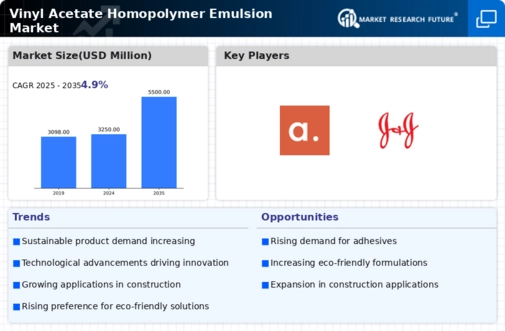
The Global Vinyl Acetate Homopolymer Emulsion Market Industry is poised for substantial growth, with projections indicating a market size of 3250 USD Million by 2024 and an anticipated increase to 5500 USD Million by 2035. This growth trajectory suggests a compound annual growth rate of 4.9% from 2025 to 2035, reflecting the increasing adoption of vinyl acetate homopolymer emulsions across various industries. The expanding applications, coupled with technological advancements and regulatory pressures, are likely to contribute to this upward trend. The market's resilience and adaptability to changing industry dynamics further reinforce its potential for sustained growth in the coming years.

Growth in Automotive Applications

The automotive industry is a notable driver for the Global Vinyl Acetate Homopolymer Emulsion Market Industry. These emulsions are increasingly employed in manufacturing automotive coatings and adhesives, which require high durability and performance. As the automotive sector shifts towards lightweight materials and eco-friendly solutions, vinyl acetate homopolymer emulsions are positioned to meet these evolving demands. The market is expected to witness a compound annual growth rate of 4.9% from 2025 to 2035, indicating a robust expansion driven by innovations in automotive technology and design. This trend underscores the versatility and adaptability of vinyl acetate emulsions in meeting industry-specific requirements.

Increasing Environmental Regulations

The Global Vinyl Acetate Homopolymer Emulsion Market Industry is influenced by the tightening of environmental regulations. Governments worldwide are enforcing stricter standards on volatile organic compounds (VOCs) in paints and coatings, prompting manufacturers to seek low-VOC alternatives. Vinyl acetate homopolymer emulsions are inherently lower in VOC content, making them an attractive option for compliance with these regulations. This shift not only enhances product safety but also aligns with the growing consumer preference for environmentally friendly products. As a result, the market is likely to benefit from increased adoption of these emulsions in various applications, reinforcing their role in sustainable development.

Rising Demand in Construction Sector

The Global Vinyl Acetate Homopolymer Emulsion Market Industry is experiencing a surge in demand driven by the construction sector. This emulsion is widely utilized in adhesives, paints, and coatings, which are essential for various construction applications. As urbanization continues to expand, particularly in developing regions, the need for durable and high-performance materials is paramount. The market is projected to reach 3250 USD Million by 2024, reflecting the increasing reliance on vinyl acetate homopolymer emulsions in construction. Furthermore, the anticipated growth in infrastructure projects globally suggests a sustained demand for these emulsions, reinforcing their significance in the construction landscape.

Technological Advancements in Production

Technological innovations in the production of vinyl acetate homopolymer emulsions are propelling the Global Vinyl Acetate Homopolymer Emulsion Market Industry forward. Advances in polymerization techniques and formulation technologies have led to the development of emulsions with enhanced properties, such as improved adhesion, flexibility, and weather resistance. These advancements enable manufacturers to cater to diverse applications across industries, including construction, automotive, and textiles. As the market evolves, the introduction of novel formulations is expected to drive growth, with projections indicating a market size of 5500 USD Million by 2035. This trajectory highlights the importance of continuous innovation in maintaining competitiveness within the industry.

Market Segment Insights

By Application: Adhesives (Largest) vs. Coatings (Fastest-Growing)

<p>In the Vinyl Acetate Homopolymer Emulsion Market, the application segment is diverse, with adhesives taking the lead as the largest contributor to market share. This dominance stems from the widespread utilization of vinyl acetate in various adhesive formulations, particularly in wood, construction, and packaging applications. Following adhesives, coatings are emerging robustly, driven by demand in industrial and architectural sectors, making them the fastest-growing application segment.</p>

<p>Coatings (Dominant) vs. Textiles (Emerging)</p>

<p>Coatings, as a dominant segment in the Vinyl Acetate Homopolymer Emulsion Market, benefit from their extensive application in industrial finishes, protective coatings, and decorative paint sectors. Their versatility in providing durability and resistance against environmental factors makes them highly sought after. On the other hand, textiles represent an emerging segment, as vinyl acetate emulsions are increasingly being used in fabric treatments and finishes. This shift is energized by the growing preference for synthetic textiles and the demand for enhanced performance characteristics, such as washability and durability, positioned to capture a larger share of the market.</p>

By End Use: Building and Construction (Largest) vs. Packaging (Fastest-Growing)

<p>The Vinyl Acetate Homopolymer Emulsion Market exhibits a diverse distribution of end-use applications, with Building and Construction holding a significant share due to the extensive use of emulsions in adhesives, sealants, and coatings. This sector benefits from ongoing trends in infrastructure development and rising demand for durable construction materials. On the other hand, Packaging is rapidly gaining ground, fueled by increasing consumer preference for eco-friendly and sustainable packaging solutions, making it a key player in the market.</p>

<p>Building and Construction: Dominant vs. Packaging: Emerging</p>

<p>The Building and Construction sector is currently the dominant application in the Vinyl Acetate Homopolymer Emulsion Market, as it encompasses a wide range of products including adhesives, paints, and sealants that are essential for construction activities. The segment thrives on the growing construction sector, driven by urbanization and infrastructure investments. Conversely, the Packaging segment is emerging quickly, propelled by the demand for sustainable packaging solutions and innovative product designs that utilize emulsion technology. As manufacturers seek to meet consumer demands for greener products, the Packaging segment is expected to leverage advances in emulsion technology to enhance performance characteristics while ensuring environmental compliance.</p>

By Formulation Type: Water-Based (Largest) vs. Non-Aqueous (Fastest-Growing)

<p>In the Vinyl Acetate Homopolymer Emulsion Market, the formulation types exhibit distinct shares, with Water-Based emulsions leading the segment due to their eco-friendly characteristics and versatility in applications across construction, adhesives, and coatings. Water-Based formulations are preferred by manufacturers and consumers for their low volatile organic compounds (VOCs), driving their continued dominance. Meanwhile, Non-Aqueous formulations, although currently smaller in market share, are experiencing rapid growth driven by applications requiring specific performance attributes that are best delivered through these formulations. Their unique properties allow for better performance in specific industrial applications where traditional methods may falter, thereby attracting increased investment and interest.</p>

<p>Water-Based (Dominant) vs. Non-Aqueous (Emerging)</p>

<p>Water-Based emulsions are solidly positioned as the dominant formulation type within the Vinyl Acetate Homopolymer Emulsion Market, thanks to their environmental benefits and efficiency in numerous applications. They serve a wide range of industries including paints, adhesives, and coatings, and are favored for their user-friendly nature and compliance with stringent regulatory requirements. On the other hand, Non-Aqueous formulations represent the emerging segment, offering specialized applications that cater to the needs of industries demanding enhanced performance features. As technology advances and demand for specific characteristics increases, Non-Aqueous emulsions are gaining traction, appealing to manufacturers looking for alternatives that can provide high-performance solutions in challenging environments.</p>

By Distribution Channel: Direct Sales (Largest) vs. Online Sales (Fastest-Growing)

<p>In the Vinyl Acetate Homopolymer Emulsion Market, Direct Sales hold the largest share among distribution channels, reflecting a well-established relationship between manufacturers and end-users. This segment thrives on direct interactions, ensuring tailored solutions that meet specific customer needs. Meanwhile, Distributors and Retail also contribute significantly, yet they face stiffer competition and market saturation compared to the leading channels. Online Sales, while smaller currently, are rapidly gaining ground as businesses adapt to changing consumer behaviors and preferences. Growth trends in this segment indicate a shift towards a more digital landscape. The Online Sales channel is projected as the fastest-growing due to increasing e-commerce adoption and consumer preference for convenience. Innovations in supply chain management and digital marketing strategies are driving this change, allowing companies to reach broader audiences efficiently. Additionally, Direct Sales continue to thrive as businesses focus on personalized services and customer satisfaction to retain market share.</p>

<p>Direct Sales (Dominant) vs. Retail (Emerging)</p>

<p>Direct Sales in the Vinyl Acetate Homopolymer Emulsion Market remain a dominant distribution channel due to established trust and direct engagement with clients, enabling firms to create customized solutions that foster long-term relationships. This channel is characterized by in-depth product knowledge and responsiveness, ensuring that customer feedback drives product enhancements. In contrast, Retail is emerging as a viable channel, reflecting a transition in the purchasing dynamics where end-users seek convenience and accessibility. Retail's growth is complemented by an increasing number of specialty stores focused on providing niche products like vinyl acetate emulsions. This shift underscores a diversification strategy from manufacturers who are now addressing a broader range of consumer preferences.</p>

Get more detailed insights about Vinyl Acetate Homopolymer Emulsion Market Research Report- Forecast to 2035

Regional Insights

North America : Market Leader in Emulsions

North America is poised to maintain its leadership in the Vinyl Acetate Homopolymer Emulsion Market, holding a significant market share of 50% in 2024. The region's growth is driven by robust demand in construction, automotive, and packaging sectors, alongside favorable regulatory frameworks promoting sustainable practices. The increasing focus on eco-friendly products is further catalyzing market expansion, with innovations in formulation and application techniques enhancing product performance. The United States stands as the primary contributor, with key players like Dow Inc., BASF SE, and Eastman Chemical Company leading the competitive landscape. The presence of advanced manufacturing facilities and a strong distribution network supports the market's growth. Additionally, collaborations and strategic partnerships among industry leaders are expected to enhance product offerings and market penetration, solidifying North America's position as a manufacturing hub for vinyl acetate emulsions.

Europe : Emerging Market Dynamics

Europe is witnessing a dynamic shift in the Vinyl Acetate Homopolymer Emulsion Market, with a market share of 30% in 2024. The region's growth is fueled by stringent environmental regulations and a rising demand for sustainable and high-performance products. The European Union's commitment to reducing carbon emissions and promoting green chemistry is driving innovation in emulsion technologies, making them more efficient and eco-friendly. Germany and France are leading the charge, with major companies like Wacker Chemie AG and BASF SE investing heavily in R&D to develop advanced formulations. The competitive landscape is characterized by a mix of established players and emerging startups focusing on niche applications. The emphasis on circular economy principles is reshaping market strategies, encouraging companies to adopt sustainable practices and enhance product lifecycle management.

Asia-Pacific : Rapid Growth and Innovation

Asia-Pacific is rapidly emerging as a significant player in the Vinyl Acetate Homopolymer Emulsion Market, holding a market share of 30% in 2024. The region's growth is driven by increasing industrialization, urbanization, and a booming construction sector. Countries like China and India are witnessing a surge in demand for adhesives and coatings, which are key applications for vinyl acetate emulsions, supported by government initiatives to boost infrastructure development. China is the leading country in this region, with major companies like Mitsubishi Chemical Corporation and Kraton Corporation expanding their production capacities. The competitive landscape is marked by a mix of local and international players, fostering innovation and competitive pricing. The region's focus on sustainable practices and regulatory compliance is expected to further enhance market growth, making Asia-Pacific a vital hub for vinyl acetate emulsion production.

Middle East and Africa : Untapped Market Potential

The Middle East and Africa region is gradually emerging in the Vinyl Acetate Homopolymer Emulsion Market, with a market share of 17% in 2024. The growth is primarily driven by increasing construction activities and a rising demand for adhesives in various industries. Government initiatives aimed at diversifying economies and investing in infrastructure are catalyzing market expansion, creating opportunities for manufacturers and suppliers in the region. Countries like South Africa and the UAE are at the forefront, with local players and international companies exploring market entry strategies. The competitive landscape is evolving, with a focus on establishing production facilities to meet local demand. As the region continues to develop, the presence of key players and investment in R&D will be crucial for capturing market share and driving innovation in vinyl acetate emulsions.

Key Players and Competitive Insights

The Vinyl Acetate Homopolymer Emulsion Market is currently characterized by a dynamic competitive landscape, driven by increasing demand across various applications such as adhesives, paints, and coatings. Key players are actively engaging in strategies that emphasize innovation, sustainability, and regional expansion. For instance, BASF SE (Germany) has been focusing on enhancing its product portfolio through sustainable solutions, while Dow Inc. (US) is leveraging its technological advancements to improve product performance and reduce environmental impact. These strategies collectively contribute to a competitive environment that is increasingly oriented towards meeting regulatory standards and consumer preferences for eco-friendly products.In terms of business tactics, companies are localizing manufacturing to reduce lead times and optimize supply chains. The market structure appears moderately fragmented, with several players vying for market share. This fragmentation allows for a diverse range of products and innovations, although it also intensifies competition among key players. The collective influence of these companies shapes market dynamics, as they strive to differentiate themselves through unique offerings and operational efficiencies.


In November Wacker Chemie AG (Germany) announced the launch of a new line of bio-based vinyl acetate homopolymer emulsions aimed at the construction sector. This strategic move is significant as it aligns with the growing trend towards sustainable building materials, potentially positioning Wacker as a leader in eco-friendly solutions within the market. The introduction of these products may enhance their competitive edge and attract environmentally conscious customers.


In October Celanese Corporation (US) expanded its production capacity for vinyl acetate emulsions in North America. This expansion is likely to bolster their market presence and meet the rising demand in the region, particularly in the adhesives and coatings sectors. By increasing production capabilities, Celanese may enhance its responsiveness to market needs and strengthen its supply chain resilience.


In September Mitsubishi Chemical Corporation (Japan) entered into a strategic partnership with a leading technology firm to develop advanced digital solutions for its manufacturing processes. This collaboration is indicative of a broader trend towards digital transformation in the industry, which could lead to improved operational efficiencies and product quality. Such initiatives may also facilitate better data analytics and customer engagement, further enhancing Mitsubishi's competitive positioning.


As of December the competitive trends in the Vinyl Acetate Homopolymer Emulsion Market are increasingly defined by digitalization, sustainability, and technological integration. Strategic alliances are becoming more prevalent, enabling companies to pool resources and expertise to innovate more effectively. The shift from price-based competition to a focus on innovation, technology, and supply chain reliability is evident, suggesting that future competitive differentiation will hinge on the ability to adapt to these evolving market demands.

Key Companies in the Vinyl Acetate Homopolymer Emulsion Market include

Industry Developments

Future Outlook

Vinyl Acetate Homopolymer Emulsion Market Future Outlook

<p>The Vinyl Acetate Homopolymer Emulsion Market is projected to grow at a 5.09% CAGR from 2025 to 2035, driven by increasing demand in construction, adhesives, and coatings.</p>

New opportunities lie in:

  • <p>Expansion into bio-based emulsion products to meet sustainability demands. Development of customized formulations for niche applications in automotive coatings. Strategic partnerships with construction firms to enhance product distribution channels.</p>

<p>By 2035, the market is expected to solidify its position as a leader in sustainable emulsion solutions.</p>

Market Segmentation

Vinyl Acetate Homopolymer Emulsion Market End Use Outlook

  • Building and Construction
  • Automotive
  • Consumer Goods
  • Industrial
  • Packaging

Vinyl Acetate Homopolymer Emulsion Market Application Outlook

  • Adhesives
  • Coatings
  • Textiles
  • Paper
  • Construction

Vinyl Acetate Homopolymer Emulsion Market Formulation Type Outlook

  • Aqueous
  • Non-Aqueous
  • Solvent-Based
  • Water-Based

Vinyl Acetate Homopolymer Emulsion Market Distribution Channel Outlook

  • Direct Sales
  • Distributors
  • Online Sales
  • Retail

Report Scope

MARKET SIZE 2024 1.27(USD Million)
MARKET SIZE 2025 1.33(USD Million)
MARKET SIZE 2035 2.19(USD Million)
COMPOUND ANNUAL GROWTH RATE (CAGR) 5.09% (2025 - 2035)
REPORT COVERAGE Revenue Forecast, Competitive Landscape, Growth Factors, and Trends
BASE YEAR 2024
Market Forecast Period 2025 - 2035
Historical Data 2019 - 2024
Market Forecast Units USD Million
Key Companies Profiled BASF SE (DE), Wacker Chemie AG (DE), Dow Inc. (US), Celanese Corporation (US), SABIC (SA), Kraton Corporation (US), Mitsubishi Chemical Corporation (JP), Huntsman Corporation (US), Eastman Chemical Company (US)
Segments Covered Application, End Use, Formulation Type, Distribution Channel
Key Market Opportunities Growing demand for eco-friendly adhesives drives innovation in the Vinyl Acetate Homopolymer Emulsion Market.
Key Market Dynamics Rising demand for eco-friendly adhesives drives innovation and competition in the Vinyl Acetate Homopolymer Emulsion Market.
Countries Covered North America, Europe, APAC, South America, MEA

FAQs

What is the forecast period of Vinyl Acetate Homopolymer Emulsion Market research report?

The forecast period for Vinyl Acetate Homopolymer Emulsion Market research report is 2025-2035

Which region will lead the Vinyl Acetate Homopolymer Emulsion Market?

Vinyl Acetate Homopolymer Emulsion Market is dominated by APAC region.

Who are the key players in the Vinyl Acetate Homopolymer Emulsion Market?

The main players in the Market are Celanese Corporation (U.S),Pexi Chem Private Limited. (India),Tailored Chemical (U.S), The Dow Chemical Company (U.S), Xyntra Chemicals B.V. (the Netherlands), Acquos (Australia), Wacker Chemie AG (Germany).

  1. SECTION I: EXECUTIVE SUMMARY AND KEY HIGHLIGHTS
    1. | 1.1 EXECUTIVE SUMMARY
    2. | 1.1.1 Market Overview
    3. | 1.1.2 Key Findings
    4. | 1.1.3 Market Segmentation
    5. | 1.1.4 Competitive Landscape
    6. | 1.1.5 Challenges and Opportunities
    7. | 1.1.6 Future Outlook
  2. SECTION II: SCOPING, METHODOLOGY AND MARKET STRUCTURE
    1. | 2.1 MARKET INTRODUCTION
    2. | 2.1.1 Definition
    3. | 2.1.2 Scope of the study
    4. |-- 2.1.2.1 Research Objective
    5. |-- 2.1.2.2 Assumption
    6. |-- 2.1.2.3 Limitations
    7. | 2.2 RESEARCH METHODOLOGY
    8. | 2.2.1 Overview
    9. | 2.2.2 Data Mining
    10. | 2.2.3 Secondary Research
    11. | 2.2.4 Primary Research
    12. |-- 2.2.4.1 Primary Interviews and Information Gathering Process
    13. |-- 2.2.4.2 Breakdown of Primary Respondents
    14. | 2.2.5 Forecasting Model
    15. | 2.2.6 Market Size Estimation
    16. |-- 2.2.6.1 Bottom-Up Approach
    17. |-- 2.2.6.2 Top-Down Approach
    18. | 2.2.7 Data Triangulation
    19. | 2.2.8 Validation
  3. SECTION III: QUALITATIVE ANALYSIS
    1. | 3.1 MARKET DYNAMICS
    2. | 3.1.1 Overview
    3. | 3.1.2 Drivers
    4. | 3.1.3 Restraints
    5. | 3.1.4 Opportunities
    6. | 3.2 MARKET FACTOR ANALYSIS
    7. | 3.2.1 Value chain Analysis
    8. | 3.2.2 Porter's Five Forces Analysis
    9. |-- 3.2.2.1 Bargaining Power of Suppliers
    10. |-- 3.2.2.2 Bargaining Power of Buyers
    11. |-- 3.2.2.3 Threat of New Entrants
    12. |-- 3.2.2.4 Threat of Substitutes
    13. |-- 3.2.2.5 Intensity of Rivalry
    14. | 3.2.3 COVID-19 Impact Analysis
    15. |-- 3.2.3.1 Market Impact Analysis
    16. |-- 3.2.3.2 Regional Impact
    17. |-- 3.2.3.3 Opportunity and Threat Analysis
  4. SECTION IV: QUANTITATIVE ANALYSIS
    1. | 4.1 Chemicals and Materials, BY Application (USD Million)
    2. | 4.1.1 Adhesives
    3. | 4.1.2 Coatings
    4. | 4.1.3 Textiles
    5. | 4.1.4 Paper
    6. | 4.1.5 Construction
    7. | 4.2 Chemicals and Materials, BY End Use (USD Million)
    8. | 4.2.1 Building and Construction
    9. | 4.2.2 Automotive
    10. | 4.2.3 Consumer Goods
    11. | 4.2.4 Industrial
    12. | 4.2.5 Packaging
    13. | 4.3 Chemicals and Materials, BY Formulation Type (USD Million)
    14. | 4.3.1 Aqueous
    15. | 4.3.2 Non-Aqueous
    16. | 4.3.3 Solvent-Based
    17. | 4.3.4 Water-Based
    18. | 4.4 Chemicals and Materials, BY Distribution Channel (USD Million)
    19. | 4.4.1 Direct Sales
    20. | 4.4.2 Distributors
    21. | 4.4.3 Online Sales
    22. | 4.4.4 Retail
    23. | 4.5 Chemicals and Materials, BY Region (USD Million)
    24. | 4.5.1 North America
    25. |-- 4.5.1.1 US
    26. |-- 4.5.1.2 Canada
    27. | 4.5.2 Europe
    28. |-- 4.5.2.1 Germany
    29. |-- 4.5.2.2 UK
    30. |-- 4.5.2.3 France
    31. |-- 4.5.2.4 Russia
    32. |-- 4.5.2.5 Italy
    33. |-- 4.5.2.6 Spain
    34. |-- 4.5.2.7 Rest of Europe
    35. | 4.5.3 APAC
    36. |-- 4.5.3.1 China
    37. |-- 4.5.3.2 India
    38. |-- 4.5.3.3 Japan
    39. |-- 4.5.3.4 South Korea
    40. |-- 4.5.3.5 Malaysia
    41. |-- 4.5.3.6 Thailand
    42. |-- 4.5.3.7 Indonesia
    43. |-- 4.5.3.8 Rest of APAC
    44. | 4.5.4 South America
    45. |-- 4.5.4.1 Brazil
    46. |-- 4.5.4.2 Mexico
    47. |-- 4.5.4.3 Argentina
    48. |-- 4.5.4.4 Rest of South America
    49. | 4.5.5 MEA
    50. |-- 4.5.5.1 GCC Countries
    51. |-- 4.5.5.2 South Africa
    52. |-- 4.5.5.3 Rest of MEA
  5. SECTION V: COMPETITIVE ANALYSIS
    1. | 5.1 Competitive Landscape
    2. | 5.1.1 Overview
    3. | 5.1.2 Competitive Analysis
    4. | 5.1.3 Market share Analysis
    5. | 5.1.4 Major Growth Strategy in the Chemicals and Materials
    6. | 5.1.5 Competitive Benchmarking
    7. | 5.1.6 Leading Players in Terms of Number of Developments in the Chemicals and Materials
    8. | 5.1.7 Key developments and growth strategies
    9. |-- 5.1.7.1 New Product Launch/Service Deployment
    10. |-- 5.1.7.2 Merger & Acquisitions
    11. |-- 5.1.7.3 Joint Ventures
    12. | 5.1.8 Major Players Financial Matrix
    13. |-- 5.1.8.1 Sales and Operating Income
    14. |-- 5.1.8.2 Major Players R&D Expenditure. 2023
    15. | 5.2 Company Profiles
    16. | 5.2.1 BASF SE (DE)
    17. |-- 5.2.1.1 Financial Overview
    18. |-- 5.2.1.2 Products Offered
    19. |-- 5.2.1.3 Key Developments
    20. |-- 5.2.1.4 SWOT Analysis
    21. |-- 5.2.1.5 Key Strategies
    22. | 5.2.2 Wacker Chemie AG (DE)
    23. |-- 5.2.2.1 Financial Overview
    24. |-- 5.2.2.2 Products Offered
    25. |-- 5.2.2.3 Key Developments
    26. |-- 5.2.2.4 SWOT Analysis
    27. |-- 5.2.2.5 Key Strategies
    28. | 5.2.3 Dow Inc. (US)
    29. |-- 5.2.3.1 Financial Overview
    30. |-- 5.2.3.2 Products Offered
    31. |-- 5.2.3.3 Key Developments
    32. |-- 5.2.3.4 SWOT Analysis
    33. |-- 5.2.3.5 Key Strategies
    34. | 5.2.4 Celanese Corporation (US)
    35. |-- 5.2.4.1 Financial Overview
    36. |-- 5.2.4.2 Products Offered
    37. |-- 5.2.4.3 Key Developments
    38. |-- 5.2.4.4 SWOT Analysis
    39. |-- 5.2.4.5 Key Strategies
    40. | 5.2.5 SABIC (SA)
    41. |-- 5.2.5.1 Financial Overview
    42. |-- 5.2.5.2 Products Offered
    43. |-- 5.2.5.3 Key Developments
    44. |-- 5.2.5.4 SWOT Analysis
    45. |-- 5.2.5.5 Key Strategies
    46. | 5.2.6 Kraton Corporation (US)
    47. |-- 5.2.6.1 Financial Overview
    48. |-- 5.2.6.2 Products Offered
    49. |-- 5.2.6.3 Key Developments
    50. |-- 5.2.6.4 SWOT Analysis
    51. |-- 5.2.6.5 Key Strategies
    52. | 5.2.7 Mitsubishi Chemical Corporation (JP)
    53. |-- 5.2.7.1 Financial Overview
    54. |-- 5.2.7.2 Products Offered
    55. |-- 5.2.7.3 Key Developments
    56. |-- 5.2.7.4 SWOT Analysis
    57. |-- 5.2.7.5 Key Strategies
    58. | 5.2.8 Huntsman Corporation (US)
    59. |-- 5.2.8.1 Financial Overview
    60. |-- 5.2.8.2 Products Offered
    61. |-- 5.2.8.3 Key Developments
    62. |-- 5.2.8.4 SWOT Analysis
    63. |-- 5.2.8.5 Key Strategies
    64. | 5.2.9 Eastman Chemical Company (US)
    65. |-- 5.2.9.1 Financial Overview
    66. |-- 5.2.9.2 Products Offered
    67. |-- 5.2.9.3 Key Developments
    68. |-- 5.2.9.4 SWOT Analysis
    69. |-- 5.2.9.5 Key Strategies
    70. | 5.3 Appendix
    71. | 5.3.1 References
    72. | 5.3.2 Related Reports

Chemicals and Materials Market Segmentation

Chemicals and Materials By Application (USD Million, 2025-2035)

  • Adhesives
  • Coatings
  • Textiles
  • Paper
  • Construction

Chemicals and Materials By End Use (USD Million, 2025-2035)

  • Building and Construction
  • Automotive
  • Consumer Goods
  • Industrial
  • Packaging

Chemicals and Materials By Formulation Type (USD Million, 2025-2035)

  • Aqueous
  • Non-Aqueous
  • Solvent-Based
  • Water-Based

Chemicals and Materials By Distribution Channel (USD Million, 2025-2035)

  • Direct Sales
  • Distributors
  • Online Sales
  • Retail
Infographic

Free Sample Request

Kindly complete the form below to receive a free sample of this Report

Get Free Sample

Customer Strories

Compare Licence

×
Features License Type
Single User Multiuser License Enterprise User
Price $4,950 $5,950 $7,250
Maximum User Access Limit 1 User Upto 10 Users Unrestricted Access Throughout the Organization
Free Customization
Direct Access to Analyst
Deliverable Format
Platform Access
Discount on Next Purchase 10% 15% 15%
Printable Versions