×
Hero Background
English
Chinese
French
Japanese
Korean
German
Spanish

Vinyl Acetate Emulsion Polymers Market Analysis

ID: MRFR/CnM/3853-HCR
138 Pages
Chitranshi Jaiswal
October 2025

Vinyl Acetate Emulsion Polymers Market Research Report by Application (Paints & Coatings, Adhesives, Textiles, Construction and Paper) – Forecast till 2035

Share:
Download PDF ×

We do not share your information with anyone. However, we may send you emails based on your report interest from time to time. You may contact us at any time to opt-out.

Vinyl Acetate Emulsion Polymers Market Infographic
Purchase Options

Market Analysis

In-depth Analysis of Vinyl Acetate Emulsion Polymers Market Industry Landscape

The market dynamics of vinyl acetate emulsion polymers (VAE) reflect a blend of factors influencing the supply, demand, and trends within the industry. VAE polymers have gained prominence as versatile materials used in various applications, notably in adhesives, paints, and coatings. One of the primary drivers of the VAE market is the booming construction sector globally. The demand for environmentally friendly and sustainable building materials has led to an increased adoption of VAE polymers in the formulation of adhesives and construction chemicals, enhancing the overall performance and durability of these products.

Environmental regulations also play a pivotal role in shaping the dynamics of the VAE market. With a growing emphasis on reducing volatile organic compound (VOC) emissions, VAE polymers have become favored alternatives in the coatings industry. Their low VOC content aligns with stringent environmental standards, driving the market growth as manufacturers seek eco-friendly solutions to comply with regulations.

The evolving trends in the furniture and automotive industries contribute significantly to the dynamics of the VAE market. The demand for water-based adhesives, which often incorporate VAE polymers, is on the rise as these industries prioritize sustainability and seek alternatives to solvent-based adhesives. VAE polymers offer improved bonding strength and versatility, making them a preferred choice for various applications in these sectors.

Technological advancements in the production of VAE polymers also influence market dynamics. Ongoing research and development efforts focus on enhancing the performance characteristics of these polymers, such as their adhesion properties, flexibility, and durability. Innovations in formulation and manufacturing processes contribute to the competitiveness of VAE polymer products in the market, meeting the evolving needs of end-users.

Raw material prices and availability are crucial factors impacting the VAE market dynamics. The primary raw material, vinyl acetate monomer, is subject to fluctuations in pricing due to factors like feedstock costs and market demand. These variations can influence the overall production costs, subsequently affecting pricing strategies within the market. Additionally, supply chain disruptions and geopolitical events contribute to the complexity of raw material dynamics in the VAE market.

Competitive dynamics within the VAE market involve a mix of major multinational corporations and regional players. Companies engage in strategic initiatives such as mergers, acquisitions, and partnerships to strengthen their market position and expand their product portfolios. The pursuit of innovation and sustainability, coupled with a strong distribution network, forms the cornerstone of competitive strategies employed by market participants.

Geographically, the dynamics of the VAE market exhibit variations across regions. Developed economies with stringent environmental regulations, such as North America and Europe, witness a higher adoption of VAE polymers. In contrast, emerging economies in Asia-Pacific and Latin America experience robust growth due to increased construction activities, urbanization, and rising consumer awareness about sustainable materials.

Consumer preferences and awareness of sustainable practices are driving market dynamics, with end-users seeking products that align with eco-friendly principles. The shift towards water-based formulations, which often include VAE polymers, reflects the changing preferences of consumers who prioritize environmentally responsible choices.

Author
Chitranshi Jaiswal
Research Analyst Level I

In her 3 years of experience in the market research field, she has handled critical cross-domain projects. She has an in-depth knowledge of market estimation & analysis, problem-solving, primary as well as secondary research, and team management.She holds an engineering degree and is an MBA professional from a well-known university, capable of evaluating the market and competitive conditions. An exceptional strategist with excellent communication skills and a passion for delivering cutting-edge & practical insights for the market. Proficient in multi-tasking, and can successfully deal with competing demands, while maintaining complete confidentiality. Generated business through active client and project development, networking, and high-quality responses. Her knowledge and skills have helped in making solid business decisions, securing funding from investors, and avoiding business failures.

Leave a Comment

FAQs

What is the forecast period of Vinyl Acetate Emulsion Polymers Market research report?

The forecast period for Vinyl Acetate Emulsion Polymers Market research report is 2025-2035.

Which region will lead the Vinyl Acetate Emulsion Polymers Market?

Vinyl Acetate Emulsion Polymers Market is dominated by APAC region.

Who are the key players in the Vinyl Acetate Emulsion Polymers Market?

The major players are BASF SE (Germany), The Lubrizol Corporation (U.S.), Clariant (Switzerland), Cytec Industries Inc (U.S.), DIC CORPORATION (Japan), Arkema S.A.(France), Nuplex Industries Ltd (Australia), Trinseo (U.S.), Momentive (U.S.) and Synthomer plc (U.K.) among others.

Market Summary

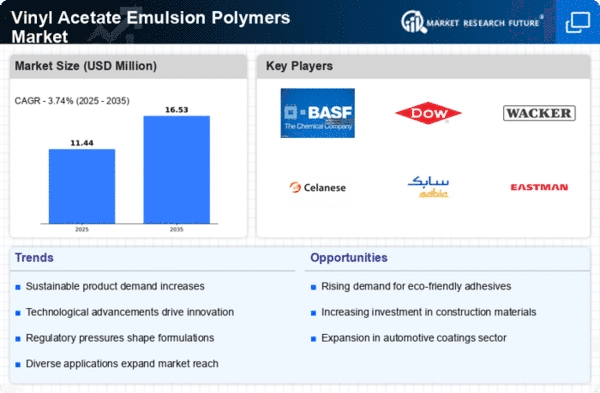
As per Market Research Future analysis, the Vinyl Acetate Emulsion Polymers Market Size was estimated at 11.03 USD Million in 2024. The Vinyl Acetate Emulsion Polymers industry is projected to grow from USD 11.45 Million in 2025 to USD 16.53 Million by 2035, exhibiting a compound annual growth rate (CAGR) of 3.74% during the forecast period 2025 - 2035

Key Market Trends & Highlights

The Vinyl Acetate Emulsion Polymers Market is experiencing a dynamic shift towards sustainability and innovation.

  • The market is witnessing a pronounced focus on sustainability, driving the development of eco-friendly products.
  • Technological advancements in polymer production are enhancing the performance and application scope of vinyl acetate emulsions.
  • North America remains the largest market, while Asia-Pacific is emerging as the fastest-growing region for these polymers.
  • The rising demand in the construction sector and increased regulatory support for eco-friendly products are key drivers of market growth.

Market Size & Forecast

2024 Market Size 11.03 (USD Million)
2035 Market Size 16.53 (USD Million)
CAGR (2025 - 2035) 3.74%
Largest Regional Market Share in 2024 North America

Major Players

<p>BASF SE (DE), Dow Inc. (US), Wacker Chemie AG (DE), Celanese Corporation (US), SABIC (SA), Eastman Chemical Company (US), Huntsman Corporation (US), Mitsubishi Chemical Corporation (JP), Kraton Corporation (US)</p>

Market Trends

The Vinyl Acetate Emulsion Polymers Market is currently experiencing a dynamic phase characterized by evolving consumer preferences and technological advancements. This sector, integral to various applications such as adhesives, paints, and coatings, is witnessing a shift towards sustainable and eco-friendly products. Manufacturers are increasingly focusing on developing formulations that minimize environmental impact while maintaining performance standards. The growing awareness regarding health and safety is prompting companies to innovate and adapt their offerings to meet stringent regulations and consumer demands. Moreover, the Vinyl Acetate Emulsion Polymers Market is influenced by the rising demand for high-performance materials across industries. As construction and automotive sectors expand, the need for durable and versatile polymers becomes more pronounced. This trend is further supported by the increasing adoption of advanced manufacturing techniques, which enhance product quality and efficiency. Stakeholders in this market are likely to explore strategic partnerships and collaborations to leverage technological advancements and expand their market reach, indicating a robust competitive landscape that is poised for growth in the coming years.

Sustainability Focus

There is a noticeable trend towards sustainability within the Vinyl Acetate Emulsion Polymers Market. Companies are prioritizing the development of eco-friendly products that align with consumer preferences for environmentally responsible solutions. This shift is prompting innovations in formulations that reduce harmful emissions and enhance biodegradability.

Technological Advancements

The market is witnessing significant technological advancements that enhance the performance and versatility of vinyl acetate emulsion polymers. Innovations in production processes and material formulations are enabling manufacturers to create products that meet diverse application needs, particularly in the construction and automotive sectors.

Regulatory Compliance

Increasing regulatory pressures are shaping the Vinyl Acetate Emulsion Polymers Market. Companies are adapting their product lines to comply with stringent health and safety regulations, which is driving the development of safer and more efficient polymer solutions. This trend reflects a broader commitment to consumer safety and environmental stewardship.

Vinyl Acetate Emulsion Polymers Market Market Drivers

Increased Investment in R&D

Investment in research and development is a critical driver for the Global Vinyl Acetate Emulsion Polymers Market Industry. Companies are allocating significant resources to innovate and improve product formulations, aiming to meet the evolving needs of various industries. This focus on R&D not only enhances product quality but also fosters the development of new applications for vinyl acetate emulsions. As industries increasingly prioritize performance and sustainability, the ongoing investment in R&D is expected to play a vital role in shaping the future of the market, ensuring its growth and competitiveness.

Rising Environmental Concerns

Environmental sustainability is becoming a pivotal factor influencing the Global Vinyl Acetate Emulsion Polymers Market Industry. Manufacturers are increasingly focusing on producing eco-friendly products that comply with stringent regulations regarding volatile organic compounds. The shift towards sustainable building materials and low-emission products is likely to enhance the adoption of vinyl acetate emulsions, which are known for their lower environmental impact compared to solvent-based alternatives. This trend aligns with global initiatives aimed at reducing carbon footprints, potentially contributing to a market growth trajectory that could reach 20.3 USD Billion by 2035.

Growing Demand in Construction Sector

The Global Vinyl Acetate Emulsion Polymers Market Industry experiences a robust demand from the construction sector, primarily due to the increasing use of these polymers in adhesives, paints, and coatings. The construction industry is projected to expand significantly, with investments in infrastructure development reaching unprecedented levels. This growth is expected to drive the market size to approximately 12.5 USD Billion in 2024. Vinyl acetate emulsions provide superior adhesion and flexibility, making them ideal for various applications in construction. As urbanization accelerates globally, the demand for high-performance materials will likely continue to rise, further bolstering the market.

Expanding Applications in Consumer Goods

The Global Vinyl Acetate Emulsion Polymers Market Industry is witnessing an expansion in applications across various consumer goods sectors. These polymers are increasingly utilized in products such as textiles, packaging, and personal care items due to their excellent binding properties and versatility. The growing consumer preference for high-quality, durable products is likely to drive demand for vinyl acetate emulsions. As manufacturers seek to enhance product performance, the market could see substantial growth, reflecting the changing dynamics of consumer behavior and preferences in the coming years.

Technological Advancements in Polymer Production

Innovations in polymer production technologies are significantly impacting the Global Vinyl Acetate Emulsion Polymers Market Industry. Advances such as improved polymerization techniques and the development of new formulations enhance the performance characteristics of vinyl acetate emulsions. These advancements enable manufacturers to produce polymers with tailored properties, catering to specific industry needs. As a result, the market is expected to witness a compound annual growth rate of 4.51% from 2025 to 2035. This growth is indicative of the industry's adaptability and responsiveness to evolving consumer demands and technological capabilities.

Market Segment Insights

By Application: Adhesives (Largest) vs. Coatings (Fastest-Growing)

<p>The Vinyl Acetate Emulsion Polymers Market shows a diverse application across several segments, with adhesives leading the market. The adhesives segment captures a substantial share, benefitting from high demand in numerous end-use industries such as construction, automotive, and packaging. Following adhesives, coatings also present significant market potential, fueled by growth in construction activities and an increasing preference for eco-friendly products. Coatings are expected to see rapid growth as innovations in formulations and sustainability drive consumer interest. Growth drivers in the Vinyl Acetate Emulsion Polymers sector are primarily influenced by the booming construction industry and rising regulations favoring environmentally friendly materials. Adhesives growth remains stable due to ongoing industrial applications and consumer products, while coatings are increasingly recognized for their protective and aesthetic benefits—leading to increased adoption in residential and commercial sectors. As industries pivot towards sustainable options, the demand for vinyl acetate emulsions in coatings is especially set to surge, marking it as a key growth area.</p>

<p>Adhesives (Dominant) vs. Textiles (Emerging)</p>

<p>Adhesives in the Vinyl Acetate Emulsion Polymers Market hold a dominant position due to their versatility and ability to bond diverse substrates effectively. This segment sees extensive use in various industries such as construction, automotive, and consumer goods, where strong adhesion and durability are crucial. As the demand for robust and reliable adhesion solutions continues to rise, the adhesives segment benefits significantly from innovations in formulatory technology. In contrast, textiles are viewed as an emerging segment within this market. The use of vinyl acetate emulsions enhances the performance properties of textiles, including water resistance and flexibility, making them attractive for manufacturers looking to improve product quality. As performance materials gain traction in the textile industry, the adoption of vinyl acetate emulsion polymers is poised to grow.</p>

By End Use: Building and Construction (Largest) vs. Packaging (Fastest-Growing)

<p>The Vinyl Acetate Emulsion Polymers Market exhibits distinct segmentation by end use. The Building and Construction segment holds the largest share, thanks to the increasing demand for adhesive formulations and coatings that enhance durability and performance. In contrast, the Packaging segment is experiencing rapid growth, driven by rising consumer preferences for sustainable packaging solutions and increased product shelf life. Other segments such as Automotive, Consumer Goods, and Industrial also contribute to the market dynamics, although they occupy smaller shares compared to the lead segments.</p>

<p>Building and Construction: Dominant vs. Packaging: Emerging</p>

<p>The Building and Construction sector remains the dominant force in the Vinyl Acetate Emulsion Polymers Market, primarily due to its extensive use in adhesives, caulks, and sealants that are essential for construction projects. This segment benefits from a push for more resilient and eco-friendly building materials. Conversely, the Packaging segment is emerging as a key area with innovative developments in sustainable materials. Its growth is fueled by the trend towards eco-conscious packaging, as manufacturers strive to meet evolving regulatory standards and consumer expectations for recyclable and biodegradable packaging solutions.</p>

By Type: Polyvinyl Acetate (Largest) vs. Ethylene Vinyl Acetate (Fastest-Growing)

<p>In the Vinyl Acetate Emulsion Polymers Market, Polyvinyl Acetate (PVA) dominates the landscape due to its extensive application in adhesives, paints, and coatings. With significant adoption in the construction and textile industries, PVA has carved out a substantial share within the market, outpacing its counterparts. In contrast, Ethylene Vinyl Acetate (EVA) is rapidly gaining traction, propelled by its increasing use in packaging, automotive, and renewable energy sectors, highlighting a shift in consumer demand towards flexible and durable materials.</p>

<p>Polyvinyl Acetate (Dominant) vs. Ethylene Vinyl Acetate (Emerging)</p>

<p>Polyvinyl Acetate stands as the dominant player in the Vinyl Acetate Emulsion Polymers Market, recognized for its versatility and adaptability across various applications. Its properties, including excellent adhesion and clarity, make it the preferred choice for adhesives and coatings. On the other hand, Ethylene Vinyl Acetate, while emerging, showcases remarkable potential driven by innovations in packaging solutions and advancements in the automotive industry. EVA's unique characteristics, such as enhanced elasticity and toughness, cater to the evolving consumer preferences for high-performance and lightweight materials, positioning it firmly as a formidable contender ready to capture increased market share.</p>

By Formulation: Water-Based (Largest) vs. Solvent-Based (Fastest-Growing)

<p>In the Vinyl Acetate Emulsion Polymers Market, the formulation segment is notably diverse, with water-based systems commanding a substantial market share due to their environmental compliance and versatility in applications. Solvent-based systems, while offering high performance in specific applications, are under pressure from regulatory challenges, making water-based formulations more favorable among consumers who prioritize eco-friendliness. As the market continues to evolve, these dynamics highlight the competitive landscape across various formulation types.</p>

<p>Water-Based (Dominant) vs. Solvent-Based (Emerging)</p>

<p>Water-based formulations are currently the dominant force in the Vinyl Acetate Emulsion Polymers Market, thanks to their safe, user-friendly nature and lower environmental impact compared to solvent-based options. They are extensively used in adhesives, paints, and coatings where durability and sustainability are key concerns. Solvent-based formulations, on the other hand, are emerging as a viable choice in niche applications that require fast drying times and strong adhesion properties. Despite facing regulatory scrutiny, they are experiencing growth driven by demand in specialty applications where performance is paramount.</p>

By Distribution Channel: Direct Sales (Largest) vs. Online Sales (Fastest-Growing)

<p>The distribution of vinyl acetate emulsion polymers across various channels showcases distinct preferences and market dynamics. Direct sales currently hold the largest share due to established relationships with large manufacturers and custom requirements that necessitate a direct approach. Distributors also play a crucial role, providing a bridge between manufacturers and end-users, managing a diverse product range and ensuring wider market reach. Online sales, on the other hand, have surged in relevance, taking a more significant share annually as industries embrace e-commerce platforms for their convenience and accessibility.</p>

<p>Direct Sales (Dominant) vs. Online Sales (Emerging)</p>

<p>Direct sales remain a dominant distribution channel for vinyl acetate emulsion polymers, benefitting from established customer relationships and tailored service offerings. This method allows manufacturers to cater to specific user needs directly, fostering long-term partnerships. Conversely, online sales represent an emerging channel, driven by a growing preference for digital transactions in the industry. Factors such as the ease of access, streamlined purchasing processes, and enhanced visibility of product offerings contribute to the rapid growth of this segment, attracting a new customer base and positioning online platforms as key players in the distribution landscape.</p>

Get more detailed insights about Vinyl Acetate Emulsion Polymers Market Research Report- Forecast to 2035

Regional Insights

North America : Market Leader in Innovation

North America is poised to maintain its leadership in the Vinyl Acetate Emulsion Polymers market, holding a significant market share of 5.51 in 2024. The region's growth is driven by robust demand from construction, automotive, and consumer goods sectors. Regulatory support for sustainable materials and innovations in polymer technology further catalyze market expansion. The increasing focus on eco-friendly products is also shaping consumer preferences, leading to a surge in demand for vinyl acetate emulsions. The competitive landscape in North America is characterized by the presence of major players such as BASF SE, Dow Inc., and Eastman Chemical Company. These companies are investing heavily in R&D to enhance product offerings and meet evolving market needs. The U.S. remains the largest market, driven by its advanced manufacturing capabilities and strong distribution networks. Canada and Mexico are also emerging as key players, contributing to the region's overall growth.

Europe : Emerging Market with Potential

Europe's Vinyl Acetate Emulsion Polymers market is projected to grow, with a market size of 3.3 by 2025. The region is increasingly focusing on sustainability, driven by stringent regulations and consumer demand for eco-friendly products. The European Union's Green Deal and various national initiatives are pushing industries to adopt sustainable practices, which is expected to boost the demand for vinyl acetate emulsions in applications like adhesives and coatings. Leading countries in this region include Germany, France, and the UK, where major players like Wacker Chemie AG and Celanese Corporation are actively expanding their operations. The competitive landscape is marked by innovation and collaboration among companies to develop advanced formulations. The presence of a well-established manufacturing base and a strong emphasis on research and development further enhance Europe's position in the global market.

Asia-Pacific : Rapid Growth and Expansion

The Asia-Pacific region is witnessing rapid growth in the Vinyl Acetate Emulsion Polymers market, with a market size of 2.5 by 2025. This growth is primarily driven by increasing industrialization, urbanization, and rising demand from the construction and automotive sectors. Countries like China and India are leading this growth, supported by government initiatives aimed at boosting manufacturing and infrastructure development. The region's favorable economic conditions and growing middle class are also contributing to the rising demand for consumer goods that utilize vinyl acetate emulsions. China stands out as the largest market in the region, with significant investments in polymer production and technology. Key players such as Mitsubishi Chemical Corporation and Kraton Corporation are expanding their presence to capitalize on the growing demand. The competitive landscape is becoming increasingly dynamic, with local manufacturers also entering the market, intensifying competition and innovation.

Middle East and Africa : Emerging Market with Challenges

The Middle East and Africa region is gradually emerging in the Vinyl Acetate Emulsion Polymers market, with a market size of 0.72 by 2025. The growth is driven by increasing demand in sectors such as construction, automotive, and textiles. However, challenges such as economic instability and regulatory hurdles may hinder rapid growth. Governments are focusing on diversifying their economies, which could lead to increased investments in manufacturing and infrastructure, thereby boosting demand for vinyl acetate emulsions. Countries like South Africa and the UAE are leading the market, with a growing number of local and international players entering the scene. The competitive landscape is evolving, with companies looking to establish a foothold in this emerging market. The presence of key players and their strategic initiatives will be crucial in shaping the future of the vinyl acetate emulsion market in this region.

Key Players and Competitive Insights

The Vinyl Acetate Emulsion Polymers Market is characterized by a dynamic competitive landscape, driven by increasing demand across various applications such as adhesives, paints, and coatings. Key players are actively engaging in strategies that emphasize innovation, sustainability, and regional expansion. For instance, BASF SE (Germany) has been focusing on enhancing its product portfolio through sustainable practices, while Dow Inc. (US) is leveraging digital transformation to optimize its operations. These strategies collectively contribute to a competitive environment that is increasingly shaped by technological advancements and a shift towards eco-friendly solutions.

In terms of business tactics, companies are localizing manufacturing to reduce lead times and enhance supply chain efficiency. The market appears moderately fragmented, with several key players exerting influence over their respective segments. This fragmentation allows for niche players to emerge, yet the collective strength of major companies like Wacker Chemie AG (Germany) and Celanese Corporation (US) ensures that competition remains robust and innovation-driven.

In November 2025, Wacker Chemie AG (Germany) announced the launch of a new line of bio-based vinyl acetate emulsions, which aligns with the growing trend towards sustainability in the industry. This strategic move not only enhances their product offerings but also positions them favorably in a market increasingly concerned with environmental impact. The introduction of bio-based products could potentially attract a new customer base that prioritizes sustainability.

In October 2025, Eastman Chemical Company (US) expanded its production capacity for vinyl acetate emulsions in response to rising global demand. This expansion is significant as it reflects the company's commitment to meeting customer needs while also enhancing its competitive edge. By increasing production capabilities, Eastman is likely to solidify its market position and respond more effectively to fluctuations in demand.

In September 2025, SABIC (Saudi Arabia) entered into a strategic partnership with a leading technology firm to develop advanced digital solutions for its manufacturing processes. This collaboration is indicative of a broader trend towards digitalization within the industry, suggesting that companies are increasingly recognizing the importance of integrating technology to enhance operational efficiency and product quality.

As of December 2025, the competitive trends in the Vinyl Acetate Emulsion Polymers Market are heavily influenced by digitalization, sustainability, and the integration of AI technologies. Strategic alliances are becoming more prevalent, allowing companies to pool resources and expertise to drive innovation. The competitive landscape is likely to evolve from traditional price-based competition towards a focus on technological advancements and supply chain reliability, emphasizing the need for companies to differentiate themselves through innovation and sustainable practices.

Key Companies in the Vinyl Acetate Emulsion Polymers Market market include

Industry Developments

Future Outlook

Vinyl Acetate Emulsion Polymers Market Future Outlook

<p>The Vinyl Acetate Emulsion Polymers Market is projected to grow at a 3.74% CAGR from 2024 to 2035, driven by increasing demand in construction, adhesives, and coatings.</p>

New opportunities lie in:

  • <p>Expansion into bio-based vinyl acetate emulsions for sustainable products.</p>
  • <p>Development of customized polymer solutions for specific industrial applications.</p>
  • <p>Investment in advanced manufacturing technologies to enhance production efficiency.</p>

<p>By 2035, the market is expected to achieve robust growth, driven by innovation and sustainability initiatives.</p>

Market Segmentation

Vinyl Acetate Emulsion Polymers Market Type Outlook

  • Polyvinyl Acetate
  • Ethylene Vinyl Acetate
  • Vinyl Acetate Copolymers
  • Vinyl Acetate Ethylene
  • Vinyl Acetate Butyl Acrylate

Vinyl Acetate Emulsion Polymers Market End Use Outlook

  • Building and Construction
  • Automotive
  • Consumer Goods
  • Industrial
  • Packaging

Vinyl Acetate Emulsion Polymers Market Application Outlook

  • Adhesives
  • Coatings
  • Textiles
  • Paper
  • Construction

Vinyl Acetate Emulsion Polymers Market Formulation Outlook

  • Water-Based
  • Solvent-Based
  • Powdered
  • Emulsion
  • Aqueous

Vinyl Acetate Emulsion Polymers Market Distribution Channel Outlook

  • Direct Sales
  • Distributors
  • Online Sales
  • Retail
  • Wholesale

Report Scope

MARKET SIZE 202411.03(USD Million)
MARKET SIZE 202511.45(USD Million)
MARKET SIZE 203516.53(USD Million)
COMPOUND ANNUAL GROWTH RATE (CAGR)3.74% (2024 - 2035)
REPORT COVERAGERevenue Forecast, Competitive Landscape, Growth Factors, and Trends
BASE YEAR2024
Market Forecast Period2025 - 2035
Historical Data2019 - 2024
Market Forecast UnitsUSD Million
Key Companies ProfiledBASF SE (DE), Dow Inc. (US), Wacker Chemie AG (DE), Celanese Corporation (US), SABIC (SA), Eastman Chemical Company (US), Huntsman Corporation (US), Mitsubishi Chemical Corporation (JP), Kraton Corporation (US)
Segments CoveredApplication, End Use, Type, Formulation, Distribution Channel
Key Market OpportunitiesGrowing demand for eco-friendly adhesives and coatings drives innovation in the Vinyl Acetate Emulsion Polymers Market.
Key Market DynamicsRising demand for eco-friendly adhesives drives innovation and competition in the Vinyl Acetate Emulsion Polymers market.
Countries CoveredNorth America, Europe, APAC, South America, MEA

FAQs

What is the forecast period of Vinyl Acetate Emulsion Polymers Market research report?

The forecast period for Vinyl Acetate Emulsion Polymers Market research report is 2025-2035.

Which region will lead the Vinyl Acetate Emulsion Polymers Market?

Vinyl Acetate Emulsion Polymers Market is dominated by APAC region.

Who are the key players in the Vinyl Acetate Emulsion Polymers Market?

The major players are BASF SE (Germany), The Lubrizol Corporation (U.S.), Clariant (Switzerland), Cytec Industries Inc (U.S.), DIC CORPORATION (Japan), Arkema S.A.(France), Nuplex Industries Ltd (Australia), Trinseo (U.S.), Momentive (U.S.) and Synthomer plc (U.K.) among others.

  1. Executive Summary
    1. Scope of the Report
    2. Market Definition
      1. Research Objectives
    3. Scope of the Study
    4. Assumptions & Limitations
    5. Markets Structure
  2. Market Research Methodology
    1. Research
    2. Process
    3. Secondary Research
    4. Primary
    5. Research
    6. Forecast Model
  3. Market
    1. Landscape
    2. Porter’s Five Forces Analysis
      1. Bargaining power of buyers
      2. Threat of substitutes
      3. Segment
    3. Threat of New Entrants
    4. rivalry
    5. Value Chain/Supply Chain of Global Vinyl Acetate
    6. Emulsion Polymers Market
  4. Industry Overview of Global Vinyl
    1. Acetate Emulsion Polymers Market
    2. Introduction
    3. Growth Drivers
    4. Impact analysis
    5. Market Challenges
  5. Market Trends
    1. Introduction
    2. Growth Trends
    3. Impact analysis
  6. Global Vinyl Acetate Emulsion Polymers Market
    1. by Application
    2. Introduction
    3. Paints
      1. Market Estimates & Forecast, 2020-2027
    4. & Coatings
    5. Market Estimates & Forecast by Region, 2020-2027
    6. Adhesives
      1. Market Estimates & Forecast, 2020-2027
      2. Market Estimates &
    7. Forecast by Region, 2020-2027
    8. Textiles
      1. Market
      2. Market Estimates & Forecast by
    9. Estimates & Forecast, 2020-2027
    10. Region, 2020-2027
    11. Construction
      1. Market Estimates
      2. Market Estimates & Forecast by Region,
    12. & Forecast, 2020-2027
    13. Paper
      1. Market Estimates & Forecast,
      2. Market Estimates & Forecast by Region, 2020-2027
      3. Market Estimates & Forecast, 2020-2027
      4. Market Estimates & Forecast by Region, 2020-2027
    14. Others
    15. Global Vinyl Acetate Emulsion Polymers Market by Region
    16. Introduction
    17. North America
      1. Market Estimates
      2. Market Estimates & Forecast by Application,
      3. US
      4. Canada
    18. & Forecast, 2020-2027
    19. Mexico
    20. Market Estimates & Forecast by Application, 2020-2027
    21. Europe
      1. Market Estimates & Forecast, 2020-2027
      2. Market Estimates &
      3. Germany
      4. Italy
      5. UK
      6. Rest of Europe
    22. Forecast by Application, 2020-2027
    23. Market Estimates & Forecast, 2020-2027
    24. by Application, 2020-2027
    25. Estimates & Forecast, 2020-2027
    26. by Application, 2020-2027
    27. & Forecast, 2020-2027
    28. & Forecast, 2020-2027
    29. Asia Pacific
      1. Market Estimates &
      2. Market Estimates & Forecast by Application, 2020-2027
      3. China
      4. Market Estimates & Forecast,
      5. Market Estimates & Forecast by Application, 2020-2027
      6. Saudi Arabia
      7. Qatar
      8. North Africa
      9. GCC
      10. Rest of Middle East & Africa
    30. Forecast, 2020-2027
    31. India
    32. Market Estimates & Forecast by Application, 2020-2027
    33. Japan
    34. Market Estimates & Forecast by Application, 2020-2027
    35. Rest of Asia Pacific
    36. Middle East & Africa
    37. & Forecast by Application, 2020-2027
    38. Market Estimates & Forecast, 2020-2027
    39. by Application, 2020-2027
    40. Forecast, 2020-2027
    41. Latin America
      1. Market Estimates &
      2. Market Estimates & Forecast by Application, 2020-2027
      3. Brazil
      4. Argentina
      5. Uruguay
      6. Rest of Latin America
    42. Forecast, 2020-2027
    43. & Forecast by Application, 2020-2027
    44. Estimates & Forecast, 2020-2027
    45. by Application, 2020-2027
    46. Estimates & Forecast, 2020-2027
    47. by Application, 2020-2027
  7. Company Landscape
  8. Company Profiles
    1. BASF SE
      1. Company Overview
      2. Product/Business Segment Overview
      3. Key Developments
      4. Company Overview
      5. Product/Business Segment Overview
      6. Key Developments
      7. Company Overview
      8. Financial
      9. Key Developments
    2. Financial Updates
    3. The Lubrizol Corporation
    4. Financial Updates
    5. Clariant
    6. Product/Business Segment Overview
    7. Updates
    8. Cytec
      1. Company Overview
      2. Financial
      3. Key Developments
      4. Company Overview
      5. Financial
      6. Key Developments
      7. Company Overview
      8. Financial
      9. Key Developments
    9. Industries Inc
    10. Product/Business Segment Overview
    11. Updates
    12. DIC CORPORATION
    13. Product/Business Segment Overview
    14. Updates
    15. Arkema S.A.
    16. Product/Business Segment Overview
    17. Updates
    18. Nuplex
      1. Company Overview
      2. Financial
      3. Key Developments
    19. Industries Ltd
    20. Product/Business Segment Overview
    21. Updates
    22. Trinseo
      1. Company Overview
      2. Product/Business
      3. Financial Updates
    23. Segment Overview
    24. Key Developments
    25. Momentive
      1. Product/Business Segment Overview
      2. Financial Updates
      3. Key Developments
    26. Company Overview
    27. Synthomer plc
      1. Company Overview
      2. Product/Business Segment Overview
      3. Key Developments
      4. Company Overview
      5. Financial
      6. Key Developments
    28. Financial Updates
    29. Wacker Chemie AG
    30. Product/Business Segment Overview
    31. Updates
    32. Asahi
      1. Company Overview
      2. Financial
      3. Key Developments
    33. Kasei Corporation
    34. Product/Business Segment Overview
    35. Updates
    36. Celanese
      1. Company Overview
      2. Financial
      3. Key Developments
    37. Corporation
    38. Product/Business Segment Overview
    39. Updates
    40. OMNOVA
      1. Company Overview
      2. Financial
      3. Key Developments
    41. Solutions Inc
    42. Product/Business Segment Overview
    43. Updates
    44. STI
      1. Company Overview
      2. Financial
      3. Key Developments
    45. Polymer
    46. Product/Business Segment Overview
    47. Updates
  9. Conclusion
    1. List of Tables:
  10. World Population by Major
    1. Regions (2020 To 2030)
  11. Global Vinyl Acetate
    1. Emulsion Polymers Market: By Region, 2020-2027
  12. North
    1. America Vinyl Acetate Emulsion Polymers Market: By Country, 2020-2027
  13. Europe Vinyl Acetate Emulsion Polymers Market: By Country,
  14. Asia-Pacific Vinyl Acetate Emulsion
    1. Polymers Market: By Country, 2020-2027
  15. Middle
    1. East & Africa Vinyl Acetate Emulsion Polymers Market: By Country, 2020-2027
  16. Latin America Vinyl Acetate Emulsion Polymers
    1. Market: By Country, 2020-2027
    2. Table8 Global Vinyl
    3. Acetate Emulsion Polymers by Application Market: By Regions, 2020-2027
    4. Table9 North America Vinyl Acetate Emulsion Polymers by Application
    5. Market: By Country, 2020-2027
    6. Table10 Europe Vinyl
    7. Acetate Emulsion Polymers by Application Market: By Country, 2020-2027
    8. Table11 Asia-Pacific Vinyl Acetate Emulsion Polymers by Application
    9. Market: By Country, 2020-2027
    10. Table12 Middle East
    11. & Africa Vinyl Acetate Emulsion Polymers by Application Market: By Country,
    12. Table13 Latin America Vinyl Acetate Emulsion
    13. Polymers by Application Market: By Country, 2020-2027
    14. Table14
    15. Global Application Market: By Region, 2020-2027
    16. Table15
  17. North America: Vinyl Acetate Emulsion Polymers Market, By Country
    1. Table16 North America: Vinyl Acetate Emulsion Polymers Market,
    2. By Application
    3. Table17 Europe: Vinyl Acetate Emulsion Polymers
  18. Market, By Country
    1. Table18 Europe: Vinyl Acetate Emulsion
  19. Polymers Market, By Application
    1. Table19 Asia-Pacific: Vinyl
  20. Acetate Emulsion Polymers Market, By Country
    1. Table20 Asia-Pacific:
  21. Vinyl Acetate Emulsion Polymers Market, By Application
    1. Table21
  22. Middle East & Africa: Vinyl Acetate Emulsion Polymers Market, By Country
    1. Table22 Middle East & Africa Vinyl Acetate Emulsion
  23. Polymers Market, By Application
    1. Table23 Latin
  24. America: Vinyl Acetate Emulsion Polymers Market, By Country
    1. Table24
  25. Latin America Vinyl Acetate Emulsion Polymers Market, By Application
    1. List of Figures:
  26. Global Vinyl Acetate Emulsion Polymers
    1. market segmentation
  27. Forecast Methodology
  28. Five
    1. Forces Analysis of Global Vinyl Acetate Emulsion Polymers Market
  29. Value
    1. Chain of Global Vinyl Acetate Emulsion Polymers Market
  30. Share
  31. of Global Vinyl Acetate Emulsion Polymers Market in 2020, by country (in %)
    1. FIGURE
  32. Global Vinyl Acetate Emulsion Polymers Market, 2020-2027,
    1. FIGURE 7
    2. Global Vinyl Acetate Emulsion Polymers Market size by Application, 2020
  33. Share of Global Vinyl Acetate Emulsion Polymers Market by Application,

Vinyl Acetate Emulsion Polymers Market Segmentation

Market Segmentation Overview

  • Detailed segmentation data will be available in the full report
  • Comprehensive analysis by multiple parameters
  • Regional and country-level breakdowns
  • Market size forecasts by segment
Infographic

Free Sample Request

Kindly complete the form below to receive a free sample of this Report

Get Free Sample

Customer Strories

Compare Licence

×
Features License Type
Single User Multiuser License Enterprise User
Price $4,950 $5,950 $7,250
Maximum User Access Limit 1 User Upto 10 Users Unrestricted Access Throughout the Organization
Free Customization
Direct Access to Analyst
Deliverable Format
Platform Access
Discount on Next Purchase 10% 15% 15%
Printable Versions