
Request Free Sample ×

Kindly complete the form below to receive a free sample of this Report

* Please use a valid business email

Leading companies partner with us for data-driven Insights

clients tt-cursor
Hero Background
English
Chinese
French
Japanese
Korean
German
Spanish

Video Surveillance as a Service Market Analysis

ID: MRFR/ICT/1714-HCR
100 Pages
Shubham Munde
April 2026

Video Surveillance as a Service Market Size, Share and Trends Analysis Report By Application (Retail, Transportation, Banking, Healthcare, Government), By Deployment Model (Cloud-Based, On-Premises, Hybrid), By Component (Hardware, Software, Services), By End Use (Residential, Commercial, Industrial) and By Regional (North America, Europe, South America, Asia Pacific, Middle East and Africa) - Forecast to 2035.

Share:
Download PDF ×

We do not share your information with anyone. However, we may send you emails based on your report interest from time to time. You may contact us at any time to opt-out.

Video Surveillance as a Service Market Infographic
Purchase Options

Market Analysis

In-depth Analysis of Video Surveillance as a Service Market Industry Landscape

Due to technology advances and evolving security concerns, VSaaS, a cloud-based video surveillance approach, has grown in popularity. Its inherent scalability and versatility drove VSaaS market growth. Without large investments, organizations can expand their monitoring infrastructure to meet changing needs. This flexibility lets firms of all sizes modify their security frameworks to changing circumstances, which is attractive.

Cost-effectiveness also drives VSaaS adoption. Hardware and infrastructure costs are high in traditional surveillance systems. However, the membership-based VSaaS model makes sophisticated surveillance innovation more accessible to many enterprises by eliminating significant initial guesses. Excellent video surveillance is now affordable, allowing even small and medium-sized businesses to undertake advanced safety measures without straining their budgets.

The worldwide rise in physical security concerns has also helped VSaaS grow. Organizations want complete and technologically sophisticated surveillance arrangements as they realize the value of monitoring in preventing and mitigating security risks. VSaaS provides real-time monitoring, video analytics, artificial intelligence, and remote access, improving safety systems. This combination of cutting-edge technologies makes VSaaS a complete security solution.

Integration with other smart breakthroughs also shapes market dynamics. VSaaS providers are working with IoT platforms, access control frameworks, and data analytics tools to establish integrated security environments. This connection improves surveillance systems and makes security infrastructures smarter and more responsive. VSaaS is expanding beyond video checking to include other capabilities, harmonizing with smart urban neighborhoods and related initiatives.

VSaaS has obstacles despite progress. Security and privacy are crucial because cloud services need robust protections for sensitive data. VSaaS providers should adapt to compliance requirements and use strong encryption and authentication protocols when regulations change. A solid and fast internet connection is also needed to operate VSaaS, which may be difficult in areas with limited network.


Author
Author Profile
Shubham Munde
Team Lead - Research

Shubham brings over 7 years of expertise in Market Intelligence and Strategic Consulting, with a strong focus on the Automotive, Aerospace, and Defense sectors. Backed by a solid foundation in semiconductors, electronics, and software, he has successfully delivered high-impact syndicated and custom research on a global scale. His core strengths include market sizing, forecasting, competitive intelligence, consumer insights, and supply chain mapping. Widely recognized for developing scalable growth strategies, Shubham empowers clients to navigate complex markets and achieve a lasting competitive edge. Trusted by start-ups and Fortune 500 companies alike, he consistently converts challenges into strategic opportunities that drive sustainable growth.

Leave a Comment

FAQs

What is the current valuation of the Video Surveillance as a Service Market?

The Video Surveillance as a Service Market valuation reached 28.7 USD Billion in 2024.

What is the projected market size for the Video Surveillance as a Service Market by 2035?

The Video Surveillance as a Service Market is expected to grow to 85.23 USD Billion by 2035.

What is the expected CAGR for the Video Surveillance as a Service Market from 2025 to 2035?

The Video Surveillance as a Service Market is anticipated to experience a CAGR of 10.4% during the forecast period.

Which application segments are leading in the Video Surveillance as a Service Market?

<p>The leading application segments include Healthcare, Banking, and Transportation, with valuations of 20.61, 19.29, and 12.93 USD Billion respectively by 2035.</p>

How does the deployment model impact the Video Surveillance as a Service Market?

<p>Cloud-Based deployment is projected to dominate, with a valuation of 34.5 USD Billion by 2035, compared to On-Premises and Hybrid models.</p>

What are the key components driving the Video Surveillance as a Service Market?

<p>The market is driven by Hardware, Software, and Services, with Software expected to reach 31.5 USD Billion by 2035.</p>

Which end-use segments are expected to grow in the Video Surveillance as a Service Market?

<p>Commercial and Industrial segments are projected to grow significantly, with valuations of 38.25 and 29.73 USD Billion respectively by 2035.</p>

Who are the major players in the Video Surveillance as a Service Market?

Key players in the Video Surveillance as a Service Market include Motorola Solutions, Hikvision, Dahua Technology, and Axis Communications, among others.

What trends are influencing the Video Surveillance as a Service Market?

<p>Trends include increased adoption of cloud-based solutions and advancements in AI technology for enhanced surveillance.</p>

How does the Video Surveillance as a Service Market compare across different regions?

<p>Regional analysis indicates varying growth rates, with North America and Asia-Pacific likely leading in market share by 2035.</p>

Market Summary

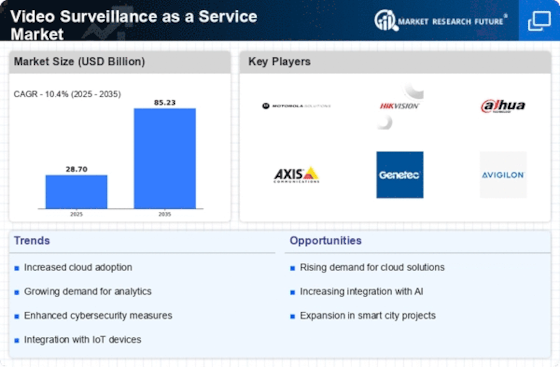
As per Market Research Future analysis, the Video Surveillance as a Service Market was estimated at 28.7 USD Billion in 2024. The Video Surveillance as a Service industry is projected to grow from 31.69 USD Billion in 2025 to 85.23 USD Billion by 2035, exhibiting a compound annual growth rate (CAGR) of 10.4% during the forecast period 2025 - 2035

Key Market Trends & Highlights

The Video Surveillance as a Service Market is experiencing robust growth driven by technological advancements and increasing security demands.

  • The market is witnessing increased adoption of cloud solutions, particularly in North America, which remains the largest market. Integration of AI and analytics is becoming prevalent, enhancing the capabilities of surveillance systems across various sectors. Data privacy and compliance are gaining prominence, especially in the retail segment, which is currently the largest in the market. Rising security concerns and the cost-effectiveness of subscription models are key drivers propelling growth in the transportation segment, the fastest-growing area.

Market Size & Forecast

2024 Market Size 28.7 (USD Billion)
2035 Market Size 85.23 (USD Billion)
CAGR (2025 - 2035) 10.4%
Largest Regional Market Share in 2024 North America

Major Players

Motorola Solutions (US), Hikvision (CN), Dahua Technology (CN), Axis Communications (SE), Genetec (CA), Avigilon (CA), Honeywell (US), Bosch Security Systems (DE), Tyco Security Products (US)

Market Trends

The Video Surveillance as a Service Market is currently experiencing a transformative phase, driven by advancements in cloud technology and increasing demand for security solutions across various sectors. Organizations are increasingly adopting this model due to its flexibility, scalability, and cost-effectiveness. The rapid proliferation of VSaaS allows enterprises to move away from heavy capital expenditures on local servers toward a more agile, subscription-based security framework. The shift from traditional on-premises systems to cloud-based services appears to be a significant factor influencing market dynamics. As businesses seek to enhance their security infrastructure, the integration of artificial intelligence and machine learning into surveillance systems is becoming more prevalent, potentially improving threat detection and response times. The rapid expansion of the broader video as a service market has paved the way for specialized security applications, allowing enterprises to leverage high-bandwidth video streaming for real-time monitoring.

As organizations prioritize digital transformation, the adoption of "video surveillance as a service" is becoming a cornerstone for modern security strategies, offering unparalleled scalability compared to legacy systems. Moreover, the growing emphasis on data privacy and compliance with regulations is shaping the landscape of the Video Surveillance as a Service Market. Companies are now more aware of the need to protect sensitive information while ensuring that surveillance practices align with legal standards. This awareness may lead to the development of more sophisticated solutions that not only provide security but also address privacy concerns. As the market evolves, it seems likely that innovations will continue to emerge, further enhancing the capabilities and appeal of video surveillance services in various industries.

Increased Adoption of Cloud Solutions

Organizations are increasingly transitioning to cloud-based video surveillance systems, which offer enhanced flexibility and scalability. This trend indicates a shift from traditional hardware-based solutions to more adaptable and cost-effective services.

Integration of AI and Analytics

The incorporation of artificial intelligence and advanced analytics into video surveillance systems is becoming more common. This integration suggests a potential for improved threat detection and operational efficiency, allowing businesses to respond more effectively to security incidents.

Focus on Data Privacy and Compliance

As regulations surrounding data privacy become more stringent, the Video Surveillance as a Service Market is witnessing a heightened focus on compliance. This trend indicates that companies are prioritizing solutions that not only enhance security but also adhere to legal standards.

Video Surveillance as a Service Market Market Drivers

Rising Security Concerns

The increasing prevalence of security threats, including theft, vandalism, and terrorism, drives the demand for enhanced surveillance solutions. Organizations across various sectors are increasingly recognizing the necessity of robust security measures. The Video Surveillance as a Service Market is experiencing a surge in adoption as businesses seek to mitigate risks associated with these threats. According to recent estimates, the market is projected to grow at a compound annual growth rate of approximately 20% over the next few years. This growth is indicative of a broader trend where companies prioritize safety and security, leading to a heightened reliance on video surveillance solutions that are both effective and scalable.

Integration with Smart City Initiatives

The ongoing development of smart city initiatives is creating new opportunities for the Video Surveillance as a Service Market. As urban areas increasingly adopt smart technologies, the integration of video surveillance systems into these frameworks is becoming essential. These systems can enhance public safety, traffic management, and emergency response capabilities. The collaboration between municipalities and service providers is likely to foster innovative solutions that leverage video surveillance data for urban planning and safety enhancements. This trend not only supports the growth of the market but also aligns with broader societal goals of improving urban living conditions and safety.

Cost-Effectiveness of Subscription Models

The shift from traditional capital expenditure models to subscription-based services is reshaping the Video Surveillance as a Service Market. Organizations are increasingly attracted to the cost-effectiveness of these models, which eliminate the need for significant upfront investments in hardware and software. Instead, businesses can access advanced surveillance technologies through manageable monthly fees. This financial flexibility allows companies to allocate resources more efficiently, potentially leading to increased operational efficiency. As a result, the market is witnessing a growing number of small and medium-sized enterprises adopting video surveillance solutions, further expanding the customer base and driving market growth.

Regulatory Compliance and Data Protection

The growing emphasis on regulatory compliance and data protection is a significant driver for the Video Surveillance as a Service Market. Organizations are increasingly required to adhere to stringent regulations regarding data privacy and security. This has led to a heightened demand for surveillance solutions that not only provide security but also ensure compliance with legal standards. Companies are seeking video surveillance services that incorporate features such as data encryption and secure access controls. As regulatory frameworks continue to evolve, the market is expected to expand, with service providers enhancing their offerings to meet compliance requirements and address customer concerns regarding data protection.

Technological Advancements in Surveillance Systems

Rapid advancements in technology are significantly influencing the Video Surveillance as a Service Market. Innovations such as high-definition cameras, cloud storage, and advanced analytics are enhancing the capabilities of surveillance systems. These technologies not only improve image quality but also enable real-time monitoring and data analysis. The integration of artificial intelligence and machine learning into surveillance systems is also becoming more prevalent, allowing for smarter threat detection and response. As these technologies continue to evolve, they are likely to attract more businesses to adopt video surveillance solutions, thereby propelling market growth and increasing competition among service providers.

Market Segment Insights

By Application: Retail (Largest) vs. Transportation (Fastest-Growing)

In the <a title="video surveillance" href="https://www.marketresearchfuture.com/reports/video-surveillance-market-957" target="_blank" rel="noopener">Video Surveillance</a> as a Service Market, the application distribution is notably driven by the retail sector, which holds the largest market share. Retailers increasingly adopt sophisticated surveillance systems to enhance security and monitor customer behavior, effectively utilizing data analytics provided by these systems. Following closely, the transportation segment shows rapid growth as transit authorities invest in advanced surveillance to ensure safety and improve operational efficiency in public transportation networks.

Retail (Dominant) vs. Transportation (Emerging)

The retail segment is the dominant application in the Video Surveillance as a Service Market due to its considerable demand for security and customer management solutions. Retailers leverage video surveillance to not only secure their premises but also to analyze shopper behavior and optimize inventory management. On the other hand, the transportation segment, considered emerging within this context, is experiencing rapid adoption of video surveillance technologies. Authorities are implementing these systems to enhance safety protocols and streamline operations across various transport modes, including rail, bus, and airports, reflecting the growing awareness of security imperatives in public spaces.

By Deployment Model: Cloud-Based (Largest) vs. On-Premises (Fastest-Growing)

In the Video Surveillance as a Service Market, the distribution of deployment models reveals a notable preference for cloud-based solutions. Cloud-based deployment is favored due to its scalability, flexibility, and reduced maintenance costs, thus capturing a significant share of the market. On-premises models, while still relevant, are gradually losing ground to cloud solutions as organizations seek more adaptive security technologies. Hybrid models combine both deployment types, appealing to enterprises that require a tailored approach, bridging security needs with cost management. Growth trends indicate a robust shift towards cloud-based solutions, propelled by advancements in internet speeds and increased demand for remote access to surveillance systems. The ongoing digital transformation across sectors further accelerates the adoption of cloud deployments, with businesses seeking to minimize upfront investments. Moreover, the rapid growth of data analytics and AI integration in video surveillance strengthens the value proposition of cloud services, while on-premises options remain attractive for organizations with strict compliance needs and data locality concerns.

Cloud-Based (Dominant) vs. Hybrid (Emerging)

Cloud-based deployment in the Video Surveillance as a Service Market stands out as the dominant segment, favored for its extensive capabilities in delivering accessible and flexible surveillance solutions. Organizations appreciate the ease of scaling services, the reduction in hardware reliance, and the high level of integration with other cloud services. In contrast, hybrid deployment is emerging as a compelling alternative for businesses looking to customize their surveillance strategy. This model allows firms to maintain some on-premises infrastructure while leveraging cloud benefits, particularly for real-time analytics and storage efficiency. As businesses navigate security demands with diverse needs, hybrids offer a balance, catering well to both immediate operational requirements and future scalability.

By Component: Hardware (Largest) vs. Services (Fastest-Growing)

In the Video Surveillance as a Service Market (VSaaS) market, the component segment is primarily composed of three values: Hardware, Software, and Services. Currently, Hardware dominates the market share due to widespread adoption of advanced camera systems and integrated security devices. This dominance is fueled by the increasing need for robust security solutions across various sectors, including retail, banking, and government facilities. Meanwhile, Software holds a significant share as the backbone of the VSaaS model, enabling surveillance data processing and analytics. On the growth front, Services are identified as the fastest-growing segment. The rising demand for managed services and remote monitoring solutions is propelling the growth of this segment. As businesses increasingly prioritize operational efficiency and cost savings, the trend towards cloud-based service offerings has been accelerating. This shift not only enhances accessibility but also integrates advanced features such as AI-powered analytics, contributing to overall market expansion.

Hardware (Dominant) vs. Services (Emerging)

In the VSaaS market, Hardware is the dominant component, characterized by its foundational role in providing security infrastructure. This segment includes a variety of physical devices, such as cameras, sensors, and recording equipment, which are essential for effective video surveillance systems. The integration of high-definition imaging and smart technology has positioned Hardware as a critical enabler for modern surveillance solutions. In contrast, the Services segment is emerging rapidly, influenced by the growing trend of outsourcing security management to third-party service providers. This shift not only offers users flexibility and scalability but also allows for continual updates and improvements in surveillance capabilities, underscoring the importance of adaptive solutions in the evolving security landscape.

By End Use: Commercial (Largest) vs. Residential (Fastest-Growing)

The Video Surveillance as a Service Market (VSaaS) market is witnessing a clear distribution of market share among its end-use segments. The commercial sector continues to dominate this landscape, driven by the increasing demand for security solutions in businesses and public spaces. This segment is characterized by significant investments in surveillance technologies, which serve to protect assets and personnel, ultimately leading to enhanced safety and operational efficiency. In contrast, the residential segment is rapidly emerging as the fastest-growing part of the market. This growth can be attributed to the rising awareness of home security and the demand for <a title="smart home" href="https://www.marketresearchfuture.com/reports/smart-home-market-974" target="_blank" rel="noopener">smart home</a> technologies. As homeowners seek to integrate surveillance solutions into their everyday lives, advancements in user-friendly interfaces and mobile accessibility are further propelling the adoption of VSaaS in this sector.

End Use: Commercial (Dominant) vs. Residential (Emerging)

In the Video Surveillance as a Service Market, the commercial segment is notably the dominant player, driven by businesses that prioritize security and operational efficiency. Commercial entities leverage advanced surveillance systems to monitor premises and mitigate risks associated with theft or vandalism. This sector is often characterized by significant investments in high-quality camera systems, cloud storage solutions, and professional monitoring services, underscoring its extensive infrastructure commitment. Conversely, the residential segment is emerging rapidly as home security becomes increasingly important to consumers. Homeowners are now prioritizing smart security solutions, leading to a rise in demand for user-friendly VSaaS offerings that offer remote access and monitoring capabilities. This transition reflects broader trends toward smart home integration and heightened consumer awareness regarding personal safety.

Get more detailed insights about Video Surveillance as a Service Market Research Report-Forecast 2035

Regional Insights

The Video Surveillance as a Service Market has shown substantial growth, particularly across different regions. In 2023, North America leads with a market valuation of 10.4 USD Billion, expected to rise to 25.2 USD Billion by 2032, indicating its majority holding in the industry due to advanced technological integration and high-security demands. Europe follows with a valuation of 8.0 USD Billion in 2023, projected to grow to 19.2 USD Billion, highlighting the significant investment in smart city projects.

The APAC region, with a 2023 value of 5.2 USD Billion, is anticipated to rise to 13.2 USD Billion, driven by increasing urbanization and security concerns.South America and MEA have comparatively lower valuations, at 1.6 USD Billion and 0.8 USD Billion, respectively, in 2023, but both regions present opportunities for growth, particularly in enhancing security solutions across emerging markets. This diverse Video Surveillance as a Service Market segmentation illustrates varied demand and investment patterns influenced by regional security needs, technological advancements, and government initiatives aimed at improving safety and surveillance capabilities.

Key Players and Competitive Insights

The Video Surveillance as a Service Market has experienced notable growth, driven by an increasing demand for enhanced security solutions across various sectors. As organizations recognize the need to protect their assets and ensure safety, there has been a marked shift towards adopting cloud-based video surveillance services. Competitive insights into this market reveal a landscape populated with a mix of established vendors and emerging players, all vying for market share. The competitive landscape is increasingly defined by the top VMS companies that provide the software infrastructure necessary to manage complex, cloud-integrated camera networks. Companies are leveraging technological advancements, data analytics, and integration capabilities to offer more sophisticated and scalable solutions. Leading providers are increasingly offering comprehensive service surveillance packages that combine 24/7 remote monitoring with automated cloud backups to ensure uninterrupted security for global enterprises. The focus on user-friendly interfaces, mobile access, and enhanced data security has become increasingly crucial in attracting clients. As a result, continuous innovation and strategic partnerships are pivotal for businesses seeking to establish a robust presence in this dynamic market.
 
Understanding the competitive dynamics is essential for stakeholders as they navigate through varying customer needs and stay ahead of industry trends.Dahua Technology has carved a significant niche for itself within the Video Surveillance as a Service Market through its strong emphasis on innovation and product development. The company is well-regarded for its comprehensive portfolio of video surveillance solutions, which includes advanced cameras and intelligent video analytics. By integrating technologies such as artificial intelligence and cloud computing, Dahua Technology effectively addresses diverse security challenges faced by enterprises, creating tailored solutions for various applications. The organization boasts a solid distribution network that enhances its market presence worldwide, enabling it to serve a diverse clientele efficiently.
 
Its commitment to research and development ensures that the company remains at the forefront of cutting-edge security technologies, thereby solidifying its competitive edge in the video surveillance sector.Nokia, primarily known for its telecommunications heritage, is increasingly making strategic inroads into the Video Surveillance as a Service Market. Leveraging its expertise in networking and mobility, Nokia is focusing on providing comprehensive and scalable surveillance solutions that integrate seamlessly with existing infrastructure. The company’s robust technological foundation allows for the creation of reliable and sustainable security solutions aimed at enhancing situational awareness for clients across various industries. Nokia's emphasis on cybersecurity has also become a key strength, ensuring that the data collected through its surveillance systems remains secure from emerging threats. By fostering partnerships and collaborations, Nokia is enhancing its value proposition in the market, consistently working towards delivering solutions that cater to the growing demand for integrated video surveillance systems while maintaining a focus on innovation and operational efficiency.

Key Companies in the Video Surveillance as a Service Market include

Industry Developments

Recent developments in the Video Surveillance as a Service Market highlight significant advancements and partnerships among key players. Dahua Technology and Hikvision have been focusing on integrating AI capabilities into their video surveillance systems to enhance security measures. Nokia has announced partnerships aiming to leverage 5G connectivity to improve real-time monitoring. Amazon Web Services and Google Cloud are expanding their cloud-based video surveillance offerings, while Microsoft has reported increased adoption of its Azure platform for video analytics. Strategic partnerships between hardware manufacturers and the top VMS companies are also streamlining how users access and store video data in hybrid environments.

Recent mergers include ADT's acquisition of a smaller security firm to expand its service offerings, aimed at bolstering its market position against competitors like Motorola Solutions and Honeywell, which are also actively enhancing their product lines. Furthermore, the expansion of ADT security services Mexico highlights the brand's commitment to capturing the growing Latin American demand for integrated, cloud-based monitoring solutions. Additionally, Genetec and Axis Communications have been seen collaborating on new technology to improve system interoperability. Growth in market valuation for these companies reflects the rising demand for cloud-based solutions, which is being driven by increased security concerns and technological advancements in video analytics. The market is significantly impacted by these shifts, showcasing a dynamic environment where innovation and competitive positioning play crucial roles.

Future Outlook

Video Surveillance as a Service Market Future Outlook

The Video Surveillance as a Service Market is projected to grow at a 10.4% CAGR from 2025 to 2035, driven by technological advancements, increasing security concerns, and the demand for scalable solutions.

New opportunities lie in:

  • <p>Integration of AI-driven analytics for enhanced surveillance insights. Development of subscription-based models for flexible pricing strategies. Expansion into emerging markets with tailored solutions for local needs.</p>

By 2035, the Video Surveillance as a Service Market is expected to solidify its position as a leader in security solutions.

Market Segmentation

Video Surveillance as a Service Market End Use Outlook

  • Residential
  • Commercial
  • Industrial

Video Surveillance as a Service Market Component Outlook

  • Hardware
  • Software
  • Services

Video Surveillance as a Service Market Application Outlook

  • Retail
  • Transportation
  • Banking
  • Healthcare
  • Government

Video Surveillance as a Service Market Deployment Model Outlook

  • Cloud-Based
  • On-Premises
  • Hybrid

Report Scope

MARKET SIZE 2024 28.7(USD Billion)
MARKET SIZE 2025 31.69(USD Billion)
MARKET SIZE 2035 85.23(USD Billion)
COMPOUND ANNUAL GROWTH RATE (CAGR) 10.4% (2025 - 2035)
REPORT COVERAGE Revenue Forecast, Competitive Landscape, Growth Factors, and Trends
BASE YEAR 2024
Market Forecast Period 2025 - 2035
Historical Data 2019 - 2024
Market Forecast Units USD Billion
Key Companies Profiled Motorola Solutions (US), Hikvision (CN), Dahua Technology (CN), Axis Communications (SE), Genetec (CA), Avigilon (CA), Honeywell (US), Bosch Security Systems (DE), Tyco Security Products (US)
Segments Covered Application, Deployment Model, Component, End Use, Regional
Key Market Opportunities Integration of artificial intelligence enhances analytics and operational efficiency in the Video Surveillance as a Service Market.
Key Market Dynamics Rising demand for cloud-based security solutions drives innovation and competition in the Video Surveillance as a Service market.
Countries Covered North America, Europe, APAC, South America, MEA

FAQs

What is the current valuation of the Video Surveillance as a Service Market?

The Video Surveillance as a Service Market valuation reached 28.7 USD Billion in 2024.

What is the projected market size for the Video Surveillance as a Service Market by 2035?

The Video Surveillance as a Service Market is expected to grow to 85.23 USD Billion by 2035.

What is the expected CAGR for the Video Surveillance as a Service Market from 2025 to 2035?

The Video Surveillance as a Service Market is anticipated to experience a CAGR of 10.4% during the forecast period.

Which application segments are leading in the Video Surveillance as a Service Market?

<p>The leading application segments include Healthcare, Banking, and Transportation, with valuations of 20.61, 19.29, and 12.93 USD Billion respectively by 2035.</p>

How does the deployment model impact the Video Surveillance as a Service Market?

<p>Cloud-Based deployment is projected to dominate, with a valuation of 34.5 USD Billion by 2035, compared to On-Premises and Hybrid models.</p>

What are the key components driving the Video Surveillance as a Service Market?

<p>The market is driven by Hardware, Software, and Services, with Software expected to reach 31.5 USD Billion by 2035.</p>

Which end-use segments are expected to grow in the Video Surveillance as a Service Market?

<p>Commercial and Industrial segments are projected to grow significantly, with valuations of 38.25 and 29.73 USD Billion respectively by 2035.</p>

Who are the major players in the Video Surveillance as a Service Market?

Key players in the Video Surveillance as a Service Market include Motorola Solutions, Hikvision, Dahua Technology, and Axis Communications, among others.

What trends are influencing the Video Surveillance as a Service Market?

<p>Trends include increased adoption of cloud-based solutions and advancements in AI technology for enhanced surveillance.</p>

How does the Video Surveillance as a Service Market compare across different regions?

<p>Regional analysis indicates varying growth rates, with North America and Asia-Pacific likely leading in market share by 2035.</p>

  1. SECTION I: EXECUTIVE SUMMARY AND KEY HIGHLIGHTS |
    1. EXECUTIVE SUMMARY | |
      1. Market Overview | |
      2. Key Findings | |
      3. Market Segmentation | |
      4. Competitive Landscape | |
      5. Challenges and Opportunities | |
      6. Future Outlook 2
  2. SECTION II: SCOPING, METHODOLOGY AND MARKET STRUCTURE |
    1. MARKET INTRODUCTION | |
      1. Definition | |
      2. Scope of the study | | |
    2. RESEARCH METHODOLOGY | |
      1. Overview | |
      2. Data Mining | |
      3. Secondary Research | |
      4. Primary Research | | |
      5. Forecasting Model | |
      6. Market Size Estimation | | |
      7. Data Triangulation | |
      8. Validation 3
  3. SECTION III: QUALITATIVE ANALYSIS |
    1. MARKET DYNAMICS | |
      1. Overview | |
      2. Drivers | |
      3. Restraints | |
      4. Opportunities |
    2. MARKET FACTOR ANALYSIS | |
      1. Value chain Analysis | |
      2. Porter's Five Forces Analysis | | |
      3. COVID-19 Impact Analysis | | |
  4. SECTION IV: QUANTITATIVE ANALYSIS |
    1. Information and Communications Technology, BY Application (USD Billion) | |
      1. Retail | |
      2. Transportation | |
      3. Banking | |
      4. Healthcare | |
      5. Government |
    2. Information and Communications Technology, BY Deployment Model (USD Billion) | |
      1. Cloud-Based | |
      2. On-Premises | |
      3. Hybrid |
    3. Information and Communications Technology, BY Component (USD Billion) | |
      1. Hardware | |
      2. Software | |
      3. Services |
    4. Information and Communications Technology, BY End Use (USD Billion) | |
      1. Residential | |
      2. Commercial | |
      3. Industrial |
    5. Information and Communications Technology, BY Region (USD Billion) | |
      1. North America | | |
      2. Europe | | |
      3. APAC | | |
      4. South America | | |
      5. MEA | | |
  5. SECTION V: COMPETITIVE ANALYSIS |
    1. Competitive Landscape | |
      1. Overview | |
      2. Competitive Analysis | |
      3. Market share Analysis | |
      4. Major Growth Strategy in the Information and Communications Technology | |
      5. Competitive Benchmarking | |
      6. Leading Players in Terms of Number of Developments in the Information and Communications Technology | |
      7. Key developments and growth strategies | | |
      8. Major Players Financial Matrix | | |
    2. Company Profiles | |
      1. Motorola Solutions (US) | | |
      2. Hikvision (CN) | | |
      3. Dahua Technology (CN) | | |
      4. Axis Communications (SE) | | |
      5. Genetec (CA) | | |
      6. Avigilon (CA) | | |
      7. Honeywell (US) | | |
      8. Bosch Security Systems (DE) | | |
      9. Tyco Security Products (US) | | |
    3. Appendix | |
      1. References | |
      2. Related Reports 6 LIST OF FIGURES |
    4. MARKET SYNOPSIS |
    5. NORTH AMERICA MARKET ANALYSIS |
    6. US MARKET ANALYSIS BY APPLICATION |
    7. US MARKET ANALYSIS BY DEPLOYMENT MODEL |
    8. US MARKET ANALYSIS BY COMPONENT |
    9. US MARKET ANALYSIS BY END USE |
    10. CANADA MARKET ANALYSIS BY APPLICATION |
    11. CANADA MARKET ANALYSIS BY DEPLOYMENT MODEL |
    12. CANADA MARKET ANALYSIS BY COMPONENT |
    13. CANADA MARKET ANALYSIS BY END USE |
    14. EUROPE MARKET ANALYSIS |
    15. GERMANY MARKET ANALYSIS BY APPLICATION |
    16. GERMANY MARKET ANALYSIS BY DEPLOYMENT MODEL |
    17. GERMANY MARKET ANALYSIS BY COMPONENT |
    18. GERMANY MARKET ANALYSIS BY END USE |
    19. UK MARKET ANALYSIS BY APPLICATION |
    20. UK MARKET ANALYSIS BY DEPLOYMENT MODEL |
    21. UK MARKET ANALYSIS BY COMPONENT |
    22. UK MARKET ANALYSIS BY END USE |
    23. FRANCE MARKET ANALYSIS BY APPLICATION |
    24. FRANCE MARKET ANALYSIS BY DEPLOYMENT MODEL |
    25. FRANCE MARKET ANALYSIS BY COMPONENT |
    26. FRANCE MARKET ANALYSIS BY END USE |
    27. RUSSIA MARKET ANALYSIS BY APPLICATION |
    28. RUSSIA MARKET ANALYSIS BY DEPLOYMENT MODEL |
    29. RUSSIA MARKET ANALYSIS BY COMPONENT |
    30. RUSSIA MARKET ANALYSIS BY END USE |
    31. ITALY MARKET ANALYSIS BY APPLICATION |
    32. ITALY MARKET ANALYSIS BY DEPLOYMENT MODEL |
    33. ITALY MARKET ANALYSIS BY COMPONENT |
    34. ITALY MARKET ANALYSIS BY END USE |
    35. SPAIN MARKET ANALYSIS BY APPLICATION |
    36. SPAIN MARKET ANALYSIS BY DEPLOYMENT MODEL |
    37. SPAIN MARKET ANALYSIS BY COMPONENT |
    38. SPAIN MARKET ANALYSIS BY END USE |
    39. REST OF EUROPE MARKET ANALYSIS BY APPLICATION |
    40. REST OF EUROPE MARKET ANALYSIS BY DEPLOYMENT MODEL |
    41. REST OF EUROPE MARKET ANALYSIS BY COMPONENT |
    42. REST OF EUROPE MARKET ANALYSIS BY END USE |
    43. APAC MARKET ANALYSIS |
    44. CHINA MARKET ANALYSIS BY APPLICATION |
    45. CHINA MARKET ANALYSIS BY DEPLOYMENT MODEL |
    46. CHINA MARKET ANALYSIS BY COMPONENT |
    47. CHINA MARKET ANALYSIS BY END USE |
    48. INDIA MARKET ANALYSIS BY APPLICATION |
    49. INDIA MARKET ANALYSIS BY DEPLOYMENT MODEL |
    50. INDIA MARKET ANALYSIS BY COMPONENT |
    51. INDIA MARKET ANALYSIS BY END USE |
    52. JAPAN MARKET ANALYSIS BY APPLICATION |
    53. JAPAN MARKET ANALYSIS BY DEPLOYMENT MODEL |
    54. JAPAN MARKET ANALYSIS BY COMPONENT |
    55. JAPAN MARKET ANALYSIS BY END USE |
    56. SOUTH KOREA MARKET ANALYSIS BY APPLICATION |
    57. SOUTH KOREA MARKET ANALYSIS BY DEPLOYMENT MODEL |
    58. SOUTH KOREA MARKET ANALYSIS BY COMPONENT |
    59. SOUTH KOREA MARKET ANALYSIS BY END USE |
    60. MALAYSIA MARKET ANALYSIS BY APPLICATION |
    61. MALAYSIA MARKET ANALYSIS BY DEPLOYMENT MODEL |
    62. MALAYSIA MARKET ANALYSIS BY COMPONENT |
    63. MALAYSIA MARKET ANALYSIS BY END USE |
    64. THAILAND MARKET ANALYSIS BY APPLICATION |
    65. THAILAND MARKET ANALYSIS BY DEPLOYMENT MODEL |
    66. THAILAND MARKET ANALYSIS BY COMPONENT |
    67. THAILAND MARKET ANALYSIS BY END USE |
    68. INDONESIA MARKET ANALYSIS BY APPLICATION |
    69. INDONESIA MARKET ANALYSIS BY DEPLOYMENT MODEL |
    70. INDONESIA MARKET ANALYSIS BY COMPONENT |
    71. INDONESIA MARKET ANALYSIS BY END USE |
    72. REST OF APAC MARKET ANALYSIS BY APPLICATION |
    73. REST OF APAC MARKET ANALYSIS BY DEPLOYMENT MODEL |
    74. REST OF APAC MARKET ANALYSIS BY COMPONENT |
    75. REST OF APAC MARKET ANALYSIS BY END USE |
    76. SOUTH AMERICA MARKET ANALYSIS |
    77. BRAZIL MARKET ANALYSIS BY APPLICATION |
    78. BRAZIL MARKET ANALYSIS BY DEPLOYMENT MODEL |
    79. BRAZIL MARKET ANALYSIS BY COMPONENT |
    80. BRAZIL MARKET ANALYSIS BY END USE |
    81. MEXICO MARKET ANALYSIS BY APPLICATION |
    82. MEXICO MARKET ANALYSIS BY DEPLOYMENT MODEL |
    83. MEXICO MARKET ANALYSIS BY COMPONENT |
    84. MEXICO MARKET ANALYSIS BY END USE |
    85. ARGENTINA MARKET ANALYSIS BY APPLICATION |
    86. ARGENTINA MARKET ANALYSIS BY DEPLOYMENT MODEL |
    87. ARGENTINA MARKET ANALYSIS BY COMPONENT |
    88. ARGENTINA MARKET ANALYSIS BY END USE |
    89. REST OF SOUTH AMERICA MARKET ANALYSIS BY APPLICATION |
    90. REST OF SOUTH AMERICA MARKET ANALYSIS BY DEPLOYMENT MODEL |
    91. REST OF SOUTH AMERICA MARKET ANALYSIS BY COMPONENT |
    92. REST OF SOUTH AMERICA MARKET ANALYSIS BY END USE |
    93. MEA MARKET ANALYSIS |
    94. GCC COUNTRIES MARKET ANALYSIS BY APPLICATION |
    95. GCC COUNTRIES MARKET ANALYSIS BY DEPLOYMENT MODEL |
    96. GCC COUNTRIES MARKET ANALYSIS BY COMPONENT |
    97. GCC COUNTRIES MARKET ANALYSIS BY END USE |
    98. SOUTH AFRICA MARKET ANALYSIS BY APPLICATION |
    99. SOUTH AFRICA MARKET ANALYSIS BY DEPLOYMENT MODEL |
    100. SOUTH AFRICA MARKET ANALYSIS BY COMPONENT |
    101. SOUTH AFRICA MARKET ANALYSIS BY END USE |
    102. REST OF MEA MARKET ANALYSIS BY APPLICATION |
    103. REST OF MEA MARKET ANALYSIS BY DEPLOYMENT MODEL |
    104. REST OF MEA MARKET ANALYSIS BY COMPONENT |
    105. REST OF MEA MARKET ANALYSIS BY END USE |
    106. KEY BUYING CRITERIA OF INFORMATION AND COMMUNICATIONS TECHNOLOGY |
    107. RESEARCH PROCESS OF MRFR |
    108. DRO ANALYSIS OF INFORMATION AND COMMUNICATIONS TECHNOLOGY |
    109. DRIVERS IMPACT ANALYSIS: INFORMATION AND COMMUNICATIONS TECHNOLOGY |
    110. RESTRAINTS IMPACT ANALYSIS: INFORMATION AND COMMUNICATIONS TECHNOLOGY |
    111. SUPPLY / VALUE CHAIN: INFORMATION AND COMMUNICATIONS TECHNOLOGY |
    112. INFORMATION AND COMMUNICATIONS TECHNOLOGY, BY APPLICATION, 2024 (% SHARE) |
    113. INFORMATION AND COMMUNICATIONS TECHNOLOGY, BY APPLICATION, 2024 TO 2035 (USD Billion) |
    114. INFORMATION AND COMMUNICATIONS TECHNOLOGY, BY DEPLOYMENT MODEL, 2024 (% SHARE) |
    115. INFORMATION AND COMMUNICATIONS TECHNOLOGY, BY DEPLOYMENT MODEL, 2024 TO 2035 (USD Billion) |
    116. INFORMATION AND COMMUNICATIONS TECHNOLOGY, BY COMPONENT, 2024 (% SHARE) |
    117. INFORMATION AND COMMUNICATIONS TECHNOLOGY, BY COMPONENT, 2024 TO 2035 (USD Billion) |
    118. INFORMATION AND COMMUNICATIONS TECHNOLOGY, BY END USE, 2024 (% SHARE) |
    119. INFORMATION AND COMMUNICATIONS TECHNOLOGY, BY END USE, 2024 TO 2035 (USD Billion) |
    120. BENCHMARKING OF MAJOR COMPETITORS 7 LIST OF TABLES |
    121. LIST OF ASSUMPTIONS | |
      1. |
    122. North America MARKET SIZE ESTIMATES; FORECAST | |
      1. BY APPLICATION, 2025-2035 (USD Billion) | |
      2. BY DEPLOYMENT MODEL, 2025-2035 (USD Billion) | |
      3. BY COMPONENT, 2025-2035 (USD Billion) | |
      4. BY END USE, 2025-2035 (USD Billion) |
    123. US MARKET SIZE ESTIMATES; FORECAST | |
      1. BY APPLICATION, 2025-2035 (USD Billion) | |
      2. BY DEPLOYMENT MODEL, 2025-2035 (USD Billion) | |
      3. BY COMPONENT, 2025-2035 (USD Billion) | |
      4. BY END USE, 2025-2035 (USD Billion) |
    124. Canada MARKET SIZE ESTIMATES; FORECAST | |
      1. BY APPLICATION, 2025-2035 (USD Billion) | |
      2. BY DEPLOYMENT MODEL, 2025-2035 (USD Billion) | |
      3. BY COMPONENT, 2025-2035 (USD Billion) | |
      4. BY END USE, 2025-2035 (USD Billion) |
    125. Europe MARKET SIZE ESTIMATES; FORECAST | |
      1. BY APPLICATION, 2025-2035 (USD Billion) | |
      2. BY DEPLOYMENT MODEL, 2025-2035 (USD Billion) | |
      3. BY COMPONENT, 2025-2035 (USD Billion) | |
      4. BY END USE, 2025-2035 (USD Billion) |
    126. Germany MARKET SIZE ESTIMATES; FORECAST | |
      1. BY APPLICATION, 2025-2035 (USD Billion) | |
      2. BY DEPLOYMENT MODEL, 2025-2035 (USD Billion) | |
      3. BY COMPONENT, 2025-2035 (USD Billion) | |
      4. BY END USE, 2025-2035 (USD Billion) |
    127. UK MARKET SIZE ESTIMATES; FORECAST | |
      1. BY APPLICATION, 2025-2035 (USD Billion) | |
      2. BY DEPLOYMENT MODEL, 2025-2035 (USD Billion) | |
      3. BY COMPONENT, 2025-2035 (USD Billion) | |
      4. BY END USE, 2025-2035 (USD Billion) |
    128. France MARKET SIZE ESTIMATES; FORECAST | |
      1. BY APPLICATION, 2025-2035 (USD Billion) | |
      2. BY DEPLOYMENT MODEL, 2025-2035 (USD Billion) | |
      3. BY COMPONENT, 2025-2035 (USD Billion) | |
      4. BY END USE, 2025-2035 (USD Billion) |
    129. Russia MARKET SIZE ESTIMATES; FORECAST | |
      1. BY APPLICATION, 2025-2035 (USD Billion) | |
      2. BY DEPLOYMENT MODEL, 2025-2035 (USD Billion) | |
      3. BY COMPONENT, 2025-2035 (USD Billion) | |
      4. BY END USE, 2025-2035 (USD Billion) |
    130. Italy MARKET SIZE ESTIMATES; FORECAST | |
      1. BY APPLICATION, 2025-2035 (USD Billion) | |
      2. BY DEPLOYMENT MODEL, 2025-2035 (USD Billion) | |
      3. BY COMPONENT, 2025-2035 (USD Billion) | |
      4. BY END USE, 2025-2035 (USD Billion) |
    131. Spain MARKET SIZE ESTIMATES; FORECAST | |
      1. BY APPLICATION, 2025-2035 (USD Billion) | |
      2. BY DEPLOYMENT MODEL, 2025-2035 (USD Billion) | |
      3. BY COMPONENT, 2025-2035 (USD Billion) | |
      4. BY END USE, 2025-2035 (USD Billion) |
    132. Rest of Europe MARKET SIZE ESTIMATES; FORECAST | |
      1. BY APPLICATION, 2025-2035 (USD Billion) | |
      2. BY DEPLOYMENT MODEL, 2025-2035 (USD Billion) | |
      3. BY COMPONENT, 2025-2035 (USD Billion) | |
      4. BY END USE, 2025-2035 (USD Billion) |
    133. APAC MARKET SIZE ESTIMATES; FORECAST | |
      1. BY APPLICATION, 2025-2035 (USD Billion) | |
      2. BY DEPLOYMENT MODEL, 2025-2035 (USD Billion) | |
      3. BY COMPONENT, 2025-2035 (USD Billion) | |
      4. BY END USE, 2025-2035 (USD Billion) |
    134. China MARKET SIZE ESTIMATES; FORECAST | |
      1. BY APPLICATION, 2025-2035 (USD Billion) | |
      2. BY DEPLOYMENT MODEL, 2025-2035 (USD Billion) | |
      3. BY COMPONENT, 2025-2035 (USD Billion) | |
      4. BY END USE, 2025-2035 (USD Billion) |
    135. India MARKET SIZE ESTIMATES; FORECAST | |
      1. BY APPLICATION, 2025-2035 (USD Billion) | |
      2. BY DEPLOYMENT MODEL, 2025-2035 (USD Billion) | |
      3. BY COMPONENT, 2025-2035 (USD Billion) | |
      4. BY END USE, 2025-2035 (USD Billion) |
    136. Japan MARKET SIZE ESTIMATES; FORECAST | |
      1. BY APPLICATION, 2025-2035 (USD Billion) | |
      2. BY DEPLOYMENT MODEL, 2025-2035 (USD Billion) | |
      3. BY COMPONENT, 2025-2035 (USD Billion) | |
      4. BY END USE, 2025-2035 (USD Billion) |
    137. South Korea MARKET SIZE ESTIMATES; FORECAST | |
      1. BY APPLICATION, 2025-2035 (USD Billion) | |
      2. BY DEPLOYMENT MODEL, 2025-2035 (USD Billion) | |
      3. BY COMPONENT, 2025-2035 (USD Billion) | |
      4. BY END USE, 2025-2035 (USD Billion) |
    138. Malaysia MARKET SIZE ESTIMATES; FORECAST | |
      1. BY APPLICATION, 2025-2035 (USD Billion) | |
      2. BY DEPLOYMENT MODEL, 2025-2035 (USD Billion) | |
      3. BY COMPONENT, 2025-2035 (USD Billion) | |
      4. BY END USE, 2025-2035 (USD Billion) |
    139. Thailand MARKET SIZE ESTIMATES; FORECAST | |
      1. BY APPLICATION, 2025-2035 (USD Billion) | |
      2. BY DEPLOYMENT MODEL, 2025-2035 (USD Billion) | |
      3. BY COMPONENT, 2025-2035 (USD Billion) | |
      4. BY END USE, 2025-2035 (USD Billion) |
    140. Indonesia MARKET SIZE ESTIMATES; FORECAST | |
      1. BY APPLICATION, 2025-2035 (USD Billion) | |
      2. BY DEPLOYMENT MODEL, 2025-2035 (USD Billion) | |
      3. BY COMPONENT, 2025-2035 (USD Billion) | |
      4. BY END USE, 2025-2035 (USD Billion) |
    141. Rest of APAC MARKET SIZE ESTIMATES; FORECAST | |
      1. BY APPLICATION, 2025-2035 (USD Billion) | |
      2. BY DEPLOYMENT MODEL, 2025-2035 (USD Billion) | |
      3. BY COMPONENT, 2025-2035 (USD Billion) | |
      4. BY END USE, 2025-2035 (USD Billion) |
    142. South America MARKET SIZE ESTIMATES; FORECAST | |
      1. BY APPLICATION, 2025-2035 (USD Billion) | |
      2. BY DEPLOYMENT MODEL, 2025-2035 (USD Billion) | |
      3. BY COMPONENT, 2025-2035 (USD Billion) | |
      4. BY END USE, 2025-2035 (USD Billion) |
    143. Brazil MARKET SIZE ESTIMATES; FORECAST | |
      1. BY APPLICATION, 2025-2035 (USD Billion) | |
      2. BY DEPLOYMENT MODEL, 2025-2035 (USD Billion) | |
      3. BY COMPONENT, 2025-2035 (USD Billion) | |
      4. BY END USE, 2025-2035 (USD Billion) |
    144. Mexico MARKET SIZE ESTIMATES; FORECAST | |
      1. BY APPLICATION, 2025-2035 (USD Billion) | |
      2. BY DEPLOYMENT MODEL, 2025-2035 (USD Billion) | |
      3. BY COMPONENT, 2025-2035 (USD Billion) | |
      4. BY END USE, 2025-2035 (USD Billion) |
    145. Argentina MARKET SIZE ESTIMATES; FORECAST | |
      1. BY APPLICATION, 2025-2035 (USD Billion) | |
      2. BY DEPLOYMENT MODEL, 2025-2035 (USD Billion) | |
      3. BY COMPONENT, 2025-2035 (USD Billion) | |
      4. BY END USE, 2025-2035 (USD Billion) |
    146. Rest of South America MARKET SIZE ESTIMATES; FORECAST | |
      1. BY APPLICATION, 2025-2035 (USD Billion) | |
      2. BY DEPLOYMENT MODEL, 2025-2035 (USD Billion) | |
      3. BY COMPONENT, 2025-2035 (USD Billion) | |
      4. BY END USE, 2025-2035 (USD Billion) |
    147. MEA MARKET SIZE ESTIMATES; FORECAST | |
      1. BY APPLICATION, 2025-2035 (USD Billion) | |
      2. BY DEPLOYMENT MODEL, 2025-2035 (USD Billion) | |
      3. BY COMPONENT, 2025-2035 (USD Billion) | |
      4. BY END USE, 2025-2035 (USD Billion) |
    148. GCC Countries MARKET SIZE ESTIMATES; FORECAST | |
      1. BY APPLICATION, 2025-2035 (USD Billion) | |
      2. BY DEPLOYMENT MODEL, 2025-2035 (USD Billion) | |
      3. BY COMPONENT, 2025-2035 (USD Billion) | |
      4. BY END USE, 2025-2035 (USD Billion) |
    149. South Africa MARKET SIZE ESTIMATES; FORECAST | |
      1. BY APPLICATION, 2025-2035 (USD Billion) | |
      2. BY DEPLOYMENT MODEL, 2025-2035 (USD Billion) | |
      3. BY COMPONENT, 2025-2035 (USD Billion) | |
      4. BY END USE, 2025-2035 (USD Billion) |
    150. Rest of MEA MARKET SIZE ESTIMATES; FORECAST | |
      1. BY APPLICATION, 2025-2035 (USD Billion) | |
      2. BY DEPLOYMENT MODEL, 2025-2035 (USD Billion) | |
      3. BY COMPONENT, 2025-2035 (USD Billion) | |
      4. BY END USE, 2025-2035 (USD Billion) |
    151. PRODUCT LAUNCH/PRODUCT DEVELOPMENT/APPROVAL | |
      1. |
    152. ACQUISITION/PARTNERSHIP | |

Information and Communications Technology Market Segmentation

Information and Communications Technology By Application (USD Billion, 2025-2035)

  • Retail
  • Transportation
  • Banking
  • Healthcare
  • Government

Information and Communications Technology By Deployment Model (USD Billion, 2025-2035)

  • Cloud-Based
  • On-Premises
  • Hybrid

Information and Communications Technology By Component (USD Billion, 2025-2035)

  • Hardware
  • Software
  • Services

Information and Communications Technology By End Use (USD Billion, 2025-2035)

  • Residential
  • Commercial
  • Industrial
Infographic

Free Sample Request

Kindly complete the form below to receive a free sample of this Report

Get Free Sample

Customer Strories

Compare Licence

×
Features License Type
Single User Multiuser License Enterprise User
Price $4,950 $5,950 $7,250
Maximum User Access Limit 1 User Upto 10 Users Unrestricted Access Throughout the Organization
Free Customization
Direct Access to Analyst
Deliverable Format
Platform Access
Discount on Next Purchase 10% 15% 15%
Printable Versions